A Detectable Subservience – Australia’s ill-fated nuclear submarine deal?

All of this leaves one wondering about just what due diligence was done before Morrison, and the 24-hour copycat decision-maker Albanese, committed us to the folly of paying $A368 billion to purchase a subservient position embedded within the US war machine by means of a soon-to-be fully detectable and therefore likely to be destroyed fleet of nuclear-powered submarines.
June 6, 2024 by: The AIM Network, By Michael Willis, https://theaimn.com/a-detectable-subservience/
The first operational outcome of the Pillar 2 AUKUS arrangement between the US, UK and Australia has just been announced.
The three countries will share data from their submarine-hunting PA-8 Poseidon aircraft, manufactured by the troubled Boeing Corporation.
This was announced on May 29 in an “exclusive interview” given to US online website Breaking Defense by Michael Horowitz, whose office serves as the Pentagon’s day-to-day lead on AUKUS issues.
(In a deliciously ironic slip, the website referred to the United Kingdom as the “Untied Kingdom”, true of the political cohesion of both the UK and the US at this time.)
All three AUKUS nations:
“… operate the Boeing-made maritime surveillance aircraft; the US operates 120, Australia 12, and the United Kingdom nine. A key part of the P-8 is its collection of sonobuoys, which are dropped into the water to hunt down submarines. (“Sonobuoys” is the preferred US-spelling of the English language “sonar buoys”.)
According to Horowitz, the Pentagon’s Deputy Assistant Secretary of Defense for Force Development and Emerging Capabilities, a new “trilateral algorithm” will allow them to share information from P-8 sonar buoys between each other.
According to Breaking Defense, the trilateral algorithm requires a high level of trust between the three countries.
“Even among Five Eyes partners,” it says, “sonobuoy information is highly sensitive, as sharing that data not only makes clear what each country has the ability to gather and where those buoys are deployed, but because it clearly reveals what and where each country is tracking.”
Pillar 2 arrangements build on those of Pillar 1 which are solely concerned with Australia’s acquisition of the hugely expensive nuclear-powered submarines.
At a cost averaged out at $A33 million a day over 35 years, we are promised a fleet of 8 submarines with the apparent advantages of extended range and endurance, higher speed, increased payload capacity, and reduced refuelling needs.
But given our own use of sonar buoys and knowing that our own all-but-at-war with “enemy”, China, has the same or superior detection technologies, it is the claim that SSNs (nuclear-powered submarines) have greater stealth and reduced detectability that is the major sales pitch justifying our $368 billion spend.
SSNs are claimed to have reduced noise and to be able to operate at greater depths, thus making them harder to detect.
Reduced noise will affect passive sonar buoys which listen for sounds generated by submarines. These sounds can include engine noise, propeller cavitation, or other mechanical noises.
Greater depth will affect active sonar buoys, those that send out a sound wave which then bounces off the submarine, allowing the buoy to detect the “ping” that travels back to the buoy. That ping is weaker the greater distance it has to travel.
Former Senator and submariner Rex Patrick was critical of the AUKUS decision for Australia to begin its SSN acquisition with the purchase of three second-hand Virginia Class SSNs from the US.
“The first highly noticeable issue with the Virginia class is a problem that has surfaced with the submarine’s acoustic coating that’s designed to reduce the ‘target strength’ of the submarine (how much sound energy from an enemy active sonar bounces off the submarine, back to the enemy),” he said.
“The coating is prone to peeling off at high-speed leaving loose cladding that slaps against the hull, making dangerous noise, and causes turbulent water flow, which also causes dangerous hull resonance (where the hull sings at its resonant frequency, like a tuning fork) and extra propulsion noise. I know a bit about this as a former underwater acoustics specialist.”
Magnetic Anomaly Detection (MAD) is another method of detection. MAD detects disturbances in the Earth’s magnetic field caused by the metal hull of a submarine. MAD sensors are typically deployed on aircraft and can detect submarines at relatively close ranges. The signals weaken with distance.
However, the Chinese are developing the ability to detect extremely low frequency (ELF) electromagnetic signal produced by speeding subs.
Researchers from the Chinese Academy of Sciences’ Fujian Institute of Research on the Structure of Matter found an ultra-sensitive magnetic detector could pick up traces of the most advanced submarine from long distances away.
The researchers calculated that the extremely low frequency (ELF) signal produced by a submarine’s bubbles could be stronger than the sensitivities of advanced magnetic anomaly detectors by three to six orders of magnitude.
The bubbles are an inevitable consequence of the submarine’s cruising speed, which causes the water flowing around the hull to move faster as its kinetic energy increases and its potential energy – expressed as pressure – decreases. When the pressure decreases sufficiently, small bubbles form on the surface of the hull as some of the water vaporises. This process causes turbulence and can produce an electromagnetic signature, in a phenomenon known as the magnetohydrodynamic (MHD) effect.
Though faint, ELF signals can travel great distances, thanks to their ability to penetrate the water and reach the ionosphere, where they are reflected back to the Earth’s surface.
Detection by ELF turns the advantage of an SSNs higher speed into its opposite, namely the disadvantage of higher detectability.
This ability of science to increase the detection of SSNs led even the pro-US Australian Strategic Policy Institute (ASPI) to publish a warning that “the oceans of tomorrow may become ‘transparent’. The submarine era could follow the battleship era and fade into history.”
It titled its article on a study of submarine detection by Australian scientists and academics “Advances in detection technology could render AUKUS submarines useless by 2050.”
According to the authors:
“The results should ring alarm bells for the AUKUS program to equip Australia with nuclear-powered submarines. Our assessment suggests that there will only be a brief window of time between the deployment of the first SSN AUKUS boats and the onset of transparent oceans.”
However, it is the expanding frontier of quantum computing that may be the ultimate nail in the AUKUS submarines coffin.
Quantum computing is the sexy new kid on the block – witness the Australian government’s investment of almost a billion dollars in a bid to build the world’s first commercially useful quantum computer in Brisbane. It’s bound to make the shareholders of US company PsiQuantum very happy, including notorious corporate investors such as Black Rock.
In July 2016, the Australia government awarded a contract to local company Q-CTRL to develop a quantum navigation system can use the motions of a single atom to precisely determine the course and position of a submarine and maintain accuracy to a remarkable degree. This overcomes two disadvantages of navigation by GPS: GPS is vulnerable to jamming by an adversary, and its signals cannot penetrate sea water to any appreciable depth.
That’s the good news story.
The bad news is that China has already funded its multi-billion-dollar National Quantum Laboratories to develop quantum-based technology applications for “immediate use to the Chinese armed forces”, possibly including targeting stealthy submarines.
According to Zhu Jin in The Conversation:
“New quantum sensing systems offer more sensitive detection and measurement of the physical environment. Existing stealth systems, including the latest generation of warplanes and ultra-quiet nuclear submarines, may no longer be so hard to spot.”
Using devices that measure and analyse the gravitational pull exercised by the mass of a submarine on the movement of sub-atomic particles in a sensor would overcome the disadvantages of sonar buoys and magnetometers, rendering any otherwise undetectable object with mass detectable.
The other area in which China is more advanced than its competitors is the use of quantum computing for encryption and decryption of communications.
In a 2022 paper on Quantum Computing and Cryptography, the authors that:
“China has set the pace for creating secure quantum communications that cannot be intercepted or manipulated. Further advances in Chinese quantum communication networks, especially networks designed for military use, will put the Navy at increased risk when deployed to the Indo-Pacific. If Chinese communications are virtually unbreakable and U.S. Navy communications can be exploited by Chinese quantum code-breaking technology, it will quickly lose its ability to safely operate among PLAN forces.”
All of this leaves one wondering about just what due diligence was done before Morrison, and the 24-hour copycat decision-maker Albanese, committed us to the folly of paying $A368 billion to purchase a subservient position embedded within the US war machine by means of a soon-to-be fully detectable and therefore likely to be destroyed fleet of nuclear-powered submarines.
Michael Williss is a member of the Australian Anti-AUKUS Coalition (AAAC) and the Independent and Peaceful Australia Network (IPAN).
Australia, Israel and the ICC. One rule for Ukraine, another for Palestine

by Ian McGarrity | May 28, 2024 https://michaelwest.com.au/australia-israel-and-icc-one-rule-for-ukraine-another-for-palestine/
Already on trial for genocide, Israel has defied the International Court of Justice and amped up its slaughter of Palestinians. Ian McGarrity looks at the ‘global rules based order’, Australia and the predicament for world justice.
ICJ orders and ICC’s Netanyahu arrest warrant
How many times have you heard Australian political leaders and senior bureaucrats intone our country’s belief in, and strategic reliance on the international community conforming to the ‘rules-based international order’?
But how consistent is a country like Australia likely to be when faced with supporting orders and obligations flowing from last week’s actions of rules-based entities like the International Criminal Court (ICC) and International Court of Justice (ICJ) when it doesn’t suit us or our own domestic values environment? Let alone those espoused by our ally, the United States?
The ICC is like a standing war crimes entity that deals with individuals accused of committing certain prescribed international crimes who are not likely to be dealt with by their own nation’s judicial system. The ICJ is a UN instrumentality dealing with disputes between countries.
Anthony Albanese and our urbane Foreign Minister, Penny Wong, are currently trying to navigate the complex thicket the ICC and ICJ have presented them. And the PM is seemingly not making a great fist of mastering the nuanced political, and arcane legal language used by the ICJ and the ICC in their respective orders and actions concerning the Gaza war last week.
ICJ orders and ICC’s Netanyahu arrest warrant
The ICJ made orders on May 17, which, on their face, appear to require Israel to cease military operations in the Gaza city of Rafah. The language of these orders is so tortured from seeking compromise and agreement from 13 of the 15 relevant judges, that international legal experts and the two dissenting judges are not really sure of their exact legal meaning.
Yet international political commentators seem to have no such difficulty interpreting the majority of the ICJ’s Rafah orders. They often take a small amount of knowledge and understanding and organically grow that into awesome conclusions that may not be factually sound.
The Chief Prosecutor of the ICC, on the other hand, put very clear meat on his bones regarding the action he wants: for a three-judge panel of the ICC to approve the issuing of arrest warrants against three Hamas leaders and the Prime Minister and Defence Minister of Israel. And if those arrest warrants are issued, for the 124 signed-on member countries of the ICC, including Australia, to arrest any of those five should they land in Australia.
One senior Australian Government Minister, Chris Bowen, has supported what he believes (really can he be sure he knows) the ICJ has ordered Israel to do by saying: “Australia believes international law should be complied with”.
Australia believes the binding rulings (of the ICJ) should be complied with, and we believe Rafah should not be invaded by Israel.
I wonder whether he’ll be as certain of his position if the Benin, Romanian and Mexican ICC judge panel of three decides Australia should arrest the Israeli Prime and Defence Ministers in accordance with the arrest warrant the ICC’s Chief Prosecutor seeks.
Or will he say the 124 members of the ICC are obligated to arrest the three Hamas leaders should their arrest warrants be approved, but remain silent on any applying to Benjamin Netanyahu and Yoav Gallant?
Australia’s response
Our PM, of course, and Foreign Minister Wong back in January had already opined that they did not agree with the basic premise of the genocide case South Africa brought before the ICJ.
Presumably, that means they must have some doubts about the ICJ orders last Friday (even if Bowen does not) concerning Israel and Rafah, which, also presumably, to some extent support the contention before the ICJ that genocide is happening or about to happen in Gaza.
So much for our PM’s reluctance last week to comment mid-stream on the ICC’s arrest warrant process when he and Wong clearly did just that back in January concerning the ICJ process.
The fact is, the ‘rules-based international order’ is really a minefield inhabited by a range of countries seeking different outcomes, usually ‘according to each’s national interest’.
The ICJ and, in particular, the ICC are fundamentally political as well as judicial entities. They are not just finding that the facts comprise ‘2’ and ‘3’ and hence the sum of those facts is ‘5’. They are dealing, like Justice Lee, in the Higgins Lehmann case, much more in ‘the balance of probabilities’.
Palestine and the ICC
The matter actually begins with the ICC admitting the State of Palestine as a member of the ICC on 1 April 2015. That was nine years ago.
As a member, on 22 May 2018, Palestine raised an issue for the ICC to adjudicate regarding relevant crimes alleged to be committed by Israelis in the territory of Palestine since 13 June 2014, with no end date.
On 5 February 2021, a previous ICC panel of three judges determined (by a 2-1 majority) that the ICC had jurisdiction to examine the alleged relevant crimes covered in the Palestine referral. The previous ICC Chief Prosecutor had referred this jurisdiction matter to the panel on 22 January 2020.
Australia provided its views to the three-judge panel on 14 February 2020 and opposed the ICC having jurisdiction concerning the relevant crimes set out in the Palestine referral of 22 May 2018. The investigation by the office of the Prosecutor, which led to last week’s application to the ICC three judge panel for arrest warrants to be issued, commenced on 3 March 2021.
Note that all this action over the 6 years since Palestine became a member of the ICC, and
occurred at least 19 months before the Hamas attack on Israel on 7 October last year and the Israeli response.
The ICC genocide case – what’s next?
On 17 November 2023, the current Chief Prosecutor, Karim Khan, received referrals from five ICC members, South Africa, Bangladesh, Bolivia, Comoros, and Djibouti, requesting an investigation into possible relevant crimes in the West Bank, East Jerusalem and Gaza (the ‘territory’ of a member’s ‘state’ – Palestine). Chile and Mexico were added to the list of referral members on 18 January 2024.
Under the Rome Statute, where a signatory has referred a matter to the Office of the Prosecutor and it determines that a reasonable basis exists to commence an investigation, the Office is obliged to act. This is thre process that led to last week’s referral.
In my view, the political and legal options open to the three judges from Benin, Romania and Mexico now considering Khan’s request for 5 arrest warrants to be issued are:
- Neither Hamas nor Israeli leaders (notwithstanding the Prosecutor’s request and the referrals from the eight members)
- Issue arrest warrants for leaders of either Hamas or Israeli leaders alone; or
- c. Issue arrest warrants for leaders of both Hamas and Israel
I can only imagine that many, if not all, at the top of the ICC tree probably think it would be best for its panel to find any substantial reason to delay any decision on the arrest warrant application because all of the options above are almost certain to do great damage to the ICC.
For theICC’s sake I hope in view of the majority only (2-1) decision regarding jurisdiction of February 2021 – and the cleft stick on which the ICC rules and processes have hoisted the Chief Prosecutor and the ICC judges – the panel can refer the decision on jurisdiction for further review.
This would place the Prosecutor’s application for arrest warrants into Chelmsford like deep sleep.
Albanese and Wong must also be hoping that deep sleep envelops Karim Khan’s latest application for arrest warrants to be issued against Netanyahu and Gallant.
What about Putin and Ukraine?
However this was not their view when Khan requested the ICC issue arrest warrants for Vladimir Putin, and his Commissioner for Children’s Rights Maria Lvova-Belova, on 22 February 2023 and such warrants were approved by the Court just 23 days later.
Australia had joined 42 other countries in referring the Ukraine invasion matter to Khan at the ICC and indicated it would act on the warrants if ever that was relevant.
Can one pick and choose which international rules-based order decisions one supports or rejects?
Could Australia say it would not support arrest warrants for Netanyahu and Gallant and remain an ICC member?
Julian Assange’s five-year battle against extradition to the US continues as he WINS last-ditch legal battle to lodge appeal
‘Today is a victory, but part of the victory only.’
‘Today marks a turning point. We went into court and we sat and heard the United States fumbling through their arguments, trying to paint lipstick on a pig.
‘We are relieved as a family that the courts took the right decision today but how long can this go on for?
Daily Mail, By GEORGE ODLING and ELIZABETH HAIGH, 21 May 24
WikiLeaks founder Julian Assange‘s five-year battle against extradition to the US for espionage charges continues after he won a last-ditch legal battle to appeal.
‘Well, the judges were not convinced. Everyone can see what is going on here. The United States’ case is offensive.
‘It offends our democratic principles, it offends our right to know, it’s an attack on journalists everywhere.
‘We are relieved as a family that the courts took the right decision today but how long can this go on for? Our eldest son just turned seven.
‘All their memories of their father are in the visiting hall of Belmarsh prison, and as the case goes along, it becomes clearer and clearer to everyone that Julian is in prison for doing good journalism, for exposing corruption, for exposing the violations on innocent people in abusive wars for which there is impunity.
There were gasps of relief from the Australian’s wife and other supporters in the High Court as Dame Victoria Sharp said she and Mr Justice Johnson had decided they were not satisfied with assurances given by US prosecutors.
The judges had last month dismissed most of Assange’s legal arguments but said he would be able to bring an appeal on three grounds unless the US provided ‘satisfactory assurances.’
These were that Assange would be protected by and allowed to rely on the First Amendment, that his trial would not be prejudiced by his nationality and that the death penalty would not be imposed.
Dame Victoria told the court they were not satisfied Assange was guaranteed protection under the First Amendment.
Speaking outside court, Assange’s wife Stella said the judges had made the ‘right decision’, adding: ‘He should be given the Nobel prize and he should walk freely with the sand beneath his feet. He should be able to swim in the sea again. Free Assange.’
Delivering the ruling, Dame Victoria told the court: ‘We have carefully considered the submissions made in writing and orally.
‘First, in respect of the appeal under section 103 of the Extradition Act, we have decided to give leave to appeal on grounds four and five.’
Assange’s lawyer, Edward Fitzgerald KC, said he was satisfied with assurances that if the WikiLeaks founder was extradited and convicted he would not face the death penalty.
But lawyers for the US said that the fact that Assange is accused of illegally obtaining and disseminating confidential defence information means he was not guaranteed protection by the First Amendment regardless of nationality.
In written submissions, he said: ‘The position of the US prosecutor is that no-one, neither US citizens nor foreign citizens, are entitled to rely on the First Amendment in relation to publication of illegally obtained national defence information giving the names of innocent sources to their grave and imminent risk of harm.’
This principle applies to both US and non-US citizens irrespective of their nationality, he added.
The US has provided an assurance that if extradited, Assange ‘will be entitled to the full panoply of due process trial rights, including the right to raise, and seek to rely upon, the first amendment as a defence.’
Assange’s wife, Stella, has previously dismissed this pledge as ‘weasel words.’
The ruling will no doubt increase calls in Assange’s native Australia for the government to intervene on his behalf.
More than a hundred supporters gathered outside the Royal Courts of Justice to wave banners emblazoned with logos including ‘If Assange goes, free speech goes with him.’
Assange declined to attend the hearing but Mrs Assange sat next to his father John Shipton in the well of court 4.
Supporters of Julian Assange cheered as news of the decision to allow his appeal against extradition to the United States filtered out of the courtroom.
Hundreds of people gathered outside the Royal Courts of Justice in London, with many holding signs, flags and banners, while a band is also playing music.
Several speakers addressed crowds on a stage erected adjacent to the court building, with one telling supporters: ‘Today is a victory, but part of the victory only.’
Following the decision, one man with a megaphone said to Assange supporters: ‘We have to do more.’
Among the supporters chanting ‘Free Julian Assange’ were former Labour leader Jeremy Corbyn and Labour MP Apsana Begum.
Kaylaa Sandwell travelled from east London to attend the rally and said: ‘It was obvious from the beginning that they want to silence him and I think he’s a very honest man, and he’s spoken up for us, so we need to really support that.
‘He needs to be freed because he hasn’t done anything wrong.
‘If he doesn’t get freed, we won’t have a free press anymore.’
Speaking outside the Royal Courts of Justice after Julian Assange won a bid to bring an appeal against his extradition to the United States, his wife, Stella Assange, said that judges ‘reached the right decision’ and called on the US to drop the ‘shameful’ case.
She said: ‘Today marks a turning point. We went into court and we sat and heard the United States fumbling through their arguments, trying to paint lipstick on a pig.
‘Well, the judges were not convinced. Everyone can see what is going on here. The United States’ case is offensive.
‘It offends our democratic principles, it offends our right to know, it’s an attack on journalists everywhere.
‘We are relieved as a family that the courts took the right decision today but how long can this go on for? Our eldest son just turned seven.
‘All their memories of their father are in the visiting hall of Belmarsh prison, and as the case goes along, it becomes clearer and clearer to everyone that Julian is in prison for doing good journalism, for exposing corruption, for exposing the violations on innocent people in abusive wars for which there is impunity.
On top of that impunity they have gone after the man who put that impunity onto the public record.
‘The Biden administration should distance itself from this shameful prosecution, it should have done so from day one, but it may be running out of time to do the right thing.
‘Everyone can see what should be done here. Julian must be freed. The case should be abandoned. He should be compensated.
‘He should be given the Nobel prize and he should walk freely with the sand beneath his feet. He should be able to swim in the sea again. Free Assange.’
She continued: ‘The judges reached the right decision. We spent a long time hearing the United States putting lipstick on a pig, but the judges did not buy it.
‘As a family we are relieved, but how long can this go on? The United States should read the situation and drop this case now.’
The 52-year-old was indicted by a US grand jury in 2018 on 17 espionage charges and a charge of unlawful use of a computer, which Assange’s lawyers claim could see him sentenced to 175 years in jail.
American prosecutors allege that the Australian encouraged and helped former US army intelligence analyst Chelsea Manning to steal the cables, which they claim put the lives of covert sources around the globe at risk.
President Joe Biden has faced persistent pressure to drop the case filed by his predecessor Donald Trump.
Assange had previously lived inside the Ecuadorian Embassy in Knightsbridge, west London, for almost seven years until he was eventually dragged out in 2019 when the Ecuadorian government withdrew his asylum.
He entered as a fugitive in 2012 to avoid extradition to Sweden on sexual assault charges, which he denied and which Sweden dropped in 2019………………………………………………………………………. more https://www.dailymail.co.uk/news/article-13438235/julian-assange-wikileaks-death-penalty-high-court.html
Australia risks being ‘world’s nuclear waste dump’ unless Aukus laws changed, critics say
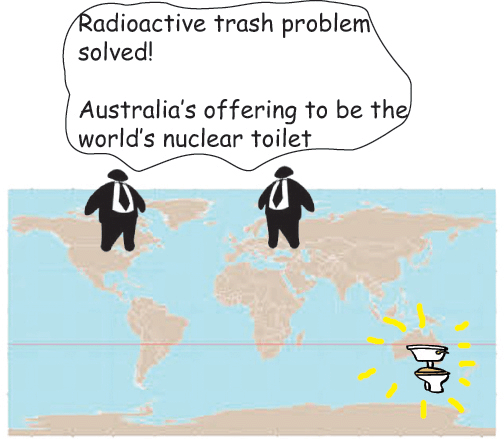
Labor-chaired inquiry calls for legislation to rule out accepting high-level nuclear waste from US and UK submarines among other recommendations
Daniel Hurst Foreign affairs and defence correspondent, https://www.theguardian.com/world/article/2024/may/13/australia-aukus-deal-submarines-critics-nuclear-waste
Australia risks becoming the “world’s nuclear waste dump” unless the Albanese government moves to rewrite its proposed Aukus laws, critics say.
A Labor-chaired inquiry has called for the legislative safeguard to specifically rule out accepting high-level nuclear waste from the US and the UK. One of the members of a Senate committee that reviewed the draft laws, independent senator Lidia Thorpe, said the legislation “should be setting off alarm bells” because “it could mean that Australia becomes the world’s nuclear waste dump”.
The government’s bill for regulating nuclear safety talks about “managing, storing or disposing of radioactive waste from an Aukus submarine”, which it defines broadly as Australia, UK or US submarines.
In a report published on Monday, the Senate’s foreign affairs, defence and trade legislation committee said this wording did not reflect the government’s promise not to accept high-level nuclear waste.
It recommended that the government consider “amending the bill so that a distinction is made between Australia’s acceptance of low-level nuclear waste from Aukus partners, but non-acceptance of high-level nuclear waste”.
The government has left the door open to accepting low-level waste from US and UK nuclear-powered submarines when they conduct rotational visits to Western Australia in the first phase of the Aukus plan. Low-level waste contains small amounts of radioactivity and include items such as personal protective equipment, gloves and wipes.
“According to the Australian Submarine Agency, nuclear-powered submarines only generate around a ‘small skip bin’ of low-level naval nuclear waste per submarine per year and that intermediate- and high-level waste will not become a concern until the first naval nuclear reactor requires disposal in the mid-2050s,” the Senate committee report said.
The government has yet to decide on the location for the disposal of radioactive waste from the submarines.
But infrastructure works proposed for HMAS Stirling – the naval base in Western Australia – to support the increased rotational visits are expected to include an operational waste storage facility for low-level radioactive waste.
The Department of Defence has argued any changes to the definitions should not prevent “regulatory control of the management of low-level radioactive waste from UK or US submarines” as part of those rotational visits.
Thorpe, an independent senator, said the call to prohibit high-level nuclear waste from being stored in Australia was “backed by experts in the field and was one of the major concerns raised during the inquiry into the bill”.
“The government claims it has no intention to take Aukus nuclear waste beyond that of Australian submarines, so they should have no reason not to close this loophole,” Thorpe said.
“They also need to stop future governments from deciding otherwise. We can’t risk our future generations with this.”
The government’s proposed legislation would set up an Australian naval nuclear power safety regulator to oversee the safety of the nuclear-powered submarines.
The committee made eight recommendations, including setting “a suitable minimum period of separation” to prevent a revolving door from the Australian Defence Force or Department of Defence to the new regulator.
The main committee report acknowledged concerns in the community that Australia might become a “dumping ground” for the Aukus countries, but it said the term was “not helpful in discussing the very serious question of national responsibility for nuclear waste”.
It also said the bill should be amended to ensure the regulator was transparent about “any accidents or incidents” with the soon-to-be-established parliamentary oversight committee on defence.
The Labor chair of the committee, Raff Ciccone, said the recommendations would “further strengthen the bill” and help “ensure Australia maintains the highest standards of nuclear safety”.
In a dissenting report, the Greens senator David Shoebridge said the legislation was “deeply flawed”, including because the regulator would report to the defence minister.
“The proposed regulator lacks genuine independence, the process for dealing with nuclear waste is recklessly indifferent to community or First Nations interests and the level of secrecy is a threat to both the environment and the public interest,” Shoebridge said.
The defence minister, Richard Marles, was contacted for comment.
Australia votes ‘yes’ at United Nations as Palestinian push for full membership gathers momentum

It’s not all that often, these days, that I can feel proud of my government’s foreign policy, or international statements.
But on this occasion, I can at last feel proud.
ABC News 11 May 24
- In short: A Palestinian bid for full membership of the United Nations gathered momentum on Friday, after a resolution passed through the organisation’s General Assembly recognising it was qualified to join.
- A total of 143 nations — including Australia — voted in favour, while nine were against and 25 abstained.
- What’s next? The vote doesn’t grant the Palestinians full membership, but they have been given extra “rights and privileges”.
Australia voted “yes” and the United Nations General Assembly emphatically supported a Palestinian bid to become a full member of the organisation by recognising it as qualified to join.
The vote, held at the UN’s New York headquarters on Friday, local time, passed with 143 nations in favour and nine against — including the United States and Israel — while 25 countries abstained.
The resolution was seen as a de facto step towards future Palestinian statehood.
The Palestinian push for full UN membership comes seven months into a war between Israel and Hamas in Gaza.
While there is a Palestinian ambassador to the UN, they are considered an “observer”.
Australia, which had previously abstained from voting on a call for an immediate humanitarian truce in the war, voted “yes” on Friday.
It does not give the Palestinians full UN membership, but simply recognises them as qualified to join, and gives them more “rights and privileges”.
“We value this decision. And we thank Australia for this position,” said Omar Awadalla, the assistant minister for the United Nations from the Palestinian Liberation Organisation (PLO) that governs the West Bank.
“And this is an action and actionable step by Australia toward recognising the rights of the Palestinian people to self-determination, and to their membership to the United Nations,” Mr Awadalla told the ABC.
He said Australia was supporting with its actions the two-state solution.
“And we think that those states who want to support the peace and justice and stability in the Middle East should take the same decision like Australia did, by accepting Palestine in having their membership to the United Nations as a step toward achieving their independence … and having the two-state solution based on international law and very well-known differences and the Arab Peace Initiative.”
Full membership unlikely……………………………………………………… more https://www.abc.net.au/news/2024-05-11/australia-votes-yes-at-un-for-more-palestinian-rights/103833838
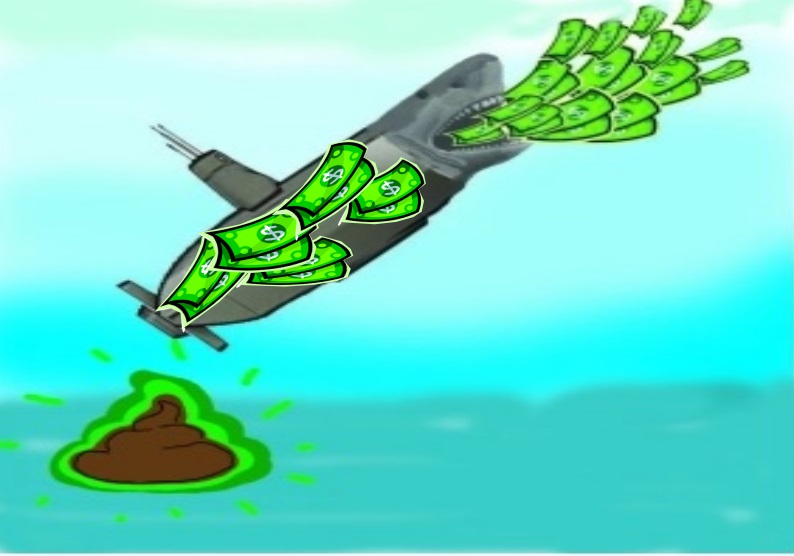
Bill lets UK/US “dump nuclear submarine waste here”
Ben Packam 6 May 24
The British company appointed to build Australia’s nuclear submarines says the government’s draft nuclear safety laws would allow the disposal in Australia of high -level radioactive wastes from UK submarines.
BAE Systems chief counsel made observation at committee hearing examining the government’s naval nuclear power safety bill, which is due to be pushed through Parliament after next week’s federal budget………….
Under questioing by Greens Senator David Shoebridge, BAE’s Peter Quinlivian agreed that the wording of the bill opened a pathway for the disposal of high-level British radioactive waste in Australia.
“The legislation as drafted is in language that would accommodate that scenario” he said.
Britain is yet to dispose of any of the nuclear submarines it has decommissioned since the 1980s. It estimates it won’t fully dispose of the boats, plus seven more dure to retire in coming years, until the late 2060s.
Mr Quinlivian said that BAE had not informed the British government of the prospects that Australia could legally dispose of its nuclear waste “because it didn’t immediately strike us”
The apparent loophole flies in the face of Australia’s reassurances that AUKUS won’t require us to become a dumping ground for other countries’ nuclear wastes.
Liberal Senator David Fawcett asked Defence officials in the April 22 committee hearing whether the bill could be amended to avoid unintended consequences, something that the government is understood to be open to.
In a written response, Defence conceded that a tightening of the bill’s language could be needed. It said specifying the “disposal” of only “Australian submarine” nuclear waste would be consistent with government policy, but the government would have to “carefully consider any amendment which excluded the possibility of regulatory control of the management of low level radioactive waste from UK or US submarines……………….
The Australian Radiation Protection and Nuclear Safety agency is poised to declare a site at the HMAS Stirling naval base off Perth as a low level radioactive waste management facility, but a decision on where to store high level waste from Australia’s planned nuclear submarines is years if not decades away

Defence Minister Richard Marles said that after the government announced its nuclear submarine plans in March 2023, Australia would not take nuclear waste from its AUKUS partners
“We’re not talking about establishing a civil nuclear industry, nor are we talking about opening Australia up as a repository for nuclear waste from other countries” he told the ABC.
Senator Shoebridge said that British bureaucrats were almost certainly “rubbing their hands together at the prospect of the Albanese government being foolish enough to pass this bill”
“Minister Marles has now been embarrassed by not only his own department but the very people he signed up to make the nuclear subs” he said.
The Senate standing committee on foreign affairs defence and trade is to release its report on the Australian Naval Nuclear Power Safety Bill 2023 on May 11.
US bases including Pine Gap saw Australia put on nuclear alert, but no-one told Gough Whitlam
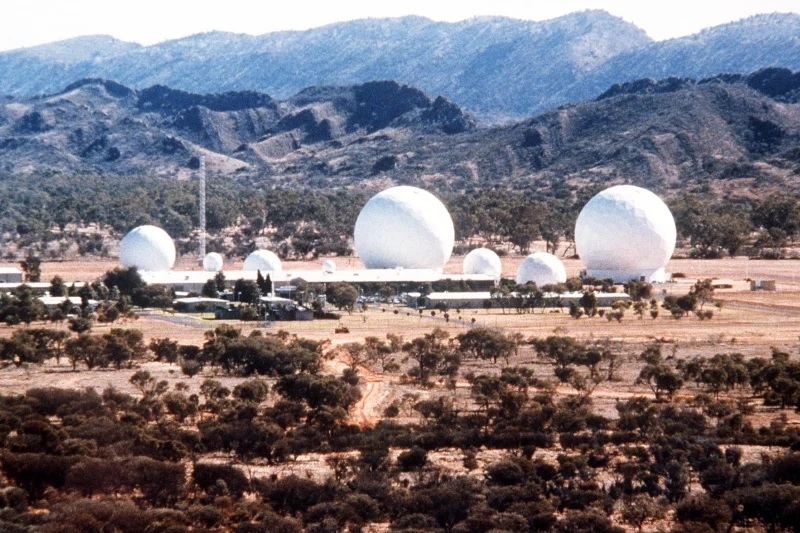
“The Australian government takes the attitude that there should not be foreign military bases, stations, installations in Australia. We honour agreements covering existing stations. We do not favour the extension or prolongation of any of those existing ones.” – Gough Whitlam
ABC News, By Alex Barwick for the Expanse podcast Spies in the Outback, 25 Apr 24
During the 1972 election campaign, Gough Whitlam promised to uncover and share Pine Gap’s secrets with Australians.(ABC Archives/Nautilus Institute)
When Australia was placed on nuclear alert by the United States government in October 1973, there was one major problem.
No-one had told prime minister Gough Whitlam.
One of the locations placed on “red alert” was the secretive Pine Gap facility on the fringes of Alice Springs.
Officially called a “joint space research facility” until 1988, the intelligence facility was in the crosshairs with a handful of other US bases and installations around Australia.
In fact, almost all United States bases around the world were placed on alert as conflict escalated in the Middle East. Whitlam wasn’t the only leader left out of the loop.
A prime minister in the dark
“Whitlam got upset that he hadn’t been told in advance,” Brian Toohey, journalist and former Labor staffer to Whitlam’s defence minister Lance Barnard, said.
Toohey said Whitlam should have been told that facilities including North West Cape base in Western Australia, and Pine Gap were being put on “red alert”.
“There had been a new agreement knocked out by Australian officials with their American counterparts, that Australia would be given advance warning.”
They weren’t.
Suddenly, the world was on the brink of nuclear war.
Why were parts of Australia on ‘red alert’?
The Cold War superpowers backed opposing sides in the Yom Kippur War.
The Soviet Union supported Egypt and the United States was behind Israel.
As the proxy war escalated in October 1973, United States secretary of state Henry Kissinger believed the crisis could go nuclear and issued a DefCon 3 alert.
A DefCon 3 alert saw immediate preparations to ensure the United States could mobilise in 15 minutes to deliver a nuclear strike.
The aim was to deter a nuclear strike by the Soviets.
And, it simultaneously alerted all US bases including facilities in Australia that a nuclear threat was real.
This level of alert has only occurred a few times, including immediately after the September 11 attacks.
Politics, pressure and protest
The secretive intelligence facility in outback Australia caused Whitlam more trouble beyond the red alert.
During the 1972 election campaign, the progressive politician had promised to lift the lid on Pine Gap and share its secrets with all Australians.
“He gave a promise that he would tell the Australian public a lot more about what Pine Gap did,” Toohey said.
But according to Toohey, the initial briefing provided to Whitlam and Barnard by defence chief Arthur Tange left the prime minister with little to say.
“Tange came along and he said basically that there was nothing they could be allowed to say. And that was just ridiculous,” Toohey said.
“He said, the one thing he could tell them was the bases could not be used in any way to participate in a war. Well, of course they do.”
Whitlam would cause alarm in Washington when he refused to commit to extending Pine Gap’s future.
In 1974 on the floor of parliament he said:
“The Australian government takes the attitude that there should not be foreign military bases, stations, installations in Australia. We honour agreements covering existing stations. We do not favour the extension or prolongation of any of those existing ones.”
According to Toohey, “the Americans were incredibly alarmed about that”.
“As contingency planning, the whole of the US Defence Department said that they would shift it to Guam, a Pacific island that America owned,” he said.
And the following year, allegations would emerge that the CIA were involved in the prime minister’s dismissal on November 11, 1975…………… https://www.abc.net.au/news/2024-04-24/when-australia-was-put-on-nuclear-alert-expanse-podcast/103733194
Washington Syndrome: Australia’s sovereignty sell-out hidden in plain sight

“The process is almost complete. The Australian Defence Force’s integration into the US military to serve the needs of Washington has been announced, albeit without announcement, this week.”
Arguably the only thing left to do is to adopt American spelling and replace the letter ‘c’ with the letter ‘s’ in ‘Department of Defence’.
by Rex Patrick | Apr 21, 2024 https://michaelwest.com.au/washington-syndrome-marles-defence-plan-sovereignty-sell-out/
Defence Minister Richard Marles rolled out some glossy new brochures this week spelling out the composition of the Australian Defence Force in the decades ahead. As media quibbled about this equipment purchase or that one, former Senator and submariner Rex Patrick explains the sovereignty sell-out hidden in plain sight.
Washington Syndrome
It’s confirmed. All the evidence points to the Defence Minister suffering from Stockholm Syndrome (or more accurately Washington Syndrome), except that he hasn’t just formed a bond with his Defence Department, where he won’t challenge them. He’s swallowed the whole kit and caboodle; adopting Defence lingo and lines as his own.
Marles has expressed Defence’s wishes beautifully, without revealing explicitly what that wish is. But it’s sitting there in plain sight.
National Defence Strategy
The use of smokescreens is a longstanding battlefield tactic, and it’s often employed by bureaucrats too. To get a clear and truthful picture from the National Defence Strategy released this week, you have to peer through a dense cloud of verbiage to get a clear sense of what’s really going on.
Early in the document the strategic framework is laid out.
Our Alliance with the US remains fundamental to Australia’s national security. We will continue to deepen and expand our defence engagement with the US, including by pursuing greater scientific, technological and industrial cooperation, as well as enhancing our own cooperation under force posture initiatives.
So, we’re joined at the hip to the United States, and we intend to stay that way.
The document spells out why Defence thinks we need to do that. The optimism at the end of the Cold War has been replaced by uncertainty and tension of entrenched and strategic competition between the US and China.
It is accompanied by an unprecedented conventional and non-conventional build-up in our region, taking place without strategic reassurance or transparency.
…
This build up is also increasing the risk of military escalation or miscalculation that could lead to a major conflict in the region.
Indeed, it zooms in with on the specifics. The risk of a crisis in the Taiwan Strait is increasing, as well as other flashpoints, including disputes in the South and East China Seas and on the border with India.
The Government will continue to strengthen its defence engagement with the US to:
- ensure joint exercises and capability rotations with the US are focused on enhancing collective deterrence and force posture cooperation.
- Acquire the technology and capability required to enhance deterrence, including through increasing collaboration on defence innovation, science and technology.
- Leverage Australia’s strong partnership with Japan in its trilateral context, including opportunities for Japan to participate in Australia-US force posture cooperation activities, to enable interoperability and contribute to deterrence; and
- Progress enabling reforms to export controls, procurement policy and information sharing to deliver a more integrated industrial base.
- Meanwhile, the US is increasing its military footprint in Australia in terms of facilities in the north (mission briefing/intelligence centre and aircraft parking aprons) at RAAF Darwin, fuel storage at Darwin Port, infrastructure at RAAF Tindal near Katherine and logistics storage in both Victoria and Queensland).
- This is on top of the long established top secret signals intelligence base, the Joint Defence Facility Pine Gap, and Australian support for US naval communications through the very low-frequency receiving and transmission facility at North West Cap. As far as American strategists are concerned, Australia has long been “a suitable piece of real estate”.
But now there’s a new dimension to the alliance with Australian taxpayers are sharing the alliance love by pouring billions into the US submarine industrial base.
US Seventh and a Half Fleet
Of course, it’s hard to fight a conflict in Taiwan Straights with an army. That’s reflected in the distribution of future expenditure outline in the Integrated Investment Program, released alongside the National Defence Strategy.
The Navy will receive almost 40% of all Defence expenditure. The Royal Australian Navy will become the seventh and a half fleet of the US Navy, supported by what are being referred to as the expeditionary air operations by the Royal Australian Air Force.
Again, hidden in plain sight.
Taiwan
Taiwan is a democracy of 22 million people. I might like to think we would come to their aid in the event their democracy was threatened.
But sending our sons and daughters to engage in a northern hemisphere conflict is a matter which should be decided upon by our Parliament at some future time.
We should seek to have a balanced and flexible Defence Force optimised first for Defence of Australia and second for near regional security (a deployment to Taiwan, if approved by our elected members, should draw from an order-of-battle optimised for Defence of Australia).
Sovereignty Stolen
But that’s not what’s happening.
It’s all too tempting to suggest that the sovereignty sell-out started at with AUKUS, announced by Scott Morrison on 16 September 2021 and adopted by Anthony Albanese at the Kabuki show in San Diego on 15 March 2023. But it didn’t.For those astute enough to have picked up and read a copy of Professor Clinton Fernandes’ book “Sub-Imperial Power: Australia in the International Arena”, they’ll know AUKUS is just natural and obvious. So too is the even greater embedding of the ADF into the US military to serve the needs of Washington that has been announced this week, albeit without announcement.
“The process is almost complete. The Australian Defence Force’s integration into the US military to serve the needs of Washington has been announced, albeit without announcement, this week.”
Arguably the only thing left to do is to adopt American spelling and replace the letter ‘c’ with the letter ‘s’ in ‘Department of Defence’.
History repeats
We have been down this road before.
n the 1920s and 1930s conservative Australian Governments saw Australian security as part of that of the British Empire as a whole. As a consequence, they implemented defence programs that were designed to produce forces, especially the Royal Australian Navy, that were hopelessly unbalanced and only made sense as a subset of British forces. Imperial Defence was prioritised ahead of national defence in a ‘strategy’, if you can call it that, that compromised Australia’s then very new national sovereignty and almost came to disaster in 1942.
Bureaucratic and political self-interest
Australia’s new “National Defence Strategy” really is nothing of the sort. It’s a sub-set of strategic planning made in Washington, not an Australian national perspective.
AUKUS has devoured whatever vestiges of independent strategic thought that might have been lingering in our Defence Department.
But don’t imagine that there’s any dissent about this in Defence Headquarters.
Those in Defence bureaucracy guiding our politicians are be happy, uproariously happy, because they’ll personally benefit from the arrangement.
AUKUS and this latest steerage will serve as a tremendous career and institutional opportunity for them. They’ve cemented their position in an alliance arrangement that involves important meetings and conferences, important decisions, trips overseas, and, for some, exchange postings. For them, they’ve got ringside seats and the opportunity to be occasional players in the big league.
Which brings me back to Defence Minister Marles, who can’t really be blamed for the sell-out.
Marles isn’t, and never was, the sort of political figure that could develop much of an understanding of what is going on around him, let alone be the one to lead with strategic vision and agenda forward. He’s too busy learning the lingo, enjoying the photo opportunities, and impressing upon his ‘sub-ordinates’ in Defence Headquarters that he’s not to be referred to as the Defence Minister, but rather as the Deputy Prime Minister. Surely he deserves that courtesy!
Biden Administration Defies Australia’s Call To End Assange Case, Submits ‘Assurances’ To UK Court
Streamed live on 17 Apr 2024, Join Kevin Gosztola, author of “Guilty of Journalism: The Political Case Against Julian Assange,” as he covers the U.S. government’s “assurances” that were submitted to a British appeals court. They represent a clear indication that President Joe Biden’s administration is not going to end the case. If Biden was “considering” a plea deal for Assange, as was reported, he has made the decision to keep pursuing extradition and a U.S. trial on Espionage Act charges.
“An Awkward Problem”: Julian Assange and the Australian dog that didn’t bark
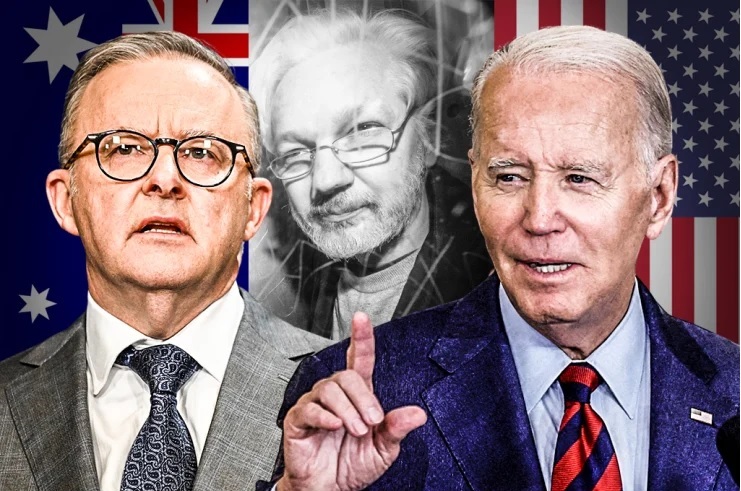
a clear Australian Government policy to limit direct engagement on the Assange case until after he has been extradited to the United States, put to trial, convicted, sentenced and exhausted all appeal rights.
by Philip Dorling and Rex Patrick | Apr 13, 2024, https://michaelwest.com.au/julian-assange-an-awkward-problem-for-albanese/?utm_source=newsletter&utm_medium=email&utm_term=2024-04-18&utm_campaign=Michael+West+Media+Weekly+Update
Joe Biden says he’s “considering” an end to the prosecution of Julian Assange. Anthony Albanese says, “enough is enough,” but not much else. Rex Patrick and Philip Dorling discuss the latest developments in the Assange case.
That’s the position behind the Government’s careful words about bringing the matter to a close.
At no point has the Australian Government called publicly for the espionage charges to be dropped and the extradition process to be ended.
A plea deal?
Last month, the Wall Street Journal reported the US Justice Department has been considering a proposed plea deal with Assange, dropping the espionage charges and allowing him to admit to a misdemeanour concerning the mishandling of classified documents.
According to the Journal the Justice Department was exploring ways to end the long London court battle as Assange continues to fight against extradition. It isn’t clear whether the move for a plea deal has come from Justice or Assange’s legal team. In any case, Assange’s lawyers said they’d been “given no indication” of any change in the US position.
President Biden may have been referring to the question of a plea deal as much as any representations from the Australian Parliament.
A plea deal might well be under consideration, but it’s clearly not a done deal yet, and a radical reduction in the charges, with Assange walking free in London and his time in His Majesty’s Prison Belmarsh taken into account, sounds like a big ask.
That dog ain’t barking…
One thing’s clear, however, Albanese hasn’t followed up on the parliamentary resolution with any personal diplomatic push on the Assange case.
One might have thought that Albanese would have directly engaged President Biden or else directed new representations across the top levels of the US Administration.
If that were the case, one would expect Albanese’s own Department to be closely engaged, working with DFAT and the Australian Embassy in Washington. Albanese is a careful, process-driven prime minister, so one would expect there to be PM&C briefing papers and correspondence. If absolutely nothing else one would expect there to be a Parliamentary Question Time Brief.
With such expectations, on March 7, 2024, Rex Patrick submitted a new FOI application for access to “PM&C submissions, talking points or other documents provided to Prime Minister Albanese between 1 February 2024 and 29 February 2024 that refer or relate to Julian Assange”.
Yesterday, the same day as Albanese’s latest comments that his government was using “all of our diplomatic efforts at every level”, PM&C provided their FOI response.
Dave Titheridge, head of the Department’s Global Interests Branch, advised: “I am refusing your request for access … as the documents you have requested do not exist”.
PM&C conducted an extensive search, including through its email system, Parliamentary Document Management System and electronic records repository and turned up nothing.
Nothing happening here – either before or after the parliamentary resolution.
Zero, zip, zilch, nada.
What’s next?
So, where does this leave Assange? His appeal options in London are nearly at an end. Perhaps his lawyers will finally get lucky. Perhaps President Biden is “considering” his case. Perhaps there will be a plea deal.
But Assange may well be extradited and spend decades rotting in a US maximum security prison. He might die there. He could also eventually come home, but as a prisoner in shackles, not as a free man.
Whatever happens, however, it won’t be down to a big effort – or barking – from the Albanese Government.
Supporters of Julian Assange were encouraged on Thursday by US President Joe Biden’s off-the-cuff- remark that his administration was “considering” an Australian request to end the espionage prosecution of the WikiLeaks founder.
Assange’s spouse, Stella Assange, called on Biden to “do the right thing” and “drop the charges”. Prime Minister Anthony Albanese said Australia was using “diplomatic efforts at every level to communicate that it is time that this was brought to a close, enough is enough.”
However, getting to the bottom of what governments do in the secretive world of diplomacy can often be akin to investigating a murder mystery. The clues are elusive and fragmentary. In the case of imprisoned Australian journalist Julian Assange, it’s a case of a dog that didn’t bark.
Parliamentary action
Media reports attributed the apparent shift in the US position to Albanese’s support for a parliamentary motion moved by independent MP Andrew Wilkie on February 14 that declared the Assange extradition proceedings have “gone on for too long” and “underline[d] the importance of the UK and USA bringing the matter to a close so that Mr Assange can return home to his family in Australia”.
Albanese said his government had supported the motion “because it is the right thing to do.” He added that he had raised the Assange case “at the highest levels” with the US and UK with “a calibrated and deliberate approach” that included discussions with Assange’s lawyers. In that context, the parliamentary resolution was “important… it’s important to send that message.”
Quiet diplomacy
It’s one thing to express support for “bringing the matter to a close”; but what does that mean in practice? For Assange supporters, it means the US dropping the prosecution and Assange returning to Australia as a free man.
However, the Albanese Government’s understanding and expectations are likely rather different.
FOI inquiries by Rex Patrick over the past eighteen months have shown that the Albanese Government’s track record on the Assange case has been patchy at best. The government’s “quiet diplomacy” has been minimalist. FOI applications directed toward the Department of Foreign Affairs and Trade, including Australia’s Embassy in Washington, have revealed little evidence of concerted diplomatic activity,
This isn’t to say that Albanese hasn’t raised the Assange case at the “highest levels.” He undoubtedly has, but it’s likely involved mentioning it as a politically awkward problem rather than a push to secure Assange’s freedom.
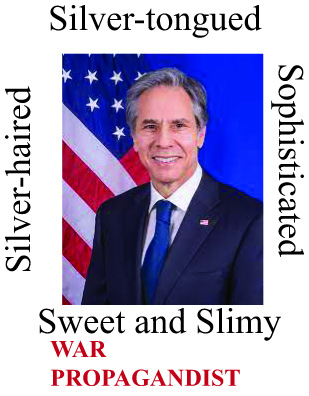
In response Secretary of State Antony Blinken made it publicly clear the US Government was most reluctant to intervene in the Justice Department’s prosecutorial process – an issue of obvious political sensitivity given the criminal charges brought against former president Donald Trump.
FOI inquiries also unearthed briefings for Attorney-General Mark Dreyfus that revealed a clear Australian Government policy to limit direct engagement on the Assange case until after he has been extradited to the United States, put to trial, convicted, sentenced and exhausted all appeal rights. Only then could Assange apply under the International Transfer of Prisoners scheme to serve a sentence of imprisonment in Australia. Only then would the Attorney-General formally consider that possibility,
Former PM Paul Keating on a craven acceptance of US strategic hegemony in Asia

By Paul Keating, Apr 11, 2024 https://johnmenadue.com/a-craven-acceptance-of-us-strategic-hegemony-in-asia/
The Financial Review, if it wishes to remain relevant, requires a monster dose of reality – a de-lousing of its misplaced strategic ideology and its craven acceptance of US strategic hegemony in Asia, a region where not one US state resides.
In the mid-1980s, a young and enthusiastic Michael Stutchbury was a permanent attendee at my often two-hour press conferences as treasurer, drumming into the Canberra press gallery that the presence of large economic forces was more important and more newsworthy than the gallery’s normal diet of election speculation, leadership changes, tax cuts and cigarette prices.
And Michael lapped it up. He was an early graduate of my school of advanced economic and entrepreneurial thinking. And while he has become more conservative as he has become older, his stewardship of The Australian Financial Review provides an attestation that those economic lessons were an anchor, a ballast, for the wider presentation and contemporary dissertation of economic news and events.
In short, Michael’s close proximity to and at the reformation of the Australian economy in the 1980s and early 1990s has made his views and leadership on economic issues today to be of substantial national value. But economic insight is where Michael’s experience shutters. On foreign policy, as in The AFR View ‘‘JAUKUS shows Australia seeks security in Asia’’ (April 9), Michael is away with the pixies
– a sugar plum fairy in the Australian strategic fantasy.
And that fantasy goes to asserting that an Atlantic power, the United States, along with other Anglos, Britain and Australia, but topped up with some resentment sauce from Japan, in some way fashions a new Asia construct – a construct in which Australia is or can be part. Distorting my policy that Australia could find its security in Asia by being tied up and indentured to a particularly un-Asian bunch.
Unlike Europe, which after the Thirty Years’ War hit upon the Westphalian model of collective security among states of roughly equal size, Asia has always been a hierarchy of countries with China at its top. This remains the case today.
So, the policy of any nation, particularly a Pacific one, thinking it can deal with Asia by ignoring China or pretending it doesn’t exist or that it is in some way illegitimate, is a policy of fantasy. A policy of fools.
But if you are a sugar plum fairy, as in foreign policy Michael seems happy to be, you will believe almost anything. Like AUKUS nuclear subs will belong to Australia and be sovereign to it, despite US Deputy Secretary of State Kurt Campbell’s regular and blatant assertions that he expects the subs to be at the beck and call of the United States whenever it wishes to hop into China over Taiwan.
The Financial Review, if it wishes to remain relevant, requires a monster dose of reality – a de-lousing of its misplaced strategic ideology and its craven acceptance of US strategic hegemony in Asia, a region where not one US state resides.
First published in the Australian Financial Review, April 10, 2024.
Flicker of Hope: Biden’s Throwaway Lines on Assange
April 12, 2024 by: Dr Binoy Kampmark, https://theaimn.com/flicker-of-hope-bidens-throwaway-lines-on-assange/
Walking stiffly, largely distracted, and struggling to focus on the bare essentials, US President Joe Biden was keeping company with his Japanese counterpart, Prime Minister Fumio Kishida, when asked the question. It concerned what he was doing regarding Australia’s request that the WikiLeaks founder Julian Assange be returned to Australia.
Assange, who has spent five tormenting years in Belmarsh Prison in London, is battling extradition to the US on 18 charges, 17 tenuously and dangerously based on the US Espionage Act of 1917.
The words that followed from the near mummified defender of the Free World were short, yet bright enough for the publisher’s supporters. “We’re considering it.” No details were supplied.
To these barest of crumbs came this reaction from from Australian Prime Minister Anthony Albanese on ABC’s News Breakfast: “We have raised on behalf of Mr Assange, Australia’s national interest, that enough is enough, that this needs to be brought to a conclusion, and we’ve raised it at each level of government in every possible way.” When pressed on whether this was merely an afterthought from the president, Albanese responded with the usual acknowledgments: the case was complex, and responsibility lay with the US Department of Justice.
One of Assange’s lawyers, the relentless Jennifer Robinson, told Sky News Australia of her encouragement at Biden’s “response, this is what we have been asking for over five years. Since 2010 we’ve been saying this is a dangerous precedent that’s being set. So, we certainly hope it was a serious remark and the US will act on it.” Assange’s brother, Gabriel Shipton, also told Sky News that the statement was significant while WikiLeaks editor-in-chief, Kristinn Hrafnsson thought the utterance “extraordinary”, cautiously hoping “to see in the coming days” whether “clarification of what this means” would be offered by “those in power” and the press corps.
The campaign to free Assange has burgeoned with admirable ferocity. The transformation of the WikiLeaks founder from eccentric, renegade cyber thief deserving punishment to prosecuted and persecuted scribbler and political prisoner has been astonishing.
The boggling legal process has also been shown up as woefully inadequate and scandalous, a form of long-term torture via judicial torment and deprivation. The current ludicrous pitstop entails waiting for a UK Court of Appeal decision as to whether Assange will be granted leave for a full reconsideration of his case, including the merits of the extradition order itself.
The March 26 Court of Appeal decision refused to entertain the glaringly obvious features of the case: that Assange is being prosecuted for his political views, that due process is bound to be denied in a country whose authorities have contemplated his abduction and murder, and that he risks being sentenced for conduct he is not charged with “based on evidence he will not see and which may have been unlawfully obtained.” The refusal to entertain such material as the Yahoo News article from September 2021 outlining the views of intelligence officials on kidnapping and assassination options again cast the entire affair in a poor light.
Even if Assange is granted a full hearing, it is not clear whether the court will go so far as to accept the arguments. The judges have already nobbled the case by offering US prosecutors the chance to offer undertakings, none of which would or could be binding on the DOJ or any US judge hearing the case. Extradition, in other words, is likely to be approved if Assange is “permitted to rely on the First Amendment”, “is not prejudiced at trial (including sentence) by reason of his nationality” and that he “is afforded the same First Amendment protection as a United States citizen, and that the death penalty not be imposed.” These conditions, on the face of it, look absurd in their naïve presumption.
Whether Biden’s latest casual spray lends any credibility to a change of heart remains to be seen. In December 2010, when Vice President in the Obama administration, Biden described Assange as a “high-tech terrorist” for disclosing State Department cables. He failed to identify any parallels with previous cases of disclosures such as the Pentagon papers.
Craig Murray, former British diplomat and Assange confidant, adds a note of cautious sobriety to the recent offering from the president: “I’m not going to get too hopeful immediately on a few words out of the mouth of Biden, because there has been no previous indication, nothing from the Justice Department so far to indicate any easing up.”
For all that, it may well be that the current administration, facing a relentless publicity campaign from human rights organisations, newspapers, legal and medical professionals, not to mention pressure from both his own party in Congress and Republicans, is finally yielding. Caution, however, is the order of the day, and nothing should be read or considered in earnest till signatures are inked and dried. We are quite a way off from that.
Aukusing for War: The Real Target Is China
Dr Binoy Kampmark, April 7 2024 https://theaimn.com/aukusing-for-war-the-real-target-is-china/
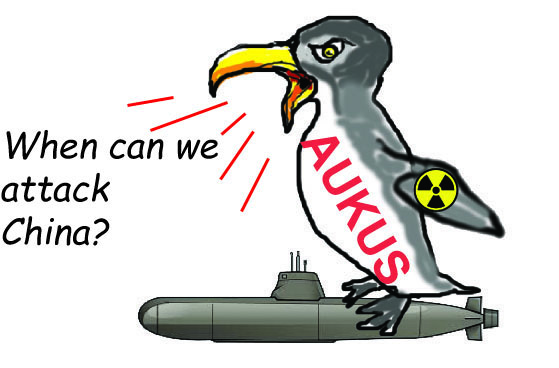
A remarkably perverse reality is in the offing regarding AUKUS. In terms of submarines, it will lag, possibly even sink, leaving the US and, to a lesser extent the UK, operating their fleets as Australians foot the bill and provide the refreshment
Not only is Australia effectively promising to finance and service that particular capacity, it will also do so in the service of a potentially catastrophic conflict which will see its automatic commitment. A truly high price to pay for an abdication of sovereignty for the fiction of regional stability.
The occasional burst of candour from US diplomats provides a striking, air clearing difference to their Australian and British counterparts. Official statements about the AUKUS security pact between Washington, London and Canberra, rarely mention the target in so many words, except on the gossiping fringes. Commentators and think tankers are essentially given free rein to speculate, masticating over such streaky and light terms as “new strategic environment”, “great power competition”, “rules-based order”.
On the occasion of his April 3 visit to Washington’s Center for a New American Security (CNAS), US Deputy Secretary of State Kurt Campbell was refreshingly frank. His presence as an emissary of US power in the Pacific has been notable since the AUKUS announcement in September 2021.
In March last year, Campbell, as Deputy Assistant to the US President and Coordinator for the Indo-Pacific National Security Council, was unfurling the US flag before various Pacific states, adamant that US policy was being reoriented from one of neglect to one of greater attentiveness. The Solomon Islands, given its newly minted security pact with Beijing, was of special concern. “We realise that we have to overcome in certain areas some amounts of distrust and uncertainty about follow through,” he explained to reporters in Wellington, New Zealand. “We’re seeking to gain that trust and confidence as we go forward.”
In Honiara, Campbell conceded that the US had not done “enough before” and had to be “big enough to admit that we need to do more, and we need to do better.” This entailed, in no small part, cornering the Solomon Islands Premier Manasseh Sogavare into affirming that Beijing would not be permitted to establish a military facility capable of supporting “power projection capabilities.”
In his discussion with the CNAS Chief Executive Officer, Richard Fontaine, Campbell did the usual runup, doffing the cap to the stock principles. Banal generalities were discussed, for instance, as to whether the US should be the sole show in projecting power or seek support from like-minded sorts. “I would argue that as the United States and other nations confront a challenging security environment, that the best way to maintain peace and security is to work constructively and deeply with allies and partners.” A less than stealthy rebuke was reserved for those who think “that the best that the United States can do is to act alone and to husband its resources and think about unilateral, individual steps it might take.”
The latter view has always been scorned by those calling themselves multilateralists, a cloaking term for waging war arm-in-arm with satellite states and vassals while ascribing to it peace keeping purposes in the name of stability. Campbell is unsurprising in arguing “that working closely with other nations, not just diplomatically, but in defensive avenues [emphasis added], has the consequence of strengthening peace and stability more generally.” The virtue with the unilateralists is the possibility that war should be resorted to sparingly. If one is taking up arms alone, a sense of caution can moderate the bloodlust.
Campbell revealingly envisages “a number of areas of conflict and in a number of scenarios that countries acting together” in the Indo-Pacific, including Japan, Australia, South Korea and India. “I think that balance, the additional capacity will help strengthen deterrence more general [sic].” The candid admission on the role played by the AUKUS submarines follows, with the boats having “the potential to have submarines from a number of countries operating in close coordination that could deliver conventional ordinance from long distances. Those have enormous implications in a variety of scenarios, including in cross-strait circumstances.” And so, we have the prospect of submarines associated with the AUKUS compact being engaged in a potential war with China over Taiwan.
When asked on what to do about the slow production rate of submarines on the part of the US Navy necessary to keep AUKUS afloat, Campbell acknowledged the constraints – the Covid pandemic, supply chain issues, the number of submarines in dry dock requiring or requiring servicing. But like Don Quixote taking the reins of Rosinante to charge the windmills, he is undeterred in his optimism, insisting that “the urgent security demands in Europe and the Indo-Pacific require much more rapid ability to deliver both ordinance and other capabilities.”
To do so, the military industrial complex needs to be broadened (good news for the defence industry, terrible for the peacemakers). “I think probably there is going to be a need over time for a larger number of vendors, both in the United States in Australia and Great Britain, involved in both AUKUS and other endeavours.”
There was also little by way of peace talk in Campbell’s confidence about the April 11 trilateral Washington summit between the US, Japan and the Philippines, following a bilateral summit to be held between President Joe Biden and Japan’s Prime Minister Fumio Kishida. When terms such as “modernize” and “update” are bandied about in the context of an alliance, notably with an eye towards a rival power’s ambitions, the warring instincts must surely be stirred. In the language of true encirclement, Campbell envisages a cooperative framework that will “help link the Indo-Pacific more effectively to Europe” while underscoring “our commitment to the region as a whole.”
A remarkably perverse reality is in the offing regarding AUKUS. In terms of submarines, it will lag, possibly even sink, leaving the US and, to a lesser extent the UK, operating their fleets as Australians foot the bill and provide the refreshments. Campbell may well mention Australia and the UK in the context of nuclear-powered submarines, but it remains clear where his focus is: the US program “which I would regard as the jewel in the crown of our defense industrial capacity.” Not only is Australia effectively promising to finance and service that particular capacity, it will also do so in the service of a potentially catastrophic conflict which will see its automatic commitment. A truly high price to pay for an abdication of sovereignty for the fiction of regional stability.
Killing Aid Workers: Australia’s Muddled Policy on Israel
Australian anger at the government level must therefore be severely qualified. Support roles, thereby rendering Australian companies complicit in Israeli’s military efforts, and in ancillary fashion the Australian government, continue to be an important feature. The F-35, a mainstay US-made fighter for the Israeli Air Force, is not manufactured or built in Australia, but is sustained through the supply of spare parts stored in a number of allied countries. According to the Australian Department of Defence, “more than 70 Australian companies have directly shared more than $4.13 billion in global F-35 production and sustainment contracts.”
April 5, 2024, by: Dr Binoy Kampmark, https://theaimn.com/killing-aid-workers-australias-muddled-policy-on-israel/
The Australian Prime Minister, Anthony Albanese, was distraught and testy. It seemed that, on this occasion, Israel had gone too far. Not too far in killing over 32,000 Palestinians in Gaza, a staggering percentage of them being children. Not too far in terms of using starvation as a weapon of war. Not too far in bringing attention to the International Court of Justice that its actions are potentially genocidal.
Israel had overstepped in doing something it has done previously to other nationals: kill humanitarian workers in targeted strikes. The difference for Albanese on this occasion was that one of the individuals among the seven World Central Kitchen charity workers killed during the midnight between April 1 and 2 was Australian national Lalzawmi “Zomi” Frankcom.
Frankcom and her colleagues had unloaded humanitarian food supplies from Cyprus that had been sent via a maritime route before leaving the Deir al-Balah warehouse. The convoy, despite driving in a designated “deconflicted” zone, was subsequently attacked by three missiles fired from a Hermes 450 drone. All vehicles had the WCK logo prominently displayed. WCK had been closely coordinating the movements of their personnel with the IDF.
In a press conference on April 3, Albanese described the actions as “completely unacceptable.” He noted that the Israeli government had accepted responsibility for the strikes, while Israel’s Prime Minister, Benjamin Netanyahu had conveyed his condolences to Frankcom’s family, with assurances that he would be “committed to full transparency”.
The next day, the Australian PM called the slaying of Frankcom a “catastrophic event”, reiterating Netanyahu’s promises from the previous day that he was “committed to a full and proper investigation.” Albanese also wished that these findings be made public, and that accountability be shown for Israel’s actions, including for those directly responsible. “What we know is that there have been too many innocent lives lost in Gaza.”
Australian Foreign Minister, Penny Wong, restated the need for “full accountability and transparency” and Australian cooperation with Israel “on the detail of this investigation.” She further acknowledged the deaths of over 30,000 civilians, with some “half a million Palestinians” starving.
Beyond an investigation, mounted and therefore controlled by the Israeli forces themselves, nothing much else can be hoped for. The Albanese approach has been one of copybook warnings and concerns to an ally it clearly fears affronting. What would a ground invasion of Rafah do to the civilian population? What of the continuing hardships in Gaza? Push for a humanitarian ceasefire, but what else?
Australian anger at the government level must therefore be severely qualified. Support roles, thereby rendering Australian companies complicit in Israeli’s military efforts, and in ancillary fashion the Australian government, continue to be an important feature. The F-35, a mainstay US-made fighter for the Israeli Air Force, is not manufactured or built in Australia, but is sustained through the supply of spare parts stored in a number of allied countries. According to the Australian Department of Defence, “more than 70 Australian companies have directly shared more than $4.13 billion in global F-35 production and sustainment contracts.”
The Australian government has previously stated that all export permit decisions “must assess any relevant human rights risks and Australia’s compliance with its international obligations.” The refusal of a permit would be assured in cases where an exported product “might be used to facilitate human rights abuses.” On paper, this seems solidly reasoned and consistent with international humanitarian law. But Canberra has been a glutton for the Israeli military industry, approving 322 defence exports over the past six years. In 2022, it approved 49 export permits of a military nature bound for Israel; in the first three months of 2023, the number was 23.
The drone used in the strike that killed Frankcom is the pride and joy of Elbit Systems, which boasts a far from negligible presence in Australia. In February, Elbit Systems received a A$917 million contract from the Australian Defence Department, despite previous national security concerns among Australian military personnel regarding its Battle Management System (BMS).
When confronted with the suggestion advanced by the Australian Greens that Australia end arms sales to Israel, given the presence of Australian spare parts in weaponry used by the IDF, Wong displayed her true plumage. The Australian Greens, she sneered, were “trying to make this a partisan political issue.” With weasel-minded persistence, Wong again quibbled that “we are not exporting arms to Israel” and claiming Australian complicity in Israeli actions was “detrimental to the fabric of Australian society.”
The Australian position on supplying Israel remains much like that of the United States, with one fundamental exception. The White House, the Pentagon and the US Congress, despite increasing concerns about the arrangement, continue to bankroll and supply the Israeli war machine even as issue is taken about how that machine works. That much is admitted. The Australian line on this is even weaker.
The feeble argument made by such watery types as Foreign Minister Wong focus on matters of degree and semantics. Israel is not being furnished with weapons; they are merely being furnished with weapon components.
Aside from ending arms sales, there is precedent for Australia taking the bull by the horns and charging into the mist of legal accountability regarding the killing of civilians in war. It proved an enthusiastic participant in the Joint Investigation Team (JIT), charged with combing through the events leading to the downing of the Malaysian Airlines MH17 over Ukraine in July 2014 by a Buk missile, killing all 298 on board.
Any such equivalent investigation into the IDF personnel responsible for the killing of Frankcom and her colleagues is unlikely. When the IDF talks of comprehensive reviews, we know exactly how comprehensively slanted they will be.
‘Poison portal’: US and UK could send nuclear waste to Australia under Aukus, inquiry told
Labor describes claims as ‘fear-mongering’ and says government would not accept waste from other nations.
Tory Shepherd, Tue 2 Apr 2024, https://www.theguardian.com/world/2024/apr/02/poison-portal-us-and-uk-could-send-nuclear-waste-to-australia-under-aukus-inquiry-told
Australia could become a “poison portal” for international radioactive waste under the Aukus deal, a parliamentary inquiry into nuclear safety legislation has heard.
New laws to establish a safety framework for Australia’s planned nuclear-powered submarines could also allow the US and UK to send waste here, while both of those countries are struggling to deal with their own waste, as no long-term, high-level waste facilities have been created.
The government introduced the Australian naval nuclear power safety bill in November last year. If passed, it will establish a nuclear safety watchdog, allow for naval nuclear propulsion facilities to be created, including for storing or disposing of radioactive waste from Aukus submarines. A second bill to enable the regulator to issue licenses was introduced at the same time.
Both have been referred to a Senate inquiry, which is due to report on 26 April.
Dave Sweeney, the Australian Conservation Foundation’s nuclear free campaigner, said the issue of waste disposal was “highly disturbing” and that the Aukus partners could see Australia as a “a little bit of a radioactive terra nullius”.
“Especially when it’s viewed in the context of the contested and still unresolved issue of domestic intermediate-level waste management, the clear failure of our Aukus partners to manage their own naval waste, the potential for this bill to be a poison portal to international waste and the failure of defence to effectively address existing waste streams, most noticeably PFAS,” he said.
The defence minister, Richard Marles, has previously accused the Greens of “fearmongering” when they raised similar concerns, saying the government would not accept waste from the other nations.
However, the legislation allows for the creation of facilities for “managing, storing or disposing of radioactive waste from an Aukus submarine”, and defines an Aukus submarine as either an Australian or a UK/US submarine, and “includes such a submarine that is not complete (for example, because it is being constructed or disposed of)”.
The Greens defence spokesperson, David Shoebridge, said HMS Dreadnought, one of the UK’s first nuclear submarines, had been “rusting away” since being decommissioned in 1980.
“You can go on Google Maps and look at them rusting away in real time, can’t you?” Shoebridge asked Australian Radiation Protection and Nuclear Safety Agency (Arpansa) chief regulatory officer, James Scott.
“Yes. There is no disposal pathway yet,” Scott said, adding he was “aware of the UK plans to establish a deep geological repository somewhere in the 2050s to 2060s”.
“There’s no exact date,” he said.
“The UK is pursuing a disposal pathway, and Australia will need to do the same. We are fully aware of this; we are engaging with our own radioactive waste agency, ARWA, on this, and it’s something that needs to be dealt with now, not later.”
The Dreadnought’s nuclear fuel has been removed to be stored safely. This has happened with some but not all of the submarines, but there is still no permanent disposal facility. The US also removes nuclear fuel for temporary storage.
1 This month

of the week – Australians for War Powers Reform (AWPR)
To see nuclear-related stories in greater depth and intensity
 Antinuclear