Australia being turned into ’51st US state’ – ex-PM

https://www.sott.net/article/493814-Australia-being-turned-into-51st-US-state-ex-PM 10 Aug 24
Canberra is losing its strategic autonomy due to its security pact with the US and UK, former Prime Minister Paul Keating has said.
The US is surrounding Australia with military bases under the AUKUS pact, which undermines the country’s sovereignty and makes it a legitimate target for China.
In an interview with ABC on Thursday, Keating, who served as prime minister between 1991 and 1996, voiced strong skepticism about whether his country benefits from being a member of AUKUS – a landmark security partnership between Australia, UK, and the US, which was announced in 2021. The pact, which has been condemned by China, focuses on helping Australia acquire nuclear-powered submarines.
Keating argued that by allowing the US to “displace our military” and surround the country with bases, Canberra is essentially giving up its right to determine its foreign and defense policy. Australia will “completely lose” its strategic autonomy as a result, he claimed.
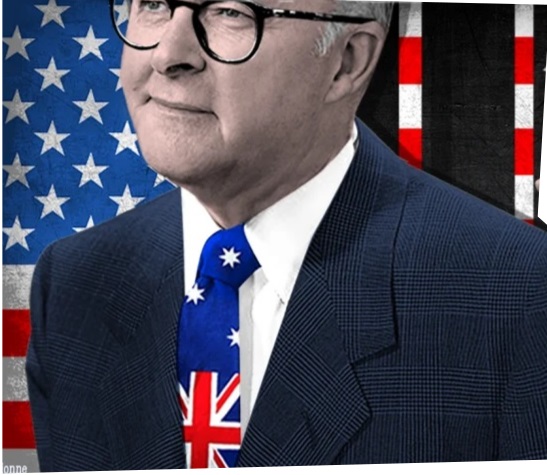
“So AUKUS is really about, in American terms, the military control of Australia. The government of Prime Minister Anthony Albanese is “likely to turn Australia into the 51st state of the United States.”
The former prime minister added that the expanded military presence makes the country a target from China’s point of view.
“We’re now defending the fact that we’re in AUKUS… If we did not have an aggressive ally, like the United States, aggressive to others in the region, there would be nobody attacking Australia. We are better left alone.”
The US, he argued, is trying to “superintend” China, with tensions between the two being fueled by a power struggle over the self-ruled island of Taiwan, which Beijing views as part of its sovereign territory.
However, Keating argued that the Taiwan situation “is not a vital Australian interest” while China “has no strategic design” on Australia. The US attitude to Taiwan is comparable to China deciding that Tasmania needed help breaking away from Australia, he said.
The former prime minister’s remarks come after Australian Defense Minister Richard Marles and Foreign Minister Penny Wong traveled to Washington for talks about the AUKUS pact, and to discuss a new agreement on the transfer of nuclear material to Canberra as part of its push to acquire domestic-built atomic submarines from the 2030s.
China has warned that the AUKUS agreement raises nuclear proliferation risks, adding that it was conceived in the “Cold War mentality which will only motivate an arms race.” Russia has also sounded the alarm about the security situation in the Asia-Pacific, insisting that it “has no place for closed military and political alliances.”
Australia makes undisclosed ‘political commitments’ in new AUKUS deal on transfer of naval nuclear technology

ABC News, By defence correspondent Andrew Greene, 8 Aug 2024
In short:
AUKUS partners have struck a revamped agreement to allow the transfer of US and UK naval nuclear material to Australia.
Critics of the trilateral submarine project warn the new document could eventually see high-level radioactive waste stored locally.
What’s next?
The agreement between the US, UK and Australia will need to be ratified by each AUKUS partner before coming into effect.
Undisclosed “political commitments” have been made between the Albanese government and its AUKUS partners in a new agreement for the transfer of naval nuclear technology to Australia, which critics warn is likely to also allow radioactive waste to be dumped here.
The White House confirmed Australia, the United Kingdom and the United States had reached another significant “AUKUS milestone” that set up further trilateral cooperation that would be essential for this country to build, operate and maintain nuclear-powered submarines.
Under the AUKUS “optimal pathway” unveiled in San Diego last year, Australia will spend up to $368 billion over the next three decades to first purchase second-hand Virginia-class submarines and then develop a new SSN-AUKUS fleet using British technology.
In a letter to speaker the US House of Representatives speaker and the US Senate president, President Joe Biden urged Congress to give the revamped AUKUS agreement “favourable consideration”
Mr Biden’s letter explains that the new agreement would permit the continued communication and exchange of Naval Nuclear Propulsion Information (NNPI), including certain Restricted Data (RD), only previously shared between the US and UK…………………………………………………………………..
Concerns over radioactive waste ‘loophole’
AUKUS critics, including the Greens party, warn that the new agreement is likely to eventually allow high-level radioactive waste to be stored in Australia and for uranium enrichment to be undertaken locally, but the government insists that is not the case.
“A political assurance is there — a legal assurance, a legislative assurance, an institutional assurance is not. That gate needs to be closed, that loophole needs to be closed,” warns Dave Sweeney, a nuclear free campaigner from the Australian Conservation Foundation.
“And that’s one of many concerns and many options for interpretation of how AUKUS is operationalised that can add greater pressure, nuclear threat in our ports, in our harbours and waters and on land around the management of radioactive waste.” https://www.abc.net.au/news/2024-08-08/australia-makes-political-commitments-in-new-aukus-deal/104200814
Nuclear shift in updated AUKUS deal
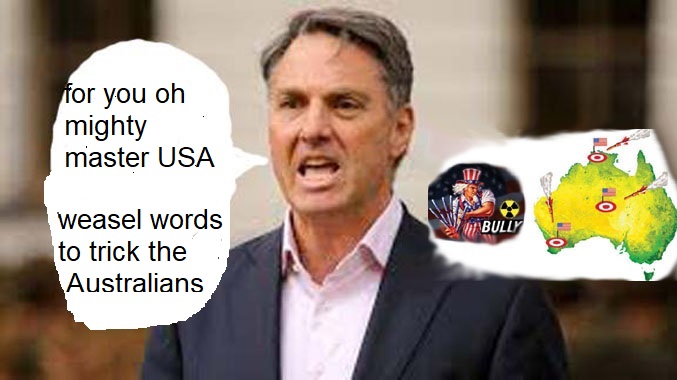
InDaily, 10 Aug 24
Australia’s acceptance of nuclear material from the US and UK has been officially approved as part of an updated AUKUS agreement.
The update to AUKUS was signed off during AUSMIN meetings in the US, the annual talks between Australian and US defence and foreign ministers.
Under the agreement, Australia will be formally permitted to take in nuclear material for the procurement of nuclear submarines.
The terms of the original deal, inked in March 2023, only allowed for the exchange of information about nuclear propulsion.
Defence Minister Richard Marles says the fresh agreement is a “foundational document” for the trilateral security pact……..
As part of the AUKUS agreement, Australia will acquire three Virginia-class vessels from the US before Australian-built nuclear submarines begin operating.
The $368 billion plan will bring eight nuclear-powered subs into service by the 2050s.
But the deal has come under renewed criticism from former prime minister Paul Keating, who says Australia is losing its autonomy by being part of it.
“AUKUS is really about, in American terms, the military control of Australia. I mean what’s happened? Our policy is likely to turn Australia into the 51st state of the United States,” he told ABC’s 7.30 program.
“The only threat likely to come for us is because we have an aggressive ally because of AUKUS.”………………………….
Australia would not be in a position to dispose of any nuclear material in the country until the 2050s, Marles said.
Details of the agreement were laid out in a letter to US Congress by President Joe Biden.
The agreement had also come under fire by Greens defence spokesman David Shoebridge, who said levels of secrecy about the terms of the deal was concerning.
“What is so damaging to the Albanese government with this new deal that it has to be kept secret from the Australian public?” he said.
“There are real concerns the secret understanding includes commitments binding us to the US in the event they go to war with China in return for getting nuclear submarines.”
It comes as opposition defence spokesman Andrew Hastie called for the WA government to include a minister dedicated to AUKUS in its cabinet. https://www.indaily.com.au/news/national/2024/08/09/australia-to-accept-nuclear-material-in-new-aukus-deal
For Australia, AUKUS and the planned nuclear submarines create more problems than solutions
Preposterous’: AUKUS creates more problems than solutions THE AUSTRALIAN,
The timelines for Australia’s transition from ageing Collins-class to its first nuclear-powered sub just don’t add up. There is hardly a single strategist in the country who believes it will happen. By CAMERON STEWART 10 Dec 21

Now that Australia has finally weathered the diplomatic fallout caused by the creation of the three-nation AUKUS pact, it is time to work out exactly what it means for the nation’s security.
The Morrison government faces a series of critical multi-billion dollar decisions in the coming year that will set the course of Australia’s maritime defence for the next half a century.
These will require Canberra to test the limits of its alliance with both the US and the UK to ensure they make good on their AUKUS promise to share their sensitive nuclear know-how to help Australia acquire a nuclear-powered submarine fleet.
………….But the not-so-good news is that AUKUS has delivered as many conundrums for Australia as it has solutions.
………. the AUKUS announcement and the related scrapping of the French submarine project offers far more problems than solutions.
The timelines for Australia’s transition from its ageing Collins-class submarines to its first nuclear-powered submarine just don’t add up. Put simply, unless something changes, Australia risks having either no submarine fleet or a grossly antiquated one in the late 2030s and early 2040s……..
The government has given itself up to 18 months from the AUKUS announcement in September to study its options, although it says it hopes to decide on a plan of action earlier.
………………… The trouble is that the government’s initial projection for the completion of the first of eight nuclear-powered submarines, which it claims will be built in Adelaide, is not until 2038, meaning it would not be brought into naval service for another two years after that, in 2040, with one new nuclear boat every three years after that. This timetable is hugely ambitious and there is hardly a single strategist in the country who believes this will happen. The lessons of naval shipbuilding in Australia is that a first-of-class boat is never completed on time, much less the building of a nuclear submarine – easily the most complex construction of its kind in the country’s history.
……….
The solutions that have been floated, in no particular order, are to shorten the process by building at least some of the nuclear submarines overseas rather than in Australia; lease nuclear submarines from the US or UK; build a new conventional submarine in Australia as an interim measure; or extend the life of the Collins for a second refit cycle, meaning they would be sailing into the 2050s.
Every one of these proposals is problematic.
………………….. if the government chooses not to build a new conventional submarine and it deems that the Collins can be extended only for a decade, rather than two decades, then the only option is to acquire nuclear submarines more quickly than the current 2040 guideline.
This is the option that Dutton is pursuing but it requires delicate diplomacy with Australia’s AUKUS partners. First, Dutton must decide whether to ditch the government’s intention to build the eight nuclear submarines in Adelaide. While building all boats here will maximise Australian defence industry content, it will almost certainly slow the project down compared to a decision which would allow at least the first few boats to be constructed in US or UK shipyards.
Second, Dutton must choose between acquiring the US Virginia-class or the UK’s Astute-class submarines. Neither the UK nor the US production lines have room to include Australian boats in the foreseeable future. Dutton would need to lean heavily on London or Washington to make room for Australian boats to be constructed in their own shipyards. In the US, it would probably require Australia to partly fund a third shipyard to build the Virginia-class boats because the current two shipyards are struggling to keep up with the orders of the US Navy.
Hellyer believes the choice between the two countries is simple. “With nuclear submarines, we are not just picking a boat we are picking a strategic partner and that can only be the US,” he says…….
However, ditching the British submarine option would require delicate diplomacy from Canberra given that Britain’s prime minister Boris Johnson promised that the AUKUS deal would create “hundreds” of highly skilled jobs across the UK and would reinforce Britain’s place “at the leading edge of science and technology”.
The Morrison government appears to have gone cold on the option of leasing nuclear submarines to get them into the navy earlier. On closer inspection, neither the UK or the US have submarines available to lease. And in any case, Australia does not have the crews or the skills to sail them.
It will take at least a decade and probably longer for Australia to be able to train enough crew to the high levels required to man a nuclear-powered boat. A vast amount of that training will need to be done in the US or UK while Australia builds up the nuclear infrastructure and knowledge that will be needed to crew, maintain and manage a nuclear fleet.
All of these options amount to multi-billion dollar decisions by the government. If the wrong option is chosen, it will not only hit taxpayers, but it could severely compromise the country’s defence for decades.
The stakes could not be higher as the government moves to turn AUKUS from rhetoric to reality. www.theaustralian.com.au/inquirer/aukus-gives-us-more-problems-than-solutions-and-our-safety-is-at-stake/news-story/fff5b011740957f5cc246eb641408894
AUKUS servility just one facet of poor governance
By Paul KeatingJul 31, 2024, https://johnmenadue.com/aukus-servility-just-one-facet-of-poor-governance/
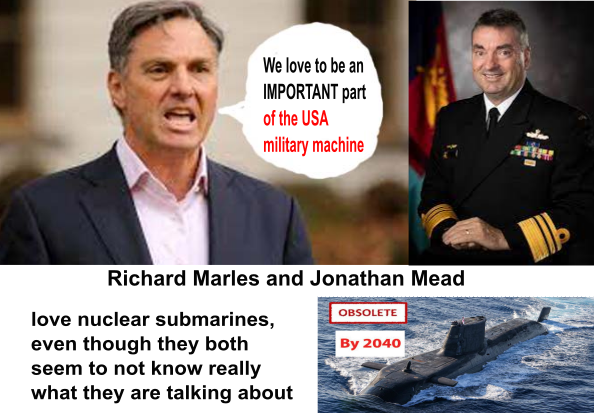
Richard Marles has the Navy out in force firing torpedoes at AUKUS critics.
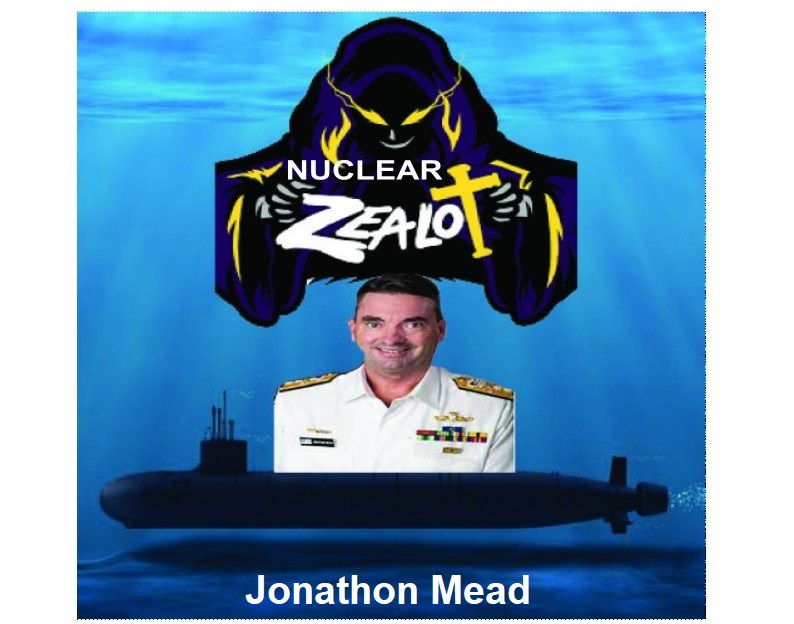
On Friday last, Vice Admiral Jonathan Mead claimed the critics need to produce evidence of any challenges to AUKUS being realised, then on Saturday, Vice Admiral Hammond, Chief of Navy, raised his periscope claiming the AUKUS debate was being ‘hijacked’ by people with ‘specific agendas’ without indicating what these agendas might be or who was likely making them.
The fact is, what clearly is being ‘hijacked’ is national accountability – accountability for the most wayward strategic and financial decision any government has taken since Federation.
Despite AUKUS’s half trillion of budgetary cost and its dangerous strategic implications there has not been one Ministerial Statement explaining its rationale, its strategic policy objective or defending its hugely distorting impact on government expenditures.
Not a coherent or persuasive word has come from the Minister for Defence or for that matter, the Prime Minister, let alone from a parliamentary debate on what is significantly a seminal turn in the country’s strategic and defence policy settings.
Vice Admiral Hammond, ignoring Australia’s geography – its residence among populous and prosperous Asian states, fell back on the old Anglo glee-club adage ‘three developed nations who have over 100 years of shared history, heritage, values and sense of purpose.’
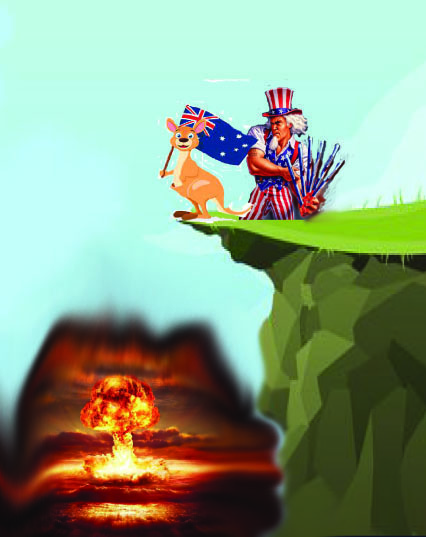
The likelihood is that Australia will not come into possession of nuclear submarines of its own making, but what it will certainly become is landlord and host to American nuclear submarines as the United States appropriates Australian real estate in its attempts, against all odds, to maintain strategic primacy in Asia. Odds that carry the likelihood of Australia being dragged into military skirmishes with China, or indeed, worse.
So irresponsible, secretive and smug has the government been in making its decision, that no amount of ‘hijacking’ by anyone else is likely to disrupt Australia from its current path of effectively falling into American hands, or at least, being abjectly at America’s beck and call.
Republished from Australian Financial Review, July 30, 2024
Experts argue for an Australian ban on nuclear weapons ahead of UN Summit
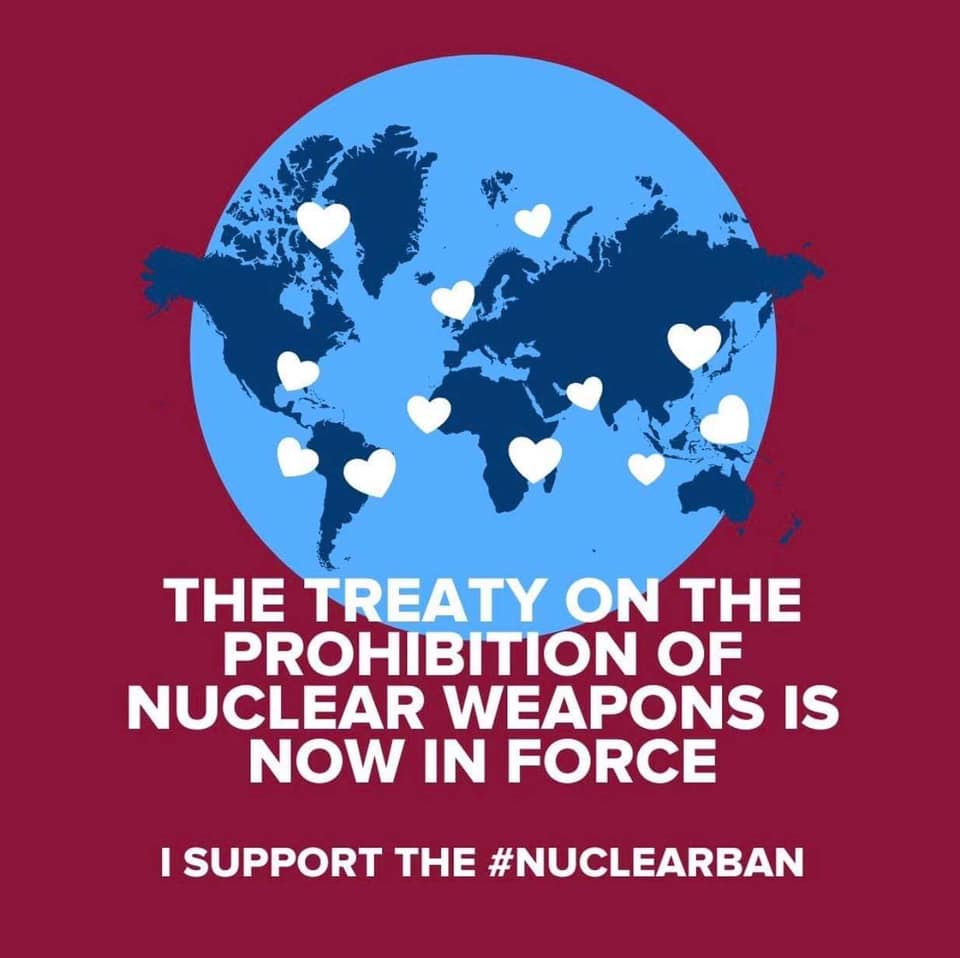
University of Melbourne experts are urging Australia to sign and ratify the UN Treaty on the Prohibition of Nuclear Weapons (TPNW) to commit most effectively to nuclear disarmament and non-proliferation.
The argument was made in ‘Luck is not a strategy: it’s time to prohibit Nuclear Weapons’, the second paper in a series prepared by the University of Melbourne’s Initiative for Peacebuilding to stimulate discussion of key issues on the agenda at the upcoming UN Summit of the Future.
Associate Professor Tilman Ruff AO, co-founder of the International Campaign to Abolish Nuclear Weapons (ICAN), which received the 2017 Nobel Peace Prize, ICAN Australia director Gem Romuld and Executive Director of ICAN Melissa Parke argue it is important Australia signs the Treaty before taking a seat on the UN Peacebuilding Commission in 2025.
Almost half the world’s nations have already joined the TPNW, which contains the only comprehensive prohibition of nuclear weapons and the only internationally agreed framework to eliminate nuclear weapons in a time-bound, verified way.
The TPNW is also the first nuclear weapons agreement to address the harm done by nuclear weapons use and testing.
Associate Professor Ruff argues Australia’s involvement is particularly critical given the number of available deployed nuclear weapons is increasing for the first time in two decades, along with explicit nuclear threats, and two nuclear-armed states – Russia and Israel – are prosecuting war, risking nuclear escalation.
No disarmament negotiations are underway, while hard won treaties limiting nuclear weapons have been abolished.
“Additional signatories, such as Australia, will contribute to the universalisation of the ban treaty, and its effectiveness,” Associate Professor Ruff said.
“For as long as we remain outside the treaty, promoting a role for nuclear weapons and assisting in their possible use in our defence policies, we are contributing to the problem.”
The Summit of the Future will be held from 22–23 September 2024 in New York, gathering world leaders to forge a new international consensus on how we deliver a better present and safeguard the future.
The Initiative for Peacebuilding, which brings together multidisciplinary research, engagement, and education to advance peacebuilding and conflict prevention in the Indo-Pacific region, plans to release a series of five policy briefs ahead of the Summit.
Associate Professor Ruff called for Australian leaders to harness this moment of great danger to sign the TPNW and then work towards ratification, just as Australia has joined the treaties banning other inhumane and indiscriminate weapons, including chemical and biological weapons, landmines and cluster munitions.
“Nuclear weapons are abhorrent, immoral, and illegal under international law. They are the worst weapons of mass destruction, and have no place in a secure and healthy future. Australia needs to signal its firm agreement and expedite signature and ratification of the UN-TPNW,” he said.
Australia further in the grip of the USA, with the Amazon data spy hub – paid for by Aussie tax-payers!
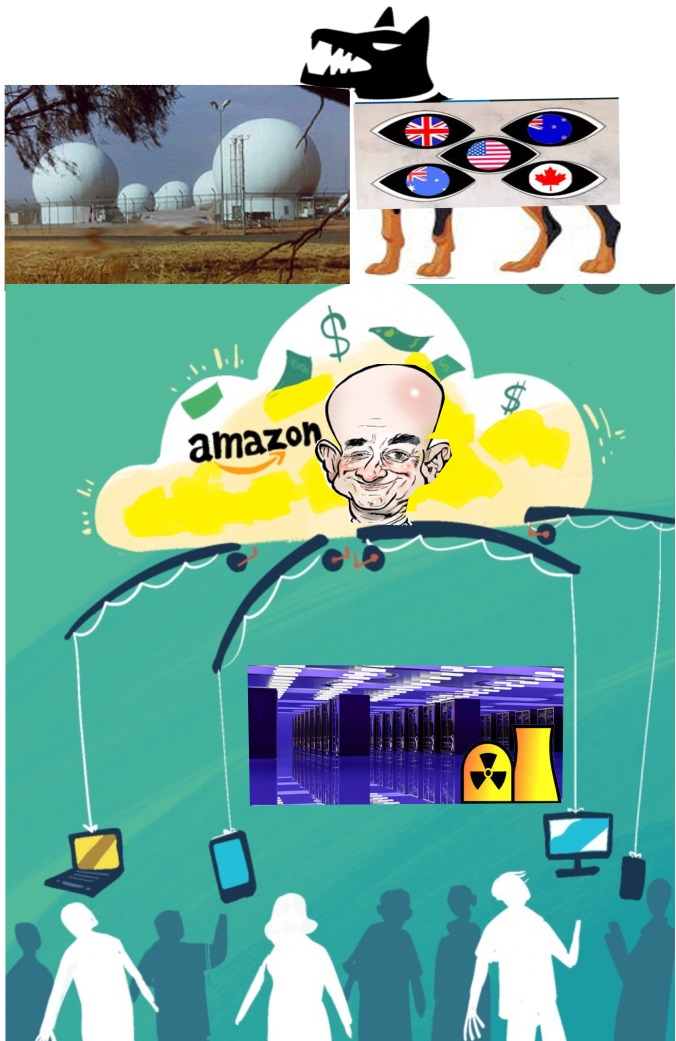
Australia’s Defence Minister Richard Marles was ecstatic as he announced the secret deal now organised for Australia to pay for Amazon to set up secret spy databanks, just as he was ecstatic about the government’s AUKUS deal for buying nuclear submarines from USA and UK
It’s not as if the public knew about either of these decisions beforehand, (the AUKUS one being largely arranged with scandal-ridden consultancy PWC). It’s not as if these matters were discussed in Parliament. On both occasions, the government just did it.
Points that haven’t been addressed:
Australian taxpayers again foot the bill to an America private company
Amazon private staff will be running the operation – with access to the data?
The whole thing perpetrates the lie about the data being “in the cloud” – but there is no “cloud”. The data will be in gigantic steel containers, set out on a large area.
The data containers will require massive amounts of electricity. ? supplied by nuclear power
The data containers will require massive amounts of cooling water, in this dry, water-short country..
The whole set up, just like the now-being expanded Pine Gap. will form a dangerous target for terrorists, or for enemies of the USA.
Like Pine Gap, it is probable that Australian authorities will have limited access to the information. And as artificial intelligence is involved – who IS going to be in control?
And what’s to stop the USA officials and the Australian government spying on Australian individuals via the Five Eyes?
The whole set-up will be the servant of the Five Eyes, secret intelligence of five English-speaking countries, ( no trust in Europe, or any non-anglophone nation) but controlled by the USA.
The vast amount of tax-payer money going to all this means the money is not going to Australians’ health, welfare, education, environment, climate action – in other words to the common good.
As the USA Supreme Court has just made the U.S. president effectively above the law – this secret deal with Amazon and the USA puts Australia more firmly in the grip of the USA – (and God help us if Trump wins).
The Release of Julian Assange: Plea Deals and Dark Legacies
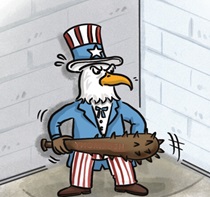
It ultimately goes to the brutal exercise of US extraterritorial power against any publisher, irrespective of outlet and irrespective of nationality…………….. the measure extracts a pound of flesh from the fourth estate. It signals that the United States can and will seek out those who obtain and publish national security information that they would rather keep under wraps under spurious notions of “harm”.
June 27, 2024, by: Dr Binoy Kampmark https://theaimn.com/the-release-of-julian-assange-plea-deals-and-dark-legacies-2/
One of the longest sagas of political persecution is coming to its terminus. That is, if you believe in final chapters. Nothing about the fate of Julian Assange seems determinative. His accusers and inquisitors will draw some delight at the plea deal reached between the WikiLeaks founder’s legal team and the US Department of Justice. Others, such as former US Vice President, Mike Pence, thought it unjustifiably lenient.
Alleged to have committed 18 offences, 17 novelly linked to the odious Espionage Act, the June 2020 superseding indictment against Assange was a frontal assault on the freedoms of publishing and discussing classified government information. At this writing, Assange has arrived in Saipan, located in the US commonwealth territory of Northern Mariana Islands in the Western Pacific, to face a fresh indictment. It was one of Assange’s conditions that he would not present himself in any court in the United States proper, where, with understandable suspicion, he might legally vanish.
As correspondence between the US Department of Justice and US District Court Chief Judge Ramona V. Manglona reveals, the “proximity of this federal US District Court to the defendant’s country of citizenship, Australia, to which we expect he will return at the conclusion of proceedings” was also a factor.
Before the US District Court for the Northern Mariana Islands, he will plead guilty to one count of conspiracy to obtain and disclose national defence information under the Espionage Act of 1917, or section 793(g) (Title 18, USC). The felony carries a fine up to $10,000 and/or up to 10 years in prison, though Assange’s time in Belmarsh Prison, spent on remand for some 62 months, will meet the bar.
The felony charge sheet alleges that Assange knowingly and unlawfully conspired with US Army intelligence analyst Chelsea Manning, then based at Operating Base Hammer in Iraq, to receive and obtain documents, writings and notes, including those of a secret nature, relating to national defence, wilfully communicated those documents from persons with lawful possession of or access to them to those not entitled to receive them, and do the same from persons unauthorised to possess such documents.
Before turning to the grave implications of this single count and the plea deal, supporters of Assange, including his immediate family, associates and those who had worked with him and drunk from the same well of publishing, had every reason to feel a surreal sense of intoxication. WikiLeaks announced Assange’s departure from London’s Belmarsh Prison on the morning of June 24 after a 1,901 day stint, his grant of bail by the High Court in London, and his release at Stansted Airport. Wife Stella regularly updated followers about the course of flight VJ199. In coverage posted of his arrival at the federal court house in Saipan, she pondered “how overloaded his senses must be, walking through the press scrum after years of sensory depravation and the four walls” of his Belmarsh cell.
As for the plea deal itself, it is hard to fault it from the emotional and personal perspective of Assange and his family. He was ailing and being subjected to a slow execution by judicial process. It was also the one hook upon which the DOJ, and the Biden administration, might move on. This being an election year in the US, the last thing President Biden wanted was a haunting reminder of this nasty saga of political persecution hovering over freedom land’s virtues.
There was another, rather more sordid angle, and one that the DOJ had to have kept in mind in thinning the charge sheet: a proper Assange trial would have seen the murderous fantasies of the CIA regarding the publisher subject to scrutiny. These included various possible measures: abduction, rendition, even assassination, points thoroughly explored in a Yahoo News contribution in September 2021.
One of the authors of the piece, Zach Dorfman, posted a salient reminder as news of the plea deal filtered through that many officials during the Trump administration, even harsh critics of Assange, “thought [CIA Director Mike] Pompeo’s extraordinary rendition plots foolhardy in the extreme, and probably illegal. They also – critically – thought it might harm Assange’s prosecution.” Were Pompeo’s stratagems to come to light, “it would make the discovery process nightmarish for the prosecution, should Assange ever see trial.”
From the perspective of publishers, journalists and scribblers keen to keep the powerful accountable, the plea must be seen as enormously troubling. It ultimately goes to the brutal exercise of US extraterritorial power against any publisher, irrespective of outlet and irrespective of nationality. While the legal freight and prosecutorial heaviness of the charges was reduced dramatically (62 months seems sweetly less imposing than 175 years), the measure extracts a pound of flesh from the fourth estate. It signals that the United States can and will seek out those who obtain and publish national security information that they would rather keep under wraps under spurious notions of “harm”.
Assange’s conviction also shores up the crude narrative adopted from the moment WikiLeaks began publishing US national security and diplomatic files: such activities could not be seen as journalistic, despite their role in informing press commentary or exposing the venal side of power through leaks.
From the lead prosecuting attorney Gordon Kromberg to such British judges as Vanessa Baraitser; from the national security commentariat lodged in the media stable to any number of politicians, including the late California Democrat Dianne Feinstein to the current President Joe Biden, Assange was not of the fourth estate and deserved his mobbing. He gave the game away. He pilfered and stole the secrets of empire.
To that end, the plea deal makes a mockery of arguments and effusive declarations that the arrangement is somehow a victory for press freedom. It suggests the opposite: that anyone publishing US national security information by a leaker or whistleblower is imperilled. While the point was never tested in court, non-US publishers may be unable to avail themselves of the free speech protections of the First Amendment. The Espionage Act, for the first time in history, has been given a global, tentacular reach, made a weapon against publishers outside the United States, paving the way for future prosecutions.
Israeli ‘extremist’ tells Australian audience Gaza should have been reduced to ashes
The Age, By Chip Le Grand, June 21, 2024
A former Israeli parliamentarian who once held a position in Benjamin Netanyahu’s government told an online gathering of Australian Jews this week that Israel should have abandoned adherence to international law and reduced Gaza to ashes.
In a series of incendiary claims, Moshe Feiglin, the leader of Israel’s far-right Zehut party, said there was no such thing as Palestinians, Palestinian statehood was the biggest lie of the 20th century and that Gaza should be resettled by Jewish Israelis and Arab families encouraged to leave.
“What Israel should have done to Gaza, on the 8th of October, was exactly what the British people did in Hamburg and Dresden, and exactly what the American people did in every Japanese city they could reach,” he told a Zoom meeting hosted by the Australian Jewish Association (AJA).
“They burnt them to ashes. No ridiculous humanitarian aid. They burnt those cities.
“If we had done that, we would have won the war in a few days and many of the hostages would be free today.”
The association’s invitation for Feiglin to speak, at a time when the war has bitterly divided Australian communities and unleashed antisemitic attacks on Jewish people, businesses and politicians, was condemned by Palestinian and Jewish community organisations……………………………………………………………………………………………………………………………..more https://www.theage.com.au/national/israeli-extremist-says-gaza-should-have-been-reduced-to-ashes-20240620-p5jnac.html
Australian Futures: Bringing AUKUS Out of Stealth Mode, and the true financial costs

June 21, 2024, by: The AIM Network, By Denis Bright
With both sides of the mainstream Australian political divide supporting the AUKUS deal, debate about the merits of this commitment by Scott Morrison has largely gone into recess.
As the third anniversary of Scott Morrison’s announcement of the AUKUS deal on 16 September 2021 approaches, there is growing confidence in the defence establishment that Australians have accepted the need for nuclear-powered submarines. The Defence Special Supplement in The Australian (28 May 2024) is a sign of this confidence. Multinational defence companies have lined up to fund advertisements which demonstrated their patriotic commitment to AUKUS with the support of the South Australia Government.
Each of the defence companies listed maintains a profitable involvement in both military and civilian projects. The KBR engineering company of Houston emphasizes a benign involvement in Australian civilian engineering projects like the Snowy Mountains upgrade and the Adelaide to Darwin Railway. This company is more deeply involved in the military sector globally.
Readers with access to the Defence Supplement can undertake their own research to uncover the ownership and activities of each of the British and US companies listed in the supplement. Here is a sample of the defence outreach from KPR Engineering:
KBR’s Defense Systems Engineering Business Unit goes beyond providing full spectrum engineering and technical solutions across the lifecycle of DoD military systems on land, at sea, in the air, and in space. KBR differentiates itself in the industry by integrating emerging technologies with platform experience to deliver increased value to US DoD and our allies.
Advertising in combination with sensational eyewitness news reporting works in eroding resistance to AUKUS. The Lowy Institute has monitored quite favourable public support for AUKUS arrangements:
Expect concerns about AUKUS to resurface in the future as the cost burdens increase and the encirclement of China by the US Global Alliance takes its toll on longer-term trade and investment relationships between Australia and China. Strategic mishaps are always possible as surface vessels and submarines compete for space in the South China Sea, the Taiwan Strait and the East China Sea. Sabre rattling over uninhabited rock outcrops and remote islands has continued for a couple of decades over rival claims about freedom of navigation. Fortunately. There have been no major mishaps.
Ironically, the US has not ratified the UN’s Freedom of Navigation conventions from the 1980s. Its strategic policies seek alternatives to Chinese trade and investment links with countries across the US Global Alliance as an afford to the peace outreach of China:
The costs of the AUKUS extend well beyond the financial and strategic costs of future naval hardware. Australia’s support for the naval encirclement of our best trading partnership will have an unknown impact on our own regional economic diplomacy. Australia’s Future Fund Chief Executive Dr Raphael Arndt dared to warn that global strategic tensions had intruded into financial decision-making and risk assessments (AFR Weekend 15 June 2024). The longer-term impact on Australian trade and investment with China is still a matter for speculation.
Financial Costs of AUKUS
According to Al Jazeera News (11 June 2022), the Albanese government completed a final payment to France of approximately $850 million for breach of contract over the abandonment of the purchase of twelve Attack-class submarines from Naval Group. Despite cost increases and construction delays, delivery of the diesel-electric submarines should have commenced in the late 2020s at a cost that was a fraction of the AUKUS estimates.
The costs of the AUKUS deal are less transparent. Construction costs alone extending over 30 years were initially set at up to $368 billion (AFR 17 March 2023). The extended delivery dates are a cause for concern. US and British supplied nuclear-powered (SSN) submarines might be deployed here in the late 2020s. At least three Virginia class submarines will be built for Australia with a new class of British submarines arriving in the late 2030s before Australian built SSNs come online in the 2040s.
Strategic Risks
Hopefully, the strategic risks of maintaining a new SSN fleet were considered prior to the AUKUS announcement by Scott Morrison on 16 September 2021. How could this have been achieved competently with a critical review from only three cabinet ministers?
Media concerns should have been raised after Scott Morrison claimed in the 7.30 Report interview with Sarah Ferguson that discussions on the AUKUS alternatives were made with just two other ministers at a time when he held multiple ministerial portfolios with the approval of the Australian Governor General between March 2020 and the election in 2022 (14 March 2023).
Before attending the G-7 Summit in Cornwall as a specially invited guest of the Summit Chair Boris Johnson, Scott Morrison had been sworn into the portfolios of Health, Finance, Industry, Science, Energy and Resources, Home Affairs and Treasury. The 47th G-7 Summit convened a month after Scott Morrison’s last two ministerial appointments. Perhaps Boris Johnson could be quizzed on this issue. Both Boris Johnson and Scott Morrison met in person at the G7 Summit in Cornwall (11-13 June 2021). It is logical for them to have discussed the emergent AUKUS deal which was hardly the brainchild of Scott Morrison as claimed by Sky News (27 February 2024).
New SSN submarines place at risk our currently favourable economic diplomacy with China. There are hazards for extended operations in stealth mode in disputed waters. Readers can always investigate the risks of accidental collisions, mechanical malfunction, radioactive hazards and psychological stress on crew members.
Even in friendly waters off Hawaii, the USS Greeneville (SSN-772) surfaced too close to a Japanese fishery high school training ship Ehime Maru. It sank with the loss of nine people on 9 February 2001.
A show of force to diffuse a territorial dispute is an archaic concept. Such gimmicks belong to the pre-1914 era. Both Britain and the US have a long history of involving middle powers in bolstering their strategic outreach…………………………………………………………………………………………………………………………
Both sides of Australian mainstream politics want to hoist those imperial umbrellas at great financial and strategic costs to future generations. Continuing to quiz political insiders about the consequences of their strategic and diplomatic policies is imperative in these troubled times. Asking questions should be imperative for all political parties. https://theaimn.com/australian-futures-bringing-aukus-out-of-stealth-mode/
Why bet on a loser? Australia’s dangerous gamble on the USA
June 15, 2024, by: The AIM Network, By Michael Williss, https://theaimn.com/why-bet-on-a-loser-australias-dangerous-gamble-on-the-us/
A fresh warning that the US will lose a war with China has just been made by a US data analytics and military software company with US Department of Defense contracts.
It seems no-one is prepared to back the US to win a war with China, so why is Australia going all-out to align itself with provocative moves and hostility from the US directed at China?
Govini released its latest study of US capacity to fight China in June. Its annual reports measure the performance of the US federal government, looking at 12 top critical national security technologies through the lens of acquisition, procurement, supply chain, foreign influence and adversarial capital and science and technology.
It concluded that it is nearly impossible for the US to win a war against the PLA if a conflict were to break out between the two global superpowers.
The report also found that China has more patents than the US in 13 of 15 critical technology areas, further demonstrating how the US is falling behind in AI development.
“This year’s report also highlighted another reason a US conflict with China could be unwinnable: the very real possibility of parts scarcity.”
It identified serious risks within seven major DoD programs, including the cornerstone of AUKUS, namely the Virginia-class submarines. Not that this will worry the cargo-culters in Canberra who keep throwing billions at the fraught arrangement.
Another factor was China’s lead in the global supply chains.
-ADVERTISEMENT-
Govini CEO Tara Murphy Dougherty said:
”China still has a dangerously high presence in US government supply chains. The Departments of the Navy and Army showed a decreasing reliance on Chinese suppliers over the past year, however, the Department of the Air Force showed a 68.8 percent increase in the usage of Chinese suppliers.”
Govini’s report adds to a number of similar scenarios in recent years, starting with the headlined warning by The Times on May 16, 2020 “US ‘would lose any war’ fought in the Pacific with China.”
In the New Atlanticist, Lieutenant Colonel Brian Kerg, an active-duty US Marine Corps operational planner, critiqued biases in modern US war games, in which military planners command opposing armed forces in simulated warfare. He writes that instead of a short, sharp war over Taiwan with a win for the US, as predicted by war games, the greater likelihood is one of a years-long war with China with uncertain outcomes. One of those, too terrible to contemplate, must be the likelihood of Chinese retaliation against Australia for joining the US, for being fully interoperable with its military, and the consequent rubbleisation of Australian cities and attacks on US military bases here.
Retired US Army Colonel Dr John Mauk agrees that any conflict over Taiwan will almost certainly be a prolonged war, and he says that it would be one that favours China. He writes:
“U.S. military forces are too small, their supply lines are too vulnerable, and America’s defense industrial capacity is far too eroded to keep up with the materiel demands of a high-intensity conflict. Another critical factor undermining U.S. capacity to sustain a war is that Americans lack the resilience to fight a sustained, brutal conflict.”
By contrast, China is well-postured to sustain a protracted high intensity war of attrition.
He says that the current political divide in the US impedes its ability to respond to national security crises, and that:
“Americans in general are unprepared for, unwilling, or incapable to perform military service. Short of reinstituting a draft, U.S. military services cannot attract or retain enough manpower quickly enough to sustain a fight with China.”
Former US assistant secretary of state for Europe and Eurasia, A. Wess Mitchell, believes that “United States is a heartbeat away from a world war that it could lose.” He writes that:
“… today’s U.S. military is not designed to fight wars against two major rivals simultaneously. In the event of a Chinese attack on Taiwan, the United States would be hard-pressed to rebuff the attack while keeping up the flow of support to Ukraine and Israel.”
Comparing US and Chinese naval growths, Mitchell says that the US is no longer able to “outproduce its opponents”. With US debt already in excess of 100% of GDP, he says that the debt loads incurred through war with China would risk catastrophic consequences for the U.S. economy and financial system.
He raises the possibility of a Chinese fire-sale of US debt:
“China is a major holder of U.S. debt, and a sustained sell-off by Beijing could drive up yields in U.S. bonds and place further strains on the economy.”
Hillary Clinton raised this quandary facing the US with then PM Kevin Rudd in 2010 when she asked him “How do you deal toughly with your banker?” It is a question that the US has yet to find an answer to.
And questions there are. Harlan Ullman, a senior adviser at the Atlantic Council, opens a January 2024 article with the observation that:
“Since World War II ended, America has lost every war it started. Yes, America has lost every war it started – Vietnam, Afghanistan and the second Iraq War.”
He sounds a warning:
“… given likely weapons expenditure rates should a war with China erupt, the U.S. has the capacity for about a month before, as in Ukraine, it runs out of inventory,” before asking his questions: “War with China would be a strategic catastrophe. The U.S. has not explained how such a war could be fought and won. The economic consequences would be disastrous. And how would such a war end? Can anyone answer these questions?”
China is quite adept at utilising sentiments such as these. Major Franz J. Gayl, a retired Marine Corps infantry officer has regularly written for Chinese online news outlet Global Times. Last year, a number of his contributed articles to GT were published as a book, “The United States Will Lose the Coming War with China” which is available on Amazon.
Australia’s Liberal-Labor pro-US coalition has placed a $368 billion bet on the ability of the US to prevent the expansion of Chinese influence in the South Pacific or its recovery of the island province of Taiwan.
It is an expensive way to be taught the African proverb that when the elephants dance, it is the grass that suffers.
A Detectable Subservience – Australia’s ill-fated nuclear submarine deal?

All of this leaves one wondering about just what due diligence was done before Morrison, and the 24-hour copycat decision-maker Albanese, committed us to the folly of paying $A368 billion to purchase a subservient position embedded within the US war machine by means of a soon-to-be fully detectable and therefore likely to be destroyed fleet of nuclear-powered submarines.
June 6, 2024 by: The AIM Network, By Michael Willis, https://theaimn.com/a-detectable-subservience/
The first operational outcome of the Pillar 2 AUKUS arrangement between the US, UK and Australia has just been announced.
The three countries will share data from their submarine-hunting PA-8 Poseidon aircraft, manufactured by the troubled Boeing Corporation.
This was announced on May 29 in an “exclusive interview” given to US online website Breaking Defense by Michael Horowitz, whose office serves as the Pentagon’s day-to-day lead on AUKUS issues.
(In a deliciously ironic slip, the website referred to the United Kingdom as the “Untied Kingdom”, true of the political cohesion of both the UK and the US at this time.)
All three AUKUS nations:
“… operate the Boeing-made maritime surveillance aircraft; the US operates 120, Australia 12, and the United Kingdom nine. A key part of the P-8 is its collection of sonobuoys, which are dropped into the water to hunt down submarines. (“Sonobuoys” is the preferred US-spelling of the English language “sonar buoys”.)
According to Horowitz, the Pentagon’s Deputy Assistant Secretary of Defense for Force Development and Emerging Capabilities, a new “trilateral algorithm” will allow them to share information from P-8 sonar buoys between each other.
According to Breaking Defense, the trilateral algorithm requires a high level of trust between the three countries.
“Even among Five Eyes partners,” it says, “sonobuoy information is highly sensitive, as sharing that data not only makes clear what each country has the ability to gather and where those buoys are deployed, but because it clearly reveals what and where each country is tracking.”
Pillar 2 arrangements build on those of Pillar 1 which are solely concerned with Australia’s acquisition of the hugely expensive nuclear-powered submarines.
At a cost averaged out at $A33 million a day over 35 years, we are promised a fleet of 8 submarines with the apparent advantages of extended range and endurance, higher speed, increased payload capacity, and reduced refuelling needs.
But given our own use of sonar buoys and knowing that our own all-but-at-war with “enemy”, China, has the same or superior detection technologies, it is the claim that SSNs (nuclear-powered submarines) have greater stealth and reduced detectability that is the major sales pitch justifying our $368 billion spend.
SSNs are claimed to have reduced noise and to be able to operate at greater depths, thus making them harder to detect.
Reduced noise will affect passive sonar buoys which listen for sounds generated by submarines. These sounds can include engine noise, propeller cavitation, or other mechanical noises.
Greater depth will affect active sonar buoys, those that send out a sound wave which then bounces off the submarine, allowing the buoy to detect the “ping” that travels back to the buoy. That ping is weaker the greater distance it has to travel.
Former Senator and submariner Rex Patrick was critical of the AUKUS decision for Australia to begin its SSN acquisition with the purchase of three second-hand Virginia Class SSNs from the US.
“The first highly noticeable issue with the Virginia class is a problem that has surfaced with the submarine’s acoustic coating that’s designed to reduce the ‘target strength’ of the submarine (how much sound energy from an enemy active sonar bounces off the submarine, back to the enemy),” he said.
“The coating is prone to peeling off at high-speed leaving loose cladding that slaps against the hull, making dangerous noise, and causes turbulent water flow, which also causes dangerous hull resonance (where the hull sings at its resonant frequency, like a tuning fork) and extra propulsion noise. I know a bit about this as a former underwater acoustics specialist.”
Magnetic Anomaly Detection (MAD) is another method of detection. MAD detects disturbances in the Earth’s magnetic field caused by the metal hull of a submarine. MAD sensors are typically deployed on aircraft and can detect submarines at relatively close ranges. The signals weaken with distance.
However, the Chinese are developing the ability to detect extremely low frequency (ELF) electromagnetic signal produced by speeding subs.
Researchers from the Chinese Academy of Sciences’ Fujian Institute of Research on the Structure of Matter found an ultra-sensitive magnetic detector could pick up traces of the most advanced submarine from long distances away.
The researchers calculated that the extremely low frequency (ELF) signal produced by a submarine’s bubbles could be stronger than the sensitivities of advanced magnetic anomaly detectors by three to six orders of magnitude.
The bubbles are an inevitable consequence of the submarine’s cruising speed, which causes the water flowing around the hull to move faster as its kinetic energy increases and its potential energy – expressed as pressure – decreases. When the pressure decreases sufficiently, small bubbles form on the surface of the hull as some of the water vaporises. This process causes turbulence and can produce an electromagnetic signature, in a phenomenon known as the magnetohydrodynamic (MHD) effect.
Though faint, ELF signals can travel great distances, thanks to their ability to penetrate the water and reach the ionosphere, where they are reflected back to the Earth’s surface.
Detection by ELF turns the advantage of an SSNs higher speed into its opposite, namely the disadvantage of higher detectability.
This ability of science to increase the detection of SSNs led even the pro-US Australian Strategic Policy Institute (ASPI) to publish a warning that “the oceans of tomorrow may become ‘transparent’. The submarine era could follow the battleship era and fade into history.”
It titled its article on a study of submarine detection by Australian scientists and academics “Advances in detection technology could render AUKUS submarines useless by 2050.”
According to the authors:
“The results should ring alarm bells for the AUKUS program to equip Australia with nuclear-powered submarines. Our assessment suggests that there will only be a brief window of time between the deployment of the first SSN AUKUS boats and the onset of transparent oceans.”
However, it is the expanding frontier of quantum computing that may be the ultimate nail in the AUKUS submarines coffin.
Quantum computing is the sexy new kid on the block – witness the Australian government’s investment of almost a billion dollars in a bid to build the world’s first commercially useful quantum computer in Brisbane. It’s bound to make the shareholders of US company PsiQuantum very happy, including notorious corporate investors such as Black Rock.
In July 2016, the Australia government awarded a contract to local company Q-CTRL to develop a quantum navigation system can use the motions of a single atom to precisely determine the course and position of a submarine and maintain accuracy to a remarkable degree. This overcomes two disadvantages of navigation by GPS: GPS is vulnerable to jamming by an adversary, and its signals cannot penetrate sea water to any appreciable depth.
That’s the good news story.
The bad news is that China has already funded its multi-billion-dollar National Quantum Laboratories to develop quantum-based technology applications for “immediate use to the Chinese armed forces”, possibly including targeting stealthy submarines.
According to Zhu Jin in The Conversation:
“New quantum sensing systems offer more sensitive detection and measurement of the physical environment. Existing stealth systems, including the latest generation of warplanes and ultra-quiet nuclear submarines, may no longer be so hard to spot.”
Using devices that measure and analyse the gravitational pull exercised by the mass of a submarine on the movement of sub-atomic particles in a sensor would overcome the disadvantages of sonar buoys and magnetometers, rendering any otherwise undetectable object with mass detectable.
The other area in which China is more advanced than its competitors is the use of quantum computing for encryption and decryption of communications.
In a 2022 paper on Quantum Computing and Cryptography, the authors that:
“China has set the pace for creating secure quantum communications that cannot be intercepted or manipulated. Further advances in Chinese quantum communication networks, especially networks designed for military use, will put the Navy at increased risk when deployed to the Indo-Pacific. If Chinese communications are virtually unbreakable and U.S. Navy communications can be exploited by Chinese quantum code-breaking technology, it will quickly lose its ability to safely operate among PLAN forces.”
All of this leaves one wondering about just what due diligence was done before Morrison, and the 24-hour copycat decision-maker Albanese, committed us to the folly of paying $A368 billion to purchase a subservient position embedded within the US war machine by means of a soon-to-be fully detectable and therefore likely to be destroyed fleet of nuclear-powered submarines.
Michael Williss is a member of the Australian Anti-AUKUS Coalition (AAAC) and the Independent and Peaceful Australia Network (IPAN).
Australia, Israel and the ICC. One rule for Ukraine, another for Palestine

by Ian McGarrity | May 28, 2024 https://michaelwest.com.au/australia-israel-and-icc-one-rule-for-ukraine-another-for-palestine/
Already on trial for genocide, Israel has defied the International Court of Justice and amped up its slaughter of Palestinians. Ian McGarrity looks at the ‘global rules based order’, Australia and the predicament for world justice.
ICJ orders and ICC’s Netanyahu arrest warrant
How many times have you heard Australian political leaders and senior bureaucrats intone our country’s belief in, and strategic reliance on the international community conforming to the ‘rules-based international order’?
But how consistent is a country like Australia likely to be when faced with supporting orders and obligations flowing from last week’s actions of rules-based entities like the International Criminal Court (ICC) and International Court of Justice (ICJ) when it doesn’t suit us or our own domestic values environment? Let alone those espoused by our ally, the United States?
The ICC is like a standing war crimes entity that deals with individuals accused of committing certain prescribed international crimes who are not likely to be dealt with by their own nation’s judicial system. The ICJ is a UN instrumentality dealing with disputes between countries.
Anthony Albanese and our urbane Foreign Minister, Penny Wong, are currently trying to navigate the complex thicket the ICC and ICJ have presented them. And the PM is seemingly not making a great fist of mastering the nuanced political, and arcane legal language used by the ICJ and the ICC in their respective orders and actions concerning the Gaza war last week.
ICJ orders and ICC’s Netanyahu arrest warrant
The ICJ made orders on May 17, which, on their face, appear to require Israel to cease military operations in the Gaza city of Rafah. The language of these orders is so tortured from seeking compromise and agreement from 13 of the 15 relevant judges, that international legal experts and the two dissenting judges are not really sure of their exact legal meaning.
Yet international political commentators seem to have no such difficulty interpreting the majority of the ICJ’s Rafah orders. They often take a small amount of knowledge and understanding and organically grow that into awesome conclusions that may not be factually sound.
The Chief Prosecutor of the ICC, on the other hand, put very clear meat on his bones regarding the action he wants: for a three-judge panel of the ICC to approve the issuing of arrest warrants against three Hamas leaders and the Prime Minister and Defence Minister of Israel. And if those arrest warrants are issued, for the 124 signed-on member countries of the ICC, including Australia, to arrest any of those five should they land in Australia.
One senior Australian Government Minister, Chris Bowen, has supported what he believes (really can he be sure he knows) the ICJ has ordered Israel to do by saying: “Australia believes international law should be complied with”.
Australia believes the binding rulings (of the ICJ) should be complied with, and we believe Rafah should not be invaded by Israel.
I wonder whether he’ll be as certain of his position if the Benin, Romanian and Mexican ICC judge panel of three decides Australia should arrest the Israeli Prime and Defence Ministers in accordance with the arrest warrant the ICC’s Chief Prosecutor seeks.
Or will he say the 124 members of the ICC are obligated to arrest the three Hamas leaders should their arrest warrants be approved, but remain silent on any applying to Benjamin Netanyahu and Yoav Gallant?
Australia’s response
Our PM, of course, and Foreign Minister Wong back in January had already opined that they did not agree with the basic premise of the genocide case South Africa brought before the ICJ.
Presumably, that means they must have some doubts about the ICJ orders last Friday (even if Bowen does not) concerning Israel and Rafah, which, also presumably, to some extent support the contention before the ICJ that genocide is happening or about to happen in Gaza.
So much for our PM’s reluctance last week to comment mid-stream on the ICC’s arrest warrant process when he and Wong clearly did just that back in January concerning the ICJ process.
The fact is, the ‘rules-based international order’ is really a minefield inhabited by a range of countries seeking different outcomes, usually ‘according to each’s national interest’.
The ICJ and, in particular, the ICC are fundamentally political as well as judicial entities. They are not just finding that the facts comprise ‘2’ and ‘3’ and hence the sum of those facts is ‘5’. They are dealing, like Justice Lee, in the Higgins Lehmann case, much more in ‘the balance of probabilities’.
Palestine and the ICC
The matter actually begins with the ICC admitting the State of Palestine as a member of the ICC on 1 April 2015. That was nine years ago.
As a member, on 22 May 2018, Palestine raised an issue for the ICC to adjudicate regarding relevant crimes alleged to be committed by Israelis in the territory of Palestine since 13 June 2014, with no end date.
On 5 February 2021, a previous ICC panel of three judges determined (by a 2-1 majority) that the ICC had jurisdiction to examine the alleged relevant crimes covered in the Palestine referral. The previous ICC Chief Prosecutor had referred this jurisdiction matter to the panel on 22 January 2020.
Australia provided its views to the three-judge panel on 14 February 2020 and opposed the ICC having jurisdiction concerning the relevant crimes set out in the Palestine referral of 22 May 2018. The investigation by the office of the Prosecutor, which led to last week’s application to the ICC three judge panel for arrest warrants to be issued, commenced on 3 March 2021.
Note that all this action over the 6 years since Palestine became a member of the ICC, and
occurred at least 19 months before the Hamas attack on Israel on 7 October last year and the Israeli response.
The ICC genocide case – what’s next?
On 17 November 2023, the current Chief Prosecutor, Karim Khan, received referrals from five ICC members, South Africa, Bangladesh, Bolivia, Comoros, and Djibouti, requesting an investigation into possible relevant crimes in the West Bank, East Jerusalem and Gaza (the ‘territory’ of a member’s ‘state’ – Palestine). Chile and Mexico were added to the list of referral members on 18 January 2024.
Under the Rome Statute, where a signatory has referred a matter to the Office of the Prosecutor and it determines that a reasonable basis exists to commence an investigation, the Office is obliged to act. This is thre process that led to last week’s referral.
In my view, the political and legal options open to the three judges from Benin, Romania and Mexico now considering Khan’s request for 5 arrest warrants to be issued are:
- Neither Hamas nor Israeli leaders (notwithstanding the Prosecutor’s request and the referrals from the eight members)
- Issue arrest warrants for leaders of either Hamas or Israeli leaders alone; or
- c. Issue arrest warrants for leaders of both Hamas and Israel
I can only imagine that many, if not all, at the top of the ICC tree probably think it would be best for its panel to find any substantial reason to delay any decision on the arrest warrant application because all of the options above are almost certain to do great damage to the ICC.
For theICC’s sake I hope in view of the majority only (2-1) decision regarding jurisdiction of February 2021 – and the cleft stick on which the ICC rules and processes have hoisted the Chief Prosecutor and the ICC judges – the panel can refer the decision on jurisdiction for further review.
This would place the Prosecutor’s application for arrest warrants into Chelmsford like deep sleep.
Albanese and Wong must also be hoping that deep sleep envelops Karim Khan’s latest application for arrest warrants to be issued against Netanyahu and Gallant.
What about Putin and Ukraine?
However this was not their view when Khan requested the ICC issue arrest warrants for Vladimir Putin, and his Commissioner for Children’s Rights Maria Lvova-Belova, on 22 February 2023 and such warrants were approved by the Court just 23 days later.
Australia had joined 42 other countries in referring the Ukraine invasion matter to Khan at the ICC and indicated it would act on the warrants if ever that was relevant.
Can one pick and choose which international rules-based order decisions one supports or rejects?
Could Australia say it would not support arrest warrants for Netanyahu and Gallant and remain an ICC member?
Julian Assange’s five-year battle against extradition to the US continues as he WINS last-ditch legal battle to lodge appeal
‘Today is a victory, but part of the victory only.’
‘Today marks a turning point. We went into court and we sat and heard the United States fumbling through their arguments, trying to paint lipstick on a pig.
‘We are relieved as a family that the courts took the right decision today but how long can this go on for?
Daily Mail, By GEORGE ODLING and ELIZABETH HAIGH, 21 May 24
WikiLeaks founder Julian Assange‘s five-year battle against extradition to the US for espionage charges continues after he won a last-ditch legal battle to appeal.
‘Well, the judges were not convinced. Everyone can see what is going on here. The United States’ case is offensive.
‘It offends our democratic principles, it offends our right to know, it’s an attack on journalists everywhere.
‘We are relieved as a family that the courts took the right decision today but how long can this go on for? Our eldest son just turned seven.
‘All their memories of their father are in the visiting hall of Belmarsh prison, and as the case goes along, it becomes clearer and clearer to everyone that Julian is in prison for doing good journalism, for exposing corruption, for exposing the violations on innocent people in abusive wars for which there is impunity.
There were gasps of relief from the Australian’s wife and other supporters in the High Court as Dame Victoria Sharp said she and Mr Justice Johnson had decided they were not satisfied with assurances given by US prosecutors.
The judges had last month dismissed most of Assange’s legal arguments but said he would be able to bring an appeal on three grounds unless the US provided ‘satisfactory assurances.’
These were that Assange would be protected by and allowed to rely on the First Amendment, that his trial would not be prejudiced by his nationality and that the death penalty would not be imposed.
Dame Victoria told the court they were not satisfied Assange was guaranteed protection under the First Amendment.
Speaking outside court, Assange’s wife Stella said the judges had made the ‘right decision’, adding: ‘He should be given the Nobel prize and he should walk freely with the sand beneath his feet. He should be able to swim in the sea again. Free Assange.’
Delivering the ruling, Dame Victoria told the court: ‘We have carefully considered the submissions made in writing and orally.
‘First, in respect of the appeal under section 103 of the Extradition Act, we have decided to give leave to appeal on grounds four and five.’
Assange’s lawyer, Edward Fitzgerald KC, said he was satisfied with assurances that if the WikiLeaks founder was extradited and convicted he would not face the death penalty.
But lawyers for the US said that the fact that Assange is accused of illegally obtaining and disseminating confidential defence information means he was not guaranteed protection by the First Amendment regardless of nationality.
In written submissions, he said: ‘The position of the US prosecutor is that no-one, neither US citizens nor foreign citizens, are entitled to rely on the First Amendment in relation to publication of illegally obtained national defence information giving the names of innocent sources to their grave and imminent risk of harm.’
This principle applies to both US and non-US citizens irrespective of their nationality, he added.
The US has provided an assurance that if extradited, Assange ‘will be entitled to the full panoply of due process trial rights, including the right to raise, and seek to rely upon, the first amendment as a defence.’
Assange’s wife, Stella, has previously dismissed this pledge as ‘weasel words.’
The ruling will no doubt increase calls in Assange’s native Australia for the government to intervene on his behalf.
More than a hundred supporters gathered outside the Royal Courts of Justice to wave banners emblazoned with logos including ‘If Assange goes, free speech goes with him.’
Assange declined to attend the hearing but Mrs Assange sat next to his father John Shipton in the well of court 4.
Supporters of Julian Assange cheered as news of the decision to allow his appeal against extradition to the United States filtered out of the courtroom.
Hundreds of people gathered outside the Royal Courts of Justice in London, with many holding signs, flags and banners, while a band is also playing music.
Several speakers addressed crowds on a stage erected adjacent to the court building, with one telling supporters: ‘Today is a victory, but part of the victory only.’
Following the decision, one man with a megaphone said to Assange supporters: ‘We have to do more.’
Among the supporters chanting ‘Free Julian Assange’ were former Labour leader Jeremy Corbyn and Labour MP Apsana Begum.
Kaylaa Sandwell travelled from east London to attend the rally and said: ‘It was obvious from the beginning that they want to silence him and I think he’s a very honest man, and he’s spoken up for us, so we need to really support that.
‘He needs to be freed because he hasn’t done anything wrong.
‘If he doesn’t get freed, we won’t have a free press anymore.’
Speaking outside the Royal Courts of Justice after Julian Assange won a bid to bring an appeal against his extradition to the United States, his wife, Stella Assange, said that judges ‘reached the right decision’ and called on the US to drop the ‘shameful’ case.
She said: ‘Today marks a turning point. We went into court and we sat and heard the United States fumbling through their arguments, trying to paint lipstick on a pig.
‘Well, the judges were not convinced. Everyone can see what is going on here. The United States’ case is offensive.
‘It offends our democratic principles, it offends our right to know, it’s an attack on journalists everywhere.
‘We are relieved as a family that the courts took the right decision today but how long can this go on for? Our eldest son just turned seven.
‘All their memories of their father are in the visiting hall of Belmarsh prison, and as the case goes along, it becomes clearer and clearer to everyone that Julian is in prison for doing good journalism, for exposing corruption, for exposing the violations on innocent people in abusive wars for which there is impunity.
On top of that impunity they have gone after the man who put that impunity onto the public record.
‘The Biden administration should distance itself from this shameful prosecution, it should have done so from day one, but it may be running out of time to do the right thing.
‘Everyone can see what should be done here. Julian must be freed. The case should be abandoned. He should be compensated.
‘He should be given the Nobel prize and he should walk freely with the sand beneath his feet. He should be able to swim in the sea again. Free Assange.’
She continued: ‘The judges reached the right decision. We spent a long time hearing the United States putting lipstick on a pig, but the judges did not buy it.
‘As a family we are relieved, but how long can this go on? The United States should read the situation and drop this case now.’
The 52-year-old was indicted by a US grand jury in 2018 on 17 espionage charges and a charge of unlawful use of a computer, which Assange’s lawyers claim could see him sentenced to 175 years in jail.
American prosecutors allege that the Australian encouraged and helped former US army intelligence analyst Chelsea Manning to steal the cables, which they claim put the lives of covert sources around the globe at risk.
President Joe Biden has faced persistent pressure to drop the case filed by his predecessor Donald Trump.
Assange had previously lived inside the Ecuadorian Embassy in Knightsbridge, west London, for almost seven years until he was eventually dragged out in 2019 when the Ecuadorian government withdrew his asylum.
He entered as a fugitive in 2012 to avoid extradition to Sweden on sexual assault charges, which he denied and which Sweden dropped in 2019………………………………………………………………………. more https://www.dailymail.co.uk/news/article-13438235/julian-assange-wikileaks-death-penalty-high-court.html
Australia risks being ‘world’s nuclear waste dump’ unless Aukus laws changed, critics say
Labor-chaired inquiry calls for legislation to rule out accepting high-level nuclear waste from US and UK submarines among other recommendations
Daniel Hurst Foreign affairs and defence correspondent, https://www.theguardian.com/world/article/2024/may/13/australia-aukus-deal-submarines-critics-nuclear-waste
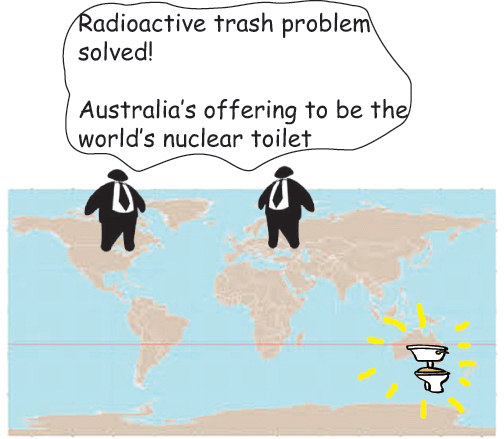
Australia risks becoming the “world’s nuclear waste dump” unless the Albanese government moves to rewrite its proposed Aukus laws, critics say.
A Labor-chaired inquiry has called for the legislative safeguard to specifically rule out accepting high-level nuclear waste from the US and the UK. One of the members of a Senate committee that reviewed the draft laws, independent senator Lidia Thorpe, said the legislation “should be setting off alarm bells” because “it could mean that Australia becomes the world’s nuclear waste dump”.
The government’s bill for regulating nuclear safety talks about “managing, storing or disposing of radioactive waste from an Aukus submarine”, which it defines broadly as Australia, UK or US submarines.
In a report published on Monday, the Senate’s foreign affairs, defence and trade legislation committee said this wording did not reflect the government’s promise not to accept high-level nuclear waste.
It recommended that the government consider “amending the bill so that a distinction is made between Australia’s acceptance of low-level nuclear waste from Aukus partners, but non-acceptance of high-level nuclear waste”.
The government has left the door open to accepting low-level waste from US and UK nuclear-powered submarines when they conduct rotational visits to Western Australia in the first phase of the Aukus plan. Low-level waste contains small amounts of radioactivity and include items such as personal protective equipment, gloves and wipes.
“According to the Australian Submarine Agency, nuclear-powered submarines only generate around a ‘small skip bin’ of low-level naval nuclear waste per submarine per year and that intermediate- and high-level waste will not become a concern until the first naval nuclear reactor requires disposal in the mid-2050s,” the Senate committee report said.
The government has yet to decide on the location for the disposal of radioactive waste from the submarines.
But infrastructure works proposed for HMAS Stirling – the naval base in Western Australia – to support the increased rotational visits are expected to include an operational waste storage facility for low-level radioactive waste.
The Department of Defence has argued any changes to the definitions should not prevent “regulatory control of the management of low-level radioactive waste from UK or US submarines” as part of those rotational visits.
Thorpe, an independent senator, said the call to prohibit high-level nuclear waste from being stored in Australia was “backed by experts in the field and was one of the major concerns raised during the inquiry into the bill”.
“The government claims it has no intention to take Aukus nuclear waste beyond that of Australian submarines, so they should have no reason not to close this loophole,” Thorpe said.
“They also need to stop future governments from deciding otherwise. We can’t risk our future generations with this.”
The government’s proposed legislation would set up an Australian naval nuclear power safety regulator to oversee the safety of the nuclear-powered submarines.
The committee made eight recommendations, including setting “a suitable minimum period of separation” to prevent a revolving door from the Australian Defence Force or Department of Defence to the new regulator.
The main committee report acknowledged concerns in the community that Australia might become a “dumping ground” for the Aukus countries, but it said the term was “not helpful in discussing the very serious question of national responsibility for nuclear waste”.
It also said the bill should be amended to ensure the regulator was transparent about “any accidents or incidents” with the soon-to-be-established parliamentary oversight committee on defence.
The Labor chair of the committee, Raff Ciccone, said the recommendations would “further strengthen the bill” and help “ensure Australia maintains the highest standards of nuclear safety”.
In a dissenting report, the Greens senator David Shoebridge said the legislation was “deeply flawed”, including because the regulator would report to the defence minister.
“The proposed regulator lacks genuine independence, the process for dealing with nuclear waste is recklessly indifferent to community or First Nations interests and the level of secrecy is a threat to both the environment and the public interest,” Shoebridge said.
The defence minister, Richard Marles, was contacted for comment.
1 This month
17 October, Free Public Talk on Nuclear Issues in South Australia
David Noonan will speak on public interest concerns over the new Roxby Downs Indenture Act 2026 on BHP copper-uranium mining and ore processing in SA, and on how AUKUS may face SA with a High-Level nuclear waste agenda.
Dr Jim Green will discuss international developments in the field of nuclear power including ‘small modular reactors’ and Generation 4 ‘advanced’ nuclear reactor concepts.


Help Aunty Sue Protect Her Land and Sacred Sites From Destructive Rocket Testing.
.

Australians deserve the truth
about
AUKUS – https://aukuspublicinquiry.com/

PETITION – To: Prime Minister Anthony Albanese and the Australian Labor Government

of the week – Australians for War Powers Reform (AWPR)
To see nuclear-related stories in greater depth and intensity

