A Father Fights for His Son & What’s Left of Democracy
The film Ithaka, about the quest of Julian Assange’s father to save his son, makes its U.S. premiere on Sunday in New York City. It is reviewed by Joe Lauria.
By Joe Lauria
Special to Consortium News
To the extent that the media has covered the tragedy of Julian Assange at all, the focus has been on politics and the law.
Consortium News, which has provided perhaps the most comprehensive coverage of the prosecution under the Espionage Act of the WikiLeaks publisher, has also focused more on the case and less on the man.
The great issues involved transcend the individual: war, diplomacy, official deception, high crimes, an assault on press freedom and on the core of what little democracy is left in a militarized and money-corrupted system.
Assange supporters sometimes also overlook the person and concentrate instead on the larger issues at stake. Ironically, it has been Assange’s enemies and detractors who’ve long focused on the person in the worst tradition of ad hominem assaults.
He has been attacked to deflect public attention from what WikiLeaks has revealed, from what the state is doing to him and to hide the impact on freedom in the media and standards in the courtroom.
There has been a steady and organized stream of smears against Assange, from ridiculous stories about him smearing feces on Ecuadoran Embassy walls to the widely reported falsehood that he was charged with rape. That case was dropped three times before any charges were filed, but the “rape” smear persists.
These personal attacks were planned as far back as March 8, 2008 when a secret, 32-page document from the Cyber Counterintelligence Assessment branch of the Pentagon described in detail the importance of destroying the “feeling of trust that is WikiLeaks’ center of gravity.” The leaked document, which was published by WikiLeaks itself, said: “This would be achieved with threats of exposure and criminal prosecution and an unrelenting assault on reputation.”
An answer to these slurs and the missing focus on Assange as a man is Ithaka. The film, which makes its U.S. premiere Sunday night in New York, focuses on the struggle of Assange’s father, John Shipton, and his wife, Stella Assange, to free him.
f you are looking for a film more fully explaining the legal and political complexities of the case and its background, this is not the movie to see. The Spanish film, Hacking Justice, will give you that, as well as the more concise exposition in the brilliant documentary, The War on Journalism, by Juan Passarelli.
Ithaka, directed by Ben Lawrence and produced by Assange’s brother, Gabriel Shipton, humanizes Assange and reveals the impact his ordeal has had on the people closest to him.
The title comes from the poem of that name by C.P. Cavafy (read here by Sean Connery) about the pathos of an uncertain journey. It reflects Shipton’s travels throughout Europe and the U.S. in defense of his son, arguably the most consequential journalist of his generation.
The story begins with Shipton arriving in London to see his son for the first time behind bars after the publisher’s rights of asylum were lifted by a new Ecuadoran government leading to him being carried out of the embassy by London police in April 2019.
“The story is that I am attempting in my own … modest way to get Julian out of the shit,” Shipton says. “What does it involve? Traipsing around Europe, building up coalitions of friendship.” He meets with parliamentarians, the media and supporters across the continent. Shipton describes the journey as the “difficulty of destiny over the ease of narrative.”……………………………
We learn that Julian Assange’s frustration with the inability to stop the 2003 Iraq invasion, despite the largest, worldwide anti-war protests in history, motivated him to start WikiLeaks.
The releases he published about the Iraq and Afghanistan wars, leaked by Army intelligence analyst Chelsea Manning, were published not only by WikiLeaks but by its partners at The New York Times, Die Spiegel and The Guardian, yet only Assange has been prosecuted.
The main focus of the film is the extradition hearing in Westminster Magistrate’s Court that began in February 2020 and ended in September of that year…………………………
One of several scenes that drives home the personal side of the story is audio of Assange speaking from Belmarsh Prison to Stella about what children’s books to read to their two sons. The toll it is taking on her is seen as she breaks down emotionally during the recording of a BBC interview that has to be paused.
“Extraditions are 99 percent politics and one percent law,” Stella says. “It is entirely the political climate around the case that decides the outcome. And that is shaped by the media. For many years there was a climate that was deliberately created through false stories, smears; through a kind of relentless character attack on Julian to reduce that support and make it more likely to successfully extradite him to the United States.”
“This is the public narrative that has been spread in the media for ten years,’ Nils Melzer, the now former U.N. Special rapporteur on torture, says in the film.
“No one has been able to see how much deception there is. Why is this being done? For ten years all of us were focused only on Julian Assange, when he never wanted it to be about him. It never was about him. It was about the States and their war crimes and their corruption. That’s what he wanted to put a spotlight on – and he did. And that’s what made them angry. So they put the spotlight on him.”
“He just needs to be treated like a human being,” says Stella, “and be allowed to be a human being and not denied his dignity and his humanity, which is what has been done to him.”
Ithaka makes its first theatrical showing in the U.S. at the SVA Cinema, 333 W. 23rd St, New York, N.Y., on Sunday, Nov. 13, at 7:45 pm. There will be a Q&A following the first screening with Ben Lawrence, Gabriel Shipton, Adrian Devant, cinematographer Niels Ladefoged, and John Shipton.
For ticket information: https://docnyc.net/film/ithaka/ https://consortiumnews.com/2022/11/11/a-father-fights-for-his-son-whats-left-of-democracy/
Climate change, not China, is Australia’s real security danger

The definitive case against nuclear subs The Saturday Paper, Albert Palazzo -adjunct professor at UNSW Canberra. He was a former director of war studies for the Australian Army. November 12, 2022 “……………………………………………………………. Too many security officials hold to the mistaken belief that China is the most significant threat Australia faces. In fact, climate change deserves the top spot. Climate scientists, United Nations officials and military commanders themselves, including current US Secretary of Defense Lloyd Austin, consider climate change an existential threat to survival. Any threat posed by China is much more limited. At worst, China’s challenge to the US-led world order could result in America’s withdrawal from the Western Pacific. Climate change could lead to the end of the human project and take countless other species down with us.
China represents, at most, a second-order threat, but it is China that draws the obsessive focus of much of the current generation of security thinkers. It does not make sense for Australia to invest so much in a weapon system that has no utility against the nation’s most dangerous threat, yet this is what is happening.
Advocates of nuclear-powered submarines also propose that constructing these vessels in Adelaide will help sustain a sovereign shipbuilding industry. In fact, the opposite is the likely result. Once in service these vessels will actually increase Australia’s dependence on the US and foreign contractors. This is because many of the sub’s critical components, weapons and systems will be made by foreign parties. Australian sailors might even need shadow US sailors to co-staff technical positions until Australia generates enough nuclear-savvy personnel of its own.
The government has announced it will invest between $168 billion and $183 billion in what it has called a national naval shipbuilding enterprise, with the goal of sustaining and growing a domestic shipbuilding capability and securing Australian jobs for the future. Such a capability is a noble goal, but what has been left unexplained is why it should be such a priority compared with foreign-dominated industries that are more critical to the nation’s future wellbeing.
Last summer, for example, Australian transport risked grinding to a halt as a result of the urea crisis, which led to a serious shortage of AdBlue, a vital diesel fuel additive. Without AdBlue, the nation’s fleet of long-haul trucks would have stopped moving, resulting in supermarkets running out of food, farmers not harvesting their crops and the mining industry coming to a halt. Yet there has been no talk of taxpayer-supported AdBlue production in Australia. Similarly, many medicines are imported, as are a host of important everyday items, such as baking powder and matches. Unlike shipbuilding, these industries apparently warrant no support.
If one wanted a truly sovereign defence industry, then the product that might mandate the level of support proposed for the subs is microchips. Virtually all military and civilian technology contains chips, yet Australia is happy to remain fully reliant on overseas suppliers for this most important of components. Establishing a domestic industry would require a huge subsidy, as well as additional investment in tertiary education and precursor manufacturing processes. Without these chips, however, no weapon system is truly sovereign.
So why the nuclear-powered subs, if they make so little sense? The obvious answer is to support the alliance. Instead of aiming for self-reliance, Australia has always preferred to seek the protection of a great power. But there is another reason: like a kid in a lolly shop, Australia has been given permission to buy the biggest treat on display. Nuclear-powered subs are one of America’s most closely guarded technologies. If Australia gets them, it will be a clear sign that, like Britain, we have been admitted to a very exclusive club, the inner sanctum of US security. What is missed, however, is that being in the inner sanctum generates a massive obligation – and some day that bill may fall due. https://www.thesaturdaypaper.com.au/opinion/topic/2022/11/12/the-definitive-case-against-nuclear-subs
AUKUS and nuclear submarines: Defence Minister Richard Marles sets Australia’s course in lockstep with USA-UK’s animosity to China.
the United States wants to build the first several nuclear-powered submarines for Australia and provide it with a submarine fleet by the mid-2030s in response to China’s growing military power.
Australia Sets New Defense Course To Establish Nuclear Submarines Fleet – Defense Minister

https://eurasiantimes.com/australia-sets-new-defense-course-to-establish-nuclear-submarines/—By EurAsian Times Desk November 8, 2022
Australia has set the course of its next defense strategy, which includes the development of nuclear-powered submarines to repel attacks far from the country’s shores, Australian Defense Minister Richard Marles said on Tuesday.
“Increasingly, we are going to need to think about our Defence Force in terms of being able to provide the country with impactful projection, meaning an ability to hold an adversary at risk much further from our shores across the full spectrum of proportionate response,” Marles said, delivering a speech at a university in Canberra, as quoted by the Australian Financial Review newspaper.
The minister also said that the new defense strategy relies on the establishment of a submarine fleet in cooperation with the United States and the United Kingdom within the AUKUS trilateral partnership.
Australia, the US, and the UK announced the AUKUS defense partnership in September 2021. The first initiative announced under the AUKUS pact was the development of nuclear-powered submarine technology for the Royal Australian Navy, which prompted the Australian government to abandon a $66 billion agreement with France’s Naval Group company for the construction of diesel-electric submarines.
Earlier, the Wall Street Journal had reported that the Biden administration is in the middle of discussions to expedite the construction of Australia’s first nuclear-powered submarines as guaranteed in the AUKUS defense pact.
The report said on Friday, citing Western officials, that the United States wants to build the first several nuclear-powered submarines for Australia and provide it with a submarine fleet by the mid-2030s in response to China’s growing military power.
The United States’ recommendation has not yet been formally approved, but a final decision on this matter is expected in March, the report said.
The report also highlighted the challenges the United States would face to complete the task, including the need to secure billions of dollars to expand its submarine-production capacity and a contribution from Australia to back the effort.
The White House said in a press release that Australia, the United Kingdom, and the United States – the countries that comprise the AUKUS security pact – have made significant progress toward ensuring that Australia would acquire conventionally armed, nuclear-powered submarines. The AUKUS allies will provide the submarines at the earliest possible date, the release said.
In September, the three allies announced the new trilateral security partnership, forcing Australia to abandon its $66 billion contract with France to receive 12 state-of-the-art conventionally-powered attack submarines from the United States.
In May, the Chinese Foreign Ministry said the AUKUS security pact is provoking an arms race in the South Pacific without any consultation with island countries of the region.
China believes that the AUKUS partnership escalates the arms race in the region and urges the US, the UK, and Australia to commit to the non-proliferation of nuclear weapons, Chinese Defense Ministry spokesman Tan Kefei had said earlier.
“The trilateral security partnership and cooperation on nuclear submarines between the US, the UK and Australia create serious risks of proliferation of nuclear weapons, escalate the regional arms race, undermine regional peace and stability as well as threaten global peace and security,” Tan had said.
The official noted that China had always believed that any regional cooperation should strengthen mutual trust among countries in the region and pose no threat to others.
“We urge the US, the UK, and Australia to abandon the Cold War mentality and ‘zero-sum game’ ideas and fulfill its obligations in good will regarding non-proliferation of nuclear weapons,” the spokesman had added
US warns Australia against joining treaty banning nuclear weapons
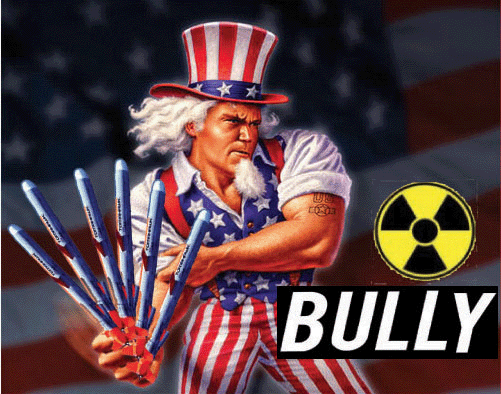
US embassy in Canberra says treaty ‘would not allow for US extended deterrence relationships’
Daniel Hurst, 9 Nov 22,
The US has warned Australia against joining a landmark treaty banning nuclear weapons, saying the agreement could hamper defence arrangements between the US and its allies.
But New Zealand said it was “pleased to observe a positive shift” in Australia’s position in a United Nations vote and “would, of course, welcome any new ratifications as an important step to achieving a nuclear weapon-free world”.
The comments follow the Albanese government shifting Australia’s voting position on the treaty on the prohibition of nuclear weapons to “abstain” after five years of blanket opposition by the Coalition government.
The relatively new treaty imposes a blanket ban on developing, testing, stockpiling, using or threatening to use nuclear weapons – or helping other countries to carry out such activities. But so far it has been shunned by all of the nuclear weapons states and many of their allies.
The US embassy in Canberra said the treaty “would not allow for US extended deterrence relationships, which are still necessary for international peace and security”.
That is a reference to Australia relying on American nuclear forces to deter any nuclear attack on Australia – the so-called “nuclear umbrella” – even though Australia does not have any of its own atomic weapons.
The embassy said the treaty also risked “reinforcing divisions” within the international community…………………………
The comments are a sign of the pushback Australia faces from its top security ally if it gets closer to signing and ratifying the treaty – although that still seems distant.
New Zealand said it welcomed “constructive developments in Australia’s approach” to the treaty, including the shift from opposing a NZ-backed resolution on the topic at the UN general assembly first committee last month.
New Zealand’s minister for disarmament and arms control, Phil Twyford, has met with Australian representatives.
A spokesperson for the Ministry o
f Foreign Affairs and Trade said New Zealand continued to urge all countries that were not yet a party to the treaty to sign and ratify it “at the earliest opportunity”, while acknowledging it was “for Australia to determine its position”.
The Australian prime minister, Anthony Albanese, has been involved in advocacy against nuclear weapons and has described them as “the most destructive, inhumane and indiscriminate weapons ever created”.
Albanese moved the motion at Labor’s 2018 national conference backing the TPNW, saying the task would not be easy or simple but it would be “just”.
The treaty now has 91 signatories, 68 of which have formally ratified it, and it entered into force last year.
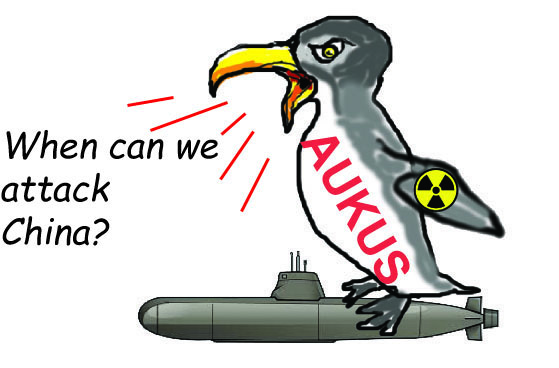
With nuclear-capable B-52 bombers in Australia, USA could make lethal nuclear attack on mainland China.
The ability to deploy the long-range bombers to Australia sends a strong message to adversaries about Washington’s ability to project lethal air power, the US Air Force was quoted as saying in the report.
China slams report US to deploy nuclear-capable B-52 bombers in Australia amid Taiwan tensions, SCMP 31 Oct 22
The US Air Force said deploying long-range bombers to Australia sends a message to adversaries about Washington’s ability to project lethal air power
As the B-52s could reach and potentially attack mainland China, they will serve as a warning to Beijing over a Taiwan assault, a defence analyst said
The United States is planning to deploy up to six nuclear-capable B-52 bombers to an airbase in northern Australia, a source familiar with the matter said on Monday, amid heightened tensions with Beijing.
Dedicated facilities for the bombers will be set up at Australian air force’s remote Tindal base, about 300km (190 miles) south of Darwin, the capital of Australia’s Northern Territory, said the source, who declined to be identified because they are not authorised to speak publicly on the issue.
The development was first reported by the Australian Broadcasting Corp (ABC)‘s Four Corners programme, citing US documents………………………..
Australia’s Northern Territory is already host to frequent military collaborations with the United States. Thousands of US marines rotate through the territory annually for training and joint exercises, first started under President Barack Obama.
Australian Defence Minister Richard Marles’ office did not immediately respond to a request seeking comment…………………
The ability to deploy the long-range bombers to Australia sends a strong message to adversaries about Washington’s ability to project lethal air power, the US Air Force was quoted as saying in the report.
Last year, the US, Britain and Australia created a security deal that will provide Australia with the technology to deploy nuclear-powered submarines, riling China.
Becca Wasser, senior fellow at the Washington-based Centre for a New American Security, told the ABC that putting B-52s that could reach and potentially attack mainland China in Australia will be a warning to Beijing, as fears grow of an assault on Taiwan.
Asked about US nuclear bombers being positioned in Australia, Chinese Foreign Ministry spokesperson Zhao Lijian said defence and security cooperation between countries should “not target any third parties or harm the interests of third parties.”
“The relevant US behaviours have increased regional tensions, seriously undermined regional peace and stability, and may trigger an arms race in the region,” Zhao told reporters at a regular briefing in Beijing
“China urges the parties concerned to abandon the outdated Cold War and zero-sum mentality and narrow-minded geopolitical thinking, and to do something conducive to regional peace and stability and enhancing mutual trust between the countries,” Zhao added. https://scmp.com/news/asia/australasia/article/3197806/amid-taiwan-tensions-us-deploy-nuclear-capable-b-
Australia changes policy tack – moves in the direction of supporting the UN Treaty on the Prohibition of Nuclear Weapons.

Australia drops opposition to treaty banning nuclear weapons at UN vote
After former Coalition government repeatedly sided with US against it, Labor has shifted position to abstain
https://www.theguardian.com/world/2022/oct/29/australia-drops-opposition-to-treaty-banning-nuclear-weapons-at-un-vote— Daniel Hurst, 29 Oct 22,
Australia has dropped its opposition to a landmark treaty banning nuclear weapons in a vote at the United Nations in New York on Saturday.
While Australia was yet to actually join the Treaty on the Prohibition of Nuclear Weapons, the shift in its voting position to “abstain” after five years of “no” is seen by campaigners as a sign of progress given the former Coalition government repeatedly sided with the United States against it.
The foreign affairs minister, Penny Wong, said through a spokesperson that Australia had “a long and proud commitment to the global non-proliferation and disarmament regime” and that the government supported the new treaty’s “ambition of a world without nuclear weapons”.
The previous Coalition government was firmly against the Treaty on the Prohibition of Nuclear Weapons, a relatively new international agreement that imposes a blanket ban on developing, testing, stockpiling, using or threatening to use nuclear weapons – or helping other countries to carry out such activities.
Australia voted against opening negotiations on the proposed new treaty in late 2016 and did not participate in those talks in 2017. Since 2018 it has voted against annual resolutions at the UN general assembly and first committee that called on all countries to join the agreement “at the earliest possible date”.
That changed early on Saturday morning when Australia shifted its voting position to abstain. Indonesia, New Zealand, Malaysia and Ireland were among countries to co-sponsor this year’s supportive UN resolution.
Australia traditionally argued the treaty would not work because none of the nuclear weapons states had joined and because it “ignores the realities of the global security environment”.
It also argued joining would breach the US alliance obligations, with Australia relying on American nuclear forces to deter any nuclear attack on Australia.
But the treaty has gained momentum because of increasing dissatisfaction among activists and non-nuclear states about the outlook for disarmament, given that nuclear weapons states such as the US, Russia and China are in the process of modernising their arsenals.
The treaty currently has 91 signatories, 68 of which have formally ratified it, and it entered into force last year.
The Nobel peace prize-winning International Campaign Against Nuclear Weapons (Ican) had been urging Australia to vote in favour of the UN resolution on Saturday – or at least abstain in order to “end five years of opposition to the TPNW under the previous government”.
Three in four members of the Labor caucus – including Anthony Albanese – have signed an Ican pledge that commits parliamentarians “to work for the signature and ratification of this landmark treaty by our respective countries”.
Labor’s 2021 national platform committed the party to signing and ratifying the treaty “after taking account” of several factors, including the need for an effective verification and enforcement architecture and work to achieve universal support.

These conditions suggest the barriers to actually signing may still be high. But Gem Romuld, the Australia director of Ican, said the government was “heading in the right direction” and engaging positively with the treaty.
Romuld said it “would be completely self-defeating to wait for all nuclear-armed states to get on board” before Australia joined.
“Indeed, no disarmament treaty has achieved universal support and Australia has joined all the other disarmament treaties, even where our ally – the US – has not yet signed on, such as the landmine ban treaty,” Romuld said.
In 2017 the US, the UK and France declared that they “do not intend to sign, ratify or ever become party” to the new treaty, and the Trump administration actively lobbied countries to withdraw.
Wong told the UN general assembly last month that Australia would “redouble our efforts” towards disarmament because Russian president Vladimir Putin’s “weak and desperate nuclear threats underline the danger that nuclear weapons pose to us all”. https://www.theguardian.com/world/2022/oct/29/australia-drops-opposition-to-treaty-banning-nuclear-weapons-at-un-vote—
Wong, Marles schedule US trip as nuclear submarine deadline nears
Financial Review, Andrew TillettPolitical correspondent, 26 Oct 22,
Annual top-level foreign affairs and defence talks will be held in Washington in December, allowing senior officials to lock down final details over Australia’s planned purchase of nuclear-powered submarines before the Albanese government publicly outlines its plans for the multibillion-dollar project.
With this year’s federal budget eschewing major funding decisions in the defence portfolio, The Australian Financial Review understands the US will for the third year running host the annual AUSMIN talks between the Australian and US governments………..
One defence source suggested that holding talks in the US would result in the ministers being accompanied by a bigger-than-usual cohort of Australian officials to speak to US counterparts from the Defence and Energy departments about the submarine project.
The nuclear submarine taskforce, which is examining the best options for Australia to acquire nuclear submarine technology from the US and UK under the AUKUS partnership, is due to report to the Albanese government in March after an 18-month study on what submarine to acquire, where it will be built, delivery timetable, cost and any interim measures required to avoid a capability gap.
Separately, former defence minister Stephen Smith and former Defence Force chief Angus Houston are conducting a Defence Strategic Review looking at the military’s weapons needs in light of deteriorating regional security. That review is also due in March.
Both reviews will outline billions of dollars in new spending for Defence that will need to begin to be accommodated when the next budget is handed down in May.
This year’s budget papers fail to reflect the significant increase in funding required for existing projects as construction gets under way in earnest…………………………….. more https://www.afr.com/politics/federal/wong-marles-schedule-us-trip-as-nuclear-submarine-deadline-nears-20221026-p5bsyp
A conversation with Paul Keating: Australia’s strategic interests, alliances and standing up for ourselves
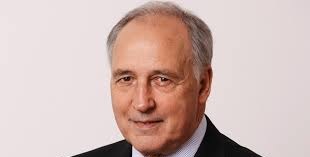
Stability in Asia can no longer be imposed by a non Asian power, and least of all by direct application of US military power.
On Taiwan, Keating said again that it is not a vital interest for Australia. ‘Why would we want to be part of a US defeat over Taiwan?’.
https://johnmenadue.com/a-conversation-with-paul-keating-australias-strategic-interests-alliances-and-standing-up-for-itself/ By John Menadue, Oct 14, 2022,
Not many were given a continent, says Keating on the challenges and opportunities that Australia faces. We have to stop ignoring the realities of the region in which we are positioned.
More than 4,000 people from Australia and around the world tuned in to A Conversation with Paul Keating, held by La Trobe University’s Ideas and Society Program. The online discussion between former Prime Minister, Paul Keating, and James Curran, the Professor of Modern History at the University of Sydney and author of Australia’s China Odyssey, uncovered issues fundamental to the future of Australia, such as our relations with China and the United States.
Key to the discussion was the negative impact of our current view of China and the region in which Australia is positioned. Ignoring the historical elements that underpin the issues of the 21st century including the importance of identity and culture, puts Australia in a position of having to make choices.
The rise of China and the escalating tensions driven by the US have been front and centre. Australia can no longer ignore the geopolitical forces in our region and decision makers need to make a stand against geo strategic enmeshment with the USA and AUKUS, akin to outsourcing our sovereignty, security and strategic relationships. This leaves Australia isolated.
Opening the conversation with the fall of Singapore 80 years ago, Keating reminded the audience that it was WWll that dragged Australia into Asia, showing us that we could not depend on the UK.
He reminded us of Wilson and Roosevelt and the multi-polar world that each envisaged through the League of Nations and the United Nations and the dream to end colonialism. The end of the Cold War saw the US declaring victory. What followed was the failure of the Clinton, Bush and Obama administrations who instilled a unipolar view of the world that had no place for China and Russia.
Instead of settling the world’s issues with war and then afterwards asking for conversation, we should be able to have the conversation first.
“There will never be a peaceful, well-operating world while there are western structures like the G7”, Keating reminded us.
He went on to say that there needs to be a place of respect for China:
- According to the IMF, their GDP is 20 percent larger than the USA
- They have 20 per cent of the world’s humanity
- They have a very large navy
- They have solved hunger for 20 per cent of the world’s population
- They are not exporting an ideology
Stability in Asia can no longer be imposed by a non Asian power, and least of all by direct application of US military power.
The USA could run the world alongside China, where the US consolidates the Atlantic, including Russia, while China provides the balance in the East and the Pacific. It is naive to assume China’s interests lie only in the Pacific. In fact they have more interest in the Asia continent and the Stans and Turkey.
China doesn’t want to be a stakeholder in a proprietary system run by the US and why should it? Keating asked.
On the US in Asia, Keating said that ‘the US has no idea what to do with itself in Asia’. He bluntly added that the US is not interested in ‘thinking allies’. It wants ‘dummies’.
He described the QUAD as a strategic nonsense and a waste of time.’Can anyone seriously think that the Indian Navy is going to confront China in the South China Sea?’
On Taiwan, Keating said again that it is not a vital interest for Australia. ‘Why would we want to be part of a US defeat over Taiwan?’.
On Australian strategic commentators and advisors Keating said: ‘The problem with the immaturity of the Australian international debate is that people as ordinary as Medcalf (Head of the National Security College at the ANU), who fail to understand basic things, should not be supported by editorial managers in any of the newspapers’. Medcalf he said wants Australia to try and persuade India to change its national interests!
Keating said that he hoped the Australian Government did not listen to Andrew Shearer, the Director of the Office of National Intelligence.
Australia can do its own foreign policy, its own security arrangements and pacts, and develop its own defence capability without being owned by anyone else. But ‘our strategic sovereignty is being out sourced to another country, the US’.
AUKUS should be an exchange of ideas and no more than that. It is not too late for the Australian Government to back out of the agreement. ‘Keeping Australia in the AUKUS alliance would be a tragedy for Australia. I mean going to Cornwall (in the UK) to find our security in Asia. James Cook and Arthur Philip left 230 years ago. Do we really need to go back there?’.
This doesn’t mean we don’t need friends like the US. And Indonesia on our door step is vitally important.
The challenge of governments is to make their own stories. That is what the present day government should be brave enough to do. Tone needs to become substance.
Australia currently has a very poor idea of itself, not sure what it should be, yet we have a continent.
It is time to consider a republic. King Charles might welcome it, Paul Keating said.
Australia needs a leader like Paul Keating. View the conversation with Paul Keating here.
Rotting in jail’: Thousands march for Julian Assange’s release as his brother urges Anthony Albanese to act.
Supporters of jailed WikiLeaks founder Julian Assange have formed a human chain in Melbourne’s city centre to protest his detention.
Thousands have marched through Melbourne’s city centre calling for the release of WikiLeaks founder Julian Assange.
The 51-year-old Australian has been in London’s Belmarsh prison since he was removed from the Ecuadorian embassy in 2019.
Mr Assange is fighting a long-running legal battle to avoid extradition to the United States,
Melbourne protesters marched through the city streets and formed a human chain across a Southbank bridge on Saturday morning as they called on the Australian government to intervene.
“There’s an expectation in the electorate that the prime minister and this government is going to get Julian out of jail,” Mr Assange’s brother Gabriel Shipton told AAP.
“The prime minister’s statements before the election – enough is enough, he doesn’t see what purpose is served by Julian being kept in prison – those were seen as a commitment.
“It’s been so many days of this government and Julian is still rotting in that prison.”
Prime Minister Anthony Albanese should contact the United States president directly and plead Mr Assange’s case, Mr Shipton said.
“They can pick up the phone, call Joe Biden and say, hasn’t Julian suffered enough? Drop the charges and extradition,” he said.
“Julian would walk free.”
What’s the latest on Julian Assange’s case?
In June, then-United Kingdom home secretary Priti Patel approved Mr Assange’s extradition to the US
.Then, in August, lawyers for Mr Assange filed an appeal , arguing he is being prosecuted and punished for his political opinions.
Mr Assange was charged by the US with 17 counts of espionage and one charge of computer misuse after WikiLeaks published thousands of leaked military and diplomatic documents.
Melbourne’s demonstration against Mr Assange’s detention was one of many being held across the world on Saturday.
It was heartening to see such global solidarity for Mr Assange’s cause, Mr Shipton said.
“The movement is growing around the world as evidenced by these protests,” he said.
“We’re not going to stop. We are not going to be quiet.”
.
Marshall Islands to receive U.N. support over nuclear legacy

https://english.kyodonews.net/news/2022/10/e2a640256da0-marshall-islands-to-receive-un-support-over-nuclear-legacy.html KYODO NEWS -8 Oct 22,
The U.N. Human Rights Council adopted a resolution Friday aimed at assisting the Marshall Islands in its efforts to secure justice for people suffering from the impact of the United States’ former nuclear testing program in its territory.
“We have suffered the cancer of the nuclear legacy for far too long and we need to find a way forward to a better future for our people,” Samuel Lanwi, deputy permanent representative of the Republic of the Marshall Islands in Geneva told the body in an emotional speech.
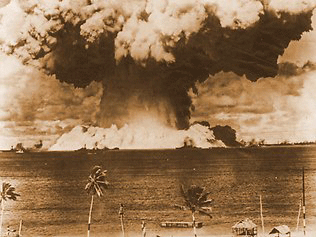
The United States conducted dozens of nuclear weapons tests in the islands of the Pacific state in the 1940s and ’50s, including the 1954 Castle Bravo test at Bikini Atoll, the biggest U.S. bomb ever detonated.
The text tabled by five Pacific Island states — the Marshall Islands, Fiji, Nauru, Samoa and Vanuatu — was backed by Australia and did not demand reparations.
It called on the U.N. rights chief to submit a report in September 2024 on the challenges to the enjoyment of human rights by the Marshallese people stemming from the nuclear legacy.
The United States as well as other nuclear weapons states such as Britain, India and Pakistan expressed concern about some aspects of the text but did not ask for a vote on the motion. Japan did not speak at the meeting.
The Marshallese people are still struggling with the health and environmental consequences of the nuclear tests, including higher cancer rates. Many people displaced due to the tests are still unable to return home.
A concrete dome on Runit Island containing radioactive waste is of particular concern, especially in relation to rising sea levels as a result of climate change, according to the countries that drafted the resolution.
The Marshall Islands says a settlement reached in 1986 with the United States fell short of addressing the extensive environmental and health damage that resulted from the tests.
The U.S. government asserts the bilateral agreement settled “all claims, past, present and future,” including nuclear compensation.
Observers say some nuclear states fear the initiative for the Marshall Islands could open the door to other countries bringing similar issues to the rights body.
Never mind Australia’s economic problems, health crisis etc – Weapons for Zelensky is the big need.

Zelensky: Australia to deliver ‘significant’ new support for Ukraine, The Age Matthew Knott, October 6, 2022 Ukrainian President Volodymyr Zelensky has revealed Australia is preparing to ramp up support for his nation’s war against Russia by announcing a new tranche of military assistance, including donations of heavy weapons.
In an appearance via video link at the Lowy Institute think tank in Sydney, Zelensky urged the global community not to give in to Russian President Vladimir Putin’s “nuclear blackmail”………………..
Asked what Australia could do to help Ukraine, Zelensky said the Albanese government had been preparing a “significant package” of assistance that will be announced soon.
“This process is ongoing as we speak and I’m very grateful to that,” he said. “It’s not only small arms but heavy weapons as well.”
Zelensky said that, for the upcoming round of assistance, Australia had been negotiating with other countries to announce a joint support package for Ukraine.
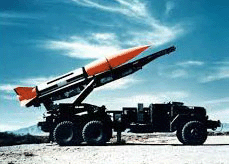
Ukrainian Ambassador to Australia Vasyl Myroshnychenko has publicly asked Australia to provide Ukraine with a supply of anti-ship missiles known as Harpoons and howitzer long-range weapons.
Ukraine is also asking for an additional fleet of 30 four-wheel drive vehicles on top of the 60 already provided…………………..
He also called for “new and tough sanctions against Russia” as a punishment for its invasion of Ukraine. https://www.theage.com.au/politics/federal/zelensky-australia-to-deliver-significant-new-support-for-ukraine-20221006-p5bnrm.html
Australia the ‘subimperial power’

ABC Radio National – Late Night Live – Broadcast 4 Oct 22, A new book ‘Subimperial Power – Australia in the International Arena’ argues Australians ought to be told what our relationship with the United States is really about: a relationship where we eagerly and routinely act to help the US keep its imperial position at the apex of global power. Iraq, Afghanistan and now AUKUS – the book argues Australians have been kept in the dark as to the real motivations behind these consequential decisions.
Philip Adams interviews Clinton Fernandez – https://www.abc.net.au/radionational/programs/latenightlive/australia-the-subimperial-power-/101503728
Pacific islanders want nuclear legacy aid
https://www.canberratimes.com.au/story/7931308/pacific-islanders-want-nuclear-legacy-aid/ By Emma Farge, October 5 2022,
Nuclear powers have criticised an effort led by the Marshall Islands and backed by Australia at the United Nations to seek help on dealing with the consequences of nuclear testing.
The issue is before the UN’s Human Rights Council and involves the United States, Britain, Russia, India and China, all of them nuclear-armed.
Pacific islanders, who are particularly threatened by rising sea levels from climate change, are becoming more vocal in seeking redress from former colonial powers and wealthy countries on environmental and climate issues which they say affect their human rights.
This motion brought to the Human Rights Council on Monday by the Marshall Islands, Fiji, Nauru, Samoa and Vanuatu and backed by Australia requests assistance from the UN rights office; seeks a report from its boss; and calls for a future debate at the council.
“The nuclear legacy is a lived reality for us that must be addressed,” Samuel Lanwi, deputy permanent representative of the Republic of the Marshall Islands (RMI) in Geneva told Reuters.
The United States conducted 67 nuclear weapons tests in the Marshall Islands from 1946 to 1958 including “Castle Bravo” at Bikini Atoll in 1954 – the largest US bomb ever detonated. Islanders still suffer the health and environmental effects such as high cancer rates and enduring displacement from contaminated areas.
The Marshall Islands Ambassador to the UN in Geneva, Doreen de Brum could not join the talks because she is on leave following her daughter’s death from cancer. “My fight for nuclear justice is personal,” she said on Twitter.
While the motion does not mention the United States by name, some see it as an attempt to wield leverage over Washington in ongoing negotiations on a Compact of Free Association (COFA) that governs US economic assistance to the RMI. Marshallese diplomats deny this.
The nuclear legacy has been a major sticking point in the talks, although last week US President Joe Biden’s administration acknowledged it and said it remained committed to addressing concerns.
The Marshall Islands, one of 47 voting members on the rights council, is a key Western ally including on human rights, such as on scrutiny of China’s rights record.
Three sources who attended the Geneva talks told Reuters they were surprised by the level of resistance to a resolution seeking “technical assistance” – a term that could take the form of legal and political advice – rather than a formal probe.
“Nuclear powers were converging in their determination to protect themselves from any future accountability and there were attempts to empty out the resolution of any significance,” Yves Lador from Earthjustice said.
Diplomats say there were concerns about opening the door for future litigation. Past nuclear test sites include French Polynesia, Algeria, Kazakhstan and China’s Xinjiang.
The United States, Britain and India all argued that the rights council was not the appropriate forum to raise the issue and sought to strip out references to the new UN right to a clean and healthy environment, according to the sources.
China and Russia also argued for the latter, they said.
The British and Russian missions declined to comment. India’s did not respond. A spokesperson for China’s mission said they had “constructively participated” in the talks.
A vote might be called later this week – something that happens in a minority of cases when countries cannot agree.
Taiwan “is not a vital Australian interest — we do not recognise it as a sovereign state”. A repost from November 17, 2021
Notwithstanding that we have no obligation to defend Taiwan, the hard reality, as many Americans commentators agree, is the Americans would likely lose such a contest and in the event could withdraw from Asia altogether, leaving Australia to face the wrath of the Chinese state and its military to which we had been party in attacking.
America can withdraw from Asia to the safety of its west coast on the other side of the Pacific. But Australia cannot withdraw — it has no place to withdraw to.
Pearls and Irritations, By Paul Keating, Sep 28, 2022 https://johnmenadue.com/taiwan-is-not-a-vital-australian-interest-we-have-no-alliance-with-taipei-we-do-not-recognise-it-as-a-sovereign-state-a-repost-from-november-172021/
Peter Hartcher has a lot to answer for, writes Paul Keating in a response to the Nine columnist that did not make it to print.
I should have hoped that after 26 years away from the National Press Club, my appearance there, at the Club’s invitation, would have indicated to Peter Hartcher that I believed the invitation was important to accept — an invitation which had arisen from recent views I had put on Australian foreign policy, including in relation to China.
Instead, in Saturday’s Sydney Morning Herald and Age, Hartcher sought only to disparage what I had had to say including, comparing me to King Canute and in Hartcher’s case, not even understanding the Canute fable.
King Canute was not trying to direct the waves as Hartcher depicts me trying to do and as does the cartoon, rather Canute used the metaphor of his perching on the beach to “let all the world know that the power of the king is empty and worthless save for him, (meaning God) by whose will heaven and the sea obey eternal laws”.
So, right from the get-go, Hartcher mocks the motivation and tone of my speech.
He says, drawing on his misconception of King Canute, that, Canute-like, I gave “orders” to the United States about its geopolitics, that America has to come to a point of accommodation where it acknowledges China’s pre-eminence in East Asia and the Asian mainland.
Of course, I gave no such “order” nor am I in a position to give such an “order”, save to remind the audience that the coldest of America’s Cold War warriors, the implementer under President Jimmy Carter of the Nixon-Mao détente, Zbigniew Brzezinski, had said: “America should tacitly accept the reality of China’s geopolitical pre-eminence on the mainland of Asia, as well as China’s ongoing emergence as the predominant Asian economic power”.
Apparently, Hartcher thinks I should not have quoted Brzezinski, a statesman of enormous achievement and stature to Australians in respect of China — rather I should have fallen back on the philosophy of our very own internationalist, Peter Hartcher himself. I quoted Brzezinski word for word — Hartcher disparages me for this, claiming I was, in effect, giving the US “orders”.
Hartcher claims that I “won’t acknowledge anything that doesn’t have China in charge”. This is an obnoxious fabrication.
What Hartcher seriously failed to deliver to the readership of the Herald and The Age was what I had said to the Chinese leadership in Beijing in 2013, in the presence of a Chinese vice premier — years before Hartcher and his Nine colleagues hit upon their voluptuous contumely about China.
I had this to say:
A lot of attention has been given to America’s responsibility to China’s rise — but China too has equal responsibility for creating a new stable and sustainable order in Asia. As it steps up to a larger leadership role it will at the same time need to be willing to accept and respect restraints on the way it uses its immense strength, because the acceptance of such restraints by great powers is the key to any successful and durable international order.”
I then went on to instance two points.
I said, first, and most obviously, “China should continually reaffirm by word and by deed its commitment to repudiate the use or threat of force to settle disputes”. I went on to say, “the work of reassurance is never done, that the stronger China becomes the more it will need to reassure its neighbours and this will depend on deeds more than words”.
Second, “China will do a great deal to help build a continuing stable order in Asia if it quite unambiguously welcomes and supports a continued strong role for the United States in Asia”.
These were tough things to say to an audience of Chinese officials, but I said them in Beijing in 2013. And I repeated those words in my National Press Club address. But Hartcher made certain Sydney Morning Herald and Age readers would hear none of those critical references to the Chinese, because my utterances then, pull the rug from under Hartcher’s principal claim that I believe “Beijing is correct and everyone else should fall back in awe”.
Well, I certainly wasn’t falling back in awe in 2013 and Hartcher should have had the decency to have let Herald and Age readers know what firmly held views I had put to Chinese authorities back then.
But he did not let them know — he omitted to fully inform them.
Hartcher then misrepresented my longstanding view that Australia should find its security in Asia not from Asia.
He went on to say that the Quad is centred on Asia, notwithstanding that I had said at the Press Club, the Quad’s main failing and certainly in Australia’s terms, was to ignore the centrality of Indonesia and the ASEAN group of countries.
In fact, I used a metaphor — the park seesaw. I said under the Quad, we are focusing on the wobbly ends — India to the extreme west and Japan to the extreme east, rather than on the pivot at the centre, which is Indonesia.
Indonesia is five flying hours from Australia. India is 10, Japan is 15. Our strategic bread is buttered in the Indonesian archipelago which arcs across our northern approaches. And I made the point that relying on India to fight the Chinese in the South China Sea or the western Pacific, would be to rely on a state which will never meet such obligations.
And what’s more, India demonstrated its feckless unreliability over last weekend in pulling the rug from under COP26, weakening the communique by refusing to accept the words “phase out” of coal which would otherwise have achieved consensus.
A central point I made in the Press Club address is that the Quad is a joke and will present little value to Australia. Most military strategists agree it has no use as a device to contain China militarily.
Hartcher makes much of my dismissive response to questions about the so-called “14 demands” China has made of Australia. These — let’s remember — were a list of points of difference in Australian and Chinese policy positions handed by a junior Chinese embassy official to a TV reporter in Canberra last year.
That’s not the way any government in the world has ever conveyed serious policy demands to another one.
Hartcher at least found value in what I had to say about tensions over Taiwan.
I said that Taiwan “is not a vital Australian interest — we have no alliance with Taipei — we do not recognise it as a sovereign state”. That statement was enough to draw out Defence Minister Peter Dutton, to say a day later, that “it would be inconceivable that Australia as a US alliance partner, would not join in military action”.
That is, military action against China by the United States, should it attempt to take Taiwan by force.
Notwithstanding that we have no obligation to defend Taiwan, the hard reality, as many Americans commentators agree, is the Americans would likely lose such a contest and in the event could withdraw from Asia altogether, leaving Australia to face the wrath of the Chinese state and its military to which we had been party in attacking.
America can withdraw from Asia to the safety of its west coast on the other side of the Pacific. But Australia cannot withdraw — it has no place to withdraw to.
This is where years of unprincipled and obsessive writing and misreporting by the Herald and The Age to its readership on China may, in the end, take us.
Peter Hartcher and his mate Uhlmann have a lot to answer for and may in future, have a great deal more to answer for.
Who are the war criminals?
Pearls and Irritations , By Brian Toohey, Sep 29, 2022
One of the few heartening things to come out of Russia’s war against Ukraine is the renewed emphasis on how it’s a crime for national leaders to start a war of aggression. Putin is not the only one who can reasonably be accused of committing war crimes. Most US president since World War II have done so. So have some Australian Prime Ministers.
None of the wars Australia has fought in since World War II were necessary for defence. Instead, they all involved dispatching military expeditions to intervene in countries that posed no threat to Australia. All were wars of aggression, or soon became so, after the initial goal had been quickly achieved…………………………………………………….
The Labor leader Arthur Calwell gave a parliamentary speech demolishing Menzies rationale that North Vietnam was a Chinese puppet. He explained that Vietnam had a “1000-year history of hostility towards China” and said Labor opposed a “cruel, costly and interminable” civil war that would “prolong and deepen the suffering” of the Vietnamese people.
In a particularly despicable war crime, the US dropped more bombs on tiny Laos than the combined total on Europe and Japan during World War II. The total for Laos was the equivalent of a bomb load dropped every eight minutes, 24 hours a day, for nine years. Many were mines or unexploded cluster bombs that continue to kill. The US called this a “secret war”. It was no secret to the Laotians beneath the falling bombs.
The people of Indo-China were no threat to Australia or the US. But the invading forces subjected them to death and disfigurement from carpet bombing, deliberate crop destruction, torture, massacres, assassinations, napalm, and dioxin – the persistent poison that still condemns anguished mothers to give birth to terribly deformed children they spend years nursing.
About 60,000 Australian troops, including 19,000 conscripts, were sent to the war. A total of 521 died and over 3000 were wounded. Estimates of the number of Vietnamese, Cambodians and Laotians killed vary from 1.2 million to over 3.8 million. Far higher than is likely for the war in Ukraine.
While John Howard was Australia’s prime minister in 2003 he made a demonstrably false statement in his March 2003 television address at the start of the illegal invasion of Iraq. He said Iraq possessed chemical and biological weapons that, “Even in minute quantities are capable of causing destruction on a mammoth scale”. Iraq had not produced any new chemical and biological weapons since they were disarmed by UN weapons inspectors in 1991.
Howard also claimed that the supply of intelligence was a “priceless component” of the relationship with the US and the UK. Far from priceless, the intelligence on WMD was worse than useless: it provided the rationale for a disastrous invasion. With few exceptions, the Australian media peddled nonsense in support of invasion.
Unlike Bush and Blair, Howard has never admitted that he was wrong to help invade Iraq. In 2016, Sir John Chilcot’s devastating report on the British involvement on the war found that the “benefit of hindsight was not needed to understand the intelligence was flawed”. But Howard told journalists he wouldn’t “retreat” from his decision to invade. Howard’s grotesque mistakes reinforce the need for the full Parliament to authorise a decision to go to war.
Howard also announced the dispatch of Australian SAS and other troops to Afghanistan to combat the Al Qaeda terrorist group. This group escaped in the opening months of the war. With the terrorists gone, there was no rationale for the US or Australia to stay. Their continued participation in a war of aggression was a war crime. No Afghanis took part in the September 11 attacks or helped al-Qaeda plan these atrocities. Before September 11, the Taliban government in Kabul offered to hand bin Laden over to the US. The offer was ignored……………………………………..
The last of the Australian military left in April 2021 after 41 had died and 260 were wounded or injured. How many they killed is unknown. The financial cost of the Australian contribution was $8.4 billion.
On August 30, 2021 the last of the US forces left Afghanistan behind with a rapidly growing humanitarian crisis in which starvation is rife……………………..
By the standards now rightly being applied to Vladimir Putin, the American and Australian leaders who brought devastation to Iraq and Afghanistan, George W Bush, Tony Blair and John Howard should arguably appear in the dock, subject to the presumption of innocence. Justice also demands a reasonable effort be made to bring them before a court. That hasn’t happened and won’t until the public demand justice. https://johnmenadue.com/who-are-the-war-criminals/
1 This month
17 October, Free Public Talk on Nuclear Issues in South Australia
David Noonan will speak on public interest concerns over the new Roxby Downs Indenture Act 2026 on BHP copper-uranium mining and ore processing in SA, and on how AUKUS may face SA with a High-Level nuclear waste agenda.
Dr Jim Green will discuss international developments in the field of nuclear power including ‘small modular reactors’ and Generation 4 ‘advanced’ nuclear reactor concepts.


Help Aunty Sue Protect Her Land and Sacred Sites From Destructive Rocket Testing.
.

Australians deserve the truth
about
AUKUS – https://aukuspublicinquiry.com/

PETITION – To: Prime Minister Anthony Albanese and the Australian Labor Government

of the week – Australians for War Powers Reform (AWPR)
To see nuclear-related stories in greater depth and intensity

