China Reaffirms Support for ASEAN’s Nuclear Weapon-Free Zone
https://jakartaglobe.id/news/china-reaffirms-support-for-aseans-nuclear-weaponfree-zone BY :JAYANTY NADA SHOFA. JULY 11, 2022
Jakarta. China recently pledged to take its ties with ASEAN to greater heights, among others, by backing the Southeast Asian bloc’s nuclear-weapon-free treaty.
China reaffirmed its readiness to ink the protocol to the treaty when its senior diplomat Wang Yi visited the ASEAN Secretariat in Jakarta on Monday.
“We will continue to support ASEAN’s efforts in building a nuclear-weapon-free zone and reaffirm that China is ready to sign the protocol to the Treaty of Southeast Asia Nuclear-Weapon-Free Zone at any time,” Wang Yi said at the ASEAN Secretariat.
According to Wang Yi, over the past years, China has made several historic milestones in its ties with ASEAN, among others, in regard to the country’s support to help keep the Southeast Asian region free of nuclear arms.
“[China was] the first to publicly express its willingness to sign the protocol to the Southeast Asia nuclear-weapon-free zone,” Chinese Foreign Minister Wang Yi said.
In 1995, the ten ASEAN member states, including Indonesia, agreed to a nuclear weapons moratorium treaty known as the Bangkok Treaty.
The protocol for this treaty is open for signature by the five nuclear-weapon states recognized by the Non-Proliferation Treaty, namely China, France, the UK, the US, and Russia.
The protocol obliges its signatories not to use or threaten to use nuclear weapons within the zone or against any state party to the treaty. To date, none of the nuclear-weapon states has penned the protocol.
Chinese President Xi Jinping has pledged to sign the protocol as early as possible. Xi Jinping made this commitment at last year’s China-ASEAN Special Summit, which marked the 30th anniversary of dialogue relations between the two sides.
Why Australia’s Labor government refuses to defend Julian Assange

WSWS Oscar Grenfell@Oscar_Grenfell, 6 July 22, When the Labor Party scraped into office following the May 21 federal election, some supporters of Julian Assange voiced hopes that the new government would defend the WikiLeaks publisher because he is an Australian journalist and citizen undergoing persecution abroad.
The crudest and most thoughtless expression of these hopes came in the form of an update to a petition demanding that the Australian government act to free Assange. Over the course of almost three years, the petition has been signed by more than 730,000 people, and has served as an important focal point for the latent, mass support that exists for Assange.
But on July 4, the petition’s founder declared that it was no longer necessary to issue any demands on the Australian government. The sole evidence provided was that Labor Prime Minister Anthony Albanese had purportedly signed the petition, and that some members of the government have hinted that it may engage in “quiet diplomacy” on behalf of Assange. “Now that we confirm that the Prime Minister of Australia is one of us and together with all of our collective 731,000 Signatories to this petition we will together move forward with direct representations to the responsible Public Officers in both the USA and Britain,” the update declared.
It was necessary to “understand that the Australian Government does have a right to negotiate the matter of freedom of Julian Assange in the best way they see to secure his freedom… We do not intend to work against any action being taken in different ways by any individual Signatory”—i.e., Albanese.
“[W]e will move forward in a peaceful, harmonious and inclusive manner,” the update declared, that is with regards to the Labor government.
To be blunt, such statements are exercises in wilful delusion. Since forming government, Labor has not issued anything that even could be described as weasel-words in support of Assange. Its attitude towards the WikiLeaks publisher is barely concealed hostility.
The greatest mistake defenders of Assange could make would be to allow a right-wing pro-war Labor government to lead them around by the nose. Such a course would serve to demobilise the mass backing that Assange has among workers and young people, and create the political conditions required for Labor to bury his plight and ensure that extradition from Britain to the US proceeds without hindrance.
The petition update promoted the latest comments on Assange by a member of the government. In an Australian Broadcasting Corporation “Law Report” radio program on June 28, Labor’s Attorney-General Mark Dreyfus again stated that the Assange case had “gone on for too long.” It was this comment that was highlighted on the petition.
But what, of substance, did Dreyfus actually say?
Introducing the subject of Assange, midway through the interview, the host noted warnings that the attempted US prosecution of Assange would set a dangerous precedent of US law being imposed globally.
Assange, an Australian citizen, is facing prosecution in the US, for documents he published while in Europe, exposing American war crimes in Iraq and Afghanistan. Citing Assange legal advisor Greg Barns, the interviewer asked if Dreyfus was troubled by this attempt to extend the reach of American legislation to an Australian citizen with no legal connection to the US?
The attorney-general brushed the question aside. “The United States has long legislated in an extra-territorial way and I think that all other countries have understood that for a long time,” he said. In other words, the US government can do what it likes.
Dreyfus continued: “It is not open to the Australian government to directly interfere with either the jailing of Mr Assange in the United Kingdom or the extradition request that has been made by the United States.”
As with all other Labor ministers, Dreyfus presented Assange’s imprisonment and threatened extradition as a bona fide, lawful procedure. But Assange’s detention, in a maximum-security British prison, without conviction, has been denounced by outgoing United Nations Rapporteur Nils Melzer as state torture.
The US extradition effort is akin to a pseudo-legal lynching. Assange is to be imprisoned, for 175 years, under the draconian Espionage Act, for publishing true information revealing the illegal actions of the American government. Such an operation recalls dissidents being hurled into a dungeon cell, with the key thrown away, during medieval times.
Credible allegations are now on the public record, moreover, that the Trump administration and the CIA discussed kidnapping or assassinating Assange in 2017, before filing an indictment and an extradition request.
Dreyfus again made reference to the possibility of diplomatic representations on Assange’s behalf.
In a highly revealing exchange, the interviewer noted: “The government has said it would like to see this matter brought to an end, but hasn’t exactly said how it would prefer it to come to an end.” Would the government seek to have the charges against Assange dropped in the United States? she asked. “I am not going to canvas what will be the resolution of this case,” Dreyfus replied.
In other words, the attorney-general’s vague statements are worthless. Why would anyone believe that a government minister, who will not even state publicly that the charges against Assange should be dropped, would be fighting for his freedom behind closed doors?
Dreyfus’ vague references to “representations” are like a bone to a hungry dog, meant to placate Assange’s supporters, as is the cloak and dagger operation of Albanese possibly signing the petition.
The real position of Labor has been spelled out by two of its most prominent leaders, Foreign Minister Penny Wong and Defence Minister Richard Marles.
Marles stated last month: “This is a matter for the United Kingdom. Like any Australian citizen facing legal proceedings abroad, he will be provided consular assistance.”
The position is identical to that of the previous Liberal-National Coalition government. Consular support means monitoring the extradition case and the decline of Assange’s health. It is the antithesis of a diplomatic and political intervention to free Assange.
For his part, Albanese has sought to dodge the issue of Assange for the past six weeks. He refuses to mention the WikiLeaks founder’s name, even when directly questioned about the topic. The only passionate comments he has made on the case were in an angry denunciation of Twitter users calling on the Labor government to take action.
It is hardly a mystery why Labor refuses to defend Assange.
The primary focus of the new government has been a foreign policy blitz, orchestrated in the closest of collaboration with the Biden administration, which is seeking Assange’s extradition.
Wong and Albanese have been on one foreign visit after another, seeking to shore-up US dominance in the Indo-Pacific, and to further American imperialism’s confrontation with China, which threatens nuclear war.
The highpoint came last week, when Albanese attended the NATO summit in Madrid. There, he gave full support to a new NATO doctrine, which labels Russia and China as threats and calls on member states to prepare “for high-intensity, multi-domain warfighting against nuclear-armed peer-competitors.”
The persecution of Assange is retribution for his exposure of past war crimes. But it is also a preparation for new, and even greater crimes, associated with these US-led plans for what is nothing short of a global war. The aim is to intimidate the mass anti-war sentiment that exists among workers and young people, and to establish a precedent for further frame-ups and victimisations. The Labor government is fully committed to Washington’s war measures, so it is hostile to Assange. ………………………… https://www.wsws.org/en/articles/2022/07/07/isae-j07.html?fbclid=IwAR0KI1GXMtRjNi5gMnnDCcCiFsGuXMVqQKQcD1XNx2edJay1aEwTdLlSzmI
Jacinda Ardern says New Zealand’s no-nuclear line on AUKUS subs met with ‘understanding and appreciation’ in Australia

ABC NEWS, 7 July 22, New Zealand Prime Minister Jacinda Ardern has reaffirmed her country’s long-standing policy of not allowing nuclear-powered vessels in its waters, saying the rule was well understood in Australia.
Key points:
- Jacinda Ardern says New Zealand will continue to take a “strong, principled position” on its nuclear-free zone
- New Zealand banned ships with nuclear weapons and nuclear-powered vessels in its waters in 1987
- Ms Ardern says New Zealand’s defence policy would remain focused on the Pacific
Asked by 7.30 host Sarah Ferguson if there were “any circumstances” in which an Australian nuclear-propelled submarine might dock in a New Zealand port in the future, Ms Ardern said the policy was set.
“But, actually, you know, I’ve only ever encountered understanding and appreciation of that position,” she said.
“We’ve taken a strong, principled position and we’ll continue to do so. That doesn’t change the relationship we have with Australia or their understanding of our position.”
Ms Ardern has been in Australia this week for her second meeting with Prime Minister Anthony Albanese as well as meetings with state premiers………………………………….
A question of neutrality
Ms Ardern was also asked about a recent security pact struck between Solomon Islands and China, which some analysts warn could provide a pretext for the basing of Chinese troops or vessels in the Pacific Island nation.
The Solomon Islands government has repeatedly ruled out a military base.
…….. “We believe that escalation in our region and a militarisation in our region is not necessary, not called for, and not wanted. So we’re very clear on that.”
Asked if New Zealand would join Australia in increasing its defence capability in response to China’s military expansion, Ms Ardern said it was up to Australia to explain its own rationale for its defence strategy.
New Zealand’s defence policy would remain “Pacific-focused”, she said………………..
“It is not for New Zealand, or Australia, to dictate the relationships that Pacific Island neighbours have with others.”
She said China pursuing closer ties with Pacific Island nations was not a new phenomenon and that Solomon Islands had been on a “trajectory” of closer links with Beijing over a “number of years”. https://www.abc.net.au/news/2022-07-07/jacinda-ardern-new-zealand-nuclear-policy-met-with-understanding/101216094
Albanese’s extreme language against China is out of place now, and against Labor tradition
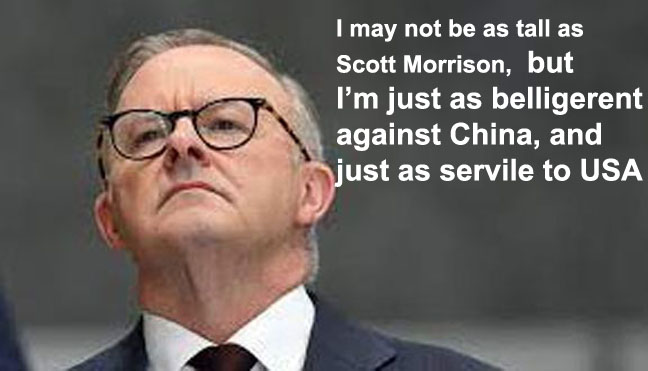
Even the hawkish former defence Minister Peter Dutton told National Press Club that he did not believe China wanted to occupy Australia. Why then do both sides of politics go out of their way to make an enemy of China. It is a recklessly provocative policy that could cause many Australians to die unnecessarily.
Albanese blasted China for not condemning Russia’s invasion of Ukraine but exempted India which did the same.
China has not been in major war since 1950. Nor has it killed anyone in the South China Sea or near Taiwan, where it is accused of behaving more aggressively. All major countries accept Taiwan is part of China.
What is Anthony Albanese up to! https://johnmenadue.com/what-is-anthony-albanese-up-to/ By Brian Toohey. Jul 6, 2022
Anthony Albanese has shown during his recent trip to Europe that he is a prime minister addicted to hyperbole and oblivious to how countries can change in unexpected ways.
He told NATO leaders China aimed to become the most powerful nation in the world and its strengthening relations with Moscow “posed a risk to all democratic nations”. It’s most unlikely all democratic countries will be at risk. For a start, Russia will be in no condition to go to war with any other country after its abhorrent decision to invade Ukraine. It could be bogged down for years in a guerrilla war. China faces a growing number of countries, including those in NATO, which are committed to containing its military and economic growth.
Albanese said in Europe that China is trying to “build up alliances to undermine what has historically been the Western Alliance in places like the Indo Pacific”. Historically, however, most Asian countries, including India and China, have been there a lot longer than the Western intruders are likely to last. The US may be the exceptional state. It annexed Hawaii in 1898 and made it an American state in 1959. But there is a plausible chance America will not remain a democracy in coming years. While nothing is certain, China may become a democracy sometime after a discredited President Xi is deposed or dies. If so, it is entirely feasible the public may elect a majority Communist government led by a moderate reformist. No one knows. Alternatively, the US may become an autocratic state with a feral Supreme Court while China remains an autocratic state with an unpopular and futile determination to achieve “Zero Covid”.
The story of other members of the Western alliance is one of momentous change. Britain took Hong Kong by force in 1842 as a base for peddling opium produced in India by the British East India Company. India won its independence from Britain in 1947 and Hong Kong was handed back to China in 1977. France had a cumulative 100 years as the colonial power in Indochina until booted out by the Viet Minh in 1953. However, it retained its colonial possessions in the Pacific Islands. Albanese told President Macron in Paris that France was an Indo Pacific power which could help contain China’s “growing ambitions” in the region.
Albanese told President Macron in Paris that France was an Indo Pacific power which could help contain China’s “growing ambitions” in the region.
Albanese blasted China for not condemning Russia’s invasion of Ukraine but exempted India which did the same. Labor’s Defence Minister Richard Marles earlier warmly praised India and said it is “central to Australia’s worldview and defence planning”. It also has a Hindu supremacist government that actively discriminates against Islamic members of the population.
While in Europe, Albanese falsely claimed that Australia always obeys the international rules. If it had, it would not have helped the US and the UK invade Iraq. The invasion killed or seriously injured large numbers of people and rendered even more homeless. It also allowed terrorist groups to operate in Iraq when none were present under Saddam Hussein. Albanese’s misleading assertion dishonours Labor’s leader at the time, Simon Crean, who opposed the invasion as a breach of the rules forbidding the use of military aggression in international relations.
Albanese caught the attention of his European audience when he complained that China had “economically coerced” Australia. A fuller picture would have acknowledged Australia officially took more than 100 anti-dumping complaints against China, despite usually frowning on such measures as potentially harming free trade. China eventually retaliated with tariffs and anti-dumping measures on some Australian exports to China. Albanese gives no sign that he understands China is not the only one who should back off.
China has not been in major war since 1950. Nor has it killed anyone in the South China Sea or near Taiwan, where it is accused of behaving more aggressively. All major countries accept Taiwan is part of China. Some of China’s opponents, including senior US Republican politicians, seem intent on goading it into using military force against Taiwan. Fortunately, Taiwanese leaders seem to understand that the island will not be attacked unless they declare independence. China could make this less likely by granting Taiwan a genuine status as autonomous region. One reason China won’t grant independence is this would make the island a convenient base to stage attacks against the mainland. Nevertheless, an experienced observer Geoff Raby says China won’t attack the island as this would involve the killing fellow ethnic Han Chinese which would be highly unpopular.
China makes claims to territorial waters in the South China Sea that other littoral countries also claim. The Pentagon acknowledges China withdrew six land claims to settle borders disputes. If it wants to be more accommodating, China could settle some of the extreme territorial sea claims that were originally made by the Communist Party’s political opponent, the Nationalist Party, before 1949. Taiwan also makes these claims. Ideally, China Sea could follow the Antarctic example and offer to turn South China Sea into a demilitarised zone beyond the 12 nautical mile offshore line.
There is no dispute that China is building up its armed forces. But its spending is no match for the US which is spends as much as the next nine countries together, including China. China has good reason to respond to a US military build up. In 2009, the US announced it had developed an Air/Sea Battle Plan for a war with China, to destroy much of its air and naval forces and blockade all its ports and maritime routes. The details have changed, but in 2011 the US also adopted a “pivot” to the Pacific with goal of deploying 60 per cent of its forces there. It is also actively engaged in building new bases on Pacific islands within striking distance of China while the Albanese government loudly opposes any hint that China might try to build naval base in the Pacific, or even in nearby Cambodia. US and Australian forces also constantly undertake surveillance missions close to China.
In these circumstances, it is vital to try to ease tensions on all sides to avoid what would be a terrible war. In the past, Labor would be among those urging support for new arms control agreements and expanding all channels for the potential combatants to talk. Ben Chifley, Bert Evatt, Gough Whitlam, Bill Hayden, Gareth Evans and Paul Keating all made significant efforts to actively promote peace. Anthony Albanese is supporting a large arms buildup, which is not the same thing.
Well before Albanese’s European trip, he stressed the Labor government would support the Coalition’s new security pact between Australia, the UK and the US (AUKUS). No one has given a convincing explanation for why we need AUKUS on top of the Australian New Zealand US (ANZUS) security treaty signed back in 1951.
The UK adds nothing of value. In 1968 the then Labour Prime Minister Harold Wilson announced that Britain would withdraw its military bases from “East of Aden”. This was a good policy reflecting the fact that Britain no longer ruled the waves. Wilson also refused to send British troops to the Vietnam war, partly because the country couldn’t afford it. Yet Britain retained its “special relationship” with the US. A subsequent government restored a military base in the Middle East, but now Boris Johnson, a disastrous prime minister, has given British military forces a role in confronting China in the Asia-Pacific.
Although the text of AUKUS has not been released, it states the US and UK are prepared to sell nuclear submarines to Australia. They would’ve done that without AUKUS. They would also have done so for other countries such as Japan, South Korea, Vietnam and Singapore, but they see more advantages in writing operating modern conventionally powered ones. NATO members without nuclear subs could buy them, but don’t because it doesn’t make military or financial sense. Yet Labor still wants buy eight nuclear subs, almost certainly from the US, so it can fire cruise missiles from nuclear submarines operating far from Australia into China. This is an extremely bad idea on both strategic and cost grounds. It will only provoke China which çan fire more missiles into Australia than Australia can fire into it. We could do more to defend Australia from closer to home with a mix of weapons at a much lower cost. Moreover when our nuclear submarine fires the first missile into China it will be detected and almost certainly sunk.
Plausible estimates put the cost of eight US nuclear submarines at $171 billion. (This is from a government that says it can’t afford to increase the miserable level of the New Start Allowance.) The risks of buying nuclear are on the upside, particularly as Australia wants to build them here.
The first submarine, probably a version of the US Virginia class attack ones, will not be operationally available until the early 2040s and the last by 2060. A leading US defence analyst Winslow Wheeler cautions that the Virginia class has maintenance problems and is not available for much of the time. He says that over 33 years they have only performed 15 six monthly deployments.
The former Senator Rex Patrick, an ex-submariner, says that conventionally powered submarines are now commonly equipped with air independent propulsion (AIP), which makes them quieter than nuclear submarines which have to keep their reactor cooling pumps going and use noisy big meshing gears between the steam turbines and propellers. Others point out that nuclear subs can be detected by their constant release of hot water; by leaving wakes on the surface when run at high speeds and by blue green lasers that will penetrate water by 2040.
Patrick says that figures given to the parliament show Australia could buy 20 modern off-the-shelf conventional submarines for $30 billion – not $171 billion for nuclear submarines that don’t meet our requirements.
Another downside of buying nuclear subs is that we would have to meet our obligations to declare any fissile material under our control to the International Atomic Energy Agency which acts on behalf of the Nuclear non-Proliferation Treaty (NPT). However, the US will refuse to give us the required information about the highly enriched, weapons grade uranium in the reactors.
A further problem is that several Pacific Island leaders don’t want Australia to buy nuclear submarines. Nor, as Foreign Minister Penny Wong discovered on her recent visit to Malaysia, do its leaders.
Australian public opinion does not unambiguously support Labor’s strategy. The latest Lowy Institute’s annual poll shows over 51 per cent believe Australia should remain neutral in a military conflict between China and the US.
Even the hawkish former defence Minister Peter Dutton told National Press Club that he did not believe China wanted to occupy Australia. Why then do both sides of politics go out of their way to make an enemy of China. It is a recklessly provocative policy that could cause many Australians to die unnecessarily.
AUKUS submarines: Beasts of nuclear proliferation
The AUKUS security partnership, announced last September by Australia, the United States and Britain, has muddied the pool of non-proliferation.
The precedent of permitting Australia to be the only non-nuclear weapons state with HEU-propelled technology is also seismic on another level.
For one thing, Article III of the NPT exempts naval reactors from nuclear safeguards, which threatens a pillar of the non-proliferation regime — limiting the production and use of highly enriched uranium (HEU) which can be used, in turn, to make nuclear weapons.
There will be nothing stopping China and Russia doing what the United States and Britain promise to do: proliferate naval reactor technology and long-range missiles with a nuclear capability.
https://www.greenleft.org.au/content/aukus-submarines-beasts-nuclear-proliferation Binoy Kampamrk, July 6, 2022, Issue 1352,
When faced with the option of acquiring nuclear technology, states have rarely refused. Since the splitting of the atom and the deployment of atomic weapons in war, the acquisition of a nuclear capacity has been a dream. Those who did acquire it, in turn, tried to restrict others from joining what has become, over the years, an exclusive club.
Members of this club engage in elaborate ceremonial claims that their nuclear weapons inventory will eventually be emptied. Non-nuclear weapons states allied to such powers go along with appearances, taking comfort that nuclear weapons states will offer them an umbrella of security.
This hypocrisy underlines such arrangements as the Treaty on the Non-Proliferation of Nuclear Weapons (NPT).
Central to the document is the discouragement of non-nuclear weapons states from weaponising nuclear technology, as long as members of the nuclear club pursue “good-faith” disarmament negotiations. While it is true to say that the NPT probably prevented a speedier, less infectious spread of the nuclear virus, it remains a constipated regime of imperfections that has only delayed proliferation.
Most tellingly of all, most non-nuclear weapon states have complied with their undertakings whereas nuclear weapons states have not: they have disregarded serious multilateral nuclear disarmament. Nor do they have an incentive to alter current arrangements, given that any changes to the NPT can only take place with the unanimous support of the three treaty depositories: Russia, Britain and the United States.
The NPT supporters pour scorn on alternative approaches to nuclear weapons, such as the Treaty on the Prohibition of Nuclear Weapons (TPNW), which held its first meeting of state parties in Vienna from June 21—23.
While the Anthony Albanese government sent Susan Templeman MP to the meeting as an observer, Canberra has remained consistently opposed to the TPNW as a threat to the accepted disarmament and NPT framework. Dated and spurious concepts, such as extended nuclear deterrence and the interoperability of Australian and US military systems, tend to be common justifications.
The AUKUS security partnership, announced last September by Australia, the United States and Britain, has muddied the pool of non-proliferation.
A central component of the agreement is a promise to share nuclear propulsion technology with Australia, thereby enabling it to acquire eight nuclear submarines, to supposedly be built in Adelaide.
While much of this is wishful thinking — Australia has no expertise in the field and will have to rely on expertise from the other two — the glaring problem with AUKUS is what it does to non-proliferation arrangements.
While former Prime Minister Scott Morrison said the agreement would comply with Australia’s own non-proliferation commitments, such confidence is misplaced.
For one thing, Article III of the NPT exempts naval reactors from nuclear safeguards, which threatens a pillar of the non-proliferation regime — limiting the production and use of highly enriched uranium (HEU) which can be used, in turn, to make nuclear weapons.
Non-proliferation experts have not been enthusiastic with the promised new Royal Australian Navy submarines. Daryl G Kimball, director of the Arms Control Association, noted the salient difference between deepening defence cooperation with allies on the one hand and proliferating “sensitive HEU nuclear propulsion tech in contravention of US and global nonpro principles”.
Hans Kristensen, director of the Nuclear Information Project at the Federation of American Scientists, greeted AUKUS with gloom when it was announced. Its provisions on nuclear technology would “further intensify the arms race in the region and the dynamics that fuel military competition”.
The International Atomic Energy Agency’s (IAEA) Director General Rafael Mariano Grossi is visiting Australia to discuss safeguards of nuclear material used for naval propulsion.
This is nothing short of problematic, given that IAEA inspectors are unable to inspect such material for extended periods of time when the vessel is at sea. Grossi described this process as “quite complex”, although he wants Australia to commit to non-proliferation alongside the acquisition of nuclear technology.
“There is a period of 18 months which was given by the three partners — the United States, United Kingdom and Australia — to define how the project is going to be implemented but, already we have started this interaction, this joint work of technical levels so that we can reconcile both things.”
Prior to Grossi’s visit, Foreign Minister Penny Wong reiterated Australia’s “longstanding” support of the “IAEA’s mission to harness the peaceful use of nuclear technology in areas like medicine, industrial processes and environmental monitoring, as well as upholding the international nuclear non-proliferation regime”.
The world Wong described is distinctly pre-AUKUS. Despite promises of “open and transparent engagement with the IAEA on nuclear safeguards”, the whinnying horse of proliferation has bolted from the stable. Assurances to avoid the future development of nuclear weapons capability in Australia or a national nuclear fuel cycle also ring hollow.
The precedent of permitting Australia to be the only non-nuclear weapons state with HEU-propelled technology is also seismic on another level.
There will be nothing stopping China and Russia doing what the United States and Britain promise to do: proliferate naval reactor technology and long-range missiles with a nuclear capability. [Dr Binoy Kampmark lectures at RMIT University.]
Julian Assange files new appeal fighting extradition to US.
Washington Examiner. by Ryan King, Breaking News Reporter, July 01, 2022
WikiLeaks founder Julian Assange is appealing the United Kingdom’s order to extradite him to the United States.
Two appeals were filed in the High Court of Justice in London to challenge the extradition, and the court will decide whether to evaluate the case, Assange’s attorney Gareth Peirce announced, according to the Wall Street Journal……………………………………
Friday was the deadline for Assange to appeal the extradition order, according to the BBC. He is being held at Belmarsh prison in London.
His lawyers claimed that he could face up to 175 years behind bars if he stands trial in the U.S., but the U.S. argued he will likely face between four and six years.
A myriad of groups championing freedom of the press urged the U.K. not to extradite Assange, arguing that doing so could set a bad precedent and hamper press freedoms in the future. For example, the International Federation of Journalists has expressed concerns the move could pose a “chilling effect” on journalists worldwide.
“The US pursuit of Assange against the public’s right to know poses a grave threat to the Fundamental tenets of democracy, which are becoming increasingly fragile worldwide,” the group said. “Irrespective of personal views on Assange, his extradition will have a chilling effect, with all journalists and media workers at risk.”
“The case sets a dangerous precedent that members of the media, in any country, can now be targeted by governments, anywhere in the world, to answer for publishing information in the public interest,” the group added.https://www.washingtonexaminer.com/policy/courts/julian-assange-files-appeal-fighting-extradition
Mr Albanese goes to Madrid: Australia on the alliance path to Global Nato

Albanese’s trip to the leaders’ summit of a US-dominated alliance centred on the other side of the world will prepare the way for deeper Australian integration into a broadened Nato.
Above all, in one respect Mr Albanese’s rush to Madrid is not so different from his predecessor’s cajoling of Washington and London to help out a mate with the anachronistic PR nonsense of AUKUS and the gift horse of a ‘privileged’ offer to allow Australia to buy massively expensive American or conceivably British nuclear-powered submarines.
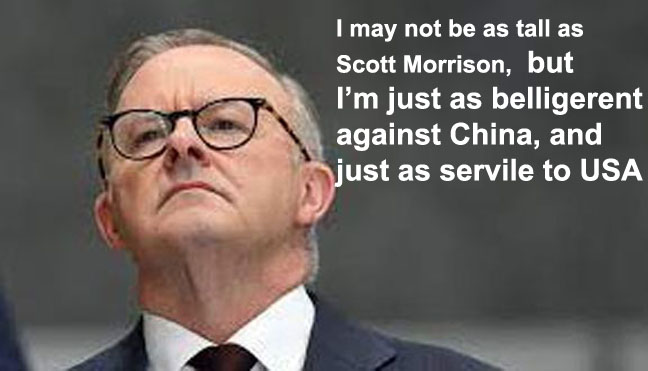
https://johnmenadue.com/mr-albanese-goes-to-madrid-australia-on-the-alliance-path-to-global-nato/ By Richard TanterJun 30, 2022, While most eyes rest on the remains of Scott Morrison’s failed attempt at a khaki election through last September’s announcement of a backward-looking AUKUS alliance, prime minister Anthony Albanese’s trip to Madrid for the North Atlantic Treaty Organisation summit points to a much more significant shift in Australia’s alliance with the United States – ‘a global alliance of democracies’, aka Global NATO.
Scott Morrison’s AUKUS centring on agreement with the US and UK to provide Australia with submarine nuclear propulsion evoked derision about its back to the 1950s strategic vision and despair about what promises to be the worst and most consequential of Australia’s numerous recent politically-driven defence procurement choices.
The submarines debacle apart, AUKUS for the most part remains a matter of two or three lines of unpromising promises in media releases, largely dealing with matters already the subject of bilateral agreements or dimly-seen possible futures like quantum computing for defence purposes.
The most recent, if somewhat limp, nudge to keep the Albanese government on the nuclear submarine track came at the National Press Club when the Lowy Institute’s Michael Fullilove mocked an informed questioner concerned about the deal’s implications for the tattered nuclear Non-Proliferation Treaty. This widely-held worry – if first Australia, then serious nuclear weapon-wannabes Brazil and South Korea – was in fact unimportant Fullilove replied, since experts such as former Foreign Minister Gareth Evans have assured us are under control.
At the same time the US has just added its confidence booster to this process with a bill before Congress for an Australia-U.S. Submarine Officer Pipeline Act that would allow two RAN submariners a year to attend a seven-week nuclear reactor training, take the US Navy’s Submarine Officer Basic Course, and then deploy aboard a US nuclear-powered submarine.
This only leaves the imponderables of deciding the strategic rationale of the mission to which the submarines are to be solution, the actual technical requirements that would be entailed by that mission, the design of the submarine, the choice of country and lead contractors for the build, the development of a full-scale naval nuclear-engineering safety and maintenance regime, and a brief discussion of the lifetime costs likely to be more than a couple of multiples of the $100 billion estimate for the French submarines.
What could possibly go wrong?
And that’s before any discussion of opportunity costs – even for alternative contenders for defence spending, let alone meeting non-military requirements for a secure Australia – of the lifetime costs of a commitment to nuclear submarines that are likely to move towards the half trillion dollar mark.
But Albanese’s trip to the leaders’ summit of a US-dominated alliance centred on the other side of the world will prepare the way for deeper Australian integration into a broadened Nato.
For over a decade US and Nato officials and Australian defence advisors have been calling for ‘a global alliance of democracies’. The Australian prime minister, together with the leaders of Nato’s other ‘Asia-Pacific partners’ from Japan, New Zealand and South Korea, will participate in the launch of the first formal iteration of Global Nato with Nato’s Strategic Concept 2022.
Two decades of high tempo deployment of Australian military under Nato auspices in the disastrous wars in Afghanistan and the Middle East have conditioned the Australian Defence Force to close operational coordination and interoperability with US-led Nato ground, air, and naval forces.
Defence planners have gradually integrated Nato into high-level Australian strategic planning, first as an ‘Asian partner’ Nato along with Japan, South Korea and New Zealand, and recently as an ‘Enhanced Strategic Partner’.
Nato’s centrality to the hyper-multinational International Security Assistance Force in Afghanistan provided the first and possibly most important Australian escalator into Nato.
While replete with consequences as lethal for the people of Afghanistan as they were dysfunctional for all of the alliance militaries involved, ISAF, together with the parallel US-orchestrated Combined Maritime Forces in the western Indian Ocean from 2002, provided deep operational experience and ‘learnings’ for a Nato-centred US-led coalition on a scale approaching a multilateral ‘global’ presence.
Nato’s Strategic Concept 2022 is to be formalised at the Madrid Summit, representing a maturation of US post-Cold War planning for a major step towards an integrated global defence alliance after seventy years of US-dominated Nato in Europe and the limitations of bilateral hub-and-spokes alliances in Asia.
Most importantly, apart from integrating its Asian partners more closely, the new Strategic Concept is to prepare Nato ‘against all threats, from all directions’.
Full membership of Nato for any of these Asian partners will be a long way off, not least because the governing institutions of a now 30 member country nuclear alliance will need adjustment, even assuming there is no uncomfortable internal opposition as Turkey has mounted against the admission of Sweden.
For the present, Australia, Japan and Korea – and possibly New Zealand – will be drawn into Nato’s seemingly endless rounds of political, diplomatic, military and civil society consultations (though the last is in practice a most attenuated and selective grouping of actual national and international civil society).
US-led military interoperability drives will be coupled with injunctions for closer political and strategic planning coordination between Canberra and Brussels (aka Washington).
But there can be little doubt of the ultimate goal for Washington in the construction of ‘an alliance of democracies’ with global reach.
The follies of AUKUS distract attention from the scale of the quiet achievement of the United States in rescuing Nato from post-Cold War obsolescence, latterly assisted greatly by the Russian war against Ukraine.
Drawing the line from Kyiv to Taipei, ‘we know’, the Prime Minister said, ‘that there is an alliance that has been reached as well between Russia and China. There are implications for our region, given the strategic competition that is in our region, which is why this Nato summit comes at such a critical time’.
As Mr Albanese rightly put it Russia’s ‘brutal invasion is against the rule of law’, and carries implications for ‘all of those who cherish democracy, who cherish the rule of law, and who cherish the rights of nations to be sovereign’.
Yet Australia needs to tread carefully.
The warm glow of rhetorical solidarity with Ukraine facing World War 2-scale Russian attack tends to veil the fact that multiple US-auspiced Nato interventions in the Middle East, North Africa and Afghanistan have led, via great destruction, to evident defeat or specious ‘mission accomplished’.
Moreover the list of Nato members and partners does not provide an unsullied list of countries honoured for their respect for democracy, rule of law, or sovereignty.
Mr Albanese might like to chat about the rule of law with Victor Orbán from Hungary or Recep Tayyip Erdoğan from Turkey, or indeed with Boris Johnson – or mull over the battered state of American democracy with Joe Biden.
Perhaps a stopover by his RAAF plane in Diego Garcia might prompt some thoughts about British respect for the rule of law – in certain respects, such as the forced dispossession of the indigenous Chagos Islanders to make way for a giant US military base often used by Australia, more egregious than China’s violations of international law somewhat further east.
Above all, in one respect Mr Albanese’s rush to Madrid is not so different from his predecessor’s cajoling of Washington and London to help out a mate with the anachronistic PR nonsense of AUKUS and the gift horse of a ‘privileged’ offer to allow Australia to buy massively expensive American or conceivably British nuclear-powered submarines.
By all means, let us make common cause with governments we find congenial – when our interests do in fact genuinely align. Defence coordination and cooperation with democratic states in our principal areas of strategic interest is a must for Australia. The problem is that Europe is not such an area, and neither was the Middle East, Afghanistan, nor Nato’s latest fronts in North Africa and the Sahel.
Thinking about an alliance of democracies is not inherently foolish. The problem comes when the form of periodic elections is confused with the substance of democracy. It may seem carping to point to the Orbans and Erdoğans of Nato, but with Marine Le Pen possibly just one more election away from the Elysée, the authoritarian threat in Europe is palpably real.
Remarking on a British prime minister’s announced willingness to trash international agreements for political gain at the risk of re-starting a war in Northern Ireland may seem unoriginal, it is scarcely beside the point with talk of new alliances built on rule of law.
Most seriously of all, we should be talking about the risk of a precipitous decline, or even collapse, of democracy in the United States extremely seriously. Appalling as it is, the Supreme Court decision abolishing US women’s rights to control their bodies is but the latest blow to the unexamined claim for the United States to still be called a global model of democracy.
The view in Canberra seems to be that the US alliance has survived the threat of Trump, so it’s back to business as usual, and onward to ever closer union – with the path leading now through Brussels. Yet the dangers to Australia from unconsidered reliance on a country with both systemic dysfunction and deep anti-democratic impulses at its heart should not be ignored.
The common element between the swooning Australian interest in Global Nato and the Morrison fiasco with AUKUS and the manifold problems of its submarine element is that in both cases a considered assessment of whether Australian national interests align with those of the United States – in this case in the guise of Nato – is absent.
The new Australian foreign minister has started a commendable reset of Australian regional relations in an effort to recover, at least as a start, from the wreckage of a decade of coalition policy.
In a series of important statements on foreign policy in recent years Penny Wong eloquently has made the case for understanding that a proper consideration of our national interest cannot be separated from the long and sometimes difficult process of working out who we are.
Interests very largely flow from identity, especially when it comes to reading a map of threats and opportunities. Why then would the first foreign policy ventures of a new prime minister be tied to an alliance with the other side of the world – for Australia, the old world?
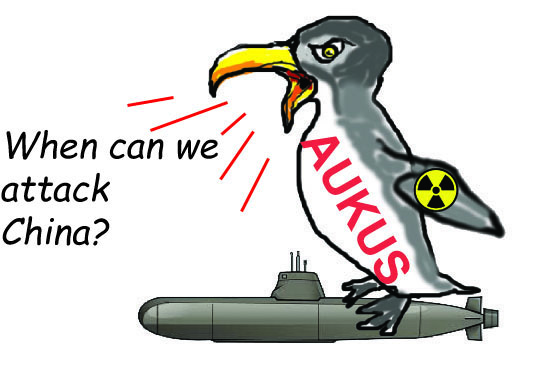
Oh, for a Prime Minister honest about Australia’s security!
https://johnmenadue.com/oh-for-a-prime-minister-honest-about-australias-security/1 By Mike Gilligan, Jun 29, 2022,
How did it come to this? Australia’s defence policy has been baldly sacrificed to US interests via AUKUS with little public discourse.
Mostly, those that present as security experts have mumbled support as the US entangles Australia in its planning for war with China. Not a word from the serried rows of professors, publicly funded, who otherwise jostle for public exposure.
For five decades Australia’s security policy has centred on defending our territory independently. Self-reliance has been the prudent and rational posture for Australian governments with ANZUS deliberately avoiding a commitment to armed response by the US in the event of attack on Australia.
Implementing that strategy has been a big task – intellectually, financially and managerially, requiring all our defence spending to be directed to that objective. Whenever we have chosen to join the US in its global wars we did so with modest contributions drawn from forces created for our own priorities, measured to signal political support but not detract from our own objective. Now that policy has been abruptly buried with AUKUS requiring our taxes to heavily fund US strategic denial of China – building nuclear submarines of little value for our own needs to fit with US planning for military conflict with China.
How could Australia’s security policy move largely unremarked from an earnest and internationally respected self-defence policy to mounting aggressive deployments into China’s adjacent waters, at mind numbing cost? Former Prime Minister Paul Keating was an early and insightful critic of AUKUS. Just a few weeks after it was announced, Keating addressed the National Press Club, in November last year. He began by inferring that it was because mainstream media coverage of security is so weak in Australia he felt compelled to share his perspective. Keating’s reservation was reinforced by the level of questions from the floor at the end. Keating made the then striking claim that Australia was to build nuclear submarines specifically to attack China in its waters. He observed that this had been admitted effectively by Australia’s ambassador to Washington, Arthur Sinodinos. The submarines would be designed to attack China’s nuclear missile submarines which are China’s second-strike deterrent to US nuclear attack on China.
So, Australia is being set up as a key factor in the nuclear war equation of the US and China. Broadly, Keating argued that China deserves respect. It now has a bigger economy than the US by 25% and can be expected to expand that gap in coming decades. China has shown it wants to participate in global structures and be part of reform. China has a lot to offer and is not contriving to run the world. Its security concern is to push US sea and air military forces away from its borders, noting US and other forces (including Australian) exercise in the South China Sea. The more senior of the serried professors, Paul Dibb, quickly took up the pen disparagingly against Keating, observing that Keating “gave the strong impression of being a sleepwalker”. Dibb is thereby suggesting it has long been common knowledge that Australia is preparing for war against China. If so, that is news to most Australians, including those who have a more-than-cursory interest in our security affairs.
On Thursday last week, Dibb was delivered by ABC TV into the living rooms of Australians via the 7:30 Report, unannounced and without context, just prior to Leigh Sales’ interview with Prime Minister Albanese. His hectoring message was that Defence should have first priority from the Government, to ensure that it counters an “aggressive and expansionist” China. Urgency was implied as China could exploit a “window of opportunity” with the US distracted by the Ukraine. I suspect most viewers thought that this was just more of the banality we enjoy on Thursday nights from Sammy J. But it was shabby, ABC.
Dibb’s professional pedigree lies in Cold War intelligence. It has been claimed that he enjoyed unusual access to sensitive classified material for years. In this regard Dibb should now be obsolete. These days he writes for an online ASPI platform where his paragraphs settle comfortably alongside trademarks of weapons systems purveyors. The tone is invariably unsettling and receptive to greater defence spending. Yet big media conduits such as the Press Club and ABC television, which provide him a national platform at prime time, offer no declaration of interests.
Another professor, Rory Medcalf, head of the “National Security College “ at the ANU with staff of about sixty, writes and comments regularly. His recent book “Contest for the Indo-Pacific” is engaging but the substance is a worry. In discussing Australia, Medcalf shows poor comprehension of the realities of Australia’s defence policy post ANZUS: “ Australia relies acutely on … in the ultimate crisis, the expectation under the ANZUS Treaty that overwhelming (US) force would come to its aid “. In fact Australia’s policy has been quite the reverse – to have no such expectation of US force intervening on our behalf under ANZUS . Even security hobbyists know Medcalf Is at odds with decades of Australian defence policy centred on self-reliance, deriving from the ANZUS negotiation by Spender, its ratification by Congress and subsequent affirmations. This failure is not of some slippery nuance. Ignorance of a key risk factor in our security is more than disappointing at his level. Only by getting ANZUS right can we address our security risk.
In public commentary Medcalf seems as anchored ideologically as the daily media, lining up with China as a threat to be constrained. How can Australians understand security without credible public thought leaders? Recognising the deficiency is a start. Balanced analytical commentary should aim for Australians to be confident that their governments comprehend and are dealing with the risks in ANZUS. At present few realise that any Australian government joining with the US in applying military force against China on the assumption that the US will be with us “all the way”, is foolhardy.
What an achievement it would be for a serving prime minister to inform Australians honestly of our ultimate security risk under ANZUS. Prime Minister Albanese might ponder that as he sits amongst NATO leaders in Madrid, none of whom carry similar risk to him because they share a real security treaty with the US. And perhaps the Prime Minister might realise that Australia, in being treated differently, can learn from Ukraine’s experience as a qualified friend of the US.
Dr Mike Gilligan worked for 20 years in defence policy and evaluating military proposals for development, including time in the Pentagon on military balances in Asia.
A new era as Australia joins historic UN nuclear ban meeting
.
https://johnmenadue.com/australia-joins-historic-un-nuclear-ban-meeting/ By Tilman RuffJun 27, 2022,
This week in Vienna, Australia joined a landmark gathering of eighty-three governments to further implement and develop the treaty banning nuclear weapons.
In a stunning demonstration of resolve, goodwill and cooperation, with no shred or adversarial politics, the meeting adopted a realistic action plan that breaks new ground. It maps out collaborative programs of work led by different states in key areas of treaty obligations: promoting treaty membership and norms, complementarity with other nuclear treaties, disarmament processes including verification, and assisting victims and remediating (where possible) environments harmed by nuclear weapons use and testing. States also made a political declaration that is arguably the strongest and clearest rejection of nuclear weapons ever made by a multilateral gathering.
Five years ago, by a vote of 122 to 1 in the United Nations in New York, the first treaty to ban the worst weapons of mass destruction was born: the Treaty on the Prohibition of Nuclear Weapons (TPNW). For its role in bringing about the treaty, the Melbourne-born International Campaign to Abolish Nuclear Weapons (ICAN) became the first Australian-born entity to be awarded the Nobel Peace Prize. The treaty entered into legal force last year, and this week for the first time, governments gathered to discuss and decide how to promote and implement the treaty.
The Australian delegation to Vienna was led by NSW Labor MP Susan Templeman, federal member for Macquarie, who last year said Australia “can and should lead international efforts to rid the world of nuclear weapons”. She told the Blue Mountains Gazette this week: “It was great to be in Austria to observe the first Meeting of States Parties to the Treaty on the Prohibition of Nuclear Weapons (TPNW) on behalf of Australia. … Australia shares the ambition of TPNW states parties of a world free of nuclear weapons.”
The Vienna meeting from 21-23 June was the first intergovernmental gathering focused on addressing the threat of nuclear weapons since Russia’s invasion of Ukraine and multiple threats by President Vladimir Putin to use nuclear weapons. Other “nuclear-endorsing” states attending the meeting as observers included NATO members Germany, the Netherlands, Norway and Belgium. Sweden, Finland and Switzerland also joined.
Shamefully, the previous Australian government boycotted the negotiation of and opposed the TPNW, the first time Australia has ever boycotted multilateral disarmament negotiations. This stands in stark contrast to Australia under governments both Labor and Coalition having joined the treaties that ban biological and chemical weapons, landmines and cluster munitions.
In 2018, the ALP adopted unanimously a national policy platform commitment to sign and ratify the TPNW. It reaffirmed that policy at its national conference in 2021. Prime Minister Anthony Albanese is a long-term champion of nuclear disarmament and non-proliferation and moved the new policy in 2018. Over three-quarters of all members of the new government have personally backed the treaty. In this they have strong public support – opinion polls over recent years have consistently shown 70-80% of the public want Australia to join the TPNW – in the most recent poll 76% of those asked want Australia to join the nuclear weapon ban, with only 6% opposed (Ipsos, March 2022).
Fifty-five Australian former ambassadors and high commissioners this week released an open letter to PM Albanese urging him to sign and ratify the TPNW without delay.
The meeting in Vienna and a new more constructive era in Australia’s approach to nuclear disarmament and non-proliferation could not come at a more critical time. With Russia’s invasion of Ukraine accompanied by repeated threats to use nuclear weapons, the world faces the greatest evident danger of nuclear war since the Cuban missile crisis of 1962. Russia’s threats should shatter any misplaced sense of complacency or denial that somehow the risk of nuclear war is a faded relic of the past that no longer demands our urgent attention.
Russia’s threats have upended decades-old assumptions about security and deterrence, with Russia using nuclear weapons not to deter but to coerce and intimidate, and provide a cover for war crimes and gross violations of international law and human rights.
But as former UN secretary-general Ban Ki-moon said, “There are no right hands for the wrong weapons.” Every day that thousands of nuclear weapons remain launch-ready, two thousand of them ready to be launched within minutes, they remain the most acute existential threat to humanity and our planet. The leading scientists behind the Doomsday Clock have set it at 100 seconds to midnight, further forward than ever before. None of the nine states wielding nuclear weapons are disarming or negotiating for disarmament as they are obligated to do. To the contrary, all are engaged in upgrading and modernising their arsenals with new, more accurate, flexible and ‘usable’ weapons. Kinds of nuclear weapons the world has never seen before are being developed and deployed, including hypersonic missiles, nuclear-armed cruise missiles powered by nuclear reactors, and nuclear torpedos. And the number of usable weapons in military stockpiles is again increasing.
The International Campaign to Abolish Nuclear Weapons (ICAN) in a report released last week documented that last year the nine nuclear-armed countries spent US$82.4 billion (A$116 billion) on nuclear weapons – A$220,000 per minute – an inflation-adjusted increase of A$9.2 billion from 2020.
The day before the treaty meeting, the Australian delegation also joined a Conference on the Humanitarian Impacts of Nuclear Weapons hosted by Austria, which provided compelling updated evidence from scientists, emergency responders and other experts on the catastrophic consequences and growing risks of use of nuclear weapons.
The TPNW provides our best hope to control our worst weapons, and is currently the only bright light in an otherwise bleak and darkening nuclear landscape. Hopefully this early positive step will be promptly followed by the new government signing and working towards Australia ratifying the treaty, in line with its pre-election commitments.
TILMAN RUFF
Tilman Ruff AO is Co-President of International Physicians for the Prevention of Nuclear War (Nobel Peace Prize 1985); and co-founder and founding international and Australian Chair of the International Campaign to Abolish Nuclear Weapons (ICAN), awarded the 2017 Nobel Peace Prize, the first to an entity born in Australia.
The United States-the Pacific bully
https://johnmenadue.com/the-united-states-the-pacific-bully/ By Brian Toohey, Jun 24, 2022,
The US dominates the Pacific Islands to an extent China can never hope to achieve. With Australia’s support, the US is now engaged in an arms build-up in its Pacific territories and de-facto colonies in a little known boost to its containment of China.
The US has three self-governing territories in the Pacific: Guam, American Samoa and the Northern Mariana Islands. Guam hosts some of the US’s most important bases the world. After a large scale military expansion on one of the main islands in the Northern Marianas, Tinian is expected to rival Guam in importance in coming years.
The US also has Compacts of Free Association with three countries covering thousands of islands in the Pacific – the Federated States of Micronesia, Palau and the Marshall Islands. The compacts are a de-facto form of colonialism which gives the US exclusive military access to these countries’ land and maritime surrounds in return for defence guarantees and financial assistance.
The Federated States of Micronesia has a population of around 100,000. It has a land area of 702 square km on 607 islands amid 2,600,000 square km of ocean. The US will build a new base there. The residents are concerned about the impact of the base as their islands are often tiny and the landscape important to their identity. The US is also establishing a new military base on Palau, which has 340 islands and a total population of just over 18,000. The Marshall Islands landmass is 181 square km amid 466,000 square km of ocean. Although the Kwajalein atoll is only 15 square km, it is exclusively a military base with an extraordinary array of US activities; including a key role in US testing interceptors aimed ballistic missiles.
The Chinese foreign minister Wang Yi recently visited seven South Pacific countries and signed various agreements in some, including the provision of infrastructure and police training , but he failed to get support for a 10-country trade agreement. He did not seek permission to build a navy base in the Solomon Island or anywhere else. Nevertheless, some saw the visit as an act of Chinese aggression. It is an odd view of aggression compared to the damage done by US, British and French testing of thermonuclear (also called hydrogen) bombs on Pacific islands, or when Australia helped invade Iraq.
The US conducted 105 nuclear tests in the Pacific, mainly in the Marshall islands, between 1946 and 1962, as part oftits program to develop thermonuclear bombs. Operational weapons were sometimes tested, including a submarine-launched war head. One test in 1952 completely vaporised the island of Eluglab. In 1954, a thermonuclear bomb tested on Bikini atoll exploded with force of 15 megatons – over 1,000 times bigger than the bomb dropped on Hiroshima. The radioactive cloud engulfed a Japanese fishing boat about 80 miles away in a white powder that poisoned the crew. One died from the exposure seven months later and 15 more in following years.
The radioactivity affected the drinking water and food. Children played in the ash-like powder. Some ate it. Marshall Islanders over a wide area were subject to abnormal radiological doses. In 2005, the US National Cancer Institute reported that the risk of contracting cancer for those exposed to the fallout was over one in three.
Nevertheless, in 1946, a US Navy Commodore had asked 167 people living on Bikini atoll to re-locate so their home could be used use “for the good of mankind”. They were resettled in 1969, but had to be evacuated again after high radiation levels were detected.
There has been some increase in the pathetically low initial compensation. But it is hard to compensate for the environmental damage and loss of cultural heritage, traditional customs and skills. In 2014, the Marshall Islands attempted to sue the US and eight other nuclear armed nations, for failing to move towards nuclear disarmament as required by the Nuclear Non-Proliferation Treaty. A US Court dismissed the suit in 2017.
Britain tested 40 thermonuclear bombs on an islands in the Kiribati group between 1957 and 1962. Troops from Britain , Fiji (then a British colony), and New Zealand worked on the tests. Many were harmed by radiation and other causes. As usual, the locals were treated badly and their water and lands polluted.
France conducted 41 atmospheric nuclear tests between 1966 and 1974 in French Polynesia. It then conducted 140 underground, primarily of thermonuclear bombs, until 1996. One of the islands used was subject to cracking. In an act of state terrorism, French secret service frogman killed a photographer when they bombed a Green Peace protest ship in Auckland harbour on its way to the French nuclear testing area.
Labor’s defence minister, Richard Marles now refers to France as a Pacific county, despite the fact that it is a European country with a tenuous justification for holding onto its colonial possessions in the Pacific – New Caledonia and French Polynesia. Labor used to oppose colonialism. Now it seems it’s good if the colonial power opposes China.
The South Pacific Forum comprises 18 members: Australia, Cook Islands, Federated States of Micronesia, Fiji, French Polynesia, Kiribati, Nauru, New Caledonia, New Zealand, Niue, Palau, Papua New Guinea, Republic of Marshall Islands, Samoa, Solomon Islands, Tonga, Tuvalu and Vanuatu. Not all are normally considered to be in the South Pacific. The inclusion of three countries with Compacts of Free Association with the US and two French possessions basically guarantees they will vote for what the US or France wants.
However, the legacy of the contemptuous disregard for the indigenous residents during massive hydrogen bomb tests ensures that nuclear issues, including the passage of nuclear submarines, remain sensitive.
At the time of the negotiation of the South Pacific Nuclear Free Zone Treaty in 1985 Paul Malone wrote that it was for a “partial nuclear free zone”, as it did not prohibit the “passage of nuclear-armed ships or aircraft through the region”. Malone reported that some Pacific Island countries wanted to be Treaty to prohibit access to nuclear-armed warships. The then Prime Minister Bob Hawke insisted on that omission which reflected the wishes of the US. However, nuclear issues have been revived by the creation of the 2021AUKUS pact in which Australia is committed to buying nuclear powered submarines.
A journalist and researcher based in the Pacific, Nic Maclellan says, “Any hope that Australia’s island neighbours will welcome further nuclearisation of the region is folly. Within days of the UKUS announcement, statements from Pacific leaders, community elders and media organisations highlighted the persistence of the deep antinuclear sentiment.
The general secretary of the Pacific Conference of Churches, Reverend James Bhagwa tweeted
“Shame Australia, Shame.” The Solomon Islands Prime Minister Manasseh Sogavare told the UN General Assembly his nation “would like to keep our region nuclear-free . . . We do not support any form of militarisation in our region that could threaten regional and international peace and stability.”
The Kiribati President Taneti Maamau told the ABC, “Our people are victims of nuclear testing. We still have trauma. With anything to do with nuclear, we thought it would be a courtesy to discuss it with your neighbours”. He said he was especially concerned about Australia developing nuclear powered submarines which he said “puts the region at risk”
Fiji’s Prime Minister Frank Bainimarama tweeted that his father was among the Fijian soldiers the British sent to help with their nuclear bomb tests. He said, “To honour the sacrifice of all those who have suffered due to these weapons, Fiji will never stop working towards a global nuclear ban.”
The New Zealand Prime Minister Jacinda Ardern repeated that nuclear submarines “can’t come into our internal waters”. New Zealand and nine South Pacific Forum countries have ratified the new Treaty on the Prohibition of Nuclear Weapons. Australia hasn’t. The Samoa Observer wrote, “It is a relief seeing Prime Minister Ardern continuing to maintain the tradition of her predecessors by promoting a nuclear-free Pacific; probably she is the only true friend of the Pacific Islands.”
“Truly historic” First Meeting of States Parties concludes! -UN Treaty on the Prohibition of Nuclear Weapons

ICAN Australia, 24 June 22, The first Meeting of States Parties to the UN Treaty on the Prohibition of Nuclear Weapons has just concluded in Vienna! To great applause, the meeting adopted a political declaration and an action plan to take the work of the treaty forward. Read them here.
There were 82 states in attendance, including the Australian Government attending as an observer, along with other nuclear-endorsing states Germany, Norway, Belgium and the Netherlands.
The Australian delegation participated constructively in the meeting, engaging with many delegations including the ICAN team in Vienna. Susan Templeman MP, head of the delegation, also made time to join our Nuclear Ban Hub online on Wednesday night.
At the conclusion of the meeting the Chair, Ambassador Alexander Kmentt, said:
“I think we’ve accomplished something truly historic…
We have a powerful and clear political declaration that we do not accept the nuclear status quo of the sword of Damocles above us…
The path is prepared and the real work starts, so let us continue to work in this spirit and show the world what kind of progress is possible.”
MP Susan Templeman represents Australia at landmark nuclear weapons ban treaty in Vienna

MP Susan Templeman represents Australia at landmark nuclear weapons ban treaty in Vienna ttps://www.bluemountainsgazette.com.au/story/7791272/mp-susan-templeman-represents-australia-at-landmark-nuclear-weapons-ban-treaty-in-vienna/Federal Member for Macquarie Susan Templeman has attended the first Meeting of State Parties to the Treaty on the Prohibition of Nuclear Weapons (TPNW).
Joining the conference as an observer, the Labor MP’s attendance was welcomed by the International Campaign to Abolish Nuclear Weapons (ICAN). A spokesperson said they see see it as “recognition the newly-elected federal government is willing to engage with this critical meeting as a step towards signature and ratification [of the treaty]”.
Held from June 21 to 23 in Vienna, Austria, Australia’s attendance as an observer will provide insights into how states parties intend to address serious questions about the treaty, including:
the adequacy of the TPNW’s verification and enforcement regime;- interaction with the Treaty on the Non-Proliferation of Nuclear Weapons (NPT), which the Australian Government considers to be the cornerstone of the international disarmament and non-proliferation regime;
- how states parties will work to achieve universal support, especially that of nuclear-weapon states.
“It was great to be in Austria to observe the first Meeting of States Parties to the Treaty on the Prohibition of Nuclear Weapons (TPNW) on behalf of Australia,” said Ms Templeman.
“Australia shares the ambition of TPNW states parties of a world free of nuclear weapons.”
Australia is not a party to the TPNW and Ms Templeman’s attendance as an observer does not represent a decision to join the treaty.
ICAN Australia campaigner Jemila Rushton, who is also in Vienna this week for the historic meeting, welcomed the Australian government’s decision to participate.
“We’re delighted that Australia will be officially represented at this important meeting. It’s a first step towards our country becoming a TPNW state party,” she said.
Australia will also attend the fourth Conference on the Humanitarian Impacts of Nuclear Weapons, hosted by Austria.
China accuses the US and UK of hypocrisy on press freedom for calling out Beijing’s crackdowns while putting Australian Wikileaks founder Julian Assange on trial for espionage
- China accuses US and UK of hypocrisy over extradition of Julian Assange
- Assange set to face charges in the US over leaking of classified US documents
- Chinese say the ‘trumped up’ charges expose press freedom double standards
- Australian government says it is quietly discussing the case with US authorities
By DAVID SOUTHWELL FOR DAILY MAIL AUSTRALIA 21 June 2022 China has branded US and UK hypocrites on press freedom over the looming extradition of Wikileaks founder Julian Assange to face espionage charges that could land the Australian in jail for life.
Assange’s extradition to the US to face charges over the leaking of thousands of official secrets has been approved by British Home Secretary Priti Patel after a protracted legal battle.
Chinese Foreign Ministry spokesman Wang Wenbin accused the US of pursuing ‘trumped up’ charges against Assange for exposing secrets about the US wars in Iraq and Afghanistan and about the CIA’s cyber attacks against other countries.
Chinese Foreign Ministry spokesman Wang Wenbin said that the US and UK were conspiring against Assange using ‘trumped up’ charges to punish him for exposing US wrongdoing.
Chinese Foreign Ministry spokesman Wang Wenbin said that the US and UK were conspiring against Assange using ‘trumped up’ charges to punish him for exposing US wrongdoing.
‘The US and Britain are cooperating in cross-border crackdowns on certain individuals,’ he said.
The case of Assange is a mirror that shows how hypocritical the US and Britain’s claim to uphold press freedom is.
‘People enjoy fully freedoms to expose other countries and will be regarded as heroes if they do so, but they will be severely punished and considered to be criminals if they expose their own country or its allies and partners.’
……… Mr Wenbin said all eyes would be on Mr Assange’s human rights and expressed the hope that ‘justice’ would prevail over ‘abuse and hegemony’.
………….. His defenders argue he exposed US war crimes and human rights abuses in Guantánamo Bay in Cuba, Iraq, and Afghanistan, as well as revealing the CIA’s covert activities against its own citizens…………………..
There have been calls for Australian Prime Minister Anthony Albanese to make a public plea on behalf of Assange, which so far he has resisted.
Employment Minister Tony Burke said the government was making quiet ‘behind-the-scenes’ representations to the US over the case..……………. https://www.dailymail.co.uk/news/article-10936875/China-calls-UK-press-freedom-hypocrites-Julian-Assange-trial.html
Greg Barns: Julian Assange and the Albanese Government – Enough is enough!
https://johnmenadue.com/julian-assange-albanese-government-enough-is-enough/, By Greg Barns, Jun 20, 2022,
Now is the time to end a dangerous threat to basic freedoms and the rule of law. The Albanese government has a critical role to play in ensuring that outcome.
The decision on Friday of UK Home Secretary Priti Patel to approve the extradition to the US of Australian citizen and WikiLeaks founder Julian Assange is not surprising in some ways. Ms Patel has swallowed the ‘assurances’ of lawyers acting for the US that Assange would get a fair trial in an Eastern Virginia court on charges relating to his publication in 2010 and 2011 of shocking revelations about the war crimes and other serious misconduct perpetrated by the US and its allies in the Iraq and Afghanistan wars. But Ms Patel’s decision drives home the need for the Albanese government to roll up its sleeves and ensure this Australian citizen does not face an effective death penalty of over 170 years in an US prison.
Unlike his Labor predecessor Julia Gillard and subsequent Liberal Prime Ministers Mr Albanese has rightly expressed genuine concern over the treatment of Assange. He is on the record, on a number of occasions as saying that he does “not see what purpose is served by the ongoing pursuit of Mr Assange” and, as importantly, “enough is enough”. In a statement released by Foreign Minister Penny Wong on Friday night in response to the Patel decision, she also repeated the Prime Minister’s words.
More recently, in the context of a recent media conference, Mr Albanese indicated the Assange case was not one to be pursued by megaphone diplomacy. An interesting comment clearly implying he is prepared to speak with US President Joe Biden about the matter, but in a closed door fashion.
The change in rhetoric and the sense that the Australian government might actually work assiduously to ensure that Assange, languishing with declining health in the notoriously harsh Belmarsh prison outside of London, is released and allowed to re-join his family, is a welcome development. Rome wasn’t built in a day and while there are many who understandably would like to see Mr Albanese dial the White House today, it is important to quickly get the approach right before that conversation, or conversations, are had.
The Assange case will drag on in the UK courts now given the inevitability of appeals against the Patel decision and a cross appeal against rulings in the original extradition case in 2021. Meanwhile the threat to freedom of the press and the rule of law which this case poses remains potent.
Eminent Australian journalists such as the former Financial Times and Fairfax foreign correspondent Tony Walker, the ABC’s Kerry O’Brien and Andrew Fowler and the former SBS’ presenter Mary Kostakidis have been rightly warning about how serious a threat to journalists and publishers this case really is. If the US is successful in prosecuting an Australian journalist and publisher for letting the world know the dirty secrets of the US military machine then this will have a chilling effect on press freedom. And it will embolden other nations to follow suit. If the US can seek the arrest of a journalist who is not a citizen of that country and who has not set foot in the US, then how can it, and nations such as Australia, criticise China for enacting a law last year which allows for critics of that regime to be hunted down irrespective of where they are in the world.
From the perspective of the rule of law the Assange case should trouble new Attorney-General Mark Dreyfus. Extra-territorial reach of laws is generally thought to be stretching the idea that the law of a nation only applies to those who are its citizens or who allegedly commit crimes in territory that is governed by that nation’s laws. To seek to extend the reach of domestic laws to those who have no legal connection to it by way of citizenship, residence or other ties to the jurisdiction, is anathema to the rule of law. That is the danger presented by the Assange case.
Of course, some say the Assange case must be allowed to take its course via the courts because extradition is a legal process. While that is true in the vast majority of cases this is an exceptional set of circumstances. In that sense it is like the case of David Hicks, the Australian who found himself in the torture chamber that is Guantanamo Bay facing trumped up terrorism charges. Rightly that case was resolved via the political relationship between the Howard government here and the Bush Administration because it too was a case infused with a political overlay.
Now is the time to end a dangerous threat to basic freedoms and the rule of law. The Albanese government has a critical role to play in ensuring that outcome.
Greg Barns SC is an Adviser to the Australian Assange Campaign
ICAN Australia welcomes government decision to attend the first Meeting of States Parties to the Treaty on the Prohibition of Nuclear Weapons as an observer
Gem Romuld, ICAN Australia, 20 June 22,
We are delighted to share the news that Australia will attend the first Meeting of States Parties to the Treaty on the Prohibition of Nuclear Weapons as an observer. We welcome the government’s decision to engage with this critical meeting as a step towards signature and ratification.
The federal member for Macquarie, Susan Templeman MP, will head up Australia’s delegation. Templeman stated to ICAN in 2022, “I’ve been personally committed to this for as long as I can remember”. We look forward to Australia playing a positive and productive role at this historic first meeting for the TPNW.
This morning we are excited to publicly release an open letter to Prime Minister Albanese calling on him to join the TPNW, signed by 55 former Australian Ambassadors and High Commissioners.
It says “we warmly welcome your pre-election commitment to sign and ratify the Treaty on the Prohibition of Nuclear Weapons (TPNW), which we regard as essential for bringing the current nuclear arms race to an end and for establishing the kind of truly representative multilateral framework that might be expected to usher in and support a new era of genuine disarmament.”
The letter’s signatories include former diplomatic representatives to the US, United Kingdom, China, Indonesia, Japan and the United Nations. Several are experts in the field of disarmament.
They expressed hope that under Mr Albanese’s leadership the goal of a nuclear-weapon-free world would be reinstated as “an Australian foreign policy priority” and Labor’s commitment to the TPNW would be “swiftly realised”.
Last night we hosted a special community meeting in Port Augusta before Mia Haseldine, Aunty Sue Coleman-Haseldine and Karina Lester (pictured below) crossed live to the Nuclear Ban Forum in Vienna. They shared their personal stories of the impacts of nuclear weapons testing in Australia and their perspectives on the TPNW and what it can do to assist survivors. It was a profound conversation, with a very clear call for Australia to join the treaty as a key step on the path to nuclear justice. The recording is coming soon, if you missed it.
Tonight the second Nuclear Ban Hub kicks off in Fremantle and online, all the registration details are here. For written analysis of each day this week, keep your eye on the Vienna Blog “Sacher-Torte: a slice of the nuclear ban action in Vienna” here!
1 This month
15 April – Zoom –Nuclear Power is Not the Solution
Apr 15, 2026 01:00 AM in Canberra, Melbourne, Sydney

Join the International Physicians for the Prevention of Nuclear War (IPPNW) on Tuesday, April 14th for a timely webinar exploring the risks associated with nuclear power and challenging the myth that it offers a simple, safe, carbon-free solution to the climate crisis

of the week – Australians for War Powers Reform (AWPR)
To see nuclear-related stories in greater depth and intensity
 Antinuclear