The movement to save Julian Assange – his father in Ireland
Will you come and help?’ Father of Julian Assange on campaign to free his son, Irish Examiner, MICHAEL CLIFFORD November 09, 2019 At 80, John Shipton thought he would be enjoying his retirement, he tells Michael Clifford. Instead, he is touring European capitals campaigning for his son, Wikileaks founder Julian Assange.
A parent’s work is never done. John Shipton entering his ninth decade. He’d like to kick back, maybe learn a few recipes, stroll at a leisurely pace towards the declining years.
But his son needs him. His son’s health is in serious danger and his future looks dark, with the prospect of spending decades, if not the remainder of his life, in prison.
His son is Julian Assange. It’s a name that is familiar to most people, although many would, at this remove, find it difficult to couple his celebrity standing with his talent or achievement.
Assange is an Australian who has been a serious thorn in the side of the powerful. His Wikileaks organisation was responsible for disseminating information that showed what exactly the US and its allies were getting up to in foreign wars.
Wikileaks exposed war crimes. It was the receptor for whistleblower Chelsea Manning’s treasure trove of documents that painted a picture of torture and maltreatment by US forces in Iraq, among other crimes.
Vanity Fair described the resultant stories as “one of the greatest journalistic scoops of the last 30 years… they have changed the way people think about how the world is run”…….
Assange is a category B prisoner, which means he’s not considered an immediate danger to fellow human beings or society in general, but his conditions of detention are still onerous.
“He’s locked up 22 or 23 hours a day,” his father says. “It’s a grade A maximum security prison. Because those in it are treated like terrorists, that’s what Julian is being subjected to.”
Shipton was in Dublin recently on a flying visit that now forms part of his current “job”. That entails lobbying, meeting, and publicising on behalf of his son. Shipton is on a tour of European capitals trying to round up support……
Assange is in a bad way, there is no doubt about that. Both physically and psychologically, his condition is deteriorating. The prison conditions are onerous but they come following eight years cooked up in the embassy, at times under serious stress. The day before arriving in Dublin Shipton had been in to see his son.
“As you would expect after nine years of persecution, he’s a bit down in the dumps,” he says.
“The report of the UN rapporteur on torture says it all really, pointing out that he has every sign of having suffered torture with both physical and mental results…..
The UN rapporteur on torture, Nils Melzer, did visit Assange with two doctors in June in Belmarch and were highly condemnatory of the conditions in which he was being kept.
Last week, Melzer issued a further statement, saying Assange’s life was at risk and that he must not be extradited to the US as a consequence of “exposing serious governmental misconduct”…..
Melzer goes further and offers an opinion on what is driving the harsh treatment.
“In my view, this case has never been about Mr Assange’s guilt or innocence, but about making him pay the price for exposing serious governmental misconduct, including alleged war crimes and corruption,” he says. “Unless the UK urgently changes course and alleviates his inhumane situation, Mr Assange’s continued exposure to arbitrariness and abuse may soon end up costing his life.”…..
Since coming to power, Trump has railed against many forms of the free press. And his government has requested Assange’s extradition to stand trial for spying.
If he is extradited, his father doesn’t have much confidence in the prospects of a fair trial.
“The espionage law courts are held in Elizabeth, Virginia,” says Shipton. “It’s a town where all the constituents are from the intelligence community. Every judgement in the espionage courts they say just go to jail. It’s not theoretical. If he’s tried he will go to jail.”
The next hearing on extradition isn’t scheduled until February and on the basis that he previously did skip bail while awaiting an extradition hearing he is unlikely to get bail. For his family and close friends, the most immediate issue is his health rather than the political and legal vortex into which he has been drawn.
At a recent court appearance on October 21, he was described by eyewitnesses as appearing “distressed and disorientated”.
He is subject to a legal process, but few could argue that it is anything more than political. Assange published leaked material. In that he was performing an act of journalism.
Manning, for instance, was prosecuted and served seven years of what was originally a 35-year sentence. But Assange’s role was that of publisher.
Much of Wikileaks most serious material was presented in collaboration with leading global newspapers, including the New York Times and The Guardian.
His father believes that the attack on the press through Assange is not fully appreciated.
“It’s in the self interests of all journalists and news corporations to ensure that this is fought,” he says…… https://www.irishexaminer.com/breakingnews/views/analysis/michael-clifford/will-you-come-and-help-father-of-julian-assange-on-campaign-to-free-his-son-962776.html
Gross injustice: the relentless destruction of Julian Assange
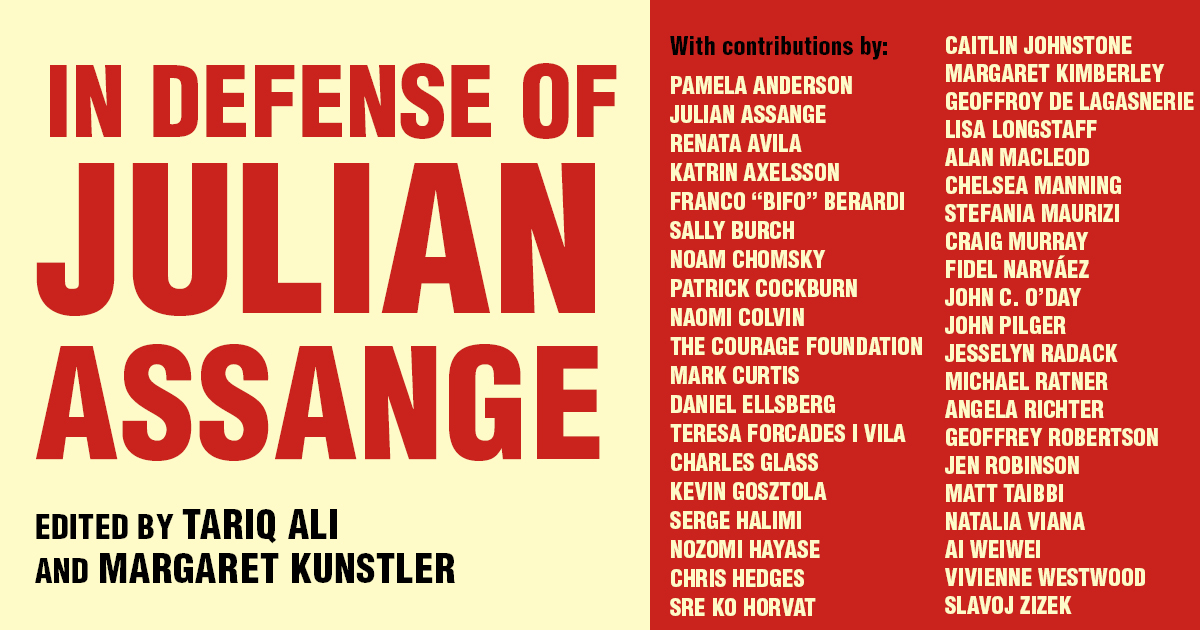
The charge against Julian is very specific; conspiring with Chelsea Manning to publish the Iraq War logs, the Afghanistan war logs and the State Department cables. The charges are nothing to do with Sweden, nothing to do with sex, and nothing to do with the 2016 US election; a simple clarification the mainstream media appears incapable of understanding.
The campaign of demonization and dehumanization against Julian, based on government and media lie after government and media lie, has led to a situation where he can be slowly killed in public sight, and arraigned on a charge of publishing the truth about government wrongdoing, while receiving no assistance from “liberal” society.
Unless Julian is released shortly he will be destroyed. If the state can do this, then who is next?
 The Annihilation of Julian Assange, https://www.truthdig.com/articles/the-annihilation-of-julian-assange/, Craig Murray “In Defense of Julian Assange,” edited by Tariq Ali and Margaret Kunstler, is now available for OR Books.
I was deeply shaken while witnessing yesterday’s events in Westminster Magistrates Court. Every decision was railroaded through over the scarcely heard arguments and objections of Assange’s legal team, by a magistrate who barely pretended to be listening.
Before I get on to the blatant lack of fair process, the first thing I must note was Julian’s condition. I was badly shocked by just how much weight my friend has lost, by the speed his hair has receded and by the appearance of premature and vastly accelerated aging. He has a pronounced limp I have never seen before. Since his arrest he has lost over 15 kg in weight.
But his physical appearance was not as shocking as his mental deterioration. When asked to give his name and date of birth, he struggled visibly over several seconds to recall both. I will come to the important content of his statement at the end of proceedings in due course, but his difficulty in making it was very evident; it was a real struggle for him to articulate the words and focus his train of thought.
Until yesterday I had always been quietly skeptical of those who claimed that Julian’s treatment amounted to torture – even of Nils Melzer, the UN Special Rapporteur on Torture – and skeptical of those who suggested he may be subject to debilitating drug treatments. But having attended the trials in Uzbekistan of several victims of extreme torture, and having worked with survivors from Sierra Leone and elsewhere, I can tell you that yesterday changed my mind entirely and Julian exhibited exactly the symptoms of a torture victim brought blinking into the light, particularly in terms of disorientation, confusion, and the real struggle to assert free will through the fog of learned helplessness. Continue reading
Nuclear weapons and Australia’s hypocrisy about them
 from congratulating ICAN for the first Australian-born Nobel Peace Prize. While a childish move, this only served to highlight the government’s discomfort with the treaty and its clear challenge to Australia’s position on nuclear weapons. As the signatures and ratifications continue to stack up and the treaty nears entry-into-force, this challenge persists.
Financial institutions are divesting from nuclear weapon producers, citing the treaty as their reason for doing so even though it has yet to enter into force. These include ABP, the largest Dutch pension fund, and Norway’s trillion-dollar sovereign wealth fund. Cities and towns are declaring their support for the treaty, including Paris, Berlin, Geneva, Washington DC, Toronto, Sydney and Melbourne.
This year’s Nobel Peace Laureate, Ethiopian Prime Minister Abiy Ahmed Ali, has been rewarded for formalising a peace agreement between Ethiopia and Eritrea. For ICAN, the Nobel Peace Prize served a directive upon all nations to sit up and pay attention to the fresh 10-page nuclear weapon ban treaty. We know that we’re up against powerful nations, a lucrative industry and deeply entrenched modes of thinking. The real prize will be the total elimination of nuclear weapons, and we have the tools to get there. It’s up to all people, civil society and governments to turn the tide of history. Our collective security depends on it.
- Gem Romuld is the Australian director of the International Campaign to Abolish Nuclear Weapons and a recipient of the 2017 Nobel Peace Prize. https://www.canberratimes.com.au/story/6442739/nuclear-hypocrisy-cant-continue/?cs=14246
Australian company Worley Parsons joins the international throng trying to sell nuclear power to Saudi Arabia
Australian company WorleyParsons will provide consultancy services including project governance, resource management, project services, training and compliance across the full scope of the large nuclear power plant (LNPP), small modular reactors and nuclear fuel cycle.
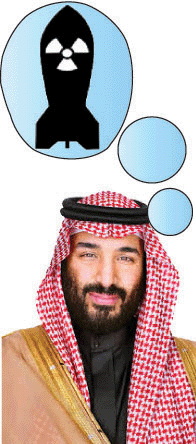 US confirms nuclear energy talks with Saudi Arabia, https://www.power-technology.com/comment/us-confirms-nuclear-energy-talks-with-saudi-arabia/ By MEED 30 Oct 19, Riyadh will have to sign an accord with Washington on the peaceful use of nuclear technology for US firms to participate in the projectA senior US official has confirmed that Washington is in talks with Riyadh about supporting Saudi Arabia’s planned nuclear programme. US confirms nuclear energy talks with Saudi Arabia, https://www.power-technology.com/comment/us-confirms-nuclear-energy-talks-with-saudi-arabia/ By MEED 30 Oct 19, Riyadh will have to sign an accord with Washington on the peaceful use of nuclear technology for US firms to participate in the projectA senior US official has confirmed that Washington is in talks with Riyadh about supporting Saudi Arabia’s planned nuclear programme.
Speaking in Abu Dhabi on 26 October, US Energy Secretary Rick Perry Perry confirmed that talks were ongoing. Continue reading |
Australian government rejects call for help from Julian Assange’s legal team
 Why is it that the Australian government is so helpful to Australian murderers and drug dealers imprisoned overseas, but so relentlessly unhelpful to an Australian whose only crime is to tell the truth?
Assange legal team asks for Australian government help amid growing health fears, https://www.theage.com.au/politics/federal/assange-legal-team-asks-for-australian-government-help-amid-growing-health-fears-20191028-p534xw.html, By Rob Harris
The WikiLeaks founder has been held in HM Prison Belmarsh since his April 11 arrest at the Ecuadorian embassy, where he had lived in asylum for almost seven years.
Australian officials told a Senate estimates hearing on Thursday that diplomats had not heard back from Assange’s lawyer since writing to her last week asking that she raise with him their offer of consular assistance.
The 48-year-old is fighting US attempts to extradite him to face 17 counts of spying and one of computer hacking in relation to WikiLeaks’ release of thousands of classified Pentagon files regarding the Iraq and Afghanistan wars.
Barrister Greg Barns, an adviser to the Australian Assange campaign, told The Age and The Sydney Morning Herald his UK lawyers on Friday requested consular assistance following a recent inquiry from the Department of Foreign Affairs and Trade.
“Julian’s lawyers are asking for the Australian government’s assistance in dealing with their client’s inhumane conditions in Belmarsh prison which has led to, and is continuing to cause, serious damage to Julian’s health,” Mr Barns said.
His supporters say he is being kept in solitary confinement and is allowed out of his cell for only 45 minutes a day. At a court appearance last week, he appeared gaunt and disorientated.
Assange was due to be released on September 22 but was told at a court hearing last month he would be kept in jail because there were “substantial grounds” for believing he would abscond.
The Australian Lawyers Alliance (ALA) passed a motion at its national conference on Saturday calling for the Australian government to do “all it can” to bring Assange home and resist US attempts to extradite him.
ALA national president Andrew Christopoulos said it was an important issue about the rule of law and protecting an Australian in a vulnerable position overseas.
“This is about standing up for the rule of law, fairness and the freedom to expose wrongdoing,” he said. “The reported decline of Julian Assange’s physical and mental health heightens the need for urgent government intervention. The government has intervened in cases like this before and should do so in this circumstance.”
If the case goes to a series of appeals, Assange could remain in a UK jail until at least 2025.
Foreign Minister Marise Payne last week acknowledged the publicity around the case and that Assange had high-profile and loyal supporters. She said it was important to let the legal process run its course.
“He has been offered consular services … like any other Australian would,” Senator Payne told the Senate committee. “I think it’s important to remember that as Australia would not accept intervention or interference in our legal processes, we are not able to intervene in the legal processes of another country
Why we can’t trust Scott Morrison – his REAL climate policy
to cut a long story short, Morrison has signed a document with Pacific leaders, with the “family”, that suggests we are as one when it comes to managing the risks of climate change, yet in reality we have very different policies, goals and objectives.
It pays to remember things like this when our prime minister asks you to trust him.
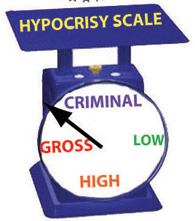 Scott Morrison’s climate pact with the Pacific ‘family’ exposes the hollowness of his words, One small exchange in Senate estimates has exposed the measurable gap between the prime minister’s rhetoric and actions, Guardian, Katharine Murphy Political editor, @murpharoo 24 Oct 19,“………. Morrison wants one thought to penetrate the great national switch-off: he wants voters to trust him. He wants voters to believe he is a man of his word, that he means what he says, and follows through on commitments. It seems an audacious strategy for a leader in an age when people are inclined to think all politicians stink, but that’s what Morrison wants. Scott Morrison’s climate pact with the Pacific ‘family’ exposes the hollowness of his words, One small exchange in Senate estimates has exposed the measurable gap between the prime minister’s rhetoric and actions, Guardian, Katharine Murphy Political editor, @murpharoo 24 Oct 19,“………. Morrison wants one thought to penetrate the great national switch-off: he wants voters to trust him. He wants voters to believe he is a man of his word, that he means what he says, and follows through on commitments. It seems an audacious strategy for a leader in an age when people are inclined to think all politicians stink, but that’s what Morrison wants.
Trust. With that thought in mind, it was interesting this week to watch one small exchange in Senate estimates exposing a measurable gapbetween the prime minister’s rhetoric and actions. Readers will remember Morrison took some heat at the Pacific Islands Forum earlier in the year when he presented as insufficiently empathetic about the threat the climate emergency posed to the region. There were some harsh words. But at the end of the day, despite all the thundering and virtue signalling on the greatness of coal, Australia signed on to a communique that was actually pretty forward leaning on climate change. As I noted at the time, despite all the arm twisting in Tuvalu, Morrison did, in the end, sign up to a statement that committed Australia to pursuing efforts to limit global warming to 1.5C, and to produce a 2050 strategy by 2020 – no small things. This 2050 strategy, the statement said, “may include commitments and strategies to achieve net zero carbon by 2050”. Navigating that harmonious landing point with Pacific leaders was, presumably, an important gesture for an Australian prime minister fond of calling his counterparts in the region “family”. But Labor’s Senate leader, Penny Wong, during this week’s Senate estimates hearings, decided to do a little bit of due diligence about what Australia had actually signed up to at the Pacific Islands Forum, and whether we actually meant it. With foreign affairs department officials arrayed before her, Wong asked first whether or not Australia had sought any reservations or exceptions to the PIF communique (which just means did we opt out of any part of the statement). Kathy Klugman, the official responsible for Pacific strategy, said no exceptions had been sought. When it came to the PIF communique, Australia was all in. Having established that we were all in, Wong professed some curiosity that the Morrison government had signed a communique declaring that a “climate change crisis” was facing Pacific Island nations, when the Coalition rejects that language at home as alarmism. Were we on board with that bit – the climate crisis? Klugman replied that Australia had signed the declaration and “we associate ourselves with all parts of it, including that part”. Wong then asked whether the government agreed that emissions needed to be reduced to net zero by 2050 in order to achieve the goals articulated in the PIF declaration. Things then got a bit stickier. Clare Walsh, a deputy secretary of the department, joined the conversation. Walsh noted that achieving net zero emissions by 2050 was “an aspiration by some countries”. But the Australian government had not signed on to that “in terms of its domestic application”, she said. Wong then translated. So we’ve associated ourselves with that objective internationally in this communique, but would not take the requisite action domestically? Walsh ploughed on. She said the PIF declaration recognised the importance of that issue to the Pacific and recognised net zero by 2050 as a “commonly referenced target – but it isn’t one that Australia has signed up to domestically, no”. Wong then wondered why Australia had signed up to a document which said pursuing global efforts to limit global warming to 1.5C above pre-industrial levels was “critical to the security of our Blue Pacific” when Australia’s domestic emissions reduction targets – the ones we’ve signed on to as part of the Paris agreement – were not consistent with achieving the 1.5C objective. Was the government planning to increase the level of ambition to square those circles, Wong wondered? “There is no change to the government’s policy senator,” noted the foreign minister, Marise Payne, who was at the table. Wong evidently thought she’d reached the moment to deliver the moral of the story. “So we go along to the PIF and tell them we think 1.5C is important but we are not prepared to put targets on the table that are anywhere near consistent with it – just so we are clear about what we are doing,” she said. Payne replied that Wong could “put it in those terms” but the government had been very clear it was persisting with the policies it took to the election. So, to cut a long story short, Morrison has signed a document with Pacific leaders, with the “family”, that suggests we are as one when it comes to managing the risks of climate change, yet in reality we have very different policies, goals and objectives. It pays to remember things like this when our prime minister asks you to trust him. https://www.theguardian.com/australia-news/2019/oct/26/scott-morrisons-climate-pact-with-the-pacific-family-exposes-the-hollowness-of-his-words |
|
Australian Prime Minister Morrison’s attitude to Pacific Islanders – “Take the Money and Shut Up about Climate Change”
 Take the money and shut up’: Ex-Tuvalu PM slams Morrison’s climate bargaining, The Pacific nation of Tuvalu is one of the world’s most vulnerable countries to the effects of climate change. SBS News has spoken to its former leader about Australia’s ‘lack of climate action’. Take the money and shut up’: Ex-Tuvalu PM slams Morrison’s climate bargaining, The Pacific nation of Tuvalu is one of the world’s most vulnerable countries to the effects of climate change. SBS News has spoken to its former leader about Australia’s ‘lack of climate action’.
SBS 23 OCT 19
BY NICK BAKER
Former Tuvalu Prime Minister Enele Sopoaga has accused the Morrison government of trying to buy the silence of Pacific Island leaders who are vocal about climate change. Mr Sopoaga, who has been a fierce advocate on climate change action, told SBS News on Wednesday that Prime Minister Scott Morrison’s climate policies were “un-Pacific” and that Australia was letting down the region. Earlier this year, Australia said it will steer $500 million of existing aid towards the Pacific to help the region cope with climate change. But Mr Sopoaga said some Pacific leaders felt like they were being told to “take the money and shut up”. “Putting this money on the table – $500 million – and then expecting Pacific Island countries like Tuvalu to say ‘OK, we’ll stop talking about climate change’, it’s not on … This is completely irresponsible.” He said greater action on climate change back in Australia was more important than Pacific aid. “Any amount of money that is coming with the Step-Up [Pacific aid program] cannot be seen as an excuse for no action at a domestic level to cut down on greenhouse emissions.”…….. HTTPS://WWW.SBS.COM.AU/NEWS/TAKE-THE-MONEY-AND-SHUT-UP-EX-TUVALU-PM-SLAMS-MORRISON-S-CLIMATE-BARGAINING
|
|
|
Judge denies Julian Assange a delay in extradition hearings

|
WikiLeaks founder Julian Assange denied delay to extradition hearing by London judge, https://www.abc.net.au/news/2019-10-22/wikileaks-founder-assange-in-court-to-fight-extradition/11625042 The full extradition hearing of WikiLeaks founder Julian Assange will go ahead in February 2020 after a London judge declined a request by his lawyers to delay proceedings by three months.
Key points:
The 48-year-old appeared in a packed court on Monday to fight extradition to the United States, where he faces 18 counts, including conspiring to hack into Pentagon computers and violating an espionage law. Britain’s former Home Secretary Sajid Javid signed an order in June allowing Assange to be extradited to the US, where authorities accuse him of scheming with former Army intelligence analyst Chelsea Manning to break a password for a classified government computer. He could spend decades in prison if convicted. Assange and his legal team said he needed more time to prepare his case, but failed to convince District Judge Vanessa Baraitser that a slowdown was justified. The full extradition is still set for a five-day hearing in late February, with brief interim hearings in November and December. Assange — clean shaven, with his silvery-grey hair slicked back — defiantly raised a fist to supporters who jammed the public gallery in Westminster Magistrates Court. After the judge turned down his bid for a three-month delay, Assange, speaking very softly and at times appearing to be near tears, said he did not understand the proceedings. He said the case was not “equitable” because the US government had “unlimited resources” while he did not have easy access to his lawyers or to documents needed to prepare his battle against extradition while confined to Belmarsh Prison on the outskirts of London. Lawyer Mark Summers, representing Assange, told the judge that more time was needed to prepare Assange’s defence against “unprecedented” use of espionage charges against a journalist. Mr Summers said the case has many facets and would require a “mammoth” amount of planning and preparation. He also accused the US of illegally spying on Assange while he was inside the Ecuadorian Embassy seeking refuge, and of taking other illegal actions against the WikiLeaks founder. “We need more time,” Mr Summers said, adding that Assange would mount a political defence. Mr Summers said the initial case against Assange was prepared during the administration of former president Barack Obama in 2010 but wasn’t acted on until Donald Trump assumed the presidency. He said it represented the US administration’s aggressive attitude toward whistleblowers. Representing the US, lawyer James Lewis opposed any delay to the proceeding. The case is expected to take months to resolve, with each side able to make several appeals of rulings. The judge said the full hearing would be heard over five days at Belmarsh Court, which would make it easier for Assange to attend and contains more room for the media. Assange’s lawyers said the five days would not be enough for the entire case to be heard. Health concerns for Assange Outside the courthouse, scores of his defenders — including former London mayor Ken Livingstone — carried placards calling for Assange to be released. Wikileaks editor-in-chief Kristinn Hrafnsson said it was a “big test case for journalism worldwide”. “This should be thrown out immediately because this is a total violation of a bilateral treaty between the US and the United Kingdom which basically states that you cannot extradite someone for political offences, and this is a political case,” he said. Regarding Assange’s health, Mr Hrafnsson said he was in a “stable condition” but was living in “de facto solitary confinement”. “After three or four weeks it starts to bite in and you can feel that he is suffering,” he said. Assange supporter Malcolm, who did not give his surname, told the ABC there was “not nearly enough” people actively campaigning for Assange’s freedom, and he wanted to see the whole street blocked at the next hearing. Another supporter accused the Australian government of failing to “defend their own citizen”. The crowd outside court was largely well-behaved but briefly blocked traffic when a prison van believed to be carrying Assange left court. |
|
Momentum grows for the rescue of Julian Assange
|
Growing calls for Australian government to defend Julian Assange https://www.wsws.org/en/articles/2019/10/19/assa-o19.html?
 fbclid=IwAR2smK6ChQzsIB7Ndld4N_No68RpVViDz5V-RH7qTiYfWmFWFdqkThOA-DQ fbclid=IwAR2smK6ChQzsIB7Ndld4N_No68RpVViDz5V-RH7qTiYfWmFWFdqkThOA-DQ
By Oscar Grenfell, 19 October 2019 Over the past week, several prominent public figures, including federal members of parliament, have called on the Australian government to fulfil its obligations to defend WikiLeaks’ publisher Julian Assange, including by taking steps to prevent his extradition from Britain to the US.The statements come in the lead-up to British extradition hearings in February, that will decide whether Assange is dispatched to the US. He faces a maximum sentence of 175 years in an American prison for exposing US war crimes and diplomatic intrigues. There are concerns within the Australian political and media establishment that the refusal of successive governments to defend Assange, an Australian citizen and journalist, has generated widespread anger and opposition. The fear in ruling circles is that if Assange is extradited, or if his parlous health continues to deteriorate, the latent support for him will coalesce into a political movement against the entire official set-up. In a statement to the House of Representatives on Wednesday, independent MP Andrew Wilkie declared that Assange is “an Australian citizen and must be treated like any other Australian. He was not in the US when he provided evidence of US war crimes in Iraq. He can’t possibly have broken their laws.” Wilkie said that if Assange is extradited to the US, he “faces serious human rights violations including exposure to torture and a dodgy trial. And this has serious implications for freedom of speech and freedom of the press here in Australia, because if we allow a foreign country to charge an Australian citizen for revealing war crimes, then no Australian journalist or publisher can ever be confident that the same thing won’t happen to them.” He concluded by stating: “Put simply, he must be allowed to return to Australia.” Wilkie, a former intelligence agent who resigned to speak out against “weapons of mass destruction” lies used to justify the illegal 2003 invasion of Iraq, has previously condemned the assault on democratic rights. In 2010 and 2011, he made statements and spoke at public events in defence of Assange. Alongside the Greens and a host of civil liberties organisations, however, Wilkie has largely remained silent about the WikiLeaks founder’s plight for a number of years and has boycotted all actions taken in his defence. Wilkie said that if Assange is extradited to the US, he “faces serious human rights violations including exposure to torture and a dodgy trial. And this has serious implications for freedom of speech and freedom of the press here in Australia, because if we allow a foreign country to charge an Australian citizen for revealing war crimes, then no Australian journalist or publisher can ever be confident that the same thing won’t happen to them.” He concluded by stating: “Put simply, he must be allowed to return to Australia.” Wilkie, a former intelligence agent who resigned to speak out against “weapons of mass destruction” lies used to justify the illegal 2003 invasion of Iraq, has previously condemned the assault on democratic rights. In 2010 and 2011, he made statements and spoke at public events in defence of Assange. Alongside the Greens and a host of civil liberties organisations, however, Wilkie has largely remained silent about the WikiLeaks founder’s plight for a number of years and has boycotted all actions taken in his defence. Joyce, a populist who has sought to build a base of support in rural areas, was well aware of the sentiments in favour of Hicks among workers in regional centres and country towns. He played a role in the sordid agreement brokered by Howard, which saw Hicks returned to Australia in 2007. Hicks was forced to serve out a bogus prison sentence in Australia and was banned for a year from speaking to the media. In comments to the media on Monday, former Labor foreign minister Bob Carr hinted at the concerns animating the comments in defence of Assange by such figures from within the political establishment. Carr told the Sydney Morning Herald that ordinary people would be “deeply uneasy” about the prospect of an Australian citizen being handed over to the “living hell of a lifetime sentence in an American penitentiary.” He criticised current Foreign Minister Marise Payne over her claim that she made “friendly” representations on behalf of Assange to US Secretary of State Mike Pompeo. Pompeo has denounced Assange as a “demon” who is not entitled to any democratic rights and labelled WikiLeaks as a “non-state hostile intelligence service.” Carr stated: “I think the issue will gather pace, and in the ultimate trial there will be a high level of Australian public concern, among conservative voters as much as any others.” In his strongest comments in defence of Assange yet, Carr declared: “We have an absolute right to know about American war crimes in a conflict that the Australian government of the day strongly supported. We wouldn’t know about them except for Assange.” Carr is no political innocent. During his decades in the Labor Party, he functioned as a secret informant for the US embassy, beginning in the 1970s. He was a leading minister in the Gillard Labor government which refused to defend the WikiLeaks founder and instead pledged to assist the US campaign against him. That Carr has spoken out now is a measure of the fears within the ruling elite that the defence of Assange will animate millions of workers, students and young people in the coming period. In keeping with the central role of Labor in the US-led pursuit of Assange, no prominent current figure in the party has joined the calls for him to be defended. When the WikiLeaks’ founder was illegally expelled from the Ecuadorian embassy and arrested by the British police in April, Labor MP Tanya Plibersek shared a Tweet denouncing his supporters as “cultists.” Julian Hill, a little-known federal backbencher representing a working-class electorate in outer Melbourne, is the only Labor MP to have spoken out. He told the Guardian on Thursday that Assange is “an Australian and, at the very least, we must be vigorously consistent in opposing extradition to countries where he might face the death penalty.” Prime Minister Scott Morrison responded this week by blandly declaring that Assange must “face the music” in the US. Senior government ministers have previously maligned Assange, repeating the lies concocted by the US intelligence agencies to discredit him. Liberal Senator James Paterson attempted to provide a more sophisticated argument for the government’s refusal to defend Assange, telling the Sydney Morning Herald last week that both Britain and the US were “rule-of-law countries.” Paterson piously stated: “This is not the case in many other countries in the world. Sadly, we know there are Australian citizens detained right now in China and Iran who are not facing free and fair legal systems … and the Australian government does have a greater obligation to assist those citizens.” The suggestion that the Australian government has a responsibility to defend its citizens in some jurisdictions, but not in others, is a legal fiction that has no basis in Australian or international legislation. Paterson’s statements, moreover, fly in the face of repeated warnings by United Nations officials and human rights organisations that Assange’s legal and democratic rights have been trampled upon by the British and US authorities. Paterson’s comments point to the real reason why successive Australian governments, Labor and Liberal-National alike, have joined the US-led vendetta against Assange. Their participation in the attacks against him has gone hand in hand with unconditional backing for the US alliance and support for Washington’s military build-up in the Asia-Pacific region, in preparation for war against China. The record demonstrates that no faith can be placed in any section of the political or media establishment to defend Assange or any democratic rights. All the official parties and institutions in Australia are implicated in the persecution of the WikiLeaks founder. They will take action only to the extent that they fear the political consequences if they do not. Workers, students and young people must be mobilised as part of an international movement demanding the immediate freedom of Assange and all class war prisoners. This is the only way that an Australian government will be forced to uphold its responsibility to prevent Assange’s extradition to the US and allow him to unconditionally return to Australia. |
|
Dick Smith, Julian Assange, and USA’s “outrageous” claim to “universal jurisdiction over every person on earth”.
|
Dick Smith lobbied US to drop Julian Assange extradition The campaign for the Morrison government to intervene gathered momentum on Monday after former deputy prime minister Barnaby Joyce lent his support to the WikiLeaks founder’s cause. Independent MP Andrew Wilkie also revealed that a multi-party parliamentary group to “agitate” for Mr Assange to be brought home to Australia would be launched in the coming weeks and would include some members of the Coalition government. In April, Mr Smith voiced concerns to Washington’s man in Canberra that Mr Assange could be charged under an “outrageous” US claim to “universal jurisdiction over every person on earth”. “Australians, like Americans, may have mixed opinions on Julian Assange, however, I believe the tide will turn if it appears an Aussie is being made a scapegoat for a security failure of the US intelligence services,” Mr Smith wrote in the letter seen by The Age and The Sydney Morning Herald. “I can assure you that many Australians will not readily accept that Mr Assange is being held responsible for such a serious security failure, as embarrassing as it may be.” He said it was “imperative to maintain the good relations” between Australia and the US, but Washington would “jeopardise” the relationship by asking its courts to “criminalise journalistic endeavours”. “I believe this will damage the reputation of the United States as an upholder of freedom of speech and a defender of human rights, and result in untold damage to the good relations between Australia and the American people.” Treasurer Josh Frydenberg said the government would not intervene in attempts by the US to have the 48-year-old Australian stand trial, where he faces a sentence of 175 years if found guilty of computer fraud and obtaining and disclosing national defence information……. Confidential government briefing notes, inadvertently released on email by the Prime Minister’s Office on Monday, gave “talking points” to MPs if they were asked about Mr Assange and his fight against extradition from Britain to the US. …. https://www.theage.com.au/politics/federal/dick-smith-lobbied-us-to-drop-julian-assange-extradition-request-20191014-p530lf.html |
|
Sir David Attenborough slammed the Australian government’s response to climate change
|
David Attenborough says Australian government ‘doesn’t give a damn’ about rest of the world, Telegraph, UK, Giovanni Torre, perth 24 SEPTEMBER 2019 While the United Kingdom has reduced its carbon emissions over the past 12 Sir David said the current Australian government had departed from the Sir David noted that Mr Morrison brought a lump of coal into one of “If you weren’t opening a coal mine okay I would agree, it’s a joke. But you Sir David noted that Mr Morrison had campaigned for re-election on a Speaking from Chicago, Mr Morrison defended his government’s record on
|
Pacific Island nations urge action on climate change at UN
Scott Morrison and Donald Trump happily together against climate change action

|
Scott Morrison’s decision to spurn the UN climate summit for a Trump rally speaks volumes, https://thenewdaily.com.au/news/world/2019/09/23/scott-morrison-donald-trump-climate/ Prime Minister Scott Morrison has enthusiastically shared the stage at a Trump rally in the US swing state of Ohio rather than attend the United Nations Climate Action Summit in New York.The rally was organised around the opening of Australian cardboard box billionaire Anthony Pratt’s new recycling factory in the regional town of Wapakoneta.
Its timing is probably no coincidence either, as President Donald Trump, like the Prime Minister, was not invited to speak in New York and didn’t want to go anyway. The Special Representative of the UN Secretary-General Antonio Guterres, Rachel Kyte, said: “He (Mr Guterres) wanted people to come with plans, not speeches.” Those plans had to be about doing more to reduce emissions and combat climate change than had already been promised. Mr Guterres, backed by the latest scientific assessments, is concerned by the fact that what nations promised at the Paris Climate Summit four years ago will fall disastrously short of what is needed to avert a catastrophic rise in global temperatures by 2050. Simply put, if a nation had nothing new to say, it was not welcome to make it to the podium. Our Foreign Minister Marise Payne is reduced to bystander status. At the Ohio Rally, Trump told 1500 cheering supporters that Scott Morrison was supposed to lose the last election, but “he blew ’em away”. And added that the PM did that because “he believes the same things I believe”. Incredibly, given the fact that some 300,000 people rallied for climate change action around Australia – and millions more did the same around the world – climate change wasn’t mentioned during the leaders’ Oval Office love in. “No it didn’t come up” was Morrison’s terse reply to reporters. Even though since achieving the top job, Mr Morrison has said he believes the climate science and is “taking action”, that is not how he is perceived by the American media. CBS Radio commentator Michael Williams, in a live cross from Washington to The Sunday Project, said the two men get on because they both like “free trade and closed borders”. And more to the point, “both are big on climate scepticism”. Williams, like other foreign commentators, hasn’t caught up with the Prime Minister’s rhetorical pivot. Or maybe, like the UN Secretary-General, is judging him on his government’s weak commitments. Though Energy Minister Angus Taylor insists “we are taking strong action and we need to”. Mr Taylor says Australia is overachieving in reaching the commitments we have made. Never mind that a special exemption was given to Australia at Kyoto to keep emitting on the promise to do better later. Our emissions, on the government’s own figures, are continuing to rise. Mr Taylor, like his Prime Minister, has no plans on how to achieve our net zero emissions target by 2050 other than yet-to-be invented technology. Fuel reserve failureIt’s becoming the MO of this government – as they say in police speak of the modus operandi or the usual way suspects commit their crimes – to claim success while failing to really deliver. Another worrying example is its failure to deliver its commitment to the international world-standard minimum of 90 days of fuel reserves. Now in its seventh year, the best the government has done is two to three weeks of fuel reserves. The attack last week on the Saudi oil refinery complex and the disruption this caused could be just a foretaste of the dangers ahead. Mr Taylor claims we are close to 90 days because he is including “stocks on water”. Not even his colleague, Resources Minister Matt Canavan, believes that. He told Sky TV on the weekend “we’ve got roughly on average about 40 days” of reserves. Nero famously fiddled while Rome burned. Pity he seems to be a role model for our leaders in Canberra. Paul Bongiorno AM is a veteran of the Canberra Press Gallery, with 40 years’ experience covering Australian politics |
|
Trump tries to pull Scott Morrison, ‘man of titanium’, into a military coalition
 Donald Trump suggests China ‘a threat to the world’ while praising Scott Morrison as a ‘man of titanium’. US president signalled he would raise with Morrison a military contribution in Iran but then indicated he did not do so, Guardian, Katharine Murphy Political editor
Following a ceremonial welcome for Morrison on Friday Washington time attended by more than 4,000 guests, Trump praised Morrison’s personal fortitude, describing him as “a man of real, real strength, and a great guy”.
The American president signalled he would raise with Morrison a possible military contribution in Iran beyond the current freedom of navigation commitment in the Strait of Hormuz, but later in the day indicated he had not, in fact, raised the issue during a bilateral meeting at the White House.
The Australian prime minister made a point of praising the president’s restraint in relation to Iran to date and made no commitment beyond saying the government would consider any request from the administration on its merits.
…….Trump said he was interested in building a coalition for military action with Australian participation, but then told reporters at a subsequent press conference Iran wasn’t discussed, and Morrison then described Australia’s possible participation as “moot”…….. https://www.theguardian.com/australia-news/2019/sep/21/donald-trump-suggests-china-a-threat-to-the-world-while-praising-scott-morrison-as-a-man-of-titanium
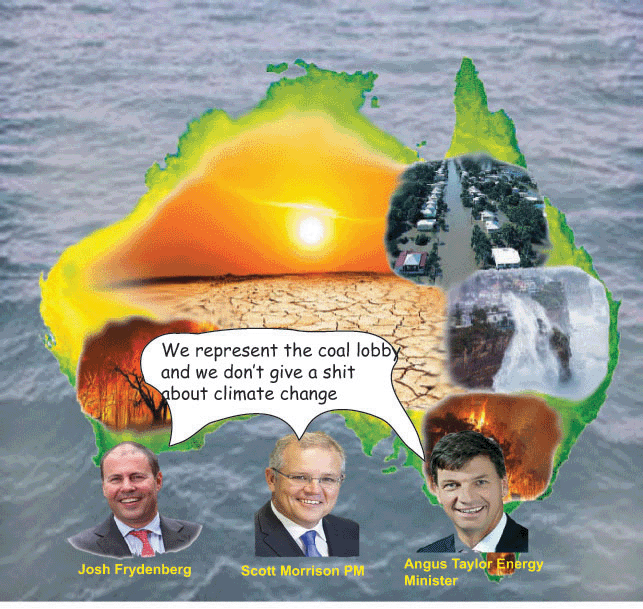
Coal’s servant, P.M. Morrison makes Australia an international pariah at UN Climate Summit
|
PM accused of ‘trashing’ Australia’s reputation by spruiking coal ahead of UN summit, SMH, By Dana McCauley September 22, 2019 Environmentalists are accusing Scott Morrison of “trashing” Australia’s international reputation, as official documents reveal the broad scale of his government’s efforts to significantly increase coal exports at a time of mass protests calling for action on climate change.
As delegates of the United Nations climate change summit – which Mr Morrison has snubbed – prepare to discuss emission reduction efforts this week, briefing notes obtained under Freedom of Information laws detail the emphasis placed on coal in the government’s diplomatic relations.
Departmental briefing notes provided to Resources Minister Matt Canavan ahead of his official visit to Singapore and India last month canvass the potential to expand Australia’s coal exports into Bangladesh – a nation that is among the most vulnerable to the effects of global warning. The government is seeking to grow its coal exports in overseas markets as it looks to buttress the economic fallout from a deteriorating relationship with China. Australian Conservation Foundation climate change campaigner Christian Slattery said Australia was “trashing its international reputation because of its addiction to polluting coal”. “As major importers of Australian coal move to transition to cleaner forms of energy, the Morrison government is doing the coal industry’s bidding, trying to secure new markets,” Mr Slattery said. “Burning coal is the number-one cause of climate damage. Unless we stop digging up and burning coal the planet will suffer unmanageable damage from more extreme fires, droughts, storms and coral bleaching that will harm hundreds of millions of people.” The briefing note to Senator Canavan, released in redacted form to the ACF, said that with “a significant expansion of coal-fired power in Bangladesh expected in the near future”, there were opportunities for Australia “to establish a new export market for thermal coal”…….. Foreign Minister Marise Payne will front the UN climate change summit this week, but will not address delegates – as Australia is among a group of coal-supporting economies singled out as not getting a spot on the list of 63 speakers. Mr Morrison’s snub comes despite him being in the United States on an official visit…….. ACF’s Mr Slattery said the government “seems intent on selling a 20th century technology to a 21st century world and doing a great deal more climate damage while they are at it”. “Australia’s reported blocking by the UN Secretary-General from speaking at the special climate summit in New York is nothing short of an international embarrassment for a wealthy and developed country that prides itself on being a good international citizen,” he said. https://www.smh.com.au/politics/federal/pm-accused-of-trashing-australia-s-reputation-by-spruiking-coal-ahead-of-un-summit-20190922-p52tr1.html |
|
1 This month

of the week – Australians for War Powers Reform (AWPR)
To see nuclear-related stories in greater depth and intensity
 Antinuclear