September 8-9 Conference of The Independent and Peaceful Australia Network (IPAN)
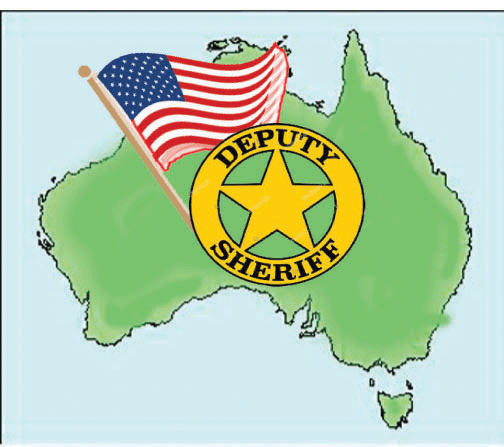 At a time when recent US administrations have become more proactive about the need for solidarity within US Global Alliance Systems, there is a pressing need for elected leaders of both government and opposition parties to be more concerned about protection of our national sovereignty.
 Support for the UN Draft Treaty on the Prohibition of Nuclear Weapons, or more comprehensive US nuclear weapons umbrellas? July 28, 2017, by: The AIM Network By Denis Bright
 In the past, Australia developed a bipartisan balance between continued membership of the Australia-US Alliance, support for the Charter of the United Nations and commitment to its own national sovereignty.Article 1 of the ANZUS Treaty of 1951 indeed rejected the need for sabre-rattling in the settlement of international disputes.
Barry McGuire – Eve Of Destruction
New Zealand officially left the Alliance in 1986 after continued participation compromised its national sovereignty (Office of the Historian, Bureau of Public Affairs, US Department of State Online).
In 1984, the ANZUS Treaty began to unravel when New Zealand declared its country a nuclear-free zone and refused to allow U.S. nuclear-powered submarines to visit its ports. Two years later, U.S. Secretary of State George P. Shultz and Australian Foreign Minister Bill Hayden concluded a series of bilateral talks by confirming that their countries would continue to honor their obligations to one another under the ANZUS Treaty, in spite of the fact that the trilateral aspects of the Treaty had been halted. On September 17, 1986, the United States suspended its treaty obligations toward New Zealand.
- In Australia, the pendulum has swung in the opposite direction towards greater solidarity with the US Alliance and away from a diversity of foreign policies which required the US to adjust to policy diversity over issues like the Suez Crisis of 1956, the Cuban Missile Crisis of 1962, the War in Vietnam and even the presence of nuclear powered ships carrying nuclear weapons into New Zealand during the 1980s. Continue reading
Head of Donald Trump’s manufacturing council, Australian Mr Liveris breaks with Trump on climate policy
Andrew Liveris adamant US will revisit Paris climate deal, http://www.theaustralian.com.au/business/companies/andrew-liveris-adamant-us-will-revisit-paris-climate-deal/news-story/d4b0e75cb50c717220f4b13543157a67, 22 July 17 JAMIE WALKERAssociate Editor, Brisbane @Jamie_WalkerOz The Australian businessman tasked with making American manufacturing great for Donald Trump has broken with the President on climate policy, saying the US must re-engage with the Paris agreement.
And in a provocative address in Brisbane, Dow Chemical boss Andrew Liveris revealed that spiralling domestic gas prices had forced the multinational firm to review its Australian operations.
As the head of Mr Trump’s manufacturing council, Darwin-raised Mr Liveris is working with the embattled administration to deliver a key election promise to revitalise US manufacturing, while engineering one of the biggest corporate mergers in history between Dow Chemical and DuPont.
Warning that environmental sustainability was “no longer an initiative, it’s a business model”, Mr Liveris said Mr Trump’s decision to pull the US out of the Paris accord should not halt international co-operation on greenhouse gas mitigation. “We cannot as citizens of the world let that move impede our collective progress and our determination to remove carbon from the atmosphere,” he said, to applause from the crowd of 1500 that turned out for the UQ ChangeMakers forum, put on by his alma mater the University of Queensland and supported by The Weekend Australian.
“Many businesses in the US, NGOs and states have re-upped and picked up the commitment of what’s become the slack left behind by the federal government.
“I believe the US will re-engage ultimately with Paris and I am certainly being part of the solution to make that happen.” But he distanced himself from Mr Trump’s handling of the issue, saying it was “very unfortunate” the President had said the US was withdrawing from the 2015 Paris agreement, when the aim was to “redefine its engagement”. Under the UN-backed accord, Australia is committed to reduce greenhouse emissions by 26-28 per cent on 2005 levels by 2030. Mr Liveris said: “They are actually not withdrawing, they just want to re-engage on different terms. So if you think about it that way, I would say the odds would be very high of a re-engagement.”
Mr Liveris was one of the first business leaders to warn of the “gas cliff” that has deepened eastern Australia’s energy crisis, prompting intervention by the federal government to limit LNG exports and boost domestic gas supplies. He said yesterday that the gas price paid by Dow Chemical in Australia had rocketed from “roughly five or six dollars” to $20 in less than a year, jeopardising the business. “So my leader of Australia-Pacific … he’s got a proposal in front of us to look at exiting Australia right now in terms of uncompetitive energy prices.
We are not alone. We … can see the future in terms of the trajectory … you need to fix supply and you have got to basically recalibrate demand so that 90 per cent of the gas isn’t exported.”
Backing the controversial Finkel report to the government on energy security, Mr Liveris said it offered a “great series of policy solutions” and business would accept a target for renewables. The country, however, needed “policies that outlive” the government concerned. “What I would say is give me a policy that has a renewable target, give me time to develop it and I will develop a partnership model with you, in an innovation hub … to develop the technologies over time,” he said.
Quiet shipment of uranium from Australia to India – non signatory to Non-Proliferation Treaty
 Australia quietly makes first uranium shipment to India three years after supply agreement, ABC Radio The World Today By South Asia correspondent James Bennett, 18 Jul 17 Three years after signing a civilian nuclear supply treaty, the Federal Government confirmed overnight the first shipment of Australian uranium has left for India.
Foreign Minister Julie Bishop provided little detail about the inaugural sale, saying only that it was subject to commercial negotiations.
The supply deal with India, signed in 2014, is the first of its kind Australia has made with a country not party to the nuclear non-proliferation treaty…….
Details of inaugural shipment unclear
It is not clear how big the shipment is, where it departed from, or where in India it might be heading.
Indian officials were unable to immediately provide comment, while the Department of Foreign Affairs and Trade said only that the details were subject to commercial negotiation.
Parliament only passed the final legislation enabling sales last December, following years of debate about supplying uranium to a country with a strategic nuclear weapons program and that refuses to sign the non-proliferation treaty.
Parliamentary hearings to ratify the supply treaty in 2014 heard the International Atomic Energy Agency still had concerns about India’s safeguards.
Ongoing tensions between India and its neighbour Pakistan, which also has not signed the non-proliferation treaty, have raised the spectre of armed confrontation in the past……..http://www.abc.net.au/news/2017-07-19/australia-quietly-makes-first-uranium-shipment-to-india/8722108
Australia should join UN nuclear weapons ban treaty, when it opens in September
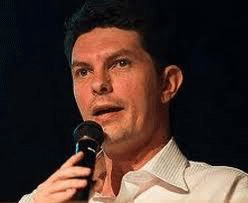 Aust on ‘wrong side’ of nuclear weapon ban http://www.heraldsun.com.au/news/breaking-news/aust-on-wrong-side-of-nuclear-weapon-ban/news-story/be98118f29f512aad05aac1134546ad4, Belinda Merhab, Australian Associated Press, July 8, 2017 Australia is accused of being on the wrong side of history after ignoring a United Nations vote to ban nuclear weapons.
Australia can play a role in promoting dialogue, not war, with North Korea
There is no point in Australia waiting to be a pallbearer at the funeral. We need to use what influence we have to shape a better response in Washington and other capitals.
We should also open a line of communication with Pyongyang — to see if there is any dialogue that might help to prevent conflict.
Australia can play a role here. Our embassy in Seoul is accredited to Pyongyang, where there hasn’t been a US embassy for years. We should co-ordinate this with key allies, but Australia should look to open a line of dialogue with the regime.
Australia has performed a similar role in Iran, where the US hasn’t had diplomatic representation since 1979.
Has Australia got the gumption to do this, or will we just wait for the conflict to start and hope others fight the war for us?

 Dialogue better than all-out war with unpredictable North Korea http://www.theaustralian.com.au/news/inquirer/dialogue-better-than-allout-war-with-unpredictable-north-korea/news-story/f471a9a09b1dae1fe0d2464f5501d03e?nk=ba26857f63080120cbd5fc74c94d3959-1499480511, PETER JENNINGS,The Australian, July 8, 2017
The members of the G20 are meeting during one of the most serious global situations since the Cuban Missile Crisis of 1962.
Then the Soviet Union was intent on deploying nuclear-armed missiles to an island a few minutes’ flying time from America’s southeast.
The risk was not only what missiles could be launched from Cuba but whether a conflict might spiral out of control and lead to an all-out nuclear war between Washington and Moscow.
Today the situation on the Korean peninsula is just as uncertain. With help from Pakistan and China, North Korea is within a sprint of developing a nuclear-armed intercontinental ballistic missile, with a widely dispersed arsenal of such weapons able to be launched from silos, mobile vehicles and, in time, from submarines.
The North already has about 20 nuclear devices and although these may not fit on missiles, it is possible they could be detonated inside submarines sent on suicide missions to Seoul or Tokyo.
After an American strike in response, we don’t know how China might react to the destruction of its ally. Once the nuclear threshold is breached we face a global situation as dire as those 13 days in October 1962 when nuclear war seemed likely. Continue reading
If North Korea attacks USA with nuclear warhead, Australia will join US in fight – Deputy PM Barnaby Joyce
Australia will join US in fight against North Korea if war breaks out, Yahoo News, JULY 6, 2017 Australia would join military action against North Korea if the rogue nation fires a nuclear warhead at the United States, acting Prime Minister Barnaby Joyce has confirmed.
As Malcolm Turnbull heads to Germany for talks with other G20 leaders, Mr Joyce is ramping up pressure on China to step in and “stop this madness”.
His call comes after US ambassador to the United Nations Nikki Haley warned that America would use force “if we must” against North Korea, after Pyongyang tested an intercontinental ballistic missile (ICBM) with the potential to reach Darwin or Alaska.
“No one should ever go too far in testing the resolve of the United States of America,” Mr Joyce told Sky News on Thursday.
“If North Korea was to deliver a warhead into the United States of America then the ANZUS alliance would be called in.”……One of Australian’s most senior military commanders insists the risk of a strike on the country’s north by North Korean remains low.
Chief of Joint Operations Vice Admiral David Johnston says that despite Pyongyang’s aggressive demonstrations, the range and capability of the missile launched this week is still to be determined.
“There is very little risk at the moment to the northern part of our country,” he told reporters in Canberra……Given the low threat to Australia’s mainland, Vice Admiral Johnston says there hasn’t been an immediate focus on amassing a system to defend against missiles.
The focus now was on applying diplomatic pressure on North Korea to stop their nuclear program and the development of missile technology.
“Where there’s emerging issues that require military support, the ADF has the capability to provide the government (with) options and we’re able to do so.” https://au.news.yahoo.com/a/36295225/australia-will-back-us-if-nuclear-war-breaks-out-with-north-korea/#page1
Greens Senator Scott Ludlam at nuclear weapons ban treaty talks
Ludlam, not Australia, in New York for nuclear weapons ban treaty talks, Greens Senator Scott Ludlam has slammed Australia for not taking part in talks on a global ban on nuclear weapons. By Andrea Nierhoff, SBS News, 6 July 17, Senator Ludlam is in New York with delegates from 120 countries to discuss a treaty to ban nuclear weapons around the world.
UN poised to adopt nuclear weapons ban treaty today
 The United Nations is set to adopt a global treaty to ban nuclear weapons (Friday 7 July (New York time)) – a long-awaited historic event marred by Australia’s boycott of negotiations.
“This is the biggest step towards nuclear disarmament that we have seen since the end of the Cold War,”  said Associate Professor Dr Tilman Ruff, the Melbourne-based founding chair of the International Campaign to Abolish Nuclear Weapons (ICAN), who is attending the UN talks in New York.
“It comes at a time of growing international nuclear tension, where the risks of armed conflict escalating to the use of nuclear weapons is real and would be a humanitarian and environmental disaster,” he said.
“Pressure must now build on Australia to sign up to the treaty, as it has to treaties for the elimination of other weapons of mass destruction – biological and chemical, and other inhumane indiscriminate weapons such as landmines and cluster munitions.”
More than 130 nations are involved in the UN talks, including New Zealand and Indonesia, but Australia, at the behest of the United States, has boycotted the process. It is the first time ever that Australia has not participated in multilateral disarmament negotiations.
“If passed today, the treaty will stigmatise possession of nuclear weapons by any state, provide a source of legal, political, ethical, economic and civil society pressure on nuclear armed states to disarm, and encourage financial institutions to divest from companies that produce nuclear weapons,” said Tim Wright, Asia-Pacific director of ICAN.
“Of vital interest to Australia and the Pacific, it will also promote addressing the rights and needs of victims of nuclear use and testing, and of remediating contaminated environments,” he said.
“By failing to be involved in these negotiations, Australia has relinquished its responsibilities to its own Indigenous people, and to many others affected by nuclear testing in our region,” Mr Wright said.
Media please note:
Delegates at the UN will decide on Friday —by acclamation or vote—whether to adopt the treaty. If adopted, as is expected, it will open for signature on September 20, after which states will pursue ratification. Once 50 states have completed this process, the treaty will become binding international law.
ICAN Australia and Pacific representatives are available in New York and Australia for interviews, before and after the treaty’s expected adoption on Friday, New York time (likely Saturday morning, Australian time).
Video footage is available of addresses to the UN treaty conference plenary session (Thursday NY time) by: Australian Greens Senator Scott Ludlam, Vanessa Griffen (Fiji), FemLINK Pacific, ICAN Asia-Pacific director Tim Wright.
North Korea’ latest intercontinental ballistic missile would be able to hit Darwin
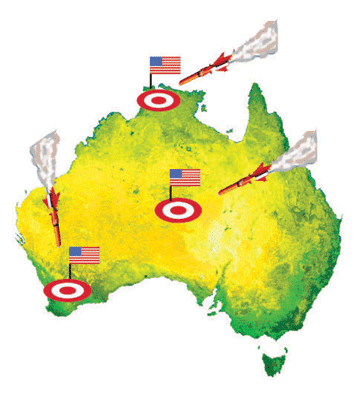 Australia now within range of new North Korean missile, as calculations show it could fly far enough to hit Darwin
- The ‘landmark’ test of a Hwasong-14 missile was overseen by leader Kim Jong-Un
- It was fired from a site in the North Phyongan province into the Sea of Japan
- It is believed to have reached an altitude of 2802 km and flew 933 km
- The North has long sought to build nuclear missiles capable of reaching the US
- Weapons analysts say the missile has the capability to travel up to 6,700km
- Darwin is only 5,750km from Pyongyang, putting Australia into the firing line
Experts say the missile could reach a maximum range of 6,700km on a standard trajectory, meaning it would be able to hit Darwin, which is 5,750km from Pyongyang.
David Wright, of the Union of Concerned Scientists, wrote on the organisation’s allthingsnuclear blog that the available figures implied the missile ‘could reach a maximum range of roughly 6,700 km on a standard trajectory’.
‘That range would not be enough to reach the lower 48 states or the large islands of Hawaii, but would allow it to reach all of Alaska.’ …………http://www.dailymail.co.uk/news/article-4664328/Australia-range-new-North-Korean-missile.html#ixzz4ltt8SE9M
Australian politicians condemn North Korea’s missile test
 North Korea’s missile test condemned by Australia, ABC News, By political correspondent Louise Yaxley 4 Jul 17 Australia has condemned North Korea after it said it had successfully tested a new intercontinental ballistic missile capable of hitting “anywhere in the world”.
Foreign Minister Julie Bishop called it a provocative act that is in breach of numerous United Nations Security Council resolutions. “North Korea continues to threaten its neighbours while undermining regional and global security,” Ms Bishop said in a statement. “North Korea’s long-term interests would be best served by ceasing its nuclear and missiles programs and focusing on improving the lives of its long-suffering people.”
The statement echoed her remarks after a North Korean missile test in April.
US Vice President Mike Pence was visiting Australia when that test occurred and declared the “era of strategic patience” over.
Ms Bishop said North Korea was “on a path to achieving nuclear weapons capability and we believe Kim Jong-un has a clear ambition to develop an intercontinental ballistic missile capable of carrying a nuclear payload as far as the US”.
“That would mean Australia would be in reach,” Ms Bishop said.
Australia ‘blindly and zealously toeing the US line’
Those comments angered North Korea, which singled out the US deployment of marines to Darwin as evidence of preparation for war. A North Korean Foreign Ministry spokesman said Australia was “blindly and zealously toeing the United States line”.
“If Australia persists in following the US’ moves to isolate and stifle North Korea … this will be a suicidal act of coming within the range of the nuclear strike of the strategic force of North Korea,” the spokesman said.
Defence Industry Minister Christopher Pyne responded by saying the location of US marines in Darwin was a longstanding government policy. “It’s not in any way a preparation for a conflagration on the Korean Peninsula,” he said. “Obviously, we want to avoid any such military action and we want the North Koreans to behave as well as they can, like reasonable, international citizens.
“That means ending their missile testing and not preparing for a nuclear war with either the United States, Japan, South Korea or anyone else for that matter.”……..http://www.abc.net.au/news/2017-07-04/north-korea-missile-test-condemned-by-australia/8677922
United Nations committee encourages Australia to rethink its support for coal mining industry
In a periodic review of Australia’s performance under a UN treaty on human rights, released this week, the committee noted: “environmental protection has decreased in recent years as shown by the repeal of the Emissions Trading Scheme in 2013, and the State party’s ongoing support to new coal mines and coal-fired power stations”.
In light of this, the committee of 18 international human rights experts encouraged Australia to “review its position in support of coal mines and coal export”.
The Australian government has remained a staunch supporter of the proposed Carmichael mine project, coal from which will generate more carbon emissions than New York City each year it operates.
On a trip to India in April, prime minister Malcolm Turnbull claimed the project would create “tens of thousands of jobs” for Australians – a claim that has been discredited by Adani’s own experts and a Queensland court.
A government infrastructure fund is weighing an application for a near-$1bn loan to Adani for a railway to transport the coal to the coast.
Australian ministers have often argued the Adani mine is backed by a “moral case” for supplying Indians with cheap electricity. The experts on the CESCR are elected by state parties based on their “high moral character”. They include an Indian representative.
The UN recognises that climate change is a threat to human rights. Coal mining and other highly-polluting industries could therefore be viewed as contravening international treaty obligations.
Aside from curbing coal mining, the CESCR recommended Australia’s government immediately introduce new measures to cut its growing carbon emissions and expand renewable energy production. http://www.climatechangenews.com/2017/06/29/un-committee-urges-australia-rethink-support-adani-mine/
Australia’s Karina Lester at United Nations conference on a nuclear weapons ban treaty
 South Australian woman Karina Lester presents anti-nuclear speech to United Nations in New York http://www.adelaidenow.com.au/news/south-australia/south-australian-woman-karina-lester-presents-antinuclear-speech-to-united-nations-in-new-york/news-story/be7b9ecb4ae5e0f0c568908f117c4be9 Erin Jones, The AdvertiserJune 23, 2017
KARINA Lester’s family remembers the ground shaking and a black mist rolling towards them when nuclear tests were carried out at Emu Field, in the state’s Far North. The residents of Walatina community, 150km south of the explosion, were given no notice of the British tests, in 1953, but they would suffer from lifelong health affects.
Her father, Yankunytjatjara elder Yami Lester, became blind as a result of the testing, while others suffered skin infections, auto-immune diseases and severe vomiting.
Ms Lester shared the poignant story with world leaders in New York this month in a four minute address to the United Nations conference on a nuclear weapons ban treaty. “It was certainly a once-in-a-lifetime opportunity to present to the UN,” Ms Lester said. “It’s really important to be able to share these stories otherwise we forget. “We learn so much about world wars but we don’t hear the history of what happened here.”
The treaty talks have been supported by more than 120 countries, but Australia and those with nuclear powers, including Russia and the United States have boycotted the conference.
Countries which signed the treaty would be forbidden from developing or manufacturing nuclear weapons and they would need to get rid of any weapons they already possess.
“It was disappointing as an Australian person to speak about what happened in our own backyard, when your country wasn’t even in the room,” Ms Lester said.
“This is an opportunity for nations to get together and completely ban nuclear weapons, instead of spending trillions of dollars to improve their technology.”
Ms Lester, of North Plympton, also took part in sessions with Hiroshima survivors to further share stories of the how nuclear weapons affect humanity.
“You can’t help but be moved when you hear those stories from people who survived and what they remember from when the blast when off,” she said.
Talks on the global treaty to outlaw nuclear weapons conclude on July 7.
Ukraine uranium sales plan: Unreasonable, unstable and unsafe
In a statement tabled in the Senate last night, the Turnbull government has confirmed it will seek to proceed with selling Uranium to Ukraine despite significant safety and security concerns raised by the Joint Standing Committee on Treaties.
Uranium exports to Ukraine
“Australia, the nation that fuelled Fukushima should not sell uranium to the country that gave us Chernobyl,” said the Australian Conservation Foundation’s Dave Sweeney.
In February a JSCOT investigation found that existing safeguards were ‘not sufficient’ and there was a risk Australian nuclear material would disappear off the radar in Ukraine.
The government has ignored JSCOT’s recommended pre-conditions around risk assessment and recovery of nuclear materials and is looking to advance the deal despite the risks of war, civil unrest and nuclear insecurity in the eastern European country, which is involved in hostilities with Russia.
“The treaties committee’s report found ‘Australian nuclear material should never be placed in a situation where there is a risk that regulatory control of the material will be lost’, yet this is exactly what could happen under the deeply inadequate checks and balances that apply to exported Australian uranium,” said Mr Sweeney.
“JSCOT recommended the Australian government undertake a detailed and proper risk assessment and develop an effective contingency plan for the removal of ‘at risk’ Australian nuclear material prior to any sales deal.
“Unreasonably and irresponsibly the government response fails to credibly address this. Australia should be very cautious about providing nuclear fuel to an already tense geo-political situation in eastern Europe.
“Ukraine’s nuclear sector is plagued by serious and unresolved safety, security and governance issues.
“Two-thirds of Ukraine’s aging fleet of 15 nuclear reactors will be past its design lifetime use-by date in just four years.
“This is an insecure and unsafe industrial sector in a highly uncertain part of the world. Australian uranium directly fuelled Fukushima and this deeply inadequate response shows the government has learnt little and cares less”.
Senator Scott Ludlam asks inconvenient questions about Australia’s role in nuclear weapons ban negotiations
Senator LUDLAM: …I want to turn to the opening day of the nuclear weapons ban treaty negotiations, 27 March this year. Having failed to prevent these negotiations occurring, the Trump administration’s ambassador to the UN held a protest outside the UN General Assembly Hall. Did Australia participate in the protest?
Senator LUDLAM: So we just stood there in mute solidarity with the Trump administration? As 130 UN member states started serious work on negotiating a nuclear weapons ban treaty, we were outside the room in a protest?
It is a shame that there will be no Australian representatives at the UN because these talks are scheduled to conclude at the end of June or early July
 FOREIGN AFFAIRS, DEFENCE AND TRADE LEGISLATION COMMITTEE, UN – Nuclear Weapons Ban, 31st May 2017 http://parlinfo.aph.gov.au/parlInfo/download/committees/estimate/0a6ef7dd-2f88-423a-a01b-23b5c5b4e4c0/toc_pdf/Foreign%20Affairs,%20Defence%20and%20Trade%20Legislation%20Committee_2017_05_31_5055.pdf;fileType=application/pdf
Pg- 20
Senator LUDLAM: Can I speak to someone on the UN Conference to Negotiate a Legally Binding Instrument to Prohibit Nuclear Weapons?
Senator LUDLAM: Can I speak to someone on the UN Conference to Negotiate a Legally Binding Instrument to Prohibit Nuclear Weapons?
Mr Sadleir: Yes, Senator.
Senator LUDLAM: It is good that you are here, Mr Sadleir, because I want to ask a couple of questions about a meeting that occurred between 4 and 8 July 2016 that I understand you were present at. You and Ms Jane Hardy travelled to Washington, DC to meet with a range of, I understand, quite senior State Department and National
Pg – 21
Security Council people to discuss what was then referred to as the UN open-ended working group on nuclear disarmament. Can you confirm for us on the record that that meeting occurred and that you were in attendance?
[Here it took an extraordinarily long time for Mr Sadleir to admit that he was at this meeting]
‘……..Senator LUDLAM: I have not asked what you discussed yet. Were you in attendance at that meeting? Mr Sadleir
? Mr Sadleir: I was certainly in Washington. I would need to check my diary to get the precise dates but I was certainly there around that time.
Senator LUDLAM: I think that what will happen when you check the dates is that you will come back and confirm that you were in fact there. I will let you check the record. I would appreciate that. What was the purpose of those meetings? Continue reading
Turnbull government ignoring new government in South Korea
Given that there is new leadership in Seoul, Canberra needs to review its stance on North Korea and discuss it with the Moon administration.
Calling North Korea’s nuclear program a threat to Australia isn’t going to solve the North Korean problem.
It’s time for Australia to review its Korea policy and take South Korea more seriously.
Turnbull’s policy towards North Korea crucially ignores South Korea, Guardian, Continue reading
1 This month

of the week – Australians for War Powers Reform (AWPR)
To see nuclear-related stories in greater depth and intensity
 Antinuclear