AUSTRALIA’S SHAME: getting UN climate draft to drop action to help climate refugees
 UN drops plan to help move climate-change affected people, Guardian, Oliver Milman, 7 Oct 15 Australia opposed the plan for a group to assist migration, and it has been left off the draft agreement for UN climate talks in Paris Australia’s opposition to the creation of a body to help people escaping the ravages of climate change appears to have paid off, with the idea dropped from the draft agreement for the crucial UN climate talks in Paris.
A previous draft of the deal to be thrashed out by nations included a “climate change displacement coordination facility” that would provide “organised migration and planned relocation”, as well as compensation, to people fleeing rising sea levels, extreme weather and ruined agriculture.
However, this reference has been removed in a revised text ahead of the December climate conference negotiations. Australia opposed the facility, although Guardian Australia understands the prime minister, Malcolm Turnbull, has shown interest in the issue of displacement.
“Australia does not see the creation of the climate change displacement coordination facility as the most effective or efficient way to progress meaningful international action to address the impacts of climate change,” a Department of Foreign Affairs and Trade spokesman said. “Australia is already working closely with our Pacific partners on these important issues.”
Australia had spent more than $50m in climate resilience projects in the Pacific and contributed another $200m to the Green Climate Fund.
Opposition to the coordination facility is not shared by Australia’s traditional allies, with representatives from the US, British and French governments indicating they were open to the idea……..
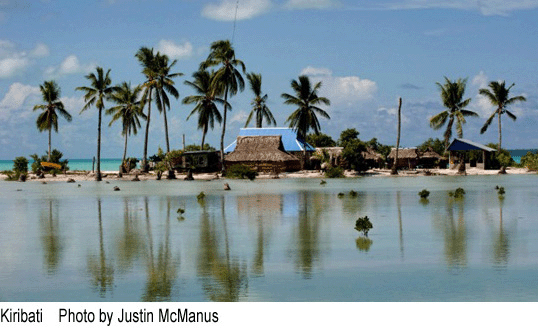
The impact of climate change is anticipated to displace up to 250 million people worldwide by 2050, including many in low-lying Pacific islands such as Tuvalu, the Solomon Islands and Kiribati.
In areas of the Pacific, sea level is rising by 1.2cm a year, four times faster than the global average. For coral-based islands two to three metres above sea level this has resulted in communities being relocated, and drinking water and crops are threatened by salt water inundation. Recent research suggests islands will not be submerged but will change shape and height, posing difficulties for fixed infrastructure.
“Why on earth would Australia not support a coordination facility?” said Phil Glendenning, president of the Refugee Council. “We are talking about the most vulnerable people on the planet who are facing threats to their food security, seeing their water supplies diminish and their entire cultures at risk.
“The world is going to have to deal with this displacement. We need to get on the front foot. Australia can’t say we are doing enough. People in Kiribati and Tuvalu are the canaries in the coalmine and they are looking to Australia.”
Last year the Kiribati government bought 20 sq km of land on Vanua Levu, one of the Fiji islands, in case its people cannot be moved internally. It has a policy called “migration with dignity” if its cluster of 33 coral atolls becomes inhabitable…….
Relocation of people is occurring across the Pacific region. Dozens of villages in Fiji will be moved, and 2,000 people from the Carteret atoll of Papua New Guinea will be transferred to mainland Bougainville, a three-hour trip on a wooden boat, because of salt intrusion and destructive tides. http://www.theguardian.com/environment/2015/oct/07/un-drops-plan-to-create-group-to-relocate-climate-change-affected-people
Trans Pacific Partnership’s Investor-State Dispute Settlement [ISDS] provisions bad for environment
 Trans-Pacific Partnership bad for the environment, green groups say October 7, 2015 Peter Hannam Environment Editor, The Sydney Morning Herald “……Greens Senator Peter Whish-Wilson said the Investor-State Dispute Settlement [ISDS] provisions of the pact will allow large corporations to challenge any efforts to tighten environmental regulation.
“This is a watershed moment for the Liberals and the mining industry in their continuing assault against environmental protections in Australia,” Senator Whish-Wilson said. “ISDS will provide a massive chilling effect against improvements in environmental law at a local, state and federal level.”
Kelly O’Shanassy, chair of the Australian Conservation Foundation, said it was “a very silly idea to lock in restrictions to future policy in this country”.
Corporations could now have a look at a proposed policy change and if it threatened their ability to make profit, they would go to the courts as they did to oppose the Gillard government’s plain packaging laws to curb tobacco marketing.
“It could be the plain packaging fiasco for climate change,” Ms O’Shanassy said.
With the Paris climate summit now looking increasingly likely to fall short on locking in sufficient cuts to greenhouse gas emissions to limit global warming to 2 degrees, governments will need to make regular revisions of their targets beyond this year’s summit.
The TPP is likely to limit nations’ ability to take those necessary additional steps, she said: “It means governments won’t be bold and ambitious as they should be.”http://www.theage.com.au/environment/transpacific-partnership-bad-for-the-environment-green-groups-say-20151006-gk2bga.html#ixzz3o10RNuqa
Coming refugee crisis as sea levels rise on Pacific Islands
 Fiji PM Warns Of Syria-Style Refugee Crisis If Rich Nations Don’t Do More On Climate, Thom Mitchell, New Matilda, 2 Oct 15 Frank Bainimarama has taken aim at advanced nations for ignoring the plight of Pacific Islanders in pursuit of short-term economic growth. Thom Mitchell reports.
The Fijian Prime Minister Frank Bainimarama has hit out at developing nations for their “unacceptable” progress in reducing carbon emissions as part of a speech to the United Nations General Assembly, in which he warned of a humanitarian refugee crisis on the scale of the current migration out of Syria if more is not done.
The talks come as Foreign Minister Julie Bishop seeks a place for Australia on the UN Security and Human Rights Councils, but Bainimarama warned that developed nations like Australia are not listening to the voice of Pacific Island nations, whose human rights are threatened by rising seas and hostile weather patterns.
“It is simply not acceptable for advanced economies to build a high standard of living on the degradation of the earth and the seas,” Bainimarama said.
The choices we face may be politically difficult in the short run, but the consequences we are already seeing – environmental degradation, unbearable heat, drought, powerful tropical storms and unpredictable weather patterns – are simply unacceptable,” he said.
“[Fiji] plans to move some 45 villages to higher ground, and we have already started.
“We have committed to resettle people from other low-lying, South Pacific Island States that face the prospect of being swallowed up by the rising ocean and falling inexorably to oblivion.
“Should that happen, the people of those Island States would be refugees as desperate and lost as the hundreds of thousands fleeing conflict in Syria and Iraq,” he said.
As New Matilda reported in June, experts in migration law, like those at the University of New South Wales’Kaldor Centre for International Refugee Law, are already warning that the “disasters on steroids” climate change will bring is likely to create a need for special refugee visas.
It is clear by now that international pledges nations have made through the United Nations climate change process will not be enough to keep the global rise in temperature to less than two degrees, which is the level accepted as ‘safe’ by Australia and around 200 other nations: https://newmatilda.com/2015/10/01/fiji-pm-warns-syria-style-refugee-crisis-if-rich-nations-dont-do-more-climate#sthash.hk0kghO3.dpuf
Uranium deal with India is bad for Australian business
 Australia-India nuclear deal http://www.lowyinterpreter.org/post/2015/09/14/Reader-riposte-Australia-India-nuclear-deal.aspx
Besides its collateral damage to Australia’s security, commercial and diplomatic interests, the soon-to-be ratifiedAustralia-India nuclear cooperation agreement notably fails to meet its objectives.
The aim was to give a green light to Australian uranium exports to India. Two objectives were to be served, one commercial, the other diplomatic. A vast new market was to be opened for Australian uranium exporters and India was to be convinced Australia was a reliable partner, worthy of a closer relationship.
Instead, as has been exposed in the Joint Parliamentary Committee, the Australian side gave away so much in the course of the negotiations on safeguards against nuclear proliferation and left open such loopholes for Australian uranium to end up in bombs or otherwise help their manufacture, that this proposed treaty does not do what Australia’s 23 existing nuclear safeguards treaties do.
Unlike them, it does not give Australian exporters legally watertight guarantees that the trade will be subject to effective controls against misuse of the uranium in ways Australian companies neither want nor could afford. So many deficiencies in the proposed treaty have been exposed it amounts at best, not to a greenlight but to a blinking yellow one. Not ‘all is guaranteed safe’ but ‘proceed carefully at your own peril’. And JSCOT’s main recommendation is a red light: no uranium exports to be permitted for the foreseeable future.
How Australian companies will respond and what risks they will be prepared to take remains to be seen, but no responsible government would have placed them in this situation.
The Indian Government has every reason to feel it too has been dudded. Instead of a reliable supply, there is a big element of precariousness. As for a demonstration of the Australian Government’s trustworthiness as a close partner, the contrary impression is conveyed of a bumbling inability to manage our own end of the deal.
Joint Standing Committee on Treaties (JSCOT) shows big hurdles in selling uranium to India
 Miles to go: exporting uranium to India http://www.onlineopinion.com.au/view.asp?article=17665, By M V Ramana – 11 September 2015 Plans to export uranium from Australia to India may have hit their most significant hurdle so far in the form of Report 151 of the federal Parliament’s influential Joint Standing Committee on Treaties (JSCOT). After much deliberation and expert testimony, the Committee has put forward a number of recommendations that India has to abide by before Australian uranium is sold to India. The history of India’s nuclear programme and the country’s stand in various diplomatic fora suggest that there is little chance of India agreeing to these conditions.
The first three recommendations laid out in the JSCOT report are particularly important. The first and second recommendations pertain to India acceding to the Comprehensive Test Ban Treaty (CTBT) and negotiating a fissile material cut-off treaty as well as a nuclear arms limitation treaty for the Indian subcontinent region. The third recommendation is focused on the safety and efficacy of the safeguards and standards of nuclear facilities in India arguing that a series of key checks and balances must be put into practice and proven to work before any uranium sales. If taken seriously, these recommendations will make it all but impossible for the Australian government to sell any uranium to India. Continue reading
Tony Abbott un-moved by Pacific islands plight with rising seas
Tony Abbott faces down Pacific island nations’ calls for tougher action on climate change
ABC Radio AM By Eric Tlozek in Port Moresby, 11 Sept 15 Prime Minister Tony Abbott has held his Government’s line on climate change despite pleas from low-lying Pacific island nations for a stronger stance on emissions and temperature rises.
Both Mr Abbott and New Zealand prime minister John Key refused to go further than their existing commitments on global warming at the Pacific Islands Forum in Port Moresby.
Some Pacific island leaders say they are disappointed in the leaders for putting economic growth ahead of the survival of communities in small Pacific nations.
“Australia and New Zealand have made no additional commitments when it comes to climate change,” Mr Abbott told reporters after the meeting last night……….
Tony Abbott has ‘a very good story to tell’ Pacific Islanders, about climate change
 ‘I’ve got a very good story to tell’: Tony Abbott confident of placating island leaders on climate change September 10, 2015 Michael Gordon Political editor, The Age Tony Abbott has entered a retreat with leaders from Pacific island nations confident he can reassure those who say their survival is threatened without a stronger commitment to reduce carbon emissions.
“I think I have got a very good story to tell on climate change to tell the Pacific Islands Forum,” the Prime Minister said before entering a day-long meeting with 15 Pacific island leaders.
Led by the president of Kiribati, Anote Tong, several of the leaders have warned that anything short of a commitment to limit the average global temperature rise to 1.5 per cent would represent a betrayal of their people.
…..Both Mr Abbott and New Zealand Prime Minister John Key will resist the push led by the smaller island states to go beyond a commitment to the goal of limiting the global rise to 2 degrees.
Fairfax Media has seen successive drafts of the leader’s declaration where a reference to a 1.5 degree commitment is removed. The final draft will be released after the leaders’ retreat. http://www.theage.com.au/federal-politics/political-news/ive-got-a-very-good-story-to-tell-tony-abbott-confident-of-placating-island-leaders-on-climate-change-20150910-gjj93v.html#ixzz3lOo0rT8H
Will Tony Abbott ignore the cautionary message of committee on uranium sales to India?
 India uranium red-light a test for Tony Abbott, SBS News, 8 Sept 15, While Prime Minister Abbott and Foreign Minister Bishop have been strong supporters of selling Australian uranium to India, many others, including key Australian diplomats and insiders, remain far more circumspect. By Dave Sweeney
The JSCOT report followed a detailed examination and expert testimony and states that while the federal government can ratify the deal it must not advance uranium sales or supply to India before key checks and balances are put into practice and proven to work.
In short, the committee charged with advising the government on Indian uranium sales has reached the unambiguous conclusion that the government can sign but not sell.
The question now is whether the Abbott government will follow due parliamentary process and act in the public interest or will it ignore these concerns and JSCOT’s advice and seek to fast-track the agenda of the under-performing uranium sector?
When Prime Minister Tony Abbott signed a uranium deal with Indian Prime Minister Narendra Modi in New Delhi in September 2014, he praised India’s “absolutely impeccable non-proliferation record”. Yet India’s record on nuclear proliferation tells another story. India acquired its nuclear arsenal by breaking a promise not to use a Canadian reactor for military purposes. It remains outside the globe’s key non-proliferation frameworks and the region remains on nuclear high alert amid tensions with nuclear rival Pakistan.
Instead of addressing real questions about India’s nuclear weapons program and inadequate nuclear safety standards Mr Abbott resorted to cricketing clichés, declaring that Australia and India trust each other on issues like uranium safeguards because of “the fundamentally ethical principle that every cricketer is supposed to assimilate – play by the rules and accept the umpire’s decision”.
The JSCOT process received strongly critical submissions from a who’s who of nuclear arms control diplomats and experts including John Carlson (former long serving Director-General of the Australian Safeguards and Non-Proliferation Office from 1989 to 2010), Ron Walker (former Chair of the International Atomic Energy Agency, Prof. Lawrence Scheinman (former Assistant Director of the US Arms Control and Disarmament Agency). These are veteran players in global nuclear diplomatic and regulatory regimes, not anti-nuclear activists.
Nuclear arms control expert Crispin Rovere noted that “this treaty appears less like the deepening of a bilateral partnership and more like one of a client state being dictated to in an expanded Indian empire. It is a major display of weakness on the part of the Australian Government, and a failure to stand up for Australia’s national interests in this area”.
One thing we can all agree on is that Australia has a key role to play in supporting India’s legitimate energy aspirations, but this cannot be advanced by a retreat from responsibility on nuclear safeguards and security. The government must read and heed the JSCOT report and Australia’s uranium must remain away from India’s nuclear reactors and weapons – to do otherwise would be profoundly irresponsible.
JSCOT has just clean bowled this dangerous and deeply deficient sales plan. Mr Abbott must now heed his own words, “accept the umpire’s decision” and start the long walk back to pavilion for a serious re-think. http://www.sbs.com.au/news/article/2015/09/08/comment-india-uranium-red-light-test-tony-abbott
Joint Standing Committee on Treaties (JSCOT) not happy with plan to sell uranium to India
Caution urged on uranium sales to India, Herald Sun September 8, 2015 THE government needs to consider greater safeguards and stronger diplomatic efforts before Australia sells uranium to India, a new report says. THE treaties committee report, tabled in parliament on Tuesday, said India should be encouraged to become a party to the comprehensive test ban treaty and separate its civil and military nuclear facilities.Uranium should not be sold to India until it puts in place an independent nuclear regulator and best practice safety inspections of nuclear facilities, the report said.Committee chairman, Liberal MP Wyatt Roy, said in the report there were some “significant risks” to selling uranium to India.India was outside the “nuclear non-proliferation mainstream” and Australia should use all diplomatic steps to ensure it signed the Nuclear Non-Proliferation Treaty.There were weaknesses in the way India’s nuclear facilities are regulated “that jeopardise nuclear safety and security”.
“The committee has made a recommendation that the sale of uranium to India only commence when these weaknesses have been addressed,” Mr Roy said……..Two Labor members of the committee said the full separation of India’s civil and military nuclear facilities and the setting up of a new independent watchdog should be done before the treaty is ratified.The majority committee view was that these two matters should be addressed after ratification.”We consider it essential that any nuclear agreement with India should be at least as rigorous as all the agreements Australia has concluded with other countries,” Labor’s Melissa Parke and Sue Lines wrote.Greens senator Scott Ludlam said the deal should not go ahead.”It puts the interest of a small and marginal industry ahead of global security,” he said……..http://www.heraldsun.com.au/news/breaking-news/australias-india-uranium-deal-report-due/story-fni0xqi4-1227517124640
Pacific Island Forum will be dominated by Australia’s Inaction on Climate Change
Australia’s inaction on climate change set to dominate Pacific Island talks, Guardian, 6 Sept 15 Australia and New Zealand are expected to face strong criticism from Pacific Island leaders disappointed the nations are not doing more to combat climate change.
The issue will likely dominate this week’s Pacific Islands Forum leaders summit in Port Moresby, ahead of the United Nations climate change conference in Paris later in the year.
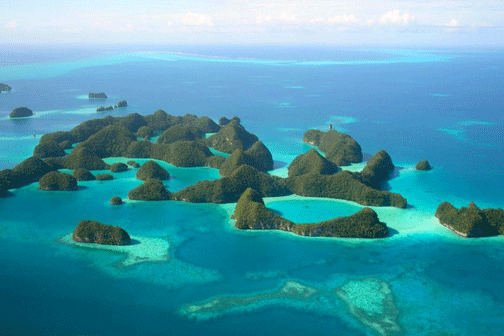
Pacific leaders want the world to work on restricting the global warming temperature rise to 1.5C, fearing a 2C target will risk the survival of many tiny islands.
Natural disaster recovery will be fresh on their minds. The summit starts on Monday, six months after Cyclone Pam, which flattened much of Vanuatu and caused heavy flooding on Tuvalu, Kiribati and the Marshall Islands.
Host nation Papua New Guinea is grappling with the opposite problem – what could be its worst drought in 20 years and a potential food crisis.
The prime minister, Peter O’Neill, has said El Niño conditions have been exacerbated by the effects of climate change.
The Solomon Islands and Vanuatu are also experiencing a dry spell………
The Pacific Island Forum runs from 7-11 September. http://www.theguardian.com/world/2015/sep/06/australias-inaction-on-climate-change-set-to-dominate-pacific-island-talks
Increasing danger of #nuclear submarines in Indo Pacific oceans
 ‘the more submarines you put in the same body of water, the higher the probability they might collide’.
Indo-Pacific nuclear sub threat to rival Cold War AFR, by John Kerin, 3 Sept 15 The Indian and Pacific Oceans are becoming increasingly crowded with nuclear armed and conventional submarines increasing the risk of collision and nuclear conflict.
The warning is contained in a new Lowy Institute of International Affairs paper to be released on Friday which argues the region faces the greatest threat of a miscalculation involving nuclear armed submarines since the Cold War era.
“The regional contests for influence between the United States and China and China and India do not yet have the existential or ideological ‘life or death character’ of the Cold War,” the paper by Professor Rory Medcalf of the ANU based National Security College and Brendan-Thomas Noone from the Lowy International Security Program says.
“But quite literally below the surface a new and dangerous competition is emerging as China and India in particular start deploying nuclear weapons at sea………. Continue reading
India pushing to hurry up uranium purchases from Australia
India pushes for early implementation of nuclear deal with Australia, Economic Times By PTI | 1 Sep, 2015 NEW DELHI: India today conveyed to Australia its eagerness to conclude negotiations for early implementation of the bilateral nuclear deal besides pushing for joint production of defence equipment.
Both Swaraj and Andrews also discussed first ever naval joint exercise to be held later this month at the Bay of Bengal. …….http://economictimes.indiatimes.com/articleshow/48764027.cms?utm_source=contentofinterest&utm_medium=text&utm_campaign=cppst.
Abbott snubs UN climate talks in December
 Abbott won’t attend UN climate change talk http://www.heraldsun.com.au/news/breaking-news/abbott-wont-attend-un-climate-change-talk/story-fni0xqi4-1227478782154 PRIME Minister Tony Abbott won’t attend the United Nations climate change summit at the end of the year.
INSTEAD, he will send Foreign Minister Julie Bishop to Paris for the talks to nut out a post-2020 global approach to dealing with climate change.
Labor says if world leaders like US President Barack Obama can find time to attend there is no excuse Mr Abbott can’t as well.
Labor Senator Wong fights TPP’s Investor State Dispute Settlement (ISDS) clauses
 ISDS clauses give foreign investors the right to sue governments if the company’s business interests are adversely affected by national policy. The Asian arm of the tobacco multinational Philip Morris is challenging the Australian government over plain packaging laws, despite the company already losing a case in the Australian courts.
Penny Wong backs fight against free-trade clauses that let companies sue Australia http://www.theguardian.com/australia-news/2015/jul/24/penny-wong-expected-to-fight-free-trade-clauses-that-let-companies-sue-australia Gabrielle Chan
Labor’s trade spokeswoman supports motion to remove investor state dispute settlement clauses from existing trade agreements Labor has committed to remove investor state dispute settlement (ISDS) clauses from existing trade agreements, including the Chinese and Korean free trade agreements (FTA) recently signed by the Abbott government.
The motion was supported by the opposition trade spokeswoman, Penny Wong.
The motion, moved by New South Wales MP Pat Conroy, would also mean a Labor government would work to reform ISDS tribunals to remove “perceived conflicts of interest” of judges determining disputes.
Conroy said: “When the Productivity Commission, the chief justice of the high court and a range of academics say ISDS must be reformed, it is time to fix this system that undermines our sovereignty.” Continue reading
Australian mining companies’ shameful record in Africa
Australia sells itself as a nation that can teach the world about responsible mining – Afghanistan is one willing student – but the record suggests our corporations have a callous disregard for the rights of civilians.
Why is it left to US NGOs to expose Australian mining’s wrongdoing in Africa? Antony Loewenstein, Guardian , 27 july 15
There are hundreds of Australian mining companies working in Africa, but just one full-time Australian journalist. What does that mean for accountability? Australian miners are making a killing overseas. With little regulation or oversight, billions of dollars are being made in some of the most remote places on Earth.
The necessity of partnering with autocratic regimes has proved no impediment to investment. Human rights have been breached. Victims are largely invisible.
None of this should be surprising. If Australian companies operating internationally are mentioned in the media, it appears in the business pages and discusses the strengths of a CEO or share price. Rio Tinto, for example, receives largely uncritical coverage despite in the 1980s the corporation facing serious allegations of human rights abuses around the world, including in Papua New Guinea.
Two American non-profit media organisations, the Centre for Public Integrity and the International Consortium of Investigative Journalists, recently bucked the trend and released a stunning report, Fatal Extraction, on Australian mining companies working in Africa (in which no allegations were made against Rio Tinto). How revealing that this research was led from America and not Australia itself.
The findings of the report, produced in collaboration with African journalists on the ground, were shocking.
From the Democratic Republic of the Congo to Malawi, grim details of death, maiming and police and army brutality were revealed. Continue reading
1 This month

of the week – Australians for War Powers Reform (AWPR)
To see nuclear-related stories in greater depth and intensity
 Antinuclear