‘Not everyone knows acronyms’: Australian politicians shrug off Trump blunder on AUKUS

By Richard Wood • Senior Journalist Feb 28, 2025, https://www.9news.com.au/world/donald-trump-stumbles-when-asked-about-aukus-defence-deal/6a602864-b990-4d37-95a4-530e31bd96e8
Politicians from both sides in Australia have weighed in today on US President Donald Trump’s apparent stumble when he said he did not know what AUKUS was.
Trump was hosting visiting British Prime Minister Keir Starmer at the White House when the pair were asked by a reporter whether they’d be discussing AUKUS, under which Australia will acquire nuclear-powered submarines.
“What does that mean?” Trump replied.
American or Trump’s values, or are they the same?
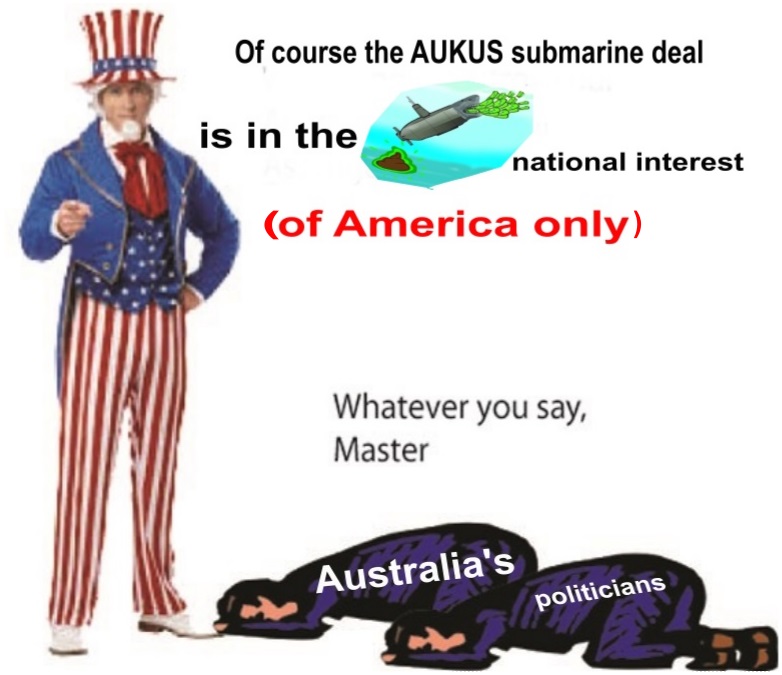
Crispin Hull, 11 Feb 25 https://www.crispinhull.com.au/2025/02/10/american-or-tumps-values-or-are-they-the-same/?utm_source=mailpoet&utm_medium=email&utm_campaign=crispin-hull-column
Australia can now either grimace and bear it for four years pretending nothing has happened; or face reality and question whether AUKUS and the US alliance more generally are worth it.
ANZUS and AUKUS were, from the start, purportedly based on “shared values”. Less than a month into the Donald Trump presidency can we put our hands on our hearts and say, “We share values with the US, and we will spill blood and treasure for those values”?
The acid question now is: to what extent are Trump’s values American values?
Can they be separated as if there is a separate pocket of American values – the rule of law; the separation of powers; freedom of the press; international order; liberal democracy and its spread throughout the world; and the helping hand to people and countries less fortunate?
It is difficult to see how.
The assertion by Trump of his “values” has attracted dozens of lawsuits in less than a month. He acts unlawfully; he bullies; he acts with cruel indifference to human suffering; he acts capriciously and vindictively and without diplomacy.
Trump is reversing 400 years of progress in governance: the rule of law; and the principle that those who are governed owe their loyalty to the law and not to the ruler and that those who govern do so with the consent of the governed and owe their loyalty to the law and the people not to themselves.
The time has come for the allies of the US to ask: what are the passing Trump values that we do not share that will disappear and what values, under Trump, have transmogrified into American values. After all, that is what Trump asserts: that his values are American values.
And, let’s face, a majority of voters voted for Trump.
If Trump values are now American values and American values Trump values, does Australia want to be a part of it? Is Australia safe relying on a new transactional America that sees everything through the selfish prism of only what is good for America, or more narrowly what is good for Trump.
Surely it is dangerous to presume that there are some underlying intrinsically good Amercian values that transcend Trump and will re-emerge when he is gone – when the chances are that this Trump administration will have trashed America’s constitutional framework and electoral processes so badly that the next election, if there is one, will be Trump’s for the taking, with the constitutional prohibition against third terms ignored. Or it will be a shoe-in for his anointed successor – probably JD Vance.
Surely, a better, safer, and more morally sustainable position would be for Australia to suspend the alliance until we can truly say that we have “shared values”.
How do we know that contributing militarily to any US international action is nothing more than Australian blood and treasure being expended to enhance Trump’s personal real-estate empire? He wants to buy Greenland; make Canada the 51st state; and overrun Gaza.
The treatment of Canada is alarming. Canadian Prime Minister Justin Trudeau said that Trump’s desire to make Canada a 51st state “is a real thing”. Remember Trump referred to Trudeau as “Governor Trudeau”.
He threatened Canada with crippling tariffs They have been suspended, but you cannot undo the threat. The relationship dynamic is forever changed because threats (economic, violent, or psychological) destroy trust.
If he can treat Canada, the US’s closest neighbour geographically, linguistically, and historically in that way, surely Australia is no more than a bit piece in the American game of global dominance and economic exploitation.
Australia should now also look at its alliance with the US against the background of history. Against that it is alarming: Trump is not a passing aberration but part of a continuum of some deep-seated ugly American traits.
It starts with the Declaration of Independence when “all men are created equal” excluded women and slaves. Then the Constitution was framed with a deep suspicion of the mass of people and set up an Electoral College to elect the President, rather than by the people directly.
Violence, racism and guns have dominated US history, beginning with the dispossession and genocidal cruelty against the indigenous population. Shortly after fighting a civil war over slavery, the south reverted to segregationist racism that lasted into the 1960s.
In the 19th century, the US was a vicious colonial occupier of the Philippines, In the 20th century, rampant capitalism tipped the US into the Great Recession. Selfish America refused to join the fight against racist Nazism and Japanese fascism until it was itself directly attacked.
Yes, Australia benefited from the US joining the fight against Japan, but the US did not do it to help Australia; that was a side-effect. It just used Australia as a base for its efforts to counter Japan’s threat to the US.
What if our naïve belief in US goodness and exceptionalism is misguidedly founded upon those four or five years of US munificence immediately after World War II despite a 250-year violent history of a male, white, Christian assertion of supremacy?
In those brief years after World War II, the US led the foundation of the United Nations; set up the international rules-based order leading to the World Bank and International Monetary Fund.
The US led the way promoting peace, law, harmony, and immense generosity in adopting the Marshall Plan to reconstruct Europe and a benign, forgiving occupation of Japan.
The US has benefitted and traded off that immediate sunlit post-war image for way longer than its used-by date. And US allies have fallen for it.
Later decades gave us the Korean war; the Vietnam War; Iraq; and Afghanistan. It gave us the Bay of Pigs and numerous other ill-founded, unwarranted interferences in small nations to promote US economic interests under the guise of promoting democracy over communism. The incessant US blood-spilling belligerence went on and on, and Australia was sucked into it at great cost to our blood and treasure.
Do we really now want to contribute to a genocidal expulsion of two million Palestinians so Trump’s America can erect a hotel-strewn shoreline in Gaza for Israel and exploit the rights to newly found oil and gas offshore?
Under Trump, the AUKUS deal takes on a different complexion. Australia, under then Prime Minister Scott Morrison, was stupid enough to sign up to an asymmetrical deal where we pay (and have in fact mostly paid) $A4 billion to US shipyards to help them hasten the construction of Virginia-class nuclear submarines of which we are supposed to get three. But this would be contingent on the President of the day certifying that US would not need the submarine.
Does anyone imagine that transactional Trump would allow any submarines to go to Australia without some further payment or supplication?
The US does not protect Australia, it uses us – and puts us in harm’s way in doing so.
Perhaps we should just be honest and say we do not care about shared values or morality we just want protection and we are willing to pay for it – like some nervous shop owner being stood over by a gangster.
But I think Australia is better than that and that, in the face of the Trumpian wrecking ball, we should suspend AUKUS and the US alliance, or at least have an inquiry into them. Disruptive surprises need not be the sole purview of the attention-seeking and attention-demanding man in the Oval Office.
Is “Bad Faith”‘s Council for National Policy the Atlas Network’s half-brother?

Ed COMMENT. I put this article up on the Australian website. You might think that it has nothing to do with Australia.
But it does! The fascist chaos now developing in the USA could spread to Australia, as the Atlas Network promotes its Australian off-shoot “Advance”. Advance will funnel $millions into Trumpian-style propaganda, to influence the coming Australian federal election.
The long game of the Mont Pelerin Society that spawned the Atlas Network became colonising government and the law, to make them the servants of the largest players in the economy.
February 6, 2025 Lucy Hamilton, https://theaimn.net/is-bad-faiths-council-for-national-policy-the-atlas-networks-half-brother/
The Council for National Policy is the ultra-secret body tracked in the documentary Bad Faith. Are the Mont Pelerin Society fingerprints there just by chance?
The chaos that is erupting from the people around Trump was forecast in the 900 pages of Project 2025 for those paying attention. The firehose of brutality and stupidity is coming too fast for observers to encompass. Whether it’s 25 year olds with the power to alter code in the Bureau of Fiscal Service or a Christian Nationalist-driven freeze on all public spending or trying to deport Navajo people, the whole project reeks of reckless cruelty and apparent irrationality.

Just as Ronald Reagan implemented 2/3 of the first Mandate for Leadership, Donald Trump implemented 2/3 of his first iteration. Now the Mandate is known as Project 2025 and it’s no longer just a “business republican” project. It’s a Christian Nationalist project too. And 2/3 of the first executive orders of this Trump administration came from Project 2025.
The man likely to take the helm of the Office of Management and Budget, Russell Vought, was revealed as the Christian Nationalist radical he is in this undercover sting operation last year. The chaos is intended to continue. He has said he intends to put career civil servants “in trauma.” He also intends to use the military to crush protests.
This domestic chaos will be deadly; the freeze on USAID spending will kill people sooner. These radicals around Trump do not care: their eugenicist beliefs run deep. It’s a longterm goal: this 2006 annual Atlas Network report contains an essay repeating disdain for foreign aid as a failed concept by (MPS member since 1984, erstwhile president and critical figure in the growth of Atlas and several junktanks), Leonard Liggio. There is no reflection on how many nations need foreign aid because of MPS-driven restructuring and neoliberal interventions to keep those nations impoverished and dependent.
Ronald Reagan, the first de facto Atlas Network US president said: “The nine most terrifying words in the English language are: I’m from the Government, and I’m here to help.” The Trump apparatchiks are trying to make that a vicious reality.
The long game of the Mont Pelerin Society that spawned the Atlas Network became colonising government and the law, to make them the servants of the largest players in the economy. They sold the mission as “freedom” in a “free market,” with “small government” staying out of the little guy’s way. That was not the real intent. Democratic projects, rights or a decent life for the individual (below enabler class) were intended by few in the project. Neofeudalism is a more apt label. You are not even to be allowed to protest your (or others’) immiseration.
People committed to the neoliberal project have a firm commitment to making government look ineffective and wasteful. It may be that government efforts to tackle the pandemic risked making people trust government. The steps towards a UBI might have stung badly for people who believe government spending should only serve the already rich. It is likely also that coercive measures like lockdowns, mask wearing and vaccine mandates triggered their socialism-alarms. There is extensive evidence of junktank partners’ investmentin pandemic disinformation and the fighting of public health measures including masking.
It’s possible that the greater inclusivity of a pluralist society might have been enough on its own to repulse the narrow-minds of this machinery; it could be that the pandemic broke them.
Either way, after the worst of the pandemic, one of the Atlas Network’s most pivotal junktanks appointed a Rad Trad Catholic extremist with connections to Opus Dei as its president, in September 2021. Kevin Roberts was an Atlas operative before this. He used to run the Atlas Texas Public Policy Foundation.
He was also however, by 2022, already on the Council for National Policy board.
The Bad Faith (2024) documentary reveals in grim detail how the Council for National Policy (CNP) was the theocratic machine that built the Moral Majority. It was the network that brought together the extremist Evangelical preachers of that movement, media organisations and funders with some of the Republican Party’s most effective strategists. The documentary is based on journalist Anne Nelson’s extensive investigations in Shadow Network.

Key figures amongst the Republican Party strategists that founded the CNP belonged to the Mont Pelerin Society, just as the key operators in the Atlas Network did – and do.
(Atlas has, since it was founded in 1981, vacuumed up other junktanks and networks into its web of shared strategies and personnel connections: whether they are Atlas spawned or interlinked can be complex to disentangle. Whether CNP was in part an MPS project at its foundation is opaque. It could be that class interests of a small band of operatives led to overlaps in strategising. The two networks are, however, overtly operating in concert now with both strongly represented in the Project 2025 Advisory Board.)
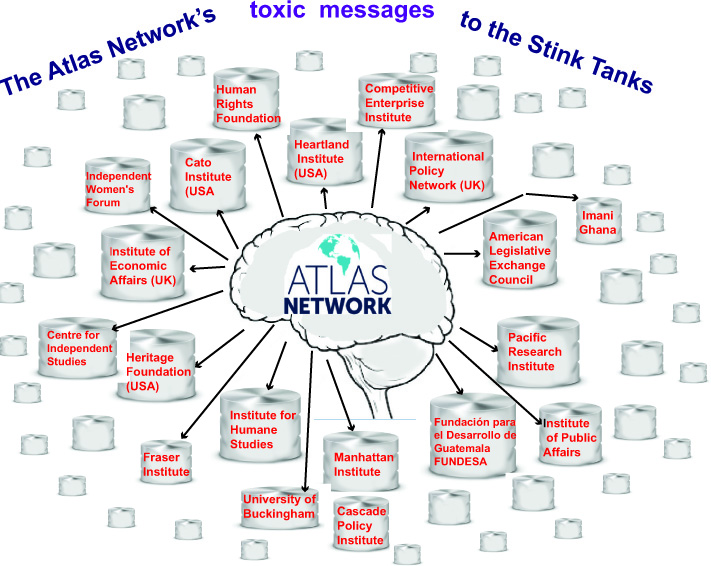
Catholic zealot Paul Weyrich co-founded the Heritage Foundation in 1973. Many historic clips of Weyrich uttering his extreme beliefs are to be viewed in Bad Faith. In 1981, the CNP was founded to galvanise the 1978 undertaking to use the issue of abortion to create a Christian Republican voter bloc. (In 1978, abortion was a fringe Catholic issue, of little interest to Evangelicals.)
Weyrich’s co-founder at Heritage was Catholic Edwin Feulner, later an MPS president, but a member from 1972. He is also a CNP member.
The CNP’s Republican founders included Episcopalian (Anglican) Morton Blackwell, an MPS member from 2007, who created the Atlas Network-and-CNP’s Leadership Institute founded in 1979. It aims to increase “the number and effectiveness of conservative leaders in the public policy process. More than 300,000 conservatives have become leaders through Leadership Institute training.”
Fellow CNP founder was Evangelical? Edwin Meese III who worked with Atlas’s Ronald Reagan from 1966, and was later one of his attorney-generals. Meese was involved with Heritage from 1988. A third was Catholic Richard Viguerie who invented the direct mail scam that fostered the demonising of Democrats to scare grannies out of their pittance.
Both Atlas and the CNP receive funding from Charles Koch and his circle including the Bradleys. On the CNP leaked membership list, Lawson Bader is identified. He is an MPS member and has been president and CEO of Donors Trust and Donors Capital Fund since 2015. Donors Trust is known as the “dark money ATM of the right.” The Mercer family, that funded Breitbart and Cambridge Analytica, is also listed as a CNP donor. The united Devos and Prince families are key donors. Betsy DeVos has roles at several Atlas junktanks. Peter Thiel, tech plutocrat, is now a significant funder of Donors Trust.
Boeing, Coors, Cinemark, Forbes media and Morgan Stanley all have senior figures affiliated with CNP. (Coors money was central to the Heritage Foundation’s funding, with Joseph Coors, Evangelical and white supremacist, a co-founder.)
Currently the CNP and Atlas share several critical partner organisations apart from Heritage and Leadership such as the Federalist Society which has been described as creating the imperial juristocracy around Donald Trump’s second presidency. Another is the American Legislative Exchange (ALEC) that produces reactionary and anti-labour model bills for state legislatures to reproduce. A thirdis Americans For Tax Reform, which Grover Norquist (CNP member) founded at Ronald Reagan’s “request.”
The Acton Institute, Media Research Center, Capital Research Center, Buckeye Institute, National Center for Public Policy Research, Center for Security Policy, Young America’s Foundation, American Conservative Union (parent of CPAC), Discovery Institute and Americans for Prosperity are other joint members. Tea Party Patriots is a CNP member that is spawned as an astroturf outfit out of Atlas’s Freedomworks.
The CNP’s members include the Club for Growth, which is another Koch-supported entity. It funds Republican candidates who fight labour rights. The farce of fighting for the working man that Trump’s campaign feigns is exposed by the many junktanks here strategising to suppress workers.(1)
The CNP is a particularly ugly partner for the Atlas Network which advertises itself as “strengthening the worldwide freedom movement.” It unites the NRA with Turning Point USA with a range of hate groups promoting Islamophobia and homophobia. Its Christofascist members fight rights for women as well.
A key member is the Alliance Defending Freedom which the SPLC summarises as having supported “the recriminalization of sexual acts between consenting LGBTQ adults in the U.S. and criminalization abroad; has defended state-sanctioned sterilization of trans people abroad; has contended that LGBTQ people are more likely to engage in pedophilia; and claims that a “homosexual agenda” will destroy Christianity and society.” Not much freedom there.
The Conservative Partnership Institute (CPI) founded by Senator Jim DeMint, former Heritage Foundation president, in 2017, is a CNP member since 2020. This sub-network has spawned a range of extreme election denial and reactionary policy junktanks. One notable CPI entity is America First Legal, white supremacist Stephen Miller’s critical creation. It is largely funded by Bradley donations.
One of the significant names on the CNP list is Steve Bannon. He has been fighting for the “deconstruction of the administrative state” for years. His esoteric traditionalist beliefs call for the destruction of the age of slaves (democracy) to be replaced by the age of priests. His ally Curtis Yarvin, inspiration of many of the tech-fascist oligarchs, argues a CEO-monarch should replace the democratic experiment. It looks like Elon Musk thinks that should be him.
Many of the Christofascist organisations and individuals in the CNP are anti-democratic, believing that a theocracy is the answer to America’s ills. There is, at minimum, no freedom of religion allowed.
The destruction around Trump is a genuine threat to American’s democratic experiment.
That Reagan’s Mandate for Leadership should have become Project 2025 is startling on its own. The linking of Atlas’s ostensible campaign for freedom with the CNP’s campaign for theocratic coercion illustrates starkly that the freedom is only for a few.
* * * * *
Mont Pelerin is a secretive, invitation only organisation, but some of its leaked members can be found here. The Council for National Policy is ultra-secretive but its leaked members can be found here.
(1) (Business donors who had captured former Democrat Kirsten Sinema years back seem to have sent her back from early retirement to vote down Biden’s choice for a Labor Relations Board that might have been able to protect workers’ rights into the Trump era.)
This research is supported by an Australian Government Research Training Program Scholarship.
How Australia’s CANDU Conservatives Fell in Love with Canadian Nuclear
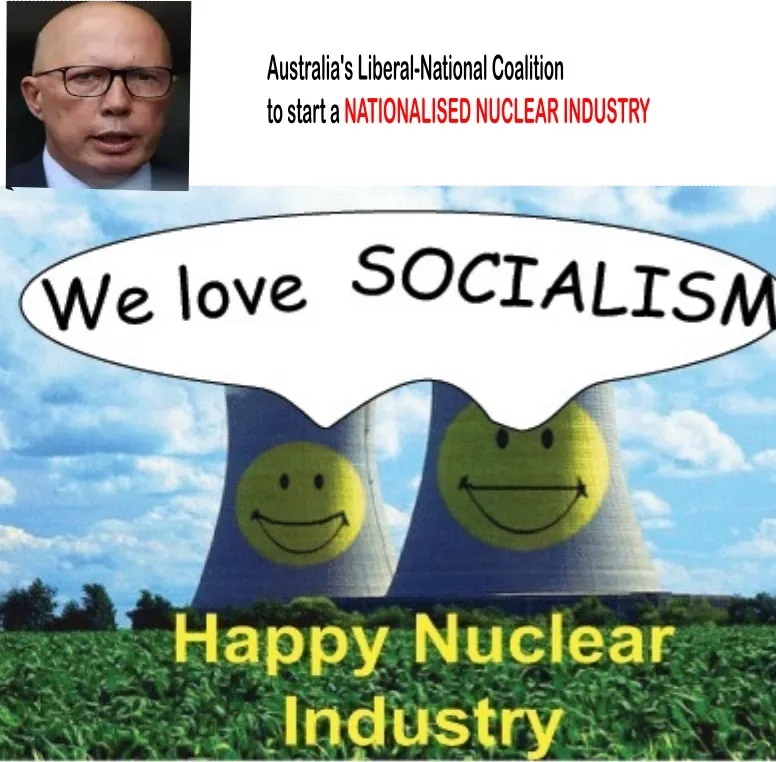
This time around, with the current push to embrace nuclear energy, the federal Australian Coalition’s ideas appear to be shaped by the internet, where a pro-nuclear media ecosystem of influencers and podcasters has flourished just as nuclear has become attractive to conservative parties worldwide.
Ontario, Canada is the only place in the world to tear out wind turbines and embrace nuclear power. Australia’s conservatives have been taking notes.
DRILLED, Royce Kurmelovs 5 Feb 25
If there is a Holy Land for nuclear energy, Australian Shadow Climate Change and Energy Minister, Ted O’Brien, seems to think it’s Ontario, Canada.
Other countries have well-established nuclear power industries, of course. There’s the United Kingdom where the Hinkley Point C nuclear reactor – dubbed “the world’s most expensive power plant” – where work began in 2007 with an expected start date of 2027 but is now at least ten years behind schedule and billions over budget. Meanwhile, it’s sister project, Sizewell C, is estimated to cost the equivalent of AUD $80bn (GBP £40bn, USD $49bn). There’s France where, in mid-August 2022, half the country’s nuclear reactors were forced offline, many as a direct result of climate impacts such as heat and drought.
Over in the United States, storied home of the Manhattan Project, where newly minted energy secretary (and fracking CEO) Chris Wright has announced a commitment to “unleash” commercial nuclear energy, one of the last two new nuclear power builds attempted this century forced Westinghouse into bankruptcy protection, and a separate effort by NuScale to build a cutting edge small modular reactor (SMR) was cancelled in November 2023 due to rising costs. There’s also Finland, a country of 5.6 million people, that finally turned on Europe’s newest nuclear reactor 18 years after construction began, finishing up with a price tag three times its budget. Though it had a noticeably positive effect on prices after start up, the cost of building Olkiluoto-3 was so high, its developer had to be bailed out by the French government. Since then, technical faults continue to send the reactor temporarily offline – a remarkably common occurrence among nuclear reactors.
Ontario, however, is so far the only place in the world that has ripped out wind turbines and built reactors – though the AfD in Germany has pledged to do the same if elected, and US President Donald Trump has already moved to stop new windfarm construction. Thanks to much self-promotion by pro-nuclear activists and Canada’s resources sector, that move caught the imagination of O’Brien and Australia’s conservative party. Now, as Australians head to polls in 2025, the country’s conservatives are looking to claw back government from the incumbent Labor Party with a pro-nuclear power play that critics charge is nothing more than a climate-delay tactic meant to protect the status quo and keep fossil fuels burning. “This is your diversion tactic,” says Dave Sweeney, anti-nuclear campaigner with the Australian Conservation Foundation. “There’s a small group that have long held an ambition for an atomic Australia, from first shovel to last waste barrel to nuclear missile. Some of the people who support this are true believers, for others it’s just the perfect smoke screen for the continuation of coal and embedding gas as a future energy strategy.”
Apples and Maple Syrup
On the face of it, Ontario is an odd part of the world on which to model Australia’s energy future. Privatization in both places has evolved messy, complicated energy grids, but that’s about all they have in common. One is a province on the sprawling North American landmass, and the other is a nation that spans a continent. Ontario has half the population of Australia and spends five months a year under ice. Its energy system has traditionally relied on hydro power and nuclear, where Australia is famously the driest inhabited continent on the planet that used to depend on coal but now boasts nearly 40% renewable electricity as of 2024.
One Australian state, South Australia, already draws more than 70% of its power from renewables and frequently records weeks where all its electricity needs are met with solar and wind. Unlike Ontario, and the rest of Canada, Australia has no nuclear industry aside from a single research reactor in the Sydney suburbs. The cost of transmitting power over vast distances in Australia makes up approximately two-fifths of retail power prices. Electricity prices in Ontario, meanwhile, have been artificially lowered by an $7.3bn a year bundle of subsidies for households and businesses. Comparing the two jurisdictions is stranger than comparing apples and oranges; it’s more like comparing apples and maple syrup.
None of this has stopped the province from becoming O’Brien’s touchstone for the marvels of nuclear energy, and “Ontario” from becoming his one-word reply to critics who question the wisdom of creating a new nuclear industry from scratch in Australia. If the country wanted to transition away from coal, the Coalition’s suggestion was it should be embracing nuclear energy — not more renewables — just look at Ontario. “We have to keep learning the lessons from overseas,” O’Brien told Sky News in August 2024. “There’s a reason why countries like Canada, in particular the province of Ontario, has such cheap electricity. They’ve done this many years ago. They were very coal-reliant and eventually, as they retired those plants, they went into nuclear.”
Weirder still, O’Brien is not the only Australian political leader to be chugging the maple syrup. Ever since the conservative Liberal-National Coalition began to float the idea of an atomic Australia as part of their 2025 election pitch, its leader, Peter Dutton, has similarly pointed to the Canadian province as an example for Australia to follow. In interview after interview, Dutton referred to Ontario’s power prices to suggest that nuclear is the future for Australia – raising the question: how did Ontario capture the hearts and minds of Australia’s conservatives?
Atomic Australia
The idea of an atomic Australia has long lived in the heart of Australian conservatism. Former conservative Prime Minister Robert Menzies once begged the United Kingdom to supply Australia with nuclear weapons after World War II, going so far as to allow the British to nuke the desert and the local Indigenous people at a site known as Maralinga. The first suggestion for a civilian nuclear power industry evolved out of this defense program and has never been forgotten. Iron ore magnate Lang Hancock and his daughter, Gina Rinehart, today Australia’s richest woman, both remained fascinated by nuclear energy. In 1977, Hancock, a passionate supporter of conservative and libertarian causes, brought nuclear physicist Edward Teller to Australia on a speaking tour to promote nuclear power, including an address to the National Press Club where he promised thorium reactors would change the world.
Though Australian plans to build a domestic nuclear industry have failed due to eye-watering costs and public concerns about safety, the country today is the fourth largest exporter of uranium according to the World Nuclear Association, sending 4820 tonnes offshore in 2022 and providing 8% of the world’s supply. The country is also planning to acquire a nuclear-powered submarine fleet through AUKUS, an alliance with the US and UK. This increasingly tenuous defense deal is thought unlikely to happen thanks to issues with US and UK shipyards, but the existence of the program has been used to justify the creation of a civilian nuclear power sector. There have been at least eight inquiries or investigations into the viability of a nuclear industry in Australia since 2005, and five proposals to build government-owned nuclear waste dumps since 1990. Each inquiry has concluded that nuclear power would largely be a waste of time and money and, with the exception of two facilities in Western Australia that store low-level radioactive waste, efforts to build additional dumps capable of storing higher grades of waste have mostly foundered for lack of community support. This time around, with the current push to embrace nuclear energy, the federal Australian Coalition’s ideas appear to be shaped by the internet, where a pro-nuclear media ecosystem of influencers and podcasters has flourished just as nuclear has become attractive to conservative parties worldwide.
When Australia LNP opposition leader Peter Dutton formally unveiled the gist of his “coal-to-nuclear” transition plan in June 2024, for example, he was asked what the plan would be to handle the waste and responded with a curious sleight of hand: “If you look at a 470MW [nuclear] reactor, it produces waste equivalent to the size of a can of Coke each year.” A fact check published in the Nine papers pointed out that nuclear reactors typically operate on much larger scales than 470 megawatts. Citing World Nuclear Association figures, it found a typical large-scale nuclear reactor with 1-gigawatt capacity will generate 30 tonnes of spent fuel each year – roughly 10 cubic metres, or 10,000 litres a year. It is unclear where Dutton or his speechwriters stumbled onto this talking point, but it appeared to be a corruption of the idea that one person’s lifetime waste from nuclear energy could fit inside a soda can – a common Facebook meme promoted by the Canadian Nuclear Association. A similar claim was repeated last year in a social media video by Brazilian model and Instagram influencer Isabelle Boemeke.
Boemeke, who goes by the online persona Isodope and claims to be the “world’s first nuclear energy influencer,” begins her video by outlining her daily diet, starting with black coffee and ending with a post-gym snack of energy-dense gummy bears. In a dramatic transition, she then compares the size of a gummy bear to the size of a uranium pellet, before launching into a didactic explanation of the role these pellets play in generating nuclear power.

“It also means the waste it creates is tiny. If I were to get all of my life’s energy from nuclear, my waste would fit inside of a soda can,” she says, before ending by advising her viewers not to drink soda because “it’s bad for you.”
Neither the Canadian Nuclear Association nor Boemeke elaborated on how the world might dispose of the cumulative waste if a significant proportion of the Earth’s population drew their energy from nuclear power – but then that is not the point.
Boemeke is hardly alone. Online there is a small but determined band of highly networked, pro-nuclear advocates, podcasters and social media influencers working to present an alternate vision for an atomic world. Many of those involved in this information ecosystem are motivated by genuine belief or concern over environmental issues, even if their activities often align with right-wing causes and ideas. Nuclear is often positioned as an essential climate solution, as well, although it’s typically a cynical promise: nuclear reactors take decades and billions of dollars to build, buying fossil power more time. In the U.S. especially, pro-fossil conservative politicians often use nuclear as a rhetorical wedge: they will ask any expert or advocate in favor of climate policy whether they support nuclear and imply that if they don’t, they must not be serious about actually addressing the climate crisis by any means necessary.
One of those helping export the strategy from North America to Australia is Canadian pro-nuclear advocate, Chris Keefer, host of the Decouple podcast and the founder of Canadians for Nuclear Energy. A self-described “climate hawk”, Keefer is a practicing emergency physician in Toronto who built an online presence as an advocate for keeping existing nuclear power plants open. Through his public advocacy, he has been instrumental in cultivating the image of Canadian – and particularly Ontarian – nuclear excellence, a legend he has recently promoted in Australia through a series of meetings, speeches and his podcast.
Nuclear on Tour
…………………………………………………………………in September 2023, when Keefer traveled to Australia to give a keynote address at Minerals Week, hosted by the Minerals Council of Australia (MCA) at Parliament House in Canberra. Ahead of his visit, a write up published in the The Australian Financial Review framed Keefer as a “leftie” and “long time campaigner on human rights and reversing climate change” who had previously “unthinkingly accepted long-standing left-wing arguments against nuclear” but had embraced nuclear due to his unionism. During his time in Australia, Keefer says he met with federal Opposition leader Peter Dutton to discuss “Ontario’s coal phaseout and just transition for coal workers”,………………………………………..
As political folklore this was a tale that would have appealed deeply to Keefer’s audience, whose constituencies were threatened by renewable energy projects. The MCA itself has historically been hostile to Indigenous land rights and campaigned heavily to stop or delay any government response to climate change during the 90s, largely in defence of coal producers…………………………………………. The promise of an Ontario-style “blue-blue alliance” – a political alignment between certain blue-collar unions and conservatives – would be alluring, especially given how well a pro-nuclear campaign paired with anti-wind scaremongering. Even a nuclear-curious Labor member may have spotted a way to stem the flow of votes to Greens.
Changing Winds
What Keefer presented to the Australian resources sector as a glorious triumph, Don Ross, 70, recalls as a difficult time in his small community that became a flashpoint in a fight over Ontario’s future. ……………………………………………
As a longtime member of the County Sustainability Group, Ross says an awareness that the climate is changing pushed him and others to fight for the White Pines Wind development back in 2018. In his telling, the community had the best wind resource in the area and had been pitched as a site for development since the year 2000. There were six or seven serious efforts over the years, all small projects in the range of 20 megawatts that would have allowed the community to be largely self-reliant in terms of power. Only White Pines came closest to completion. It was a ten year development process that Ross says was fought at every step by an anti-wind campaign, with some of the campaigners active since 2001.
“They just took all the information from Australia or America or around the world to fight the same fight – they used the same information, same tactics, played on the same fears and uncertainties,” Ross says. “They were very effective. They had the media backing them, and the conservatives saw an opportunity to drive a wedge.”……………………………………………………………………………………………..
By election day, four of the nine towers at the White Pines windfarm development were already built, the cranes were on site, and the other towers were laying in position ready to go. The development was just four weeks from completion when the election was called for Ford.
On his first day in office, Ford cancelled 758 renewable energy contracts. ……………………………… Ontario’s future Energy Minister, Todd Smith – a former radio presenter who has since left politics and now serves as Vice President of Marketing and Business Development at the Canadian nuclear technology firm, Candu Energy, a subsidiary of AtkinsRealis – had opposed White Pines from its inception. ………………………………………………………………….
Next the Ford government slammed the brakes on renewables investment. It shredded a cap-and-trade program that was driving investment in the province, a successful energy efficiency strategy that was working to reduce demand and a deal to buy low-cost hydropower from neighbouring Quebec. During the campaign, Ford promised Ontario’s voters that taxpayers wouldn’t be on the hook for the cost of literally ripping the turbines out of the ground and ending the other 750 or so projects. He had pledged that doing so would actually save CAD $790 million. When the final tally came in, that decision alone ended up costing taxpayers at least CAD $231 million to compensate those who had contracts with the province. The amount finally paid to the German-company behind the White Pines development is unknown. The former developers remain bound by a non-disclosure clause.
Canada’s Nuclear Heartland
…………………………………..Under Ford, Ontario – and later, Canada itself – fell into a nuclear embrace. Much of this, Professor Winfield says, played on a historical amnesia and nostalgia for what was considered a hero industry that traced its origins to the dawn of the atomic era. The province supplied the refined uranium used in the Manhattan Project and its civilian nuclear industry grew out of the wartime program. At first, the long-term strategy was to use domestic nuclear power as a base for a new export industry, selling reactor technology and technical expertise to the world. Development on a Canadian-designed and built reactor, the heavy-water CANDU – short for “Canadian Deuterium Uranium” – began in 1954. Two sites, Pickering and, later, Darlington were set aside for the construction of nuclear plants. The first commercial CANDU reactor would start up at Pickering in 1971 but the hope of a nuclear-export industry died on the back of questions about risk, waste, cost and scandals involving Atomic Energy of Canada that included attempts to sell CANDU reactors to Nicholai Ceausescu’s Romania.
………………………………………………“So Ontario went from an electricity system that was basically almost 100% hydroelectric to a system that was about 60% nuclear by the early 90s. By 1997, eight of the original 20 reactors in Ontario were out of service.”
……………………………………….Until 2018, the idea of a nuclear revival in Ontario seemed a fantasy. Then Doug Ford began ripping out wind turbines and blocking the province from considering renewables as part of its energy mix. It was an act designed to play to his base, especially the workforce within the nuclear industry………………… Whatever the precise figure is today, the weight of numbers from those directly involved, or further out in the supply chain, offered a constituency that could be appealed to. It also helped that Ford’s government was able to run its energy systems largely by executive fiat. …………………….
More of the Same
So far, Ford’s government – re-elected in 2022 – has taken advantage of this opaque arrangement to pursue its plan to refurbish 10 existing nuclear reactors, build four new 1200 megawatt units at the Bruce Nuclear Facility, and four new small-modular reactors (SMR) at Darlington – the centerpiece of Ontario’s promised nuclear revival. ………………………….
…………………….Each [smr] unit is built to be smaller, more standardized, with fewer components or systems. On paper, this is supposed to make it possible to manufacture the units in large batches, bringing down costs, which are historically the barrier to a broader embrace of nuclear power. As the Globe and Mail reported in early December 2024, Christer Dahlgren, a GE-Hitachi executive, acknowledged as much during a talk in Helsinki in March 2019. The company, which is responsible for designing the BWRX-300 reactors – an acronym for “Boiling Water Reactor 10th generation” – to be installed at Darlington, needed to line up governments to ensure a customer base. Keeping the total capital cost for one plant under $1 billion was necessary, he said, “in order for our customer base to go up”.
The initial price for Ontario’s new reactors, however, was offered before the design had been finished. As the cost is not fixed, any change to the design at any part of the process will up the cost as the plans are reworked. ………………………….the publicly-owned utility companies most likely to invest in nuclear power take on considerable financial risk with any given project – a risk that only goes up as the price tag climbs through the billions………..
………………..So far Ontario is the only jurisdiction to fully commit to a new SMR build. In January 2023, Ontario Power Generation, the successor entity to Ontario Hydro, signed the contract to deploy a BWRX-300, and preliminary site preparation at Darlington is currently underway. As Darlington was already an approved site for nuclear operations, the regulatory process is expected to be shorter, meaning the project will move towards construction much more quickly than others might – such as any new greenfield development in Australia. If everything goes to plan – a questionable assumption given the project will bind Ontario and Canada to United States at a time when US President Donald Trump is threatening to impose tariffs – the first reactor is expected to come online by 2028, with additional reactors to follow by 2034 and 2036.
………………….. Some estimates, such as Professor Winfields’, put the total cost of the Ford government’s nuclear refurbishment and SMR build plan in the range of $100bn, but firm numbers on the expected cost of the SMR build and the refurbishment of existing reactors have remained elusive. Industry insiders expect the numbers to be released by the end of 2025 potentially after an early provincial election.
……………….“The idea that anybody would be looking at us as a model in terms of how to approach energy and electricity and climate planning is just bizarre,” says Professor Mark Winfield from York University,. “You can’t make this stuff up. We’re a mess.”
……………………………………………………………..Ontario’s Soft Power
Winfield’s is a very different read of the landscape than the one presented by Chris Keefer, who rejects these criticisms, saying claims about overblown costs and delays are themselves overblown – a deflection that has been repeated by Australian political figures.
……………………………………………………….Nuclear, in Keefer’s view, remains not just a climate solution, but the climate solution. A self-described “climate realist”, he has developed this theme across more than 300 episodes of his podcast, Decouple – much of this output devoted to specifically promoting the Canadian nuclear industry and the CANDU reactor. It is a story told again and again, whether in conversation with figures like climate contrarian and long-time nuclear advocate Michael Shellenberger……………………….
Keefer knows his reach. He says he has given no formal advice to the Australian federal Coalition on nuclear but adds that his podcast “is listened to by policy makers throughout the anglosphere,” meaning that “it is possible that the thinking of Australian policy makers has been influenced by this content.” Among his lesser-known guests have been a small contingent of Australian pro-nuclear activists such as Aidan Morrison and former advisor to Ted O’Brien, James Fleay, both of whom have been publicly involved in making the case for an atomic Australia.
As far as pro-nuclear advocates go, Morrison has self-styled himself the “bad boy of the energy debate”. A physicist who abandoned his PhD with the University of Melbourne, he worked briefly as data scientist with large banks and founded a Hunter S. Thompson-themed bar “Bat Country”. His first foray into public life and nuclear discourse was as a YouTuber, where he used the platform to attack the Australian Energy Market Operator (AEMO) and its Integrated System Plan (ISP), a document produced from a larger, iterative and ongoing planning process that guides the direction of the National Electricity Market. ………In December 2023, Morrison was hired into the Centre for Independent Studies (CIS), another free market think tank and Atlas Network partner, as head of research on energy systems.
………………………………..As Keefer hosted Morrison on his podcast, Morrison returned the favor in October 2024 when he brought Keefer back to Australia for a CIS event titled “Canada’s Nuclear Progress: Why Australia Should Pay Attention.” Leading up to the event, they toured the Loy Yang coal-fired power plant together, and visited farmers in St Arnaud, Victoria who have been campaigning against the construction of new transmission lines. Where Keefer previously presented himself as a lefty with a hard realist take on climate change, his address to the free market think tank took a different tack.
Over the course of the presentation, Keefer once more retold the story of the pivotal 2018 provincial election in Ontario, but this time elaborated on how an alliance between popular conservative movements and blue-collar unions mobilised against what he called a “devastating” renewables build out. Because “it was astonishingly difficult to convert environmentalists into being pro-nuclear”, Keefer explained how he had sought to exploit a vacuum around class politics by targeting workers unions and those employed in the industry by playing to an underlying anxiety…………………………..
In the mix were union groups such as the Laborers International Union of North America (LiUNA), the Society of United Professionals, the boilermakers union and, critically, the Power Workers’ Union. These were all unions whose membership depended on big infrastructure builds, but it was helpful that Keefer’s advocacy aligned with the interests of capital and government.
Twenty thousand signatures on a petition wasn’t enough to save the White Pines wind farm from demolition in 2018, but according to Keefer, 5874 names on an online petition to the House of Commons he organized as part of a campaign to save the Pickering nuclear plant in 2020 was enough to earn him access.
“That really opened the doors in Ottawa politically for me,” he said of the petition to save Pickering. His go-to tactic to achieve this influence, he said, was the “wedging tool” to pull left and centrist parties “kicking and screaming at least away from anti-nuclearism.”
………………………………………………………………………. “So the environmental NGOs were very, very powerful. We needed to form a countervailing force within civil society, and so with that intent I co-founded Canadians For Nuclear Energy in 2020 very quickly, to have some kind of influence.”…………………………………………………………………………………………………………
A Confluence of Energies
Within this convergence of pro-nuclear activism, internationalist conservative political ambition and new media ecosystems, companies within Canada’s nuclear industry have also been positioning themselves to take advantage should the prevailing wind change in Australia. In October 2024, Quebecois engineering services and nuclear company, AtkinsRéalis – the parent company of Candu Energy that now employs Ontario’s former energy minister, Todd Smith – announced it was opening a new Sydney office to “deliver critical infrastructure for Australians”.
Though little known in Australia, the company has a storied history in Canada. Formerly known as SNC-Lavalin, the Quebecois company changed name in 2023 in the long wake of a lingering corruption scandal involving allegations of political interference by Canadian Prime Minister Justin Trudeau in the justice system. Today the company holds an exclusive license to commercialize CANDU reactor technology through Candu Energy and in 2023 signed an agreement with Ontario Power Generation to help develop Canada’s first SMR reactor. A year later, the company signed a memorandum of understanding with GE Hitachi Nuclear Energy to support the deployment of its BWRX-300 reactors in the UK.
………………………………………………Under a future Coalition government, AtkinsRealis’s work with traditional reactors and SMRs would make it one among a field of contenders for lucrative contracts to design, build and operate any nuclear facility……………………………………………………………………………….
Just getting started, however, would require lifting a ban on nuclear power introduced in 1998 by former conservative prime minister John Howard, and any state-level equivalent. Communities, many of which are already concerned about unanswered questions such as how material will be transported and stored, or how much water will be required in the driest inhabited continent, would need to be consulted. …………………………………..
If all goes according to plan – a heroic “if” – the earliest any nuclear generator would come online in Australia is 2037 – or 2035 if the country embraces SMR technology – with the rest to follow after 2040. In the short-to-medium term, the Coalition leader Peter Dutton has freely admitted his government would continue with more of the same in a manner reminiscent of Ontario: propping up Australia’s aging fleet of coal-fired power plants, and burning more gas as a “stopgap” solution in the interim.
………………………………“This is not going to deliver anything in the times that are relevant to what the Australian system needs, or certainly what the climate needs. It’s not a serious policy or proposal.” – Dylan McConnell, an energy systems expert with University of New South Wales
……………… …………………………..To sell this vision to the Australian public, the Coalition released a set of cost estimates in late December 2024, claiming its plan would be (AUD) $263bn cheaper than a renewables-only approach. These figures, however, were declared dead on arrival. Not only did the modelling underpinning them assume a smaller economy, with a vastly lower take up in electric vehicles over time, but it excluded the entire state of Western Australia – a state twice as big as Ontario and nearly four times as big as Texas with a tenth of the population – and did not consider ancillary costs such as water, transport and waste management. Even more nuanced reviews, published weeks later, found the assumptions underpinning the model outlined a program of work that would choke off renewables and backslide on Australia’s commitments under the Paris Agreement………………………………………………………………………………………………………………………
Power Politics
The lack of detail and apparent effort to crib from Ontario’s conservatives on strategy underscores how the politics of nuclear power is what made it attractive to the federal Coalition, a party that continues to fiercely protect the interests of oil, gas and coal producers. As the reality of climate change increasingly compels action, the party has been facing a challenge from independent, climate-conscious candidates known collectively as the “Teals”, running in seats previously thought safe. Nuclear power offers the perception that the party is taking climate change seriously even as it still serves its traditional constituency ………………………………………………… https://drilled.media/news/aus-nuclear
AUKUS: Flawed and Sinking

January 13, 2025 Dr Binoy Kampmark, https://theaimn.net/aukus-flawed-and-sinking/
A stillborn agreement treated as thrivingly alive; an understanding celebrated as consensual and equal. The AUKUS security arrangement between Australia, the United Kingdom and the United States, envisaging the transfer and building of nuclear-powered submarines to the Royal Australian Navy, continues operating in haphazard fashion. So far, the stream has flown away from Australia and into the military industrial complexes of the UK and the US, both desperate to keep the production of these absurd boats steady.
Australia has yet to see the fabled white elephants of the sea and remain at the mercy of the US Congress. In the meantime, the country is becoming garrisoned, billeted and appropriated to Washington’s geopolitical vanities. Not being a natural enemy and adversary in any sense, and being the most lucrative trading partner, China has become a fantastically idiotic target for Canberra’s foreign policy dunces.Announced in September 2021 as “an enhanced trilateral security partnership,” AUKUS has hobbled and stuttered its way into 2025. Commentary from the pompom holders for war at such outlets as The Economist continue with such mild remarks as “ambitious but expensive”. The Australian, armed and eager to do battle in print and digital media against the Yellow Peril, features an article about feeding the military industrial complex by politely calling it “a defence revolution.”
19FortyFive fastens onto the idea that Australia’s naval modernisation is central in this endeavour, though never mentions the obvious beneficiary. (In two words: not Australia.) “Nevertheless, AUKUS allows for a broader integration of technological advances in its partners and much-needed modernization of the Australian navy.”
This optimistic glow, despite the limping, the delays, and the blunders, can also be found in Australian Defence. The military industrial complex never needs concrete reasons to exist. It’s a creature onto itself. “Global firms are partnering with Australian based entities in a bid to position themselves for lucrative AUKUS submarine contracts, despite law reforms needed to progress.” One of them is the Texas-based Fluor Corporation, an engineering and construction firm proud, in the words of its Australia & New Zealand president, Gillian Cagney, of its “thousand engineers who have nuclear capability.” Cagney, like most chiefs and CEOs in this line of work, is good at saying nothing about nothing in particular. When doing so, the language can be guaranteed a good mauling. “We have that experience and capability that we will be supporting the joint venture to bring to bear and making sure we’re bringing the best in class globally.”
Even then, Cagney concedes that the whole business of nuclear-powered submarines for the RAN, known in military planning circles as “Pillar One”, is dicey. Hardly a reason to panic, as this tortured statement testifies: “One of the things as Worley Fluor Australia we are able to do is in multiple sectors globally is to ramp up to meet our customers needs so it’s no different.”
From the United States Studies Centre, that comfortable, uncritical bastion of Pax Americana, a senior research associate, Alice Nason, is found telling France’s Libération that hiccups are bound to take place when the tasks are large. “In a project of this size, length and complexity of AUKUS, it’s no surprise that disruptions and delays are going to arise.” The truism here is intended to excuse the unpardonable. Why projects of such scale are ever needed is left dangling in ether.
These dreary excuses for justifications dressed up as analysis never hide the fundamental defect of AUKUS. It remains, almost entirely, governed by US domestic and foreign interests. It says almost nothing about Australia’s needs, merely speaking to confected Australian fears. It advances the agenda of insecurity, not security. The analysts, lined up from one row to another, cannot assure anybody about what Congress will do if the submarine supply quota lags, or if there will be a war over that strip of territory known as Taiwan.
No publication, however lovingly disposed to the business of war, can avoid the teasing worries. Even that pro-Washington, and US defence industry funded outlet based in Canberra, the Australian Strategic Policy Institute, has gone so far as to consider a heresy. In December, it ran an article by Peter Briggs, past president of the Submarine Institute of Australia, suggesting that Canberra consider acquiring “at least 12 submarines of the French Suffren design. The current AUKUS plan for eight nuclear-powered attack submarines (SSNs) has always been flawed, and now its risks are piling up.” And so we return to where we began: a Franco-Australian agreement to acquire submarines that was sunk in 2021 by Prime Minister Scott Morrison.
All in all, forget the submarines, Pillar One, or whatever pillar the strategists tie themselves in knots about. Focus, instead, on the second “pillar”. Australia has become captive – aided through its dim bulbed representatives – of an empire that fears growing old, haggard and weak. It has been enlisted as servitor, grounds keeper and nurse. Retirees from the US Navy are being given astronomical sums in consultancy fees to divulge wisdom they do not have on junkets Down Under. Think tankers from Australia purporting to be academics make similar trips to Washington to celebrate a failing agreement with treasonous delight. The price Australia is paying is already savagely burdensome. It may well, in the long run, prove worse.
Sovereignty not worth a nickel?
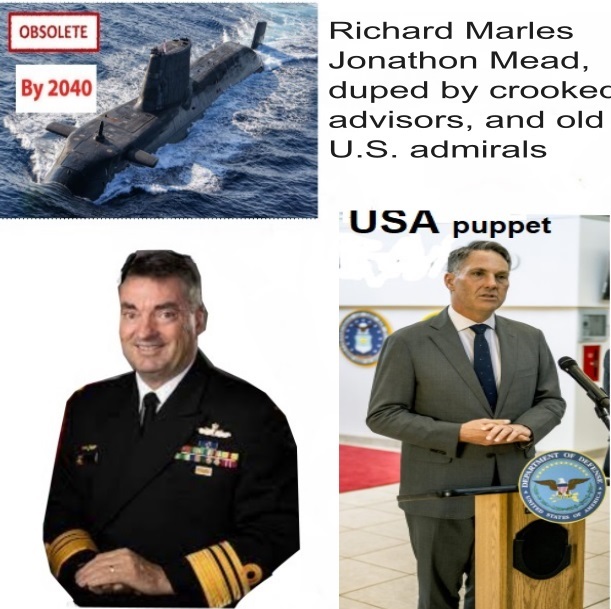
A terse exchange between Greens Senator David Shoebridge and Vice Admiral Jonathan Mead during a Senate Estimates hearing earlier this year revealed that contracts signed by the Australian government that have handed billions of taxpayer dollars to American and British shipyards, supposedly to support the faster delivery of submarines, did not include standard protective clawback provisions.
If we never see a submarine—as is possible—we don’t get any of our billions back.
In influence and dollar terms, foreign-owned companies comprise the vastly dominant proportion of the industrial base, not “part of” it. Research by the Australian Strategic Policy Institute in 2017 showed that the top 15 weapons contractors received 91 per cent of the Department’s expenditure.
A decade of spin from both sides of politics has inured Australians to the stark reality of our loss of independence inside the US alliance. At what cost?
Michelle Fahy, Jan 12, 2025, https://undueinfluence.substack.com/p/sovereignty-not-worth-a-nickel?utm_source=post-email-title&publication_id=297295&post_id=154382292&utm_campaign=email-post-title&isFreemail=true&r=1ise1&triedRedirect=true&utm_medium=emailAustralia’s independence has been dangerously compromised by Labor and Coalition governments, which have signed up to deep-rooted military agreements with the United States of America. These agreements have also underpinned the increasing militarisation of Australia: witness the 2022 speech by Labor’s Richard Marles, the newly appointed deputy prime minister, in Washington DC when he announced that Australian military forces would now become interchangeable with those of the United States.
In August, after this year’s formal annual talks with the United States, Defence Minister Marles announced that the meeting had “built on the last two in seeing a deepening of American force posture in Australia”.
He added: “American force posture now in Australia involves every domain: land, sea, air, cyber and space.”
A decade of spin from both sides of politics has inured us to the stark reality of our loss of independence. Much is made of “defence industry cooperation” with the United States, for example, but this is simply code for the expansion of the US arms industry in Australia in support of its increasing military presence on our soil.
The day before AUKUS was launched in 2021, the US State Department made plain the importance of Australia in supporting America’s military-industrial base:
Australia is one of America’s largest defence customers, supporting thousands of jobs in the United States … The United States is Australia’s defence goods and services partner of choice … the partnership is expected to deepen further over the coming decade, including in the area of defence industry cooperation.
Soon after this statement was published, Marles flew to Washington to endorse its sentiment. He reassured the Americans that when it came to arms production, “our ultimate goal is to supplement and strengthen US industry and supply chains, not compete with them”.
Meanwhile, our much-trumpeted “sovereign defence industrial base” is simply a collection of the world’s top arms multinationals, dominated by the British-owned BAE Systems, the French-owned Thales, and the American-owned Boeing.
Then there is the egregious erosion of Australia’s sovereignty contained within the little-known Force Posture Agreement (FPA) with the United States, which the Abbott Coalition government signed in 2014.
In short, the FPA permits the US to prepare for, launch and control its own military operations from Australian territory.
Yet AUKUS dominates the headlines, even though other decisions by our political leaders that have sold out the public interest have received little coverage in the mainstream media.
A terse exchange between Greens Senator David Shoebridge and Vice Admiral Jonathan Mead during a Senate Estimates hearing earlier this year revealed that contracts signed by the Australian government that have handed billions of taxpayer dollars to American and British shipyards, supposedly to support the faster delivery of submarines, did not include standard protective clawback provisions. If we never see a submarine—as is possible—we don’t get any of our billions back.
The single most important downside of the US alliance, rarely mentioned, is arguably Australia’s military dependence on a foreign power. The Australian Defence Force is critically dependent on US supply and support for the conduct of all operations except those at the lowest level and of the shortest duration.
We were warned about this substantial sacrifice of national freedom of action. In 2001, a Parliamentary Library research paper stated that “it is almost literally true that Australia cannot go to war without the consent and support of the US”.
Foreign-dominated “sovereign” defence industry
Australia’s political and defence hierarchy regularly assert the need to build “a sovereign defence industrial base”. Most people would assume this to mean Australian-owned defence companies, with profits that stay local. This is not what the Defence Department means by it.
The world’s largest weapons companies, including BAE Systems (UK), Thales (France) and US companies Boeing, Lockheed Martin, Raytheon and Northrop Grumman, dominate the local defence industry. Almost all of the top 15 weapons contractors to the Defence Department are foreign-owned. In June 2024, Deputy Secretary Christopher Deeble, the head of the Capability Acquisition and Sustainment Group—the Department’s arms-buying group—explained in a Senate Estimates hearing the government’s definition of “sovereign” in this regard. Deeble agreed with independent senator David Pocock that the local subsidiaries of foreign weapons multinationals, such as Lockheed Martin Australia, were not “sovereign” Australian companies. Nevertheless, he said, the Department considers such foreign-owned subsidiaries to be “part of the sovereign defence industry base here in Australia”.
In influence and dollar terms, foreign-owned companies comprise the vastly dominant proportion of the industrial base, not “part of” it. Research by the Australian Strategic Policy Institute in 2017 showed that the top 15 weapons contractors received 91 per cent of the Department’s expenditure.
Force Posture Agreement
The erosion of Australian sovereignty accelerated in 2011, when Labor prime minister Julia Gillard agreed that up to 2,500 US Marines could be stationed in Darwin on a permanent rotation, and that an increased number of US military aircraft, including long range B-52 bombers, could fly in and out of the Top End and use Australia’s outback bombing ranges.
This agreement was expanded dramatically a few years later by the Force Posture Agreement, which provides the legal basis for an extensive militarisation of Australia by the US, particularly across the Top End.
The tri-nation military pact AUKUS, between Australia, the United Kingdom and the United States, was later negotiated and agreed to, in secret, by the Morrison Coalition government. AUKUS gained bipartisan support within one day of it being revealed to Anthony Albanese’s Labor opposition in September 2021. Among other things, AUKUS, in conjunction with the FPA, ensures that Australia’s navy will be tightly integrated with the US navy for the purpose of fighting China, and that the two navies can operate as one from Australian ports and waters.
Two months after Labor assumed office in May 2022, Marles was in Washington DC announcing that Labor would “continue the ambitious trajectory of its force posture cooperation” with the United States. Australia’s engagement with the US military would “move beyond interoperability to interchangeability” and Australia would “ensure we have all the enablers in place to operate seamlessly together, at speed”.
Non-lethal” F-35 parts
Australia’s newest high-tech major weapons systems make us more reliant than ever on the United States. As veteran journalist Brian Toohey reported in 2020, “The US … denies Australia access to the computer source code essential to operate key electronic components in its ships, planes, missiles, sensors and so on”. This includes the F-35 fighter jets, which both Foreign Minister Penny Wong and Defence Minister Marles have noted form the largest proportion of the air force’s fast jet capacity.
When it agreed to buy Lockheed Martin’s expensive and controversial fifth generation fighter jets, Australia became one of the early members of the F-35 consortium. As part of the deal, Australia negotiated a role for local industry in the F-35 global supply chain. As of June 2024, more than 75 Australian companies had shared in $4.6 billion worth of work, according to the Defence Department.
But there’s been a significant ethical downside. Israel, also a member of the F-35 consortium, is using its F-35s in its war against Gaza. Israel stands accused in the world’s highest court of conducting a genocide in Gaza. Every F-35 built contains Australian parts and components, and for some of these Australia is the sole source.
A senior Defence Department official, Hugh Jeffrey, said in a Senate Estimates hearing in June 2024:
“We are a member of the F-35 consortium [which] exists under a memorandum of understanding … That gives the defence industry opportunity to contribute to that supply chain. It also requires Australia to provide those contributions in good faith…” [emphasis added]
Jeffrey also noted that when assessing any export permit, “we have to have high confidence that, in agreeing to the permit, it’s consistent with our national security requirements and with our international legal obligations”.
What happens if the Department perceives a conflict between Australia’s “national security requirements” and its “international legal obligations”? Is Australia “required” to continue supplying Australian-made arms “in good faith”?
In June, after nine months of spreading disinformation, the Australian government was forced to admit that Australia was still supplying parts and components to the F-35 global supply chain. At the time of writing, the government was allowing this supply to continue despite repeated calls from the UN asking nations—and multinational weapons makers—to cease supplying weapons to Israel, including parts and components, or risk being responsible under international law for serious human rights violations.
Decoded: Defence Department’s deadly deceits
Michelle Fahy, July 10, 2024
Critical Archival Encounters and the Evolving Historiography of the Dismissal of the Whitlam Government (Part 2)

I will never forget the day when I, living in a country area, ran to answer a phone call. It was my mother, in the faraway city. And I’ll never forget her exact words: “The queen’s man has sacked our elected Prime Minister!”
My Mum summed it up. Later, I have realised that this was a case of the UK government toeing the line of the USA government, and making sure that Australia got that USA military intelligence hub, Pine Gap.
January 8, 2025 AIMN Editorial, By Jenny Hocking
Continued from Part 1
After years of legal action, still absent from public view are crucial documents from a most contentious time in British imperial history: the 1947 and 1948 diaries covering the Mountbattens’ shared involvements in pre-Independence India, transition and partition, among “scores of other files” not yet released.
These remain locked away, and Lownie has spent £250,000 of his own funds in pursuit of public access to papers which constituted a purportedly public archive, while the Cabinet office has spent £180,000 keeping them secret. Particularly disquieting is Lownie’s recent claims that he has himself become the target of security surveillance as he continues to pursue the closed Mountbatten files.
Somewhere among those voluminous Mountbatten papers are letters between Mountbatten and the Governor-General, Sir John Kerr, about the dismissal of the Whitlam government. These letters were briefly cited by Mountbatten’s authorised biographer Philip Ziegler in which Mountbatten declared that he “much admired” Kerr’s “courageous and constitutionally correct” action in dismissing Gough Whitlam.
Several years ago, I visited Southampton University hoping to see Mountbatten’s dismissal correspondence with Kerr since, as discussed below, bizarre circumstance means that it no longer exists in Kerr’s papers in the National Archives of Australia. Although Ziegler had been granted access and had quoted from Mountbatten’s congratulatory letter to Kerr, I was denied access to the diaries and letters. Instead, I was handed some thin, rather desultory files containing a handful of itineraries, dinner placements, menus, and invitations to Mountbatten during his visit to Australia. No diaries and certainly no letters between Mountbatten and Kerr.
……………………………In relation to Kerr’s secret correspondence with the Queen, “the Palace letters” regarding the dismissal, it was the use of this uniquely powerful word in the archival lexicon – “personal” – that had placed the letters outside the reach of the Archives Act 1983 and necessitated an arduous Federal Court action to challenge their continued closure. Livsey notes in relation to the migrated Kenyan archive that the construction of “regimes of secrecy” in which the label “personal” was used to control access to and knowledge of British colonial practice; “files labelled ‘Personal’ could be consulted by white British officials only and ‘should not be sighted by local eyes’”…………………..
Lownie’s now four-year legal battle has been described as eerily similar to the Palace letters legal action which I took against the National Archives of Australia in 2016, arguing that the Queen’s correspondence with the Governor-General was not personal, and seeking its release. The case ended in the High Court in 2020 with a resounding 6:1 decision in my favour, the Court ruling that the Palace letters are, as I had argued, not personal and that they are Commonwealth records and come under the open access provisions of the Archives Act. The letters were released in full in July 2020, in a striking rebuff to the claimed convention of royal secrecy on which the Archives had in part relied.
…………………………………….. At its most significant, the denial of access to royal documents as “personal” enables the sophistry that the monarch remains politically neutral at all times to persist……………….
…………Although the Queen was publicly a careful adherent of that core requirement of neutrality, something the “meddling Prince” Charles most assertively was and is not, Hocking argues that “the much vaunted political neutrality is a myth, enabled and perpetuated by secrecy”. Professor Anne Twomey similarly notes that “If neutrality can only be maintained by secrecy, this implies that it does not, in fact, exist”.
Our own history gives us a powerful example of the way in which archival secrecy functions as a Royal protector, casting a veil over breaches of the claimed political neutrality of the Crown, in the changing historiography of the dismissal of the Whitlam government. ……………………….
For decades, the dismissal history was constrained by the impenetrable barrier of “Royal secrecy” which denied us access firstly, to any of Kerr’s correspondence with the Queen, ………………………………………….
Sir John Kerr’s abrupt dismissal, without warning, of the Whitlam government on 11 November 1975 just as Whitlam was to call a half-Senate election, was an unprecedented use of the Governor-General’s reserve powers and “one of the most controversial and tumultuous events in the modern history of the nation”, as the Federal Court described it.
These powers, derived from those of an autocratic Monarch untroubled by parliamentary sovereignty and even less by the electoral expression of the popular will, had not been used in England for nearly two hundred years, and never in Australia…………………………………………………………………. more https://theaimn.net/critical-archival-encounters-and-the-evolving-historiography-of-the-dismissal-of-the-whitlam-government-part-2/
Jenny Hocking is emeritus professor at Monash University, Distinguished Whitlam Fellow at the Whitlam Institute at Western Sydney University and award-winning biographer of Gough Whitlam. Her latest book is The Palace Letters: The Queen, the governor-general, and the plot to dismiss Gough Whitlam. You can follow Jenny on X @palaceletters.
Can true nuclear independence be achieved without ending the US Alliance?
By Donald Wilson, Jan 4, 2025, https://johnmenadue.com/can-true-nuclear-independence-be-achieved-without-ending-the-us-alliance/
Australia’s historical commitment to nuclear disarmament is facing new challenges, as critics say the nation’s alliance with the United States is leading to a conflicted stance on nuclear non-proliferation.
While Australia has actively participated in global nuclear arms control initiatives, such as the Nuclear Non-Proliferation Treaty (NPT) and the Comprehensive Nuclear-Test-Ban Treaty (CTBT), it simultaneously relies on the so-called “US nuclear umbrella” for security. This duality has led to ongoing debate about whether Australia’s security policies align with its disarmament principles.
Australia’s approach to nuclear non-proliferation has shifted over recent years. In 2016, Australia voted against a United Nations General Assembly resolution aimed at creating a legally binding instrument to prohibit nuclear weapons. The following year, it refused to join negotiations that led to the Treaty on the Prohibition of Nuclear Weapons (TPNW). As a result, Australia remains one of the few regional countries not signed onto this treaty, despite a 2018 resolution by the Australian Labor Party to consider joining under a future government.
Critics argue that if Australia were to adopt the TPNW, it would be compelled to prohibit any support for other countries’ nuclear weapons programs—potentially forcing the closure of Pine Gap, a key joint defence facility with the US. Yet government supporters claim that distancing from the US would leave Australia vulnerable, especially amid regional tensions with China.
However, questions have arisen about the reliability of this “nuclear umbrella.” Currently, US military systems, including missile defence, offer limited protection against intercontinental ballistic missiles (ICBMs). After investing over $400 billion in missile defence research and development, no system has yet achieved dependable protection against ICBMs. Critics argue this leaves Australia exposed rather than safeguarded, despite assurances from the US.
In addition, Australia’s recent defence agreements, particularly the AUKUS pact and the US-Australia Force Posture Agreement (FPA), have raised concerns over sovereignty. Signed in 2014, the FPA allows the US to store and control defence equipment on Australian soil. According to Article VII of the agreement, the US retains “exclusive control” over its prepositioned military supplies in Australia, with full ownership rights, effectively restricting Australian authority over the use of these materials.
Article XII of the FPA states that US government vehicles, aircraft, and vessels are exempt from inspection by Australian authorities without US consent. This clause has fuelled arguments that the FPA has compromised Australia’s independence by allowing the US to make defence decisions within Australian borders. For instance, US B2 bombers have launched from Australian bases in operations overseas, reportedly without consulting the Australian public.
As Australia contemplates its nuclear policy, the debate over whether it can maintain both its alliance with the United States and a commitment to nuclear non-proliferation will likely intensify. This complex question has implications not only for Australia’s defence but also for its sovereignty and international standing in the movement toward nuclear disarmament.
Syria Today, Iran Tomorrow, and Inevitably China
A US-backed terrorist organization fresh from overthrowing a US-targeted nation in the Middle East now vows to target China next.
The London Telegraph in a December 13, 2024 article titled, “Uyghur fighters in Syria vow to come for China next,” claims “a Uyghur militant group that helped to topple Bashar-al Assad has vowed to take the fight to China.”
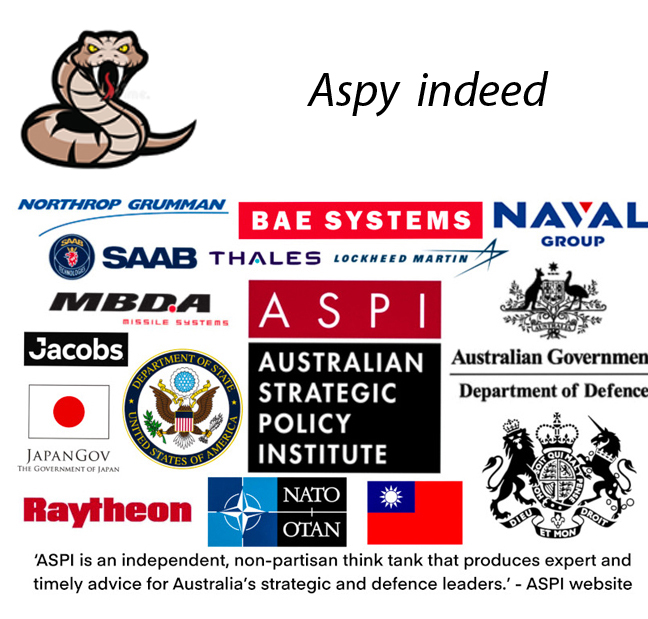
Far from an exception, virtually all reports on the subject stem from either Adrian Zenz himself or reports published by US government-funded organizations including the Australian Strategic Policy Institute
New Eastern Outlook, Brian Berletic, December 19, 2024, https://journal-neo.su/2024/12/19/syria-today-iran-tomorrow-and-inevitably-china/
The collapse of the Syrian government in mid-December 2024 represents a pivotal moment for U.S. geopolitical strategies in the Middle East and beyond.
This event aligns with longstanding objectives, including the subsequently planned disarming, division, and destruction of Iran and the toppling of the Iranian government, the possible eviction of Russian military bases in Syria, and the use of US-sponsored terrorist organizations utilized in overrunning Syria to export terrorism to other targeted nations both in the region and far abroad including both Russia and China.
Syria’s Collapse Was Long Sought After
The US has repeatedly attempted to undermine and overthrow the government of Syria since at least as early as the 1980s. This most recent attempt began preparations as early as 2007 as revealed in a New Yorker article published that year titled, “The Redirection.”
Written by legendary journalist Seymour Hersh, the article admitted:
To undermine Iran, which is predominantly Shiite, the Bush Administration has decided, in effect, to reconfigure its priorities in the Middle East. In Lebanon, the Administration has coöperated with Saudi Arabia’s government, which is Sunni, in clandestine operations that are intended to weaken Hezbollah, the Shiite organization that is backed by Iran. The U.S. has also taken part in clandestine operations aimed at Iran and its ally Syria. A by-product of these activities has been the bolstering of Sunni extremist groups that espouse a militant vision of Islam and are hostile to America and sympathetic to Al-Qaeda*.
Also that year, the US State Department had already been training, equipping, and funding opposition groups to return to their nations across the Arab World and overthrow their respective governments as part of what would later be referred to as the “Arab Spring,” the New York Times would reveal in a 2011 article titled, “U.S. Groups Helped Nurture Arab Uprisings.”
Following the initial protests of the 2011 “Arab Spring,” US-sponsored regime change quickly and deliberately turned violent before transforming into a multitude of armed conflicts – some of which involved overt US military intervention, including in Libya, Syria, and Yemen.
By 2012, a US Defense Intelligence Agency (DIA) report about US-sponsored regime change in Syria specifically, published by Judicial Watch, admitted that the so-called “Syrian” opposition consisted of Salafists, the Muslim Brotherhood, and Al-Qaeda*. The report admitted that, “the West, Gulf countries, and Turkey support the opposition,” and that “if the situation unravels there is the possibility of establishing a declared or undeclared Salafist principality,” and that “this is exactly what the supporting power of the opposition [the West, Gulf countries, and Turkey] want in order to isolate the Syrian regime.”
It is very clear that the “Salafist principality” referred to the so-called “Islamic State.” While the West posed as intervening in Syria to eliminate the “Islamic State,” it was actually supporting and using it precisely to “isolate the Syrian regime,” just as the US DIA report noted.
Through a combination of sanctions, US-Israeli military strikes, US and Turkish military occupation including of Syria’s oil and wheat fields, Syria was slowly hollowed out and, as of December 2024, with Russia and Iran overextended elsewhere, finally toppled.
Next Target: Iran
Most obviously, just as with the US-engineered overthrow of Libya in 2011, Syria will persist as a failed and divided state the US and its regional proxies used to export terrorism across the region toward what remains of Iran’s asymmetrical military power including Hezbollah in Lebanon and Iranian-backed militias across Iraq.
Syria can now also be used as a staging ground for attacks on Iran itself, including via the use of Syria’s now unprotected airspace.
One crucial obstacle eliminated with the collapse of Syria’s government was the destruction of its military hardware, including a formidable integrated air defense network. Even as US-Turkish-backed terrorists advanced on Damascus, US-armed Israeli warplanes carried out 100s of airstrikes across the country, both eliminating the abandoned air defense systems themselves and a long list of targets those air defenses had long prevented Israel from striking.
The Times of Israel itself, in an article titled, “IDF sees chance for strikes on Iran nuke sites after knocking out Syria air defenses,” connected Israel’s targeting and destruction of Syrian air defenses with plans to then carry out direct strikes on Iran.
………………………………….now the Israeli air force “can operate freely across the country’s skies,” and will likely do so both as part of shaping chaos inside Syria itself as well as amid future strikes on Iran.
Far from simply exploiting recent, unexpected developments, the elimination of Syria as an ally of Iran was a long-standing prerequisite required and planned for before moving on to toppling Iran itself.
Such plans were published by US government and arms industry-funded Brookings Institution in its 2009 paper, “Which Path to Persia? Options for a New American Strategy toward Iran,” noting specifically:
Israel may be more willing to bear the risks of Iranian retaliation and international opprobrium than the United States is, but it is not invulnerable and may request certain commitments from the United States before it is ready to strike. For instance, the Israelis may want to hold off until they have a peace deal with Syria in hand (assuming that Jerusalem believes that one is within reach), which would help them mitigate blowback from Hizballah and potentially Hamas. Consequently, they might want Washington to push hard in mediating between Jerusalem and Damascus.
Obviously, Israel’s recent war on Hezbollah and US-sponsored regime change in Syria has fulfilled this prerequisite – regime change achieved in Syria using many of the other methods listed in the 2009 Brookings paper focused on Iran including “supporting a popular uprising,” supporting [armed] minority and opposition groups,“airstrikes,” and “invasion.” In fact, such methods are used over and over again against all nations targeted by the US for coercion and eventually regime change.
US-Sponsored Terrorism Targets China and “Chinese Projects/Embassies”
In addition to targeting Iranian-backed militias, Iranian-friendly governments, and Iran itself, the US has utilized terrorist organizations now in Syria against other adversaries abroad, including China. Many signs now indicate the US could redirect these terrorist organizations back toward China once again.
This includes the so-called, “Turkestan Islamic Party” (TIP) also known as the “East Turkestan Islamic Movement” (ETIM).
What is particularly troubling about TIP/ETIM is the fact that the US disingenuously removed it from its Foreign Terrorist Organizations list in 2020 specifically to provide it with wider and more overt support. DW in its article titled, “US removes China-condemned group from terror list,” would claim TIP/ETIM was removed as a terrorist organization by the US government, “because, for more than a decade, there has been no credible evidence that ETIM continues to exist.”
This is demonstrably untrue considering the US Department of Defense admitted to having carried out airstrikes against the group in Afghanistan only 2 years prior to its delisting, NBC News would report.
Now, the organization the US government claimed no longer exists, is in Syria and reported comprising an entire military unit alongside Hayat Tahrir al-Sham* (HTS), aiding in the recent overthrow of the Syrian government. HTS* is listed by the US as a Foreign Terrorist Organization, while TIP/ETIM is listed as a terrorist organization by the UN and even Washington’s close ally, the UK.
The London Telegraph in a December 13, 2024 article titled, “Uyghur fighters in Syria vow to come for China next,” claims “a Uyghur militant group that helped to topple Bashar-al Assad has vowed to take the fight to China.”
A US-backed terrorist organization fresh from overthrowing a US-targeted nation in the Middle East now vows to target China next. The ability to do so is only possible with continued US government backing including training, weapons, and logistics via regional proxies including Türkiye, who prepared and incorporated the militants in the invasion force that toppled Syria’s government.
Short of fighting in China itself, the Telegraph in an accompanying video would note, “can TIP take the fight to China, home to the world’s largest military with 2 million active troops? It’s easier said than done. Still, TIP could target Chinese projects or embassies abroad.”
The US already backs violent terrorism attacking Chinese projects and embassies abroad, including in Baluchistan, Pakistan and Myanmar. An army of well-trained, well-armed experienced terrorists fresh from the battlefield in Syria are poised to significantly escalate what is already a US war on China by proxy along the length of Beijing’s Belt and Road Initiative (BRI) and ultimately aimed at China itself.
It should be noted that TIP/ETIM and affiliated extremists carried out years of deadly terrorism within China’s western region of Xinjiang. The BBC in a 2014 article titled, “Why is there tension between China and the Uighurs?,” proudly listed the rampant violence Beijing at the time struggled to contain. When Chinese anti-terrorism efforts finally began to work, the BBC along with the rest of the Western media omitted any mention of separatist violence and depicted Chinese efforts to uproot extremism as “human rights abuses,” “coerced labor,” and even “genocide.”
No evidence exists of any systemic abuses, including either “coerced labor” or “genocide.” Even US government-funded organizations tasked with producing reports claiming to document such abuses bury admissions of a lack of evidence in the reports themselves.
One 2020 report titled, “Coercive Labor in Xinjiang: Labor Transfer and the Mobilization of Ethnic Minorities to Pick Cotton,” written by Adrian Zenz, a member of the US government-funded “Victims of Communism Memorial Fund,” admitted in its conclusion that, “in a system where the transition between securitization and poverty alleviation is seamless, and where the threat of extralegal internment looms large, it is impossible to define where coercion ends and where local consent may begin.”
Far from an exception, virtually all reports on the subject stem from either Adrian Zenz himself or reports published by US government-funded organizations including the Australian Strategic Policy Institute (ASPI) or US NED-funded fronts like the World Uyghur Congress, Uyghur Human Rights Project, Campaign for Uyghurs, and the Uyghur Transitional Justice Database Project.
While these organizations pose as “human rights” advocates, their websites overtly refer to China’s Xinjiang region as “East Turkestan*” (sometimes spelled East Turkistan), claiming it is “occupied” by China, and openly seek separatism from China as one of their central objectives – objectives underwritten by generous funding by the US government.
In other words, the US is backing deadly violence, political movements promoting separatism, and fronts attempting to depict the Chinese government’s reaction to all of the above as “human rights abuses,” which in turn is used to justify otherwise indefensible sanctions applied to Chinese companies attempting to do business anywhere the collective West exerts influence.
Defending Against Washington’s Superweapon
While many are tempted to treat conflicts around the globe in isolation, the truth is the United States is pursuing a long-standing global policy of eliminating all rivals through persuasion, coercion, sanctions, US-sponsored sedition, terrorism, and military confrontation – by proxy and directly.
The fall of Syria and other nations like it contribute toward a more dangerous world where larger and more stable nations may be targeted, undermined, and toppled next.
The chaos that has followed US regime change in Serbia, Afghanistan, Iraq, Georgia, Libya, Ukraine, and now Syria this 21st century is just a small fraction of the instability, death, destruction, and destitution the entire globe faces should Washington continue prevailing in its geopolitical pursuits.
Among the most effective and so far unanswered weapons the United States government wields is its dominion over global information space and its global-spanning network of political interference and capture, centered around the National Endowment for Democracy and adjacent government and corporate-funded foundations.
Russian and Chinese military and economic power continues to rise, and both nations have successfully protected their respective information spaces. However, the US continues unopposed undermining nations along both Russia and China’s peripheries, successfully politically capturing nations and transforming them into political and even military battering rams against both targeted nations.
While China may have successfully uprooted US-sponsored extremism in Xinjiang, the US continues arming, backing, and promoting these same extremists out of China’s reach in recently decimated Syria. Through Washington’s control over information space outside of China, these terrorists are being presented as “freedom fighters” in much the same way the US has presented HTS despite being listed by the US State Department as actual terrorists.
Russia and China aid partner nations in the defense of their traditional national security domains – air, land, and sea – but have failed to export their own domestic success in securing a 21st century national security domain – information space. Should Russia and China succeed in doing this, Washington will be denied one of its last and most effective weapons used to sustain its global hegemony, making multipolarism inevitable rather than a mere possibility.
*-banned in Russia
Brian Berletic is a Bangkok-based geopolitical researcher and writer.
Letter re: Canada selling fission Uranium to OZ.
Ken Collier, Subject: Canada allows sale of fission Uranium to Australian company
To: Justin Trudeau <justin.trudeau@parl.gc.ca 21 Dec 24
Adding to the very evident dangers of nuclear power generally, a topic well-covered in previous correspondence from myself and many others (https://nuclearwastewatch.weebly.com/ ; https://wethenuclearfreenorth.ca/you-can-help/educational-materials/ ; https://www.ccnr.org/index.html , I see further concerns. The conditions set by Industry Canada about limiting Chinese funding are feeble, to be generous. Anyone familiar with accounting techniques know how easy it is to side-step regulations and limits like those stated. All that is needed is a slight change in categories of expenditure, say, from administration to sales, or exploration to promotion, or human resources to fees, to avoid the intent of the provisions about Chinese funding.
Surely approval from Investment Canada is not all that is needed to let this unwise sale go ahead. Scientific, technical and environmental concerns should also be addressed. In the best case, sales of fission Uranium should just not be allowed.
Canada clears Paladin’s $789 million Fission Uranium takeover, By ReutersDecember 18, 2024
- Paladin gets clearance from Investment Canada
- Canada conditions include no China funding
- Buyout opens way to North American markets
MELBOURNE, Dec 19 (Reuters) – Australia’s Paladin Energy (PDN.AX), opens new tab has received the final green light it needed from Canadian authorities to buy Fission Uranium (FCU.TO), opens new tab in a C$1.14 billion ($789.1 million) deal that cements is position as a major global producer, it said on Thursday.
Paladin got the clearance under the Investment Canada Act on Wednesday and said the deal under which it would acquire Fission’s advanced PLS project in Saskatchewan was expected to be completed by early January 2025.
The clearance comes as prices for the nuclear fuel surge on expectations of a demand spike as the energy transition unfolds. Shares fell 1.8% amid weakness in the mining sector.
The Canadian government in October stepped in to review the proposed tieup on national security grounds, raising concerns it may be derailed by the county that has become increasingly sensitive towards strategic resource firms being taken over by overseas buyers.
Paladin has agreed to several conditions Canada has attached to the merger including not to use any China-sourced finance for funding PLS, or to sell PLS’s uranium directly or indirectly to any China customers beyond China General Nuclear Power Group, which has an existing offtake agreement, it said.
Canada in July cracked down on big mining takeovers, saying it would only approve foreign buyouts of large Canadian firms involved in critical minerals production “in the most exceptional of circumstances.”The Canadian government in October stepped in to review the proposed tieup on national security grounds, raising concerns it may be derailed by the county that has become increasingly sensitive towards strategic resource firms being taken over by overseas buyers.
Paladin has agreed to several conditions Canada has attached to the merger including not to use any China-sourced finance for funding PLS, or to sell PLS’s uranium directly or indirectly to any China customers beyond China General Nuclear Power Group, which has an existing offtake agreement, it said.
Canada in July cracked down on big mining takeovers, saying it would only approve foreign buyouts of large Canadian firms involved in critical minerals production “in the most exceptional of circumstances.”
Netanyahu and Australia
By Peter Henning, Dec 13, 2024, https://johnmenadue.com/netanyahu-and-australia/?fbclid=IwY2xjawHIojtleHRuA2FlbQIxMAABHUWJqNvizL8WHJZxYN7U779UH03pCltHRtwXoRrjUiF8YZ4f9tCoCURbqQ_aem_ZfzYMXvnUoiUkusIlGg3lANetanyahu has demonstrated that he has the complete measure of the Labor-Coalition political class, that he only has to snap his fingers and bark an order and they will all do his bidding and follow his instructions with alacrity.
Netanyahu’s direct intervention into the Australian political scene has been a complete success for him. He now knows that he can control the political agenda in Australia whenever he feels like it. He gained control of the narrative of the synagogue fire almost as soon as it occurred, all Labor-Coalition politicians hastily falling into genuflection at his command, some only being briefly tardy by suggesting maybe the police should investigate before conclusions were finalised.
No Australian prime minister has ever been subject to such a public attack by the head of a foreign government as that delivered by Netanyahu on 6 December, so it’s somewhat unprecedented to watch Albanese so wretchedly buckle at the knees and capitulate like he was a little boy pleading sorry for doing something wrong.
To briefly summarise Netanyahu’s success. It was interestingly a very rapid response to the destruction by fire of two of three buildings of the Adass Israel synagogue in Melbourne, a synagogue by the way whose congregants are decidedly apolitical, not actively Zionist in any way.
Not with standing this, Netanyahu brazenly excoriated “the federal government’s extreme anti-Israeli position” for “the reprehensible arson attack”, linking the synagogue fire to what he described as Australia’s “scandalous decision to support the UN resolution calling on Israel ‘to bring an end to its unlawful presence in the Occupied Palestinian Territory, as rapidly as possible’, and preventing a former Israeli minister from entering the country”.
Netanyahu was immediately accepted by the pro-Likud Australian mainstream media as the man who should be in charge of Australian decisions, the vitriolic attack against the Albanese government reported as if Netanyahu was entitled to force his interpretation of events and allocation of responsibility as his essential unchallengeable prerogative, beyond question and to be endorsed as a matter of course.
Such is the level of grotesque obsequiousness now entrenched in the Australian political and media culture, that the direct intervention of Netanyahu in Australian affairs for his own political purposes is regarded not merely as acceptable but welcomed wholeheartedly, even by those he attacks, especially the increasingly out-of-depth, embarrassingly ignorant and easily manipulated prime minister.
Irrespective of the identity and motives of those who lit the fire, which are not known, the investigation has been quickly transformed into a “terrorism” incident by the police, which is exactly what Netanyahu sought to achieve, for it opened the door like magic to labelling any opposition to Israeli policies in relation to Palestinians anywhere, however criminal, as promoting “terrorism”.
It went like clockwork. We can expect to see bans against anti-genocide protests legislated post-haste, further clamps imposed on reliable information about Israeli atrocities, a strengthening of censorship and a McCarthyist-style “taskforce against antisemitism” designed to silence and destroy opposition to the annihilation of Palestinian society.
The extreme inability of Albanese to assert a strong voice as an Australian prime minister even against a man like Netanyahu, wanted for war crimes, is no longer surprising, but it is also not the right way to frame the terms of the relationship which now exists between the Australian political establishment – including the Dutton-led Coalition, not just Labor – and Netanyahu’s Likud party regime in Israel.
Consider that not once throughout the daily slaughter of Palestinians for more than a year have Albanese and Dutton spoken against it. Not once have they mentioned the wanton destruction of all places of worship in Gaza, whether Christian or Muslim, even when those places have been destroyed while (and because) civilian women and children in large numbers were seeking refuge in those places.
Their silence about massive atrocities contrasts sharply with their zeal to smear anti-genocide protesters as responsible for the synagogue fire, as abettors of “terrorism”. Even while Netanyahu was successfully imposing his will on Australia his own forces were killing Palestinians in Gaza in refugee camps, in tents and food-lines, as well as killing patients and staff in the Kamal Adwan hospital, not things that Albanese and Dutton regard as worthy of comment.
Netanyahu’s interference was notable for revealing his utter contempt for the Albanese government. With an Australian election not far away it could be said that he seeks to influence the outcome in favour of the more Trump-aligned, and more hard-right Dutton, who he probably sees as more amenable to the Likud party project now in full swing to eliminate any possibility of the creation of a Palestinian state.
As Israeli finance minister Smotrich said after the fall of the Assad government in Syria, it is an opportune time for the Netanyahu government to “create facts on the ground that prevent the establishment of a Palestinian state and remove this possibility from the agenda once and for all”, something which a Dutton administration in Australia would fully support.
The abject failure of the Australian political class to take a principled stance in full support of international law and conventions, and its failure to comply with directives from the ICJ and its distinct lack of support for the ICC’s arrest warrant of Netanyahu, due to its obsequious servility to the US, has now come full circle.
Just as Washington is the boss that actually allows Australia a little room to pretend to be an “independent nation” within its “rules-based order”, now it has been fully exposed that Tel Aviv is also the boss. And it’s a boss which won’t tolerate its Australian political pawns from deviating from the Likud Party agenda to silence all opposition to the creation of Eretz Israel encompassing all of Palestine, south Lebanon, the Golan Heights and other parts of Syria (as a minimum), which means the utter and complete destruction of Palestinian society in Gaza by any means whatsoever.
The Labor-Coalition political class will most certainly comply. The Asia-Pacific, including everyone from Indonesia to China, won’t forget or forgive. That’s Australia’s future. That’s the legacy of the Albanese-Dutton political class, whatever they might do in Canberra during the rest of their political careers.
Will Donald Trump kill US-UK-Aussie sub defense deal?

The landmark defense agreement between the U.S, U.K. and Australia could be in jeopardy with the maverick Republican back in the White House.
Politico, December 9, 2024, By Stefan Boscia and Caroline Hug
LONDON — There are few issues on which we do not know Donald Trump’s opinion.
After thousands of hours of interviews and speeches over the past eight years, the president-elect has enlightened us on what he thinks on almost any topic which enters his brain at any given moment.
But in the key area of defense, there are some gaps — and that’s leading global military chiefs to pore over the statements of the president’s allies and appointees to attempt to glean some clues, specifically over the $369 billion trilateral submarine program known as AUKUS he will inherit from Joe Biden.
Trump does not appear to have publicly commented on the AUKUS pact — named for its contingent parts Australia, the United Kingdom and the United States — which would see the U.S. share technology with its partners to allow both countries to build state-of-the-art nuclear submarines by the 2040s.
This uncertainty has left ministers and government officials in London and Canberra scrambling to discover how the Republican is likely to view the Biden-era deal when he returns to the White House in January.
Two defense industry figures told POLITICO there were serious concerns in the British government that Trump might seek to renegotiate the deal or alter the timelines.
This is because the pact likely requires the U.S. to temporarily downsize its own naval fleet as a part of the agreement — something Trump may interpret as an affront to his “America First” ideology.
Looking east
There is hope in Westminster that Trump would be in favor of a military project which is an obvious, if unspoken, challenge to China.
The deal would see American-designed nuclear submarines right on China’s doorstep and would form a part of Australia’s attempts to bolster its military might in the Indo-Pacific.
When former U.K. Prime Minister Boris Johnson said in September 2021 that the deal was not “intended to be adversarial toward China,” President Xi Jinping simply did not believe him.
The Chinese leader said AUKUS would “undermine peace” and accused the Western nations of stoking a Cold War mentality.
Mary Kissel, a former senior adviser to Trump’s ex-Secretary of State Mike Pompeo, said “you can assume Trump two will look a lot like Trump one” when it comes to building alliances with other Western countries against China.
“We revivified the Quad [Australia, India, Japan and the U.S.], got our allies to bolster NATO funding and worked to prevent China from dominating international institutions,” she said.
However, the deal also forces the U.S. government to sell Australia three to five active Virginia attack submarines, the best in the U.S. Navy’s fleet, by the early 2030s as a stopgap until the new AUKUS subs are built.
Is America first?
This coincides with a time where there is a widely recognized crunch on America’s industrial defense capacity.
In layman’s terms, the U.S. is currently struggling to build enough submarines or military equipment for its own needs.
One U.K. defense industry figure, granted anonymity to speak freely, said there was “a lot of queasiness” in the U.K. government and a “huge amount of queasiness in Australia” about whether Trump would allow this to happen.
“There is a world in which the Americans can’t scale up their domestic submarine capacity for their own needs and don’t have spare to meet Australia’s needs,” they said.
“If you started pulling on one thread of the deal, then the rest could easily fall away.”
One U.K. government official played down how much London and Canberra are worried about the future of the deal, however.
They said the U.K. government was confident Trump is positive about the deal and that the U.S. was “well equipped with the number of submarines for their fleet.”………………………………………………………………………………………………………………………………..
‘Everyone’s a winner
This attempted U.K.-China reset will likely be high on the list of talking points when Healey meets with his Australian counterpart Richard Marles next month in London for an “AUKMIN” summit.
The Australian Labor government, after all, has conducted a similar reset with the Chinese government since coming to power in 2022 after relations hit a nadir during COVID.
Also at the top of the agenda will be how to sell the incoming president on the AUKUS deal in a positive way.
A second defense industry insider said the British and Australian governments should try to badge the deal in terms that make it look like Trump has personally won from the deal.
“Everybody is worried about America’s lack of industrial capacity and how it affects AUKUS,” they said.
“He is also instinctively against the idea of America being the world’s police and so he may not see the value in AUKUS at all, but they need to let him own it and make him think he’s won by doing it.”………………………………………………………………………..
Pillar II
While the core nuclear submarine deal will get most of the headlines in the coming months, progress on the lesser-known Pillar II of AUKUS also remains somewhat elusive.
Launched alongside the submarine pact, Pillar II was designed to codevelop a range of military technologies, such as quantum-enabled navigation, artificial intelligence-enhanced artillery, and electronic warfare capabilities.
One Pillar II technology-sharing deal was struck on hypersonic missiles just last month, but expected progress on a range of other areas has not transpired.
Ambitions to admit Japan to the Pillar II partnership this year have also gone unfulfilled……………………………………………………………
https://www.politico.eu/article/donald-trump-aukus-kill-us-uk-aussie-sub-defense-deal/
Canada’s nuclear waste organisation joins forces with the Australian Radioactive Waste Agency
World Nuclear News, November 25, 2024
Canada’s Nuclear Waste Management Organization said it recently signed a
new co-operation agreement with the Australian Radioactive Waste Agency
at a ceremony in the Australian Parliament in Canberra. The NWMO and
ARWA will collaborate on a range of issues related to the safe
management of radioactive waste, including the important topic of
reconciliation with Indigenous peoples.
The NWMO said it was honored to
learn from the experiences of Aboriginal Australians and Torres Strait
Islanders during the visit and it “looks forward to a relationship of
partnership and knowledge-sharing”.
Trump, AUKUS and Australia’s Dim Servitors
November 22, 2024, Dr Binoy Kampmark, https://theaimn.com/trump-aukus-and-australias-dim-servitors/
There is something enormously satisfying about seeing those in the war racket worry that their assumptions on conflict have been upended. There they were, happily funding, planning and preparing to battle against threats imagined or otherwise, and there comes Donald Trump, malice and petulance combined, to pull the rug from under them again.
What is fascinating about the return of Trump to the White House is that critics think his next round of potentially rowdy occupancy is going to encourage, rather than discourage war. Conflict may be the inadvertent consequence of any number of unilateral policies Trump might pursue, but they do not tally with his anti-war platform. Whatever can be said about his adolescent demagogic tendencies, a love of war is curiously absent from the complement. A tendency to predictable unpredictability, however, is.
The whole assessment also utterly misunderstands the premise that the foolishly menacing trilateral alliance of AUKUS is, by its nature, a pact for the making of war. This agreement between Australia, the UK and the US can hardly be dignified as some peaceful, unprovocative enterprise fashioned to preserve security. To that end, President Joe Biden should shoulder a considerable amount of the blame for destabilising the region. But instead, we are getting some rather streaky commentary from the security wonks in Australia. Trump spells, in the pessimistic words of Nick Bisley from La Trobe University, “uncertainty about just what direction the US will go.” His policies might, for instance, “badly destabilise Asia” and imperil the AUKUS, specifically on the provision of nuclear–powered submarines to the Royal Australian Navy. On the last point, we can only hope.
The Australians, being willing and unquestioning satellites of US power, have tried to pretend that a change of the guard in the White House will not doom the pact. Australian Foreign Minister Penny Wong expressed a “great deal of confidence” that things would not change under the new administration, seeing as AUKUS enjoyed bipartisan support.
Australia’s ambassador to the US, Kevin Rudd, is also of the view that AUKUS will survive into the Trump administration as it “strengthens all three countries’ ability to deter threats, and it grows the defence industrial base and creates jobs in all three countries.”
Another former ambassador to Washington, Arthur Sinodinos, who also occupies the role of AUKUS forum co-chair, has pitched the viability of the trilateral pact in such a way as to make it more appealing to Trump. Without any trace of humour, he suggests that tech oligarch Elon Musk oversee matters if needed. “If Musk can deliver AUKUS, we should put Musk in charge of AUKUS, and I’m not joking, if new thinking is needed to get this done,” advises the deluded Sinodinos.
The reasoning offered on this is, to put it mildly, peculiar. As co-head of the proposed Department of Government Efficiency, Musk, it is hoped, will apply “business principles” and “new thinking”. If the Pentagon can “reform supply chains, logistics, procurement rules, in a way that means there’s speed to market, we get minimum viable capability sooner, rather than later.”
These doltish assessments from Sinodinos are blatantly ignorant of the fact the defence industry is never efficient. Nor do they detract from the key premise of the arrangements. Certainly, if an anti-China focus is what you are focusing on – and AUKUS, centrally and evidently, is an anti-China agreement pure and simple – there would be little reason for Trump to tinker with its central tenets. For one, he is hankering for an even deeper trade war with Beijing. Why not also harry the Chinese with a provocative instrument, daft as it is, that entails militarising Australia and garrisoning it for any future conflict that might arise?
Whatever the case, AUKUS has always been contingent on the interests of one power. Congress has long signalled that US defence interests come first, including whether Australia should receive any Virginian class submarines to begin with.Trump would hardly disagree here. “Trump’s decisions at each phase of AUKUS cooperation will be shaped by zero-sum balance sheets of US interest,” suggests Alice Nason of the University of Sydney’s US Studies Centre rather tritely.
If Trump be so transactional, he has an excellent example of a country utterly willing to give everything to US security, thereby improving the deal from the side of Washington’s military-industrial complex. If there was one lingering, pathological complaint he had about Washington’s NATO allies, it was always that they were not doing enough to ease the burdens of US defence. They stalled on defence budgets; they quibbled on various targets on recruitment.
This can hardly be said of Canberra. Australia’s government has abandoned all pretence of resistance, measure or judgment, outrageously willing to underwrite the US imperium in any of its needs in countering China, raiding the treasury of taxpayer funds to the tune of a figure that will, eventually, exceed A$368 billion. Rudd openly acknowledges that Australian money is directly “investing into the US submarine industrial base to expand the capacity of their shipyards.” It would be silly to prevent this continuing windfall. It may well be that aspect that ends up convincing Trump that AUKUS is worth keeping. Why get rid of willing servitors of such dim tendency when they are so willing to please you with cash and compliments?
Signing US/UK nuclear deal would shred Australia’s credibility: Turnbull
Australia would kill its credibility internationally if it were to embrace domestic nuclear power to please key foreign allies, Malcolm Turnbull has warned, accusing the Coalition of gaslighting voters over power prices.
Amid a heated fight in parliament over a nuclear agreement signed by the United States and the United Kingdom at the COP29 talks in Azerbaijan this week, the former prime minister said Australia had distinct advantages on renewable energy and must make decisions in its national interest.
“The job of the Australian prime minister is to stand up for Australia and recognise Australia has distinct interests and distinct characteristics,” Mr Turnbull told The Australian Financial Review.
“Simply falling into line and being some sort of sycophantic copier of everybody else’s agendas doesn’t bring you in any respect.”
The former Liberal leader’s comments followed Britain and the US signing a deal for civil nuclear collaboration at the summit in Baku, part of plans to combine billions of dollars for research and development of new technologies.
An early version of the British government’s statement announcing the deal said Australia would be among a number of other countries signing on. But the UK government conceded on Tuesday that Australia had been included in the statement erroneously.
The original statement, viewed by the Financial Review, said countries signing on would include Canada, France, Japan, South Korea, South Africa, China, Switzerland and Australia.
But the updated agreement, published online by UK Energy Secretary Ed Miliband, has the names of participating countries removed and says only that Russia will remain excluded because of its invasion of Ukraine.
A spokeswoman for Energy Minister Chris Bowen, who is representing Australia at the talks, ruled out any participation, noting Australia had no nuclear energy industry and a federal ban on nuclear power is in place.
The government said Australia would remain as an observer to the deal, and support scientists in other nuclear research fields.
In question time on Wednesday, Acting Prime Minister Richard Marles accused the Coalition of exaggerating the significance of the statement.
“Every expert out there makes it completely clear that what we are awaiting is a 20-year duration before we could reasonably expect to have nuclear energy in this country, were we to go down that path,” he said.
“Even then, all we are talking about is a contribution of 4 per cent to the electricity grid.
“What we are pursuing is policies in the here and now, which are being pursued around the world: firmed renewable energy, which is the cheapest form of energy, which is being brought online around the world.”
Mr Dutton accused the government of a stubborn refusal to consider nuclear, as countries including South Korea, Turkey and Nigeria had joined another pledge to triple global nuclear power by 2050. He said nuclear could “reduce emissions and deliver energy at a reasonable cost”.
Long a critic of Mr Dutton’s leadership, Mr Turnbull said nuclear would not complement renewable energy.
“That is nonsense. That’s gaslighting, quite frankly,” he said. “What complements renewables is something that is flexible. We have 4 million households in Australia. Over a third of all Australian homes have got solar panels on. It’s the highest percentage of solar household solar penetration in the world.”
Tom McIlroy is the Financial Review’s Canberra Bureau Chief based in the press gallery at Parliament House. He was previously the AFR’s political correspondent. Connect with Tom on Twitter. Email Tom at thomas.mcilroy@afr.com
Paul Smith edits the technology coverage and has been a leading writer on the sector for 20 years. He covers big tech, business use of tech, the fast-growing Australian tech industry and start-ups, telecommunications and national innovation policy. Connect with Paul on Twitter. Email Paul at psmith@afr.com
1 This month

of the week – Australians for War Powers Reform (AWPR)
To see nuclear-related stories in greater depth and intensity
 Antinuclear