Sanction Israel Now – APH Convergence

22 July 2025 AIMN Editorial, https://theaimn.net/sanction-israel-now-aph-convergence/
NATIONAL CONVERGENCE ON CANBERRA DEMANDS THE AUSTRALIAN GOVERNMENT SANCTION ISRAEL NOW
Advocates for justice and human rights from across the continent will converge at Parliament House Canberra from Sunday, 20 July 2025 to Tuesday, 22 July 2025 to demand that the Australian government immediately impose sanctions on the state of Israel.
Over the last 77 years, the Israeli government has openly committed genocide and crimes against humanity against the Palestinian people without consequence. Over the last 21 months, we have witnessed an escalation of these atrocities as Israel flaunts its human rights violations and contraventions of international law before the eyes of the world.
Despite international law compelling states including Australia to take action to prevent these atrocity crimes, the Australian government has failed to take meaningful action by imposing boycotts, divestments and sanctions on the genocidal state. Instead, it has opted to remain friends and allies with, and supply weapons to, a state openly committing gross human rights violations.
“Palestinian men, women and children are being massacred and starved to death before the eyes of the world. All eyes are on Gaza but no one is willing to do anything to help ” said Nasser Mashni, Australia Palestine Advocacy Network President.
Israel has sought to cripple Gaza by imposing a blockade, bombing hospitals and manufacturing a famine. Repeated human rights violations have been documented while states, including Australia remain reluctant to take concrete action.
Noura Mansour, Democracy in Colour National Director said that “We are witnessing a humanitarian and global catastrophe. We have been asking the international community to stop these atrocities for over 77 years. The escalation and atrocities we are witnessing today are a direct result of Palestinians being ignored since 1948.”
The Australian government remains complicit in the genocide, occupation and crimes against humanity being committed against the Palestinian people by the Israeli government.
We remain steadfast in demanding the Australian government take immediate action to pressure Israel to abide by international law by imposing sanctions.
“We have been constantly demanding that the Australian government impose sanctions and an arms embargo on Israel for over 21 months. Despite the constant bombardment, starvation and brutality, the Australian government is reluctant to take any concrete action. Instead, it has shamefully chosen to take the side of the oppressor” said Activist and Organiser, Sarah Baarini.
We call on the community from every corner of the continent to converge at the centre of decision making on this colony, for the opening of Parliament, to send a clear and strong message that the people remain united and demand that the Australian government
SANCTION ISRAEL NOW
“We will not be passive in the face of injustice. Every second that passes without meaningful action taken by those in power is another second too late. Time is truly of the essence. We are already 77 years too late – we can not afford to wait a second more. We will not stop and we will not rest – we will continue to resist and demand justice until Palestine is free, from the river to the sea” said Dan, Renegade Activist and Political Staffer.
ENDORSED BY:
Academics for Palestine – South Australia
Academics for Palestine WA
ACT Greens
ANMF nurses and midwives for Palestine
ANU 4 Palestine
Anak Bangsa Malaysia
Australia Palestine Advocacy Network
Australia’s Voice
Australian MADE (Muslim Adolescent
Development & Education) Inc
Australian Greens First Nations Network
Australian Social Workers for Palestine
ASU for Palestine
Banyule Palestine Action Group
Canberra Islamic School
Canberra Palestine and Climate Justice
Central Coast Friends of Palestine
Central West New South Wales 4 Palestine
Climate Activists for Palestine
Climate Justice Alliance Northern Rivers
Coalition for Justice and Peace in Palestine
Connecting the dots
Conversations For Palestine
Darebin for Palestine
Defend Dissent Coalition
Democracy in Colour
Disrupt Burrup Hub
Disrupt Wars
DrummersforPalestine
Education4Palestine
Extinction Rebellion
Extinction Rebellion ACT
Extinction Rebellion Peace – XR Peace
Fairfield for Palestine
Families For Palestine
Food Not Bombs Gadigal/Sydney
Fowler for Palestine
Free Gaza Australia
Free Palestine Central Vic
Free Palestine Coalition Naarm
Free Palestine Far North Queensland
Free Palestine Frankston
Free Palestine Gippsland
Free Palestine Melbourne
Free Palestine Newcastle
Free Palestine Sunbury
Free Palestine Townsville
Free Palestine Wurruk
Friends of Palestine Western Australia
Green Left
Greens (WA) Inc
Happily Made
Health Workers 4 Palestine (South
Australia)
Healthcare Workers for Palestine WA
Hobsons Bay 4 Palestine
Hunter Asylum Seeker Advocacy
Hume for Palestine
Independent and Peaceful Australia
Network (IPAN)
Independent and Peaceful Australia
Network ACT
Inner West for Palestine
Institute for Collaborative Race Research
IPAN Geelong and Southwest Victoria
Ireland Palestine Solidarity ‘Australia’Islamic Association of Monash Mosque
Islamic Council of Victoria
Jewish Council of Australia
Jews Against the Occupation ‘48
Jews for Palestine WA
Justice for Palestine Magan-djin
Law Students For Refugees
Loud Jew Collective
Lutruwita Socialist Alliance
MAA International
Maribyrnong 4 Palestine
Melbourne for Palestine
Menzies for Palestine
Merri-bek & Northern Suburbs 4 Palestine
Mountains for Palestine
Mparntwe for Falastin
Mums For Palestine
Muslim Collective
Muslim Votes Matter
Naarm Frontline Medics
National Amnesty Refugee Network
Newcastle Mums For Palestine
Nillumbik 4 Palestine
No AUKUS Coalition Victoria
No Weapons for Genocide
Northern Naarm Action for Palestine
Northern Rivers Friends Of Palestine
NTEU for Palestine
Our Race Community
Palestine Action Group Canberra
Palestine Action Group Muloobinba
Palestine Action Group Sydney
Palestine Action Group Warrnambool
Palestine Justice Movement Sydney
Peoples Climate Assembly
Perth Doctors Medical Aid For Palestine
Prams for Palestine
Queensland Muslims Inc.
Readers and Writers against the Genocide
Red Spark
RESISTANCE
Rising Tide
Sit Intifada
Socialist Alliance
South Australian Grassroots Ecosystem
(SAGE)
Stop Arming Israel
Students for Palestine
Students for Palestine WA
Students For Palestine UTS
Sundays For Peace – Wagga Wagga
Sydney Hearts in Action
Tasmanian Palestine Advocacy Network
Teachers and Families for Palestine,
Northern Territory
Teachers and School Staff for Palestine
NSW
The Greens NSW
The Greens SA
The Initiative for a Moral Economy
The Socialist Party
The Victorian Greens
Tomorrow Movement
Total Liberation Alliance
Treaty Council Worldwide
Unionists for Palestine WA
Wage Peace
WA Socialists
Watermelon Rebellion
Women’s Climate Justice Collective
Yarra Ranges For Palestine
Australia must rethink AUKUS and assert its sovereignty

16 July 2025 AIMN Editorial, By John Sherman , https://theaimn.net/australia-must-rethink-aukus-and-assert-its-sovereignty/
Australia stands at a crossroads, facing mounting pressure from an AUKUS partnership that increasingly compromises its sovereignty. The trilateral agreement with the United States and United Kingdom, initially framed as a strategic alliance to bolster regional security, has evolved into a complex web of demands that risks binding Australia to U.S. interests for decades. This shift raises serious concerns about our foreign policy autonomy and economic relationships with key trading partners, particularly China.
The original AUKUS framework promised mutual benefit, but recent U.S.-driven stipulations have tilted the balance, treating Australia as a subordinate rather than an equal partner. Australians are expressing a growing unease: AUKUS is now a leash on our independence. The agreement’s expanding scope now threatens to dictate Australia’s foreign policy, potentially straining ties with Asia-Pacific neighbours vital to our economy. This is not the partnership we signed up for.
Defence Minister Richard Marles must take a firmer stance. His apparent acquiescence to these demands undermines Australia’s interests. If he cannot renegotiate terms that prioritise our sovereignty, he should step aside for leadership capable of navigating this complex geopolitical landscape. Australia deserves a minister who can assert our position as a confident middle power, not one tethered to U.S. policy.
The Trump administration’s approach, as seen in its dealings with African nations, offers a cautionary tale. Countries like Nigeria and South Africa have rejected similar U.S. agreements laden with restrictive conditions, opting instead for partnerships that respect their autonomy. Australia should take note. Our alliances must serve our national interests, not entangle us in great-power rivalries that destabilise the region.
Global challenges – climate change, resource scarcity, and economic recovery – demand unity, not division. Australia must champion a future where nations collaborate as equals, not as pawns in a superpower’s strategy. By reevaluating AUKUS and asserting our independence, we can lead by example, fostering a world that prioritises collective progress over zero-sum conflicts. The time for bold, principled leadership is now.
A Vassal’s Impulse: Australia Backs US Strike on Iran

The Australian position, along a number of European states, also failed to acknowledge the General Conference Resolutions of the International Atomic Energy Agency (in particular GC(XIXI)/RES/444 and GC(XXIV)/RES/533) declaring that “any armed attack on and threat against nuclear facilities devoted to peaceful purposes constitutes a violation of the United Nations Charter, international law and the Statute of the Agency.”
29 June 2025 Dr Binoy Kampmark, https://theaimn.net/a-vassals-impulse-australia-backs-us-strike-on-iran/
The initial statement from Australian government sources was one of constipated caution and clenching wariness. Senator Penny Wong’s time as head of the Department of Trade and Foreign Affairs has always been about how things come out, a process unsatisfyingly uncertain and unyielding in detail. Stick to the safe middle ground and sod the rest. These were the cautionary words of an Australian government spokesperson on June 22: “We have been clear that Iran’s nuclear and ballistic missile program has been a threat to international peace and security.”
That insipid statement was in response to Operation Midnight Hammer, a strike on three nuclear facilities in Iran by the US Air Force, authorised by US President Donald Trump on June 22. With such spectacular violence came the hollow call for diplomatic prudence and restraint. There was an importantdifference: Tehran, not Israel or Washington, would be the subject of scolding. Iran would not be permitted nuclear weapons but jaw jaw was better than war war. “We note the US president’s statement that now is the time for peace,” stated the spokesperson. “The security situation in the region is highly volatile. We continue to call for de-escalation, dialogue and diplomacy.”
Within twenty-four hours, that anodyne position had morphed into one of unconditional approval for what was a breach of the United Nations Charter, notably its injunction against the threatened or actual use of force against sovereign states in the absence of authorisation by the UN Security Council or the necessity of self-defence. “The world has long agreed Iran cannot be allowed to get a nuclear weapon, and we support action to prevent this. That is what this is,” accepted Wong.
This assessment was not only silly but colossally misguided.It would have been an absurd proposition for the US to make the claim that they were under imminent threat of attack, a condition seen as necessary for a pre-emptive strike. This was a naked submission to the wishes of a small, destabilising and sole (undeclared) nuclear power in the Middle East, a modern territorial plunderer celebratory of ethnonational supremacy.
The Australian position, along a number of European states, also failed to acknowledge the General Conference Resolutions of the International Atomic Energy Agency (in particular GC(XIXI)/RES/444 and GC(XXIV)/RES/533) declaring that “any armed attack on and threat against nuclear facilities devoted to peaceful purposes constitutes a violation of the United Nations Charter, international law and the Statute of the Agency.”
Wong also misrepresented the circumstances under which Iran was told they could negotiate over their nuclear program, erroneously accepting the line from the Trump administration that Tehran had “an opportunity to comply”. Neither the US diplomatic channel, which only permitted a narrow, fleeting corridor for actual negotiations, nor Israel’s wilful distortion of the IAEA’s assessment of Iran’s uranium enrichment plans and prevarication, ever gave chance for a credible resolution.Much like the calamitous, unlawful invasion of Iraq in 2003 by a crew of brigand nations – the merry trio of US, UK and Australia stood out – the autopilot to war was set, scornful of international law.
Wong’s shift from constipated caution to free flow approval for the US attack, with its absent merits and weighty illegalities, was also a craven capitulation to the warmonger class permanently mesmerised by the villain school of foreign relations. This cerebrally challenged view sees few problems with attacking nuclear facilities, the radioactive dangers of doing so, and the merits of a state having them in the first place.
The US attack on Iran found hearty approval among the remnants of the conservative opposition, who tend tospecialise in the view that pursuing a pro-Israeli line, right,wrong, or murderous, is the way to go. Liberal Senator and former Australian ambassador to Israel, David Sharma, thought the Albanese government’s initial response “underwhelming and perplexing,” claiming that support for this shredding of international law “a straightforward position for Australia to adopt.” Sharma is clearly getting rusty on hislaw of nations.
His side of politics is also of the view that the attacked party here – Iran – must forgo any silly notion of self-defence and retaliation and repair to the table of diplomacy in head bowedhumiliation. “We want to see Iran come to the negotiating table to verify where that 400 kilos of enriched uranium is,” stated a very stern opposition home affairs minister, Andrew Hastie. “I’m very glad to see that Penny Wong has essentially endorsed our position and I’m glad we have bipartisanship on this.”
Australia’s response has been that of the weary poltroon. Little has been asked about Canberra’s standout complicity in assisting the US imperium fulfil its global reach when it comes to striking targets. The role of the intelligence signals facility in Pine Gap, cutely and inaccurately called a joint venture, always lends its critical role to directing the US war machine through its heavy reliance on satellite technology. Wong, when asked about the role played by the facility in facilitating the attacks on Iran, had little to say. Australian Prime Minister Anthony Albanese was also cold towards disclosing any details. “We are upfront, but we don’t talk about intelligence, obviously. But we’ve made very clear this was unilateral action taken by the United States.”
At least on this occasion, Australia did not add its forces to anillegal adventure, as it all too wilfully did in 2003. Then, Iraq was invaded on the spurious grounds that weapons of mass destruction not only existed but would somehow be used either by the regime of Saddam Hussein or fictional proxies he might eventually supply. History forever shows that no such weapons were found, nor proxies equipped. But the Albanese government has shown not only historical illiteracy but an amnesia on the matter. Unfortunately, it’s the sort of amnesia that has become contagious, afflicting a goodly number of Washington’s satellites, vassals and friendly states.
Why is Australia Supporting the US Attack on Iran?

24 June 2025 AIMN Editorial, By Denis Hay https://theaimn.net/why-is-australia-supporting-the-us-attack-on-iran/
Description
Why is Australia supporting the US attack on Iran despite no proven nuclear threat? Explore the truth behind the alliance and why our national interest is at stake.
Introduction: The Flashpoint
Location: Parliament House, Canberra – just hours after the US launched strikes on Iranian facilities.
The Prime Minister steps up to the podium. Flashbulbs pop. He says solemnly, “We support action to prevent Iran from acquiring nuclear weapons.”
But there’s a problem: Iran does not have nuclear weapons. Nor has the International Atomic Energy Agency (IAEA) found proof of an active nuclear weapons program. Yet, Australia is once again supporting US attack on Iran, despite lacking credible evidence.
By supporting the US attack on Iran, Australia reinforces a troubling trend of endorsing military aggression based on disputed intelligence.
This article delves into the underlying reasons behind this decision, separating rhetoric from reality.
The Problem: Why Australia Is Supporting the US Attack on Iran
A History of Following Washington
Since Vietnam, Australia has followed the US into conflicts: Iraq, Afghanistan, and Syria. The justification is often “shared values”, but the outcomes? Displacement, destabilisation, and destruction.
“We’re not a central player,” the PM insists. Yet, we continue to echo Washington’s every move.
No Proof, Yet Full Support
The IAEA has repeatedly said there’s no verified Iranian nuclear weapons program. Iran enriched uranium to 60%, but weapons-grade is 90 %+. Still, our leaders claim this is reason enough for supporting the US attack on Iran, even without definitive proof.
What Was Actually Hit?
According to US sources, the strikes targeted “nuclear-related sites”. But independent verification is scarce. And our Prime Minister won’t confirm whether Pine Gap or other Australian resources were involved. This silence raises concerns that supporting the US attack on Iran also involves more profound complicity behind the scenes.
The Consequences of Obedience
Civilian Risk and Global Fallout
Imagine being an Australian working in Tehran. One day, you’re sending postcards home. Next, you’re rushed to the Azerbaijani border under armed escort. Over 3,000 Australians were left scrambling.
“We’re evacuating staff,” Foreign Minister Wong said. “Airspace is closed.”
Damaged Diplomacy, Rising Insecurity
Supporting the US attack on Iran damages Australia’s credibility as an independent voice in global affairs. We’re seen less as an independent nation and more as a military proxy. This makes us, and our citizens, potential targets.
The Illusion of Peace Through Bombs
Our leaders claim they “support de-escalation.” Yet, they support an illegal airstrike that has only escalated tensions.
Peace isn’t achieved through provocation – it’s forged through diplomacy.
Double Standards in Nuclear Politics
The Real Nuclear Threats: Israel and the USA
While Iran is accused of developing nuclear weapons without proof, Israel, a state with confirmed nuclear warheads, faces no sanctions or inspections. Worse still, Israel continues to violate international law, commit human rights abuses, and face allegations of war crimes. Yet, it is never threatened with airstrikes.
The United States remains the only country in history to use nuclear weapons in war, dropping them on the civilian populations of Hiroshima and Nagasaki in 1945. Despite indications that Japan was already seeking surrender, the bombs were deployed, not just to end the war, but as a geopolitical message to the world.
Many historians now consider the attacks to have been militarily unnecessary and politically motivated.
“You don’t stop a nuclear war by attacking countries that don’t even have nuclear weapons. You stop it by holding those with them accountable.”
US Militarism: A Global Record of Havoc and Misery
From Vietnam to Iraq, Libya to Syria, and coups in Latin America and Africa, the United States has caused immense suffering worldwide. Their justification – “freedom” and “democracy” – rarely materialises for the people left behind.
Australia’s uncritical support not only aligns us with this destruction, but it also makes us complicit.
A Foreign Policy True to Australia’s Interests
Uphold International Law, Not Just Alliances
Australia must reaffirm its commitment to the UN Charter, which permits the use of military force only in self-defence or with the approval of the Security Council. Unilateral aggression is illegal.
Prioritise Evidence Over Allegiance
Before expressing support for military action, the Australian Government must demand verifiable intelligence. Without proof, there should be no participation – military or moral.
Transparency About Pine Gap and Involvement
Pine Gap plays a critical role in US surveillance and drone strikes. Citizens have a right to know whether their country is taking actions that violate international law.
Leverage Our Dollar Sovereignty
Australia issues its own currency, meaning we are not financially dependent on any foreign state. We can afford to fund independent diplomacy, peace building, and humanitarian aid rather than militarism.
“We are not broke. We are not beholden. Let’s act like it.”
The Price of Following, The Power of Leading
For decades, Australia has marched in step with the United States, often at the cost of our principles, safety, and independence.
This time, we are supporting the US attack on Iran, a strike on a country accused of a crime without evidence, risking war, instability, and the lives of Australians abroad.
Yet, we have the means, through monetary sovereignty, public accountability, and diplomacy, to reject supporting the US attack on Iran and shape a better, more independent path. We need the political will to make the choice.
Q&A Section
Q1: Was Iran about to build a nuclear weapon?
A: The IAEA has confirmed Iran has enriched uranium to 60%, which is not weapons-grade. There is no verified evidence of an active nuclear weapons program.
Q2: Could Australia have refused to support the strike?
A: Yes. Australia is a sovereign nation that can choose an independent foreign policy. We were not compelled to support a strike, especially without legal backing.
Q3: What role does Pine Gap play in US operations?
A: Pine Gap is a joint US-Australia intelligence base. While our leaders avoid specifics, it’s widely known that Pine Gap supports surveillance and targeting data for US military operations, including drone strikes.
Australia backs US strikes on Iran while urging return to diplomacy
Australia’s explicit expression of support for the strikes goes a step further than allies including the UK, Canada and New Zealand
By political reporter Tom Crowley ABC News 23 June 25
In short:
Australia has given its support to US strikes on Iranian nuclear facilities but has repeated calls for de-escalation to avoid a wider war.
Penny Wong said Australia had not received a request for assistance and declined to speculate on how any request would be met.
What’s next?
A National Security Meeting was held in Canberra on Monday morning.
Australia has given its support to US strikes on Iranian nuclear facilities but has repeated calls for de-escalation to avoid a wider war.
Prime Minister Anthony Albanese said on Monday Australia was in favour of action to prevent Iran getting a nuclear weapon, echoing comments made earlier on Monday by Foreign Minister Penny Wong.
“The world has long agreed Iran cannot be allowed to get a nuclear weapon, and we support action to prevent that. That is what this is,” the PM told reporters.
The government initially adopted a more cautious tone, declining to give its explicit support.
Senator Wong said Australia had not received a request for assistance and emphasised the US action was “unilateral” when asked whether Pine Gap, a shared military facility, had been engaged.
While the PM and foreign minister declined to speculate on the response to any such request, Mr Albanese said Australia was “deeply concerned” about the prospect of escalation, placing the onus on Iran.
“We want to see diplomacy, dialogue and de-escalation … Iran had an opportunity to comply, they chose not to and there have been consequences of that,” he said.
Earlier, Senator Wong cited a UN watchdog finding that Iran had acquired enriched uranium at “almost military level”.
“The key question for the international community is what happens next … It’s obviously a very precarious, risky and dangerous moment the world faces,” she said.
The National Security Committee, comprised of key ministers, met in Canberra this morning.
Australia’s explicit expression of support for the strikes goes a step further than allies including the UK, Canada and New Zealand, although all three countries have emphasised the risk of Iran gaining nuclear weapons.
Opposition supports strike, Greens opposed
The Coalition supported the strikes on Sunday and also says it does not want further war, but has put the onus on Iran to negotiate peace.
“We want to see Iran come to the negotiating table to verify where that 400 kilos of enriched uranium is,” Andrew Hastie told ABC Radio National……………………………………..
Dave Sharma, a Liberal senator and former Australian ambassador to Israel, said the government’s response was “underwhelming and perplexing” on Sunday and that support for the strikes “should be a straightforward position for Australia to adopt”.
The Greens are against the strike, with defence spokesperson David Shoebridge calling Donald Trump a “warmonger” and demanding Australia clarify it will not get involved.
“You cannot bomb your way to peace … and the people who are always going to pay the price are the ordinary people on the street,” he said.
……………………………………………….. Five Eyes partners respond
UK Prime Minister Keir Starmer spoke to Mr Trump via phone, emphasising the “grave risk” of Iran’s nuclear program and placing the onus on Iran “returning to the negotiating table as soon as possible”, according to a readout of the call.
A joint statement from the UK, France, Germany and Italy urged Iran not to “take any further action that could destabilise the region” but did not include an explicit position on the strike.
The New Zealand government has “acknowledged” the strike, and called for diplomacy, Foreign Minister Winston Peters saying “ongoing military action in the Middle East is extremely worrying”.
Canadian PM Mark Carney said Iran should not be allowed to obtain a nuclear weapon and that the US strike “was designed to alleviate that threat”, but stopped short of explicitly endorsing it and called for “all parties” to return to the negotiating table. https://www.abc.net.au/news/2025-06-23/australia-backs-us-strikes/105448088
Why Richard Marles Backs the U.S. War Machine
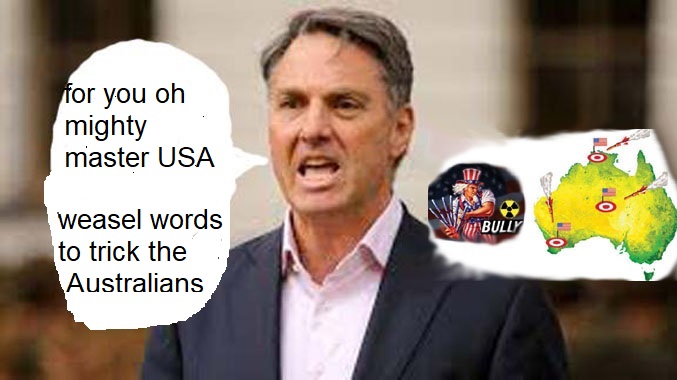
Since becoming Defence Minister, Richard Marles has overseen a shift that aligns Australia more closely with U.S. military goals than ever before.
Richard Marles backs the U.S. military, not just with rhetoric, but with billions in public funds diverted from services Australians urgently need.
Richard Marles is a senior figure in the Labor Right, a faction increasingly indistinguishable from the Liberal Party on core issues such as defence, foreign policy, and trade.
20 June 2025 AIMN Editorial, By Denis Hay
Description
Richard Marles backs the U.S. military power on Australian soil. Discover how it risks our sovereignty, and what citizens can do to reclaim it.
Introduction – A Quiet Coup Over Australia’s Defence
Location: Tindal, Northern Territory. Action: A U.S. B-52 bomber roars overhead. Thoughts: “Are we a launchpad for war?” Emotions: Unease, betrayal.
It’s 2025. As Defence Minister Richard Marles smiles beside a Pentagon official, another defence deal is signed. Few Australians notice. Even fewer understand its implications. Our government says it’s about ‘defending democracy.’ But whose democracy, and against what threat?
While China is still our biggest trading partner, we’re warned of its menace. Meanwhile, U.S. troops, bombers, and weapons quietly embed themselves deeper into our soil. This isn’t protection, it’s occupation by consent.
How did we end up here? And why is it that Richard Marles backs the U.S. military over Australia’s sovereign interests?
Problem: The Erosion of Australian Sovereignty
A Defence Strategy Written in Washington
Since becoming Defence Minister, Richard Marles has overseen a shift that aligns Australia more closely with U.S. military goals than ever before. The 2021 USFPI agreement expanded joint military operations.
Billions have since been given to help U.S. base upgrades in Darwin and Tindal, alongside hosting U.S. nuclear-capable planes.
This is yet another example of how Richard Marles backs the U.S. military agenda, prioritising American strategic interests over national independence.
“It’s not just alliance cooperation, it’s dependence,” says defence analyst Dr. Alison Broinowski.
The Permanent U.S. Footprint
- U.S. bases in Australia: Pine Gap, Robertson Barracks, and now expanded northern airfields. Ref: How US Military Bases in Australia Threaten Our Future & How to Remove Them
- Rotating forces: Thousands of U.S. Marines cycle through annually, training for potential regional conflicts.
- Infrastructure: Funded by Australian public money for U.S. strategic benefit.
Public Money, Private Empire
Under Marles’ leadership, defence spending reached 2.4% of GDP in 2024. That’s over $60 billion, more than education or climate resilience combined. But this isn’t public defence, it’s public subsidy for the U.S. military-industrial complex.
This is precisely how Richard Marles backs the U.S. military, not just with rhetoric, but with billions in public funds diverted from services Australians urgently need.
The Manufactured ‘China Threat’
A Convenient Villain
There is no evidence that China poses a military threat to Australia. Defence intelligence reports confirm no plans for invasion or aggression. Yet headlines scream of ‘Chinese expansionism,’ fuelling fear and compliance.
Who Benefits?
- Weapons contractors profit from panic.
- U.S. hegemony is preserved through Australian complicity.
- Political careers thrive on appearing ‘tough on China.’
“The U.S. has surrounded China with 200+ military bases,” notes historian John Pilger. “China has none outside its borders. Who’s the aggressor here?”
Real Consequences for Australians
Story: Emily, a nurse in Perth, struggles to afford rent. Her hospital is understaffed. Meanwhile, Marles commits $368 billion for nuclear submarines, years away from delivery, if ever.
“Why do we always find money for war, but never for nurses?” Emily asks.
Because Richard Marles backs the U.S. military, while ignoring the suffering of frontline workers like Emily.
The Labor Right: A Party Captured by Foreign and Corporate Interests
Richard Marles and the Rise of Labor’s Conservative Core
Richard Marles is a senior figure in the Labor Right, a faction increasingly indistinguishable from the Liberal Party on core issues such as defence, foreign policy, and trade.
Rather than upholding the Labor tradition of peace, workers’ rights, and democratic independence, the right faction embraces military alliances and market orthodoxy.
Their influence is evident in Labor’s full-throated support for AUKUS, Marles’ open enthusiasm for U.S. military integration is no coincidence – Richard Marles backs the U.S. military model as central to Labor’s right-faction ideology, and the suppression of internal dissent from more progressive voices within the party.
“Marles speaks more like a U.S. Pentagon spokesperson than an Australian minister,” notes a former Labor policy adviser.
How the Right Faction Is Reshaping Labor
This shift reflects how Richard Marles backs the U.S. military, pushing Labor further from its peace-promoting roots.
Suppresses internal debate on AUKUS, Palestine, and climate.- Aligns with corporate donors, including arms manufacturers.
- Stifles progressive legislation, watering down meaningful reforms.
The result? A Labor Party that once represented workers and peace is now compromised and cautious, often at the expense of sovereignty and social justice.
A Peaceful, Sovereign Path Forward
Reclaiming Foreign Policy Independence
- End the U.S. military presence on Australian soil.
- Cancel or renegotiate treaties that erode autonomy.
- Prioritise diplomacy over deterrence.
Invest in Public Needs, Not Foreign Conflicts
Redirect defence billions to:
Fully fund Medicare.- End homelessness.
- Provide free tertiary education.
Australia, as a sovereign nation with currency-issuing power, can fund peace just as easily as it funds war. The real limitation is a lack of political will, not a shortage of money.
Learn from Global Examples
- Costa Rica abolished its military in 1948. Today, it ranks among the world’s happiest and healthiest nations.
- Finland and Switzerland remain militarily neutral but are globally respected.
“We must stop being a staging post for other nations’ wars,” says Senator David Shoebridge.
Marles, the U.S., and Our Crossroads
For decades, Australia walked a delicate line, partner to the U.S., yet proudly sovereign. That line is vanishing.
Richard Marles has accelerated Australia’s subservience to U.S. military interests under the guise of strategic cooperation. But what we face is not defence, it’s deterrence at the cost of independence.
This is the inevitable outcome when Richard Marles backs the U.S. military without accountability or public consent.
And it’s happening with full ministerial approval, Richard Marles backs the U.S. military posture without public scrutiny or debate.
It’s time Australians asked: Who does our government really serve?
Q&A – Reader Questions Answered…………………………. https://theaimn.net/why-richard-marles-backs-the-u-s-war-machine/
Warmongering Marles commits Australia to US war against China amid Iran mayhem.
Let’s never forget the truth, that Iran is compliant with its international nuclear reporting; Israel is not. Israel doesn’t even allow the IAEA to check their nuclear facilities, Iran is a member of the Nuclear Non-Proliferation Treaty, unlike Israel.
It is not the generals emblazoned with their medals who will pay the price if we march off to another worthless American war. It is not the pusillanimous media pundits, nor the preening politicians. It is young Australians who will pay the price.
by Michael West | Jun 17, 2025 | https://michaelwest.com.au/warmongering-marles-commits-australia-to-us-war-against-china-amid-iran-mayhem/
The craven appeasement of Benjamin Netanyahu by Western media and political elites has brought the world to the brink of war. Now Richard Marles says Australia’s part in a US war against China is a fait accompli. Michael West reports.
The closest Deputy PM Richard Marles has come to war may well be a school debating stoush at Geelong Grammar but here he is today, on page 1 of Rupert Murdoch’s warmongering The Australian, committing young Australians to war against China. Should it transpire.
Our major trading partner, which has posed us no threat but buys 40% of our exports and has delivered nothing but prosperity to The Lucky Country.
Given the way things are shaping up in Europe, America and the Middle East, the spectre of World War 3 has never loomed so large. This morning Donald Trump warned Iranians to evacuate Tehran, the capital and home to 10 million people. Now there are reports of Trump seeking executive orders to invade.
There is little doubt that the Neville Chamberlains in Western governments and media, these sapless appeasers of the political and media elites, who have supported ‘our friend Israel’ and its demonic leadership of genocidaires, are culpable for the deaths of thousands (in Gaza and the West Bank, Syria, Lebanon and now Iran). They are guilty of genocide, the world’s most egregious crime, and now Israel’s attacks on Iran, in a world daily edging closer to WW3.
They could have stopped this. Cowed by Israel money and the fear of being called antisemitic, they didn’t. Who loses this? Everybody, Israel included. The first casualty of Israel’s unprovoked assault on Iran last week was a child, buried under rubble.
It is Western appeasement of the Netanyahu government which has led to this; principally the US, UK and Germany, with Australia a bit player albeit with blood dripping from its hands.
Sucked in by Benjamin Netanyahu, again, sucked in by the Israel propaganda of Iran’s nuclear program, world mainstream media again – the very people who fell for the ’40 babies beheaded’ and mass rapes of October 7 – are now running Israel’s ‘regime change’ narrative.
Plus ca change
We’ve seen it before: in Vietnam the ‘domino theory’, in Iraq the fabled WMD which turned regime change when that was found out. “Liberty, freedom and democracy” they cried, after Netanyahu sold them into that war. A million dead, a spate of world terrorism. Islamic State.
And Afghanistan, whose cause turned from Osama bin Laden to regime change to remove the Taliban. Twenty years later the Taliban were back in office.
These abysmal failures, one after another, and now we’ve got Murdoch again beating the drums of war for an attack on China.
Australia is walking into another disastrous war by kowtowing to the US. AUKUS – the controversial security alliance – has made us less safe, not more safe.
The government of Anthony Albanese, feebly abetted by a warmongering Coalition and media, dead-set scared of what the US will say, or the chicken-hawk Coalition, is wedged … if they don’t go all the way with Donald J.
Real strength is being able to stand up to bullies and make the right decisions, not cravenly cave to the demands of our ‘allies’ carrying out a genocide in Gaza and now destabilising the whole world. The ‘global rules based order’ is a sick joke.
Iran support
And make no mistake, that is what we are doing, destabilising the world. China has said it would back Iran in the face of Israeli aggression, Russia has its own thing going with Ukraine but presumably backs Iran. Pakistan, a neighbour and ally of Iran, says it will nuke Israel if Israel nukes Iran.
North Korea – whose decision to get nukes has been entirely vindicated by Western aggression – backs Iran. It is topsy turvey. In Syria, Israel and the US have installed a puppet regime of former Isis and Al Qaeda types – yes the very terrorists who they funded to commit war crimes are now their allies.
This is an almighty mess, and at its epicentre is Israel which decries the regime in Iran, a country which has not attacked another country in 300 years, a country where, despite an authoritarian government, embraces freedom of religion. Mosques, churches and synagogues are free.
In Palestine and Lebanon, Netanyahu and his cronies have been gleefully bombing mosques and churches. No arabs or Thai workers have been crowding the bomb shelters this week as Israelis scurried for cover from Iran’s retaliatory strikes, crying victimhood. In this apartheid state, bomb shelters are only for Jews.
Plainly, we are on the wrong side, the ‘genocide’. And now we see Richard Marles and his media proxies talking about the threat from China and the inevitability of joining a US war.
As Israel continues to murder dozens of civilians daily under cover of media blackouts, starving and murdering Gazans as they scramble for food – and annexing the West Bank – the war crimes by the US/Israel alliance are legion, too many to be listed here; they are daily.
This morning Israel bombed an Iranian TV station mid-broadcast, unapologetically gloating about it in the media; like the grotesque terrorism of its pager explosives, another war crime, targeting journalists going about their jobs.
Follow the money
Trump, the self-described peacemaker, has lost control. And behind it, if we follow the money is an epic laundering operation which has dragged in the entire political class in the US.
It is quite simple: America sends billions in public money, earned by their taxpayers, to support Israel every year. Israel in turn sends money to its lobby groups such as AIPAC, bribing almost every politician on Capital Hill to support its genocide and deny its daily war crimes, its land theft, rape and torture of prisoners, its unrelenting, barbaric military aggression.
And Australia, we are sending our tributes to these US warmongers via AUKUS for submarines which may never arrive, certainly not in time for this looming war, if it occurs. We can only hope common sense prevails. But when it comes to cajoling Australia into its next useless war, the US only has to pamper one man, and that’s Albo.
War powers reform
We can be thankful it’s not Peter Dutton. But few would put store in Albo to stand up to US pressure. The rub is that, in the UK and US, the decision to go to war is made by a vote of Parliament or Congress. In Australia, there is no vote. It is down to the PM, one man. It’s Albo’s call.
So what can we expect? The warmongers of the media are stepping up their campaigns. We have seen it all before, it will all be about downplaying Israel’s aggression. It will all be about demonising the Iranian regime, driving spurious arguments for regime change as if it is our right to meddle in the affairs of countries which want peace and which have done no wrong.
It will be about the elusive, unfounded threat of Iranian nukes, it will dehumanise Iranians, just like it did the people of Gaza. the machine will do all it can to manufacture consent for war. This – Fox News ‘secret Iranian nuclear weapons site revealed’ – is a taste of things to come.
Iran compliant, Israel not
Let’s never forget the truth, that Iran is compliant with its international nuclear reporting; Israel is not. Israel doesn’t even allow the IAEA to check their nuclear facilities, Iran is a member of the Nuclear Non-Proliferation Treaty, unlike Israel.
These facts will be dutifully buried in an avalanche of lies and spin but if the world needs regime change, they should start with Israel, not Iran. Somehow Netanyahu has managed to – in his jungle of lies – inveigle the US into war with Iraq and ‘regime change’ in a plethora of countries.
He has trashed the reputation of his country forever, demolished any credibility it might have enjoyed, lost to the Palestinian resistance in Gaza after almost two years, and failed miserably in his two stated aims of ousting Hamas and returning the hostages.
And this despite America and the US deploying more firepower than Nagasaki and Hiroshima, killing and maiming 100s of thousands of civilians. And now starving them to boot.
Still the IDF can’t summon the guts to go down in the tunnels and take Hamas on, mano a mano, preferring instead to frock up in the lingerie of their victims and blithely prance around on social media celebrating their war crimes.
Netanyahu and his cronies, including America, have destroyed Israel through their brutality and stupidity and given rise to antisemitism. While blaming everybody else from peace protestors to Palestinians, they are squarely to blame.
It is not the generals emblazoned with their medals who will pay the price if we march off to another worthless American war. It is not the pusillanimous media pundits, nor the preening politicians. It is young Australians who will pay the price.
Why the AUKUS ‘dream’ was never realistic and is likely to die

it has always been clear that Washington will sell us its submarines only if it is absolutely certain Australia would commit them to fight if the US goes to war with China.
The Albanese government has never acknowledged it is willing to make that commitment.
it has always been clear that Washington will sell us its submarines only if it is absolutely certain Australia would commit them to fight if the US goes to war with China.
The Albanese government has never acknowledged it is willing to make that commitment.
Hugh White, Jun 16, 2025, https://www.thenewdaily.com.au/opinion/2025/06/16/aukus-submarines-review-australia
The first clear sign the Trump administration was taking a long hard look at AUKUS came two weeks ago, when US Secretary of Defence Pete Hegseth gave his first major speech on US strategic policy in Asia at the annual Shangri-La Dialogue in Singapore.
In a long presentation that catalogued a host of initiatives with America’s Asian allies, AUKUS was not mentioned once.
This was noteworthy, because under the Biden administration, AUKUS was the poster-child for US military engagement in the region, name-checked at every opportunity. Now we understand why.
The Pentagon’s review of AUKUS, announced last week, marks the first time any of the three partners – the US, Britain and Australia – has tested the AUKUS dream against hard military and strategic realities. It is unlikely to survive.
AUKUS was always a long shot, right from the start. That was clear from the moment, back in September 2021, that then prime minister, Scott Morrison, sprung the dream of an Australian nuclear-powered submarine force on an astonished public. For that dream to be realised, a lot of things would have to go right, and most of them were much more likely to go wrong.
But the flaw that looks set to kill the AUKUS dream is one that was not part of the original plan. The way Morrison and his then defence minister, Peter Dutton, originally conceived it, there would be no need for Australia to acquire US-built Virginia-Class subs in the 2030s before taking delivery of Australian-built subs to replace the Collins-class boats. They were confident that subs built in Australia, almost certainly to a British design, could be delivered fast enough to enter service as the old Collins subs were being retired, ensuring no gap in our capability.
It became clear this was not going to work out only after Labor took office in 2022, as the new government tried to turn Morrison’s vague idea into a viable project. It soon found there was simply no way to bring new Australian-built nuclear subs into service until long after the Collins boats had to be retired.
To save the AUKUS dream, it was necessary to fill the gap between the retirement of the Collins and the delivery of the first of what we now know as the UK-designed, Australian-built SSN-AUKUS class of submarine. That was when the idea of Australia getting ex-US Navy Virginia class boats first surfaced.
It was a desperate measure that vastly increased the already formidable risks of the whole AUKUS idea. One reason is that it meant the Royal Australian Navy had the almost impossible task of managing and operating not one but two very different kinds of nuclear submarine, powered by two very different nuclear power plants.
For a navy that has struggled to keep the much simpler Collins subs at sea, the task of operating just one class of nuclear-powered subs was truly formidable. To expect it to effectively operate two quite different classes of nuclear submarine simultaneously was frankly absurd.
But there is another reason why the decision to buy Virginia subs to cover the capability gap undermined the viability of the whole AUKUS plan.
Very simply, the US has no submarines to spare. The facilities and workforce that build and maintain its submarines have never recovered from the savage cuts imposed in the 1990s after the end of the Cold War. No serious steps were taken to rebuild it even after it became clear China had become a formidable new maritime rival.
The result is that America’s two submarine construction yards have for many years been delivering barely half as many Virginia-class subs as the Pentagon now says America needs – about 1.2 a year instead of two a year.
This problem was acknowledged when the AUKUS partners announced the detailed plan in 2023. It was optimistically claimed that everything necessary would be done to increase production to the level of 2.3 subs a year required to meet US needs and provide extra boats for Australia.
So far, there is no sign of that happening. Elbridge Colby, the senior US official conducting the Pentagon’s AUKUS review, will almost certainly puncture the irresponsible optimism around this crucial issue and make it clear that unless there is a miracle in US submarine production, America will not sell any Virginia-class subs to Australia.
But that’s not all. Even if that miracle is achieved, US leaders and officials still have to ask whether it makes sense for America to pass the extra submarines to Australia rather than bring them into service with the US Navy.
Any subs sold to Australia weaken America at a time when it is already struggling to match China’s fast-growing navy. So it has always been clear that Washington will sell us its submarines only if it is absolutely certain Australia would commit them to fight if the US goes to war with China.
The Albanese government has never acknowledged it is willing to make that commitment. The Biden administration, desperate for its own reasons to keep the AUKUS dream alive, did not press Canberra on this very sensitive point.
The Trump administration will be much tougher. Colby’s review will also certainly conclude that America should not sell Virginia-class subs to Australia, unless Canberra offers much clearer and more public guarantees that Australia will go to war with China if the US ever does.
For Canberra, this could well be a deal-breaker, making the end of the AUKUS dream. It certainly should be.
Hugh White’s new Quarterly Essay, Hard New World: Our Post-American Future, is published this month.
Hugh White, Emeritus Professor of Strategic Studies at the Strategic and Defence Studies Centre, Australian National University
Pacific Rim countries say no to U.S.-China war
The question that the people of the Pacific and Pacific Rim countries are asking is: Why do we have to respond to this demand by the U.S.? We are not threatened by China. Where is the dire urgency that demands such a huge distortion of our public spending on the military?
The indications are that the United States is preparing for war against China, but cannot wage such a war from the West Coast of the USA. It needs military bases, port facilities and airfields in the countries on the west side of the Pacific Rim; for example, South Korea, Japan, the Philippines, Guam, Micronesia and Australia. Without these bases, without the backing of the military forces and munitions and manufacturing capabilities of the Pacific Rim countries, the United States cannot launch and sustain a war against China.
By Bevan Ramsden | 16 June 2025, https://independentaustralia.net/politics/politics-display/pacific-rim-countries-say-no-to-us-china-war,19837
As the U.S. pushes Pacific Rim allies to ramp up military spending for a possible war with China, a new campaign asks: at what cost and for whose benefit? Bevan Ramsden writes.
THE PACIFIC and Pacific Rim countries have a geographical commonality. They are encircled by, or have a border with, the vast, blue, peaceful Pacific Ocean. They also share a political commonality. The people and countries of this region are under pressure to lift their military spending at the expense of addressing their social needs.
The pressure comes from the United States, whose Defence Secretary, Peter Hegseth, at the recent Singapore Defence Summit, declared that the U.S. expects its allies in this region to increase their defence spending to 5% of their GDP. His justification was a “possibly imminent threat” posed by China. He emphasised how the U.S. is “reorienting towards deterring aggression by China” and made it clear that the Donald Trump Administration’s defence strategy revolves around stifling the rise of China.
Responding to this expectation would involve the doubling of South Korean expenditure on military defence, from 2.6% of its GDP to 5%.
It would mean Japan’s military defence spending would have to triple from 1.8 % of its GDP to 5%.
In Australia, such an increase would represent a two-and-a-half times increase from 2% to 5% of its GDP.
These examples show that the 5% target represents a massive increase in military spending, which can only be made by reducing funding for urgent infrastructure, social needs such as health and education and loss of resources to address the real threat to their living environments, the climate crisis.
The question that the people of the Pacific and Pacific Rim countries are asking is: Why do we have to respond to this demand by the U.S.? We are not threatened by China. Where is the dire urgency that demands such a huge distortion of our public spending on the military?
Another commonality among the countries of the Pacific Rim, particularly those on the western and southern rim of the Pacific, is U.S. troops and U.S. military installations stationed on their territory. In the case of South Korea, these are substantial, close to 30,000 and put that country’s military virtually under the control of the U.S.
Japan has 57,000 U.S. troops, including 20,000 on Okinawa, where the U.S. Kadena Air Base is its largest outside of the USA. Clearly, this level of foreign military occupation exerts substantial pressure on Japan’s foreign policy.
The Philippines has four U.S. bases with troops rotating through its territory and training with its defence forces, and is setting up logistic centres for equipment and munitions.
The people of Guam, a territory under direct U.S. control, are subject to 7,000 U.S. troops, with almost a third of the land controlled by the U.S. military. The Joint Region Marianas is a U.S. military command combining the Andersen Air Force Base and the Naval Base Guam.
Andersen Air Force Base hosts B-52 bombers and fighter jets. Naval Base Guam is the home port for four nuclear-powered fast attack submarines and two submarine tenders. American military commanders have referred to the island as their “permanent aircraft carrier”.
Australian governments, in their subservience to the U.S., have signed the Force Posture Agreement, giving the U.S. military unimpeded access to Australia’s ports and airfields and enabling the establishment of a Northern Territory base for its B-52 bombers, some of which are nuclear-capable. The Agreement is giving the U.S. fuel and munitions storage areas to support war operations and an $8 billion port facility for servicing their nuclear submarines and storage of their nuclear waste.
The people of Pacific Rim countries, including Australia, need to ask: Why does the U.S. have these extensive military facilities in our countries and why are they demanding such huge military expenditures from us?
The answer, unfortunately, is not for the benefit of the people of this region but for its own foreign policy objectives, which include maintaining its dominance in the region by “containing” China and preventing the rise of its influence.
The indications are that the United States is preparing for war against China, but cannot wage such a war from the West Coast of the USA. It needs military bases, port facilities and airfields in the countries on the west side of the Pacific Rim; for example, South Korea, Japan, the Philippines, Guam, Micronesia and Australia. Without these bases, without the backing of the military forces and munitions and manufacturing capabilities of the Pacific Rim countries, the United States cannot launch and sustain a war against China.
So the United States needs us but we don’t need such a war.
It would only bring devastation to our lives and our economies, and if it turned nuclear, who would survive?
The Pacific Peace Network, with representatives from the Pacific Rim countries and together with World Beyond War, has produced a solidary campaign which is being launched on 21 June 2025.
This is a campaign in which the people of each country on the Pacific Rim, including Australia, can say no to such a war and no to an increase in military spending for it, through a common petition which is a call on their governments.
The common petition can be accessed here at the World Beyond War website.
This call on governments reads:
For sustainable peace and the survival of our peoples and environment, we ask you:
- refuse to join military preparations for a U.S.-China war;
- declare you will not fight in a U.S.-China war;
- declare neutrality should such a war break out; and
- do not allow your territory or waters to be used in such a war, including the collection and relay of military intelligence, sales of weapons and hosting combatant troops and facilities.
Later this year, the petitions will be presented to their respective governments by peace activists in each country.
US launches AUKUS review to ensure it meets Donald Trump’s ‘America First’ agenda
By Brad Ryan and Emilie Gramenz in Washington DC, ABC News, 11 June 25
In short:
The US is reviewing the AUKUS security pact with Australia and the UK, which Australia is depending on to acquire nuclear-powered submarines.
A US defence official said it would ensure the pact met President Donald Trump’s “America First” agenda, as the US struggles to build enough submarines for its own fleet.
But Defence Minister Richard Marles said he was “very confident this [AUKUS] is going to happen” and it was only natural for the new US administration to review it.
The Pentagon is reviewing the AUKUS security pact between Australia, the US and the UK to ensure it aligns with President Donald Trump’s “America First” agenda, a US defence official told the ABC.
But Defence Minister Richard Marles said he remained confident the pact would remain intact, and a review was a “perfectly natural” thing for a new administration to do.
The news follows US Defense Secretary Pete Hegseth’s recent request for Australia to significantly boost its defence spending “as soon as possible”.
The US defence official said the review “will ensure the initiative meets … common sense, America First criteria”.
“As Secretary Hegseth has made clear, this means ensuring the highest readiness of our service members, that allies step up fully to do their part for collective defence, and that the defence industrial base is meeting our needs,” the official said.
Under the AUKUS pact, Australia would be armed with nuclear-powered submarines at a cost of more than $350 billion.
Elbridge Colby, who is the under secretary of Defense for Policy and has voiced scepticism about AUKUS, is leading the review, according to the UK’s Financial Times.
Last August, Mr Colby tweeted he was an AUKUS “agnostic”.
“In principle it’s a great idea. But I’ve been very skeptical in practice,” he wrote, but added he’d become “more inclined based on new information I’ve gleaned”.
Mr Marles told ABC Radio Melbourne he was “very confident this [AUKUS] is going to happen”.
“The meetings that we’ve had with the United States have been very positive in respect of AUKUS,” Mr Marles said. “That dates back to my most recent meeting with Pete Hegseth in Singapore.”
……………………………………………. The Australian government paid the US almost $800 million earlier this year — the first in a series of payments to help America improve its submarine manufacturing capabilities.
………… Mr Hegseth met Defence Minister Richard Marles in Singapore, and said Australia needed to lift its defence spending.
Mr Trump himself has said little publicly about the AUKUS pact, and his criticisms of America’s traditional alliances have fuelled anxieties about its future in Canberra and London.
When a reporter asked Mr Trump about AUKUS in February, he appeared to be unfamiliar with the term, replying: “What does that mean?”…………………………..
Under “Pillar I” of the two-pillar AUKUS deal, the first submarine would arrive in Australia no sooner than 2032. It would be a second-hand US Virginia-class vessel.
The US would subsequently supply Australia with between three and five submarines, before Australia began building its own in Adelaide, modelled on British designs.
Mr Albanese was expected to meet Mr Trump on the sidelines of the G7 summit in Canada next week. But that’s now in limbo after the US condemned Australia and several other countries that placed sanctions on two far-right Israeli ministers.
…………..Critics of the deal, including former prime ministers Malcolm Turnbull and Paul Keating, have long warned it is unfair and risky. “I’ve never done a deal as bad as this,” Mr Turnbull told Radio National earlier this year.
The Greens have proposed a “plan B” defence policy that would eventually see AUKUS cancelled.
There are also longstanding concerns around the US’s consistent failure to meet its own submarine-building targets to fully stock its military fleet…………………………………………….https://www.abc.net.au/news/2025-06-12/aukus-pentagon-review-donald-trump-america-first/105406254
In Australia’s post-US future, we must find our own way with China

Hugh White, 2 June 25, https://www.theguardian.com/australia-news/2025/jun/02/australia-post-america-future-china
The Canberra establishment thinks we must depend on Washington more than ever in today’s hard new world. That misses a vital point, Hugh White writes in this Quarterly Essay extract.
Thanks to US regional strategic primacy, Australia has been virtually immune from the threat of direct military attack since the defeat of Japan in 1945. Now that is changing. In future it will no longer be militarily impossible for China to attack Australia directly. And not just China: other major regional powers, especially India and eventually perhaps Indonesia, will have the potential to launch significant attacks on Australia.
That does not mean we now face a serious threat of Chinese military attack. Today the only circumstance in which Australia could credibly find itself under attack from China would be if Australia joined the US in a war with China over Taiwan. Reports that Australia is a target of Chinese cyber and intelligence operations do not show that Beijing poses a military threat to us any more than our cyber and intelligence operations targeting China provide evidence that we pose a military threat to them.
It is harder to say whether China might become militarily aggressive towards us in future. We cannot assume that it will from its military buildup alone, because countries often expand their armed forces to defend themselves rather than to attack others.
But, equally, we cannot rule out the possibility that China might decide to use armed force against Australia in decades to come. Some aspects of China’s naval buildup, especially its sustained investment in aircraft carriers, which would have no useful role in a US-China war over Taiwan, suggest that it wants to be able to conduct long-range power-projection operations, which could encompass Australia.
Nonetheless, it does seem unlikely. For one thing, it is a little hard to imagine what China’s purpose might be in attacking Australia, given that we are not an easy country to invade. And if we get our defence policy right it should be possible for us to raise the cost to the point that it is not worth China’s while.
This all means that, while we should not ignore it, we should not allow the distant possibility of a Chinese military threat to dominate our thinking about China. There are many other dimensions to what is a very important, complex and ultimately inescapable relationship.
It is also a relationship of a completely unfamiliar kind. Other than our two great allies, Australia has never before encountered a country as large, as powerful, as influential in our region, as important to us economically, and with close heritage connections with such a large proportion of our population, as China.
Once we abandon the illusion that the US is going to manage China for us, we will realise that we have no choice but to find our own way. This will not be comfortable or easy. China is ruthless, demanding and completely transactional – though no more than other great powers. Over the past decade, in Canberra and around the country, exaggerated fears and a desire to stay in step with Washington have crowded out serious thinking about China itself and how the complex range of interests we have in our relationship with it can best be balanced. We have less deep expertise on China now than we had 30 years ago. That has to change.
Our second big task is to rethink our relationship with the US. In the decades before the mid-1990s, there was an assumption that – in a Whig-view-of-history way – Australia was gradually but ineluctably emerging from dependence to independence as we left our colonial and imperial past behind and embraced our Asian future. That died away around the time John Howard became prime minister in 1996, when it seemed to many people that the future was America’s, and that Australia’s future was to become ever more tightly entwined with it, strategically, economically and culturally.
This was the time when a US-Australia free trade agreement seemed both essential and sufficient to guarantee Australia’s economic future, and when America’s place as the world’s dominant military power seemed unchallengeable. The economic illusions of that era were soon overtaken by the hard realities of China’s rise but the strategic illusions have survived. Indeed, they were strengthened by the “war on terror” and have been intensified again by the rising fear of China. So we clung on and stopped imagining we could do anything else.
It is often said, for example, that the intelligence relationship is so close and so important to both sides as to be indissoluble. Don’t bet on that. US access to Pine Gap as a location for its satellite ground station is valuable but far from essential. Our access to US intelligence under the Five Eyes arrangements is very beneficial and, in some ways, irreplaceable, in that it provides intelligence we could not get in other ways. But that does not mean we could not get by without it. We certainly could.
As things get tough with Washington over the months and years ahead, there will be a temptation to try to placate Donald Trump and earn his favour by meeting his demands for increased defence spending, or by siding with the US in its economic war by cutting links with China.
There may be good reasons to increase defence spending but trying to buy Trump’s favour is not one of them. Likewise, that futile goal would in no way offset the many powerful arguments against joining a US-led anti-China economic coalition. There are no favours we can do Trump which will keep the US strategically engaged in Asia and committed to Australia’s defence.
We need to bear these cold realities clearly in mind as we think about our future relations with Washington. The first step is to recognise that the end of the alliance as we have known it for so long does not mean the end of the relationship. We have been close allies for so long that it is hard to imagine what other form our relationship might take.
But with careful management, a new, beneficial post-alliance relationship can evolve, just as our relations with Britain evolved after it withdrew from Asia in the late 1960s. We continued to have close and productive defence and security links, drawing some strength from our shared history together.
Singapore offers another instructive model. It is not a US ally but it has an excellent relationship with Washington, including deep defence links. We should aim for a post-alliance relationship like that with the US in the years ahead – and we should be building it now. That does not mean severing ties with Washington but it does mean changing the relationship fundamentally.
Above all, it means acknowledging that the security undertakings in Anzus can no longer be the foundation of our strategic policy, or of our relationship with the US. The Canberra establishment is shocked by any suggestion that we should walk away from the Anzus commitments. They think we can and must depend on the US more than ever in today’s hard new world.
But that misses the vital point. It is not Australia but the US that is walking away from the commitments it made in the Anzus treaty in very different circumstances 75 years ago. That was plain enough under Joe Biden. It is crystal clear today under Trump.
This is the lesson we must draw from Washington’s failure to defend Ukraine, from its crumbling position in Asia and from US voters’ decisive rejection of the old idea of US global leadership to which we still cling. Our best path now is to recognise this and start acting accordingly.
- Hugh White is emeritus professor of strategic studies at the Australian National University. This is an edited extract of Hard New World: Our Post-American Future, published in Quarterly Essay
Rudd talking the AUKUS talk in Washington, but is the US walking?
by Rex Patrick | May 23, 2025, https://michaelwest.com.au/rudd-talking-the-aukus-talk-in-washington-but-is-the-us-walking/
A new FOI reveals Kevin Rudd has been talking the AUKUS talk, with success. Yet no amount of talk will help the US walk the AUKUS walk. Rex Patrick on the project status.
A Freedom of Information request looking into what Ambassador Kevin Rudd and his Washington staffers had been doing on AUKUS since he took up his post in March 2023 shows that he was pretty busy.
When he arrived at his Embassy post, the US Congress had already passed the Australia-United States Submarine Officer Pipeline Act. That was the first US legislative action to support AUKUS, allowing Australian submarine officers to train with the US Navy, to gain expertise in nuclear-powered submarines and to set them up to serve on their subs.
But there was a lot more work to be done. The FOI shows that AUKUS was a priority that Rudd took on with his characteristic eagerness and focus. Between March and July 2023, he met with President Biden and over 40 members of Congress of both political persuasions, with a focus on those who were members of the Armed Services Committee or Foreign Relations/Affairs Committees.
In amongst tens of private or close-knit lunches, dinners and meetings, he also spoke at a House Foreign Affairs Committee roundtable on 18 April, had drinks with twelve Republican Members of Congress on 5 July and hosted an ‘AUKUS and US-AUS International Cooperation’ dinner at the Australian Embassy with seven Senators on July 11.
By then, the Embassy was declaring victory in cables back to Australia regarding AUKUS support in Congress.
Transfer legislation passes
Further Embassy work saw a swath of other laws change in support of AUKUS, including laws in the 2024 National Defense Authorization Act allowing for the conditional transfer in the 2030s of three Virginia-class submarines to the Royal Australian Navy.
The conditional elements of the law are that the transfer cannot take place if it would cause a degradation of US undersea capabilities or is inconsistent with US foreign policy and national security interests. Furthermore, the law requires the President to certify the US is making sufficient submarine production and maintenance investments to meet the combination of US and Australian requirements.
And therein lies the problem.
The US Congressional Research Service (CRS) estimates that, before a transfer of submarines can occur, the US Submarine Industrial Base needs to be producing one Columbia-class nuclear missile submarine and 2.3 Virginia-class attack submarines per annum.
Currently, the Columbia submarine program, the US Navy’s highest priority program, is running between 12 and 16 months behind schedule.
Virginia-class submarines are being built at a rate of 1.2 boats per annum, way below what’s required. At the same time, the number of commissioned US submarines either in depot maintenance or idle (awaiting depot maintenance) has increased from 11 boats (21% of the attack submarine force) to 16 boats (33% of the attack submarine force).
And that is why the Albanese Government has committed $4.7B to uplift the capabilities of the US Submarine Industrial Base. The US is also injecting billions, with a plan to get to a build rate of two Virginia-class submarines by 2028.
The big picture
The problem is that, when one stands back and looks at past US performance, even with the money being spent, hitting a build rate of 2.3 Virginia-class submarines a year is fanciful.
The Government Accountability Office (GAO) testified to the House of Representatives Armed Services Seapower and Projection Forces subcommittee on March 11 this year, stating,
The Navy has no more ships today than when it released its first 30-year shipbuilding plan in 2003.
This stagnation has occurred despite regular demands and plans for a substantial increase to the Navy’s fleet size and a near doubling of its shipbuilding budget (inflation-adjusted) over the past 2 decades.”
GAO described the situation in more detail stating that; in the 2000s attack submarines took six years to build and cost around $US3B, they now take nine years to build and cost around $US4.5B (only a third of the increase can be attributed to shipbuilding inflation); destroyers used to take five years and cost $US1.9B to build and now take nine years and cost $US2.5B (the lead ship of the new Constellation class frigate program has an estimated 3 years delay, with construction stalled; aircraft carriers used to take eight years to build and now take eleven years.
Over the period 2019 to 2040 it is estimated that the US Navy will have lost 234 ship service years due to shipbuilding delays and between 2027 and 2030 the US fleet will be smaller by 20 ships, mostly attack submarines.
Both the CRS and GAO have advised Congress that it’s not just a money problem; there are systemic issues right across the board.
The CRS testified that it has taken a long time to get into this situation and that it will take a long time to “right the ship”.
Talking cross-purposes
This brings us back to an exchange in the Australian Senate between the man in charge of AUKUS, Vice Admiral Mead, and Greens Senator David Shoebridge in June last year.
Shoebridge was asking what happens if the US can’t deliver; will we get our $4.7B back? Mead was answering that the US was fully committed. Shoebridge was in effect asking, ‘what happens if the US can’t walk the AUKUS walk’. Mead was answering, ‘they’re talking the AUKUS talk’.
Politics over engineering?
Over the years we’ve seen Australian politicians make promises about, and commit public money to, Defence projects that have subsequently gone off the rails and cost the country dearly in terms of money spent, unavailability of military capability and the undermining of national security.
It doesn’t matter what politicians in Australia or the US say; it matters what the experienced project managers and engineers say. In addition, our Defence is, at best, very short of experienced project managers; rather, they have flag-ranked officers who’ve never run projects but need somewhere to go after successfully commanding a ship or unit.
The warning signs for AUKUS are apparent right now. Australia is an island state that needs submarines and, based on the actual states of US shipyards,
“the current trajectory of AUKUS is a likely loss of our submarine force altogether.“
The Government recently announced that the Collins Life of Type Extension will be scaled back, and is refusing to develop a Plan B. Plan B is no submarines, after spending $4B not buying French submarines and pouring almost $5B into the US Submarine Industrial Base.
In any normal organisation which has accountability to shareholders, someone would have been fired by now. But no-one ever gets fired in upper echelons of the Defence force
Why US Interference in Australia Must Stop.
May 21, 2025 AIMN Editorial By Denis Hay https://theaimn.net/why-us-interference-in-australia-must-stop/
Description
US Interference. Discover how U.S. propaganda, led by the National Endowment for Democracy, manipulates global politics, including in Australia. Is our democracy truly sovereign?
Introduction: Are We the Masters of Our Destiny?
Picture this: Canberra, late 2023. A backbencher quietly raises concerns about Australia’s hawkish stance on China. He’s quickly silenced by a chorus of talking points – suspiciously uniform across think tanks, media panels, and government briefings. Behind the curtain? A well-funded global influence machine with links to Washington.
This isn’t a conspiracy, it’s a documented, multi-decade campaign spearheaded by the National Endowment for Democracy (NED), a U.S.-funded entity once described as the CIA’s “soft power arm.” As revelations surface that the NED may soon be defunded, the world, including Australia, has a rare window to reflect.
The Problem: US Interference Hidden in Plain Sight
The Rise of the National Endowment for Democracy
Created in 1983, NED appeared from a CIA-backed vision to continue covert operations under the guise of democracy promotion. Its founder, CIA director William Casey, appointed former CIA staff to lead it, turning it into a powerhouse of global opinion-shaping.
According to the NED, it funds over 2,000 organisations annually. These include media outlets, advocacy groups, and political movements – all carefully aligned with U.S. foreign policy interests. But where transparency was once claimed, secrecy now prevails.
Australia: A Silent Target?
While countries like India, Iran, and Egypt have expelled or restricted the influence of the NED, Australia has yet to take any such action, leaving us vulnerable to foreign interference.” While there’s no official list of NED-backed groups working here, patterns appear:
• Think tanks echoing U.S. security narratives.
• Media outlets pushing Sinophobic content.
• NGOs subtly shaping Australia’s international alignments.
Certain Australian non-governmental organisations (NGOs) and think tanks have been identified as aligning closely with U.S. foreign policy interests, which may influence Australia’s sovereignty.
NGOs and Think Tanks Influencing Australia’s Alignment with U.S. Interests
1. Australian Strategic Policy Institute (ASPI)
ASPI has received funding from the U.S. State Department and is known for its critical stance on China. Critics argue that ASPI’s work often reflects U.S. strategic interests, potentially impacting Australia’s independent foreign policy decisions.
2. Lowy Institute
Founded by Frank Lowy, the Lowy Institute receives funding from Australian government departments and major corporations. It advocates for a proactive Australian foreign policy, often aligning with U.S. perspectives, which may influence Australia’s international alignments.
3. Australian Council for International Development (ACFID)
ACFID coordinates the efforts of Australian NGOs involved in international development, with activities often reflecting Australia’s strategic interests in the Indo-Pacific region. Its alignment with U.S. foreign policy goals may subtly influence Australia’s international relations.
Implications for Australia’s Sovereignty
US interference with its close alignment to organisations with U.S. interests can have several implications:
- Policy Influence: Their research and advocacy may shape Australian foreign policy in ways that prioritise U.S. strategic goals over Australia’s independent interests.
- Public Perception: By framing international issues through a U.S.-aligned lens, these organisations can influence public opinion, potentially limiting diverse perspectives on foreign policy matters.
- Sovereignty Concerns: Integrating U.S. perspectives into Australian policy discussions may challenge Australia’s ability to formulate and implement policies that fully reflect its national interests and values.
Moving Forward: Away from US Interference
To safeguard Australia’s sovereignty, it is essential to:
- Promote Diverse Perspectives: Encourage a range of viewpoints in foreign policy discussions to ensure balanced decision-making.
- Enhance Transparency: Ensure that funding sources and affiliations of influential organisations are transparent to assess potential biases.
- Strengthen Independent Policy Development: Invest in independent research and policy development, prioritising Australia’s national interests.
By critically evaluating the influence of NGOs and think tanks on Australia’s foreign policy, steps can be taken to ensure that national sovereignty is upheld, and that policies reflect the diverse interests and values of the Australian people.
How Australia Is Losing Control
Normalising Hostility, Undermining Diplomacy
Since 2020, public sentiment against China has spiked. What changed? A surge in media narratives framing China as a threat, many linked to foreign-funded analysis.
Thoughts: “Why do we always follow Washington’s lead?” asked a young policy adviser who remained anonymous. “Every time we try to de-escalate, there’s pressure – think tanks, pundits, even donor influence.”
The True Cost of Obedience
This foreign narrative dominance has consequences:
• Foreign policy subservience: Lockstep alignment with U.S. wars and AUKUS.
• Economic fallout: Trade tensions with China are harming Australian exporters.
• Public trust erosion: Citizens increasingly distrust institutions that parrot foreign lines.
Reclaiming Australia’s Political Sovereignty
1. Demand Transparency and Oversight
• Create a public register of all foreign-funded organisations.
• Require disclosure of media and think tank funding sources.
2. Commission a Royal Inquiry
• Investigate the influence of U.S. foreign policy agents in Australian politics.
• Examine the links between domestic policies and foreign think tank agendas.
3. Embrace Australia’s Monetary Sovereignty
With our sovereign currency, the government can:
• Fully fund independent media.
• Support civic education that strengthens democratic resilience.
• End reliance on corporate-funded foreign narratives.
4. Shift to Peace-Based Foreign Policy
• Withdraw from U.S.-led military coalitions that don’t serve Australia’s interests.
• Build diplomatic and trade ties based on mutual respect, not rivalry.
Sovereignty Starts with Awareness
The potential defunding of the NED signals a pivotal moment. For too long, Australia has been a proxy for U.S. geopolitical ambitions. But it doesn’t have to stay that way.
Australians can reclaim policy independence by exposing foreign influence, demanding transparency, and using our monetary sovereignty.
Q&A: Common Reader Concerns
Q1: Isn’t the NED just promoting democracy?
No. Numerous academic studies and U.S. journalists have exposed NED’s role in funding regime change operations, often supporting authoritarian regimes aligned with U.S. interests.
Q2: Has Australia really been influenced by foreign propaganda?
Yes. While evidence is carefully veiled, indirect ties through foreign-funded think tanks and media campaigns are clear. Unlike India or Venezuela, Australia has not pushed back.
Q3: What can we do as citizens?
Support independent media, call for transparency, contact your MP, and educate others about Australia’s monetary power and the need for sovereign policymaking.
Call to Action: Take Back Australia’s Voice
If you found this article insightful, visit Social Justice Australia to learn more about political reform and Australia’s monetary sovereignty.
Share this article with your community to help drive the conversation toward a more just and equal society.
Click on our Reader Feedback menu. Please let us know how our content has inspired you. Submit your testimonial and help shape the conversation today!
Support Social Justice Australia – Help Keep The Platform Running.
This article was originally published on Social Justice Australia
Who’s afraid of big, bad China?
Neither side wanted to bring China into the debate, and neither side wanted to discuss AUKUS, which is based on a perceived need to take military action against that country.
In the recent Australian election, Neither side wanted to bring China into the debate, and neither side wanted to discuss AUKUS, which is based on a perceived need to take military action against that country.
Jocelyn Chey, May 7, 2025 , https://johnmenadue.com/post/2025/05/whos-afraid-of-big-bad-china/
Be afraid, be very afraid. But not of China. To the contrary, the proper management of co-operative relations with China is essential to Australia’s future.
Finally, the election process is over and done with and the results are in. We look forward to news bulletins not dominated by party spokespeople spruiking how they will deal with the cost of living. Rents, health and transport costs are all important, but the big issues that will make or break their social policies are all global, and the real question is how we can front up to them and hopefully turn them to our benefit. If the world goes into recession, which is a very real possibility, we will all be affected. The cost of living will go up. Cuts to social services will be inevitable.
Why did the candidates not admit this? Do they have contingency plans and, if so, what are they? What are they afraid of? Were they scared that if they mentioned China, the US or Russia, they would lose votes, or be backed into election promises that they could not keep? Or were there structural weaknesses in their policies that they did not wish to expose to scrutiny?
In previous election campaigns, the candidates were not so hesitant to pronounce on international affairs. The 2001 election was dominated by immigration issues and the terrorist attack on the Twin Towers in New York. It was the first “khaki election” since the Vietnam War. In the 2022 election, the Morrison Government tried to repeat their 2001 success by promoting fear of Chinese invasions, both military or cultural, but their attempt failed. This time around, both sides of politics have been careful about their choice of language and avoided difficult topics.
Insofar as national security featured at all in the elections, Labor and the Liberals competed to portray themselves as the better party to protect Australia’s international relationships, particularly in the Pacific. Penny Wong accused the Liberals of leaving a “vacuum” that China was ready to fill, but she did not directly accuse Beijing. The one attempt to whip up fear of an invasion was pinned onto Moscow, rather than Beijing, when news broke of a possible deal between Russia and Indonesia about developing a military airbase in West Papua.
Neither side wanted to bring China into the debate, and neither side wanted to discuss AUKUS, which is based on a perceived need to take military action against that country. Labor and Liberal both promised to increase defence spending, one side to 2.3% of GDP, and the other side to 3% over 10 years. Neither mentioned the reasons for such an increase, or where the money would be found. AUKUS is already absorbing all the increases announced by the last government and affecting other procurement needs. AUKUS spending over the next five years is estimated to reach $18 billion and ultimately will total $368 billion, not including the cost of new infrastructure such as a dedicated naval base at HMAS Stirling. The rationale for nuclear-powered vessels is not the defence of our coasts, but the perceived need to attack distant targets, and that target is China.
China has been progressively opening to the world since the 1980s. It is a permanent member of the UN Security Council and an active member of many multilateral organisations. With Australian encouragement, it has engaged with the multilateral trade system, joined APEC and the World Trade Organisation. The domestic economy has flourished in this open environment and in a region that has not seen armed conflict since the end of the Vietnam War. Maintaining strong growth and raising living standards have been the main pillars of Chinese domestic policies.
Economic development has not always been smooth, and recently new problems have emerged on the international front. China trusted the established international governance system to support and regulate its growth, but, as the country grew stronger, it became evident that the US did not return that trust. Its rapid rise and increasing global presence changed the regional and global balance and generated a geopolitical response that was perhaps predictable.
In 2025, the Trump administration has not yet clarified its policy for handling the relationship with China. Tariffs have been imposed, increased and decreased, and threats and hints have been made by the White House. All is chaos. The only thing that is certain is that Trump will challenge China in a more transactional and unpredictable way, will intensify trade confrontations and sanction Chinese companies in his goal to achieve greater self-sufficiency in the US.
In Beijing, Xi Jinping’s response has been measured and consistent. Official statements emphasise that China supports international rules and regulations and the multilateral system. During the National People’s Congress in March, Foreign Minister Wang Yi in a briefing to the international press presented China as a responsible and stable global power and, without explicitly saying so, drew comparisons with Trump’s America and its chaotic pronouncements.
He said: “We will provide certainty to this uncertain world. … We will be a staunch force defending our national interests. … We will be a just and righteous force for world peace and stability. … We will be a progressive force for international fairness and justice. We will be a constructive force for common development of the world.”
The contrast with Trump’s Tweets could not be more striking.
China is now truly integrated into the global economy. National policy has determined this, and, in any case, it would have been inevitable, given the development of advanced technologies and information and communication systems, all requiring international engagement. China, above all, wants stability and security in international relations to underpin its economic growth. In the future, the major challenges that the world will face are global. Climate change cannot be tackled without international co-operation. Australia needs more than ever to understand China and its domestic and foreign policies.
Co-operation with China is not easy. To borrow Trump’s words, “They hold the cards”. Australia, however, is not alone, and the best response to China is to consult and co-ordinate with neighbouring countries who also regularly interact with the rising superpower. Singapore, Thailand, Vietnam, Malaysia, all have important trade and diplomatic ties with China and have much experience to share about how to manage a relationship with China, a regional power and a global superpower. Australia should be able to manage relations with China. If we respect Beijing’s legitimate rights, Beijing will respect ours
It is possible. China has no history of annexing other countries as Russia annexed Crimea. It respects other countries’ autonomy more than Trump respects the sovereignty of Mexico, Canada or Greenland. It has claims over a large part of the South China Sea that on the surface suggest aggressive intent, but this is not a new claim. The “nine dash line” outlining its territorial claim was first proposed by the then Nationalist government in 1948, and the government of Taiwan still maintains this position. Considering that China is surrounded by a string of US bases along the “first island chain” from Japan to the Philippines, amid that Camp Humphreys, near Seoul in South Korea, the largest US overseas military base, is just 549 kms from the city of Dalian in northeast China, it is not surprising that China should wish to limit further US advances.
As for the other superpower, in the first 100 days of the Trump regime, he has attempted to use the legal system to carry out his personal vendettas. He has shut down many government departments. He has attacked scientific research and the universities and disregarded statistical evidence, particularly in medical science and climate science. He is prejudiced against immigrants. He dismisses the most basic ideas of trade and economics. He prefers to deal with other autocrats like Vladimir Putin and has turned his back on international agreements and treaties.
Be afraid, be very afraid. But not of China.
(This is a summary of a talk given at the Festival of Wild Ideas, St Paul’s Burwood, on 4 May 2025)
1 This month
17 October, Free Public Talk on Nuclear Issues in South Australia
David Noonan will speak on public interest concerns over the new Roxby Downs Indenture Act 2026 on BHP copper-uranium mining and ore processing in SA, and on how AUKUS may face SA with a High-Level nuclear waste agenda.
Dr Jim Green will discuss international developments in the field of nuclear power including ‘small modular reactors’ and Generation 4 ‘advanced’ nuclear reactor concepts.


Help Aunty Sue Protect Her Land and Sacred Sites From Destructive Rocket Testing.
.
Australians deserve the truth
about
AUKUS – https://aukuspublicinquiry.com/

PETITION – To: Prime Minister Anthony Albanese and the Australian Labor Government

of the week – Australians for War Powers Reform (AWPR)
To see nuclear-related stories in greater depth and intensity

