Australian uranium to India, a mirage more than a reality
 the glacial pace of nuclear power plant construction and activation in India in the face of anti-nuclear campaigns;
Indian uranium deals a long way off GEOFF HISCOCK The Australian October 29, 2012 AUSTRALIA’S new willingness to sell uranium to India is more about snuggling up to Asia’s third largest economy than any actual nuclear
commerce. It is highly unlikely that Australian uranium will be powering Indian nuclear reactors in this decade. Continue reading
Pakistan says of Australian uranium – “Me Too!”
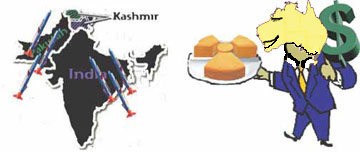 Pakistan says it should be allowed to buy Australian uranium November 17, 2011 BUSINESS RECORDER Pakistan says if Australia sells uranium to India, it too should be eligible for exports of the product. India’s arch rival is also a nuclear power and, like India, a non-signatory of Nuclear Non-Proliferation Treaty. Pakistan says it could use Australian
uranium to boost its civilian nuclear power programme.
And its High Commissioner to Australia Abdul Malik Abdullah told ABC Radio correspondent Michael Edwards in an interview that it would be discrimination to sell to India and not to Pakistan.
“We are not against uranium sales to India but that if they do go ahead they should also be available to Pakistan,” Abdullah was quoted as saying by ABC Radio on Tuesday. “In the past when United States, India nuclear deal had taken place, we feel that Pakistan was discriminated against. And we hope that this time, given our very strong and cordial relationship with Australia, Pakistan would not be discriminated against.”
Pakistan’s atomic programme began in earnest after India conducted its first nuclear test in 1974. It tested its first bomb in 1998. It’s also expanding its civilian nuclear power programme. ….. http://www.brecorder.com/business-a-economy/189/1251905/
Senator Ludlam to question India’s Ambassador on the arrest of David Bradbury
 Australian filmmaker detained in India while investigating nuclear industry Australian Greens Senator Scott Ludlam. 26 October 2012. Australian documentary maker David Bradbury was detained by police late yesterday in Tamil Nadu while investigating the Indian nuclear industry.
Greens nuclear policy spokesperson Senator Scott Ludlam said the arrest was only the latest in a series of moves to suppress criticism of India’s notorious nuclear sector.
“Mr Bradbury was approaching Idinthakarai, a village that has been subjected to severe police repression in response to anti-nuclear protests, when he was detained and taken to Radhapuram Police Station. He has since been released. I will be raising the matter with the Indian Ambassador today. Continue reading
Police stop Australian film-maker from entering Kudankulam anti nuclear protest area
 Australian filmmaker prevented from entering Kudankulam 25 Oct 12http://www.dnaindia.com/india/report_australian-filmmaker-prevented-
 from-entering-kudankulam_1756187 , Oct 25, 2012, Three persons from Australia were today prevented from entering Idinthakarai, the epicentre of protests by People’s Movement Against Nuclear Energy leading the stir against Kudankulam Nuclear Power Plant in Tirunelveli district, police said.
Filmmaker David Bradbury along with his wife and son arrived in India on tourist visas and were about to enter Idinthankarai from Kanyakumari district this morning when police stopped them near Radhapuram police station, they said.
“After interrogations, the three were made to go back, since prohibitory orders were in place,” an officer said.
The PMANE has been leading protests against the plant for over a year citing safety concerns.
Commissioning of the first unit of the Indo-Russian project was originally scheduled for December last year, but has been delayed due to the protest.
India: police deny they detained Australian David Bardbury
 Australian filmmaker detained, let off http://www.thehindu.com/news/states/tamil-nadu/australian-filmmaker-detained-let-off/article4031884.ece , 26 Oct 12, David Bradbury, a documentary filmmaker from Australia, was said to have been detained by the police at Kamanaeri village, near Thomas Mandapam, on his way to Idinthakarai village on Thursday evening Police, however, denied any such incident.
A local resident said a foreign national was intercepted by the police at Kamanaeri while he was on his way to Idinthakarai, the hub of the anti-nuclear protest. He was later taken to the Radhapuram police station and let off after some time. However, he was not allowed to proceed to Idinthakarai.
The Deputy Superintendent of Police, Valliyoor, K. N. Stanley Jones, denied that any foreigner was detained at the Radhapuram police station.
M. Pushparayan, a leader of the People’s Movement Against Nuclear Energy (PMANE), which spearheads the protest, said he had no knowledge of a filmmaker by that name planning to come to Idinthakarai.
Time for Australia to sign up to the new Kyoto Protocol
 Sign on now, UN climate chief says October 25, 2012 THE United Nations climate chief has called on Australia to sign up to a new round of the greenhouse-gas-limiting Kyoto Protocol, saying it already has significant clean-energy
policies in place.
EU likely to exceed Kyoto carbon-cut target
”From a national perspective it wouldn’t change that much what Australia is already doing,” the head of the UN Framework Convention on Climate Change, Christiana Figueres, said in Sydney. ”It would send a very clear message internationally that what Australia is doing at a national level is actually contributing to global interests.”
The comments by Ms Figueres come as the government weighs joining the federal opposition in backing a second round of the 1997 climate treaty. The current period of the Kyoto Protocol, under which most developed nations pledged to limit their greenhouse gas emissions, lapses at the end of the year. Continue reading
Gillard government takes its orders from USA – uranium to India
Gillard is helping to destabilise the sub-continent by fuelling a dangerous arms race involving India’s rivals, China and Pakistan.
The Labor government’s about face on uranium sales to India under Gillard was carried out on Washington’s orders. In November 2011, the US ambassador to Australia, Jeffrey Bleich, publicly called on Canberra to “sort out” its issues with India, as the US had done when it resolved the “thorny point” of uranium sales through the 2008 nuclear deal that exempted India from the Nuclear Non-Proliferation Treaty (NPT)

Australian PM visit to India bolsters new “strategic partnership” WSWS, By Patrick O’Connor 20 October 2012 Australian Prime Minister Julia Gillard’s three-day trip to India this week was aimed at deepening military, diplomatic, and economic ties between the two countries.
Washington has encouraged the closer relations as part of its aggressive drive to undermine the influence of China in the Indo-Pacific region. Gillard met with Prime Minister Manmohan Singh on Wednesday. High on the agenda was progress towards Australian uranium sales to India, Continue reading
Julia Gillard and Manmohan Singh in harmony over uranium sale plan
Gillard and Singh on song on uranium, The Age October 18, 2012 Adam Gartrell, AAP India’s leader has personally praised Prime Minister Julia Gillard for her government’s revised stance on uranium sales and has declared a “new chapter” in the bilateral relationship.
Manmohan Singh and Ms Gillard have formally agreed to start negotiations on a nuclear safeguards agreement to allow Australia to start selling uranium to India….
Australian uranium sales to India, fraught with hypocrisy and danger
If we really want to assist Indian communities who currently lack access to electricity – and we should – it would be far more effective to prioritise exporting Australian expertise in regional renewable energy systems.
the admission this week from India’s own auditor that the country’s nuclear industry is “dangerously unsafe, disorganised and, in many cases, completely unregulated” – only compounds concerns.
When Australian uranium leaves our waters it effectively disappears from the radar. This is a profound concern for a fuel that can power either nuclear reactors or nuclear weapons. High-level Indian officials have stated that they need to source uranium from overseas in order to free up their own uranium for military purposes
No smooth passage to India for Australian uranium http://www.abc.net.au/environment/articles/2012/10/18/3612800.htm DAVE SWEENEY, ABC 18 OCT 2012 PRIME MINISTER JULIA GILLARD is in India this week and amid the staged handshakes and solemn exchanges of signed papers. The uranium sales plan is being heavily promoted. But there is growing concern both here and in India about the implications of the move and the fast-tracking of nuclear-armed India into the global atomic club.
No doubt Julia Gillard will be employing the age-old tactic of highlighting a problem that no reasonable person could ignore and then seeking to ‘own’ the solution. Proponents of the sales deal point to the estimated 200 million Indians who do not have reliable access to electricity as a rationale for the sales deal. But to link Australian yellowcake with lights and cookers in remote Indian villages is to draw a very long bow. Continue reading
Legal challenge by Pacific Nations against sale of uranium to India?
 Pacific nations could challenge Australian uranium sales to India, ABC News, Stephanie March, Oct 12, 2012 Until last year, the Labor government in Australia had refused to sell uranium to India because it isn’t a signatory to the Nuclear Non-Proliferation Treaty, and is a nuclear weapons producing state A move by Australia to allow the export of uranium to India could face a legal challenge from Pacific nations…….International law expert Professor Donald Rothwell has told Radio Australia’s Asia Pacific program that could lead to a challenge under a 1985 treaty which governs nuclear testing and the use of nuclear materials from the region.
“Australia therefore has an obligation to ensure that its sale of uranium mined from within Australia is dealt with consistently with the provisions of the South Pacific Nuclear Free Zone Treaty,” he said.
“To that end, there’s very much an expectation that any sale would be only to countries that meet the Nuclear Proliferation Treaty obligation and that immediately raises an issue, because India, of course, is not a party to the NPT.”
The South Pacific Nuclear Free Zone Treaty, or the Treaty of Rarotonga was signed in 1985 by 12 nations in the Pacific and Australia.
Any objection under the Treaty of Rarotonga would have to be brought by one of the Pacific Nations that are signatories to the agreement.
Mr Rothwell says due to its history, the South Pacific does have a very strong record of being anti-nuclear
“The region fiercely contested France’s nuclear weapons testing program in the 1970s and as recently as the 1990s,” he said.
“So any concerns that might be raised by Australia’s conduct could well come from within the region and given the history of the region, it shouldn’t be completely ruled out…… http://www.abc.net.au/news/2012-10-12/an-australian-uranium-sales-to-india-could-face-pacific-challen/4311024?section=business
Prominent Indian citizens appeal to Australian Prime Minister against selling uranium to India
CNDP Appeals To The Australian PM Against Uranium Export to India http://www.countercurrents.org/cndp161012.htm 16 October, 2012
Dear Prime Minister,
We urge you to reconsider the decision to supply uranium to India. This uranium will fuel the massive expansion of nuclear power programme that the Indian government is undemocratically pushing on poor people of India, criminally overlooking the concerns of safety, environment, livelihoods of surrounding populations and the financial implications.
Supplying uranium to India also amounts to legitimizing its status as a nuclear weapons state. Continue reading
Gillard to India, to QUIETLY arrange uranium sale deal: uranium industry to lobby opponents
Uranium controls point to India deal, Financial Review, 4 Oct 12 “…..When she visits India in a fortnight, Prime Minister Julia Gillard will hold top level discussions that are expected to open the way to a uranium safeguards agreement that would contain strict requirements on the safe use of the fuel.
The strategy is intended to neutralise opponents who highlight that India has not signed the Nuclear Non-Proliferation Treaty.
 The final safeguards agreement will take some time but sources close to the negotiations said it was expected to boast the same regulations as the NNPT as well as strict rules on access to nuclear facilities in the world’s biggest democracy…….
Australia has previously refused to sell the nuclear fuel to India because the South Asian country hasn’t signed the treaty. Resource Minister Martin Ferguson in February 2011 opened up political debate on India uranium sales, saying Australia should be able to negotiate on a country by country basis rather than have a blanket ban on those who hadn’t signed the treaty.
That paved the way for Ms Gillard to prevail at Labor’s December national conference to overturn the party ban, amid opposition from cabinet ministers, including Communications Minister Stephen Conroy, Schools Minister Peter Garrett and Transport Minister Anthony Albanese…..
Ms Gillard will travel to India from October 15-17 and is expected to meet the government’s most senior officials about energy, trade and economic ties. Australia is going into its fourth round of negotiations on the Closer Economic Cooperation Trade Agreement…..
A final uranium safeguards agreement with India would first be analysed by the Joint Standing Committee on Treaties, which can make recommendations to the government. “Once the government puts the treaty to parliament the Joint Standing Committee on Treaties will have a certain amount of time look at it,” said committee chair and Labor MP Kelvin Thomson.
“On a contentious issue like this there would be public hearings before we make recommendations to the government and  the parliament.
“Generally, I think it is important we promote the nuclear non proliferation treaty, Australia is of course a signatory to that.”….
Mr Angwin said. “I think the implication between any agreement between Australia and India is to put pressure on those governments and political parties which have so far have not given their support to the expansion of the uranium industry.”
USA Green Party joins with Australian, Canadian, New Zealand Greens to oppose Trans-Pacific Partnership

 US Green Party signs international Green statement against “secret” Trans-Pacific Partnership pact October 1, 2012 WASHINGTON, DC — The Green Party of the United States has joined Green Parties of Australia, Canada, and New Zealand in a “Joint Statement on Trans-Pacific Partnership Agreement” that strongly criticizes the proposed international trade pact.
The text of the Joint Statement, which the Green Party of the United States has endorsed, is appended below.
“The Trans-Pacific Partnership, which was negotiated in secret by the Obama Administration, is meant to privilege corporate profits and enhance corporate power in the nations that rim the Pacific, including the U.S. This pact is a threat to jobs in the U.S. It contradicts claims by both President Obama and Gov. Romney that they want to put Americans back to work,” said Cheri Honkala, the Green Party’s vice-presidential nominee (http://www.jillstein.org).
“Every voter should know about the Trans-Pacific Partnership. Unfortunately, both Obama and Romney support it, which means it won’t be discussed in the presidential debates. Only Green candidates, including my running mate, Jill Stein, are talking about the Trans-Pacific Partnership publicly. This is why it’s so crucial that Dr. Stein participate in the debates,” added Ms. Honkala. Contacts:
Scott McLarty, Media Coordinator, 202-904-7614, mclarty@greens.org
Starlene Rankin, Media Coordinator, 916-995-3805, starlene@gp.org
Joint Statement on Trans-Pacific Partnership Agreement
http://www.greenparty.ca/statement/2012-08-21/joint-statement-trans-pacific-partnership-agreement

Australia would back USA and Israel attacking Iran, just like it backed attack on Iraq
 Gillard’s statements on Iran were a declaration of Australian support for war.
Gillard asserted that Iran “refuses to take the urgent steps necessary to build confidence that its nuclear program is exclusively peaceful.”
In fact, Iran is a signatory to the Nuclear Non-Proliferation Treaty. Inspections of Iranian nuclear facilities have repeatedly uncovered no evidence of the development of nuclear weapons—any more than UN inspectors found “weapons of mass destruction” in Iraq.
Australian PM demands UN rubberstamp war on Syria and Iran World Socialist Website By James Cogan 28 September 2012 Australian Prime Minister Julia Gillard delivered a speech to the United Nations General Assembly on Wednesday, demanding that the UN endorse imperialist intervention into Syria and rubberstamp a US bombardment of Iran… Continue reading
Australian company Mantra Resources duped Tanzania out of taxes for its uranium profits
 the transfer of Mantra Resources Limited to ARMZ enables its former shareholders to pocket $1.04 billion without paying capital gains to the Tanzanian government…. Mantra Resources Limited of Australia was supposed to have paid capital gains tax to Tanzania.
Sh320bn loss looming over uranium project , 29 September 2012 By Felix Lazaro, The Citizen Dar es Salaam. Tanzania risks losing about Sh320 billion in mining taxes because of weak legal checks, particularly when it comes to uranium.
Local mining experts said yesterday that the country must go back to the drawing board and put in place a watertight policy and regulations before it allows uranium mining.Earnings from the mineral are believed to have the potential to turn around the lives of thousands of poor Tanzanians.
The chief concern right now, though, is that some subsidiaries of multinational firms licensed to explore uranium in Tanzania are capitalising on a weak legal and institutional framework to transfer ownership to affiliated companies. In the process, there are missed opportunities to collect revenue. Continue reading
1 This month

of the week – Australians for War Powers Reform (AWPR)
To see nuclear-related stories in greater depth and intensity
 Antinuclear