Malaysian protest – Lynas, take back your radioactive wastes to Australia
 300 Malaysians protest plant on radiation fears TODAYonline May 20, 2011, KUALA LUMPUR, Malaysia (AP) – About 300 Malaysians have staged a peaceful protest against plans for an Australian-built rare earth refinery amid fears of radioactive pollution.The plant being built by Australian miner Lynas in eastern Malaysia ………..Protesters including opposition lawmakers marched Friday from Kuala Lumpur’s Petronas Twin Towers to a street near the Australian High Commission. Some carried banners that read “Go back to Australia” and “Malaysia not a radioactive waste dump site.”…..TODAYonline | Business | 300 Malaysians protest plant on radiation fears
Malaysian Protest Against Australian Company Lynas Dumping Radioactive Waste There
.……..lower environmental standards in Malaysia and double standards from Lynas.
SALLEH: I’m very concerned that Lynas is taking advantage of the loopholes in our laws, and does not implement, what it’s supposed to implement in Australia, but use a different standard here in Malaysia…..the authorities have issued a licence to Ashton rare earth, [in Australia] prior to Lynas acquiring it. And I had a copy of that approval and then, I saw, how stringent they are……
SINGH: If it’s reasonably that good, why don’t they do the processing within Australia, why send it to Malaysia? it is a classic example of a polluting industry being exported to a developing country………
Demonstrators are planning to rally outside the Australian Embassy in Malaysia’s capital Kuala Lumpor on Friday. May 19, 2011, Radio Australia may 18 2011
They’ll be protesting against the Australian mining company Lynas and its plans to process rare earths in Pahang state. Local communities and environmental groups have raised concerns over the management of radioactive waste. They say the waste product thorium will affect fishing, tourism and public health .. while the Malaysian government has also asked for more information. Continue reading
China’s scandalous record on nuclear power and civil liberties
 It is scandalous that Ziggy Switkowski is touting China as a great leader in nuclear power. All this while knowing how very dangerous is the nuclear industry, and how China is both excessively secretive and tramples on dissent and curtail civil liberties.

Nuclear issues are one area of significant environmental concern in China and occupied territories such as Tibet and East Turkestan. Considerable ecological damage caused by nuclear production, and uranium mining and the disposal of radioactive waste within China and the occupied territories of Tibet and East Turkestan……… – Christina Macpherson
“…..it has been reported that secret nuclear testing has also been going on with grave effects on the health of the people in the surrounding areas. An investigative report by London’s newspaper, The Independent, revealed that the areas surrounding the Lop Nor nuclear test site—on the eastern edge of the Taklamakan Desert—have a cancer rate that is 35 percent higher than the rest of China and higher than average rates of Leukemia, tumors, and birth defects such as cleft palates. …….A UK television documentary ‘Death on The Silk Road’ (Channel Four 1998) secretly filmed inside East Turkestan documented a range of illnesses linked to radiation exposure…………Greenpeace Ignores Tibet’s Nuclear Poisoning « Tibettruth
“………………Sun Xiaodi, in Gansu province, complained for years about pollution from a uranium mine and recently accused local officials of fraud. In July he was sentenced to two years in a labor-reform facility for “illegally providing state secrets overseas” and “rumor-mongering.” His daughter Sun Haiyan was sentenced to 18 months on the same charges………” Zhang Zuhua and Jiang Qisheng — To help fix the climate, fix human rights in China – washingtonpost.com
Australian MP calls for ban on Lynas dumping radioactive wastes in Malaysia
 “I also call upon the Transport Minister (Troy Buswell) to halt planned shipments of rare earth with radioactive Thorium 232 to Malaysia,”
Aussie MP: Don’t dump toxic by-products in Kuantan, Free Malaysia Today, G Vinod | May 18, 2011 An Australian MP has joined the chorus of calls to halt planned shipment of radioactive waste to Malaysia.
Namibia: it’s getting harder for Australian uranium miners to exploit the Namibians
| Second mining expo to be held amid fears of ‘nationalisation’ |  |
 |
 |
| Namicia Economist, by Nyasha Francis Nyaungwa | ||||||
| , 13 MAY 2011 09:41 | ||||||
| The 2011 Mining Expo which kicks off next week in the capital is being held at a time when the mining sector faces uncertainty after government recently declared uranium, copper, coal, diamonds and rare earth metals as strategic minerals. Last month, government through cabinet endorsed a decision that the right to own licenses for strategic minerals will only be issued to a state company. The dramatic shift in policy has caught many investors and would-be investors unaware …..“….the mining sector’s contribution to government revenue is not commensurate with its share to the gross domestic product. Such contribution is mainly through royalties levied on the market value of the minerals. This means that Namibia benefits from its natural endowment mainly through rent-seeking. This situation is untenable” the minister said……http://www.economist.com.na/index.php?option=com_content&view=article&id=23739:second-mining-expo-to-be-held-amid-fears-of-nationalisation&catid=588:special-focus&Itemid=70
President of the Mineworkers Union of Namibia (MUN), John Ndeutepo, says that in order to create a conducive labour environment for workers in the mining sector, there is a need for a paradigm shift…. companies try by all means to prevent its employees from being organised. Some even deny them their rights to freedom of association. It is a proven fact that one cannot make people work any longer; you will need to motivate workers in order for them to perform,” Ndeutepo added.He said that the mining labour sector is faced with great challenges that calls for urgent change. One such challenge is the ability of unions to address labour issues involving contract and agency labour cases. |
Some multi national companies do not even bother to monitor adherence especially when it comes to contractors and they even end up corrupting compliance officials,” he said.
Ndeutepo also called for the recognition of unions in the sector. He said that a lot of companies cannot yet get any returns from this relationship as they view the union as an enemy.—http://www.economist.com.na/index.php?option=com_content&view=article&id=23738%3Aunion-calls-for-a-paradigm-shift-within-the-mining-industry&catid=588%3Aspecial-focus&Itemid=70
USA – Australia deal for developing nuclear power
 U.S.-Australia civilian nuclear cooperation: issues for congress, Australian Policy Online, Mary Beth Nikitin, Bruce Vaughn 2 May 11, READ THE FULL TEXT
| U.S.-Australia civilian nuclear cooperation: issues for congress |
On 2 December 2010 a new US-Australia Civilian Nuclear Cooperation Agreement entered into force, …
This report, written by the Congressional Research Service states, ‘The agreement permits the export, subject to licensing, of information, material, equipment, and components for nuclear research and nuclear power production. .http://www.apo.org.au/research/us-australia-civilian-nuclear-cooperation-issues-congres
IAEA to help Australian company to leave radioactive wastes in Malaysia?
 growing public pressure to scrap the plant as environmental activists say it could make Malaysia a dumping ground for radioactive by-products
IAEA panel to advise Malaysia on rare earths plant. Reuters May 3, 2011 VIENNA – The U.N. nuclear agency will organise an expert panel to advise the government of Malaysia on the potential radiation risks of a rare earths facility planned by Australian miner Lynas , the agency said on Tuesday. Continue reading
Australian company Lynas wants Malaysia to take its radioactive wastes
 Alarm bells were raised when a report in April questioned how Lynas was going to dispose the waste material from the plant ……
there are questions as to why Lynas did not build the plant in Australia instead if it did not pose any danger to the environment and the people?
Baffling Perak can think of 2nd rare earth project when Japan radiation still fresh, The Star (Malaysia) – By B.K. Sidhu 29 April 11, IT is baffling that Perak can even think of accommodating a second rare earth project when the horrors of radiation in Japan are still fresh on the people’s minds and there was a major disaster involving a rare earth plant in the state just a decade ago. Continue reading
Australian uranium mining shares tumble as Namibia wakes up to foreigners’ exploitation
 comments Minister of Mines and Energy Isak Katali made in parliament last week about the Namibian people deserving to benefit more from the country’s resources have set some investors’ nerves on edge.
Extract Resources shares drop onNamibia government plan, Apr 28,2011 MELBOURNE (Reuters)…http://af.reuters.com/article/investingNews/idAFJOE73R06E20110428
Namibia nationalisation anxiety knocks uranium miners TORONTO (miningweekly.com) 29 April 11, – Uranium miner Paladin Energy moved to calm investors after its shares tumbled 7,4% on the TSX over reports that Namibia’s state-owned mining company wanted to claim all uranium mining rights, as well as other “strategic” materials… Continue reading
Australian company Lynas meets opposition to its rare earths plan
 The Star Online, said that if Lynas claimed the residue from the plant would be safe, it should be shipped back to Australia. “Malaysia cannot afford to keep a health time bomb here and we do not know when it will explode,”
Protests threaten Lynas’s Malaysian rare-earths plant, The Australian, Sarah-Jane Tasker , April 26, 2011 RARE-EARTHS miner Lynas’s plans for a processing plant in Malaysia have been thrown into doubt as local authorities review the proposal in light of concerns about radiation pollution. Continue reading
No real safeguards in Australia’s uranium to Russia
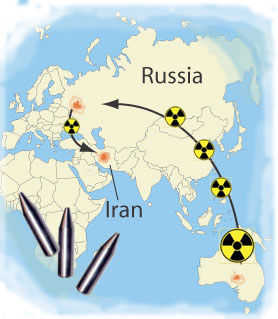 Fukushima sets faithful to spin mode James Norman The Australian April 11, 2011“………Given Julia Gillard ratified the nuclear co-operation agreement with Russia last November to supply Australian uranium, the apparent opportunism and the lack of transparency of the Russian nuclear industry is very much Australia’s business.The agreement struck with Russia contains no requirement for nuclear safeguards inspections, despite the rhetoric from the government and industry that “strict” safeguards will “ensure” peaceful use of Australian uranium in Russia.
Aside from the often stated reality that there is still no long-term safe way to dispose of nuclear waste, one of the most critical but frequently overlooked issues is the nuclear industry’s repeatedly proven connection to the proliferation of nuclear weapons. For those who remain sceptical of this connection, Iran, Pakistan and North Korea provide compelling examples….Fukushima sets faithful to spin mode | The Australian
Australia keen to sell uranium to Middle East, never mind the unrest there
“Doesn’t matter whether you’re a Communist dictatorship or a Middle Eastern Emirate” … “it seems Australia is more than happy to do the bidding of the uranium mining companies….a bad time to start selling uranium to the Middle East, given the unrest sweeping the area.”

Australia may sell uranium to UAE, Ipswich Queensland Times, Adam Gartrell, 9th March 2011 .Australian Greens Senator Scott Ludlam said the move was “profoundly unhelpful” to global non-proliferation efforts. AUSTRALIA is paving the way to sell uranium to the United Arab Emirates. Continue reading
Uranium exports and the Nuclear Non Proliferation Treaty
On the back of purported concern over climate change, there is increasing noise from vested interests about the need to sell uranium to India, allowing the country to limit its coal use and high greenhouse gas emissions.
This is a debate we need to engage with. We simply cannot avoid Australia’s moral and political hypocrisy in this area.
Fuelling Catastrophe: Uranium, Climate Change and Elephants – News and Events, Monash University, 7 March 2011 Dr Gavin M. Mudd,

In the midst of a debate about a proposed carbon tax – a tax we have to have (and should have had years ago) – there is another environmental proposal being prosecuted by a select minority of the Australian Government that is getting much less attention: uranium sales to nuclear-armed India. Continue reading
Danger for our region in uranium sales to India
there are fundamentally sound reasons why the Labor Party has resisted sales to India up to this point. The foremost reason is that India is not party to the Nuclear Non-Proliferation Treaty (NPT)
Uranium sales to India a recipe for regional insecurity Sydney Morning Herald, Leigh Hubbard February 18, 2011 The wheels are firmly in motion for the Labor Party to reconsider its position on the contentious issue of uranium sales to India if this week’s comments from Resources Minister Martin Ferguson and Paul Howes from the Australian Worker’s Union are any indication. Continue reading

Nuclear submarines: bad policy for Australia
.. bad policy and bad strategy. It turns entirely reasonable concerns about China’s military expansion into responses that verge on hysteria. The proposals are ill-defined and not costed. They would almost certainly prove counter-productive, if not downright dangerous, in terms of Australian policy towards China.
Panicky response would harm our interests Paul Dibb and Geoffrey Barker: The Australian * February 08, 2011 NATIONAL security policy is too important for federal ministers to stay mute when thoroughly bad ideas are put forward by influential government military advisers. That is why Foreign Affairs Minister Kevin Rudd and Defence Minister Stephen Smith should immediately reject proposals on how to counter China’s military expansion from Ross Babbage, as reported by Greg Sheridan in The Weekend Australian.
Babbage says Australia should acquire 12 nuclear attack submarines, host more US military bases, arm “arsenal ships” with cruise missiles and expand cyber warfare capabilities. Continue reading
1 This month
17 October, Free Public Talk on Nuclear Issues in South Australia
David Noonan will speak on public interest concerns over the new Roxby Downs Indenture Act 2026 on BHP copper-uranium mining and ore processing in SA, and on how AUKUS may face SA with a High-Level nuclear waste agenda.
Dr Jim Green will discuss international developments in the field of nuclear power including ‘small modular reactors’ and Generation 4 ‘advanced’ nuclear reactor concepts.


Help Aunty Sue Protect Her Land and Sacred Sites From Destructive Rocket Testing.
.

Australians deserve the truth
about
AUKUS – https://aukuspublicinquiry.com/

PETITION – To: Prime Minister Anthony Albanese and the Australian Labor Government

of the week – Australians for War Powers Reform (AWPR)
To see nuclear-related stories in greater depth and intensity

