The AUKUS operations are stalled because Australia cannot meet the nuclear waste disposal requirements of the non-proliferation treaty regime

13 Aug 24
Despite the somewhat difficult or convoluted language in the Agreement it gives the power and agreed authority to the International Atomic Energy Agency (IAEA) to demand a proper and safe means for the storage and disposal in accordance with the prescriptions of IAEA of all nuclear material including waste generated in or acquired by Australia by whatever means and for the continuing inspection and audit of that material by IAEA
This applies specifically to the nuclear waste generated by the rotational visits of the nuclear powered submarines of the United States and the United Kingdom with Australia being solely responsible for the management and disposal of that waste
Irrespective of the strength of AUKUS by the involvement of the United States and the United Kingdom the requirements of IAEA under the Agreement will be strongly demanded by the member states who are
signatories to the non-proliferation treaty regime
The international demands on this issue will be readily adopted since they go to the most basic principles of nuclear safety and both the United States and the United Kingdom are known to have serious problems with the management of their own nuclear waste
COMPREHENSIVE SAFEGUARDS AGREEMENT
From the latest available information the Comprehensive Safeguards
Agreement as described below has still not been varied which means
that the AUKUS arrangements cannot be fully implemented for the
purposes of the non-proliferation treaty regime
The reason is that Australia cannot meet all the safety requirements of
IAEA by not having the proper means for the management and disposal
of all the nuclear waste generated by the AUKUS activities in
accordance with its prescriptions as outlined in the publication by IAEA
as to Disposal of Radioactive Waste No. SSR-5 and other
prescriptions.
There is the problem of the disposal of all the
nuclear waste generated initially by the rotational visits of nuclear submarines of the United States and the United Kingdom to Stirling in Western Australia.
Australia by its foreign minister has advised IAEA that it is seeking
appropriate sites on Defence land for a facility for the AUKUS
generated nuclear waste but this has been insufficient for the variation
of the Comprehensive Safeguards Agreement and hence is delaying
the implementation of AUKUS
*********************************************
COMPREHENSIVE SAFEGUARDS AGREEMENT
The problem for Australia is that without a variation with the
International Atomic Energy Agency (IAEA) of the
Comprehensive Safeguards Agreement as it is commonly
called it will be difficult for Australia to implement the AUKUS
arrangements yet at the same time remain within the non –
proliferation treaty regime.
In order to achieve the variation Australia must show that it
has or is in the latter stages of planning a nuclear waste
facility for the permanent disposal of the nuclear waste to be
generated by the AUKUS operations.
COMPREHENSIVE SAFEGUARDS AGREEMENT
PROVISIONS
AGREEMENT BETWEEN AUSTRALIA AND THE INTERNATIONAL ATOMIC
ENERGY AGENCY FOR THE APPLICATION OF SAFEGUARDS IN
CONNECTION WITH THE TREATY ON THE NON-PROLIFERATION OF
NUCLEAR WEAPONS
Opened for signature at London, Moscow and Washington on 1 July 1968
and which entered into force on 5 March 1970
NON-APPLICATION OF SAFEGUARDS TO NUCLEAR MATERIAL TO BE
USED IN NON-PEACEFUL ACTIVITIES
Article 14
If Australia intends to exercise its discretion to use nuclear material which is
required to be safeguarded under this Agreement in a nuclear activity which
does not require the application of safeguards under this Agreement, the
following procedures shall apply:
(a) Australia shall inform the Agency of the activity, making it clear:
(i) That the use of the nuclear material in a non-proscribed military
activity will not be in conflict with an undertaking Australia may
have given and in respect of which Agency safeguards apply, that the nuclear material will be used only in a peaceful nuclear activity;
and
(ii) That during the period of non-application of safeguards the
nuclear material will not be used for the production of nuclear
weapons or other nuclear explosive devices;
(b) Australia and the Agency shall make an arrangement so that, only while
the nuclear material is in such an activity, the safeguards provided for in this
Agreement will not be applied. The arrangement shall identify, to the extent
possible, the period or circumstances during which safeguards will not be
applied. In any event, the safeguards provided for in this Agreement shall
apply again as soon as the nuclear material is reintroduced into a peaceful
nuclear activity. The Agency shall be kept informed of the total quantity and
composition of such unsafeguarded nuclear material in Australia and of any
export of such nuclear material; and
(c) Each arrangement shall be made in agreement with the Agency. Such
agreement shall be given as promptly as possible and shall relate only to
such matters as, inter alia, temporal and procedural provisions and reporting arrangements, and shall not involve any approval or classified knowledge of
the military activity or relate to the use of the nuclear material therein.
APPLICATION OF SAFEGUARDS
Article 2
The Agency shall have the right and the obligation to ensure that safeguards
will be applied, in accordance with the terms of this Agreement, on all source
or special fissionable material in all peaceful nuclear activities within the
territory of Australia, under its jurisdiction or carried out under its control
anywhere, for the exclusive purpose of verifying that such material is not
diverted to nuclear weapons or other nuclear explosive devices.
±±The relevant provision of INFCIRC/153 is paragraph 14
Paragraph 14 provides for the “non- application” of “the safeguards
provided for in the Agreement”, but only while the nuclear material is in
the non-proscribed military use. 15 Feb 2022
Australia indemnifies US and UK ‘against any liability’ from nuclear submarine risks

Guardian, Daniel Hurst Foreign affairs and defence correspondent, 12 Aug 24
New text reveals any party can terminate their collaboration on nuclear-powered boats with just one year’s notice
The United States, the United Kingdom or Australia could terminate their collaboration on nuclear-powered submarines with just one year’s notice, according to the terms of a new treaty designed to make the Aukus security pact a reality.
The Australian government published the text of the new agreement on Monday as it sought to dispel claims it was failing to tell the public about potentially significant political commitments to the US and the UK.
But opponents of the Aukus arrangement said the treaty contained “multiple get-out-of-jail-free cards for the US”, adding to pre-existing concerns a future president could back away from selling Virginia class submarines to Australia in the 2030s.
The concerns are based on US shipyard bottlenecks that are causing delays in the US meeting its own submarine production needs.
Under the Aukus plan announced in San Diego in 2023, Australia plans to buy at least three Virginia class submarines from the US in the 2030s.
Australia and the UK will then build a new class of nuclear-powered submarine to be known as SSN-Aukus.
The new agreement will allow for the transfer of nuclear material to Australia and it replaces a pre-existing treaty that allowed “for the exchange of naval nuclear propulsion information”.
……………………………………….. The document reveals Australia has agreed to take responsibility for any nuclear safety risks.
Australia will indemnify the US and the UK “against any liability, loss, costs, damage or injury” arising from nuclear risks “connected with the design, manufacture, assembly, transfer, or utilisation” of any of the material and equipment………………………………….
The Australian Greens’ spokesperson for defence, David Shoebridge, said he had “never seen such an irresponsible one-sided international agreement signed by an Australian government”.
“Every aspect of this agreement is a blow to Australian sovereignty,” Shoebridge said.
“This is the deal of the century for the US and UK who must be chuckling all the way to the bank having found the Albanese government and their billions in public dollars.”
Shoebridge and other critics of Aukus raised alarm last week when the US president, Joe Biden, revealed that the new treaty was accompanied by “a non-legally binding understanding” including “additional related political commitments”…………………..
The Australian defence minister, Richard Marles, said the treaty was “another significant Aukus milestone”………………….https://www.theguardian.com/world/article/2024/aug/12/aukus-deal-submarines-nuclear-termination-clause
Australia, US, UK sign nuclear transfer deal for AUKUS subs – AUSTRALIA RESPONSIBLE FOR THE SPENT FUEL WASTES
Australia would be responsible for the storage and disposal of spent nuclear fuel and radioactive waste from the nuclear power units that are transferred under the deal.
SYDNEY: Australia said on Monday (Aug 12) it had signed a deal to allow the exchange of nuclear secrets and material with the United States and Britain, a key step toward equipping its navy with nuclear-powered submarines.
It binds the three countries to security arrangements for the transfer of sensitive US and UK nuclear material and know-how as part of the tripartite 2021 AUKUS security accord.
AUKUS, which envisages building an Australian nuclear-powered submarine fleet and jointly developing advanced warfighting capabilities, is seen as a strategic answer to Chinese military ambitions in the Pacific region.
“This agreement is an important step towards Australia’s acquisition of conventionally armed nuclear-powered submarines for the Royal Australian Navy,” said Richard Marles, Australia’s defence minister and deputy prime minister.
Australia’s acquisition of a nuclear-powered submarine fleet would set the “highest non-proliferation standards”, he said, stressing that the country did not seek nuclear weapons.
The latest deal – signed in Washington last week and tabled in the Australian parliament on Monday – includes a provision for Australia to indemnify its partners against any liability for nuclear risks from material sent to the country.
Nuclear material for the future submarines’ propulsion would be transferred from the US or Britain in “complete, welded power units”, it says.
But Australia would be responsible for the storage and disposal of spent nuclear fuel and radioactive waste from the nuclear power units that are transferred under the deal.
“Submarines are an essential part of Australia’s naval capability, providing a strategic advantage in terms of surveillance and protection of our maritime approaches,” the transfer deal says.
China’s foreign minister Wang Yi warned in a visit to Australia in April that AUKUS raised “serious nuclear proliferation risks”, claiming it ran counter to a South Pacific treaty banning nuclear weapons in the region.
Peter Dutton’s nuclear lies.
Ian Lowe, The Saturday Paper, August 10–16, 2024, No. 512
https://www.thesaturdaypaper.com.au/2024/08/10/the-opposition-leaders-nuclear-lies#mtr
On June 19, Peter Dutton announced that a future Coalition government would introduce nuclear energy to Australia. A fact-check of the media release he sent out that day, and subsequent claims made by the leader of the opposition, reveals a whole series of factual errors, half-truths and barefaced lies. The media release urged an open discussion about nuclear power, but its tsunami of misinformation could have been designed to avoid serious evaluation of the proposal.
Before dealing with the explicit baseless claims, I remind you that the whole scheme is totally illegal. The Howard government legislated to prohibit nuclear power 25 years ago. Three states – New South Wales, Victoria and Queensland – have their own laws that would prevent building nuclear power stations. Since the initial media release, the Coalition found a lawyer who says the laws could be changed but didn’t admit that would require a majority in both houses of parliament.
There has been only one brief period in the past 30 years when the government had control of the Senate. Since the ban was actually proposed to the Howard government by the Greens, it beggars belief to think they would support its removal. The premiers of all the states proposed for nuclear power have come out against the scheme. Even Dutton’s Liberal National Party colleagues in Queensland, facing a state election in October, have hastened to distance themselves from the proposal. So there is a formidable legal barrier to the proposal to build nuclear power stations.
The media release claims “90 per cent of baseload electricity, predominantly coal fired power stations, is coming to the end of life over the next decade”. The clear implication is that the proposed nuclear power rollout would replace those plants. In fact, we now have about 21 gigawatts of coal-fired electricity. Three of the 15 power stations – Eraring and Vales Point B in New South Wales and Callide B in Queensland – are certainly scheduled to close by 2034 and take with them about five gigawatts of generating capacity. If a future Coalition government were to build its proposed seven nuclear power stations, that would roughly replace the three units that are certain to close. If 90 per cent of the capacity does actually retire, as the media release said, the proposed nuclear program would replace only about 30 per cent of the removed generation. What would then keep the lights on?
A second claim is that “zero-emissions nuclear energy … has proven to get electricity prices and emissions down all over the world”. This is one of nine places in the Coalition media release where the dishonest claim is made that nuclear energy is “zero-emissions”. Building a nuclear power station requires huge amounts of fossil fuel energy, about what would be produced by four years of nonstop operation. It has, like solar or wind, low emissions compared with burning coal or gas but nowhere near zero.
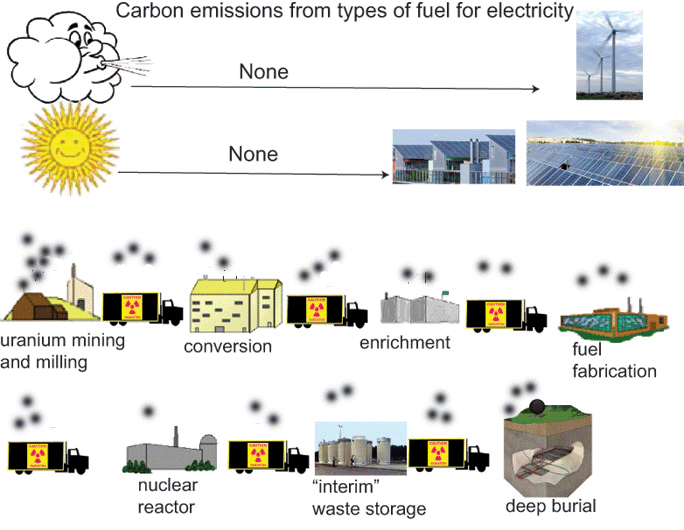
The dishonest claim of zero emissions implies we could use unlimited amounts and still meet our climate change obligations. In fact, building seven nuclear power stations would increase our greenhouse gas emissions and irresponsibly accelerate climate change.
Another falsehood is there in the very same sentence: nuclear energy is not used “all over the world”. Some 30 countries operate nuclear power stations, including four with just one reactor and six with two. About 160 countries don’t have any. Far from bringing prices down, the average price of nuclear power is much higher than solar, wind, hydro, gas or coal. Old power stations are being closed down because the costs of operation and maintenance mean they can’t compete with new solar farms and wind turbines. The world pattern of investment is telling. This year, about 500 gigawatts of new renewables will come on line. Hardly any nuclear power stations will start up. The electricity industry has voted with its chequebooks.
A third dishonest claim is that “Of the world’s 20 largest economies, Australia is the only one not using nuclear energy, or moving towards using it.” In fact, six of the 20 largest economies – Germany, Italy, Australia, Indonesia, Türkiye and Saudi Arabia – don’t operate nuclear power stations. Türkiye is the only one of those countries “moving towards using it”, with one nuclear power station being constructed.
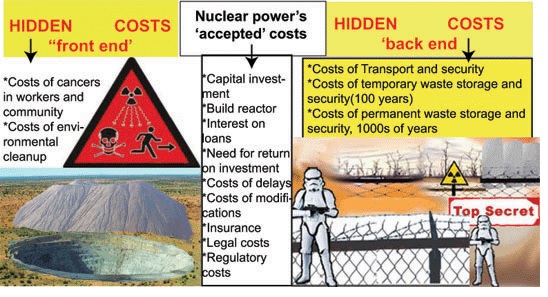
A fourth dishonest claim is that “A zero-emissions nuclear power plant will be a national asset delivering cheaper, cleaner and consistent energy for 80 years.” Again, the “zero-emissions” claim is false. Both current world average prices and regular CSIRO GenCost studies show nuclear power is far more expensive than renewables with storage. Historically, nuclear power stations have typically lasted 30 to 40 years, not 80. That is longer than the whole industry has existed.
The media release identifies “seven locations, located at a power station that has closed or is scheduled to close, where we propose to build zero-emissions nuclear power plants”. The list includes “Loy Yang Power Stations” and “Callide Power Station”. Loy Yang A is due to close in 2035, but Loy Yang B is scheduled to keep running until 2047. Callide B will close soon, but Callide C was commissioned in only 2001 and no closing date had been set. It is not true that all the power stations named will have closed within a decade.
Perhaps the most jaw-dropping of all the claims, however, is this one: “A Federal Coalition Government will initially develop two establishment projects using either small modular reactors or modern larger plants … They will start producing electricity by 2035 (with small modular reactors) or 2037 (if modern larger plants are found to be the best option)”. In fact, a report just released by the Australian Academy of Technological Sciences and Engineering shows it is unlikely we could buy small modular reactors before 2040. They do not yet exist anywhere in the OECD. Several different designs have been proposed, but they are all at the early stage of development. The idea they could be operating here by 2035 is pure fantasy.
The “modern larger plants” being built in Western Europe are years behind schedule, even though these are in countries with an established nuclear power industry, a working regulatory system and the skilled workforce needed to build these very complicated systems. The pro-nuclear Switkowski report, provided to the Howard government, concluded it would take at least 10 years and possibly 15 to build even one nuclear power station in Australia. It is just not credible to claim, even if the laws could be changed, that we could build seven by 2037, starting from scratch with no local experience and no regulatory system to assure the public of safety.
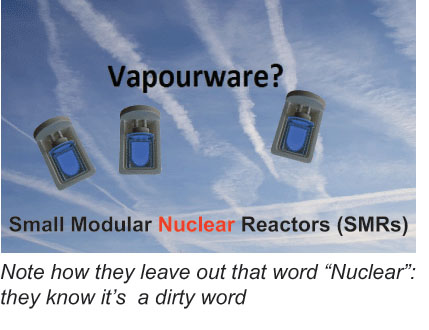
The label “small modular reactors” is misleading, too, giving the impression of a cute little device that would fit in your garage or a shipping container. The designs being proposed vary in size, but a typical so-called “small” reactor would require a site about the size of two football fields and would weigh several hundred tonnes. It would be “small” only when compared with most of the nuclear power stations that have been built. They have typically been much larger because there are economies of scale. For that reason, while there are no reliable figures at this stage, the CSIRO evaluation has consistently concluded that “small” reactors are likely to produce even more costly electricity than large ones.
A final piece of studied dishonesty is the statement that the current government’s approach of using renewables to provide our electricity would require 58 million solar panels and 3500 new wind turbines, giving a scary total investment figure. The clear implication is that seven nuclear reactors, for which no cost figures are given, wouldn’t cost as much. The recent track record for the building of nuclear power stations in Western Europe doesn’t provide much confidence. Hinkley Point C in the UK was meant to cost about $20 billion, but the total cost is likely to end up close to $100 billion. More seriously, the comparison is totally invalid. It compares an inflated estimate of the cost of providing enough renewables to meet all our needs with the unknown figure of the price of seven reactors. If they were ever to be built, they would provide about six gigawatts of generating capacity. Our installed capacity now is about nine times that much. A serious emissions reduction program will mean replacing petroleum transport fuels and gas heating with electricity. That will require doubling our capacity over the next decade. The Coalition is comparing apples with watermelons. They contrast the still-unrevealed cost of nuclear reactors to meet about 5 per cent of our needs with an inflated estimate of the cost of building enough renewables to supply our total demand.
The whole proposal is really a smokescreen. It is designed to hide the reality that a Coalition government would keep burning coal and gas for decades. There is also no plan to deal with the radioactive waste that nuclear reactors would produce, needing to be stored for geological time. The 2015 Nuclear Fuel Cycle Royal Commission, held in South Australia, estimated a storage facility would cost an eye-watering $41 billion. Peter Dutton’s nuclear plan is a farce. No part of it is real, plausible or sincere. As a proposal, it is probably the most dishonest ever put before the Australian electorate.
This article was first published in the print edition of The Saturday Paper on August 10, 2024 as “Dutton’s nuclear lies”.
Australian government would like the lucrative import of UK and USA nuclear waste ? But there’s a hitch.

Peter Remta. 12 August 24
From the information I have there is no question that Australia should like to import nuclear waste for permanent disposal principally from the United Kingdom but also from the United States if appropriate
The basic reason is that the payment for the disposal is considerable and will be some offset part of the substantial contributions – some would say astronomical – by Australia to the AUKUS arrangements
The United Kingdom has a reported legacy of 200,000 m³ of intermediate level waste with no means to dispose of it and has approached other countries for its disposal
The UK is hoping that Australia would take 40,000 m³ of this waste at obviously a negotiated fee but the applicable present cost internationally is $1.5 million a cubic metre of intermediate level waste
The British government had previously asked Australia to take this volume of waste for disposal but it could only be for long term storage at the proposed Kimba facility in South Australia which of course in timing and other reasons was not possible
An approach had also been made to Spain for disposal of that waste at the highly regarded El Cabril facility but the charges demanded by Spain were prohibitive despite being royal cousins
I understand it is affectively agreed that Australia will take 40,000 m³ of intermediate level waste as defined by the International Atomic Energy Agency from Britain as part of significantly assisting with the development and construction locally of the SSN AUKUS submarine fleet
However there can be no nuclear waste sent to Australia under the AUKUS arrangements until Australia achieves a variation of the Comprehensive Safeguards Agreement as explained in questions in the Senate, by Senator Jacqui Lambie .
Australia is still finding out what it doesn’t know about its secretive AUKUS deal
7.30 / By Laura Tingle, Sat 10 Aug 2024
When US President Joe Biden announced he would not be standing for another term, Australia’s political leaders expressed their gratitude for his contribution to public life. But this week, Australian voters had something else for which to be grateful to Biden.
For it was only as a result of a letter the US president wrote to the US Congress, that we found that there had been an update to the AUKUS agreement which will allow naval nuclear propulsion plants, rather than just nuclear propulsion “information”, to be transferred to Australia.
But it is not this part of the letter that has raised eyebrows and hackles even if, as usual, we find out about such deals from the Americans before we find out about them from our own government. The formal part of the deal will be exposed when it is submitted to the Treaties committee of our own parliament.
It is a side agreement, between the US, the UK and Australia that is of considerable concern: a non-legally binding “understanding” that includes “additional related political commitments”.
What are these? Well, they are secret.
The AUKUS saga moves on without much scrutiny
Critics argue that the “understanding” and “additional related political commitments” could include how and where these vessels are used. That is, what conflicts Australia would be expected to show up for, and how.
Some speculate on the possibility that it involves Australia agreeing to accept nuclear waste from the US and the UK, something the government has denied.
The idea that any of these such undertakings may have been made, but we aren’t allowed to know, is simply outrageous.
A quick recap of the AUKUS deal reveals that we are still expecting to receive two second-hand US Virginia class submarines, before embarking on building an entirely new, and so far unseen, British submarine in Adelaide.
Of course, we get a bit of a say in the design and plans for that new sub, don’t we?
Well the UK announced in October 2023 that it had selected BAE Systems for the SSN-AUKUS submarine. That month, Greens senator David Shoebridge asked officials about what involvement Australia had in the selection of the company that would build both the UK and Australian submarines.
The Australian Submarine Agency’s Alexandra Kelton told the Senate that “we had, through our high commission, some notification that an announcement would be made and some context around that but not of the content in great detail”.
The AUKUS submarine saga moves on with not much scrutiny in Australia, let alone apparently much input from Australia, given its cost and its huge strategic investment in one particular idea.
The second-hand Virginia class subs and later the AUKUS-class subs to be built in Adelaide are supposedly “sovereign Australian assets operating under the complete control of the Australian government”.
The Greens’ Shoebridge is one critic who warns the secret undertakings could include commitments on how the subs are used.
And this is a position which seems to be backed in by the authoritative papers written for the US Congressional Research Service.
Voters likely to be the last to know
In its latest update on the Virginia-class submarines, dated August 5, the Service’s analysts once again outline the relative benefits costs and risks of an “alternative division-of-labor approach”.
That’s technical talk for an alternative plan in which “up to eight additional Virginia-class SSNs would be procured and retained in US Navy service and operated out of Australia along with the US and UK SSNs that are already planned to be operated out of Australia … while Australia invested in military capabilities (such as, for example, long-range anti-ship missiles, drones, loitering munitions, B-21 long-range bombers, or other long-range strike aircraft)”.
That is, we don’t get any submarines, the Americans (and Brits) just run theirs out of here. Along with an expansion of bomber visits, personnel and troop rotations.
The “deterrence and warfighting cost-effectiveness” arguments for doing this “include [the fact that] Australian Defence Minister Richard Marles in March 2023 reportedly confirmed that in exchange for the Virginia-class boats, Australia’s government made no promises to the United States that Australia would support the United States in a future conflict over Taiwan.”
“Selling three to five Virginia-class SSNs to Australia would thus convert those SSNs from boats that would be available for use in a US-China crisis or conflict into boats that might not be available for use in a US-China crisis or conflict. This could weaken rather than strengthen deterrence and warfighting capability in connection with a US-China crisis or conflict.”
There’s a lot more like that.
Riled on Friday by the prime minister’s dismissal of his observations on AUKUS, Albanese’s predecessor Paul Keating warned that “the strength and scale of the United States’s basing in Australia will eclipse Australia’s own military capability such that Australia will be viewed in the United States as a continental extension of American power akin to that which it enjoys in Hawaii, Alaska and more limitedly in places like Guam”.
“Such an outcome is likely to turn the Australian government, in defence and security terms, into simply the national administrator of what would be broadly viewed in Asia as a US protectorate,” he said.
If that happens, voters are likely to be the last to know about it.
Laura Tingle is 7.30’s chief political correspondent
AUKUS Revamped: The Complete Militarisation of Australia
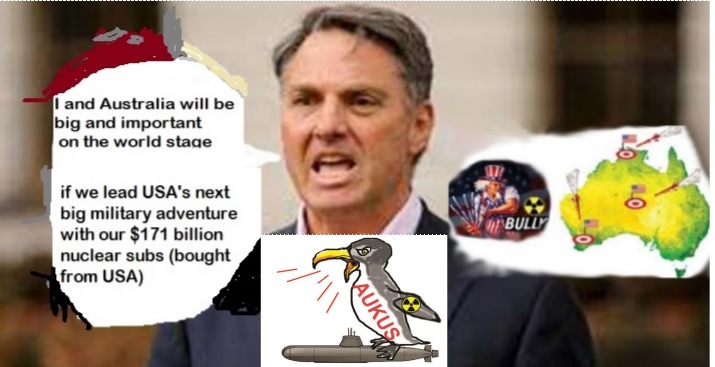
Marles, the persistently reliable spokesman for Australia’s wholesale capitulation to the US war machine, calls the document “the legal underpinning of our commitment to our international obligations so it’s a very significant step down the AUKUS path and again it’s another demonstration that we are making this happen.”
US military forces, in short, are to occupy every domain of Australia’s defence.
August 10, 2024, by: Dr Binoy Kampmark https://theaimn.com/aukus-revamped-the-complete-militarisation-of-australia/
There is much to loathe about the AUKUS security agreement between Canberra, Washington and London. Of the three conspirators against stability in the Indo and Asia Pacific, one stands out as the shouldering platform, the sustaining force, the political and military stuffing. But Australian propagandists and proselytisers of the US credo of power prefer to see it differently, repeatedly telling the good citizens down under that they are onto something truly special in being a military extension, the gargantuan annexe of another’s interests. Give them nuclear powered submarines, let them feel special, and a false sense of security will follow.
The August 2024 AUSMIN talks in Annapolis, Maryland, held between US Secretary of Defense Lloyd J. Austin III, US Secretary of State Antony Blinken, and their Australian counterparts, Richard Marles (Minister of Defence) and Penny Wong (Foreign Minister)provided yet another occasion for this grim pantomime. No one could be in doubt who the servitors were.
The factsheet from the US Department of Defense on the meeting is worth noting for Washington’s military capture – no other word describes it – and Australia’s sycophantic accommodation. As part of the “Enhanced Force Posture Cooperation,” the US and Australia are to advance “key priorities across an ambitious range of force posture cooperation efforts.” This is merely a clumsy way of describing the deeper incorporation of Australia’s own military requirements into the US military complex “across land, maritime, air, and space domains, as well as the Combined Logistics, Sustainment, and Maintenance Enterprise.” US military forces, in short, are to occupy every domain of Australia’s defence.
The greedy and speedy US garrisoning of Australia is evident through ongoing “infrastructure investments at key Australian bases in the norther, including RAAF Bases Darwin and Tindal” and “site surveys for potential upgrades at RAAF Bases Curtin, Learmonth, and Scherger.” Rotational deployments of US forces to Australia, “including frequent rotations of bombers, fighter aircraft, and Maritime Patrol and Reconnaissance Aircraft” are to increase in number. As any student of US-Australian relations knows, rotation is the disingenuous term used to mask the presence of a permanently stationed force – occupation by another name.
The public relations office has obviously been busy spiking the language with a sense of false equality: the finalising, for instance, by December 2024 of a Memorandum of Understanding on Co-Assembly for Guided Multiple Rocket Systems (GLMRS) – a “co-production”; finalising, by the same date, an MOU “on cooperative Production, Sustainment, and Follow-on Development of the Precision Strike Missile (PrSM)”; and institutionalising of “US cooperation with Australia’s Guided Weapons and Explosive Ordnance (GWEO) Enterprise.” Everywhere we look, a sense of artificial cooperation under the cover of Washington’s heavy-handed dominance, be it cooperative activities for Integrated Air and Missile Defence, or the hypersonic weapons program, can be found.
In this even more spectacular surrender of sovereignty and submission than previous undertakings, Canberra is promised second hand nuclear-powered toys in the form of Virginia Class submarines, something forever contingent on the wishes and whimsy of the US Congress. But even this contingent state of affairs is sufficient for Australia to bury itself deeper in what has been announced as a revised AUKUS agreement. More accurately, it constitutes a touch-up of the November 22, 2021 agreement between the three powers on the Exchange of Naval Nuclear Propulsion Information (ENNPIA).
The ENNPIA allows the AUKUS parties the means to communicate and exchange relevant Naval Nuclear Propulsion Information (NNPI), including officially Restricted Data (RD) as part of what is described as the “Optimal Pathway” for Australia’s needless acquisition of nuclear powered vessels.
In his letter to the US House Speaker and President of the Senate, President Joe Biden explains the nature of the revision. Less cumbersomely named than its predecessor, the new arrangements feature an Agreement between the three powers for Cooperation Related to Naval Nuclear Propulsion. In superseding the ENNPIA, it “would permit the continued communication and exchange of NNPI, including certain RD, and would also expand the cooperation between the governments by enabling the transfer of naval nuclear propulsion plants of conventionally armed, nuclear-powered submarines, including component parts and spare parts thereof, and other related equipment.”
The Agreement further permits the sale of special nuclear material in the welded power units, and other relevant “material as needed for such naval propulsion plants.” Transferrable equipment would include that necessary for research, development, or design of naval propulsion plants. The logistics of manufacture, development, design, manufacture, operation, maintenance, regulation and disposal of the plants is also covered.
Tokenistic remarks about non-proliferation are then made in Biden’s letter. The powers, for instance, commit themselves to “setting the highest nonproliferation standard” while protecting US classified information and intellectual property. This standard is actually pitifully low: Australia has committed itself to proliferation not only by seeking to acquire submarine nuclear propulsion, but by subsidising the building of such submarines in US and UK shipyards.
Marles, the persistently reliable spokesman for Australia’s wholesale capitulation to the US war machine, calls the document “the legal underpinning of our commitment to our international obligations so it’s a very significant step down the AUKUS path and again it’s another demonstration that we are making this happen.”
Obligations is the operative word here, given that Australia is burdened by any number of undertakings, be it as a US military asset placed in harm’s way or becoming a radioactive storage dump for all the AUKUS submarine fleets. Marles insists that the only nuclear waste that will end up on Australian soil will be that generated by Australia. “That is the agreement that we reached with the UK and the US back in March of last year, and so all this is doing is providing for the legal underpinning of that.”
Given that Australia has no standalone, permanent site to store high-level nuclear waste, even that undertaking is spurious. Nor does the understanding prevent Australia from accepting the waste accruing from the fleets of all the navies. Given the cringing servitude of Canberra, and the admission by the Australian government that they have made undisclosed “political commitments”, such an outcome cannot be ruled out.
Always reliably waspish, former Australian Labor Prime Minister Paul Keating gavehis assessment about the latest revelations of the AUSMIN talks. “There’ll be an American force posture now in Australia, involving every domain.” The Albanese government had “fallen for the dinner on the White House lawn.” That, and much more besides.
Australia being turned into ’51st US state’ – ex-PM

https://www.sott.net/article/493814-Australia-being-turned-into-51st-US-state-ex-PM 10 Aug 24
Canberra is losing its strategic autonomy due to its security pact with the US and UK, former Prime Minister Paul Keating has said.
The US is surrounding Australia with military bases under the AUKUS pact, which undermines the country’s sovereignty and makes it a legitimate target for China.
In an interview with ABC on Thursday, Keating, who served as prime minister between 1991 and 1996, voiced strong skepticism about whether his country benefits from being a member of AUKUS – a landmark security partnership between Australia, UK, and the US, which was announced in 2021. The pact, which has been condemned by China, focuses on helping Australia acquire nuclear-powered submarines.
Keating argued that by allowing the US to “displace our military” and surround the country with bases, Canberra is essentially giving up its right to determine its foreign and defense policy. Australia will “completely lose” its strategic autonomy as a result, he claimed.
“So AUKUS is really about, in American terms, the military control of Australia. The government of Prime Minister Anthony Albanese is “likely to turn Australia into the 51st state of the United States.”
The former prime minister added that the expanded military presence makes the country a target from China’s point of view.
“We’re now defending the fact that we’re in AUKUS… If we did not have an aggressive ally, like the United States, aggressive to others in the region, there would be nobody attacking Australia. We are better left alone.”
The US, he argued, is trying to “superintend” China, with tensions between the two being fueled by a power struggle over the self-ruled island of Taiwan, which Beijing views as part of its sovereign territory.
However, Keating argued that the Taiwan situation “is not a vital Australian interest” while China “has no strategic design” on Australia. The US attitude to Taiwan is comparable to China deciding that Tasmania needed help breaking away from Australia, he said.
The former prime minister’s remarks come after Australian Defense Minister Richard Marles and Foreign Minister Penny Wong traveled to Washington for talks about the AUKUS pact, and to discuss a new agreement on the transfer of nuclear material to Canberra as part of its push to acquire domestic-built atomic submarines from the 2030s.
China has warned that the AUKUS agreement raises nuclear proliferation risks, adding that it was conceived in the “Cold War mentality which will only motivate an arms race.” Russia has also sounded the alarm about the security situation in the Asia-Pacific, insisting that it “has no place for closed military and political alliances.”
Australia makes undisclosed ‘political commitments’ in new AUKUS deal on transfer of naval nuclear technology

ABC News, By defence correspondent Andrew Greene, 8 Aug 2024
In short:
AUKUS partners have struck a revamped agreement to allow the transfer of US and UK naval nuclear material to Australia.
Critics of the trilateral submarine project warn the new document could eventually see high-level radioactive waste stored locally.
What’s next?
The agreement between the US, UK and Australia will need to be ratified by each AUKUS partner before coming into effect.
Undisclosed “political commitments” have been made between the Albanese government and its AUKUS partners in a new agreement for the transfer of naval nuclear technology to Australia, which critics warn is likely to also allow radioactive waste to be dumped here.
The White House confirmed Australia, the United Kingdom and the United States had reached another significant “AUKUS milestone” that set up further trilateral cooperation that would be essential for this country to build, operate and maintain nuclear-powered submarines.
Under the AUKUS “optimal pathway” unveiled in San Diego last year, Australia will spend up to $368 billion over the next three decades to first purchase second-hand Virginia-class submarines and then develop a new SSN-AUKUS fleet using British technology.
In a letter to speaker the US House of Representatives speaker and the US Senate president, President Joe Biden urged Congress to give the revamped AUKUS agreement “favourable consideration”
Mr Biden’s letter explains that the new agreement would permit the continued communication and exchange of Naval Nuclear Propulsion Information (NNPI), including certain Restricted Data (RD), only previously shared between the US and UK…………………………………………………………………..
Concerns over radioactive waste ‘loophole’
AUKUS critics, including the Greens party, warn that the new agreement is likely to eventually allow high-level radioactive waste to be stored in Australia and for uranium enrichment to be undertaken locally, but the government insists that is not the case.
“A political assurance is there — a legal assurance, a legislative assurance, an institutional assurance is not. That gate needs to be closed, that loophole needs to be closed,” warns Dave Sweeney, a nuclear free campaigner from the Australian Conservation Foundation.
“And that’s one of many concerns and many options for interpretation of how AUKUS is operationalised that can add greater pressure, nuclear threat in our ports, in our harbours and waters and on land around the management of radioactive waste.” https://www.abc.net.au/news/2024-08-08/australia-makes-political-commitments-in-new-aukus-deal/104200814
Nuclear shift in updated AUKUS deal
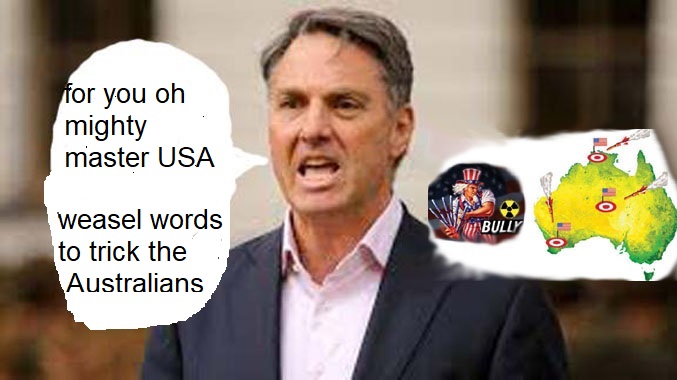
InDaily, 10 Aug 24
Australia’s acceptance of nuclear material from the US and UK has been officially approved as part of an updated AUKUS agreement.
The update to AUKUS was signed off during AUSMIN meetings in the US, the annual talks between Australian and US defence and foreign ministers.
Under the agreement, Australia will be formally permitted to take in nuclear material for the procurement of nuclear submarines.
The terms of the original deal, inked in March 2023, only allowed for the exchange of information about nuclear propulsion.
Defence Minister Richard Marles says the fresh agreement is a “foundational document” for the trilateral security pact……..
As part of the AUKUS agreement, Australia will acquire three Virginia-class vessels from the US before Australian-built nuclear submarines begin operating.
The $368 billion plan will bring eight nuclear-powered subs into service by the 2050s.
But the deal has come under renewed criticism from former prime minister Paul Keating, who says Australia is losing its autonomy by being part of it.
“AUKUS is really about, in American terms, the military control of Australia. I mean what’s happened? Our policy is likely to turn Australia into the 51st state of the United States,” he told ABC’s 7.30 program.
“The only threat likely to come for us is because we have an aggressive ally because of AUKUS.”………………………….
Australia would not be in a position to dispose of any nuclear material in the country until the 2050s, Marles said.
Details of the agreement were laid out in a letter to US Congress by President Joe Biden.
The agreement had also come under fire by Greens defence spokesman David Shoebridge, who said levels of secrecy about the terms of the deal was concerning.
“What is so damaging to the Albanese government with this new deal that it has to be kept secret from the Australian public?” he said.
“There are real concerns the secret understanding includes commitments binding us to the US in the event they go to war with China in return for getting nuclear submarines.”
It comes as opposition defence spokesman Andrew Hastie called for the WA government to include a minister dedicated to AUKUS in its cabinet. https://www.indaily.com.au/news/national/2024/08/09/australia-to-accept-nuclear-material-in-new-aukus-deal
For Australia, AUKUS and the planned nuclear submarines create more problems than solutions
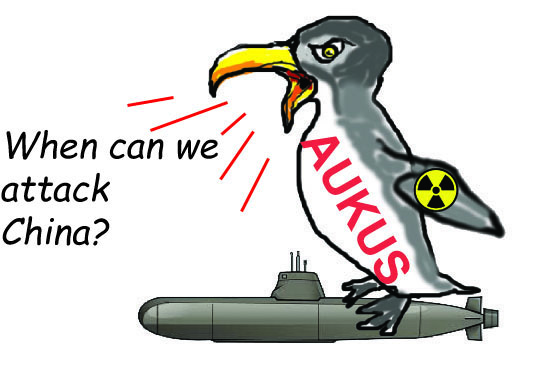
Preposterous’: AUKUS creates more problems than solutions THE AUSTRALIAN,
The timelines for Australia’s transition from ageing Collins-class to its first nuclear-powered sub just don’t add up. There is hardly a single strategist in the country who believes it will happen. By CAMERON STEWART 10 Dec 21

Now that Australia has finally weathered the diplomatic fallout caused by the creation of the three-nation AUKUS pact, it is time to work out exactly what it means for the nation’s security.
The Morrison government faces a series of critical multi-billion dollar decisions in the coming year that will set the course of Australia’s maritime defence for the next half a century.
These will require Canberra to test the limits of its alliance with both the US and the UK to ensure they make good on their AUKUS promise to share their sensitive nuclear know-how to help Australia acquire a nuclear-powered submarine fleet.
………….But the not-so-good news is that AUKUS has delivered as many conundrums for Australia as it has solutions.
………. the AUKUS announcement and the related scrapping of the French submarine project offers far more problems than solutions.
The timelines for Australia’s transition from its ageing Collins-class submarines to its first nuclear-powered submarine just don’t add up. Put simply, unless something changes, Australia risks having either no submarine fleet or a grossly antiquated one in the late 2030s and early 2040s……..
The government has given itself up to 18 months from the AUKUS announcement in September to study its options, although it says it hopes to decide on a plan of action earlier.
………………… The trouble is that the government’s initial projection for the completion of the first of eight nuclear-powered submarines, which it claims will be built in Adelaide, is not until 2038, meaning it would not be brought into naval service for another two years after that, in 2040, with one new nuclear boat every three years after that. This timetable is hugely ambitious and there is hardly a single strategist in the country who believes this will happen. The lessons of naval shipbuilding in Australia is that a first-of-class boat is never completed on time, much less the building of a nuclear submarine – easily the most complex construction of its kind in the country’s history.
……….
The solutions that have been floated, in no particular order, are to shorten the process by building at least some of the nuclear submarines overseas rather than in Australia; lease nuclear submarines from the US or UK; build a new conventional submarine in Australia as an interim measure; or extend the life of the Collins for a second refit cycle, meaning they would be sailing into the 2050s.
Every one of these proposals is problematic.
………………….. if the government chooses not to build a new conventional submarine and it deems that the Collins can be extended only for a decade, rather than two decades, then the only option is to acquire nuclear submarines more quickly than the current 2040 guideline.
This is the option that Dutton is pursuing but it requires delicate diplomacy with Australia’s AUKUS partners. First, Dutton must decide whether to ditch the government’s intention to build the eight nuclear submarines in Adelaide. While building all boats here will maximise Australian defence industry content, it will almost certainly slow the project down compared to a decision which would allow at least the first few boats to be constructed in US or UK shipyards.
Second, Dutton must choose between acquiring the US Virginia-class or the UK’s Astute-class submarines. Neither the UK nor the US production lines have room to include Australian boats in the foreseeable future. Dutton would need to lean heavily on London or Washington to make room for Australian boats to be constructed in their own shipyards. In the US, it would probably require Australia to partly fund a third shipyard to build the Virginia-class boats because the current two shipyards are struggling to keep up with the orders of the US Navy.
Hellyer believes the choice between the two countries is simple. “With nuclear submarines, we are not just picking a boat we are picking a strategic partner and that can only be the US,” he says…….
However, ditching the British submarine option would require delicate diplomacy from Canberra given that Britain’s prime minister Boris Johnson promised that the AUKUS deal would create “hundreds” of highly skilled jobs across the UK and would reinforce Britain’s place “at the leading edge of science and technology”.
The Morrison government appears to have gone cold on the option of leasing nuclear submarines to get them into the navy earlier. On closer inspection, neither the UK or the US have submarines available to lease. And in any case, Australia does not have the crews or the skills to sail them.
It will take at least a decade and probably longer for Australia to be able to train enough crew to the high levels required to man a nuclear-powered boat. A vast amount of that training will need to be done in the US or UK while Australia builds up the nuclear infrastructure and knowledge that will be needed to crew, maintain and manage a nuclear fleet.
All of these options amount to multi-billion dollar decisions by the government. If the wrong option is chosen, it will not only hit taxpayers, but it could severely compromise the country’s defence for decades.
The stakes could not be higher as the government moves to turn AUKUS from rhetoric to reality. www.theaustralian.com.au/inquirer/aukus-gives-us-more-problems-than-solutions-and-our-safety-is-at-stake/news-story/fff5b011740957f5cc246eb641408894
AUKUS servility just one facet of poor governance
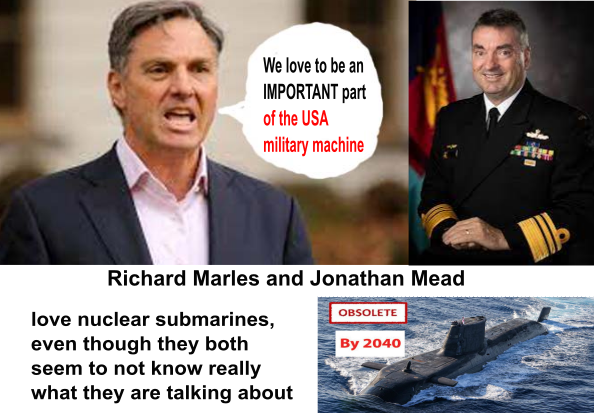
By Paul KeatingJul 31, 2024, https://johnmenadue.com/aukus-servility-just-one-facet-of-poor-governance/
Richard Marles has the Navy out in force firing torpedoes at AUKUS critics.
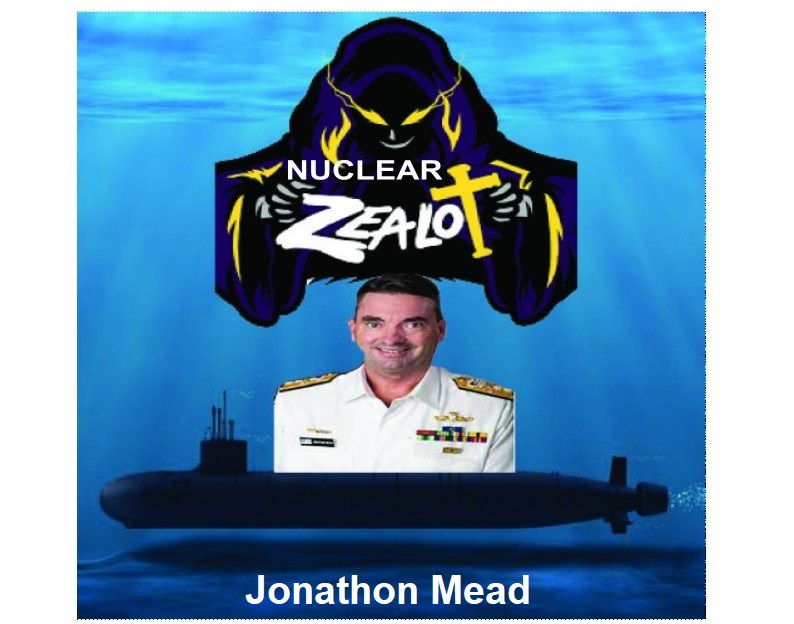
On Friday last, Vice Admiral Jonathan Mead claimed the critics need to produce evidence of any challenges to AUKUS being realised, then on Saturday, Vice Admiral Hammond, Chief of Navy, raised his periscope claiming the AUKUS debate was being ‘hijacked’ by people with ‘specific agendas’ without indicating what these agendas might be or who was likely making them.
The fact is, what clearly is being ‘hijacked’ is national accountability – accountability for the most wayward strategic and financial decision any government has taken since Federation.
Despite AUKUS’s half trillion of budgetary cost and its dangerous strategic implications there has not been one Ministerial Statement explaining its rationale, its strategic policy objective or defending its hugely distorting impact on government expenditures.
Not a coherent or persuasive word has come from the Minister for Defence or for that matter, the Prime Minister, let alone from a parliamentary debate on what is significantly a seminal turn in the country’s strategic and defence policy settings.
Vice Admiral Hammond, ignoring Australia’s geography – its residence among populous and prosperous Asian states, fell back on the old Anglo glee-club adage ‘three developed nations who have over 100 years of shared history, heritage, values and sense of purpose.’
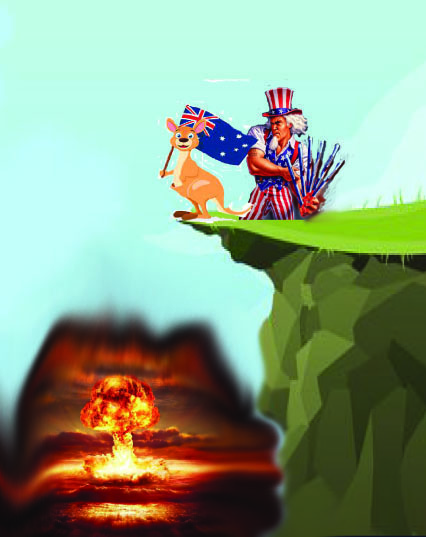
The likelihood is that Australia will not come into possession of nuclear submarines of its own making, but what it will certainly become is landlord and host to American nuclear submarines as the United States appropriates Australian real estate in its attempts, against all odds, to maintain strategic primacy in Asia. Odds that carry the likelihood of Australia being dragged into military skirmishes with China, or indeed, worse.
So irresponsible, secretive and smug has the government been in making its decision, that no amount of ‘hijacking’ by anyone else is likely to disrupt Australia from its current path of effectively falling into American hands, or at least, being abjectly at America’s beck and call.
Republished from Australian Financial Review, July 30, 2024
Experts argue for an Australian ban on nuclear weapons ahead of UN Summit
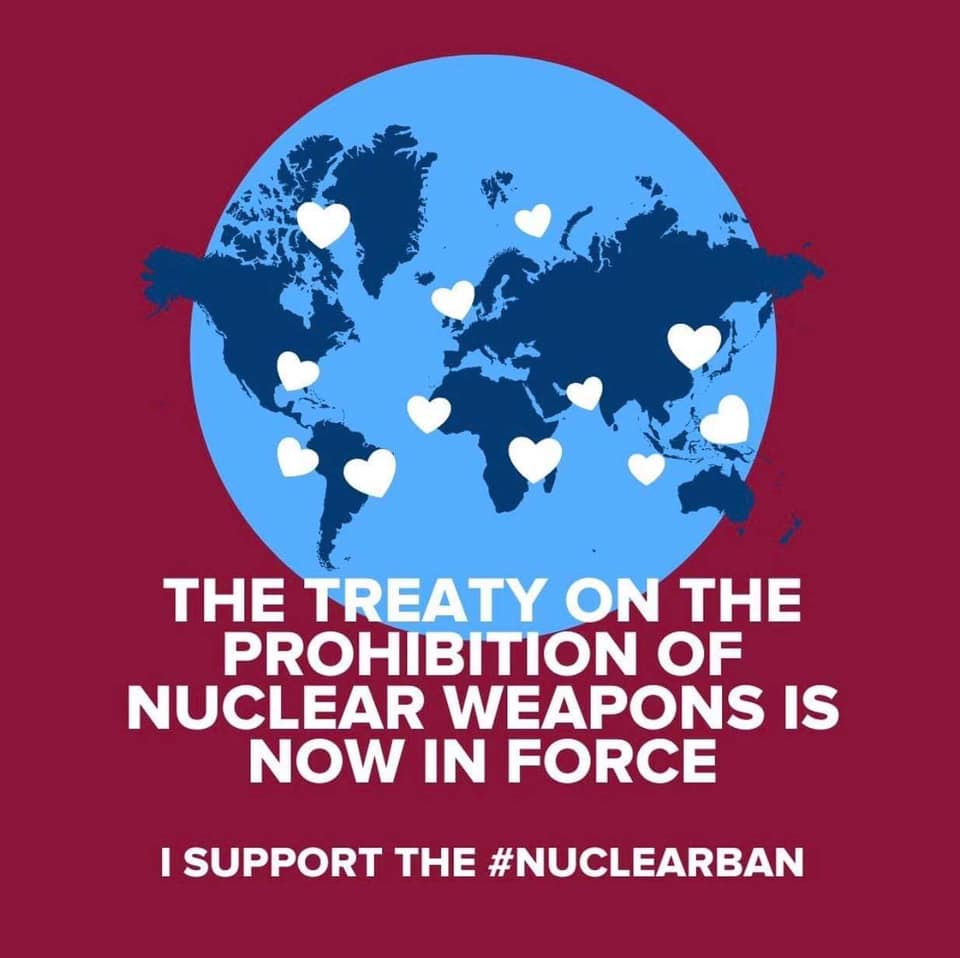
University of Melbourne experts are urging Australia to sign and ratify the UN Treaty on the Prohibition of Nuclear Weapons (TPNW) to commit most effectively to nuclear disarmament and non-proliferation.
The argument was made in ‘Luck is not a strategy: it’s time to prohibit Nuclear Weapons’, the second paper in a series prepared by the University of Melbourne’s Initiative for Peacebuilding to stimulate discussion of key issues on the agenda at the upcoming UN Summit of the Future.
Associate Professor Tilman Ruff AO, co-founder of the International Campaign to Abolish Nuclear Weapons (ICAN), which received the 2017 Nobel Peace Prize, ICAN Australia director Gem Romuld and Executive Director of ICAN Melissa Parke argue it is important Australia signs the Treaty before taking a seat on the UN Peacebuilding Commission in 2025.
Almost half the world’s nations have already joined the TPNW, which contains the only comprehensive prohibition of nuclear weapons and the only internationally agreed framework to eliminate nuclear weapons in a time-bound, verified way.
The TPNW is also the first nuclear weapons agreement to address the harm done by nuclear weapons use and testing.
Associate Professor Ruff argues Australia’s involvement is particularly critical given the number of available deployed nuclear weapons is increasing for the first time in two decades, along with explicit nuclear threats, and two nuclear-armed states – Russia and Israel – are prosecuting war, risking nuclear escalation.
No disarmament negotiations are underway, while hard won treaties limiting nuclear weapons have been abolished.
“Additional signatories, such as Australia, will contribute to the universalisation of the ban treaty, and its effectiveness,” Associate Professor Ruff said.
“For as long as we remain outside the treaty, promoting a role for nuclear weapons and assisting in their possible use in our defence policies, we are contributing to the problem.”
The Summit of the Future will be held from 22–23 September 2024 in New York, gathering world leaders to forge a new international consensus on how we deliver a better present and safeguard the future.
The Initiative for Peacebuilding, which brings together multidisciplinary research, engagement, and education to advance peacebuilding and conflict prevention in the Indo-Pacific region, plans to release a series of five policy briefs ahead of the Summit.
Associate Professor Ruff called for Australian leaders to harness this moment of great danger to sign the TPNW and then work towards ratification, just as Australia has joined the treaties banning other inhumane and indiscriminate weapons, including chemical and biological weapons, landmines and cluster munitions.
“Nuclear weapons are abhorrent, immoral, and illegal under international law. They are the worst weapons of mass destruction, and have no place in a secure and healthy future. Australia needs to signal its firm agreement and expedite signature and ratification of the UN-TPNW,” he said.
Australia further in the grip of the USA, with the Amazon data spy hub – paid for by Aussie tax-payers!
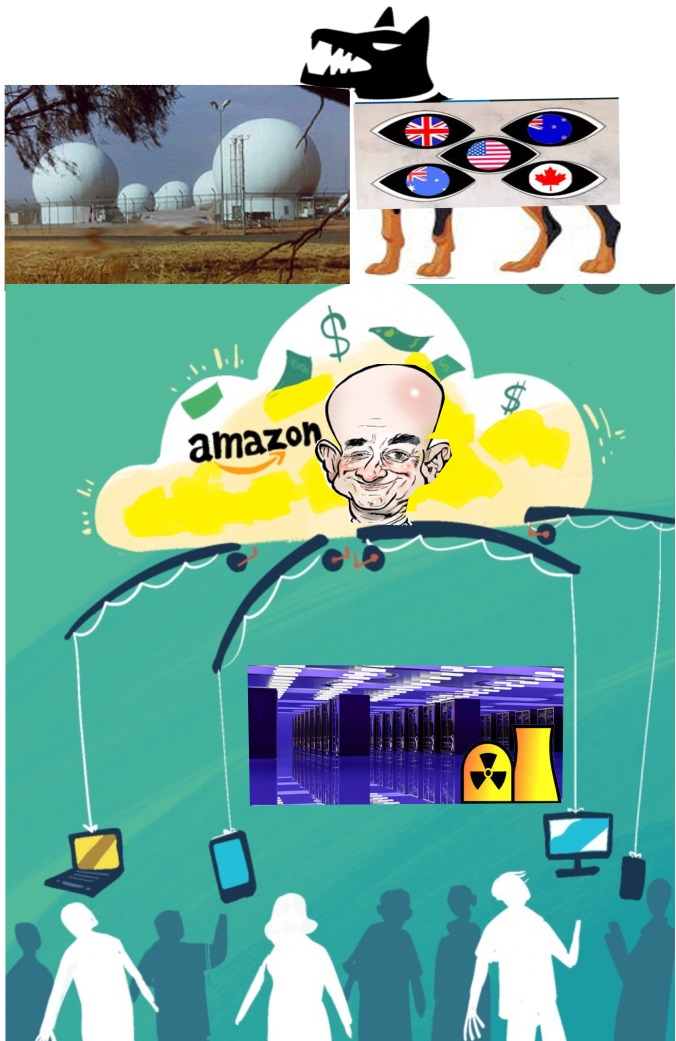
Australia’s Defence Minister Richard Marles was ecstatic as he announced the secret deal now organised for Australia to pay for Amazon to set up secret spy databanks, just as he was ecstatic about the government’s AUKUS deal for buying nuclear submarines from USA and UK
It’s not as if the public knew about either of these decisions beforehand, (the AUKUS one being largely arranged with scandal-ridden consultancy PWC). It’s not as if these matters were discussed in Parliament. On both occasions, the government just did it.
Points that haven’t been addressed:
Australian taxpayers again foot the bill to an America private company
Amazon private staff will be running the operation – with access to the data?
The whole thing perpetrates the lie about the data being “in the cloud” – but there is no “cloud”. The data will be in gigantic steel containers, set out on a large area.
The data containers will require massive amounts of electricity. ? supplied by nuclear power
The data containers will require massive amounts of cooling water, in this dry, water-short country..
The whole set up, just like the now-being expanded Pine Gap. will form a dangerous target for terrorists, or for enemies of the USA.
Like Pine Gap, it is probable that Australian authorities will have limited access to the information. And as artificial intelligence is involved – who IS going to be in control?
And what’s to stop the USA officials and the Australian government spying on Australian individuals via the Five Eyes?
The whole set-up will be the servant of the Five Eyes, secret intelligence of five English-speaking countries, ( no trust in Europe, or any non-anglophone nation) but controlled by the USA.
The vast amount of tax-payer money going to all this means the money is not going to Australians’ health, welfare, education, environment, climate action – in other words to the common good.
As the USA Supreme Court has just made the U.S. president effectively above the law – this secret deal with Amazon and the USA puts Australia more firmly in the grip of the USA – (and God help us if Trump wins).
The Release of Julian Assange: Plea Deals and Dark Legacies
It ultimately goes to the brutal exercise of US extraterritorial power against any publisher, irrespective of outlet and irrespective of nationality…………….. the measure extracts a pound of flesh from the fourth estate. It signals that the United States can and will seek out those who obtain and publish national security information that they would rather keep under wraps under spurious notions of “harm”.
June 27, 2024, by: Dr Binoy Kampmark https://theaimn.com/the-release-of-julian-assange-plea-deals-and-dark-legacies-2/
One of the longest sagas of political persecution is coming to its terminus. That is, if you believe in final chapters. Nothing about the fate of Julian Assange seems determinative. His accusers and inquisitors will draw some delight at the plea deal reached between the WikiLeaks founder’s legal team and the US Department of Justice. Others, such as former US Vice President, Mike Pence, thought it unjustifiably lenient.
Alleged to have committed 18 offences, 17 novelly linked to the odious Espionage Act, the June 2020 superseding indictment against Assange was a frontal assault on the freedoms of publishing and discussing classified government information. At this writing, Assange has arrived in Saipan, located in the US commonwealth territory of Northern Mariana Islands in the Western Pacific, to face a fresh indictment. It was one of Assange’s conditions that he would not present himself in any court in the United States proper, where, with understandable suspicion, he might legally vanish.
As correspondence between the US Department of Justice and US District Court Chief Judge Ramona V. Manglona reveals, the “proximity of this federal US District Court to the defendant’s country of citizenship, Australia, to which we expect he will return at the conclusion of proceedings” was also a factor.
Before the US District Court for the Northern Mariana Islands, he will plead guilty to one count of conspiracy to obtain and disclose national defence information under the Espionage Act of 1917, or section 793(g) (Title 18, USC). The felony carries a fine up to $10,000 and/or up to 10 years in prison, though Assange’s time in Belmarsh Prison, spent on remand for some 62 months, will meet the bar.
The felony charge sheet alleges that Assange knowingly and unlawfully conspired with US Army intelligence analyst Chelsea Manning, then based at Operating Base Hammer in Iraq, to receive and obtain documents, writings and notes, including those of a secret nature, relating to national defence, wilfully communicated those documents from persons with lawful possession of or access to them to those not entitled to receive them, and do the same from persons unauthorised to possess such documents.
Before turning to the grave implications of this single count and the plea deal, supporters of Assange, including his immediate family, associates and those who had worked with him and drunk from the same well of publishing, had every reason to feel a surreal sense of intoxication. WikiLeaks announced Assange’s departure from London’s Belmarsh Prison on the morning of June 24 after a 1,901 day stint, his grant of bail by the High Court in London, and his release at Stansted Airport. Wife Stella regularly updated followers about the course of flight VJ199. In coverage posted of his arrival at the federal court house in Saipan, she pondered “how overloaded his senses must be, walking through the press scrum after years of sensory depravation and the four walls” of his Belmarsh cell.
As for the plea deal itself, it is hard to fault it from the emotional and personal perspective of Assange and his family. He was ailing and being subjected to a slow execution by judicial process. It was also the one hook upon which the DOJ, and the Biden administration, might move on. This being an election year in the US, the last thing President Biden wanted was a haunting reminder of this nasty saga of political persecution hovering over freedom land’s virtues.
There was another, rather more sordid angle, and one that the DOJ had to have kept in mind in thinning the charge sheet: a proper Assange trial would have seen the murderous fantasies of the CIA regarding the publisher subject to scrutiny. These included various possible measures: abduction, rendition, even assassination, points thoroughly explored in a Yahoo News contribution in September 2021.
One of the authors of the piece, Zach Dorfman, posted a salient reminder as news of the plea deal filtered through that many officials during the Trump administration, even harsh critics of Assange, “thought [CIA Director Mike] Pompeo’s extraordinary rendition plots foolhardy in the extreme, and probably illegal. They also – critically – thought it might harm Assange’s prosecution.” Were Pompeo’s stratagems to come to light, “it would make the discovery process nightmarish for the prosecution, should Assange ever see trial.”
From the perspective of publishers, journalists and scribblers keen to keep the powerful accountable, the plea must be seen as enormously troubling. It ultimately goes to the brutal exercise of US extraterritorial power against any publisher, irrespective of outlet and irrespective of nationality. While the legal freight and prosecutorial heaviness of the charges was reduced dramatically (62 months seems sweetly less imposing than 175 years), the measure extracts a pound of flesh from the fourth estate. It signals that the United States can and will seek out those who obtain and publish national security information that they would rather keep under wraps under spurious notions of “harm”.
Assange’s conviction also shores up the crude narrative adopted from the moment WikiLeaks began publishing US national security and diplomatic files: such activities could not be seen as journalistic, despite their role in informing press commentary or exposing the venal side of power through leaks.
From the lead prosecuting attorney Gordon Kromberg to such British judges as Vanessa Baraitser; from the national security commentariat lodged in the media stable to any number of politicians, including the late California Democrat Dianne Feinstein to the current President Joe Biden, Assange was not of the fourth estate and deserved his mobbing. He gave the game away. He pilfered and stole the secrets of empire.
To that end, the plea deal makes a mockery of arguments and effusive declarations that the arrangement is somehow a victory for press freedom. It suggests the opposite: that anyone publishing US national security information by a leaker or whistleblower is imperilled. While the point was never tested in court, non-US publishers may be unable to avail themselves of the free speech protections of the First Amendment. The Espionage Act, for the first time in history, has been given a global, tentacular reach, made a weapon against publishers outside the United States, paving the way for future prosecutions.
1 This month

of the week – Australians for War Powers Reform (AWPR)
To see nuclear-related stories in greater depth and intensity
 Antinuclear