Where do candidates stand on nuclear waste dumping? Friends of the Earth are finding out
Sounding out candidates on nuclear https://www.whyallanewsonline.com.au/story/5991908/sounding-out-candidates-on-nuclear/?fbclid=IwAR3jlaHvuyECA2gwYQCZOGo6ysCmFwSKSGtyFUA8hD4IEex8CKJg6lK3GkQ, Louis Mayfield 3Apr19
Friends of the Earth National Nuclear Campaigners have been speaking to candidates for the seat of Grey ahead of the federal election to see where they stand on the proposed nuclear waste dump regional SA.
Mara Bonacci and Jim Green were in Whyalla on Tuesday and met with trade unionists and one of the candidates for Grey.
The process of establishing a low-level and intermediate waste dump in Kimba or Hawker is currently delayed because of two court cases brought on by the Barngarla and Adnyamathanha traditional land owners.
“Unless people go out to find the information towns like Whyalla, Pirie or Lincoln don’t get it,” she said
“The Department of Industry, Innovation and Science are still open for submissions. People can still write to the government about this issue.”
Ms Bonacci said the scope of the federal government’s consultation during the site process had been very narrow.
“They’re looking at the sites proposed to house the facility rather than the towns it’s going to impact which is potentially all of the Eyre Peninsula,” she said.
Their visit is also a follow-up on a report from the Department of Industry, Innovation and Science made public last year which named Whalla, Port Pirie and Port Lincoln (among others) as potential nuclear waste ports. “There are communities that haven’t been told at all about being a nuclear port unless NGOs like the ones we work through had trawled through reports and identified these port towns,” Mr Green said.
“They’ve had no say, let alone a meaningful say on whether this goes ahead.”
To make a submission to the Department of Industry, Innovation and Science click here.
Coalition government rejects Clive Palmer’s call for nuclear power for Australia
Clive Palmer’s nuclear power plan for SA knocked back by Coalition, Chris Russell, The Advertiser, March 31, 2019
A push by the United Australia Party for nuclear power has been swiftly rejected by the Federal Government.
A spokesman for the party led by Clive Palmer confirmed nuclear was on the agenda.
“South Australia has a major energy problem and we, as a party, are discussing nuclear,” he said. “Australia has uranium reserves and nuclear is emissions free.
“Kristian Rees, our number one senate candidate is speaking with his SA candidates and party members on major issues like cheaper power, manufacturing and jobs.”
A planned announcement on nuclear power, reported by the Sunday Mail, was revealed early by Professor Adrian Cheok who quit the party despite being the No. 2 Senate candidate in SA.
The party spokesman said it was “disappointing someone who didn’t get what they wanted leaked confidential discussions”.
Federal Energy Minister Angus Taylor rejected the nuclear call.
“Nuclear power remains illegal in Australia and highly expensive to build and operate,” he said.
The Government has short-listed electricity generation projects that could warrant underwriting — but the program specifically excluded nuclear.
Last financial year, SA generated more electricity than it used, exporting the excess to Victoria.
Wholesale prices were 11 per cent lower than the year before, according to the Australian Energy Market Operator’s report on SA electricity.
Mr Palmer is the national leader but has yet to nominate for a seat. His options include his former seat of Fairfax, on the Sunshine Coast, and Herbert, based in Townsville.
The Senate ticket for Queensland also is unresolved.
A party spokesman said Mr Palmer was expected to be endorsed “very soon”.
Government ‘failing’ on climate change: poll

SBS News, 1 Apr 19, As the federal election approaches, new polling shows how public attitude to climate change are shifting. Only 13 per cent of Australians believe the Morrison government is doing a good job in addressing climate change, according to a new poll.Results from an Ipsos poll released Sunday framed public perceptions of climate change in the leadup to the federal election, due in May.
It found almost half of Australians now feel that “honouring the Paris Climate Agreement should be a key priority” for this country.
And many Australians want to go even further. Forty per cent said they would like to see an emissions reduction target set that goes beyond reducing emissions by 26 per cent – 28 per cent on 2005 levels by 2030 as set out in the Paris agreement.
In a statement, Ipsos said the poll “uncovered a growing momentum for action on climate change and acceptance of the role of humans in causing it”.
“We also [found] that the majority of Australians believe that they will not be negatively impacted by a move towards renewables and that support for climate action by the government is on the rise.”……. https://www.sbs.com.au/news/government-failing-on-climate-change-poll
Clive Palmer will promise to build a nuclear reactor in South Australia
Clive Palmer will promise to build a nuclear reactor in SA, United Australia Party defector claims, The Advertiser MARCH 30, 2019
Building a nuclear reactor in South Australia will be Clive Palmer’s final pitch to voters on the eve of the Federal Election, a man who was selected to represent him has told the Sunday Mail.
The bold project has been revealed by Adrian Cheok, who was selected to run as the second Senate candidate for Palmer’s United Australia Party.
Professor Cheok has quit the party, in part because he says the mining magnate is not the Donald Trump-like figure he wanted to represent.
The awarded University of Adelaide alumnus, who has specialised in human-computer interfaces, has also told the Sunday Mail:
CANDIDATES elected to parliament who then leave, or breach party rules, have to repay $250,000 as a reimbursement for the costs and expenses of the party.
TRUMP’S chief strategist Steve Bannon and Mr Palmer had a meeting to discuss political tactics.
CEASE and desist notices are used as a tactic to stop party members talking to each other about policy.
PALMER kept asking the professor to get a haircut to match a picture, taken from social media and used on party promotions, from 15 years earlier.
AGREEMENTS were made for him work as chief of staff for the party’s lead candidate, former Adelaide United soccer player Kristian Rees, for three years and then take over the Senate spot.
The party did not deny the claims when contacted by the Sunday Mail but said that Professor Cheok had resigned because he “wasn’t happy” being the number two Senate candidate.
Professor Cheok said the party’s big idea to woo South Australian voters would be something that has never been done in Australia, would require expertise from overseas and would not employ “a single worker from Salisbury”.
“He said to me that ‘one week before the election we are going to announce South Australia is going to have a nuclear reactor’,” he said.
“He said ‘it is going to win us the election in South Australia’. I think everything is related to mining in his mind.”…..
Bill Shorten’s climate policy, much better than Liberals’, but it might appeal to some Liberal voters?
Bill Shorten treads gently with careful climate change plan, https://www.brisbanetimes.com.au/politics/federal/bill-shorten-treads-gently-with-careful-climate-change-plan-20190331-p519di.html, By Shane Wright, March 31, 2019 The environment has claimed many political victims since the 2007 election.
John Howard, Kevin Rudd, Julia Gillard, Malcolm Turnbull and even Tony Abbott were all, to an extent, brought down by their response to climate change. And if Scott Morrison is defeated at next month’s election there’s likely to be a mention of the issue in his political epitaph.
Which means Bill Shorten is well aware of the dangers around Labor’s latest climate change approach, which is being made public in the shadow of the federal budget and just six weeks out from an election.
Hence the absence of a carbon tax, the use of safeguard mechanisms which were introduced by Turnbull, the exclusion of agriculture except for where farmers and landholders may be able to turn a buck, handouts to trade-exposed businesses and credits to firms that over-achieve.
By targeting vehicle emissions, Labor is tapping a worldwide trend which already has countries such as China and Britain effectively outlawing the sale of new petrol-driven vehicles from 2040.
Labor isn’t even going this far. Instead, it is setting a target of 50 per cent new car sales being electric while also looking to lift overall vehicle emission standards.
The demise of the Australian car manufacturing industry means any fight against the proposed changes will have to be led by the government if it dares.
But arguing against tighter emission standards would run the risk of the Coalition looking like those who bemoaned the removal of lead from petrol in the 1980s.
Not that the government won’t try. While the $100 lamb roasts may be gone, it’s already trying to claim that a snag at the local school fete could go through the roof under Shorten.
Labor’s policy is as much an effort to neutralise the political attack as to find ways to truly reduce Australia’s greenhouse gas emissions.
Bill Shorten doesn’t want his name added to the list of those MPs claimed by Australia’s climate wars.
Labor’s climate plan
https://www.sbs.com.au/news/labor-s-climate-plan 31 Mar 19
Labor has promised to get Australia’s 250 biggest polluting companies to cut their emissions if the party wins the next election.
*Extend the safeguard mechanism to a threshold of 25,000 tonnes of direct carbon pollution annually
* This will capture about 250 of Australia’s biggest polluters.
* Pollution baselines will be reduced over time below current levels, in consultation with businesses
* Agricultural sector is exempt, working towards carbon neutral by 2030
* Energy companies also exempt, covered by Labor’s energy policy
* Steel, aluminium and cement companies supported to remain trade competitive
* Kyoto credits will not be carried over to count towards the Paris target
* Half of all new vehicles sold by 2030 to be electric
* New government vehicles to be 50 per cent electric by 2025
* New vehicle emissions standards for car retailers, electric cars to offset higher polluting vehicles
* Restoring the Climate Change Authority
SOURCE: Labor
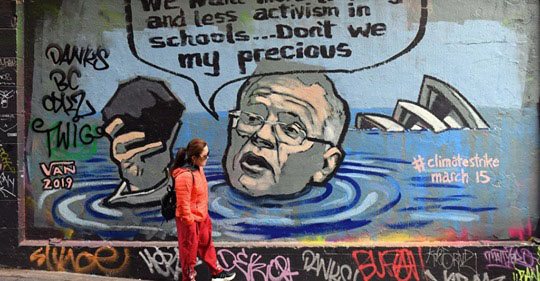
Home Affairs Minister, and wannabe Australian P.M> Petewr Dutton rubbishes the climate action schoolkids
‘Defies common sense’: Peter Dutton takes aim at school climate strikers Peter Dutton has taken aim at school students who protested about inaction on climate change, saying they would be sitting in the dark without coal-fired power. https://www.sbs.com.au/news/defies-common-sense-peter-dutton-takes-aim-at-school-climate-strikersHome Affairs Minister Peter Dutton has laid the boot into Australian students who skipped school to rally against inaction on climate change.
Nearly 40,000 students took the day off school last Friday to participate in strikes around the country.
Mr Dutton said it was “100 per cent right” to suggest people would be left to sit in the dark if coal-fired power was stripped from the grid for 48 hours.
“Let the teachers tell their students that and go out on strike – but their mobile phones aren’t being charged,” he told 2GB radio on Thursday. This is how stupid the debate’s gotten, it defies common sense.”
New South Wales Labor’s pledge for ‘solar schools’
Labor promises $100 million for ‘solar schools’ https://www.smh.com.au/nsw-election-2019/labor-promises-100-million-for-solar-schools-20190315-p514i9.html, By Lisa Visentin, March 17, 2019 Labor leader Michael Daley has pledged to spend $100 million installing solar panels on hundreds of public schools across NSW.
Mr Daley linked his “solar schools package” to the recent student strike over climate change inaction, and said the policy would help teach students about renewable energy.
“As we saw at rallies across the country on Friday, the next generation is demanding real action on climate change,” Mr Daley said.
“Putting solar panels on schools will help students further their knowledge about renewable energy, as well as bring down their school’s power bills and reduce emissions.”
Under Labor’s plan, solar panels would be installed at 350 government schools. The $100 million package would be funded as part of the Labor’s $800 million “cool schools” policy to install airconditioning in every single classroom in the state.
Mr Daley’s announcement comes after he publicly backed the striking school students during a speech earlier in the week, describing their actions as a “demonstration of young leadership”.
His endorsement drew fire from Premier Gladys Berejiklian who said she was “appalled” the alternate premier was encouraging students to skip school.
It comes as a recent ReachTEL poll revealed climate change was a pressing concern for most NSW voters, with 57.5 per cent of voters saying it would influence the way they voted.
As part of the state election campaign, Ms Berejiklian has announced interest-free loans to 300,000 households for solar and battery systems while Labor has pledged to put solar on 500,000 homes over the next decade through rebates.
Ms Berejiklian earlier this week restated her government’s support for action on climate change and said NSW had the largest renewable projects in Australia.
“We’ve had a consistent position since we’ve been in government, that climate change is real and that as a government we need to do everything we can to deal with it and we have been,” she said.
It’s time that the Liberal Coalition politicians stopped manipulating dissent about climate change – and apologised to the Australian public
Malcolm Farr: ‘The public debate on the existence of climate change is over and we are owed an apology’
Some elected politicians have been too frightened or deliberately manipulative to acknowledge this issue. It’s time, writes Malcolm Farr. news.c om.au Malcolm Farr@farrm51 17 Mar 19, The public debate on the existence of climate change is over and we are owed an apology from those who prolonged it for self-serving political purposes.
They might acknowledge their disrespect for science, or for driving rejection as a vehicle for “brutal retail politics”.
Voices as varied as the schoolchildren who marched on Friday, the top ranks of Australia’s central bank, and federal department chiefs are warning of the consequences of those changes.
The debate continues, but it now is centred on measuring the urgency of a response to increasing climate instability, and the detail of that response.
Emergency services, diplomats and farmers are all seeking the best answers to climate change effects — effects which some of their flecked representatives for the better part of a decade said didn’t exist.
Military and intelligence agency leaders have warned climate change is a national security threat to Australia.
There still are holdouts, including a few reactionary MPs who continue to embrace Tony Abbott’s belief just over nine years ago that the science was “absolute crap”. And there is a fringe which make cases which can only be resolved by outlandish conspiracy theories, often along the dubious lines of the United Nations and One World Government.
And there are credible sources moving in the other direction.
Deputy governor of the Reserve Bank of Australia Guy Debelle last week made clear climate change is now a factor in tracking and guiding the economy; he gave no hint it was a UN plot.
But he did stress the need for an orderly transition to clean energy; a need for greater backing of renewable energy projects; preparing for new ways we work and the jobs available to us; and the broader task of readying the entire economy for change.
“Financial stability will be better served by an orderly transition rather than an abrupt disorderly one,” he said.
Last week, secretary of the Department of Home Affairs Mike Pezzullo mentioned climate change in a speech — Seven Gathering Storms — to a think tank.
Mr Pezzullo warned of states which might become ungovernable and a possibility of “mass displacement of people”.
Contributions to this displacement could be “poverty, hunger, water and resource scarcity, and a changing climate, which will have to be thought of as a systemic risk factor”.
These are just a few elements of government which have appreciated the existence and impact of climate change in ways some elected politicians have been too frightened or deliberately manipulative to acknowledge.
These are the folk who might consider an apology.
Tony Abbott is not the only denier in parliament but over a decade he has been the pacesetter if not the leader of that block of ignorance.
“The argument is absolute crap. However, the politics of this are tough for us,” he told a regional audience in December 2009.
“Eighty per cent of people believe climate change is a real and present danger.”
Just as Mr Abbott scorned majority views on same sex marriage, he early on resolved to ignore voters on climate change.
He used that rejection of evidence and local opinion to wreck the carbon price policy of Labor Prime Minister Julia Gillard, his offensive from Opposition against the so-called “carbon tax”.
His chief adviser in Opposition and when he became prime minister, Peta Credlin, in 2017 put that campaign into context.
“That was brutal retail politics, and it took Abbott six months to cut through and when he did cut through Gillard was gone,” she told Sky News.
And, Ms Credlin said, “It wasn’t a carbon tax, as you know.”
However, Mr Abbott was “hugely unconvinced” in 2009 and continued to harness his rejection of climate change science in 2017 in a speech he made in along on.
“Primitive people once killed goats to appease the volcano gods. We are more sophisticated now but are still sacrificing our industries and our living standards to the climate gods to little more effect,” he said.
But something happened 10 days ago.
Mr Abbott abruptly endorsed the UN backed Paris agreement on emission reduction, a process aimed at limiting climate change.
A sudden convert, he has yet to say sorry for his past rejection.
— Malcolm Farr is news.com.au’s national political editor. Continue the conversation @farrm51
Students’ climate action strike: 150,000 people at 60 locations across Australia
Students strike to demand climate action | ABC News
Climate strikes attract 150,000 supporters, https://www.sbs.com.au/news/climate-strikes-attract-150-000-supporters, 16 Mar 19, About 150,000 people took part in climate strikes across the country on Friday, with students planning more rallies if their demands for more action aren’t met. About 150,000 students, parents and activists have taken to the streets to protest over the federal government’s inaction on climate change.
Strikes were held across the country on Friday at 60 locations, as part of a global effort to shine a light on climate change.
The protests were estimated to be 10 times the size of those held in November. The students have three demands: stop the Adani coal mine in central Queensland, no new coal or gas, and 100 per cent renewables by 2030.
More strikes will be planned if the students don’t see the action they want from the government.
“If the politicians are just going to throw our futures away there’s nothing we can do but be out here and say: we’re not going to let you do that,” 15-year-old Olivia Boddington told AAP at a climate strike in Canberra.
“We’re not going to just go away.”
Huge crowds gathered across the country on Friday, including at Sydney’s Town Hall Square, outside Melbourne’s Old Treasury Building and in Brisbane’s CBD.
The movement was inspired by Swedish teen Greta Thunberg, who has been striking for climate action since last August.
The 16-year-old’s activism has earned her a Nobel Peace Prize nomination.
Senior cabinet minister Christopher Pyne criticised the students for striking, saying the move will damage their education.
However, Labor national president Wayne Swan defended student activism.
Animal Justice Party – pro nuclear advocate in sheeps’ clothing?
Well, I gave this party my preferences at the most recent election. But not any more. Rumour has it that there’s a strong pro nuclear presence in the Animal Justice Party.
This rumour is now confirmed by Michael Dello, Animal Justice Party candidate for Heffron, New South Wales.
I n response to a request about this, Michael Dello writes:
- Nuclear is one of the safest forms of energy per unit energy produced, safer than even wind and solar (in terms of lives lost per unit energy). Some highly publicised events make this seem untrue, but the st statistics support this. I admit that this isn’t simple, as nuclear causes more property damage per unit energy, but it seems far from clear that nuclear is more dangerous than wind and solar.
- Nuclear has saved millions of lives to date by pushing out coal. Granted, renewables have done this too to an extent.
- The production of renewable energy and batteries also has waste, in particular the process of mining nickel and lead which are used for batteries produce far more toxic waste (e.g. sulfur dioxide) per unit energy produced than nuclear.
- I don’t believe we can achieve the emissions reduction targets we need with renewable energy alone. I believe that nuclear power and a reform of our agriculture system (animal agriculture being the leading cause of climate change yet the most ignored in Australia by far) are important and neglected parts of this process.
- I don’t believe it is possible with current or even near future technology to have sufficient battery storage with renewables alone.
- Nuclear has a significantly smaller land use requirement than renewable energy. The environmental cost of clearing land to make room for renewable energy is non-trivial (less of an issue in SA than the east coast).
Matt Canavan, Australia’ s Minister For Nuclear and Coal, skirts around the truth about radioactive waste dump plan
Matt Canavan radio interview March 14th 2019 Fight To Stop Nuclear Waste In The Flinders Ranges
New South Wales Labor leader sticks up for the right of school students to strike over climate change
Michael Daley says NSW schoolchildren have right to strike over climate change, Guardian, Anne Davies
State Labor leader says education is ‘bigger than the classroom’ as he applauds students for ‘standing up and taking action’
The New South Wales opposition leader, Michael Daley, has backed the state’s schoolchildren striking and attending rallies on climate change, saying it was a democratic right to protest and “an important way to realise their own personal power”.
Speaking at a National Press Club event in Sydney, Daley said he supported the rallies on Friday, even though he might soon be the premier and responsible for ensuring children attend school.
“Education is also bigger than the classroom. It is based on life experience. That is, in part, the importance of being confident and passionate enough to form beliefs and being prepared to stand up for them,” he said.
“They don’t have a microphone or money like the big end of town. But they do have their democratic right to assembly. I support that right to protest especially when it comes to climate change and our fragile environment.
“And more importantly in this inert digital age, of acting on that belief. Of standing up and taking action for what you believe in – it is called leadership.”
Labor has sought to distinguish itself from the Coalition by promising more rapid action on climate change, including installing seven gigawatts of regional solar farms and establishing a rebate scheme to encourage households to install a further two gigawatts of rooftop solar……… https://www.theguardian.com/australia-news/2019/mar/13/michael-daley-says-nsw-schoolchildren-have-right-to-strike-over-climate-change
Angus Taylor, Energy Minister, confirms that the Morrison government considering supporting new coal projects
Angus Taylor says Coalition assessing new projects despite pushback from moderate Liberals, but says taxpayers will only support ‘viable’ projects
The energy minister Angus Taylor has confirmed the Morrison government is continuing to assess new coal generation projects despite pushback from moderate Liberals, but he says taxpayers will only support projects that are “viable”.
In a statement to Guardian Australia, Taylor confirmed the government was continuing to consider 10 coal projects through its power generation underwriting program, as well as new gas and pumped hydro proposals……
Taylor’s confirmation that new coal generation projects remain on the table for consideration comes as an open brawl is continuing within the Coalitionabout energy policy.
Queensland Nationals and the former deputy prime minister Barnaby Joyce are demanding the government commit taxpayer support to new coalregardless of whether or not the projects stack up economically, and city-based Liberals, under pressure from their constituencies, are pushing back against that offensive….. https://www.theguardian.com/australia-news/2019/mar/12/morrison-government-has-not-ruled-out-supporting-coal-energy-minister-says