Coalition’s climate armour takes beating, SBS, News 4 Mar 19, A group of climate experts has issued a joint statement to the government, calling for a 45-to-65 per cent emissions reduction target on 2005 levels by 2030. A group of climate science experts has warned the government Australia needs more policies to cut greenhouse gas pollution in line with international obligations.
“Climate change is becoming an economic wrecking ball and it’s already having an impact,” the Climate Council’s Will Steffen said on Monday, calling for an emissions reduction target of 45-to-65 per cent below 2005 levels by 2030, instead of 26-to-28 per cent.
The joint statement was released after the government’s emissions data revealed last week showed a 0.9 per cent increase on levels in the September quarter compared to the previous year.
While emissions are declining in the electricity sector, this progress is outweighed by rises in transport and industrial energy, fuelled by a 19.7 per cent increase in LNG exports.
Climate Council spokesman and former head of BP Australasia Greg Bourne says the government’s recent policy announcements – including $2 billion for the Climate Solutions Fund – are unlikely to make a significant difference.
“Pollution has increased year on year under the government’s recently re-badged Emissions Reduction Fund,” he said.
Angus Taylor again falsely claims Australia’s greenhouse emissions are falling, Guardian, Amy Remeikis
@amyremeikis The energy minister repeats PM’s line that emissions fell by 1% when the government’s own figures show the opposite The energy minister has again insisted Australia’s emissions are going down, when the government’s official figures show emissions continue to increase, as the government struggles to sell the latest incarnation of its energy policy.
NSW election roundup: independents join forces on climate changeThree possible kingmakers write to premier and opposition leader. Plus: the key promises made this week , Guardian, Josephine Tovey
Three independent MPs who could become kingmakers in the event of a hung parliament have put climate change, and “future-proofing” the environment and economy, at the forefront of their agenda. Sydney’s Alex Greenwich, Lake Macquarie’s Greg Piper and Wagga Wagga’s Joe McGirr joined forces on Friday to call on the two major parties to commit to a 10-year adjustment strategy for coalmining communities, “backed by substantial financial resources to affected regions”.“A transition away from coal is what the planet urgently needs but it requires planning to avoid social and economic impacts in mining regions,” they wrote in a letter to the New South Wales premier and opposition leader.
Polls have consistently suggested the main parties are locked in a dead heat, and a Coalition minority government is widely regarded as a likely outcome of the 23 March election.
Green finance experts say Australia is out of step with World Bank, Europe and the US, which are using funding to combat global warming
Australia is the only developed country that allows climate change funding to be used to upgrade coal-fired power plants, green finance experts say.
Experts say allowing Vales Point coal-fired power station to register with the Morrison government’s emissions reduction fund, rebadged this week as a “climate solutions” policy, puts Australia out of step with the World Bank, Europe and the US, which have all rejected using climate financing for coal power retrofits.
The World Bank has issued US$13bn in green bonds since 2008 to stimulate spending to combat global warming.
China has used green bonds to help build new coal-fired plants to replace older, dirtier stations on the grounds it reduces nitrogen-based emissions causing the country’s oppressive air pollution. But it announced in Decemberit would no longer consider “clean coal” plants – which still emit significant amounts of greenhouse gas – investments in green technology.
Sean Kidney, chief executive of the London-based Climate Bonds Initiative, says China’s shift leaves Australiaout on its own.
“If you were committed to meeting the goals of the Paris climate agreement, which the Australian government says it is committed to, this is just lunacy,” Kidney says.
“No investors in the western world will accept any green bonds that incentivise anything like coal station retrofits. From an investor’s perspective, coal is a dead duck.”
Emma Herd, chief executive of the Investor Group on Climate Change, says Australia is moving acrossthe trend by considering giving taxpayer support to coal. In addition to the potential support through the climate solutions fund, the government is considering underwriting the cost of building new coal-fired power stations.
In the past fortnight, mining giant Glencore has said it will cap coal production in response to pressure from shareholders, while Rio Tinto stressed it was the only large mining company with no fossil fuel investments, having sold its final coal assets to Glencore last year……..
I did enjoy watching Australia’s not very bright Minister for Resources, Matt Canavan, floundering about as he tries to cover up his ignorance of the subject! I did enjoy Matt Canavan triyng hard to shut up Senator Rex Patrick with his inconvenient questions about risks of nuclear waste – risks explained by Dept of Defence!
Hansard extract of Estimates Hearing on 21 February 2019 radioactive waste. [20:46]
Senator Canavan :….. we do have the uncertainty of a court case at the moment, the government hasn’t made any decision around future steps to test support for a radioactive waste facility at Kimba or Hawker. ……
Sen Patrick: – Could you give me some idea as to whether locations 45 and 45A were considered by the Commonwealth in the selection process? I note that both of those sites were recommended as a possibility in this very extensive report.
Sen Canavan: I’m not familiar with the land ownership of these two sites there. Are you saying they’re on Defence land— ……
Sen Patrick: Senator PATRICK: I just thought the department would have been aware of this study and would have some information…..
Senator PATRICK: If it is Defence land and outside the WPA, there has to be another reason, and I’m just asking for what that reason is. …
Sen Patrick I think everyone’s aware of 3 the CSIRO waste at Woomera, but there’s also another facility called Koolymilka, which is owned by Defence and has some intermediate-level waste, some of it owned by Defence, some of it administered by Defence.
I did ask for a copy of their manual, their emergency response plan. In that plan there were a number of risks that they identified associated with the facility. They included things like fire, flood, storm, civil protest activity at Woomera, missile strike from something that might be on the range, aircraft strike from an aircraft nearby and they mention, ‘terrorist activity aimed at accessing the facility for publicity purposes, or for removing drums from the facility for use in a dirty bomb’. That is a Defence assessment. It’s in their emergency response plan and they have a contingent for it. some sort of way of reacting to that plan. I’ve spoken to residents of Kimba who basically have said that the Department of Industry has been silent on that particular prospect even though it has been raised during community consultation. I’m giving the department an opportunity to lay out has the community been consulted about the possibility of a terrorist attack and what was the nature of that consultation, if there was any?
Senator Canavan: Can I say up-front that I’ve never been provided with any advice that this is at all a risk …. this has never been raised as an issue. I have no reason to believe there is any risk of this. …….. There is extensive work around the security of the facility. This is not an issue that we would consider to be a major risk. In the same way it’s been managed at Lucas Heights for decades, it will be managed in another site once that is developed, so it would be—
Senator PATRICK: Sorry, on what basis do you say that? Have you got some defence background? Have you had some briefings on this? Senator Canavan: Senator, this has been looked at, sorry, no— Senator PATRICK: I understand that. Senator Canavan: I’m going to intervene here, because now you’re verballing public servants— Senator PATRICK: No. I simply asked on what basis did she make the claim that there’s no risk
Senator Canavan: Yes, but you made the claim in an editorial way. I don’t want to go further. But I think you’re bordering on being highly irresponsible to be 5 throwing around potential risks that I don’t think are well formed. The assessments of— Senator PATRICK: This is a Department of Defence document, Minister ….
If the Coalition has had a climate epiphany, I’m Beyoncé, Guardian Katharine Murphy 25 Feb 19, Call the emissions reduction fund a ‘climate solutions’ fund if you like, but it doesn’t mean it is.
Let’s start with the good news. Scott Morrison is talking constructively about climate change because he is intelligent enough to understand that failing to do that renders the Coalition unelectable in parts of the country, and with parts of its own base.
Compared with where we’ve been, a Liberal prime minister standing up at a podium, accepting the science of climate change and making the case for action, is progress.
We need to acknowledge it.
But this isn’t, ultimately, a test of talking points.
It has to be a test of substance, and a test of whether or not you are prepared to be a grown-up government facing up to a significant policy problem – and the truth is the Coalition has been here before.
Right on this spot.
John Howard had a very similar epiphany in 2007, delivering a speech in Melbourne within sight of an election in much the same way Morrison did on Monday. Like Morrison, Howard knew the Coalition needed to switch course on climate policy because Australians then, like now, were fretting about extreme weather and the droughts that never seemed to end.
Howard signed the Liberal party up to emissions trading during his 2007 pivot. But after he lost the election to Kevin Rudd, madness descended inside the Coalition, and raged in full public view for a decade, with that madness killing most of the optimal policy solutions for dealing with emissions reduction.
While Morrison would like us to think that was all a bit of a bad dream, and the Coalition has actually been tremendous on climate policy despite all the compelling evidence to the contrary, the truth is the madness still defines the parameters of the policy.
Monday’s climate policy pivot reflects Morrison’s limited options. He’s unveiled a reboot of Tony Abbott’s Direct Action policy, kicking in more cash to the emissions reduction fund (although the cash only pans out at $200m a year), and giving it a new business card.
This mechanism will deliver some abatement, a significant chunk according to the government’s own projections, but the persistent question over the ERF as a mechanism (apart from why taxpayers have to pay, as opposed to big polluters) has always been whether it delivers any abatement beyond what would have happened anyway………
Just one more problem. You also have to line up Monday’s “climate solutions” pivot with the climate problem the government will create for itself if it proceeds to lock in more coal-fired power to Australia’s energy grid, underwritten by taxpayers, which is what the energy minister, Angus Taylor, keeps hinting he wants to do.
In order to hit reset on climate policy in a way that has some prospect of cutting through with the cohort of voters inclined to desert the government over this issue, and this issue alone, Morrison needed to do two things on Monday.
He needed to say sorry for all of that insanity. He needed to say I don’t know what came over us, but we aren’t going to do that again.
Prime ministers can do that in two ways. The first is to just say it, but that’s very hard for risk-averse politicians who equate public acts of humility with public acts of weakness.
The second is do it by implication: put forward a serious policy program that is an implicit apology for past misdeeds, and in so doing, project that you are prepared to stare down any internal brinkmanship that ensues.
That didn’t happen on Monday, and it didn’t happen on Monday because we all know what happens when the Coalition hits these particular tipping points.
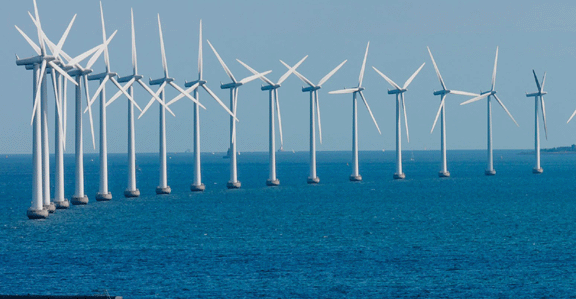
Development of Australia’s first offshore wind farm, which would power up to 1.2 million homes, has been stalled by Energy Minister Angus Taylor’s failure to sign off on an exploration license allowing a detailed assessment of the wind resource to commence.
Development of Australia’s first offshore wind farm, which would power up to 1.2 million homes, has been stalled by Energy Minister Angus Taylor’s failure to sign off on an exploration license allowing a detailed assessment of the wind resource to commence.
The Department of the Environment and Energy confirmed during Senate Estimates that an evaluation of the project has been undertaken, a plan for a customised exploration license developed, and a briefing and recommendations provided to the Energy Minister, but that the project can progress no further without the Minister granting the exploration license.
The Star of the South project seeks to construct 250 wind turbines in Commonwealth waters off the coast of Victoria’s Gippsland region, generating up to 20 per cent of Victoria’s electricity needs and feeding the power into the National Electricity Market via an underground cable to the Latrobe Valley.
The Maritime Union of Australia said the project — which the company claims will create up to 12,000 manufacturing and construction jobs and slash Australia’s carbon emissions — appeared to be falling victim to the Morrison Government’s ideological hatred of renewable energy.
MUA Deputy National Secretary Will Tracey said the exploration license awaiting approval did not allow construction to commence and was simply about allowing the use of floating buoys and platforms off the Gippsland coast to gather wind and wave observations.
“We have a major wind project that would create thousands of jobs and provide clean, reliable energy for more than a million Australian households, but because of their ideological hatred of renewable energy the Morrison Government appears to be actively stalling its development,” Mr Tracey said.
“The Star of the South project has been in the works since 2012, yet in this time no legislation has been put forward, no regulatory framework put in place, and no responsible agency nominated, despite offshore wind being an established industry internationally.
“Now we have revelations from Senate Estimates that Energy Minister Angus Taylor has been briefed on the project and presented with recommendations, yet the exploration license continues to sit on his desk gathering dust.
“Rather than support renewable energy projects, under the Morrison Government we can’t even get approval for a few wind measurement buoys off the Gippsland coast.
Energy Minister Angus Taylor must get off his hands and immediately allow the Star of the South wind project to move forward to the exploration stage.”
Mr Tracey said offshore wind generation was a mature industry internationally which has successfully operated for two decades, but Australia was falling behind, putting future employment opportunities at risk.
“This project isn’t just about generating renewable energy and tackling climate change, it’s about creating secure jobs for the future, particularly for workers who are being displaced from the offshore oil and gas industries,” he said.
“The Federal Government urgently needs to put in place a plan to support the development of the offshore wind industry, including a clear regulatory framework, along with the right port infrastructure and specialised construction vessels to roll out this project and others like it as quickly as possible.”
‘Everyone loves solar’: Climate action heats up as NSW election issue, Brisbane Times By Peter Hannam February 23, 2019 NSW voters, including conservative ones, want the state government to step up action on climate change, including boosting renewable energy, two separate polling sets show.
A statewide Essential survey conducted February 6-11 for the Nature Conservation Council of 544 respondents found 51 per cent were more likely to back a party boosting clean energy and 18 per cent less likely. Among those identifying as Liberal or National supporters, the ratio was 43 per cent in favour and a quarter against.
Three separate uComms surveys for Greenpeace, each of more than 600 respondents conducted in marginal seats of Ballina, Coogee, and Penrith, found higher support for renewable energy.
In Penrith, for instance, 60 per cent of Liberal voters said they were more likely to support a party investing in renewables and 30.7 per cent less likely. In Coogee, 52.1 per cent of Liberal voters were more likely to back a party with such policies, and 38.6 per cent against.
In Ballina, 65 per cent of National supporters agreed rooftop solar and batteries would cut household power bills for homeowners and renters, while 32.8 per cent disagreed.
The polling comes amid another torrid period of extremes. NSW smashed heat records in January, with temperatures almost six degrees about average and two degrees above the previous record set in bushfire-scorched January 1939.
Much of the state remains in severe drought – with 2019 off to a dry start amid rainfall levels typically less than a fifth of normal levels – sending reservoir levels tumbling and contributing to a series of mass fish kills and algal bloom outbreaks in the Darling and other rivers.
While climate scientists have yet to determine the role climate change is having, the background warming of more than a degree over the past century across Australia is raising the likelihood of heatwaves. Climate models also point to a long-term drying trend across southern Australia, including NSW, with more to come.
No policy’
The onus to demonstrate action to tackle climate change appears to fall heavier on the Coalition if the polling and last December’s federal byelection for the Sydney seat of Wentworth are any guide, Kate Smolski, chief executive of the Nature Conservation Council, said.
“Voters deserted the Liberals in Wentworth over climate change, and [this month’s] poll shows that it’s a statewide phenomenon,” Ms Smolski said.
“This is bad news for the Berejiklian government, which after eight years of Coalition rule still doesn’t have a climate change policy or a renewable energy target.”……..
the Greens plan to introduce a carbon change bill, including a broad carbon price, to reach the net-zero emissions goal by 2040.
“We need targets with teeth if we are going to actually decarbonise,” Cate Faehrmann, Greens environment spokeswoman, said. “That is why I have developed legislation which sets binding targets to reach net-zero emissions by 2040 and gives ordinary citizens the power to prosecute government ministers who are not serious about meeting these targets.”
Jeremy Buckingham, the former Greens and now independent MP, said policies are needed to tackle emissions from agriculture, industry and transport.
Scott Morrison to reboot Tony Abbott’s emissions reduction fund with $2bn PM to announce ‘climate solutions fund’ to appeal to voters concerned about Coalition’s record , Guardian, Katharine Murphy Political editor@murpharoo, 25 Feb 2019
Scott Morrison will attempt to appeal to voters deeply concerned that the Coalition has been been wreckers on climate change by rebadging Tony Abbott’s emissions reduction fund as a “climate solutions” fund – with $2bn to be rolled out over 10 years.
Attempting to draw a line over years of destructive in-fighting within the Coalition that has cruelled various emissions reduction policies, the prime minister will use a speech in Melbourne on Monday to launch a new package of measures on climate change, saying his government acknowledges and accepts the challenge “but we do so with cool heads, not just impassioned hearts”.
The emissions reduction fund is a vestige of Abbott’s heavily criticised Direct Action policy. Funded by taxpayers initially at $2.5bn, the ERF pays farmers and businesses to cut carbon dioxide pollution to below what it would otherwise be. But an investigation by Guardian Australia last year found it was often difficult to determine if the fund was offering value for money.
Morrison will confirm on Monday the ERF will be rebadged a “climate solutions fund” and given a 10-year funding profile. The rebooted fund will partner with farmers, local governments and businesses to deliver “practical climate solutions” across the economy that reduce carbon emissions.
The prime minister will also continue to assert that Australia will meet its Paris target despite the trend of rising emissions in the economy that has been evident in the government’s own figures since the abolition of the carbon price in 2013.
But a chart released in advance of Monday’s speech makes it clear the looming abatement exercise will rely significantly on accounting measures as well as on practical emissions reduction.
According to projections done last December, the government will count a 367 megatonne abatement from carry-over credits (an accounting system that allows countries to count carbon credits from exceeding their targets under the soon-to-be-obsolete Kyoto protocol periods against their Paris commitment for 2030) to help meet the 2030 target.
It is also factoring in emissions reduction from Turnbull’s pet project, the Snowy 2.0 expansion (which the Morrison government has not yet formally signed off on); energy efficiency measures; an electric vehicle strategy (that it has not yet unveiled); the rebadged climate solutions fund; additional hydro projects and just under 100Mt of abatement from “technology solutions” (which aren’t specified) and “other sources of abatement” such as projects under development but not yet contracted……. https://www.theguardian.com/australia-news/2019/feb/25/scott-morrison-to-reboot-tony-abbotts-emissions-reduction-fund-with-2bn
Bad enough that leaked information has shown Adani and their lawyers will go after individual people, and attempt to use our legal system on our own government in an effort to bankrupt, jail and silence anyone stopping theirr mine.
“Lawyers for mining firm Adani proposed waging “war” on opponents of its controversial Queensland mine by using the legal system to pressure government, silence critics and financially cripple activists, according to documents obtained by the ABC.”
Adani are under investigation for tax evasion, and fraud (1), and have found themselves between a rock and a hard place with the massive mobilisation against the Carmichael mine in Australia putting the brakes on their cash cow.
Adani have a reputation for exploiting and destroying local communities and environments for profit, like the coal mine in Parsa, that drained the entire village of water (2).
Law firm AJ & Co promised to be Adani’s “trained attack dog”
The firm launched bankruptcy proceedings against an Indigenous mine opponent
Head of commercial litigation Alex Moriarty quit after a falling out over strategy
The draft copy of Adani’s new law firm’s aggressive strategy to bring the Carmichael mine to life is labelled “Taking the Gloves Off” and outlines a commercial proposal by AJ & Co to win a multi-million-dollar legal contract with the Indian mining giant.
In the document, the Brisbane firm promised to be Adani’s “trained attack dog”.
The strategy recommended bankrupting individuals who unsuccessfully challenge Adani in court, using lawsuits to pressure the Queensland Government and social media “bias” as a tool to discredit decisionmakers.
In a section called “Play the Man”, it recommended “where activists and commentators spread untruths, use the legal system to silence them”.
It also urged Adani to hire private investigators to target activists and work “with police and a criminal lawyer to ensure appropriate police action is taken against protesters”.
“Like a well-trained police dog, our litigations know when to sit and shake, and when it is time to bite,” the law firm promised. “To achieve its commercial goal, Adani needs to accept it is involved in a war.”
The AJ & Co plan pledged to “assess each battle as part of the overall war” and to “know when to negotiate and known when all out attack is required”.
An Adani spokeswoman said “we won’t apologise for pursuing our legal rights”.
“Like many organisations, we have a panel of law firms that service our business on a wide range of matters to ensure we are complying with Australia’s legal and regulatory frameworks,” the Adani spokeswoman said.
“We will not comment in detail on the legal firms we use, their marketing material and any matters where they may represent us or advice we may receive.”
Lawyer quit firm over strategy
The ABC can reveal AJ & Co’s former head of commercial litigation, Alex Moriarty, quit after an internal falling out over strategy in the wake of the proposal.
Mr Moriarty — who did not leak the planning document and now runs his own legal firm — also alleged he was assaulted by a colleague who confronted him over dealings with Adani, a complaint that Queensland police were investigating.
The ABC understands the alleged incident did not involve physical contact.
Mr Moriarty said he disavowed the “aggressive commentary” at the heart of the proposal, and that he believed it “tends to bring the legal profession into disrepute”.
“Such comments tend to damage the professional independence and integrity of the legal profession as a whole.”
The AJ & Co proposal suggested Adani “not settle for government departments dragging out decisions — use the legal system to pressure decisionmakers”.
It also argued that “social media is a tool to use against activists and decisionmakers”.
“Look for evidence of bias and use it to show the court system is being used for political activism,” the law firm wrote.
Since it was engaged by Adani, AJ & Co has pushed to bankrupt a cash-strapped Indigenous opponent of the mine, threatened legal action against a community legal service and an environmental group, and applied to access an ABC journalist’s expenses and documents.
Queensland Deputy Premier Jackie Trad told the ABC she believed it was “clear that their strategy has been activated … and we should be concerned”.
“We’ve seen the attacks on government — they clearly don’t like the role that the independent regulator [the Department of Environment and Science] is performing in terms of using science to make recommendations around final approval,” she said.
“I mean, seriously, what’s Adani going to do next? Are they going to start pressuring the CSIRO around the ground water management plan?
“And quite frankly, I am quite alarmed by some of the language used in the report like pursuing individuals so that they become bankrupt.
“I, like most Australians, don’t want to see us go down an Americanisation path of heavy litigation and corporate attack.”
Murrawah Johnson from the anti-Adani faction of the mine site’s traditional owners, the Wangan and Jagalingou (W&J), told the ABC that in recent months “Adani’s strategy has definitely changed — it’s become more aggressive”.
On Adani’s behalf in December, AJ & Co launched bankruptcy proceedings against vocal W&J opponent Adrian Burragubba over unpaid legal costs.
“My uncle Adrian has been public enemy number one for Adani,” Ms Johnson said.
“Going after him, I think, has been their plan all along — to essentially stamp out our resistance to the coal mine going ahead on our country.”
EDO chief executive Jo Bragg, who commented in the ABC story, said the letter was “clearly designed to intimidate us”, although she declined to elaborate.
“It appears Adani has built an entire, well-funded strategy around hiring lawyers to bully community groups into silence,” she said.
AJ & Co later applied under federal Freedom of Information laws to access ABC journalist Mark Willacy’s expenses, and documents relating to the story.
In November, AJ & Co demanded environmental campaigners Market Forces abandon a trip to South Korea with W&J opponents to lobby banks not to invest in Adani.
Market Forces executive director Julien Vincent said the law firm accused the campaigners of injurious falsehood, unlawful conspiracy to cause economic loss to Adani and threatened legal action.
“It was pretty aggressive,” Mr Vincent said.
“It came across with a tone that had little substance to back up the allegations it made, and was quite threatening in the steps that would be taken if we didn’t comply with everything they wanted.”
A barrister for Market Forces told AJ & Co its allegations were “doomed to fail” and no more was heard from the firm.
Mr Vincent said Adani’s mine was “a massive public issue … and it is entirely reasonable for people to speak up and voice their concerns”.
An AJ & Co spokesman said “we don’t discuss matters which may relate to clients”.
Government cannot fund new coal plants without parliamentary approval, advice says
New legal advice sought by the Australia Institute contradicts what government has been telling stakeholders, Guardian, Katharine Murphy Political editor@murpharoo, 17 Feb 19
A new legal opinion suggests the Morrison government will not have the ability to roll out taxpayer support to its controversial plan to underwrite new coal plants unless it enacts supporting legislation or amends existing legislation.The advice, sought by the progressive thinktank the Australia Institute, argues assistance for new generation projects will require “some form of supporting legislation”, either new or existing, to operate and fund the program, otherwise the arrangements would be open to a high court challenge.
The invisible minister’: Melissa Price accused of going missing on the environment, Guardian, Lisa Cox, 16 Feb 2019
The criticism comes during a summer of disasters, including the mass fish kill, Townsville floods and fires in Tasmania
She is being called the “invisible minister”, the cabinet member responsible for the environment who is accused of “disinterest” during Australia’s summer of natural disasters and record-breaking heatwaves.
Melissa Price has been criticised by three of the country’s biggest environment groups who say they have been unable to meet with her since her appointment last year. A fourth is accusingher office of being in breach of its responsibilities on threatened species.
The criticism comes during a summer that has brought numerous environmental catastrophes, including the mass fish kill in Menindee in far-west New South Wales, fires in Tasmania’s world heritage area, a record-breaking January heatwave, and floods in Townsville that Queensland’s premier Annastacia Palaszczuk described as unprecedented.
While the prime minister Scott Morrison and other senior members of the government including Michael McCormack and David Littleproud have made public appearances in towns affected by the disasters, Price has been absent…….
15th February 2019BY: ESMARIE IANNUCCICREAMER MEDIA SENIOR DEPUTY EDITOR: AUSTRALASIA PERTH – The Northern Territory has passed the Nuclear Waste Transport Storage and Disposal (Prohibition) Amendment Bill, providing the offshore oil and gas industry with a blueprint of their obligations around the management of nuclear waste.
The nuclear waste covered by the Bill included naturally occurring radioactive materials (NORMs) that could be incidentally generated from offshore oil and gas activities and subsequently brought into the Northern Territory, Environment and Natural Resources Minister Eva Lawler said.
“The Bill demonstrates the Northern Territory government’s commitment to protecting the Territory’s environment, while listening to and responding to concerns raised by the offshore oil and gas industry about the ambiguities in the regulatory environment.
“The Amendment Bill addresses ambiguities in exemptions for nuclear waste, including NORMs that may be created as a by-product of industry activities.”
NORMs are widespread in sands, clay, soils and rocks and many ores and minerals, commodities, products and by-products.
Lawler said that the amendments to this Bill became necessary after uncertainties were raised by industry about whether NORMs were exempt from the Act. The Amendment Bill reframes the exemptions while maintaining the Parliament’s original intention when passing the original Act.
She noted that the Northern Territory maintains a strong environmental stance against nuclear waste being dumped in the Territory, and from becoming a nuclear waste dump for the rest of Australia.
“Jobs are the number one priority for the Territory Labor government and we believe that good environmental policy makes good economic sense,” Lawler added.












 Antinuclear