Australia’s climate change policy sets a dangerous precedent for the world
if all other countries were to follow Australia’s current policy settings, warming could reach over 3°C and up to 4°C.
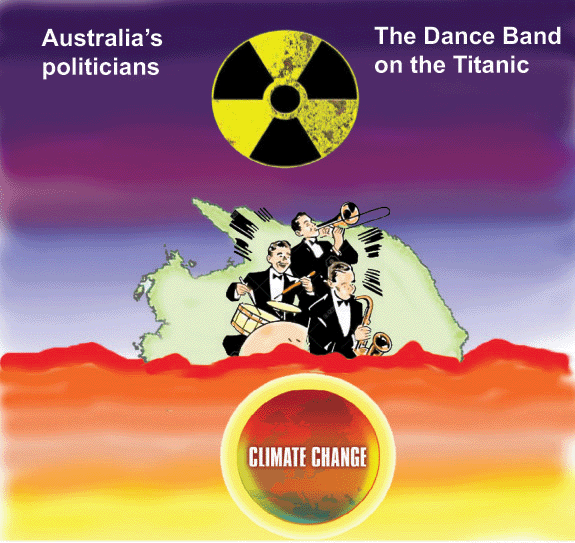 Climate Change Policy Toppled Australia’s Leader. Here’s What It Means for Others, New York Times, By Somini Sengupta Aug. 24, 2018
Climate change policy toppled the government in Australia on Friday.
How much does that really matter?
It is certain to keep Australia from meeting its emissions targets under the Paris climate agreement.
It’s also a glimpse into what a potent political issue climate change and energy policy can be in a handful of countries with powerful fossil fuel lobbies, namely Australia, Canada and the United States.
In Australia, the world’s largest exporter of coal, climate and energy policy have infused politics for a decade, helping to bring down both liberal and conservative lawmakers.
This week, the failure to pass legislation that would have reined in greenhouse gas emissions precipitated Malcolm Turnbull’s ouster as prime minister. He was elbowed out by Scott Morrison, an ardent champion of the Australian coal industry who is known for having brought a lump of the stuff to Parliament.
It could be a bellwether for next year’s Canadian elections, expected in October, in which Prime Minister Justin Trudeau faces a powerful challenge from politicians aligned with the country’s oil industry. Conservatives have pledged to undo Mr. Trudeau’s plans to put a price on carbon nationwide if they take power. At the provincial level, conservatives won a majority in Ontario after campaigning against the province’s newly enacted cap-and-trade program.
The Australian parallels with the United States are striking. The Trump administration has promised to revive the coal industry, rolled back fuel emissions standards and announced the country’s exit from the Paris pact altogether. Climate change is not a driving issue in the United States midterm election campaign, though it is for liberal Democrats, a recent study by the Yale Program on Climate Change Communication has shown.
Environmental policy and global warming are top priorities for those who describe themselves as liberal Democrats, the study found, after health care and gun control.
……… Robert C. Orr, dean of the School of Public Policy at the University of Maryland, pointed to another parallel: In both Australia and the United States, local leaders have embraced renewable energy even as national politicians promote fossil fuels.
“Australia is a lot like the U.S.,” said Dr. Orr, who is also the special adviser on climate change to the United Nations secretary general. “Climate policy has really been driven from below, from the state, local and business level. That is not going to change.”
Most Australian states have renewable energy targets, and Australians are powering their houses with solar energy at one of the highest rates in the world. But Australia’s emissions have continued to rise.
Australia is among several industrialized nations that are not on track to reduce greenhouse gas emissions to keep global warming below two degrees Celsius as the Paris accord promises, according to independent analyses.
Climate Action Tracker, an alliance of European think tanks that tracks countries’ climate pledges under the agreement, concluded recently that “if all other countries were to follow Australia’s current policy settings, warming could reach over 3°C and up to 4°C.” Those are levels that climate scientists consider “highly insufficient” to stop the worst effects of climate change. https://www.nytimes.com/2018/08/24/climate/australia-climate-change.html
The Liberal Party is imploding largely because of climate change.

‘Climate wars’ claim another political scalp IN Daily, 24 Aug 18 While some remain unconvinced that climate change is wreaking havoc with our weather systems, the current circus in federal politics proves it is doing inordinate damage to our political system, writes climate lobbyist Rod Mitchell. It may not be obvious to all that climate change is beginning to wreak havoc with our weather systems but the last few days in federal politics makes it clear as day that climate change is doing inordinate damage to our political system.
The ‘climate wars’ have deeply infected and divided our parliament. Now they have formally divided the Coalition, perhaps fatally.
The Liberal Party is imploding in large part because of climate change.
The feelings that it engenders have latched onto and amplified other tensions and differences in the party and lit the fuse of self-destruction. The prospect of legislating our Paris Climate Agreement target as part of the NEG was just the last straw in a struggle that has been going on since 2009, at least.
Climate change was a major factor in the successive downfalls of Rudd and Gillard and the end of the Labor government itself. And it has been a significant cause of the increasing polarisation in politics, both here and in other parts of the world.
The great divide between US Democrats and Republicans has been fuelled by vested interests who have funded think tanks to sow seeds of doubt about climate change and have made many ‘political donations’ to Members of Congress.
So why is climate change having such a powerful effect on politics? There are two main reasons.
First, the implications of climate change are truly frightening, so much so that for most of us it is too hard to look at. It is so much easier to look away, to keep busy with life and to welcome the soothing words of anyone who suggests that it is not happening. The survival instincts we have inherited from our ancestors are finely tuned to respond to immediate danger but have not yet evolved to encompass more distant threats. We tend to live for the present and for the short-term future. We can think about setting up our kids with a good education and job prospects but find it too hard to think about leaving them a liveable world.
Secondly, our economic system is set up in such a way that it is unable to put medium to long-term risk ahead of short-term gain. Quite simply, the profits to be made from activities that feed climate change are so great that most industries and their customers (that’s most of us) cannot resist the temptation. Furthermore, companies are obliged to grow their business and produce surpluses, but only in the short term. Only recently are they being urged (but not obliged) to factor climate risk into longer-term planning.
This is the way our economic system has evolved and it is inevitable that corporations would use the political power their wealth has generated to keep it evolving in their interests. Funding think tanks, donating to political parties and MPs and lavishing decision makers with their largesse make perfect economic, if not moral sense. Political instability, opportunist politicking and policy paralysis are acceptable forms of collateral damage if the profits keep flowing.
There comes a tipping point however where the damage begins to threaten the economy itself and the society it is supposed to serve. Perhaps that point has arrived, and our current political crisis may be the most glaring symptom yet.
With Scott Morrison as Australia’s new Prime Minister- no hope for action on climate change
 “Scoal-Mo” as PM. What does that mean for climate and energy policy? REneweconomy 24 August 2018
……a relief for the renewable energy industry in Australia – because it is clear that Dutton may have led Australia out of the Paris climate agreement and even brought renewable energy schemes to a crashing halt.
But it may not be cause for celebration. Morrison will lead and will have as his deputy Josh Frydenberg, the man who put together the National Energy Guarantee that proposed no new investment in wind and solar for a decade.
Morrison is known as “Sco-Mo”, an abbreviation of his name. But he might just as well be known as “Scoal-Mo” after brandishing a lump of coal thoughtfully lacquered by the Minerals Council of Australia in parliament in February last year.
But we were. In doing this, Morrison was pinning his colours to the mast of energy policy idiocy of the sort you find in the Murdoch media and on talk back radio, and on the front and back benches of the Coalition.
And Morrison dived even deeper into the murky depths of ignorance a few months later.
South Australia had followed that outage in February – caused by the failure of a gas plant to switch on – by building the Tesla big battery – in just 100 days – but Morrison decried it as being as useful as the Big Banana………
Morrison, as Treasurer, also ignored climate change in his most recent budget, making no mention of it in his speech, apart from insisting that Australia would “maintain our responsible and achievable emissions reduction target at 26-28 per cent and not the 45 per cent demanded by the opposition.”……
Right now, there is no policy in place. Australia’s emissions are rising, predicted to miss the weak 2030 target by a wide margin, and there is complete uncertainty about the National Energy Guarantee that Frydenberg has been spending a year putting together with the Energy Security Board and the big business lobbies.
Frydenberg has had to run the line between good energy policy and the madness of the right wing, and ended up with a policy proposal that sought no emissions reductions from the sector that can deliver the cheapest……https://reneweconomy.com.au/scoal-mo-as-pm-what-does-that-mean-for-climate-and-energy-policy-26556/
Right wing MPs wanted Dutton as PM to exit Paris climate agreement
 MPs push for Paris climate exit under Dutton, The Age, By Eryk Bagshaw23 August 2018 —Conservative MPs would ramp up the pressure on a Dutton government to exit the Paris climate agreement, opening up Australia to the risk of trade sanctions, stalling negotiations with the European Union and critically endangering relationships with the Pacific.
……..The conservative vanguard, led by former prime minister Tony Abbott and backbenchers Craig Kelly, Jim Molan and Eric Abetz, have been fierce advocates of dumping the Paris climate deal and delivering the Catholic school sector millions in extra funding.
The group has been instrumental in elevating Mr Dutton to within striking distance of the Lodge on a platform of lowering energy bills, cutting immigration and wrestling control of the Liberal Party away from the “inner-city elite”.
Mr Dutton refused to commit to the Paris agreement when he announced he was challenging Prime Minister Malcolm Turnbull for his job. “My judgment is that we do whatever reduces power prices,” he said. …….Mr Kelly, a Dutton ally, said there should a full national audit of the impact of the Paris target on the economy.
……..The agreement locks in an emissions cut of 26-28 per cent on 2005 levels by 2030.
Pulling out of it, which can not be done before 2020, would put Australia in breach of international trade agreements, potentially endangering a free trade deal with the EU that is in the middle of negotiations.
Legislation does not have to pass Parliament to exit Paris. A prime ministerial direction to the joint committee on treaties would be enough to remove Australia from the deal.
Robyn Eckerlsey, a climate treaty expert at the University of Melbourne, said it “was a crazy thing” to be considering given the pledged targets are voluntary and there were no formal penalties……
The Pacific Islands Forum is due to be held in the first week of September, where Australia could be represented by Mr Turnbull, Mr Dutton, Scott Morrison or Julie Bishop if there is a party-room vote on Friday.
The landmass of some of the nations attending – including Kiribati and the Maldives – are directly threatened by rising sea levels…….https://www.theage.com.au/politics/federal/mps-push-for-paris-climate-exit-under-dutton-20180823-p4zz9y.html
Australia’s racist politicians are also mostly Australia’s nuclear-loving politicians
Alice Workman No Nuclear Waste Dump Anywhere in South Australia August 15
Here’s a list of the politicians who shook hands / hugged / kissed Fraser Anning after his “final solution” speech calling for an end to Muslim immigration and a return to the White Australia policy.
Minister Mathias Cormann
Minister Bridget McKenzie
Minister Nigel Scullion
Minister Conchetta Fierravanti-Wells
Minister Matt Canavan
Assistant minister James McGrath
Assistant minister Anne Ruston
Steve Martin
Amanda Stoker
Jonathan Duniam
James Paterson
Dean Smith
David Bushby
Wacka Williams
Barry O’Sullivan
Cory Bernardi
Derryn Hinch
David Leyonhjelm
One Nation’s Peter Georgiou
Centre Alliance’s Stirling Griff & Rex Patrick
No Labor/Greens senators congratulated him. https://www.facebook.com/groups/1314655315214929/
Should there be another nuclear reactor at Lucas Heights?
| Siting another reactor at Lucas Heights http://ssec.org.au/our_environment/issues_campaigns/nuclear/info_sheets/1997_oct_1a.htm |
| Even if we assume that Australia does need a third nuclear reactor, is Lucas Heights the best site? There are numerous and compelling reasons why it is not.
1. It’s not remote Lucas Heights was selected in 1955, as a site for Australia’s nuclear industry for the very reason that it was remote from population. Now, 40 years later, it is surrounded by houses, on the edge of Australia’s largest city. This is no longer in a good site for a nuclear reactor! 2. It’s not been the subject of a proper site-selection process The most recent search for a dump for low and short-lived intermediate level radioactive waste has taken 4 years and has considered criteria such as low rainfall, freedom from flooding, stable hydrology, freedom from cyclones, tectonic, seismic or volcanic activity, as well as socio-economic, ecological and land-use factors. Selection of a site for a nuclear reactor – its production of high, medium and low level waste- should be at least as stringent as that for a low level waste dump! The McKinnon report said that “If a decision were made to construct a new reactor, it would not necessarily best be placed at Lucas Heights. An appropriate site would best be decided after exhaustive search and taking into account community views. Any siting decision should be based on criteria similar to those developed by the National Resource Information Centre (in its search for a low level waste dump) with an additional range of economic and scientific criteria.” (1993 Research Reactor Review 20.1-2.) 3. It’s the easiest option ANSTO maintains that “The relocation of infrastructure and personnel to a new site would significantly add to the costs of a new research reactor.” (Website) This is no justification for building a reactor at Lucas Heights! According to leaked memo to Peter McGauran on the Relocation of the Lucas Heights Nuclear Reactor, “the political fallout from either the refurbishment of the old reactor or the construction of a new one would be of the same order.” The real reason that Lucas Heights was seen by the Federal Government as being the best site was that it knew that no other community in Australia would accept it. It also believed that the Local Council would be compliant as would the surrounding population 4. It does not comply with public opinion ANSTO’s recent public opinion poll – commissioned at a cost of $40,000 of taxpayers’ money – found that 83% of Sutherland Shire people surveyed thought that a new reactor should be in a “remote location”. This is consistent with this Centre’s 1992 poll which found that 81 % people felt that a new reactor should be away from population centres. The Commonwealth has ignored this finding. 5. It is a health and safety risk to the local population According to ANSTO “The annual dose of radiation received by any member of the public living near ANSTO as a result of authorised emissions from the site is currently less than one-100th of the amount permitted by the National Health and Medical Research Council and by NSW Government regulations. A modern research reactor would not produce more than those levels…” (Website) Regulations or not, there is no proof that this (or any) level of radiation is safe. There are neither medical records nor diagnostic tests to assess the effects of radiation on the local population. Apart from obvious cancers and leukaemia – which can take decades to develop – more subtle health or genetic problems could be caused such as impaired scholastic performance, visual impairment or reproductive problems. The NSW Health Authorities have avoided their responsibilities and declined to carry out health studies. They say that one “would not be warranted”. Current scientific studies in the UK suggest that even radiation exposure less than 1mSv may be harmful and could be poisoning the human gene pool (New Scientist Oct. ’97) Yet we are daily subjected to routine emissions of radioactive gasses from the nuclear plant at Lucas Heights! There is no insurance to cover the public against risk of a nuclear accident. Commercial insurance companies will not insure against radiation or nuclear accidents because they “would not have enough funds to cover claims” . (NRMA Insurance letter.) In the event of such an accident claims would have to be made against the Commonwealth Government. The NSW Government and the local Council may also be liable for damages and they are uncertain of their position. 6. Lucas Heights a potential disaster area In 1994 and 1997 disastrous bushfires struck the area. In the most recent calamity Barden Ridge, the suburb closest to ANSTO, was evacuated at the height of the fire. Eleven houses in the next suburb of Menai were destroyed. At the same time the ANSTO staff were locked in, unable to telephone their families. The official reason was that staff were held back on police advice. For several days the only road connecting the site was blocked to through traffic. This is hardly the perfect site for Australia’s only nuclear reactor! |

Prime Minister Malcolm Turnbull sells out on climate policy, in effort to save his job
 Turnbull dumps emissions from NEG in final act of capitulation, REneweconomy
Right-wing in Liberal Coalition causing Turnbull to again weaken climate action
 Malcolm Turnbull plans more changes to energy policy amid pressure from within Coalition, ABC News, By Jade Macmillan , 20 Aug 18 Prime Minister Malcolm Turnbull has outlined further changes to his national energy policy amid increasing pressure from within his own party.
Nuclear has left its run too late: a response to Ian Hore-Lacy
ETHOS, 14 August 2018 | Robert Farago “………… Nuclear as the solution? There are a number of unresolved problems around nuclear power and questions of whether nuclear energy can grow quickly enough to solve our climate change problem. I will just list some of these problems with a sentence each:
- Weapons proliferation – enriching Uranium for civilian nuclear energy programs can lead to fuel being diverted and further enriched for nuclear weapons programs.
- Safety – although less deaths have been recorded from nuclear power than from coal mining, nuclear accidents such as Three Mile Island, Chernobyl and Fukushima have shaken the confidence of citizens to have nuclear reactors near their homes and food sources.
- Waste – although we have generated nuclear waste for 70+ years we still don’t have a solution. Nuclear waste needs to be stored safely for hundreds of thousands of years, longer than settled agricultural society has existed.
- Decommissioning – cost estimates vary wildly and it’s particularly technically challenging and expensive after nuclear accidents.
- Water use – like thermal coal generators, nuclear needs large quantities of water for cooling, making droughts and heatwaves a problem.
- Capacity – if we moved to a large portion of our global electricity generation to nuclear power, will there be enough Uranium to fuel them?
- Timeliness – can we move quickly enough to a majority nuclear electricity future and meet our global emission reductions?
Malcolm Turnbull caves in to climate denialists – again
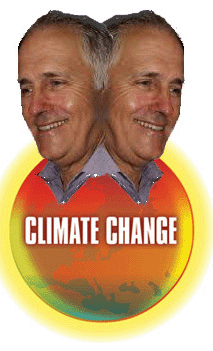 Malcolm Turnbull dumps plan to legislate Paris emissions targets, ABC News, By political editor Andrew Probyn and Melissa Clarke , 17 Aug 18
Resources Minister Matt Canavan is deceptive in his statements about “Low Level “nuclear waste
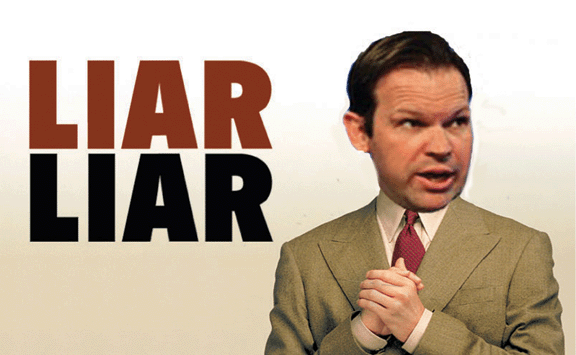 Greg Bannon, Quorn 16/08/2108
Senator Canavan introduces the concept of nuclear energy into the debate on radioactive waste storage, (The Advertiser, 15/08/2018) but refers only to low level waste.
He does not mention the long-lived intermediate level waste. In April, he announced that this would also be stored at the facility. His Department admits there are no plans for its disposal at this stage, only moving it from current temporary storage, to park it temporarily near Hawker or Kimba for several decades.
People in both communities, including the Traditional Owners have said “No”.
Nuclear power generation is another matter entirely. The Scarce Royal Commission into the nuclear fuel cycle rejected nuclear power generation two years ago. The Citizens Jury even rejected the Commission’s recommendation to investigate storing nuclear waste in South Australia. The Senator’s Department vehemently denied any connection between their waste facility and the Scarce Commission’s investigation. The Senator’s reference to nuclear energy seems strange timing.
Nuclear stooge Senator Matt Canavan deplores delay in decision on nuclear waste dump
Note the Advertiser makes the mistake of saying its only for low level waste.
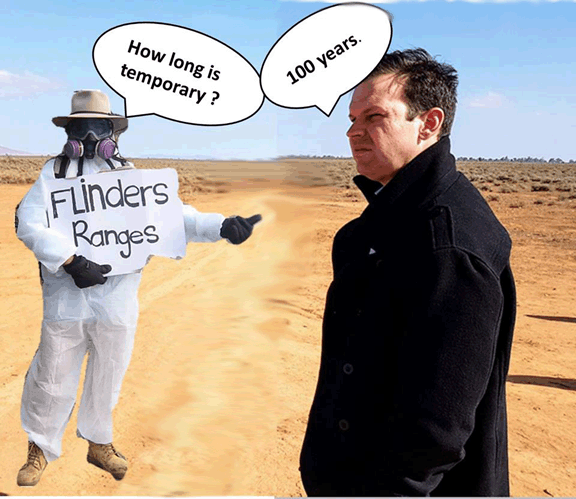 Federal Industry Minister Matt Canavan says Australia can’t have a serious debate about nuclear energy until a radioactive waste dump is built, Peter Jean, Senior Federal Political Reporter, The Advertiser,
Senator Canavan made the comments after lawyers for the Barngarla Determination Aboriginal Corporation launched legal action to try to prevent a community vote on radioactive waste going ahead in the Kimba district next week.
Kimba and Hawker district residents are scheduled to vote on whether they’d be willing to accept a low-level radioactive waste facility in their local areas.
A hearing on the Barngarla application to stop the Kimba vote will be heard in the Supreme Court today.
The Barngarla group argues that members who are native title holders in the Kimba District but don’t live there should be permitted to vote on the waste dump proposal.
Senator Canavan said the Barngarla people were entitled to take their concerns to court.
He said discussion about the establishment of a nuclear power industry in Australia wouldn’t get off the ground unless the nation found a way to manage low-level radioactive waste, including by-products of the Lucas Heights nuclear reactor in Sydney.
“If we can’t find a long-term repository for our low-level waste – which we produce from a reactor that produces nuclear medicines, not power – we have no hope of building a nuclear power station that would produce high-level waste,’’ Senator Canavan said.
“We are supporters of an open and mature debate around this issue but we recognise that any move to nuclear power in this country would take years and require bipartisan support, those are things that we don’t have now.’’
Two sites near Kimba and one near Hawker have been short-listed as possible locations for a radioactive waste storage facility. The community votes are being held before the Government proceeds with selecting a preferred site.
Kimba Mayor Dean Johnson said he was unable to comment on the Barngarla application because the matter was before the courts.

Inadequate report from Senate Committee on selection process for nuclear waste dump
The final report on the senate inquiry into the selection process for a national radioactive waste management facility in South Australia was released on Tuesday but those who oppose the facility say it has failed to address their main concerns.
The recommendations included the Department of Industry, Innovation and Science (DIIS) working with local stakeholders to use part of the 60 hectare buffer zone to grow and test agricultural produce to reassure the community and agricultural markets the produce is safe for consumption.
However, while the No Radioactive Waste on Agricultural Land in Kimba or SA group is thankful for the time and effort put into the inquiry, member Kellie Hunt said it was “disappointed” with the recommendations.
“We are disappointed that the recommendations do not address any of our primary concerns,” she said. “In particular, our issues regarding the lack of definition of what constitutes broad community support, and the lack of genuine need to move the intermediate level waste from Lucas Heights to a second interim storage location.
“We continue to oppose the siting of this facility on agriculture land in the Kimba district.”
The Senate Economics References Committee wrote the report using submissions made by stakeholders in in the affected communities near the sites in Kimba and Hawker, as well as public hearings in Kimba, Hawker and Canberra.
A spokesperson from the Department of Industry, Innovation and Science said the department thanked the committee for the report and that it “looks forward to reviewing it.”
“We have the opportunity to take account of the findings ahead of the community ballot that is scheduled to begin on August 20.”
The full report is available on the senate inquiry website at aph.gov.au/Parliamentary_Business/Committees/Senate/Economics/Wastemanagementfacility
Senator Rex Patrick: Additional Comments on Senate Report re selection process for siting nuclear waste dump
Recommendation 1 The Minister must quantify how broad community support will be determined and do so before vote.
Recommendation 2 As a minimum, broad community support must mean a 65% vote in favour in the AEC vote, AND agreement from all adjoining neighbours AND the agreement from aboriginal communities.
Recommendation 3 The ANSTO Act should be changed to permit the storage of intermediate-level waste until such time as an appropriate facility site has been identified and a facility built and commissioned
Senator Rex Patrick Senator for South Australia, Selection process for a national radioactive waste management facility in South Australia, 14 August 2018
p. 67 Additional Comments by Senator Rex Patrick Kimba and Hawker, when you finally surrender, it must be of your own free will!
The Work of the Committee
1.1 I thank the committee for the work it has done in relation to this very important inquiry. I also thank the secretariat for their behind the scenes efforts.
1.2 I support the general findings in this report and the recommendations that flow from them, but I feel they do not address several substantive issues with enough force.
1.3 Out of responsibility to the communities of Hawker and Kimba, I address those issues now. Continue reading
Conflict of interest: Richard Yeeles, adviser to South Australian Premier on Olympic Dam Aboriginal Trust
 Tim Bickmore shared a link.No Nuclear Waste Dump Anywhere in South Australia, 15 Aug 18
The Olympic Dam Aboriginal Trust distributes funding to 3 aboriginal groups based upon income from the mine. Those groups are: Barngarla, Kuyani (Adnymathanha) & Kokotha.
Barngarla & Kuyani are currently the groups targeted by the radioactive waste site suppository process.
According to the ODAT website, currently Richard Yeeles, senior economic adviser to State Premier Steven Marshall is listed as a BHP representative on the council which determines who gets what monies…..
Conflict of interest? https://www.facebook.com/groups/1314655315214929/?multi_permalinks=2493650837315365%2C2493518107328638¬if_id=1534298281981165¬if_t=group_activity
1 This month

of the week – Australians for War Powers Reform (AWPR)
To see nuclear-related stories in greater depth and intensity
 Antinuclear