ABC News, by political reporter Jake Evans, Fri 20 Dec 24
In short:
Video has emerged of a Nationals senator saying his party’s nuclear policy shows it is not serious about cheap energy, arguing if it was it would instead pursue more coal.
Separately, his Nationals colleague Keith Pitt has announced he will quit politics, citing frustrations over the Nationals’ approach to climate.
What’s next?
A new member for Hinkler in Queensland will be elected next year.
Video has emerged of Nationals senator Matt Canavan labelling his party’s nuclear policy a “political fix” and conceding it is not the cheapest form of power, as a colleague quits the party over its approach to climate change.
Senator Canavan told a podcast in August that his party was “not serious” about nuclear power being a solution to high energy costs.
“Nuclear is not going to cut it. I mean, we’re as guilty of this too — we’re not serious. We’re latching onto nuclear,” Senator Canavan told the National Conservative Institute podcast.
“I fully support getting the ban [lifted], we’ve got a bill in the Senate to get rid of it. We should build some nuclear power stations. They’ll help, they’ll help our system.
“But we’re latching on to it as a silver bullet, as a panacea because it fixes a political issue for us, that it’s low-emission and it’s reliable. But it ain’t the cheapest form of power.”
Climate Change Minister Chris Bowen leapt on the comments, saying it revealed a divide within the Coalition.
“I don’t agree with much Matt Canavan says. But I do acknowledge he’s honest on this occasion,” Mr Bowen said.
“Canavan admits the Coalition is willing to impose higher costs on Australians with the most expensive form of energy just to ‘fix a political problem’ for Peter Dutton’s divided party room.”
Federal energy and climate minister Chris Bowen has lambasted the federal Coalition’s nuclear power plans, describing them as a recipe for blackouts and a “con job”, and has expressed astonishment at Peter Dutton’s assumption of a grid that will use 40 per cent less power than forecast.
Dutton’s nuclear costings – revealed last Friday – and some of its major assumptions have been widely dismissed, even mocked, by the energy industry, although the proposal has garnered support from some with strong connections to the fossil fuel industry.
The reason for that is the Coalition’s focus on extending the life of the country’s ageing coal fired power generators, increasing the dependence on gas, and the implications for renewables, which will largely be stopped in their tracks, and climate targets, which will be ripped up and ignored.
The Coalition says it can get the first nuclear power plant running by the mid 2030s – a target most in the industry find laughable. But its own modelling confirms that most of the planned 14 GW will not be delivered until the mid 2040s, which means it must run ageing coal generators for another two decades.
“This is a recipe for blackouts and unreliability,” Bowen says in the latest episode of Renew Economy’s weekly Energy Insiders podcast. “Sweating the coal assets for longer, I mean, these coal fired power stations are not getting younger. None of us are.
“Just this week, we’ve had 3.4 gigawatts of coal out in the NEM (National Electricity Market, the main grid) and three gigawatts of that was unplanned, ie breakdowns, unexpected breakdowns, three gigawatts out this week.
“Now, the grid’s coped okay, even though it’s been very hot, but you’d still rather not have three gigawatts out, and that’s only going to get worse the longer you rely on coal.”
Indeed, the Australian Energy Market Operator has made it abundantly clear, and even the coal plant owners agree, that the biggest threat to reliability on the grid is the unplanned and sudden losses of big fossil fuel generators, particularly coal.
Over the last two weeks, AEMO has managed the heatwaves and the multiple outages and has turned to more demand and supply flexibility to help manage the situation, including putting several big batteries on standby – a protocol it is now using when the grid faces demand highs, and demand lows.
It is this focus on flexibility that is undermining the case for existing, let alone new even larger “always on” baseload power stations.
The Coalition, however, says it is determined to power on, but its costings have also come under heavy criticism – both on the assumed price and timeline of building new nuclear from a standing start, but also its assumption that electricity demand would fall more than 40 per cent below forecasts.
In the energy world, it is generally assumed that less primary energy will be used in an electrified world. But that’s because inefficient fossil fuel engines and generators (in cars, homes and on the grid) are replaced by more efficient inverter based technologies – wind, solar and battery storage.
That means less energy is needed overall (because around two thirds of energy from fossil fuels is lost as waste heat), but more electricity will produced on the world’s grids. The Coalition modelling shuts its eyes to that evolution, and assumes that electrification does not happen and fossil fuels are still burned in huge quantities.
“I spent a fair bit of time thinking about how they (the Coalition) might try and make nuclear look cheaper, and I’ve got a confession to make,” Bowen tells Energy Insiders.
“Not in my wildest dreams did I suspect that they would just assume we need less electricity. So they’ve said we’re going to need 40% less electricity than AEMO’s Step Change scenario.
“And guess what? Who knew if you make 40% less electricity, it’s roughly 40% cheaper. I mean, who would have figured? I mean, what a con job. We all know that nuclear is the most expensive. They had to find a way of pretending it isn’t.”
On Labor’s own policies, Bowen says that the Capacity Investment Scheme, which released the winners of the first major generation tender last week, is working better than expected, with 6.4 GW of capacity awarded rather than the planned 6 GW, and all representing new projects that have not begun construction.
“It’s working better than I thought it would,” Bowen says.
“And that’s a very encouraging thing. The value and the quality of the projects we’re having coming forward means that we can award more than we were intending.
“No, I won’t be giving tenderers an opportunity to know what our reserve price is. That’s not how an auction works, but (the result) meant that I could also announce for the next round that we’re going to target, in effect, 10 gigawatts, four gigawatts of dispatchable and six gigawatts of generation for tenders three and four.
“That’s huge, and that really means that those projects will get into the planning system faster and the emos connection process faster and help us get to our target.
“The only disappointing thing about this round, from my point of view, was the lack of projects that we could award in Tasmania. “I want to see more Tasmanian projects come forward, and … we have provided feedback to Tasmanian bidders about that …. we’ve got to ensure that we might get more Tasmanian projects into the future.”
However, Bowen says there is more to do, and he is hopeful – should Labor be re-elected and he remains in the portfolio – to make more reforms.
“We’ve made good progress in the first three years, but not yet good enough, in my view, and you really need a good long stretch in a job like this to, you know, bed down the reforms and make them work properly, and keep the momentum growing going and and learn as you go,” he says.
“Obviously, you know, you just get, you just get more proficient on things like the CIS, etc, as you build the experience collectively in the department.
“I would say the next term … should we get one, as I hope and expect we will, is that it’s a combination of consolidation, so a whole bunch of things that are well underway just need to be bedded down and consolidated, including the CIS, including the new vehicle efficiency standards that … have been in the too hard basket for so long, but don’t actually come in until the first of January.
“So they haven’t had any impact yet, to be honest, but they will. Same with the safeguards reforms, again, big and huge and difficult to do, but it has got to be bedded down and continued with and so there’s so much at stake.
“And then there’s the what’s next? And of course, we’ll go through the process of the 2035 target, the climate change authority advice to sector plans. All that process is underway, but I really see it now as a bit of a continuum.
“Having made good progress in the first two and a half to three years, got to build on it, bed it down, continue it. And it’s just unthinkable to me that we would, you know, having made this good progress, then stop, rip some of it up and go backwards, as the alternative would suggest.”
To hear more from Bowen on those plans and more, you can listen to the full episode here once its published later today.
“PETER DUTTON’S NUCLEAR numbers have more holes than Swiss cheese, leaving out big ticket items like the costs of dealing with radioactive waste,” says the Climate Council CEO Amanda McKenzie, slamming the Federal Coalition’s misleading modelling.
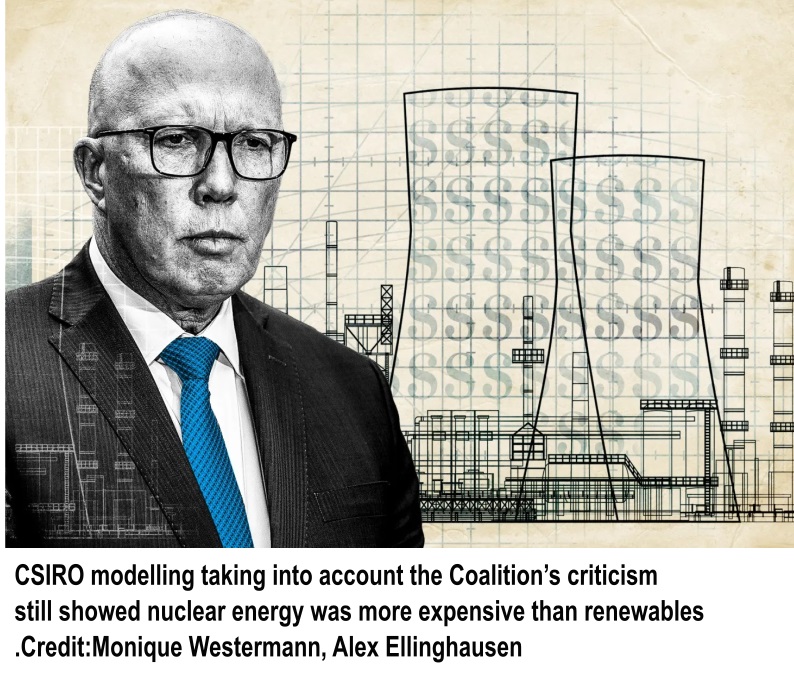
“Dutton must be honest with the Australian people. CSIRO tells us nuclear is double the cost of renewables, no amount of dodgy accounting can change the facts.”
Nicki Hutley, Climate Councillor and economist, said: “It’s shocking to see the Federal Coalition knowingly mislead Australians on the true costs of nuclear. If we’re going to debate the economics of energy it must be based. on real-world evidence – not dodgy modelling that obscures the real price tag.”
The Climate Council has identified four ways that the Federal Coalition appear to be cooking the books with their dodgy nuclear numbers:
1) Ignoring the costs of keeping our ageing coal-fired generators operating for longer, which would cost a bomb in constant maintenance and fault repairs, and produce far more climate pollution.
2) Failing to account for Australia’s growing electricity needs, producing up to 45% less power than our current plan by 2050. The Australian Electricity Market Operator expects power generation to double by 2050, and assuming any less is inaccurate.1
3) Underestimating the cost and timeline of building nuclear reactors, which international experience has shown cost on average 2.2 times more to build than their initial estimate, and take at least 15 years for construction alone.
-Advertisement-
4) Excluding significant and certain costs from their estimates, including the costs of managing highly radioactive nuclear waste.
Nicki Hutley, Climate Councillor and economist, said: “Nuclear doesn’t add up for Australia. The CSIRO tells us that nuclear energy will cost twice as much as renewables, and the risks of further budget and bill blowouts are simply not worth it. International experience has proven that nuclear is a financial black hole, with the average project costing more than double its original estimate, and projects like the UK’s Hinkley Point C costing triple. We’re already seeing renewables deliver power faster and at lower cost today.”
Amanda McKenzie, CEO of the Climate Council, said: “The Federal Coalition’s nuclear scheme would send our kids’ future up in smoke. Waiting up to 20 years for nuclear reactors means burning coal and fossil gas longer—adding 1.5 billion tonnes of climate pollution by 2050. That means more deadly bushfires, floods, and heatwaves.”
Greg Bourne, energy expert and Climate Councillor, said: “Australians can’t afford to wait 20 years for nuclear. All our coal-fired generators are due to close before even the first nuclear reactor could be built, and keeping our old coal clunkers running past their use-by-date presents a critical risk to our energy security. We need more renewables backed by storage now so it’s online before more coal is retired.”
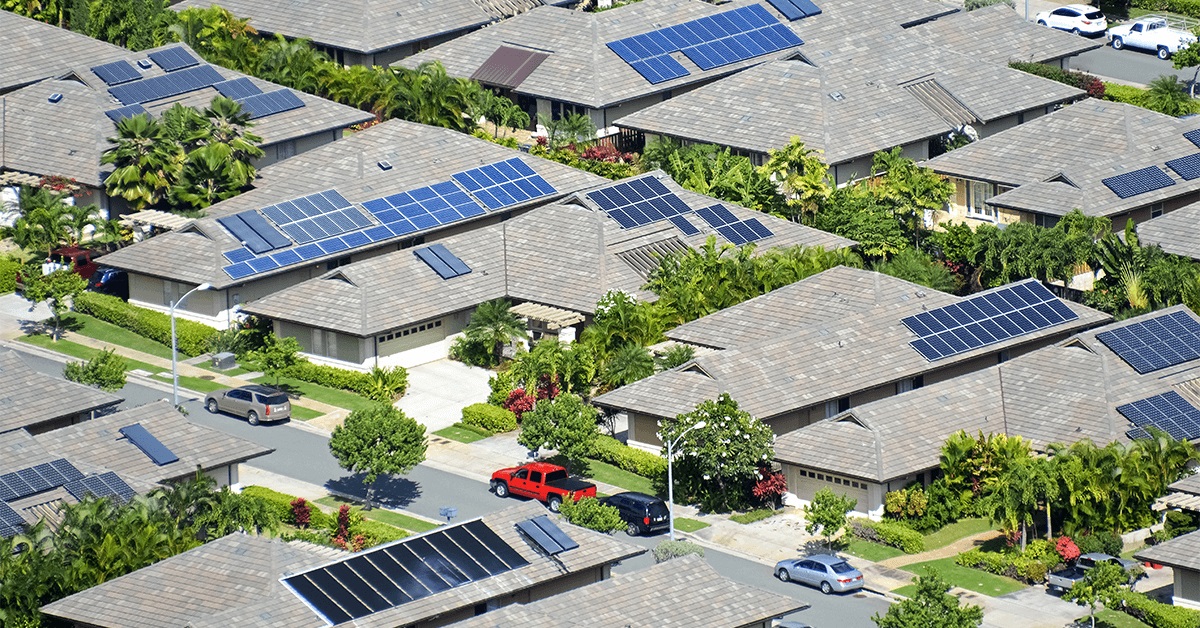
Amanda McKenzie, CEO of the Climate Council, said: “Investing in renewable power backed by storage is the only way we can tackle climate change and replace our ageing coal fleet this decade. More than four million Australian households have already put solar panels on their roofs, saving $3 billion a year on electricity bills. Expanding access to rooftop solar will cut bills further, reduce climate pollution, and drive a cleaner, safer energy future. Let’s focus on what’s already working.”
1 Based on total generation implied by 14 GW of nuclear capacity, providing 38% of total generation at an 89% capacity factor.
The South West town of Collie is in the spotlight once again as the federal government hosted an inquiry into nuclear energy.
The WA government is in the middle of transitioning the town away from coal by 2030.
What’s next?
The federal Opposition wants to turn the site of one of Collie’s coal fired stations into a small modular reactor if elected.
Usually the domain of the blue collar worker, the small town of Collie has played host to numerous federal politicians in tailored suits in recent months.
Both parties have sent their leaders and a steady stream of federal and state MPs to talk about their respective energy plans to the community, which is expecting to transition away from coal by 2030.
On Monday, the federal parliament’s Inquiry into Nuclear Power Generation in Australia travelled to the town, 200km south of Perth, to hear the views of local experts and residents on the prospect of having a nuclear power plant in their backyard.
The proposal
The Coalition has identified Collie’s coal fired power station as one of seven sites where it would like to build a nuclear plant if elected.
Under the proposed policy, Collie would host a small modular reactor (SMR).
Small modular reactors have a capacity of up to 300 megawatts per unit — about a third of traditional plants.
Currently none are in commercial operation in any Organisation for Economic Co-operation and Development (OECD) country.
Several are in planning stages but they remain largely theoretical and the lack of completed projects makes it difficult to accurately project costs.
However, it did not include reference to Collie or SMRs.
Coalition says there’s support for nuclear
The gap in existing commercially operational SMR projects internationally was a central sticking point in the Collie hearing.
Shadow Assistant Minister for Trade and Federal Member for O’Connor Rick Wilson said more than two-thirds of respondents he had surveyed supported the Coalition’s nuclear plan.
He said he had sent a hard copy survey to every house in Collie and followed it up with a targeted social media survey.
Traditional owners at hearing
Noongar elder Phillip Ugle said at the hearing he held concerns about the impact a nuclear reactor could have on local waterways, which he said were central to cultural ceremonies.
He also said traditional owners should have been the first group the Opposition spoke to about the proposal.
The deputy chair of the hearing, Liberal MP Ted O’Brien, said there would be a two-and-a-half year consultation process in each location.
He asked the panel of traditional owners if they had any advice for how they would like to see those consultations run.
Noongar elder Karim Khan said he felt it was late in the game to be asking this question.
South West Aboriginal Corporation Gnaala Karla Booja CEO Bruce Jorgensen said the group had not yet asked its more than 1,000 members for their opinions as they felt they did not have enough information.
Workers confused
Representatives from WA’s Electrical Trades Union (ETU) and Australian Manufacturing Workers Union (AMWU) said workers had been thrown back into uncertainty over their futures.
AMWU WA branch secretary Steve McCartney said workers had just made peace with and begun to embrace the Just Transition plan, focused on renewable energy and battery storage.
“There’s been a lot of consultation with the whole public. Everyone knows what’s happening here,” he said.
ETU WA branch organiser Simon Brezovnik said the “nuclear fantasy” had sewn chaos and uncertainty among workers.
Edith Cowan University Associate Professor Naomi Joy Godden said the community had the right to continuing consent over what happens to their community.
“This dialogue around nuclear has not happened yet and certainly the proposal was launched onto the community [without] any level of dialogue that is required,” she said.
The last hearing of the parliamentary inquiry will happen on Tuesday in Perth.
A nuclear Australia would grow 12 per cent slower every year until 2050, according to government analysis of Opposition Leader Peter Dutton’s power plan, with economists warning that less energy for the country will lead to a smaller economy.
The long-awaited economic costings of Dutton’s nuclear energy policy, released last week, revealed the opposition is banking on an electricity grid that ends up 40 per cent smaller by 2050 than the government’s plan, which predicts the country to be almost entirely powered by renewables.
Government figures revealed to this masthead project that under Labor’s energy plan the economy would grow at 2.12 per cent a year. But under the opposition’s plan for a smaller grid, the figures state the economy would grow at 1.89 per cent a year.
That equates to a 12 per cent difference in annual economic growth, compounding each year.
The government has not provided this masthead with the analysis used to produce these figures.
Treasurer Jim Chalmers, while not revealing his expectation of how large the economy will be, said the cost to Australia under the opposition’s proposal would equate to $4 trillion by 2050.
“What these characters are proposing is a recipe for less growth in a smaller economy, with less energy at higher prices,” Chalmers said, referring to CSIRO findings from earlier this month that nuclear energy is at least 50 per cent more expensive than renewables.
“It means an economy which is $294 billion smaller by 2050, and the lost output between now and then would be about $4 trillion.”
………………………………………………………..Treasurer Jim Chalmers, while not revealing his expectation of how large the economy will be, said the cost to Australia under the opposition’s proposal would equate to $4 trillion by 2050.
“What these characters are proposing is a recipe for less growth in a smaller economy, with less energy at higher prices,” Chalmers said, referring to CSIRO findings from earlier this month that nuclear energy is at least 50 per cent more expensive than renewables.
“It means an economy which is $294 billion smaller by 2050, and the lost output between now and then would be about $4 trillion.”
The government’s ambitious renewable plan is based on a scenario identified by the Australian Energy Grid Operator that assumes the capacity of the country’s electricity grid will need to nearly quadruple in the next 25 years.
However, the opposition’s model assumes the grid will only grow just over half as much and also assumes some existing energy-intensive businesses will either reduce their power usage or disappear.
The opposition’s forecast for the energy grid, based on energy market operator modelling of a scenario where electricity grows more modestly than forecast by the government, assumes electricity demand from heavy industry drops about a third between 2027 and 2030.
That could spell bad news for aluminium smelters like those located in NSW’s Hunter Valley and Portland, in Victoria, which are the largest individual electricity customers in the grid and major regional employers.
Australian Aluminium Council chief executive Marghanita Johnson said smelters used about 10 per cent of all the electricity in the grid, and the industry may have to shut if power costs become internationally uncompetitive.
“The next five years are critical for Australia’s aluminium sector,” Johnson said. “High energy costs, regulatory uncertainty, and more attractive policies in competitor nations make the future of our industry far from certain.”
……………………………………………Grattan Institute energy and climate change deputy program director Alison Reeve said the issue of electricity grid planning hinged on assumptions about economic growth.
“If you choose to have a larger economy, you will need a larger electricity grid,” Reeve said.
Independent economist and member of the advocacy group Climate Council Nicki Hutley said it was illogical to argue that power supply can be reduced as much as the opposition plans to do without also reducing economic growth.
“You can’t curtail the supply side to the degree that the nuclear plan does while using the most expensive form of energy without it increasing energy costs,” Hutley said.
The Australian Industry Group, which represents big energy users like manufacturers and smelters, said its members depended on the delivery of reliable and affordable power.
“Energy-intensive industries like aluminium, steel and ammonia are vital and should be able to make an even bigger contribution to our national economy if Australia delivers on our potential for energy advantage,” said AIG principal national adviser Tennant Reed.
Achieving net zero by 2050 is non-negotiable. Australia and our global partners have agreed to targets that limit warming and maximise the chance to avoid the worst impacts of climate change, such as more natural disasters, rising sea levels, and species and habitat loss.
But the pathway to decarbonisation matters too. Cutting greenhouse gas emissions as far and fast as possible now can reduce the amount of temperature rise experienced in the years ahead and help curb the risks to our economy, communities and way of life.
That’s one reason why accelerating work to create a new electricity network built on renewables such as wind and solar – backed by storage, firming and peaking gas – is essential.
It’s the biggest abatement opportunity available in the short term and the most cost-effective form of new energy generation needed to underpin progress on decarbonisation across the rest of the economy. And the race to pull forward investment in renewable energy generation is on because the owners of existing coal-fired power stations have begun to close them.
The first shutdown occurred at Lake Munmorah, NSW, in 2012, and more have since exited the system. It’s now expected that 90 per cent of the existing coal-fired generation capacity will depart the system by 2035.
Against this backdrop, the Climate Change Authority will undertake analysis of the Coalition’s nuclear proposal. We want to give the Australian people an economic and science-based understanding of the impacts on the grid, the climate and their energy bills. But at first glance, Peter Dutton’s nuclear policy stops decarbonisation, blows the carbon budget, punishes consumers and harms the economy.
Under any scenario contemplated, Australia will be more dependent on coal-fired power stations for longer. The CSIRO says the best case for delivery of a single new nuclear facility in Australia is 15 years. And that assumes the legislative, regulatory, workforce and other issues can be resolved – and the cost blowouts and time delays witnessed overseas aren’t repeated.
Yet to replace all of Australia’s confirmed retiring generation capacity with nuclear as a zero-emission alternative would require deploying at least 15 to 17 large-scale nuclear facilities, or more than 50 proposed small modular reactors, by 2040. In the meantime, Australia will need to depend on coal-fired power that is increasingly unreliable and the cause of price spikes and blackouts. It would be strange to subsidise the ongoing operation of plants that can’t be guaranteed to actually keep the lights on.
It also compounds the challenge of reducing our emissions in the short and long term. Relying primarily on electricity from fossil fuels for longer would also delay necessary and achievable cuts to emissions in other sectors such as transport and industry, which depend on the availability of zero emission energy for their own decarbonisation pathways
The authority has calculated that for every percentage point that Australia falls short of achieving 82 per cent by renewables by 2030, about 2 million tonnes of harmful emissions will be added to the atmosphere.
The other element the authority will consider is cost – to the economy, taxpayers and consumers. For example, the proposal doesn’t just appear to slow decarbonisation, but the economy too. Some initial forecasts have already suggested it assumes an economy 40 per cent smaller than the alternative.
Assuming there will be far less demand for electricity means assuming far fewer Australians take up EVs or electrify their homes. It means assuming fewer industrial and manufacturing businesses switch to efficient, electric production processes.
The sensitivities are heightened given the proposal involves taxpayers funding nuclear power stations, which risks sending private investment now attracted to renewables offshore in pursuit of better returns.
The CSIRO, AEMO and the authority have all also made the point – a system built on renewables will lead to lower power prices for households and businesses compared with nuclear. It would take an astonishing leap of faith to suggest otherwise, but the modelling published last week in support of nuclear seemed to take that path.
The debate over Australia’s energy transition should be based on sober analysis, rooted in economics and engineering. It’s why markets, scientists and experts keep defaulting to a system based on renewables.
Alternatives that place faith in a technology that does not exist in Australia, risks slowing our economy, undermining energy security and stalling our bid to reduce emissions deserve scrutiny. That’s what the Climate Change Authority will do.
Matt Kean is chair of the Climate Change Authority. He previously served as a NSW minister for energy.
the Coalition documents released on Friday don’t seem to get around to mentioning is that its proposal for nuclear power involves taxpayers taking on all the massive financial risks (apart from the other sorts) and costs.
The August 2010 federal election campaign was conducted amid continuing shock waves from the Julia Gillard coup against Kevin Rudd a little less than two months earlier.
So, you may be forgiven for forgetting much that happened in the actual campaign, and specifically, how the federal Coalition didn’t bother releasing the costings of its election promises until just 48 hours before voters went to the polls.
It had already refused to submit the policy promises for independent analysis — which in those days was done by Treasury and the Department of Finance rather than the Parliamentary Budget Office.
That refusal might not have mattered too much to the broad sweep of history if the election result had been different. But a knife-edge result left three crossbench House of Representatives MPs to make the call on which side of politics would get their support and, therefore, be able to form government.
In making their decision the “Three Amigos” — Tony Windsor, Bob Katter and the subsequently infamously loquacious Rob Oakeshott — relied heavily on a Treasury and Finance analysis requested by them post-election.
Its findings? That the Coalition’s claimed budget savings were out by almost $11 billion. In the current age of announcements measured in the hundreds of billions of dollars, that might not sound like a lot.
But given that the claimed cost of Coalition policies was originally only $31.5 billion, that’s a rather spectacular …. miscalculation.
It felt for all the world like the work of an ill-prepared, lazy opposition that thought it could coast to office amid the chaos of a dysfunctional government. And it almost did.
A perfectly timed announcement
There’s something spookily familiar about the circumstances now, as the opposition finally unveiled its much-promised nuclear energy costings on a Friday one week before the country closes down entirely for Christmas.
There may be a lot more detailed modelling in the document prepared by Frontier Economics for the Coalition than there was in 2010.
But the modelling, and more importantly the Coalition’s political message wrapped around it, doesn’t answer the myriad of questions raised by the idea of nuclear energy. And this belated release of what we are led to believe is a signature policy for the election comes as the Coalition still hasn’t released details of most of its other key policies — from tax to immigration.
The decision to release the costing on December 13 feels like the Coalition is once again playing voters for mugs at a time when it is up against a federal government that has spent the year apparently determined to prove it is not very good at politics, or persuading voters that it knows what it is doing.
The Frontier modelling does implicitly raise important questions about the government’s own energy plans: just how much coal-fired power will the system need as we move towards a system that is dominated by renewables, and for how long?; how much gas will be needed (and is it in the right place) to be used to “firm” or underwrite the system?; how much can we really rely on battery technology that is still evolving to store renewables? and just how much transmission infrastructure do we need (and where) for a mostly renewables future?
The government has “sort of” answered these questions. Most analysts will tell you that it is almost impossible to answer them precisely because the wheel is still in spin. Prices and technologies are changing.
But, up against an opposition leader who is better at cut-through messages, it will need to do a lot better than that.
Crucial to the political debate is the fact that much of the uncertainty around these decisions arises because they are being made by individual investors who are taking on all the risks in building new energy capacity.
And this must surely be the threshold point of difference with what the federal Coalition is proposing.
For the one thing that the Coalition documents released on Friday don’t seem to get around to mentioning is that its proposal for nuclear power involves taxpayers taking on all the massive financial risks (apart from the other sorts) and costs.
The Coalition wants this big shift to be overseen by a public sector which it usually loves to point out is notoriously bad at running big projects, either directly or via massive subsidies.
The nuclear divide
The electorate is a lot more disengaged than it was in 2010, but the politically dangerous part of the nuclear policy from the government’s perspective is how it plays to regional Australia and, a bit like Brexit, likely divides the country into two very different blocks of voters.
Many regional voters, most pollsters will tell you, are worried about job losses as coal mining disappears, are unconvinced renewables offer job replacements, and are very exercised about the proliferation of wind and solar farms, and by the transmission lines to link them to the grid.
Earlier talk of small nuclear reactors has disappeared from the model set out using the Frontier modelling, and that modelling doesn’t seem to make provision for the fact that there are usually high costs for a first build, or that most expert opinion says it will take until at least 2040 to have the regulatory system and build in place for a first nuclear reactor to be functional, not 2036………………………………………………………………..
The Coalition has been pledging all year that its plans would lead to lower energy prices for stressed households.
But Peter Dutton had to sidestep on that issue on Friday because there is no clear mechanism for his plans to bring down those costs any time soon.
All the energy experts will be poring over the details for days. One could say they would be poring over them for weeks but (almost as if it was planned that way) the media coverage and the debate seem likely to come to a screeching stop in a week’s time as everything shuts down for Christmas.
Like the 2010 election costings, not many voters may remember the details of any analysis.
But the Coalition will have to be hoping there is no political equivalent of the Three Amigos to answer to this side of the 2025 election.
The signature [nuclear] Coalition policy for the 2025 election will be a huge government-owned energy monolith.
The overall costs will be borne by taxpayers because the publicly owned reactors will bear them. But the overall profits will be made by the private sector which will queue up for the construction contracts and whose profits will balloon as the costs of construction inevitably and uncontrollably blow out.
the real aim of the exercise is not to produce the cleanest energy at the lowest cost, but to keep the profits of the fossil industry flowing for as long as possible.
Crispin Hull, 17 Dec 24
Opposition Leader Peter Dutton’s announcement on nuclear energy last week contained a welcome development. For the first time since about 1989, the Coalition has acknowledged that only governments can do some of the really big-ticket items.
Since about 1990, the Coalition has said, Private Sector Good, Public Sector Bad. But with the program to build seven nuclear power stations, the Coalition acknowledges that only the public sector can do it.
The publication of Fightback! by then Opposition Leader John Hewson in 1992 was the touchstone of conservative policy: the private sector was more efficient and could do things quicker and better than the great big bloated public sector full of lazy, box-ticking public servants. Taxpayers and consumers would be much better off, they argued.
If you can find it in the Yellow Pages, they said, buy it there. Or these days, Google it. Don’t let the Government do it, they said. The Government is not the solution to the problem. The Government is the problem, as Ronald Reagan said. Get government out of the way, and the private sector will provide the solution.
So, what has happened now? The signature Coalition policy for the 2025 election will be a huge government-owned energy monolith.
Gulp.
That will require the unlearning of three decades of conservative policy.As it happens, though, much of that policy was a cruel hoax. Far from being cheaper and more efficient, the neo-liberal conservatives did not – to use market parlance – factor in two critical elements of private-sector contracting: fraud and profit gouging.
Since about 1990 in Australia we have seen, through privatisation, a major shift of wealth and income up to the top two percentiles at the cost of people on middle income. From employees and small business to the managers and shareholders of big business.
In the 1990s, the neo-liberals (read, the Coalition) harped on about reducing the role of government, particularly government spending. It did not happen. Government spending remained at 38 percent throughout the 1990s’ privatisations and downsizing. All that happened was that the spending went from public health, education, and welfare into subsidies and tax breaks for the fossil-fuel industry, other big corporates, and private health, education and other providers.
Public spending remained stubbornly the same.
It will be the same with the nuclear reactors. The overall costs will be borne by taxpayers because the publicly owned reactors will bear them. But the overall profits will be made by the private sector which will queue up for the construction contracts and whose profits will balloon as the costs of construction inevitably and uncontrollably blow out.
Importantly, even though the Coalition is going for a massive program of government spending and ownership for its nuclear reactors, it has relied on a private firm of economists to do the costings. Surely, if such a massive spend and risk is to be undertaken by the public sector, you would want the public sector to do the costings.
As it happens, we have that. The CSIRO has costed and re-costed nuclear energy and come up with the same result: higher electricity bills and greater dangerous carbon emissions.
The private-sector costings, on the other hand, look like an exercise in: “These are the conclusions upon which we have based our facts.”
This is because the real aim of the exercise is not to produce the cleanest energy at the lowest cost, but to keep the profits of the fossil industry flowing for as long as possible.
However, it is an electorally risky exercise. Not because a generally financially illiterate electorate will see nuclear as a white elephant, but rather because an ever-growing portion of the electorate has rooftop solar and know it pays off.
Further, in the unlikely event that nuclear goes ahead there will be times when the grid has too much power and domestic solar generators will be blocked from exporting their product to the grid because nuclear power stations cannot be turned on and off without enormous cost and difficulty.
That is going to annoy the owners of four million rooftop solar systems. It would be about as popular as taking away Medicare.
The electoral dynamics for nuclear are made worse for the Coalition because more than three million of those solar systems are on the roofs of stand-alone houses – in the very suburbs and regions which the Coalition hopes to take from Labor. That is about six million voters in an electorate of 18 million.
Moreover, those six million voters are proselytising about the value of solar, and lots of tenants and unit holders – hitherto shut out of solar – want to get a slice of the action sooner rather than later.
The big trouble with nuclear is spending vast amounts of public money with no electricity generation for at least a decade, more likely a lot more. Whereas every bit of renewable infrastructure generates from Day 1 and every battery stores from Day 1. Voters prefer the here-and-now to spending on something they might never see.
Nuclear is a matured industry. It not going to get much more efficient, if at all. Whereas the efficiency of solar, wind, and batteries continues on an upward trajectory well beyond previous expectations.
When you add electric vehicles, the renewables pay for themselves very quickly.
The task for Australia now is to reduce our reliance on our $30 billion a year of imported oil. And to reduce our reliance on $30 billion a year of thermal coal exports before the world does it for us. These are energy and national-security issues.
The Coalition’s decades-long nuclear program and Labor’s continued approval of coal mines fail to meet the urgency and magnitude of the national-security risks arising from climate change and fossil-fuel reliance.
A government’s first priority should be national security: not just from the threat of arms but the threats of disasters and supply-chain disruption.
We need politicians who think about the long-term security of their people not the short-term profits of big corporations and the donations which come from them.
Peter Dutton’s steady progress away from the traditions of his own party continued in Friday’s nuclear policy costings, one of the more disingenuous documents foisted on Australians by either party for quite some time.
Given that the job of the Coalition and Frontier Economics was to invent a set of numbers to claim that a build-from-scratch nuclear power industry would be cheaper than renewables with storage — when the objective truth is the latter is far cheaper — it’s unsurprising the modelling was so shambolic…………………………….. (Subscribers only )https://www.crikey.com.au/2024/12/16/peter-dutton-nuclear-plan-costing-fossil-fuels-coal-economy/
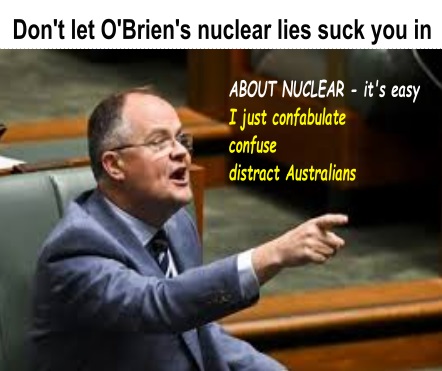
Comments about Ted O’Brien’s (Opposition energy spokesperson) disrespectful and dishonest questioning of witnesses during the hearings of the Inquiry into nuclear power generation in Australia. Maybe these comments could even be useful to future witnesses, if they were forewarned.
At today’s hearing in Lithgow one of the witnesses started to call him out. This is the first time that I can remember anyone really challenging him. It would be helpful if he was called out more clearly, ideally in a way that strikes at the heart of his dishonesty. Make it hard for him to use these tactics.
He regularly asks questions along the following lines:
“Have you read such and such a report?” (99% of the time the witnesses have not.) He then quotes or paraphrases (or misrepresents) something out of the report and asks the witness to answer “Yes” or “No” to some loaded proposition. When the witness doesn’t give him the Yes/No answer he wants, he interrupts them and insists that they answer Yes or No. Loaded questions might be along the following lines:
Based on this report, would you agree that nuclear is a viable option?
Or
Do you think you know better than the [unquestionably authoritative] author of this report?
(These are not direct quotes, just the general gist. See below for a specific example.)
This approach is disrespectful, because it is unreasonable to expect witnesses to have read every official report that O’Brien chooses to use (or misuse) to back up his position. Of course, O’Brien knows they haven’t read the report.
It is also disrespectful, because it is generally used for the purpose of making a fool of the witness in order to destroy their credibility.
It is dishonest, because he quotes or paraphrases the reports selectively, out of context, and probably misrepresents the reports.
An example from today’s hearing in Lithgow (11/12/2024) illustrates the point. It can be heard from 1.24.55 on the following link:
These two witnesses stood up for themselves, but on many other occasions throughout these hearings, the witnesses have been left looking silly, even though the fault is with O’Brien’s dishonest approach. (Note that a similar approach is used by Coalition “Supplementary Member” of the Inquiry, Simon Kennedy.)
Ted O’Brien: “My question was going to go to your comments on the timing for the construction of those plants — Generation 3, Generation 3+. And my question is, Do you recognise the experience of the International Atomic Energy Agency with respect to advice on the timing of introducing nuclear energy to new nations? And also the experience and authority of ANSTO, the government’s nuclear technology advisers, when it comes to the construction of nuclear power plants?”
Geoffrey Miell (retired mechanical engineer): “I look at the actual construction times around the world….”
O’Brien then interrupted Miell’s very reasonable answer and demanded that he give a Yes/No answer to the question “Do you recognise…?”
When Miell offered a variation of his original response, O’Brien asked, “Does that mean you do not recognise their experience and expertise sir?”
After this, at 1.28.25, Sarah Elliot (nursing academic and member of NSW Nurses and Midwives Association) called O’Brien out:
“I will say that I have read transcripts Mr O’Brien where you have misled …[interrupted by bickering between Chair Repacholi and Deputy Chair O’Brien]… Mr O’Brien can I ask you to afford this panel the respect you gave to the last ones. We may not be in agreeance with your views, but can you please respect this panel that is before you right now … I’m disgusted with your behaviour as a representative of…”
The dishonesty of O’Brien’s line of questioning is exposed when you read the latest CSIRO GenCost draft report. That report makes the following comment about the IAEA’s timing estimates:
“Nuclear development lead time
“The development lead time includes the construction period plus all of the preconstruction activities such as planning, permitting and financing. Many stakeholders have agreed with the GenCost estimate of at least 15 years lead time for nuclear generation. Those stakeholders that are more optimistic cite two alternative sources, the International Atomic Energy Agency (IAEA) who have an estimate of 10 to 15 years and the recent completion of a nuclear project in the United Arab Emirates (UAE) had a 12 year lead time. Both estimates are in relation to building nuclear for the first time. This consultation draft provides additional analysis of nuclear lead times to examine this issue more closely. We examine recent construction times and their relationship with the level of democracy in that country.
So the IAEA’s estimate is a 2015 estimate. In the 9 years since then we’ve seen massive blowouts in construction times in the US, UK, France and Finland. Those projects were already in trouble in 2015, but since then they’ve blown out much more, while the VC Summer plant in South Carolina was abandoned part way through construction. But O’Brien still uses the 2015 IAEA estimate to put witnesses on the spot. As for ANSTO, their credibility was demolished by John Quiggen in the following article. https://www.crikey.com.au/2024/03/20/coalition-nuclear-power-ansto-csiro-small-modular-reactors/
Another example was when O’Brien used the first Frontier Economics report (the second can be expected any day) to say the total system cost of the electricity grid in 2050 will be five times what the ALP Government has claimed (AEMO’s ISP report). He also completely misrepresented Minister Bown’s response to that report. However, on this occasion, Tennant Reed (Australian Industry Group), who had actually read the Frontier Economics report, interrupted him (5.55.50). This caused a problem for O’Brien, because his brazen dishonesty was exposed by a real expert. Unfortunately, Reed was too polite. He didn’t call out O’Brien’s dishonesty. He just explained the source of the difference between AMEO’s ISP figure and the figure in Frontier Economics report. “The two numbers are different sorts of number, rather than greatly in disagreement with each other.”
See the following YouTube link from 5.53.50:
See the following YouTube link from 5.53.50:
Inquiry Into Nuclear Power Generation In Australia, Melbourne, 04/12/2024
The above two examples are examples of where O’Brien was actually challenged, but, unfortunately, not exposed for the charlatan that he is. I am hopeful that if witnesses are forewarned of his tactics, they might be in a better position to stand up to him, ideally to expose him, but definitely not to be intimidated by his dirty tactics.
It’s hard to take the Coalition’s nuclear energy policy seriously, so we didn’t. And frankly, why would they put taxpayers on the hook for the biggest public funded project in history when renewables are crowding private investment en masse? https://www.youtube.com/watch?v=fSeaybp9oAA
It might seem weirdly appropriate that the federal Coalition should release its nuclear power policy costings on Friday the 13th, considered an unlucky day in western superstition. But that would be to downplay the sheer lunacy, rank dishonesty, and clear danger in Peter Dutton’s energy plans.
Shows like Edward Scissorhands are horror fantasies played out on a screen. But the Peter Dutton and Ted O’Brien nuclear plan is a horror show we may have to live and breathe. After so many years, the Coalition is still playing culture wars on the most fundamental issues of our time – and all at the behest of the fossil fuel industry.
It doesn’t matter at which level you look at it, this energy policy makes no sense at all. You could look at it backwards, from behind, sideways, leave it out in the sun for a few days, or even bury it in the garden (please do), the only thing that would change is that it might smell more than it does now.
It would likely take until Christmas to go through all the lies, deceptions and misunderstandings that comprise this policy and these costings, but let’s just focus on a couple of the important ones for now.
The reference to the sheer lunacy and the danger of the Coalition policy comes in Dutton’s desire to simply ignore climate science, along with basic engineering and economics.
Emissions reductions are put off to the never never. And, as Dutton revealed in his press conference through his comments on rooftop solar, he simply does not have a clue about the basic concepts of the energy system.
Dutton and Co simply want to bring a crashing halt to Australia’s only successful emission reductions efforts – the transition to green energy – and walk away from the country’s natural advantages in wind, solar and storage and the industries that are emerging from that.
They even have the chutzpah to claim that it will result in lower emissions. Which, inevitably, is pure bunkum. But, as Donald Trump has demonstrated, if you “flood the zone with shit”, something will stick – mostly to the front pages of mainstream media.
And that’s what we saw on Friday. A planned leak of the findings resulted in claimed headline “savings” – emblazoned across the front pages of the cheer-leading Murdoch media and the AFR this morning – that the nuclear power plan will save $264 billion.
It is of course, a complete nonsense, and obviously so to anyone who is paying attention, or even bothered to read the Coalition document. We are talking about completely different scenarios, and taking traditional accounting methods away from the international norm.
Dutton and his media followers have made a big deal of Frontier Economics costings of the Australian Energy Market Operator’s Integrated System which is the basis of Labor policy.
Frontier concedes, however, that the cost of AEMO’s “step change” plan is about what it says it is – $122 billion, based on the standard accounting practice of “net present value.”
But, at the urging of the Coalition, Frontier has published an additional number, around $600 billion, based on the “real cost” and throwing in some more transmission spending.
Dutton has used that number to insist that AEMO and Labor had lied to the Australian people. But it was the former Coalition government who instructed AEMO to cost it this way. And for good reason – it is standard international accounting practice. It is Dutton and O’Brien who are now spreading the lies.
Indeed, the Frontier Economics report actually reveals that the claimed $264 billion in savings parroted by the mainstream media are from two entirely different scenarios. One is from AEMO’s “Step Change”, the other from the Coalition’s version of “progressive change.”
The actual savings on a like for like basis are much smaller, if you can believe Frontier’s costings of nuclear.
Progressive change assumes that demand will not be as great as forecast by AEMO. It assumes much smaller electrification (thanks to the gas industry) and slower uptake of EVs (thanks to the oil industry). It then ignores the $75 billion a year of extra fuel costs that would result from that.
Now let’s go to the Coalition’s plan to shut down just one third of the main grid’s ageing coal fired generators by 2034 – with the rest trying to stay on line until nuclear power plants can be built.
The Coalition says it still thinks the first nuclear power plant can be built by the mid-2030s. The rest of the industry says this will be pretty much impossible until the mid 2040s.
Keeping the coal fired power stations open will not just increase pollution – both within the grid and the industries that depend on it – it will also puts grid reliability at risk.
This week, AEMO had to issue several lack of reserve alerts as another heatwave approached the eastern states. The main reason was that Origin, despite being promised up to $450 million to keep Australia’s biggest coal generator on line for another two years, reported another breakdown at Eraring.
At Bayswater, a unit is offline because of a tube leak. One third of the coal units in Victoria are also offline due to unplanned outages, and so is the country’s newest and “most efficient” coal generator at Kogan Creek, which is also the country’s largest single generation unit.
Dutton and O’Brien insist that these ageing and increasingly decrepit coal fired power plants will only have to operate “a few years longer”. But they are kidding themselves. Their own modelling confirms that.
They are still setting a timeline of 2035 for the first reactors. Will these be large scale of small commercial small modular reactor. No one has built one, or even got a licence to build one.
The Coalition insists that new nuclear can be built, from scratch, in a country with no nuclear infrastructure or know-how to speak of, no work force and no regulatory base ,in about a dozen years. There’s also a golden replica of the Sydney Harbour Bridge at the bottom of your packet of Cornflakes.
A dozen years is the average “delay” in the big nuclear power plants being built in western democracies – the UK, France, and Finland – all of whom have been operating nuclear power plants for decades.
Dutton and O’Brien are now telling us their nuclear plan will result in 14 gigawatt of nuclear capacity – double what they previously said. And Frontier’s modelling shows that coal is going to have to last a lot longer, beyond the official lifetime limits of the coal generators.
Even the Australian Energy Council, one of the most conservative of lobby groups that represents the coal generator owners, believes this is a bad idea and “could result in reliability issues.”
But let’s go back to the conventional way of measuring costs – net present value. The Frontier report includes it, at the very last page of its report. It shows that the difference in costs, on their calculations, is actually $62 billion over 25 years for the step change scenario.
But even that is on the basis of some heroic assumptions on the costs of nuclear. Frontier puts the total cost, including 14 GW of new nuclear power plants, at $142 billion (see table above).
Let’s look at the cost of Hinkley C, the first nuclear power station to be built in the UK for decades. At just 3.2 GW, its cost has already blown out to $A92 billion and is running at least 14 years late from its promised timeline. What does the Coalition know that the rest of the nuclear world does not know?
The Coalition’s vision for renewables also beggars belief. Under its modelling, it estimates the share of wind, solar and hydro will be less than 50 per cent in 2050. That’s in the “progressive” plan that appears to be their chosen one.
If you take the current level of renewables, the already committed large scale projects, and the continued roll out of rooftop and behind the metre solar, the Coalition is essentially telling everyone that the construction of new large scale wind and solar more or less comes to an end with their election next year.
The stupidity of the idea is frightening. Quite how the Coalition figures it could keep the lights on in the 2030s and 2040s is beyond belief.
The Coalition are also trying to convince people that somehow their plan does not need new transmission, or much back-up.
All generation needs back-up, and all generation needs transmission. A 1.4 GW nuclear power plant will be nearly twice the size of the current biggest unit in Australia’s main grid, the currently broken Kogan Creek coal fired generator.
That means it needs twice as much back-up, because if it trips suddenly – which it inevitably will, just look at the patchy performance of the new nuclear power plant in Finland – then the market operator needs to be able to fill in the gaps at a moment’s notice. That’s expensive.
And then, of course, is what to do with your rooftop solar. If the Coalition wants its fleet of nuclear power plants to run “always on” then there may be no room on the grid for your rooftop solar.
Your best bet might be to buy a battery, or better still an electric vehicle. You don’t have to leave the grid, but you will want to make sure that you can have power without it. And you sure don’t have to believe Dutton’s nonsense about solar not being able to charge EVs and batteries at the same time.
But the safest and cheaper option might be to ensure these idiots don’t get elected.
If you really want to understand where the federal Coalition’s nuclear energy policy is taking us, and it’s real purpose, you need to turn to Figure 6 on the costings analysis provided by its consultant Frontier Economics.
This is the estimation of capacity installed on Australia’s main grid over the next 25 years. It is based on Coalition leader Peter Dutton’s preferred scenario – the one he used to emblazon the claims of $260 billion in savings across the front pages of the mainstream media on Friday.
Since this is the comparison that Dutton is seeking to sell to the Australian public, let’s look at in detail.
In contrast to the Australian Energy Market Operator’s Step Change scenario, the one that the federal Labor government has used for its policy and planning blueprint, the Coalition’s Progressive Scenario imagines a world still revolving around the concept of baseload power, of petrol and diesel powered cars, of gas-powered homes and a lot less renewables.
The scenario also assumes a lot less rooftop solar, which means that the Coalition is banking on consumers buying more from the grid, and paying money to big utilities such as the Hong Kong owned ElectricityAustralia.
But the Frontier model focuses only on large scale capacity and generation. For large scale solar it is a bad look: Just a doubling of capacity from 2025 to 2050. Given that 5 GW of capacity is likely already locked in, that reduces the rollout of large scale solar to a trickle over the next two decades.
For wind, the story is actually worse. The modelling assume no offshore wind at all, given the Coalition’s promise to scrap the newly declared offshore wind zones, and despite the legislated target in Victoria of 9 GW by 2040.
For onshore wind, Frontier puts the installed capacity in 2025 at 12.8 GW (according to OpenNEM it would be closer to 14 GW by the end of that year, and predicts the total rising to 28 GW by 2050.
Given that more than 5 GW of wind power is already locked in and under construction or contract, then that is a painfully slow build rate over the coming two decades.
It’s the Coalition telling local and international investors: “F*** off we don’t want you here:” And forcing consumers to buy more power from the big utilities at the same time.
Apart from scrapping the offshore wind zones, the federal Coalition has also promised to “rip up contracts” for large scale underwriting agreements written with the federal government.
According to the Frontier report , Large scale renewables total 49 per cent (wind 32 per cent and solar 17 per cent) by 2050, with nuclear likely to be 38 per cent, assuming that everything gets built in time. The graph above shows limited growth in each of wind, solar and utility storage after 2030.
“This … would represent a dramatic slowdown in the installation and investment of renewable energy across Australia and will be a massive shock and concern to investors who have invested $40 billion into large-sale renewable energy in Australia since 2020,” Clean Energy Council CEO Kane Thornton said.
“Australia has been a world leader in rooftop solar with over four million systems installed on homes and small businesses and an additional 300,000 plus systems being installed every year. The Coalition’s plan means millions of Australians would miss out on the chance to install solar.”
And Thornton also pointed out that it would not be good for the owners of rooftop solar. Currently, households are up in arms at the prospect of having their panels switched off – in an emergency – once or twice a summer.
In the Coalition’s nuclear plan, it would likely be a daily occurrence to ensure that the nuclear generators are “always on.”
“A nuclear-powered energy grid would also be a disaster for the four million Australian homes that have already installed a rooftop solar system as a way to lower their power bills,” Thornton said. “These systems would have to be switched off regularly if Australia was to move to inflexible nuclear power.”
Regional Australia is having its “phoenix moment” as more people move to the bush, according to a local councillor, but some residents fear the Coalition’s nuclear plan could hinder growth and prosperity.
The Coalition has earmarked seven sites for nuclear reactors at former and closing coal power plants across Australia, including at Lithgow’s Mount Piper power station in central west NSW.
Tom Evangelidis, who sits on Lithgow City Council, told a parliamentary inquiry his family moved to the town at the foot of the NSW Blue Mountains four years ago for its affordability and proximity to Sydney.
The presence of a nuclear reactor could dissuade others from settling in the region at a time when it is planning a bright future, Mr Evangelidis told the parliamentary committee sitting in Lithgow on Wednesday.
“This is our phoenix moment,” he said, referring to the mythical creature that rises from the ashes as a symbol of renewal and progress. “Nuclear in our region will stop that.”
Opposition Leader Peter Dutton has pledged to release the costings of his nuclear plan soon, having slammed an experts’ report that showed solar and wind remained the cheapest forms of energy.
Mount Piper operator EnergyAustralia has plans for a 500-megawatt battery energy storage system adjacent to the site, while also looking into pumped hydro at nearby Lake Lyell.
Further west near Dubbo, there is a proposed Renewable Energy Zone, with 4.5 gigawatts of potential capacity through solar, wind and new transmission infrastructure.
Peter Hennessy, who lives on a property at Bathurst, said communities have been left “high and dry” by planning laws and consultation on renewable projects.
“[Energy Minister Chris Bowen] would have solar everywhere, couldn’t care less about the countryside at all,” Mr Hennessy said.
“[It’s] just an absolute disgrace and total disregard to the welfare of the land or the people surrounding or indeed anywhere else.”
Jim Blackwood, a retired GP and vice president of the Bathurst Community Climate Action Network, said it was redundant to debate the pros and cons of nuclear because it would take too long to establish.
“The issue is we need to do something now, and we need to do it in a time frame that is going to make a difference,” Dr Blackwood told the hearing.
Lithgow is at the front line of climate change tensions, facing the end of its economic base in the fossil fuel industry while also recovering from the Black Summer bushfires.
“Four years ago, this whole town was surrounded by an inferno, a raging inferno,” Dr Blackwood said.
“All the hills were a fire, and so those two things are basically what’s confronting all of us.”





 Antinuclear