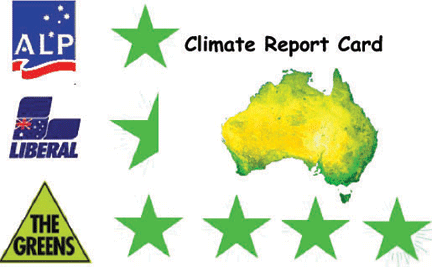
Australian Marine Conservation Society’s scoreboard on Liberal and Labor policies
 Reef election policies don’t go far enough: Fight for the Reef AMCS (Australian Marine Conservation Society) http://www.marineconservation.org.au/news.php/826/reef-election-policies-dont-go-far-enough-fight-for-the-reef29 June 16:
“The Fight for the Reef campaign’s final Election Policy Scorecard, released today (Wednesday),
shows that the next Australian Government will need to increase its financial commitment to the Reef,
regardless of which party wins office.
“Key findings of the scorecard:
“The Coalition’s $1 billion loan announcement is an existing climate fund rebadged as a Reef water quality initiative.
Assessing this policy announcement has been challenging as no further information has been forthcoming.
… Accordingly, the policy has been assessed as not meeting what is required to deliver the water quality reforms that are needed.
“The ALP’s promise to increase funds by $377 million is a good down payment, but it’s not enough.
“The ALP has scored green for two major Reef policies:
commitment to introduce a legal cap on pollution flowing from the catchment into the Reef and
a promise to reform the Great Barrier Reef Marine Park Authority to make it more independent.
“Both the Coalition and the ALP scored green for committing to satellite tracking of commercial fishing vessels to improve protection of green zones. … ”
From WGAR News ( WGAR: Working Group for Aboriginal Rights (Australia) Editorial Note: The Australian #Greens scored green for all items on the scorecard.
Guardian’s video explains Liberal and Labor plans on climate change
 So what will the Coalition, Labor and the Greens do about climate change? A video explainer https://www.theguardian.com/australia-news/video/2016/jun/29/so-what-will-the-coalition-labor-and-the-greens-do-about-climate-change-a-video-explainer Lenore Taylor explains what each of the major parties plan to tackle the problem of greenhouse emissions. While the Coalition is planning to review its plans after Saturday’s general election, Labor is promising two new emissions trading schemes and the Greens have are advocating that Australia source 90% of its power from renewable sources by 2030 Lenore Taylor,Josh Wall and Clare Downey, Source: theguardian.com 29 June 2016
Fiona Stanley’s survey on political parties’ response to climate change
 The climate change letter most candidates won’t answer Canberra Times, June 29 2016 Fiona Stanley I recently wrote to more than 1000 candidates in the federal election. I described how climate change is a real and growing threat requiring urgent attention, and that health professionals are seeing its impacts in medical practice right now and will be increasingly in the future.
The results distressed me. More than 100 independent candidates and those from virtually all minor parties and Greens responded to me with comments that were often constructive and extensive. There was only one individual response from a Labor Party candidate, and a courteous response from Labor campaign headquarters detailing official Labor policy. No Liberal Party candidate acknowledged my letter and there was no official response. Continue reading
Federal election candidates oblivious about the South Australian nuclear waste plan
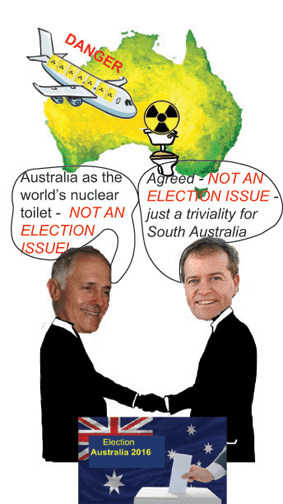 Nuclear waste importing: The taboo election topic, Independent
Australia 29 June 2016, An international nuclear waste dump is planned for South Australia but it is hardly mentioned in the lead up to the federal election. Noel Wauchope approached the candidates to see where they stand.
THE MAJOR PARTIES have each shrunk their thinking down to a couple of themes.
Occasionally, there’s a little burst from Labor about climate change, to which Turnbull might respond with a few motherhood statements on that subject.
But the one that nobody touches is nuclear waste importing.
The South Australian Labor Government is spending an enormous amount of money, time and effort, towards starting the world’s first commercial nuclear waste importing business. They plan to make a decision on this later this year — a decision that will impact the whole of Australia.
Whether you think about ports for receiving radioactive wastes or road or rail transport to the South Australian waste facility, or other issues, such as safety, the terrorism risk, Australian agriculture’s clean green reputation, it is pretty clear that this is a matter of national importance.
I’ve now found that Australian federal politicians, outside of South Australia, are pretty much oblivious of this extraordinary plan, unprecedented in the world, to invite in global nuclear waste. Continue reading
Voter support for Climate Action is now high, but Turnbull and Shorten don’t care
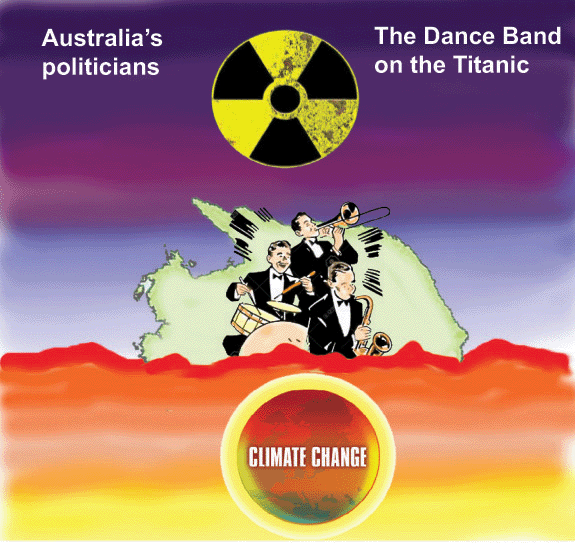 Turnbull and Shorten ignoring voters on coal and climate, Canberra Times, June 28 2016 Sarah Gill
Here are two statistics to ponder as we prepare to head to the polls this weekend: voter support for action on climate change has surged to historically high levels since the last election and; four fifths of usbelieve neither of the major parties actually gives a toss.
Polling released by the Climate Institute last week reveals that 72 per cent of us are worried about global warming, and that while only 17 per cent think the Coalition’s climate policies are credible, the plausibility of Labor’s response is ahead by just a whisker, at a paltry 20 per cent.
And, really, is it any wonder? While the Coalition and the ALP have emission-reduction targets – neither of which, it must be said, will avoid dangerous global warming – the policy detail underpinning them is woefully inadequate. It’s like trying to build the Eiffel Tower with a box of matchsticks.
After a decade of flip-flopping on climate policy, the electorate, it seems, has wised up. We’re not buying Labor’s pledge of an “orderly” closure of coal-fired power stations – remember how well that went last time? – any more than Environment Minister Greg Hunt’s enthusiasm for the Coalition’s Emissions Reduction Fund which, as everyone knows, is about as effective as an ashtray on a motorbike. …….
If you thought Resources Minister Josh Frydenberg was on thin ice spruiking the benefits of coal for the third world – asserting, I kid you not, that coal will reduce air pollution – then the Australian coal lobby recently dispensed with reason altogether by claiming, in the wake of the Paris climate agreement, that “coal will play a part in reducing emissions globally”……..
Let’s not forget that in the lead up to the last election, the Coalition snared $1.8 million from companies in favour of a carbon price repeal. Mining industry executives – who are drawn, with disturbing regularity, from the ranks of former politicians and political staffers – would, no doubt, be similarly disgruntled. ……
The world’s largest privately-owned coal producer, Peabody Energy, may have recently filed for bankruptcy protection amid a slump in global demand and tighter environmental regulation, but our political leaders are resolutely peddling a narrative on the merits of Australian coal that could have been drafted by the Minerals Council of Australia. Who knows, maybe it was? http://www.canberratimes.com.au/comment/turnbull-and-shorten-ignoring-voters-on-coal-and-climate-20160627-gpsmp8.html
Politics and the Nuclear Waste Importing Plan
Risks, ethics and consent: Australia shouldn’t become the world’s nuclear wasteland, The Conversation, Mark Diesendorf, Associate Professor, Interdisciplinary Environmental Studies, UNSW Australia, June 28, 2016
In a country that is divided about nuclear power and where the annual economic value of uranium exports is a modest A$622 million (roughly equal to Australia’s cheese exports), the origin of the nuclear waste proposal is puzzling and inevitably involves speculation.
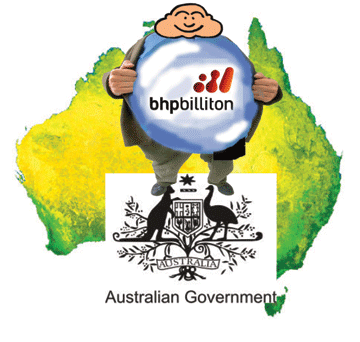 However, one could suggest the political influence of BHP-Billiton, owner of Olympic Dam in South Australia, Australia’s largest uranium mine and the second-largest in the world, and Rio Tinto, owner of the Ranger uranium mine in the Northern Territory.
A global nuclear waste site would lock future generations of Australians into an industry that is dangerous and very expensive. It’s unlikely to gain social consent from Indigenous Australians, or indeed the majority of all Australians. Given the risks, it would be wise not to proceed. https://theconversation.com/risks-ethics-and-consent-australia-shouldnt-become-the-worlds-nuclear-wasteland-61380
Queensland approves all environmental activity applicants despite ‘disqualifying events’ ‘An independent review has raised se
rious questions about the system for registering people and companies for sensitive environmental activities in Queensland.
Key points:
– Applicants were approved despite leaving questions unanswered, missing documents
– Environmental lawyer describes the process as “sloppy”
– The Environment Department says it helps applicants fix applications
The ABC can reveal that not a single applicant has been denied “suitable operator” status
since the system was brought in three years ago, despite instances of missing paperwork,
inadequate information, and applications containing “disqualifying events”.’
‘Concerns over #Adani port expansion prompted review …
Background check ‘ignores foreign offences’ … ‘
Exclusive by the National Reporting Team’s Mark Willacy | ABC News
http://www.abc.net.au/news/2016-06-27/no-applicants-rejected-under-qld-environmental-activity-register/7546290
Social Consent and South Australia’s Nuclear Waste Import Plan
Risks, ethics and consent: Australia shouldn’t become the world’s nuclear wasteland, The Conversation, Mark Diesendorf, Associate Professor, Interdisciplinary Environmental Studies, UNSW Australia, June 28, 2016
“…….Aware that Australians are divided on the nuclear industry, the royal commission acknowledges that gaining “social consent warrants much greater attention than the technical issues during planning and development”.
Then, on the same page of its report, it postulates that community support could be gained by “careful, considered and detailed technical work”. It thus creates the false impression that all social and ethical concerns can be reduced to technical issues.
Ultimately, gaining social consent is a socio-political struggle that draws only slightly on research and education on science, technology and economics. This is demonstrated by current debate in Australia on climate science, in which citizens are influenced by a print media that in many cases is biased towards denial, and a Coalition government that contains several vocal climate sceptics
Indigenous Australians have successfully opposed for 20 years an above-ground dump for low-level national nuclear waste on their land at Muckaty in the Northern Territory. Indigenous communities are already mobilising, together with environmentalists, to resist very strongly any development of intermediate- and high-level repositories in South Australia. The social impacts of a low-level waste dump are bad enough, but would be dwarfed by the social, physical and financial impacts of a high-level waste repository…….” https://theconversation.com/risks-ethics-and-consent-australia-shouldnt-become-the-worlds-nuclear-wasteland-61380
Former Liberal leader says climate change should be dominant election issue
 Climate change: John Hewson accuses Coalition of ‘national disgrace’
Former Liberal leader says climate should be dominant issue of election campaign rather than ‘short-term politicking’, Guardian, Michael Slezak 25 June 16, The former Liberal leader John Hewson addressed an estimated 2000 people protesting in the Sydney suburb of Double Bay – minutes from Malcolm Turnbull’s harbourside mansion – calling on the prime minister to take stronger action on climate change.
Speaking at the same time as Turnbull addressed the party faithful at the Coalition’s campaign launch, Hewson told protesters the Coalition’s lack of action on climate change was a “national disgrace”
“I think climate change should be the dominant issue of this campaign – it should have been for quite some time,” said Hewson, who was once the local member for the seat of Wentworth, which includes Double Bay.
He said “short-term politicking” from both sides left targets that were inadequate and policies that were not going to meet those targets.
“The one thing that hasn’t failed is people like yourselves,” he said. “The community is way ahead of the political leaders and the business leaders on this issue.”
He urged the crowd to push political leaders for a bipartisan approach to climate change. “Enough is enough, it’s time to act,” Hewson said.
A spokesperson from GetUp, which organised the protest in coalition with three other environment groups, estimated there were about 2000 people in the crowd.
Protesters were given placards in the shape of coral, which were coloured on one side, and white on the other, which symbolised the devastating bleaching on the Great Barrier Reef. They turned them around for the cameras, while chanting “Choose the reef, not coal”……..
The protest caps three days of protesting in Turnbull’s electorate.
On Friday Greenpeace activists hung a banner from Turnbull’s electorate office in Edgecliff, saying: “Turnbull’s Legacy: bleaching – brought to you by Malcolm’s mates in the coal industry.”
And on Saturday, a group of 50 pacific islanders kayaked from Blues Point to Lady Martin’s beach, mere metres from Turnbull’s harbourside mansion, raising awareness of climate change and sea level rise. https://www.theguardian.com/science/2016/jun/26/climate-change-john-hewson-accuses-coalition-of-national-disgrace
Citizens Jury: the ever climbing costs of Jay Weatherill’s nuclear waste dream
 $7k each for Jay Weatherill’s nuclear citizen jury http://www.theaustralian.com.au/news/briefs-nation/7k-each-for-jay-weatherills-nuclear-citizen-jury/news-story/c363f8aac22374ef76e470b9c71d33e8 JUNE 27, 2016 Rebecca Puddy Reporter Adelaide The South Australian government has set aside $350,000 for 50 randomly chosen people to meet over four days to discuss the establishment of a nuclear waste dump, equating to $7000 a person.
The first two days of consultations of the citizens’ jury were held at the weekend, with Premier Jay Weatherill picketed by anti-nuclear activists on his way to open the deliberations over whether the state should have a high-level nuclear waste repository.
It is understood a budget of $350,000 has been set aside for the four days, including recruitment and management, accommodation and transport, event facilitation over the two weekends, live streaming and transcription services, catering, venue hire and security.
In announcing the citizens’ jury, Mr Weatherill last month said less than a $1 million had been budgeted for his nuclear consultation process, but more would likely be assigned in the state budget on July 7.
The powerful influence of mining companies on Australia’s political parties
serious questions about the influence that mining and energy companies have on major political parties during election campaigns.
It is well known there is a perpetually revolving door between mining/energy companies and politicians/staffers from the major parties.
Take the Labor Party. When Labor lost the last election, Martin Ferguson, Craig Emerson and Greg Combet either took up management jobs with mining and energy companies and associations or worked as consultants for them.
Combet, a former climate change minister, took up consultancies for coal seam gas companies AGL and Santos. Ferguson, resources minister during Labor’s last term of office, landed the position as chairman of the Australian Petroleum Production and Exploration Association’s advisory committee only six months after leaving politics.
With the Coalition, former National Party leader Mark Vaile is chairman of Whitehaven Coal, the company at the centre of protest and controversy at the Maules Creek mine. Another former National Party leader, John Anderson, became chairman of Eastern Star Gas only two years after quitting Canberra.

How Big Mining’s donations influence the political agenda in Canberra, Independent Australia The Conversation 25 June 2016, Voters take note: As the old adage goes, if you take the King’s shilling, you do the King’s bidding. In this case, it is King Coal— and its biggest subject is the Coalition. Monash University’s David Holmes reports.
THE ENDORSEMENT for coal mining from the Labor-Coalition duopoly that the election campaign has seen in the last week makes the token appeals that have been made about tackling climate change even more disingenuous.
In this election campaign, the major parties have only brought up climate change when they have been pressed to do so at public forums, like leaders’ debates, the ABC’s Q&A, or when they treat social media as something that needs to be quelled.
The Coalition’s response is simply to say that Australia participated in the Paris agreement, and that is good enough. Labor, on the other hand, points to having outbid the Coalition on targets. Yet neither party is planning to deliver the cuts needed for Australia to play its part in keeping global warming below the 2℃ threshold.
Which leads us back to a question I will deal with at the end of this article: if polls are consistently showing that Australian voters want climate change on the election agenda, why are the leaders keeping so quiet about it?
Neither party is shy of talking up coal, however. Bill Shorten declared last week that a Labor government would not ban coal mining — and that it would be part of Australia’s energy needs for the foreseeable future.
But then on Tuesday, Attorney-General George Brandis, campaigning for Queensland’s most marginal seat of Capricornia, put in one of the pluckiest coal-selling performances of the campaign. He cited the gigantic Adani mine in central Queensland a saviour for the electorate……. Continue reading
Gems from Nuclear Citizens Jury – South Australia today
Morning Session
DemocracyCo advises on streaming of Nuclear Citizens Jury hearings in Adelaide
Emily from democracyCo here.
 The Lifestream sessions will be up tomorrow on this website. http://yoursay.sa.gov.au/decisions/yoursay-engagements-nuclear-community-conversation/about First session will be from 9.20am. We are also transcribing all presentation & Q&A sessions with the Jury – we can’t transcribe workshop sessions though, too tricky! On Facebook & Twitter you will also be able to find updates throughout the day.
******************************************
 For any credibility, the hearings with witnesses would need to be available on video and audio, and preferably televised. I fear that NewDemocracyCo is being played by the Nuclear Royal Commission and the Weatherill government.
National Labor opposes nuclear waste importing: an obstacle to South Australia’s plan

 Labor’s national policy against nuclear could create issues for SA’s waste dump proposal http://www.abc.net.au/news/2016-06-24/alp-policy-could-create-issues-for-sa-nuclear-vision/7539166?utm_source=dlvr.it&utm_medium=twitter By Leah Maclennan Labor may oppose a high-level nuclear waste dump, even if the South Australian Government decides to build one, a federal Labor MP says.
The State Labor Government is consulting on the proposal following the recommendations of the Nuclear Fuel Cycle Royal Commission.
But Labor MP Nick Champion told a forum in Adelaide that he is against it, and would not want one in his electorate, which covers the northern suburbs and the Barossa Valley.
“I think the transport of it. I think the actual construction of it, the fact that nobody in the world has done it,” Mr Champion said. “Canada hasn’t done it. I think the Fins have only just established one, I think there is a lot more thinking that would have to go into it before we embarked on such a route.”
Mr Champion also raised the issue of the Labor Party’s policies, saying it has a national position in opposition to a high-level nuclear waste dump.
“There’d be some interesting debates at the national conference as there has been for the last three decades on nuclear issues,” he said
“But at the moment our platform opposes a high-level nuclear waste dump and so I suspect that’s the way the policy will be.”
Liberal senator Simon Birmingham told the forum it was the strongest opposition he has heard from a Labor MP.
“I’ve heard Bill Shorten and Penny Wong and Anthony Albanese express reservations about a nuclear waste dump before but I think Nick has put the party platform and position more clearly today than I’ve actually heard from a lot of others,” he said.
“For South Australians who think there is a good opportunity for our economy here, and [Premier] Jay Weatherill appears to be one of them, that’s a concerning proposition that you’ve put that it would seem to be very hard to get cooperation from a federal Labor government if SA is to go down this pathway.”
The federal Liberal Government has said it would work cooperatively with the South Australian Government if it decides to go ahead with the plan.
S Australia’s Nuclear Citizens Jury – dubious panel, dubious public accessability
omigawd I can’t believe that they are classing nuclear business lobbyists Nigel NcBride  and Jason Kuchel as “experts” on nuclear science.
This Citizens jury panel is worse than I expected it to be. As for the link to “streaming” – it does not lead you there. It leads you to the Nuclear Royal Commission’s page where you’re invited to “register for discussion”. So much for public access to the hearings. This is a charade of the Citizens Jury Process.
To have any credibility a Citizens Jury on this nationally important matter should be televised, or at very least available as video, audio and transcript.
1 This month
7 April – WEBINAR – Australia and the Doomsday Clock – Preventing nuclear war through NoFirstUse and other policies
Online | Tuesday April 7, 4:00-5:30pm, Australian Eastern Time / 8:00-9:30am Central Europe Time
– Access the registration link
15 April – Zoom –Nuclear Power is Not the Solution
Apr 15, 2026 01:00 AM in Canberra, Melbourne, Sydney

Join the International Physicians for the Prevention of Nuclear War (IPPNW) on Tuesday, April 14th for a timely webinar exploring the risks associated with nuclear power and challenging the myth that it offers a simple, safe, carbon-free solution to the climate crisis

21 April Webinar: No Nuclear Weapons in Australia
Start: 2026-04-21 18:00:00 UTC Canberra, Melbourne, Sydney (GMT+10:00)
End: 2026-04-21 19:30:00 UTC Canberra, Melbourne, Sydney (GMT+10:00)
Event Type: Virtual
A virtual link will be communicated before the event.
Host Contact Info: australia@icanw.org

of the week – Australians for War Powers Reform (AWPR)
To see nuclear-related stories in greater depth and intensity
 Antinuclear