Community opposition stops nuclear waste dump: U-turn by MP John Cobb on nuclear policy
 Hill End nuclear waste dump ruled out due to community opposition, ABC News 29 Jan 16 By Nick Dole
A nuclear waste facility will not be built at Hill End in central-west New South Wales because community opposition to the proposal is so strong, the Federal Government has said.
The site at Hill End, north of Bathurst, was one of six being considered for a nuclear waste facility.
It was offered up by a local landowner, who could be paid four times the land’s market value.
At a packed public meeting on Saturday, dozens of residents spoke against the concept, telling representatives from the Federal Government that Hill End was a “totally inappropriate” location.
Many residents expressed concerns about potential water contamination or the risk of transporting radioactive material. Local resident Kerri Burns said Hill End should be removed from the selection process immediately.
“We’ve been polite, but if this goes further, the gloves are off,” she said.
The audience was told Hill End would remain on the shortlist for now, due to a legislated consultation process.
But the Member for Calare, John Cobb, said he had already communicated the community’s view to Minister Josh Frydenberg.
“I said, ‘We are not going to be building this at Hill End’ and he looked at me and I said ‘The community is against it and they are not going to change their mind’,” Mr Cobb said……..http://www.abc.net.au/news/2016-01-30/hill-end-to-be-spared-nuclear-waste-dump/7127092
It’s Big Money that impels politicians to promote the nuclear industry
from CaptD 31 Jan 16 The first reason is MONEY and I mean BIG Money. Politicians are always gear 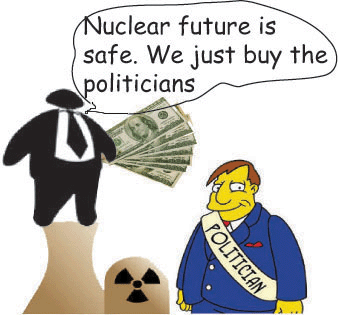 for Nuclear Payback*
* http://www.urbandictionary.com/define.php?term=Nuclear+payback
Those that support nuclear power because nuclear power somehow supports them; no matter what the health implications or other “costs” are for others.
The “other” reason is that the Nuclear Industry and their Utilities are desperate to create a radioactive waste dumping site for waste is that they are going to want to site Small Modular Reactors (SMRs) very soon, which companies like SD’s General Atomic are now working on. Since CA has a law that says no more nuclear reactors, until a waste site is developed, the lack of a disposal site is the biggest roadblock they face preventing them from deploying SMRs in CA.
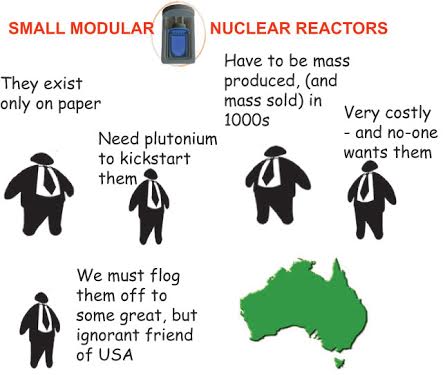
I believe that most Utilities will want to phase out Nat. Gas fired Peaker plants and install SMR’s “because they don’t emit CO2.” That is, unless they are going to be making big money using nat. gas like SDG&E will be, since they already have a contract to import Nat. Gas from Mexico (which Sempra owns a share of, so they will be kind of buying Nat. Gas from themselves) for use in their two new state of the art Billion Dollar Peaker Plants that the CPUC just approved for them (despite the fact that the cost of Wind and Solar generation continues to drop almost monthly)!
SCE just had the CPUC decide against approving a Nat. Gas Peaker plant for them, so you can bet that they are now getting “very excited” about installing one or more SMR’s at San Onofre, since the grid wiring connection is already in place and they are going to be guarding that “nuclear waste” site for decades to come.
http://www.kpbs.org/news/2016/jan/08/oceanside-takes-stand-relocating-san-onofres-nucle/
BTW: All waste facilities should be run by the Government, that way they will always be responsible for it, since Big Waste Corp.’s can go out of business any time they want as as everybody knows Radiation is FOREVER since 50 or more than 100 years is forever to everyone living today.
South Australian Cabinet nuclear stooge Leesa Vlahos already spruiking for nukes!

Labor MP Leesa Vlahos says pro-nuclear debate ‘getting easier’ March 16, 2015. South Australian Labor MP Leesa Vlahos says pro-nuclear advocates have started to win the debate in the five weeks since Premier Jay Weatherill announced a royal commission into the nuclear industry……(subscribers only) http://www.afr.com/business/mining/uranium/labor-mp-leesa-vlahos-says-pronuclear-debate-getting-easier-20150313-143fhw &http://www.mypolitician.com.au/SA/politician/leesa-vlahos
Medical isotopes: tax-payer funded ANSTO should be promoting non nuclear technology
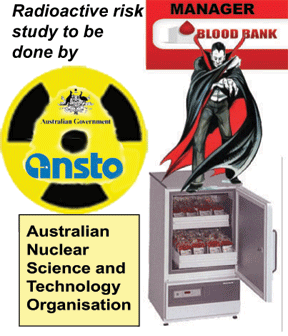 Medical isotope production in Australia: Should we be using reactor based or cyclotron technology? 15th January 2016 Dr Margaret Beavis MBBS FRACGP MPH Medical Association for Prevention of War, Australia Health Professionals Promoting Peace
South Australian Cabinet gets two new pro nuclear enthusiasts
 Leesa Vlahos’ elevation to the Cabinet of South Australia in the Jay Weatherill government was announced on 18 January 2016.
Vlahos was described by the Australian Financial Review as ‘staunchly pro-nuclear’ and advocated for nuclear power in Australia during the lead-up to the Royal Commission into South Australia’s future role in the nuclear fuel cycle. In her 2015 submission in response to the Terms of Reference for the Royal Commission she stated that she had been an advocate for a “modern and safe” nuclear industry for South Australia “for years”. She also encouraged an investigation of the possibility of developing Thorium-fueled nuclear power.
Peter Malinauskas’ elevation to the Cabinet of South Australia in the Jay Weatherill government was announced on 18 January 2016.
In February 2014, Malinauskas expressed his openly pro-nuclear position to the media. At the time, the Labor party remained opposed to the establishment of a new nuclear waste repository or nuclear power plant in South Australia. He told The Advertiser:
“I believe climate change is a real challenge we need to face up to, and nuclear energy can be a safe source of base load power, with zero carbon emissions… We should have a mature debate based on science and economics to determine if a nuclear industry is viable in SA.”
That gives the Weatherill gov’t at least 3 spokespeople within Cabinet (including Koutsantonis) who can sing the praises of the Commission’s findings when released next month.
Voters in key Liberal Coalition electorates strongly support renewable energy
 Strong Renewable Energy Support In Key LNP
  Electorates http://www.energymatters.com.au/renewable-news/renewables-australia-lnp-em5288/
January 12, 2016 The passion for renewables in Australia isn’t waning, but support for coal appears to be – particularly when it comes to new mines. This is a continuing trend among voters of all political leanings.
72-77% of voters recently polled in conservative electorates support Australia becoming a 100% renewable energy powered nation by 2030.
A ReachTEL-conducted survey of thousands of residents across the federal electorates of New England, Page, Warringah and Dickson in December revealed just 14% to 18% opposed a renewables powered Australia.
The polling of these voters also indicated a global moratorium on new coal mines had strong support; at 50 – 57%.
It will come as no surprise that Labor and Greens voters indicated even stronger support.
“Renewable energy is popular across the political spectrum. Part of Tony Abbott’s undoing was that he placed himself at odds with the electorate on this issue,” said Ben Oquist, Executive Director of The Australia Institute said.“These results show politicians of any hue who undermine support for a 100% renewable future risk an electoral backlash.”
Mr. Oquist also stated construction of new mines in a struggling market is “a recipe for economic disaster.”
“China recently announced a 3 year moratorium on new coal mines. Malcolm Turnbull can and should show the same commitment to deliver on commitments made at the Paris climate meeting in December,” he said.
The chances of a moratorium? Late last year, Federal Energy Minister Josh Frydenberg claimed there was a “strong moral case” for coal. Also in October, the Federal Government granted Adani re-approval to build the massive and very controversial Carmichael coal mine
Back in 2014, the Institute for Energy Economics and Financial Analysis (IEEFA) issued a wake-up call to investors, stating the global coal industry’s economic models were flawed. IEEFA said major coal projects with a reliance on export markets such as India constituted a huge financial risk.
The Australia Institute is actively campaigning against new coal mines in Australia and says a local moratorium will send the strongest political signal that the reign of coal is over.
Australia’s role in the big nuclear issues for 2016
 Five big nuclear issues for 2016 — and Australia’s role in them, Independent Australia Noel Wauchope 5 January 2016, Nuclear issues got next to no discussion in Australia in 2015. That is sure to change in 2016 from five explosive factors, writesNoel Wauchope.
#1: Nuclear weapons “……….. In the event of nuclear war, Pine Gap makes Australia both a participant and a target.
What the experts call a “limited nuclear war” between India and Pakistan is always on the cards as both nations ramp up their nuclear weaponry. What does Australia do about this? The Turnbull Government, ignoring the advice of the Joint Standing Committee on Treaties (JSCOT) and pro nuclear power expert Dr John Carlson, goes ahead with insecure uranium sales to India, thus contributing to that India-Pakistan arms race.
All these considerations will matter to Australia in a number of ways in 2016. An obvious example is in the diplomatic tightrope that our Government must walk in its relations with China — Australia’s largest export market.
#2: Indigenous rights……. For 2016, governments must have learned that Indigenous Australians are a force to be reckoned with and that non-Indigenous might join in that anti nuclear struggle. State governments, particularly Western Australia, have sought to strengthen the resources industries’ power to fight Aboriginal land rights. This has to be an issue for uranium mining in 2016 — whether mining developments can continue to ride roughshod over traditional Indigenous traditional land.
#3: Energy technologies Renewable energy is here to stay. ….. Australia leads the world in rooftop solar, with the highest portion of residential buildings with rooftop photovoltaic power. Despite government policy uncertainty, important solar research continues, community solar projects are developing, large scale solar projects are taking off, for example, in New South Wales. Wind power is now also taking off and has long shown its success in South Australia.…….. The nuclear lobby would have everyone believe that nuclear energy is the answer. But even they know that this is not a practical choice for Australia. In February, the South Australia Nuclear Fuel Cycle Royal Commission will be announcing its recommendations. Its chief, Kevin Scarce, has already indicated that it is not likely to recommend nuclear power.
In 2016, Australia still has the opportunity to become a leader in truly clean renewable energy technologies, as energy storage systems become a reality…….With 2016 as an election year and with the ALP’s policy of a 50 per cent renewable energy target by 2030, renewable energy developments form a challenging issue.
#4: Australia as the world’s nuclear waste dump….. the South Australian Nuclear Fuel Cycle Royal Commission and all that will ensue from its recommendations. Commission head, Kevin Scarce, will no doubt cover his back with worthy statements about proceeding only if there is a social licence, but we can be pretty sure that this expensive year-long Royal Commission is not going to turn its back on its central idea — importing nuclear wastes. Meanwhile, in 2016, the ALP will have to face the push within its ranks to change its existing anti nuclear policy.
#5: The propaganda war….. there will be pressure on Australia’s academic and health authorities, as well, of course, on the mainstream media……. https://independentaustralia.net/environment/environment-display/five-nuclear-issues-for-2016–and-australias-role-in-them,8544
New Directive to Clean Energy Finance Corporation (CEFC) supports renewable energy investment
 New clean energy investment mandate a shift from policy proposed by Abbott
Directive to CEFC to focus on innovative and emerging technologies will enhance support for windfarms and small-scale solar projects, Guardian, Shalailah Medhora, 24 Dec 15. The Clean Energy Finance Corporation (CEFC) has been directed to focus on innovative and emerging technologies, reversing a mandate by the former prime minister Tony Abbott that would have specifically blocked funding for windfarms and small-scale solar projects.
The mandate came into effect on Thursday, with a new clause outlining the shift in focus.
“As part of its investment activities in clean energy technologies, the corporation must include a focus on supporting emerging and innovative renewable technologies and energy efficiency, such as large-scale solar, storage associated with large- and small-scale solar, offshore wind technologies, and energy efficiency technologies for cities and the built environment,” the clause said. “ This will in turn increase the uptake of emerging technologies such as large-scale solar and energy efficiency.”
The investment mandate is not exclusive, meaning that established technologies can still be funded, and not retrospective, so projects that have already been funded will not be affected.
“The CEFC will therefore continue to pursue a diverse range of investment activities that are within the scope of the CEFC Act and this new investment mandate,” a statement by the body said.
“Together, the new investment mandate and the accompanying explanatory statement provide guidance on how the CEFC should approach investment in mature and established technologies, such as conventional onshore wind and conventional hydro,” it said. “It is the government’s expectation that, in many circumstances, projects involving mature technologies should be able to secure finance from commercial financing sources.”
The mandate is a shift from what Abbott proposed in July, when he said the body should no longer fund small-scale solar projects such as rooftop panels and wind technology…….
The CEFC chairwoman, Jillian Broadbent, wrote to the environment minister, Greg Hunt, and the finance minister, Mathias Cormann, welcoming the new mandate. She said it was an “appropriate approach that allows the CEFC to support the Australian government policy priorities while still allowing a measure of investment flexibility”. …….http://www.theguardian.com/environment/2015/dec/24/new-clean-energy-investment-mandate-a-shift-from-policy-proposed-by-abbott
Coal giant Adani in a financial pickle
 Adani’s finances go from bad to worse, Independent Australia Lachlan Barker 3 January 2016, Federal and State Governments continue to approve it but the Adani Carmichael project will never eventuate unless an investor with “a financial death wish” can be found, writes Lachlan Barker.
IN OCTOBER 2015, the new Minister for Resources, Energy and Northern Australia,Josh Frydenberg, made a death knellpronouncement on Adani’s Carmichael Coal Mine and Rail Project, indicating that the rail line to the Galilee Basin to serve the mine:
“… wouldn’t be a priority project.”
He added that Adani’s project was:
“… a commercial operation and it needs to stand on its own two feet.”
This makes it pretty clear that the federal government have, at last, recognised that this Adani coal mine has not a chance in hell of making a red cent and federal funding through the Northern Australia Infrastructure Facility (named by opponents as the ”Dirty Energy Finance Corporation”) will not be provided.
Additionally, the banks have indicated that they will not touch this project and the one bank that Adani has constantly pointed to as a source of finance, the State Bank of India (SBI), has not actually said “yes” to the project. The SBI has simply received an application from Adani for financing.
Currently, the SBI are reviewing Adani’s application – as they do with any application – and will, presumably, announce their decision soon.
So, with no banks and now without the Australian Government, Adani were left with the solitary hope that the Queensland Government might come to the “white elephant” party.
If that was indeed their main source of hope, they must have been chagrined when, over the Christmas break, a tiny story appeared on the SBS website, headlined, ‘Adani must fund mine: Qld premier’.
The link takes us to a brief story reprinted here:
Queensland’s government has warned Indian mining giant Adani it must finance the controversial Carmichael coal mine on its own.
The federal government on Tuesday approved the expansion of Abbot Point port, which is intended to service the proposed Carmichael mine, prompting Premier Annastacia Palaszczuk to sternly tell Adani not to expect any financial assistance from the state.
“There will be no taxpayers’ money going towards this project,” she said.
At the time of writing, the only entity on the planet prepared to fund the Carmichael mine project – rated as a A$16 billion project (US$11 billion) – is Adani itself.
IEEFA tells us that Adani has already borrowed A$3 billion for the initial investment in the mine and now need to raise the remaining A$13-14 billion (US$9-10 billion). That being the case, the mine looks as likely to be built as environment minister Greg Hunt’s chances of getting an invitation to the Greenpeace Christmas party — for Adani’s financial situation has got worse………https://independentaustralia.net/article-display/adanis-finances-go-from-bad-to-worse,8539
Maralinga nuclear toxicity continues
Mr Kerin and the Minister for Aboriginal Affairs, Robert Tickner, told the cabinet that the Commonwealth would plead the Statute of Limitations if any Aboriginal initiated a common law  action against Canberra.
Further, the ministers stipulated that if Yami Lester, a Yankunytjatjara man blinded by a “black mist from the south in the 1950s”, rejected the offer and proceeded with his common law action the Commonwealth should also plead the Statute of Limitations.
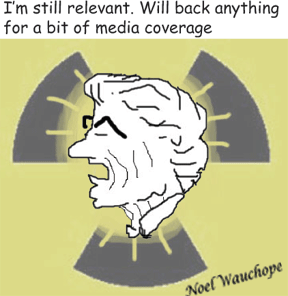 In a coda, Bob Hawke [at left] told journalists attending a National Archives briefing on the cabinet papers last month that Australia should take the world’s nuclear waste as a way to raise new revenue as an alternative to raising the GST or reducing expenditure.
Cabinet papers: Fallout continues from British atomic tests http://www.smh.com.au/nsw/cabinet-papers-fallout-continues-from-british-atomic-tests-20151217-glqlmg.html January 1, 2016 Damien Murphy The cabinet papers reveal how ignorant various Australian governments had remained about contamination at the British atomic test sites in Maralinga in South Australia.
They also erroneously believed that British clean-up operations were effective in removing plutonium contamination. Continue reading
Has Malcolm Turnbull got any hope of real action on climate change?
 Paris UN Climate Conference 2015: Paris delivers, but can Malcolm Turnbull? SMH December 13, 2015 Tom Arup Environment editor, The Age With the Paris summit wrapping up having delivered an historic global climate agreement, questions will inevitably turn to whether Malcolm Turnbull will use the international momentum to advance the climate debate back home.
For half a decade, Australia has been stuck in a fact-free debate on climate policy – one that has seen one of the biggest challenges the world faces turned into a domestic political chew toy.
But where the failure at Copenhagen helped derailed Kevin Rudd’s climate ambition back in 2009, success in Paris presents the opposite opportunity for Turnbull, who many believe has a deep desire to move to a more robust climate policy.
We will soon find out whether two weeks on, and one historic agreement later, Turnbull feels the world has moved enough to take a few brave steps forward.
Deeper cuts will also require a bigger re-think of domestic policies – Australia will not be able to rely on the current combination of paying some farmers and businesses to cut emissions, carbon accounting fiddles and falling demand for electricity.
It will have to find a way to finally address pollution from the country’s fleet of large, ageing coal-fired power plants. Emissions from coal have been rising since the Coalition abolished the national carbon price scheme.
The government’s direct action scheme is not fit for this job – at least not as currently designed. It will need a radical overhaul, perhaps one that would make it look more like a type of emissions trading scheme……..forward. http://www.smh.com.au/environment/un-climate-conference/paris-un-climate-conference-2015-paris-delivers-but-can-malcolm-turnbull-20151212-glm6op.html#ixzz3uFQmfQc5
Julie Bishop signs Paris Declaration for clear rules for carbon trading
What a tortuous track Julie Bishop, Greg Hunt and co. have to navigate, as they weave about within the Turnbull government’s climate policies – which are exactly the same as Tony Abbott’s !
 How long before the Turnbull government trips itself up in its own convoluted
rhetoric?
How long before Australia’s voters wake up to them?
Australia signs up for clear carbon trading rules, hinting at policy change, Guardian, Lenore Taylor in Paris, 10 Dec 15
Signing declaration at the Paris climate talks ‘recognises the role a carbon market might play after 2020’, foreign minister Julie Bishop says. Australia has signed a Paris declaration calling for new clear rules for international carbon trading in a signal the Coalition’s six-year carbon pricing policy veto could be softening as it prepares to review its climate policy in 2017.
Foreign minister Julie Bishop, who signed the declaration in Paris, said it was in Australia’s interests to recognise the role an international carbon market might play in reducing emissions after 2020.
“It’s just a declaration, it’s not legally binding,” she said after a speech to an event organised by Australia’s Carbon Market Institute. Continue reading
‘High ambition coalition” on climate change – but Australia won’t be joining
 Australia unlikely to join climate coalition, Sky News, 11 December 2015 Canada has joined a new coalition of 100 countries calling for an ambitious agreement at major climate talks in Sky News alia is unlikely to add its name to the list.
Some predict the new ‘high ambition coalition’ could be a significant force in the negotiations, with a majority of nations – from the richest to the poorest – involved.
Australia, while supporting its intention, hasn’t joined.
The 100 countries, including the United States, are demanding a reference to limiting global warming to 1.5C, five-yearly reviews and a pathway to low carbon.
It also wants adequate financing for poor countries.
Marshall Islands Foreign Minister Tony de Brum urged more countries to join while revealing the coalition on Wednesday night.
Canada’s environment and climate change minister Catherine McKenna took up that offer the following day, despite not initially being on the list.
Australia is understood to agree with the group’s goals but wants to focus its energy elsewhere…….http://www.skynews.com.au/news/top-stories/2015/12/11/-difficulties–in-climate-talks–hollande.html
Western Australian Greens appalled at plan for funding out-of-state renewable energy projects
 WA considers funding out-of-state renewable energy projects, The Fifth Estate Annie Kane | 8 December 2015 Electricity generator and retailer Synergy, owned by the Government of Western Australia, is considering paying for renewable energy projects in other states in order to meet renewable energy targets.
According to The West Australian, the company is looking at paying for wind farms and solar plants in eastern states to help meet the Renewable Energy Target, which requires electricity providers to get 20 per cent of their power supplies from large-scale renewable sources by 2020…..
Move is a “bastardisation of the Renewable Energy Target”
The move, however, has been criticised by WA Greens energy spokesperson Robin Chapple, who said: “The idea of our tax dollars going towards renewable projects interstate is a bastardisation of the Renewable Energy Target.
“Why would we pay for clean energy projects that we won’t ever receive electricity from? “The fact that this has even been floated just shows how short-term this government is in its thinking.
“Here is an industry that could create new jobs, lower the price of electricity and greatly improve our environment. “The excuse that our system is over capacity is ridiculous.”
He said that by retiring the state’s fossil-fuel generators could help bring in new renewable capacity and therefore work towards the 2020 target.
Mr Chapple added: “As a state we should, and could, be doing a lot more around renewables. Frankly, the costs of this technology are dropping so fast, and our natural resources are so good, that it is only a matter of time for WA.
“I am dumbfounded by Mr Rowe’s comments, and I sincerely hope that these ideas are not borne out.” http://www.thefifthestate.com.au/innovation/energy/wa-considers-funding-out-of-state-renewable-energy-projects/79284
Govt talks big on renewables ‘innovation’, but will close Australian Renewable Energy Agency
JOHN CONNOR: Well, we’ve got a big belting boom gate that’s our old, clunking coal-fired power stations, and so until we get those out of the system and replaced with cleaner technologies, then we’re going to be stuck.
Innovation is fine, but we’ll have no way to implement it.
MICHAEL EDWARDS: The environmental sector also wants the Government to provide certainty about the future of the Australian Renewable Energy Agency, the body charged with developing new technologies and increasing the supply of renewable energy in Australia.
Hopes innovation money will drive investment in renewable energy http://www.abc.net.au/am/content/2015/s4367751.htm Michael Edwards reported this story on Tuesday, December 8, 2015 MICHAEL BRISSENDEN: There are hopes that renewable energy products will be one of the areas that will see a boost in investment form the Government’s billion-dollar innovation package.
The Prime Minister Malcolm Turnbull says he wants to start an ‘ideas boom’ to transform Australia’s economy away from mining.
The investment sector has welcomed the package, saying it provides a policy framework needed for people to invest in the clean energy sector.
But some say the Government needs to change its positions on renewable energy and climate change for the industry to truly thrive. Continue reading
1 This month
Chernobyl: The Lost Tapes – A good documentary on Chernobyl on SBS available On Demand for the next 3 weeks– https://www.sbs.com.au/ondemand/tv-program/chernobyl-the-lost-tapes/2352741955560
15 April – Zoom –Nuclear Power is Not the Solution
Apr 15, 2026 01:00 AM in Canberra, Melbourne, Sydney

Join the International Physicians for the Prevention of Nuclear War (IPPNW) on Tuesday, April 14th for a timely webinar exploring the risks associated with nuclear power and challenging the myth that it offers a simple, safe, carbon-free solution to the climate crisis

21 April Webinar: No Nuclear Weapons in Australia
Start: 2026-04-21 18:00:00 UTC Canberra, Melbourne, Sydney (GMT+10:00)
End: 2026-04-21 19:30:00 UTC Canberra, Melbourne, Sydney (GMT+10:00)
Event Type: Virtual
A virtual link will be communicated before the event.
Host Contact Info: australia@icanw.org

of the week – Australians for War Powers Reform (AWPR)
To see nuclear-related stories in greater depth and intensity
 Antinuclear