New South Wales Premier Mike Baird firmly on the side of the coal lobby
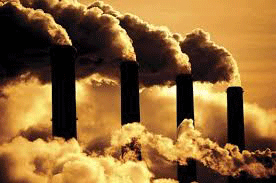 Thom Mitchell: Backing Big Coal – Mike Baird Promises To Up The Ante For Acting On Your Conscience
Miners get rewarded for destroying our environment, while protestors cop massive fines. And it’s about to get worse. Welcome to Mike Baird’s new New South Wales……..
“So-called plans to phase out mining in NSW have no place in this parliament,” Baird announced, “and I’ll be very clear on this, no place”.
In fact, Baird said, he would halve the time it takes to get big mines approved………
New Matilda understands Baird’s Liberal government will seek to change Workplace Health and Safety laws and other relevant legislation in the new parliament to reverse the liability, but protestors are unlikely to be deterred by his promise of harsher penalties……https://newmatilda.com/2015/04/12/backing-big-coal-mike-baird-promises-ante-acting-your-conscience
Senator Sean Edwards spruiks for the South Australian nuclear lobby
 Yesterday, I wrote about the media publicity given to Senator Sean Edwards, a former estate agent, who is going very public in support of South Australia getting the entire nuclear fuel chain (around its necks). Meanwhile, Dr Helen Caldicott, a world authority, was denied publicity to put the counter case.
Today, I learn that Sen Edwards has now set up a website to promote this theme. It’s a corker.
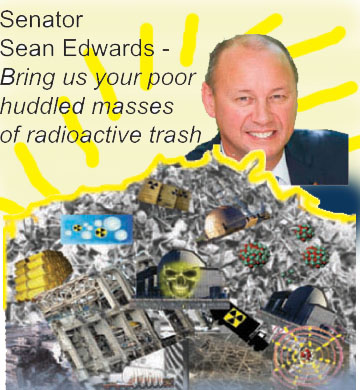
He starts with an attack on the Greens – they should be “morally and philosophically compelled to support advanced nuclear energy”
Moves quickly on to the argument for nuclear power as “free energy” and the $billions of revenue for South Australia, in importing the world’ radioactive trash.
“Polling proves South Australians want this and they want it yesterday” – says Edwards. Actually – no! Polling shows that South Australians voters reject expansion of the nuclear industry.
He asserts that “nuclear reactors produce no emissions that contribute to global warming”. (That’s untrue, but especially untrue if you ignore the entire nuclear fuel chain)
They “deliver abundant energy without any mining”. Hey – he doesn’t count the mining required for the conventional reactors to produce the wastes to put into the reprocessing reactors that he is touting! Edwards must be a bit confused. One of the main arguments for the South Australian expansion, as put by nuclear proponent Oscar Archer, is that it will give a strong boost to Australia’s uranium mining and uranium export industry.
Edwards tells us how very safe the nuclear industry – except for 3 what he calls “incidents” (Three Mile Island, Chernobyl, and Fukushima).
And without any evidence at all, he asserts that – for the new non existent untested reprocessing nuclear reactors – “The science is sound, the business case has been made and the public is behind us”
Abbott government to help South Australia remove restrictions on the nuclear industry
Federal Gov White Paper on Energy prepares way to cut red tape on nuclear industry http://www.adelaidenow.com.au/business/federal-government-white-paper-on-energy-prepares-way-to-cut-red-tape-on-nuclear-industry/story-fni6uma6-1227296081932
by: CHRISTOPHER RUSSELL BUSINESS EDITOR From: The Advertiser, 8 Apr 15
 THE Federal Government is positioning itself to cut red tape blocking development of a nuclear industry in South Australia.
The Federal Government’s White Paper on Energy, launched on Wednesday by Industry Minister Ian Macfarlane, says the Commonwealth will consider the findings of SA’s royal commission into the nuclear fuel cycle.
“The royal commission will allow for a considered and informed community discussion on nuclear industries and energy, examining the opportunities and the risks,” the White Paper says.
It adds the government wants to work with states by “responding to technical developments and the streamlining and removal of any unnecessary regulation”.
Mr Macfarlane has said the Federal Government will not lead a push for nuclear energy. His spokeswoman said yesterday this remained the case but the Federal Government wanted to ensure it had the expertise to deal with any change advocated by SA.
SA Mineral Resources and Energy Minister Tom Koutsantonis welcomed federal co-operation. “A lot of the imports and exports of this industry are regulated by the Commonwealth,” he said. “Having Canberra on side with our royal commission is a great boost.
“It’s important to understand exactly what impediments there are to the importation of spent fuel rods.
“It’s important to understand the impediments to exporting uranium through all of our ports around the country; understanding exactly what grade of uranium can be exported and imported.
“So the red tape reduction is all about making sure that whatever industry we want to build in this state can be accomplished.
Loves coal, hates solar, friendly to nuclear – Tony Abbott’s Energy White Paper
The energy white paper also continues its attack on solar…..
 Interestingly, it says it recognises the argument that nuclear is a costly alternative to renewables, uses lots of water and has waste-disposal issues. But it also says others argue that it is “adequate” affordable and reliable, and has significant environmental benefits and public health advantages over other existing base-load technologies. It says it will consider the outcomes of the South Australian Royal Commission into the nuclear fuel cycle, including its use as an energy source.
The winners and losers of Abbott’s energy white paper (SPOILER: Tony likes coal),  Crikey, GILES PARKINSON | APR 08, 2015 In many ways, the Coalition’s energy white paper is a predictable piece of backward-looking falsehoods. But it does make some surprising concessions to a future of renewable energy. Today, the Coalition government released its energy white paper — the document that is supposed to outline the nation’s energy vision for the short and long term future. But there are no surprises for guessing that this is a document that is largely focused on the rear-view mirror.
The energy white paper begins with a false assumption: that “Australia’s large quantities of traditional energy resources provide low cost, predictable and reliable power for Australia and the world”.
They don’t. Coal might be cheap to shovel into a boiler, but it is mighty costly to transport. Grid (delivery) costs make electricity in Australia some of the most expensive in the world. Transport and shipping costs make coal and gas expensive, to the point where they are now being undermined by local, renewable alternatives — or a new focus on environmental policy — even in major markets such as India and China.
Like the Abbott government’s discussion paper on emission reduction targets released late last month, this document also works on the principle that the world will do nothing new to address climate change. The energy white paper’s assumptions are based on the International Energy Agency’s “new policies” scenario, which sets the scene for what would be a catastrophic rise in temperatures to an average 4 degrees.
No matter, the Abbott government concludes: “Ongoing access to large volumes of coal and gas will also underpin our energy generation mix for some decades.” Although it does at least acknowledge that these fuels will be “increasingly exposed to competition from renewable energy”.
Not that it intends to accelerate that transition. Quite the opposite. Continue reading
Australian Government’s Energy White Paper- mixed messages on renewables
Cost-reflective tariffs could also increase power bills for people with solar panels to make sure they’re paying their fair share of network upkeep.
Instead of being charged a flat rate for electricity, where infrastructure costs are equally shared, consumers would pay the cost of delivering the power at the time it’s used.
The proposal is outlined in the government’s energy future blueprint and would require households to install advanced metering – or smart meters – to monitor how much energy they’re using………
The paper touches on Australia’s “good potential” for a range of renewable energy sources and outlines a commitment to a sustainable clean energy sector.
But it also reaffirms a commitment to cutting the renewable energy target and plans to abolish the Clean Energy Finance Corporation and the Australian Renewable Energy Agency.
While the government doesn’t detail a promised national energy productivity plan, it does say a 40 per cent target by 2030 is achievable.
It also doesn’t rule out nuclear energy, with Canberra closely watching the outcome of South Australia’s royal commission into the possibility of a local industry.……. http://www.businessspectator.com.au/news/2015/4/8/renewable-energy/govt-releases-energy-white-paper
Abbott’s “Direct Action” climate policy – a gift to the big polluters
Top polluters to set own limits virtually penalty free, according to Direct Action policy paper ABC News 27 Mar 15 By the National Reporting Team’s Lisa Main Australia’s 140 top polluters will set their own limits for future pollution virtually penalty free, according to the Government’s latest Direct Action policy paper.
The Federal Government is building towards the launch of its flagship climate change initiative, the Emission Reduction Fund (ERF), in mid-April. As part of that it has released a consultation paper outlining “safeguards” to ensure the big polluters do not offset emissions saved through the ERF.
Companies subject to the safeguards will select a baseline, or limit, for future pollution. That baseline will be set according to the highest peak of emissions from the past five years.
Grattan Institute energy program director Tony Wood said the ideas proposed in the paper simply would not work. “The safeguard mechanism was always a critical element of the Direct Action plan, but there is nothing in this safeguard mechanism that puts any absolute limit on a whole range of sectors,” he said.
There is also significant wiggle room for companies, according to the paper. Changes to the baselines can be made if there are changes to the company size or if the company has a “limited ability to control such emissions”. “All of the flexibility seems to be in the hands of the emitter and that runs counter to the fundamental principal of the paper,” Mr Wood said.
System designed as a toothless tiger, economist says Continue reading
Disappearance of Submissions from the Nuclear Royal Commission website
The very short time allowed for people to submit for the draft Terms of Reference nevertheless was enough for over 1000 submissions to be sent – the overwhelming majority raising issues that I bet the
 nuclear lobby would not want raised. No surprise then that the promised web page of all these submissions just vanished within a day or two.
However, here below is a sample of some of these excellent submissions. It is from DR. PETER BURDON ASSOCIATE PROFESSOR ALEXANDER REILLY MR. PAUL LEADBETER of the University of Adelaide
To Whom It May Concern, RE: Royal Commission – Our role in nuclear energy
Thank you for the opportunity to contribute to the terms of reference for the Royal Commission into South Australia’s nuclear industry potential. Continue reading
NARROW Terms of Reference for Royal Commission on South Australia’s further participation in the nuclear fuel chain
Below are the Terms of Reference. You will note how very few related issues are included.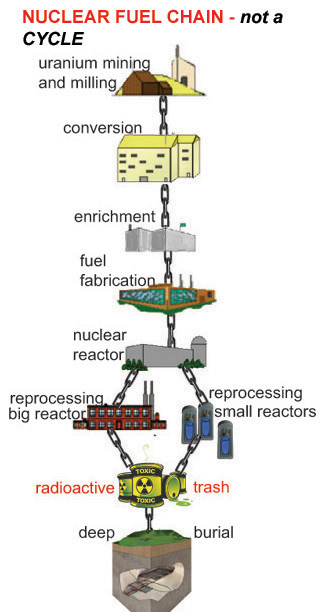
The Terms cover:
- feasibility of expanding mining of radioactive materials
- feasibility of conversion, enrichment, fabrication or re-processing in South Australia
- feasibility of generating electricity from nuclear fuels
- feasibility of establishing facilities in South Australia for the management,
storage and disposal of nuclear and radioactive waste - and a little nod to the impact on economy, environment, and community
(TO WIT)
HIS EXCELLENCY THE HONOURABLE HIEU VAN LE, Officer of the Order of
Australia, Governor in and over the State of South Australia:
TO
REAR ADMIRAL THE HONOURABLE KEVIN JOHN SCARCE, AC, CSC, RANR
GREETING Continue reading
Abbott govt’s Direct Action policy to give privileges to heavy-polluting electricity industry
Greens Leader Christine Milne said the policy would not raise revenue because the baselines were  being set so high that no company would breach them.
“It’s just a joke of a policy which will do nothing to reduce emissions and nothing to drive energy efficiency or more innovative practices,” she said.
 Power sector to get special treatment under Direct Action, The Age March 27, 2015 Peter Hannam and Lisa Cox The Abbott government has proposed a major concession to the heavy-polluting electricity industry in its direct action climate change policy by exempting individual companies from caps on emissions. Continue reading
Labor and Liberal happy to get donations from coal seam gas companies
 Lee Rhiannon: Future mortgaged to the mining past, Online opinion 26 Mar 15 Last week, Federal Labor voted with the Liberals and Nationals to block a Senate motion calling for a ban on political donations from mining and coal seam gas companies.
It seems that Labor is not prepared to back up Luke Foley’s recent comments about a post-coal future by ending its own reliance on mining donations.
Data recently released by the Australian Electoral Commission shows that political donations in the lead up to the 2013 election quadrupled. Mining companies are big donors, contributing hundreds of thousands to the Liberal, National and Labor parties.
Santos, Woodside Energy and Hancock Coal were some of the companies that donated more than $1.1 million to the major parties. The implications for democracy are deeply concerning.
http://www.onlineopinion.com.au/view.asp?article=17199
Nuclear lobby influence – Australian Industry Group Defence Council wants nuclear submarines
 Nuclear submarine option pushed by industry Financial Review by John Kerin, 24 Mar 15, Australia’s peak defence industry group has urged Prime Minister Tony Abbott to reconsider buying or leasing a nuclear submarine fleet to replace the ageing Collins class, saying the absence of a supporting domestic nuclear power industry no longer presents a hurdle.
Australian Industry Group Defence Council chairman Chris Jenkins, who is also the Australian chief of French industry giant Thales, said today’s submarine nuclear power plants were so efficient and required so little maintenance that an onshore nuclear power industry was hardly a requirement.
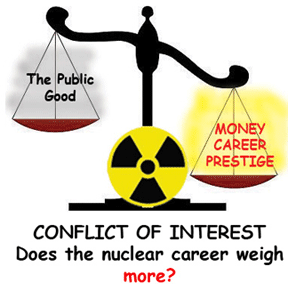
He said nuclear submarine powerplant technology was constantly improving and you would need a trained workforce but not necessarily a power industry to support it.
The defence council is the peak body representing the’s $8 billion 24,000 strong defence sector. “That’s been said [you need a nuclear power industry] but I think nuclear energy these days is much more modularised than people think….like anything else [the submarine] powerplant is manageable,” Mr Jenkins said.
“The idea of a nuclear industry as a fundamental necessity, I am not convinced, but I did think it was quite a good thing that there was a call for a really deep review from South Australia in to nuclear energy,” Mr Jenkins said.
Mr Jenkins was referring to a royal commission called by South Australian Premier Jay Weatherill into the development of nuclear power.
Defence Minister Kevin Andrews will deliver the opening address at a major two-day summit on Australia’s Future Submarine, where experts are expected to fiercely debate the competitive evaluation process given ongoing concerns over the future of Adelaide based ASC and jobs in Adelaide……..
the French firm DCNS has offered a diesel powered version of its 5000 tonne Barracuda submarine.The nuclear version of the Barracuda will be in service with the French Navy from 2017.
But its understood DCNS could offer the nuclear version of the Barracuda from around 2030 if Canberra wished to go down that route……..
Mr Jenkins said. “Given the concern over jobs, South Australia should be as keen to know the answer as anyone because it would undoubtedly be the centre of Australia’s nuclear industry,” he said. http://www.afr.com/news/politics/nuclear-submarine-option-pushed-by-industry-20150324-1m5cpx
Abbott government intransigent on its plan to weaken Renewable Energy Target
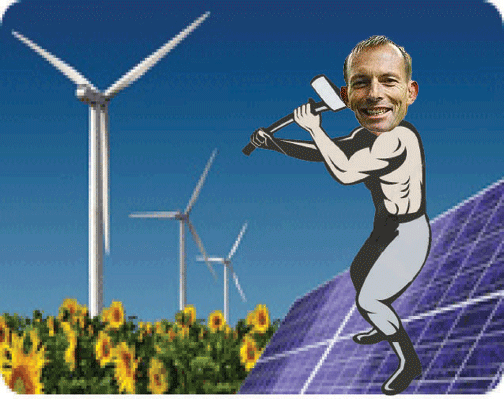 ‘Take it or leave it’, government tells renewable energy industry in latest RET talks, SMH March 24, 2015 Lisa Cox National political reporter Industry Minister Ian Macfarlane has told the clean energy industry that the government’s latest offer on the renewable energy target is a “take it or leave it” position.
In a fresh round of talks with unions and representatives for the clean energy and aluminium industries on Monday, Mr Macfarlane said the government would not budge from a figure of 32,000 gigawatt hours of renewable energy production by 2020.
The number represents a substantial reduction from the existing large scale target of 41,000 gigawatt hours and both Labor and the clean energy industry have said it is unacceptable…….
Australian Solar Council chief executive John Grimes said “we are now at the end point”.
Mr Grimes said his organisation was shut out of Monday’s talks.
“This is not a process and the end point is perpetual uncertainty,” he said. http://www.smh.com.au/federal-politics/political-news/take-it-or-leave-it-government-tells-renewable-energy-industry-in-latest-ret-talks-20150324-1m5ql8.html
Greens call to reinstate Municipal and Essential Services funding for remote Aboriginal communities
Consultation to begin with Aboriginal communities slated for closure in WA, Guardian Calla Wahlquist 17 Mar 15 “………Greens senator Rachel Siewert was due to move a motion on Tuesday calling for the prime minister to apologise for the “insensitive” remark.
Abbott has so far refused to apologise for the comments or concede it was a poor choice of words.
The motion will also call on the federal government to reinstate the Municipal and Essential Services funding, which will run out next year under a deal that gave states responsibility for providing for remote communities, and urge the WA government to abandon plans to close Aboriginal communities.
“Many organisations, including the National Aboriginal Community Controlled Health Organisation, have noted that these remote communities are important to cultural, emotional and social wellbeing and should not be shut down for the sake of short-sighted budgetary measures,” Siewert said.
“We need to be working with communities to deliver essential services and support, not closing and abandoning them.”…..
Dodson, known as “the father of reconciliation”, said on Sunday the avenue for dialogue between Indigenous people and the federal government had closed and urged Abbott to reconsider his approach.
“Does Australia want to have a relationship with Aboriginal people, or does it not?” Dodson said. “Or does it simply want to improve the management and control systems over the lives of Aboriginal people? That’s the seminal issue.”……http://www.theguardian.com/australia-news/2015/mar/17/consultation-to-begin-with-aboriginal-communities-slated-for-closure-in-wa
Examining the full chain proposed by Australia’s (and USA & Canada’s) nuclear lobby
What does the nuclear lobby want, for South Australia?, Online Opinion,
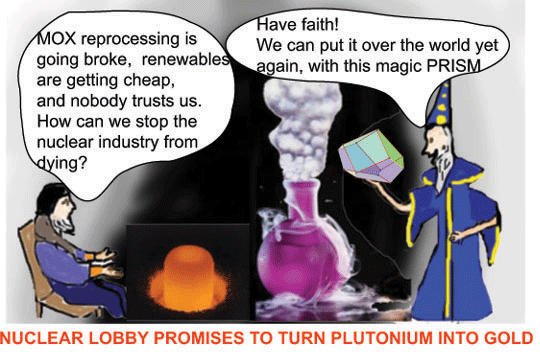
| By Noel Wauchope 19 March 2015 “….It is difficult to work out exactly what is planned in nuclear industry expansion for South Australia. The plans involve some or all of these industries: uranium enrichment, nuclear power, importation and storage of nuclear wastes, 4th Generation nuclear reactors, and expansion of uranium mining. However, we can be grateful to ABC Radio’s Ockham’s Razor programme, as it provided the nuclear lobby with a platform for setting out succinctly their intentions. Oscar Archer, a well -known voice for the nuclear industry, explains…… Australia should get a fleet of PRISM small nuclear reprocessing reactors – Archer’s plan is for “IFS+IFR: Intermediate Fuel Storage and Integral Fast Reactor, namely the commercially offered PRISM breeder reactor from General Electric Hitachi.” What he means here is the Power Reactor Innovative Small Module Archer then sets out the sequence of events that would lead to the establishment of this fleet. In Archer’s words “it goes like this. Australia establishes the world’s first multinational repository for used fuel – what’s often called nuclear waste” However, he notes that “This is established on the ironclad commitment [my emphasis] to develop a fleet of integral fast reactors to demonstrate the recycling of the used nuclear fuel”…… the sting in the tale of his plan is really exactly what he calls the first step – the overturning or weakening of Federal and State laws. The Federal Act protects against nuclear reprocessing and expanded nuclear industries. ARPANSA sets safety standards for exposure to ionising radiation. South Australian State Law would have to be overturned, too – under the Nuclear Waste Storage Facility (Prohibition) Act 2000 The central premise of Oscar Archer’s promotion of this nuclear chain of events is that Australia should go out on a limb – be the first country in the world to import nuclear wastes and to order a mass purchase of PRISM reactors….. The PRISM reactor exists only on paper and its development is decades away from completion. David Biello, in Scientific American comments “Ultimately, however, the core problem may be that such new reactors don’t eliminate the nuclear waste that has piled up so much as transmute it. Even with a fleet of such fast reactors, nations would nonetheless require an ultimate home for radioactive waste, one reason that a 2010 M.I.T. report on spent nuclear fuel dismissed such fast reactors.”
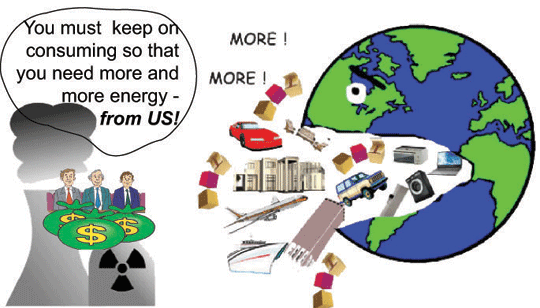
The PRISM can’t melt down in the way that conventional nuclear reactors can. However, its essential use of plutonium entails hazardous transport – vulnerability to terrorism and use as a “dirty” bomb. And – finally the PRISM reactor itself becomes radioactive waste requiring security and burial. There is another, underlying premise here that needs to be examined. This is the premise that it is OK for Australia and the world to continue to consume energy endlessly…….
The plan purports to reduce greenhouse emissions by means of thousands of little reactors, (and big ones) – but their development is so many decades away that it would be too late for climate change action. We are left with a plan that looks suspiciously as if the troubled nuclear industries of USA, Canada and UK have selected Australia as the guinea pig for a plan to reverse their industries’ present decline.
|
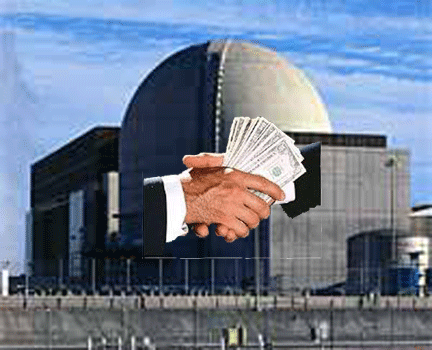
Family First Senator Bob Day gets Senate support for SA nuclear commission
 Senate backs SA nuclear commission http://www.heraldsun.com.au/news/breaking-news/senate-backs-sa-nuclear-commission/story-fni0xqi4-1227268345280 AAP MARCH 18, 2015
THE Senate has backed South Australia’s royal commission into expanding the nuclear industry.
SA Premier Jay Weatherill launched a royal commission to investigate if the state, home to world’s largest uranium deposits, should embrace production, enrichment and storage of nuclear power.
SA Family First senator Bob Day won enough Senate support to formally welcome the commission, with his motion passing 34 to 33.
1 This month
17 October, Free Public Talk on Nuclear Issues in South Australia
David Noonan will speak on public interest concerns over the new Roxby Downs Indenture Act 2026 on BHP copper-uranium mining and ore processing in SA, and on how AUKUS may face SA with a High-Level nuclear waste agenda.
Dr Jim Green will discuss international developments in the field of nuclear power including ‘small modular reactors’ and Generation 4 ‘advanced’ nuclear reactor concepts.


Help Aunty Sue Protect Her Land and Sacred Sites From Destructive Rocket Testing.
.

Australians deserve the truth
about
AUKUS – https://aukuspublicinquiry.com/

PETITION – To: Prime Minister Anthony Albanese and the Australian Labor Government

of the week – Australians for War Powers Reform (AWPR)
To see nuclear-related stories in greater depth and intensity

