Dutton’s truth-sounding nuclear power arguments are for generating impressions, not information.

He didn’t mention having to keep coal in the mix for a lot longer. But that’s certainly what his Coalition partners, the Nationals, have been saying with a nudge and a wink, whenever they are in receptive company.
Karen Middleton, 24 Sept 24, https://www.theguardian.com/global/2024/sep/24/peter-dutton-ceda-speech-coalition-nuclear-power-plan-costs
The opposition leader keeps bypassing questions over the cost of his energy plan – while leaning on little more than fuzzy assurances.
It was nothing if not audacious.
In a speech that avoided answering one of the biggest questions hanging over his policy to build nuclear reactors at seven sites around Australia, Peter Dutton posed a very similar one about his opponents and their plans to phase out fossil fuels.
“Who will bear the costs of this transition?” Dutton asked in an address to the Committee for Economic Development of Australia on Monday, before answering it himself. “Australian households will – in their power bills.”
Dutton’s speech to a lunchtime event titled “A nuclear-powered Australia – could it work?” contained no new information about his nuclear plan and was instead an exercise in relativism via admission. To paraphrase: my energy policy might cost a lot, but theirs will cost more and mine is more reliable.
“Yes, our nuclear plan does have significant upfront cost,” Dutton said. “… But a whole new and vast transmission network and infrastructure won’t be needed.”
He has still provided no evidence to support this statement, nor any further detail beyond naming seven sites and indicating he favours small modular reactors.
This speech was not about providing that detail. It was about making truthy-sounding arguments designed to generate an impression, not information.
He had a few messages that clearly came straight from the focus groups, starting and ending on a plea for “pragmatism, not politics”, rebuking the Albanese government for being “juvenile” and “childish” and accusing it of avoiding “a sensible discussion” about nuclear power.
What is evident from Dutton’s speech is that he knows, as the government does, that it won’t be arguments about three-eyed fish or even earthquake fault lines that will swing voters for or against nuclear power as they think about which way to vote. It’s what it will cost and whether nuclear can actually address Australia’s energy challenges.
Dutton was cosying up to renewable energy, suggesting he’s all for it, but that it needs more grunt to get Australia through. He’s trying to suggest his policy is about climate responsibility, not denial, and balances environmental and economic imperatives.
“We can have cheaper, cleaner and consistent energy if we adopt nuclear power,” he said. “And zero-emission nuclear power is our only chance to reach net zero by 2050.”
He didn’t mention having to keep coal in the mix for a lot longer. But that’s certainly what his Coalition partners, the Nationals, have been saying with a nudge and a wink, whenever they are in receptive company.
Referring to the government’s policy, Dutton used the false label “renewables-only” seven times and “renewables alone” once. He suggested that the government’s pledge to an ongoing role for gas was support in name only. Tell that to the Labor party members and constituents who are outraged that its future gas strategy embeds that particular fossil fuel in the energy mix to 2050 and beyond.
The opposition leader said Labor was lying about the “true costs” Australians would bear in its planned transition away from coal-fired power to cleaner forms of energy, calling this an “absolute scandal” while saying precisely nothing specific about the cost of his own.
“We will release our costings in due course, at a time of our choosing,” Dutton said.
Calling his own policy idea “truly visionary” was the closest he came to acknowledging that nuclear power could not be up and running in Australia for at least two decades.
“We can’t switch nuclear power on tomorrow,” he said, adding one more little caveat about legislative obstacles. “Even if the ban is lifted.”
Not when, if.
Instead of cold, hard facts, Dutton’s Ceda speech relied on warm, fuzzy assurances. With the emphasis on fuzzy.
“Clean nuclear energy is reliable,” he insisted. “It will underpin renewables. It will get the cost of electricity down. It will keep the lights on.”
In which decade, he didn’t quite say.
Peter Dutton’s nuclear plan still has no costings, and no grid connection: It’s a political hoax

ReNewEconomy, Giles Parkinson, Sep 23, 2024
Outside, in Martin Place, the voices were clear – unions and environmental groups holding placards and denouncing Coalition leader Peter Dutton’s nuclear “fantasy:” A combination of denial and delay they said: “Dutton wants gas, Dutton wants coal, nuclear is just a troll,” they chorused.
Inside the Fullerton Hotel, in the basement where Ballroom B is located, it was expected to be the moment for the nuclear true believers, but the numbers just weren’t there.
Unusually for a CEDA event, there was only a scattering of corporate table sponsors – ANZ, KPMG, and Clayton Utz – and most of the ballroom was partitioned off. Among the 160 attending, quite small for a CEDA event, there was the usual Dutton entourage, including energy spokesman Ted O’Brien, Warren Mundine, and a lot of media.
Bizarrely, many of the rest were from the clean energy industry, curious to know what they might be dealing with should the Coalition return to power next year. Did they like what they heard? Not really. Did they learn anything? No.
This was supposed to be Dutton’s occasion to spell out his nuclear power plan: “A nuclear powered Australia – could it work” was the title of the event. But we left little the wiser. The question about how many nuclear power plants, how much would they cost, when they would be built, and which technology, were not answered.
Instead, the event got a re-run of the Coalition’s renewable scare campaign. Dutton’s thesis is that wind and solar won’t work, even with storage and dispatchable back-up. Renewables, says Dutton, are dangerous and will lead to blackouts and the destruction of industry.
We’ve heard this before. It’s the common refrain of the fossil fuel and nuclear industries. They’ve gone from attacking the climate science to ignoring it, and have focused their attacks on the technology solutions. The ones that threaten their legacy and vested interests.
The Coalition uses “baseload” as if it’s another word for “reliability”. It’s not, as AEMO boss Daniel Westerman explains in this week’s Energy Insiders podcast.
Dutton did at least concede that building nuclear power stations at the seven sites identified by the Coalition will cost a lot, even if he wouldn’t say how much, or how consumers are impacted. Somehow, he imagines, the cost will be amortised by their assumed 80 year timeline. Perhaps he hasn’t seen their maintenance and refurbishment bills.………………………….
We did learn a couple of new things. One was that Dutton admitted that Aukus – the controversial deal to sign up for half a dozen nuclear submarines at horrific cost and questionable use – was as much a Trojan horse for the nuclear debate as it is an allegory for his power plans…………………
There was indeed, an awful lot of fudging. Dutton pretends that his nuclear power plan can be rolled out without new transmission lines. But he’s kidding himself, and trying to fool the public.
Firstly, the seven sites he has targeted are already filling up with their owner’s own projects – mostly battery storage and renewables. There simply isn’t room on the grid…………….
There was indeed, an awful lot of fudging. Dutton pretends that his nuclear power plan can be rolled out without new transmission lines. But he’s kidding himself, and trying to fool the public.
Firstly, the seven sites he has targeted are already filling up with their owner’s own projects – mostly battery storage and renewables. There simply isn’t room on the grid.
Secondly, the sort of nuclear reactors Dutton is planning are nearly twice the size of most coal generators – which means – as a matter of course – that there has to be more infrastructure built to support them, in transmission lines, and back-up capacity in case of a trip or unexplained outage. That is grid management 101.
Thirdly, Dutton hasn’t explained what fills the gap as coal fired power plants exit the grid. Either he has to double, table, or even quadruple his nuclear power plans – at great cost and huge new transmission requirements, or he has to rely on renewables after all, and they will also require new transmission.
Fourthly, his complaints against new transmission is largely a furphy. AEMO’s Integrated System Plan – which is little changed for when it was produced for the Coalition government – doesn’t contemplate the 28,000 kms of new transmission as Dutton claims…………
Dutton did confirm that the Coalition’s plan was to extend the life of coal fired power stations as much as it could, and build a lot of new gas generators. Quite how he believes these investment will lower the price of power to consumers was not and has never been explained.
Like nuclear, they are the most expensive sources of power. He suggested they will all be government owned, which is inevitable as private finance won’t touch it, and Snowy Hydro is quite accustomed to projects that run well over time and budget. And that way, the true cost will already be hidden from homes and businesses……………………………….
He also confirmed he doesn’t understand batteries. They can’t store energy for more than four hours he said, which is news to the project developers of more than 3,000 megawatt hours of eight-hour batteries. Has he heard of demand management? Dutton refuses to see or admit the solutions that are right in front of him.
Meanwhile, the general public is being led a merry dance by folksy promises, a solution that sounds vaguely plausible, but in reality has no chance of delivering.
The protestors with the placards outside the hotel were closest to the truth: This is about denial and delay, the whole policy is an elaborate troll, a political hoax, and a refuge for the climate deniers and do-littles. Nothing more, nothing less. https://reneweconomy.com.au/peter-duttons-nuclear-plan-still-has-no-costings-and-no-grid-connection-its-a-political-hoax/—
Why is Peter Dutton so frightened of nuclear detail?
September 23, 2024, by: The AIM Network, https://theaimn.com/why-is-peter-dutton-so-frightened-of-nuclear-detail/
Still missing from the Coalition’s nuclear fantasy – any plans on costs, reducing climate pollution or nuclear accidents
The public will have to keep waiting after Opposition Leader Peter Dutton failed to announce anticipated costings and other detail of the Liberal National Coalition’s nuclear proposal today.
Following Mr Dutton’s speech, Solutions for Climate Australia called on the Federal Liberal and National parties to step up and tell the public just how long, how expensive and how risky their pro-nuclear reactor policy is.
Solutions for Climate Australia senior campaigner Elly Baxter said:
“Today, Peter Dutton has again failed to give any detail on how he plans to establish nuclear reactors in Australia. Mr Dutton seems to be bug-out frightened to put forward any detail – what’s he got to hide?
“Australia’s coal plants are old and falling apart. Nuclear would never be delivered in time, whereas solar and wind already provide 40% of Australia’s electricity.
Solutions for Climate Australia director Dr Barry Traill said:
“Multiple credible estimates from industry experts show that even if, somehow, the nuclear reactors were built by 2040, they could only produce 4% of Australia’s total electricity needs.
“Why would we spend many billions on the most expensive and risky way of making electricity in Australia, to produce just 4% of the power we need?
“We call on the Coalition to have the guts to put out the details of what they are proposing.”
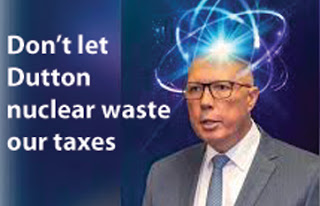
Peter Dutton’s weird obsession with uncosted nuclear risks energy security, the economy and our kids’ future.
Climate Council 23 SEP, 2024
PETER DUTTON’S WEIRD NUCLEAR OBSESSION is a reckless distraction that will delay real cuts to climate pollution and expose Australians to even more dangerous climate change. While Dutton clings to outdated ideas, our kids’ futures hang in the balance.
Despite Peter Dutton’s grand claims, the Coalition has failed to produce any new numbers to back their nuclear obsession. Meanwhile, a new report from the Institute for Energy Economics and Financial Analysis (IEEFA) reveals the true cost of nuclear: an average increase of $665 per year on household electricity bills. Nuclear power is slow, costly, and dangerous, while clean energy solutions, like wind and solar backed by storage, are already powering Australia today.
Climate Council CEO Amanda McKenzie said: “Peter Dutton’s weird nuclear obsession is a distraction from the fact that he wants to delay building new power for a generation. A child riding their bike to primary school today will be driving to work by the time even one nuclear reactor is producing electricity.
“Delaying building new energy means more dangerous climate pollution from coal and gas. This will hit our kids hard, fuelling worse floods, fires, and heatwaves.
“Delaying means our ageing energy system failing without investment and support.”
Greg Bourne, Climate Councillor said: “Peter Dutton’s nuclear obsession doesn’t pass the pub test and would meet just a fraction of Australia’s energy needs by 2050. The cost blowouts, delays, and energy shortages nuclear power would cause are staggering. Renewables are faster, cheaper, and cleaner.
“While nuclear sits at the starting blocks for another decade or more, renewable energy is surging ahead, already providing 40% of the electricity in our main national grid and set to reach over 96% by the time Dutton’s first reactors might be operational. Dutton and his colleagues will be long retired before a single nuclear plant is built in Australia, whereas the renewable solutions we need are ready today.
Dutton’s refusal to provide any analysis, costs or modelling proves what we already know – nuclear is a high-risk, low-reward scheme. Nuclear power will not bring down energy bills or solve Australia’s energy challenges. This obsession will only stall the progress we desperately need to safeguard our planet and our kids’ futures.”
Nuclear debate stalls as detail goes missing in action
Angela Macdonald-Smith, https://www.afr.com/companies/energy/nuclear-debate-stalls-as-detail-goes-missing-in-action-20240920-p5kc56 21 Sept 24
Australia’s debate over nuclear power is going nowhere. Politicians are happy to roll out any argument that suits them, but the credible and comprehensive analysis and modelling needed is completely missing.
The upshot is that the energy industry – the people who need to make the transition happen – are disengaged, and consumers who will have to vote on these “policies” are confused.
The vacuum of information includes both the costings and details behind the Coalition’s seven-site nuclear power vision, but also a realistic assessment from the Albanese government about the difficulties in reaching its 2030 climate targets.
Federal Energy and Climate Change Minister Chris Bowen on Friday released energy department findings on the huge reliability gaps that the Coalition’s nuclear plan would cause.
Two scenarios were studied: one that assumed coal plant owners close their plants as projected by the Australian Energy Market Operator between now and 2035, and the Coalition caps investment in large-scale renewables and does not support new transmission builds; a second assumed all coal power stations set to close before 2035 are extended beyond 2040 to try to tide the power system over until nuclear reactors could come online.
According to the results released by Bowen’s office, the first would lead to a huge 49 per cent gap between the demand for energy of about 316 terawatt-hours and available supply – of about 160 TWh – by 2035. The second, an 18 per cent gap of “unmet energy”.
The minister’s office compared those numbers with AEMO’s current tolerance gap for an effectively operating electricity system of just 0.002 per cent of “unmet energy”.
Bowen says the analysis shows how the Coalition’s plan “will result in massive supply shortages over the next decade”. However, the full work carried out by the department was not made available.
Analysis released on Friday by the Institute for Energy Economics and Financial Analysis, which advocates a faster shift to clean energy, also played into Labor’s hands. The analysis sought to estimate the potential impact on household electricity bills using six scenarios that were based on international examples of nuclear power construction projects.
The results suggested that the median household bill would rise, on average, by about $665 a year. The work was based on six recent real-world examples of new nuclear plant builds, ranging from the cheapest location in the Czech Republic through to the most expensive, the Hinkley Point C reactor under construction in the UK at a cost that may top £46 billion ($90 billion).
“The cost of electricity generated from nuclear plants would likely be 1.5 to 3.8 times the current cost of electricity generation in eastern Australia,” IEEFA found.
The analysis was dismissed as “complete nonsense” by shadow treasurer Angus Taylor, while Opposition Leader Peter Dutton also questioned its credibility. He cited Labor’s failed pre-election promise to deliver $275 bill reductions by 2025 as evidence it can’t be trusted.
But the Coalition’s own arguments are just as flimsy, weakened by the continuing absence of the full costings and details of its energy plan.
Dutton is scheduled to speak on nuclear power at the Committee for Economic Development of Australia on Monday. It will not, however, include the much anticipated business case for nuclear. Coalition sources say that will have to wait until some time before the election, due by May next year.
A Coalition source said Monday’s speech would instead be “values”-based. That means a reaffirmation of the seven potential nuclear sites, and more words about why nuclear is better than Labor’s “renewables-only” approach.
The energy industry, meanwhile, is disengaged as the politics play out. While not writing the nuclear option off as impossible, the starting point for real action is much too far off for it to register.
Continuing delays in the build-out of the energy grid – caused by slow project approvals and rising costs, among many other issues – mean these companies have much more immediate challenges to worry about.
Coalition should show us its sums on nuclear
September 20, 2024, https://www.smh.com.au/national/nsw/coalition-should-show-us-its-sums-on-nuclear-20240920-p5kc2k.html
How many more studies are needed to show what is glaringly obvious to everyone? That nuclear power is not cheap and that it is potentially very expensive (“Extra cost of nuclear power revealed”, September 20)?
Despite this, the Coalition keeps sticking to its guns. They can’t be wrong and any study that says otherwise is “shallow and flawed”. They claim the latest study cherry-picks the worst cases, ignoring that any selection is needed to make the study more realistic. Australia won’t have access to cheap labour, so those cases should rightly be ignored. Also, nuclear energy is not where you want to cut corners to keep costs down. And yet, the Coalition has decided to go down the nuclear path.
How can you make a decision without the supporting numbers? If they have the numbers they should release them. David Rush, Lawson
Nuclear is not a viable option for Australia. It will be too expensive and it will take far too long to be of any use and by the Coalition’s own numbers, it will produce almost no electricity even if they are built. Every report from the CSIRO down that exposes Peter Dutton’s nuclear brain explosion has been belittled by the Coalition. The Coalition says it will release its costings eventually. Presumably, they don’t know what the cost will be yet, but given their wildly inaccurate estimates on Snowy 2.0 and inland rail, we have little cause for hope of an accurate figure. Ross Hudson, Mount Martha (Vic)
Coalition energy spokesman Ted O’Brien calls the first analysis of the Coalition’s nuclear plan shallow and flawed – in other words fake news. Having cherry-picked the lowest numbers in their discussions of this policy, and choosing their examples, the Coalition will now have to present their documentation as to how low electricity prices will be under their leadership. As a taxpayer, I’m concerned about the level of accountability if there are cost blowouts or hugely extended construction times. So even if the proposed nuclear plants can deliver cheaper electricity, what happens in the meantime? The Coalition’s switch to government ownership of this infrastructure and the cash splash to those communities who accept a nuclear plant is using taxpayer money to subsidise lower electricity prices to win this argument. We are not just building a few buildings – we are creating a whole new industry from scratch. Meanwhile, another decade or so will pass and more opportunities will be wasted for a better environment. Robert Mulas, Corlette
Ted O’Brien says the US non-profit think tank the Institute for Energy Economics and Financial Analysis has cherry-picked the costs for the opposition’s nuclear “plan”. Why it would do this is unclear but far from choosing selected examples, it has based its analysis on average bills for construction of large-scale nuclear plants by countries with comparable economies to Australia. As for who will put up the money, O’Brien says they will be built by a government entity while Angus Taylor says they will not be publicly subsidised. Peter Nash, Fairlight
More than a third of Australian households have solar power and they won’t like analysis from the Smart Energy Council that shows Dutton’s seven nuclear reactors will shut down solar panels for between 1.8 and 2.9 million homes. The council says that as nuclear power can’t be switched off, it will continue pushing power into the grid, “regardless of whether it’s the most expensive form of energy, or even needed”. Is this really the best energy policy Dutton can come up with, or is it simply an expensive smokescreen to extend the life of fossil fuels? Alison Stewart, Riverview
We are now told our power bills may rise by $665 a year to pay for nuclear energy infrastructure costs. Is this why Dutton is so reluctant to release his costings? Peng Ee, Castle Cove
“Catastrophic:” Coalition plan to stop renewables and push nuclear will result in massive supply gaps

Giles Parkinson, Sep 20, 2024, https://reneweconomy.com.au/catastrophic-coalition-plan-to-stop-renewables-and-push-nuclear-will-result-in-massive-supply-gaps/
Federal energy minister Chris Bowen has launched a new attack against the federal Coalition’s nuclear power policy, saying its plan to stop renewables and potentially “sweat” the remaining coal assets could lead to “catastrophic” supply gaps in the electricity market.
The federal government released new modelling on Friday, the same day as another independent report pointed to a $1,000 a year bill hike to consumers from a nuclear power policy, and just days before Coalition leader Peter Dutton is expected to outline more details at a Sydney event.
The Coalition has been vague about its nuclear power plans to date, identifying only seven potential sites for large scale nuclear or small modular reactors, but has said it intends to stop new wind, solar and battery projects, cease the rollout of new transmission lines, and boost coal and gas output.
In response, the federal department of energy has modelled several different scenarios, and both point to massive supply gaps in the future if the Coalition holds firm on its promise to stop renewable, and even “tear up” as some contracts, as National leader David Littleproud has threatened.
The department estimates that the Coalition’s energy plan will leave a “gaping black hole” of between 18 per cent to 49 per cent of unserved energy, ie the gap between supply and demand.
The biggest gap is created on the assumption that private coal operators do close their ageing coal fired generators between now and 2035, and that the Coalition does not build any new utility scale renewables beyond what’s currently committed, and does not support new transmission builds.
On that scenario, the department modelling estimates a shortfall of around 156 terawatt hours (TWh) between demand for energy (around 316 TWh) and available supply (arround 160 TWh).
The second scenario assumes that all coal plants are extended beyond 2040, to allow time for the Coalition to begin construction of its promised nuclear power plant, but that still results in a shortfall of 18 per cent if the Coalition delivers on its promise to stop the rollout of large scale renewables.
“These scenarios are so catastrophic for the economy, for ordinary Australians, and for Australia’s place as an advanced country they seem implausible,” the department report says.
“But that will be the result of the Coalition’s nuclear scheme.”
It’s ironic because the Coalition is pitching its nuclear scheme on three assumptions: That it is lower cost, that it is more reliable, and that it is compatible on a net zero strategy.
But analysis shows that it would fail on all three counts. Multiple reports have highlighted the higher cost of nuclear, and although the Coalition insists there higher costs affect only investors and not consumers (without ever explaining why), the new analysis from IEEFA points to a blow out in retail bills.
The Coalition insists that a reliance on wind and solar will lead to the destruction of industry, but that is proved a nonsense by South Australia, already at more than 70 per cent wind and solar and aiming for net 100 per cent by 2027, and its inability to explain what will be meeting growing demand needs.
“The fact of the matter is that Mr Dutton and Mr Littleproud and Mr O’Brien wander around the country saying that they will pause renewable energy investments,” Bowen told journalists on Friday.
“Even under their own scheme, they admit that we would not have any nuclear power in Australia until 2035 at the earliest, and that is wildly optimistic.
“Now the question that Mr Dutton has to answer is, where will the electricity come from? If we stop building renewables now and nuclear takes so long, as Australia’s electricity needs are increasing every day, where will he get the power from?
“He wanders around making outrageous accusations about black‑outs under this government, when in fact it’s his own scheme which is the biggest risk to reliability in Australia.”
The department report is just one of three released this week that undermines the Coalition’s case for nuclear in Australia. One is the IEEFA report on the impact on bills, and the World Nuclear Industry Status Report on nuclear that shows an industry that is barely advancing, despite the Dutton rhetoric.
And the problem around reliability is further highlighted by issues at Vogtle, the first nuclear power plant to be built in the US for more than three decades. (And despite Coalition claims of a nuclear renaissance, no other nuclear power projects are being built or committed).
One of the two units at Plant Vogtle, a plant that ran way over budget and time in the country with the biggest nuclear fleet of any, was shut down in July, and again in September, due to various valve issues in what critics note is the most expensive power plant on the planet.
The Coalition has been selling nuclear as reliable and “always on”, but like any generation source it can face hiccups, and the bigger the generation unit – the Westinghouse AP1000s at Vogtle (cited as a potential technology choice by the Coalition) have a capacity of 1,117 MW – the more back-up that is required.
And it is these unexpected interruptions, as opposed to the entirely predictable setting of the sun each day, that creates the biggest problems for the market operator.
“I’ve never said the shift to a clean, cheap, renewable energy system would be easy. But it is achievable, and our plan is working,” Bowen wrote in an op-ed in The Australian.
“Supporting new investment in generation and batteries, bringing on offshore wind projects, and underwriting crucial transmission lines through Rewiring the Nation are real policy solutions underway now.
“Last month AEMO confirmed on time delivery of federal, state and territory programs as planned and legislated, will be sufficient to meet demand out to 2035, within the stringent reliability standard.
“Contrast that with the Coalition’s ideological pursuit of its anti-renewable nuclear scheme that leave almost half Australia’s energy needs unserved in the same period.”
The challenge for Labor, however, is not to convince the Australian or even international energy industry of this. The industry understands just how unsuitable the nuclear option is.
But the Coalition, with the often uncritical and sometime active support of mainstream media and most conservative “think tanks”, is seeking only to win a public debate on this, and the public care little about the details.
“They are treating the Australian people like mugs, arrogantly holding the details of their costings, of the modelling, of the impact of their policies on Australians from the Australian people,” Bowen said.
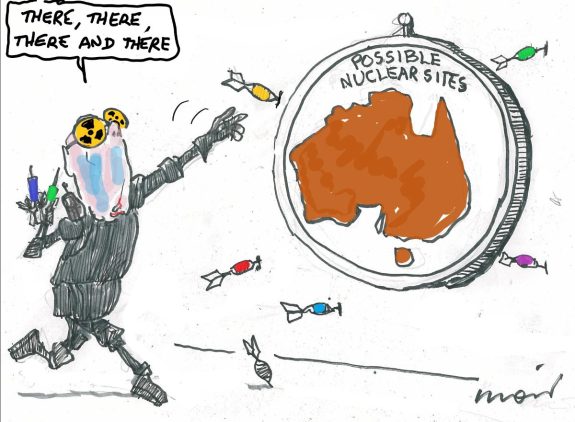
Peter Dutton and the pursuit of fame.
21 September 24 https://theaimn.com/peter-dutton-and-the-pursuit-of-fame/
Peter Dutton is the leader of Australia’s opposition party – the Liberal-National Coalition.
Which is pretty noteworthy and important, anyway. But of course, he would be more important if he is elected as Prime Minister in 2025. But is that enough fame for him?
Dutton aspires to a greater, global, significance. He would be the first world leader to introduce the commercial, peaceful, advanced nuclear industry to not just a country, but to an entire continent. And not to some “third-world” “undeveloped” country “in need of charity” – but to a prosperous, privileged, purportedly well-educated, and still mainly white population.
For the global nuclear industry – that would be a first! And not just any old first, but an extremely timely one. Just released this week, The World Nuclear Industry Status Report 2024 describes an industry on life support. Even back in 2016 Former World Nuclear Association executive Steve Kidd spoke to this problem, noting that “the industry is essentially running to stand still.”
For Australia to adopt a government-run nuclear industry involving both large and small nuclear reactors across a continent – what a wonderful shot in the arm for the global nuclear lobby. And Dutton – what a hero!
Dutton would be famous not just in Australia, but world-wide
Is this why Peter Dutton is promoting his nuclear policy?
I can’t think of any other reason.
Australia, especially in the State of South Australia, is becoming a world leader in renewable energy use – particularly in decentralised household rooftop solar, but also in large solar and wind programmes. Of course, Australia’s mining magnates are pretty happy with Dutton’s plan, as it will mean more mining, not just of uranium, but of coal and gas in the decades before nuclear power actually comes into use.
So – look – it’s a winner for Dutton’s fame.
And if that doesn’t work, there’s fame in another way
The last Liberal Prime Minister, Scott Morrison, is a great contender for the worst Prime Minister in Australian history. Just a few of his achievements to merit this award were:
- By 2022, Australia’s gross national debt was 42.5 per cent of GDP (Peak Whitlam government was 24.5. Peak Hawke-Keating was 24. Peak Rudd-Gillard Government debt was 20.)
- Notorious for taking a holiday during Australia’s 2019–20 bushfire season.
- Signed Australia up to the costly AUKUS nuclear submarine deal
- Secretly appointed himself to five ministerial positions without the knowledge of the public or his own government.
Economically, the nuclear power programme, added to the continuing AUKUS nuclear deal, could pretty well bankrupt Australia. Although Dutton claims that nuclear power will be cheap, he’s given no costings, and the over-riding opinion of energy and economics experts is that nuclear power would be the most expensive form of energy for Australia.
Environmentally, Dutton’s plan includes advanced nuclear reactors, which will require plutonium or enriched uranium – so this brings virtually eternal radioactive pollution into Australia (something that has been nearly avoided up until now). It also brings the hazards of nuclear weapons proliferation, and terrorism targets.
So – it’s a bold venture for Peter Dutton, to centre his election campaign on promoting the nuclear industry. He is to be commended for bravery in taking such a big risk.
If Dutton carries this through, as Prime Minister, he will rapidly gain world fame.
But also, as far as Australia is concerned, he could beat Scott Morrison into history as the nation’s worst Prime Minister.
Dutton’s big risk is that he might not get elected in 2025, and vanish very quickly from history.
Coalition’s nuclear plan will lead to ‘massive’ electricity shortages and risk blackouts, new analysis warns

Energy minister Chris Bowen says Peter Dutton must explain what happens to national grid over next decade if opposition stops building renewables
Guardian, Adam Morton Climate and environment editor, 20 Sept,24
The Coalition’s proposal to cap large-scale renewable energy and eventually build nuclear power plants would lead to “massive” electricity supply shortages risking blackouts, according to analysis released by the federal government.
The climate change and energy minister, Chris Bowen, released the findings of an energy department analysis that suggested electricity supply could be at least 18% less than what will be needed in 2035 under a scenario that reflects the few details of the Coalition plan that have been released.
Those details include the country building fewer solar and wind farms, the cancellation of the “rewiring the nation” policy to build transmission lines, extending the life of ageing coal plants and building nuclear plants at seven sites.
The Coalition’s proposal to cap large-scale renewable energy and eventually build nuclear power plants would lead to “massive” electricity supply shortages risking blackouts, according to analysis released by the federal government.
Under a scenario in which about 90% of remaining coal generation closes by 2035 – consistent with what the Australian Energy Market Operator (Aemo) projects – the gap between demand and supply could be 49%, according to the analysis.
Bowen said it showed Peter Dutton would “take to our finely tuned electricity system planning with a sledgehammer” and cause “massive supply shortages over the next decade”.
“The question that Mr Dutton has to answer is: where would the electricity come from if we stop building renewables now and nuclear takes so long?” Bowen said at a media conference. “He wanders around making outrageous accusations about blackouts under this government when in fact it’s his own scheme [that] is the biggest risk to reliability in Australia.”
The analysis, released via an opinion piece in The Australian, is timed to precede a speech by Dutton on Monday on whether nuclear power could work in Australia.
Dutton and the opposition treasury spokesman, Angus Taylor, rejected Bowen’s analysis in TV interviews on Friday, but declined to release details of their proposal. Speaking on Sky News Australia, Taylor said Bowen was “full of nonsense” and Labor’s policies would “always cost Australians more than our alternative policies”.
The Coalition has said if elected it would use public money to build nuclear plants at seven sites. It has suggested it would also cap investment in large-scale renewable energy and back more gas, a fossil fuel responsible for 21% of Australia’s climate pollution.
It has not released the expected cost of the plants, explained how the Coalition would lift legislated bans on nuclear power, or said why he believed the first two plants could be operating by 2035 or 2037 – a much faster timeframe than experts say would be possible.
Government agencies and independent analysts have found nuclear and more gas would be more expensive for households and businesses than Labor’s plan of running on variable renewable energy backed by “firming” from batteries, pumped hydro, more transmission lines and some gas.
Aemo last month suggested the country’s main power grid, covering the five eastern states, would remain reliable as it shifted from running on mostly coal to mostly renewables if planned investments in new generation were delivered “on time and in full”. Bowen said this would not be possible under the Coalition’s plan……………………………………….. more https://www.theguardian.com/australia-news/2024/sep/20/coalitions-nuclear-plan-will-lead-to-massive-electricity-shortages-and-risk-blackouts-new-analysis-warns?fbclid=IwY2xjawFZ80RleHRuA2FlbQIxMQABHRjcdt-9ZgyIv3BFzTaDCzbuWnZHwb4j4tAAT811vpZzm5UGVBP0h9xHpA_aem_LiV8Y3dC8T95lCzPdJNBHQ
Peter Dutton is about to talk nuclear at CEDA. Will he be fact checked by Chris Uhlmann?
Dutton and his team have not come close to explaining how it will dance around rooftop solar, or how rooftop solar will be forced to dance around nuclear. Will Dutton tell solar households that their PV will be switched off in the middle of the day to accommodate his energy ideology?
Giles Parkinson, Sep 19, 2024
Federal energy minister Chris Bowen calls it the great distraction. Virtually everyone in the electricity market calls it a nonsense, but Opposition leader Peter Dutton’s efforts to put the nuclear debate on centre stage appears to be gaining traction.
On Monday, Dutton takes his nuclear campaign, complete with obvious untruths and exaggerations, to the august environment of the Committee For Economic Development of Australia. The event, on Monday, is titled “A nuclear powered Australia – could it work?
CEDA was established in 1960 to “better understand and interrogate public policy” and says it remains independent and not restricted by vested interests or political persuasion. It should, in that case, be the perfect place for Dutton’s nuclear claims to be fact-checked.
Dutton has so far revealed little about his nuclear policy, apart from a vague plan to build reactors, both large-scale and the yet-to-be-commercialised small modular reactors (SMRs) at seven sites across the country where coal fired power stations have or still do operate.
The premise, according to the Coalition, is simple. Just build them and plug them in where there is an existing grid connection, and Australians will be protected from the lights going out and the economy being sent back to the dark ages, something it insists will be the result of Labor’s renewable energy roadmap.
It’s not clear how much more Dutton will tell CEDA about the details of the nuclear plan. He has insisted that the first reactors could be up and running and producing power by 2035 – a fanciful idea according to the regulators and other experts who point out that the late 2040s might be closer to the mark.
Dutton insists that nuclear is essential for the net zero target. It might be for other countries, particularly those with inferior solar resources and a well-established nuclear industry, but for Australia that claim is a nonsense.
The clear intention of the Coalition to slow, even stop, the rollout of new wind, solar and battery storage projects, extend the life of ageing coal generators and invest heavily in new gas – all of which will blow Australia’s emissions budget over the coming decades. It is difficult to think of a worse idea if climate change is the motivation.
Dutton has been regularly fact-checked on a number of other claims both here, and on the Guardian – less so, if not at all, in the rest of mainstream media and on radio and TV, where the claims are often broadcast. It hasn’t deterred him.
It includes the claim that Labor is looking to build 28,000 km of transmission lines to support its green energy transition. Not true. it has only targeted little more than 5,000kms.
The 28,000 km is a target under the most optimistic green energy scenario – it was developed by the Australian Energy Market Operator in its modelling under the previous Coalition government, and has changed little since then.
Dutton claims that nuclear is cheaper than wind, solar and storage. Again, not true and not by a long shot, according to recognised and respected Australian and international experts – all of whom have come under fierce attack by the Coalition and its attack dogs on social media.
It includes the claim that nuclear leads to lower power bills for consumers. But that only happens when the nuclear power is heavily subsidised, as it is in France, and when consumers are protected from market forces.
Ontario is often cited by the Coalition as having cheaper electricity prices than Australia, but they forget to tell you Ontario’s electricity prices are significantly higher than other Canadian provinces, thanks to nuclear.
Australia’s bills are weighed down by the cost of networks, servicing a population nearly twice the size of Ontario in a land are more than seven times bigger.
Dutton’s claim that nuclear can be plugged in to existing power grids without the need for upgrades is also nonsense. Most of those sites already have replacement capacity – Port Augusta and Collie in particular, and the site owners at Liddell, Mt Piper and Loy Yang have their own plans that definitely do not include nuclear.
The Coalition and their choristers also insist that nuclear somehow requires no additional back-up. That would be a miracle. All forms of generation require back up to ensure the lights stay on in case of an unexpected outage, or planned and long term maintenance.
Nuclear is no exception – it was the cause of massive amounts of pumped hydro being built around the world, in France, the Americas and China – and the size of its units at large scale mean additional measures are needed should the units go offline, even if the cause is as mundane as a tree falling across power lines.
Dutton insists that nuclear is attractive because it is “baseload” and “always on.” But modern grids demand flexibility, and none more so than Australia where – because of its excellent solar resources, the falling cost of PV and the high retail prices – more rooftop solar has been installed per capita than anywhere else in the world.
That rooftop PV is already causing problems for the existing “baseload” generators – coal and gas: It destroys their business models, and is technically challenging. The economics of nuclear relies more than any other on being “always on”.
Dutton and his team have not come close to explaining how it will dance around rooftop solar, or how rooftop solar will be forced to dance around nuclear. Will Dutton tell solar households that their PV will be switched off in the middle of the day to accommodate his energy ideology?
Dutton’s event will be compered by Chris Uhlmann, the former ABC political editor who became an instant “expert” in grids and renewables when he seized on the South Australia state-blackout and blamed it all on wind energy, even though multiple reports from regulators and energy experts have shown that not to be the case.
Will Uhlmann fact-check Dutton in the way that CEDA might expect? Uhlmann has spent much of his time since joining Sky News and The Australian earlier this year attacking the same targets as the Coalition – the IPCC, climate science itself, emissions targets, and the transition away from fossil fuels.
One of his more egregious pieces was an attack last month on a research report “Fossil Fuels are a Health Hazard” that was put together by the Doctors for the Environment Australia. Uhlmann’s piece in the Weekend Australian was titled “Fossil fuel bans are hazardous to our health”.
It included claims by Uhlmann that products such as panadol and soap depend on fossil fuels. Nonsense, the doctors wrote in response: These products might source fossil fuels now, but they don’t need to. No, we can’t stop using fossil fuels overnight, but we can phase them out very quickly.
The promotion of nuclear and fossil fuels, and attacks and the downplaying of climate science often go hand in hand. Will that be the case at CEDA next week?
As Nicholas Talley and Kate Wylie wrote in the excellent Croakey:
“Journalists have an opportunity to raise public awareness of climate change, using their power to encourage transformative action on what is termed the defining story of our time. They have a responsibility to ensure their coverage is evidence based and reports on the very real scientific and health warnings.”
Monday’s event should be very interesting.
David Noonan confronts Australia’s politicians with critical unanswered questions on the AUKUS agreement – will they pretend not to hear this?
Federal Labor has failed to inform the SA community of the Health risks they face in imposed N-Subs at Port Adelaide and failed to carry out required nuclear accident Health Impact Studies.
AUKUS aims Australia buy existing US military nuclear reactors in second-hand N-Subs that are to be up to 10-12 years old, loaded with intractable US origin High-Level nuclear wastes that are also weapons usage fissile materials – and remain as Bomb Fuel long after decommissioning.
AUKUS will aim to compulsorily acquire and declare a High-Level nuclear waste dump site, with override of State laws through this Bill, long before the 2032 first purchase of a second-hand US N-Sub.
This Inquiry should respect and investigate the ‘Right to Know’ of affected Communities and Indigenous People facing federal imposed nuclear risks in an AUKUS Agreement requiring HighLevel nuclear waste & nuclear weapons usable fissile material storage and disposal facilities:
It is not credible for the JSCT to over rely on an AUKUS proponent in Defence Minister Marles.
Submission no. 154
Submission to Joint Standing Committee on Treaties Inquiry into the AUKUS 2.0 Agreement:
‘Agreement among the Government of Australia, the Government of the United Kingdom of Great Britain and Northern Ireland, and the Government of the United States of America for Cooperation Related to Naval Nuclear Propulsion’.
Public Input by Mr David J. Noonan B.Sc., M.Env.St.
Independent Environment Campaigner 1 September 2024 https://www.aph.gov.au/Parliamentary_Business/Committees/Joint/Treaties/NuclearPropulsion/Submissions
RE: National Interest, Public Safety and Indigenous Consent are compromised as the Agreement imposes N-Subs risks and untenable AUKUS military High-Level nuclear waste & nuclear weapons usable fissile material on all future generations of Australians
Dear Secretary
This Inquiry into ‘the Agreement’ (Washington, dated 4 August) goes to fundamental matters of public interest through the powers, imprimatur and pathway this AUKUS Agreement provides to an unfolding Federal Labor agenda to impose nuclear powered submarine (N-Subs) risks and nuclear reactor wastes (N-wastes), with serious consequences for Civil Society and Indigenous People in Australia.
Please consider this Public Submission, the Recommendations provided (see p.10-12) and Discussion (p.13).
I also request an opportunity to give Evidence as a Witness in a Hearing (see my Relevant Background, p.14).
This public input focuses on serious N-Sub reactor accident risks and N-waste impacts due to this AUKUS Agreement:
First: N-Subs inherent nuclear reactor accident risks & impacts are imposed on Australian Port communities without their informed consent, while the US is granted Indemnity.
Port communities face Evacuation and persons may require ‘decontamination’ and medical treatment, while children require Stable Iodine Tablets to lessen the risk of Thyroid cancer.
Second: untenable AUKUS military High-Level nuclear waste & nuclear weapons usable fissile materials are recklessly imposed as an uncosted liability on all future generations.
Continue readingThe Public Interest and Indigenous Rights in South Australia must not be compromised by an untenable Defence imposition of AUKUS military High-Level nuclear waste & nuclear weapons usable fissile material on the Woomera Area
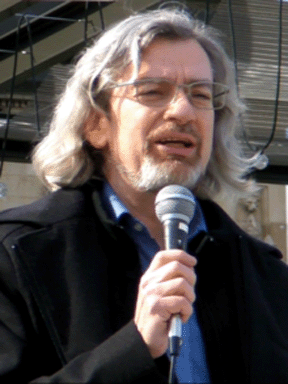
David Noonan’s Submission to the Review of the Woomera Prohibited Area Coexistence Framework
30 August 2024
Contents:
Introduction
The public has a ‘Right to Know’ who is targeted for imposed storage of AUKUS N- wastes.
AUKUS N-wastes are a threat to the Rights of the People of SA to decide their own Future.
3 There is an onus on this Woomera Area Review to see it doesn’t add to a sad history of nuclear disrespect for Indigenous Human Rights and Interests in our State.………………….
4 Civil Society faces imposition of an AUKUS military High-Level nuclear waste dump …………………..
5 Defence is already targeting the Woomera Area as a potential region to site an imposed
AUKUS military High-Level nuclear waste dump ……………………………….
6 Indigenous People have a UN recognised Human Right to Say No to AUKUS N-wastes …………………….
7 Is US origin military High-Level nuclear waste from US N-Subs to be dumped at Woomera? ……………………………
8 Multi-billion $ N-waste Costs are ignored while the US gets Indemnity over nuclear risks ……………….
9 Recommendations
10 Discussion
The Review must be transparent on Defence roles for Woomera in AUKUS and in war
11 As to my Relevant Background
The public has a ‘Right to Know’ who is targeted for imposed storage of AUKUS N- wastes.
Minister Marles MP has still not made a promised ‘announcement’, said to be by early 2024, on
a process to manage High-Level nuclear waste and to site a waste disposal facility, he saying
“obviously that facility will be remote from populations” (ABC News 15 March 2023).
The national press (11 August 2023) reports the Woomera rocket range is understood to be the
‘favoured location’ for storage and disposal of submarine nuclear waste (“Woomera looms as
national nuclear waste dump site including for AUKUS submarine high-level waste afr.com).
Political leaders in WA, Qld and Vic have already rejected a High-Level nuclear waste disposal
site. SA’s Premier has so far only said it should go to a ‘remote’ location in the national interest.
This Review must respect the SA public and Traditional Owners rights to full disclosure of
potential nuclear risks and impacts in advance of any decisions, legislation and process to
impose AUKUS N-waste onto community in the Woomera Area or anywhere else in SA.
Defence can-not claim to have a ‘social license’ to operate in the Woomera Area while failing to
inform affected community of the AUKUS nuclear risks, the cultural and environmental impacts,
and socio-economic impacts they may face through siting for AUKUS nuclear waste storage.
Defence has so far denied South Australians their ‘Right to Know’ the nuclear risks they face.
AUKUS N-wastes are a threat to the Rights of the People of SA to decide their own Future.
The Woomera Area Review must understand that South Australians will not accept federal
Labor and Defence undemocratic imposition of AUKUS nuclear wastes in our State.
If federal Labor go ahead with storage of AUKUS nuclear wastes in SA, it will have to over-ride
State Law to impose the dump. AUKUS N-wastes are a threat to the Safety of the People of SA.
Storage and disposal of nuclear wastes compromises the Safety and Welfare of the people of
South Australia, that is why it is prohibited by the Nuclear Waste Storage (Prohibition) Act 2000.
The Reforming Defence Legislation Review also proposes to take on Defence Act powers to
override State legislation to ‘provide certainty’ to Defence roles, operations and facilities. My
input and Recommendations to the Defence Review called for transparency on these issues:
Defence should become transparent over proposed Navy High-Level nuclear waste
disposal, policy, siting process, rights and legal issues. Defence must declare whether
the SA Nuclear Waste Storage (Prohibition) Act 2000 will be respected OR is intended to
be over-ridden to impose a Navy High-Level nuclear waste storage or disposal site on
‘remote’ lands and unwilling community in South Australia. (April 2023, p.7 & Rec 6-7)
I refer the Review’s consideration to “The Politics of Nuclear Waste Disposal: Lessons from
Australia”, a Report by Dr Jim Green and Dimity Hawkins AM, Published by the Asia-Pacific
Leadership Network (January 2024). The Defence AUKUS agenda needs to learn these lessons…………………………………………………………………………………………………….
Recommendations
These Recommendations No.1-5 comprise public interest disclosures that must be required
from Defence to facilitate an informed public Review of the future of the Woomera Area:
Civil Society faces imposition of an AUKUS military High-Level nuclear waste dump
This Review must respect affected Communities and Indigenous People’s ‘Right to Know’ the
Defence imposed nuclear risks they face in intended High-Level nuclear waste & nuclear
weapons usable fissile material storage and disposal facilities.
1.1 The Review must call on Defence to publicly disclose which Australian regions and
Indigenous Peoples are currently under threat of imposed siting and compulsory land
acquisition for an AUKUS High-Level nuclear waste dump, and which – if any – existing Defence
lands are included in the regional short list that is currently being prepared.
1.2 The Review must make Defence become accountable over the future and fate of the
Woomera Area, understood in national media to be a ‘favoured location’ for storage and
disposal of submarine nuclear waste (“Woomera looms as national nuclear waste dump site
including for AUKUS submarine high-level waste afr.com AFR 11 August 2023). Noting the
Woomera Area is currently subject to a Defence ‘Review’: “to ensure it remains fit for purpose
and meets Australia’s national security requirements” – read AUKUS requirements.
1.3 Defence must become publicly accountable and declare its intension to over-ride the SA
Nuclear Waste Storage (Prohibition) Act 2000 through powers in an AUKUS Bill now before
Parliament (Sec.135 “Operation of State and Territory laws”): to impose an AUKUS nuclear
waste dump on outback lands and unwilling community in SA, by decree in federal Regulations.
This Defence agenda to impose nuclear waste storage in SA also involves Defence over-ride of
the SA Environment Protection Act 1993 and over-ride of the SA Aboriginal Heritage Act 1988.
2 Indigenous People have a UN recognised Human Right to Say No to AUKUS N-wastes
The Woomera Area Review must respect the clear views of Indigenous Labor Senator Patrick
Dodson and act in accordance with the Recommendations of a Federal Inquiry Report (Nov
2023) into the UN Declaration on the Rights of Indigenous Peoples, stating:
“the Commonwealth Government ensure its approach to developing legislation and
policy on matters relating to Aboriginal and Torres Strait Islander people be consistent
with the Articles outlined in the UNDRIP”.
2.1 This Review must seek an explanation from the federal Labor Gov as to whether they will
commit to respect and comply with the United Nations Declaration on the Rights of Indigenous
Peoples Article 29 provision of Indigenous Peoples Rights to “Free, Prior and Informed
Consent”, as a Right to Say No, over storage or disposal of hazardous materials on their lands;
OR if Federal Labor intends to claim a sanction to over-ride UNDRIP and to impose a hazardous AUKUS nuclear waste dump against the potential express wishes of Traditional Owners.
3 US origin military High-Level nuclear waste from US N-Subs to be dumped at Woomera?
The Woomera Area Review must recognise the AUKUS Agreement’s proposed importation of US
origin military High-Level nuclear wastes sourced in 10–12-year-old US Navy nuclear reactors in
second hand US Virginia Class N-Subs that will require perpetual storage in Australia:
This Review must seek a full explanation of how Defence Minister Marles claims to be able
to manage a globally unprecedented task in siting and perpetual storage & disposal of
intractable US origin High-Level nuclear wastes from second-hand US Virginia N-Subs.
It is not credible for the Review to overly rely on claims by AUKUS proponent Minister Marles.
3.1 The Review should call on Minister Marles to explain the incompatibility between the AUKUS
Agreement’s transfer of US origin Virginia Class N-Sub nuclear wastes to Australia, effective
importation of nuclear wastes sourced from the US, and the pre AUKUS Federal Labor Policy
commitment in the ALP National Platform (2021, Uranium p.96-98) to oppose overseas waste:
Labor will: 8. d. Remain strongly opposed to the importation and storage of nuclear
waste that is sourced from overseas in Australia.
4 Multi-billion $ N-waste Costs are ignored while the US gets Indemnity over nuclear risks.
There is an onus on this Review to require public $ Costings and an evidentiary basis on:
- the liability $ Cost consequent in required capability and facilities for in perpetuity High-
Level nuclear waste storage and geological waste disposal at the Woomera Area; - whether the $ Cost of High-Level nuclear waste storage and claimed geological disposal
is included in – OR is additional to – the public Cost of AUKUS at approx. A$368 billion.
These unstated, kept secret, liability $ Costs must be in the order of at least A$10’s of billions.
4.1 In the public interest the Review must require a full exposition on the array of nuclear waste
risks the AUKUS Agreement exposes the Woomera Area to and grants the US Indemnity over.
“Indemnity 22. The Agreement requires Australia to indemnify the UK and the US
against any liability, loss, costs, damage, or injury (including third party claims) arising
out of, related to, or resulting from nuclear risks (risks attributable to the radioactive,
toxic, explosive or other hazardous properties of materials) … transferred pursuant to the
Agreement (Article IV(E)).” (In the National Interest Analysis [2024] ATNIA 14)
5. The Review must be transparent on Defence’s roles for Woomera in AUKUS and in war.
Our survival is at stake, ex-Ambassador to China, Ross Garnaut has stated (20 August 2024):
“America would be damaged by war with China over the status of Taiwan, but, short of a
major nuclear exchange debilitating both great powers, its sovereignty would not be at
risk. Australia’s would be. Indeed, I doubt that Australia could survive as a sovereign
entity the isolation from most of Asia that would be likely to follow anything other than a
decisive and quick US victory in a war in which our military was engaged.”
Discussion:
Defence imposed AUKUS military High-Level nuclear waste & nuclear weapons usable fissile
material on all future generations of Australians is untenable and will be opposed at Woomera.
This Review must at least be able to facilitate informed public consideration of the future of the
Woomera Area through required full disclosures from Defence to the set of pre-requisite public
interest Recommendations No.1-5 presented in this public input.
Australian regional communities and Indigenous groups have a ‘Right to Know’ who is being
currently targeted for siting and assessment of an AUKUS nuclear waste storage / dump.
The Review must realise an answer from federal Labor over whether the UNDRIP championed
by Senator Patrick Dodson will be complied with OR over-ridden to impose AUKUS N-wastes.
Three years into AUKUS the failure to respect affected communities ‘Right to Know’ is evidence
Defence is on a seriously wrong track and is undermining trust in governance in Australia.
There is an onus is on this Review to investigate the array of serious nuclear waste risks to be
imposed on Woomera through AUKUS and subject to an Indemnity to favour US interests.
The Review must be transparent on Defence roles for Woomera in AUKUS and in war.
It is arguable that AUKUS and N-Subs bring Australia closer to a devastating war between the
US and China, including likely strikes on Australia with a real risk of nuclear weapons strikes.
For instance, the Review should consider “AUKUS: The worst defence and foreign policy
decision our country has made” by ex-Foreign Affairs Minister Gareth Evans (17 August 2024):
“… Four, the price now being demanded by the US for giving us access to its nuclear
propulsion technology is, it is now becoming ever more clear, extraordinarily high. Not
only the now open-ended expansion of Tindal as a US B52 base; not only the conversion
of Stirling into a major base for a US Indian Ocean fleet, making Perth now join Pine Gap
and the North West Cape – and increasingly likely, Tindal – as a nuclear target …
Australia’s no-holds-barred embrace of AUKUS is more likely than not to prove one
of the worst defence and foreign policy decisions our country has made, not only
putting at profound risk our sovereign independence, but generating more risk than
reward for the very national security it promises to protect.”…………………………………………………………..
Record weeks for renewables blow up Dutton’s nuclear con
The record high of low-cost wind and solar in the grid comes as we are still waiting for the costing on the Coalition’s plan to nationalise the eye-watering cost of seven nuclear plants.
Tim Buckley and Annemarie Jonson, 12 Sept 24, https://www.afr.com/policy/energy-and-climate/record-weeks-for-renewables-blow-up-dutton-s-nuclear-con-20240910-p5k9e4
It’s been a red-letter few weeks for renewables in Australia. In the last week of August, coal dropped below 50 per cent of electricity generation for the first time, as renewables’ share rose to a record high 48.7 per cent, boosted by windy conditions and low grid demand.
In August last year, coal contributed 57 per cent and renewable energy held a 37 per cent share
As in the US and Britain, where zero-emissions supply is burgeoning as fossil fuels’ contribution to generation falls, this threshold moment in Australia symbolises that the inevitable shift to clean energy is well under way and accelerating here and globally. China is deploying 23 gigawatts of renewables every month, four times what Australia does in a year.
The record-high renewable energy penetration in our national electricity market was accompanied by near record-low wholesale prices, averaging $57 per megawatt hour in the last week of August, versus $91 in August last year. This shows that more renewables equals cheaper power.
South Australia is the standard-bearer for Australia’s renewable energy future. In the past seven days, more than 75 per cent of its power use was generated by renewables, at average wholesale prices of just $37 per megawatt hour, way below the $123 average over the past year.
South Australian Energy Minister Tom Koutsantonis has revised the state’s renewables target to 100 per cent by 2027, off the back of the continued rollout of clean energy infrastructure.
This includes three big batteries announced last week under Federal Energy Minister Chris Bowen’s flagship Capacity Investment Scheme – a key driver of investment momentum underpinning the renewables build-out nationally – and major grid developments, with concomitant projected residential and business energy bill savings.
The federal government and its state counterparts are getting on with the job of accelerating our national energy transition, working to deliver the federal 82 per cent renewables by 2030 target and the resulting energy bill relief. The lower house passed the Future Made in Australia Act this week, key to the government’s vision for a renewables-powered economy.
Still no nuclear costings
Meanwhile, the federal Coalition continues to perpetuate its nuclear con, designed to blow up progress on the transformation of our energy system to low-cost, reliable firmed renewables and entrench decades more of volatile, expensive fossil fuel-based power while we wait … and wait.
Next week marks three months since Opposition Leader Peter Dutton and chief nuclear spruiker Ted O’Brien released their fact- and costings-free, one-page nuclear memo, effectively a note proposing to nationalise the eye-watering cost of construction of seven nuclear plants nationwide – in a country with zero history and expertise in nuclear power generation, on a timeframe that, by all expert accounts, will not result in any material delivery before the mid-2040s. We’re still waiting for their budget projections on this excuse for a policy.
Only this week, Dutton was reported as dismissing questions about budget impacts because he didn’t want to overload Australians with too much information, as the government released an ad citing calculation by industry body the Smart Energy Council that the nuclear energy build would cost up to $600 billion and add $1000 annually to household electricity bills.
Our estimate is that the public cost would be a minimum of $100 billion, and this would inevitably be taxpayer-funded because, unlike firmed renewables, into which private capital is increasingly flowing, there is zero investor interest in nuclear in Australia without massive government subsidies, risk transfer and guarantees.
The Coalition plan involves a fiscally negligent impost on consumers already struggling with cost-of-living pressures. The global history of huge cost blowouts and bailouts in every Western economy building nuclear exacerbates this, and should discourage even the most credulous believer.
This alone makes nuclear unviable here. But the clincher is ongoing generation costs feeding into retail prices. The 2024 GenCost report by the CSIRO and the Australian Energy Market Operator prices large-scale nuclear energy at $155 to $252 a megawatt hour. That is double their estimate of the cost of fully firmed renewable energy of $90 to $100, even after factoring in grid transmission, curtailment and battery firming costs.
The renewables surge is the way of the future. We cannot afford to entertain the Coalition’s damaging nuclear distraction.
Any government proposing nuclear here would be robbing Australians three times: once via a $100 billion public capital subsidy for nuclear reactors; again by locking in long-term hyperinflated energy prices; and third to compensate owners of the former coal power sites the Coalition has slated for nuclear, which have already built new clean energy assets, such as batteries onsite.
Progress is building on transforming our grid with superabundant wind and solar energy, distributed across rooftops and utility-scale, backed up by battery storage and modernised transmission. This now needs further acceleration, particularly given looming closures of breakdown-prone, expensive end-of-life coal power clunkers.
The evidence that firmed renewables win on cost is irrefutable, and double-digit annual deflation of battery and solar costs widens this advantage every year. The energy market operator last month confirmed it sees no energy supply reliability gaps to 2030 in the national electricity market, assuming planned renewables projects proceed on time and at the targeted scale.
The renewables surge we have experienced is the way of the future. We cannot afford to entertain the Coalition’s damaging nuclear distraction. For the sake of Australia, let’s hope that as the renewables reality rises, the Coalition’s domestic nuclear pipe dream is consigned to oblivion, where it belongs.
Any government proposing nuclear here would be robbing Australians three times: once via a $100 billion public capital subsidy for nuclear reactors; again by locking in long-term hyperinflated energy prices; and third to compensate owners of the former coal power sites the Coalition has slated for nuclear, which have already built new clean energy assets, such as batteries onsite.
Progress is building on transforming our grid with superabundant wind and solar energy, distributed across rooftops and utility-scale, backed up by battery storage and modernised transmission. This now needs further acceleration, particularly given looming closures of breakdown-prone, expensive end-of-life coal power clunkers.
The evidence that firmed renewables win on cost is irrefutable, and double-digit annual deflation of battery and solar costs widens this advantage every year. The energy market operator last month confirmed it sees no energy supply reliability gaps to 2030 in the national electricity market, assuming planned renewables projects proceed on time and at the targeted scale.
The renewables surge we have experienced is the way of the future. We cannot afford to entertain the Coalition’s damaging nuclear distraction. For the sake of Australia, let’s hope that as the renewables reality rises, the Coalition’s domestic nuclear pipe dream is consigned to oblivion, where it belongs.
Barnaby Joyce — nuclear energy not as cheap as he thinks it is
Independent Australia, By Belinda Jones | 14 September 2024,
Barnaby Joyce jumps on the nuclear energy bandwagon but gets his facts wrong, writes Belinda Jones.
THE COALITION’S NUCLEAR PLANS suffered another setback this week when it revealed that the Member for New England, Barnaby Joyce, got key nuclear facts wrong in a recent debate.
As part of the annual Bush Summit, presented by Gina Rinehart’s Hancock Prospecting and News Corp, Joyce took part in a debate with Chair of the Climate Change Authority, Matt Kean.
The Bush Summit has been an annual event on the bush calendar since 2019, which meets in rural and remote locations around the country and brings together leaders in politics, mining, agriculture and many other fields……………………………………..
Joyce had jumped on the nuclear energy bandwagon a few years earlier and has been there ever since. Joyce’s position was supported in 2019 with a push for an inquiry into the feasibility of nuclear energy by fellow National Keith Pitt and L-NP Senator James McGrath.
In 2022, Coalition donor Rinehart invested $60 million in Arafura Rare Earths. Arafura’s Nolans Project outputs involve exploration and processing of rare earths, including uranium ‘as a minor product’. A minor product that could be very lucrative if Australia had nuclear energy.
According to the Minerals Council of Australia ‘Australia’s uranium reserves are the world’s largest, with around one-third of global resources’, which might explain mining billionaire Rinehart’s embrace of nuclear energy as the transition away from coal continues…………..
Joyce’s passion for nuclear energy does beg the question — why didn’t the Coalition seize the opportunity to begin a transition to nuclear energy while they were in government from 2013 to 2022? One government minister said at the time it was because ‘financially it doesn’t stack up’.
In 2021, Morrison rejected nuclear energy because of a lack of bi-partisan support. Joyce revealed at the recent Bush Summit debate with Matt Kean that the real reason Morrison had rejected nuclear energy was because internal polling said nuclear energy was unpopular, as it still does, not because of a lack of bipartisan support.
During the recent Bush Summit debate, Joyce claimed that France and Finland’s energy is cheaper than Australia’s because they use nuclear energy.
This claim has since been fact-checked by AAP as wrong:
‘The National Party MP was responding to a suggestion that Russia’s invasion of Ukraine in 2022 had driven up power prices globally.
When asked to provide evidence for the claim, Mr Joyce’s office sent AAP FactCheck an article from the Australian Energy Council comparing household electricity prices internationally.
The analysis is from February 3, 2022, which predates the beginning of Russia’s invasion of Ukraine by three weeks.’
Currently, the Coalition has released scant details about their nuclear energy ambitions. In the absence of a clear, comprehensive, costed nuclear energy plan from which Coalition politicians can work, misinformation or disinformation is more likely to spread on the nuclear issue…………………………….
Joyce has become the self-appointed poster boy for groups opposing renewables, particularly the New England, Illawarra and Hunter regions. He will be a panelist on ABC’s Q and A next Monday. Advertised shuttle buses will likely be ferrying anti-renewables activist audience members from Muswellbrook and Port Stephens to the Newcastle studio. Joyce will be at his theatrical best, knowing he has an audience full of supporters………………………… more https://independentaustralia.net/politics/politics-display/barnaby-joyce–nuclear-energy-not-as-cheap-as-he-thinks-it-is,18977
The fake charity AMDA Foundation is exposed by Michael West Media’s Michelle Fahy.

Landforces’ brothers in arms: how a weapons peddler qualified for charitable status . https://www.michaelwest.com.au/landforces-brothers-in-arms-how-a-weapons-peddler-qualified-for-charitable-status/

by Michelle Fahy | Jun 4, 2021 The Coalition is cracking down on charitable organisations. However, the Australian charity promoting arms deals on behalf of weapons makers that profit from humanitarian catastrophes is unlikely to be in the government’s sights. With the weapons expo LandForces wrapping up in Brisbane this week, Michelle Fahy delves into the charity behind LandForces.
The Morrison government has charitable organisations in its sights. It proposes to amend the legislation covering charities so that minor legal misdemeanours by staff or supporters of a charity could be used as a prompt by the regulator for a review of a charity’s privileged status.
St Vincent de Paul told The Saturday Paper that if an activist wearing a Vinnies T-shirt refused to move along when asked by police, Vinnies could risk having its charitable status removed.
Hands Off Our Charities, an alliance of Australian charities, said in a submission to government: “The proposal is a major overreach and the need for further regulation has not been (and in our view cannot be) properly explained.”
Yet consider the activities of a not-for-profit organisation that many Australians will be astounded to discover has gained privileged charitable status – AMDA Foundation Limited (AMDA).
AMDA is the organiser of Land Forces, a biennial military and weapons exhibition running in Brisbane this week showcasing organisations “operating across the full spectrum of land warfare”.
The 600 exhibitors at Land Forces include local and multinational weapons manufacturers and other suppliers to military forces. Event sponsors include global arms corporations such as Boeing, BAE Systems, Lockheed Martin, Rheinmetall, General Dynamics, Saab and Hanwha, along with local companies Electro Optic Systems (EOS), CEA, and NIOA. Representatives from foreign governments and militaries are among the attendees.
Several of AMDA’s arms-maker sponsors have supplied their weaponry to the two countries leading the coalition fighting the war in Yemen – Saudi Arabia and the United Arab Emirates. The UN has been pleading for years for countries to cease supplying weaponry to these countries.
In late 2018, the New York Times published distressing photographs of emaciated children in Yemen dying as a result of aid blockades during the war. The mass starvation continues. UNICEF has said more than 400,000 Yemeni children under five could die preventable deaths this year.
Promoting arms deals on behalf of corporations that have profited from this unspeakable humanitarian catastrophe is the antithesis of what an Australian registered charity should be doing.
But the political posturing evident in the government’s proposed changes is unlikely to result in any repercussions for the AMDA Foundation. Instead, it is ‘activist’ environmental charities that are being targeted by the changes. Which is precisely the problem with such sweeping broad powers. They can be implemented selectively to silence voices the government does not want heard.
“It is the principle that underpins the change that is wrong, regardless of who it is used to target,” said Matt Rose, Economy & Democracy Program Manager at the Australian Conservation Foundation.
Arms trade promotion a “charitable activity”?
AMDA runs numerous major military and weapons-related trade exhibitions around Australia. Its roster of events includes Avalon, a biennial aerospace military and weapons expo in Victoria, next slated for early December 2021. The Indo Pacific Expo, a maritime warfare exhibition, is scheduled for May 2022 in Sydney.
These and other industry trade shows bring together sellers and buyers of weaponry and other military and security-related equipment. “Doing business is easy at Land Forces,” says its website, noting that Land Forces serves as a “powerful promotional and industry engagement forum”.
AMDA says it exists to help the “general community in Australia”. But the general community is not permitted to attend Land Forces nor AMDA’s other arms exhibitions. (The public can attend the Avalon Air Show, a separate public event run at the same time as the Avalon arms expo.)
AMDA is part of a group of companies registered with ACNC which operates around the country. It had 24 full-time-equivalent employees and a gross income in 2020 of $11.7 million – 32% of which came from government grants and 61% from operating revenue. Its income in 2019 was $26.2 million, mostly from operating revenue.
Revolving doors and conflicted interests
The AMDA board is an all-male affair. Its chair is former chief of the Royal Australian Navy, Christopher Ritchie, who joined the board in May 2017 while concurrently sitting on the boards of Lockheed Martin Australia (until 2020) and German naval shipbuilder Luerssen Australia, both multibillion dollar contractors to the Defence Department.
Former chief of army Kenneth Gillespie sits on the AMDA board while also sitting on the board of Naval Group, the French multinational building Australia’s controversial new submarines. Gillespie is also chair of the Australian Strategic Policy Institute (ASPI) Council, the highly influential and supposedly “independent” think tank tasked with providing strategic advice to the government.
ASPI is sponsored by Naval Group as well as other global arms manufacturers including Lockheed Martin, Thales, Saab and Northrop Grumman. ASPI has been vocal in its anti-China ‘war drums’ rhetoric, stoking regional tensions, along with the Asia Pacific arms race.
1 This month


Help Aunty Sue Protect Her Land and Sacred Sites From Destructive Rocket Testing.
.

Australians deserve the truth
about
AUKUS – https://aukuspublicinquiry.com/

PETITION – To: Prime Minister Anthony Albanese and the Australian Labor Government

of the week – Australians for War Powers Reform (AWPR)
To see nuclear-related stories in greater depth and intensity

