Why Aged Care Funding Scrutinised, but Military Spending Not
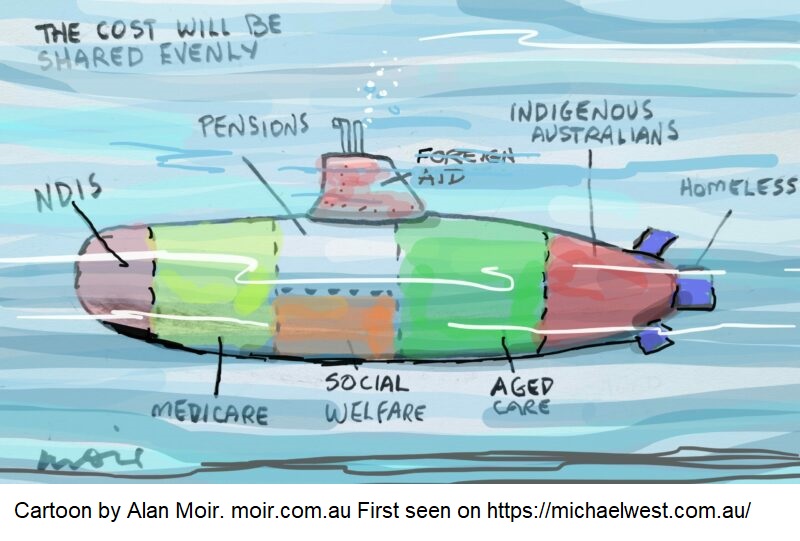
Double Standards in Public Discourse
The double standard in how we view social versus military spending is stark. While aged care is framed as a financial burden that requires higher contributions from individuals, military spending is accepted without the same level of scrutiny. Why is it that investments in the well-being of citizens are questioned while investments in military equipment go ahead without question?
Australia’s government has the financial ability to distribute more resources toward aged care without compromising national defence. By reallocating just, a fraction of the $368 billion earmarked for submarines, the aged care system could receive the necessary funding to address worker shortages, improve infrastructure, and ensure that no senior is left without quality care.
September 13, 2024 by By Denis Hay, The AIM Network
Introduction
Australia is grappling with rising demands for aged care services as its population grows older, leading to a $5.6 billion reform package to improve the sector. Yet, every dollar given to aged care is met with scrutiny, with questions about sustainability and affordability. In stark contrast, military spending – including the $368 billion given for the AUKUS submarine deal – goes ahead with far less financial scrutiny.
Why do we ask, “At what cost?” for aged care, yet overlook the same question for military projects? This article explores these double standards and how Australia’s currency sovereignty means the government has the financial capacity to fund both without compromising one for the other.
Disparities in Spending Scrutiny
I. Aged Care Reforms: Why “At What Cost” is Constantly Asked
A. Key Changes in Aged Care
The Australian government’s $5.6 billion aged care reform package aims to improve services for more than 1.4 million older Australians, helping them stay at home longer before entering institutional care. However, the reforms include higher means-tested contributions from seniors, raising concerns about affordability for lower-income individuals.
B. Challenges in Aged Care Funding
Australia’s aged care sector is facing significant challenges, even with the new reforms:
1. Workforce shortages – More than 300,000 workers are needed to meet the demand for aged care services, but underfunding is making recruitment and retention difficult.
2. Underfunding – The sector is still underfunded despite the reforms, with many care facilities still struggling to provide adequate services.
3. Increased demand – With Australia’s aging population expected to double by 2050, more funds will be needed to provide quality care.
Despite these growing challenges, aged care funding is constantly questioned. The $5.6 billion reform package was seen as necessary, but it came with a public narrative focused on budget concerns and intergenerational equity, suggesting the government is walking a financial tightrope when funding such social services.
C. Public and Political Scrutiny
Aged care spending is consistently subjected to public and political debate, with media coverage often emphasising the “cost to the taxpayer“ and generational fairness. Yet this intense scrutiny stands in stark contrast to how military spending is viewed, where multibillion-dollar defence projects move forward with little financial questioning.
II. Military Spending: An Unquestioned Cost
A. Overview of Military Expenditures
In 2023, Australia committed $368 billion over the next 30 years to the AUKUS submarine program, making it one of the largest military spending commitments in the country’s history. The overall defence budget for 2023-2024 alone reached $50 billion, marking a significant increase compared to previous years.
B. Justifications for Military Spending
Proponents of military spending often argue that defence investments are critical for national security, particularly with the growing military presence of China in the Indo-Pacific region. The AUKUS deal, which promises to deliver nuclear-powered submarines to Australia, has been framed as necessary for safeguarding Australia’s interests in the future.
However, this narrative ignores the question of cost. While $368 billion has been committed for submarines over the next three decades, far less attention is given to the financial opportunity costs – what else could be funded with such vast sums?
C. Limited Scrutiny on Defence Budgets
In contrast to aged care, military expenditures are rarely subject to serious financial scrutiny. Public debate around defence spending typically focuses on national security threats rather than the financial burden of these projects. Even when media coverage addresses military budgets, it rarely compares them to the costs of social services, leaving aged care and defence spending to occupy entirely different public conversations.
Australia’s Currency Sovereignty and the Real Limits…………………………………………………………………………..
Double Standards in Public Discourse
The double standard in how we view social versus military spending is stark. While aged care is framed as a financial burden that requires higher contributions from individuals, military spending is accepted without the same level of scrutiny. Why is it that investments in the well-being of citizens are questioned while investments in military equipment go ahead without question?
…………………………………………………………… Rebalancing Australia’s Budget Priorities
…………………..Australia’s government has the financial ability to distribute more resources toward aged care without compromising national defence. By reallocating just, a fraction of the $368 billion earmarked for submarines, the aged care system could receive the necessary funding to address worker shortages, improve infrastructure, and ensure that no senior is left without quality care. ……………..more https://theaimn.com/why-aged-care-funding-scrutinised-but-military-spending-not/
Submission -Terry Barridge – re new agreement on Naval Nuclear Propulsion – it’s dangerous, the public should vote on it.

Given the significant implications of such a security pact, it is only democratic that the Australian population has a direct say in this matter. I strongly advocate for this issue to be put to a vote, allowing the voices of Australian citizens to be heard and respected in a decision that will impact our nation’s future.
I am writing to express my concerns and opposition to the recent enhancement of the AUKUS agreement,
commonly referred to as AUKUS 2.0, between Australia, the United States, and the United Kingdom. As an
Australian citizen deeply invested in the long-term security and prosperity of our nation, I feel compelled to voice my apprehensions regarding the implications of this agreement
Firstly, I am troubled by the increased proximity of Australian military and security policies to those of the
United States. The United States, in its current geopolitical stance, appears to many as a waning power, facing significant domestic challenges and shifting international allegiances. By binding our security interests so closely with those of the United States through agreements like AUKUS 2.0, Australia risks inheriting the animosities and conflicts that are directed towards America. This alignment not only draws us into the sphere of influence of a nation facing considerable global scrutiny and criticism but also potentially makes Australia a target for those who view the United States unfavorably.
Secondly, the financial burden of AUKUS 2.0 on Australian taxpayers is a major concern. The investment
required to uphold the commitments within this agreement is substantial, and the returns – both in terms of security enhancements and economic benefits – are uncertain. In an era where economic stability is precarious, it is crucial that government expenditures are made with a clear and guaranteed return on investment. The lack of transparency regarding the financial implications and benefits of AUKUS 2.0 is worrying. Australian taxpayers deserve clarity on how their funds are being used and assurances that these expenditures will not only safeguard but also enhance our national interests.
Furthermore, in light of the current “cost of living” crisis, the financial commitment required for this deal
appears especially irresponsible. Many Australians are already struggling to manage everyday expenses, from utility bills to housing costs. Allocating substantial public funds to an uncertain and contentious military agreement further burdens the average citizen without offering immediate or transparent benefits.
Moreover, the United States has a long and contentious history of treating warfare as a business opportunity, enriching a select few at the expense of many. This perspective on military engagement should not be what we aspire to promote in our region. America’s track record in wars across the globe has often led to long-standing conflicts without clear successes, posing significant concerns about the wisdom of aligning our defense policies so closely with their strategies.
Given the significant implications of such a security pact, it is only democratic that the Australian population has a direct say in this matter. I strongly advocate for this issue to be put to a vote, allowing the voices of Australian citizens to be heard and respected in a decision that will impact our nation’s future.
I appreciate your attention to this matter and look forward to your response, outlining how you and your office will address these concerns. https://www.aph.gov.au/Parliamentary_Business/Committees/Joint/Treaties/NuclearPropulsion/Submissions
Submission – Stephen Clendinnen – re new agreement on Naval Nuclear Propulsion – oppose this costly, dangerous, AUKUS mistake
I am writing to you to oppose the proposed AUKUS deal. Here are my reasons.
1 The AUKUS deal will provoke an arms race with China which will destabilise the entire Indo-Pacific region and lead to increased conflict in our region. China is our number one trading partner. Entering an arms race with China will seriously jeopardise our economic interests with potential massive financial costs. Entering an arms race with China will also make us more of a target for attack.
2 The proposal is extremely expensive and we know from past experience that these type of high tech defence projects usually run massively over budget. So it is safe to say that the cost will be well over $386 billion.
3 The AUKUS deal will make us completely subservient to the USA. These submarines will not really be owned by Australia; the US and the UK will retain complete control over crucial technologies that operate the subs. Without active support from the US and the UK the subs will not be able to operate.
4 There are very real risks that the USA will cease to be a functioning democracy in the near future. There are no contingency plans for this eventuality. The USA is complicit in war crimes that Israel is committing through the supply of weapons. Both the Republicans and the Democrats support this policy. By entering the AUKUS agreement Australia will bear legal and moral responsibility for participating in war crimes.
5 These subs will not be built in Australia. There are massive technical and labour force impediments to this ever happening. The promises made about building submarines here are always deliberately vague about the time line.
6 The US cannot make enough of the subs for their own needs and are running way behind schedule. Delivery of submarines to Australia will be massively delayed, however Australia has already started making payments.
7 This is a very expensive proposal that gives all the benefits to the USA and the UK with many of the up front costs being paid by Australia.
8 Australia will be receiving large amounts of nuclear waste from the USA and from the UK as part of this arrangement.
Submission -James Lechte – re new agreement on Naval Nuclear Propulsion it’s not too late to walk back this AUKUS commitment
China has never in its long history shown a track record of external aggressiveness.
its highly likely that
rather than China, the US in fact may become more unstable and less trustworthy in the coming
decades, even sooner perhaps.
Submission no 19
This is formal feedback on the proposed AUKUS legislation/policy and related $ 370 billion budget
spend forecast by the current administration for the nuclear submarine acquisition from the US.
As a concerned Aussie citizen, and having had the privilege of living in Switzerland for a number of
years whilst working overseas, it brings new light on recent commentary about the AUKUS deal and
Australia’s position, held by both Labour and the Liberal National party coalition.
My feedback relates to If and how.
IF
The key question Australians deserve further dialogue over is whether or not its in our best interests
to develop a first of a kind, pro US, assertive (some would consider aggressive) defense posture in
the region. Australia is a peaceful country, with a diverse and increasingly multi-cultural pan Asian
background. History tells us that wars are difficult, do not end well nor are in any parties interests.
Whatsmore, history also tells us that deterrence based on increased defence capability is not based
in fact. Rather, strategic ambiguity – where by any threat does not understand which side we would
take in a conflict, may be a better deterrent, as it gives parties options and does not actively signal a
threat.
AUKUS removes this opportunity.
likelihood of getting into conflict. Switzerland is an excellent example here – across their history from
the late 1200s, they have managed to achieve this ambiguity, which has provided them with options
in alliances and support, in different scenarios across history.
China has never in its long history shown a track record of external aggressiveness. On the contrary,
despite them being very assertive in their economic position, often crossing the line, the latest
example from 2020/21 economic stoush with Australia highlights to us that this can be managed and
resolved, by using soft power – diplomacy, patience and dialogue. In any conflict, showdown or
threat, we have already engaged by virtue of the posture that is in question built into AUKUS. We
have no option but to engage, regardless of the rhetoric of Minister Marles suggesting that this is
within our discretion. We effectively have a target on our back.
As Ray Dalio highlights in his essays regarding world power being reshaped, its highly likely that
rather than China, the US in fact may become more unstable and less trustworthy in the coming
decades, even sooner perhaps. If this happens, where does this leave Australias options around
independence, freedom of defence action and strategic ambiguity? If this world power shift continues and China continues its ascendency, why is it in Australias interest to maintain an
aggressive posture with the new world power? This makes no sense.
How
If one is to assume that based on a long history of alliance, collaboration and defence information
and knowledge sharing, Australia should join an AUKUS alliance, then the question is how this can be
achieved whilst maintaining a) as much of the above ambiguity as possible as its in our long term
interests, and b) a commercial strategy that sees Australia have an equitable commercial
relationship, grow its economy, not primarily its debt. It is in Australias interest to have a resilient
and multi faceted defence capability, whilst also managing a careful cost benefit of investing in these
assets. This means that we need to be extremely commercial, shrewd and strategic in the use of
multiple options to fend off potential threats and get the best long term value for money. This
classically is now termed ‘Asymmetric’ capabilities. Aside from the issue of how Australian Defence
experts and the Government choose to renew this capability, one thing is for certain, we need to
develop much better commercial capabilities in this space given the quantum were talking about,
this role would be similar in scale to a Deputy capability group within the ATO or home affairs for
example, dealing with the size of the spend. We should be extremely commercially aggressive on
clawing back spend where budgets have been over run, ultimately meaning that shared success is
the primary objective for all parties.
The deal that has been presented to Australians, with scant detail, suggests that none of the above
has been achieved. On the contrary, it seems like we have entered into an agreement MAXIMISING
our partners interests and not ours. The context that this deal is/has taken shape under is that for
the health and prosperity of the region, it is in many parties (US, Japan, Indo Pacific nations etc)
interests for Australia and other nations to have strategic defence capabilities. It is also important to
note, that in doing so, we are buttressing the US’s defence posture in the region and as such,
deserve special economic consideration, just like the defence consideration (being given access to
these tools). We are also an extension of the US defence capability, given the tools being selected. It
somehow flies in the face of economic reality and pragmatism, that Australia is the sole payer at
what appears a significant premium, where the bulk of the jobs, companies and profits will go
offshore.
This is an enormous let down to Australians. A let down for the significant work and taxpayer dollars
that taxpayers are burdened by. There is no question that a) we have enormous spending
commitments over the coming decades with an ageing population and at best c class infrastructure
across the country and b) declining tax revenues combined with c) an inability to reform the tax
system so that the wealthy, mining and other multinationals pay way too little tax. It is more that
arguable that Australia simply cannot afford this luxury capability, especially until one or many of
these aforementioned planks of our economic condition are improved measurably.
Ultimately, if we have no choice but to contribute to the AUKUS pact, we should do so judiciously,
economically, and carefully. However – its not too late to maintain some form of independence by
walking back commitments to acquire nuclear submarines, which will undoubtedly be well over
budget, technologically inferior and pin us down to be a multi decade minion of the US, as one
recently put it – ‘the 51 state of the United States’. Developing a more conservative stance within
these treaties is in all Australians interests. https://www.aph.gov.au/Parliamentary_Business/Committees/Joint/Treaties/NuclearPropulsion/Submissions
Protecting the Merchants of Death: The Police Effort for Land Forces 2024
September 12, 2024, by: Dr Binoy Kampmark, https://theaimn.com/protecting-the-merchants-of-death-the-police-effort-for-land-forces-2024/—
September 11. Melbourne. The scene: the area between Spencer Street Bridge and the Batman Park–Spencer Street tram stop. Heavily armed police, with glinting face coverings and shields, had seized and blocked the bridge over the course of the morning, preventing all traffic from transiting through it. Behind them stood second tier personnel, lightly armed. Then, barricades, followed by horse mounted police. Holding up the rear: two fire trucks.
In the skies, unmanned drones hovered like black, stationary ravens of menace. But these were not deemed sufficient by Victoria Police. Helicopters kept them company. Surveillance cameras also stood prominently to the north end of the bridge.
Before this assortment of marshalled force was an eclectic gathering of individuals from keffiyeh-swaddled pro-Palestinian activists to drummers kitted out in the Palestinian colours, and any number of theatrical types dressed in the shades and costumery of death. At one point, a chilling Joker figure made an appearance, his outfit and suitcase covered in mock blood. The share stock of chants was readily deployed: “No justice, no peace, no racist police”; “We, the people, will not be silenced. Stop the bombing now, now, now.” Innumerable placards condemning the arms industry and Israel’s war on Gaza also make their appearance.
The purpose of this vast, costly exercise proved elementary and brutal: to defend Land Forces 2024, one of the largest arms fairs in the southern hemisphere, from Disrupt Land Forces, a collective demonised by the Victorian state government as the great unwashed, polluted rebel rousers and anarchists. Much had been made of the potential size of the gathering, with uncritical journalists consuming gobbets of information from police sources keen to justify an operation deemed the largest since the 2000 World Economic Forum. Police officers from regional centres in the state had been called up, and while Chief Commissioner Shane Patton proved tight–lipped on the exact number, an estimate exceeding 1,000 was not refuted. The total cost of the effort: somewhere between A$10 to A$15 million.
It all began as a healthy gathering at the dawn of day, with protestors moving to the Melbourne Convention and Exhibition Centre to picket entry points for those attending Land Forces.
Over time, there was movement between the various entrances to prevent these modern merchants of death from spruiking their merchandise and touting for offers. As Green Left Online noted, “The Victorian Police barricaded the entrance of the Melbourne Convention Centre so protestors marched to the back entrance to disrupt Land Forces whilst attendees are going through security checks.”
In keeping with a variant of Anton Chekhov’s principle, if a loaded gun is placed upon the stage, it is bound to be used. Otherwise, leave it out of the script. A large police presence would hardly be worthwhile without a few cracked skulls, flesh wounds or arrests. Scuffles accordingly broke out with banal predictability. The mounted personnel were also brought out to add a snap of hostility and intimidation to the protestors as they sought to hamper access to the Convention. For all of this, it was the police who left complaining, worried about their safety.
Then came the broader push from the officers to create a zone of exclusion around the building, resulting in the closure of Clarendon Street to the south, up to Batman Park. Efforts were made to push the protests from the convention centre across the bridge towards the park. This was in keeping with the promise by the Chief Commissioner that the MCEC site and its surrounds would be deemed a designated area over the duration of the arms fair from September 11 to 13.
Such designated areas, enabled by the passage of a 2009 law, vests the police with powers to stop and search a person within the zone without a warrant. Anything perceived to be a weapon can be seized, with officers having powers to request that civilians reveal their identity.
Despite such exercisable powers, the relevant legislation imposes a time limit of 12 hours for such areas, something most conspicuously breached by the Commissioner. But as Melbourne Activist Legal Support (MALS) group remarks, the broader criteria outlined in the legislative regime are often not met and constitute a “method of protest control” that impairs “the rights to assembly, association, and political expression” protected by the Victorian Charter of Human Rights and Responsibilities.
The Victorian government had little time for the language of protest. In a stunningly grotesque twist, the Victorian Premier, Jacinta Allan, defended those at the Land Forces conference as legitimate representatives of business engaging in a peaceful enterprise. “Any industry deserves the right to have these sorts of events in a peaceful and respectful way.” If the manufacture, sale and distribution of weapons constitutes a “peaceful and respectful” pursuit, we have disappeared down the rabbit hole with Alice at great speed.
That theme continued with efforts by both Allan and the opposition leader, John Pesutto, to tarnish the efforts by fellow politicians to attend the protest. Both fumed indignantly at the efforts of Greens MP Gabrielle de Vietri to participate, with the premier calling the measure one designed for “divisive political purposes.” The Green MP had a pertinent response: “The community has spoken loud and clear, they don’t want weapons and war profiting to come to our doorstep, and the Victorian Labor government is sponsoring this.”
The absurd, morally inverted spectacle was duly affirmed: a taxpayer funded arms exposition, defended by the taxpayer funded police, used to repel the tax paying protestors keen to promote peace in the face of an industry that thrives on death, mutilation and misery.
Submission- Jennifer Lyons -re new agreement on Naval Nuclear Propulsion- reject AUKUS and its dangerous war games
Enough of the fat cat white men making decisions, that are more about a bunch of boys playing war games than the health and future of our country.
Submission no. 17
Why would Australia spend so much money (our money, the people’s money) on something that
would put us in a volatile position with China?
America and Britain are both crumbling sick societies with useless political leaders, and here we
are following their lead.
Wake up Australia before it is too late. You are killing us, our land and my grandchildren’s future
with stupidity.
Enough of the fat cat white men making decisions, that are more about a bunch of boys playing
war games than the health and future of our country.
I am a concerned citizen and I am begging you to change.
Jennifer Lyons
Submission- G.H. Toll -re new agreement on Naval Nuclear Propulsion- Australia should pursue an independent non aligned foreign policy.
Submission no. 13
I wish to express my complete opposition to the Aukus agreement.
Australia should pursue an independent non aligned foreign policy.
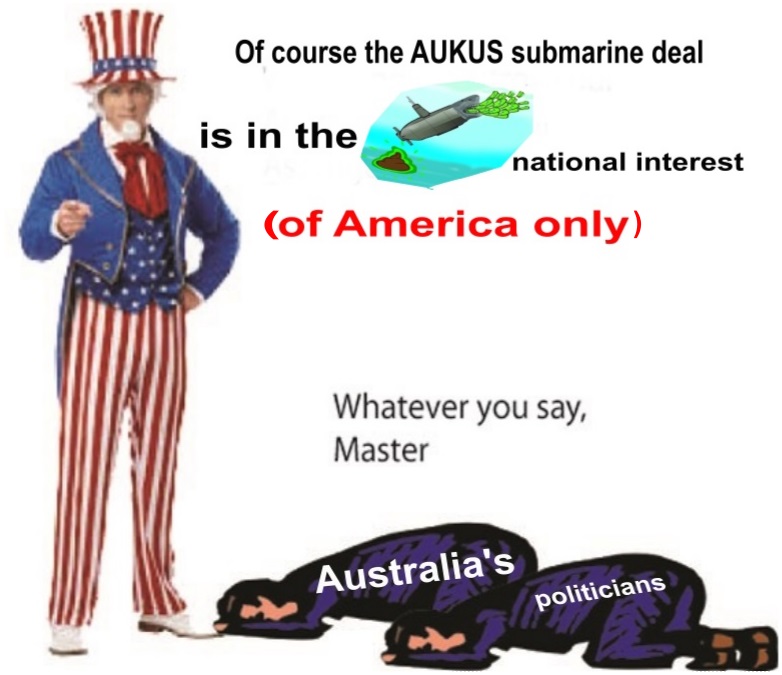
We should not ratify this Aukus agreement and should refuse to continue to humiliate
ourselves by acting as a vassal state for the will of the USA.
Yours sincerely,
Mr G H Toll
Australian citizen and fully emerged Australian elder.
Voter
Melbourne
Submission- Tom Warwick -re new agreement on Naval Nuclear Propulsion- not in the public interest, designed to provoke China
The other partners in the deal take no risk and Australia agrees to accept all the risks and nuclear waste. The government who agreed to this deal is not acting in the interest of the people and is either naive or traitorous
China does not want war with Australia, China has not fired a shot in 40 years, China is trying to prove that their model of prosperity without war is superior and they are successful in doing so.
Submission no 11 https://www.aph.gov.au/Parliamentary_Business/Committees/Joint/Treaties/NuclearPropulsion/Submissions
Dear senate committee, I am a member of the Australian public, and a voter in the electorate of
Durack. I represent myself and the ordinary people of Australia.
The AUKUS deal is not in the interest of the Australian people.
The opportunities forgone by spending an exorbitant $368B on nuclear submarines is enormous, we
have great need in this country for public spending on social programmes, social and commercial
infrastructure.
Not only does the AUKUS spending not produce social good it is harmful and causes risks to
Australian society.
The other partners in the deal take no risk and Australia agrees to accept all the risks and nuclear
waste. The government who agreed to this deal is not acting in the interest of the people and is
either naive or traitorous. If naïve the government should be removed, if traitorous the government
must be prosecuted and severely punished.
The submarines are not defensive in nature, the reason why nuclear has been chosen is that they
can operate far off shore and not in Australian territorial waters to provoke and possibly attack an
adversary far away, and though it has not been explicitly stated China is the object of this
antagonism, our largest trading partner and the nation upon who most of our prosperity depends.
China does not want war with Australia, China has not fired a shot in 40 years, China is trying to
prove that their model of prosperity without war is superior and they are successful in doing so.
AUKUS is not in the public interest
AUKUS has never been demanded by the Australian people
AUKUS places an excessive financial burden in the public purse, funds that could be much
better spent on public infrastructure.
There are no guarantees that Australia will receive anything from AUKUS except public debt,
nuclear waste from Britain and USA and risk.
AUKUS is provocative to our most valuable trading partner
Please cancel AUKUS now.
Submission- Women’s International League for Peace and Freedom, Australia -re new agreement on Naval Nuclear Propulsion.
Submission no. 6 https://www.aph.gov.au/Parliamentary_Business/Committees/Joint/Treaties/NuclearPropulsion/Submissions
In contributing to this inquiry, the WILPF Australia Board will:
- Introduce WILPF Australia.
- Note that the National Interest Analysis is negligent in that it makes no serious attempt to assess
the public interest of the proposed Agreement - Highlight the significant national interest arguments against acceding to the terms of the
agreement which need to be given proper consideration - Recommend a complete rejection of the Agreement as it would serve to implement decisions
previously made without proper consideration of the national interest.
Women’s International League for Peace and Freedom (WILPF)
WILPF Australia is a feminist peace-building organisation of volunteer activists which is anti-war, antiviolence, non-profit, and non-aligned, bringing civil society together to bring about a sustainable peace.
WILPF staff, sections and members have been active and vocal supporters of the international treaty to
ban nuclear weapons for over a decade, following consistent antinuclear organising and advocacy since the dawn of the nuclear age.
The National Interest Analysis is negligent
The National Interest Analysis is predominantly a summary of what appears in the draft Agreement. There
are only two direct references to the National Interest:
- at item 6, referring to allowing access to information and material necessary to implement a
nuclear-powered submarine program - at item 10, referring to the need to achieve the “Optimal Pathway”
Other issues directly relating to the draft Agreement which would appear to be contrary to the National Interest are not considered, including:- Article IV (C) – the agreement commits Australia to paying whatever price the US or the UK wish to
charge for the “Special Nuclear Material contained in complete, welded Power Units, and other
Material as needed for such Naval Nuclear Propulsion Plants”. The statement that the prices with
be “based on the fair market price of comparable enriched uranium” at IV(B) neglects to consider
that there will be no market price for the goods under consideration. Committing Australia to
paying whatever the UK and the US wish to charge is not in the national interest - Article XI – Intellectual Property – commits Australia to handing over any intellectual property and
patents developed by Australians to the US and/or the UK where it derives from “information,
Material, or Equipment” that they have provided. This applies to both Classified and non-Classified
information. Such a sweeping commitment will ensure that Australia does not benefit from any
innovations developed here for fifty years (to 2075). It is clearly not in the National Interest
The cursory nature of the National Interest Analysis does not inspire confidence that the national interest
is foremost in the minds of the government.
More importantly, however, is the fact that the National Interest Statement takes the commitment to
embark on a nuclear-powered submarine program and the so-called “Optimal Pathway” to implement this commitment, as given. Neither of these have been subjected to National Interest assessment. The
legitimacy of all these agreements and arrangements hinges on the legitimacy of that original decision. In
the following section we set out some of the National Interest arguments that WILPF suggests should be
considered.
National Interest arguments that should have been considered
Firstly, for years, WILPF has debunked the myth that militarisation creates a safer world, showing that
more weapons and arms invariably lead to more violence, instability, and gender inequality. The
masculinist, militarist nuclear deal proposed by the US and UK is not in the National Interest because it will not make Australia safer. On the contrary, changing Australia’s defence policy to be more assertive
towards our major trading partner in the region threatens our economic well-being, our regional alliances
and exposes us to additional threats.
Secondly, the National Interest arguments concerning the nuclear waste that will result from
implementing the draft Agreement have not been considered. Disposal of high-level nuclear waste is
globally unprecedented. Our AUKUS ‘partners’, the US and UK, have proven unable to dispose of the waste\ in the 60+ years since first putting nuclear submarines to sea. It seems that the ALP’s National Platform commitment to “remain strongly opposed to the importation and storage of nuclear waste that is sourced from overseas in Australia” is yet to be considered.
Further, storage and disposal of nuclear wastes already compromises the safety and welfare of the people
in South and Western Australia. The fact that nuclear waste storage is prohibited in South Australia by the
SA Nuclear Waste Storage (Prohibition) Act 2000 can potentially be overridden by Federal law. This is
shameful, and could be an abuse of power that undermines Australians’ basic human rights
Thirdly nuclear weaponry and wastes have gendered impacts …………………………….
Fourthly Australia has a long land ongoing legacy of colonialism………………………….
WILPF Australia recommends that the agreement be rejected……………………………..
Give Me Missiles: Gina Rinehart and the Pathologies of Mining
Australian Independent Media, September 6, 2024, by: Dr Binoy Kampmark
Power should only ever be vested carefully, and certainly not in the hands of mining magnate Gina Rinehart, a creature so comically absurd as to warrant immediate dismissal in any respectable commentary. But Australia’s richest human being demands to be noticed, given the insensible influence she continues to exert in press and policy circles. Rants of smelly suggestion become pearls of perfumed wisdom, often occasioned by large amounts of largesse she disgorges on her sycophantic following.
Of late, she has been busy in her narcissistic daftness. At the National Bush Summit held last month, she proved particularly unstoppable. While advertised as a News Corp project backed by a number of Australian corporate heavies (NBN, CommBank, Woolworths and Qantas), Rinehart’s Hancock Prospecting left its unmistakable mark. The events offered a Rinehart Hall of Mirrors, self-reflecting her purchased eminence. She funded much of it; she structured it; she brought the necessary tyrannical boredom in tow.
Before remarking on some of the observations, brief mention should be made about the source of Rinehart’s animal spirit. One should never condemn, outright, the children for the sins of their parents. But she is the exception that proves the rule. Her father, Lang Hancock, was an elemental Australian version of a 20th century conquistador, an enterprising plunderer of the land and equally immune to cultural refinements and such novel notions as human rights. With barbaric clarity and genocidal suggestion, he proposed in 1984 that unassimilated members of the Indigenous populace be given the following treatment: “dope up the water up, so that they were sterile and would breed themselves out in the future and that would solve the problem.”
At the Port Hedland leg of the Bush Summit, Rinehart fantasised about having the military styled comforts offered by the US firm Rafael Advanced Defense Systems in 2011 to Israel. The Iron Dome system, used to shield Israel from rocket attacks, could just as well be deployed in Australia. But instead of focusing on protecting civilians, the batteries would be invaluable in protecting Rinehart’s own mining assets in the Pilbara.
A gorged ego, the country’s perceived welfare and mining interests are all fused in an unsteady mix of justified plunder under the cover of military protection for Hancock Prospecting. “It is no good having the resources of the Pilbara unless we can ship it out. Hence, we should have defence to keep our railways and ports open, and defend our sea lanes.” To the defensive dome could also be added “war drones, and smart sea mines.”
The next target in this spray of barking madness was government regulation – at least the sortthat impairs her extractive practices. With brattish petulance, she even claimed that Canada had treated the mining industry with greater aplomb and respect, despite having, in her words, a “socialist” Prime Minister in the form of Justin Trudeau. Various taxes, such as the Fringe Benefits Tax, should be ditched, given the damage it was doing to Northern Australia………………………………………………………………………………………………………………
…………. All liberal democracies face similar challenges: how to make sure the thick of mind remain distracted and resistant to riot, and keeping the malevolently wealthy contained within the realm of accountability. Rinehart’s commentaries suggest a desire to escape that orbit of accountability, operating as an unelected politician’s wish list. And being unelected is exactly how she likes it. The compromise and messiness of parliamentary debate and the making of policy would prove too excruciating and intolerable. Far better to intimidateelected representatives from afar, using platoons of paid-up lobbyists, consultants and cheering propagandists. When feeling generous, give them a confessional platform to ask forgiveness for their sins.
Were the fossil fuel lobby to be equipped with actual weapons, a coup would not be off the cards. A few Australian prime ministers have already had their heads, politically speaking,served on a platter to the mining industry, with Rinehart’s blessings. A depressing conclusion can thereby be drawn. Australia is a country where rule is exercised by those outside parliament. It’s Rinehart on minerals and metals and the Pentagon and the US military complex on weapons and military bases. What a stupendous state of affairs Australians find themselves in. https://theaimn.com/give-me-missiles-gina-rinehart-and-the-pathologies-of-mining/
Submission- Friends of the Earth -re new agreement on Naval Nuclear Propulsion
underlying premises are false or misleading
most importantly, a wasteful expenditure of public money that will make Australia less safe
It is a logical contortion to suggest that nuclear powered naval submarines are “a peaceful activity”.
Besides spent nuclear fuel from Australian AUKUS submarines, there is a danger that Australia could be pressured into storing and disposing of spent nuclear fuel from UK and US submarines.
a giant millstone bequeathed to the people of Australia.
Submission to the Joint Standing Committee on Treaties re “Agreement … for Cooperation
related to Naval Nuclear Propulsion” Submission no. 5 https://www.aph.gov.au/Parliamentary_Business/Committees/Joint/Treaties/NuclearPropulsion/Submissions
Philip White, For Friends of the Earth Adelaide 4 Sept 24 [Original contains many nots, references, sources)
This Agreement should be rejected for reasons including those outlined below.
- Because the underlying premises are false or misleading.
(a) Australia’s defence and security
The premises stated in the preamble include:
Recognizing that their common defense and security will be advanced by the exchange
of information, including Naval Nuclear Propulsion Information, and the transfer of
Material and Equipment for conventionally armed, nuclear-powered submarines, in
accordance with this Agreement; and
Believing that such exchanges and transfers can be undertaken without unreasonable
risk to each Party’s common defense and security.
These premises are false. In fact, Australia’s security will not be advanced and there is an
unreasonable risk to Australia’s defence and security, as can be seen from the quotes below from
eminent military analysts.
Hugh White (emeritus professor of strategic studies at the Australian National University, former
deputy-secretary of the Department of Defence) states as follows:
The new plan – to buy a nuclear-powered submarine instead – is worse [than the old
plan]. It will make the replacement of the Royal Australian Navy’s fleet of Collins-class
boats riskier, costlier and slower. It means an even bigger slump in our submarine
capability over the next few dangerous decades. And it deepens our commitment to the
United States’ military confrontation of China, which has little chance of success and
carries terrifying risks.1
He concludes that it “tied Australia to a deal that undermines our sovereign capabilities,
overspends on hardware we can barely be confident of operating, and drags us closer to the front
line of a war we may have no interest in fighting.”2
Major General Michael G Smith (retired) says:
In my view this decision to procure nuclear-powered submarines will prove to be as
useless, but even more costly, than was our flawed Singapore strategy before World War
II.3
Sam Roggeveen (director of the Lowy Institute’s International Security Program) is quoted as
saying:
It (AUKUS) is a project of vaulting ambition that is out of step with Australian tradition
as a middle military power, wildly at odds with our international status and, most
importantly, a wasteful expenditure of public money that will make Australia less safe.4
(b) Nuclear non-proliferation
The preamble also includes the following premises:
Reaffirming their respective obligations under the Treaty on the Non-Proliferation of
Nuclear Weapons, done at London, Moscow, and Washington 1 July 1968, and entered
into force 5 March 1970; …
Further recognizing that Australia has announced its intention to negotiate and conclude
an Article 14 arrangement with the International Atomic Energy Agency (“IAEA”)
pursuant to the Australia-IAEA Comprehensive Safeguards Agreement, related to
cooperation under this Agreement.
The premises thus stated fail to acknowledge that the ‘Article 14’ arrangement in question is a
self-contradictory attempt to close a dangerous loophole in the Treaty on the Non-Proliferation of
Nuclear Weapons (NPT). The NPT only requires the application of safeguards to ‘peaceful’
nuclear activities. That leaves unstated the question of what to do about ‘non-peaceful’ nuclear
activities, other than nuclear weapons which are banned for non-nuclear-weapon states
‘Article 14’ of the Australia- IAEA comprehensive safeguards agreement (INFCIRC/217, 13
December 1974) states:
Australia shall inform the Agency of the activity, making it clear:
That the use of the nuclear material in a non-proscribed military activity will not be in
conflict with an undertaking Australia may have given and in respect of which Agency
safeguards apply, that the nuclear material will be used only in a peaceful nuclear activity.
It is a logical contortion to suggest that nuclear powered naval submarines are “a peaceful
activity”.
In a 6 October 2021 letter to President Biden, seven leading US non-proliferation experts explain
the problem as follows:
The IAEA is charged by the Treaty on the Nonproliferation of Nuclear Weapons with
verifying that nuclear material in non-weapon states is not diverted to nuclear weapons.
The IAEA is constrained, however, by Section 14 of its standard safeguard agreement,
“Non-Application of Safeguards to Nuclear Material to be Used in [Non-Explosive]
Non-Peaceful Activities,” which would allow a country to exempt HEU fuel from
normal inspections for decades. This well-known loophole has not yet been tested.5
These nuclear non-proliferation experts go on to articulate the following concern:
We … are concerned that the AUKUS deal to supply Australia with nuclear-powered
attack submarines fueled with weapon-grade uranium could have serious negative
impacts on the global nuclear nonproliferation regime and thereby on US national
security.6
They are concerned that countries including Iran, Brazil and South Korea could use the agreement
between Australia, the UK and the US as a precedent to support their own interest in acquiring
nuclear submarines. The experts express their concern for US national security, but the negative
impacts also apply to the national security of Australia.
- Radioactive waste
If Australia goes ahead with its plan to acquire nuclear powered submarines, the resulting spent
nuclear fuel and other radioactive waste will continue to be dangerous for tens of thousands of
years. It will have to be managed, stored and disposed of, but the countries from which we would
purchase these submarines inspire no confidence that this can be safely achieved. In over 60 years
of operating nuclear submarines, the US and UK have been unable to dispose of their own spent
nuclear fuel.
Besides spent nuclear fuel from Australian AUKUS submarines, there is a danger that Australia
could be pressured into storing and disposing of spent nuclear fuel from UK and US submarines.
Under the Agreement, the status of spent fuel from second hand Virginia class submarines to be
purchased from the US is vague, but it is likely that Australia would be expected to accept US
spent fuel: i.e. to dispose of both the spent fuel produced while the submarines were owned and
operated by the US, as well as that produced while they were owned and operated by Australia.
The situation regarding other UK and US submarines is also unclear.
Minister for Defence RichardMarles has stated that Australia would not accept radioactive waste from overseas, but this has not been explicitly ruled out in the Australian Naval Nuclear Power Safety Bill 2023 currently before Parliament. The words of an under-pressure defence minister in 2024 are unlikely to count for much decades hence if Australian legislation and the Agreement between Australia, the UK and
the US do not prohibit the acceptance of foreign spent nuclear fuel.
It is important to acknowledge Australia’s poor history regarding radioactive waste disposal
facilities. As former Senator Rex Patrick points out, “Australia has been searching for a site for a
National Radioactive Waste Management Facility (NRWMF) site since the 1970s; and after 50
years, it still hasn’t found a spot on which to safely establish such a repository.”8 Several attempts
have been made, but they have been opposed by the Traditional Custodians, as well as the wider
public. The United Nations Declaration on the Rights of Indigenous Peoples states:
States shall take effective measures to ensure that no storage or disposal of hazardous
materials shall take place in the lands or territories of indigenous peoples without their
free, prior and informed consent.9
This principle has not been followed in the search for a National Radioactive Waste Management
Facility. Now the Commonwealth Government is seeking to commit Australia to storing and
disposing of highly radioactive long-lived spent nuclear fuel from nuclear submarines. In the event
that Australia does acquire nuclear submarines, any future disposal site selection process should
adhere to this principle. However, it should not be taken for granted that Australia will be able to
find willing communities to host a site, especially considering that several State and Territory
governments have laws or policies opposing the disposal of nuclear waste in their jurisdictions. The Commonwealth should respect such prohibitions. It should not take the view that it can jus tride roughshod over them.
- Health and Safety
Much as the United States Navy claims that its nuclear-powered submarines are safe,11 the fact is
that the longer they operate the more highly radioactive material accumulates in their reactors.
Unlike civilian nuclear power plants, which have some of their spent fuel removed during regular
outages, US and UK designed submarines, which use highly enriched uranium and do not require
refuelling, keep accumulating radioactive material for the life of the submarine. Therefore, even
though submarine reactors have a lower power output than standard civilian reactors, after they
have been operating for a while they accumulate a substantial inventory of spent fuel.
It is not possible to guarantee that some of that radioactive material will not be released into the
environment, but, under the terms of the Agreement, liability is foisted onto Australia. Article IV.E
states as follows:
Australia shall indemnify, subject to paragraph F of this Article, the United States and
the United Kingdom against any liability, loss, costs, damage or injury (including
third-party claims) arising out of, related to, or resulting from Nuclear Risks connected
with the design, manufacture, assembly, transfer, or utilization of any Material or
Equipment, including Naval Nuclear Propulsion Plants and component parts and spare
parts thereof, transferred or to be transferred pursuant to this Article.
So even if the fault lies with the US or the UK, the liability, which could be huge, lies with
Australia. No government should accept such a risk.
Emergency planning is necessary to respond to potential accidents. In the case of port visits by
foreign nuclear vessels, organisations including the Australian Radiation Protection and Nuclear
Safety Agency (ARPANSA), the Department of Defence, and State and Territory authorities each
play a role in planning and responding to accidents involving the release of radioactive material. According to the Department of Defence,
1.4 The Australian Government requires contingency arrangements to be in place at all
Australian ports visited by NPWs and also requires that there be the capability to
undertake radiation monitoring of the port environment. These arrangements are
formulated to cover two potential release mechanisms, which are failure or malfunction
of radioactive waste control systems within the vessel and an accident involving the
reactor plant.13
One scenario that is not considered is the case of a nuclear vessel being attacked by a hostile
foreign power. As we witness the attacks on the Zaporizhzhia Nuclear Power Plant in Ukraine, we are forced to realise that attacks on nuclear facilities are not confined to the realm of fantasy.
Inevitably a hostile power (be it China, or Russia, or some other country in future) would perceive
Australian nuclear powered submarines operated in alliance with the United States and the United
Kingdom as a threat. We cannot rule out the possibility that such a hostile power might one day
decide to attack an Australian nuclear powered submarine, or a US or UK nuclear vessel while it is
in an Australian port or in waters near the Australian coast.
Even if the probability of a nuclear accident is low, the potential consequences could be
catastrophic. The fact that there are grave risks is essentially acknowledged in the high
“permissible radiation dose[s]” envisaged under the existing emergency response plans.
14,15 There are already risks involved in accepting visits by foreign nuclear ships. However, there have been no nuclear vessel visits to Adelaide, where Friends of the Earth Adelaide is based, so there has
been no need to develop emergency plans for this contingency. We would like to keep it that way.
For that reason, we do not want Osborne to be declared a “designated zone” for nuclear submarine
construction. The claimed benefits (which are mostly illusory) are not worth the risk.
- Waste of money and human resources
The projected cost of AUKUS is extraordinary.
The costs of the submarine component of AUKUS are estimated at $368bn through to
the 2040s; and the total cost also includes $3bn to be transferred to the USA to help with
its current domestic submarine production difficulties (Creighton 2023).16
We live in a time of multiple crises: for example, a failing health system, lack of housing, energy
system transformation, and degradation of the environment. All of these crises are security issues.
The security of ordinary Australians is compromised when they can’t get a hospital bed, or find a
home to live in, or pay their electricity bill, or enjoy the fruits of a sustainable environment. All
these security crises could be greatly ameliorated by the wise use of $368 billion. On the other
hand, nuclear-powered submarines won’t even make us safer from attack (refer discussion above),
let alone solve any of the real security issues faced by Australians on a daily basis.
Politicians like to claim that the submarine project will create jobs.
A government press release in March 2023 claimed that the jobs in South Australia
arising from the AUKUS deal would be fairly evenly divided between 4,000 workers employed to design and build the infrastructure at Osborne (Port Adelaide) and a further
4,000 to 5,500 to build the actual submarines. The AMWU sees around 5,000 workers
being needed to build, maintain and repair the submarines when the build is scheduled to
start in the 2040s. Spread over more than a quarter of a century, this is not hugely
impressive.
Furthermore, as John Quiggin (2023) pointed out, at current estimates, this works out at
roughly $18 million per job.17
Spending this money on health, housing, renewable energy and the environment would create
many more jobs at the same time as addressing the real sources of insecurity for Australians now
and in the foreseeable future. Furthermore, it is not just a matter of the money, but also the
diversion of skills that unwise spending leads to.
For Port Adelaide/Osborne, the lesson is that it would be wise to treat all claims
regarding job growth and related local economic development with a large pinch of salt.
South Australia, like the rest of the country, is facing a massive skills shortage. A 2023
report from Jobs and Skills Australia (JSA 2023) argued that Australia would need more
than two million workers in the building and engineering trades by 2050 and more than
32,000 more electricians by 2030. A development focussed entirely on producing
nuclear submarines to reinforce a growing Cold War is going to suck skilled workers
from other vital sectors.18
- Conclusion
The proposal for Australia to acquire nuclear powered submarines from the US and the UK, was
conceived in secret and presented as a fait accompli to the Australian public by then Prime
Minister Morrison. After taking a few hours to collect its thoughts, judging that so close to an
election it couldn’t afford to be seen to be weak on Defence, as a matter of political expediency the
then Albanese Opposition accepted the deal, even though it made no sense from a security
perspective and represented a massive opportunity cost for every Australian for decades. If
Australia proceeds with the deal, it will be Scott Morrison’s greatest legacy: a giant millstone
bequeathed to the people of Australia.
Despite the fact that the deal has received criticism from both the right and the left, there is no sign
that either Labor or the Liberal/National Coalition are interested in winding it back. But maybe
these submarines have an escape hatch written into the clauses of the Memorandum of
Understanding and the Agreement itself. Clause 6 of the Memorandum of Understanding states:
The Governments affirm that cooperation under the Agreement is to be carried out in
such a manner as to not adversely affect the ability of the United States and the United
Kingdom to meet their respective military requirements and to not degrade their
respective naval nuclear propulsion programs.
The grounds for making this judgement are not specified, but based on the current rate of
submarine construction in the US and the UK, it would not be difficult for those countries to make
the case that delivery of submarines to Australia would “degrade their respective naval nuclear
propulsion programs”.19 Article XIII of the Agreement gives them the right to terminate the
Agreement with one year’s written notice, so there is their escape hatch.
We strongly believe that the Agreement should not be entered into in the first place. The proposal
for Australia to acquire nuclear powered submarines should be rejected on security, safety, nuclear
non-proliferation, environmental and economic grounds. Given that both sides of politics have
committed themselves to these submarines, it would take some political courage to reverse course.
If the government does not have enough political courage to make the right decision now, then it
should encourage the US and UK governments to do the arithmetic and quickly come to the
conclusion that they can’t build submarines fast enough to supply Australia without degrading
their own nuclear propulsion programs. The quicker everyone acknowledges this and exercises
their right to terminate the Agreement, the less money will be wasted.
Cash splash for nuclear towns under Coalition plan

Don’t believe the hype!
The Age, By Paul Sakkal and Mike Foley, September 5, 2024 —
Regional communities will be showered with gifts for hosting nuclear reactors under Opposition Leader Peter Dutton’s energy policy, as the Coalition pledges a government-backed managed investment fund propped up by profits from its proposed power plants.
Opposition energy spokesman Ted O’Brien detailed the plans in a speech planned for this week’s Gippsland New Energy Conference, announcing the Coalition’s Community Partnership funds that invest dividends earned by the nuclear plants into the local economy.
Climate and Energy Minister Chris Bowen was invited to speak at the conference while O’Brien’s office claimed he was blocked from speaking despite the Coalition proposing a nuclear facility in the region, displaying what O’Brien called Australia’s “immature” energy debate that excludes nuclear energy advocates. Conference organisers were contacted for comment.
The Coalition’s signature energy policy would build seven taxpayer-funded, government-owned nuclear plants on the sites of existing coal generators. The proposed sites are in Lithgow and the Hunter Valley in NSW, Loy Yang in Victoria’s Latrobe Valley, Tarong and Callide in Queensland, Collie in Western Australia and Port Augusta in South Australia.
In his draft speech given to this masthead, O’Brien claimed the plants would supply the “cheapest electricity in the nation” for firms in industrial zones, which would attract a wave of investment to build facilities, grow the workforce and drive regional population growth.
“We want to ensure that communities like Latrobe can power Australian manufacturing for the remainder of this century and beyond,” O’Brien said in the speech.
“The key here is workers can move over in their same occupations, continuing to apply their skills, doing what they’ve always done. It means their social networks remain, their kids can still go to the same school.”
The Coalition has pledged to build the first two nuclear plants by 2037, with all seven completed by 2050. The sites have been selected to tap into existing transmission line infrastructure once the existing coal plants reach the end of their life.
However, experts have rejected claims that nuclear energy would be cheap, arguing renewables already produce less expensive electricity than fossil fuels and that CSIRO findings show it would cost more than $16 billion to build a single nuclear reactor.
The CSIRO said electricity will come from a grid drawing 90 per cent of its power from renewables, it would cost between $89 and $128 per megawatt hour by 2030. A large scale nuclear reactor would supply power for $136 to $226 per megawatt hour by 2040, according to the CSIRO.
The Coalition disputes the findings, saying the CSIRO did not consider the long life of nuclear plants, but has not released its own costings. This document will be key to understanding how the Coalition intends to return a profit on taxpayers’ investment in nuclear plants.
Bowen told the Gippsland conference on Wednesday the Coalition’s nuclear plan would cripple investment in renewable energy currently flowing to regional communities.
“They want to stop investment, stop jobs, and stop benefits in favour of waiting for a nuclear fantasy that may never come true,” he said.
The Coalition’s claims of a regional industrial boom under the nuclear plan resembles the goals of its previous regional investment policies…………………….more https://www.theage.com.au/politics/federal/cash-splash-for-nuclear-towns-under-coalition-plan-20240902-p5k72h.html
A quick update on Submissions to Parliament about the new AUKUS agreement

The remaining 16 Submissions are clear and straight-out in their condemnation of the agreement.
So far, – at 6 pm Tuesday 3rd September – 18 Submissions have been published
For several days, there were only 2 Submissions up. One, (by Robert Heron) – gives some weak criticism of the agreement. The other gives fulsome support to the agreement – it’s by Crispin Rovere – poker player, AI enthusiast, science fiction writer – who claims to be an “internationally recognised nuclear expert” – recognised by whom, I wonder?)
The remaining 16 Submissions are clear and straight-out in their condemnation of the agreement. On the whole, they give sound arguments for their opposition. I will be publishing them over the next days.
One wonders whether Australia’s always conformist and now cowardly Labor politicians will take any notice of these strong opinions. Liberal/National politicians can be relied on to kow-tow to their corporate backers and to the USA. Thank goodness Australia’s system gives intelligent iIndependents and Greens a chance to have a say.
Here are some of the core statements among those 16 Submissions:
I wish to express my complete opposition to the Aukus agreement. Australia should pursue an independent non aligned foreign policy.
It is sheer lunacy that we have put ourselves in a position which only profits the US and UK.
It is not in the best interests of the Australian people on a number of grounds
This Agreement should be rejected – the underlying premises are false or misleading.
The National Interest Analysis is negligent
Proceeding down the path of AUKUS will not make us safer. This Agreement should
not go forward.
Firstly, AUKUS is a horrifying idea in the sense that it is taking money away from the
Australia institutions that well and truly need it.
The acquisition of a fleet of nuclear-powered submarines (some of them second-hand) costing up to
A$368 billion is the largest defence project since World War Two and the worst foreign policy
mistake.
Not only does the AUKUS spending not produce social good it is harmful and causes risks to
Australian society.
Much to lose and nothing to gain.
Dutton’s nuclear vision is distorted by ignorance (or worse)
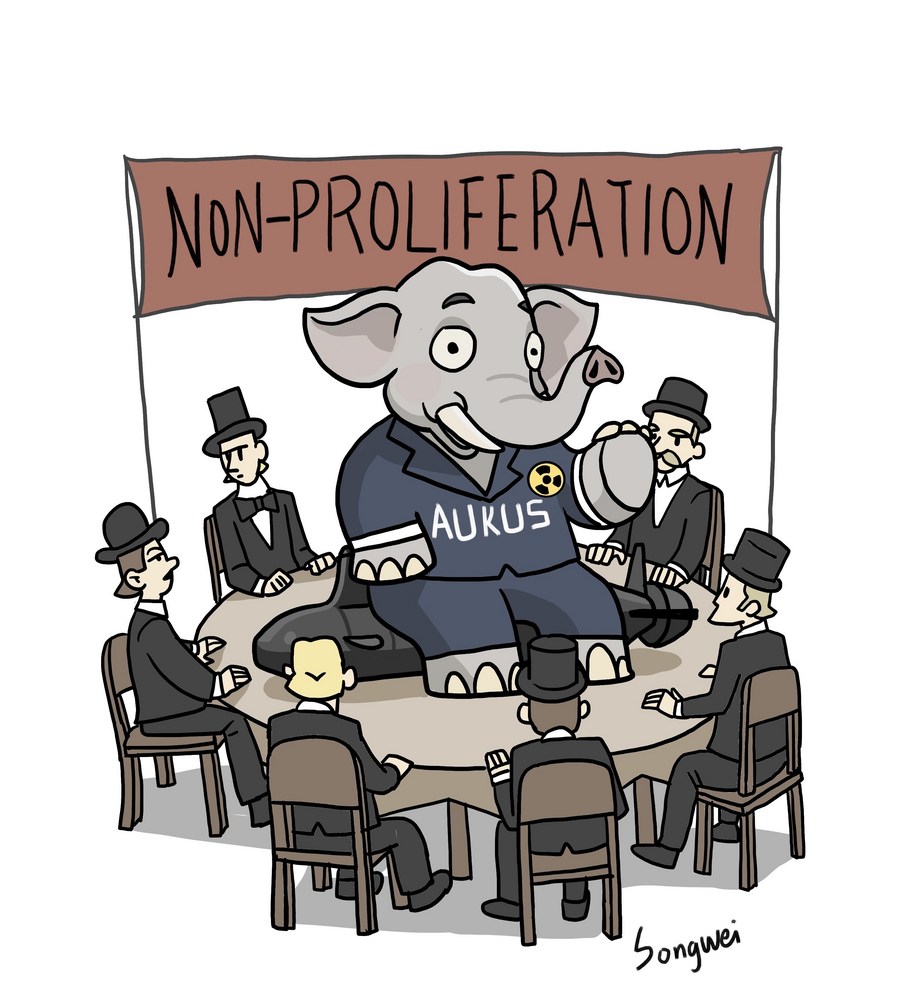
The elephant in the room is the fantasy that we will somehow graduate to having a self-sustaining nuclear industry. Firstly, this would be in breach of the Nuclear Non-Proliferation Treaty, which, AUKUS notwithstanding, would bring down on our heads the disapproval of the civilised world. The difficulties I have described above, with the fuel rods presumably purchased from a weapons state, most likely the US, would be compounded by the need for the International Atomic Energy Agency to ensure that any processing of the fuel in Australia meets non-proliferation standards.
By Jim Coombs, Sep 2, 2024, https://johnmenadue.com/duttons-nuclear-vision-is-distorted-by-ignorance-or-worse/
Peter Dutton’s nuclear plan may well have minimal carbon emissions, but the distant time of arrival, and ignoring the well known drawbacks makes it a dud.
On the face of it, it is all whizzbang white heat of technology (albeit of 60 years ago) and no carbon emissions (never mind the other ones). The problem lies with the nature of the beast.
The energy produced is heat, resulting from nuclear fission (the splitting of atoms, from a critical mass of highly radioactive material, e.g., uranium 235). The process needs to be controlled or it goes off like Hiroshima, so it is a technical fear of some delicacy, given the cost of failure, as can be seen from Chernobyl and Fukushima.
The fuel is usually in the form of rods containing the fissile material, and, over time, it is transmuted into “waste” which contains residual fuel and what are quaintly called the “daughter products of fission”. The spent fuel is reprocessed to extract further and remaining fissionable material and the “daughters’, which are extremely radioactive and dangerous with radioactive half-lives of some thousands of years and which, up to now, have not been found a final resting place that can guarantee their safety for future generations for those thousands of years.
The most celebrated aggregation of these products is at Sellafield in the UK where they have sat awaiting adequate disposal for decades. Dutton blithely says the spent fuel rods will be stored on the power station site, which is mostly not the case elsewhere. For how long, how many and where they might be sent, once processed, for future generations to be safe, is ignored.
The nations he says happily depend on nuclear power, such as France or Japan, either fuel their stations with fissile material from their nuclear weapons programs, as in the case of France, (the cost is, thus, a defence secret), or they are trying to reduce their dependence, to reduce the cost of ensuring safe operation (Japan and Germany).
The cost overruns of nuclear power stations under construction in the UK and elsewhere are notorious. The light-bulb idea of small modular stations has yet to be demonstrated in practice, though the concept has been around for decades. They too have the problems of what to do with the waste as described above which remain unsolved .
The elephant in the room is the fantasy that we will somehow graduate to having a self-sustaining nuclear industry. Firstly, this would be in breach of the Nuclear Non-Proliferation Treaty, which, AUKUS notwithstanding, would bring down on our heads the disapproval of the civilised world. The difficulties I have described above, with the fuel rods presumably purchased from a weapons state, most likely the US, would be compounded by the need for the International Atomic Energy Agency to ensure that any processing of the fuel in Australia meets non-proliferation standards.
The idea that we could produce the fuel rods from our own supply of uranium would entail our establishing a uranium enrichment facility. All that we now know about the cost of doing this, in the face of international obloquy, is that it is a defence secret, which has never been undertaken commercially. Indeed President Richard Nixon famously offered GE and Westinghouse free access to the technology and they both declined to take it on as a business.
Consider then, what is involved in uranium enrichment. Uranium comes in two isotopes. U235 (the fissile one) and U238. To achieve fission, the concentration of U235 needs to be higher than is found in nature, so increasing the proportion of U235 is what needs to be done. That is, increasing the amount of the lighter isotope, and this can only be done by physical means, separating on the basis of three parts by weight out of 238. The only medium for achieving this separation is, in the case of uranium, uranium hexafluoride, an extremely corrosive gas, making the process entirely contained and corrosion resistant the only way to go ahead.
What is the mechanism working in this severely constrained process? A long series of gas centrifuges of the highest quality stainless steel requiring a constant supply of energy to keep the spinning process going. A task at the very edges of technical feasibility. Desperate stuff, or as Dr Johnson said of women preaching, surprising that it is done at all. Cost estimate? A deep dark secret.
Lastly, Dutton’s pro-AUKUS stance goes along with his wilful blindness to the nuclear safety issue. Way back, Billy McMahon denied entry of nuclear-powered submarines to all Australian harbours, because of the mere possibility of an escape of waste or other nuclear materials into populated environments. In the UK and US, berthing of nuclear powered vessels takes place largely at purpose-designed port facilities away from population centres. AUKUS plans to berth near Adelaide, and port cities in NSW. Imagine the effect of a minor “excursion” on real estate prices near Adelaide or even Port Kembla. “It’s clean, it’s green,” Peter cries, with no evidence whatsoever of the cost of keeping it all safe.
Barmy, or dishonest ?
Barnaby’s Bush Summit bombshell: Why ScoMo wouldn’t back nuclear
Barnaby Joyce revealed Scott Morrison rejected a push from within the Coalition to introduce nuclear power in Australia because polling showed it was unpopular.
Daily Telegraph, John Rolfe and James O’Doherty, 30 Aug 24
Former Prime Minister Scott Morrison rejected a push from within his Coalition government to introduce nuclear power in Australia because polling showed it was unpopular, the Bush Summit has heard.
Speaking in a panel on energy policy at the Summit in Orange, Barnaby Joyce revealed that when he was Deputy Prime Minister he went to Mr Morrison, the then PM, and made the case for overturning the prohibition on nuclear and building reactors.
He claimed Mr Morrison said there wasn’t enough community backing.
“He (Mr Morrison) said that the polling didn’t support that,” Mr Joyce recalled. “And so it didn’t go ahead.”
He added: “We’ve continued fighting, and … now the Opposition is taking it on. That’s what happens in politics. You just fight, fight, fight, and then you finally get there, and we’re there.”
Later, in an interview for DTTV, Mr Joyce went further: “I’ve always been a supporter of nuclear power. So Scott Morrison didn’t pursue nuclear power because he thought it was politically untenable.
“In politics, it’s not a case of following. It’s a case of leading. And that’s what we intend to do.”
Mr Morrison told The Telegraph it was “seriously considered and discussed.
“It was determined and agreed that there was insufficient runway before the election to prosecute the case for a civil nuclear energy capability … especially given there would not be bipartisan support for the change, which had been our standing policy position on nuclear power for many years, that is, to proceed it would need to be bipartisan.
“That said, nuclear power was included in our government’s Technology Road Map.”
Mr Joyce also told the Summit that the push for renewable energy is the “most divisive thing” he has seen in his time in politics in a fiery debate with Matt Kean.
‘WHAT IS THIS, THE WIZARD OF OZ?’
“It has split communities down the middle. It has made good friends (go) for each other’s throats,” Mr Joyce said during his face-off with the former NSW treasurer and energy Minister Mr Kean – now Climate Change Authority chairman.
“We are going to be mugged by reality on this one … if we keep going down this path, the lights are going to go out,” Mr Joyce said, adding red tape would slow down building new energy such as nuclear power.
“You were the deputy Prime Minister of the country Barnaby … you could do something about it,” Mr Kean said.
Mr Kean added he wasn’t “opposed” to nuclear.
“I’m supportive of the facts, I’m not opposed to nuclear per se, but … nuclear is three to five times more expensive than firmed renewables,” Mr Kean said, prompting a barrage of rejections from the New England MP.
“What is this? The Wizard of Oz,” Mr Joyce said.
Mr Kean said the government Mr Joyce was part of didn’t build any baseload power.
Earlier, Mr Joyce met with pro-nuclear protesters outside the summit and promised he would “fight this till the end.”
The anti-wind farm campaigners were brandishing signs saying “we do not consent” and “minimum 6km setback from our homes”.
“They’re ruining the environment and wrecking regional Australia,” one protester said of wind farms………………………………………………………………………….. https://www.dailytelegraph.com.au/bush-summit/barnabys-bush-summit-bombshell-why-scomo-wouldnt-back-nuclear/news-story/f16eae0098c75cb049d0d1a03eddf4be
1 This month


Help Aunty Sue Protect Her Land and Sacred Sites From Destructive Rocket Testing.
.

Australians deserve the truth
about
AUKUS – https://aukuspublicinquiry.com/

PETITION – To: Prime Minister Anthony Albanese and the Australian Labor Government

of the week – Australians for War Powers Reform (AWPR)
To see nuclear-related stories in greater depth and intensity

