Opposing a USA-led international nuclear agreement that is bizarrely unfair to Australia
Australians can object to the agreement, by putting in a submission to a Parliamentary Joint Standing Committee.
Submissions are due by September 1st. So far, only 2 submissions have been published. They’re sort of “zipped” – so I can’t read them. You can bet your boots they are from the nuclear lobby
I’s a bit of an IT hurdle to actually get your submission in. That’s after you’ve even written it. Which is tough, too, as the general public in Australia knows nothing about it.
But anyway, here’s one little effort
TITLE: Submission to the Joint Standing Committee on Treaties concerning the:
Agreement among the Government of Australia, the Government of the
United Kingdom of Great Britain and Northern Ireland, and the Government
of the United States of America for Cooperation Related to Naval Nuclear Propulsion.
This submission urges that the Joint Standing Committee on Treaties recommends against
the Australian Government signing this Agreement as I believe that it is not in the best interests of the Australian people on a number of grounds, as outlined in this submission
Australia would be landed with high level nuclear waste – This Agreement
requires Australia to “be responsible for the management, disposition, storage, and
disposal of any spent nuclear fuel and radioactive waste resulting from the
operation of Naval Nuclear Propulsion Plants transferred pursuant to this Article,
including radioactive waste generated through submarine operations, maintenance,
decommissioning, and disposal.” (ARTICLE IV Naval Nuclear Propulsion Plants,
Related Equipment and Material, Section D).
The health risk to Australians brought in by the construction of nuclear facilities
and the management and storage of radioactive wastes. Buying second-hand
nuclear submarines make this waste danger another hazard, as we’d be buying
already existing toxic wastes.
Under this agreement it is possible for a nuclear weapon to be present on
Australian shores– this would it would be a clear breach of the highest order of the
Treaty on the Non-Proliferation of Nuclear Weapons (NPT) because as a signatory to
NPT Australia is not allowed to manufacture or otherwise acquire nuclear weapons.
The agreement does not guarantee that the USA will continue with the nuclear
submarine arrangements, but still ensures that Australia will cop the costs. This is
blatantly unfair.
It is extraordinarily unfair and bizarre that under Article IV E. “Australia shall
indemnify, the United States and the United Kingdom against any liability, loss,
costs, damage or injury (including third-party claims) arising out of, related to, or
resulting from Nuclear Risks connected with the design, manufacture, assembly,
transfer, or utilization of any Material or Equipment, including Naval Nuclear
Propulsion Plants and component parts and spare parts thereof transferred or to be
transferred pursuant to this Article.”
The ‘National Interest Analysis [2024] ATNIA 14 with attachment on consultation’,
acknowledges that “There has been no public consultation”, with paragraph 55
stating that “No public consultation has been undertaken, given the classified scope of consultations between the Parties on the Agreement, including matters relating to
national security and operational capability.”
The Treaty clearly outlines that Special Nuclear Material to be transferred under the
agreement, “shall contain highly enriched uranium and, only with respect to
irradiated fuel, may contain plutonium”, (ARTICLE VI Conditions and Guarantees,
SECTION I –SPECIAL NUCLEAR MATERIAL)
In conclusion – the whole agreement is unfair, poorly organised, and should not be
accepted by Australia, particularly in this situation where there has been no public
consultation – set up completely in the dark as far as the Australian people are
concerned.
Noel Wauchope
Coalition Proposal Undercuts Australians to Fund Expensive Nuclear Fantasy

August 28, 2024, https://theaimn.com/coalition-proposal-undercuts-australians-to-fund-expensive-nuclear-fantasy/
In response to the federal Coalition’s proposal for $100 billion in cuts to housing, transport, education, and climate solutions, the 30 undersigned organisations released the following statement:
Peter Dutton and the Coalition made their priorities clear today with a proposal to gut social services and roll back Australian renewables – all to fund their expensive nuclear fantasy
The radical proposal would slash everything from housing and public transport to renewable energy and manufacturing jobs in an attempt to find the $100 billion they’d need to bankroll their unpopular nuclear scheme – a scheme that would drive up energy bills in the short, medium, and long-term.
By attacking both bedrock social programs and the renewable energy already providing 40% of Australia’s electricity, the Coalition would undercut Australia’s economic prosperity, undermine investor certainty, and make life harder for Australians already doing it tough.
By scrapping Future Made in Australia, Powering the Regions Fund and Rewiring the Nation, Peter Dutton would also abandon the key initiatives designed to reduce carbon pollution and reform the economy to ensure we remain prosperous and internationally competitive in a decarbonising world.
Peter Dutton’s attacks on a Future Made in Australia are especially telling, a rehash of the tired arguments Donald Trump and the Republicans used in their attempt to kill the U.S. Inflation Reduction Act.
Contrary to their ‘sky-is-falling’ rhetoric, however, U.S. inflation has decreased substantially since the U.S. passed its signature clean industry policy. Meanwhile, the policy has crowded in private investment equivalent to six times the support it provides, driven the creation of 210 new clean projects, created 400,000 new jobs and added $155B to the U.S. GDP annually.
The Coalition wants Australians to forego that same opportunity and sacrifice their own social services so they can prop up a nuclear industry expected to raise household energy bills an average of $1000 annually. If elected, Peter Dutton risks taking Australia back to the decade of chaos that characterised the Abbott, Turnbull, Morrison years on climate and energy policy.
-Advertisement-
This proposal is a transparent stunt, not a serious plan. Where the Coalition should be proposing real solutions on cost of living, the economy, and climate, they continue to offer only denial, delay, and disinformation. The Australian people deserve far more.
Coalition pledges to ditch nuclear sites if earthquake zones are declared unsafe

The Age, By Mike Foley, August 26, 2024
Proposed nuclear sites would be abandoned if studies reveal unacceptable risks, the Coalition has declared following an earthquake near its planned Hunter Valley site, raising questions about other selected locations close to geological fault lines.
A magnitude 4.7 earthquake struck near Muswellbrook in NSW’s Upper Hunter region on Friday, several kilometres from the Liddell coal plant where the opposition has pledged to build a nuclear reactor if elected. The quake damaged buildings in the town while tremors were felt as far away as Sydney.
Opposition energy spokesman Ted O’Brien pledged that if the Coalition formed government, it would establish an independent nuclear authority that would conduct detailed studies of the proposed sites.
“If [the studies] come back with advice that says any power plant should not proceed, then a power plant would not proceed, full stop,” he told ABC radio on Friday. “That is absolutely key.”………………………………………………………………………………………………………………
Four of the opposition’s seven proposed nuclear sites are located near active fault lines: Port Augusta in South Australia, Lithgow in NSW, Collie in Western Australia and the Latrobe Valley in Victoria – an area that has had seven seismic events this year ranging from magnitudes of 2 to 4.3.
Latrobe Valley resident Wendy Farmer, president of the Voices of the Valley group, is helping to establish an alliance of anti-nuclear groups from the communities selected for plants.
Farmer said the opposition should have studied its selected sites before nominating them for reactors.
“Had they taken time to either speak to companies or communities, they would have already known this,” she said.
Hunter Community Environment Centre co-ordinator Jo Lynch said she was concerned about nuclear waste, considering the millions of tonnes of fly ash stored in dams across her region.
“I am concerned about waste management from a nuclear facility. Just looking at the track record with coal, that was a result of outdated environmental laws,” Lynch said………………………….. https://www.theage.com.au/politics/federal/coalition-pledges-to-ditch-nuclear-sites-if-earthquake-zones-are-declared-unsafe-20240826-p5k5d5.html
Civil Society faces imposition of an AUKUS military High Level nuclear waste dump
by David Noonan, Independent Environment Campaigner 22 August 2024
The Federal ALP belatedly disclosed a secret pre-condition in AUKUS plans to buy second hand US
nuclear subs: for Australia to keep US N-Subs US origin military High Level nuclear waste forever.
In a breach of trust the ALP is seeking to ‘normalise’ High Level nuclear waste in Australia. Claims of
‘nuclear stewardship’ in taking on US N-Subs and in retaining untenable US N-Sub wastes are a farce.
Disposal of High-Level nuclear waste is globally unprecedented, with our AUKUS ‘partners’ the US &
UK having proven unable to do so in over 65 years since first putting nuclear powered subs to sea.
Minister for Defence Richard Marles MP has still not made a promised ‘announcement’, said to be by
early 2024, on a process to manage High Level nuclear waste and to site a waste disposal facility, he
saying “obviously that facility will be remote from populations” (ABC News 15 March 2023).
Defence is already working to identify potential nuclear waste storage and disposal sites, assessing
existing Defence lands, and appraising potential regions with areas to compulsorily acquire a site.
The public has a right to know who is already being targeted for imposed AUKUS N- waste storage.
Political leaders in WA, Qld and Vic have already rejected a High-Level nuclear waste disposal site.
Our SA Premier has so far only said it should go to a safe ‘remote’ location in the national interest.
AUKUS compromises public confidence in Gov and sets up a serious clash with civil society:
In setting the offer for a next Federal Election, Labor must become transparent and be made
accountable over AUKUS and associated rights and interests that are at stake in Labor’s intended
High Level nuclear waste dump siting process. For instance:
- Federal and SA Labor must commit to comply with the United Nations Declaration on the Rights
of Indigenous Peoples Article 29 provision of Indigenous People’s Rights to “Free, Prior and
Informed Consent” over storage or disposal of hazardous materials on their lands. - Defence must declare their intension to over-ride the SA Nuclear Waste Storage (Prohibition) Act
2000 to impose an AUKUS nuclear dump on outback lands and unwilling community in SA. - Federal Labor must fully set out the array of AUKUS nuclear wastes to be stored in Australia.
The ALP National Platform (2021, Uranium p.96-98) makes a commitment to oppose overseas waste:
Labor will: 8.d. Remain strongly opposed to the importation and storage of nuclear waste
that is sourced from overseas in Australia.
In contrast, AUKUS aims Australia buy existing US military nuclear reactors in second-hand N-Subs
that are to be up to 10-12 years old, loaded with intractable US origin High-Level nuclear wastes that
are also weapons usage fissile materials – and remain as Bomb Fuel long after decommissioning.
Further, in an affront to public trust Labor’s AUKUS Bill has been written to provide a federal legal
power to take existing US and UK N-Sub nuclear reactor wastes for storage and disposal in Australia.
Labor claims that it is not their ‘policy’ to do so – but it is their proposed Federal Law…
Q: Is Federal Labor already targeting the Woomera Area in SA as a potential site to impose an AUKUS military High-Level nuclear waste dump?
A Labor AUKUS Bill assumes a power and a right to over-ride State laws by naming State laws in
Regulations that are to be made in 2025. Section 135 “Operation of State and Territory laws”, states:
If a law of a State or Territory, or one or more provisions of such a law, is prescribed by the
regulations, that law or provision does not apply in relation to a regulated activity.
The Bill provides for regulated activities in ‘nuclear waste management, storage and disposal’ at
AUKUS facilities in future nuclear zones, which are to be authorised in part under Sec.135.
The national press has reported the Woomera rocket range is understood to be the ‘favoured
location’ for storage and disposal of submarine nuclear waste (“Woomera looms as national nuclear
waste dump site including for AUKUS submarine high-level waste afr.com 11 August 2023).
A ‘Review’ of the Woomera Prohibited Area has just been announced by the Minister for Defence
Richard Marles MP: “to ensure it remains fit for purpose and meets Australia’s national security
requirements.” The Review is due to report in mid-2025 – after the federal election…
AUKUS will aim to compulsorily acquire and declare a High-Level nuclear waste dump site, with over-
ride of State laws through this Bill, long before the 2032 first purchase of a second-hand US N-Sub.
It was left up to a US Vice Adm. Bill Houston to reveal the proposed sales of in-service Virginia-class
subs will be in 2032 and in 2035, with a first new N-Sub in 2038 (US Breaking Defence 8/11/23).
If Federal Labor wants to locate an AUKUS nuclear waste dump in SA, it will have to over-ride our
existing State Law to impose the dump. This AUKUS Bill is a threat to the safety of the people of SA.
Storage and disposal of nuclear wastes compromises the safety and welfare of the people of South
Australia, that is why it is prohibited by the SA Nuclear Waste Storage (Prohibition) Act 2000.
Labor Premier Mike Rann strengthened these laws in 2002 and now Federal Labor may over-ride them.
The Objects of this Act cover public interest issues at stake, to protect our health, safety and welfare:
“The Objects of this Act are to protect the health, safety and welfare of the people of South
Australia and to protect the environment in which they live by prohibiting the establishment
of certain nuclear waste storage facilities in this State.”
The import, transport storage and disposal of High-Level nuclear reactor waste is prohibited in SA.
However, Federal Labor are taking up legal powers to impose a dangerous AUKUS nuclear dump on
SA or on the NT, through an undemocratic override of State laws and compulsory land acquisition.
Question: Will Federal Labor also disregard Indigenous Peoples UN recognised Right to Say No?
In the lead up to a federal election Labor must now declare if they will respect or ignore an
Indigenous Right to Say No to an AUKUS nuclear waste dump on their country.
South Australians have a democratic right to decide their own future & to Say No an AUKUS dump.
The anti-renewables groups pushing the nuclear option to rural Australia.

SMH, By Bianca Hall, August 26, 2024
Conservative economists, lobbyists, commentators and energy boffins have descended on regional communities nominated by the Coalition for nuclear sites, in a raft of events aimed at changing hearts and minds in the bush.
Organisers hope the events will create grassroots support for nuclear energy and stoke scepticism about renewables, particularly wind farms. The events, which organisers say aren’t linked, have featured climate science denier Ian Plimer, who recently wrote a treatise mocking the “blackbirding” slave trade, anti-wind farm activist Grant Piper, and others.
A matter of detail
Opposition Leader Peter Dutton announced a future Coalition government would build seven government-owned nuclear facilities on the sites of existing coal-fired power stations, using existing transmission poles and wires.
To get there, it would need to overturn the federal ban on nuclear energy, and overcome state bans in NSW, Victoria and Queensland. It would also need to overcome community opposition to nuclear energy.
Dutton is yet to offer detailed costings for his nuclear policy, but CSIRO’s latest energy cost report card, compiled with Australia’s energy market regulator AEMO, estimates a large-scale nuclear reactor could cost $16 billion and take nearly two decades to build.
While the Coalition’s policy details remain scant, Nuclear for Australia, a lobby group founded two years ago by 16-year-old Will Shackel and backed by entrepreneur Dick Smith, has been growing as a political force to sell nuclear to Australia.
The group has more than 10,000 followers on Facebook; it has paid ads on Meta’s social media platforms that can reach up to 500,000 people; and it held a standing-room only pro-nuclear event recently in Lithgow.
Shackel said he wasn’t a political party member, and his organisation received no funding from any party.
But there are clear links between anti-wind farm activists, the pro-nuclear movement and conservative think tanks like the Centre for Independent Studies.
The pro-market CIS in January launched its new Energy Program, focusing on nuclear energy. Its energy research director Aidan Morrison was a keynote speaker at Nuclear for Australia’s Lithgow event.
Morrison, a data analyst, in June told CIS senior fellow Robert Forsyth he was no expert, and that he was still learning about climate science.
“I haven’t, like many people, dived deep into the science on climate change and tried to map out my assessment of all the different mechanisms and how it’s worked, so I rely – like most people – on trusting those in public spaces.”
Nuclear for Australia was established as a charity in October, but it isn’t required to report its financial statements and reports until December.
Three people are listed as directors of Nuclear for Australia: former ANSTO chief executive Adrian (Adi) Paterson, also the chairman, Will’s mother Kylie, and Matthew Faint.
Paterson, who told The Guardian he was not a climate change denier, in May nonetheless described concerns about human-induced climate change as “an irrational fear of a trace gas which is plant food”.
Tony Irwin, a member of Nuclear for Australia’s “expert working group”, told this masthead the group was trying to convert hearts and minds in communities earmarked for nuclear sites by the Coalition.
“You’ve got to have a bottom up approach to lifting the ban, and also be able to influence the politicians and the people at the top,” he said.
Irwin said his group had been contacted by communities in NSW and Queensland opposed to the rollout of renewables.
“I’ve just been in Queensland and the Great Dividing Range, who’ve been absolutely devastated with wind turbines and just bulldozing through all the forests up there,” he said. “We seem to be destroying the environment to save the environment.”
Concerns about land use have been promoted by the Institute of Public Affairs, which in December said “one third of Australia’s prime agricultural farmland” could be covered in solar panels and wind turbines by 2050.
(It’s an assessment rejected by Australian National University professor of engineering Andrew Blakers, who estimates we could fulfil Australia’s solar and wind energy needs in just 1200 square kilometres, a tiny fraction of the 4.2 million square kilometres devoted to agriculture.)
Professed concerns about wind turbines, and their effects on landscapes, are common among pro-nuclear campaigners.
Also speaking was Dr Alan Moran, an economist and former director at the conservative think tank the Institute of Public Affairs, who on his website derides “green radicals”.
……………………. Nuclear for Australia has secured frequent and positive coverage in News Corp outlets, including front page coverage in the Daily Telegraph and on Sky News, Chris Smith’s show TNT Radio, and with 2GB’s Ben Fordham.
Exclusive polling conducted by Resolve Political Monitor for this masthead in June showed voters are open to the prospect of nuclear: 41 per cent support it, and 35 per cent are opposed.
But renewable projects have far stronger support: 73 per cent are in favour, amid warnings that investment in wind and solar may weaken after Dutton promised to set up seven nuclear plants if he wins the next election………………………………………
What we hear matters
It’s a truth of politics that a simple message repeated often enough becomes accepted wisdom. But this month a group of Australian National University academics released research that shows this is also true of climate change and renewables.
The team, led by PhD candidate Mary Jiang, showed even the most committed climate science believers could be swayed by hearing repeated scepticism; while sceptics could be affected by repeated statements of science.
“It shows that the power of repetition is quite strong,” Jiang said. “It can influence truth assessment.”
Nuclear for Australia’s Shackel said his group was now planning events across the country.
“If a community want to know about nuclear, we will provide our experts and support our experts to get out there,” he said.
For those living in regions under a nuclear shadow the questions are more complex, says Kate Hook, who is considering a run against Nationals MP-turned-independent Andrew Gee in Calare next election.
“[What] I’m hearing from people is the nuclear proposal, as a best-case scenario, could be up and running in 15 years [and] that’s not a ‘now’ thing. Whereas you can see renewable energy projects coming up in the region, and that is a ‘now’ thing,” she said. https://www.smh.com.au/national/the-anti-renewables-groups-pushing-the-nuclear-option-to-rural-australia-20240812-p5k1mp.html
Too big to fail? Who cares if there’s no accountability – the Nuclear Lie

How is it that political parties can get away promising huge projects that won’t eventuate for 10 to 20 years; that’s four to eight election cycles in the future.
Even if the current opposition leader, Peter Dutton, manages to sell the nuclear dream at the next election, he won’t be around to see his promises are kept. He simply isn’t accountable for the claims he’s making today.
by David Salt | Aug 21, 2024 https://sustainabilitybites.com/too-big-to-fail-who-cares-if-theres-no-accountability/
Building big on big promises of endless clean energy ignores the limits of our institutions. It’s something rarely considered in the febrile, volatile environment of contemporary politics. We pull our leaders up on the smallest of inconsistencies but let them get away with the biggest of lies. When you next cast your vote, keep in mind that extraordinary promises require extraordinary accountability.
The nuclear lie
Australia is currently contesting a future based on nuclear energy vs renewables.
The conservative opposition Coalition has put forward a ‘plan’ to build seven government-owned nuclear plants across Australia that will come online around 2035. The promise is that these plants will provide cheap, reliable carbon free electricity and help our nation achieve ‘net zero’ by 2050. It’s a strange policy requiring massive government investment and control from a party the stands for smaller government. But that’s just the beginning of strangeness around this thinking.
To call it a ‘plan’ is drawing a long bow because the proposal comes with no costings or modelling attached; existing legislation prevents the construction of nuclear power plants; and Australia currently lacks the necessary capacity to develop a nuclear power network (something the nuclear loving coalition did nothing about while in government for most of the last decade). Experts from across Australia don’t believe it would be possible to build the plants by 2035, or that they can produce electricity at anything close to what can be produced by renewables.
However, if the electorate was to buy the proposal and vote in the conservatives, it would result in the extension of coal power (to fill the gap till nuclear comes online), the expansion of gas energy and a redirection of investment away from renewables, which don’t really complement nuclear anyway.
While questions are being asked about all of these uncertainties, I think a more fundamental issue relates to governance and scales of time.
How is it that political parties can get away promising huge projects that won’t eventuate for 10 to 20 years; that’s four to eight election cycles in the future. Even if the current opposition leader, Peter Dutton, manages to sell the nuclear dream at the next election, he won’t be around to see his promises are kept. He simply isn’t accountable for the claims he’s making today.
Flawed accountability
Clearly this is a weakness of our democratic system of governance. We vote someone in to represent us for a number of years, three to six years in most electorates around the world, and we hold these representatives to account for the how they perform in delivering what they promised at election time. This tends to have voters actively reflecting on day-to-day business (taxes, health care delivery, education etc), while simply ignoring the hundreds of billions of dollars of commitments made for promises that sit well over the electoral horizon (promises like nuclear submarine fleets and nuclear power plants).
This weakness in accountability appears to be increasingly exploited by all sides of politics. Voters are collapsing under the ‘cost of living’, holding their breaths with every quarterly inflation announcement, and quick to pull down any politician who seems insensitive to the needs of ‘working families’.
Yet, at the same time, voters seem oblivious to the consequences of political leaders making a $100 billion dollar pledge to be delivered in 3-4 election’s time (though I note critics say this plan could easily end up costing as much as $600 billion). Consequently, we’re seeing more of these big announcements because the pollies know the electorate is not going to hold them to account. They simply don’t have the capacity to take it in, they are too absorbed by the day-to-day stuff.
Extraordinary accountability
The late, great astronomer Carl Sagan once said that “extraordinary claims require extraordinary evidence”. He was referring to the possibility of UFOs and extra-terrestrial life, but the same principle should apply to extraordinary political promises. If a political leader makes an extraordinary promise that can’t be delivered in one to two electoral cycles and commits vast quantities of (scarce) resources, then they need to put up a corresponding level of ‘extraordinary accountability’ before their case should be considered seriously by the broader electorate.
It’s not just the money involved and skills needed, it’s also how such a goal might be met over several electoral cycles. Bipartisan support, you would think, would have to be a basic first step.
A couple of decades ago Prime Minister John Howard passed the Charter of Budget Honesty Act in an effort to make political parties more accountable for the spending they promised. Many claim it has achieved little however, at the very least, it was an effort to show the electorate that politicians were aware that they needed to demonstrate greater accountability for the promises they make.
In the case of Dutton’s nuclear plan, this accountability is completely missing. However, rather than acknowledging this and attempting to build a stronger case, the Coalition has instead been attacking the institutions that have been examining the proposal (like CSIRO and the Australian Academy of Technological Sciences and Engineering). The conservatives have simply written them off when they question the validity of the proposal. (“I’m not interested in the fanatics,” says Dutton.) This doubling down is doubly dumb because it involves both extraordinary promises with no proof and the politicisation of independent experts.
Beyond nuclear
But this tendency to aim extraordinarily big without extraordinary accountability goes way beyond Australia’s future nuclear energy ambitions. Consider the quest for fusion energy.
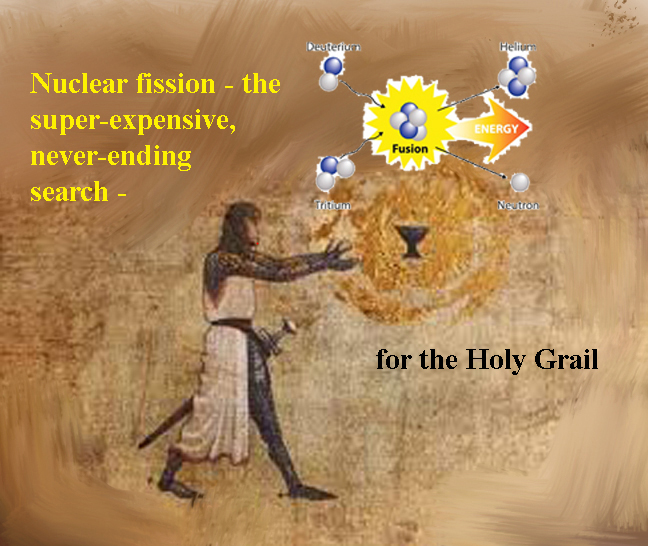
Europe is chasing the holy grail of clean energy by investing in fusion power. The multi-country International Thermonuclear Experimental Reactor (ITER) project was dreamt up in the 1980s and took over 25 years to come together as a formal collaboration between China, the European Union, India, Japan, South Korea, Russia, and the United States. Construction began in 2010 with operations expected to start about a decade later. But manufacturing faults, the COVID-19 pandemic, and the complexity of a first-of-a-kind machine (one of the most complex machines in the world) have all slowed progress and now ITER will not turn on until 2034, 9 years later than currently scheduled. Energy producing fusion reactions—the goal of the project—won’t come online until 2039!
ITER is a doughnut-shaped reactor, called a tokamak, in which magnetic fields contain a plasma of hydrogen nuclei hot enough to fuse and release energy. The technocrats running the project will gleefully explain that particle beams and microwaves heat the plasma to 150 million degrees Celsius—10 times the temperature of the Sun’s core—while a few meters away the superconducting magnets must be cooled to minus 269°C, a few degrees above absolute zero. Amazing as that sounds, it’s possibly less challenging than coordinating the actions and investment choices of the world’s superpowers decades into the future; Russia, China and the US are not exactly buddies at the moment. How strong do the ‘particle beams’ have to be to hold this agreement together for 20-30 years.
And even if ITER never eventuates, the possibility of ‘unlimited, clean energy’ over the horizon impacts investment decisions today. We’re seeing this even with the nuclear fission debate today in Australia as investors become wary of putting their money into renewables with the opposition promising nuclear powerplants just down the road.
And then there’s growing talk about implementing geoengineering solutions to fix humanity’s existential overheating problem (‘global boiling’). We’re talking pumping sulphates into the stratosphere, giant mirrors in space and fertilising the ocean to draw down carbon in the atmosphere. Playing God by ‘controlling’ the Earth system is going to be as big a governance issue as it is a technical challenge. And, given we’re doing so poorly on energy solutions using technology that’s relatively well understood, we’d be wise to demand extraordinary accountability before swallowing any promises in this domain.
Going thermonuclear
Which is not to say that ‘thermonuclear’ is not potentially a big part of a possible energy solution, just not the man-made kind. That big ball of energy in the sky called the Sun is driven by thermonuclear fusion, and this energy is there for the harvesting via photovoltaic cells (and indirectly by wind turbines).
And the accountability on these renewable sources of power doesn’t need the same level of extraordinary accountability that nuclear and thermonuclear demands because it can be delivered now, in the same electoral cycle as the promise to deliver it.
Renewables are not without their own set of issues but in terms of cost, feasibility AND accountability, it’s a solution that Australia (and the world) should be implementing now. Renewables are not ‘too big to fail’ but waiting twenty years before switching to them is simply too little too late.
“Gas Trojan horse:” Coalition nuclear push slammed as fossil wedge aimed at renewables

RENEW ECONOMY, Sophie Vorrath, Aug 19, 2024
The chair of Australia’s largest group of clean energy investors has described the federal Coalition’s push for nuclear power as a “gas Trojan horse,” and a political wedge intended to douse investment in renewables and prolong the use of fossil fuels.
John Martin, CEO of renewables developer Windlab and chair of the Clean Energy Investor Group, on Monday named wedge politics as one of biggest issues holding back the shift to renewables in Australia, describing the current industry status quo as “really, really challenging.”
“Australia is the land of wedges,” Martin told the 2024 Clean Energy Investor Conference in Melbourne.
“When I think of the whole nuclear debate, I don’t see that as really about nuclear. It’s a gas Trojan horse,” Martin told the conference.
“If you do any modeling, what will happen? The coal will go, nuclear will take forever, none of us are going to invest in renewables knowing we can’t compete against government-funded nuclear, [so that] big gap will be filled with gas. So there’s a wedge there that’s being aimed at us.”
Painting renewables as a natural enemy of the environment and wildlife is “another fantastic wedge strategy,” Martin says, that likewise threatens to derail progress on decarbonisation, while doing nothing to address the urgent need to reform Australia’s environment and biodiversity protection rules…………………………………………………………………………………………………………………………….. https://reneweconomy.com.au/gas-trojan-horse-coalition-nuclear-push-slammed-as-fossil-wedge-aimed-at-renewables/
Defence Minister Richard Marles insists AUKUS milestone won’t force Australia to accept foreign nuclear waste
The Greens say legislation already before parliament would allow the UK and US to dump high-level nuclear waste in Australia from their nuclear submarines, an issue the Labor-led inquiry into the proposed laws recommended amending to prevent.
9 Aug 2024 #ABCNewsAustralia https://www.abc.net.au/news/2024-08-0…
In short:
The defence minister says there is no circumstance where Australia would accept radioactive waste from foreign nations.
Critics of the AUKUS deal claimed Thursday’s milestone could oblige Australia to take waste from the US and UK.
What’s next?
The agreement will see secret nuclear information shared with Australia, and plans progressed to acquire second-hand nuclear submarines.
The defence minister insists Thursday’s milestone agreement on AUKUS does not oblige Australia to take nuclear waste from the United States or the United Kingdom.
Australia and the US made significant progress on Thursday towards acquiring nuclear-powered submarines under the AUKUS agreement, in a deal that included undisclosed “political commitments” to Australia’s partner nations, the US and the UK.
Critics of the nuclear submarine plan claimed that the deal would eventually oblige Australia to take high-level radioactive waste from the US and UK.
Defence Minister Richard Marles insisted on Friday morning that was not the case.
“Nuclear waste won’t end up in Australia, other than the waste that is generated by Australia,” Mr Marles said.
“That is the agreement that we reached with the UK and the US back in March of last year, and so all this is doing is providing for the legal underpinning of that.”
Mr Marles said there would be “no circumstance” where Australia takes waste from any other country.
Instead, Thursday’s agreement would allow for the transfer of nuclear naval technology to Australia, including restricted data never shared outside the US and UK.
The agreement also progresses plans to transfer second-hand US Virginia-class submarines to Australia, while its own submarines are being built.
Nothing unusual in undisclosed ‘additional political commitments’ on AUKUS, says PM
The government however has been pressured to further explain the details of the deal formalised on Thursday.
US President Joe Biden’s letter to Congress on the agreement said it provided “additional related political commitments”, but did not detail what those were.
Opposition Leader Peter Dutton challenged the government to explain the political commitments made to the US.
“It’s certainly an unusual statement, and I think the prime minister should provide an explanation as to what Australia has signed up to,” Mr Dutton said.
Prime Minister Anthony Albanese said there was nothing out of the ordinary in the agreements the federal government had made.
“We have agreed to have nuclear-powered submarines, that is what we have agreed to, and the transfer of technology that is related to that,” Mr Albanese said.
“There aren’t extra political commitments, I’m not sure what you mean.
“There will be no nuclear [waste] transfer from either the US or UK.”
The Greens say legislation already before parliament would allow the UK and US to dump high-level nuclear waste in Australia from their nuclear submarines, an issue the Labor-led inquiry into the proposed laws recommended amending to prevent.
Mr Marles also defended himself after Labor luminary and vocal critic of the AUKUS deal Paul Keating repeated his criticisms of the program and the minister.
Mr Keating claimed that the Albanese government had sold out Labor values by adopting AUKUS from the former Morrison government, and said Mr Marles’s comments while in the US would make “any Labor person cringe”.
Mr Marles said that criticism was “not fair”, but said Mr Keating had a right to express his view.
In Taiwan, reaction from some corners was scathing.
Former US ambassador to Palau US John Hennessy-Niland, who was the first US ambassador to visit Taiwan since 1979, said Mr Keating was living in the past “and never changes”.
“Keating reveals his true colours when he talks about ‘party values’ should be paramount but what about Australia’s national interests?” Mr Hennessey-Niland told the ABC.
Wen-Ti Sung, from the Atlantic Council’s Global China Hub, said partnerships like AUKUS were essential to preventing future conflict.
“Forward defence planning in concert with like-minded democratic partners is how countries have managed to deter and prevent major wars,” he said.
“Long-term partnership building with at least one superpower has been the cornerstone of Australian foreign policy ever since World War II, namely ANZUS. There is no clear reason why Australia should be abandoning its almost century-long partner.
“Facing an increasingly strategically uncertain world, Australia needs to develop more partners, not less.”
Director of international affairs for Taiwan’s opposition Kuomingtang Party, Alexander Huang, said the island’s first priority was preventing conflict through both deterrence and dialogue.
Mr Huang declined to comment on Mr Keating’s “disagreement with Prime Minister Albanese and his cabinet”.
Call to end nuclear power ban brings heated reaction in Australia
Ft.com, Nic Fildes in Sydney, 12 Aug 24
Opposition wants to change law and build new plants but critics say focus should remain on renewable energy
Liddell Power Station in Australia’s Hunter Valley burned through coal for five decades before closing last year. Opposition leader Peter Dutton now wants Liddell to be reborn as something banned in the country for a quarter of a century: a nuclear power plant. The site in New South Wales is one of seven operating or closed coal-fired plants that Dutton, leader of the centre-right Liberal party, has said could become nuclear power stations as part of a big shift in the way Australia generates its energy.
Nuclear energy is what Australia needs for its “three goals of cheaper, cleaner and consistent power”, he said earlier this year. Dutton’s pitch has pushed energy policy to the fore ahead of next year’s election, as Australia — rich in resources and a big exporter of energy in the form of coal, liquefied natural gas and uranium — grapples with how to decarbonise its economy
Anthony Albanese’s Labor government has put its focus on renewable energy, passing legislation that targets a 43 per cent cut in carbon emissions from 2005 levels by 2030 and net zero emissions by 2050. It hopes to rapidly phase out coal — which has accounted for almost two-thirds of power generation over the past year — and deliver 82 per cent of electricity from renewable sources by 2030. But the opposition Liberals and their allies, the rurally focused Nationals, have pledged to abandon the 2030 target and scrap large-scale wind farm projects. They say nuclear energy could deliver power from the middle of next decade………………………………..
Dutton’s plan would reverse decades of Australian policy and require changes to national and state-level laws in Australia that ban nuclear power. The ban dates from 1998, when John Howard’s conservative government offered it as a quid pro quo to minority parties for supporting the construction of a research reactor near Sydney. It remains the country’s only reactor, producing material for medical and industrial use………………………………………………………………..
Chris Bowen, Australia’s energy minister, has dubbed the opposition’s proposal “a nuclear scam” that is too expensive, too slow to build and too risky. A report in May by CSIRO, the government science agency, argued that generating nuclear energy — whether by building large-scale plants or small modular reactors — would be significantly more expensive than renewables and that building a plant would take at least 15 years. “Long development times mean nuclear won’t be able to make a meaningful contribution to achieving net zero emissions by 2050,” the report concluded.
………………………………Marilyne Crestias, interim chief executive of the Clean Energy Investor Group, which represents investors in renewables, said conditions for putting money into projects had improved, but more was needed to improve confidence and clarity around policy. “We need more ambition on climate and energy, not less,” she said.
Jeff Forrest, a partner at LEK Consulting’s energy practice, said the nuclear idea was “a 2040s solution to an energy problem we’ve got today” and said there was frustration among investors and in boardrooms that long-term investment plans could be disrupted by the “left-field” nuclear debate. “Energy investment needs consistent and clear signals. That is really important for long-dated investments and no one wants the rug pulled out from under them,” he said. Around the Loy Yang coal-fired power plant in the Latrobe Valley in the state of Victoria, locals said the nuclear proposal would disrupt plans by its owners to make the region a renewable energy hub after the plant’s closure during the next decade.
Wendy Farmer, Gippsland organiser for Friends of the Earth and president of the Voices of the Valley community group, said the proposal would threaten A$50bn of planned renewable investment. “Are they telling investors to go away?” said Farmer. “Imposing nuclear on these communities without any consultation or discussion with the owners of the sites is an insult and a bullying tactic.”
Please use the sharing tools found via the share button at the top or side of articles. Copying articles to share with others is a breach of FT.comT&Cs and Copyright Policy. Email licensing@ft.com to buy additional rights. Subscribers may share up to 10 or 20 articles per month using the gift article service. More information can be found here.
https://www.ft.com/content/89c1ea46-29bc-4a7e-9943-a420b3f1512c
Tim Buckley, director of the Climate Energy Finance think-tank, said the opposition’s proposals would displace private capital with a “communist-style policy” requiring more than A$100bn of public funds. “It is not impossible, but it is financially illogical,” said Buckley, who questioned the move’s political motivations ahead of an election. “This is not nuclear versus renewables. This is about extending the climate wars.” https://www.ft.com/content/89c1ea46-29bc-4a7e-9943-a420b3f1512c
Western Australia rules out uranium mining policy change amid nuclear energy push from Peter Dutton
ABC Goldfields / By Jarrod Lucas, 8 Aug 24
In short:
WA Mines Minister David Michael has ruled out any change to the Cook government’s long-standing policy on uranium mining.
There is an effective ban on mining the mineral in WA, where only one uranium mine is permitted to operate.
Peter Dutton says the ban is “ideologically based” and should be overturned.
Western Australia’s mines minister has rejected calls from federal Liberal leader Peter Dutton to overturn the state’s long-standing ban on uranium mining and insisted that future energy needs will be met by renewable sources.
The state has had an effective ban on mining the nuclear fuel since Labor was swept to power in 2017, while Mr Dutton has made nuclear power development the centrepiece of the Coalition’s energy policy.
Speaking on the sidelines of this week’s Diggers and Dealers Mining Forum in Kalgoorlie-Boulder, Mr Dutton said the WA policy should be scrapped.
But WA Mines Minister David Michael, who attended the final day of the forum, poured cold water on the idea and said the state government’s stance on uranium would not be changing anytime soon.
“WA Labor, for two elections, has committed to not approving any uranium mines and there is no intention to change that policy,” Mr Michael said……………………………………………………………………………………..
Mr Michael said he spoke with officials from Deep Yellow at Diggers and Dealers and believed renewables such as wind, solar and battery storage were a safer bet than uranium.
“I think it’s more important to focus on critical minerals in terms of the renewable future,” he said.
“We know that renewable energy is what the world moves to sooner or later.
“We know that’s what we need to tool up for in WA, and we’re doing it.”…………………………………………………………. more https://www.abc.net.au/news/2024-08-08/wa-uranium-mining-policy-to-stay-despite-nuclear-energy-push/104196130
Ted O’Brien sets out long-term plan for uranium-enrichment industry
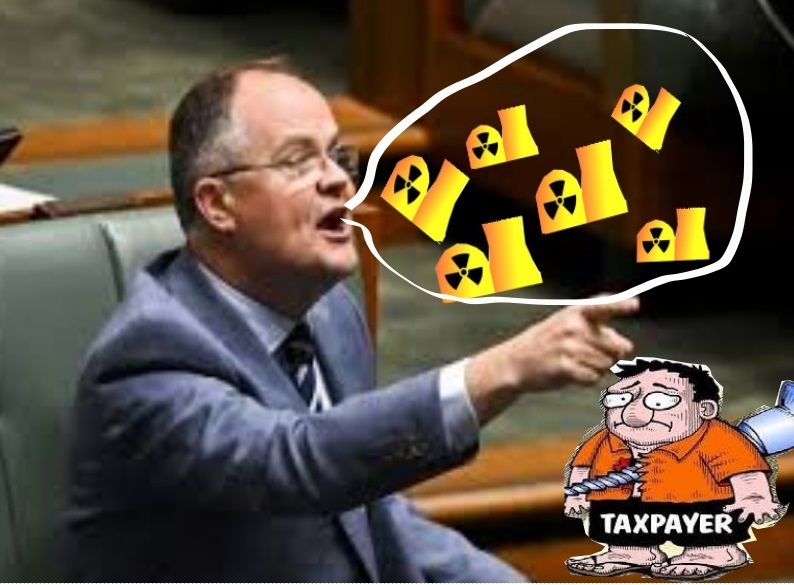
Joe Kelly, THE AUSTRALIAN, 31 July 24
Opposition energy spokesman Ted O’Brien will call for Australia to develop a sovereign capability at the front end of the nuclear fuel cycle – including the enrichment, conversion and fabrication of uranium – as new survey results show a dip in support for nuclear power.
In an address in Adelaide on Thursday night, Mr O’Brien will sketch out a long-term national endeavour to strengthen Australia’s energy security, building on the Coalition’s plans to replace retiring coal-fired power stations with up to seven nuclear power plants.
Mr O’Brien’s long-term nuclear plan for Australia now includes three key planks: the unlocking of the nation’s uranium reserves; the building of nuclear power plants; and a longer-term plan to develop expertise across the front end of the nuclear fuel cycle that would involve the development of a uranium-enrichment industry.
The three-pronged plan is aimed at ensuring Australia can eventually be self-sufficient, and not have to rely on global supply chains for the nuclear fuel rods that will be needed to power a future fleet of nuclear power plants…………………….
“Advancing Australia in this direction would set Australia up for the future, not just economically, but also strategically.”
Mr O’Brien will speak about his longer-term vision at an energy event on Thursday night being hosted by the Institute of Public Affairs, where he will also make a case for Australia to develop the capability to export nuclear fuel…………………….
The speech follows SEC Newgate’s release of its latest Mood of the Nation report on Thursday, which reveals only moderate support for nuclear power and a clear preference for renewables and new transmission infrastructure.
The latest tracking survey of 2021 Australians over the age of 18, taken between July 17 and 23, shows support for nuclear is slightly lower than in April at 37 per cent, while 39 per cent of respondents say they are against nuclear, and 23 per cent are neutral.
The results show a clear preference for building large-scale wind and solar farms with new transmission lines (50 per cent of respondents prefer this option), rather than nuclear power plants that use existing transmission infrastructure (26 per cent of people prefer this option).
Support for the Coalition’s policy to build seven new nuclear power plants is 39 per cent, while 35 per cent of respondents say it makes them less likely to vote with the Coalition, and 26 per cent say it makes them more likely to vote for the Opposition at the next election.
Of those who oppose the Coalition plan, most objections relate to safety concerns (41 per cent say it is too dangerous). However, 19 per cent of opponents to the Coalition plan believe renewables are superior.
Prime Minister Albanese’s hypocrisy on matters nuclear
Reverse nuclear secrecy. Albo or Dutton? What’s the scam?
Michael West Media, by Rex Patrick | Jul 28, 2024
“……………………………………………………………………..At the same time, the Prime Minister has launched a full-scale attack on Dutton’s half-baked scheme to build seven nuclear power reactors. Albanese’s problem is that much of Labor’s critique of Dutton’s contentious plans applies to AUKUS too.
It’s hard to criticise power reactors when you’re the man who stamped approval on the $368B AUKUS program as you swung by the political Kabuki show in San Diego last year.
Which leaves the Prime Minister exposed as a hypocrite on an issue he would like to put at the centre of his election campaign. https://michaelwest.com.au/reverse-nuclear-secrecy-albo-or-dutton-whats-the-scam/
Coalition to fast-track nuclear power.

Pearls and Irritations, By Ian McAuley, Jul 27, 2024
The Coalition’s nuclear power idea is based on an obsolete model of electricity supply
Circulating in the media are three arguments against nuclear power in Australia. One is based on safety, an emotive issue, involving unresolved questions about future costs, and the dangers are probably overstated. The danger issue doesn’t need to be argued, however, because the main problems with the Coalition’s nuclear power plans have to do with cost and the long time before the first kWh would be generated.
Those impediments were confirmed in a speech earlier this month by AEMO CEO Daniel Westerman: Australia’s energy transition: What’s needed to keep the momentum going. He said:
Our ISP [Integrated System Plan] does not model nuclear power because it is not permitted by Australian law, and development of nuclear power generation is not a policy of any government. But we know from our work with the CSIRO on the GenCost report that nuclear is comparatively expensive, and has a long lead time. Even on the most optimistic outlook, nuclear power won’t be ready in time for the exit of Australia’s coal-fired power stations.
The Australian Academy of Technological Sciences and Engineering has just released an assessment of the viability of small modular nuclear reactors, which feature strongly in the Coalition’s proposals. These reactors are still at an early development stage: it will be many years before they become established. Although the study does not explicitly address costs, it does point out that early adopters are likely to face much higher costs than those who wait for SMRs s to become a mature product. As ATSE President Katherine Woodthorpe explains on ABC Breakfast, small modular reactors are unlikely to become a realistic energy source in Australia for decades, and our large coal-fired generators are closing in the next few years.
Writing in The Conversation Asma Aziz of Edith Cowan University reminds us of another cost component not covered in the Coalition’s plans: Without a massive grid upgrade, the Coalition’s nuclear plan faces a high-voltage hurdle. The Coalition’s idea is about replacing retiring coal-fired generators with nuclear plants, plugged into the existing transmission infrastructure. But as she points out, demand for electricity is growing rapidly, which means the cost of upgrading the transmission network should be included in the Coalition’s plans. (It is already included in the costings for renewable energy.) The other point she stresses is that all power plants, whatever their technologies, are subject to outages, planned and unplanned. A distributed set of comparatively small solar and wind plants therefore need less transmission redundancy than large centralized nuclear plants.
There is a fourth, and more basic problem with the Coalition’s nuclear proposal. It’s based on an old and inflexible “base load” model, which was determined by the technology of coal-fired generation. There has to be enough capacity in the system to cope with demand peaks, and that was achieved by keeping the boilers hot, keeping the generators spinning, and shovelling in heaps of coal as demand rose. Nuclear is a little different, in that shovels aren’t involved, but the principle is the same.
There are now more flexible and lower-cost ways to meet peaks……………………………………………………………
All the above is in the context of a debate about the comparative cost of nuclear energy and renewables. The Australian community is being distracted from that debate, because the Murdoch media and Coalition-aligned think tanks are spreading absurd misinformation and disinformation about the cost of renewable energy. ……
Even if nuclear power plants were cheaper than renewables (they’re certainly not), there is no way they could replace coal-fired stations as they come to the end of their lives. The lead time for nuclear power is just too long. As Michael West explains, there is a constellation of forces, including the Institute of Public Affairs, Putin’s mate Tucker Carlson, and the Murdoch media, pushing to keep oil and gas burning. That would have to involve new “base-load” coal-fired stations: there is no way to extend the life of our old stations for twenty or more years while nuclear power gets developed.
The other driver of the Coalition’s policy is an intention to cripple the renewable industry through creating uncertainty. That way they can confirm their claim that the government’s renewable plans are failing. It’s doubtful that any seriously cashed-up investor is convinced by the Coalition’s nuclear argument, but the belief that next year’s election could see the election of a government of Trumpian crazies is enough to make investors cautious. ………………more https://johnmenadue.com/coalition-to-fast-track-nuclear-power-north-korean-style-weekly-roundup/
Shoalhaven’s nuke-free vote

Shoalhaven City Councillors voted unanimously to remain a nuclear-free zone at Monday night’s ordinary meeting. A motion was tabled seeking council reaffirm its 2006 position that it would oppose any plan or attempt to establish a nuclear reactor or power plant in the region or in the Jervis Bay Territory. It comes after federal Opposition Leader Peter Dutton flagged seven nuclear sites across Australia in June.
AUKUS and the pride of politicians

By Nick Deane, Jul 24, 2024 https://johnmenadue.com/aukus-and-the-pride-of-politicians/
With AUKUS, the pride of politicians has become an obstacle to reaching the best solution to the ‘national security’ conundrum. In the end, it could be that ego-driven reluctance to shift from entrenched positions results in the Australian people being delivered a disaster.
For my own purposes, I have been keeping a record of articles I have read under the topic ‘AUKUS’. There are now some 300 such items on my spreadsheet – nearly all of them finding fault of one kind or another with this extraordinary project.
The criticisms deal with a wide variety of aspects (mainly focussed on the acquisition of nuclear-powered submarines). To summarise a few, the AUKUS project:-
- Leads Australia in the direction of war;
- Has done damage to Australia’s international reputation;
- Destabilises Australia’s immediate region;
- Brings a nuclear industry with it;
- Introduces the intractable problem of nuclear waste disposal;
- Damages our relationship with our most important trading partner;
- Causes a significant loss of sovereignty;
- Is not good value for money;
- Diverts resources away from social programs;
- Will not be as effective as conventional submarines;
- Is aggressive and not defensive, and
- Will probably not come to fruition in any case.
Highly respected commentators, such as Hugh White, Paul Keating, Sam Roggeveen, Andrew Fowler, Rex Patrick and Clinton Fernandes, have all raised significant concerns. Meanwhile ‘civil society’ is also getting mobilised, with ‘anti-AUKUS’ groups springing up in all the major centres.
However, the proponents of AUKUS (and the mainstream media) appear content to ignore the valid, rational arguments being put forward against it. Indeed, industry-based conferences are going ahead as if there is nothing about to the project that needs to be questioned, and, no doubt, secret, military training programs are already well under way. Within the military-industrial establishment, the project is gathering momentum. Those in the military are excited by the prospect of controlling a new, highly lethal weapon, whilst those in the industry are attracted by the smell of the limitless funds being devoted to it.
It is disturbing to have to concede that rational argument appears to have little impact on AUKUS’s proponents. However there is an even more worrying aspect to add. That is the pride of politicians. For the longer the process continues, with all its secrecy and in the absence of meaningful debate at high levels, the harder it is for politicians to change course. Abandoning the project would already cause senior members of both major parties considerable ‘loss of face’. If it falls over (as some predict), or if opposition becomes a vote-winner at the next election, that ‘loss of face’ will be highly embarrassing. With AUKUS, the pride of politicians has thus become an obstacle to to reaching the best solution to the ‘national security’ conundrum. In the end, it could be that ego-driven reluctance to shift from entrenched positions results in the Australian people being delivered a disaster.
In an ideal, democratic society, voters and the politicians they elect appraise themselves of the ‘pros and cons’ of controversial matters and make decisions on a rational basis. If they do that in the case of AUKUS, it is surely doomed. Politicians beware!
1 This month


Help Aunty Sue Protect Her Land and Sacred Sites From Destructive Rocket Testing.
.

Australians deserve the truth
about
AUKUS – https://aukuspublicinquiry.com/

PETITION – To: Prime Minister Anthony Albanese and the Australian Labor Government

of the week – Australians for War Powers Reform (AWPR)
To see nuclear-related stories in greater depth and intensity

