Labor’s decision to pull UNRWA funding is just wrong
By Hannah Thomas | 12 February 2024, https://independentaustralia.net/politics/politics-display/labors-decision-to-pull-unrwa-funding-is-just-wrong,18312—
The Albanese Government’s decision to pull UNRWA funding has rendered Australia complicit in the ongoing humanitarian crisis in Gaza, writes Hannah Thomas.
ON 26 JANUARY, the International Court of Justice (ICJ) handed down its provisional ruling ordering Israel to, among other things, not commit acts of genocide and take immediate steps to ensure aid could reach civilians in Gaza.
The logical response, from a government that loves throwing around phrases like “international rules-based order” would have been to publicly back the ICJ’s ruling, demand an immediate and permanent ceasefire to allow aid to reach Palestinians in Gaza, increase aid to Palestine and stop military exports to Israel.
These responses were all logical – and not to mention morally necessary – many weeks ago, but the ICJ’s assessment that Israel’s military campaign is an existential threat to Palestinians in Gaza should have made these steps inevitable for the Albanese Government.
And yet less than 24 hours after the ICJ’s ruling, Minister Penny Wong announced the Albanese Government wouldn’t be stepping in to prevent a genocide. The Albanese Government wouldn’t punish the entity committing the genocide, it would punish its victims.
Based on allegations from the same entity freshly implicated by the ICJ, the Australian Government suspended funding to the UN Relief and Works Agency for Palestine Refugees (UNRWA), blindly and rashly following the United States and other “like-minded” countries.
Now, to the surprise of absolutely no one, the allegations have been exposed as baseless. As reported by the UK’s Channel 4, the dossier sent by Israel to UNRWA donors to justify its allegations didn’t contain a shred of evidence. And yet, the suspension of funding still stands.
Penny Wong and other Labor MPs dance around the issue, acknowledging the crucial, lifesaving work that UNRWA does, saying the Albanese Government is considering its next steps to increase funding for UNRWA in the future, while conveniently ignoring that they are currently crippling its operations at the most crucial of times. It is not clear what evidence they relied on to make the decision.
Every day that funds are suspended has grave consequences. The importance of UNRWA’s role is incontrovertible and utterly immense. In ordinary times, it is the only organisation with a mandate to provide relief and essential services to over 5 million Palestinian refugees in the region — a country’s worth of people.
In current times, more than 2 million Palestinians in Gaza depend on UNRWA for their immediate survival. More than a million people are sheltering in UNRWA schools and facilities as Israel indiscriminately rains hell on Gaza. These UNRWA facilities have been mercilessly targeted by Israel, who have slaughtered over 150 UNRWA staff since 7 October 2023. The Albanese Government has not imposed a single consequence on Israel.
It must be emphasised that even if the allegations were proven true, the decision would still be wrong. UNRWA already acted on the allegations before the Australian Government suspended funding: it sacked nine of those accused, while two are missing and one is dead. Even if UNRWA had not acted, punishing millions of Palestinians for the actions of 12 people would be unreasonable, but the point is that it has.
It is clear that the Albanese Government has already made us complicit in genocide, through military exports to Israel, the significant diplomatic cover it provides Israel and its refusal to call for a ceasefire. But continuing to starve UNRWA takes things to a new level.
Francis Boyle, a human rights lawyer who successfully argued a genocide case at the ICJ for Bosnia and Herzegovina, states that countries cutting off funding to UNRWA, have moved past aiding and abetting Israeli genocide.
He argues:
“These states are now also directly violating Genocide Convention Article 2(c) themselves: ‘Deliberately inflicting on the group conditions of life calculated to bring about its physical destruction in whole or in part’.”
Michael Fakhri, the UN special rapporteur on the right to food, said that by cutting UNRWA funding, countries like Australia had turned an imminent famine into an “inevitable” one.
The decision to suspend UNRWA funding was unforgivable and utterly incomprehensible. To maintain the suspension in the face of what have proven to be baseless allegations is even more unforgivable.
The Albanese Government must immediately reverse its decision and should also increase funding to the UNRWA to compensate for its wrongful suspension.
Australian Conservation Foundation is seriously concerned about the AUKUS nuclear submarine project, its costs and consequences and the way this initiative is being advanced.

Submission to the Senate Foreign Affairs, Defence and Trade Legislation Committee – Inquiry into the Australian Naval Nuclear Power Safety Bill 2023
ACF and AUKUS
ACF holds serious concerns around the AUKUS nuclear submarine project, its costs and consequences and the way this initiative is being advanced…..
ACF’s focus in this submission is on the environmental ramifications of AUKUS in Australia. The submission starts from the premise a regulatory system of some kind related to AUKUS in Australia will be adopted by Federal Parliament. The submission identifies gaps in the regime and issues that require further consideration and provides practical recommendations for improvement
Summary
– ACF’s is deeply concerned with the Bill’s potential for approval to be granted for the storage in Australia of high-level radioactive waste from submarines operated by other countries.
– The safety of the Australian public should be the paramount concern here. The Bill’s proposed objects do not adequately reflect this. The objects need to be expanded.
– The current drafting does not provide for any meaningful community information, consultation or reporting. The principles of open government and accountability would suggest that the default position ought to be that information will be available but permit exceptions based on regulations or ministerial discretion.
– The current drafting permits abrogation of responsibility by Commonwealth entities. Non-government third parties (e.g. contractors) could be solely responsible for compliance with the relevant duties. This could include organisations based outside Australia. Given the nature of the risk, Commonwealth entities should be subject to ongoing responsibility, regardless of contractual arrangements.
– The Bill proposes a compliance regime which would make enforcement of the nuclear safety duty problematic. The use of “as far as reasonably practicable” is rare in the criminal offence context and should not be used in the context of nuclear safety.
– Licences ought only to be issued to entities that have demonstrated capability and record and reputation for meeting their regulatory obligations. A requirement that licences only be issued to entities that are a fit and proper person should be included.
Other issues addressed in this submission are:
– Consent considerations and the UN Declaration on the Rights of Indigenous Peoples
– Nuclear Non-Proliferation Treaty
– A Nuclear Industry by Stealth?
– Disregard of advice from ARPANSA’s Radiation Health and Safety Advisory Council
– Clarification on Relationship of New Regulator with Existing Agencies
Summary of Recommendations
1. The Bill be amended to ensure that it only provides for the licencing of radioactive waste storage facilities for HLW from Australian submarines.
2. The Federal Government develop an open approach to future HLW management in Australia that is informed by the wider consideration of domestic ILW (intermediate-level waste) management.
3. That the objects of the Bill be redrafted to address protection of a range of people and the environment, and transparency of information and decision-making and accountability of the Government.
4. That the Bill be amended to improve transparency by requiring, subject to national security exceptions, public notification of applications and decisions, a public register of key applications and decisions and mandatory reporting requirements. The Committee should consider principles of open government and comparable regulatory regimes in developing its detailed recommendations to improve transparency.
5. That the Bill be amended to establish a clear-cut obligation to ensure nuclear safety and then provide a defence if the defendant can demonstrate that they exercised due diligence and took all reasonably practicable precautions.
6. That the Bill be amended to recognise and reflect the foundational management principle of free, prior and informed consent (FPIC).
7. That the Bill be amended to ensure the Commonwealth cannot contract out of liability in relation to compliance with the duties on licence holders created by the Bill. A mechanism should be included to ensure the Commonwealth bears responsibility in relation to nuclear safety for the actions of a contractor who holds a licence.
8. That the Bill be amended to ensure the definition of Commonwealth Contractor does not include sub-contractors to a Commonwealth sub-contractor.
9. That the Bill be amended such that the responsibility of each person in the supply chain or logistics chain is expressed, including in terms of the duties and incident reporting, in a manner similar to the National Heavy Vehicle Laws and Work Health and Safety Laws
10. That the Bill be amended to include a requirement that licences only be issued to entities that are a fit and proper persons similar to the Protection from Harmful Radiation Act 1990 (NSW) or Protection of the Environment (Operations) Act 1997 (NSW).
11. That the Committee request ARPANSA’s Radiation Health and Safety Advisory Council give evidence and consider the divergence of the Bill from the Council’s 2022 advice to the ARPANSA CEO.
12. The Committee recommend the ARPANS Act exclusion be modified or removed.
13. The Committee take evidence from the Department on, and consider, the interaction between the new regulatory regime, ARPANSA and potentially relevant state and territory regulatory controls.
14. The Committee consider amendments to provide for a formal means of contact between ARPANSA and the new regulator. This could include a formal position with the new regulator of the requirement to consider ARPANSA guidance materials.
High-Level Radioactive Waste from Other Countries
The AUKUS initiative brings a profound elevation in the cost, complexity and challenges of radioactive waste management in Australia through the introduction of High-Level Waste (HLW)0F1. This material needs to be securely isolated from people and the wider environment for periods of up to 100,000 years.1F2
The AUKUS initiative brings a profound elevation in the cost, complexity and challenges of radioactive waste management in Australia through the introduction of High-Level Waste (HLW)0F1. This material needs to be securely isolated from people and the wider environment for periods of up to 100,000 years.1F2
Speaking on the ABC in March 2023 Defence Minister Marles stated:
We are making a commitment that we will dispose of the nuclear reactor. That is a significant commitment to make. This is going to require a facility to be built in order to do that disposal, obviously that facility will be remote from populations, and today we are announcing that that facility will be on Defence land, current or future.
Part of the AUKUS deal is that Australia must manage all radioactive waste generated by the submarines on Australian soil. Minister Richard Marles said this was a pre-condition for the whole program.
The ABC also reported that while the sole responsibility of the submarine nuclear waste disposal lies with Australia, the White House has promised the US and UK will help, quoting a White House representative:
The United Kingdom and the United States will assist Australia in developing this capability, leveraging Australia’s decades of safely and securely managing radioactive waste domestically.
At no point has a compelling case been made for why Australia should take responsibility for the management of this waste, especially in relation to waste arising from purchased secondhand US Virginia class submarines.
This lack of rationale was highlighted in an article by Kym Bergmann titled the Nightmare of Nuclear-powered Submarine Disposal in the July-August, 2023edition of the Asia-Pacific Defence Reporter (APDR):
Why Australia has committed to this expensive process, hazardous to human life is unknown. In summary form, we will need to put in place facilities for the following:
• To remove the fuel from the sub.
• To store the recently removed fuel in pools of water.
• To transfer the fuel from the pools to dry casks.
• To store the dry casks on an interim basis.
• To permanently dispose of the spent fuel deep underground.
• To permanently dispose of the rest of the reactor (excluding the fuel).
It is unknown whether the estimated project cost of $368 billion covers this. It is unknown where the facilities will be built. It is unknown whether the decommissioning of submarines
will occur at their east coast base. In addition, the U235 will have to be in a secure location and then guarded forever to prevent its theft for conversion into weapons.
APDR went on to ask:
One of the many mysteries around the AUKUS deal is why Australia has agreed to disposing of the Virginia class submarines here. Surely the logical thing would be to have an agreement where the US took them back at the end of their lives and decommissioned them using their well established procedures.
Who benefits from compelling Australia to develop our own waste disposal industry? Why not lease the used Virginia class subs rather than purchase them outright?
To this can be added the mystery of why agree to second hand submarines at all?………………………………………………………………………………………………………………………………………………………………….
Cost of UK’s flagship nuclear project blows out to more than $A92 billion

But it also has implications for Australia, because one its main political groupings, the right-wing Liberal and National Party coalition, has decided that Australia should abandon its current plan to dump coal for renewables and storage, and wait for nuclear instead.
Australia currently has a target of 82 per cent renewables by 2030, and AEMO’s latest Integrated System Plan suggests it could be close to 100 per cent renewables within half a decade after that.
Giles Parkinson, Jan 29, 2024, https://reneweconomy.com.au/cost-of-uks-flagship-nuclear-project-blows-out-to-more-than-a92-billion/
The cost of the flagship nuclear project in the United Kingdom has blown out again, this time to a potential $A92.6 billion as a result of yet more problems and delays at the Hinkley C project.
The latest cost blowout was revealed last week by the French-government owned EdF, whose former CEO had originally promised in 2007 that the Hinkley project would be “cooking Christmas turkeys” in England by 2017, at a cost of just £9 billion.
But like virtually every major nuclear project built in western economies, that ambitious deadline was never going to be met. The new start-up date is now for 2030, but more likely 2031 – and that is only for one of the two units.
The budget has leaped from the original promise of £9 billion, to £18 billion, and has since blown out multiple times to now reach £31 billion and £34 billion, and it could be more than £35 billion “in 2015 values,” according to EdF. This translates into current day prices, according to Michael Liebreich, the former head of Bloomberg New Energy Finance, of £48 billion, or $A92.6 billion.
“The cost of civil engineering and the longer duration of the electromechanical phase (and its impact on other work) are the two main reasons for this cost revision,” EdF said in its statement. It has also experienced massive cost over-runs and delays at other similar projects in Flammanville in Fance and Olkiluoto in Finland.
It is yet another crippling blow to the UK plans to make nuclear a centrepiece of its green energy transition. EdF has already had to be bailed out by its own government, and ultimately nationalised, because of the cost blowouts and the huge costs of buying replacement power when half its French nuclear fleet went offline in 2023.
China’s CGN had to be brought in to fund one third of the Hinckley project, but is refusing to contribute more funds because China has been frozen out of other UK projects.
Alison Downes of Stop Sizewell C, a campaign group opposed to the planned Suffolk nuclear plant, told the Financial Times that EDF and the Hinkley project was an “unmitigated disaster”.
She added the UK government should cancel Sizewell C, saying state funding for the project could be better spent on “renewables, energy efficiency or, in this election year, schools and hospitals”.
But it also has implications for Australia, because one its main political groupings, the right-wing Liberal and National Party coalition, has decided that Australia should abandon its current plan to dump coal for renewables and storage, and wait for nuclear instead.
The Coalition had been pushing so-called small modular reactors, but after the failure of the leading technology developer in the US last year, and confirmation by the CSIRO and the Australian Energy Market Operator that SMR costs would be three times more expensive than renewables, several key Coalition members pointed to large scale nuclear such as Hinckley.
Australia currently has a target of 82 per cent renewables by 2030, and AEMO’s latest Integrated System Plan suggests it could be close to 100 per cent renewables within half a decade after that.
This switch to low carbon electricity is critical for Australia’s emissions targets, and for emission cuts in other parts of the economy. Any delay in the roll-out of renewables, in the expectation that nuclear would fill its place, will push that timeline out by at least another decade, if not, and blow out the costs of the energy transition.
“It is not like cost over-runs in nuclear projects are a big secret,” Liebreich writes on his Sub-stack blog.
He cites the world’s leading academic expert on project management, Danish Professor Bent Flyvbjerg, author of How Big Things Get Done, who shows that nuclear plants are worse only than Olympic Games in terms of cost over-runs.
“On average they go 120% over the budget, with 58% of them going a whopping 204% over budget,” Liebreich writes.
The Coalition energy spokesman Ted O’Brien complained in December that the CSIRO/AEMO report focused only on the “investment” cost, and not the “consumer cost.”
It’s not clear what he means by that. But as Liebreich notes, while Hinkley’s construction costs are in the £42 to £48 billion range, its first 35 years of electricity at £87.50 or £92.50/MW in 2012 money, adjusted for inflation, will cost UK energy users a gargantuan £111 or £116 billion, or up to $A223 billion.
As earth records hottest year, Coalition digs in against climate action and renewables
Pearls and Irritations, By Sophie Vorrath, Jan 23, 2024
The science is in. The European Union’s Copernicus Climate Change Service has overnight confirmed that 2023 was the earth’s warmest year on record: 0.16°C warmer than the previous record year (2016); 0.6°C warmer than the 1991-2020 average; 1.48°C warmer than the pre-industrial period.
The report from Copernicus notes that each month from June to December in 2023 was warmer than the corresponding month in any previous year, with July and August the warmest two months on record.
“2023 marks the first time on record that every day within a year has exceeded 1°C above the 1850-1900 pre-industrial level for that time of year,” the report says.
“Close to 50% of days were more than 1.5°C warmer than the 1850-1900 level, and two days in November were, for the first time, more than 2°C warmer.”
Furthermore, it is likely that a 12-month period ending in January or February 2024 will exceed 1.5°C above the pre-industrial level – the threshold climate scientists had hoped to limit global warming to through the sort of emissions reduction policies and actions they have been calling for for decades.
Around the world, the changing climate manifested itself in extreme heat waves in southern Europe, North America and China, devastating wildfires in Canada and Hawaii, record-breaking sea surface temperatures and record low sea ice extent around Antarctica.
Australia, remarkably, was the only continent that did not see large areas register record temperatures. But the impacts of global warming are no less evident.
Far North Queensland is picking up the pieces following a devastating cyclone and floods, while large parts of Victoria remain on flood watch after some regions experienced rainfall “higher than their 100-year rates” over 48 hours, according to the BOM. In Western Australia, a searing heatwave is on the cards.
“It’s not surprising, unfortunately,” prime minister Anthony Albanese said on Wednesday from Queensland, where he announced a $50 million federal support package for people affected by the state’s most recent extreme weather events.
“All of this is a reminder that the science told us that climate change would mean there would be more extreme weather events and they would be more intense. And unfortunately, we’re seeing that play out with the number of events that we’re having to deal with right around Australia.”
Climate Council research director Simon Bradshaw says the most alarming thing about the news from Copernicus is that 2023 broke heat records by such a considerable margin, with 2024 projected to be even hotter.
“We’re seeing how much more extreme our climate becomes as we approach the 1.5°C warming threshold,” he said on Wednesday.
“This is why we must limit future warming as much as possible by getting our emissions down fast by rapidly phasing out the burning of fossil fuels such as coal, oil and gas. We can’t keep stoking the fire if we want the room to cool down.”
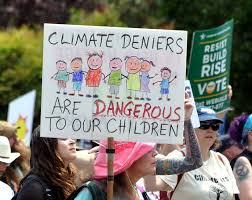
But as the reality sinks in that 2023 shattered annual heat records and that the world looks like sailing past the safe climate zone hoped for by scientists, the federal Coalition has set to work walking back national emissions targets, railing against renewables and still – still! – banging on about nuclear.
On Wednesday, reports emerged that a majority of Liberal and National Party MPs will oppose taking a 2035 emissions reduction target to the 2025 election, arguing it will worsen the cost-of-living crisis for regional and vulnerable Australians.
“This is why we must limit future warming as much as possible by getting our emissions down fast by rapidly phasing out the burning of fossil fuels such as coal, oil and gas. We can’t keep stoking the fire if we want the room to cool down.”
But as the reality sinks in that 2023 shattered annual heat records and that the world looks like sailing past the safe climate zone hoped for by scientists, the federal Coalition has set to work walking back national emissions targets, railing against renewables and still – still! – banging on about nuclear.
On Wednesday, reports emerged that a majority of Liberal and National Party MPs will oppose taking a 2035 emissions reduction target to the 2025 election, arguing it will worsen the cost-of-living crisis for regional and vulnerable Australians
A survey by The Australian has found most Liberal MPs are privately opposed to any sort of 2035 target and didn’t see any point in putting a number to the Australian people.
Nationals MPs were more forthcoming with their views on the matter, with Barnaby Joyce, Colin Boyce, Keith Pitt, Matt Canavan and Bridget McKenzie on the record as rejecting “any target” or expressing serious reservations about adopting one, the Australian reports.
“There is also a smaller rump within the Nationals, including Senator Canavan and Mr Boyce, who want the Coalition to drop the current policy of net zero emissions by 2050,” the paper says
The context to this is that the latest climate science says 2050 net zero targets are now not enough to rein in global warming at the rate required to keep the planet safe and liveable. It has also been argued that such a distant target allows governments to take their time on policy – time they do not have.
Recent modelling by Monash University’s Climateworks Centre found Australia must move its net-zero emissions target forward by a decade to 2040 and cut national emissions by 68 per cent below 2005 levels by 2030 in order to have any hope of limiting warming to 1.5°C.
Federal Labor – which wants to get to 82 per cent renewables by 2030 – is under pressure to adopt a 2035 emissions target of more than 70 per cent, and is in consultation on the size of the interim target it has promised to bring to the 2025 election.
But the LNP is having none of it, preferring to believe that its constituents are unable to make the mental leap that “cost of living” might be intrinsically linked with the social, environmental and economic costs of ever increasing extreme weather events.
“I’m not confident the Labor Party’s current targets, let alone anything more ambitious, can be achieved without significant social and economic detriment to the nine million of us that don’t live in capital cities,” said McKenzie…………………………………………………………………
A National Rally Against Reckless Renewables is on the calendar for February 6 – federal parliament’s first sitting day for 2024 – with the Facebook page for the event promising “lots of great speakers,” including Joyce, Senator Jacinta Nampijinpa Price, David Gillespie MP, Senator Gerard Rennick, Senator Malcolm Roberts, and old mate Matt Canavan……………………………………..
But not all of the Coalition’s “people,” as Pitt claims regional Australians to be, are drinking this particular brand of Kool Aid.
“The impact of climate change on our communities is immediate and devastating,” said Major General Peter Dunn, a member of Emergency Leaders for Climate Action and former Commissioner for the ACT’s Emergency Services Authority on Wednesday.
“The urgency to stop relying on fossil fuels such as coal, oil and gas, which only worsen this crisis, has never been greater. The time has come for Australia to decisively move away from these harmful pollutants.”
Peter Lake, a northern NSW farmer and member of Farmers for Climate Action says the ongoing drought his farm is experiencing shows how climate change is continuing to make farming “unpredictable.”
“The sooner we get serious about reducing our burning of fossil fuels and start to reduce the amount of carbon dioxide going into our atmosphere the better,” he said on Wednesday.
For federal Labor’s part, it is now imperative that they move faster and with more ambition in the opposite direction to the Coalition and hold their nerve against what is bound to be a ramping up of anti-renewables propaganda……………… more https://johnmenadue.com/as-earth-records-hottest-year-coalition-digs-in-against-climate-action-and-renewables/
Nuclear goes backwards, again, as wind and solar enjoy another year of record growth

Jim Green 21 January 2024, https://reneweconomy.com.au/nuclear-goes-backwards-again-as-wind-and-solar-enjoy-another-year-of-record-growth/
The nuclear renaissance of the late-2000s was a bust due to the Fukushima disaster and catastrophic cost overruns with reactor projects. The latest renaissance is heading the same way, i.e. nowhere. Nuclear power went backwards last year.
There were five reactor start-ups and five permanent closures in 2023 with a net loss of 1.7 gigawatts (GW) of capacity. There were just six reactor construction starts in 2023, five of them in China.
Due to the ageing of the reactor fleet, the International Atomic Energy Agency (IAEA) anticipates the closure of 10 reactors (10 GW) per year from 2018 to 2050.
Thus the industry needs an annual average of 10 reactor construction starts, and 10 reactor startups (grid connections), just to maintain its current output. Over the past decade (2014-23), construction starts have averaged 6.1 and reactor startups have averaged 6.7.
The number of operable power reactors is 407 to 413 depending on the definition of operability, well down from the 2002 peak of 438.
Nuclear power’s share of global electricity generation has fallen to 9.2 percent, its lowest share in four decades and little more than half of its peak of 17.5 percent in 1996.
Over the two decades 2004-2023, there were 102 power reactor startups and 104 closures worldwide: 49 startups in China with no closures; and a net decline of 51 reactors in the rest of the world.
In China, there were five reactor construction starts in 2023 and just one reactor startup. Put another way, there was just one reactor construction start outside China in 2023. So much for the hype about a new nuclear renaissance.
Small modular reactors and ‘advanced’ nuclear power
Small modular reactors (SMRs) are the subject of endless hype but there were no SMR construction starts or startups last year. The biggest SMR news in 2023 was NuScale Power’s decision to abandon its flagship project in Idaho despite securing astronomical subsidies amounting to around US$4 billion (A$6.1 billion) from the US government.
The pro-nuclear Breakthrough Institute noted in a November 2023 article that efforts to commercialise a new generation of ‘advanced’ nuclear reactors “are simply not on track” and it warned nuclear advocates not to “whistle past this graveyard”:
It wrote:
“The NuScale announcement follows several other setbacks for advanced reactors. Last month, X-Energy, another promising SMR company, announced that it was canceling plans to go public. This week, it was forced to lay off about 100 staff.
“In early 2022, Oklo’s first license application was summarily rejected by the Nuclear Regulatory Commission before the agency had even commenced a technical review of Oklo’s Aurora reactor.
The nuclear renaissance of the late-2000s was a bust due to the Fukushima disaster and catastrophic cost overruns with reactor projects. The latest renaissance is heading the same way, i.e. nowhere. Nuclear power went backwards last year.
There were five reactor start-ups and five permanent closures in 2023 with a net loss of 1.7 gigawatts (GW) of capacity. There were just six reactor construction starts in 2023, five of them in China.
Due to the ageing of the reactor fleet, the International Atomic Energy Agency (IAEA) anticipates the closure of 10 reactors (10 GW) per year from 2018 to 2050.
Thus the industry needs an annual average of 10 reactor construction starts, and 10 reactor startups (grid connections), just to maintain its current output. Over the past decade (2014-23), construction starts have averaged 6.1 and reactor startups have averaged 6.7.
The number of operable power reactors is 407 to 413 depending on the definition of operability, well down from the 2002 peak of 438.
Nuclear power’s share of global electricity generation has fallen to 9.2 percent, its lowest share in four decades and little more than half of its peak of 17.5 percent in 1996.
Over the two decades 2004-2023, there were 102 power reactor startups and 104 closures worldwide: 49 startups in China with no closures; and a net decline of 51 reactors in the rest of the world.
In China, there were five reactor construction starts in 2023 and just one reactor startup. Put another way, there was just one reactor construction start outside China in 2023. So much for the hype about a new nuclear renaissance.
Nuclear decline vs. record renewables growth
The International Energy Agency (IEA) has just released its ‘Renewables 2023’ report and it makes for a striking contrast with the nuclear industry’s malaise.
Nuclear power suffered a net loss of 1.7 GW capacity in 2023, whereas renewable capacity additions amounted to a record 507 GW, almost 50 percent higher than 2022. This is the 22nd year in a row that renewable capacity additions set a new record, the IEA states. Solar PV alone accounted for three-quarters of renewable capacity additions worldwide in 2023.
Nuclear power accounts for a declining share of share of global electricity generation (currently 9.2 percent) whereas renewables have grown to 30.2 percent. The IEA expects renewables to reach 42 percent by 2028 thanks to a projected 3,700 GW of new capacity over the next five years in the IEA’s ‘main case’.
The IEA states that the world is on course to add more renewable capacity in the next five years than has been installed since the first commercial renewable energy power plant was built more than 100 years ago.
Solar and wind combined have already surpassed nuclear power generation and the IEA notes that over the next five years, several other milestones will likely be achieved:
— In 2025, renewables surpass coal-fired electricity generation to become the largest source of electricity generation
— In 2025, wind surpasses nuclear electricity generation
— In 2026, solar PV surpasses nuclear electricity generation
— In 2028, renewable energy sources account for over 42 percent of global electricity generation, with the share of wind and solar PV doubling to 25 percent
Tripling renewables
The IEA states in its ‘Renewables 2023’ report that:
“Prior to the COP28 climate change conference in Dubai, the International Energy Agency (IEA) urged governments to support five pillars for action by 2030, among them the goal of tripling global renewable power capacity. Several of the IEA priorities were reflected in the Global Stocktake text agreed by the 198 governments at COP28, including the goals of tripling renewables and doubling the annual rate of energy efficiency improvements every year to 2030. Tripling global renewable capacity in the power sector from 2022 levels by 2030 would take it above 11 000 GW, in line with IEA’s Net Zero Emissions by 2050 (NZE) Scenario.
“Under existing policies and market conditions, global renewable capacity is forecast to reach 7300 GW by 2028. This growth trajectory would see global capacity increase to 2.5 times its current level by 2030, falling short of the tripling goal.”
In the IEA’s ‘accelerated case’, 4,500 GW of new renewable capacity will be added over the next five years (compared to 3,700 GW in the ‘main case’), nearing the tripling goal.
Tripling nuclear?
The goal of tripling renewables by 2030 is a stretch but it is not impossible. Conversely, the ‘pledge’ signed by just 22 nations at COP28 to triple nuclear power by 2050 appears absurd.
The Labor federal government signed Australia up to the renewables pledge but not the nuclear pledge. The Coalition wants to do the opposite, and also opposes the Labor government’s target of 82 per cent renewable power supply by 2030.
One of the lies being peddled by the Coalition is that nuclear power capacity could increase by 80 percent over the next 30 years. That is based on a ‘high case’ scenario from the IAEA. However the IAEA’s ‘low case’ scenario — ignored by the Coalition — is for another 30 years of stagnation.
So should we go with the IAEA’s high or low scenarios, or split the difference perhaps?
According to a report by the IAEA itself, the Agency’s ‘high’ forecasts have consistently proven to be ridiculous and even its ‘low’ forecasts are too high — by 13 percent on average.
Nuclear power won’t increase by 80 percent by 2050 and it certainly won’t triple; indeed it will struggle to maintain current output given the ageing of the reactor fleet and recent experience with construction projects.
Comparing nuclear and renewables in China
China’s nuclear program added only 1.2 GW capacity in 2023 while wind and solar combined added 278 GW. Michael Barnard noted in CleanTechnica that allowing for capacity factors, the nuclear additions amount to about 7 terrawatt-hours (TWh) of new low carbon generation per year, while wind and solar between them will contribute about 427 TWh annually, over 60 times more than nuclear.
Barnard commented:
“One of the things that western nuclear proponents claim is that governments have over-regulated nuclear compared to wind and solar, and China’s regulatory regime for nuclear is clearly not the USA’s or the UK’s. They claim that fears of radiation have created massive and unfair headwinds, and China has a very different balancing act on public health and public health perceptions than the west. They claim that environmentalists have stopped nuclear development in the west, and while there are vastly more protests in China than most westerners realize, governmental strategic programs are much less susceptible to public hostility.
“And finally, western nuclear proponents complain that NIMBYs block nuclear expansion, and public sentiment and NIMBYism is much less powerful in China with its Confucian, much more top down governance system.
“China’s central government has a 30 year track record of building massive infrastructure programs, so it’s not like it is missing any skills there. China has a nuclear weapons program, so the alignment of commercial nuclear generation with military strategic aims is in hand too. China has a strong willingness to finance strategic infrastructure with long-running state debt, so there are no headwinds there either.
“Yet China can’t scale its nuclear program at all. It peaked in 2018 with 7 reactors with a capacity of 8.2 GW. For the five years since then then it’s been averaging 2.3 GW of new nuclear capacity, and last year only added 1.2 GW …”
Dr. Jim Green is the national nuclear campaigner with Friends of the Earth Australia and a member of the Nuclear Consulting Group.
The Coalition is hoodwinking Australia about nuclear energy

Opposition Leader Peter Dutton is expected to make rescinding the nuclear power prohibition a 2025 election policy. One expert wonders whether he can do basic sums.
EMMA ELSWORTHY, JAN 12, 2024 https://www.crikey.com.au/2024/01/12/nuclear-energy-coalition-policy-dutton-2025-election/
It’s now more expensive than renewables, Australia has a decades-long ban on it, and its key international example touted by the Coalition was scrapped, but that hasn’t stopped growing cries from conservatives about nuclear power entering the energy mix on the nation’s path to net zero by 2050.
Opposition Leader Peter Dutton is reportedly preparing to make nuclear a key part of his energy policy for the next federal election, telling the Institute of Public Affairs: “The only feasible and proven technology, which can firm up renewables and help us achieve the goals of clean, cost effective and consistent power is next generation nuclear technologies.”
Dutton has tasked the opposition’s climate change and energy spokesperson Ted O’Brien with an internal investigation into a domestic nuclear energy industry in Australia. An enthused O’Brien has since returned from a tour of the US and Canada’s nuclear reactors last year, including the site of the BWRX-300 build in Ontario and Pittsburgh’s Generation IV nuclear battery, called the eVinci.
O’Brien is interested in small nuclear reactors, or SMRs — structures that would be manufactured in a factory, shipped out and assembled on-site in a dreamlike bid to drive down the cost and time delays of larger reactors.
“Environmental advocates, industry, private equity, centre-left and centre-right think-tanks, members of Congress — all told us that near 100% renewables was neither practical nor affordable, and that we needed nuclear in our energy mix,” O’Brien wrote in The Australian last year.
Several conservative figures have called for nuclear power to enter the energy conversation, including former Liberal treasurer Peter Costello, Nationals senator Matt Canavan, Nationals leader David Littleproud, and Liberal Democratic MP David Limbrick. Meanwhile, Climate and Energy Minister Chris Bowen has flat-out called the idea “dumb”.
In November, however, conservative SMR dreams were dashed here and abroad when a US developer binned a project widely touted as kicking off the new nuclear era. NuScale Power said it had failed to attract enough utility customers for the controversial power source to proceed — but it had also nearly doubled in cost (from US$8 billion to US$14 billion), suffered a five-year time delay, and revealed its power generation capacity had been slashed by a third.
Even so, Australian National University Honorary Associate Professor Tony Irwin told Crikey there was “still time” for nuclear to contribute to Australia’s pursuit of net zero, requiring “politicians with a long-term vision” to recognise what some COP28 nations called “the key role of nuclear energy in limiting temperature rise”.
Griffith University Emeritus Professor of Science, Technology and Society Ian Lowe called this bullshit.
“Nobody who can read joined-up writing and do take-away sums thinks nuclear power has any role in slowing Australia’s release of greenhouse gases,” the environmental scientist told Crikey.
A CSIRO report released last month found likewise, concluding nuclear power did not offer an “economically competitive solution”, and that SMRs would be “too late to make a significant contribution to achieving net zero emissions” because of both legal and commercial viability hurdles.
Lowe also noted the 2006 Uranium Mining, Processing and Nuclear Energy Review (UMPNER) report had found nuclear energy would need very generous public subsidies to compete with renewables, which have backslid in price enormously in the 18 years since the review’s release.
The UMPNER was chaired by then head of the Australian Nuclear Science and Technology Organisation (ANTSO) Dr Ziggy Switkowski — a spokesperson for the government organisation told Crikey it’s following the nuclear debate though officially “agnostic” on nuclear energy.
Lowe also noted that the Coalition’s bleating about the nation rescinding the nuclear ban and embracing the controversial power source from the opposition has interesting timing considering the nine years it spent in government.
“Of course, they did nothing to promote that technology in their decade in office and are now predictably evasive about where a nuclear power station would be located and how it would be funded,” Lowe said.
Labor MP Josh Wilson went harder, telling Crikey that Dutton’s growing support for nuclear energy in the face of cheaper and cleaner renewables showed the opposition leader is unfit to lead the country.
“By giving in to the climate deniers and nuclear cheerleaders in his own show, Dutton shows his preparedness to consign the Australian community to an expensive, disaster-prone, and dangerous future for the sake of protecting his own position,” Wilson said.
Defence Minister Marles announces Australia has joined in U.S. attacks on Yemen
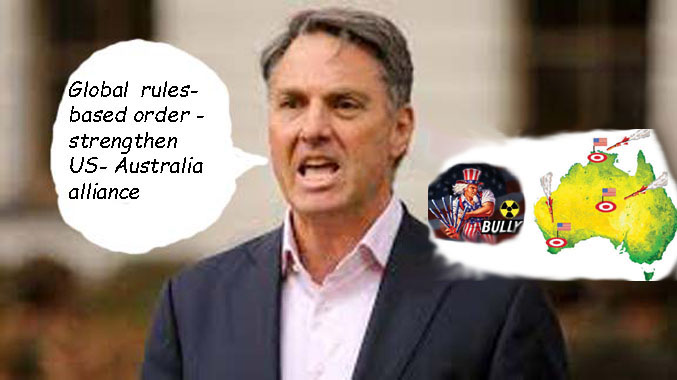
Comment. As Marles yet again spouts the “global rules-based order”, we wonder where is Prime Minister Anthony Albanese, and why was Parliament not consulted?
Deputy Prime Minister Richard Marles confirms Australian personnel contributed to strikes in Yemen.
ABC News, 12 Jan 24
Defence Minister and Deputy Prime Minister Richard Marles says Australian personnel had been present in “operational headquarters” but said he could not elaborate further on the precise nature of their participation.
Key points:
- A US official said strikes against the Iran-backed group were carried out by aircraft, ships and a submarine
- It comes as the United Nations Security Council demands an immediate halt to the shipping disruptions
- The US Central Command said Houthi rebels have launched their 27th attack since November 19
Mr Marles said Australia’s participation was “completely consistent” with the national interest. “Australia must stand up for freedom of navigation,” Mr Marles said, accusing the Houthis of “disruption of the rules-based order.”
The US and Britain have started launching strikes against Houthi targets in Yemen.
Houthi official Abdul Qader al-Mortada said raids were conducted in several Yemeni cities, including the capital Sana’a, in the early hours of Friday.
Two Hodieda residents told Associated Press they heard five strong explosions.
Hodieda lies on the Red Sea and is the largest port city controlled by the Houthis.
Yemen’s Houthi rebels said they will continue targeting Israel-linked ships in the Red Sea despite overnight air strikes by the US and Britain, their spokesman said on Friday.
“We affirm that there is absolutely no justification for this aggression against Yemen, as there was no threat to international navigation in the Red and Arabian Seas, and the targeting was and will continue to affect Israeli ships or those heading to the ports of occupied Palestine,” Yemen’s Houthis spokesperson Mohammed Abdulsalam posted on X, formerly known as Twitter.
On Friday, Iran said it condemns the US-Britain attack on Houthis in Yemen warning that it will fuel “insecurity and instability” in the region, Iranian state media reported.
“We strongly condemn the military attacks carried out this morning by the United States and the United Kingdom on several cities in Yemen,” said Nasser Kannani, spokesperson at Iran’s foreign ministry.
“These attacks are a clear violation of Yemen’s sovereignty and territorial integrity, and a breach of international laws,” he added…………………………………………
US President Joe Biden said Australia, Canada, Bahrain and the Netherlands provided support for the operation………………………………………..
The strikes would mark the first counterattack launched against the Iran-backed group, since it began Red Sea attacks in November last year.
It comes as the United Nations Security Council demanded an immediate halt to the disruption in global commerce on Thursday.
A joint statement by Australia, Bahrain, Canada, Denmark, Germany, Netherlands, New Zealand, Republic of Korea, United Kingdom and the US said the UN resolution, in addition to Houthi ignoring calls to end the shipping attacks, had led to these “precision strikes”……………………………..
Scotland’s first minister Humza Yousaf, whose parents-in-law escaped Gaza in early November, warned the UK “does not have a good record of military intervention in the Middle East”, demanding MPs have a briefing. ………………………………………………………………………………….
The Iran-backed group says it is conducting attacks in support of Palestinian militant group Hamas in its fight against Israel………………………………………………………….
Before the resolution on Thursday, United States deputy ambassador Robert Wood said “freedom of commercial activity on the seas is critically important to commerce and to national security of a number of states”.
Wider fallout on the horizon
Nearly 10 per cent of global oil trade and an estimated $US1 trillion ($1.5 trillion) in goods pass through the Red Sea route annually.
Houthi attacks have forced many shipping companies to use the much longer and more-expensive route around Africa’s Cape of Good Hope………………………………………………………………. more https://www.abc.net.au/news/2024-01-12/britain-joins-strikes-against-houthi-rebels/103312432?fbclid=IwAR0IWBxVsFVdHyF534j_12Il1ojMC-TMJ2zflrOI_J5Xnt9KWqBRBmUCAy8
Nuclear dreams rudely awoken by blast of CSIRO reality
National Party Leader David Littleproud has publicly stated that the National’s goal is to stop renewables and wait for nuclear, and it’s a similar story with the Liberals
by Rosco Jones | Dec 27, 2023 , https://michaelwest.com.au/nuclear-energy-too-expensive-csiro-gencost/?utm_source=newsletter&utm_medium=email&utm_term=2023-12-28&utm_campaign=Michael+West+Media+Weekly+Update
CSIRO, Australia’s top science agency, has relegated nuclear reactors and hydrogen to the energy bench. They simply cost too much to be viable sources for our energy future.
on the latest GenCost report.
It was revealed in the shadows of Christmas, and its impact has so far been muted as there were more pressing matters to attend to, such as last-minute shopping and holidays. Yet the importance of the latest big-ticket analysis of energy costs cannot be understated. Indeed it will shape decision-making in politics and the energy markets this year and Australia’s energy future.
The CSIRO’s annual GenCost report has confirmed the view of new energy experts that small nuclear reactors and hydrogen – lauded as ‘wonder-technologies’ by pro-fossil-fuel political figures in their ideological campaign against renewable energy are fast losing allure as price projections skyrocket.
The 2023-24 GenCost report by CSIRO and AEMO is Australia’s most comprehensive electricity generation cost projection report. It uses the best available information each cycle to provide a benchmark on cost projections and updates forecasts to guide decision-making, as electricity costs change significantly each year.
This year’s analysis has cast ever more doubt on the Coalition’s nuclear fantasy, with a raft of issues plaguing nascent Small Modular Reactor (SMR) technology, accompanied by investor disinterest in large-scale nuclear power plants. Additionally, renewables are still by far the cheapest option for Australia’s grid despite this year’s inclusion of infrastructure costs. Unsurprisingly these results have left a wave of frustration rippling across the political right. They also come as a slap to Opposition Leader Peter Dutton’s campaigning against the Albanese government.
Although sidetracked by fossil industry distractions such as carbon capture and storage (CCS) technology, the government has pressed ahead with wind, solar and hydro as its focus for Australia’s energy future. The Coalition, in the absence of constructive policy ideas, has been pushing nuclear power through its usual media channels. However, the GenCost report estimates that SMR cost of production has risen 70% and also suggests demand for hydrogen is massively overinflated given the cost outlook.
…………. Utah venture dashes hopes

The much-hyped UAMPS project in Utah has proven commercially unviable and was cancelled with inflationary pressures on construction costs contributing to its demise.
This failure of the argument for nuclear in the face of cheaper, proven renewable technologies has inflamed Australia’s conservative pro-nuclear lobby, which has resorted to attacking the CSIRO’s credibility and analysis.
Critics have taken issue with the usage of a single project’s failure as a broad indicator of SMR’s capital costings. However, as noted in GenCost, UAMPS is an industry leader in the SMR field and represents one of the only sources of data available to derive non-theoretical cost estimates.
“GenCost requires first-of-a-kind cost estimates given the first commercial project is yet to be completed”.
UAMPS was set to be the first completed commercial SMR. With the added context of Chinese ventures into SMRs having similarly rising costs even prior to 2023. It seems likely that theoretical estimates, most of which have been performed by organisations heavily influenced by the nuclear industry, were likely of poor quality rather than UAMPS being an improper proxy.
This explanation, included within the report, did not prevent scathing commentary by the likes of lobbyist turned LNP minister Ted O’Brien:
“They’re not looking at companies like Westinghouse, GE or Hitachi, and they’ve chosen that one design from a start-up for one customer that has run into problems and based the entire analysis of nuclear on that.”
UAMPS is the only SMR that has actually received design approval.
In addition to the cost hikes, the delivery timeframe for the implementation of SMRs was larger than expected. A common criticism of Nuclear Power is, of course, its lengthy set up times, which range from 6-8 years for conventional power stations. SMRs were intended to address this, with construction as short as 3-5 years, however this seems to no longer be an advantage in an Australian context:
“If a decision to pursue a nuclear SMR project in Australia were taken today, with political support for the required legislative changes, then the first full operation would be in 2038.”
Waiting until 2038 to begin using nuclear power guarantees another 15 years of dependence upon fossil fuels for energy production. Party Leader David Littleproud has publicly stated that the National’s goal is to stop renewables and wait for nuclear, continuing their tradition of unwavering support for petrochemical extraction and use, and it’s a similar story with the Liberals, who have publicly stated that no nuclear means no net zero.
Ted O’Brien’s fact-free nuclear cheerleading is cover for the same old climate vandalism
For O’Brien’s foray to be something other than time-wasting, oxygen-thieving nonsense, the shadow minister needs to be explicit about how much nuclear costs compared with other technologies.
For O’Brien’s foray to be something other than time-wasting, oxygen-thieving nonsense, the shadow minister needs to be explicit about how much nuclear costs compared with other technologies.
Katharine Murphy Guardian, 22 Dec 23
In huffing and puffing over renewables while denying the measurable costs of nuclear generation, the Coalition is digging in with the politics of relentless opportunism.
The great modernist poet TS Eliot once observed that humankind cannot bear very much reality. He might have been talking about Ted O’Brien, the shadow minister for climate and energy.
O’Brien is a fan of nuclear energy. That’s not a thought crime. I wouldn’t describe myself as a nuclear fan – but I know we might need every available technology, including nuclear, to reduce emissions in a manner consistent with the goal of limiting global heating to 1.5C. There are lots of things in life that we don’t love, but might need – nuclear energy is one of those things. I’m yet to be persuaded that Australia needs it given the other abundant resources we have, but I’m open…………………………………………………………………………………………
If I were the federal minister for climate change, I’d remove the legislative ban on nuclear energy and instead regulate the well-documented safety risks through other legislative means. Chris Bowen has a different view. Nuclear lacks a social licence in Australia. It is also prohibitively expensive. Given these two facts, why would you chew up valuable policy bandwidth (a finite commodity when you are trying to correct 10 years of obstruction and regression) looking at the nuclear ban, when you can accelerate actual, achievable risk mitigation right now? When it comes to the energy grid, Australia can execute the necessary transition much more rapidly using firmed renewables – a significantly cheaper technology that the community actually supports.
Bowen’s position is entirely logical.
………………………This week, a new analysis from the CSIRO, in collaboration with the organisation that runs the power grid, the Australian Energy Market Operator, found that electricity generated by solar and onshore wind is the cheapest in Australia. This remans the case even when you factor in the expenses associated with bolting renewables into the power grid. This same analysis found smaller nuclear reactors was the most expensive form of technology considered in the exercise.
O’Brien wasn’t happy. Big feelings ensured. Huffing and puffing. Renewables might be the cheapest form of energy for investors, “but not for consumers.” O’Brien felt the “big investors that come into Australia to make money from utility scale wind and solar projects can look after themselves, but it’s Australian households that I care about – even if Chris Bowen doesn’t.”
Dude. Come on. Can we be grownups?
Nuclear power is expensive. This is not a bolt from the blue, nor a conspiracy promulgated by the wild wokeists of the world. It’s a well-established fact. These things can be measured.
When John Howard asked businessman and nuclear physicist Ziggy Switkowski to scope out nuclear power in the mid-2000s, Switkowski concluded the government would need to legislate a carbon price to make the technology economical. Obviously energy verities have evolved over a couple of decades, but Switkowski maintained his point about the significant expense of conventional nuclear reactors in 2019, when he contributed a submission to a parliamentary committee chaired by (wait for it) O’Brien. Switkowski’s view in 2019 was that there might be commercial opportunity for small modular reactors in some parts of Australia, but “we won’t know until SMRs are deployed in quantity during the late 2020s.”
While we are on facts, here’s another one. The only company to have a small modular nuclear power plant approved in the United States has recently cancelled its first project due to rising costs.
Rounding out the picture, a centre-right thinktank recently acknowledged there was no prospect of nuclear energy playing a role in Australia before 2040. As my colleague Adam Morton has pointed out, Aemo says renewable energy could be providing 96% of Australia’s electricity by that time.
So, let’s inhabit reality. Please. It really doesn’t seem that much to ask.
Persisting with reality, if the Coalition wants to propose an Australian nuclear option seriously (as opposed to pretending to explore something while weaponising large scale renewable developments that can reduce emissions now) then lots of things need to happen.
For O’Brien’s foray to be something other than time-wasting, oxygen-thieving nonsense, the shadow minister needs to be explicit about how much nuclear costs compared with other technologies.
If he’s concerned about the high energy costs Australian households are facing, O’Brien needs a plan to pay for his preferred nuclear generation. If the government is paying, then consumers are actually paying through their taxes. Also: where do the reactors go? Where is waste stored? How is the industry regulated?
In the absence of substance and transparency, the Coalition is continuing to have a lend of the Australian people. You’d think a couple of decades having a lend of Australians on an existential issue would be enough, but apparently it isn’t.
In the Abbott era, things were simpler. It was acceptable to wonder out loud whether climate change was crap. Now, the Coalition has to say it supports net zero. It has to suggest nuclear could be the magic bullet to get us there. (Sort of) committing to nuclear, then, provides a measure of cover for the same old vandalism – thwarting the renewable technology the Coalition has spent two decades thwarting.
This isn’t a contention. Like the costs of nuclear, political behaviour can be measured. The Coalition is now leading the charge, with One Nation, against offshore wind developments in the Hunter Valley. …………………………………………………………………………………… https://www.theguardian.com/australia-news/2023/dec/23/ted-obrien-nuclear-cheerleading-renewables-climate-vandalism
Opposition need to explain whether they’ll will stick with their ‘nuclear fantasy’
Climate Change and Energy Minister Chris Bowen says the Opposition has some explaining to do about whether they’ll stick with their “nuclear fantasy”.
“So, of course, projects will encounter some challenges – Snowy 2.0 has encountered delays and cost increases,” he said during a media conference on Thursday.
“That’s just one example.
“Nevertheless, it remains a very important project.
“Renewable energy, in all the evidence independently examined by the CSIRO and AEMO, is the cheapest form of energy.”
Busting the government spin about “radioactive waste management” at Garden Island, Western Australia.

The claim that planning has begun for a “low-level radioactive waste management”
facility at HMAS Stirling as part of the AUKUS arrangements must surely be the worst of
political spin as Garden Island by its geological and topographical settings is both
completely unsuitable and highly dangerous for that purpose.
What is more it will be be difficult to separate the nuclear waste generated through the
use of Stirling into the levels of low and intermediate classifications – and there will be
some of intermediate level generated – for storage or other means of management of
the resulting nuclear waste.
Besides its relatively small size Garden Island is comprised of porous limestone
covered by a thin layer of sand making it unsafe even by extensive engineering from
harmful contamination through leakages of nuclear waste which occur regularly at
above the ground nuclear waste installations
Why does the federal government in its various guises fail to avail itself of the Azark
Project underground nuclear waste facility at Leonora in Western Australia which is
regarded internationally as the best and safest possible for the permanent disposal of
nuclear waste
The Garden Island proposal reeks of the same incompetence as with the choice of
Kimba in South Australia for the national waste facility where the government was
spared by the recent judicial decision against that choice the embarrassment of having
it rejected under international prescriptions for its unsuitable and unsafe nature.
It should be clearly understood that none of the operations of AUKUS can be
implemented until Australia has a proper means for the safe disposal of the resulting
nuclear waste.
Price Waterhouse Cooper’s (PWC’s) $8m nuclear submarine payday revealed
18 DECEMBER 2023, By: Liam Garman, https://www.defenceconnect.com.au/naval/13341-pwc-s-8-million-nuclear-submarine-payday-revealed
Talking points prepared for Vice Admiral Jonathan Mead, director general of the Australian Submarine Agency, on the Nuclear-Powered Submarine Taskforce’s engagement with the embattled professional services firm have come to light following a freedom of information request from former independent senator Rex Patrick.
Information seen by Defence Connect have detailed two separate contracts between the Nuclear-Powered Submarine Taskforce and the consulting firm via the Defence Support Services Panel.
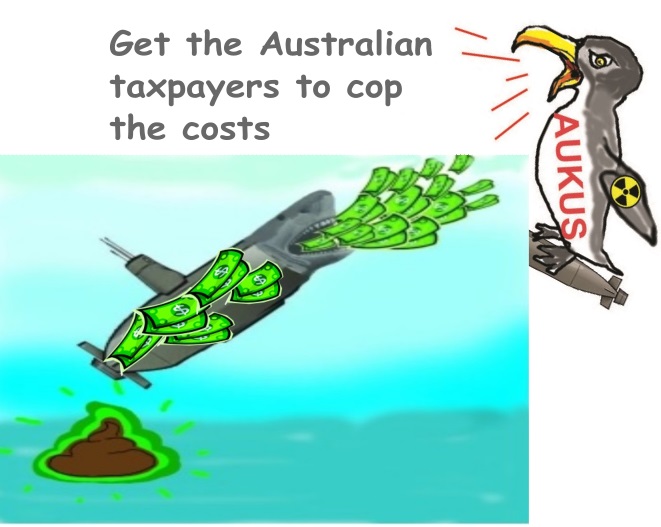
In total, Defence spent $8,055,928.56 with PwC between 2021 and 2023, with one contract phase costing Defence $560,142.57 for just 12 weeks of consulting work.
The revelation comes as PwC grapples with the fallout of the widely reported tax scandal in early 2023, which saw senior partners at the firm share confidential Commonwealth information with clients to avoid paying tax.
Leaked internal emails from PwC showed that confidential tax information was shared with over 50 of the company’s partners, some of whom then used the information to approach 14 global companies.
The talking points sourced by former South Australian independent senator Rex Patrick were developed for the head of the ASA, Vice Admiral Mead, for budget estimates, who justified the engagements, outlining that “value for money was a core consideration in the Nuclear-Powered Submarine Taskforce’s engagement of PwC”.
The ASA has not engaged with PwC since its creation on 1 July 2023.
Speaking to Defence Connect, an ASA spokesperson explained the taskforce’s engagement with PwC: “The Nuclear-Powered Submarine Taskforce entered into two contracts with PwC, during the 18-month consultation period.
At no time was PwC briefed into any security compartment, nor were they part of any development of the Optimal Pathway during the 18-month consultation period.”
The contracts were awarded to support the development of a domestic nuclear-powered submarine industry and included $5,275,135.90 for the development of Program Management Office (PMO) artefacts, scheduling support, program development and management, and “governance mechanisms”.
The second contract, valued at a total $2,780,792.66, was for the delivery of an enterprise-wide solution on the reporting of workforce demographics, and supported the development and implementation of a workforce support concept development plan.
At its time of writing, the talking points detailed that the Australian Submarine Agency had five ongoing consulting contracts valued at $2.756 million with KPMG and Deloitte.
More to follow.
Flirting With Nuclear Energy Down Under
December 15, 2023, by: Dr Binoy Kampmark, https://theaimn.com/flirting-with-nuclear-energy-down-under/
It was a policy that was bound to send a shiver through the policymaking community. The issue of nuclear energy in Australia has always been a contentious one. Currently, the country hosts a modest nuclear industry, centred on the Australian Nuclear Science and Technology Organisation (ANSTO), nuclear medicine and laboratory products. But even this has created headaches in terms of long-term storage of waste, plagued by successful legal challenges from communities and First Nation groups. The advent of AUKUS, with its inane yet provocative promise of nuclear-powered submarines for the Royal Australian Navy, adds yet another, complicating dimension to this fact. Without a clear idea of a site, a vital part of the nuclear dilemma remains unresolved.
Broadly speaking, the nuclear issue, in manifold manifestations, has never entirely disappeared from the periphery of Australian policy. The fact that Australia became a primary testing ground for Britain’s nuclear weapons program was hardly something that would have left Canberra uninterested in acquiring some nuclear option. Options were considered, be they in the realm of a future weapons capability, or energy generation.
In a June 29, 1961 letter from Australian Prime Minister Robert Menzies to his counterpart in the UK, Harold Macmillan, concerns over the impediments imposed by a potential treaty that would impose limitations on countries the subject of nuclear testing were candidly expressed. Were that treaty to go ahead, it “could prove a serious limitation on the range of decisions open to a future Australian Government in that it could effectively preclude or at least impose a very substantial handicap on Australia’s acquisition of nuclear weapons.”
Menzies put forth a suggestion that was ultimately never pursued – at least officially. An arrangement deemed “more practical,” suggested the Australian PM, might involve “the supply of ready-made weapons” at the conclusion of such a treaty.
A sore point here were efforts by the Soviets to insist that countries such as Australia be banned from pursuing their own nuclear program. Menzies therefore wished Macmillan “to accord full recognition of the potentially serious security situation in which Australia could find herself placed as a result of having accommodated United Kingdom testing.”
Australia eventually abandoned its nuclear weapons ambitions with the ratification of the Treaty on Non-Proliferation of Nuclear Weapons (NPT) in February 1970, preferring, instead, the nuclear umbrella of extended deterrence offered by the United States. (The nature of that deterrence has always seemed spectacularly hollow.) Domestically, nuclear technology would be sparingly embraced. Nuclear power stations, however, were banned in every state and territory, a policy left unchallenged by a number of parliamentary inquiries.
The quest of meeting emissions reduction targets during the transition to the goal of net zero was bound to refocus interest on the nuclear power issue. The Liberal-National opposition is keen to put the issue of nuclear power back on the books. It is a dream that may never see the light of day, given, according to the chief government scientific body, the CSIRO, its uncompetitive nature and the absence of “the relevant frameworks in place for its consideration and operation within the timeframe required.”
Australian politicians have often faced, even when flirting with the proposition of adopting nuclear power, firm rebuke. South Australian Premier Malinauskas gave us one example in initially expressing the view late last year that “the ideological opposition that exists in some quarters to nuclear power is ill-founded.” It did not take him long to tell the ABC’s 7.30 program that he did not wish “to suggest that nuclear should be part of the mix in our nation.” Australia had to “acknowledge that nuclear power would make energy more expensive in our nation & [we should] put it to one side, rather than having a culture war about nuclear power.”
Opposition Leader Peter Dutton has been by far the boldest, pitching for a gentler exit from the fossil-fuel powered nirvana Australia has occupied for decades. Australia, he is adamant, should join “the international nuclear energy renaissance.” Of particular interest to him is the use of Small Modular Reactors (SMRs), which might be purposefully built on coal generator cites as part of the general energy package alongside renewables. SMRs, as Joanne Liou of the International Atomic Energy Agency explains, “are advanced nuclear reactors that have a power capacity of up to 300 Mw(e) per unit, which is about one-third of the generating capacity of traditional nuclear power reactors.”
The heralded advantages of such devices, at least as advertised by its misguided proponents, lie in their size – being small and modular, ease of manufacture, shipping and installation. They also offer, according to the International Atomic Energy Agency, “savings in cost and construction time, and they can be deployed incrementally to match increasing energy demand.”
For all these benefits, the cold reality of SMR designs is how far they have yet to go before becoming viable. Four SMRs are currently in operation, though these, according to Friends of the Earth Australia’s lead national nuclear campaigner, Jim Green, hardly meet the “modular definition” in terms of serial factory production of components relevant to such devices.
Russia and China, despite hosting such microreactors, have faced considerable problems with cost blowouts and delays, the very things that SMRs are meant to avoid. Oregon-based NuScale has tried to convince and gull potential patrons that its small reactor projects will take off, though the audience for its chief executive John Hopkins is primarily limited to the Coalition and NewsCorp stable. The company’s own cost estimates for energy generation, despite heavy government subsidies, have not made SMR adoption in the United States, let alone Australia, viable.
In his second budget reply speech in May, Dutton showed little sign of being briefed on these problems, stating that “any sensible government [in the 21st century] must consider small modular nuclear as part of the energy mix.” Labor’s policies on climate change had resulted in placing Australia “on the wrong energy path.”
Such views have not impressed the Albanese Government. Energy Minister Chris Bowen insists that counterfeit claims are being peddled on the issue of the role played by nuclear energy in Canada along with false distinctions between the costs of nuclear power and renewable energy.
“If they are serious about proposing a nuclear solution for Australia, the simplistic bumper stickers and populist echo chamber has to come to an end. Show the Australian people your verified nuclear costings and your detailed plans about where the nuclear power plants will go.”
Such verification will be a tall order indeed. As the CSIRO concedes, “Without more real-world data for SMRs demonstrating that nuclear can be economically viable, the debate will likely continue to be dominated by opinion and conflicting social values rather than a discussion on the underlying assumptions.”
Nuclear energy is not viable for Australia, for a number of reasons
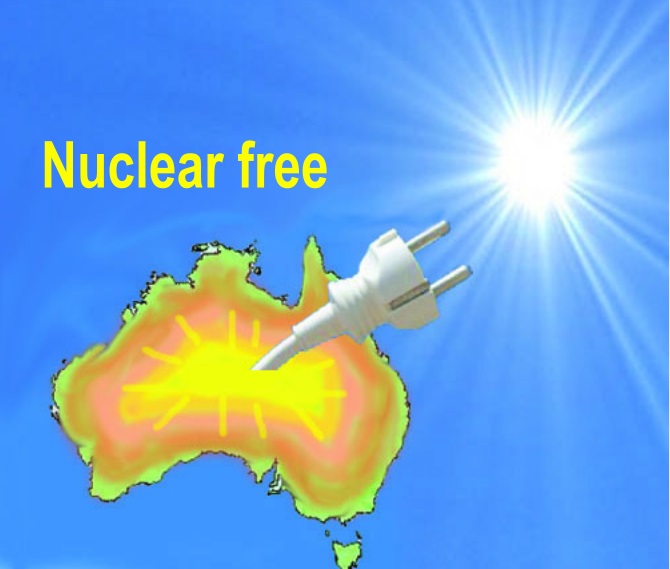
By John Grimes, Saul Griffith, Tim Buckley, Blair Palese, Janaline Oh, John Hewson, Mara Bun, https://www.canberratimes.com.au/story/8456455/debating-viability-of-nuclear-power-in-australia/ December 13 2023
The prospect of nuclear power generation in Australia is now a live debate. There are a number of barriers that make nuclear unviable as a solution for Australia’s energy transition in a timeframe necessary to respond to the climate, energy and cost-of-living crisis. We outline these below.
We need energy, decarbonisation and cost of living solutions this decade. The Intergovernmental Panel on Climate Change recommends a 50 per cent emissions reduction by 2030. As former Chief Scientist Dr Alan Finkel has noted, It is hard to imagine first operation of small modular reactor (SMR) technology before 2040.
SMR technology, advocated by proponents of nuclear energy in Australia, is not commercial. There are no SMRs in operation outside of Russia and China, and none under construction in Europe or North America, meaning there is no evidence of their safe and consistent operation, or viability. In November, the only SMR development in the US was terminated.
Nuclear power is prohibited in Australia under federal legislation, with similar legislation in the states and territories.
To overturn these bans and establish the new regulatory and compliance regime would take years and would only be the start of the process of developing a nuclear industry. Sites for reactors would need to be identified, and social licence secured. Rigorous approvals processes would need to run their course. A skilled specialist local workforce would need to be trained and deployed. Robust arrangements would need to be made to manage waste and to mitigate risk. Legal challenges and civic protest would arise.
All of the above means nuclear would not be ready to deploy in a climate-necessary timeframe in Australia.
Therefore, we must continue to deploy the commercially viable and proven zero-emissions technologies of firmed solar and wind power as rapidly as possible.
Further, the cost of nuclear power generation is much higher than its low-cost alternatives.
The 2022 World Nuclear Industry Status Report (WNISR) notes that between 2009 and 2021, unsubsidised costs for solar PV declined from US$359 to US$36 per megawatt hour (MWh), a fall of 90 per cent, and for wind from US$135 to US$38 per MWh, a 72 per cent fall, while nuclear power costs rose from US$123 to US$167 per MWh, up 36 per cent. This gap is widening.
The CSIRO/Australian Energy Market Operator May 2023 GenCost report found that: “A review of the available evidence makes it clear that nuclear power does not currently provide an economically competitive solution in Australia – or that we have the relevant frameworks in place for its consideration and operation within the timeframe required.”
The Investor Group on Climate Change, which represents investors with $30 trillion in assets under management, says there is no interest among investors in nuclear, when nuclear has “project time blowouts of anything from seven to 15-plus years and cost blowouts in the tens of billions, and lowest-cost technologies, renewables, batteries and so on, are available to deploy now”.
The 2023 WNISR notes that in 2022, “total investment in renewable electricity capacity reached a new record all-time high of US$495 billion (up 35 per cent), 14 times the reported global investment decisions for the construction of nuclear power plants”.
The climate and energy price crises require Australia to accelerate the decarbonisation of its electricity system and economy toward zero-emissions this decade.
Australia enjoys the global advantage of superabundant solar and wind resources.
Unlike some economies where nuclear energy is established, Australia also has available landmass for renewables infrastructure and the opportunity to share the benefits with communities.
We urge the federal government to maintain its policy and investment focus on the proven technology of low-cost, deflationary firmed renewables and “electrification of everything”, and to accelerate deployments, as it has done with its recent landmark boost to the Capacity Investment Scheme (CIS) bolstered by its pledge at COP28 to triple renewables by 2030.
When announced last year, the federal government said the first iteration of its CIS would drive around $10 billion of investment in clean dispatchable power.
Climate Energy Finance estimates the recently announced turbocharging of the CIS will see a four-fold lift in firmed clean energy investment across Australia.
The fastest-to-deploy and most popular renewable energy option for Australia is rooftop solar, the world’s cheapest energy source, because it eliminates transmission and distribution costs.
Mass solar electrification of households should be central to our clean energy transition plans.
Electrification of communities and commercial operations in Renewable Energy Zones will improve equity and build social licence for large-scale energy infrastructure, as it enables decarbonisation of industry.
These complementary actions will permanently reduce greenhouse emissions and energy prices, enable Australia to deliver on its climate commitments, and catalyse our generational opportunity to position Australia as a zero-emissions trade and investment leader.
Australia has no time to lose. The rise of renewables offers us a chance to reinvent Australia’s economy.
We can ill afford the opportunity cost of delay to our renewables transformation.
John Grimes is CEO of the Smart Energy Council. Dr Saul Griffith is co-founder and chief scientist of Rewiring Australia. Tim Buckley is a director of Climate Energy Finance. Blair Palese is founder of the Climate Capital Forum. Janaline Oh is executive director of Diplomats for Climate and a former senior diplomat. Dr John Hewson AM is a professor at the ANU Crawford School of Public Policy. Mara Bun is a company director and former president of the Australian Conservation Foundation.
Coalition delivers the same old tired nuclear talking points at COP28
With a heavy sigh, Crikey once again delves into the most pointless ritual in Australian public policy — the nuclear energy ‘debate’.
CHARLIE LEWIS, DEC 11, 2023, https://www.crikey.com.au/2023/12/11/coalition-nuclear-energy-australia/
“Today I am happy to announce that a reelected Coalition government will, at its first COP after being returned to office, sign the nuclear pledge and return Australia to where it belongs, standing alongside its friends and allies,” opposition climate change and energy spokesman Ted O’Brien told world climate summit/increasingly dark joke at humanity’s expense COP28 on Saturday.
He pledged that a reelected Coalition government would triple nuclear energy output and overturn Australia’s nuclear energy moratorium, insisting “no nuclear, no net zero”.
And so, with a heavy sigh, Crikey once again delves into what our politics editor Bernard Keane has described as “the single most boring and ossified ritual in Australian public policy”.
A ‘sensible’ debate
It always starts with a demand for a “sensible” debate around the topic. Going back to John Howard’s years as prime minister (he called for this not once but twice) and to pick a handful of examples since: Then-foreign minister Julie Bishop in 2014, the then-assistant science minister Karen Andrews in 2015 and then-candidate Warren Mundine in 2019. Just last week, troublemaking former Labor minister Joel Fitzgibbon called on the Albanese government to end the ban on nuclear energy. This is not to mention a swathe of conservative media figures adding their voices to the choir over the years.
With dreary inevitability, Opposition Leader Peter Dutton reached for the old hymn book in his budget reply this year, arguing (all together now): “Any sensible government must consider small modular nuclear as part of the energy mix.”
Time is money and also money is money
As we’ve long reported — long, long reported — there are several barriers to nuclear power in Australia, primarily that the whole thing is incredibly expensive because Australia doesn’t have any nuclear infrastructure. As clean energy investor and man with a zeal for the teal Simon Holmes à Court, who was at O’Brien’s address, puts it, “it is a pretty easy pledge to sign because three times zero is zero”.
Nuclear power plants take a very long time to build — as Australia’s former chief scientist Alan Finkel told the Nine papers in August, it’s highly unlikely Australia could open a nuclear power plant before the early 2040s, a delay the country can ill afford if it is to dramatically reduce emissions as quickly as it needs to.
On top of this is the eye-watering price. According to research from the Department of Climate Change and Energy released in September this year, the cost of replacing coalmine sites with small nuclear reactors would be $387 billion.
Even former chair of the Australian Nuclear Science and Technology Organisation Dr Ziggy Switkowski, who undertook a review on the viability of nuclear power for the Howard government in 2007 and is a very big fan of nuclear energy, conceded in 2018 “the window for gigawatt-scale nuclear has closed”:
With requirements for baseload capacity reducing, adding nuclear capacity one gigawatt at a time is hard to justify, especially as costs are now very high (in the range of $5 billion to $10 billion), development timelines are 15+ years, and solar with battery storage are winning the race.
The tax that is not to be named
There is and always has been only one way, in the eyes of Australia’s most credible nuclear spruikers, for nuclear energy to compete with existing energy sources: impose a carbon price.
Switkowski’s 2007 review probably didn’t greatly please Howard, given it found that nuclear became viable compared with coal and gas only if there was a carbon price. Economist and Crikey contributor John Quiggin has also previously argued in favour of nuclear energy in Australia only if it is backed by a carbon price.
1 This month

of the week – Australians for War Powers Reform (AWPR)
To see nuclear-related stories in greater depth and intensity
 Antinuclear