The Moral Hazard of Being US Deputy-Sheriff

6 December 2025 David Tyler , https://theaimn.net/the-moral-hazard-of-being-us-deputy-sheriff/
In a secure room in Washington last week, Australian officials watched what the world would soon see.
A small Venezuelan fisherman’s tinnie drifts, already incinerated by a first missile. Two survivors cling to a piece of the wreckage. A pause. Then a second flash. A missile is aimed at the living, not the vessel. Eleven men die. US officials insist it was legal. Congress wants answers. The survivors are dead either way. It is an act of primitive, barbaric cruelty. The purpose is to erase witnesses and to send a message of terror as a deterrence.
That second strike; the notorious “double tap” has a long historical precedence. It is now under investigation as a potential war crime, authorised by the same US defence secretary Australia is binding itself to more tightly than at any time since 1945. This is what AUKUS really entangles us with: not an abstract “rules-based order,” but a command chain learning to live with killing those who survive.
Hannah Arendt warned that “most evil is done by those who never make up their minds to be good or evil.” Australia is drifting into that moral fog; without even pretending to know the difference.
Our Hands Are Not Clean
When the footage broke, six US lawmakers, all military veterans, reminded troops they must refuse illegal orders. President Trump’s response? Their comments were “seditious behaviour, punishable by death.” His team later softened his threat, but the FBI still moved to interview the six.
No strike operators are under investigation. The dead Venezuelans are not discussed. The controversy, incredibly, is whether Americans are allowed to warn other Americans not to commit war crimes.
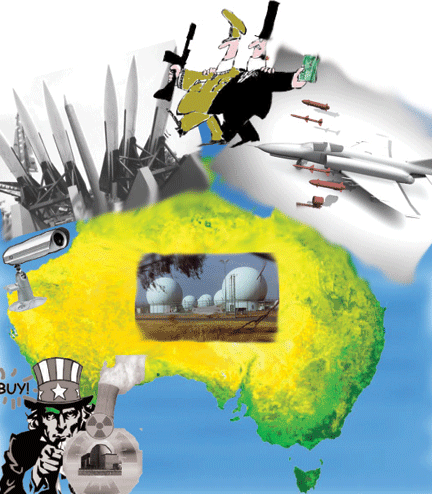
Australia, moreover, is not just an innocent onlooker to a Trump’s gung-ho vigilantism, a state which shoots first and asks questions after. We have ADF personnel embedded in US commands that carry out attacks of this kind. We host Pine Gap, described by senior intelligence analysts as a premier US targeting facility in the southern hemisphere, linking satellites to weapons systems across the Middle East and Asia. We tell ourselves we host it for “security.” In practice, we help aim weapons we never authorised, and cannot refuse.
It is not the brutality that shocks the alliance; it is the dissent.
Asymmetry on Steroids
AUKUS was sold as strategic maturity; an insurance policy against an uncertain Indo-Pacific. Instead, it could become a transfer of sovereignty disguised as procurement. Australia pays up to AUD 368 billion for nuclear submarines that may not arrive until the 2040s. Ships we can neither crew, service nor fuel.
Even then, we may service American boats before our own. The Parliamentary Library analysis makes clear the technology transfer remains subject to US export controls. We do not buy independence; we buy a permanent maintenance job.
Washington gains unfettered access to Australian ports, deeper control of our deterrence posture, and logistical reach into Asia. Canberra gets second-hand privileges wrapped in secrecy.
As Bernard Keane has observed, Labor governs as though office is something to occupy, not use. The result is an alliance that treats American commercial and military interests as interchangeable, while our interests and needs are politely deferred.
The Pattern Is Becoming Impossible to Ignore
In just two weeks:
- The administration signalled openness to watered-down Nvidia AI chip sales to China, over the objections of US China hawks who argued they could bolster Chinese military capacity.
- A leaked plan for Ukraine’s reconstruction envisaged turning frozen Russian assets into profit streams for US-led venture funds; Europeans were expected to accept territorial loss and pay a commission for the privilege.
- Trump stalled sanctions against a Chinese spy agency implicated in extensive hacking to protect an upcoming trade trip to Beijing.
In each episode, intelligence and human rights concerns are bent around the same question: What makes money now?
Imagine if Canberra behaved as crassly. When Australia signs quiet deals with Beijing, we call it “strategic naïveté‘. When Washington does it, we call it “the alliance.”
Australia Has Agency – or It Has Nothing
This is not an argument for abandoning the alliance, but for removing the leash. A self-respecting partner demands:
- Transparency: Parliamentary oversight of defence commitments, including rules of engagement affecting Australian personnel and facilities.
- Reciprocity: Partnerships beyond one power; ASEAN, India, Japan, South Korea, the EU, not an exclusive dependence.
- Sovereign capability: Shipbuilding and cyber defence that serve Australia first, not as a service station for US fleets.
- Moral Limits: If allies breach international law, we do not close our eyes; we close our ports.
Blind obedience is not strategy. It is outsourcing judgment. Surrendering autonomy.
The Choice Is Not Between America and China
Canberra’s defenders of AUKUS love a false dilemma: independence equals Beijing. They mistake sovereignty for treason. Malcolm Fraser warned of this decades ago, describing Australia as a “client state.” We have since upgraded ourselves; to a nuclear client state, paying interest on promises.
Independence is not abandonment. It is partnership without servility. It is the ability to say no. If a second strike on drowning men does not trigger such a boundary, nothing will.
The real danger is no longer foreign power. It is our refusal to imagine ourselves without permission.
Choose Leadership Before It’s Chosen For Us
The Caribbean footage will fade. The legal arguments will thicken. The bodies will be forgotten. What will remain is the alliance, tighter than ever, and a government too cautious to ask what we might be agreeing to on our behalf.
Gough Whitlam once feared Australia would become a nation of “toadies and bludgers” trading sovereignty for illusion. That future arrives quietly. It arrives not with invasion, but with permission slips. It arrives when the second flash on a foreign sea is someone else’s problem, and ours only if we ask.
Albanese must choose leadership while we still have a choice to make.
Nuke Submarine ‘community consultation’

By Philip White on Nov 23, 2025
Australian Naval Infrastructure (ANI) is conducting a ‘community consultation’ about its plan to lodge a site licence application for the ‘Nuclear-Powered Submarine Construction Yard Project’. An application has to be lodged with the new Australian Naval Nuclear Power Safety Regulator before it can prepare a site for a Naval Nuclear Propulsion facility.
We wonder why they are in such a hurry to apply for a site licence when the Strategic Impact Assessment (SIA – Commonwealth process) and the Environmental Impact Statement (EIS – State government process) haven’t even been finalised. FoE Adelaide made submissions to both these processes (click to read our SIA submission & our EIS submission) in March 2025, but no public submissions and no follow-up report have been published. We also made a submission on the new nuclear powered submarine Regulations, which came into effect on 1 November 2025 without any response to the public comments received.
Click here (251123FoEAdelaideSubmission) to read our submission to ANI’s site licence ‘community consultation’.
And let us never forget that acquiring nuclear powered submarines is a bad idea in the first place.
Unlocking Asia: CPA Australia urges bold action to boost national capability.

12 November 2025 AIMN Editorial, https://theaimn.net/unlocking-asia-cpa-australia-urges-bold-action-to-boost-national-capability/
Australian businesses are missing significant investment and innovation opportunities in Asia.- Education, business and professional exchange programs must be expanded.
- Speaking from experience – CPA Australia has nearly 50,000 members in the region.
One of the world’s leading accounting bodies, CPA Australia, is urging the Federal government to take bold steps to strengthen Australia’s Asia capability, warning that Australian businesses are missing out on significant opportunities in the region.
In a submission to the government’s inquiry into building Australia’s Asia capability, CPA Australia provides four key recommendations aimed at deepening Australia’s engagement with Asia through education, business and cultural exchange.
Rebecca Keppel-Jones, Chief Member Operations Officer at CPA Australia, says many Australian businesses, particularly SMEs, remain domestically focused and are not capitalising on opportunities in Asia.
“Asia is central to Australia’s future prosperity. To remain competitive, we must build Asia capability from the classroom to the boardroom,” Ms Keppel Jones said.
“With Asia home to some of the world’s fastest-growing economies, Australia risks falling behind unless it invests in Asia capability now. We need more investment into existing programs, such as the New Colombo Plan, to improve Australians’ understanding of Asia.”
CPA Australia is proud to have maintained a strong presence in Asia for more than 70 years. It now represents nearly 50,000 members in mainland China, Hong Kong, Malaysia, Singapore, Indonesia, Vietnam and the UAE.
“Australia must better leverage its people-to-people connections and professional networks to unlock economic potential,” Ms Keppel-Jones said.
CPA Australia’s four key recommendations:
- Expanding Asia-focused training for SMEs to improve business readiness and regional engagement.
- Showcasing Australian success stories in Asia through a government-supported case study library to inspire and educate.
- Increasing scholarships and professional placements for young Australians to study and work in Asia.
- Revitalising Asian language and cultural education in schools and universities to reverse declining enrolments and build long-term regional literacy.
“As global dynamics shift, our ability to engage with Asia is more critical than ever. We need to ensure Australia’s workforce is globally competitive,” Ms Keppel-Jones said. “We are ready to work with government, educators and industry to turn these recommendations into action.”
The submission highlights CPA Australia’s active contributions to regional policy development, education and professional exchange, including a reciprocal work placement exchange program with Malaysia.
Eligible CPA Australia members can enjoy temporary work placements in Malaysia as part of a broader Young Professionals Exchange Program organised by the Department of Foreign Affairs and Trade. The exchange program is designed to enhance business engagement between Australia and its Southeast Asia partners and is available in Malaysia first, before being rolled out to other Southeast Asian markets.
CPA Australia’s thought leadership initiatives across Asian nations include its annual Asia-Pacific Small Business Survey and Business Technology Report.
Coalition to look at coal subsidies, stick with nuclear

Liberals risk joining ‘baddies’ with fossil-fuel push
CanberraTimes, By Tess Ikonomou, November 9 2025
A senior Liberal has warned his party would push Australia towards joining “baddies” in rejecting international climate goals as it prepares to back fossil fuel-fired power.
Political infighting within the coalition has intensified over the Liberals’ commitment to a target of reaching net-zero emissions by 2050, a position the party is poised to follow junior partner the Nationals in dumping.
The Liberal Party’s formal position on the climate target will be decided following meetings in Canberra mid-week.
Liberal frontbencher and leading moderate Andrew Bragg on Sunday indicated he could quit shadow cabinet if his party decided it would pull out of the Paris Agreement and not maintain a clear goal for lowering emissions.
“If we left Paris, we’d be with Azerbaijan, Iran, Syria, you know, and a few other baddies,” he told ABC’s Insiders program.
“Australia has never been with those people before.
“Australia needs to be in Paris, in my opinion, and then we need to try to find a way to do net-zero better than Labor. That is better for jobs, better for industry, and better for decarbonisation.”
Senator Bragg added the Liberals were “not fringe dwellers” and most Australians want the nation to play a fair role in reducing emissions, an objective seen as key for the party to reverse its electoral decimation in urban seats.
Under the Paris Agreement, signed in 2015, members must increase their emissions targets every five years and cannot water down their goals……………………………………………………………………………………………………….
Opposition energy spokesman Dan Tehan has flagged subsidies could be offered to keep current coal-fired power plants operating for longer under the coalition’s long-awaited climate and energy plan………………………………………………………………………………………………
Mr Tehan also foreshadowed the Liberals would continue their pre-election policy of supporting the development of nuclear power plants.
“Absolutely we want to see a nuclear policy, and we’ve already committed, through the coalition agreement, to lifting the ban, and that will be very much part of the discussions we have,” he said. https://www.canberratimes.com.au/story/9107389/liberals-risk-joining-baddies-with-fossil-fuel-push/
Free solar, nuclear cost blowouts, and “deadly negligence” on climate: A heady mix for the Coalition

Giles Parkinson, Nov 7, 2025, https://reneweconomy.com.au/free-solar-nuclear-cost-blowouts-and-deadly-negligence-on-climate-a-heady-mix-for-the-coalition/
The Coalition’s favoured energy technology is quite clearly nuclear – perhaps for no other reason than it is not wind or solar.
The Coalition no longer pretends that nuclear is the best option to address climate change, because they are tearing up their agreement on net zero, the softest of climate targets. That may be an admission that nuclear is very slow to build, particularly for a country that has never done so, and is still built on democratic principles.
Nor can they pretend that nuclear is the best technology on economics. Real world examples continue to defy the carefully constructed modelling commissioned by the Coalition.
In the UK, financing has finally been landed for the planned Sizewell C nuclear plant – and it turns out to be £38 billion, or around $A76 billion, for a 3.2 gigawatt facility. That translates to around $24 million a megawatt capacity cost, which is more than twice as much as the Coalition modelling would have you believe.
Sizewell C is expected to be a replica of Hinkley Point C, whose costs are now estimated at up to $A94 billion, and it seems that Sizewell kept its capital costs under control, because the UK government had to step in to take a 44 per cent stake. (The builder, the French government owned EDF, only wanted 12 per cent, because of the cost risks.)
It also changed the nature of the funding game – turning the new nuclear plant into a regulated asset (like Australia’s electricity networks), which will require consumers to start paying for the nuclear plant more than a decade before it is actually built.
Remember, this is the 5th or 6th plant to be built using the French EPR technology – and yet there is no sign of it getting any cheaper. And we haven’t see the inevitable delays and cost blowouts yet. Civil construction costs are blowing up projects all over the world, and nuclear is about as big as they come.
The UN starts another climate party
The Coalition’s anti-climate and no-to-net-zero stance comes as the UN climate conference is poised to start in Belem, Brazil, where UN secretary general Antonio Guterres has lamented “more failure” to do enough to keep the world on track to cap average global warming at 1.5°C.In remarks that might have been addressed specifically at the Coalition, but were directed at the world, Guterres said:
“Too many corporations are making record profits from climate devastation, with billions spent on lobbying, deceiving the public and obstructing progress,” Guterres said.
“Too many (political) leaders remain captive to these entrenched interests,” noting that countries are spending about ($A1.54 trillion) each year subsidising fossil fuels.
“We can choose to lead – or be led to ruin. Every fraction of a degree means more hunger, displacement and loss – especially for those least responsible. This is moral failure – and deadly negligence.”
What is the real target?
Those fractions of a degree are significant. The latest “emissions gap” report published by the UNEP says the world is headed for average of 2.9°C of warming based on current enacted policies, and 2.3°C and 2.5°C based on announced commitments.
What does a world of 3°C look like. Australia’s National Climate Risk report made it clear – catastrophic impacts, rising sea levels, collapsing ice sheets, the destruction of the Great Barrier Reef. Much of northern Australia would be uninhabitable.
Gina Rinehart, who appears to hold so much sway over the Nationals, wants to build a “defence dome” over northern Australia to protect its mineral riches. It might need a geodesic dome just to make it habitable.
What could possibly be done? As the UNEP notes: “The required low-carbon technologies to deliver big emission cuts are available. Wind and solar energy development is booming, lowering deployment costs. This means the international community can accelerate climate action, should they choose to do so.”
Astonishingly, the Coalition battle over net zero has been playing out in mainstream media as nothing more than political porn, focusing on personalities, egos and power. Climate science, and the renewable solutions, have barely been mentioned.
I’ve seen and heard maybe half a dozen interviews with Opposition energy and emissions reduction spokesman Dan Tehan and can’t remember him once being asked about climate science, or the economics and the engineering of the energy transition.
Does Australia really want to host COP31
Sometime in the next two weeks we will get an answer on whether Australia wants to host COP31, the next UN climate talks in 2026.
The plan is to do it in Adelaide, which would be a grand opportunity to show off the world’s most advanced renewable grid, with South Australia already at a world-leading share of 75 per cent wind and solar, and aiming for 100 per cent “net” renewables by 2027.
The state hosted the world’s first big battery and was the first to roll out “grid forming inverters,” which will help kill the need for fossil fuel generators and often has rooftop solar meeting the equivalent of all state demand. None of which was considered possible just a few years ago.
But if it is this hard to agree to a venue (Türkiye still has its hand up), does Australia want the hassle and embarrassment of presiding over a UN conference with no particular landmark goal, squabbling nations and the notable absence of the world’s biggest economy, the US?
Some in the ALP machine are thinking not. The delays and the massive oil and gas projects still being approved and rolled out, could make logistics tricky and the politics difficult. Which would be a shame: It is a rare opportunity for the Pacific Island nations to also have their say.
They have done so before when Fiji was the official host of COP23, but that was – for obvious reasons – held in Bonn, Germany. That might happen again, with Australia and Türkiye sharing “hosting” duties and various lead-up events, expos and talk-fests.
Duck! Free solar is coming your way
As the Coalition tries to tear itself apart over its position on climate and energy, federal energy minister Chris Bowen’s advocacy of “free solar” may turn out to be a political masterpiece – if only because it promises to change the conversation about the green energy transition.
Bowen wants to force energy retailers to offer at least three hours of “free electricity,” taking advantage of the abundance of rooftop and other solar in the middle of the day, and to make sure the benefits are shared with the 60 per cent of households that do not yet have, or can’t have, rooftop solar.
It’s sparked a predictable fury about heavy handed regulation: You can’t do that! And it’s true that some retailers already do offer such a tariff, although potential customers may want to assess the rates that are being charged in the evening peaks.
Morgan Stanley says the implications are significant enough – savings of up to $660 a year for non-solar households able to take up the offer (you need a smart meter and a big enough midday load so it can make sense), and estimates it might cost big retailers like AGL and Origin around $60 million each.
That suggests an uptake of less than 100,000 customers, which sounds about right. But it’s the messaging that counts – both to the long-forgotten consumer, and to the legacy retailers who are reminded they need to be on their toes to negotiate this energy transition.
Customers should no longer be the forgotten part of the energy transition. They now own rooftop PV, and are busy installing batteries and buying EVs. That will accelerate, but the benefits should not be theirs and theirs alone. Sadly, the legacy players sometimes need to be told to do the right thing.
Podcasts to listen to
This week on the Energy Insiders podcast, we talk to Vestas’ Jan Daniel Kaemmer about the prospects for wind industry in Australia, and of course the news of the week. See: Energy Insiders Podcast: The future of wind energy
Our other weekly podcast, SwitchedOn Australia hosted by Anne Delaney, has a look at the scandal over pre-paid energy packages for First Nations peoples. See: SwitchedOn podcast: The scandal of weekly power cuts in First Nations communities
In our Solar Insiders podcast, Sophie Vorrath digs in to the “free solar” idea and the opportunities for more electrification in a discussion with the EEC’s Luke Menzel: See: Solar Insiders Podcast: Would you like electrification with that?
And you can also catch up with the latest episode of the EV-focused The Driven podcast, where Sam Parkinson, Sarah Aubrey and the team discuss BYD’s cheapest EV, VW’s ID. Buzz GTX, and if local car manufacturing is just talk? See: The Driven Podcast: BYD’s most affordable EV, Kia’s new van, and what’s the buzz around VW’s GTX
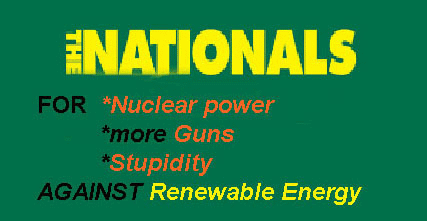
Nationals choose coal, nuclear and climate denial, as politics of delay threatens to kill another industry.
Giles Parkinson, Nov 3, 2025, RenewEconomy,
So, the Nationals have decided to stop pretending they care about climate change, and have thrown in their lot with the fossil fuel industries. It should come as no surprise – climate denial, coal and nuclear often go hand in hand.
It is the greed, stupidity and cowardice that stuns the most. This is a party that chooses not to support its regional constituency – those likely to suffer most from the impacts of climate change – but to side with billionaires determined not to let science and the fate of future generations get in the way of making money.
Climate science demands that strong action is needed as quickly as possible to avoid the worst impacts of climate change. This is true for Australia as it is for the rest of the world. Reaching net zero by 2050 is the very least that should be done – we should really be aiming for net zero in the mid 2030s or early 2040s.
The Nationals, though, having rejected near and medium term climate targets, can’t even be bothered kicking the can down the road, which is how many describe the task of net zero by 2050. And like most climate deniers, they voice support for the world’s most expensive, difficult and delayed technology – nuclear energy.
The most obvious technologies, and by far the best in the Australian context, are solar, wind, and battery storage. It is not all we need, but it is the lowest cost and the most readily deployable. The Nationals prefer to look the other way.
It looks, sounds and feels Trumpian. We’ve seen how idiots and ideologues have been promoted to the key roles in the new US administration, and the damage that has been done, the lives that have been lost and will be lost, and the attacks on science, the environment, and the foundations of western democracy.
But we really don’t have to look beyond our own shores to see how this plays out – new right wing governments in Queensland (LNP) and the Northern Territory (CLP) have ripped up renewables targets and ignored climate science to pursue what appears to be a single goal: To further enrich the fossil fuel interests that support them.
Tomago, not pronounced like tomato
This has consequences. The owners of the giant Tomago aluminium smelter last week flagged the possible closure in three years – not because of the transition to renewables, but largely because it has not come quickly enough in NSW.
There is deep irony in this. Rio Tinto believes it has secured the future of its Boyne Island smelter and associated refineries in Gladstone in Queensland by locking in a series of wind, solar and solar battery hybrid contracts – all the biggest of their type in Australia. And there are more to come, we understand.
This was the result of the state Labor government’s pro-active efforts and a common sense approach to the rollout of renewables and renewable zones in the country’s most coal dependent state, although the new LNP government has tried to bugger that up by “calling in” the wind project. It seems a phone call solved that issue.
NSW has arguably more ambitious transition plans – given the size of its grid – and a lot more urgency because of the age of its coal generators.
But behind the ostensibly bipartisan support have been acts of quiet and noisy sabotage – rabble rousing and planning delays – particularly from the Nationals that has made the rollout of wind and solar that much more difficult.
Of course, they are not the only ones to blame. The buyers’ strike by the big energy retailers, the failure of super to invest in their own country’s future, the pathetic coverage of mainstream media have all played their part………
Race to renewables
It is instructive to note the number of industries that are trying to transition to renewables as quickly as they can, to secure their future, like Boyne Island.
BHP has signed up for a series of large renewable contracts with Neoen based around wind and battery storage to provide the bulk of power to its giant Olympic Dam mine in South Australia.
Fortescue is charging towards “real zero” – meaning burning no gas or diesel by 2030 to power and operate their iron more mines by 2030, which would be an extraordinary feat if they can pull that off in that time frame.
And numerous smaller mines are already reaching levels of 90 per cent renewables on their off grid mines, and gaining big benefits and customer approvals because of it
This is happening at the local level too – the federal battery rebate numbers are now at 108,000 (as of Saturday) and showing no signs of slowing down.
And there is renewed enthusiasm for vehicle-to-grid, essentially using the big batteries in EVs for the same purpose, to act as batteries on wheels. Amber’s Chris Thompson says consumer energy resources – such as batteries and EVs – is the next big wave.
“You really start to see the future forming here, where consumers are actually the backbone of the energy grid,” he says. “They are participating, they are accelerating this renewable transition, and we are desperately trying to work hard to make sure that we can help make it simple and easy for everyone to participate.”
And as ARENA’s Darren Miller noted: “We can expect the level of storage in these vehicles to exceed what we need in the grid by about three times. So all we need is a third of people plugging their cars in and having this technology to essentially provide all of the firming that we need for our grid for our home energy consumption.”
See also: Video: Big breakthrough for batteries on wheels
Co-operation please………………………..
Carter had a simple message on what needs to be done.
“Stop fighting and get aligned for the common good. We need a global carbon platform and market. We can’t keep assuming that dumping manmade greenhouse gases is free or has no consequence,” he said.
“Partly, this is due to the crazy ideology that dominates climate change, which is fuelled by a deep distrust of science and scientists………..https://reneweconomy.com.au/nationals-choose-coal-nuclear-and-climate-denial-as-politics-of-delay-threatens-to-kill-another-industry/
All the way with Donald J. Albo supporting mass murder

And all complying with Paul Keating’s criticism that our governments keep seeking security from Asia when we should be seeking security within it
by Michael Pascoe | Oct 19, 2025, https://michaelwest.com.au/anthony-albaneses-donald-trump-visit/
Australia is murdering people and threatening democracy. That’s the reality of Anthony Albanese kissing Donald Trump’s ring this week, writes Michael Pascoe.
Michael Pascoe.
Let’s be clear about this. If you support a criminal gang, provide it with weapons, keep schtum about its crimes, either pay bribes or accept being extorted, you are an accessory to everything the thugs and hitmen do.
That’s us, as represented by our government bowing before Donald Trump.
When Trump exercises massive economic coercion on Brazil because that democracy’s judiciary is dealing, as it should, with an attempted coup (unlike the United States), we’re supporting him.
When Trump threatens Brazilians with further unspecified pain if they don’t vote for his preferred right-wing candidate, we’re supporting him.
“We’re all the way with Donald J, all the way with the mob that is the US administration.“
When Trump, on zero legal basis, orders suspected smugglers to be summarily executed in international waters, we’re on his side. When he leans on corporations for a piece of their action, we’re okaying it. Heck, we’re joining the conga line offering a slice.
As a Trump vassal state, we’ve moved beyond merely being America’s Deputy Dawg in the South Pacific to active backers of Trump’s global shakedown.
The “rules-based international order” was always a façade for self-interest. Now it’s a pathetic joke, high farce, darkly ironic. Just as Trump’s Supreme Court has declared him above the law, Trump has declared the United States beyond any law, a piracy state free to exploit, extort, betray, reneg and kill at will.
Ready to kiss the ring
The local media demanding for months that the Australian Prime Minister have the opportunity to play a humble fool in the White House have their wishes fulfilled this week.
Embarrassingly, our major newspapers are reporting as a good thing that Albanese will either, depending on your perspective, bribe or be willingly extorted by Trump to curry favour with the lawless mob.
Rather than support free trade and that rules-based international order thing, we are expected to act like the sycophantic American companies and “give” Trump a large gift. Another billion dollars towards America’s military capacity is just an appetiser.
More galling, the reported main aim in compromising whatever moral stance Australia might once have had is to keep alive the AUKUS nuclear-powered submarine deal. We’re compromising ourselves to further compromise our military sovereignty by locking into the American military’s strategic aims. “Integration”, as the American cheerleaders in the local security and military game call it.
And all complying with Paul Keating’s criticism that our governments keep seeking security from Asia when we should be seeking security within it.
As stated here before, contrary to the perspective of nearly all Australian media, most of the world is not in the Trump or China camps. Most countries recognise the failures of both those powers and seek to tread an independent path.
Not Albanese’s ALP or whoever’s LNP. Having already surrendered sovereignty by inviting and hosting American military and espionage bases, we’re doubling down by funding the American military machine on a bipartisan basis and mutely approving Trump’s international transgressions.
There is no pride in this, only a stain. Acting without integrity, supporting a bullying criminal, we are
“accessories to everything that untrustworthy self-aggrandising joke of a US president does.”
That’s Australia, us, you and me.
Michael Pascoe
Michael Pascoe is an independent journalist and commentator with five decades of experience here and abroad in print, broadcast and online journalism. His book, The Summertime of Our Dreams, is published by Ultimo Press.
Australia Peace and Neutrality: A Path to Regional Stability
The AUKUS cost is now estimated to exceed $368 billion, committing vast amounts of public money to nuclear-powered submarines that may arrive long after regional conditions have changed. Instead of strengthening security, this approach diverts resources that could serve a public purpose and deepens dependence on U.S. technology and strategy.
13 October 2025 AIMN Editorial, By Denis Hay
Australia peace and neutrality can strengthen diplomacy, use dollar sovereignty wisely, and build stability across the Indo-Pacific region.
Introduction
For decades, Australia has followed the United States into every major military venture, from Vietnam and Iraq to AUKUS. Yet as the Indo-Pacific becomes the world’s new power centre, a quiet question is growing louder: what if Australia charted its own path to peace and neutrality?
A truly independent Australia could use its dollar sovereignty, the power of its currency-issuing government, to build peace and prosperity across the region instead of fuelling an arms race. Australia’s peace and neutrality offer a strategy for stability, regional leadership, and national integrity.
This vision of Australia peace and neutrality challenges the assumption that our security must depend on foreign powers. Australia peace and neutrality could reshape our future security choices.
From Ally to Independent Actor
The Albanese government has signed a string of defence agreements across Asia and the Pacific – with Papua New Guinea, Fiji, Indonesia, and others. Publicly, these are framed as strengthening regional security. Privately, they reflect deep anxiety about China’s rise and U.S. expectations under the AUKUS pact.
But what if Australia could keep strong regional relationships without taking sides?
Neutrality would allow Canberra to cooperate economically with China, coordinate diplomatically with ASEAN, and collaborate militarily only for defence.
Neutrality does not mean isolation; it means freedom to choose peace. Embracing Australia peace and neutrality would allow our nation to build genuine independence through cooperation, not coercion.
Endless Alliances, Endless Dependence
Australia spends more than $50 billion annually on defence, with projections showing a surge to over $100 billion by 2034, much of it tied to AUKUS and U.S. systems.
According to the SIPRI Military Expenditure Database, global military spending reached a record US$2.44 trillion in 2024, with Australia following this trend.
The AUKUS cost is now estimated to exceed $368 billion, committing vast amounts of public money to nuclear-powered submarines that may arrive long after regional conditions have changed. Instead of strengthening security, this approach diverts resources that could serve a public purpose and deepens dependence on U.S. technology and strategy.
By investing in Australia peace and neutrality, defence spending could serve constructive goals that strengthen stability and mutual respect across the region. This imbalance weakens our sovereignty.
When defence procurement is outsourced and strategic thinking is imported, national independence becomes a slogan rather than a policy.
Redirecting spending toward Australia peace and neutrality would reflect our true interests.
Risking War by Proxy
By aligning too closely with Washington’s containment strategy, Australia risks becoming a proxy in a potential U.S.–China confrontation.
The Taiwan Strait and South China Sea remain volatile, and one miscalculation could drag us into a conflict far from our shores but devastating to our trade and security.
Meanwhile, China’s influence strategy, while assertive, relies more on infrastructure investment and trade than on military projection.
Unlike the U.S., China doesn’t keep hundreds of foreign bases or seek regime change. Its primary interest is economic stability, which is essential for its own growth. Through Australia peace and neutrality, we can maintain productive trade ties with both China and the U.S. without being drawn into military rivalry.
Australia’s uncritical alignment with the U.S. narrative feeds a false dichotomy: democracy versus authoritarianism. The real contest is between militarism and mutual benefit.
Pursuing Australia peace and neutrality keeps us clear of great-power rivalry.
Adopting a Neutral Foreign Policy
Neutrality is not new, it’s just forgotten…………..
A neutral foreign policy would reorient Australia’s military to genuine defence, protecting borders, sea lanes, and cyber networks, while withdrawing from power blocs that demand loyalty over logic.
Neutrality also aligns with public opinion: the 2025 Lowy Institute Poll shows 72% of Australians fear a major war in Asia, but only 35% believe military alliances make us safer.
Neutrality, therefore, is not weakness, it’s strategic independence. Australia’s peace and neutrality would enhance our reputation as a fair-minded, responsible regional actor. Australia peace and neutrality can become a defining national identity, proof that leadership in the Indo-Pacific can come through diplomacy rather than dominance.
Investing in Peace Through Dollar Sovereignty
Here lies Australia’s hidden strength: monetary sovereignty……………………………………………………………
Regional Partnerships for Stability
The Pacific doesn’t need more weapons; it requires trust and development. The Albanese government’s Pacific Engagement Visa and renewed aid to Fiji and PNG are steps forward. Still, Australia must go further, establishing joint renewable-energy zones, shared fisheries management, and infrastructure councils led by Pacific nations themselves.
Transparency, Public Mandate, and Trust
Defence and foreign policy have long run behind closed doors. Yet democracy demands sunlight.
To ensure neutrality reflects the national will, the government should:
- Hold annual Lowy-style peace polls to gauge public sentiment.
- Publish Defence Opportunity Cost Reports showing what alternative spending could deliver.
- Require parliamentary approval for overseas military commitments.
Transparency builds trust. Australians deserve to know whether each use of public money serves peace or perpetuates conflict.
Yet, transparency must also extend to media accountability. Australia’s mainstream outlets, dominated by right-wing interests, often frame militarism as inevitable and portray dissent as unpatriotic. This narrative undermines informed debate and limits the public’s understanding of real alternatives like neutrality or public-purpose spending.
To counter this, the government could:
- Strengthen media diversity laws and limit concentrated ownership.
- Increase funding for independent and public-interest journalism, including not only the ABC and SBS but also Michael West Media, Independent Australia, Pearls and Irritations, and The Australia Institute.
- Establish a Truth in Media Commission to hold broadcasters accountable for disinformation, particularly around war narratives and economic myths.
A healthy democracy depends on an informed public, not a manipulated one………………………………………………………………………………………………………………………… https://theaimn.net/australia-peace-and-neutrality-a-path-to-regional-stability/
Nuclear energy sank the Coalition at the election — can it power their comeback?

2 October 2025, By Catriona Stirrat, https://www.sbs.com.au/news/podcast-episode/nuclear-energy-sank-the-coalition-at-the-election-can-it-power-their-comeback/eqd6mzqsd
The coalition are revamping their proposal for nuclear energy, despite suffering an election loss with this policy. The details are yet to be confirmed, but the Opposition Energy Minister says they will adapt their plan to meet developments in the space.
The Coalition’s nuclear policy didn’t secure the party a win in the May federal election.
But that’s not stopping the Opposition Minister for Energy and Emissions Reduction:
“I have a very, very strong view that nuclear has to be part of our energy mix here in Australia, if we are going to be serious about reducing emissions.”
That was Dan Tehan speaking on ABC’s 730 program, following a trip to the United States which has inspired this latest revival of a Coalition nuclear energy policy.
Speaking on ABC Radio, Mr Tehan praised US advancements in the space.
“There’s basically a nuclear renaissance taking place in the US. There’s huge investment going into nuclear, there’s huge developments that are taking place. And everyone that I spoke to are incredibly confident given the use of AI, given the use of quantum, that they will continue to make rapid developments with nuclear technology.”
While avoiding detail, he did admit the policy would be adapted from their pre-election pitch to respond to rapid developments in the area.
But Mr Tehan is confident Australia should be influenced by the US model.
“The amount of investment, the amount of technological know-how going into nuclear, and the breakthroughs when it comes to small modular reactors, or micro-reactors, has to be seen to be believed. And the capital which is flowing into these developments, especially by the large tech companies in the US, is leading to developments which are occurring on a daily basis. And I have a very, very strong view that nuclear has to be part of our energy mix in Australia if we are to be serious about reducing emissions.”
While details of the policy remain unclear, the Opposition has already committed to some form of nuclear energy as part of a deal with the Nationals to prevent another coalition splinter.
Coalition frontbencher Bridget McKenzie insists the policy wouldn’t be in the top five reasons the coalition suffered a heavy loss in the May federal election.
She’s told Sky News the nuclear debate has to be viewed in the broader view of climate and energy policy.
She says the government is flagging poor policies to try and get Australia to emissions reduction targets, pointing to their efforts to encourage a switch to electric vehicles within a short time frame.
“Once again, we’re seeing the Labor Party pulling one lever for a policy solution, whilst making opposing decisions that aren’t good for the country. We know they aren’t going to meet their emissions reduction target, so they’ve doubled down on that and produced this transport sector plan for 2035 that’s going to see Australian motorists really do the heavy lifting and pay the costs of emissions reduction.”
Labor has long criticised the coalition’s nuclear energy plan – arguing the nation’s energy needs can be met with a mix of renewables and gas.
Addressing National Press Club following his election win, Prime Minister Anthony Albanese called the coalition’s nuclear policy a ‘last desperate attempt to delay action on climate change’.
He outlined his reasons for opposing the policy in a social media address in December last year.
“Here’s the lowdown on nuclear power – it will add $1200 to your power bills, it will take decades to build, it will block cheaper renewable energy. Energy experts at the CSIRO and the Australian Energy Market Operator have made that clear. Still, Peter Dutton is asking Australians to pay the price for his nuclear power scheme. Never before has so much taxpayer money delivered so little to so few Australians.”
The government is yet to respond to the coalition’s latest comments promoting nuclear energy and slamming Labor’s emissions reduction policy.
Coalition in ‘overwhelming agreement’ on nuclear future, energy spokesman says
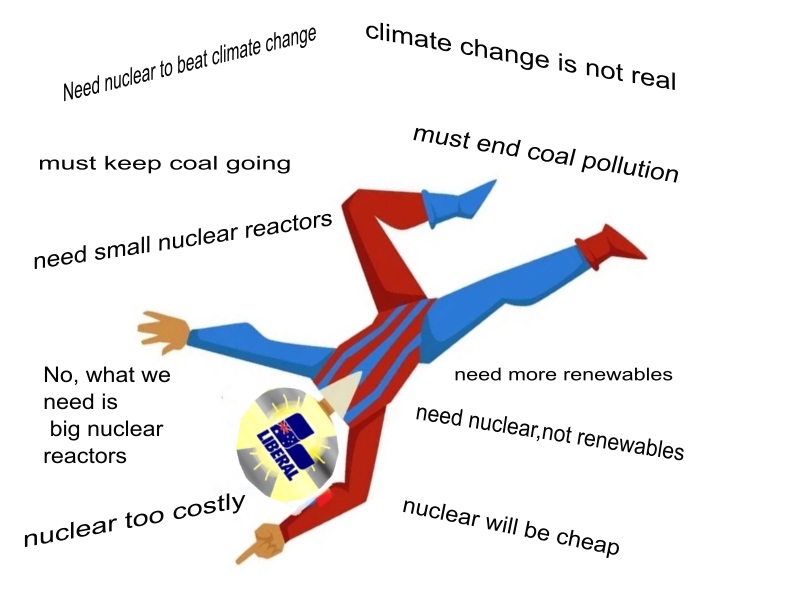
The Coalition has given its biggest clue yet on what its post-election policy will be.
Joseph Olbrycht-Palmer, 2 Oct 25. news.com.au
Opposition energy spokesman Dan Tehan has returned from a lengthy fact-finding mission to the US starry-eyed about a “nuclear renaissance taking place”.
Mr Tehan spent much of September touring facilities and meeting with nuclear heavyweights in the US.
His trip overlapped with the release of Australia’s first-ever climate risk assessment and Labor government’s 2035 emissions reduction targets.
His absence drew some criticism but, fronting media for the first time since landing back in the country, Mr Tehan said the knowledge he gained was worth it.
“What I learned was that there is basically a nuclear renaissance taking place in the US,” he told the ABC on Thursday.
There is huge investment going into nuclear.
“There are huge developments that are taking place.
“And everyone that I spoke to was incredibly confident, given the use of AI, given the use of quantum, that they will continue to make rapid developments with nuclear technology which will enable not only the US, but the globe, to provide abundant energy in a form which is emissions neutral.”
He was particularly struck by micro reactors, which are transportable nuclear power sources that typically generate between 1-20MW – or enough energy to power a small community, a military base or an industrial facility………………………………………………………
Mr Tehan’s comments are the strongest indication to date that the opposition may stick to its guns on nuclear despite its heavy defeat at the federal election in May.
The absence of an energy policy has sparked severe tensions within the Coalition and was key to the Nationals’ brief split from the Liberals.
Mr Tehan said he had discussed his findings with his colleagues and that “there is overwhelming agreement on the Coalition side that nuclear needs to be part of our energy mix”. https://www.news.com.au/national/politics/coalition-in-overwhelming-agreement-on-nuclear-future-energy-spokesman-says/news-story/00ba65f8cb559f8fcd0e886a783f4703
Nuclear energy to remain a central focus for Coalition
By Kye Halford • 3 October 2025, https://www.thesaturdaypaper.com.au/post/2025/10/03/nuclear-energy-remain-central-focus-coalition
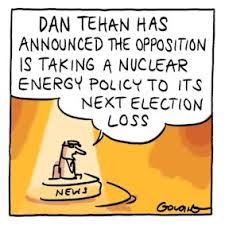
Nuclear technology will be a key aspect of the Coalition’s energy policy heading into the next election, as opposition energy spokesman Dan Tehan argues it is essential to modernise the electricity grid.
Tehan told ABC radio on Thursday: “There is overwhelming agreement on the Coalition side that nuclear needs to be part of our energy mix” (SMH).
“I have no doubt that my colleagues, like I do, see very much a future for nuclear as part of our energy mix here in Australia,” he said.
Tehan has recently returned from a study tour in the United States, where he reportedly toured facilities and spoke with nuclear experts about how the energy source could be used in Australia (Yahoo News).
Nuclear energy was a key proposal for former opposition leader Peter Dutton during his lost election campaign earlier this year, despite voter scepticism regarding its viability (The Saturday Paper).
Dan Tehan fails to grasp difference between baseload and firming as he spouts nonsense on nuclear
Giles Parkinson, 2 Oct 25, https://reneweconomy.com.au/dan-tehan-fails-to-grasp-difference-between-baseload-and-firming-as-he-sprouts-nonsense-on-nuclear/
The Australian Energy Market Operator, along with the owners of the country’s biggest fleets of coal generators have painted a pretty clear picture of the energy future: Forget baseload, it’s time has come and is going and almost gone – the future is about renewables and firming power.
It shouldn’t be too hard a concept to grasp. Low cost wind and solar will provide the bulk of the electricity supply, including and particularly from the rooftops of homes and businesses, and excess power will be stored in batteries at home and on the grid, and flexible “firming” assets will fill the gaps.
The focus on flexibility is the key. Firming assets might not be needed often, or even for long, but they will need to be switched on and off relatively quickly. Flexible demand side management will also play a key role, as will a focus on efficiency.
Australia’s operational paradigm is no longer ‘baseload-and-peaking’, but increasingly it’s a paradigm of ‘renewables-and-firming’,” AEMO boss Daniel Westerman said last year.
It’s a crucial point to understand. “Baseload” is not so much a technical virtue as a business model – the people who invest in coal generators, and nuclear in particular, count on those machines operating at or near full capacity most of the time.
Without it, they haven’t a hope of repaying the money that it took to build their facilities. They can flex a little, but the last thing they want or can do is dial down and up again on a daily or even hourly basis. Other machines are better equipped at doing that, and at much lower cost.
As the ANU’s Centre for Energy Systems wrote this year, the energy industry is aware that baseload is not just endangered, it is already functionally extinct. And they explain why in more detail.
Enter the Coalition’s new energy spokesman Dan Tehan, who quite clearly has not got the memo, and clearly hasn’t the foggiest idea what he is talking about.
Tehan has been on a “fact finding” tour of energy facilities in the US, which appears to have included no renewables, but a lot of nuclear, and – having briefed Coalition colleagues early in the week – he was keen to share his new-found knowledge with the ABC.
“Do you accept that expertise of the Australian energy market operator when it comes to base load power and the transition that’s underway?” Tehan was asked on the 7.30 Report.
“Well, your quote said it all there, Sarah,” Tehan replied. “Renewables and firming, and what nuclear can do is provide that firming over time, it can replace gas and coal, which are providing that firming at the moment.”
Clearly, he was already confused by the difference between baseload and firming. And then Tehan said this: “So my argument is as a replacement for diesel. When it comes to mine sites all that firming capacity over time, that’s exactly the role that nuclear can play.”
Mine sites, it should be noted, use little in the way of gas and diesel capacity. Maybe 10, maybe 20 megawatts (MW). And they are now rarely switched on. Most new mine sites are running on an average 80 per cent renewables, even those partly owned by arch-renewables critic Gina Rinehart.
BHP is sourcing the bulk of its electricity needs for it massive Olympic Dam mine and refinery and nearby sites through two “renewable baseload” contracts with Neoen comprised only of wind and battery storage.
But Tehan was back at the ABC on Thursday morning, this time on Radio National, where he was extolling the virtues of “easily transportable” micro-reactors sized he said – and wait for it – between five and 10 gigawatts!
“And the particular thing that was really of note to me was how the research into micro reactors, so small, sort of five gigawatt, 10 gigawatt reactors, which are very transportable,” he said.
We suspect he meant megawatts, not gigawatts. (A gigawatt is 1,000 megawatts). And, we should point out, these micro reactors do not exist in any commercial form, and it’s doubtful too that they would be “very transportable”.
Tehan said he is convinced that in the US there is a “nuclear renaissance”, despite the recent World Nuclear Industry Status report pointing out there is no such thing. “The simple fact is … that there isn’t a single power reactor under construction in the 35 countries on the American continent,” ACF’s Jim Green writes.
Tehan insisted that 30 nations at COP29 had signed up to triple the amount of nuclear capacity. True, but they said they would do that over a 25 year timeframe, by 2050 – with the aim of lifting global capacity from around 350 GW to just over 1,000 GW.
In the meantime, a total of 120 countries have signed up to treble renewables – in just over five years – from 3,500 GW to 11,000 GW. That is 11 times more capacity than nuclear in one fifth of the time. It is pretty clear to everyone – except perhaps for Tehan and his friends – where the money is going.
And as AEMO’s Westerman told an energy summit hosted by The Australian last week, Australia is experiencing a “stunning democratisation” of energy generation, thanks to rooftop solar and consumer batteries.
Which means that they too will need the grid for “firming”, rather than baseload. Such a dramatic reshaping of the grid will leave no room for nuclear, or any other “baseload” power source. But Tehan and his mates seem intent to jam it into Australia’s energy debate, even if they can’t get it into the grid.
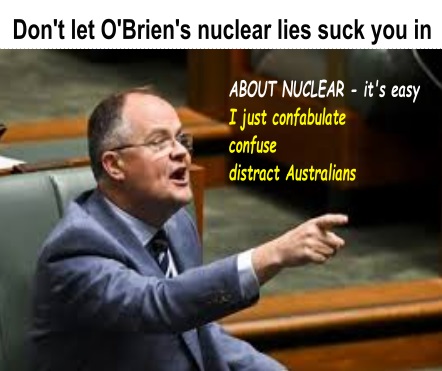
Deputy leader Ted O’Brien confident nuclear will be part of Coalition’s energy policy
By Bridget McArthur and Madigan Landry https://www.abc.net.au/news/2025-10-04/deputy-opposition-leader-confident-nuclear-in-energy-policy-mix/105848854
In short:
The federal shadow energy minister and shadow treasurer are adamant nuclear energy will form part of the Coalition’s future energy policy, though their leader has been less bullish.
Energy analyst Tony Wood says nuclear energy could work in Australia but the uncertainty caused by the lack of bipartisanship threatens to drive up power prices.
What’s next?
Deputy Opposition Leader Ted O’Brien says the Coalition’s energy policy is still in the works and more details will be shared once it is cemented.
Deputy Opposition Leader Ted O’Brien says he is “supremely confident” nuclear will be part of the Coalition’s future vision for Australia’s energy mix.
Shadow Energy Minister Dan Tehan made similar comments this week, signposting the resurrection of the Coalition’s nuclear policy after touring US nuclear facilities.
His predecessor, Mr O’Brien, was a key figure in the Coalition’s nuclear pitch at the last federal election — a policy some political pundits said contributed to their resounding loss.
Now Liberal deputy, Mr O’Brien said he was committed to giving it another go.
Mr O’Brien said the Coalition was yet to settle on the details of its new nuclear policy, including whether it would be government-funded or private sector-led.
Some commentators have speculated that the Coalition may look at narrowing its aspirations to focus on lifting the moratorium on nuclear energy, which has been in place since the late 1990s.
Mr O’Brien would not confirm whether the seven locations proposed to host nuclear reactors would still play a role.
But he maintains people in those regions, including Collie, 190 kilometres south of Perth, were “very open” to the idea.
On a two-party preferred basis, all four of Collie’s polling booths recorded a swing towards the Liberals, which Mr O’Brien said indicated local support for the Coalition’s energy policy.
However, he conceded that on a multi-party basis, there was a swing away from both major parties towards minor parties, such as One Nation and Legalise Cannabis.
Party leader less bullish
Opposition Leader Sussan Ley, also in WA at the moment, was less clear-cut on whether nuclear would play a role in the Coalition’s energy policy.
Asked about her colleagues’ comments at a press conference today, she said Mr Tehan would brief the party and policy teams next week on his US tour, where he had been specifically looking at developments in small modular reactors.
“We know that 19 out of 20 OECD countries … have either adopted or are in the process of adopting nuclear,” she said.
“It’s very important for the future, and we’ll continue to examine it closely.”
Federal Energy Minister Chris Bowen said the Opposition’s pro-nuclear stance was out of touch.
“Ted O’Brien masterminded the nuclear policy that was so comprehensively rejected by the Australian people just a few months ago,” he said.
“Now he says he is ‘supremely confident’ that his nuclear policy is right.
“It shows just how arrogant this LNP is — they just don’t get it.”
Analyst says energy indecision costs
Grattan Institute energy program director Tony Wood said nuclear energy warranted serious consideration.
However, he said a lack of bipartisanship around the future of energy could ultimately prove worse for electricity prices.
“When you’ve got different possible futures with different political parties, investors have to build more risk premiums into their decisions,” he said.
“That means the cost of everything goes up.”
Mr Wood said uncertainty could make the nation less attractive to the private energy sector.
“What [investors] want is clear and predictable policy,” he said.
The Electrical Trades Union (ETU) national secretary Michael Wright said workers in regional communities, such as the coal mining town of Collie, were also seeking clarity.
“When Peter Dutton was spruiking nuclear, we saw projects put on hold and jobs put on hold while developers waited to see which way the election went,” Mr Wright said.
“Now those jobs, for the most part, are back on. This sort of irresponsible attitude to the core business of powering our country costs jobs and jeopardises our grid. It’s just irresponsible and immature.”
Mr Wright said he was not ideologically opposed to nuclear but believed the infrastructure simply would not be ready in time to meet demand.
He said renewable projects had not been without their own challenges, with planning and regulatory approvals continuing to hold up work.
But he said it was time for Australia to pick an energy policy and stick to it.
Global report confirms and details nuclear power’s stagnation: Someone needs to tell the Coalition.

Small modular reactors
Dan Tehan told Sky News he planned to visit Idaho to investigate developments relating to small modular reactors (SMRs). But the only significant recent SMR ‘development’ in Idaho was the 2023 cancellation of NuScale’s flagship project after cost estimates rose to a prohibitive A$31 billion per GW.
The NuScale fiasco led the Coalition to abandon its SMR-only policy and to fall in love with large, conventional reactors despite previously giving them a “definite no”.
SMR wannabes and startups continue to collapse on a regular basis. WNISR-2025 reports that two of the largest European nuclear startups Newcleo (cash shortage) and Naarea (insolvent) are in serious financial trouble.
Ultra Safe Nuclear Corporation filed for bankruptcy protection in the US last year – just a year after a company representative falsely told an Australian Senate inquiry that it was constructing reactors in North America. The Nuward project was suspended in France last year following previous decisions to abandon four other SMR projects in France.
Jim Green, Sep 23, 2025, https://reneweconomy.com.au/global-report-confirms-and-details-nuclear-powers-stagnation-someone-needs-to-tell-the-coalition/
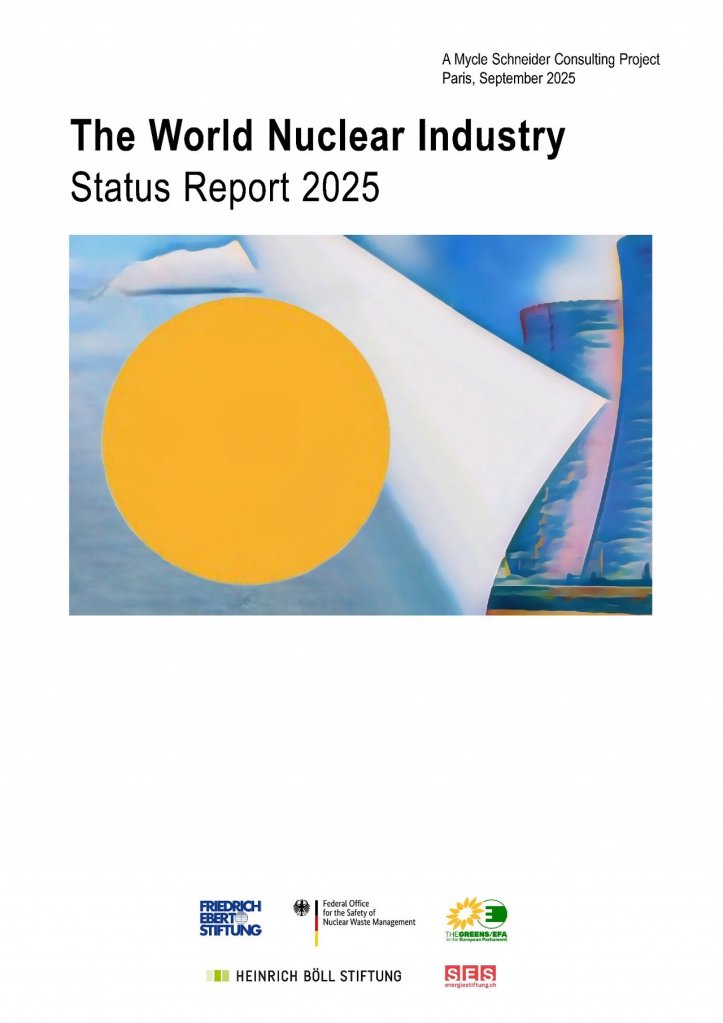
The latest edition of the World Nuclear Industry Status Report paints a glum picture for the nuclear power industry — the number of countries building reactors has plummeted from 16 to 11 over the past two years — and gives the lie to claims by the Coalition that Australia risks being ‘left behind’ and ‘stranded’ if we don’t jump on board.
That appears to be news to new Coalition energy spokesman Dan Tehan, who has taken over the portfolio from Ted O’Brien, the chief architect of the nuclear power policy that cost the Coalition around 11 seats in the May 2025 election.
Speaking to Sky News from the US, where he says he is on a nuclear “fact-finding” mission, Tehan said Sky News that “every major industrialised country, apart from Australia, is either seriously considering nuclear or is adopting nuclear technology at pace”.
Continuing with the theme, Tehan said: “Australia is going to be completely and utterly left behind, because we have a nuclear ban at the moment in place, and if we’re not careful, the rest of the world is going to move and we are going to be left stranded.”
The simple fact is, however, that there isn’t a single power reactor under construction in the 35 countries on the American continent; and the number of countries building reactors has plummeted from 16 to 11 over the past two years.
World Nuclear Industry Status Report
Tehan could — but won’t — read the latest edition of the World Nuclear Industry Status Report (WNISR-2025), released on Monday. For three decades, these annual reports have tracked the stagnation and decline of the nuclear industry.
There are two related factoids that nuclear enthusiasts can latch onto among the 589 pages of bad news in WNISR-2025: record global nuclear power generation of 2,677 terawatt-hours in 2024 and record capacity of 369.4 gigawatts (GW) as of December 2024. But they are pyrrhic wins. Both records are less than one percent higher than the previous records and they mask the industry’s underlying malaise.
Nuclear power generation has been stagnant for 20 years. Then, a relatively young reactor fleet was generating a similar amount of electricity. Now, it’s an ageing fleet. WNISR-2025 notes that the average age of the 408 operating power reactors has been increasing since 1984 and stands at 32.4 years as of mid-2025.
For the 28 reactors permanently shut down from 2020-24, the average age at closure was 43.2 years. With the ageing of the global reactor fleet and the closure of more and more ageing reactors, the industry will have to work harder and harder just to maintain the long pattern of stagnation let alone achieve any growth. Incremental growth is within the bounds of possibility; rapid growth is not.
Further, the global figures mask a striking distinction between China and the rest of the word. WNISR-2025 notes that in the 20 years from 2005 to 2024, there were 104 reactor startups and 101 closures worldwide. Of these, there were 51 startups and no closures in China. In the rest of the world, there was a net decline of 48 reactors and a capacity decline of 27 GW. So much for Tehan’s idiotic claim that Australia risks being “left behind” and “stranded”.
Even in China, nuclear power is little more than an afterthought. Nuclear’s share of total electricity generation in China fell for the third year in a row in 2024, to 4.5 percent. Nuclear capacity grew by 3.5 GW, while solar capacity grew by 278 GW. Solar and wind together generated about four times more electricity than nuclear reactors.
Since 2010, the output of solar increased by a factor of over 800, wind by a factor of 20, and nuclear by a factor of six. Renewables, including hydro, increased from 18.7 percent of China’s electricity generation in 2010 to 33.7 percent in 2024 (7.5 times higher than nuclear’s share), while coal peaked in 2007 at 81 percent and declined to 57.8 percent in 2024.
Global data
In 2024, there were seven reactor startups worldwide — three in China and one each in France, India, the UAE and the US. There were four permanent reactor closures in 2024 — two in Canada and one each in Russia and Taiwan. The 2025 figures are even more underwhelming: one reactor startup so far and two permanent closures.
As of mid-2025, 408 reactors were operating worldwide, the same number as a year earlier and 30 below the 2002 peak of 438.
Nuclear’s share of total electricity generation fell marginally in 2024. Its share of 9.0 percent is barely half its historic peak of 17.5 percent in 1996.
The number of countries building power reactors has fallen sharply from 16 in mid-2023 to 13 in mid-2024 and just 11 in mid-2025. Only four countries — China, India, Russia, and South Korea — have construction ongoing at more than one site.
As of mid-2025, 63 reactors were under construction, four more than a year earlier but six fewer than in 2013. Of those 63 projects, more than half (32) are in China.
As of mid-2025, 31 countries were operating nuclear power plants worldwide, one fewer than a year earlier as Taiwan closed its last reactor in May 2025. Taiwan is the fifth country to abandon its nuclear power program following Italy (1990), Kazakhstan (1999), Lithuania (2009) and Germany (2023).
Nuclear newcomers
Only three potential newcomer countries are building their first nuclear power plants — Bangladesh, Egypt and Turkiye. All of those projects are being built by Russia’s Rosatom with significant financial assistance from the Russian state.
(According to the World Nuclear Association, only one additional country — Poland — is likely to join the nuclear power club over the next 15 years.)
The number of countries operating power reactors reached 32 in the mid-1990s. Since then it has fallen to 31. That pattern is likely to continue in the coming decades: a trickle of newcomers more-or-less matched by a trickle of exits.
Russia is by far the dominant supplier on the international market, with 20 reactors under construction in seven countries (and another seven under construction in Russia). Apart from Russia, only France’s EDF (two reactors in the UK) and China’s CNNC (one reactor in Pakistan) are building reactors abroad.
WNISR-2025 notes that it remains uncertain to what extent Russia’s projects abroad have been or will be impacted by sanctions imposed on Russia following its invasion of Ukraine. Sanctions — including those on the banking system — have clearly delayed some projects.
Construction of nine reactors began in 2024: six in China, one in Russia, one Chinese-led project in Pakistan, and one Russian-led project in Egypt.
Chinese and Russian government-controlled companies implemented 44 of 45 reactor construction starts globally from January 2020 through mid-2025, either domestically or abroad. The one exception is a domestic construction start in South Korea.
Small modular reactors
Dan Tehan told Sky News he planned to visit Idaho to investigate developments relating to small modular reactors (SMRs). But the only significant recent SMR ‘development’ in Idaho was the 2023 cancellation of NuScale’s flagship project after cost estimates rose to a prohibitive A$31 billion per GW.
The NuScale fiasco led the Coalition to abandon its SMR-only policy and to fall in love with large, conventional reactors despite previously giving them a “definite no”.
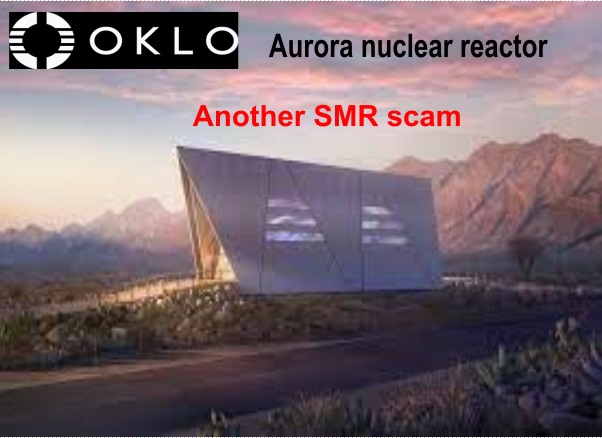
Or perhaps Tehan was at Oklo’s SMR ‘groundbreaking ceremony’ in Idaho on Monday. Oklo doesn’t have sufficient funding to build an SMR plant, or the necessary licences, but evidently the company found a shovel for a ‘pre-construction’ ceremony and photo-op.
Worldwide, there are only two operating SMRs plants: one each in Russia and China. Neither of the plants meet a strict definition of SMRs (modular factory construction of reactor components). Both were long delayed and hopelessly over-budget, and both have badly underperformed since they began operating with load factors well under 50 percent.
WNISR-2025 notes that there are no SMRs under construction in the West. Pre-construction activity has begun at Darlington in Canada. But as CSIRO found in its latest GenCost report, even if there are no cost overruns in Canada, the levelised cost of electricity will far exceed the cost of firmed renewables in Australia.
Argentina began planning an SMR in the 1980s and construction began in 2014, but it was never completed and the project was abandoned last year.
SMR wannabes and startups continue to collapse on a regular basis. WNISR-2025 reports that two of the largest European nuclear startups Newcleo (cash shortage) and Naarea (insolvent) are in serious financial trouble.
Ultra Safe Nuclear Corporation filed for bankruptcy protection in the US last year – just a year after a company representative falsely told an Australian Senate inquiry that it was constructing reactors in North America. The Nuward project was suspended in France last year following previous decisions to abandon four other SMR projects in France.
Nuclear vs. renewables
For two decades, global investments in renewable power generation have exceeded those in nuclear energy and are now 21 times higher.
Total investment in non-hydro renewables in 2024 was estimated at US$728 billion, up eight percent compared to the previous year.
In 2024, solar and wind capacity grew by 452 GW and 113 GW, respectively, with the combined total of 565 GW over 100 times greater than the 5.4 GW of net nuclear capacity additions.
In 2021, the combined output of solar and wind plants surpassed nuclear power generation for the first time. In 2024, wind and solar facilities generated over 70 percent more electricity than nuclear plants.
In April 2025, global solar electricity generation exceeded monthly nuclear power generation for the first time and kept doing so in May and June 2025. In 2024, wind power generation grew by 8 percent, getting close to nuclear generation.
Renewables (including hydro) account for over 30 percent of global electricity generation and the International Energy Agency expects renewables to reach 46 percent in 2030. Nuclear’s share is certain to continue to decline from its current 9 percent.
WNISR-2025 concludes: “2024 has seen an unprecedented boost in solar and battery capacity expansion driven by continuous significant cost decline. As energy markets are rapidly evolving, there are no signs of vigorous nuclear construction and the slow decline of nuclear power’s role in electricity generation continues.”
Dr. Jim Green is the national nuclear campaigner with Friends of the Earth Australia and a member of the Nuclear Consulting Group.
Nuclear subs base. Will it be Newy or The Gong?
“what we will end up getting is zero submarines but a bunch of new US bases.”
“all to keep on the right side of Donald Trump’s America.”
by Rex Patrick | Sep 15, 2025, https://michaelwest.com.au/nuclear-subs-base-newcastle-or-wollongong/
A business case to establish a nuclear submarine base at Port Kembla or Newcastle is being prepared for the NSW Cabinet, but the public is being kept totally in the dark. Transparency Warrior Rex Patrick reports.
It’s a radioactive issue in more ways than one, with no one in either the Federal or NSW government prepared to talk about it with the people they govern.
Discussions between the two parties are clearly well advanced, with a final NSW Cabinet submission in preparation – a fact that has been kept secret until the Department of Planning, Housing and Infrastructure inadvertently revealed it in NSW Civil and Administrative Tribunal (NCAT) proceedings.
When confronted with this revelation, Senator David Shoebridge remarked, “Two levels of Labor government are secretly planning to dump a nuclear submarine base on NSW residents and neither of them has the guts to even discuss it. The Albanese government is shovelling hundreds of billions of public dollars into the AUKUS funnel, and
“what we will end up getting is zero submarines but a bunch of new US bases.”
AUKUS is big business
Announcements over the weekend show that AUKUS is big business, with $12 billion to be spent on shipyard and naval facilities in Western Australia.
It’s clear that the question of basing nuclear submarines in NSW is an important one. There will be opinions for and against, but one thing is for sure: without information, public debate won’t occur, or if it does, it will be ill-informed.
“The two shortlisted sites for wildly unpopular nuclear submarine bases, Port Kembla and Newcastle, are both Labor heartlands,” remarked Shoebridge, a former member of the NSW Legislative Council and now NSW senator.
“Port Kembla and the Illawarra would go into open revolt if the Labor government was honest about their plans, and this explains a lot about the secrecy”.
“This secrecy risks deep generational betrayal of Labor voters in both these regions and
No doubt NSW Premier Chris Minns is salivating.
It’s clear that the question of basing nuclear submarines in NSW is an important one. There will be opinions for and against, but one thing is for sure: without information, public debate won’t occur, or if it does, it will be ill-informed.
“The two shortlisted sites for wildly unpopular nuclear submarine bases, Port Kembla and Newcastle, are both Labor heartlands,” remarked Shoebridge, a former member of the NSW Legislative Council and now NSW senator.
“Port Kembla and the Illawarra would go into open revolt if the Labor government was honest about their plans, and this explains a lot about the secrecy”.
“This secrecy risks deep generational betrayal of Labor voters in both these regions and
“all to keep on the right side of Donald Trump’s America.”
Shoebridge seems rather unimpressed. So too does his counterpart in the NSW Legislative Council, Sue Higginson, who told MWM, “Premier Chris Minns is picking up where Peter Dutton left off with a plan to dump nuclear waste at sites in regional NSW. Minns is going further by hosting nuclear subs; he’s making us and our ports vulnerable military targets, and it’s all happening behind closed doors.”
Transparency flip-flop
In May this year, I used the NSW Government Information Public Access (GIPA) Act to ask the NSW Government for access to correspondence they’d had with the Federal Government that related to the use of Port Kembla or Newcastle as a future submarine base, and any briefs prepared for NSW’s Ministers.
The response, received in June, indicated that there were 24 “internal emails” and an “Advice”, but stated that I couldn’t have them because they were “Cabinet information”.
I appealed the decision to NCAT, arguing, as per the NSW Cabinet Practice Manual, that Cabinet privilege is waived when documents are shared with officials from another polity.
That caused a backflip from the NSW Government, with them writing to the Tribunal asking that the decision be remitted back to them to allow them to reconsider their position.
The Tribunal heard their request and ordered them to reconsider the access refusal, and to do so, pronto.
And so it was on 08 September that they sent me a new decision. They’d reconsidered their position … and … the public are still not allowed to see any of the documents, for new and different reasons.
The matter will now proceed to a contested hearing on 18 December in Sydney.
NSW fait acompli participation
Everything the NSW Government does it does for the people of NSW. Everything the NSW Government does is paid for by the people of NSW. The GIPA Act recognises this and allows NSW citizens to part the curtains on the windows of Government buildings to see the information that belongs to them and affects them.
But the NSW Government is having none of that … their arguments for secrecy amount to a desire not to prejudice their relations with the Federal Government, not to prejudice the way ministers in NSW go about their business, and not to have the internal deliberations of public servants subject to public review.
It’s a case of ‘officials’ interest over public interest’.
Whether you think a nuclear submarine base at Port Kembla or Newcastle is a good or bad idea, the NSW public has a right to participate in such a decision. But the way this is lining up is that the NSW Government will look at the business case , make a decision, and then present the people of NSW with a fait accompli.
Democracy comes from the Greek word ‘demos’, meaning ‘the people’, and ‘kratia’, meaning ‘rule’: that is, ‘government by the people’. Maybe someone should remind Chris Minns of this.
Rex Patrick
Rex Patrick is a former Senator for South Australia and, earlier, a submariner in the armed forces. Best known as an anti-corruption and transparency crusader, Rex is also known as the “Transparency Warrior.”
1 This month

of the week – Australians for War Powers Reform (AWPR)
To see nuclear-related stories in greater depth and intensity
 Antinuclear