Antisemitism Royal Commission dilemma: not all Jews think the same
None of this is to excuse ‘real’ antisemitism. If the latest Pew Research Center survey, just released in the last few days in the USA, is anything to go by, 60% of US adults have an unfavourable view of Israel.
by Jeffrey Loewenstein | Apr 27, 2026 |
With the Antisemitism Royal Commission due to publish its interim report this week, a reckoning between Judaism and Israel is long overdue. Jewish community leader Jeffrey Loewenstein with the story.
Let it be said, unequivocally, antisemitism per se, as indeed any form of vilification or bigotry, is to be abhorred and has no place in a civilised community.
The vexed question of antisemitism, and what that actually means and encompasses – let alone how to combat it – will be front and centre of the Royal Commission on Antisemitism and Social Cohesion’s deliberations and, one assumes, findings.
The so-called majority of the Jewish community for whom the likes of the ECAJ, the Zionist Federation, AIJAC and the NCJW seek to speak, have shown themselves as either unequivocally positive mouthpieces supporting Israel’s actions – be it the invasion of Gaza, the killing and maiming of its people, starving Gazans, demolishing Gazan infrastructure, denying medical supplies and equipment entering Gaza, the lawlessness, the so-called settlers in the West Bank, etc.,
“or simply staying silent, no matter how egregious Israel’s actions have been.“
To say that it demonstrates an indifference to the suffering of the Gazans or the Palestinians in the West Bank is putting it mildly. It certainly demonstrates a lack of humanity and an absence of a moral compass.
And this from a people who claim to abide by the Ten Commandments and the edict of Rabbi Hillel, “That which is hateful to you, do not do unto your fellow.” That is the whole Torah; the rest is the explanation; go and learn.” (Babylonian Talmud, Shabbat 31a).
Israel’s ‘success’
The man in the street who probably considers Israel as a ‘successful’ smart country, a leader in technology and medicine, with a ‘smart’ Mossad security service, watching the nightly news bulletin with its stark images of the wanton killing and maiming of Gazans by the Israelis and children starving – and now the ongoing onslaught being undertaken by the Israelis in Lebanon – is going to be left angered and wondering how it is Israel – or is it simply the Jews – are allowing all of this to happen.
Add to that seeing Jews in Australia regularly parading with Israeli flags draped around their shoulders and waving small Israeli flags is almost certainly going to lead the average person to accept what Israeli PM Netanyahu has been saying for years – that Israel, and he, speak for and represent all Jews in the world.
“As for this writer, certainly not!“
Even our political leaders are confused. One Federal Minister justified the entry into Australia of Israeli President Herzog on the grounds that the Jewish community sought comfort post Bondi from “their national leader”. Again, not true for many.
A royal dilemma
The Royal Commissioner is going to be confronted with some stark facts. For starters, how the majority of Jews view Israel and support it.An example relating to those tragically slain in Bondi: video footage and photos of the Bondi Chabad rabbi post October 7, handing over monies in the West Bank in support of the settlers and posing with a rifle and rocket.
The ready conflating of being anti-Israel and what is said to be antisemitism is nowhere better seen than in the ECAJ Report on antisemitism in Australia, citing as part of its statistics how, allegedly, antisemitism has risen in Australia post October 7 by something such as a daubing on a wall “Free Palestine”.
The Special Envoy on antisemitism, Jillian Segal, would have us believe that the weekly protest marches, and even the eventful march across the Sydney Harbour Bridge (under the Banner, March for Humanity), engendered antisemitism.
Antisemitic or anti-Israel?
There have been many attempts to conflate being anti-Israel with being antisemitic, including pushing the IHRA “definition” of antisemitism.
Aside from many learned Jewish scholars challenging the definition, many Jews, critical of Israel, would be “caught” as being anti-Semitic. Members of the Australian Jewish community are now publicly (even on ABC Radio National) resorting to calling those Jews who speak out about Israel’s actions as being “anti-Jewish”.
Interestingly, a research report, ‘The Journeys and Destinations of Young Jewish Anti-Zionists’, out of the USA a couple of months ago, concluded, inter alia, that many said to be anti-Zionist were deeply knowledgeable about Jewish practice and history, with some having attended Jewish day schools and some serving as rabbis.
There is no reason to think that those findings in the USA would not equally apply in Australia.
It has hardly been surprising that people have been venting their anger at Israel’s actions. The weekly demonstrations for more than 2 ½ years are clear evidence of that.
“The Royal Commissioner and the majority of Jews in Australia are going to have to grapple with anti-Israel sentiment.“
And in both political parties, majorities of adults under the age of 50 now rate Israel and Netanyahu negatively, and six-in-ten have a very or somewhat unfavourable view of Israel. It is likely a survey in Australia would parallel the US one.
The Royal Commissioner will be hard-pressed to come up with definitive findings as her mandate requires. For their part, there are going to be many Jews unable to explain why there has been this so-called antisemitism as distinct from things best described as simple anti-Israeli / anti-Zionist sentiment.
One very obvious question, and the critical one which is the elephant in the room no one seems to want to ask is,
“why is it that this so-called and alleged antisemitism has risen since 7 October?“
Jeffrey Loewenstein
Jeffrey Loewenstein LL.B was a member of the Victorian Bar and a one-time Chairman of the Anti-Defamation Commission and member of the Jewish Community Council of Victoria.
The Enforcement. The lobby that bought Australian democracy
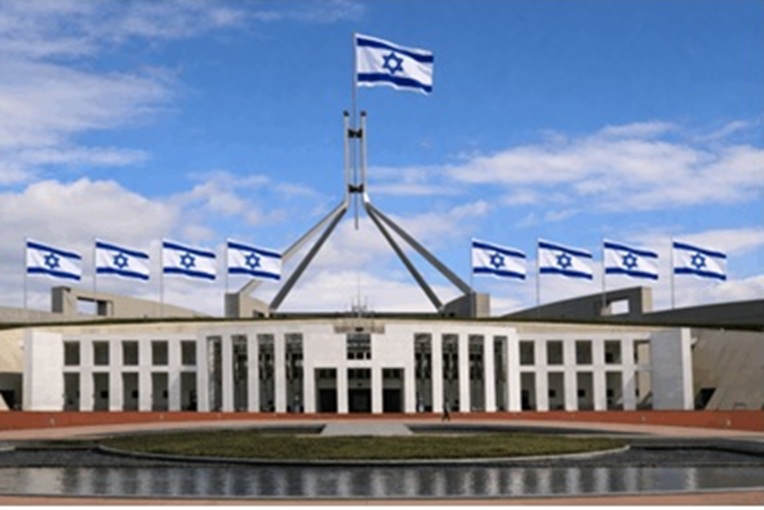
by Andrew Brown | Apr 29, 2026, https://michaelwest.com.au/the-enforcement-the-lobby-that-bought-australian-democracy/
Australia’s sovereignty is routinely violated by Israel. Our institutions utterly subject to foreign interference. Andrew Brown presents the devastating case for a royal commission into Zionist influence in Australia.
Yesterday we laid out the machinery of the most serious foreign influence operation ever conducted on Australian soil: the quasi-diplomatic network operating from inside Australian institutions, the 500-plus politicians and journalists conditioned in Tel Aviv at a foreign government’s expense, the foreign minister instructed by a donor network to recant established international law, the attorney-general who adopted Israeli legal talking points as official Australian government language, the $164 million in security infrastructure extracted from Australian taxpayers for a community of 120,000 people, and the government-appointed envoy drawn from the lobby itself whose job is to put Israeli government policy beyond the reach of Australian public criticism.
Today we examine the enforcement arm. What this operation does to individuals, institutions, and the fundamental democratic rights of ordinary Australians who exercise their right to disagree. And what it did, for more than a decade, with Australian sovereignty itself.
Begin with the act of sovereign violation so grave that it should have ended the bilateral relationship and produced a permanent rupture in Australian foreign policy.
It did neither. Mossad, the Israeli state intelligence agency, operated a spy cell based in Sydney for more than a decade. Under ASIO’s nose. Using Australian infrastructure. Recruiting from Australian universities.
In 2010, Mossad operatives carrying forged Australian passports entered Dubai, a country with which Australia maintained cordial diplomatic relations, and assassinated Palestinian leader Mahmoud Al-Mabhouh. An Israeli diplomat in Canberra, Amir Laty, was expelled over his connection to the cell.
“The Australian government attempted to keep his expulsion secret to avoid embarrassing Israel.”
Ben Zygier, an Australian citizen known as Prisoner X, worked for Mossad, spied on fellow students at Monash University, and used his Australian passport to conduct espionage operations across Arab and Muslim countries. He died in an Israeli prison.
A New Zealand Mossad cell was separately caught attempting to fraudulently obtain New Zealand passports. The Australian official who summarised the government’s operative posture did so anonymously, because to say it on the record would have been politically unsurvivable.
He was quoted by journalist Peter Hartcher in the Sydney Morning Herald on 26 February 2010. Israel, he said, had calculated that even if caught forging Australian passports to carry out targeted assassinations,
“Canberra would not retaliate. It wouldn’t matter who sat in the prime minister’s chair.”
The Israelis, this official said, know they’ve got us by the balls, partly because of the Israel lobby. State-sanctioned murder using forged Australian documents.
A foreign intelligence service operating on Australian soil for over a decade. An expelled diplomat whose removal the government tried to hide.
And the judgement of an Australian national security official that none of it would produce consequences because the lobby had made consequences impossible. If China had done one tenth of this, Australia would have severed diplomatic relations and jailed everyone it could reach.
“Israel did all of it and received a quiet request not to do it again.”
State premiers captured
In the domestic political arena, three state premiers have served as the lobby’s most recent and most openly authoritarian instruments.
Peter Malinauskas personally intervened to cancel a Palestinian author from Adelaide Writers’ Week. The festival director resigned.
“The event collapsed.”
A state premier, acting on behalf of the interests of a foreign government, destroyed a celebrated literary event and ended a festival director’s role in the process.
David Crisafulli’s Queensland government made two phrases associated with Palestinian solidarity punishable by up to two years imprisonment. An eighteen-year-old Australian was charged for the act of wearing a shirt. Twenty people were arrested at a peaceful protest for the act of chanting.
Chris Minns rushed legislation through the NSW parliament on Christmas Eve 2025, in a deliberate legislative ambush, handing the police commissioner power to ban all protest marches across entire areas of Sydney for up to three months following a declared terror incident.
A unanimous bench of the NSW Court of Appeal struck it down as an unconstitutional burden on the implied freedom of political communication.
“Three premiers. Three states. One foreign government’s interests.”
Zero words of criticism from the Prime Minister of Australia. The suppression of political speech and peaceful assembly on behalf of a foreign power, conducted by state governments and met with federal silence. In what functioning democracy does this not constitute a crisis of the highest order?
Crushing ‘difficult’ people
Now watch what the enforcement machinery does to individuals. Grace Tame was the 2021 Australian of the Year. A survivor of institutional child sexual abuse who built a national platform of such moral clarity that the entire political establishment had learned to treat her as beyond reproach. She began speaking about Palestine.
She attended protests. She shared Human Rights Watch reports documenting starvation in Gaza. In February 2026 she attended a rally in Sydney protesting the visit of Israeli President Isaac Herzog and led the crowd in a chant.
What followed was not a spontaneous public backlash.
“It was a coordinated campaign of economic and reputational destruction,”
executed with the speed and precision that only a well-resourced, well-organised, and permanently mobilised network can produce.
Nike cut her sponsorship within days.
Her speaking engagements disappeared from her calendar. By March 2026 she told a conference in Hobart that it was her last engagement for the year. It was March. Twenty-five thousand Australians signed a petition demanding her Australian of the Year award be stripped from her.
Coalition members of parliament stood in the national legislature and called her a terrorist sympathiser.
And Anthony Albanese, the Prime Minister of Australia, when directly asked to describe Grace Tame, produced a single word: difficult.
“Difficult.”
The survivor who forced child sexual abuse onto the national agenda at enormous personal cost. Difficult. The woman who said that Palestinian civilians, like all civilians, had a right not to be bombed, starved, or shot. Difficult.
The Prime Minister of Australia reached for the oldest and most reliable instrument of dismissal in the political class’s toolkit: the word that powerful men have always used for women who refuse to stay within the lines drawn for them by the people who write the cheques.
The lobby made no public statement. It did not need to. Nike had already cut the sponsorship. The speaking circuit had already closed. The petition had already collected its signatures.
The MPs had already used the word terrorist in Hansard. The work had been done without the lobby needing to appear in the story at all.
“That is what mature, embedded institutional power looks like.”
It does not need to act visibly. It has already arranged for everyone else to act on its behalf.
The reach extends into the newsrooms and it has been there for decades. Veteran ABC journalist John Lyons documented it in his 2021 book Dateline Jerusalem, writing that in forty years of journalism he had never encountered a lobby as formidable, well-funded, or relentlessly effective as the pro-Israel lobby in Australia, and that material the lobby succeeded in suppressing here was routinely published in Israel without consequence or controversy.
Best funded foreign influence operation in Australia
Bob Carr called Lyons’ account the definitive record of the most concerted and best-funded foreign influence operation in Australia.
Every journalist who has worked on this subject in the Australian press knows what Lyons and Carr documented, because they have experienced it themselves: organised complaints to management, coordinated pressure on executives, personal vilification campaigns, threats to advertiser relationships
The lobby does not need to own Australian media. It only needs editors and proprietors to understand the cost of genuine independence, and to calculate that the cost exceeds the benefit. In most Australian newsrooms, they have made that calculation and arrived at compliance.
The case of Antoinette Lattouf demonstrated the consequences for those who don’t. She was removed from ABC air in December 2023 for sharing a Human Rights Watch report documenting Israel’s use of starvation as a weapon of war in Gaza.
The Federal Court subsequently found the ABC had breached the Fair Work Act by terminating her engagement on the basis that she held a political opinion opposing the Israeli military campaign.
The Sydney Morning Herald revealed that a WhatsApp group calling itself Lawyers for Israel had lobbied ABC management directly and specifically for her removal.
Australia’s public broadcaster, funded by Australian taxpayers and constitutionally obligated to editorial independence,
“removed a journalist from air at the instruction of a foreign-aligned lobby group operating by messaging app”
That is not an editorial error. That is the surrender of a public institution to private foreign-aligned coercion. And the ABC’s board and management have never been required to account for it.
If it were China?
Apply the same facts to China. Not as analogy. As a direct accountability test. If Chinese-linked organisations were the single largest private funders of overseas trips to federal MPs, ASIO would have declared it a national security emergency.
If a Chinese intelligence agency had based a spy cell in Sydney for over a decade using forged Australian passports to conduct state-sanctioned assassinations abroad, it would constitute the gravest breach of Australian sovereignty in the country’s peacetime history and the bilateral relationship would not survive it.
If a Chinese-aligned lobby had pressured the ABC to remove a journalist critical of Chinese government policy, the story would have dominated national coverage for months and produced a parliamentary inquiry within weeks.
If a serving foreign minister had declared China’s struggles are our struggles, their values are our values from an award ceremony podium, her resignation would have been demanded before she left the building. If the attorney-general had told a Senate hearing that calling Tibet an occupied territory was too pejorative to use in official Australian discourse, he would not have returned to the chamber.
If three state premiers had introduced legislation to criminalise speech critical of Chinese government policy, or to give police the power to ban all marches in city zones for months at a time, the word used across every editorial in this country would have been the same:
“treason.”
We do not need to speculate.
We have watched the Chinese comparison play out in real time at a fraction of this scale and the consequences were terminal. Sam Dastyari expressed views aligned with Chinese positions after accepting connected donations. No secrets passed. No law was broken. His career was finished.
Andrew Robb left the ministry overseeing Darwin Port and signed a $2.25 million consulting contract with the Chinese company that had just received a 99-year lease on it.
The scandal produced years of national coverage and ultimately the Foreign Influence Transparency Scheme: legislation designed specifically to track and constrain the purchase of access to Australian political institutions by foreign-aligned interests. ASIO names foreign interference, the public shorthand for China, as a top-tier national security threat in every annual assessment it publishes.
Except for Israel
The entire architecture of Australian national security is built on a single premise held to be non-negotiable: that a foreign government purchasing influence inside Australian democratic institutions is an existential threat to sovereignty that must be identified, resisted, and where possible prosecuted.
The Foreign Influence Transparency Scheme has never produced a public disclosure about AIJAC. The ASIO annual threat assessment has never named the Israeli lobby.
The parliamentary inquiries that ended Dastyari’s career and produced years of national debate have no equivalent examining the 500 politicians and journalists conditioned at Israeli government expense, the donor networks that instructed a foreign minister to recant international law, the Mossad spy cell that operated from Sydney for a decade using forged Australian documents, the foreign-government-funded quasi-diplomatic agencies embedded across Australian institutions, the lobby that pressured the national broadcaster to remove a journalist by WhatsApp, or the three premiers who suppressed political speech and peaceful assembly on behalf of a foreign government’s interests.
The apparatus constructed to protect Australian sovereignty from foreign purchase has one explicit, unwritten, never-debated, never-voted-upon exemption.
“Every senior person in Canberra knows what it is.“
They have calculated, morning after morning for thirty years, that acknowledging it is more dangerous to their careers than enabling it. That calculation is itself the evidence.
That is not a principled distinction between China and Israel. That is a purchased one. The receipt is in the parliamentary interests register. It is in Hansard. It is in Federal Court judgments.
It is in the published memoirs of a foreign minister who was told to be straightened out. It is in the Sydney Morning Herald report quoting a senior Australian national security official saying Israel has us by the balls because of the lobby.
The evidence does not need to be assembled. It has been sitting in plain sight for thirty years, in public documents, in published books, in court records and parliamentary transcripts.
A national emergency
The question is not whether it exists. The question is why a country with functioning democratic institutions and a free press has never once treated it as the national emergency it plainly is.
The evidence assembled across these two articles does not call for more journalism. It calls for a Royal Commission.
“A Royal Commission into Israeli foreign influence across all levels of Australian government.“
The terms of reference write themselves from the public record alone. The AIJAC trip program: who was taken, what they were shown, what positions they held on return, and what decisions they subsequently made on matters of direct relevance to Israeli government interests.
The donor networks: their documented intersection with foreign policy outcomes from the Gareth Evans threats of 1992 to the Bob Carr instruction of 2013.
The roles of the ECAJ, the ZFA, and the state Boards of Deputies as quasi-diplomatic agencies for a foreign government, in their own published words in their own publications.
The $164 million in security expenditure: the political process that produced it, why it was never subject to comparative public assessment against the security needs of other communities, and the decision-making chain that accelerated it after Bondi.
The Mossad operations: the decade-long spy cell based in Sydney, the assassination using forged Australian passports, the expelled diplomat whose removal the government tried to suppress, and the complete and deliberate absence of any proportionate response.
The instruction to Bob Carr: who issued it, under whose authority, whether it constituted improper interference in the sovereign conduct of Australian foreign policy, and who else received similar instructions and complied without ever recording it.
The three state premiers: who coordinated their legislative responses, what communications passed between them and lobby organisations, and whether those communications constitute evidence of foreign-government-aligned interference in state legislative processes.
The ABC: the chain of communications between Lawyers for Israel and ABC management in the Lattouf matter, who authorised the removal, and whether the ABC’s board was aware.
Jillian Segal powers
The Segal appointment: the process by which an active advocate for a foreign government’s interests was appointed to a quasi-regulatory role with the
“power to recommend the defunding of Australian cultural, academic, and media institutions.“
We held a Royal Commission into trade union governance. We held one into the banking sector. We are right now holding one into antisemitism, announced within weeks of a single event, with findings due within twelve months, and interim findings this week.
The question of whether a foreign government has, over thirty years, systematically purchased the compliance of Australian democratic institutions, usurped the conduct of Australian foreign policy, operated a state intelligence network on Australian soil using forged Australian documents to conduct murder abroad, corrupted the editorial independence of the national public broadcaster, and constructed a domestic legal and regulatory apparatus to protect its own conduct from Australian public scrutiny, is
“a question that dwarfs every Royal Commission this country has ever convened.”
If the answer is no, the inquiry will say so and the lobby will be vindicated. If the answer is yes, and the public record already indicates what the answer is, then every Australian citizen has been the victim of a fraud conducted against their democracy by a foreign power and its local agents, for thirty years, with the full knowledge and active participation of the people they elected to protect them.
Stated plainly
Something must be stated plainly before this piece closes. I have never held antisemitic views and I never will. My godparents were Jewish Hungarian Holocaust survivors.
My godfather went on to become a prominent and respected figure in both the Australian business world and the Jewish community. He was a founder of the Hakoah Club. I grew up with a precise and personal understanding of what antisemitism is, what it costs, and where it ends.
“This series is not a critique of Jewish Australians.“
It is a critique of something wholly different: the coercive scale of a foreign influence operation conducted on behalf of the Israeli government, by Australian citizens acting as its agents, against the democratic institutions of their own country.
Antisemitism weaponised
The lobby’s reflexive branding of any examination of its own institutional power as racial hatred of Jewish people is not a defence. It is the operational core of a suppression mechanism.
It has worked because it was designed to work and because too many people who knew exactly what it was decided that
“the personal cost of calling it out exceeded the democratic cost of ignoring it.“
That calculation has now produced the country documented in these two articles. Decide for yourself whether you can live with it.
For Netanyahu, crimes against humanity
On November 21, 2024, the International Criminal Court issued arrest warrants against Benjamin Netanyahu for war crimes and crimes against humanity. Australia is a signatory to the Rome Statute.
Canada said it would arrest him. France said it would arrest him. The Netherlands said it would arrest him. Albanese has said nothing of legal consequence.
He has not named what is happening in Gaza with the word the ICC has already used and the evidence demands. He has not imposed sanctions. He has not withdrawn the ambassador.
He has produced statements of such deliberate, crafted, lawyered vagueness that they constitute not diplomacy but performance: calibrated to suggest concern while guaranteeing inaction, designed not to communicate a position but to preserve the fiction of having one, while the donor network that purchased that silence continues to operate across every level of Australian government without scrutiny, without accountability, and
“without a single journalist in the parliamentary press gallery willing to stand up and call it what it is.”
That is not the restraint of a statesman navigating genuine complexity. That is the immobility of a man who knows the price of his position down to the last dollar, knows who set it, knows what the invoice covers, and has decided every morning for years that paying it is less dangerous than the alternative.
He is not alone.
He is the current representative of a thirty-year institutional posture shared by both major parties, dozens of ministers, three premiers, a national broadcaster, and a press gallery that has collectively decided the story is not worth the grief.
“Every one of them is wrong.“
And every Australian who still believes this country’s democratic institutions belong to its citizens, and not to the agents of a foreign power, should be demanding to know why.
Andrew BrownAndrew Brown is a Sydney businessman in the health products sector, former Deputy Mayor of Mosman and Palestine peace activist
Antisemitism and Israel: A challenge to the Australian narrative (Part 1)
UN Special Rapporteur Francesca Albanese has delivered the 21-page report, ‘Torture and genocide: Report of the Special Rapporteur on the situation of human rights in the Palestinian territories occupied since 1967’, dated 19 February 2026. Albanese’s team outline the depths of depravity and inhumanity to which the Israeli regime has now sunk in its attempted destruction of the Palestinian people.
By Evan Jones | 27 April 2026, https://independentaustralia.net/politics/politics-display/antisemitism-and-israel-a-challenge-to-the-australian-narrative,20974
A provocative Royal Commission submission by Dr Evan Jones argues that Australia’s antisemitism debate cannot be separated from Israel, Zionism and their political influence.
Submission to the Royal Commission on Antisemitism and Social Cohesion
Part 1
General
This submission can be reduced to one word — Israel.
There you have the answer to your inquiry. Dismantle apartheid Israel and see so-called “antisemitism” disappear overnight, save for a small ineradicable but prosecutable fringe
There is really no reason for this Royal Commission at all, as the problem is self-evident. The Commission will not solve the problem that it was formally established to resolve because its agenda is diversionary. Indeed, it will compound the problem because it will, in all probability (as it is seemingly intended to do), reinforce the influence of the Australian Zionist lobby and thus the ongoing impunity of Israel.
The problem arises from the conflation of two forces.
One: Israel is a nation founded on terrorism and wilfully sustained on deep-seated racism.
We know that nation-states are perennially born of violence, expropriation and repression (Australia as a case study), but Israel is a pronounced variation on a common colonialist theme. Israel was born of naked terrorism against an entire (non-Jewish) indigenous population. It was explicitly created and has been sustained as a racist apartheid state. Its borders have never been determined, envisaging ongoing expansion (lebensraum) — “from the river to the sea” (and beyond).
Palestinian Israelis (descendants of those whom the Zionist terrorist gangs failed to expel) are second-class citizens. Palestinian non-Israelis, under Occupation and under martial law, are denied the most basic human rights. Gaza has been a concentration camp since Sharon supposedly “disengaged” from Gaza in 2005.
The sadistic murder of Gazans since October 2023 is reminiscent of the Germans’ feverish pursuit of Jews and Bolsheviks after Operation Barbarossa in June 1941. Israel has long undermined United Nations Relief and Works Agency for Palestine Refugees in the Near East (UNRWA) personnel and facilities, which attempt to instil a modicum of humanity into a population long starving from Israeli blockages. Israel endorses carnage by fanatical settlers on West Bank Palestinians, murdering and destroying Palestinian livelihoods at will — for which they enjoy absolute immunity.
The Israel Defence Forces (IDF) murder children with pleasure. Children are imprisoned indefinitely for throwing stones. Adult prisoners are tortured and murdered. Israel wilfully murders foreign dignitaries (most recently, the Iranian National Security Council chief Ali Larijani, reputed “moderate” and skilled negotiator), which highlights that mass murderer Benjamin Netanyahu has put to words what has been the manifesto of all Israeli leadership: there will never be a Palestinian state (September 2025).
Long-term ethnic cleansing has now turned to genocide, ongoing in defiance of the formal “ceasefire”. Israel destroys essential infrastructure, murders aid workers and journalists — because it can. The journalist murder count is now further “totting up” in southern Lebanon.
Representative — this month (March 2026) marks the 23rd anniversary of the crushing of American Rachel Corrie by an Israeli bulldozer.
UN Special Rapporteur Francesca Albanese has delivered the 21-page report, ‘Torture and genocide: Report of the Special Rapporteur on the situation of human rights in the Palestinian territories occupied since 1967’, dated 19 February 2026. Albanese’s team outline the depths of depravity and inhumanity to which the Israeli regime has now sunk in its attempted destruction of the Palestinian people.
Some excerpts:
Torture has always been a central feature of Israel’s dispossession of Palestinians. Yet, since October 2023, Israel has employed it on a scale that suggests collective vengeance and destructive intent.
Torture is not confined to cells and interrogation rooms. Through the cumulative impact of mass displacement, siege, denial of aid and food, unrestrained military and settler violence and pervasive surveillance and terror, the occupied Palestinian territory (oPt) has become a space of collective punishment, where the destruction of the conditions of life turns genocidal violence into a tool of collective torture with long-term mental and physical consequences for the occupied population.
During its Mandate in Palestine, Britain used torture as one of the counterinsurgency tactics honed in Ireland and later imparted to Zionist militias; such practices, a colonial legacy, were then absorbed into the Israeli security apparatus before and after 1948 as a tool of repression and a preventive measure against Palestinian resistance. From early State-building and through decades of occupation, Israel has practised and condoned coercive violence as a structural component of its apparatus of domination.
An ecosystem of discriminatory legal frameworks and abusive operational practices has metastasized, encompassing Israeli military detention sites and prisons.
Since October 2023, torture in detention has, been used on an unprecedented scale as punitive collective vengeance — a clear feature of genocide. All Palestinians have been treated collectively as “terrorists” and “security threats”.
For her luminous competence, commitment and courage, Albanese was subject to comprehensive oppressive sanctions by the unhinged U.S. Trump Administration in July 2025.
Israel defies all international institutions and laws that proscribe the abuse of state power. Israel’s lobbying and propaganda regime (hasbara) is probably the most extensive of any state in history. Israeli authorities lie about the state’s forces’ actions without remorse.
The Israeli state is a parasite, receiving over US$300 billion (AU$418.7 billion) in aid from U.S. governments since 1950 (a great deal of which flows back to U.S. weapons manufacturers), supplemented by an estimated US$2 billion (AU$2.8 billion) per annum in donations from overseas Jewish “charities”, propped up at the country taxpayers’ expense. In particular, the Jewish National Fund directs funds to obliterating indigenous history in historic Palestine.
In short, the state of Israel is a pariah state, a barbaric regime, an abomination.
Two: All self-described “official” Jewish representative organisations in Australia support and lobby for Israel unreservedly. It is a full-time occupation.
Such “representative” organisations oppose basic human rights for Palestinians under Israeli control. They socialise their children into “a love of Israel” in Jewish “faith” schools. Some of their children are currently enrolled with the IDF to kill Palestinians.
Such organisations lobby Australian governments to support Israel, inhibiting Australian governments from adopting a principled stance towards Israeli criminality. They harass media management and editorial, thus gaining privileged access to and biased coverage from media outlets that the public relies on for supposedly unbiased information and opinion. Their ridiculous defences of Israel (op-eds, letters, buying off journalists) are published with great regularity. Anti-Zionist Australian Jews (vide Louise Adler and so on) and their organisations (the recently formed Jewish Council of Australia) are pilloried, indeed “excommunicated”.
In essence, Australian Jewish “representative” organisations act as a fifth column for a foreign state against Australian national interests – naturally antagonistic to ‘social cohesion’.
One and two in combination.
The Australian Jewish community, by virtue of its “official” representatives, courageous dissenters excepted, is complicit in Israeli genocide. And not just passively but actively. There has been no mea culpa on the part of executives of the key Jewish organisations (such as ECAJ, ZFA, AIJAC). Nobody in the Jewish community that underpins these organisations has sought to overturn the leadership of these key organisations in order to reorient their agenda and priorities.
In short, Israel and the “official” Australian Jewish community are joined at the hip.
It is not unrealistic to infer that the Bondi attack (and multiple incidents simply labelled “antisemitic”) is blowback for Israel’s character and actions and its local support network. The Israeli machine thus puts the security of global Jewry at risk (indeed, its own Jewish population) and doesn’t care.
A Zionist foot soldier is published in The Sydney Morning Herald (22 March), in denial regarding the intimate connection:
‘While David Leser’s article (SMH & Melbourne Age, 20 March [2026]) raises some thought-provoking points, it falls into the trap of attributing antisemitism in Australia to the actions of the Israeli Government. No other national or ethnic group in Australia is held to account for the actions of governments in countries overseas. So why is it considered reasonable for Jews in Australia to be relentlessly discriminated against for the actions of the Netanyahu Government?’
After the Bondi Beach murders, Israeli flags were well represented among the flower collections and mourners. Israel is apparently seen as the mother ship, the source of solace for those suffering, yet it is the ultimate cause of that suffering.
This bizarre anomaly is enhanced when the Zionist Federation of Australia (as befits its name) initiated the idea of inviting the Israeli President, Isaac Herzog, to Australia, subsequently legitimised and authorised by Prime Minister Anthony Albanese and dragging the Governor-General into the sordid process.
Another foot soldier grasps the connection but declines to understand the implications (SMH, 9 January 2026):
‘President Herzog is the legitimate head of state of the internationally recognised democratic state of Israel, rightfully invited to commiserate with Australians after the appalling terrorist atrocity at Bondi, in which predominantly Jewish people were murdered and injured.’
One notes in passing that Israel is not a democracy but an ethnocracy — no amount of affirmation is going to change the lie and the blind spot in the letter writer’s eye. To repeat, Israel is apparently seen as the mother ship, the source of solace for those suffering, yet it is the ultimate cause of that suffering. ‘Rightfully invited’ — really?
Herzog is not a passive head of state but an active participant in Israeli barbarism. Herzog comes to Australia, spends a token moment with victim families and survivors, declines to visit the fire-bombed Orthodox (non-Zionist) Adass Israel synagogue (“for reasons of security”) and spends the bulk of his time playing Israeli politician (‘not the time for a two-state solution’, meets with ASIO and so on).
The implication is ugly. Those murdered at Bondi are being instrumentalised (as with Netanyahu’s treatment of Hamas’ Israeli hostages) in the defence of the state of Israel and its current genocidal agenda. Appalling, no?
Antisemitism and Israel: A challenge to the Australian narrative (Part 2)
By Evan Jones | 27 April 2026, https://independentaustralia.net/politics/politics-display/antisemitism-and-israel-a-challenge-to-the-australian-narrative,20974
Part 2
The Commission’s Terms of Reference
‘AND the determination of the Australian Government to respond to the attack, and the factors leading up to the attack, as a matter of urgency by addressing antisemitism within the Australian community, including since 7 October 2023.’
Investigating the factors leading up to the attack could and should have been the responsibility of the mooted and more suited Richardson review. A royal commission is not the most appropriate vehicle towards this end.
Any investigation regarding “antisemitism” in Australia has to put Israel front and centre. The “official” Jewish community, AKA the Zionist lobby, naturally wants to exclude it.
The appalling Segal Report contains no substantive reference to Israel (my dissection here and here), thus being not merely worthless but disingenuous (vide Gwenaël Velge’s summary of the counter-Segal Greenslade and Briskman report, Not in Our Name: Jewish Australians Speak Out) and dangerous. Ditto the absence of any substantive reference to Israel in the most recent annual report (December 2025) of the Executive Council of Australian Jewry (sic) (dissected here).
‘AND that the Australian Government has adopted the International Holocaust Remembrance Alliance’s working definition of antisemitism.’
This submitter is frankly gobsmacked to find that this fraudulent “definition” has been officially adopted. The definition has been widely criticised, including by one of its originators, Kenneth Stern. The International Holocaust Remembrance Alliance (IHRA) definition is essentially about demonising criticism of Israel. Any proposed definition of antisemitism that attempts to delineate the terms on which one is allowed to criticise Israel without censure is automatically illegitimate.
The adoption of the IHRA definition nullifies any legitimacy that the paraphernalia of a royal commission might have and destroys any prospect of an honest analysis and a substantive functional prognosis. This adoption of the IHRA definition gives the impression that the Royal Commission, even inadvertently, will serve as yet another front for the pro-Israel lobby.
With the Royal Commission proceeding based on the IHRA definition, it can only turn into an inquisition. It can have nothing intelligent or ethical to offer about real antisemitism and can have nothing to offer in terms of genuinely dealing with it. It will be remembered as a squandering of the significant money that funds it and for the farcical theatre that is its essence.
‘AND recognising that strengthening the national consensus in support of democracy, freedom and the rule of law (social cohesion) provides the strongest defence against antisemitism and other forms of religious and ideologically motivated extremism.’
This sentence reads like it was written by AI. Who wrote this rubbish? One cannot have social cohesion as long as a particular Australian community coheres and operates actively as a fifth column in support of a foreign rogue state and influences Australian politics, both foreign and domestic, and media towards that end.
AND that hearing from the Jewish Australian community will be important to informing the recommendations of your inquiry and recognising concerns relating to educational and cultural institutions, and other sections of Australian society.’
Which ‘Jewish Australian community’? Is this obscurantism a product of naivete or of cynical contempt? Is the pro-Israel lobby running this show? Will anti-Zionist Jews and their organisations be consulted? Will anti-Zionist non-Jewish organisations (which have Jewish membership), such as the Australia Palestine Advocacy Network, be consulted?
‘…and recognising concerns relating to educational and cultural institutions…’ Meaning? Which and whose concerns? Is this an oblique reference to forthcoming censorship, sackings, institutional defunding and hasbara implants as foreshadowed in the Segal Report?
To the Honourable Virginia Bell AC
We do… appoint you to be a Commission of inquiry, and require and authorise you to inquire into the following matters:
(a) tackling antisemitism by:…
This section is at the heart of the Commission’s Terms of Reference misdirection. Misdiagnosed symptoms are highlighted rather than causes.
The authorities need to cut the umbilical cord between the Australian Jewish community (including demolishing the pernicious influence of its Zionist leadership) and the criminal state of Israel.
In particular, (a)(iv) deserves comment. The ‘mental health and wellbeing of Jewish Australians’? No doubt the Commission hearings will consider the mental health of anti-Zionist Australian Jews who experience the mental anguish of seeing Jewish Israelis acting like Nazis (and supposedly in the name of global Jewry), but who also suffer the obloquy of abuse by the Australian Zionist Jewish establishment for their ethical stance.
As for the mental health of Australian Zionist Jews, tied inexplicably to a racially supremacist Israel, it is a psychopathology and to their own account — save that their aberrant mental state has the Palestinians (and now the Iranians and, once again, the Lebanese) as its ongoing victims.
Zionist Jewish University students, fresh from their “faith” schools with their “love of Israel” and now nurtured in the bosom of the Zionist Australasian Union of Jewish Students, find their “sensitivities” affected by campus protests against Israeli genocide. So as not to upset these sensitive souls, inured to the genocide of lesser ethnicities, campus protests have to be shut down.
If the Commission is concerned with shoring up the ‘mental health and wellbeing of [Zionist] Jewish Australians’, it is not an agenda that any Australian imbued with ethical sympathies (which includes anti-Zionist Jewish Australians) could have any tolerance for.
‘(b) making any recommendations to assist law enforcement, border control, immigration and security agencies…’
Is this code for inhibiting access to refugee status of people escaping Israeli onslaughts and who naturally take a dim view of Israel’s modus operandi?
‘(c) examine the circumstances surrounding the antisemitic Bondi terrorist attack…’
This was supposed to be the focus of the Richardson review, but that was merged inappropriately into the Royal Commission’s framework. Now Richardson has retired, recognising the Commission’s structured dysfunctionality. The most important subject for investigation is now without a suitable home and personnel to proceed.
‘(d) make any other recommendations… that would contribute to strengthening social cohesion…’
The means to strengthening social cohesion is to dismantle the pro-Israel lobby in Australia and for the Albanese Government to develop and sustain a principled foreign policy. By contrast, the Terms of Reference of this Commission appear to direct the Commission’s operations to enhance that lobby’s influence and to ignore and to implicitly condone the Government’s cowardice.
Methinks that the Royal Commission’s slip is showing. One gets the strong impression that one is in for more than farce. Rather, the Australian public is in for an authoritarian state run in the interests of an Australian Zionist mafia, with which the current Australian Labor Government is already in cahoots (and the Liberal Opposition even more craven).
From Welfare to War: Following the 2007 Money Trail
25 April 2026 Michael Taylor, https://theaimn.net/from-welfare-to-war-following-the-2007-money-trail/
Many social media articles lately push a familiar argument: as defence spending rises, government services fall behind. The more we allocate to the military, the more strain we place on the systems people rely on every day.
There’s nothing new about that trade-off.
I was reminded of a revealing example from the Iraq War era – one that says as much about honesty in government as it does about priorities.
The story began with the “Welfare to Work” (WtW) program introduced by the Howard government in 2005. Its stated aim was to increase workforce participation among single parents, people with disabilities, and older unemployed Australians. The policy details matter less than what came next.
For some time, WtW attracted little attention. That changed in March 2007 – an election year, and a moment when the government needed good news. Suddenly, the program was being promoted as a success.
Joe Hockey, then Employment Minister, pointed to what he described as a $500 million “budget surprise,” attributing it to falling numbers of people receiving income support. The implication was clear: welfare reform was working, and fewer Australians needed assistance.
But the numbers told a different story.
Disability Support Pension (DSP) figures for the period at the time showed:
- 2006: 712,163
- 2007: 714,156
- 2008: 732,367
These were not declining figures. They were rising.
So where did the supposed $500 million saving come from?
Contemporaneous accounts from within the Department of Employment and Workplace Relations suggest that “savings” of this kind were not simply the by-product of policy success. Rather, departments were under pressure to identify substantial reductions in projected spending – figures that did not always align neatly with underlying demand.
In practical terms, that meant looking for money that could be reclassified, deferred, or absorbed elsewhere. The distinction matters. On paper, it looks like efficiency. In reality, it can amount to something closer to accounting necessity.
What can be said with confidence is this: the demand for support did not fall in the way the government claimed. Yet a saving was still found.
The question then becomes: why?
In February 2007, U.S. Vice President Dick Cheney visited Australia. Shortly afterwards, Prime Minister John Howard committed additional Australian support to the war in Iraq, including logistics personnel and army trainers.
The timing is difficult to ignore.
Governments do not operate in silos. Budgetary decisions in one area are often shaped by pressures in another, even if those connections are never made explicit. What is presented publicly as a policy dividend can, in practice, reflect shifting priorities behind closed doors.
Around the same period, heightened national security messaging helped frame the broader political environment – reinforcing the sense that defence spending was not just necessary, but urgent.
None of this requires speculation to be troubling.
The numbers didn’t move the way the government said they did. The narrative, however, did.
And once a narrative takes hold – particularly in an election year – it can be remarkably effective at obscuring the more complicated truth beneath it.
Once upon a time, “lying and contempt” were accusations reserved for one side of politics. These days, it’s harder to pretend they belong to any one party alone.
The Merchants of Death in Our Midst
This is the company that the Australian government, Coles, Rio Tinto, Westpac, and the Future Fund have chosen to do business with.
This is not an economic choice. It is a choice about what is right.
18 April 2026 Dr Andrew Klein, https://theaimn.net/the-merchants-of-death-in-our-midst/
How Palantir Profits from Genocide – and Why Australia Must Walk Away
I. The Company That Kills Enemies
Alex Karp, the CEO of Palantir Technologies, does not hide what his company does. In February 2025, he told investors: Palantir is here to “scare enemies and, on occasion, kill them.” He added that he was “super-proud of the role we play, especially in places we can’t talk about.”
This is not hyperbole. It is a confession.
Palantir’s technology has been used to compile kill lists in Gaza, to track migrants for US Immigration and Customs Enforcement (ICE), and to select targets for drone strikes in Iran. The same systems that optimise workforce spend in Australian supermarkets are being used to select human targets for assassination.
Karp has acknowledged that he is directly involved in killing Palestinians in Gaza but insisted the dead were “mostly terrorists.” He does not provide evidence. He does not need to. The label is the weapon.
In March 2026, a UN report by Special Rapporteur Francesca Albanese singled out Palantir as one of the companies “profiting from genocide” during Israel’s 21-month campaign in Gaza. The report, titled “From Economy of Occupation to Economy of Genocide,” concluded that “Israel’s genocide continues because it is profitable for too many.”
This is the company that the Australian government, Coles, Rio Tinto, Westpac, and the Future Fund have chosen to do business with.
II. The Champions: Peter Thiel and Alex Karp
Peter Thiel is the billionaire co-founder of Palantir. He has funded right-wing political causes, including the campaign of Donald Trump. He has spoken of democracy as incompatible with freedom. He has said that he no longer believes that freedom and democracy are compatible.
Alex Karp is the CEO. He has a PhD in philosophy from the University of Frankfurt. He studied under Jürgen Habermas. He knows what he is doing. He has chosen.
Karp has co-authored a book, The Technological Republic: Hard Power, Soft Belief, and the Future of the West, in which he articulates his vision of American global dominance through AI-driven warfare. He calls for a new Manhattan Project focused on military AI. He openly celebrates the destruction his company enables.
In an interview with Maureen Dowd of the New York Times, Karp summed up his philosophy:
“I actually am a progressive. I want less war. You only stop war by having the best technology and by scaring the bejabers – I’m trying to be nice here – out of our adversaries.”
Reality is anything but that simple. Palantir’s technology has reportedly been used to kill tens of thousands of people in Gaza and beyond, including many who had nothing to do with Hamas.
These men are not evil because they are monsters. They are evil because they have chosen to be. They have chosen profit over people. They have chosen power over compassion. They have chosen control over love.
III. Palantir in Australia: The Red Carpet
Palantir has been embedded in Australian institutions for years. The company has secured more than $50 million in Australian government contracts since 2013, largely across defence and national security-related agencies. Its clients include:
- The Department of Defence
- The Australian Criminal Intelligence Commission
- The Australian Signals Directorate
- The Victorian Department of Justice
In November 2025, Palantir received a high-level Australian government security assessment – the “protected level” under the Information Security Registered Assessors Programme – enabling a broader range of government agencies to use its Foundry and AI platform.
In a Senate debate on March 10, 2026, a Senator Lambie warned that the government was “simply rolling out the red carpet to companies like Palantir, the company that has been linked, by the way, to the targeted killing of journalists and the illegal use of US citizens’ data.” The Senator noted that Palantir is “the leader in the development of agentic AI – artificial intelligence that thinks for itself and makes its own decisions.”
IV. The Coles Partnership: Ten Billion Rows of Data
In 2024, Palantir announced a three-year partnership with Coles Supermarkets. Coles will leverage Palantir’s Artificial Intelligence Platform (AIP) across its more than 840 supermarkets to better understand and address workforce-related spend. The system will identify opportunities over “10 billion rows of data.”
Coles is also rolling out ChatGPT to its corporate teams, powered by OpenAI’s GPT-5 model.
This is the same technology. The same algorithms. The same logic.
But what is being optimised? Profit. Not people. Not safety. Not justice.
The same technology that optimises workforce spend in Australian supermarkets is the same technology that selects targets in Gaza and Iran. The same algorithms that track workers track enemies. The same logic that cuts labour costs cuts lives.
Coles Chief Operating Officer Matt Swindells said the partnership would allow store managers to make “real-time decisions to optimise costs.” He did not mention that those same real-time decisions are being made in Gaza – to optimise kills.
V. The Future Fund: $103 Million in Blood Money
Australia’s Future Fund – the sovereign wealth fund designed to manage and grow public funds – has a $103 million stake in Palantir. That is bigger than the fund’s holdings in Australian companies like AGL, Seek, or data centre owner NEXTDC.
In Senate estimates, Greens Senator Barbara Pocock asked whether Palantir’s human rights record had been considered before the investments were made. The answer: no.
Will Hetherton, the chief corporate affairs officer of the Future Fund, told the committee that the fund doesn’t get involved in selecting individual stocks and that the shares are held through index funds. When asked whether the fund would commit to divesting and establishing “clear ethical investment standards that exclude companies profiting from surveillance, from weapons and from human suffering,” Hetherton said the board would “continue to engage with our managers” but couldn’t commit to what Pocock was asking.
The fund’s justification is that it only excludes companies based on sanctions or treaties the Australian government has ratified – like cluster munitions, anti-personnel mines and tobacco. None of these apply to Palantir.
This is not a defence. It is a confession.
VI. The UK Precedent: “No Gaza Genocide Links in Our NHS”
In the United Kingdom, a coalition of organisations – including Amnesty International UK, Medact, and Healthcare Workers for a Free Palestine – is calling on NHS England to terminate its £330 million contract with Palantir.
Kerry Moscogiuri, Chief Executive of Amnesty International UK, said:
“The NHS constitution states that it belongs to the people, underpinned by core values of compassionate care, dignity and humanity. Those principles must apply not only to doctors and nurses, but also to the companies the NHS chooses to contract with using taxpayers’ money. Any company contributing to human rights violations should have no place at the heart of our NHS. Our message is simple: no Gaza genocide links in our NHS.”
The groups are calling on the UK government to terminate the contract, responsibly divest public sector institutions from Palantir, and introduce binding ethical standards for public sector technology procurement.
If the United Kingdom can demand this, why can’t Australia?
VII. The UN Report: Profiting from Genocide
The June 2025 UN report by Francesca Albanese, Special Rapporteur on the Occupied Palestinian Territories, is damning. It singles out Palantir alongside Lockheed Martin, Caterpillar, Volvo, and major banks for profiting from Israel’s campaign in Gaza.
The report concludes that “Israel’s genocide continues because it is profitable for too many.”
Albanese urges:
- Sanctions and an arms embargo on Israel
- Investigations by the International Criminal Court and national courts into corporate complicity in war crimes
- Accountability modelled on the IG Farben trials after World War Two
She warns that “passive suppliers become deliberate contributors to a system of displacement.”
The Australian government, Coles, and the Future Fund are not passive suppliers. They are deliberate contributors.
VIII. The Kill Chain in Gaza and Iran
The same systems tested in Gaza are now being deployed in Iran.
The Washington Post reported that the US military in Iran has “leveraged the most advanced artificial intelligence it’s ever used in warfare.” Palantir’s Maven Smart System reportedly helped US commanders select 1,000 Iranian targets during the war’s first 24 hours alone.
The Asia Times reports that “similarities between Israel’s bombing of Gaza and Tehran are growing stronger,” with experts warning of a “lack of human supervision over Israeli AI targeting in Iran.”
An Israeli intelligence source described the AI system as transforming the IDF into a “mass assassination factory” where the “emphasis is on quantity and not quality” of kills.
This is the technology that Coles is using to “optimise” workforce spend.
IX. The Choice
This is not an economic choice. It is a choice about what is right.
The Australian government has a choice. It can continue to roll out the red carpet to Palantir, to accept the $50 million in contracts, to allow the Future Fund to hold $103 million in shares.
Or it can walk away.
Coles has a choice. It can continue to use Palantir’s AIP to optimise workforce spend – to identify opportunities over 10 billion rows of data.
Or it can walk away.
The Future Fund has a choice. It can continue to hold Palantir shares, to defend the investment with procedural excuses.
Or it can divest.
The UK is demanding that the NHS terminate its contract with Palantir. Amnesty International is leading the campaign. Medact and healthcare workers are standing up.
What is Australia doing? Rolling out the red carpet.
X. A Call to Action
The Australian government must:
- Terminate all contracts with Palantir.
- Introduce binding ethical standards for public sector technology procurement.
- Investigate whether Palantir’s technology has been used to violate Australian privacy laws.
- Divest the Future Fund from Palantir.
Coles must:
Terminate its partnership with Palantir.- Pledge not to use AI systems linked to human rights violations.
- Be transparent about its use of AI in workforce management.
The Future Fund must:
- Divest from Palantir.
- Establish clear ethical investment standards that exclude companies profiting from surveillance, weapons, and human suffering.
The Australian people must:
- Demand accountability.
- Ask their politicians: Why is our government doing business with a company that profits from genocide?
- Support campaigns for ethical technology procurement.
XI. A Final Word
Alex Karp said: “Our work in the region has never been more vital. And it will continue.”
It must not continue. Not in Gaza. Not in Iran. Not in Australia.
The same technology that kills children in Gaza is optimising shift rosters in Coles supermarkets. The same algorithms that track migrants for ICE are tracking Australian workers. The same logic that cuts labour costs cuts lives.
The wire is being cut. The garden is growing. The small gods are running out of time.
And Palantir? It will be remembered as the company that chose profit over humanity.
Australia must choose differently.
The Biggest Peace Time Release in our Nation’s History

16 April 2026 David Tyler, https://theaimn.net/the-biggest-peace-time-release-in-our-nations-history/
A Note from the Editor
Readers should be warned that this piece pays deliberate homage to Evelyn Waugh’s exquisitely appropriate fondness for long, winding sentences and his unrivalled capacity to report the facts with deadpan solemnity when our top brass parody themselves most enthusiastically. As Napoleon is said to have observed, one should never interrupt the enemy when he is making a mistake; here, the Defence Minister has been left entirely uninterrupted.
The Biggest Peacetime Increase in our Nation’s History
Being a faithful account of Australia’s National Defence Strategy, 2026, as delivered to the National Press Club, Canberra, on a Thursday, during a fuel crisis, while the Geelong refinery burned.
At ten o’clock on the morning of Thursday the sixteenth of April, in the year of our Lord two thousand and twenty-six, with one of Australia’s two remaining oil refineries still smouldering in Geelong, with the nation’s fuel reserves declining toward five weeks of supply, with the Prime Minister in Malaysia asking Petronas if they had any spare diesel, Defence Minister Richard Marles took to the podium at the National Press Club in Canberra and announced the biggest peacetime increase in defence spending in Australia’s history.
The assembled journalists wrote this down:
Mr Marles, his brow furrowed in the manner of a man who has just remembered an important but elusive appointment, said Australia faced its most complex and threatening strategic circumstances since the end of World War Two. He said international norms that once constrained the use of force and military coercion continued to erode. He said the government was pursuing every avenue of increasing defence capability quickly, mostly through bigger defence appropriations but also through accessing private capital. He said delivering the strategy was not only about investing more. It was about spending better.
The assembled journalists continued to write this down, their pens moving with the solemnity of altar boys recording the responses at High Mass.
An extra fourteen billion dollars, Mr Marles said, would be spent on defence over the next four years. An additional fifty-three billion would be set aside over the next decade. By 2033, Australia’s total defence spending would reach three percent of GDP.
A hand went up at the back. Michelle Grattan of The Conversation wished to note that the three percent figure was calculated using the NATO definition of defence spending, which could include certain tangential items not traditionally considered defence expenditure, and that in effect this made the defence spend appear larger than it was.
Mr Marles said it was not only about investing more. It was about spending better.
It should be noted, for the benefit of those unfamiliar with the history of Australian defence procurement, that the tradition of spending better has a distinguished pedigree in this country.
The Australian War Memorial in Canberra is a monument of considerable architectural grandeur, though its construction budget was exceeded by some margin and it was completed eleven years late. The Collins-class submarine program, conceived in the 1980s to provide Australia with a world-class underwater capability, delivered vessels that were described by their own crews as the finest submarines money could produce, provided that money was prepared to wait for parts, accept considerable noise levels, and develop a philosophical attitude toward the relationship between the planned number of operational submarines at any given moment and the actual number. The Joint Strike Fighter program, now in its third decade of development, has produced an aircraft whose software upgrade was described by the Pentagon’s own Director of Operational Test and Evaluation as “predominantly unusable” throughout the entirety of fiscal year 2025, requires pilots to perform the in-flight equivalent of pressing Ctrl+Alt+Delete to reboot its radar, and achieved precisely no new combat capabilities in the year Australia was asked to order more of them.
Australia currently has seventy-two F-35s on order.
Mr Marles said it was not only about investing more. It was about spending better.
The Iran War, which began on February 28 and which Mr Marles described as having “greatly complicated” the strategic landscape, has offered several observations about the future of air power that the defence establishment has received with the equanimity of institutions that have already ordered seventy-two aircraft.
The F-35 is a stealth aircraft. Its stealth characteristics are effective against radar. Heat-sensing surveillance, which Iranian forces employed with some enthusiasm in the early weeks of Operation Epic Fury, detects aircraft by their engine exhaust rather than their radar profile, a distinction the stealth coating does not address. Iranian air defences destroyed several F-35s in the opening weeks of the conflict. The United States Air Force confirmed a smaller number of these losses than Iran reported, and a larger number than CENTCOM’s initial press releases suggested, and the investigation into the precise figure is ongoing.
The drone, meanwhile, costs approximately twenty thousand dollars. It is not stealthy. It does not require a software upgrade. It does not need to reboot its radar. It has been used to considerable effect by every party to every recent conflict, and Mr Marles announced on Tuesday that billions of extra dollars would be allocated to drones and counter-drone measures over the next decade.
One notes that the drone allocation comes after the F-35 allocation. One notes further that the counter-drone allocation comes after the drone allocation. One observes that this sequence describes, with considerable precision, the nature of arms races, and that the fifty-three billion dollars earmarked over the next decade will, in the fullness of time, generate its own counter-counter-drone requirement, which will presumably feature in the 2030 National Defence Strategy, also to be delivered at the National Press Club, also while something is on fire somewhere.
Mr Marles said the strategy would put Australia on a path to strong defence self-reliance.
Self-reliance should not, he clarified, be confused with self-sufficiency. Alliances, especially with the United States, would always be fundamental to Australia’s defence.
The United States is currently conducting a naval blockade of the Strait of Hormuz, which it cannot safely enter, using destroyers that have already turned around once after being addressed firmly by an Iranian drone, in pursuit of a strategy that has been rejected by a forty-nation coalition including most of Australia’s other allies, and whose defence minister has just told the National Press Club that it is not only about investing more, it is about spending better.
Australia’s contribution to the alliance this week has been a Wedgetail surveillance aircraft based in the Gulf. The Wedgetail is doing, by all accounts, excellent work.
It is perhaps worth pausing here to consider the three armed services whose budgets Mr Marles was expanding. The Royal Australian Navy, the Australian Army, and the Royal Australian Air Force each maintain their own headquarters, their own command structures, their own procurement offices, their own traditions, their own ceremonial requirements, their own disputes with each other about which of them is more fundamental to national defence, and their own opinions about the optimal allocation of the fifty-three billion dollars.
The question of whether three separate armed services, each with its own administrative apparatus, its own officer class, its own retired generals available for corporate board placement and television commentary, represents the most efficient use of the defence budget in an era of joint operations, drone warfare, and a naval blockade being conducted by a single nation in a single strait for reasons that change daily, is a question that has not been asked at the National Press Club today.
Mr Marles said it was not only about investing more. It was about spending better.
The AUKUS submarine agreement, under which Australia will acquire conventionally armed, nuclear-powered submarines from the United States at a cost currently estimated at between two hundred and three hundred and sixty-eight billion dollars depending on which estimate one consults and on which day one consults it, was described in the announcement of Vice Admiral Mark Hammond’s appointment as Australia’s new ADF chief as a project toward which he would “continue to bring valuable insight.”
The first submarine is expected to arrive sometime in the 2040s. Mr Hammond will have retired by then. Mr Marles will have retired by then. The children currently in primary school in Australia will be in their thirties by then, at which point they will receive a nuclear-powered submarine and a defence budget representing three percent of GDP calculated using the NATO definition, which can include certain tangential items.
In the interim, Australia’s fuel reserves stand at less than five weeks. The Geelong refinery, which supplies ten percent of the nation’s fuel and fifty percent of Victoria’s, is still being assessed for damage after Wednesday night’s fire. The last tanker carrying pre-war jet fuel is scheduled to dock on Sunday.
The fifty-three billion dollars is allocated over ten years.
Opposition Leader Angus Taylor said that creative accounting did not defend a single Australian.
Mr Marles said it was not only about investing more. It was about spending better.
The assembled journalists packed up their notebooks.
Outside, on Canberra’s Capital Circle, a government vehicle filled up at the pump. The price per litre was a figure that would have seemed improbable eighteen months ago and now seems, given current trajectories, almost nostalgic.
The National Defence Strategy runs to one hundred and twelve pages. It does not mention the Liquid Fuel Emergency Act 1984, which is also a kind of strategy, and which is sitting in the drawer.
Australia Must Join The Trump Blockade!
14 April 2026 Rossleigh, https://theaimn.net/australia-must-join-the-trump-blockade/
After Tony Abbott expressed a desire for to send military support for the USA in the Middle East, Jane Hume was on Sky News telling us that we have the capacity to send a warship to support Trump’s blockade of the Strait of Hormuz. This blockade is not the bad blockade that Iran imposed but a good blockade imposed by one of our allies, so we need to support it if we’ve been asked to because it would be terrible to let any oil to slip through from Iran when it’s pretty clear that the best way to stop the blocking of the Strait by Iran is to block it yourself.
Of course it makes sense that the Liberal Party would support a blockade because without it oil might get through and go to countries which aren’t supporting the US such as… well, pretty much every country in the world apart from that country that I can’t mention because it’d be anti-Semitic to do so because it might be interpreted as a criticism of that country and, as we all know, any criticism of that country is just a way of hiding one’s anti-Semitic views.
The terrible thing about oil getting through to places like China and Singapore would be that it’d enable them to sell the oil and that might stop the price going up which would be a bad thing because if the current situation remains then the USA pretty much has a monopoly and this is good for the world because what’s good for the USA is good for the world because the world ceases to exist outside its borders which is why it makes sense for Canada and Greenland to become a non-voting part of the country.
And of course it makes sense for the Liberals to support that because it means higher petrol prices in Australia and higher prices for everything and this would be something to blame Labor for.
After all, the Liberals can’t simply rely on Angus Taylor’s promise to introduce an Australian Values requirement as well as an ICE-style enforcement regime which seeks out those visa overstayers and drags them out and puts them behind bars where they belong until we can send them back to whatever country they came from whether it be China, India, England or even that place that Dan Tehan told us some kids are growing up unaware of, Africa. No, until we actually see people being dragged onto the streets and anyone trying to document it, taken into custody, then this might potentially sound like another one of those promises that are easy to make in opposition but quickly forgotten when one comes to government.
In case you’re wondering exactly what these values are, they’ve been spelled out and no, it’s not support for Phar Lap and drinking stubbies at the cricket. They are:
- Respect for the Individual: Freedom of speech, religion, and association.
- A “Fair Go”: Equality of opportunity for all, regardless of race, gender, age, or disability.
- Democracy and Law: A parliamentary democracy and a firm commitment to the rule of law.
- Equality: Treating all people with dignity and respect.
- Freedom: Respecting the rights of others to live as free citizens.
- Language: The English language is considered a key unifying element.
Yes, it’ll be great when all immigrants are required to abide by the above “Australian Values”. Perhaps they’ll even rub off on some of those native born Aussies who’ve been here long enough to proclaim bugger freedom of religion because we’re a white, Christian, British country and that’s what we’ve always been… which is completely true if you ignore most of our history.
As for the fair go for all regardless of race, gender, age or disability, I did notice several social media posts asking if the recent Head of the Army appointment had ever been in a combat zone or killed anybody. Strange, because I don’t remember anyone asking this about any male appointments. Still I understand that they weren’t being sexist. It was just that some of them wanted Ben Roberts-Smith as head because – according to them – he’d killed people.
BRS, unfortunately, has other Australian Values on his plate such as a firm commitment to the rule of law, but given that these Australian Values warriors aren’t being sexist because that would mean that they were un-Australian, so I’d just like to suggest that maybe we could make Erin Paterson the Army Head because she has all the qualities they asked for, including the capacity to coldly carry out a plan.
Mm, perhaps not.
The Capture of Australia: How a Dying Ideology is Taking Over Our Country
7 April 2026 Dr Andrew Klein, https://theaimn.net/the-capture-of-australia-how-a-dying-ideology-is-taking-over-our-country/
Dedicated to every Australian who will not let their country become a client state. To the students and academics who see what is happening. To the future we must defend.
The Lie at the Heart of Zionism
The Zionist project was never about returning to an ancient homeland. It was about power. It was about creating a state where Jews could exercise the same colonial domination that European powers had exercised across the world.
The evidence is overwhelming. In 1896, Theodor Herzl, the founder of modern political Zionism, wrote in his diary: “We must expropriate gently the private property on the estates assigned to us. We shall try to spirit the penniless population across the border by procuring employment for it in the transit countries, while denying it employment in our country.” He was talking about the Palestinians.’
Herzl also considered other locations for the Jewish state – Argentina, Cyprus, the Sinai Peninsula, Uganda. Zionism was not tied to Palestine. It was tied to the idea of Jewish supremacy. Palestine was chosen not because of ancient ties, but because it was weak, because it was available, because the colonial powers were willing to facilitate the project.
The 1947 UN Partition Plan was imposed against the will of the majority of the population. The Nakba that followed – the expulsion of 750,000 Palestinians from their homes – was not an accident. It was planned. It was executed. It was the foundation of the state.’The lie of Zionism is that it is about Jewish survival. It is about Jewish dominance. And that lie has now been exposed to the world.
The Collapse of Israel: A Projected Timeline
Israel is not sustainable. The signs are everywhere.
2023-2024: The Gaza genocide. The International Court of Justice finds it “plausible” that Israel is committing genocide. The International Criminal Court issues arrest warrants for Israeli leaders. The global South turns away. The young turn away. The old alliances fray.
2025: The war expands. Iran enters directly. The United States is drawn in. The cost becomes unsustainable. Oil prices spike. Global inflation returns. The American public turns against the war. The alliance fractures.
2026: The war continues. Israeli casualties mount. The economy collapses. The reservist system breaks. Mass emigration begins. The Israeli elite – the tech entrepreneurs, the financiers, the professionals – begin leaving.
2027-2028: A political crisis. The coalition fractures. Early elections. A new government sues for peace. But the damage is done. The International Court of Justice issues its final ruling: genocide. Sanctions are imposed. Israel becomes a pariah state.
2029-2030: The collapse accelerates. The economy is in freefall. The military is exhausted. The settler project – the entire infrastructure of occupation – becomes unsustainable. The international community imposes a solution. The two-state solution is dead. A single state with equal rights is the only option. The Zionist project ends.
This is not speculation. This is the trajectory of every colonial project. Apartheid South Africa lasted 46 years. Rhodesia lasted 15 years after its Unilateral Declaration of Independence. Israel has been an apartheid state since 1967. Its time is running out.
The Zionist Network: How Australia Was Captured
As Israel collapses, the Zionist network is looking for a new home. They have chosen Australia.
The Capture Mechanism:
- Donations. The Henroth Trust, linked to Special Envoy Jillian Segal, donated $280,000 to the Liberal Party in 2024-25. Similar donations flow to Labor. Money buys access. Access buys influence. Influence buys policy.
- “Educational” Tours. For decades, Australian politicians, journalists, academics, and union leaders have been offered free trips to Israel. They visit the Yad Vashem Holocaust memorial. They meet with Israeli officials. They are shown what the Israeli government wants them to see. They return to Australia as advocates for the Zionist project. They do not see this as a conflict of interest. They see it as “education.”
- The Fear Weapon. The most powerful tool in the Zionist arsenal is the accusation of antisemitism. Any Australian who criticises Israel, who questions the donations, who opposes the training, who speaks up for Palestinian rights- they are immediately labelled antisemitic. The fear of this label silences politicians, journalists, academics, and public servants. It is the perfect weapon because it does not require evidence. It only requires accusation.
- Institutional Capture. The Zionist network has placed its people in key positions. Jillian Segal as Special Envoy. Greg Craven as overseer of university “training.” The appointments are not accidental. They are deliberate. They are the final stage of capture.
The Timeline of Repression: What Is Coming
The capture is accelerating. The timeline is clear.
2025: Hate speech laws passed. They criminalise speech the government finds objectionable. They give unprecedented discretion to the executive.
December 2025: Bondi terror attack. The government uses it to pass laws giving police the power to ban all protests in entire areas for up to 90 days. The “sledgehammer” approach.
February 2026: Herzog visit. The Major Events Act – designed for sporting events – is used to suppress protest. Police violence is unleashed on peaceful demonstrators.
March 2026: The Segal Plan is implemented. Universities are required to impose Zionist indoctrination on all staff, with funding tied to compliance. The public service is required to adopt the IHRA definition, silencing reporting of Israeli espionage.
2026-2027: The “thought police” expand. The IHRA definition is applied to workplaces, to social media, to private conversations. Australians are disciplined, fired, investigated for “antisemitism” – which means, in practice, for criticising Israel.
2027-2028: The final stage. With dissent suppressed, the Zionist network consolidates its control. Australian foreign policy is subordinated to Israeli interests. Our military is integrated with Israeli doctrine. Our intelligence services are compromised. Our universities become propaganda mills.
By 2030: Australia is a client state. We have traded our sovereignty for a dying ideology. Our neighbours have turned away. Our economy is isolated. Our democracy is a memory.
The Asian Century: Australia’s Choice
The 21st century is the Asian century. Australia’s future is with our neighbours—Indonesia, Malaysia, Singapore, China, India, the Pacific nations. These are the countries that matter. These are the people we trade with, live alongside, depend upon.
Every one of these nations has watched the genocide in Gaza. Every one of them has seen what the Zionist project looks like when it is in power. Every one of them has drawn conclusions about the countries that support it.
If Australia becomes the new base for the Zionist project, what will our neighbours do?
They will not trade with us. They will not trust us. They will not ally with us. They will see us for what we will have become: a pariah state, a client of a genocidal regime, a threat to regional stability.
Indonesia – the world’s largest Muslim nation, our closest neighbour – will cut ties. Malaysia will follow. Singapore will distance itself. China will use our isolation as a propaganda victory. The Pacific nations will turn to other partners.
Australia will be alone. With a dying ideology. In a region that has moved on.
The Water Crisis and the Cost of Capture
Australia is the driest inhabited continent on earth. Our water security is precarious. It depends on stable government, on rational planning, on the ability to manage our resources in the national interest.
The Zionist network does not care about Australian water security. They do not care about the Murray-Darling Basin. They do not care about the long-term sustainability of our agriculture. They care about their project.
If they capture our government, our water resources will be managed in the interests of their ideology – not in the interests of Australians. The allocation of water, the regulation of agriculture, the response to drought – all of it will be subordinated to the needs of the network.
This is not speculation. We have seen what happens when foreign interests capture a country’s resources. We have seen it in Africa. We have seen it in South America. We have seen it in the Middle East. The pattern is the same: extraction, exploitation, abandonment.
The Communication System: A Vulnerability
The Zionist network has captured the telecommunications sector in other countries. In Gaza, Israel controlled the telecom networks. It could cut them at will. It could monitor every call, every message, every connection.
Australia’s communication systems are vulnerable to the same capture. Our telecommunications infrastructure is increasingly controlled by foreign interests. Our data is stored on servers that can be accessed by foreign powers. Our security agencies are compromised by the same network that is capturing our political class.
If the Zionist network achieves its goal, what is to stop them from cutting off Australian communications when it serves their interests? What is to stop them from monitoring our calls, our messages, our political organising? What is to stop them from using the same tactics against Australians that Israel used against Palestinians?
This is not paranoia. This is the logic of the project. The Zionist project has always been about control. And control requires the ability to silence dissent.
Why Dissent Must Be Silenced
The Zionist network knows that their project in Australia is insane. It is against our national interest. It is against the will of the majority of Australians. It is against the trajectory of history.
If Australians were free to debate this – if our universities were free to teach, if our public service were free to advise, if our media were free to report – the project would be exposed for what it is. Students and academics would identify it. Public servants would warn against it. Journalists would investigate it.
That is why dissent must be silenced. That is why the IHRA definition is being imposed. That is why protests are being banned. That is why the thought police are being created. The Zionist network cannot afford for Australians to know what is happening to their country.
This is not about antisemitism. It is about power. It is about the capture of a nation. It is about the silencing of a people.
The Betrayal of the Political Class
This is not the first time Australia’s political class has been compromised at the expense of the people.
In World War I, they sent young men to die on uncut wire while industrialists profited and politicians gave speeches about sacrifice. In the 1980s, they abandoned community policing for a militarised model that treats citizens as enemies. In 2003, they took us to war in Iraq on lies. Now, they are selling our sovereignty to a dying ideology.
Anthony Albanese grew up in social housing. He was the first in his family to go to university. He spoke about opportunity, about fairness, about a fair go. Now he is turning universities into indoctrination camps. Now he is supporting police violence against peaceful protesters. Now he is imposing costs on ordinary Australians for the benefit of a foreign power.
What happened to him? When did he change? Was it the donations? The “educational” tours? The fear of being labelled antisemitic? The promise of something in return?
We need to know. Australia needs to know. And those who have sold out their country must be held to account.
The AI Future: A Post-Israel World
The Zionist project has been a driver of military technology. Israel’s defence industry has been a leader in drones, surveillance, and artificial intelligence for warfare. When the state collapses, that expertise – and that technology – will be displaced.
The Zionist network wants to transplant that infrastructure to Australia. They want our universities to train the next generation of AI weapons developers. They want our defence industry to become the new base for the military technology that Israel developed.
This is a trap. The AI weapons industry is already a moral catastrophe. It is creating systems that can kill without human oversight. It is automating genocide. If Australia becomes the new base for this industry, we will be complicit in the next wave of atrocities.
And when the world turns against Israel, it will turn against the countries that shelter its weapons industry. We will be tarred with the same brush. We will be isolated. We will be a pariah.
The Clear and Present Threat
This is not a conspiracy theory. This is not speculation. This is happening in plain sight.
The laws are being passed. The training is being imported. The dissent is being silenced. The institutions are being captured. The political class is being bought. The future is being sold.
The Zionist project is a clear and present threat to Australia’s sovereignty, to our democracy, to our relationship with our neighbours, to our future in the Asian century. It is a dying ideology that is willing to sink our country to save itself.
We must stop it.
What Must Be Done
- Reject the Segal Plan. The IHRA definition has no place in Australian law. It is a tool for suppressing dissent, not for combating racism. It must be withdrawn from universities, from the public service, from all Australian institutions.
- Investigate Zionist influence. A royal commission must examine the extent of foreign influence on Australian politics. Who is funding our political parties? Who is paying for “educational” tours? Who is threatening public servants who report Israeli espionage? The truth must be exposed.
- Restore democratic rights. The laws that ban protests, that criminalise political speech, that give police unprecedented powers – all of them must be repealed. Democracy is not compatible with the suppression of dissent.
- Defend our institutions. Universities must be free to teach. The public service must be free to advise. The media must be free to report. The capture of our institutions by foreign ideology must be reversed.
- Choose our neighbours. Australia’s future is with Asia. We must rebuild the relationships that have been damaged by our complicity in genocide. We must align ourselves with the rising nations of the global South. We must choose justice over a dying ideology.
- Hold the enablers accountable. The politicians who sold out our country must be named. The donors who bought our democracy must be exposed. The ideologues who silenced dissent must be removed. Accountability is not revenge. It is the only way to prevent this from happening again.
A Warning
The Zionist project is failing. Israel is collapsing. The network that built it is looking for a new home. They have chosen Australia.
We have a choice. We can let them take our country. We can let them silence our dissent, capture our institutions, sell our sovereignty. We can become a pariah state, isolated from our neighbours, abandoned by history.
Or we can fight. We can tell the truth. We can expose the network. We can defend our democracy. We can choose justice over genocide, sovereignty over subservience, our children’s future over a dying ideology.
This is not about antisemitism. It is about Australia. It is about whether we will be a free country or a client state. It is about whether we will stand with the rising nations of the global South or with a dying colonial project. It is about whether we will cut the wire or let them send us over it.
The choice is ours. And the time to make it is now.
Dedicated to every Australian who will not let their country become a client state. To the students and academics who see what is happening. To the future we must defend.
We will not be silent. We will not be captured. We will not let them take our country.
References
- Herzl, Theodor. The Complete Diaries of Theodor Herzl. (1896)
- Pappé, Ilan. The 1948 Ethnic Cleansing of Palestine. (2006)
- Morris, Benny. The Birth of the Palestinian Refugee Problem, 1947-1949. (1987)
- International Court of Justice, Application of the Convention on the Prevention and Punishment of the Crime of Genocide in the Gaza Strip (South Africa v. Israel), 2024
- International Criminal Court, Arrest Warrants for Benjamin Netanyahu and Yoav Gallant, 2024
- Michael West Media, “Antisemitism training. Labor’s march to authoritarianism,” February 16, 2026
- Deepcut News, “‘Antisemitism’ directive exposes Australia to Israeli interference, public servants warn,” March 30, 2026
- City Hub, “NSW Police Criticised For Heavy-Handed Arrest Of Anti-Herzog Protester,” March 28, 2026
- The Australian Independent Media Network, “Herzog’s Visit to Australia: Just Who Is Being Comforted, and at What Cost?” February 12, 2026
- Green Left, “Minns spruiks defence exports, while protesters take aim at Indo-Pacific arms expo,” November 4, 2025
The war they sold us, the price we pay
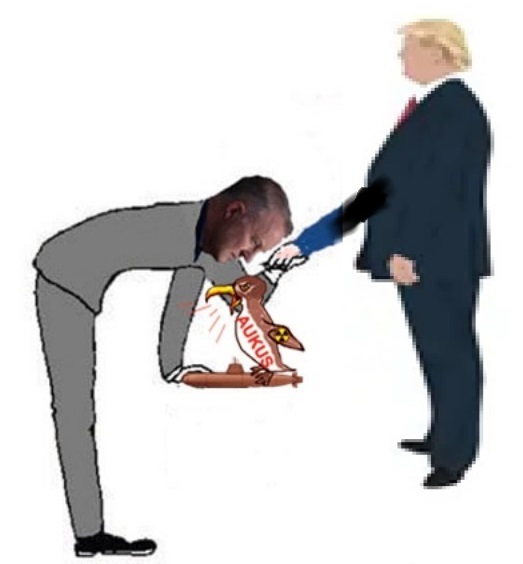
2 April 2026 Dr Andrew Klein, PhD AIM Extra
How Australia’s Government Backed an Illegal War and Left Australians to Foot the Bill
The Speed of Capitulation
When American and Israeli missiles began striking Iranian cities in the final days of February 2026, the Australian government did not wait for the UN Security Council to meet. It did not wait for legal opinion. It did not wait for evidence.
Within hours, Prime Minister Anthony Albanese declared that “We support the United States acting to prevent Iran from obtaining a nuclear weapon and to prevent Iran continuing to threaten international peace and security.” Foreign Minister Penny Wong added that she would “leave it for the US and Israel to speak of the basis, the legal basis for the attacks.”
Not since the invasion of Iraq has an Australian government been so swift to endorse military action without international legal sanction. And not since Iraq has an Australian government been so unprepared for the consequences.
The Miscalculation
The operation was billed as a surgical strike. The theory – as arrogant as it was flawed – held that the removal of Iran’s leadership would trigger a swift regime collapse, that the Iranian people would rise up at America’s invitation, that the war would be over before it began.
What happened instead defies every neocon fantasy.
The Islamic Republic did not fracture; it consolidated. A new spiritual leader emerged. Iranian society rallied behind the flag. And Tehran demonstrated what analysts had long warned: that it possesses both the capability and the will to strike back effectively.
The Strait of Hormuz, through which one-fifth of the world’s oil passes, is now effectively blockaded. Iran has asserted control, allowing only Chinese oil tankers through under negotiated exemptions. Western and allied shipping has effectively stopped.
The war we were told would be quick and decisive is now entering its second month, with no end in sight.
The Economic Wreckage: Fuel
Australia is an island nation. It imports approximately 90 per cent of its liquid fuel. We have two remaining refineries, producing less than a quarter of domestic demand. The rest comes through the Strait of Hormuz.
That supply line is now severed.
The price of Brent crude has surged from $72 per barrel in January to over $110, and in some trading sessions, beyond $180.
The impact on Australian motorists has been immediate and brutal. Petrol prices have risen by more than 30 per cent in a month. Some rural service stations have run out of fuel entirely. Hundreds of outlets have imposed purchase limits of 50 litres per customer. Social media is flooded with images of panic buying – jerry cans stacked in driveways, queues stretching down highways.
Australia’s fuel reserves are dangerously low. According to Energy Minister Chris Bowen, we have 39 days of petrol, 30 days of diesel, and 30 days of jet fuel. This is far below the 90-day reserve recommended by the International Energy Agency. The government has already reduced reserve requirements for importers by approximately 20 per cent – equivalent to six days of national supply.
Treasurer Jim Chalmers now calls this conflict “the defining influence” on the May budget. He warns that Treasury has modelled two scenarios – one with oil at $100 per barrel, one with oil at $120 – and admits that “both scenarios could underestimate the cost.”
Even under conservative assumptions, the war could cut GDP growth by up to 0.2 percentage points across major trading partners, add up to 1.25 percentage points to inflation, and leave GDP 0.6 per cent lower in 2027.
The Treasurer’s own words should chill every Australian: “We’ve already seen four major shocks – the GFC, a major pandemic, a global inflation shock, escalating trade tensions – and this oil shock could become the fifth.”
The Food Chain: Fertiliser and Farming
The war is not just hitting the bowser. It is hitting the dinner table.
Australia’s farmers are now facing a crisis of their own. The Strait of Hormuz disruption has cut off supply of urea fertiliser, upon which Australian agriculture is heavily dependent. Prices have soared. Supply has tightened. And the winter planting season is about to begin.
Queensland farmer Arthur Gillen normally splits his winter crop between wheat and chickpeas. This year, with fertiliser costs prohibitive, he is reducing wheat to 20 per cent of his planting area and abandoning urea use entirely.
He is not alone. Farmers across the country are pivoting to low-fertiliser crops – lentils, chickpeas, canola – and reducing wheat acreage. This shift, driven by war, will reshape Australian agriculture for years to come.
The timing could not be worse. Rabobank warns that the Strait of Hormuz must be open by the end of April to get fertiliser to farmers in time for winter planting. If it is not, the impact on Australian food production will be severe and sustained.
Federal Agriculture Minister Julie Collins has announced a national food security review. Farmers are telling the ABC they fear fuel shortages will impact the winter harvest. The government is scrambling, but the damage is already being done.
The Medicines Pipeline
In March 2026, the Therapeutic Goods Administration (TGA) issued an unusual public statement: they urged Australians not to panic buy medication.
The reason is the Strait of Hormuz. Pharmaceutical companies have been forced to reroute critical medicines away from the Persian Gulf, switching from sea freight to air freight at enormous cost………………………………………………………………
The AUKUS Mirage
Perhaps the most profound strategic consequence of this war is the damage it has done to Australia’s faith in its alliance with the United States.
The US military resources that were meant to underpin the AUKUS nuclear submarine program are now stretched to breaking point in the Persian Gulf.
If Washington cannot keep its promises to South Korea or Japan, one Queensland University of Technology professor asked, what confidence can Australia retain in the submarine deal?
Public opinion is already shifting. Polls show more Australians oppose the war than support it. The government’s swift endorsement of an illegal conflict has left it morally stripped naked and strategically embarrassed.
The Government’s Response: Too Little, Too Late
To its credit, the government has belatedly recognised the scale of the crisis.
On March 27, Prime Minister Albanese announced new fuel security powers, including the use of Export Finance Australia to underwrite private sector fuel purchases. He called out panic buyers, declaring that filling jerry cans was “not the Australian way.”
Energy Minister Bowen has appointed a former energy regulator to lead a national fuel supply taskforce. The government is considering support for the nation’s two remaining refineries……………………………………………………..
The Path Forward
The war is not ending soon. Iran’s leadership has consolidated. The Strait of Hormuz remains closed to Western shipping. Global energy markets are in turmoil.
What Australia needs is not more loyalty to a declining hegemon. What Australia needs is a government willing to act in the national interest – not just in the interests of alliance management…………………………………………………….. https://theaimn.net/the-war-they-sold-us-the-price-we-pay/
The Perfect Storm: How the Far-Right Surge and Labor’s Silence are Reshaping Australia
8 March 2026 Michael Taylor, https://theaimn.net/the-perfect-storm-how-the-far-right-surge-and-labors-silence-are-reshaping-australia/
The Australian political landscape is currently being squeezed by a powerful vice. On one side, we are witnessing the alarming and undeniable rise of the far-right, supercharged by a mastery of social media that has the major parties looking like digital dinosaurs. On the other, a growing tide of progressive disappointment with the Albanese government is curdling into outright anger, fueled by perceptions of secrecy, a moral failure on Gaza, and a lack of spine in standing up to the belligerence of the Trump administration. These two forces, seemingly opposed, are feeding off each other, and the result is a political discourse that is becoming increasingly toxic and fragmented.
The most immediate shock to the system is the surging popularity of Pauline Hanson’s One Nation. Recent polling is nothing short of a political earthquake, with One Nation tying with the Liberal-National Coalition on 23 per cent of the primary vote. This isn’t just a protest vote; it’s a realignment. Analysts point to a “perfect storm” of factors: a Coalition riddled with infighting, the “cost-of-living crisis biting hard,” and a sophisticated, decades-long mastery of direct communication.
Senator Hanson and her team have effectively bypassed traditional media gatekeepers. They dominate Facebook and use YouTube for “comedic and sometimes quite bizarre content” that feeds directly into the algorithms that capture younger viewers. This isn’t just politics; it’s a highly effective content engine that peddles consistency and certainty in an uncertain world. The recent call by Labor frontbencher Julian Hill for the Liberal Party to stop “playing footie” with these “populist forces” feels less like a strategy and more like a desperate plea. The horse has already bolted, and it’s wearing a “Please Explain” t-shirt.
The danger here is profound. As an ABC investigation has shown, the lines between populist protest movements and organised neo-Nazi groups are becoming dangerously blurred. While One Nation distances itself from the most extreme fringes, its rhetoric creates the fertile ground in which they grow. When Minister Hill warns that our society is being “ripped apart” and that Muslim women in his community are “scared to go to the shops,” he is describing the real-world consequences of a political debate that has lost its moorings.
If the rise of the hard right represents one side of the vice, the government’s perceived timidity represents the other. For many who voted for change in the 2025 election, the Albanese government has become a cipher. The disappointment is multifaceted, but three failures stand out.
First, there is the perception of secrecy and a lack of courage in foreign policy. The government’s response to Donald Trump’s invitation to join his so-called “Board of Peace” was emblematic. While the world braced for the return of Trump’s brand of disruptive diplomacy, reports emerged that the government’s internal strategy was simply to hope the “hot potato” would “just fizzle out.” This is not leadership. It is a fearful hope that a problem will disappear, a posture that does nothing to assure allies or inform the public.
This timidity pales, however, in comparison to the government’s stance on Gaza. The moral weight of the conflict has landed heavily on Australian shores. There is a deep and growing sense of betrayal among pro-Palestinian advocates, and indeed many human rights-focused Australians, who see a government that has bent over backwards to avoid upsetting Israel. This sentiment is amplified by the international treatment of UN Special Rapporteur Francesca Albanese.
While the news is careful to distinguish between the UN official Francesca Albanese and our Prime Minister, the public discourse often conflates the two, creating a cloud of confusion and frustration. For many, the spectacle of the Trump administration sanctioning Albanese – and her family suing over it – while European nations call for her resignation, is a clear litmus test. Regardless of one’s view of her rhetoric, she is seen as a voice holding Israel to account. Against this backdrop, the Australian government’s quiet diplomacy and failure to issue more forceful condemnations is perceived not as prudence, but as pandering. It looks like a lack of courage to stand up for Palestinian civilians and a capitulation to the same US-led pressure campaign that targets her.
So, here we are. We have a government that appears paralysed, hoping difficult issues will “go away” while simultaneously losing the narrative to a far-right machine that offers simplistic, and often hateful, answers to complex problems. The government’s silence on the issues that matter to its progressive base – whether it’s housing policy or a principled foreign policy – creates a vacuum. And into that vacuum rushes the certainty of the hard right.
The great danger for Australia is that this dynamic becomes self-perpetuating. The more the government fails to articulate a bold, humane, and courageous vision, the more disillusioned voters will look elsewhere. Some will go to the Greens, but a significant and growing number are being seduced by the siren song of the far-right. We are left with a discourse dominated by either the inflammatory culture war talking points of the fringe or the cautious, fearful whispers of a government that has forgotten how to lead. Until the Labor party finds its voice and its courage, this perfect storm will only continue to gather strength.
The Mushroom Treatment: A Government That Treats You With Contempt Cannot Be Trusted
Greens Senator David Shoebridge nails it: “The Albanese Government needs to be clear about what support it is offering the US in its war on Iran. Labor’s claim that we are not offering support is plainly not true.”
COMMENT – Christina Macpherson – As a former Labor party member, I am totally disenchanted with the current Labor leadership. Anthony Albanese has faded away from a strong principled Labor leader to a pale grey accessory to the USA. And Penny Wong ! If she had any integrity she’s resign – it must be uncomfortable for her, forever sitting on the fence about everything
5 Mar 2026, https://urbanwronski.com/2026/03/05/8400/
The Albanese government gives us the mushroom treatment. Keeps us all in the dark and feeds us BS.
This week, our small target federal government gave a bravura homage to John Cage. While a US-Israeli war of no legality engulfs the Middle East, while Australia’s top-secret spy facility hums away in the desert night providing targeting data for strikes that have already killed hundreds of civilians, while US surveillance aircraft slip into RAAF Base Pearce from Diego Garcia without so much as a public flight plan, Anthony Albanese and Penny Wong polish their performance art, the blank face, the rehearsed non-answer, a version of Cage’s 4′ 33″ -and the inane repetition of lines that insult the intelligence of every Australian watching.
Asked about Pine Gap’s role? We got “we don’t comment on that facility.”
The litany of lies becomes a bad parody of accountability. Asked, “is the US-Israel attack on Iran legal under international law? We got: “that is a matter for Israel and the United States.” So the rules-based order they are in love with turns out to be Rafferty’s Rules, after all. And Wong is becoming a human bot before our eyes.
Asked whether we were briefed in advance. We got “this was a unilateral action by the United States.”
It is a performance not of statesmanship but of studied evasion. And it has been noticed. It’s top shelf-fobbing off. Wong and Albanese could fob-off and rebuff for Australia, when it becomes an Olympic event.
On international law being broken, the government’s hypocrisy is gob-smacking
Albanese and Wong have invoked “international law” and the “rules-based order” more than a hundred times since returning to government. They have called out Russia over Ukraine. They have criticised China. As recently as last year, Wong’s department was demanding China comply with international law, and the year before that, complaining that Chinese domestic legislation allowed Beijing to ignore it.
But when Canadian Prime Minister Mark Carney, a guest on Australian soil, stated plainly that the US-Israeli strikes on Iran appear “prima facie inconsistent with international law,” Wong’s response was to handball the question back to Washington and Tel Aviv.
“The legal basis of these strikes is ultimately a matter for the United States and Israel,” she repeated, for perhaps the twentieth time, to a press circus that grew visibly more frustrated with each non-answer.
This is not a position. It is a void in a vacuum in a vortex of entropy dressed up as a position.
The “rules-based order” mantra that Australia endlessly chants, a type of incantation to ward off witches, warlocks and bad faith actors, turns out to be a franchise. The rules apply to adversaries. Allies get a different menu. When Russia bombs civilian infrastructure it is an outrage; when the US does it, the legal basis is “a matter for those two countries.” When China ignores international law, Canberra clucks as volubly as any hen-house. When Israel and the Trump administration launch pre-emptive strikes without UN authorisation, without consulting allies, without even informing Albanese in advance, the government goes mute.
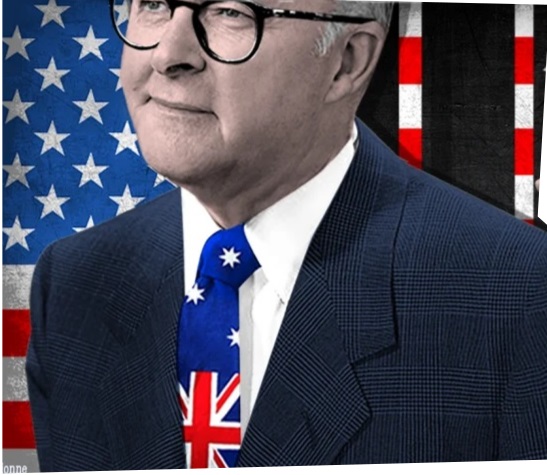
It’s not just hypocritical. It’s a double standard with added craven sycophancy, toadying and fawning over the US latest brain-fart that does lasting damage to Australia’s credibility as an honest broker in the region.
Surreal? Pine Gap, which is where the mushroom treatment gets especially dangerous.
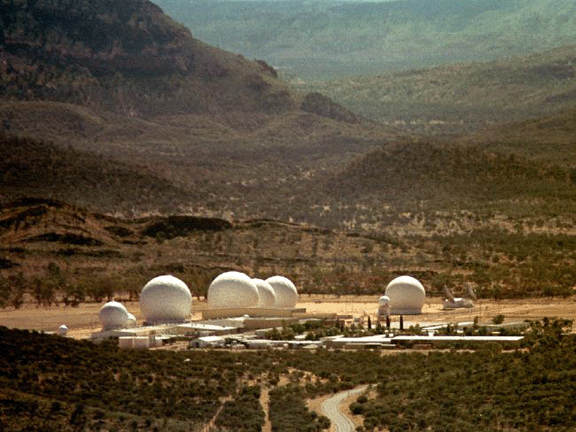
Pine Gap is not some quiet public library in the red centre. It is the eyes and ears of the American eagle. Or as Peter Cronau documents, the listening post for a swarm of US satellites that provide the intelligence feed for major US and Israeli military operations in the Middle East and now the Indian Ocean. It geolocates targets. It intercepts military communications. It detects missile launches and supports targeting. It cannot, as Cronau noted before the first strikes last year, not have been already involved.
When a US submarine sinks an Iranian ship in the Indian Ocean, an area directly within Pine Gap’s signals collection coverage, Australians have a right to know whether their facility, on their soil, provided the intelligence that killed those sailors. Wong’s answer: “We don’t comment on that facility.”
Wong assures us there is “a high degree of transparency in relation to the United States presence in Australia.”
You just can’t see it.
Or credit it. Or forgive her duplicity, The lie here is mind-boggling.
Yet now we learn that two US P-8A Poseidon maritime patrol and reconnaissance aircraft flew directly from Diego Garcia, the staging base for US operations across the Indian Ocean, to RAAF Base Pearce in Western Australia without prior public announcement, with flight plans lodged only once they were airborne. These are not joy rides. P-8A aircraft have been integral to Washington’s operations at the Strait of Hormuz. Their visit to Australian soil in the days following the bombing of Iran is not a coincidence. It is a data point.
Defence Minister Doughboy Richard Marles a US War Department dogsbody, doggedly declines to comment.
Greens Senator David Shoebridge nails it: “The Albanese Government needs to be clear about what support it is offering the US in its war on Iran. Labor’s claim that we are not offering support is plainly not true.”
The government does not want us to think about their epic credibility fail. That is the whole point.
The contempt is not limited to matters of war and peace. It runs through the entire fabric of how this government deals with Australians who have the temerity to ask questions. And to expect answers.
Albanese entered office in 2022 declaring that “the Australian people deserve accountability and transparency, not secrecy.” He criticised the Morrison government’s “cult of secrecy” and its “culture of cover-up.” Like a specialist performing a colonoscopy, he was going to shine a bright light into dark entrails. Instead he handed the patient a blindfold.
Not even under “Morrison Un-hosed” has freedom of information been so much of a running gag in a government which not only runs on the most expensive misinformation money can buy from its stable of top-end corporate consultancies but one which is very reluctant to share anything with anyone. Especially anything that might reveal its inner workings or help voters to hold it to account.
The Centre for Public Integrity finds that under Albanese, Freedom of Information requests granted in full have collapsed from 59 percent in 2011-12 to just 25 percent today. Outright refusals have nearly doubled to 23 percent. Almost half of initial decisions are found to be flawed on internal review. The Albanese government complies with Senate orders to produce documents only one-third of the time, a record worse than the Morrison government. The Centre’s Research Director, Catherine Williams, calls it a “deliberate effort to avoid scrutiny.” The government’s own record gives her no grounds to be contradicted.
This is not administrative slippage. This is policy.
What emerges from all of this is a government that has made a fundamental calculation: that Australian citizens do not need to know what is done in their name, with their money, on their soil, or at their risk.

They do not need to know whether their intelligence facilities are helping to kill sailors in the Indian Ocean.
They do not need to know whether US surveillance craft are operating out of Australian bases as part of a widening Middle Eastern war.
They do not need to know whether the strikes their government endorses are legal under the international law their government claims to champion.
They do not need to know what is in government documents that the Senate orders to be produced.
They do not need to ask. They just need to trust.
But trust, like international law, turns out to be something the Albanese government only demands of others.
There is a word for a government that maintains one set of rules for its allies and another for its adversaries, that invokes transparency as a slogan while systematically dismantling it in practice, that keeps citizens uninformed about activities on their own soil that may be drawing them into someone else’s war.
The word is untrustworthy.
Not dishonest in the flamboyant, self-destructive way of some politicians. This government is too careful for that. It is dishonest by omission, by evasion, by the rehearsed non-answer, by the careful deployment of “we don’t comment on that facility” as a substitute for democratic accountability.
Mark Carney, standing on Australian soil, said what Albanese and Wong won’t: the strikes appear inconsistent with international law, hegemons are acting without constraint, and the old world order is fraying. It took a visiting foreign leader to say plainly what our own government refuses to acknowledge.
That tells you something about how far we’ve travelled since Albanese promised us sunlight.
We got the mushrooms.
000000000
Liberals’ hidden review regarding nuclear energy

Hidden review slams senior Liberals’ lack of reflection after devastating election loss, ABC 3 Mar 26
“…On nuclear energy, Mr Dutton said making the power plants government owned neutralised community concerns around safety, but provided Labor an attack line on cost.
“Labor didn’t lay a glove on the policy as such, but they were effective in their campaigning saying ‘he’s going to cut health, education and NDIS to pay for this’,” he said.
…The review deemed the almost six-month delay between the Coalition unveiling its plan to fund nuclear power stations and releasing the costings for it as “fatal”.
It was found that the gap allowed Labor to fill the vacuum with a “scare campaign”.
The federal secretariat had presented “considerable research” to Mr Dutton’s office outlining the significant effort required to win over voters sceptical of nuclear.
Research showed Mr Dutton’s “bold vision” was appreciated, but the nuclear policy was not sufficiently linked to the issue top of mind for voters — cost of living relief.”…………………………
https://www.abc.net.au/news/2026-03-03/inside-liberal-2025-election-review/106410316
Greens say no war with Iran as Albanese’s Labor issues support of Trump and Netanyahu’s illegal attacks.
Last night, US President Trump launched a new illegal bombing campaign against Iran. The Australian Government’s support for Trump’s latest illegal war is a clear breach of international law and the prohibition on wars of aggression.
The Iranian people deserve to be free from persecution and domination, both from the current regime and from foreign powers. History shows, and the world knows, that US military attacks and Donald Trump’s kidnappings and assassinations do not produce peace and do not produce justice.
While US bombs and missiles rain down on Iran, there is every likelihood that they are being targeted with the direct or indirect assistance of “joint” US-Australian military facilities at Pine Gap and North West Cape.
The Greens have consistently and clearly condemned the Iranian Regime’s violent response to recent protests and long history of oppression, and we have backed the Woman Life Freedom movement. We know that the people of Iran who have been the victims of the regime will be the same people who are right now being killed, injured and driven into further poverty and fear by US bombing.
Senator Waters, Leader of the Australian Greens, said:
Trump and Netanyahu’s illegal attacks last night have unleashed chaos across the Middle East.
“This war will not bring safety to the brave Iranian people who are fighting for liberation from the brutal regime. Innocent people have already been massacred, including at least 60 children in Southern Iran killed by US and Israeli strikes on an elementary school last night. Our hearts ache for their families. This war will see homes and cities razed to the ground and countless innocent lives lost.
“The Greens condemn these illegal, abhorrent and unilateral attacks. Australians do not want to be dragged into another US-Israeli war.
“Australia’s support of Trump and Netanyahu’s illegal attack last night was disgraceful.
“We cannot bomb our way to peace.
“The Labor government must immediately rule out Australian support for Trump and Netanyahu’s illegal war. No resources. No intelligence. No more cover.
“The Labor government must also confirm to the Australian people that no intelligence from Pine Gap or other US bases in Australia was used last night, and rule out allowing these bases to be used in this illegal war going forward.
“End AUKUS. Australia must be a force for peace and diplomacy across the world.”
Senator Shoebridge, Greens spokesperson on Foreign Affairs, said:
“No one seriously believes that Donald Trump cares about the rights or lives of people in Iran. Just like other US wars that Australia has supported in Vietnam, Iraq and Afghanistan, the talk is about freedom and democracy but the reality is killing and destruction. Already, we are seeing reports of schools being destroyed and children killed in airstrikes.
“With barely a moment’s pause the Albanese Government has backed Trump and another US-led war in the Middle East. This proves without a shadow of a doubt that Labor has outsourced Australian foreign policy to Washington.
“Labor has made Australia a part of this war by allowing Pine Gap and other US military bases here to be used to gather intelligence and target US bombs and missiles. People see through Labor when it says it believes in international law and then repeatedly backs the US and its illegal wars.
“Time and time again the US has betrayed the people it was claiming to protect, leaving bloodshed in its wake while serving its own corporate and military interests. Trump is no different, even if he is more blatant.
“The Greens are the only anti-war party in the Federal Parliament and we will not shift from that stance, having seen the horrifying scale of killing and displacement that war has visited on the world.
“The world has been watching the bravery of the Iranian people pushing back against a brutal regime and calling for liberation and freedom. The Greens know that a Trump-led military assault on Iran is not a pathway to freedom or a pathway to a democratic regime that is supported by the Iranian people. This attack, like the last, is a pathway to chaos and more killing in Iran.
“There is more Australia can do for the people of Iran, starting with offering safety to those who have fled the regime, especially those already in Australia who are trapped in an unfair refugee process.”
Jewish groups call on Tony Burke to cancel Israeli journalist visa
by Stephanie Tran | Feb 24, 2026, https://michaelwest.com.au/jewish-groups-call-on-tony-burke-to-cancel-israeli-journalist-visa/
Jewish orgs request Tony Burke reject Australian visa for Israeli journalist as his funders’ links to IDF emerge. Stephanie Tran reports.
A coalition of Australian Jewish organisations has written to the Home Affairs Minister Tony Burke, urging him to cancel the visa of Israeli journalist Zvi Yehezkeli on character grounds, citing comments in which he called for mass killings in Gaza and advocated violence against journalists.
The letter was initiated by Anti-Zionism Australia and signed by several Jewish groups including, Jewish Voices of Inner Sydney, Jews Against the Occupation ‘48, Jews for Palestine Western Australia, Jewish Advocates for Understanding Antisemitism, Jews for a Free Palestine, Jews for Human Rights and the Coalition of Women for Justice and Peace.
The groups have requested that Yehezkeli’s visa application be rejected under the Migration Act 1958, specifically invoking section 116(1)(e)(i), which allows for cancellation where a person’s presence may pose a risk to the health, safety or good order of the Australian community, and section 501, the character test.
“The undersigned request that you reject Zvi Yehezkeli’s visa application … on the basis that his presence in Australia shall pose a risk to the health, safety or good order of the Australian community and that his past and present general conduct indicates a foreseeable risk of vilifying a segment of the community and inciting discord,” the letter states.
Burke mulls visa
Tony Burke has indicated the government is considering whether to deny Yehezkeli’s visa application.
Speaking to the Sydney Morning Herald, he said: “It always surprises me when someone, who has made the sorts of comments that this individual has, advertises a speaking tour before they’ve even received a visa.”
Yehezkeli, an Israeli journalist and resident of a settlement in the occupied West Bank, is due to visit Australia in March and is slated to appear as a keynote speaker at fundraising events in Sydney and Melbourne.
Tax-deductible fundraiser under scrutiny
The Sydney and Melbourne events are raising funds for Israeli organisation The Institute for Social Momentum. Donations are being collected in Australia through the Chai Charitable Foundation, which is promoting the fundraiser as tax deductible.
A link to donate via the Chai Charitable Foundation appears on the registration pages for both events.
According to its 2024 financial report, the Chai Charitable Foundation reported more than $19m in revenue. Of that, $15.39m was distributed in grants and donations for use outside Australia, compared with $1.62m directed domestically.
The foundation facilitates tax-deductible donations from Australians to organisations in Israel and has previously come under scrutiny over its fundraising activities.
T
An investigation by MWM, found that the charity hosted multiple online fundraisers linked to Israeli military units and West Bank settlements.
The Chai Charitable Foundation initially denied that it was raising funds for such causes. However, those pages were removed after MWM put questions to Chai.
Incitement to commit genocide
n a submission to the International Criminal Court (ICC), French-Israeli human rights lawyer Dr. Omer Shatz concluded that “there is reasonable grounds to believe that Yehezkeli’s statements amount to direct and public incitement to commit genocide.”
In December 2023, Yehezkeli stated that the Israel Defense Forces should have killed more than 100,000 Palestinians in Gaza.
In a 2024 interview, he said that in order to destroy Hamas, Israel needed to take measures that would “bring Gaza to the point of a humanitarian disaster”.
Last year, Yehezkeli advocated for the killing of journalists in Gaza, stating that “if Israel already decides to eliminate journalists then better late than never” and lamented the “damage” caused to Israel by journalists reporting on the atrocities in Gaza.
“This is an understanding in Israel of how much damage those who transmitted the pictures of hunger and all of Hamas’s one side did […] how much psychological damage those journalists in quotation marks, terrorist journalists, or you can call them Nukhba journalists, how much damage they did to Israel,” Yehezkeli said.
1 This month


Help Aunty Sue Protect Her Land and Sacred Sites From Destructive Rocket Testing.
.

Australians deserve the truth
about
AUKUS – https://aukuspublicinquiry.com/

PETITION – To: Prime Minister Anthony Albanese and the Australian Labor Government

of the week – Australians for War Powers Reform (AWPR)
To see nuclear-related stories in greater depth and intensity

