Labor likely to amend the Nuclear Waste Bill, removing certainty about the Napandee dump happening
 Labor’s position on nuclear waste bill means uncertainty remains over South Australian site, Guardian, Paul Karp @Paul_Karp 5 Oct 20, Labor will try to amend a government bill so that the federal resources minister has to nominate the site for a nuclear waste dump, despite concerns within the ALP caucus the change could pave the way for the decision to be challenged in court.On Monday, the Labor caucus agreed it would try to amend the bill by removing a schedule which states the dump should be located at Napandee some 20km north-west of Kimba in South Australia. The caucus resolved to oppose the bill if the change was not supported. Labor’s position on nuclear waste bill means uncertainty remains over South Australian site, Guardian, Paul Karp @Paul_Karp 5 Oct 20, Labor will try to amend a government bill so that the federal resources minister has to nominate the site for a nuclear waste dump, despite concerns within the ALP caucus the change could pave the way for the decision to be challenged in court.On Monday, the Labor caucus agreed it would try to amend the bill by removing a schedule which states the dump should be located at Napandee some 20km north-west of Kimba in South Australia. The caucus resolved to oppose the bill if the change was not supported.
The caucus resolution follows a recommendation by the shadow science minister, Brendan O’Connor, and despite vigorous opposition from senators Alex Gallacher and Kim Carr. They argued that making the minister select the site could leave the decision vulnerable to challenge. The government’s bill, as it stands, nominates Napandee as the location for the dump and provides a compensation package – a formulation that prevents judicial review of the site selection…… https://www.theguardian.com/environment/2020/oct/05/labors-position-on-nuclear-waste-bill-means-uncertainty-remains-over-south-australian-site |
|
Divisions in Labor, over nuclear waste dump plan
Federal Labor divided over plans to block SA’s nuclear waste dump facility, The Age, By Rob Harris, October 5, 2020 — A 40-year effort to establish a nuclear waste dump in remote South Australia faces a rocky passage through Federal Parliament after Labor signalled it is prepared to block the Morrison government’s attempts to resolve the long-running debate.
The decision, rubber-stamped by the federal caucus in lengthy debate on Monday, has sparked further divisions within the opposition, with veteran senators Alex Gallacher and Kim Carr expressing fierce criticism of their party’s position.
There are also concerns within federal Labor that its stance could unwittingly hand Prime Minister Scott Morrison a double-dissolution trigger should the crossbench sink the laws.
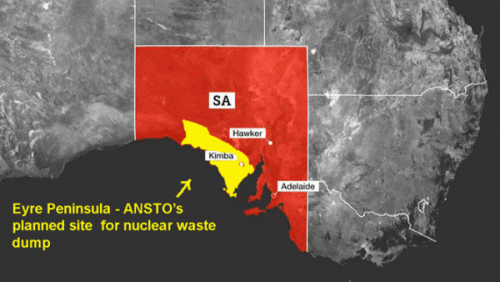
The government intends to introduce legislation to finally establish a low- and medium-level nuclear waste facility at Napandee, a farm on South Australia’s Eyre Peninsula, having spent seven years and more than $60 million finding a suitable home……..
Labor will seek to amend the laws so that the minister responsible, Resources Minister Keith Pitt, can use existing powers to nominate any site under the current legislation. Labor says the changes would still give the local community access to a significant community fund on offer and would ensure the decision be subject to a judicial review.
Seven Labor MPs spoke up in the debate over the legislation, which lasted for more than an hour………
Opposition science spokesman Brendan O’Connor said federal Labor supported the need for a national facility to store radioactive waste.
This government has had existing powers under the current legislation for the past seven years to determine a site, but under the guise of compensation has sought to remove proper scrutiny, through this proposed legislation,” he said.
“This is a contentious issue and should be subject to the highest levels of scrutiny to ensure that the principles of procedural fairness and natural justice have been applied given the national significance of this matter.”……..
A Senate committee last month recommended the legislation be supported but three members – the Greens’ Sarah Hanson-Young, Independent senator Rex Patrick and Labor senator Jenny McAllister – issued dissenting reports.
Senator McAllister said the proposed facility had not received the support of the relevant traditional owners in South Australia. https://www.theage.com.au/politics/federal/federal-labor-divided-over-plans-to-block-sa-s-nuclear-waste-dump-facility-20201005-p5628p.html
Australian State laws have weak environmental standards
 Major gaps’: no state meets national environment standards, The Age, Mike Foley, October 4, 2020 — State and territory governments should make major reforms to their environmental laws and increase compliance regimes to meet the national standards, new research has found.
The findings are revealed in a report from the “Places You Love” alliance of conservation groups, released on Monday, which found “not only does no state or territory law meet national standards, but in some jurisdictions, the environmental protections in state and territory laws have actually been weakened”.
This week the Senate is set to debate the federal government’s bill to hand approval powers for major projects to state governments, in a bid to remove bureaucratic duplication and speed-up project development to boost the economy.
Environment Minister Sussan Ley has pledged that any changes to The Environment Protection and Biodiversity Conservation Act will not reduce current level of environmental regulation…….
Ms Ley has been criticised by environment groups for rushing her bill through Parliament. It passed the lower house in August and could be enacted as soon as next week – ahead of a major review of the laws by former competition watchdog boss Professor Graeme Samuel, which is due by the end of October.
Professor Samuel said Australia’s “current environmental trajectory is unsustainable”. National laws were “not fit to address current or future environmental challenges”, he said, while for industry they are “ineffective and inefficient”…….
The EPBC Act was enacted in 1999 and created a list of “matters of national environmental significance”, including World Heritage areas, internationally listed wetlands and threatened species. While state laws do include some protections for these matters, federal government has wielded the most powerful protections for the past two decades.
The report found no state or territory legislation met the necessary suite of “national environmental standards required to protect matters of national environmental significance”.
Legacy of Maralinga bomb tests -a reminder of need for safety in matters nuclear
 Sixty years on, the Maralinga bomb tests remind us not to put security over safety, The Conversation Liz Tynan, Senior Lecturer and Co-ordinator Research Student Academic Support, James Cook University September 26, 2016 It is September 27, 1956. At a dusty site called One Tree, in the northern reaches of the 3,200-square-kilometre Maralinga atomic weapons test range in outback South Australia, the winds have finally died down and the countdown begins……….
The count reaches its finale – three… two… one… FLASH! – and all present turn their backs. When given the order to turn back again, they see an awesome, rising fireball. Then Maralinga’s first mushroom cloud begins to bloom over the plain – by October the following year, there will have been six more.
RAF and RAAF aircraft prepare to fly through the billowing cloud to gather samples. The cloud rises much higher than predicted and, despite the delay, the winds are still unsuitable for atmospheric nuclear testing. The radioactive cloud heads due east, towards populated areas on Australia’s east coast.
Power struggle
While Australia was preparing to sign the Maralinga agreement, the supply minister, Howard Beale, wrote in a top-secret 1954 cabinet document:
The British carried out two clean-up operations – Operation Hercules in 1964 and Operation Brumby in 1967 – both of which made the contamination problems worse.
Legacy of damage
The damage done to Indigenous people in the vicinity of all three test sites is immeasurable and included displacement, injury and death. Service personnel from several countries, but particularly Britain and Australia, also suffered – not least because of their continuing fight for the slightest recognition of the dangers they faced. Many of the injuries and deaths allegedly caused by the British tests have not been formally linked to the operation, a source of ongoing distress for those involved.
Decades later, we still don’t know the full extent of the effects suffered by service personnel and local communities. Despite years of legal wrangling, those communities’ suffering has never been properly recognised or compensated.
Why did Australia allow it to happen? The answer is that Britain asserted its nuclear colonialism just as an anglophile prime minister took power in Australia, and after the United States made nuclear weapons research collaboration with other nations illegal, barring further joint weapons development with the UK. …..Six decades later, those atomic weapons tests still cast their shadow across Australia’s landscape. They stand as testament to the dangers of government decisions made without close scrutiny, and as a reminder – at a time when leaders are once again preoccupied with international security – not to let it happen again. https://theconversation.com/sixty-years-on-the-maralinga-bomb-tests-remind-us-not-to-put-security-over-safety-62441?fbclid=IwAR3-AXJA_-RZTlr1AW6qxgcFRPuOX5IIi163L75vLWXFyIOcZGKxbet5DDE
China’s zero emissions target is contrasted with Australia’s inaction on global heating
China’s escalation is also set to have implications for Australia’s diplomatic position in the Pacific, where it has been attempting to manage China’s rising influence among some of its closest neighbours.
“From both sides of Parliament Australian politicians aren’t understanding it, they approach climate change like it’s just another issue for our Pacific counterparts. What Australian politicians 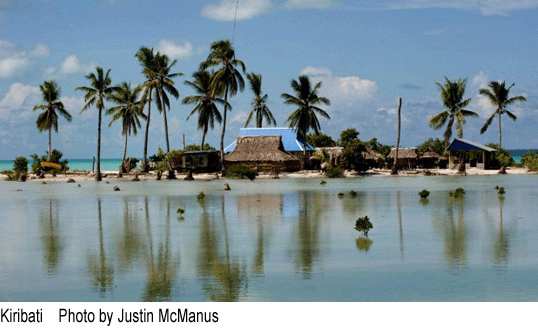 do often miss is this issue is personal,” said Professor Bamsey.
“It concerns Pacific politicians when they get out of bed, they can see the changes to the future of their country when they look out the window.”
China’s zero emissions target puts Australia on notice, The Age, By Eryk Bagshaw and Mike Foley, September 30, 2020 — Australia’s former top climate diplomat has warned China’s net-zero emissions target will leave Australia behind, threatening future trade deals and its influence in the Pacific as the Morrison government becomes wedged between the US and China on climate action.
Howard Bamsey, who was Australia’s special envoy on climate change during the Rudd government, said the announcement from President Xi Jinping last week had turned the politics of emissions reduction into a sharp economic and diplomatic issue.
Professor Bamsey, who was also Australia’s ambassador for the environment under the Howard government, said the new policy “pulls the rug out from under the argument” that Australia’s domestic climate goals do not need to accelerate because China was yet to increase its ambitions.
“It’s clear now China is accepting a leadership role,” he said. “Xi made the announcement. That carries all the weight of the state and party.”
The coronavirus has forced this year’s United Nations Glasgow Climate Change Conference to be rescheduled to November 2021, turning Australia’s international emissions obligations into a major election flashpoint. The earliest month a federal election can be held is August 2021 and voters are expected to go to the polls by the end of next year.
China, which is simultaneously the world’s largest polluter and biggest producer of renewable energy, pledged to go carbon neutral by 2060 at the UN General Assembly last week………… Continue reading
Morrison government refuses to sign leaders’ pledge on biodiversity
|
Scott Morrison declined as 10-point plan calls for commitments considered inconsistent with government policy, Guardian Lisa Cox 28 Sept 20, The Morrison government has said it refused to sign a global pledge endorsed by 64 countries committing them to reverse biodiversity loss because it was inconsistent with Australia’s policies. Emmanuel Macron, Angela Merkel, Justin Trudeau, Jacinda Ardern and Boris Johnson are among world leaders who signed the Leaders’ pledge for nature which was launched on Monday ahead of a major UN summit on biodiversity being hosted virtually from New York. The summit is working towards a Paris-style global agreement on nature. The federal government was invited to sign but refused because the 10-point plan calls for commitments that are inconsistent with Australian policy – including a greater ambition to reduce greenhouse gas pollution and reach net zero emissions by 2050…….. Apart from Australia, other countries that didn’t sign the pledge include the United States, Brazil, China, Russia and India. The pledge warns humanity is in a state of “planetary emergency” due to the intertwined crises of biodiversity loss, ecosystem degradation and climate change. It states that the decline of the natural world is accelerating at an unprecedented rate. “Nature fundamentally underpins human health, wellbeing and prosperity,” the pledge states. “We need to appropriately value nature and the services it provides as we make decisions and recognise that the business case for biodiversity is compelling.” Australia was recently singled out for mammal extinction in a UN report that found the world had failed to meet a single target to slow the loss of the natural world and preserve land and marine ecosystems. The pledge promises a stronger global effort to reduce deforestation, halt unsustainable fishing practices, eliminate environmentally harmful subsidies and begin the transition to sustainable food production systems and a circular economy during the next decade. Leaders promised to ensure “biodiversity, climate and the environment as a whole” were at the heart of responses to the economic crisis brought on by the Covid-19 pandemic. “Against the backdrop of Covid-19, which has crippled the world’s economies and pressured governments everywhere to begin the process of rebuilding and renewing, decisions made now will have ramifications for all of us and for generations to come,” the pledge states. Labor’s environment spokeswoman, Terri Butler, said the prime minister, Scott Morrison, should explain why Australia would not commit to a stronger effort to protect wildlife. “Australia is in the midst of an extinction crisis, 3 billion animals have died or were displaced by last summer’s bushfires and 12m hectares of land burnt . But the Morrison government doesn’t think we have a problem,” Butler said. The Greens environment spokeswoman, senator Sarah Hanson-Young, said a global target on extinction, similar to the Paris target, was necessary to stem the rapid loss of biodiversity. She said Australia was “squandering an opportunity” to take a leading role after the bushfire crisis, which accelerated the loss of habitat and wildlife and has forced the government to consider new threatened listings for iconic species, including the koala. “Our biodiversity is under significant threat and with it our tourism industry and local economy,” Hanson-Young said. “Australia’s lack of commitment at this summit is shameful and ultimately will be bad for our economy, as well as our environment.”…….. https://www.theguardian.com/environment/2020/sep/29/australia-joins-us-china-and-russia-in-refusing-to-sign-leaders-pledge-on-biodiversity |
|

Kimba nuclear waste dump: The government failed to show overwhelming support and the proposal to site the facility in Kimba can’t proceed.
22 November 2019
Mr Dean Johnson
Mayor
District Council of Kimba
Dear Mayor Johnson
I refer to the recent ballot at Kimba to determine the level of support
for the siting of the radioactive waste facility.
The results of the Kimba ballot were:
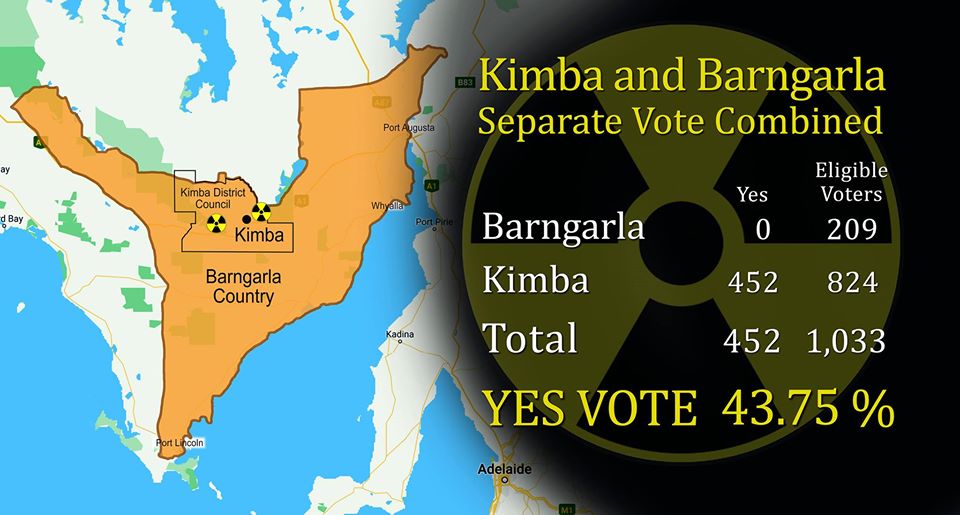
Voting papers issued 824
Formal votes accepted 735
Yes vote 452
Did not vote ~ 283
The government are saying that the result is the percentage of yes votes of the formal votes accepted and they say this is 61.50/0.
This not a vote between two political opponents who are both free to campaign and present alternatives political views for consideration.
This is a simple yes / no vote on a proposal to establish a radioactive waste facility in a wheat field.
It is the government who are the proponent. It is they who have to get people to vote yes. They have to get 413 vote to get a simple majority.
For an overwhelming show of support they need at least a 2/3 yes vote.
You have to remember that this poll was not a genuine contest of ideas. There was only one view put and paid for by the government. There was not a no vote argument presented to voters. This places an unfair bias in any result obtained.
As if this were not bad enough the government offered a $31 million cash handout to the voters and 45 permanent jobs, manned a permanent office in the town of Kimba advocating a yes vote.
The way in which this ballot has to be interpreted is this: How many people voted yes as against how many people did not vote yes.
As a famous South Australian Mick Young the former Special Minister of State in the Hawke Government correctly put it if they don’t say yes they mean no.”
The government has been dishonest in that their figure of 61.49% as it neglects the people who didn’t vote.
The correct methodology is the ratio of people who wanted the facility (voted yes) as against those who didn’t vote yes. This is the ratio of yes votes to the people who didn’t vote yes.
The actual number supporting the facility is then 54.850/0. To achieve an overwhelming result the Yes vote would have to be 536 votes.
The government failed to show overwhelming support and the proposal to site the facility in Kimba can’t proceed.
This view is based on my experience as a federal government minister and also in local government where I am currently the Mayor of the City of Melville in Western Australia.
Yours sincerely
George Gear
From October 6, the Australian Senate will discuss the NATIONAL ISSUE of the Napandee nuclear waste dump plan
The Senate returns on October 6th. At some time there will be a vote on what is indeed this national issue. The stakes remain high.
 The federal nuclear dump is a national issue, https://www.eurekastreet.com.au/article/the-federal-nuclear-dump-is-a-national-issue?fbclid=IwAR0zfICU9GSIJmfVdU30x9jCx847PF8ztvozbQNq0q57QCiWnhlKVtBHdJY Michele Madigan, 22 September 2020
Moreover, despite the former responsible Minister Matt Canavan’s repeated assertions that submissions from others outside the extraordinary narrow designated voting zone was a possible way to influence proceedings — there seems to have been no recorded mention of any of the 2789 submissions. With some of extraordinary length and scholarship, 94.5 per cent were against the federal nuclear waste proposal. They were seemingly ignored; one wonders were they even read?
From July 28th to August 28th, there have been four Senate Inquiry sessions concerning the Radioactive Waste Management Amendment Bill 2020, all by video link. During the Inquiry sessions it became obvious which three Senators had done their careful homework with penetrating questions to witnesses on either side of the debate.
Extreme concern about the issue was expressed by the Chair of the Barngarla Determination Aboriginal Corporation, Jason Bilney and by other Barngarla people; by Peter Woolford, farmer President of the No Radioactive waste on Agricultural Land in Kimba or SA group; by Dave Sweeney of the Australian Conservation Foundation, the single environmentalist invited to be a witness. On the other hand, there was spirited defence of the project, including every aspect of the process by the two senior government officials; by the landholder of the chosen site and by Kimba council representatives. There was an eager willingness by some Senators to positively enable these latter presentations.
On Monday 13th of September, the Senate report was released. Predictably in a Coalition led Inquiry, the report recommends the Senate proceed to vote yes to the plan on the Minister designated site on Barngarla country in agricultural land at the Kimba region Eyre Peninsula site.
However three Senators contributed separate dissenting reports released concurrently with the main report. Labor’s Jenny McAllister, formerly Centre Alliance and now Independent South Australian Rex Patrick, and the Green’s Sarah Hanson-Young SA all recommended that the legislation not go ahead. There were a number of reasons cited by the dissenting Senators.
The context of this ‘national issue’ declaration cited above by the Department was a defence of the strategy to take the Napandee (Kimba region) site to the Parliamentary vote — ensuring that if the proposed legislation is passed by the Senate, there will be no opportunity to take any aspect of the decision making to court. In the words of Labor Senator Jenny McAllister in her dissenting report: ‘In evidence to the committee, the Department confirmed that the effect of the change proposed in the legislation is to remove the requirements for procedural fairness in the selection of the site.’
As well, Senator Rex Patrick’s dissenting report included an emphasis on the heavily redacted nature of the government officials’ documentation: ‘The Department has, through its interaction with the committee, demonstrated a predisposition to secrecy—undue secrecy—in relation to provision of process information to the very people who pay them and who they are supposed to serve.’
The Greens’ summary was included in their final recommendation: ‘The Australian Greens believe the Federal Government has no mandate to situate a radioactive waste management facility in South Australia. It has mismanaged the site selection process, fallen short of international best practice and failed to secure the consent of traditional owners. For these reasons the Australian Greens recommend that this bill not be passed.’
No Dump Alliance is a group of organisations including First Nations, public health, trade union, faith and environment groups, academics and concerned individuals concerned about this matter. Revered SA theologian and international author Denis Edwards was an identified member.
On the release of the Senate report, NDA released their own media statement in which spokesperson Karina Lester (pictured), daughter of late former NDA Patron Yami Lester was clear: ‘In the 21st Century it is unacceptable to try and airbrush away Aboriginal peoples concern over nuclear risks. The Barngarla Native Title holders were excluded from the Kimba community ballot about the waste plan and now the federal government is trying to deny them the right to contest the plan in court. This is not only unfair to the Barngarla people but a clear insult to the concerns expressed by Aboriginal people from right across South Australia to any dumping and storage of radioactive waste on our traditional lands from outside the state’.
The Senate returns on October 6th. At some time there will be a vote on what is indeed this national issue. The stakes remain high.
- ’
Australian scientists censored on speaking about climate change

 Censored: Australian scientists say suppression of environment research is getting worse
Survey finds that many researchers are banned from speaking about their work or have had their research altered to downplay risks. Nature , Dyani Lewis, 22 Sept 20, Environmental scientists in Australia say that they are under increasing pressure from their employers to downplay research findings or avoid communicating them at all. More than half of the respondents to an online survey thought that constraints on speaking publicly on issues such as threatened species, urban development, mining, logging and climate change had become worse in recent years1.
The findings, published this month in Conservation Letters, reflect how politicized debates about environmental policy in Australia have become, says Saul Cunningham, an environmental scientist at the Australian National University in Canberra. “We need our publicly funded institutions to be more vocal in defending the importance of an independent voice based on research,” he says.
Australian scientists aren’t the only ones who have reported interference in science or pressure — particularly from government employers — to downplay research findings. Scientists in the United States, Canada and Brazil have also
Scale of the problem
Two hundred and twenty scientists in Australia responded to the survey, which was organized by the Ecological Society of Australia and ran from October 2018 until February 2019. Some of the respondents worked in government; others worked in universities or in industry, such as environmental consultancies or non-governmental organizations.
The results show that government and industry scientists experienced greater constraints from their employers than did university staff. Among government employees, about half were prohibited from speaking publicly about their research, compared with 38% employed in industry and 9% of university staff. Three-quarters of those surveyed also reported self-censoring their work (see ‘Scientists silenced’)……….
One-third of government respondents and 30% of industry employees also reported that their employers or managers had modified their work to downplay or mislead the public on the environmental impacts of activities such as logging and mining. ………. https://www.nature.com/articles/d41586-020-02669-8
A mixed blessing – the sudden departure of Australia’s nuclear high priest, Dr Adi Paterson
I am reminded of Hilaire Belloc’s advice to the young – ”Always keep a hold of Nurse, for fear of  finding something worse”.
Among other sycophantic tributes, Dr Adi Paterson is lauded for encouraging women into the nuclear industry.
Adi Paterson spent several years in South Africa, trying to establish Small Nuclear Reactors. It turned out to be Tan expensive and useless exercise. Then he came to Australia, with the same dream. He quietly signed Australia up to the Framework Agreement for International Collaboration on Research and Development of Generation IV Nuclear Energy Systems, without any consultation, discussion in Parliament (which rubber-stamped this later).
He quietly organised Australia’s participation with China in developing small nuclear reactors.
He rubbished renewable energy at a solar conference.
He went to Kimba to do propaganda for the nuclear waste dump plan, but admitted that there was no economic benefit in the low level waste dump, so the intermediate level waste was the real intention.
Leadership changes at ANSTO, Statement from the ANSTO Chair: Dr Annabelle Bennett 9 Sep 20, Dr Adi Paterson has resigned as CEO of ANSTO slightly ahead of time of his term. He has decided to take a period of leave before formally finishing. ……..
Mr Shaun Jenkinson will continue as acting CEO, while the Board undertakes a global search for a permanent CEO. https://www.ansto.gov.au/news/leadership-changes-at-ansto?fbclid=IwAR0cLOwne84D7XJP9UGwrf1aVAxyXgStAB6502zPYUgsqxdbjUuyUR3MYjo
Adrian “Adi” Paterson is a South African scientist and engineer best known for his work on Pebble Bed modular reactor research and development. He was appointed CEO of the Australian Nuclear Science and Technology Organisation (ANSTO) in 2009
He emigrated to Australia in 2008 and was appointed Chief Executive Officer at ANSTO in March 2009.
Australia is to build new nuclear reactors, in partnership with China (does Parliament know?)
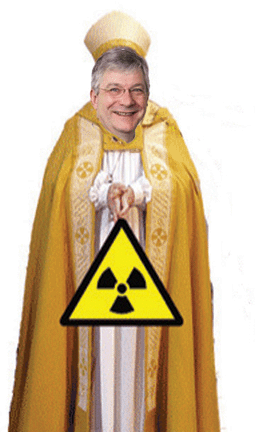

Republishing again, in view of Dr Adi Paterson’s departure from Ansto.
Republishing this one, in view of news from the UK, that a British-China nuclear research programme may be siphoning UK tax-payers’ funds off into China’s military projects.
Australia is back in the nuclear game, Independent Australia, By Noel Wauchope | 24 March 2019, One of Australia’s chief advocates for nuclear power Dr Adi Paterson, CEO of Australian Nuclear Science and Technology Organisation, (ANSTO), has done it again.
This time, he quietly signed Australia up to spend taxpayers’ money on developing a new nuclear gimmick — the Thorium Molten Salt Reactor (TMSR).
This new nuclear reactor does not physically exist and there is no market for it. So its development depends on government funding.
Proponents claim that this nuclear reactor would be better and cheaper than the existing (very expensive) pressurised water reactors, but this claim has been refuted. The TMSR has been described by analyst Oliver Tickell as not “green”, not “viable” and not likely. More recently, the plan has been criticised as, among other things, just too expensive — not feasible as a profitable commercial energy source.
Paterson’s signing up to this agreement received no Parliamentary discussion and no public information. The news just appeared in a relatively obscure engineering journal.
The public remains unaware of this.
In 2017, we learned through the Senate Committee process that Dr Paterson had, in June 2016, signed Australia up to the Framework Agreement for International Collaboration on Research and Development of Generation IV Nuclear Energy Systems (also accessible by Parliament Hansard Economics Legislation Committee 30/05/2017).
This was in advance of any Parliamentary discussion and despite Australia’s law prohibiting nuclear power development. Paterson’s decision was later rubber-stamped by a Senate Committee……..
Dr Paterson was then obviously supremely confident in his ability to make pro-nuclear decisions for Australia.
Nothing seems to have changed in Paterson’s confidence levels about making decisions on behalf of Australia.
Interestingly, Bill Gates has abandoned his nuclear co-operation with China. His company TerraPower was to develop Generation IV nuclear reactors. Gates decided to pull out of this because the Trump Administration, led by the Energy Department, announced in October that it was implementing measures to prevent China’s illegal diversion of U.S. civil nuclear technology for military or other unauthorised purposes.
Apparently, these considerations have not weighed heavily on the Australian Parliament.
Is this because the Parliament doesn’t know anything about Dr Paterson’s agreement for Australia to partner with the Shanghai Institute of Applied Physics (SINAP) in developing Thorium Molten Salt Reactors? https://independentaustralia.net/environment/environment-display/australia-is-back-in-the-nuclear-game,12488#.XJWdhxDqitc.twitter
Scott Morrison transfers his love affair with coal, to gas
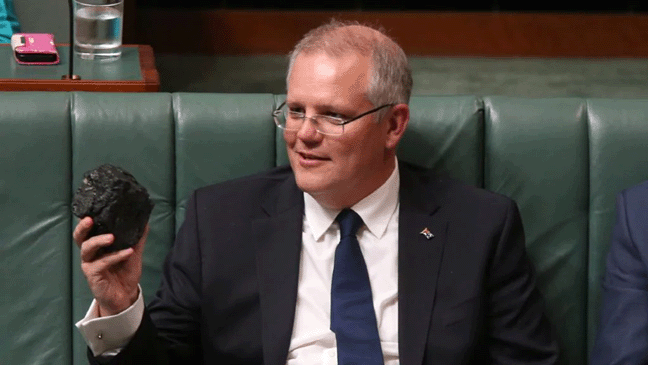
Our coal-fondling PM switches his prop to gas, but is anything really different? Jacqueline Maley, Columnist and senior journalist, The Age, 20 Sept 290 In February 2017, Scott Morrison walked into Parliament to perform a piece of coal-centred theatre that became one of the defining moments of his political career. “Mr Speaker, this is coal,” he pronounced, brandishing a black lump. “Don’t be afraid, don’t be scared. It won’t hurt you!”
As was pointed out at the time, the coal must have been lacquered – touching raw coal covers you in black dust. Morrison didn’t want to get his hands dirty. He just wanted to score a political point.
His speech was not about the benefits of coal so much as it was a gleeful attempt to wedge Labor over the electability problem it had, and still has – the insoluble tension between its heavy industry-reliant, blue-collar voter base, and its urban voters, who want meaningful climate action.
No one feels this tension more than Opposition Leader Anthony Albanese, who is old-Labor in his sensibilities, but whose inner-Sydney electorate is under siege from the Greens…………
It was always the Coalition, of course, that had the ideological attachment to coal as an energy source. The Nationals, in particular, appear to be moving away from representing farmers to supporting what is buried in the earth beneath their crops.
It is Labor that has always had the political problem with coal. It needed to convince its blue-collar base it cared about jobs and electricity prices, while also being serious about emissions reduction. But Labor is also the only side of politics that has ever been effective on emissions reduction, instituting in 2012 the only sensible mechanism to bring emissions down – a carbon price and emissions trading scheme.
It worked, in the short time it was operational, before being abolished by Tony Abbott, elected in a 2013 landslide to do exactly that.
The energy prop has changed now, with Morrison this week announcing he wants a “gas-led recovery” for the post-COVID-19 future. He is backing slowly away from coal.
In a speech in the Hunter Valley – a carefully chosen location given its significance in Labor’s own climate wars – he said there was “no credible energy transition plan for an economy like Australia that does not involve the greater use of gas”.
Details of his plan were scant. It is a plan for a plan. Morrison issued an ultimatum to electricity companies, saying if the industry did not back “dispatchable” electricity generation by next year, taxpayer money would be used to build a gas-fired power plant in the Hunter Valley, replacing the near-defunct Liddell coal plant at Muswellbrook………
Most Australians are too stressed by contemporary events, and fatigued by the climate wars, to follow the detail, which is complex. But Morrison will be able to use his “gas-led recovery” rhetoric to hedge.
His government no longer has to fight a rearguard action in defence of coal, an energy source that markets have firmly turned away from, and which public opinion is swaying against. But his party can still keep its distance from the renewable energy sources to which it seems to nurse an ideological objection. It remains to be seen if the plan will work to reduce emissions, or ensure low electricity prices.
Meanwhile, business continues to move ahead faster than the government. On Friday, BlackRock, the world’s largest investor, with $US7.32 trillion in assets under management, released a report showing that more than 1000 global companies and other organisations had signed up to the Task Force on Climate-related Financial Disclosure standards.
………Morrison’s plan for a plan will stand in for an energy policy, for now, from a government that has thoroughly betrayed the electorate on this issue for the seven years it has been in power. In that time, the earth has warmed further, and Australia has had a good taste of what is yet to come in terms of climate devastation. https://www.theage.com.au/politics/federal/our-coal-fondling-pm-switches-his-prop-to-gas-but-is-anything-really-different-20200918-p55ww9.html
Scott Morrison turns to socialism, with his new religion, not coal, but “gas-led recovery”
 It’s a small church that sings the gas gospel, Canberra Times, Michelle Grattan, 18 Sep 20,
If Labor were threatening to build a power station, the Liberals would likely be screaming “socialists”.
As for a Coalition government contemplating such a thing – well, to say the obvious, it hardly fits with the Liberals’ stated free-market, private-enterprise philosophy. But hey, neither does the hyper-Keynesian support package to cushion the economy through the pandemic.
The gas power plant is another matter, and it will be fascinating to see how the debate plays out if the threat turns into reality.
The threat is part of the go-with-gas policy unveiled by Scott Morrison this week, spruiked as driving a “gas-fired” recovery, especially for manufacturing. This sounds suspiciously like a three-word slogan that promises more than it is likely to deliver.
But Morrison has signed up to the church of gas, whose pastors include Nev Power, chairman of the Prime Minister’s COVID-19 commission, and Andrew Liveris, the head of its (now defunct) manufacturing taskforce, which delivered a pro-gas report.
Much of the gas plan is broad and aspirational at this stage. But the threat is specific enough.
Morrison said the electricity sector must lock in by April investments to deliver 1000MW of new dispatchable energy to replace the Liddell coal-fired power station before it closes in 2023. Or else. The government-owned Snowy Hydro was working on options, he said.
Going back to Malcolm Turnbull’s time, the government conducted – and lost – a bitter battle with AGL over the planned Liddell closure. It exerted maximum pressure on the company to extend the life of the station, or alternatively to sell it, but to no avail.
The gas policy, especially the threat, hasn’t gone down well – with the energy sector or environmentalists. And it’s come under criticism from experts and even from within Coalition ranks.
The Australian Energy Council, representing investors and generators, warned the spectre of a government gas generator could put off private investors.
Environmentalists are against gas anyway, whoever produces it, because it is a fossil fuel and therefore has emissions, albeit not as bad as coal.
The Nationals’ Matt Canavan, who not so long ago was resources minister, says if a new power station is to be built in the Hunter region it should be coal-fired.
And the director of the Grattan Institute’s energy program, Tony Wood, says the government’s claim that 1000MW of new dispatchable capacity is needed isn’t supported by the advice from its own Liddell taskforce.
More generally, Wood argues the idea of a gas-led recovery is “a mirage”.
He says east-coast gas prices are unlikely to fall to very low levels and anyway, even very low prices would not stimulate major economic activity. “Investing in more gas infrastructure in the face of climate change looks more like a herd of stampeding white elephants” is Wood’s blunt assessment…….
Critics don’t like the proposed expansion of the remit of the Australian Renewable Energy Agency and the Clean Energy Finance Corporation beyond supporting renewables. https://www.canberratimes.com.au/story/6931688/its-a-small-church-that-sings-the-gas-gospel/?cs=14230
Words Before Waste: South Australians Call for More Consultation on Federal Radioactive Waste Plan
 New research shows that, while South Australians are divided on the issue of a nuclear waste dump, a clear majority believe more consultation should be undertaken before any final decision is made regarding a proposed disposal and storage facility near Kimba on the Eyre Peninsula.
The Australia Institute recently surveyed 510 South Australians about the proposed nuclear waste facility.
Key Findings:
- Two in three South Australians (66%) say the traditional custodians of the land, the Barngarla people, should be formally consulted via a ballot before any proposal is advanced.
- Three in five South Australians (60%) believe the whole SA population should be formally consulted via a ballot before any proposal is allowed to go ahead.
- Two in five South Australians (40%) oppose the nuclear waste dump, while the same share of respondents (40%) support the plan.
- One in two South Australians (51%) oppose the potential use of the South Australian ports and roads to transport nuclear waste.
“This issue is dividing the state and there is a strong appetite for more consultation with both the Barngarla people and the general South Australian public,” said Noah Schultz-Byard, South Australian Director at The Australia Institute.
“Our research has shown that a significant number of people hold concerns about the transportation of nuclear waste on South Australian roads and through South Australian ports.
“In 2016 the current Premier Steven Marshall said he had much greater ambitions for South Australia than for it to become a nuclear waste dump. If that is still the case, the Premier should support a state Parliamentary inquiry and a far broader community conversation regarding the proposed federal facility.”
“This is a highly controversial proposal, with many questions unanswered and a lot of misinformation flying around. It’s little wonder the community is divided,” said Craig Wilkins, Chief Executive of Conservation SA.
“However, one thing is crystal clear: the Barngarla people, who are the formal native title owners of the area, have consistently said they have not been properly consulted. The South Australian people clearly believe further consultation, particularly with Barngarla Traditional Owners, must take place before this proposal progresses.
“There is no hurry: federal authorities have confirmed that there is safe and secure storage at Lucas Heights in Sydney for decades. So, let’s get the process and the consultation right – starting with genuine and respectful engagement with the Barngarla people,” he said.
Call to Australian Labor Party to state its position on Napandee nuclear waste dump plan
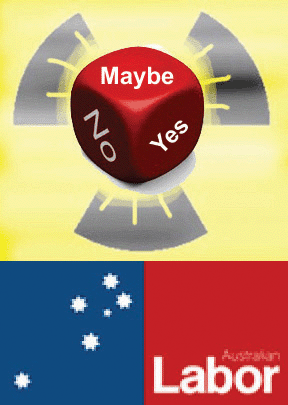 Labor split on nuclear waste dump, https://www.miragenews.com/labor-split-on-nuclear-waste-dump/ The Greens are calling on the Labor Leader in the Senate, Penny Wong to declare where her party stands on the proposed Nuclear Waste Dump in SA, after a clear division within the Labor Party was revealed in a Senate Inquiry Report released late yesterday.
NSW Labor Senator Jenny McAllister delivered a dissenting report, independent of her Labor colleagues including SA Senator Alex Gallacher who supports the majority report that SA should be a dumping ground for nuclear waste.
Greens Senator for South Australia Sarah Hanson-Young said:
“Penny Wong needs to come out today and tell South Australians where the Labor Party stands.
“Does it stand with Senator McAllister who has stated the process for selecting a site has been flawed and no meaningful community consent obtained? Or does it stand with SA Senator Alex Gallacher and the Liberal Party who want to dump on SA?
“The decision to set up a nuclear waste dump in SA will affect our state for generations to come. All South Australians should have the right to have their say on this important issue and they should know very clearly where the ‘opposition party’ stands both at a federal and state level.”
1 This month


Help Aunty Sue Protect Her Land and Sacred Sites From Destructive Rocket Testing.
.

Australians deserve the truth
about
AUKUS – https://aukuspublicinquiry.com/

PETITION – To: Prime Minister Anthony Albanese and the Australian Labor Government

of the week – Australians for War Powers Reform (AWPR)
To see nuclear-related stories in greater depth and intensity

