Doubts on the independence of the reiew of Australia’s national environmental laws
 Frustration grows over delayed release of review into Australia’s environmental laws
‘Questions naturally arise’ about review’s independence, environmental group says, Guardian, Lisa Cox 17 Jul 20, Environment groups are increasingly anxious and frustrated as they wait for the release of an interim report from a review of Australia’s national environmental laws.
The review’s chair, the former competition watchdog head Graeme Samuel, handed his report to the environment minister, Sussan Ley, almost three weeks ago.
It had been due for release shortly after that but the government pushed back its publication, which is now expected sometime next week.
“When the review was announced, Minister Ley was very clear that this was meant to be an independent report. But when the report is delayed by government, questions naturally arise about how independent that process is,” said Suzanne Milthorpe, the national environmental law campaign manager at the Wilderness Society.
“If they are serious about this, they should release it so that all Australians can see and engage with the findings of this report.”
The review of Australia’s Environment Protection and Biodiversity Conservation Act is a once-in-a-decade statutory requirement. It has the potential to shape policy for the next 10 years in an area that is highly politicised.
The interim report and its recommendations will inform the next period of public consultation before Samuel delivers a final report in October.
In submissions to the review, environmental and industry groups have put forward proposals that involve the development of national environmental standards.
They agree Australia’s environment is in decline, but they hold different views on what a set of national standards might look like.
Industry continues to advocate for reductions in environmental regulation, while conservationists have called for stronger protection and an independent national environmental authority.
Just this week, Australia’s oil and gas lobby, APPEA, called for regulatory reform, and in particular the cutting of so-called environmental “green tape”, to support economic recovery from the coronavirus pandemic. …..
James Trezise of the Australian Conservation Foundation said a recent national audit office report that examined the assessment and approval of projects under the act had identified serious failures in governance.
That included findings that the government had been ineffective in managing risks to the environment and had failed to ensure developers were meeting the environmental conditions of their project approvals.
Trezise said reforms were needed to ensure Australia’s laws were better focused on delivering outcomes for the environment and that one way of achieving that was “through setting clear national standards” for environmental protection…….
James Trezise of the Australian Conservation Foundation said a recent national audit office report that examined the assessment and approval of projects under the act had identified serious failures in governance.
That included findings that the government had been ineffective in managing risks to the environment and had failed to ensure developers were meeting the environmental conditions of their project approvals.
Trezise said reforms were needed to ensure Australia’s laws were better focused on delivering outcomes for the environment and that one way of achieving that was “through setting clear national standards” for environmental protection……… https://www.theguardian.com/environment/2020/jul/17/frustration-grows-over-delayed-release-of-review-into-australias-environmental-laws
Australia’s Liberal Coalition climate deniers are at it again
 COALITION DENIERS AT IT AGAIN, MARK BUTLER. July 15, 2020
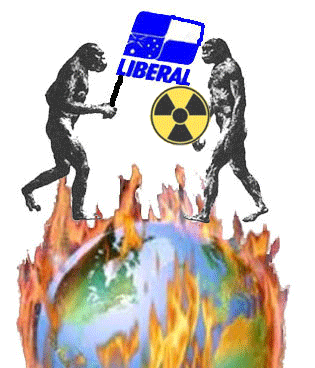
Coalition MP Craig Kelly has mounted an extraordinary attack on the Bureau of Meteorology in a Facebook post shared more than one thousand times in 36 hours.
Coalition MP George Christensen was among those who shared the post, saying: “Craig Kelly is in detective mode. Crooks within data-altering government agencies should be worried. Very worried.”
Does the Environment Minister Sussan Ley agree with these attacks on the Bureau of Meteorology? Does the Assistant Minister, Trevor Evans?
What about Mr Kelly and Mr Christensen’s backbench colleagues like Ross Vasta, Tim Wilson, Dave Sharma, Fiona Martin or Katie Allen?
If they don’t agree, what are they doing about the fact that their colleagues are using social media to spread disinformation in an attempt to discredit a government agency and undermine action on climate change?
This is beyond a joke. The Government needs to take responsibility for the actions of its own backbench.
Links to Mr Kelly and Mr Christensen’s posts:
https://www.facebook.com/CraigKellyMP/photos/a.251794581681850/1553197208208241/
https://www.facebook.com/CraigKellyMP/photos/a.251794581681850/1555461397981822/
https://www.facebook.com/gchristensenmp/posts/2988498467871728?__tn__=-R
Kimba “interim” nuclear waste site – bad news, uncannily like the misguided New Mexico waste plan
KIMBA GOVERNMENT PROPOSALS, by Peter Remta, 11 July 20 Is not the newspaper article below describing practically the same situation as with the Kimba proposals?
Should not the Australian government learn from this and the other unsatisfactory experiences overseas of which France is a main one despite being used as a successful example by the government for Kimba of community consent.
The author of this article and the former chair of the Nuclear Regulatory Commission of the USA (who incidentally has been to Kimba) would both be prepared to give evidence and their opinions to the Senate committee inquiry by video link.
However this article shows the effects of inept and incomplete planning as is the case with Kimba.
New Mexico nuclear facility is bad news, Las Vegas Sun, By Judy Treichel Monday, July 6, 2020, It may seem like good news in Nevada that an effort is underway in New Mexico to build a private storage facility for nuclear waste there.
But don’t be mistaken: This facility wouldn’t be an alternative to the disastrous Yucca Mountain nuclear waste repository. In fact, its existence depends on Yucca Mountain becoming an operating repository. That’s unacceptable, because the Nevada facility poses far too many risks for our state.
The license application for the New Mexico facility calls for it to operate over 40 years, after which the waste stored in it would go to Yucca Mountain….. today those Yucca Mountain deliberations are on an indefinite hold.
Now comes the New Mexico license application to the Nuclear Regulatory Commission, which in the opinion of the Nevada Nuclear Waste Task Force the commission should not have accepted with the assumption that Yucca Mountain would be an operating repository.
During all of the time that Nevada has been fighting the Yucca Mountain proposal, we were repeatedly assured that we could place our trust in the commission because before any license was granted for construction or operation, a thorough and unbiased process would fully play out. We were told there was no reason for questioning the fairness of the commission’s licensing process…….
Any siting of a facility that creates risk for the community should require informed consent, and the people of New Mexico do not consent.
What we see happening with this so-called interim site is that it does not solve the nuclear waste problem. In fact it increases the risks by putting the waste on the roads and rails, and requiring it to be loaded and unloaded multiple times and transported more than once. Additionally, the only way a site can be considered “interim” is to know that the waste will leave, and the assumption here is that it will leave New Mexico and come to Nevada.
The incentive for the company proposing to build the facility is purely financial — specifically, it’s to gain access to the $42 billion in the federal nuclear waste fund. An interim site does not increase or improve public safety, but rather does just the opposite. It creates one more nuclear waste site and provides more room at reactor sites for more waste. And it moves the waste closer to Nevada.
A national high-level nuclear waste repository at Yucca Mountain is an overwhelmingly unsafe idea. Nevada residents, elected officials and people across the country living near transport routes know it. For 20 years, the Department of Energy studied the site and discovered — or were forced to admit — that there were conditions present that, according to their own guidelines, disqualified the site.
If the licensing process ever restarts, how could we trust the Nuclear Regulatory Commission to fairly judge the science when it has previously assumed a licensed and operating repository at Yucca Mountain? Congress needs to reverse the action it took naming Yucca Mountain as the only site to be considered for a national repository, and take a fresh and fair look at nuclear waste disposal.
Initiatives like the interim storage site in New Mexico are simply misguided and misleading diversions.
Judy Treichel is executive director of the Nevada Nuclear Waste Task Force
In contradiction to Angus Taylor, Australia’s Minister On Behalf of Polluting Industries, the States are leading on clean energy
 How Australia’s state energy ministers are turning the tables on Angus Taylor, Guardian Simon Holmes à Court The state energy ministers still need to deliver on their promises, but imagine if any of them held the federal portfolio @simonahac, Sat 11 Jul 202 Sometimes it just takes a bit of leadership.
Former prime minister Malcolm Turnbull likes to say that we must choose “engineering and economics” over “idiocy and ideology”. The New South Wales energy minister, Matt Kean, has been making the right choices.
In December 2018 I singled out NSW for its reckless lack of energy policy. The state, reliant on an ageing coal fleet for 80% of its power, had been shunned by energy investors……..
NSW is blessed with high-quality wind and solar resources, but lacks transmission lines between the best wind and solar areas and the state’s major population and industrial centres. In 2018, only one-in-20 proposed renewable energy projects could be accommodated into the weak grids in the west of the state, and developers were forced to turn their attention to the other states.
In a landmark speech late last year, Kean, the newly minted energy minister, made it clear his government would respond to the climate science and embrace the opportunities presented by decarbonising the economy.
“To those vested interests and ideologues who want to stand in the way of this transition, I say enjoy your Kodak moment,” he said.
Undeterred by attacks from the Murdoch media and even the prime minister, Scott Morrison, over the following months, Kean set about turning the tables in NSW……….
What’s stunning is how much ambition has shifted, and how it’s being driven by the states. Just two years ago the modelling for Josh Frydenberg’s failed national energy guarantee predicted that NSW wouldn’t build a single wind or solar farm from 2021 to 2030. Now Kean has a plan to build as much large-scale renewable energy this decade in NSW as all of Australia built over the past 20 years. …….
The Australian Energy Market Operator and CSIRO have determined that the cheapest way to “firm” the huge amounts of renewable energy is a relatively modest mix of better interconnections with neighbouring states, batteries and pumped hydroelectricity – Snowy 2.0 project and multiple smaller projects. On economic grounds alone, fossil gas is unlikely to play an increased role.
The Rezs will also open up opportunities for energy intensive industry. Flexible demand, such as hydrogen production, can help balance the grid. Instead of fracking the Pilliga forest to produce fertiliser with a huge carbon footprint, business could build a zero-carbon factory in the New England region, making fertiliser from renewable energy.
Angus Taylor, the federal minister for energy and emissions reductions, is famously no fan of renewable energy or of setting meaningful emissions reduction targets. On electricity, the state energy ministers – right across the political spectrum – are charging ahead without him, which is perhaps as it should be, given that electricity is the states’ responsibility…….
Every state and territory has now formally signed on to a net-zero emissions target by no later than 2050, a target backed by business, unions and the opposition – yet the federal government and its donors stand in the way.
Australia has three Liberal state energy ministers. South Australia’s Dan van Holst Pellekaan wants to see his state hit 100% renewables by 2030. His Tasmanian counterpart, Guy Barnett, is gunning for 200% renewables and Kean has outlined a plan for NSW to be an energy superpower.
Sure, these energy ministers still need to deliver on their promises, but imagine if any one of them held the federal portfolio. https://www.theguardian.com/environment/2020/jul/11/how-australias-state-energy-ministers-are-turning-the-tables-on-angus-taylor?utm_term=Autofeed&CMP=soc_568&utm_medium=Social&utm_source=Twitter#Echobox=1594424036
Keep Australia’s nuclear prohibition laws: it appears that nuclear is no part of climate action, not necessary

The most important group of nuclear power advocates who have consistently promoted concerns about climate change as the main reason for their advocacy have been the self-described ‘eco-modernists’. The main organizational focus of ecomodernism is the
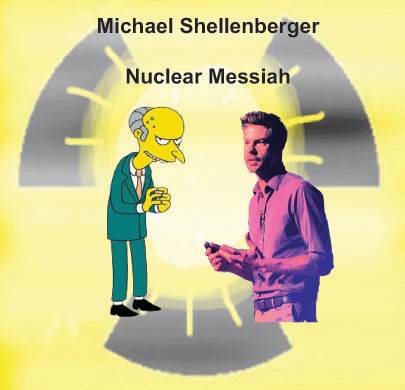 Breakthrough Institute, established by Michael Shellenberger and Ted Nordhaus in 2003.
Australia now the biggest exporter of global heating- the Saudi Arabia of coal and gas
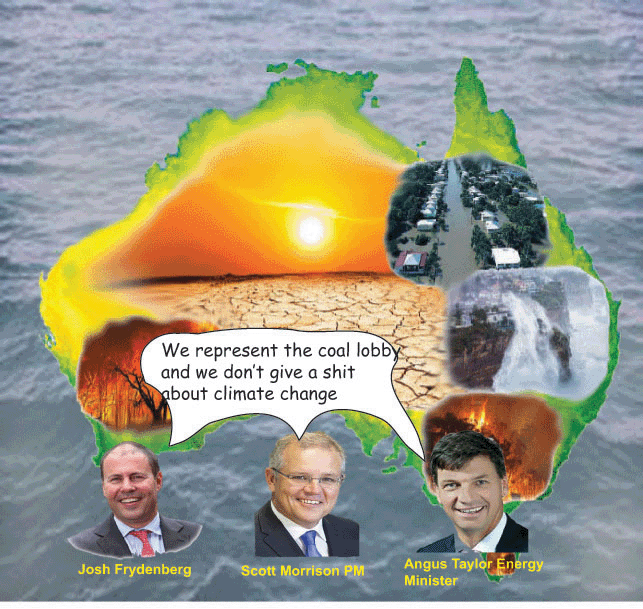 Passing the pollution: Australia becomes world’s biggest exporter of fossil fuels, https://thenewdaily.com.au/news/2020/07/09/australia-export-fossil-fuels/ Cait Kelly, Australia is now the biggest exporter of climate change, leading the world in selling fossil fuels, a new report reveals.Emissions from nations which bought our gas, coal and oil increased by 4.4 per cent between 2018 and 2019, with Australia now the world’s biggest fossil fuel producing country, the report from UNSW says. Passing the pollution: Australia becomes world’s biggest exporter of fossil fuels, https://thenewdaily.com.au/news/2020/07/09/australia-export-fossil-fuels/ Cait Kelly, Australia is now the biggest exporter of climate change, leading the world in selling fossil fuels, a new report reveals.Emissions from nations which bought our gas, coal and oil increased by 4.4 per cent between 2018 and 2019, with Australia now the world’s biggest fossil fuel producing country, the report from UNSW says.
Our exported emissions are now greater than the domestic pollution of Germany, Canada, Turkey and the UK. “Not only is Australia a laggard in meeting its UN Paris emission reduction targets, but it is also now the world’s largest exporter of coal and gas,” the authors wrote. “In fact, the emissions from Australia’s exported fossil fuels are now greater than Germany’s domestic emissions.” Australia has been on track to become the world’s bigger carbon dioxide polluter for a while, with a report from The Australian Conservation Foundation last year warning we would hit the milestone soon. Russia and Saudi Arabia were both above Australia as recently as August last year. Using new data from the Office of the Chief Economist, emissions from exported fossil fuels were 1.2 times greater than global aviation emissions in 2018 and 1.4 times greater than all the CO2 emissions produced by the summer bushfires in 2019. When Australian fossil fuels are burned overseas, the amount of carbon dioxide they produce is higher than the exported emissions of the world’s biggest oil and gas-producing nations, like Iraq and Kuwait. “Despite Federal Government claims that our national emissions have only a minimal impact on the global climate, Australia is, in fact, a major contributor to global climate change.” “The massive emissions that result from our fossil fuel exports are not counted in Australia’s national carbon budget under our UN climate obligations, nor do we take responsibility for the impact these emissions are having globally.” Australia is the world’s biggest exporter of coal and our exported emissions should be counted towards our overall emissions footprint, said lead researcher and professor of political philosophy Jeremy Moss. “We’re the Saudi Arabia of coal and gas. That’s not a good situation to be in,” he told The New Daily. “People say we’re not responsible for exports, the government spends a billion dollar to recycle our waste which otherwise would have gone to other countries. These emissions are also our problem. “Responsibility doesn’t stop at the border. We have the same view about plastic waste, uranium and live sheep exports.” The report calls for fossil fuel non-proliferation treaty, removal of the $47 billion worth of subsidies for the fossil fuel industry and phasing out production constant with climate goals,” Professor Moss said. “At least two-thirds of the known reserves of fossil fuels must be left in the ground if climate targets are to be met (IEA, 2012). “Production of fossil fuels must, therefore, be phased out rapidly. Countries such as Australia should not get a free pass to produce and export as much fossil fuels as they are able to.” The report follows the announcement that the COVID-19 economic recovery committee has made recommendations that the government underwrite a massive gas industry expansion. Australia’s Energy Minister, Angus Taylor, is proposing a gas led recovery out of the pandemic-induced recession. But a report from the Australia Institute revealed last week that fossil fuel was the worst-performing sector in the ASX 300 over the last decade. “The poor performance of fossil fuel companies is probably surprising to most Australians, who are routinely told by industry and political leaders that coal is the “bedrock” of Australia’s prosperity, or that gas will “fire” the recovery from COVID19,” it read. |
|
Independent advice essential for Kimba community: they have received only pro nuclear dump propaganda
 Having read the Hansard transcript of Tuesday’s Senate committee hearing it becomes even more imperative that the community at Kimba opposing the facility and others who are not completely convinced must get their own independent advice and assessment on the government’s proposals
The most concerning of the evidence was that on behalf of ARPANSA which contrary to expectations suggested that any community involvement or engagement in the licensing process would be rather perfunctory
The way I understand that evidence by Dr Larsson is that the extent of the consultations with the community will really be what and how the community decides – this would suggest that they will be in a far stronger position if they have proper technical information and knowledge to argue against the government’s proposals in the course of the consultations
In view of this evidence the chairman and members of the inquiry committee should be formally requested to provide the necessary funding for the independent advice and assessment and the right to bring the results into the evidence for the inquiry
The community at Kimba opposing the facility, and others must stress the disadvantage and unfairness in their being deprived of that advice and assessment, and that is it is also equitable for the Government to pay for the independent assessment having regard to the money already given to the community to bolster approval for the government’s choice of the facility location
After all how can ARPANSA expect them to be fully and properly involved in the community consultation process if they do not have the necessary information?
AustralianGovtWatcher comments on Senate Committee enquiry hearing on Tuesday 30 June 2020
In general both the committee members and the witnesses appeared to be ill prepared and lacked knowledge of some of the pertinent issues involved
Several important factors were neither raised by questions nor otherwise dealt with by the witnesses – these included:
- details of expenditure of the whole exercise particularly the cost of the reports by AECOM
- more specific description of how the Kimba proposals and present arrangements for storage of nuclear waste comply with international standards and best practice
- no information on the radionuclides inventories and mobility
- information on examination of techniques and methods for permanent disposal of intermediate level waste – merely mentioned directional drilling which no doubt refers to the borehole technology
- no specific mention of geological burial requirements and applicable codes
- complete silence on immediate availability of the highly suitable Leonora site of the Azark Project
- no questions regarding the previous nominations
- no questioning of the ballot results yet seemed to agree with the Department’s proposition that the Barngarla peoples’ own ballot was of not much help since so many had not voted
Senator Sarah Hanson-Young pursued a couple of worthwhile points regarding consultations with the Barngarla and their lack of informed consent and the issue of double handling of the intermediate level waste by initial storage at Kimba followed by permanent disposal at some other location
The other member who pursued a number of issues with some success was Senator Jenny McAllister but again she appeared to lack the required knowledge to be really effective
However she was a butt to Senator Chris Carr who is obviously very much in favour of the Kimba proposal particularly with his references to his discussions with Dr Adi Paterson from ANSTO
Senator Rex Patrick asked some good questions but regrettably this was obviously slanted towards his present campaign to get the waste disposed of at Woomera
Perhaps the most badly prepared witness was Ms Sam Chard from the Department who simply could not answer some fairly basic questions and kept asking for them to be put on notice for subsequent provision of the necessary information – she was actually castigated by Senator McAllister
Asking for requests to be put on notice is invariably good tactics to avoid having to answer immediately an uncomfortable question and I suspect there is more use of this than necessary
However this can be reduced to some extent if the inquiry committee made greater use of its powers of production and discovery before and even during the hearings
The witness with whose answers I was disappointed – and I did see a bit of him on video – was Dr Carl-Magnus Larsson from ARPANSA who was very noncommittal and not extremely helpful by continuously claiming that ARPANSA would only become involved once it received the applications for the necessary licences for the Kimba facility
The very disappointing aspect of his evidence is that he would not provide any significant technical information and seemed too interested in shoring up the position of ANSTO
It is of course very difficult in these hearings since the members of the enquiring committee are mostly not trained in the art of forensic questioning as well as having insufficient knowledge to make the inquiry process very effective
It also seems that the research team for the enquiry did not delve sufficiently into various issues that should be investigated which only makes it more difficult for the committee considering the limited time given to each member for questions
From the submissions by the government and its agencies it is now quite clear that the community members opposing the Kimba facility must get proper independent assessment and advice to be able to be involved in the consultations with ARPANSA during the licensing process in a meaningful manner
They should ask the committee to ensure sufficient funds are available for that purpose as otherwise it will be practically impossible for the community members to deal with the technical and rather scientific aspects of the licensing applications particularly as Dr Larsson was not overly encouraging in his evidence about assisting them
The best self serving evidence was from AEMCO who simply relied on their report and very stated that quite a few of the issues raised by questions ere outside of its commission
Impressions of Senate hearings on nuclear waste dump Bill
 We saw ANSTO, ARPANSA and the Department of Industry etc being grilled by Senators Rex Patrick, Sarah Hanson-Young and ALP Jenny McAllister.
In Australian Senate Inquiry uncertainty grows over whether Kimba nuclear dump site is really needed
the day saw uncertainty grow over the need for the proposed Kimba site while there was a corresponding growth in clarity that there is no urgency re this decision. The govts plan might suit ANSTO but it is not Australia’s only option – and it faces growing scrutiny.
from Jim Green, 1 July 2020 , Yesterday, Tuesday June 30 , the Senate Inquiry into Minister Pitt’s planned amendments to the national radioactive waste laws to cement and secure Kimba as a Facility site took evidence in Canberra.
The Committee heard from Govt agencies and contractors and key themes included both the need for the planned new laws and, importantly, for the Facility itself – esp. around the double handling of Intermediate Level Waste from ANSTO’s Lucas Heights.
ANSTO – as ever, there was too much bluff and bluster and too many Dorothy Dixers – as invariably happens with them in Estimates – but there were some very interesting arisings:
- Confirmed there are ‘no safety concerns’ with current waste – although ‘we cannot say that in 40 or 50 years they (ANSTO’s waste stores) will be fit for purpose’ – clear acknowledgement that they could retain waste on site and four decades is more than enough for a credible review and a more integrated approach.
- Further, ANSTO has ‘proposals under development with government for pre-2027 construction of new storage’ for ILW waste
- Hardly credible that they did not know the general proportions of ANSTO origin waste at the proposed Facility (around 80% of total wastes, and more importantly, 95% of ILW)
- They see extended on-site storage as a ‘significant management challenge and significant financial cost’ and so want to both cost shift and physically waste shift. Again, this is ANSTO’s agency agenda – not a national imperative or Australia’s sole or best option.
- Odd claim that a delay in advancing Kimba would be ‘detrimental to our sense of ourselves’ however it would not be inconsistent with any international treaty obligations. No treaty or convention obligations require Kimba to be advanced in its current form – or at all. (also I would suggest that ignoring Traditional Owner opposition to the siting of a national radioactive waste facility poses a bigger threat to our national sense of self)
- No credible threat to secure access to nuclear medicine supply should Kimba be delayed – although there would be ‘some scenario’s’ where supply could potentially be impacted. This is a very significant reduction in ANSTO’s threat messaging and a long way from a pressing problem. As I understand the scenario referred to is that Kimba is not advanced and ANSTO has taken no steps to develop a contingency.
In summary Kimba is not essential for nuclear medicine nor is it essential for Australia’s compliance with international frameworks. ANSTO could extend interim storage at Lucas Heights but understandably would prefer to transfer both the waste and its continuing management cost to a non ANSTO purse and place. Not a good enough rationale for a deficient national plan.
ARPANSA
- ANSTO waste ‘can be safely stored at Lucas Heights for decades to come’ – absolutely critical point: there is no need to rush – we have time to develop a more credible approach.
- ‘International best practice is to store radioactive waste safely – current storage at the Lucas Heights site is fully aligned with international best practice’
- There will be distinct licensing applications required for the two waste streams – LLW and ILW (with no certainty that they will have a shared approval outcome)
Dept of Industry:
- Repeated reference to the ‘contentious’ nature of the siting decision
- Extremely deficient responses re the rational and process for the change in legislative decision making from Ministerial decision to legislative instrument. Some Senators not happy at Depts inability to answer basic process questions –it is very clear the rationale is to isolate against future legal challenge.
- Statement that decision to change the legislative basis of the siting was made sometime in 2019 – then a later statement that it was made by Minister Pitt (note: Pitt was sworn in 6/2/20)
- The Departments Sam Chard rear guard action was to state that the intent of the change was to enable Parliament ‘to test the merits of the action’ – that is long overdue – could we please do this as it simply doesn’t stack up
- Increasingly clear that the Dept is utterly adrift re Barngarla liaison – understandably as they simply do not want the Facility on their country – the Facility plan is heading for some pretty sharp rocks if it doesn’t change course.
Dept of Defence:
- strongly arguing against any siting on the Woomera Prohibited Area as this could reduce its functionality. Not at all keen.
- Hard pressed by Rex Patrick though about how credible is it to say ‘not possible’ for a 100 hectare Facility inside a site twice the size of Tasmania.
AECOM:
- Predictable defence of process, their expertise and kept referring to the restricted extent of their brief as the way to avoid any tricky questions (like Barngarla liaison)
- No tech or site reason why the Facility couldn’t be at Kimba
There were good efforts from Sarah Hanson Young, Rex Patrick and Labor’s Jenny McAllister to highlight and tease out issues.
In a nutshell I would say the day saw uncertainty grow over the need for the proposed Kimba site while there was a corresponding growth in clarity that there is no urgency re this decision. The govts plan might suit ANSTO but it is not Australia’s only option – and it faces growing scrutiny.
We now need to keep up the issue profile and the expectation on Labor and the cross-benches to oppose this legislation when it comes to the Senate and instead support a strategy that advances both human and environmental rights and responsible radioactive waste management.
Oppose Kimba nuclear waste dump plan – Senator Sarah Hanson-Young

|
No Nuclear Waste Dump in South Australia https://www.sarahhansonyoung.com/no_dump
The nuclear waste dump site selection process is fundamentally flawed, has fallen short of international best practice and failed to secure the consent of Traditional Owners. The Federal Government has no mandate to situate a radioactive waste management facility in South Australia. The communities of Hawker and Kimba have been significantly impacted by the ongoing mismanagement of the site selection process. It is imperative that all stakeholders within transport corridors in South Australia, every community impacted by the potential thoroughfare of nuclear waste should be fully informed of the relevant costs and benefits, throughout the transport chain, and offered the opportunity to have their say on the proposal. The proposed double-handling of intermediate-level radioactive waste is not consistent with international best practice. Alternatives should be canvassed, including the suspension of the site selection process until a permanent disposal site can be identified. |
|
Julian Assange’s father in tireless fight to free his son, calls on Scott Morrison to help Australian citizen Julian
 Assange’s father calls extradition process ‘disgrace’ https://telanganatoday.com/assanges-father-calls-extradition-process-disgrace?fbclid=IwAR1a7bQ0W_Xcgc9EIeGaAHVP7Zmm2cM6nNV65ZXtkhCwNUlarqIYTJVw6xo1 July 20, The 80-year-old is organizing public events in Australia despite the ongoing coronavirus pandemic and hopes to travel to London in August to support Assange during his extradition trial.
Sydney: WikiLeaks founder Julian Assange’s father, John Shipton, is fighting tirelessly for the release and return of his son, who is facing an extradition trial in London for publishing classified information, a process he described as abuse.
“We maintain that the extradition request is a fraud in the English court… It’s a fraud in the English legal system, it’s a case of abuse of process, it is a disgrace,” Shipton, who travelled from Melbourne to Sydney to campaign for his son’s release, told Efe news in an interview.
The 80-year-old is organizing public events in Australia despite the ongoing coronavirus pandemic and hopes to travel to London in August to support Assange during his extradition trial which, he says, is being carried out under “dire” circumstances.
In May 2019, the UN Special Rapporteur on Torture, Nils Melzer, said, after visiting Assange in the Belmarsh prison along with two medical experts, that he showed “all symptoms typical for prolonged exposure to psychological torture, including extreme stress, chronic anxiety and intense psychological trauma”.
Assange has spent almost a decade in confinement, first under house arrest in a British town and then at the Ecuadorian embassy in London between 2012 until 2019, when Ecuador withdrew his political asylum status.
Shipton has urged the Australian government to mediate with the UK administration for the release of his son, who is wanted in the US on 18 charges of espionage and computer intrusion, for which he could be sentenced to prison for up to 175 years.
“I believe the government can, if it wishes to, assist us in bringing Julian home. I believe that (it) is very simple for the Prime Minister (Scott Morrison) to pick up the phone and ring (his UK counterpart) Boris Johnson and say Julian Assange is an Australian citizen in dire circumstances.
“This will resolve this immediately and that’s easily possible,” he told Efe news during the interview.
Australia: USA’s Deputy Sheriff goes for bloated military expenditure
 Defending Australia: The Deputy Sheriff Spending Spree https://theaimn.com/defending-australia-the-deputy-sheriff-spending-spree/?fbclid=IwAR0K25d1UTZX_0DTF_2JFQESQ3nBlXbvGjv3PihUHH3ib6Q9yW6mNUV6LBE,
  July 1, 2020, by: Dr Binoy Kampmark There are few sadder sights in international relations than a leadership in search of devils and hobgoblins. But such sights tend to make an appearance when specialists in threat inflation either get elected to office or bumped up the hierarchies of officialdom. The sagacious pondering types are edged out, leaving way for the drum beaters. As the Roman general Vegetius suggested with solemn gravity in the 4th century, “Igitur qui desiderat pacem, praeparet bellum,” an expression that has come to mean that those desiring peace best ready for war.
- Australia’s drum beating government has told its citizens rather pointedly that “we have moved into a new and less benign strategic era.” It is something that the federal government has never tired of stressing ever since the White Tribe of Asia developed fears of genetic and maternal abandonment, being thousands of miles from Britannia but uncomfortably close to the hordes of Asia. To the north lay the colours black, brown and yellow, tempered, for a time, by the powers of Europe. Henry Lawson, who had a fear or two tucked under his belt, reflected on this sentiment in his patchy Flag of the Southern Cross: “See how the yellow-men next to her lust for her, Sooner or later to battle we must for her.”
Instead of committing to an easing of that tension, Morrison is keen to throw Australia into an increasingly crowded theatre of participants in the Indo-Pacific on the mistaken premise that things have dramatically changed. “And so we have to be prepared and ready to frame the world in which we live as best as we can, and be prepared to respond and play our role to protect Australia, defend Australia.”
That defence is, invariably, linked to that of the United States, which sees Australia as an essential cog in the containment strategy of the PRC. The idea that this new round of spending will assist Australia’s own independence from this project is misleading in the extreme. For one, the continuing stress on interoperability between the Australian Defence Force and its US counterparts remains a feature of spending decisions. Deputy Sheriffs know where and from whom to take their cues and stock from. Such weapons as the United States Navy’s AGM-158C Long Range Anti-Ship Missile (LRASM) are on the list of future purchases. There is also the promise of underwater surveillance systems, and research and development in what promises to be another frontier of an international arms race: hypersonic weapons or, as US President Donald Trump prefers to call them “super duper missiles.” (Some $9.3 billion has been allocated for the latter.)
The prime minister also revisits a term that is impossible to quantify, largely because of its fictional quality. Deterrence, ever elastic and rubbery, only has meaning when the hypothetical opponent fears retaliation and loss. To undertake any attack would, to that end, be dangerous. For decades, this fictional deterrent was kept up by the vast umbrella of the US imperium.
The sense that this umbrella might be fraying is being used as an excuse to beat the war drum and stir the blood. Senator Jim Nolan is one, insisting that “we must share some of the blame [for the likelihood of regional conflict] because we have ignored our century-long history of national unpreparedness, and have relied blindly on an assumed level of US power which, since the end of the Cold War, exists at a much lower and dangerous level, and looks less likely to deter regional conflict.” Nolan nurses a fantasy that seems to be catching: that Australia aspire to “self-reliance” and have “confidence that we could adjust in time required to defend ourselves and so, with a bit of luck, deter conflict impacting directly on us. At present, we are severely deficient.”
Morrison similarly opines that, “The ADF now needs stronger deterrence capabilities. Capabilities that can hold potential adversaries’ forces and critical infrastructure at risk from a distance, thereby deterring an attack on Australia and helping to prevent war.” To imagine that Australia would be able to deter a power such as China, even with projected purchases, is daftly entertaining. The term simply does not come into play.
This incoherence is of little concern to the family of strategists that inhabit the isolated climes of Canberra. When money and weaponry is promised, champagne corks pop. Peter Jennings of the Australian Strategic Policy Institute is duly celebrating, given his fixation with that one power “with both the capacity and the desire to dominate the Indo-Pacific region in a way that works against Australia’s interest.” He even has a stab at humour: “We’re not talking about Canada.”
Broad policy commitments to bloated military expenditure are always to be seen with suspicion. They come with warnings with little substance, and only matter because people of like mind find themselves on opposite sides of the fence warning of the very same thing. If you do not spend now, you are leaving the country open to attack. That most important question “Why would they attack us in the first place?” is never asked. Even at the height of the furious battles of the Second World War, Imperial Japan debated the merits of invading an island continent which would have needlessly consumed resources. Australia, in short, has never been an inviting target for anyone.
The dangers of adding to the military industrial complex, then, are only too clear. Countries who prepare for war in the name of armed security can encourage the very thing they are meant to prevent. Purchased weapons are, after all, there to be used. The result is the expenditure of billions that would better be spent on health, education and, ever pressingly, on redressing environmental ruination.
We are then left with the desperate sense of a psychological defect: the need to feel wanted and relevant on the big stage. This was very much the case when Prime Minister Robert Menzies committed Australian troops in 1965 to stem the Red-Yellow Horde in the steaming jungles of Vietnam. The language being used then was much as it is now: to deter, to advance national security, to combat an authoritarian menace in a dangerous region. Little weight was given to the subtleties of a nationalist conflict that was not driven by Beijing. Half-baked and uncooked strategy was served in the messes.
In adding their bloody complement to a local conflict that would eventually see a US defeat, Labor’s Arthur Calwell, himself a self-styled white nationalist, made a sober speech in denunciation. Australia was committing resources to “the bottomless pit of jungle warfare, in a war in which we have not even defined our purpose honestly, or explained what we would accept as victory.” Doing so was “the very height of folly and the very depths of despair.” Australia now finds itself committed to a defence strategy against a mirage dressed in enemy’s clothes masked in language that resists meaning or quantification.
Labor rejects National Radioactive Management Amendment Bill. 2020- Josh Wilson MP
Hansard , Mr JOSH WILSON (Fremantle) Senate Committee Inquiry into National Radioactive Management Amendment Bill. 2020. “…….. There is no question that Australia needs to make progress when it comes to the proper long-term storage of nuclear waste. It is just that this bill doesn’t help take us towards that end. It’s taken us 40 years and it’s cost$55 million to get us to this point. ……..
Effectively this bill seeks to rush and force the issue of community acceptance, which is a mistake. The ministerhas the power to make the decision in question. You can only guess that the reason for this legislation is to lockin an outcome, when the minister and the government accept that there are some concerns with the communityacceptance process that has occurred so far.
The bill effectively also wants to ignore, avoid and further neglect the key issue of a permanent disposal site for intermediate-level waste. There are two kinds of waste that this bill proposes to send to a site in South Australia—low-level waste and intermediate-level waste—and they are very different. A lot of what has been said, including what the minister said in introducing this bill, glides over that difference in a way that is wrong and is certainly not helpful in terms of getting to where we need to get to with a permanent disposal site for low-level waste and a permanent site for intermediate-level waste…..
We have to get towards a long-term disposal solution, and yet this bill raises two serious questions about how the government wants to take us there. There’s concern over the site selection process, which goes to the question of consultation, engagement and community agreement, and there are concerns about the purpose and function of the facility…….
Departmental officials came before the energy and environment committee when we were inquiring into nuclear energy, and they gave us some very rough estimates of what the construction of the site itself would cost. That will be somewhere around $340 million to $350 million. That’s for the construction of the site, and that was described to us as a conservative estimate.Bizarrely, there is no current process underway with even a single dollar of government resources going towards the issue of a permanent disposal site for intermediate-level waste. It’s quite strange. It’s almost hard to believe that, when it’s taken us 40 years to get to the brink of a permanent site for low-level waste, there is not yet any departmental group or any taskforce on this and there’s not a single dollar going to the process of site selection,engineering design or anything else around the question of a permanent disposal site……
There is plenty of room [at Lucas Heights] in that interim storage facility, so there’s no issue with space as far as intermediate-level waste is concerned, and there’s no issue in relation to safety or health concerns either……where is the evidence that there is anyproblem with the intermediate-level waste staying where it is, as it should do, until the government of Australiaidentifies and resources an appropriate permanent disposal site for intermediate-level waste? …..When the interim facility was set up, there was no suggestion it was only for a few years. The licence that exists for the storage of the intermediate-level waste at Lucas Heights runs to 2055. …
ARPANSA is aware that some stakeholders have interpreted ARPANSA’s decisions regarding the IWS— which is the intermediate-level storage— as a requirement for relocation of the waste stored in the IWS, even suggesting that there is an urgent need for relocation. This is not correct. ARPANSA has not raised safety concerns regarding storage of waste at the IWS. ANSTO seems to share this view. ANSTO has indicated to ARPANSA that the mandatory recertification of the TN-81 casks every 10 years can be carried out at the IWS
But the claims that the government and government members in this place have made that intermediate-level storage needs to go to South Australia because there’s no room for it and that there are health and safety concerns about where it is currently are rubbish.
And so it should stay where it is as a spur to the government to get on with the process, which currently hasn’t even started, of finding and resourcing a permanent disposal site. That is not occurring, and that’s one of the chief flaws of this bill. ……
They need to immediately start and resource the process of a permanent disposal site for intermediate-level waste. They should commit to maintaining that waste where it is currently stored, which is another reason for an inquiry on this issue.
……..there are members of the government running around saying that nuclear power should be part of our energy mix in our communities across Australia. Frankly, that is not only deeply irrational but ridiculous and unhelpful in the task this bill presents to us.
This bill is not a sensible or appropriate way in which to move towards the waste storage solution. It puts the program at risk. That’s why we don’t support the bill.
Misinformation about Energy Economics, from nuclear companies and their propagandists
It is generally accepted in the energy industry that the cost of new nuclear is several times that of wind and solar, even when the latter are backed up by storage.
The nuclear lobby, however, has been insisting to the parliamentary inquiry that wind and solar are four to seven times the cost of nuclear, and to try and prove the point the lobby has been making such extraordinary and outrageous claims that it makes you wonder if anything else they say about nuclear – its costs and safety – can be taken seriously.
Supplementary Submission to the Victorian Parliament’s Standing Committee on Environment and Planning
Inquiry into Nuclear Prohibition Friends of the Earth Australia www.nuclear.foe.org.au
June 2020 – Extract
“……..MISINFORMATION REGARDING ENERGY ECONOMICS BY NUCLEAR COMPANIES AND ENTHUSIASTS
Highly questionable economic claims made by nuclear companies and enthusiasts are addressed in:
- submission #40 by Friends of the Earth Australia to the NSW nuclear inquiry[1]
- submission #64 to the NSW nuclear inquiry (see esp. sections 3.5 and 3.6)[2]
An important article by Giles Parkinson ‒ an energy expert and former business and deputy editor of the Australian Financial Review ‒ is particularly helpful in this regard. An excerpt is reproduced below but we encourage members of the Committee to read the full, referenced article. The article is focused on submissions to the federal nuclear inquiry[3] but many of the same claims have been presented to the NSW and Victorian inquiries.
Why the nuclear lobby makes stuff up about the cost of wind and solar
[1] https://www.parliament.nsw.gov.au/lcdocs/submissions/66217/0040%20Friends%20of%20the%20Earth.pdf
[3] https://www.aph.gov.au/Parliamentary_Business/Committees/House/Environment_and_Energy/Nuclearenergy
Giles Parkinson, 23 Oct 2019, ‘Why the nuclear lobby makes stuff up about the cost of wind and solar’, https://reneweconomy.com.au/why-the-nuclear-lobby-makes-stuff-up-about-cost-of-wind-and-solar-46538/
Giles Parkinson, 23 Oct 2019,
It is generally accepted in the energy industry that the cost of new nuclear is several times that of wind and solar, even when the latter are backed up by storage. The GenCost 2018 report from the CSIRO and the Australian Energy Market Operator (AEMO) puts the cost of nuclear at two to three times the cost of “firmed renewables”.
The nuclear lobby, however, has been insisting to the parliamentary inquiry that wind and solar are four to seven times the cost of nuclear, and to try and prove the point the lobby has been making such extraordinary and outrageous claims that it makes you wonder if anything else they say about nuclear – its costs and safety – can be taken seriously.
RenewEconomy has been going through the 290-something submissions and reading the public hearing transcripts, and has been struck by one consistent theme from the pro-nuclear organisations and ginger groups: When it comes to wind, solar and batteries, they just make stuff up.
A typical example is the company SMR Nuclear Technology – backed by the coal baron Trevor St Baker – which borrows some highly questionable analysis to justify its claim that going 100 per cent renewables would cost “four times” that of replacing coal with nuclear.
It bases this on modelling by a consultancy called EPC, based on the south coast of NSW, apparently a husband and wife team, Robert and Linda Barr, who are also co-authors of “The essential veterinarian’s phone book”, a guide to vets on how to set up telephone systems. of wind at A$157/MWh (before transmission costs), which is about three times the current cost in Australia, and A$117/MWh for solar, which is more than double.
The costs of wind and solar are not hard to verify. They are included in the GenCost report, in numerous pieces of analysis, and even in public announcements from companies involved, both buyers and sellers. St Baker could have helped out, as his company has signed two big solar contracts (for the Darlington and Vales Point solar farms) and we can bet he won’t be paying A$117/MWh.
Apart from costs, the EPC scenarios for 100 per cent renewables are also, at best, imaginative. For some reason they think there will only be 10GW of solar in a 100% renewables grid and just 100MW of battery storage. Big hint: There is already 12GW of solar in the system and about 300MW of battery storage. But we discovered that assuming wind and solar do not or won’t exist, and completely ignoring distributed energy, are common themes of the nuclear playbook.
The delivered cost of energy from wind and solar in the EPC modelling of a 100 per cent renewables grid? A hilariously outrageous sum of A$477/MWh (US$330/MWh).
Contrast this with SMR Nuclear Technology’s claims about the cost of a modern small modular reactor – US$65/MWh – even though it admits the technology “has not been constructed”, and which leading nuclear expert Ziggy Switkowski points out won’t likely be seen for at least another decade. …
Why the nuclear lobby makes stuff up about the cost of wind and solar
[1] https://www.parliament.nsw.gov.au/lcdocs/submissions/66217/0040%20Friends%20of%20the%20Earth.pdf
[3] https://www.aph.gov.au/Parliamentary_Business/Committees/House/Environment_and_Energy/Nuclearenergy
Giles Parkinson, 23 Oct 2019, ‘Why the nuclear lobby makes stuff up about the cost of wind and solar’, https://reneweconomy.com.au/why-the-nuclear-lobby-makes-stuff-up-about-cost-of-wind-and-solar-46538/
Why the nuclear lobby makes stuff up about the cost of wind and solar
[1] https://www.parliament.nsw.gov.au/lcdocs/submissions/66217/0040%20Friends%20of%20the%20Earth.pdf
[3] https://www.aph.gov.au/Parliamentary_Business/Committees/House/Environment_and_Energy/Nuclearenergy
Moltex, which says it is “developing” some sort of fission technology (it says it has a design but hasn’t actually built anything) uses the same trick as EPC to paint a daunting picture of renewable and storage costs, in this case by multiplying the cost of batteries by the total amount of electricity consumed in a single day. “Australia consumes 627 Gigawatt hours of electricity per day, and so the battery storage required to cover just one 24 hour period would cost A$138 billion,” it proclaims. It is such an incredibly stupid and misleading claim that it simply takes the breath away. …
But that’s what the nuclear industry feels it needs to do to make its yet-to-be invented technology sound feasible and competitive.
Let’s go to StarCore, a Canadian company that says it, too, wants to manufacture small modular reactors, and claims renewables are “seven times” the cost of nuclear, and which also has a fascination with the Nyngan solar farm. It uses the cost of Nyngan to make the bizarre claim that to build 405 of them would cost A$68 billion, and then compares this to what it claimed to be the “zero upfront capital costs” of one of StarCore’s plants.
Say what? Does the nuclear plant appear just like that? Solar and wind farms also usually have long-term power purchase agreements, but they still have to be built and someone has to provide the capital to do so. Nuclear with a zero capital cost? Really, you couldn’t make this stuff up.
Down Under Nuclear Energy, headed by a former oil and gas guy and a former professor at the University of Western Australia who specialises in mathematical social science and economics, also bases its solar costs on the Nyngan solar farm and makes this bizarre claim about battery storage: “The precipitous decline in solar technology is highly unlikely to be replicated in batteries, a technology already approaching 150 yrs of maturity,” it says.
Hey, here’s some breaking news. Costs of battery storage have already mirrored solar’s fall, down 80 per cent in last decade and utilities like Transgrid predict another 60 per cent fall over next 10-15 years.
And most large-scale storage batteries use lithium, an abundant resource, and this is battery technology that was actually invented just over 40 years ago by the winners of this year’s Nobel Prize for Chemistry. As the Nobel citation says: “(Co-winner Stanley) Wittingham developed the first fully functional lithium battery in the 1970s.” Not 1870.
Women in Nuclear and the Australian Workers Union both quote the Industry Super report on nuclear, which we debunked a while back, which puts the cost estimates of wind and solar plants at 10 times their actual cost.
The “capital cost” of the Dundonnel wind farm in Victoria, for instance, is put at A$4.2 billion (try A$400 million) according to their bizarre calculations, while the Darlington solar farm is put at $5.8 billion (try A$350 million). It’s pure garbage and the fact that it is being quoted really does beggar belief. …
But all the nuclear submissions have one common trait. They assume that the deployment of renewables is stopped in its tracks, either now or sometime soon. It’s more wish than analysis, but in that they will have found a willing fellow traveller in federal energy minister, Angus Taylor “there is already too much wind and solar on the grid” Taylor, who thought it a good idea to have the inquiry.
But the reality is that the rest of the energy industry wants to move on. They know that the grid can be largely decarbonised within the next two decades from a combination of renewables and storage. That’s a simple truth that the nuclear lobby cannot accept, and they’ve passed up the opportunity to have an open and honest debate by promoting utter garbage about renewables, to the point where it would be difficult to believe much of anything else they say.
1 This month


Help Aunty Sue Protect Her Land and Sacred Sites From Destructive Rocket Testing.
.

Australians deserve the truth
about
AUKUS – https://aukuspublicinquiry.com/

PETITION – To: Prime Minister Anthony Albanese and the Australian Labor Government

of the week – Australians for War Powers Reform (AWPR)
To see nuclear-related stories in greater depth and intensity

