Australian government to blame for failure of environment laws
 Let there be no doubt: blame for our failing environment laws lies squarely at the feet of government, The Conversation June 29, 2020 Peter BurnettHonorary Associate Professor, ANU College of Law, Australian National University A long-awaited draft review of federal environment laws is due this week. There’s a lot riding on it – particularly in light of recent events that suggest the laws are in crisis.
Late last week, the federal Auditor-General Grant Hehir tabled a damning report on federal authorities’ handling of the Environment Protection and Biodiversity Conservation (EPBC) Act. Incredibly, he found Australia’s premier environmental law is administered neither efficiently or effectively.
It followed news last month that mining company Rio Tinto detonated the 46,000 year old Juukan rock shelters in the Pilbara. The decision was authorised by a 50 year old Western Australian law –and the federal government failed to invoke emergency powers to stop it.
Also last month we learned state-owned Victorian logging company VicForests unlawfully logged 26 forest coupes, home to the critically endangered Leadbeater’s possum. The acts were contrary both to its own code of practice, and the agreement exempting VicForests from federal laws.
As relentless as Hehir’s criticisms of the department are, let there be no doubt that blame lies squarely at the feet of government. As a society, we must decide what values we want to protect, count the financial cost, then make sure governments deliver on that protection.
Shocking report card
I’ve been involved with this Act since before it began 20 years ago. As an ACT environment official reading a draft in 1998 I was fascinated by its complexity and sweeping potential. As a federal official responsible for administering, then reforming, the Act from 2007-2012, I encountered some of the issues identified by the audit, in milder form.
But I was still shocked by Hehir’s report. It’s so comprehensively scathing that the department barely took a trick.
Overall, the audit found that despite the EPBC Act being subject to multiple reviews, audits and parliamentary inquiries since it began, the Department of Agriculture, Water and the Environment’s administration of the laws is neither efficient nor effective………
How did this happen?
The EPBC Act itself remains a powerful instrument. Certainly changes are needed, but the more significant problems lie in the processes that should support it: plans and policies, information systems and resourcing.
As I wrote last month, between 2013 and 2019 the federal environment department’s budget was cut by an estimated 39.7%.
And while effective administration of the Act requires good information, this can be hard to come by. For example the much-needed National Plan for Environmental Information, established in 2010, was never properly resourced and later abolished……..
A national conversation
There is a small saving grace here. Hehir says the department asked that his report be timed to inform Professor Graeme Samuel’s 10-year review of the EPBC Act. Hehir timed it perfectly – Samuel’s draft report is due by tomorrow. Let’s hope it recommends comprehensive action, and that the final report in October follows through.
Beyond Samuel’s review, we need a national conversation on how to fix laws protecting our environment and heritage. The destruction of the Juukan rock shelters, unlawful logging of Victorian forests and the Auditor-General’s report are incontrovertible evidence the laws are failing……https://theconversation.com/let-there-be-no-doubt-blame-for-our-failing-environment-laws-lies-squarely-at-the-feet-of-government-141482
Auditor general finds that Morrison government has failed in its duty to protect environment
|
Morrison government has failed in its duty to protect environment, auditor general finds
Conservation groups call for independent environment regulator after scathing review of national laws, Guardian, Lisa Cox, 25 Jun 2020 The government has failed in its duty to protect the environment in its delivery of Australia’s national conservation laws, a scathing review by the national auditor general has found.
The Australian National Audit Office found the federal environment department has been ineffective in managing risks to the environment, that its management of assessments and approvals is not effective, and that it is not managing conflicts of interest in the work it undertakes. The report also finds a correlation between funding and staffing cuts to the department and a blow-out in the time it is taking to make decisions, as highlighted by Guardian Australia. The review, which comes in advance of the interim report on Australia’s Environment Protection and Biodiversity Conservation Act, has prompted renewed calls for the establishment of an independent national environmental regulator……. Among its findings, the auditor found the department could not demonstrate that the environmental conditions it set for developments were enough to prevent unacceptable risk to Australia’s natural environment. Of the approvals examined, 79% contained conditions that were noncompliant with procedures or contained clerical or administrative errors, reducing the department’s ability to monitor the condition or achieve the intended environmental outcome. The report also found that a document the department is required to produce to show how the proposed environmental conditions would produce the desired environmental protections was in most cases not being written……. “This report is a scathing indictment of the federal government’s administration of our national environment law and highlights why we need a stronger law and a new independent regulator,” said James Trezise, a policy analyst at the Australian Conservation Foundation. Trezise said the audit showed the government and department had failed in their duty to protect Australia’s unique wildlife and environment. “Worryingly for an area of public policy in which commercial interests are constantly trying to influence, the auditor general found ‘conflicts of interest are not managed’,” he said.
He said the organisation had raised concerns with the auditor about the capacity for political interference in what should be independent decisions………. Australia’s conservation laws are currently subject to a statutory review by the former competition watchdog chair Graeme Samuel. In advance of the interim report, due next week, the government has expressed a desire to streamline approvals and cut so-called “green tape”. But environment groups said the audit confirmed Australia’s laws were “fundamentally broken”. The Wilderness Society’s Suzanne Milthorpe said the findings showed a “catastrophic failure” to administer the law and protect the environment. “This report shows that the natural and cultural heritage that is core to Australia’s identity is being put at severe risk by the government’s unwillingness to fix problems they’ve been warned about for years,” she said. “It shows that even when the department is aware of high risks of environmental wrongdoing, like with deforestation from agricultural expansion, they are unwilling to act…….. https://www.theguardian.com/environment/2020/jun/25/morrison-government-has-failed-in-its-duty-to-protect-environment-auditor-general-findshu |
|
With Liberal Coalition business as usual on energy, thousands of renewable energy jobs will vanish
Up to 11,000 renewable energy jobs at risk if the government ignores calls for new policies, https://www.sbs.com.au/news/up-to-11-000-renewable-energy-jobs-at-risk-if-the-government-ignores-calls-for-new-policies Renewable energy groups are calling for greater public investment as companies risk losing thousands of jobs if the government ignores calls for a policy refresh. BY OMAR DEHEN, 26 June 20, Up to 11,000 jobs in Australia’s renewable energy sector could be lost over the next two years if no additional policies are introduced by the Morrison government, a new report has found.
Modelling from the University of Technology Sydney looked at several scenarios that predicted a reduction of jobs in the industry.
The modelling also examined scenarios that increased employment and reduced electricity costs across Australia.
Radioactive Waste Facility Site – Woomera Amendment circulated in Senate
 Senator Rex Patrick No Nuclear Waste Dump Anywhere in South Australia, 25 June 20,
The process that led to Kimba being selected as the site was flawed from inception, has bitterly divided the community and ignored the views of First Nations people. Thankfully the process has been stopped and the Parliament has been asked to decide the site. The Government has asked the Parliament to choose prime farmland, I’m asking the Parliament to choose a remote desert Defence secured site (after consultation).
I circulated my Woomera Prohibited Area (WPA) amendment to the Senate yesterday. The Senate Economics Committee looking into the site selection will hold its first hearing on Tuesday in Canberra and then come to SA for a hearing. The Committee has also resolved to conduct a WPA site visit.
I encourage you to participate in democracy and make a submission to the Committee. You’ll find a link to it’s website in the comments. mre https://www.facebook.com/groups/1314655315214929/
Labor reaches for bipartisanship on energy policy, but a DEFINITE NO TO NUCLEAR

Albanese says Labor will not support domestic nuclear power. The Morrison government has flagged examining “emerging nuclear technologies” as part of Australia’s energy mix in the future in a new discussion paper kicking off the process of developing its much-vaunted technology investment roadmap.
Let’s end Australia’s climate and energy warfare, Albanese tells Morrison https://www.theguardian.com/australia-news/2020/jun/24/lets-end-australias-climate-and-energy-warfare-albanese-tells-morrison
Labor leader sets out policy pivot in challenge to PM to display genuine bipartisanship Katharine Murphy Political editor @murpharoo
Wed 24 Jun 2020, Anthony Albanese has dumped Labor’s former backing of Malcolm Turnbull’s national energy guarantee and opened the door for taxpayer support for carbon capture and storage technologies, in a major overture to Scott Morrison to reach bipartisan agreement on energy policy.
The Labor leader will use a speech to the National Press Club on Wednesday to set out his guiding principles for an agreement to end more than a decade of political warfare on climate and energy policy.
In a letter sent to the prime minister before Wednesday’s address, Albanese says Labor is open minded on a new policy mechanism to guide investment as long as the emissions reduction targets are scalable – meaning a future government of either persuasion could dial them up, or wind them back – and as long as the mechanism isn’t the Coalition’s existing emissions reduction fund.
The Labor leader has also told the prime minister the opposition is open to CCS, which remains a controversial technology with many environmentalists, as long as projects are not funded through the national renewable energy bodies the Clean Energy Finance Corporation and the Australian Renewable Energy Agency.
But Albanese says Labor will not support domestic nuclear power. The Morrison government has flagged examining “emerging nuclear technologies” as part of Australia’s energy mix in the future in a new discussion paper kicking off the process of developing its much-vaunted technology investment roadmap.
While Albanese has signalled that Labor cannot accept the Coalition’s emissions reduction fund – the heavily criticised policy that replaced Labor’s carbon price in 2013 – as the bipartisan mechanism, he says a future Labor government would not seek to unwind contracts entered during this parliament, including any contracts involving support for CCS.
Labor’s new position reflects an attempt by Albanese to balance divided views within his own ranks. Some in the right faction believe Labor’s commitment to climate policy ambition has cost the party electorally, and Labor will not win the next federal election unless it reconnects with workers in carbon-intensive industries in New South Wales and Queensland.
But it is also an effort to challenge Morrison to use the post Covid-19 recovery to display genuine bipartisanship in the service of fixing a problem that has festered in Australia for more than a decade. Albanese’s repositioning also comes as the major parties accelerate their campaigns in the marginal seat of Eden-Monaro, where climate change is an issue, with the byelection due on 4 July.
The Coalition has successfully weaponised climate change against Labor at every federal election since 2013, but the government is also under pressure from business groups and major institutions to end the policy uncertainty that is undermining investment in critical infrastructure.
Facing sustained pressure to adopt a 2050 target of net zero emissions, pressure it is continuing to resist despite signing the Paris agreement which has that ambition embedded within it, the government plans instead to develop the technology roadmap as the cornerstone of the Coalition’s mid-century emissions reduction strategy.
Given that the government has launched the roadmap, Labor is taking the opportunity to launch its own pivot on energy policy, and attempt to open the door to a new round of discussions.
A leading Australian business organisation, the AiGroup, has called for the two biggest economic challenges in memory – recovery from the Covid-19 pandemic and cutting greenhouse gas emissions – to be addressed together, saying that would boost economic growth and put the country on a firm long-term footing. A number of other community and investor groups have expressed similar sentiments.
In his letter to Morrison, Albanese says Australia has lacked a national energy policy since the renewable energy target was met in late 2019 and Morrison dumped Turnbull’s Neg shortly after taking the prime ministership. Labor adopted the Neg as policy during the last parliament in an effort to see whether any common ground could be reached between the major parties, but that proved fruitless.
The letter says the lack of a settled mechanism has increased investor uncertainty “and new investment in renewable energy generation fell by 50% in 2019, according to the Reserve Bank of Australia and industry analysis”.
“We have an opportunity to move past partisan approaches to energy policy, to draw on the community’s clear desire for more bipartisan approaches to difficult policy areas, and to finally deliver an enduring, effective and bipartisan energy policy for Australia,” Albanese writes.
Labor has adopted a net zero target by 2050 as policy post-election, but it remains unclear what interim emissions reduction targets will be.
Australian govt current energy policies will mean 11,000 renewable energy jobs lost
 Up to 11,000 renewable energy jobs could be lost under Morrison government policies Up to 11,000 renewable energy jobs could be lost under Morrison government policiesThe job losses will be equivalent to the entire local coal industry if the renewable energy target is not replaced, Guardian Adam Morton Environment editor @adamlmorton, Thu 25 Jun 2020 Up to 11,000 renewable energy workers are expected to lose their jobs over the next two years under current government policies, according to a university analysis. If correct, the loss of jobs would be equivalent to the abolition of the domestic-focused coal industry, which employs a little more than 10,000 people in mining thermal coal for local use and running Australia’s coal-fired power plants. Described as the first large-scale survey of renewable energy jobs in Australia, the research from the University of Technology Sydney found the industry would be a major source of jobs in the medium term, but its short-term future would depend on how Covid-19 stimulus packages were deployed. About 26,000 people are employed in renewable energy, but the study found this would fall to about 15,000 by 2022 under existing policies, including the Morrison government not replacing the national renewable energy target. The target, which requires energy companies to source about 23% of electricity from clean sources, was reached last year, triggering a 50% drop in large-scale renewable energy investment compared with 2018. Conversely, renewable energy jobs would be expected to reach about 45,000 by 2025 under a “step change” scenario, set out by the Australian Energy Market Operator, consistent with the goals of the 2015 Paris agreement. The study says on this path employment in renewables would be likely to fall to about 30,000 as construction eased later this decade before rising again after 2030. Chris Briggs, a research principal at the UTS Institute for Sustainable Futures, said up to two-thirds of renewable energy jobs would be expected to be created in regional areas. “It’s a difference of 30,000 jobs in the next few years depending on government policy,” he said. Many of the jobs would be expected to be in identified renewable energy zones. The zones overlap with existing coal regions but are more widespread. Briggs said it suggested renewable energy could play a meaningful role alongside other industries in creating replacement jobs in coal regions as the world reduced reliance on fossil fuels, but only if the transition was well planned and funded……… https://www.theguardian.com/environment/2020/jun/25/up-to-11000-renewable-energy-jobs-could-be-lost-under-morrison-government-policies |
|
Up to 40 Energy jobs to be cut from CSIRO
 CSIRO to pull plug on energy jobs, https://www.miragenews.com/csiro-to-pull-plug-on-energy-jobs/ CSIRO management have announced this week that up to 40 jobs will be cut from its energy team, including key scientists, engineers, and researchers.The union representing the public sector including CSIRO workers, the CPSU, are calling on the government to halt cuts to the CSIRO.
These are the latest in a series of staff cuts to hit the CSIRO, bringing the total number of job losses to 619 this financial year alone, due to the impact of the governments’ Average Staffing Level Cap and continued budget cuts.
Projects that could affected as a result of these Energy job cuts are upstream oil and gas, the Low Emissions Technologies program, and post combustion CO2 capture research.
Four energy sites will be affected including Kensington (Western Australia), Clayton (Victoria), Newcastle and North Ryde (New South Wales).
Quotes Attributable to CPSU National Secretary Melissa Donnelly:
“There is no doubt that these cuts will have an enduring impact on the national capability to develop and implement energy and climate policy. At a time when the government should be focussed on the future of our energy needs, they are more concerned with cutting jobs.”
The CSIRO is on track to lose more than 500 jobs by 1 July and that does not include these latest cuts in Energy. We need to be investing in the CSIRO not cutting hundreds upon hundreds of jobs.”
“It’s time for the government to scrap the ASL Cap and invest in Australia’s scientific resources. If the past 6 months have shown us anything, its that the CSIRO is more important than ever.”
Quotes Attributable to CPSU CSIRO Section Secretary Sam Popovski:
“Job losses of any sort in CSIRO are bad news. CSIRO Chief Executive Larry Marshall needs to do a lot more to protect CSIRO jobs and start to make a case for increased public funding.”
“The recent King Review indicates that Australia’s energy policy remains far from settled and diminishing CSIRO’s specialist capabilities in this area harms government decision-making and future innovation.”
“There are growing concerns that the October federal budget may feature spending cuts and Dr Marshall and the Board must ensure that the case for CSIRO public funding is heard loud and clear over coming months,” Mr Popovski said.
Retain integrity of renewable energy agencies: ACF
Retain integrity of renewable energy agencies: ACF, https://www.miragenews.com/retain-integrity-of-renewable-energy-agencies-acf/ 24 June 20, The Australian Conservation Foundation has welcomed Labor leader Anthony Albanese’s commitment to the integrity of the nation’s key renewable energy agencies, the Clean Energy Finance Corporation (CEFC) and the Australian Renewable Energy Agency (ARENA).
“Any moves to dilute the mandates of ARENA and the CEFC to allow them to invest in fossil fuel projects would be a perversion of their important and very successful clean energy investment functions,” said ACF’s climate program manager Gavan McFadzean.
“Australia is positioned to be a renewable energy superpower – any move to change the direction of ARENA and the CEFC is a step in the wrong direction.
The Australian Conservation Foundation has welcomed Labor leader Anthony Albanese’s commitment to the integrity of the nation’s key renewable energy agencies, the Clean Energy Finance Corporation (CEFC) and the Australian Renewable Energy Agency (ARENA).
“Any moves to dilute the mandates of ARENA and the CEFC to allow them to invest in fossil fuel projects would be a perversion of their important and very successful clean energy investment functions,” said ACF’s climate program manager Gavan McFadzean.
“Australia is positioned to be a renewable energy superpower – any move to change the direction of ARENA and the CEFC is a step in the wrong direction.
“It is important that Anthony Albanese has today closed the door on costly, high-risk, unpopular nuclear energy.
“The CEFC was created with a specific purpose: to help mobilise finance into clean energy.
“The CEFC has made profits and provided great public value by driving down the cost of new clean energy technologies, speeding the transition to clean electricity supply through projects that support reliability of electricity and helping Australia access the enormous benefits available through improved energy productivity.
“The coal and gas lobbies have tried for years to convince the Federal Government to manipulate the CEFC’s mandate to suit the interests of the fossil fuel industry.
“We urge the Federal Government to commit to maintain the remits of ARENA and the CEFC as renewable bodies.
“ACF welcomes moves towards a bipartisan approach to energy and the desire to agree to an emissions reduction mechanism that can be strengthened by future governments.”
Senator Rex Patrick provides Federal Parliament with another option for nuclear waste storage
|
Nuclear dump debate resumes, Stock Journal , QUINTON MCCALLUM, 18 Jun 2020, HOPEFUL: No Radioactive Waste on Agricultural Land in Kimba or SA secretary Toni Scott said the group were glad Rex Patrick had provided Federal Parliament with another option for the proposed radioactive waste facility.
SA Senator Rex Patrick’s move to allow the Woomera Prohibited Area to be selected as a site for the National Radioactive Waste Management Facility has been welcomed by No Radioactive Waste on Agricultural Land in Kimba or SA secretary Toni Scott, who said it was good he had provided Federal Parliament with another option. “We believe this facility should be in the right place, not the only place that is nominated by an individual,” she said. “The government have looked into the WPA before and it has a lot of suitable attributes, with waste already there, federal security, road and rail access, as well as being remote and not on productive agricultural land. “We believe it’s likely the most suitable place in SA if our state really wishes to pursue the path of hosting a radioactive waste facility.” With a senate inquiry into the Nuclear Radioactive Waste Management Facility ongoing, the dump’s location is still subject to debate, despite the federal government declaring Napandee, 20 kilometres west of Kimba, as the site in February. SA senator Rex Patrick has announced he plans to move amendments to the National Radioactive Waste Management Facility Amendment Bill to allow for the nomination of land within the Woomera Prohibited Area as the site, rather than Kimba. “The Federal Parliament will be given a choice on whether the site should be on prime agricultural land on the Eyre Peninsula, in a community bitterly divided about it being built there, or in the remote and highly-secure WPA where a significant amount of low and intermediate level radioactive waste has been stored for more than two decades,” he said. Mr Patrick described the previous site selection process as “highly-flawed” and one that “pitched local against local”. He also said appropriate location prerequisites of 65 per cent community support, and support from neighbouring landholders and traditional landowners were never achieved. Mr Patrick said Woomera was the obvious choice for the site, being remote, having “enormous tracts of land that are not used for weapons testing” and already storing a significant amount of radioactive waste……..https://www.stockjournal.com.au/story/6796460/nuclear-dump-debate-resumes/?cs=4894&fbclid=IwAR0Q0ch76TbATXYQo5hKuI7fMl12p9Sn9VXBgBu0Dm4A3aZQ5HcHJKVKlMs |
|
|
Morrison government just doesn’t get it, on climate change
Hewson’s View: How long can Morrison deny the undeniable? https://www.canberratimes.com.au/story/6793657/how-long-can-the-pm-deny-the-undeniable/?cs=14246#gsc.tab=0
John Hewson, 19 June 20, The government is doing little to ensure that our soils are more drought resistant and resilient.
Unfortunately, the Morrison government just doesn’t get it when it comes to the imperative for urgent climate action.
Sure, the worst of the drought is over. Sure, the bushfire season has ended. Sure, Morrison has handled the COVID-19 pandemic well, certainly better than expected, but only so far – the more difficult economic and social challenges are yet to come, and the risk of a pick-up in the infection rate is omnipresent.
But, what has the government actually learned from these experiences such as to encourage them to embrace longer-term strategic thinking and planning to better respond to the inevitability of more of these crises in the future? Apparently, very little!
Climate was an important cause of the drought, and the climate predictions are that droughts will occur more frequently and with even greater intensity. Climate was an important cause of the bushfires, again the predictions are for more and worse to come. COVID-19 was very much a dress rehearsal for what awaits us if we continue to ignore the science and the urgent demands of the climate threat. The government has a “tin ear” to all this, not really accepting the significance of the science; certainly not doing much to ensure that our soils are more drought resistant and resilient, or to better prepare for the next bushfire season; and clearly failing to seize the opportunity in developing its COVID Recovery Strategy to accelerate our transition, sector by sector, to a low carbon Australia by mid-century.
They are totally self-absorbed in short-term politics, cynically relieved that they have been able to “survive” their mismanagement of both the drought and the fires, and are now making anti-climate decisions, perceiving some sort of short-term political advantage from paying out to certain vested interests and political supporters, against our longer-term national interest.
Australia is now clearly a laggard in response to climate ...
Australia is now clearly a laggard in response to climate, having squandered the opportunities to lead over the last three decades, thereby forgoing billions of dollars of investment and growth, and hundreds of thousands of jobs.
A new survey (based on digital news) released this week by the University of Canberra and conducted at the end of the bushfire season earlier this year, found that the number of climate deniers (8 per cent) in Australia is more than double the global average (3 per cent), and of the 40 countries surveyed, behind only the US (12 per cent) and Sweden (9 per cent).
While 58 per cent think climate is an “extremely or very serious problem”, this is lower than the global average of 69 per cent, and only one-quarter of the countries surveyed are less concerned than we are.
This clearly reflects the reliance on commercial AM radio and Sky/Fox News – more than one-third who listen to these outlets consider climate to be “not at all” or “not very” serious. It also reflects the government’s failure to encourage and sustain a mature debate on climate, including “threats” of job losses and disruption.
Moreover, as our government is sticking with support for more coal and gas projects, including new coal and gas-fired power projects, large fossil fuel companies are accelerating the transition away from fossil fuels. Following on from the likes of BHP and Rio Tinto, global oil giant BP this week announced the write down of its exploration and production assets by some A$25 billion, as it reassesses the global energy market – post COVID – and the increasingly rapid shift to clean energy.
The finance and investment sectors are also driving the essential climate transitions, with most major banks refusing to finance new fossil fuel or dirty energy projects; major insurers becoming increasingly reluctant to insure them; and the big global investors, fearing the possibility of “stranded assets”, are shifting their investments towards less climate-exposed assets – for example, the largest sovereign wealth fund, the Norwegian Fund, has quit coal, and Blackrock, the world’s largest funds manager, has adopted its Climate Action Strategy. Also, major corporates such as Unilever have urged Morrison to join the climate fight.
Morrison is clearly focused within the “Canberra Bubble”, mostly taking his much lauded “Quiet Australians” for granted. His short-term political game is grossly irresponsible, selling out our national interest, and stealing from future generations, to whom he will happily leave the increasingly difficult task of cleaning up his mess, probably in the context of lower living standards.
John Hewson is a professor at the Crawford School of Public Policy, ANU, and a former Liberal opposition leader.
Why we must fight miners’ push to fast-track uranium mines
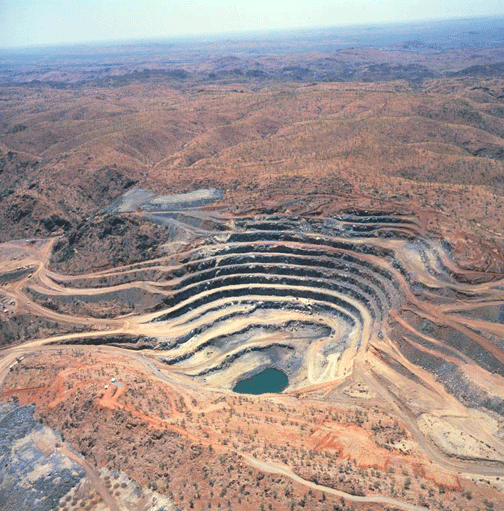 Expensive, dirty and dangerous: why we must fight miners’ push to fast-track uranium mines https://theconversation.com/expensive-dirty-and-dangerous-why-we-must-fight-miners-push-to-fast-track-uranium-mines-139966?fbclid=IwAR173tiUPtRX3YkqQh5VlmoWHWWCUHxSFtCFxFIxKtuvI3IaghgbGhAEBAM, Gavin Mudd, Associate Professor of Environmental Engineering, RMIT University, June 18, 2020 Of all the elements on Earth, none is more strictly controlled under law than uranium. A plethora of international agreements govern its sale and use in energy, research and nuclear weapons.
Australian environmental law considers nuclear actions, such as uranium mining, as a “matter of national environmental significance” under the Environment Protection and Biodiversity Conservation (EPBC) Act. This means uranium involves matters of national and international concern for which the Australian government is solely responsible.
The states, which own minerals, cannot exercise such oversight on uranium exports and use. So any new uranium mine needs both state and federal environmental approvals.
On Monday, Prime Minister Scott Morrison announced that BHP’s proposed expansion of the Olympic Dam copper-uranium-gold-silver mine in South Australia was one of 15 major projects set to be fast-tracked for environmental approval. This would include a single, joint state and federal assessment.
But responsibility and past performance make a compelling case to maintain our federal environmental laws more than ever. Here’s why uranium mining must remain a federal issue.
Our international obligations
Australia is a signatory to several international treaties, conventions and agreements concerning nuclear activities and uranium mining and export.
As of the end of 2018, the nuclear material safeguarded under international agreements derived from our uranium exports totalled 212,052 tonnes – including 201.6 tonnes of separated plutonium.
In response, a spokesperson for the Minerals Council of Australia said a national mechanism to manage safeguards already exists through the Australian Safeguards and Non-Proliferation Office, adding:
Uranium is further regulated through the Australian Radiation Protection and Nuclear Safety Agency (ARPANSA) […] under the provisions of the ARPANS Regulations 1999. The object of the ARPANS Act is “to protect the health and safety of people, and to protect the environment, from the harmful effects of radiation”.
Successful rehabilitation has yet to be seen
Uranium mines are difficult to rehabilitate at the end of their lives. In my 24 years of research, including visiting most sites, I’ve yet to see a successful case study of Australia’s 11 major uranium mines or numerous small sites.
For example, the Rum Jungle mine near Darwin, which operated from 1954 to 1971, left a toxic legacy of acidic and radioactive drainage and a biologically dead Finniss River.
The former Mary Kathleen mine, also part of Rio Tinto’s corporate history, operated from 1958-63 and 1976-82.
Rehabilitation works were completed by 1986 and won national engineering awards for excellence. But by the late 1990s, acid seepage problems emerged from the tailings dam (where mining by-products are stored) and overlying grasses were absorbing toxic heavy metals, creating a risk for grazing cattle.
Both Rum Jungle and Mary Kathleen were rehabilitated to the standards of their day, but they have not withstood the test of time.
Australia’s biggest uranium mine, Ranger, is fast approaching the end of its operating life.
Rio Tinto is also the majority owner of Ranger. Despite Ranger’s recent losses, Rio has retained control and given Ranger hundreds of millions of dollars towards ensuring site operations and rehabilitation.
Site rehabilitation is required to be complete by January 2026, with Rio Tinto and Ranger assuming 25 years of monitoring – although plans and funding for this are still being finalised.
Recently, it emerged that Ranger had not agreed to continue its share of funding the scientific research required for the rehabilitation – an issue still unresolved. So despite promises of world’s best ever rehabilitation, concerns remain.
The Conversation contacted Rio Tinto to respond, and it referred us to Energy Resources Australia (ERA), which operates Ranger. An ERA spokesperson stated:
ERA is required to cease processing in January 2021 in accordance with the expiration of its Authority to Operate under the Commonwealth Atomic Energy Act. Given the impending cessation in processing, ERA believes it is appropriate and reasonable to review the current research funding arrangements.
No other former uranium mine in Australia can claim long-term rehabilitation success. Nabarlek, Radium Hill-Port Pirie, South Alligator Valley and other small mines all have issues such as erosion, weeds, remaining infrastructure, radiation hot-spots and/or water contamination. They all require ongoing surveillance.
Uranium mining is set to be outcompeted
Even if Olympic Dam expands (and especially if it stops extracting uranium in favour of tellurium, cobalt and rare earths also present), this trend is expected to increase in the coming years as Ranger closes and the world transitions to renewable energy and electric vehicles to help address climate change.
In response, the Minerals Council of Australia stated that lithium’s contribution to large-scale electricity storage is just beginning, arguing:
Scott Morrison gives a boost to uranium mining at Olympic Dam
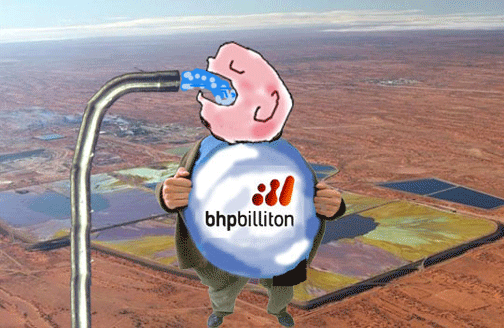
Poor old BHP. My heart bleeds! The so-called “Big Australian” (about 70% owned by overseas interests), is so poor that it’s had to get exemptions from just about every regulation that matters. The SA Roxby Downs Indenture Act legislation allows the mine to operate with  wide-ranging exemptions from the Aboriginal Heritage Protection Act, the Environment Protection Act, the Natural Resources Act, and the Freedom of Information Act. There are constant problems with tailings such as ongoing seepage and large numbers of bird deaths.
Probably worst of all, BHP plans to increase extraction of precious Great Artesian Basin water to an average 50 million litres per day for the next 25 years, with likely serious adverse impacts on the unique and fragile Mound Springs ‒ which are listed as an Endangered Ecological Community and are of significant cultural importance to Aboriginal people.
Olympic Dam expansion on fast track,e InDaily, 15 June 20
The Olympic Dam expansion is being fast-tracked as part of a Federal Government plan to boost employment and reduce the length and severity of the coronavirus-induced recession.
Prime Minister Scott Morrison is expected to today announce $1.5 billion to immediately start work on priority projects identified by the states and territories…….
BHP is proposing for a staged increase in copper production at Olympic Dam from 200,000 to up to 350,000 tonnes per annum.
The expansion has been granted Major Development status by the state government …. https://indaily.com.au/news/2020/06/15/olympic-dam-expansion-on-fast-track/
Coalition’s push to deregulate environmental approvals will lead to extinction crisis
Scientists fear Coalition’s push to deregulate environmental approvals will lead to extinction crisisScott Morrison’s announcement in wake of bushfires is ‘distressing’ and puts threatened species at risk, ecologists say, Guardian, Lisa Cox, Tue 16 Jun 2020 Scientists have expressed dismay and frustration at Scott Morrison’s latest push to deregulate the environmental approval process for major developments, noting it comes just months after an unprecedented bushfire crisis and during a review of national conservation laws.In a speech on Monday, the prime minister said he wanted to slash approval times for major projects by moving to a streamlined “single touch” system for state and federal environmental assessments.
Morrison said the change would be informed by the review of Australia’s environment laws, the Environment Protection and Biodiversity Conservation (EPBC) Act, which is under way. But his speech did not mention the environment or the act’s objectives to protect threatened species and ecosystems. ……
Scientists and environmentalists argue the act is failing to prevent an extinction crisis. Just 22 of 6,500 projects referred for approval have been knocked back in the act’s 20-year history.
Australia has the world’s highest rate of mammalian extinction. Reporting by Guardian Australia has found the government has failed to implement or track measures for species known to be at risk, stopped listing major threats to species, and not registered a single piece of critical habitat for 15 years.
The listing of species and ecosystems as threatened has been delayed by successive ministers, funding has been directed to projects that did not benefit threatened species and hundreds of plants and animals have been identified as requiring urgent attention after the summer bushfire disaster.
The government has framed its commentary about the review around a desire to speed up approval times for projects as the country moves out of the economic shutdown caused by the Covid-19 pandemic. …..
Megan Evans, an environmental policy researcher at the University of New South Wales in Canberra, said one of the reasons approvals could be slow was because the capacity of the public service had been cut. …… we have highly ambiguous wording [in the act] which provides maximum discretion to the minister that reduces certainty and puts all power in the hands of the minister of the day. You can’t on one hand complain about the lack of certainty but then on the other shy away from measures that would actually provide greater certainty.”
The climate scientist, Bill Hare, said Australia’s approach to its natural environment was damaging not only for the country’s ecosystems, but its democracy…….. https://www.theguardian.com/environment/2020/jun/16/scientists-fear-push-to-deregulate-environmental-approvals-will-lead-to-extinction-crisis
Australia’s Environment Laws have no teeth, are in much need of strengthening
‘No checks, no balances’: push for change to environment laws, The Age, By Mike Foley, June 14, 2020 Australia’s 20-year-old flagship environmental protection laws are failing badly and in urgent need of an overhaul, the crossbench senator who helped the Howard government install the landmark legislation says.
“Clearly it’s not working well,” former Democrats senator Andrew Bartlett said ahead of an imminent review of the Environmental Protection and Biodiversity Conservation Act. “The most obvious failure is despite the fact conditions can be attached to project approvals, there are just so many cases where conditions aren’t adhered to. There are no efforts to check and no penalties.”
Mr Bartlett stared down bitter opposition from some powerful players in the conservation movement and sided with the Howard government against Labor and the Greens to vote for legislation in 1999.
The act was an attempt by the Howard government to modernise environmental protection laws and was controversial because it significantly increased the environment minister’s powers, such as allowing them to intervene in project approvals to protect threatened species.
Since the act’s introduction, Australia’s list of nationally threatened species and ecosystems has grown by more than one-third – from 1483 to 1974.
The act is being reviewed by the former chair of the Australian Competition and Consumer Commission, Graeme Samuel, who is due to complete his report for Environment Minister Sussan Ley later this month.
Both conservationists and industry are unhappy with the application of the act. Conservation groups say successive governments have not used the powers in the act to protect threatened species, while industry argues the act has delayed development because of so-called “green law-fare”.
Australian Conservation Foundation policy co-ordinator James Trezise said “the idea that vexatious litigation is rife under national environment law is not borne out by the evidence”.
Professor Hugh Possingham, one of the scientists who advised the Howard government on the legislation, said the act had failed to protect the environment.
“There’s no ambiguity in the science, the EPBC Act isn’t delivering,” Professor Possingham told The Sydney Morning Herald and The Age. ……
The Wentworth Group of Concerned Scientists’ submission to Mr Samuel’s review said the “objectives of the [EPBC] act are not being met”….. https://www.theage.com.au/politics/federal/no-checks-no-balances-push-for-change-to-environment-laws-20200610-p55180.html
Government -owned Woomera a better site than agricultural land, for nuclear waste dump

|
Senator pushes Woomera instead of Kimba for waste facility, Port Lincoln Times, Jarrad Delaney , 12 June 20, South Australian senator Rex Patrick will push for the Woomera Prohibited Area to be the location of the National Radioactive Waste Management Facility instead of land near Kimba. The Centre Alliance senator has announced he will move amendments to the National Radioactive Waste Management Facility Bill, which would allow the Minister for Defence to nominate a site in the prohibited area. This comes as the National Radioactive Waste Management Amendment (Site Specification, Community Fund and Other Measures) Bill passed through the House of Representatives on Thursday.
The bill was tabled in February to formally name Napandee, near Kimba as the site for the National Radioactive Waste Management Facility. Minister for Resources, Water and Northern Australia Keith Pitt said it was an important milestone for the establishment of the facility.
However Mr Patrick said the bill was now before the Senate Economics Committee which is expected to report on July 31, although this could be extended. He said the act was based on volunteerism, as no site could be considered as a potential location for a radioactive waste management facility without the voluntary nomination of that site and agreement of persons with relevant rights and interests. “The Federal Parliament will be given a choice on whether the site should be on prime agricultural land on the Eyre Peninsula in a community that is bitterly divided about it being built there, or in the remote and highly secure Woomera Prohibited Area where a significant amount of low and intermediate level radioactive waste has been stored for more than two decades,” he said. Mr Patrick has pointed to a 2002 study which identified sites for a low level and short-lived intermediate level radioactive waste repository at three sites. These are located within the prohibited area near Koolymilka, about 20km east of Woomera and about 50km northeast of Woomera. Mr Patrick said there were already two radioactive waste storage facilities inside the prohibited area, one CSIRO building (Hanger 5 at Evetts Field) and one defence bunker (Koolymilka). “My amendment will, instead of selecting Kimba as the site, allow the Minister for Defence to nominate a site in the Woomera Prohibited Area,” he said. “If the Minister can’t find a suitable site somewhere within that 12.7 million hectares of desert, then she’s not looking hard enough. “My proposed amendments will require the Minister to consult with affected parties, including First Nation’s people, before making her decision as to the preferred Woomera site.” Mr Patrick said he would not seek to amend the community funding being directed at Kimba by the bill. However Mr Pitt said suggestions of a site in the Woomera area could be used for the facility was not practical due to the increase in Defence Force training activities that would limit access to the area……https://www.portlincolntimes.com.au/story/6788596/senator-pushes-woomera-for-waste-facility/ |
|
1 This month


Help Aunty Sue Protect Her Land and Sacred Sites From Destructive Rocket Testing.
.

Australians deserve the truth
about
AUKUS – https://aukuspublicinquiry.com/

PETITION – To: Prime Minister Anthony Albanese and the Australian Labor Government

of the week – Australians for War Powers Reform (AWPR)
To see nuclear-related stories in greater depth and intensity

