New South Wales upper house Inquiry, stacked with pro nuclear people, recommends lifting nuclear bans
 NSW upper house recommends lifting bans on nuclear energy
Michael Mazengar, 4 March 2020, A NSW upper house parliamentary committee has recommended that prohibitions on the exploration and use of nuclear energy in NSW be lifted, a move that environmental groups fear will be the first step towards the establishment of an Australian nuclear power industry.
The upper house inquiry, which was stacked with pro-nuclear members of the legislative council, concluded that state parliament prohibitions on nuclear developments should be repealed, and argued that nuclear energy would be necessary to support future NSW electricity supplies.
The inquiry was instigated at the behest of One Nation member of the NSW upper house, and former federal Labor leader, Mark Latham and was formed to consider the Uranium Mining and Nuclear Facilities (Prohibitions) Repeal Bill 2019, tabled by Latham that would repeal legislation that prohibits uranium mining and the construction of a nuclear power station in New South Wales……
A recent update to the CSIRO GenCost assessment found that nuclear power represents one of the most expensive sources of new generation capacity, noting the lack of existing power stations in Australia and the lack of industry knowledge on the construction and operation of a nuclear plant.
Australia’s uranium mining sector has also struggled in recent years, following a significant reduction in global demand for nuclear fuels as a result of the 2011 Fukushima nuclear disaster in Japan.

 In a dissenting statement included in the report, the Labor members of the committee said that their party would continue to oppose the development of nuclear industries.
“On the basis of current technologies and costs, we remain unconvinced of the benefits nuclear power may bring. We remain mindful of the challenges caused by managing and storing spent fuel rods and radioactive waste that lasts many lifetimes,” the dissenting Labor report says.
“Nuclear power continues to have question marks both over its lasting environmental impact via waste as well as its cost. Labor believes the future of energy generation for NSW lies in clean and renewable energy sources, supported by firming and storage.”
“A Labor government will maintain a ban on uranium exploration, extraction and export. A Labor Government will not introduce nuclear power in NSW.
 Greens MLC David Shoebridge, who serves as the party’s energy spokesperson, labelled the committee’s findings as dangerous and nonsensical, saying that the pursuit of nuclear power would ultimately cost NSW households more and that any development of the industry would take so long that it would simply work as a way to prop up the coal industry.
Every megawatt of new nuclear power costs at least three times new fossil-fuelled power and at least six times that of solar or wind power,” Shoebridge said.
“Those costs are based only on the construction and operation of nuclear power plants and entirely ignore the billions more required to decommission and manage the radiation from a nuclear power plant for hundreds of years after it closes.”
“Recent history tells us clearly that even if it was given an immediate greenlight not one megawatt of nuclear power in Australia will be available until well beyond 2040. The effect of nuclear advocacy is to prolong the life of coal-fired power.”……. https://reneweconomy.com.au/nsw-upper-house-recommends-lifting-bans-on-nuclear-energy-90875/
Liberals coy about nuclear power, Premier Gladys thinks “it doesn’t matter to the people of New South Wales”
NSW Deputy Premier John Barilaro backs bill to overturn nuclear power ban https://www.abc.net.au/news/2020-03-04/john-barilaro-backs-bill-to-overturn-nuclear-power-ban/12024960, By state political reporter Ashleigh Raper New South Wales Liberals must decide whether they support the overturning of a ban on uranium mining that could also pave the way for nuclear energy in the state.
Key points:
- A bill put forward by One Nation MP Mark Latham supports a pathway to nuclear power
- Deputy Premier John Barilaro has long-supported a push towards nuclear energy
- A parliamentary inquiry will deliver findings in September
A parliamentary inquiry, led by Liberal MP Taylor Martin, has recommended that the law prohibiting uranium mining and nuclear facilities should be repealed.
The inquiry was looking into a bill put forward by One Nation MP Mark Latham in the Upper House and, through its recommendations, supports the piece of legislation.
Deputy Premier John Barilaro says the Nationals will support the bill, so too will the Shooters, Fishers and Farmers.
Mr Barilaro has long-supported nuclear energy and hopes the Nationals’ support will put pressure on the Commonwealth.
“That will put the focus on the Federal Government because without the Federal Government lifting its ban, there’s no way we will see a nuclear industry here in Australia,” he told Sky News.
Labor will oppose the bill, along with the Greens and Independent MP Justin Field.
So far, the Liberals don’t have a position because the issue hasn’t gone before cabinet.
Local Government Minister Shelley Hancock today said in budget estimates she wouldn’t support uranium mining or facilities in her electorate on the South Coast.
“There will never be any uranium mining on the South Coast,” she said.
“And I oppose any facilities on the South Coast.”
In Question Time, Premier Gladys Berejiklian was asked by Labor whether the Liberal Party wanted to lift the ban like its Coalition partner, but she wouldn’t be drawn.
“The Deputy Premier has been talking about this for two to three years,” she said.
“Get a better strategy for Question Time. I say to those opposite, ask me questions that matter to the people of New South Wales.”
She told Parliament the Government didn’t need to respond to the inquiry findings until September, but Upper House MPs are likely to vote on the legislation before that time.
New South Wales National Party will support Latham’s nuclear power bill, says Barilaro
 Barilaro says Nationals will support Latham’s nuclear power bill, https://www.smh.com.au/politics/nsw/barilaro-says-nationals-will-support-latham-s-nuclear-power-bill-20200304-p546pe.html, By Alexandra Smith, March 4, 2020 Deputy Premier John Barilaro says the NSW Nationals will support Mark Latham’s bill to allow nuclear power in NSW, in a move likely to cause a split in the junior Coalition party.In his strongest comments yet, Mr Barilaro, a long-time supporter of nuclear power, said the government should “lift the ban on nuclear energy” and confirmed his party would support it. Barilaro says Nationals will support Latham’s nuclear power bill, https://www.smh.com.au/politics/nsw/barilaro-says-nationals-will-support-latham-s-nuclear-power-bill-20200304-p546pe.html, By Alexandra Smith, March 4, 2020 Deputy Premier John Barilaro says the NSW Nationals will support Mark Latham’s bill to allow nuclear power in NSW, in a move likely to cause a split in the junior Coalition party.In his strongest comments yet, Mr Barilaro, a long-time supporter of nuclear power, said the government should “lift the ban on nuclear energy” and confirmed his party would support it.
But the position has not been taken to the Nationals’ party room, and several MPs said there would be serious concern among some members, including those who hold coastal seats. A report into Mr Latham’s bill was tabled in Parliament on Wednesday, recommending the state government support repealing laws that ban uranium mining and nuclear facilities. The report followed an inquiry into the One Nation leader’s private member’s bill, which is before the upper house. The bill would allow the ban on uranium mining and nuclear power be lifted. The issue dominated question time on Wednesday, with Energy Minister Matt Kean stressing the government’s focus was “cheap reliable energy” provided by renewables. Despite Mr Barilaro’s stance, Premier Gladys Berejiklian said the government had until September to respond to the report but MPs will vote on Mr Latham’s bill later this month. Speaking on Sky News on Tuesday night, Mr Barilaro said: “I would say here today that the National Party will support his [Mr Latham’s] bill in relation to lifting the ban on mining uranium and nuclear energy.” He said it follows a motion at last year’s party conference, which supported nuclear power. But a senior Nationals MP said the issue could be very problematic for coastal MPs, where there is a strong Greens vote and anti-mining sentiment. “I think much of the party room will be agnostic but I think if you speak to the coastal Nats, they will have a very different view. This would be very problematic for them.” The MP confirmed Mr Barilaro had not taken the issue to the Nationals’ party room. Nationals MP Geoff Provest, who holds the North Coast seat of Tweed, said he would be “worried about the decision” to support Mr Latham’s bill. “Our job is to represent our communities and I think a few coastal Nats might have a few concerns,” he said. Asked whether Mr Barilaro had told Mr Latham that the Nationals would support his bill, Mr Latham said: “What he has said on Sky is consistent with what he has told me.” The group Nuclear for Climate Australia has identified 12 sites as “regions of interest” in NSW for nuclear reactors, including the area between Coffs Harbour and Port Macquarie, Grafton, Shoalhaven and the South Coast. Cabinet has not considered the issue, and the Liberals do not yet have a position on nuclear power. But in budget estimates on Wednesday, Liberals’ Local Government Minister and South Coast MP Shelley Hancock said she would not support a reactor in her electorate. There will never be any uranium mining on the South Coast and I oppose any facilities on the South Coast,” she said. Chair of the inquiry who looked into Mr Latham’s bill, Liberals’ MP Taylor Martin said, “the prohibitions on uranium mining and nuclear energy reflect the outdated fears of the 1980s”. “On the balance of evidence gathered for this inquiry, nuclear power in its emerging small scale applications is a compelling technology where energy policy settings seek to decarbonise emissions while delivering secure, reliable and affordable energy to the NSW grid,” Mr Martin said.
Labor’s energy spokesman Adam Searle said nuclear would produce the “most expensive electricity” which would “cripple homes and businesses across the state”. “The future of energy generation for NSW lies in clean and renewable energy sources, supported by storage,” Mr Searle said. |
|
Government’s latest pressure on the ABC is slammed by Paul Keating
‘Ideological contempt’: Keating slams pressure to sell ABC offices, The Age, By Jennifer Duke and Fergus Hunter, March 3, 2020 Former prime minister Paul Keating has slammed the government for encouraging the ABC to canvass a sale of its inner-city offices, saying it shows “ideological contempt” and is an attempt to “fracture” the public broadcaster.
Communications Minister Paul Fletcher wrote to ABC managing director David Anderson on Monday recommending the broadcaster consider reviewing its capital city property portfolio, which includes offices in Sydney’s Ultimo and Melbourne’s Southbank. Mr Fletcher did not refer to specific property assets in the letter, but government sources who declined to be identified said the Ultimo office in particular was under-used.
Mr Keating said the pressure on the ABC to explore these sales represented “nothing other than an attempt by the Liberal and National parties to fracture the ABC at its foundations, in settlement of its ideological contempt for the organisation”.
“For the first time in its long history, the Ultimo, Sydney and Southbank, Melbourne premises delivered to the ABC a consolidation of workplaces which facilitated cross-platform and cross-divisional facilitation of a kind that was impossible in the old fragmented locational structure,” he said in a statement.
The ABC is grappling with a funding freeze projected to shave up to $84 million off its annual budget and is set to present a five-year strategic plan for the broadcaster later this month. ……
Mr Anderson said the broadcaster’s costs had risen while it was also confronting the funding freeze. The unprecedented bushfire season saw the ABC’s emergency broadcast requirements surge, adding about $3 million on top of expected spending.
“We estimate that it’s going to cost us an extra $5 million per annum from next financial year where we are going to have to build up our ability to respond [to] this being the new normal,” he said…… https://www.theage.com.au/politics/federal/ideological-contempt-keating-slams-government-pressure-to-sell-abc-offices-20200303-p546ev.html
Cosy little cocktail party for Liberal and Labor MPs, with coal industry bigwigs
Climate campaigners condemn ‘insidious’ cocktail party for MPs and coal industry
Parliament House event represents an effort to undermine climate action, environmental group 350 Australia says, Guardian, Christopher Knaus @knauscWed 4 Mar 2020 Environmental campaigners say a cocktail night involving the fossil fuel industry and federal politicians represents an “insidious” lobbying effort to undermine climate action.
The pro-coal Liberal MP Craig Kelly and Labor’s Joel Fitzgibbon hosted a cocktail event at Parliament House to discuss carbon capture and storage with industry leaders on Wednesday night.
An invite seen by the Guardian was sent out by Kelly and Fitzgibbon, who chair the parliamentary friends of resources, together with representatives of Santos and the carbon capture body CO2CRC. The event is described as a “cocktail event to mark the inaugural meeting of the CO2CRC Carbon Capture and Storage Policy Forum”.
That forum features companies such as BHP, Chevron, Coal21, ENI, Exxon, the Global Carbon Capture and Storage Institute, JPower, Shell and Woodside.
The invite says the forum aims to “work with governments, industry and other stakeholders” to create “suitable policy settings and a regulatory framework to accelerate the development and deployment of CCS technology in Australia”…..
Environment group 350 Australia says the event shows the need to “crack down on the undue influence of lobby groups on our democracy”.
The 350 Australia chief executive, Lucy Manne, said the event was an “insidious effort by the fossil fuel lobby to undermine action on the climate crisis”.
Manne said carbon capture and storage had proven a “pipe dream of the coal and gas lobby” and diverted millions away from proven renewables…..
“It’s outrageous that instead of working out how to rapidly transition to the renewable energy future the vast majority of Australians and businesses want, our elected representatives will tonight be sipping cocktails with the coal lobby and discussing how to extend the life of dirty coal-burning power stations.”
Such lobbying is generally hidden from the public unless revealed by the media. The Fitzgibbon-Kelly cocktail event was reported in News Corp papers.
It does not appear in any of the transparency measures governing lobbying. Federal ministers are also not required to disclose who they have met with, unlike in states like Queensland and New South Wales. ……https://www.theguardian.com/australia-news/2020/mar/04/climate-campaigners-condemn-insidious-cocktail-party-for-mps-and-coal-industry
No advantage in ‘new’ back-to-the-future nuclear reactors for Australia. Is the real motive military?
Part 2 of A Study of the “Report of the inquiry into the prerequisites for nuclear energy in Australia” Australian Parliamentary Committee 2020. The Industry Push to Force Nuclear Power in Australia
The Parliamentary Committee recommends, in part, the following: Recommendation 2
The Committee recommends that the Australian Government undertake a body of work to progress the understanding of nuclear energy technology by:
- Commissioning the Australian Nuclear Science and Technology Organisation (ANSTO), or other equivalent expert reviewer, to undertake a technological assessment on nuclear energy reactors to:
- produce a list of reactors that are defined under the categories of Generation I, II, III, III+ and IV;
- advise on the technological status of Generation III+ and Generation IV reactors including small modular reactors;
- advise on the feasibility and suitability of Generation III+ and Generation IV reactors including small modular reactors in the Australian context; and
- formulate a framework to be used by Government to monitor the status of new and emerging nuclear technologies.The first item of the recommendation – for ANTSO to compile of reactors according to each one’s status within the table of Generation – 1 to 4 might be a good idea, for many of the Generation IV reactor designs were first envisaged and trialled in the 1950s and 1960s before being discarded. Whereas, at the present time, and since the time the US Department of Energy sought ways of halting the decline of nuclear power’s percentage contribution to global energy supply in the 1990s. For that is the time that the idea of resurrecting old designs and calling them new and “Generation IV” and re marketing them first arose
The waste from the very first molten salt fuelled and cooled reactor, as we saw in the previous post, continues to cost US taxpayers money 60 years later.
In 2014 the Brookings Institute published an essay by Josh Freed entitled “Back to the Future, Advanced Nuclear Energy and the Battle Against Climate Change”. This essay is available to read at http://csweb.brookings.edu/content/research/essays/2014/backtothefuture.html The cover illustration is very interesting.
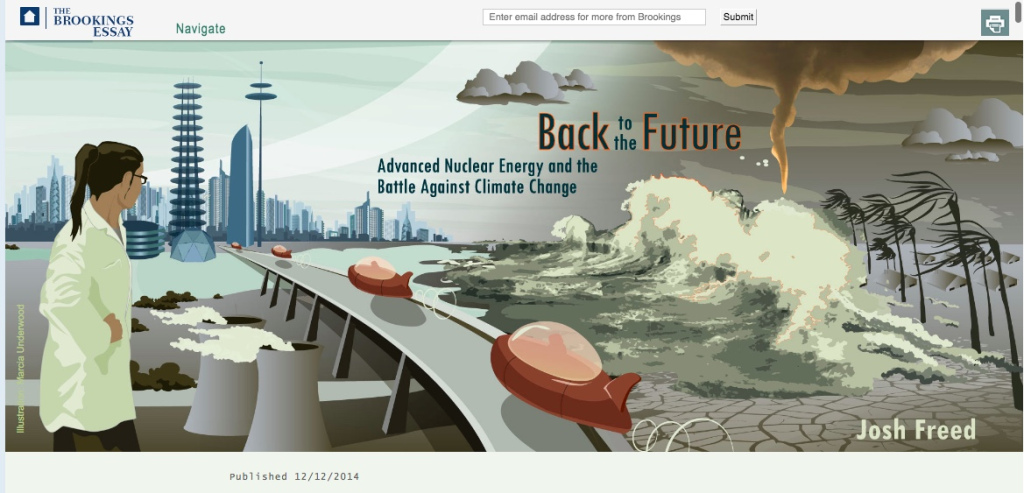
The titled cover includes the disclosure that the nuclear industry sees a future for previously discarded, old reactor designs. It shows a nuclear reactor sitting below sea level, protected by a combined Dyke / Causeway for levitating vehicles. Huge waves threaten the Dyke, vehicles, reactor and giant Science Woman, who is watching on with skilled impartiality. In the distance, buildings taken straight from the cartoon “The Jetsons” appear. The illustration is also, actually, a reinterpretation of the events which occurred in March 2011 at Fukushima. The sub text of the picture admits that nuclear industry cannot keep going in the way that it has done since the days between 1945 and now. The industry would disappear if it did not “modernise”.
The fission industry is dying as more and more competition arises in the form of alternative technologies in the energy generation technology market. Even Fusion research continues to make inroads toward the goal of successful and economic power generation, but it still a few years off. The 1930s fission patents of Szilard are long in the tooth and actually, in terms of economic energy production has always been a failure. Kick started by governments, the standard designs are trusted by fewer and fewer people, especially throughout Asia. Westinghouse Nuclear, GE Nuclear, Toshiba Nuclear are all bankrupt. British Nuclear Fuels Ltd is broke, Sellafield is broke and a growing cleanup cost liability.
So increasingly, the industry needs a unique selling point, something new and radical, something that solves the old nuclear problems. It needs a product which never fails or spills radioactive materials into the biosphere, it needs a product that will not fail because the grid goes down for a few days, it cannot melt down, catch fire like Windscale, Monju and Fermi 1 did.
Seeing as there actually no new concepts, why not look again, in desperation, at the rejected designs of the past? The essay by Josh Freed (his real name) mentions a company called Transatomic. In contrast to the contents of the Freed article, which claims the old new reactor envisioned by Transatomic run on nuclear waste, Transatomic make no such claim. They state that their proposed reactor would run on liquid uranium fuel. As per the original 50s/60s design. They claim that the Molten salt reactor would create less weight of high level waste.
Because the waste would be continuously removed from the reactor. he corporate website for Transatomic is here: http://www.transatomicpower.com/the-science/ And this, from their web site, is precisely what they promise: Molten salt reactors like Transatomic Power’s are fueled by uranium dissolved in a liquid salt. The fuel is not surrounded by cladding, making it possible to continuously remove the fission products that would otherwise stop the nuclear reaction. The liquid fuel is also much more resistant to structural damage from radiation than solid materials – simply, liquids have very little structure to be damaged. With proper filtration, liquid fuel can remain in a molten salt reactor for decades, allowing us to extract much more of its energy.” end quote. They claim their reactor design produces half the nuclear waste of a comparable conventional light water reactor.
This still does not solve the high level nuclear waste stockpile. It adds to it. Given the competition nuclear power has in the modern world, given that the need for ‘baseload’ energy is now shown to be nonsense, what would 1 or 2 small modular molten salt reactors add to Australia? Would they merely replace coal fire powered generation? SA has not had coal fired electricity for some years now. A combination of solar, wind and storage in SA means SA is a net electricity exporter to the Eastern States. We have back up of gas fired generation which very rarely needed.
Sadly for Transatomic, Green Tech Media state the following at https://www.greentechmedia.com/articles/read/transatomic-to-shutter-its-nuclear-reactor-plans-make-its-technology-public announced the following in 2018:
“Transatomic to Shutter It’s Nuclear Reactor Plans, Open-Source It’s Tecnology.
The startup backed by Peter Thiel won’t be able to build its advanced reactor designs—but it’s making its IP available for others to carry on the work.” Source: Jeff St. John, 25 Sept 2018.as given above.
This gift to the world by Transatomic occurred at the time in Australia when various people began a bombastic and highly enthused campaign to convince Australians that Molten Salt Reactors, fuelled with either Uranium or Lithium or nuclear waste, were Jesus Mark 2. “We’ll Save Yer, just like we did in the Cold War. Solar and batteries are for whimps. We Can’t have solar and wind power in Australia, its a threat to Queensland Coal. Let’s nuclear instead and all make a quick a buck with IP”.
Funny that. Talk about drumming up business prospects and investment funds, and in 2020, floating a float on the back of sympathetic and one eyed Parliamentary Inquiry!
Double or Nothing?
The promise made by Transatomics is that molten fuel/molten salt reactors made with modern techniques will reduce by roughly half the amount of high level nuclear waste generated per unit of power generated. However, at the current time the amount of high level nuclear waste (ie, fission products -the transmutation products described in Szilard’s 1930s patents) and the release of the gaseous forms of these substances into the atmosphere, generated by Australian electricity generation is ZERO.
So the introduction of Molten Salt Reactor into Australia for electricity production will RAISE the production of high level nuclear waste from this activity by 100%. It won’t half, it won’t double, it will increase by x grams per watt. It is a spurious argument to say any reactor type will reduce Australia’s power industry high level nuclear waste when we produce zero at the moment. And if Australia continues on its non nuclear path, that zero rate of power related high level waste will remain zero forever. So where is the advantage for Australia in introducing power reactors in the civilian sphere?
I am led to believe that it will take between 10 – 20 years for any Australian nuclear power reactor to come on line from the time it is approved. By that stage the competition from other forms of low carbon power production will be much, much more severe than it is now. And today, in my opinion, only a devotee of nuclear power would see any advantage in introducing any type of nuclear reactor to Australia. Unless the real motive for such a reactor is a military motive. If so, the O’Brien Committee and the government needs to come clean on that. Not that they will. Such an admission is likely to be impossible for several reasons. Besides, no nuclear industry is free to fully disclose the corporate production and disposition of “special nuclear materials”.
So, I suppose in the end the Committee recommend ANTSO compile a list of reactor types and nominate the current industry PR terms for each type. For the Generational types (1 through IV) have actually very little to do with the chronological order and date range over which each type first manifest as a prototype. The small World War 2 German reactors, of which there were many, are little known, and the US ALSOS project has not disclosed that much about them. Germany had at least 4 reactor programs, 7 ways of enriching uranium. Japan had an Army fission project, a Navy fission project, an Air Force Fission project. All were formally abandoned, ironically , in July 1945. Germany was able to enrich uranium.
This is ancient history, but the world remains fairly ignorant I think, as to which reactor type is the safest, most economic, most reliable and so on. So far, all I have heard from the nuclear industry is PR manufactured originally by the US Department of Energy which relabelled the various reactor designs originated in the US according to a “Generation Number” which is completely detached from the chronological sequence in which they occurred.
In World War 2 Germany was working on heavy water reactors. Does that mean Hitler’s heavy water reactors were Generation III+ ? Of course not. They were Gen 1. As was the Canadian heavy water reactor of World War 2 which supplemented the US plutonium production at Hansford. If the Candu reactor is Gen III+ I’m Father Christmas. What the US DOE is doing with its naming is using marketing techniques to sell old concepts as new ideas.
Car companies do the same when naming cars. Makers of garbage trucks send salesmen around to Council depots extolling the virtues of the Gen IV 2 ton rubbish truck, complete with compactor, a tilt tray and 8 track stereo sound. And Depot managers get given toy model rubbish trucks they sit on their book cases to show how technically astute they are in the field of garbage.
Same deal here. It’s a no brainer. Yet, start collecting lists from ANSTO Mr. O’Brien. Great idea sir. It’ll keep you off the streets for awhile.
Busting the lies of the Australian Government about “new” nuclear reactors
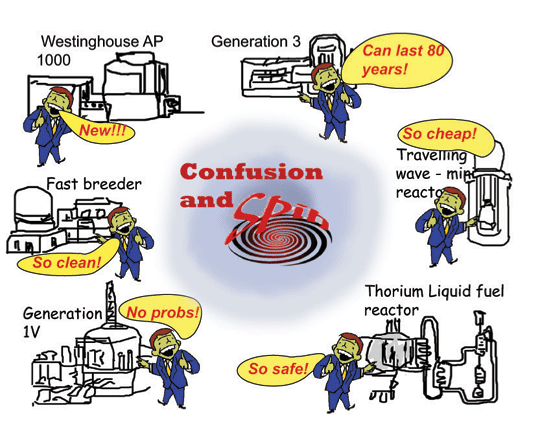
The core propositions of non-traditional reactor proponents – improved economics, proliferation resistance, safety margins, and waste management – should be reevaluated.
Before construction of non-traditional reactors begins, the economic implications of the back end of these nontraditional fuel cycles must be analyzed in detail; disposal costs may be unpalatable………. reprocessing remains a security liability of dubious economic benefit
Non-traditional” is used to encompass both small modular light water reactors (Generation III+) and Generation IV reactors (including fast reactors, thermal-spectrum molten salt reactors, and high temperature gas reactors)
|
Burning waste or playing with fire? Waste management considerations for non-traditional reactors Full Text
The Industry Push to Force Nuclear Power in Australia https://nonuclearpowerinaustralia.wordpress.com/2020/03/02/burning-waste-or-playing-with-fire-waste-management-considerations-for-non-traditional-reactors-full-text/ by nuclearhistory March 2, 2020 The following paper is copied here in order to counter the false, incorrect and erroneous propaganda published by the Australian Government and its Parliamentary Committee for lying to the Australian people about so-called new nuclear reactor designs, all of which were rejected by competent authorities in the 1950s, 1960s, and 1970s. The residues produced by these test reactors continue to cost the American taxpayer money and continue to present the American people with stored, hazardous radioactive waste which is also high chemically reactive. |
Greens leader Adam Bandt introduces climate emergency Bill
 ‘People are angry and anxious’: Adam Bandt introduces climate emergency
 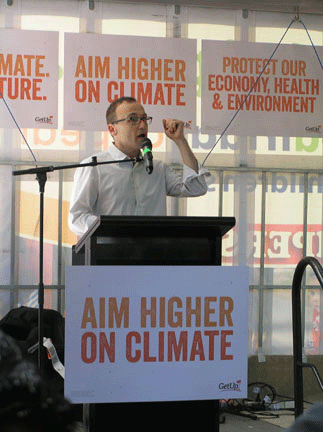 bill, https://www.sbs.com.au/news/people-are-angry-and-anxious-adam-bandt-introduces-climate-emergency-bill Greens leader Adam Bandt has introduced a bill to formally declare a climate emergency and set up a ‘war cabinet’ to tackle the crisis.
Greens leader Adam Bandt has painted a post-apocalyptic future for Australia unless the government declares a climate emergency.
Mr Bandt told parliament on Monday that “environmental collapse was here” as he introduced his bill to formally declare the crisis.
“It is not scaremongering, it is hard physics and we have just had a taste of it over the last summer,” he said.
He said northern Australia would be inhospitable for parts of the year, one-in-six native species would be extinct, mosquito-borne diseases will travel south and the country’s river systems will see more algal blooms that lead to mass fish kills in the Murray-Darling.
Under the bill, the government would be required to set up a “war cabinet” to tackle the crisis, government agencies would refer to the declaration of a climate emergency when developing policy and table annual reports on how they were meeting their obligations.
Mr Bandt’s bill was seconded by independent MP Zali Steggall, who knocked off former Liberal prime minister Tony Abbott for the NSW seat of Warringah at the last election.
“There is no doubt we are in the midst of a climate emergency,” Ms Steggall said.
We have a duty to Australian people … it is time for us all to be accountable.”
A climate emergency motion moved in October fell four votes short.
Greens Senator Hanson-Young calls for Senate Nuclear Waste Inquiry to meet in Whyalla, South Australia
 Nuclear bill referred to inquiry https://www.whyallanewsonline.com.au/story/6653019/nuclear-bill-referred-to-inquiry/?cs=1550&fbclid=IwAR3AvrninZlnLmX8r79QDkQopkBb5hXoWhguw106lCyiisCDdmWMy714MPM, Louis Mayfield 27 Feb 20, Nuclear bill referred to inquiry https://www.whyallanewsonline.com.au/story/6653019/nuclear-bill-referred-to-inquiry/?cs=1550&fbclid=IwAR3AvrninZlnLmX8r79QDkQopkBb5hXoWhguw106lCyiisCDdmWMy714MPM, Louis Mayfield 27 Feb 20,
The formal process for the federal government’s push for a nuclear waste dump in Kimba will be put under the microscope by the Senate Economics Committee, with a Greens Senator calling for hearing in Whyalla. On Thursday the Greens announced they would be referring the government’s legislation for the Nuclear Radioactive Waste Management Facility to a Senate Inquiry for ‘scrutiny of the laws and the process that led to this point’. South Australian Greens Senator Sarah Hanson-Young requested that the committee organise a public hearing in Whyalla and a visit to the federal government’s chosen site for the facility at Napandee.
“I have requested a hearing in Whyalla because it shouldn’t be left to the suits in Canberra to decide, anything less would be offensive to the communities involved,” she said. Senator Hanson-Young also claimed the site selection for the facility had been ‘dodgy from the start’.
“It’s ripped small communities apart and Traditional Owners have vehemently objected to the proposal,” she said. “It’s clear there isn’t broad community support for a nuclear waste dump in Kimba, despite what former Minister Matt Canavan would have everyone believe.”
“Port Augusta, Whyalla, Port Pirie and Port Lincoln and every town living along potential transportation route, should have been consulted and given an opportunity to have their say,” she said. “The Greens aren’t leaving it to the community of Kimba to hold the line on their own. A Senate Inquiry will give the entire proposal the scrutiny it needs.” The committee has resolved to report on the legislation in June, submissions to the committee are now open and will close at the end of March. |
|


#ScottyFromMarketing a ‘predatory’ centrist on climate policy with no plans for meaningful emissions reduction
 Wayne Swan Morrison a ‘predatory’ centrist on climate policy with no plans for meaningful emissions reduction, says Swan Wayne Swan Morrison a ‘predatory’ centrist on climate policy with no plans for meaningful emissions reduction, says SwanLabor president says party must work against PM’s PR strategy and get on with ‘solving the bloody problem’, Katharine Murphy Political editor, Sun 1 Mar 2020
Labor federal president Wayne Swan says Morrison does not have a serious climate policy ‘but as you would expect from a marketing guy, [he has] a clearly articulated PR strategy to use climate as a wedge. Labor’s federal president Wayne Swan will accuse Scott Morrison of engaging in “predatory centrism” on climate policy by styling himself as the pragmatist between the extremes of climate emergencies and denialism, when the government has no intention of driving meaningful emissions reduction. In a speech to be delivered on Sunday, Swan will argue Labor will only win the decade-long climate wars if it approaches the challenge with “pragmatic policy and ruthless organisation”. According to speech notes, Swan will say Labor needs to articulate a roadmap for the domestic coal powered industry “which manages its decline”……. https://www.theguardian.com/world/2020/mar/01/morrison-a-predatory-centrist-on-climate-policy-with-no-plans-for-meaningful-emissions-reduction-says-swan |
|
In Victoria the goal of the nuclear lobby is to remove Victoria’s Nuclear Activities (Prohibitions) Act
Nuclear lobby takes aim at Victoria to tackle prohibitions, Michael West Media, by Noel Wauchope | Feb 26, 2020 Having dithered on real action to tackle global warming, some in the Coalition are now taking a keen interest in solving it — by going nuclear. Noel Wauchope investigates what’s behind the sudden push to overturn legislation prohibiting the exploration and mining of thorium and uranium and puts a definitive case against a nuclear industry in Australia.
A batch of Coalition MP’s are pushing nuclear power as Australia’s answer to climate change. The group includes Katie Allen inner-city Melbourne Liberal, Ted O’Brien, Queensland LNP, Trent Zimmerman, North Sydney Liberal, Bridget Archer Tasmanian Liberal, David Gillespie Nationals NSW, Rick Wilson West Australian Liberal, and Keith Pitt, LNP from North Queensland, who was this week promoted to cabinet as Resources Minister. Former deputy prime minister and Nationals leader, Barnaby Joyce, is also a staunch proponent of nuclear power.
Arguing that nuclear power is the answer to bushfires and a heating climate when these are conversely nuclear’s greatest threat is akin to an argument by the Mad Hatter and the March Hare. The US National Academies Press compiled a lengthy and comprehensive report on risks of transporting nuclear wastes. They concluded that among various risks, the most serious and significant is fire. And indeed, climate change, in general, carries serious threats to nuclear reactors and the entire nuclear fuel chain.
But any port in a storm when you’re trying to sell a product that is expensive, unpopular, illegal in Australia and has the problem of long-lasting toxic wastes.
The Australian public’s renewed enthusiasm for action on climate change was timely. The nuclear lobby had, coincidentally already geared itself up for a campaign to overturn Australia’s State and Federal nuclear prohibition laws. The current Victorian inquiry is the latest in a spate of Parliamentary Inquiries aimed at removing these laws. Submissions are due by this Friday, 28 February.
The Inquiry’s Terms of Reference (TOR) are narrow:……..
It is clear the goal is to remove Victoria’s Nuclear Activities (Prohibitions) Act 1983. The very first TOR makes the mining of uranium and thorium as the prime concern. Given Victoria could run a nuclear power station with uranium/thorium sourced from elsewhere, it is clear that, after years of pressure by thorium lobbyists, the underlying goal of this inquiry is to overturn the legislation prohibiting the exploration and mining of thorium and uranium in Victoria.
The Victorian legislation was brought in to protect this State’s precious agricultural land and iconic ocean coast from polluting mining industries. South Gippsland is particularly rich in thorium.
Nuclear lobby tries to water down Victorian prohibition
The Terms of Reference are overtly biased: with no qualification, they promote the nuclear industry as undoubtedly beneficial to Victoria. This is ludicrous, as the global nuclear industry is in a state of decline.
Meanwhile, the renewable energy technologies of wind, solar and storage are now recognised by CSIRO and the Australian Energy Market Operator as, by far, the cheapest form of low carbon options for Australia, and are likely to dominate the global energy mix in coming decades
This first Term of Reference assumes that the “exploration and production” will result in nuclear power plants for Victoria, otherwise why do it? It also assumes that nuclear power will be effective in lowering C02 emissions.
However, there is no point in this “exploration and production” as it has been repeatedly demonstrated that nuclear power is no solution to climate change as in Dr. Paul Dorfman et al’s response to James Hansen on 20 December 2019 in the Financial Times.…….
The Terms of Reference are overtly biased: with no qualification, they promote the nuclear industry as undoubtedly beneficial to Victoria. This is ludicrous, as the global nuclear industry is in a state of decline.
Meanwhile, the renewable energy technologies of wind, solar and storage are now recognised by CSIRO and the Australian Energy Market Operator as, by far, the cheapest form of low carbon options for Australia, and are likely to dominate the global energy mix in coming decades
This first Term of Reference assumes that the “exploration and production” will result in nuclear power plants for Victoria, otherwise why do it? It also assumes that nuclear power will be effective in lowering C02 emissions.
However, there is no point in this “exploration and production” as it has been repeatedly demonstrated that nuclear power is no solution to climate change as in Dr. Paul Dorfman et al’s response to James Hansen on 20 December 2019 in the Financial Times.……… .https://www.michaelwest.com.au/nuclear-lobby-takes-aim-at-victoria-to-tackle-prohibitions/
Legislation banning nuclear power in Australia should be retained
| Jim Green, Online Opinion, 27 Feb 2020, https://onlineopinion.com.au/view.asp?article=20758&page=0
Nuclear power in Australia is prohibited under the Environmental Protection and Biodiversity Conservation (EPBC) Act 1999. A review of the EPBC Act is underway and there is a strong push from the nuclear industry to remove the bans. However, federal and state laws banning nuclear power have served Australia well and should be retained.
There are many other examples of shocking nuclear costs and cost overruns, including: * The cost of the two reactors under construction in the US state of Georgia has doubled and now stands at A$20.4‒22.6 billion per reactor. * The cost of the only reactor under construction in France has nearly quadrupled and now stands at A$20.0 billion. It is 10 years behind schedule. * The cost of the only reactor under construction in Finland has nearly quadrupled and now stands at A$17.7 billion. It is 10 years behind schedule. * The cost of the four reactors under construction in the United Arab Emirates has increased from A$7.5 billion per reactor to A$10‒12 billion per reactor. * In the UK, the estimated cost of the only two reactors under construction is A$25.9 billion per reactor. A decade ago, the estimated cost was almost seven times lower. The UK National Audit Office estimates that taxpayer subsidies for the project will amount to A$58 billion, despite earlier government promises that no taxpayer subsidies would be made available. Nuclear power has clearly priced itself out of the market and will certainly decline over the coming decades. Indeed the nuclear industry is in crisis ‒ as industry insiders and lobbyists freely acknowledge. Westinghouse ‒ the most experienced reactor builder in the world ‒ filed for bankruptcy in 2017 as a result of catastrophic cost overruns on reactor projects. A growing number of countries are phasing out nuclear power, including Germany, Switzerland, Spain, Belgium, Taiwan and South Korea. Rising power bills: Laws banning nuclear power should be retained because nuclear power could not possibly pass any reasonable economic test. Nuclear power clearly fails the two economic tests set by Prime Minister Scott Morrison. Firstly, nuclear power could not possibly be introduced or maintained without huge taxpayer subsidies. Secondly, nuclear power would undoubtedly result in higher electricity prices.
Former US Vice President Al Gore summarised the proliferation problem: “For eight years in Too slow: Expanding nuclear power is impractical as a short-term response to climate change. An analysis by Australian economist Prof. John Quiggin concludes that it would be “virtually impossible” to get a nuclear power reactor operating in Australia before 2040. More time would elapse before nuclear power has generated as much as energy as was expended in the construction of the reactor: a University of Sydney report concluded that the energy payback time for nuclear reactors is 6.5‒7 years. Taking into account planning and approvals, construction, and the energy payback time, it would be a quarter of a century or more before nuclear power could even begin to reduce greenhouse emissions in Australia (and then only assuming that nuclear power displaced fossil fuels).
Water consumption of different energy sources (litres / kWh): * Nuclear 2.5 * Coal 1.9 * Combined Cycle Gas 0.95 * Solar PV 0.11 * Wind 0.004 Climate change and nuclear hazards: Nuclear power plants are vulnerable to threats which are being exacerbated by climate change. These include dwindling and warming water sources, sea-level rise, storm damage, drought, and jelly-fish swarms. Nuclear engineer David Lochbaum states. “I’ve heard many nuclear proponents say that nuclear power is part of the solution to global warming. It needs to be reversed: You need to solve global warming for nuclear plants to survive.”
By contrast, the REN21 Renewables 2015: Global Status Report states that renewable energy systems “have unique qualities that make them suitable both for reinforcing the resilience of the wider energy infrastructure and for ensuring the provision of energy services under changing climatic conditions.”
To give one example (among many), the National Radioactive Waste Management Act dispossesses and disempowers Traditional Owners in many respects: the nomination of a site for a radioactive waste dump is valid even if Aboriginal owners were not consulted and did not give consent; the Act has sections which nullify State or Territory laws that protect archaeological or heritage values, including those which relate to Indigenous traditions; the Act curtails the application of Commonwealth laws including the Aboriginal and Torres Strait Islander Heritage Protection Act 1984 and the Native Title Act 1993 in the important site-selection stage; and the Native Title Act 1993 is expressly overridden in relation to land acquisition for a radioactive waste dump. No social license: Laws banning nuclear power should be retained because there is no social license to introduce nuclear power to Australia. Opinion polls find that Australians are overwhelmingly opposed to a nuclear power reactor being built in their local vicinity (10‒28% support, 55‒73% opposition); and opinion polls find that support for renewable energy sources far exceeds support for nuclear power (for example a 2015 IPSOS poll found 72‒87% support for solar and wind power but just 26% support for nuclear power). As the Clean Energy Council noted in its submission to the 2019 federal nuclear inquiry, it would require “a minor miracle” to win community support for nuclear power in Australia. The pursuit of nuclear power would also require bipartisan political consensus at state and federal levels for several decades. Good luck with that. Currently, there is a bipartisan consensus at the federal level to retain the legal ban. The noisy, ultra-conservative rump of the Coalition is lobbying for nuclear power but their push has been rejected by, amongst others, the federal Liberal Party leadership, the Queensland Liberal-National Party, the SA Liberal government, the Tasmanian Liberal government, the NSW Liberal Premier and environment minister, and even ultra-conservatives such as Nationals Senator Matt Canavan.
Australia can do better than fuel higher carbon emissions and unnecessary radioactive risk. We need to embrace the fastest growing global energy sector and become a driver of clean energy thinking and technology and a world leader in renewable energy technology. We can grow the jobs of the future here today. This will provide a just transition for energy sector workers, their families and communities and the certainty to ensure vibrant regional economies and secure sustainable and skilled jobs into the future. Renewable energy is affordable, low risk, clean and popular. Nuclear is not. Our shared energy future is renewable, not radioactive. More Information * Don’t Nuke the Climate Australia, www.dont-nuke-the-climate.org.au * Climate Council, 2019, ‘Nuclear Power Stations are Not Appropriate for Australia – and Probably Never Will Be’, https://www.climatecouncil.org.au/nuclear-power-stations-are-not-appropriate-for-australia-and-probably-never-will-be/ * WISE Nuclear Monitor, 25 June 2016, ‘Nuclear power: No solution to climate change’, https://www.wiseinternational.org/nuclear-monitor/806/nuclear-power-no-solution-climate-change Dr. Jim Green is the national nuclear campaigner with Friends of the Earth Australia. |




Barngarla Aboriginal Corporation lobby Senators- to oppose Bill to set up Kimba nuclear waste dump
|
Native title holders will travel to Canberra to lobby senators against the dump, saying they were excluded from community vote on the facility, Guardian, Sarah Martin Chief political correspondent @msmarto, Wed 26 Feb 2020 03.30 The government is pushing ahead with the legislation, despite the ballot being challenged in the federal court by the Barngarla native title holders, who were excluded from the vote because they are not ratepayers. Jason Bilney, chairman of the Barngarla Determination Aboriginal Corporation, said the 200 local native title holders were excluded from the Kimba community ballot despite repeated requests to both the council and the federal government to be included. The corporation is challenging the ballot in the federal court, claiming their exclusion is a breach of the racial discrimination act. The full court of the federal court heard the matter last Friday. “It is a simple truth that had we, as the first people for the area, been included in the Kimba community ballot rather than unfairly denied the right to vote, then the community ballot would never have returned a yes vote,” Bilney told Guardian Australia ahead of a visit to Canberra next month. “Many of our people were born in Kimba, and we have significant native title land near the proposed facility. This native title land allows us to live on and use the land. However, because it is not rateable, we were excluded from the Kimba community ballot on a technicality,” he said. The Barngarla claim the Coalition’s bill has been introduced to make it impossible to challenge the decision to locate a facility at Kimba, even if the court appeal is successful, effectively removing the protections of the Race Discrimination Act. “These amendments would entirely remove any court oversight, right in the middle of existing federal court proceedings. This would entirely deprive any protections for our people,” Bilney said. The group is expected to meet with crossbench senators in Canberra in the current session of parliament, explaining their concerns about the ballot process and pushing for the legislation to be blocked. Centre Alliance has already expressed reservations about supporting the legislation, saying Canavan had not been upfront about what constituted “broad community support” before the results of the ballot were known. “No one goes into a vote without understanding what the pass criteria is,” SA senator Rex Patrick told Guardian Australia. “I support the need for a national facility, but it should only be located where there is broad community support.” Labor discussed the party’s position regarding the legislation in a caucus meeting on Tuesday, with MPs resolving to wait until the bill had been considered by the senate economics committee and until the federal court decision had been handed down. A final decision will then be considered by the shadow cabinet and caucus and will also go through the First Nations caucus committee. Labor’s shadow industry minister, Brendan O’Connor, is expected to outline the party’s concerns when debate gets under way in the House of Representatives on Wednesday, but told MPs that there was a need for Australia to establish a national radioactive waste management facility. ….. https://www.theguardian.com/australia-news/2020/feb/26/south-australia-nuclear-waste-dump-could-face-roadblock-in-senate
|
|

How would nuclear benefit Victoria?
|
Nuclear lobby takes aim at Victoria to tackle prohibitions, Michael West Media, by Noel Wauchope | Feb 26, 2020 “…………..The Terms if Reference ask for the “economic, environmental, and social benefits to Victoria.” Victoria is moving towards a renewable energy revolution, with a significant uptake of renewable technology by the State Government. Victoria has set a renewable energy target of 50% by 2030 and Melbourne’s iconic tram network is to be powered by solar energy. The Norwegian Radiation Protection Authority (NRPA) revealed that thorium-based nuclear energy plants – once vaunted as a clean alternative type of nuclear energy – is not an environmentally safe alternative. Thorium leads to highly radioactive nuclear waste. Consequently, the risk of accidents will always be present the report said. Uranium mining has widespread effects, contaminating the environment with radioactive dust, radon gas, water-borne toxins, and increased levels of background radiation. As to the “social benefits”, the introduction of any part of the nuclear fuel chain into Victoria would particularly impact rural Victorians. The effect on tourism and farming industries has not yet been adequatley analysed, whereas solar and wind technologies can be developed alongside agriculture and tourism. Economist John Quiggin told Michael West Media last week that he’d support the removal of Australia’s ban in exchange for the establishment of a carbon price. Quiggin believes that this would put the nuclear proponents on the spot and open up the subject of the poor economics of the nuclear industry. You can read Quiggin’s submission here. This Victorian Parliamentary Inquiry may not succeed in promoting the thorium or the pro nuclear cause. However, it is part of what looks to be a co-ordinated national attack on nuclear prohibition laws. The mainstream media, particularly the Murdoch press, seems to toe the nuclear industry line that the way to fix global warming is to go nuclear. This Victorian Parliamentary Inquiry may not succeed in promoting the thorium or the pro nuclear cause. However, it is part of what looks to be a co-ordinated national attack on nuclear prohibition laws. The mainstream media, particularly the Murdoch press, seems to toe the nuclear industry line that the way to fix global warming is to go nuclear. Nuclear power is not supported by either Labor or the Greens.https://www.michaelwest.com.au/nuclear-lobby-takes-aim-at-victoria-to-tackle-prohibitions/ |
|
Bridgat McKenzie fires up for nuclear
McKenzie fires up for nuclear THE AUSTRALIAN 26 Feb 20 Former Nationals deputy leader Bridget McKenzie has thrown her support behind nuclear and hydrogen energy….(subscribers only)
1 This month

of the week – Australians for War Powers Reform (AWPR)
To see nuclear-related stories in greater depth and intensity
 Antinuclear