Celebrities urge ScottyFromMarketing to to shift from coal to renewable energies.
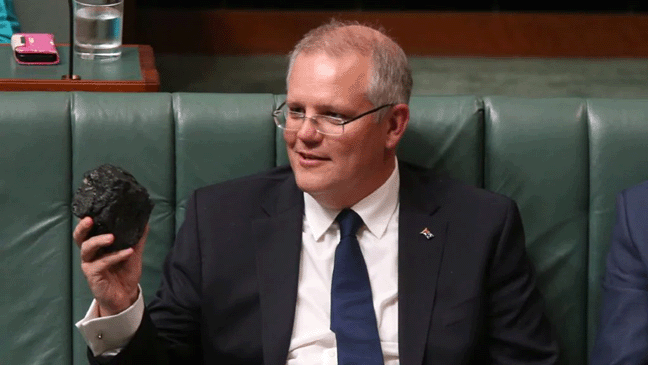 Aussie celebrities appeal to Prime Minister on climate policies, https://thenewdaily.com.au/news/national/2020/02/24/greenpeace-celebrities-climate-policies/ Australian celebrities are calling on Prime Minister Scott Morrison to take action on the nation’s energy policies in a campaign aimed at preventing new bushfires.Voices such as actor Simon Baker, musician Julia Stone and footy player Dyson Heppell have appeared in a Greenpeace video released on Monday, ask Scott Morrison to shift from coal to renewable energies. Aussie celebrities appeal to Prime Minister on climate policies, https://thenewdaily.com.au/news/national/2020/02/24/greenpeace-celebrities-climate-policies/ Australian celebrities are calling on Prime Minister Scott Morrison to take action on the nation’s energy policies in a campaign aimed at preventing new bushfires.Voices such as actor Simon Baker, musician Julia Stone and footy player Dyson Heppell have appeared in a Greenpeace video released on Monday, ask Scott Morrison to shift from coal to renewable energies.
The new campaign features bushfire survivors and Aussie personalities asking the Prime Minister “what sort of world” he wants his daughters to grow up in as a family man. Imploring Mr Morrison to act so Australia stops “falling behind the rest of world”, the video lists the “unprecedented fires”, “extreme drought” and “flash flooding” that have devastated communities in a “black summer”. The message from the Dear Scotty campaign claims to be directed to “both sides of politics” and calls for “change, unity, and leadership” to tackle the country’s future. “People have lost their lives, families have lost their homes, and koalas have burnt alive all over Australia,” Greenpeace Australia Pacific Senior Campaigner Nathaniel Pelle said. “Everyone is feeling the impacts of this coal-fueled bushfire crisis and we need Scott Morrison to act for their future and the future of all Australians.” |
|
#ScottyFromMarketing dodges the question of how much “climate business as usual will cost the economy
 Morrison admits there are climate costs, but won’t say what 3C heating would do to economy
Ahead of the release of its technology roadmap, the Coalition tries to ramp up pressure on Labor over its net zero emissions target, Guardian, Katharine Murphy Political editor, @murpharoo, Mon 24 Feb 2020 Scott Morrison has acknowledged there are “costs associated with climate change” but has declined to spell out what 3C heating would do to job creation and economic growth in Australia.
Ahead of the release of its technology roadmap, the federal government is attempting to ramp up political pressure on Labor over its commitment to a net zero target by 2050, blasting the opposition for adopting a target without a fleshed-out strategy to meet it, and pointing out that CSIRO research cited positively by Labor assumes a carbon price of more than $200 to drive the transition.
But the government is also having to fend off sustained questions about basic contradictions in its own messaging…….
While keeping all its options open, the government has been signalling for some days it is unlikely to adopt a 2050 target. …… https://www.theguardian.com/australia-news/2020/feb/24/morrison-admits-there-are-climate-costs-but-wont-say-what-3c-heating-would-do-to-economy
Bill in Aust Parliament names South Australia as the Nuclear Waste State
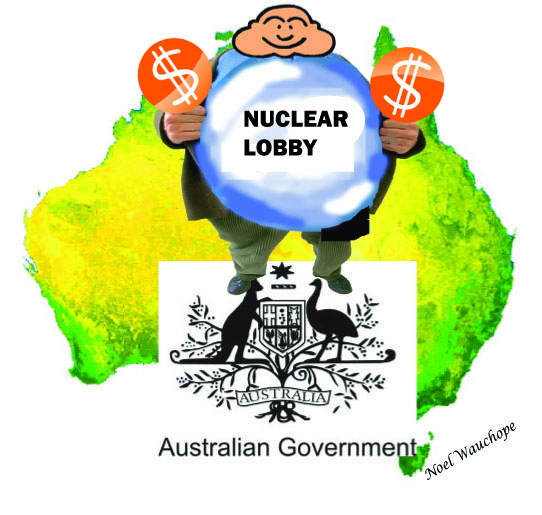
the Bill makes provision for the Federal gov. to pass Regulations to name and over-ride specific State Laws. For instance, it may be the case that the Federal gov. requires to pass a Regulation to name and over-ride the public interest protections in the SA “Nuclear Waste Storage (Prohibition) Act 2000”, and potentially to also do so regarding the SA “Aboriginal Heritage Act 1988”.
David Noonan, 24 Feb 20, Bill names SA as the Nuclear Waste State:
The Bill specifies South Australia as a nuclear waste dump state.
And specifies Napandee near Kimba as a Nuclear Waste Store – which effectively also targets Whyalla Port for multiple nuclear waste shipments.
The Bill has been to the HoRep’s and now goes to the Senate:
“to enable the decision about the location of the facility to be subject to Parliamentary scrutiny”
(see the Bill Explanatory Memorandum Outline p.1).
For access to the doc’s and to speeches, and to Track the Bill – so as to receive e updates…
The Bill is expected to be Referred by the Aust Greens around Wed 26th Feb to a short Inquiry by the Senate Standing Economics Legislation Committee. The Bill may go to a vote in Senate in the last week of May.
If the Bill is passed, the Federal gov. then instigates a Licensing process on the NRWM Facility by the nuclear regulator ARPANSA, and in parallel makes a referral for environment assessment of the proposed NRWM Facility under EPBC Act.
ARPANSA are expected to conduct separate Licensing processes for the above ground interim Nuclear Waste Store, and for the so-called Low-Level Waste Disposal Facility. ARPANSA may require the Federal gov. to make separate Licensing Applications for the two types of waste facilities.
The Federal gov. can-not assume that both facilities will be approved by the regulator.
It is arguably likely that Licensing for the NRWM Facility, and in particular for above ground interim Nuclear Waste Store, should and will fail – leaving the amended Act stranded will a failed single specified site and no provision for consideration of any further siting elsewhere in SA or in other States / Territories.
However, the Bill is said by the Minister and the Department to provide ‘certainty’.
Notes on Bill:
The Bill names and specifies South Australia, and omits “the State or Territory”, for siting a NRWM Facility and to register acquired lands;
The Bill specifies Napandee as the NRWM Facility site and amends the 2012 Act to that effect as a single site;
The Explanatory Memorandum (EM, Outline p.2) says: “Additional land will not be able to be acquired to establish a second facility”;
The Bill “Notes on Clauses” p.22 states: “Once established, it is expected to be in operation for 100 years.”
The Bill “Notes on Clauses” p.14 claims: “there is broad support in the community for the project.”
The Bill strengthens the Commonwealth powers to use the 2012 Act to over-ride State laws and to impose the NRWM Facility on unwilling communities;
The Bill specifically asks Senators to vote to approve a set of powers to over-ride any State law (or other Cth law), Continue reading
Labor’s Chris Bowen: Renewables make much more sense than ‘nuclear fantasy’
  Labor’s Chris Bowen: Renewables make much more sense than ‘nuclear fantasy’, The New Daily, Colin Brinsden , 23 Feb 20, Labor’s Chris Bowen: Renewables make much more sense than ‘nuclear fantasy’, The New Daily, Colin Brinsden , 23 Feb 20,
Federal Labor frontbencher Chris Bowen has criticised the Morrison government for even considering nuclear power as an option in the future energy mix, calling it a “fantasy and a furphy”……… Mr Bowen, the former shadow treasurer and now the opposition’s health spokesman, told reporters in Sydney that billions of dollars will be “unleashed” by renewable energy investment that will create jobs. Asked by a journalist if he would be open to nuclear power, Mr Bowen said: “No”. “The economics of nuclear power don’t stack up. You could start building a nuclear power station today and it wouldn’t be ready for decades,” Mr Bowen said. “The idea that this is part of the mix to Australia’s response to global warming is a fantasy and a furphy.”……. https://thenewdaily.com.au/news/national/2020/02/22/labors-bowen-rejects-going-nuclear/ |
|
Barngarla Aboriginal people take legal action against Australian govt’s planned Kimba nuclear waste dump
  Indigenous group fights on to stop SA dump https://www.9news.com.au/national/indigenous-group-fights-on-to-stop-sa-dump/d72f3453-28e8-4182-a9bb-6c9390098bf6?fbclid=IwAR3l91JVzBoJhkIhnf49 Feb 21, 2020 Native title holders on South Australia’s Eyre Peninsula are continuing their court fight to stop the federal government establishing a nuclear waste dump near Kimba. Indigenous group fights on to stop SA dump https://www.9news.com.au/national/indigenous-group-fights-on-to-stop-sa-dump/d72f3453-28e8-4182-a9bb-6c9390098bf6?fbclid=IwAR3l91JVzBoJhkIhnf49 Feb 21, 2020 Native title holders on South Australia’s Eyre Peninsula are continuing their court fight to stop the federal government establishing a nuclear waste dump near Kimba.
The government recently named a site on a local station as the location for the dump which will take Australia’s low to medium level nuclear waste material.
The government’s decision was informed in part by a ballot of local residents which supported the proposal.
But it’s that ballot that the Barngarla people are fighting in new Federal Court action.
They’re appealing against a court judgment last year that the council had not acted wrongly in excluding about 200 native title holders from the vote.
Counsel for the Barngarla, Daniel O’Gorman SC, told the court on Friday that their request to take part in the ballot should have been granted.
“They, therefore, are part of the community,” he said.
“This was a ballot of the community, the Kimba community. They are the native title holders of the land surrounding the sites in question.
“Therefore, we submit, they clearly had an interest in the ballot, they clearly had an interest in the dump and whether it goes ahead or not.
“Their mere standing as native title holders, warranted them being included as part of the community.”
The ballot ultimately returned about 62 per cent support for the dump, which then Resources Minister Matt Canavan accepted as broad community backing.
Those still opposed to the dump going ahead include some locals, environmental groups as well as indigenous communities.
Earlier this month, legislation to allow construction of the waste facility was introduced to federal parliament.
The underpinning laws allow for acquisition of land for the facility as well as a $20 million payment for the community to help establish and maintain the site which is expected to operate for at least 100 years.
The Federal Court’s ruling on the Barngarla appeal is expected to be handed down on a date to be fixed.
|
|
|
No place for nuclear energy in Australia: Labor’s Josh Wilson spells it out
There is still no place for nuclear energy in Australia
Josh Wilson MP ‒ federal shadow assistant minister for the environment.
February 21, 2020
I find it astonishing that while our communities and ecosystems alike suffer through Australia’s first national climate change disaster there are politicians who seek to distract from the key challenges before us by jumping on the old nuclear hobbyhorse.
More than 10 years on from the Switkowski review, all the relevant considerations have tipped further away from nuclear power. It continues to be expensive, slow, inflexible, uninsurable, toxic, and dangerous at a time when renewable energy generation and storage is becoming faster, cheaper, and more efficient. And in the meantime we’ve experienced Fukushima, which has displaced 40,000 people, still leaks radiation into the sea, and will cost Japan more than $200 billion.
The clearest point made in evidence to the recent nuclear inquiry was that settling a national energy policy is our highest priority. Without this framework, Australia’s progress towards a decarbonised energy system with better co-ordination and lower prices remains stymied. Despite that call being made by Ziggy Switkowski, Ian MacFarlane, our energy regulators and various economic and energy experts, government members of the committee couldn’t bear to see this sensible recommendation in print. Why? Because they knew it reflected poorly on the government.
The hard conservative core of the Coalition doesn’t believe in climate change and sees renewable energy as a similarly “green-left” plot. This wild disconnection from science, economics, and public consensus is hurting Australia. Even the mild courage required to deliver their own National Energy Guarantee cannot be found within the current circus.
Instead, we get the rising hum of nuclear fairy tales and the wishful myths that go with them. Top of that list is the furphy that nuclear energy, while risky and poisonous and productive of waste that no one knows how to safely store, is somehow comparatively cheap. That’s just rubbish. The definitive analysis of energy costs in the Australian context is the recently updated AEMO/CSIRO GenCost report. It confirms under various scenarios that nuclear power simply cannot compete on cost with firmed renewables.
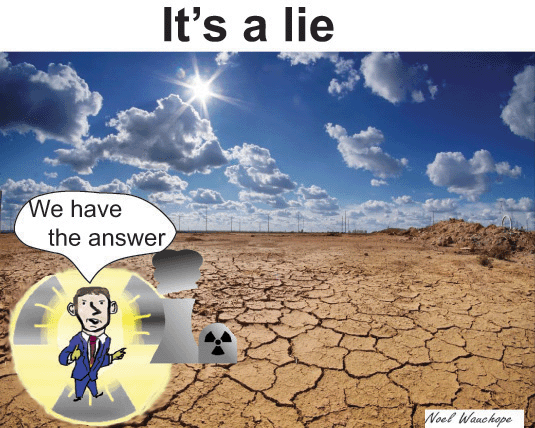
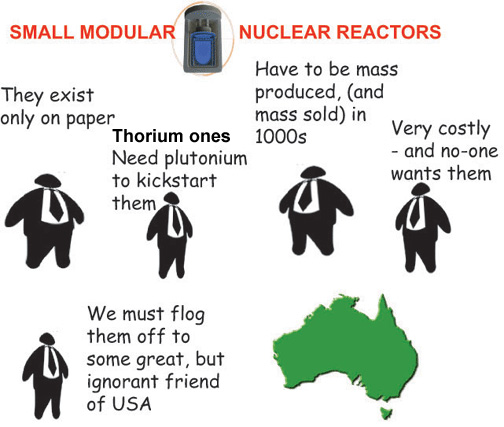
The latest darling of the ever-faithful nuclear fan club is the small modular reactor. SMRs, we are told, will be magically cheaper and safer. Such claims have been made by the nuclear industry about each new generation of technology right up to the point at which they turn out to be spectacularly untrue. At the moment SMRs simply don’t exist.
Myth number two asserts that as a matter of fact it is impossible to reach 100 per cent zero-emission energy without nuclear. Also wrong. Those making the claim are the same people who said that a 20 per cent renewable energy target for 2020 was reckless, and that a 50 per cent target for 2030 would be “economy wrecking”. Experts at the ANU gave evidence pointing to Australia’s potential as a renewable energy superpower with both generation and storage meeting our electricity needs and allowing us to export emission-free hydrogen.
The third myth is that Australia is missing out on the popular uptake of nuclear technology. In reality nuclear energy worldwide is in serious decline. The latest issue of the World Nuclear Industry Status Report shows that the nuclear share of electricity generation has dropped from its 1996 high of 17 per cent in 1996 to 10 per cent in 2018.
Countries that have relied on nuclear energy in the past are winding down their reliance. France has a target to reduce nuclear energy by a third. South Korea has decided it will no longer build nuclear. The UK is grappling with the costly implications of a new reactor that is years behind schedule and billions over budget, propped up by a 35-year power purchase agreement at double the current cost of electricity.
The most absurd myth of all is that we are being prevented from having a conversation about nuclear because of the current moratorium. Really? The claim is made in the report of yet another Parliamentary committee inquiry, which, in addition to receiving thousands of submissions, also involved public hearings in Brisbane, Melbourne, Sydney, Perth, Canberra, and Adelaide. Our inquiry followed the Switkowski review, the South Australian Royal Commission, and sits alongside a Victorian upper house inquiry.
There is nothing wrong with keeping an open mind on any topic but it shouldn’t be a blank mind. All the evidence shows there is no place for nuclear energy in Australia. Our policy paralysis is holding back our potential to be a renewable energy superpower. Those who agitate for an ongoing conversation on nuclear are spruiking a dangerous distraction.
Conflict in the COALition over climate change and emissions reduction

Mathias Cormann says Coalition will ‘finalise longer-term target in time for Cop26’ but Angus Taylor commits only to ‘long-term strategy’, Guardian, Paul Karp @Paul_Karp – 21 Feb 20 Senior Morrison government ministers are publicly at odds about whether Australia will take a long-term emissions reduction target to global climate talks in November after Labor unveiled a target of net zero emissions by 2050.On Friday the finance minister Mathias Cormann confirmed the government “will be finalising a longer-term target in time for Cop26” but the emissions reduction minister would commit only to “a long-term strategy” despite repeatedly being asked about a new target.
As revealed by Guardian Australia, Anthony Albanese used a speech to a progressive thinktank on Friday to commit the ALP to adopting a net zero target by 2050 if it wins the next federal election, without the use of carryover credits from the Kyoto period.Senior Morrison government ministers are publicly at odds about whether Australia will take a long-term emissions reduction target to global climate talks in November after Labor unveiled a target of net zero emissions by 2050.
On Friday the finance minister Mathias Cormann confirmed the government “will be finalising a longer-term target in time for Cop26” but the emissions reduction minister would commit only to “a long-term strategy” despite repeatedly being asked about a new target.
As revealed by Guardian Australia, Anthony Albanese used a speech to a progressive thinktank on Friday to commit the ALP to adopting a net zero target by 2050 if it wins the next federal election, without the use of carryover credits from the Kyoto period.
Scott Morrison is holding off from making a commitment to carbon neutrality by 2050, partly because of an internal brawl within the Coalition and partly because the prime minister says Australia should not sign up to targets in the absence of costings.
Some in the government have noted publicly in recent weeks that Australia implicitly accepted the net zero pathway when the Coalition signed and ratified the Paris agreement, and Liberal moderates are now pushing to make net zero an explicit target beyond the 26-28% emissions reduction promised by 2030…..
Despite the Coalition criticism, business rode to Labor’s defence. Australian Industry Group chief executive Innes Willox said the net zero target “is increasingly widely supported by Australian businesses, industry advocates such as Ai Group, the wider community and governments of all complexions”.
“That growing consensus is important to guide and discipline the development of efficient, trade neutral and fair policies to get there,” he said.
“We shouldn’t underestimate the challenge of net zero, which goes well beyond generating cleaner electricity……
Every state and territory has expressed at least an aspirational objective of achieving net zero emissions by 2050, and Australia has been urged by the UK and its Pacific neighbours to sign up to that target.
Albanese noted on Friday that the Business Council of Australia is calling for it as well as major corporates including AGL, Santos, BHP, Amcor, BP, Wesfarmers and Telstra.
“Seventy-three countries, including the UK, Canada, France and Germany, many with conservative governments, have already adopted it as their goal,” he said. “Australia should too
Earlier, Labor’s climate change spokesman, Mark Butler, told Radio National the opposition would set out a detailed policy about how to achieve targets and its cost “well before” the next election.
Butler argued that the cost of reducing emissions should not be divorced from the cost of inaction and noted Melbourne University research had found actions to reduce emissions have a benefit cost ratio of 20 to one. https://www.theguardian.com/australia-news/2020/feb/21/coalition-ministers-at-odds-over-emissions-target-after-labor-commits-to-net-zero-by-2050
#ScottyFromMarketing ‘s hypocritical ploy to do nothing effective against climate change
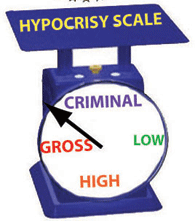 The government’s sudden passion for climate technology is newfound and insincere, The call for technology before action is a specious distraction designed to paper over the plan to take no action Guardian, Simon Holmes à Court– @simonahac 21 Feb 2020 The government’s sudden passion for climate technology is newfound and insincere, The call for technology before action is a specious distraction designed to paper over the plan to take no action Guardian, Simon Holmes à Court– @simonahac 21 Feb 2020
If you’re committed to the Paris agreement – to keep the increase in global average temperature to well below two degrees above pre-industrial levels, and pursue efforts to limit the increase to 1.5 degrees – then at a minimum, logically, scientifically, you’re committed to net-zero carbon emissions by 2050. So far, at least 77 countries have committed to the target, as has every state and territory in Australia. The fact that prime minister Scott Morrison is pushing back hard against the calls for such a target sends yet another strong signal that his government still denies the need to tackle climate change. Sensing it must be seen to do something, but committed to doing nothing substantive, the government is arguing that investing in technology is the superior pathway to… to… to what? Are billions of dollars of public funds about to be allocated to a strategy that delivers on an unspoken goal? This passion for technology is newfound and insincere. In truth, our government has a long history of undermining climate technologies. In the three years to 2016, the government ripped just shy of $1bn from the Australian Renewable Energy Agency (Arena), the body charged with helping early stage technologies through to commercial launch. The funding of a feasibility study for a coal power station in Collinsville and the foreshadowed gift of $11m to extend the life of the 42 years old Vales Point coal power station in the Hunter, demonstrate just how reluctant the Coalition is to let go of last century’s energy technologies. One of the most promising and critical new technologies is the rapid maturation of the electric vehicle, but who can forget the government’s pushback against EVs during last year’s election?…… Mike and Annie Cannon-Brooke’s Resilient Energy Collective is a case study for how far we’ve come. In just a handful of weeks the group has put together an emergency power product for restoring power to bushfire affected communities. The solar-powered, battery-backed system can be installed in a single day, and will be rolled out to 100 communities in as many days. The energy supply companies partnering in the project are stunned that the infrastructure is being rolled out in hours not months. Community members are amazed that they’re using solar power at night. ….. In reality, the call for technology before action is a specious distraction designed to paper over the plan to take no action. The greatest proponent of the frame is Danish political scientist Bjorn Lomborg, one of a small cadre of almost respectable climate obfuscationists. …… The first three years of the Coalition government focussed on tearing down climate policy. The next three used endless reviews that came to nothing – as intended. In July 2014, Tony Abbott finally made good on his promise to dismantle Australia’s carbon price mechanism, our most effective and efficient climate policy. In doing so, not only did he throw away the best tool we had, he cheated Australian farmers out of earning billions from exporting carbon credits to Europe. In 2015, Abbott managed to slash the renewable energy target – assisted in the background by Angus Taylor, the man now charged with reducing emissions – cutting future activity under the target by 40%…… In July 2014, Tony Abbott finally made good on his promise to dismantle Australia’s carbon price mechanism, our most effective and efficient climate policy. In doing so, not only did he throw away the best tool we had, he cheated Australian farmers out of earning billions from exporting carbon credits to Europe. In 2015, Abbott managed to slash the renewable energy target – assisted in the background by Angus Taylor, the man now charged with reducing emissions – cutting future activity under the target by 40%….. So here we are again. Another strategy to kick the can down the road……https://www.theguardian.com/commentisfree/2020/feb/21/the-governments-sudden-passion-for-climate-technology-is-newfound-and-insincere |
|
Frank Simpson warns against the pollution of Victoria’s agricultural land by thorium/uranium mining
 Risk in contaminating a prime green food producing region of Victoria. (3) This implies all stages of the fuel cycle from exploration to waste repository storage.
Greens in the Senate will oppose bill to storage nuclear waste at Kimba farm
 Greens to oppose bill to storage nuclear waste at SA farm, Queensland Country Life, Jamieson Murphy@jamiesonmurph18 Feb 2020, THE government may have to negotiate with the Senate crossbench to get through legislation that will transform a South Australian farm into a nuclear waste facility, after the Greens declared their opposition to the bill. Greens to oppose bill to storage nuclear waste at SA farm, Queensland Country Life, Jamieson Murphy@jamiesonmurph18 Feb 2020, THE government may have to negotiate with the Senate crossbench to get through legislation that will transform a South Australian farm into a nuclear waste facility, after the Greens declared their opposition to the bill.
The Kimba farm, which was voluntarily nominated and chosen after a four-year search, would store medical nuclear waste for 100 years. South Australian Senator and Greens nuclear spokesperson Sarah Hanson-Young said her party would work to block the “offensive” legislation. “The federal government wants to dump on South Australia and we won’t leave it to the community of Kimba to hold the line on their own,” Senator Hanson-Young said. “It is wrong to say there is broad community support. Traditional Owners have rejected the proposal. Once again the Morrison government and [former Resource] Minister Canavan haven’t listened. “A government minister from Queensland thinks South Australia is the place to dump and it’s deeply offensive to the people of SA. “Every South Australian should be concerned this government is more interested in building a radioactive waste dump than they are in investing in renewable energy and our growing potential for green industry.” Labor resource spokesperson Joel Fitzgibbon did not respond to questions about whether his party would support the bill. The recently appointed Resource Minister Keith Pitt introduced the legislation to the House of Representatives last week – just two weeks after the Kimba site was announced – where the government will have the numbers to pass the bill. With the Greens opposing the bill in the Senate and Labor not stating its position, the government will need the backing of either the Centre Alliance or One Nation to carry the bill. A spokesperson for Mr Pitt said the new minister was “working with other parties to deliver the outcome”. “Minister Pitt wants bipartisan support on the National Radiation Waste Management Bill,” the spokesperson said. “This bill has been 40 years in the making and the establishment of a national radioactive waste facility is a national priority.” South Australian Energy and Mining Minister Dan van Holst Pellekaan said the federal legislation would override SA’s state legislation….. https://www.queenslandcountrylife.com.au/story/6635712/greens-to-oppose-bill-to-storage-nuclear-waste-at-sa-farm/?cs=4704&fbclid=IwAR17gRLqP-DpCp_Ya5UqDUHu0Tj7y3siBi04TWo1wktCu-ZqtuBRG-PVyaE |
|
|
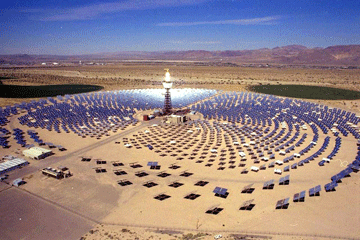
Solar thermal energy the way forward for Australia- says nuclear expert
Dr Wilson described nuclear power as simply “too risky”.
He also said the cost factor was also a major deterrent from going nuclear.
“It’s not the cost of building it. They are expensive to build and they are expensive to run but it’s the cost of demolition when it gets to the end of its life,” he said.
“Nuclear is not cheap, it’s not safe, and will be destructive to key Queensland industries like agriculture and tourism.”
|
Solar thermal power the way forward for Australia despite hiccups, nuclear expert says
https://www.abc.net.au/news/2020-02-18/solar-thermal-power-should-be-major-export-expert-says/11971938?fbclid=IwAR3zjCStZwOvdHFGY0EtSWxu4oQ0i43QAgm6O9S5YNW5I3KKna370tb7KtQ ABC Radio Brisbane
By Rebeka Powell 19 Feb 2020, As the world looks to Germany as a shining example of how to shift away from polluting coal power, a Queensland-based nuclear expert says solar thermal power is the way forward for Australia. Key points:
Paul Wilson is an electrical and control systems engineer with almost five decades’ experience who has previously made submissions to the parliamentary inquiry into nuclear power. Dr Wilson told ABC Radio Brisbane’s Steve Austin he was disappointed Australia was not showing leadership or innovation in renewables. “We’re very good in Australia at innovation and at engineering and I think we should take a leaf out of the German book,” he told the Drive program. “And they’re basically trying to systematically close down their coal mining industry but they’re doing it by replacing jobs. So they’re deliberately setting out, for every job that is lost in coal mining, they’re trying to create another job. Continue reading |
Religious leaders urge ScottyFromMarketing to move Australia away from fossil fuels
|
Faith leaders press PM on climate action, Herald Sun Heather McNab, Australian Associated Press
February 20, 2020 Religious leaders have appealed to Prime Minister Scott Morrison as a “fellow person of faith” to heed climate science following the country’s catastrophic bushfire season. The open letter – signed by 18 Christian, Hindu, Buddhist, Jewish, Muslim and other faith leaders – urges Mr Morrison to show leadership and urgently transition Australia away from fossil fuels. The signatories include: Dr Peter Catt, the Dean of St John’s Anglican Cathedral in Brisbane, the Most Reverend Vincent Long Van Nguyen OFM, Chair of the Catholic Bishops Commission on Justice, Mission and Service Muslims Australia president Dr Rateb Jneid and Buddhist Council of NSW Religious leaders have appealed to Prime Minister Scott Morrison as a “fellow person of faith” to heed climate science following the country’s catastrophic bushfire season. The open letter – signed by 18 Christian, Hindu, Buddhist, Jewish, Muslim and other faith leaders – urges Mr Morrison to show leadership and urgently transition Australia away from fossil fuels. The signatories include: Dr Peter Catt, the Dean of St John’s Anglican Cathedral in Brisbane, the Most Reverend Vincent Long Van Nguyen OFM, Chair of the Catholic Bishops Commission on Justice, Mission and Service Muslims Australia president Dr Rateb Jneid and Buddhist Council of NSW president Dr Gawaine Powell Davies…. https://www.heraldsun.com.au/news/breaking-news/faith-leaders-press-pm-on-climate-action/news-story/48ebb95e2fdee026ccc593583ea622ab |
|
Divisions within both Liberal and Labor parties over Coal
Both the Coalition and Labor are battling divisions over climate policy and the future of coal.
While a majority of Labor MPs believe the opposition needs to stay the course on climate action, some in the party’s right argue the party needs to be more positive about the coal industry……. https://www.theguardian.com/australia-news/2020/feb/19/anthony-albanese-backs-adani-coalmine-but-criticises-proposed-collinsville-power-plant
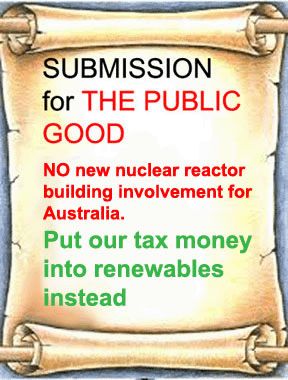
143 Anti-Nuclear, 10 Pro Nuclear Submissions (published) to Victorian Parliament
Submissions published so far to the Victorian Government’s Inquiry into Nuclear Prohibition are running strongly ANTI NUCLEAR https://www.parliament.vic.gov.au/epc-lc/article/4348
There are currently 143 submissions opposing the nuclear industry.
There are 10 submissions favouring the nuclear industry. (You can bet that vested interests have sent in confidential submissions)
 PRO nuclear
1. Don Hampshire ( with attack on ABC, The Age )
2 Robert Heron – vaguely
3 Terje- Petesen
116 Leah McDermott
122 Simon Brink
123 CFMMEU Mining and Energy Division 21 Azark 26 Buchanan, Bill 27 Murphy, Barry 28 Patterson, John
ANTI nuclear
 4 Jessica Lawson 5 Pro Forma list of 122 contributors 48 Janet Nixon 49 Karen Furniss 63 Graeme Tyschsen 68 Barbara Devine 76 Vivien Smith
77 Lachlan Dow 81 RVS Industries 92 Alan Hewett and Joan Jones 103 Anne Wharton 106 John Quiggin vague 107 Amy Butcher 109 Nick Pastalatzis 112 Philip White 22 Friends of the Earth 23 Derek Abbott 24 Simpson, Frank 25 Wauchope, Noel 29 Wissink, Bart 30 Sharp, Robyn 31, Smith, Colin
Labor stays strongly against nuclear power, despite pro nuke push from one union
Labor bipartisanship on nuclear energy needed: AWU,Australian Financial Revieew Phillip Coorey – Political Editor, Feb 18, 2020
The Australian Workers’ Union has stepped up its call for Australia to embrace nuclear power by urging Labor leader Anthony Albanese to provide the political bipartisanship that is needed. …….
Like other pro-nuclear advocates, Mr Walton supports small modular reactors. He also accepts that if Labor were in government, nuclear power would not be an option for it.
In the Coalition, the Nationals are hardening against a proposal floated by Mr Morrison and Energy Minister Angus Taylor to achieve net zero emissions by 2050.
On Monday, Mr Morrison was very cautious.
https://www.afr.com/politics/federal/labor-bipartisanship-on-nuclear-energy-needed-awu-20200217-p541eh
1 This month

of the week – Australians for War Powers Reform (AWPR)
To see nuclear-related stories in greater depth and intensity
 Antinuclear