Climate action distracted by talk of uncosted, unbuilt, unproven and unpalatable technologies such as nuclear.
|
SMH, February 10, 2020 – Chris Danckwerts, Turramurra I thought we’d all realised by now that the nuclear power option was never going to be viable, until I read Katie Allen’s article (“Keep an open mind to nuclear“, February 8-9). She ignores a number of crucial facts. First, the timeframe to build nuclear (a decade at least). Second, the cost (many billions). Third, safety. She says that smaller, more modern reactors will only “moderate” the risks, not eliminate them as most of us would wish. Finally, there would only be “less” nuclear waste to get rid of, which will still continue to be a problem. The sooner we eliminate nuclear, coal and eventually gas power options and move to 100 per cent renewables, pumped hydro, hydrogen et cetera the better off we will be.
Christopher Hill, Kensington, It seems Katie Allen has been electorally charged with selling us nonexistent new-nuclear power technologies and asking us to spend time and taxpayer money on something we never asked for. Sounds familiar. Given the continuing fallout from this government’s self-interested spending of taxpayer money, why not go nuclear? Well, the plea for open minds is all well and good. However, real movement on national energy policy and transition is now on the table. We are at that table and we are hungry for a workable energy and climate change policy. Sure, keep an open mind, but fill it with well-informed realistic debate anchored in the present, not on distracting unwanted promises of uncosted, unbuilt, unproven and unpalatable technologies such as nuclear. – Helen Lewin, Tumbi , If, as Peter Hartcher suggests (“Be amazed by our masters of delusion“, February 8-9), Allen is voicing her pro-nuclear stance in order to drag her conservative Coalition confreres into a world free of fossil fuels, I respectfully suggest she dumps this minority group of Luddites rather than tempting them with nuclear energy. She admits in her article that the “concerns” around the development of nuclear have only “moderated”. I’m afraid that won’t be enough to drag me along with her or many other Australians. – Umbi https://www.smh.com.au/national/nsw/argument-goes-nuclear-in-search-for-energy-solution-20200209-p53z2c.html |
|
Coalition nuclear stooge MPs line up to push for removing Australia’s prohibition on nuclear activities
Support for nuclear energy heating up across government, SMH, Mike Foley, February 8, 2020 — “……. Coalition MPs have spoken out on nuclear energy as a solution to the need to decarbonise the economy, arguing the government can maintain Australia’s long-held moratorium on nuclear power and take modest steps in early stage research and development of new technologies.
Dr Allen, a paediatrician and medical researcher with a PhD, said “question marks remain” over the potential to use renewables as the sole source to power Australia’s energy grid……
Queensland LNP MP Ted O’Brien, who represents the Fairfax electorate on the Sunshine Coast, chaired a parliamentary committee which last year tabled a report titled Not without your approval: a way forward for nuclear technology, calling for a partial lift in Australia’s 20-year-old nuclear moratorium.
Rather than a total and immediate lift of the moratorium, only a partial lift for new and emerging technologies is proposed, subject to the results of a technology assessment and a commitment to community consent as a condition of approval for nuclear facilities,” it said.
Mr O’Brien said without lifting the moratorium the government could commission assessments recommended by his committee into “economic, technological and readiness assessments” for nuclear energy.
Among the Coalition MPs on the government-dominated committee who endorsed the report were Trent Zimmerman, from inner-city electorate North Sydney, Bridget Archer from Bass in northern Tasmania, Nationals MP for Lyne David Gillespie, West Australian MP Rick Wilson and North Queensland Nationals MP Keith Pitt, who was this week promoted to cabinet as Resources Minister.
Former deputy prime minister and Nationals leader Barnaby Joyce has also promoted nuclear energy.
However, Prime Minister Scott Morrison and Energy Minister Angus Taylor have said they’re not considering lifting the nuclear moratorium due to lack of bipartisan support for nuclear energy.
Mr Taylor said the government is “taking the time to thoroughly consider the [committee’s] recommendations” and it had “no plans to lift the longstanding moratorium”.
Advocates argue nuclear power production costs can fall with new technology, highlighting the emerging technology of small to medium-sized reactors. However, there are no commercial examples of the new technology in operation.
Labor MPs issued a dissenting report which said the inquiry heard from experts who argued renewable energy offered better prospects to replace fossil fuels and the safety record of nuclear energy made it too risky to consider.
“In fact the events [like Fukushima], innovations and advances in renewable energy, and emerging climate and energy system developments of the last ten years have made nuclear power even less relevant and appropriate in the Australian context at a time when nuclear power is already in decline elsewhere,” the report said. https://www.smh.com.au/politics/federal/support-for-nuclear-energy-heating-up-across-government-20200207-p53yru.html
Liberal MP Katie Allen touts nuclear energy for Australia
Katie Allen, a government member of parliament (MP) representing inner-city Melbourne, wrote in a column for Nine Entertainment newspapers that Australia has an opportunity to lead the way on developing “safer and more effective” nuclear energy.
Australia has had a blanket moratorium on nuclear energy for 20 years, but a parliamentary committee chaired by coalition MP Ted O’Brien in December tabled a report calling for it to be partially lifted…….
In December, Prime Minister Scott Morrison and Angus Taylor, the minister for energy and emissions reduction, declared that they were not considering exploring nuclear options.
Any move to lift the moratorium would require the support of the opposition Labor Party, which has previously declared an anti-nuclear stance.
The report from December said that a partial lift would allow the government to conduct recommended “economic, technological and readiness assessments” for nuclear energy.
“Rather than a total and immediate lift of the moratorium, only a partial lift for new and emerging technologies is proposed, subject to the results of a technology assessment and a commitment to community consent as a condition of approval for nuclear facilities,” it said. http://www.xinhuanet.com/english/2020-02/08/c_138765779.htm
Zali Steggall , independent MP for Warringah, luring Liberals towards climate action
A matter of conscience’: Zali Steggall unveils plans for climate change act, https://thenewdaily.com.au/news/national/2020/02/10/zali-steggall-plans-climate-change-act/ Samantha Maiden She stole Tony Abbott’s blue-ribbon seat out from under the Liberal Party’s nose and now Zali Steggall is hoping to lure party dissidents to cross the floor and vote for climate change action.
|
The legislation is modelled on the UK’s Climate Change Act and is designed to provide a national framework for action and mandatory annual reporting of Australia’s trajectory towards meeting reduction targets. “We need to set out a road map for Australia to become a low-carbon economy without all the fear-mongering and misinformation,” Ms Steggall said. “The big question all sensible Australians are asking is how? This is why we need a climate change act to set out a legislative framework.” |
|
Private investors won’t touch new Coalition-backed coal plant, Labor says
Private investors won’t touch new Coalition-backed coal plant, Labor says, Morrison government to spend up to $4m in grant for feasibility study into coal-fired power plant in Queensland, Guardian, Australian Associated Press, Sat 8 Feb 2020 The federal Labor opposition says private investors will not touch “with a barge pole” the Morrison government’s plan to support a coal-fired power plant in Queensland.
The government says it will spend up to $6m in grants for two new Queensland electricity generation projects, including a coal-fired power plant, as part of a bid to lower power prices……..
Labor’s climate change and energy spokesman, Mark Butler, said private investors would not touch a new coal-fired power station “with a barge pole”.
“The government still has no energy policy – just ideological flights of fantasy,” he said in Adelaide on Saturday. The private investment sector had made it very clear it had no appetite for building expensive coal-fired power stations, he said.
Victorian govt Nuclear Inquiry – published Submissions
First published results on the Inquiry website are strongly ANTI-NUCLEAR. But we must remember that there could be many confidential submissions, that we don’t know about.
PRO nuclear
1. Don Hampshire
2 Robert Heron – vaguely
3 Terje- Petesen
116 Leah McDermott
122 Simon Brink
123 CFMMEU Mining and Energy Division
ANTI nuclear
4 Jessica Lawson
5 Pro Forma list of 122 contributors probably anti-nuclear
48 Jaznet Nixon 49 Karen Furniss
63 Graeme Tyschsen
68 Barbara Devine
76 Vivien Smith
77 Lachklan Dow
81 RVS Industries
92 Alan Hewett and Joan Jones
103 Anne Wharton
106 John Quiggin vague
107 Amy Butcher
109 Nick Pastalatzis
112 Philip White
see https://www.parliament.vic.gov.au/epc-lc/article/4348 -to read the submissions
Submission to INQUIRY INTO NUCLEAR PROHIBITION (focussing on thorium etc)

Submission to INQUIRY INTO NUCLEAR PROHIBITION
Introduction
I read the very narrow Terms of Reference (TOR) with some amazement. It is certainly made clear that the goal is to remove Victoria’s Nuclear Activities (Prohibitions) Act 1983 (1)
The very first TOR makes the mining of uranium and thorium as the prime concern. After all, Victoria could presumably have nuclear power with these minerals sourced from elsewhere. I conclude that the underlying goal of this Inquiry is, under the relentless pressure of thorium lobbyists such as John White, indeed to remove that legislation, which effectively prohibits the exploration and mining of thorium and uranium in Victoria. John White has a long history of promotion of the nuclear industry (2), and previously owned the massive 3,700 sq km mining exploration lease EL4416 [picture attached] right across Southern Gippsland’s prime coastal and tourism region, and runs the entire length of the spectacular 90 Mile Beach.(3)
Clearly, the Victorian legislation was brought in to protect this State’s precious agricultural land, and iconic ocean coast from polluting mining industries.[picture attached]
The Terms of Reference are clearly biased: with no qualification they promote the nuclear industry as undoubtedly beneficial to Victoria. This is ludicrous, as the global nuclear industry is in a state of decline (4)
Meanwhile, renewable energy technologies, wind, solar and storage are now recognised by CSIRO and the Australian Energy Market Operator as by far the cheapest form of low carbon options for Australia, and are likely to dominate the global energy mix in coming decades. (5)
- https://en.wikipedia.org/wiki/Uranium_Council
- https://independentaustralia.net/environment/environment-display/ia-investigation-victoria-goes-dirty-brown,3788
- https://www.fool.ca/2020/01/31/the-death-knell-for-nuclear-and-the-end-of-cameco-tsxcco/
- https://reneweconomy.com.au/new-csiro-aemo-study-confirms-wind-solar-and-storage-beat-coal-gas-and-nuclear-57530/
on potential benefits to Victoria in removing prohibitions enacted by the Nuclear Activities (Prohibitions) Act 1983
Now, turning to each TOR
(1) investigate the potential for Victoria to contribute to global low carbon dioxide energy production enabling exploration and production of uranium and thorium; through enabling exploration and production of uranium and thorium.
Nuclear power is no solution to climate change. This Term of Reference assumes that the “exploration and production” will result in nuclear power plants for Victoria, otherwise why do it? It also assumes that nuclear power will be effective in lowering C02 emissions.
But there is no point in this “exploration and production” as it has been repeatedly demonstrated that nuclear power is no solution to climate change.
Even if nuclear power really could combat climate change, it would take decades to get enough reactors in operation. It would be too late, whereas renewable energy, solar and wind, and also energy effiiciency strategies, can be set up quickly. This means that to establish nuclear power would be counter-productive, as time, energy, and money would be diverted away from those genuine solutions. Dr Paul Dorfman, et al (6)
Nuclear power is vulnerable to climate change. Increasing temperatures can result in reduced nuclear reactor efficiency by directly impacting nuclear equipment or warming the plant’s source of cooling water. (7) Nuclear power is uniquely vulnerable to increasing temperatures because of its reliance on cooling water to ensure operational safety within the core and spent fuel storage. As the most water-intensive energy generation technology, (8) nuclear reactors are located near a river or the ocean to accommodate hefty water usage, which averages between 1,101 gallons per megawatt of electricity produced to 44,350 gal/MWh depending on the cooling technology.
Inland reactors that use rivers as a source for cooling water are the most at risk during heat waves, which according to the Intergovernmental Panel on Climate Change (IPCC) are “very likely” to occur more often and last longer in the coming decades. (9)
Especially Australian climate impacts on nuclear technology. In view of Australia’s bushfire crisis, it just seems ludicrous that anyone would contemplate introducing nuclear power technology of any type to this country. The Lucas Heights research nuclear reactor is already enough of a worry. Bushfires have occurred in its vicinity.(10) The transport of nuclear wastes would be threatened by bushfires (11)
Nuclear power would place an intolerable burden on Australia’s precious, but limited water supply. Nuclear power plants require huge amounts of water to prevent fission products in the core and spent nuclear fuel from overheating (incidentally making nuclear the most water intensive energy source in terms of consumption and withdrawal per unit of energy delivered).
Uranium mining and nuclear facilities are highly water intensive, while solar and wind power can alleviate water stress. (12)
Why thorium exploration and production? Thorium nuclear reactors do not exist yet, and quite possibly never will. Thorium itself is not a fissile material. It can only be transformed into fissile uranium-233 using breeder and reprocessing technology. Its development entails a complex processes, bringing risks of weapons proliferation and smaller but highly toxic, amounts of long-lasting radioactive wastes. After reaction, the thorium blend leaves dangerous wastes like U-232, a potent high-energy gamma emitter that can penetrate one meter of concrete and will have to be kept safely out of our air, food, and water forever. (13)
In January, the Climate Council ‒ comprising Australia’s leading climate scientists and other policy experts ‒ issued a policy statement, noting that nuclear power plants “are not appropriate for Australia – and probably never will be” as they are “a more expensive source of power than renewable energy, and present significant challenges in terms of the storage and transport of nuclear waste, and use of water”.(14)
- https://medium.com/@albertbates/john-wayne-squares-off-against-jim-hansen-42a258b2260d
- The Effect of Rising Ambient Temperature on Nuclear Power Plants http://large.stanford.edu/courses/2018/ph241/duboc1/
- https://theatlas.com/charts/H1scYH_H7
- Future Climate Changes, Risks and Impacts https://ar5-syr.ipcc.ch/topic_futurechanges.php
- https://www.smh.com.au/national/nsw/residents-warned-not-to-leave-sydney-fire-worsens-20180415-p4z9os.html
- https://independentaustralia.net/environment/environment-display/transporting-nuclear-wastes-across-australia-in-the-age-of-bushfires,13465
- https://www.businesstimes.com.sg/energy-commodities/solar-wind-power-can-alleviate-water-stress
- Thorium ‒ a better fuel for nuclear technology? Nuclear Monitor, by Dr. Rainer Moormann
- https://www.climatecouncil.org.au/resources/godfather-of-australian-science-warns-government/
(2) identify economic, environmental and social benefits for Victoria, including those related to medicine, scientific research, exploration and mining;
Economic benefits? Victoria is right now on the cusp of a renewable energy revolution, with all sorts of exciting developments, for example, Melbourne’s iconic tram network to be powered by solar energy. (15) Victoria has a renewable energy target of 50% by 2030. (16) Why imperil that progressive transition to clean energy, by the distraction of the expensive and dirty industry, with its connection to nuclear weapons development?
In 2017–18, the state’s temperate climate, high quality soil and clean water helped the industry produce $14.9 billion worth of agricultural product from 11 million hectares. This makes Victoria Australia’s largest agriculture producer.(17). In Gippsland, John White’s Ignite Energy Resources holds a huge mining license, in an area with exceptional resources of monazite, a source of thorium.(18) the same area that is renowned for both its tourist attractions and its agriculture. Gippsland farms account for at least one quarter of Victoria’s milk, vegetable and beef production with a number of Gippsland’s businesses exporting food across the world (19)
Why would anyone in their right mind imperil Victoria’s successful and continuing agricultural and tourism industries for a gamble on a fantasy about thorium nuclear reactors? Those reactors are currently nonexistent, and likely to remain so.
The Australian nuclear hype focusses on “Generation IV” technologies, especially Small Modular Nuclear Reactors (SMRs – they leave out the unpopular word “nuclear”)
No-one wants to pay for SMRS
No company, utility, consortium or national government is seriously considering building the massive supply chain that is at the very essence of the concept of SMRs ‒ mass, modular factory construction. Yet without that supply chain, SMRs will be expensive curiosities.
Small nuclear reactors are not economically viable. The main priority preventing safe deployment [of small nuclear reactors] is economics. Most commercial proposals for SMRs involve cost-cutting measures, such as siting multiple reactors in close proximity. This increases the risk of accidents, or the impact of potential accidents on people nearby. (20)
The world wide effort by the nuclear industry to hype up small nuclear reactors is not resulting in any sign of success, given their disastrous economics, among other problems. (21)
Thorium and uranium mining? Given the decline in the nuclear power industry, and the glut in uranium, the uranium market is in permanent doldrums. (22)
Thorium nuclear reactors – there are many sources that detail the problems that make these reactors unlikely ever to become a commercial reality. They are in essence really uranium fuelled, as they require plutonium or enriched uranium to start the process. Their major problem is of course their very high cost. Other disadvantages, safety risks, toxic long-lasting wastes, weapons proliferation risks. (23)
Environmental benefits? Are they kidding? The environmental consequences of using thorium-based nuclear power will result in the same problems the world faces today with uranium bases reactors. (24)
Uranium mining has widespread effects, contaminating the environment with radioactive dust, radon gas, water-borne toxins, and increased levels of background radiation. (25) The industry’s use of water is huge, making it a very unwise industry for for water -scarce Australia.
Social benefits? What social benefits? The introduction of any part of the nuclear fuel chain into clean, green Victoria would bring conflict, division and distress especially to rural Victorians. All for the faint hope of riches for a few mining entrepreneurs, and the promise of jobs, jobs jobs in mining, an industry that is becoming increasingly and rapidly automated. The effect on the tourism and farming industry would be loss of jobs, whereas solar and wind technologies can be developed alongside agriculture, bringing many more jobs.
(3) identify opportunities for Victoria to participate in the nuclear fuel cycle; and
If the well-being of the farming and tourist communities is ignored, well, some enthusiastic nuclear entrepreneurs might be able to get hold of tax-payers’ money , and get their almost certainly futile dream started.
(4) identify any barriers to participation, including limitations caused by federal or local laws and regulations.
Apart from the barriers of extremely bad economic outlook for nuclear activities in Australia, apart from the environmental, health and safety risks, apart from damage to agriculture and tourism, -yes there are legal and regulatory hurdles for the nuclear lobby to overcome.
Victoria’s laws are not haphazard whims of a few latte-drinking tree huggers.
They have been developed to protect the public from the very sorts of dirty nuclear industries that are now being touted by the nuclear lobby
Adam Bandt, The new Australian Greens leader looks to hopeful action on climate catastrophe

“There is no point in telling people there may be jobs in unspecified industries in the future. It is incumbent on us to explain how we will look after people in this transition”. …….
He has opened his period of leadership by talking about a Green New Deal, which he characterises as “a government-led plan of investment and action to build a clean economy and a caring society”.
Adam Bandt: the Greens must provide hope there is an exit strategy from climate catastrophe The new Australian Greens leader says the party has to connect with coal communities if it wants to be taken seriously, Guardian Katharine Murphy Political editor @murpharoo, Fri 7 Feb 2020 For the first time in the party’s history, the leader of the Australian Greens sits in the House of Representatives, not in the Senate. If you have to hold a lower house seat at every election, Adam Bandt says, you have to listen, and you have to be plugged in to the practical concerns of your constituents. Continue reading
Know your Federal govt pro nuclear stooges
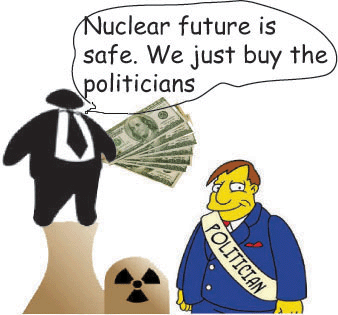
These are just a few – mentioned in today’s Age:
- Katie Allen inner-city Melbourne Liberal MP
- Ted O’Brien, Queensland LNP MP , Fairfax electorate on the Sunshine Coast
- Trent Zimmerman, from inner-city electorate North Sydney
- Bridget Archer from Bass in northern Tasmania,
- David Gillespie Nationals MP for Lyne
- Rick Wilson MP West Australia
- Keith Pitt, North Queensland Nationals MP , who was this week promoted to cabinet as Resources Minister.
Former deputy prime minister and Nationals leader Barnaby Joyce has also promoted nuclear energy.
Australian Parliament and its coal-smudged deals
Leadership spills and coal-smudged deals, Independent Australia,  By Michelle Pini | 6 February 2020 Leadership spills aside, we have a Government littered with climate denialists and two major progressive parties effectively acting as their enablers, writes executive editor Michelle Pini.
FIRST, we had a Nats spill brought on by the sports rorts scandal. Then we had a changing of the guard – and definitely not a “spill” – at the Greens, which went largely unnoticed, what with all the drama in the Government. And talk of another Lib spill – despite Morrison’s “miracle” election win – has also been doing the rounds. Again.
But today, we still have McCormack. We still have Morrison. And though we have Bandt, he is heading a party with basically the same old agenda – a self-righteous, if admirable, one – where there is no negotiation, only elaborate demands. Oh and we still have Albanese — who heads a risk-averse Labor Party, which is unlikely to spill much other than their own unelected tears.
WHEN A SPILL ISN’T A SPILL
Deputy Prime Minister McCormack is safe. For now. And by his side is David I’m-Not-A-Scientist Littleproud.
McCormack’s first appearance on national TV, since surviving the well-sharpened knives of his predecessor, was dedicated to the importance of coal and gas….. That the focus was on rocks and other fossil fuels from the leader of the party of dinosaurs pretty much says it all……..
Most Australians want action on climate change, but it’s just not going to happen so long as they also keep voting for the Coalition…….
MORE COAL-SMUDGED DEALS
Meanwhile, it’s business as usual at the Liberal Party.
With his sudden and spectacular fall from public favour as the bushfire crisis escalated, Morrison made a few “climate change is real” noises. But anyone who has actually been listening knows he never committed to doing anything real. He never has and he never will. Not while there’s coal in his fossil fuel-lobbying belly.
A challenge for the leadership will likely bring Dutton the Overlord out of his dark sinister corner, so a Lib spill will only bring more of the same — or maybe even worse outcomes for the climate emergency…..
What we have, in essence, is a Government littered with climate denialists and two major progressive parties effectively acting as their enablers. Because as long as the Greens just lay out their wish list and Labor take refuge in their hidey-hole of inaction, the coal-smudged dinosaurs continue Australia’s fossil fuel rule.
Instead of political posturing, what is needed is the collaboration of all progressive parties. In the first instance, between Labor and the Greens, and then between this partnership and the crossbench.
Those of us on the progressive side of politics need to wake up and smell the acrid smoke of the alternative.https://independentaustralia.net/politics/politics-display/leadership-spills-and-coal-smudged-deals,13568
#ScottyFromMarketing appoints nuclear-coal enthusiast as Australia’s new resources minister
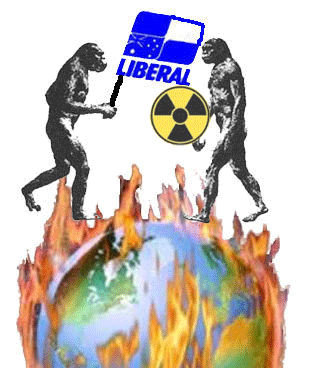
Liberal policy
Pro-coal, pro-nuclear, anti-renewables MP is Australia’s new resources minister, REneweconomy, , Queensland MP Keith Pitt – an outspoken support of coal and nuclear and critic of wind and solar – has been elevated to the federal cabinet and replaces Matt Canavan as the Minister for Resources and Northern Australia, as flagged by RenewEconomy yesterday
Liberal politicians jump on the climate bandwagon to promote nuclear power
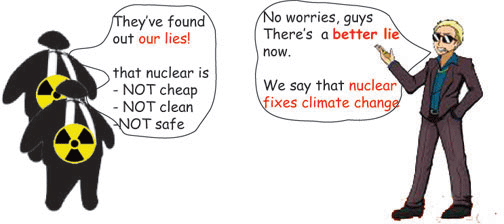
Goldstein MP, Tim Wilson and North Sydney MP Trent Zimmerman spoke in favour of nuclear power, commending MP Ted O’Brien for his parliamentary inquiry into the issue, which was tabled in December, and advocating for it to be further explored.
|
Coalition MPs clash over climate policy in first party room meeting of 2020
Scott Morrison faces difficult task of repositioning on climate change after assuring voters policies would ‘evolve’ Guardian, Sarah Martin @msmarto, Tue 4 Feb 2020 The prime minister, Scott Morrison, faces a fresh internal row over climate change policy, with MPs clashing over the issue in the first Coalition party room meeting of the year. Continue reading |
#ScottyFromMarketing “won’t be bullied” by climate science
Mr Morrison’s comments echoed those of his deputy prime minister during the height of the bushfire crisis.
In November, Mr McCormack attacked those who were linking climate change to the severity of the bushfires, labelling them “inner-city raving lunatics”
|
Scott Morrison says he won’t be ‘bullied’ on climate by inner city voters, https://www.sbs.com.au/news/scott-morrison-says-he-won-t-be-bullied-on-climate-by-inner-city-voters Prime Minister Scott Morrison says he “won’t be bullied” into changing his government’s position on climate change as National MPs renew demands for more investment in coal.
5 Feb 20, BY TOM STAYNER
Prime Minister Scott Morrison has declared he won’t be “bullied” by inner-city voters as he downplayed concerns of a fresh climate war inside the Coalition. Continue reading
|
Greens leader Adam Bandt vows to hold torch to Coalition on climate
|
Greens leader Adam Bandt vows to hold torch to Coalition on climate, The New Daily, 3 Feb 20, Adam Bandt has been elected unopposed as Greens leader following the surprise resignation of Richard Di Natale
The only Greens member in the lower house, Mr Bandt was formally endorsed by his federal party room colleagues in Canberra on Tuesday morning. He has promised to pursue a “Green New Deal” focused on including dental treatment in Medicare, making education free by abolishing public school fees, and replacing fossil fuels with renewable energy. Mr Bandt aims to win the balance of power in the upper and lower houses of federal parliament at the next election. In the meantime, he intends to pressure the Morrison government to take stronger action on climate change. Mr Bandt labelled the Coalition government “criminal” for abolishing the carbon price under Tony Abbott and argued climate inaction was fanning the ongoing bushfire crisis. He also claimed big businesses were “killing people” by contributing to a “climate catastrophe”. Mr Bandt said the Greens would provide “real opposition” and hold the government to account He said the major parties were “singing from the same song sheet” on coal mining. “I’m not one of those people who says that Labor and the Liberals are the same,” he said, shortly after his election to the leadership. “But when it comes to coal, Labor is now using exactly the same terminology as the Liberals.” Queensland senator Larissa Waters will remain co-deputy of the party and will share the role with Tasmanian senator Nick McKim. Senator Waters will also be the Greens leader in the Senate……https://thenewdaily.com.au/news/politics/australian-politics/2020/02/04/adam-bandt-greens-leader/ |
|
#ScottyFromMarketing has no climate target, because he is controlled by climate denialists
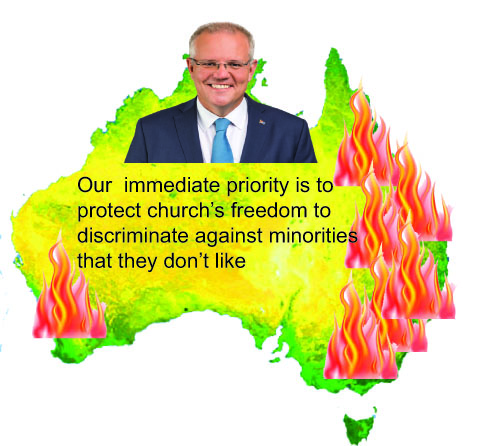
|
Scott Morrison’s missing target: climate https://www.afr.com/policy/energy-and-climate/scott-morrison-s-missing-climate-target-20200203-p53x5g
If he is going to appease noisy climate change denialists, it would be better if the Prime Minister left emissions reduction policy to the states. Richard Denniss Columnist Scott Morrison loves long-run targets for everything except climate policy.The federal government has long-run targets for inflation (2 to 3 per cent), the budget surplus (1 per cent of gross domestic product) and net debt (zero). It’s got a long-run target for defence spending (2 per cent of GDP) and countless long-run targets when it comes to Indigenous disadvantage, education performance, aged care quality and foreign aid. But when it comes to reducing the amount of coal, oil and gas Australia burns, apparently long-run targets are an unnecessary distraction for an “action man” like Scotty from Marketing. Targets give business, consumers and other levels of government something clear to work towards. Energy sources, especially the coal and nuclear power stations that the Prime Minister likes the sound of, take years to plan, years to build and decades to pay for themselves. Targets give business more certainty but they also make governments accountable for performance, which is presumably why the Prime Minister is so determined to avoid them when it comes to carbon emissions. In his sermon to the National Press Club last week, he avoided committing to net zero emissions by 2050 on the basis that his “climate action agenda is a practical one, it goes beyond targets and summits”. But you can’t go “beyond” long-run targets without having first set them.
Morrison knows targets matter. That’s why his government targeted so many sports grants to marginal electorates, and it’s why he spends so much time talking about meeting and beating Tony Abbott’s 26 to 28 per cent Paris target. Scott knows that if you set the bar low enough you can easily clear it, and if you don’t set the bar at all you can do nothing at all. After six years in office, continuing to avoid long-run emissions targets makes the government’s job easier and the energy industry’s harder. The Prime Minister’s real problem with long-run climate targets is the long-run climate change deniers in the party he’s trying to lead. For 10 years the only way for a Liberal leader to survive has been to publicly promise to do something about climate change while privately promising not to. Morrison waved a lump of coal in Parliament when he wanted to destabilise Malcolm Turnbull, but today he waves his “climate action now” slogan to stabilise his slide in the polls. Ultimately, like the last five Liberal leaders, he will be impaled on the fence his party insists he sit on. Morrison’s new-found interest in hazard reduction is no substitute for spending his prime ministerial capital in international forums, trying to steer the world away from the 3 degrees of warning we are currently on track to experience. The state premiers are perfectly capable of raking the leaves, but only the federal government can negotiate on the nation’s behalf for more ambitious action. Which brings me back to targets. Back in 2016, the ACT set a target to source 100 per cent of its electricity from renewable sources by 2020, and it’s already “meeting and beating” that goal and providing some of the cheapest electricity in Australia. The City of Sydney will be 100 per cent renewable by the end of this year and the state Coalition government of Gladys Berejiklian has committed NSW to net-zero emissions by 2050. In fact, every state in Australia is committed to carbon neutrality by 2050 – which, whether Scott Morrison likes it or not, means that Australia has committed to being carbon neutral by 2050. But rather than using those targets as leverage on the international stage, Morrison is undermining them on the domestic stage. If the Prime Minister was as interested in appeasing the quiet Australians as he was in appeasing the noisy climate denialists, he would welcome the bear hug the state premiers have wrapped him in and take credit for their ambition on the world stage while holding the premiers to account for their commitments back home. While a national approach to emissions reduction would be nice, the federal Coalition has shredded every initiative that has been put forward. Rather than take over more responsibilities from the states, Morrison would do better to leave climate and energy policy to them. The only thing stopping him from showing up at the next global climate talks and putting the states’ target of net zero by 2050 on the table is his backbench. |
|
|
1 This month

of the week – Australians for War Powers Reform (AWPR)
To see nuclear-related stories in greater depth and intensity
 Antinuclear