 Gribble , Eric (38) addresses the question of ionising radiation – nuclear power development is safe, but held back by “a widespread paranoid concern due to a lack of understanding of what radiation is.”
Goes on to explain that radiation can be beneficial – quotes some dubious science from 2002 and 1992…. “It appears that slightly elevated levels of radiation are beneficial but levels above 100 mSv the risk appears to increase. .. “ Quotes some study showing that radiation decreases incidence of lung cancer. Claims that Fukushima nuclear accident caused only one death due to material falling upon a man. No evidence of cancer caused.
Uses Hiroshima studies to dismiss concerns about radiation dangers…
Says nuclear power “is safe and the only option “
“Renewables do not stack up on a cost basis.”
Raves on about hydroponics and space “… If space travel is to become a reality using existing technology mankind will need a massive amount of energy. Energy to make rocket fuel. ….. Nuclear energy will open up the future. “”
. “Nuclear energy is the energy source of the future, Australia cannot afford to continue to let opportunities slide.”
“It is easy to be a green. You simply oppose everything, dams, nuclear, fossil fuels, the free enterprise system, whatever. Yet there are many people (probably most people) out there who are as concerned about the environment as the most rabid green but do not support the green movement.”
September 14, 2019
Posted by Christina Macpherson |
AUSTRALIA - NATIONAL, politics |
Leave a comment
Nuclear power should be allowed in Australia – but only with a carbon price, John Quiggin, The Conversation September 13, 2019 “…….. A blueprint for reform
The central recommendations of my submission were as follows:
Recommendation 1: A carbon price of A$25/tonne should be introduced immediately, and increased at a real rate of 5% a year, reaching A$50/tonne by 2035.
Recommendation 2: The government should immediately adopt the recommendations of its own Climate Change Authority for a 40% to 60% reduction in emissions by 2030, relative to 2000 levels, and match other leading OECD countries in committing to complete decarbonisation of the economy by 2050.
Recommendation 3: The parliament should pass a motion:
affirming its confidence in mainstream climate science and its acceptance of the key conclusions of the United Nations’ Intergovernmental Panel on Climate Change;- legislating a commitment to emissions reductions;
- removing the existing ban on nuclear power……..There are immediate political implications of my proposal at both the state and federal level. It will be more difficult for the Coalition-dominated committees running the two inquiries to bring down a report favourable to nuclear power without addressing the necessary conditions – including a carbon price. If the government’s hostility to carbon pricing is such that a serious proposal for nuclear power cannot be considered, it will at least be clear that this option can be abandoned for good. ……..Given the urgency of addressing climate change – a task that is best addressed through a carbon price – it makes no sense to reject action now on the basis that it opens up the possibility of nuclear power sometime in the 2030s. And, if renewables and storage perform as well as most environmentalists expect, nuclear power will be unable to compete even then. ……… https://theconversation.com/nuclear-power-should-be-allowed-in-australia-but-only-with-a-carbon-price-123170
September 13, 2019
Posted by Christina Macpherson |
AUSTRALIA - NATIONAL, politics |
Leave a comment
Barrie Hill gives an insight into just what the global nuclear lobby wants from Australia. They want to overturn Australia’ s laws prohibiting nuclear activities, and get the tax-payer to fund the development of the nuclear industry in Australia
His submission (no.60) to the FEDERAL. Inquiry into the prerequisites for nuclear energy in Australia is a fine example of the nuclear-lobby-speak that is turning up in these submissions from nuclear power experts. He’s the Managing Director of SMR Technology, and makes sure to outline his impressive background in the industry.
His is a long submission, in 3 long documents. Here are snatches from his main document.:
*****************************************************
Hill says that for Australia replacing coal with nuclear will be “ the least cost alternative “. He recommends a South Korean type nuclear chain. Says that “the viability and advantages of small modular reactors is fully covered in a separate submission”. Recommends setting up a Federal government authority to lead Australia’s nuclear program. Recommends the South Korean Advanced Power Reactor 1000MWe (APR1000).
“It is recommended that the groundwork for an inevitable future nuclear power program is put in place beginning with the removal of all legislated prohibitions and increased support or familiarisation and training programs.”
“ the government will need to guarantee high level positions with appropriate salaries for qualified persons coming from existing nuclear areas”
Recommends used fuel storage to be ready by 10 years from first plant commissioning “and that storage allow for eventual fuel recovery”. Wants high regulation and documentation, and sites for reactors chosen early.
Outlines his strong background in the nuclear industry.
Discusses the needs for electricity, and limitations of renewable energy. Criticises the electricity marketing structure. All existing subsidies should be removed. Says base-load power is critically needed. Wants a single independent Australian Electricity Commission to be set up.
Goes on at length and in detail about projected.electricity costs. “The development of nuclear reactors for power generation provides a cost effective, safe, and reliable option for the progressive replacement of the current Australian base load generation fleet.” and suggests direct replacement by Small Modular Reactors.
Says that Westinghouse indicated a “good potential for widespread industry involvement within Australia”.
Hill attributes the “difficult acceptance” of nuclear power to “accident outcomes sensationalised by technically uninformed media.”
“At an early point in the process the Federal and State governments should act to remove all legislative bans prohibiting a final decision to proceed so that the work may be developed unobstructed and finally judged on it’s merits. It is clear that the existence of the bans has restricted expenditure on thorough analysis to date particularly by government agencies and has been a severe detriment to the establishment of a coherent energy policy for the nation.”
He moves on to “Stage 2” – a feasibility study, resulting in a “national investment decision”, the forming of a Nuclear Energy Program Implementing Organisation, bring in many experts, including foreign experts for “high level knowledge” . Recommends Government Leadership and Continuous Investment in Nuclear Infrastructure….. “ The Australian government therefore should play a lead role in the program from the initial phase with investment funds, manpower selection, and appropriate planning –
“With the existence of a firm financial guarantee from the government local and overseas companies will actively participate in the national nuclear power construction program with reduced risk. ”.
“Only an Australian government agency can arrange and manage the required level of investment estimated to total $150B to eventually replace all retiring coal fired power stations, to ensure maximum benefit for the Australian community and minimum risk. The Reserve Bank has noted that this time of unprecedented low interest rates is the perfect opportunity for government investment in productive new assets such as power stations.”
Lengthy discussion on need for training and education especially tertiary. International co-operation, especially on safeguards. Need for a standard nuclear design.
[on nuclear wastes)”The work carried out for the Nuclear Fuel Cycle Royal Commission based in South Australia has provided sufficiently detailed pre-feasibility studies to commence final feasibility work for the implementation of used fuel storage in Australia. It is recommended that used fuel storage be available ten years from first plant commissioning and that storage allow for eventual fuel recovery.”
Recommends importing nuclear wastes, as a way to fund nuclear power development :“The economic viability and revenue streams defined for used fuel import storage as part of the work carried out by the South Australian Royal Commission could in the extreme provide sufficient revenue to fund the development of a nuclear power program for all of Australia. This massive economic opportunity cannot be overlooked”
Need for a strong independent regulator.
On insurance, Hill explains why “ beyond a certain level risk had to be socialised. It is now understood that the state needs to accept responsibility as insurer of last resort”
Hill dismisses the idea of any necessary connection between nuclear power and nuclear weapons proliferation.
Discusses how to organise a leadership team, then process for choosing sites for reactors.
Discusses radiation at length, tending to minimise the health effects of Chernobyl and Fukushima, and reassures about the nuclear industry’s good safety culture.
“Recent OECD and local studies suggest that Federal action to introduce nuclear power is the only economically viable option to meet minimum cost of supply, maximum reliability of supply, and key environmental imperatives for the Australian electricity sector.”
Hill gives detail on choosing a reactor type- recommending a Korean one.
On risk analysis – “Humans are poor risk managers, focusing too much on consequences and too little on probabilities – something insurance and lottery salesmen relish.” Gives lengthy detail on risk identification and risk mitigation. He includes not only safety risks, but also financial risks, and ways to mitigate them.
Finally, Hill turns to the issue of climate change, recommending nuclear power for reducing greenhouse gases, and replacing coal power.
“The Federal government will be required to manage the financing, construction and operation of all nuclear power stations for the foreseeable future.
A prerequisite for the investment is the establishment of a government leadership andmanagement control organisation the Australian Electricity Corporation”
“ It is time for the Australian Federal government to lead a strategy for change before all those benefits are
irretrievably lost.”
September 12, 2019
Posted by Christina Macpherson |
AUSTRALIA - NATIONAL, politics |
Leave a comment
 Submissions to the Federal Nuclear Inquiry? What are people saying?
Up until 7 September, 38 submissions have been published on the website of the Federal Inquiry into the prerequisites for nuclear energy in Australia
The numbers of submissions for and against nuclear power are almost 50/50. However, as some submissions may be confidential, we can’t really be sure of the numbers.
The main arguments In the pro nuclear submissions.
The topic mentioned most often was – advocating for thorium nuclear reactors. Pro nuclear submissions also tended to focus on a call for public education about nuclear power, and a need to remove Australia’s laws that prohibit the nuclear industry. Several submissions concentrated on the question of nuclear wastes – arguing that this was not such a problem and a solution would be found. Small Modular Nuclear Reactors (SMRs) were recommended, as cost effective.
The main arguments in the anti nuclear submissions
Overwhelmingly, the most selected topic was economics – the costs of nuclear power, and the government subsidies needed. Nearly as often mentioned was renewable energy, and its role in reducing greenhouse gases. Another big concern was the safety risks of nuclearpower. There were several mentions of water use of nuclear power, of radioactive waste problems, and risks of terrorism and of nuclear weapons proliferation.
There were a variety of other concerns raised by both sides. Radiation is a hotly argued issue. Its hazards are discussed by Paul Savi (Submission No 4), but Erlc Gribble (No 38) argues that low dose radiation is not harmful, in fact can be beneficial (radiation hormesis).
The anti nuclear arguments included social and political claims – that nuclear power has no social licence (EcoEnviro Pty Ltd – Richard Finlay-Jones Submisson 6), – that there is historic Australian opposition – hence the ban, (Greig Myer Submission 25), – the undemocratic history of nuclear activities in Australia,(Paul Savi, Submission 4)
Other anti-nuclear claims- that Australia shouldn’t be the first to try out SMRs, that renewables would provide more employment, that Aboriginals’ historic care of the land should be respected, (Trish Frail 32) .
On the pro nuclear side, there’s some exasperation at Australians’ lack of knowledge about nuclear power. Robert Gishubl (Submission 28) rails at “the irrational faith based objections many people have”. Eric Gribble (38) writes of “a widespread paranoid concern” about radiation, – “It is easy to be a green. You simply oppose everything “.
Pro nuclear suggestions in include first getting an international nuclear waste facility in South Australia, which would then fund the development of Generation IV nuclear reactors – (Matthew Gustafson, (20). Keith Thompson (11) suggests that the government offer generous awards for people who produce solutions to nuclear waste disposal. Geoffrey Hudson (37) warns on delay problems for land-based reactors, and advocates reactors on barges at sea. Ian Fischer(No 8) recommends a voluntary postal plebiscite to allow Australians to decide about a nuclear future. Eric Gribble (38) is keen on nuclear power’s ability to further Australia’s role in space research.
Even on the pro nuclear side, there are some reservations, and not all are sceptical of renewable energy. Goronwy Price (35) sees nuclear as a support to renewables. Geoff Billard, (31)’s support for nuclear power is conditional on it being cost-effective.
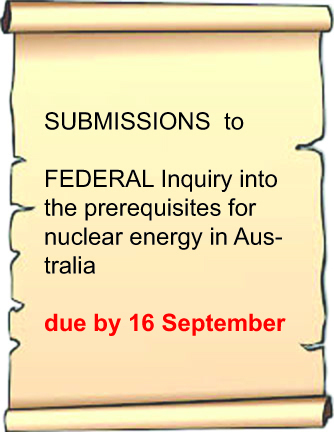
At this stage, it’s hard to assess the general opinions on ” the prerequisites for nuclear energy in Australia”. Submissions are accepted until September 16th. So there will probably a new rash of submissions published, over the next weeks. . The ones published so far have been relatively short. We can expect some longer and more detailed ones from various companies and organisations.
September 12, 2019
Posted by Christina Macpherson |
AUSTRALIA - NATIONAL, politics |
Leave a comment
Labor demands nuclear be wiped off options, https://www.theadvocate.com.au/story/6368008/labor-demands-nuclear-be-wiped-off-options/ Australian Associated Press 10 Sept 19, Ever enjoyed a holiday to Noosa, Sussex Inlet or French Island? How would you feel if there was a nuclear power station in your idyllic vacation spot?
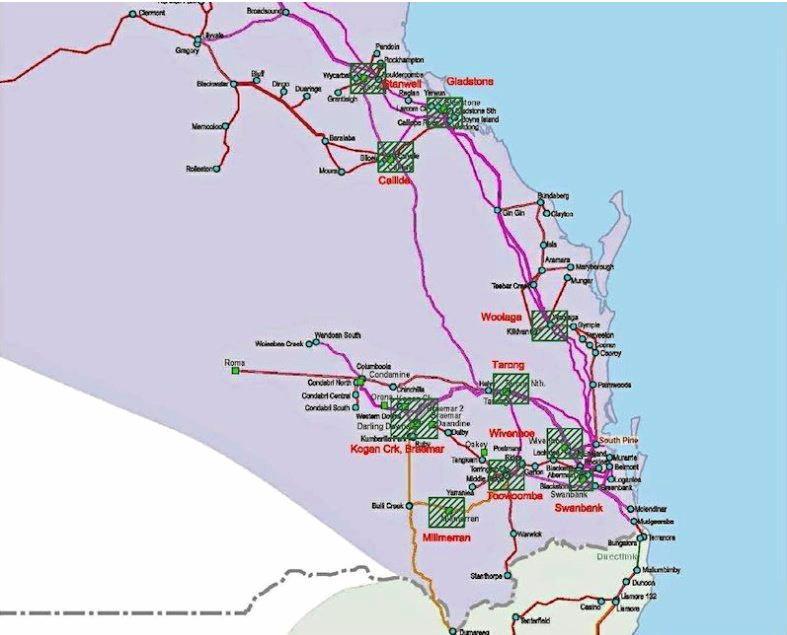
As politicians look into the feasibility of nuclear power, Labor is highlighting the nearly 140 places around Australia that have been mooted as potential locations for nuclear reactors and radioactive waste dumps over the past half-century.
The vast majority are around the country’s beloved coastlines, and almost all are near residential communities. Some sites, like Townsville, Toowoomba and Wagga Wagga have been proposed multiple times, a map collated by the Parliamentary Library shows.
“Instead of indulging the policy fantasies of his restive backbench, (Prime Minister Scott) Morrison should reject the nuclear option or be upfront with Australians about exactly where he wants to build nuclear reactors,” Labor energy spokesman Mark Butler said on Thursday.
A parliamentary committee is looking at whether nuclear is a feasible, suitable and palatable solution for Australia’s future energy needs.
Energy Minister Angus Taylor asked for the inquiry amid growing calls from coalition backbenchers for the option to be seriously examined
Last Thursday, the committee was warned by Ziggy Switkowski – who led a Howard government review into the power source – that there was a real risk of “catastrophic failure” if Australia adopted nuclear energy.
September 10, 2019
Posted by Christina Macpherson |
AUSTRALIA - NATIONAL, politics |
Leave a comment
 The survey indicates nuclear energy, which has been revived as a prospect by some Morrison government MPs, remains divisive with voters.
Only one in five put nuclear in their top three preferred energy sources, and 59% of the survey put nuclear in their bottom three.
Australians increasingly fear climate change-related drought and extinctions
Climate of the Nation survey shows growing support for net zero emissions by 2050 and rapid phase-out of coal power
https://www.theguardian.com/environment/2019/sep/10/australians-increasingly-fear-climate-change-related-drought-and-extinctions?utm_term=RWRpdG9yaWFsX0d1YXJkaWFuVG9kYXlBVVMtMTkwOTEw&utm_source=esp&utm_medium=Email&utm_campaign=GuardianTodayAUS&CMP=GTAU_email Katharine Murphy Political editor
Drought-hit land 40km north-east of Coonabarabran in NSW. More than 80% of Australians are worried about drought and floods linked to climate change.
Australians are increasingly concerned about droughts and floods, extinctions and water shortages associated with climate change, and most people think all levels of government aren’t doing enough to combat the effects of global warming, according to new research.
The annual Climate of the Nation survey, which has been tracking Australian attitudes to climate change for more than a decade, finds concern about droughts and flooding has risen from 74% of the survey in 2017 to 81% in 2019. Continue reading →
September 10, 2019
Posted by Christina Macpherson |
AUSTRALIA - NATIONAL, climate change - global warming, politics |
Leave a comment
Climate change survey shows Australians want action on emissions, but are divided on nuclear, ABC 10 Sep 19 The majority of Australians blame increasing energy costs on “excessive profit margins” of energy companies, and 64 per cent think we should be aiming for net-zero emissions by 2050.
But we’re still divided on how to get there, with solar energy topping the list of preferred energy sources and nuclear power continuing to polarise opinion.
These are some of the findings from The Australia Institute’s annual Climate of the Nation report, which shows Australians are becoming increasingly unhappy over a range of climate and energy issues.
Of the 1,960 people surveyed, general concern about climate change was highest among 18 to 34-year-olds, with more than 81 per cent of respondents saying climate change worried them, compared to 67 per cent of those aged 55 and over.
The overall acceptance by Australians that climate change is happening is on par with 2016 — the equal highest rate since the surveys began in 2007.
However, attitudes to climate change are divided along gender lines, with women more likely than men to think climate change is happening. Nearly 80 per cent of women said they are either “very concerned” or “fairly concerned” about climate change, versus 70 per cent of men. Continue reading →
September 10, 2019
Posted by Christina Macpherson |
AUSTRALIA - NATIONAL, climate change - global warming, politics |
Leave a comment
Australia’s arms deals ignoring ‘gross violations of human rights’, ex-defence official says https://www.theguardian.com/australia-news/2019/sep/08/australias-arms-deals-ignoring-gross-violations-of-human-rights-ex-defence-official-says?utm_term=Autofeed&CMP=soc_568&utm_medium=Social&utm_source=Twitter#Echobox=1567888161
Defence department says it provides export permits only if satisfied that the weapons will not be used in breach of international law Ben Doherty, 8 Sept 19, A former secretary of the Australian defence department says the country cannot justify selling weapons to militaries involved in the five-year war in Yemen, which now stand “accused of gross violations of human rights and likely war crimes by the UN”.
And the Australian co-author of the just-released United Nations report into human rights atrocities in Yemen has said governments that sell weapons to belligerent countries are responsible for prolonging the conflict and contributing to immense humanitarian suffering.
The report found that the conflict had been plagued by human rights abuses, including hospitals being bombed, civilians being deliberately targeted by shelling and sniper fire, civilian populations being deliberately starved, medical supplies being blocked, rape, murder, enforced disappearances, torture, and children being forced to fight.
Australia is one of several countries that sell weapons to those that are part of the Saudi-led Coalition in conflict with the Iran-backed Houthi rebels in Yemen. The Australian government says it imposes strict controls on exports to ensure they are not used in the Yemeni conflict.
But the former secretary of the department of defence Paul Barratt told Guardian Australia that regardless of whether Australian-made weapons were crossing the border into Yemen, “the fact remains that Australia now has a national policy which seeks and facilitates weapons sales with countries that stand accused of gross violations of human rights and likely war crimes”.
“When did this particular trade in arms become official Australian policy? Even if we are successfully legally tiptoeing around the Arms Trade Treaty, such deals surely cannot be acceptable on moral or ethical grounds,” Barratt said. “As a country that routinely asks other countries to abide by the rules-based international order, it would seem hypocritical, at best, that Australia is now willing to … make a profit from, weapons sales to nations that are openly flouting this international order.”
Melissa Parke, the former federal MP for Fremantle, was one of three UN-appointed experts to compile its report on Yemen.
The report said hospitals had been bombed, civilians attacked and starvation used as a tactic of war, and alleged that there had been a “collective failure” from the international community to intervene in the five-year war to reduce the suffering of civilians; rather, support from international actors had prolonged the conflict. The public report detailed a list of the key military, political participants in the conflict. A confidential list of those most likely to be complicit in war crimes has been sent to the UN.
Parke said Yemeni civilians had “borne the brunt” of a brutal conflict that was being exacerbated by international indifference, and material support from some governments.
September 8, 2019
Posted by Christina Macpherson |
AUSTRALIA - NATIONAL, politics, politics international, religion and ethics, weapons and war |
Leave a comment
 Submission 25 Greig Myer Hopefully this will be the final time that our elected representatives waste time and money on a form of energy that has no public support in pretty much every country on the planet. This has been indicated time and again when the general public has been allowed to have a referendum on the issue. Historically the Australian government has sensibly recognised this in its general moratorium on nuclear power. I will rely on others providing the facts backing up the following broad statements:
There remains no proven long term safe storage facility for nuclear waste anywhere in the world. All facilities to date have experienced increasing leakage risks or actual leakage as time has gone on. The waste also requires ongoing management far beyond the average extent of human planning ability and is based on the assumption of an extraordinarily long stability of government and human affairs that have historically never persisted.
This remains the most basic and fundamental reason that nuclear power should not be considered.
The health and safety risks of nuclear power are massive and exist end to end. From mining uranium, to operating the facility, to dismantling it and storing the waste, at all points humans and the natural environment are exposed to very real risk of radiation exposure, and that is assuming things are operating well.
Nuclear power is currently the most expensive form of electricity generation available, as well as the most dangerous and the most polluting. The estimated costs of generating nuclear power never include the dismantlement of the reactor at the end of its life as well as the multi-generational cost of storage of the waste. These costs must be included in an assessment of nuclear power.
If experts are to be sought to provide an overview of nuclear power then some should be sourced from Germany which is closing down all its nuclear power, and Japan that is currently dealing with the reality of nuclear power when it goes wrong.
Australia as a major supplier of uranium is an enabler of the nuclear waste problem that is going to plague the world for generations. Just because an industry provides profit or jobs does not make it a conscionable activity. Australia could make a major contribution to ensuring that nuclear waste is at least somewhat reduced by shutting down its uranium producing mines. –
Some nuclear proponents raise the red herring of carbon emissions as a reason for nuclear power. Carbon dioxide is only one form of pollution that humanity has to deal with it as a result of its activities. Replacing one form of pollution with a far more toxic alternative is not progress.
There is urgent need for focus on the long-term stabilisation of Australia’s energy grid and this would be a much more appropriate focus for a Parliamentary Inquiry. Solar and wind power are cheap and whatever problems they have they are insignificant compared to the extreme risks that exist with nuclear power
Electric cars are coming and they provide a real opportunity to provide the grid stabilisation that is needed, if the Australian Government provides the appropriate guidelines (universal plug for all cars, all charging to be done between 10am and 2pm??). It is time to focus on the future and leave nuclear power in the past where it belongs. It has had 50 years to prove itself and it has failed comprehensively.
September 7, 2019
Posted by Christina Macpherson |
AUSTRALIA - NATIONAL, Submissions Federal 19 |
Leave a comment
 Pressure on PM to rule out nuclear power https://www.9news.com.au/national/pressure-on-pm-to-rule-out-nuclear-power/00c275b4-f3f6-477c-9825-a8c28bd3ba61, By AAP Sep 6, 2019 Prime Minister Scott Morrison is under pressure to rule out nuclear power in Australia, with the opposition saying it’s too expensive and his predecessor calling it a “loopy” fad.
A parliamentary committee is looking at whether nuclear is a feasible, suitable and palatable solution for Australia’s future energy needs.
But Labor wants the coalition to put its nuclear “fantasy” to bed, saying it’s three times as costly as other options and wouldn’t be up-and-running for decades.
“It is a distraction that will do nothing to solve the energy crisis that is confronting Australian households and businesses now,” opposition energy spokesman Mark Butler told reporters in Adelaide on Thursday.
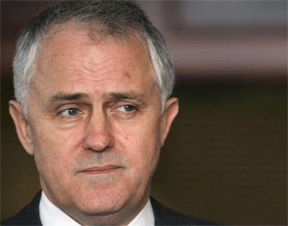
Former prime minister Malcolm Turnbull hasn’t helped the coalition’s case, calling nuclear power a “loopy” fad and a distraction for Mr Morrison’s backbenchers.
Australia’s former leader expressed the view on Twitter, in a discussion about the coalition being in line to hit its 2020 renewable energy target.
“I am delighted the target has been met – but I never had any doubt it would be – the challenge now is making sure the storage/firming is in place to make the renewables reliable,” he wrote on Thursday night.
He said ensuring such reliability will require “careful planning and provision”.
But he stressed renewable energy has an edge over coal and “loopy” nuclear power.
“The bottom line is renewables + storage are cheaper than new coal let alone the loopy current fad of nuclear power which is the current weapon of mass distraction for the backbench.”
Energy Minister Angus Taylor asked for the inquiry amid growing calls from coalition backbenchers for the option to be seriously examined.
Last Thursday, the committee was warned by Ziggy Switkowski – who led a Howard government review into the power source – that there was a real risk of “catastrophic failure” if Australia adopted nuclear energy.
September 7, 2019
Posted by Christina Macpherson |
AUSTRALIA - NATIONAL, politics |
Leave a comment
 Labor is pushing ScoMo to rule out nuclear power https://www.theleader.com.au/story/6370417/pressure-on-pm-to-rule-out-nuclear-power/v Marnie Banger, 6 Sep 19 Prime Minister Scott Morrison is under pressure to rule out nuclear power in Australia, with the opposition saying it’s too expensive and his predecessor calling it a “loopy” fad.
A parliamentary committee is looking at whether nuclear is a feasible, suitable and palatable solution for Australia’s future energy needs.
But Labor wants the coalition to put its nuclear “fantasy” to bed, saying it’s three times as costly as other options and wouldn’t be up-and-running for decades.
“It is a distraction that will do nothing to solve the energy crisis that is confronting Australian households and businesses now,” opposition energy spokesman Mark Butler told reporters in Adelaide on Thursday.
Former prime minister Malcolm Turnbull hasn’t helped the coalition’s case, calling nuclear power a “loopy” fad and a distraction for Mr Morrison’s backbenchers.
Australia’s former leader expressed the view on Twitter, in a discussion about the coalition being in line to hit its 2020 renewable energy target.
“I am delighted the target has been met – but I never had any doubt it would be – the challenge now is making sure the storage/firming is in place to make the renewables reliable,” he wrote on Thursday night.
He said ensuring such reliability will require “careful planning and provision”.
But he stressed renewable energy has an edge over coal and “loopy” nuclear power.
“The bottom line is renewables + storage are cheaper than new coal let alone the loopy current fad of nuclear power which is the current weapon of mass distraction for the backbench.”
Energy Minister Angus Taylor asked for the inquiry amid growing calls from coalition backbenchers for the option to be seriously examined.
Last Thursday, the committee was warned by Ziggy Switkowski – who led a Howard government review into the power source – that there was a real risk of “catastrophic failure” if Australia adopted nuclear energy.
September 7, 2019
Posted by Christina Macpherson |
AUSTRALIA - NATIONAL, politics |
Leave a comment
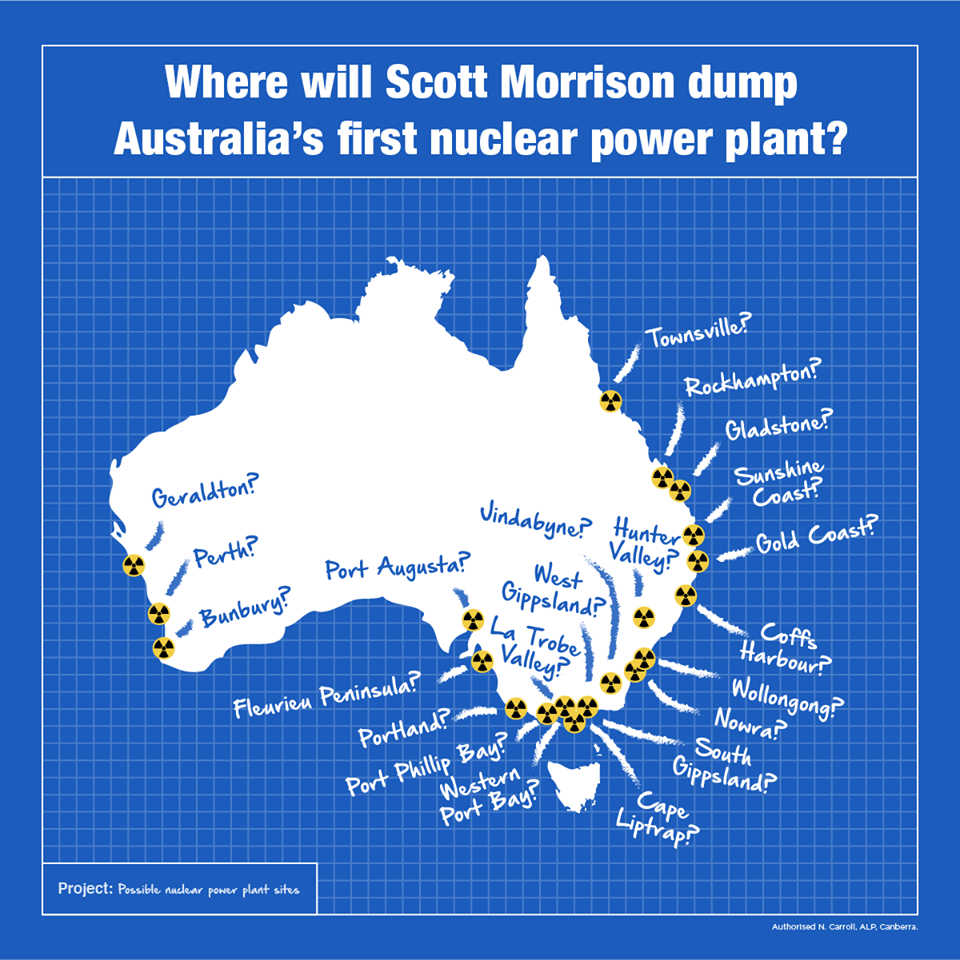
Labor pressures Coalition to rule out nuclear ‘fantasies’ or name sites for reactors Mark Butler says almost all proposed reactor sites since 1968 were near residential communities, Guardian, Sarah Martin and Amy Remeikis, 5 Sep 2019 Labor will pressure the government over its “flirtation” with nuclear energy by releasing parliamentary library research that shows almost 150 sites across the country have been proposed for reactors or dumps in the past 50 years.Calling on the prime minister, Scott Morrison, to either rule out nuclear or reveal where reactors would be located, Labor’s shadow energy minister, Mark Butler, said the government should instead direct its efforts to developing a “coherent energy policy”.
“Instead of indulging the policy fantasies of his restive backbench, Mr Morrison should reject the nuclear option or be upfront with Australians about exactly where he wants to build nuclear reactors,” Butler said. “Mr Morrison should forget nuclear energy and focus instead on practical ways of dealing with his government’s energy crisis.”
The list of locations that have been considered for nuclear activities includes about 40 locations for possible nuclear dump sites and almost 100 that have been examined as possible sites for nuclear reactors.
Labor MPs are expected to follow up the release of the information with localised campaigns highlighting the potential threat of nuclear facilities in the listed locations.
The parliamentary library research notes that some of the sites are highly speculative and have never been subject to a formal proposal, while others have been withdrawn or formally excluded as potential locations.
But Butler said that almost all of the proposed reactor sites since 1968 were near residential communities, noting that some locations – such as Townsville – had been proposed twice.
A study by the progressive thinktank Australia Institute in 2007 identified Townsville as one of 17 suitable sites for nuclear power plants across the country, based on key criteria such as electricity infrastructure, demand, transport, and water access.
Labor’s anti-nuclear push comes as parliament’s standing committee on environment and energy prepares to conduct an inquiry into the “prerequisites for nuclear energy in Australia” with a report due later this year.
The committee was set up by the energy minister, Angus Taylor, after several conservative MPs publicly agitated for the inquiry.
The chair of the committee, Liberal MP Ted O’Brien, said the inquiry would determine if nuclear energy was “feasible, suitable and palatable”…….https://www.theguardian.com/australia-news/2019/sep/05/labor-pressures-coalition-to-rule-out-nuclear-fantasies-or-name-sites-for-reactors
September 5, 2019
Posted by Christina Macpherson |
AUSTRALIA - NATIONAL, politics |
Leave a comment

New nuclear arms race brings higher risk of global catastrophe, The New Daily, Quentin Dempster@QuentinDempster 2 Sept 19The world is at its highest risk of a global catastrophe in decades, thanks to an unpredictable resumption in the nuclear arms race.
Veteran defence and security analyst Brian Toohey has warned that talk of war between the West, and China and Russia, along with brinkmanship with North Korea and Iran, has escalated the conditions that can lead to catastrophic accidents and mistakes.
Adding to the potential for disastrous nuclear consequences, Mr Toohey’s latest book – to be published this week – reveals that “many missile control systems can now be hit by a wide range of previously unknown cyber-warfare tools available to terrorists, hoaxers and governments”.
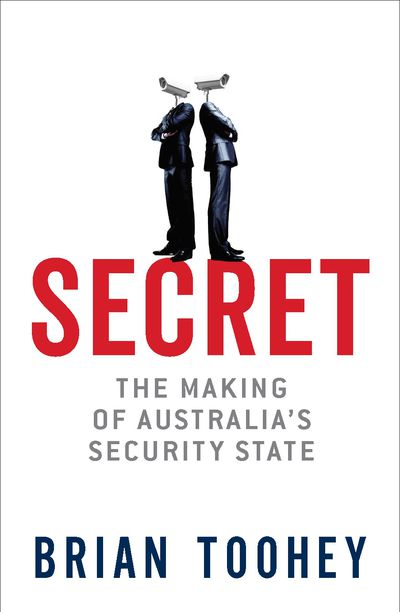
Mr Toohey’s book, Secret – The Making of Australia’s Security State, outlines a terrifying situation where nuclear weapons continue to exist in massive numbers………
Australia is complicit
Mr Toohey said Australia continued to rely on the US “nuclear umbrella” and was directly complicit in the US nuclear program through the Pine Gap and North West Cape intelligence and communications bases linked to US submarines tasked to detect and destroy Russian and Chinese nuclear-armed submarines.
Coalition governments in Australia had declined to push for nuclear disarmament, with former prime minister Malcolm Turnbull refusing to support a 2017 United Nations resolution to establish a legally binding treaty prohibiting the development or possession of nuclear weapons.
The Turnbull government refused to congratulate ICAN after it was awarded the Nobel Peace Prize in December 2017.
Mr Turnbull later declared that Australia and the US were “joined at the hip”.
The Canberra Commission on the Elimination of Nuclear Weapons concluded in 1996 that “the proposition that nuclear weapons can be retained in perpetuity and never used – accidentally or by decision – defies credibility”.
The only complete defence was the elimination of nuclear weapons with a strong international verification regime to convince the existing nuclear powers to disarm.
Calls for Australia to join the race
Current calls for Australia to consider a nuclear arms capability for its submarines to deter an invasion from China re-emerged from strategic think tanks and academics.
“It is doubtful if China’s relatively small nuclear forces could survive a US attack. The US has a total of 6550 warheads –1350 deployed on long-range missiles and bombers – compared to China’s total of 280,” Mr Toohey writes.
“Ever since George W Bush unilaterally abandoned the Anti-Ballistic Missile Treaty, the US has deployed conventional missiles on ships and land that can destroy nuclear-armed ballistic missiles.”
“Its attack submarines can track and sink China’s four ballistic-missile submarines. This means China must expand its nuclear forces to ensure that enough retaliatory missiles would survive to deter a first strike”.
Quentin Dempster is a Walkley Award-winning journalist, author and broadcaster. He is a veteran of the ABC newsroom. He was awarded an Order of Australia in 1992 for services to journalism nuclear-arms-race/
September 3, 2019
Posted by Christina Macpherson |
AUSTRALIA - NATIONAL, politics, weapons and war |
Leave a comment
 The Coalition is now taking yet another slice of that pudding. Unlike New Zealand, Germany, France, the UK and others, it will continue to draw on unused emission “credits” from the Kyoto era, which expires next year, to meet the modest 2030 target it set for itself in Paris four years ago.
With the exception of two brief years when a carbon price was in operation, emissions have continued to rise. So the Morrison government, like its predecessors, doesn’t mention them. Instead it refers repeatedly to “our target”, which we are meeting “in a canter”.
Australia has now been playing its Kyoto card for over 20 years, and shows no sign of ending the deception.
Kyoto is a magic pudding that keeps on giving.
Is mindless planet-trashing the way to go? http://southwind.com.au/2019/09/03/is-mindless-planet-trashing-the-way-to-go/ 3 September 2019 by Peter Boyer
The Morrison government is engaging in the kind of international chicanery we used to associate with tinpot dictatorships. When the United Nations emerged out of World War II, Australia was widely recognised as a model international citizen, a light helping to guide the world in a new age of diplomacy.
Civilisation’s answer to the wreckage left by nationalism was the UN’s multilateral world order. Both Coalition and Labor leaders knew that it gave a leg up to a middle-sized power like Australia, and worked hard to build our country’s reputation as a good global citizen.
Many older northern nations struggled with the new order, but Australia punched above its weight, notably in environmental advocacy. We led the world in pressing for UN measures to protect natural values in our part of the world, including the Southern Ocean and Antarctica.
Our efforts were noticed. We secured the first UN presidency. UNESCO’s World Heritage committee held its first southern hemisphere meeting in Sydney, and the first Antarctic Treaty meeting was held in Canberra. We hosted the headquarters, in Hobart, of the Commission for the Conservation of Antarctic Marine Living Resources (CCAMLR).
At the UN’s Earth Summit in 1992 Australia lobbied hard for the proposed framework convention on climate change and quickly ratified its agreement. Everyone expected as much. We had the reputation of taking a holistic view, supporting best collective outcomes.
But then something changed. Australia demanded special treatment at the 1997 Kyoto climate conference. Most developed countries agreed to lower their carbon emissions, but Australia was allowed a significant increase over 1990 levels.
That wasn’t all. Continue reading →
September 3, 2019
Posted by Christina Macpherson |
AUSTRALIA - NATIONAL, climate change - global warming, politics |
Leave a comment
How many know that, on behalf of us all, ANSTO is already preparing the groundwork for the deployment of Gen VI reactors in the 2030s?
ANSTO stooge Prof Edwards speaking to the Prerequisites Standing Committee “…….. Australia …. has chosen, ….. supporting two reactors: the very high temperature reactor and the molten salt reactor.”
in terms of the reactors Australia has chosen, we’re supporting two reactors: the very high temperature reactor and the molten salt reactor. The very high temperature reactor is probably the highest technology readiness level, or TRL, in that there are a couple being constructed in China at the moment. As part of the generation forum, I will be visiting those in October. They’ve actually started co-commissioning those plans. …. Those two reactors are particularly suitable for Australia
September 2, 2019
Posted by Christina Macpherson |
AUSTRALIA - NATIONAL, politics |
Leave a comment



 Antinuclear