Scott Morrison’s devious and incorrect claim about emissions and bushfires
 Scott Morrison contradicted on link between emissions and bushfires, https://www.brisbanetimes.com.au/politics/federal/scott-morrison-incorrect-on-link-between-emissions-and-bushfires-20191121-p53crh.html, By Mike Foley Scott Morrison contradicted on link between emissions and bushfires, https://www.brisbanetimes.com.au/politics/federal/scott-morrison-incorrect-on-link-between-emissions-and-bushfires-20191121-p53crh.html, By Mike Foley
November 21, 2019 Experts have contradicted Scott Morrison’s claim that Australia’s level of greenhouse gas emissions could not have increased the current level of risk from bushfires.
The Prime Minister said on Thursday climate change is a “global phenomenon” and Australia is doing its bit to reduce emissions. He has acknowledged that climate change increases bushfire risk, but said there could be no link drawn between our emissions and any current bushfires. “To suggest that with just 1.3 per cent of global emissions that Australia doing something differently, more or less, would have changed the fire outcome this season, I don’t think that stands up to any credible scientific evidence at all,” Mr Morrison said. “If anything Australia is an over-achiever on global commitments.” Mr Morrison made the comments on a day when several homes were lost to fires in South Australia while Melbourne recorded its hottest November day since 1894 when the mercury hit 40.9 degrees at Olympic Park in the mid-afternoon. Climate Council head of research Dr Martin Rice said there was a direct link between climate change and heightened bushfire risk. Global carbon project executive director and CSIRO research scientist Pep Canadell said Mr Morrison was “incorrect” to argue there was no link between Australia’s emissions and climate change. “It’s the tragedy of the commons. Below the biggest emitters in China and the US you have dozens and dozens of countries contributing between 1.5 and 0.8 million tonnes, which adds up to the climate problem,” Dr Canadell said. Because all the individual contributions are small no one feels responsible. “Another way to put it is on my next tax bill, because my contribution to the country’s revenue is so small, that it doesn’t matter if I don’t pay.” A recent analysis by RMIT ABC Fact Check estimated Australia’s domestic emissions of about 1.3 million tonnes, coupled with the emissions embedded in its exports, represented about 3.6 per cent of global emissions in 2016. CSIRO’s most recent State of the Climate report found “there has been a long-term increase in extreme fire weather and in the length of the fire season across large parts of Australia since the 1950s”. Eight of Australia’s 10 warmest years on record have occurred since 2005 and since the late 1990s there has been about an 11 per cent decline in cool-season rainfall between April and October in the south-east of the country. |
|
Australia as the salvation of the nuclear industry?
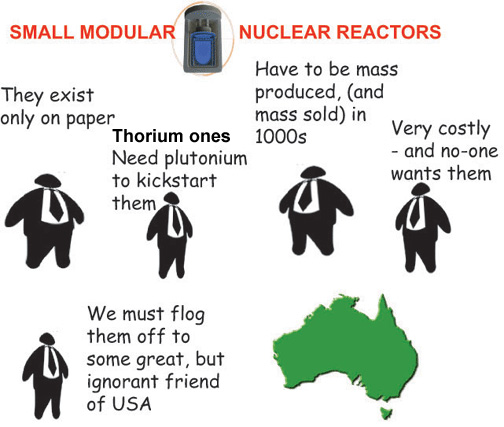
Australia is the great ‘white’ hope for the global nuclear industry, Independent Australia, By Noel Wauchope | 19 November 2019, The global nuclear industry is in crisis but that doesn’t stop the pro-nuclear lobby from peddling exorbitantly expensive nuclear as a “green alternative”. Noel Wauchope reports.
The global nuclear industry is in crisis. Well, in the Western world, anyway. It is hard to get a clear picture of Russia and China, who appear to be happy putting developing nations into debt, as they market their nuclear reactors overseas with very generous loans — it helps to have stte-owned companies funding this effort.
But when it comes to Western democracies, where the industry is supposed to be commercially viable, there’s trouble. The latest news from S&P Global Ratings has made it plain: nuclear power can survive only with massive tax-payer support. Existing large nuclear reactors need subsidies to continue, while the expense of building new ones has scared off investors.
So, for the nuclear lobby, ultimate survival seems to depend on developing and mass marketing “Generation IV” small and medium reactors (SMRs). …..
for the U.S. marketers, Australia, as a politically stable English-speaking ally, is a particularly desirable target. Australia’s geographic situation has advantages. One is the possibility of making Australia a hub for taking in radioactive wastes from South-East Asian countries. That’s a long-term goal of the global nuclear lobby. …..
In particular, small nuclear reactors are marketed for submarines. That’s especially important now, as a new type of non-nuclear submarine – the Air Independent Propulsion (AIP) submarine, faster and much cheaper – could be making nuclear submarines obsolete. The Australian nuclear lobby is very keen on nuclear submarines: they are now promoting SMRs with propagandists such as Heiko Timmers, from Australian National University. This is an additional reason why Australia is the great white hope.
I use the word “white” advisedly here because Australia has a remarkable history of distrust and opposition to this industry form Indigenous Australians…..
The hunt for a national waste dump site is one problematic side of the nuclear lobby’s push for Australia. While accepted international policy on nuclear waste storage is that the site should be as near as possible to the point of production, the Australian Government’s plan is to set up a temporary site for nuclear waste, some 1700 km from its production at Lucas Heights. The other equally problematic issue is how to gain political and public support for the industry, which is currently banned by both Federal and state laws. SMR companies like NuScale are loath to spend money on winning hearts and minds in Australia while nuclear prohibition laws remain.
 Ziggy Switkowski, a long-time promoter of the nuclear industry, has now renewed this campaign — although he covers himself well, in case it all goes bad, noting that nuclear energy for Australia could be a “catastrophic failure“. ……
his submission (No. 41) to the current Federal Inquiry into nuclear power sets out only one aim, that
‘… all obstacles … be removed to the consideration of nuclear power as part of the national energy strategy debate.’
So the Environmental Protection and Biodiversity Conservation Act (EPBC Act) should be changed, according to Switkowski. In an article in The Australian, NSW State Liberal MP Taylor Martin suggested that the Federal and state laws be changed to prohibit existing forms of nuclear power technology but to allow small modular reactors.
Switkowski makes it clear that the number one goal of the nuclear lobby is to remove Australia’s national and state laws that prohibit the nuclear industry. And, from reading many pro-nuclear submissions to the Federal Inquiry, this emerges as their most significant aim.
It does not appear that the Australian public is currently all agog about nuclear power. So, it does seem a great coincidence that so many of their representatives in parliaments – Federal, Victorian, New South Wales, South Australia and members of a new party in Western Australia – are now advocating nuclear inquiries, leading to the repeal of nuclear prohibition laws.
We can only conclude that this new, seemingly coincidental push to overturn Australia’s nuclear prohibition laws, is in concert with the push for a national nuclear waste dump in rural South Australia — part of the campaign by the global nuclear industry, particularly the American industry, to kickstart another “nuclear renaissance”, before it’s too late.
Despite its relatively small population, Australia does “punch above its weight” in terms of its international reputation and as a commercial market. The repeal of Australia’s laws banning the nuclear industry would be a very significant symbol for much-needed new credibility for the pro-nuclear lobby. It would open the door for a clever publicity drive, no doubt using “action on climate change” as the rationale for developing nuclear power.
In the meantime, Australia has abundant natural resources for sun, wind and wave energy, and could become a leader in the South-East Asian region for developing and exporting renewable energy — a much quicker and more credible way to combat global warming. https://independentaustralia.net/politics/politics-display/australia-is-the-great-white-hope-for-the-global-nuclear-industry,13326
How does the climate denialist Institute of Public Affairs (IPA) get away with being a “charity”?
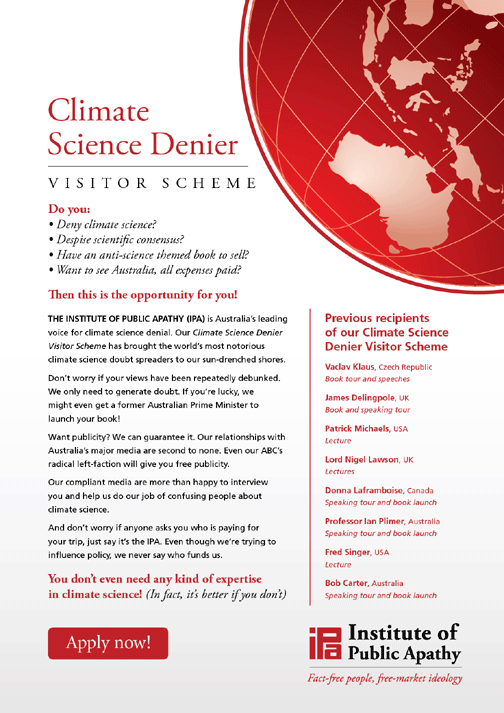
The climate denialist IPA and its ‘public interest’ charity status, Independent Australia, By David Paull | 19 November 2019, Since the IPA and CIS organisations argue against the scientific consensus on the climate change emergency isn’t that against the public interest? Why, then, are they classified as ‘charities’? David Paull reports.
The Prime Minister’s recent comments on the rights of individuals to undertake actions, such as boycotts, that may adversely affect “secondary” company interests raises questions of free speech and public interest.
But the increasingly shrill advocacy for climate denial in the public sphere in this country has reached a stage where it seems that substantive scientific arguments regarding future Earth scenarios are being drowned out.
The debate has descended – thanks in no small part to Murdoch media and political pundits – so that now it’s a “conspiracy” by the Bureau of Meteorology and NASA, or it’s “sun-spots”, which will initiate a new “ice-age”. Even the line, “We must take a balanced view” provides anti-science advocates with a platform.
Which raises the clear question: Is climate change denial of benefit to our community? Or, to put it another way, if some are still arguing against the scientific consensus on the climate change emergency we are confronting, isn’t that against the public interest?
What does it take to be a charity?
As it turns out, not if you are a “charity” registered with the Australian Charities and Not-for-profit Commission (ACNC). When talking about climate denialist organisations, key among those in Australia is the Institute of Public Affairs (IPA) and the Centre for Independent Studies (CIS). Both have generated substantial public communication, which is “climate sceptical” in nature and at deviance from the consensus scientific view. Yet both organisations – particularly the IPA – and through their front groups such as the Australian Environment Foundation, have been at the forefront of promoting the idea that global warming is a conspiracy. Examples are the recent book published by the IPA and edited by Dr Jennifer Marohasy who is working on releasing a new edition next year.
The CIS, while not being a loud advocate of climate scepticism, has certainly hosted talkfests which have articulated these views. Both organisations are also within the international Atlas Network, which channels money into groups around the world that seek to further the climate denialist and libertarian agendas. And both have registered charities with the Australian Charities and Not-For-Profits Commission (ACNC).
The IPA’s registered charity is called Trustee For Institute Of Public Affairs Research Trust, while the CIS has registered a charity under the name of, The Centre For Independent Studies Ltd……
Follow the money
The IPA receives only about ten to 20 per cent of its annual income through its charity, most of which is spent each year, amounting to some $800,000 in 2017-18. These are nearly all classed as “donations” under the ACNC disclosure requirements — though of course “donors” are not required to be identified…….
Both charities claim they are benefiting the “general community of Australia”. However, given the difficulty in matching a climate denialist agenda with a supposed community benefit, this simply does not stack up anymore.
The reviews by the ACNC in January 2014 of the charitable status of these two registered charities, in this light, needs to be reviewed again. This is particularly so of the IPA with its increasing focus on spreading misinformation (none of which stands up to proper scientific scrutiny) since 2014.
But there are also other issues which need clarification in order that better transparency occurs, such as better definitions of income and expenditure, the question of influence by foreign entities and perhaps what is key: whether charity funds being used by these organisations is for a purpose that may be deemed as being of detriment to the community. Charitable status should be relinquished under these circumstances.
I have written to the Australian Charities and Not-for-profit Commission (ACNC) to undertake a fresh review of these charities and await a response in anticipation. You can make a complaint to the ACNC HERE. David Paull is an Australian ecologist . You can follow David on Twitter @davesgas. https://independentaustralia.net/politics/politics-display/the-climate-denialist-ipa-and-its-public-interest-charity-status,13325
Coal lobby wields power over Australian govt, like the National Rifle Association does in USA
While Australia burns, the world watches our credibility go up in smoke, The New Daily, Damien Cave 14 Nov 19, When a mass shooting shattered Australia in 1996, the country banned automatic weapons.In its first years of independence, it enacted a living-wage law.
Stable retirement savings, national health care, affordable university education – Australia solved all these issues decades ago.
But climate change is Australia’s labyrinth without an exit, where its pragmatism disappears. The bushfires that continued raging on Wednesday along the country’s eastern coast have revealed that the politics of climate in Australia resist even the severe pressure that comes from natural disaster.
Instead of common-sense debate, there are culture war insults.
The deputy prime minister calls people who care about climate change “raving inner-city lunatics”. Another top official suggests that supporting the Greens party can be fatal.
And while the government is working to meet the immediate need – fighting fires, delivering assistance – citizens are left asking why more wasn’t done earlier as they demand solutions.
“We still don’t have an energy policy, we don’t have effective climate policy – it’s really very depressing,” said Susan Harris Rimmer, an associate professor at Griffith Law School. ……
in Australia, where coal is king and water is scarce, the country’s citizens have spent the week simmering with fear, shame and alarm……..
Even as the country’s emissions continue to soar, it’s been hard to reach a political consensus on energy and climate change policy because of Australia’s mining history and a powerful lobby for one product: Coal.
“Coal is our NRA,” said Dr Harris Rimmer, referring to the National Rifle Association, which has stymied changes to gun laws in the US even as mass shootings have become shockingly common.
“They have total control over Parliament.”……
For conservatives in particular, extraction of natural resources in rural areas is a stand-in for values worth fighting for against condescending urban elites.
Just a few days before the fires, for example, Prime Minister Scott Morrison told a mining group that new laws were needed to crack down on climate activists and progressives who “want to tell you where to live, what job you can have, what you can say and what you can think”.
“Climate change has become a proxy for something else,” said Robyn Eckersley, a climate politics expert at the University of Melbourne…….
Mr Morrison, who in the past has made it clear that Australia’s economic prosperity comes first, has repeatedly argued in recent days that now is not the time to discuss climate policy or politics.
Photographed hugging fire victims, he has sought to focus on emotional and financial support.
Joëlle Gergis, a climate scientist and author, said that “it wastes the opportunity to explain to the Australian public what we’re seeing in climate extremes”……. https://thenewdaily.com.au/news/2019/11/14/while-australia-burns-the-world-watches-our-credibility-go-up-in-smoke/
Scientists refute Barnaby Joyce’s claim that sun’s magnetic fields cause bushfires
The former deputy prime minister told Sky News he accepted that the climate crisis was making Australia hotter and drier.
Barnaby Joyce’s claim that changes to the sun’s magnetic fields were linked to the bushfires burning out of control across NSW have been rubbished by climate scientists.
The former deputy prime minister told Sky News he accepted that the climate crisis was making Australia hotter and drier….. “There’s just the the oscillation of the seasons. There’s a change in the magnetic field of the sun.”
Associate Professor Nerilie Abram, a climate researcher at the ARC Centre of Excellence for Climate Extremes, called his comments “ludicrous and grossly ill-informed”.
Dr Abram said she was unaware of any study suggesting changes to the sun’s magnetic field could increase Australia’s bushfire risk.
“I don’t know of any scientific study that says that,” she said.
Dr Abram said changes to the sun’s magnetic fields had a tiny effect on the Earth’s climate.
“They are not causing climate change……
Associate Professor Pete Strutton, from the Institute for Marine and Antarctic Studies at the University of Tasmania, said it was difficult to analyse Mr Joyce’s claim because it was so bizarre.
“I don’t even know what he means. We know what causes climate change,” he said. “What exactly would the magnetic fields influence? I can’t even … Are they influencing the amount of solar radiation reaching the Earth? It is hard to respond to because it is so wacky.” https://www.brisbanetimes.com.au/national/barnaby-joyce-says-sun-s-magnetic-fields-cause-bushfires-science-says-20191112-p539xb.html
Australian Greens criticise Morrison government on bushfires and climate change
 Greens ramp up climate war as fires burn, Herald Sun, Colin Brinsden, Australian Associated Press, November 10, 2019 Greens Leader Richard Di Natale says while he is saddened by the loss of life from bushfires in NSW and Queensland, “thoughts and sympathies are not enough”. Greens ramp up climate war as fires burn, Herald Sun, Colin Brinsden, Australian Associated Press, November 10, 2019 Greens Leader Richard Di Natale says while he is saddened by the loss of life from bushfires in NSW and Queensland, “thoughts and sympathies are not enough”.
Dr Di Natale said for decades it has been known that burning climate changing fossil fuels would lead to more frequent and intense bushfires. “Yet with Queensland and New South Wales burning, the Coalition government refuses to acknowledge this scientific reality and instead wants to use taxpayer dollars to fund new coal-fired power stations.” he said in a statement on Sunday. “Every politician, lobbyist, pundit and journalist who has fought to block serious action on climate change bears responsibility for the increasing risk from a heating planet that is producing these deadly bushfires.” His climate change spokesman Adam Bandt made similar comments on Saturday, drawing a scathing attack from Deputy Prime Minister and Nationals Leader Michael McCormack, saying it was “despicable”…..https://www.heraldsun.com.au/news/breaking-news/greens-ramp-up-climate-war-as-fires-burn/news-story/42fad0f6e7a70492e1fa259514deba10 |
|
|
Climate reality needs more than thoughts and prayers
|
It has an eerily similar ring to it: “Thoughts and prayers”. Australians rightly mock this platitude when it’s rolled out by politicians after a mass shooting in the US, but now our own Prime Minister saw fit to present this meaningless line for victims of the bushfires on the mainland. Like how the US does nothing to end their deadly problem, our government also appears determined to cover its ears to the stark reality now facing us: Australia is drier than ever, hotter than ever, and less prepared than ever. This is no fault of our fire services. In fact, it appears to be in spite of our fire services. Former NSW fires chief Greg Mullins and 22 other former emergency chiefs were refused an urgent meeting with the PM multiple times this year, and NSW frontline firefighting has been slashed in the eternal quest for a surplus. In Tasmania, the TFS is well aware of the risks. In Launceston this year, their State Conference was titled “Not the Norm”: because the changing climate is putting humanity in a completely unpredictable position where every year is worse than the last. There is no “norm” anymore – as evidenced by the last fire season. Did we learn anything from that fire season? It waits to be seen, but a failure to enact all recommendations from a review into those fires would be reckless. Yet while Australia faces unprecedented fires (and this is not the only “unprecedented” weather event of recent times, with floods, drought and ocean heatwaves increasing in severity year on year), politicians continue to mislead on carbon emissions, or use rubbery accounting tricks to meet our emissions targets. Yet while Australia faces unprecedented fires (and this is not the only “unprecedented” weather event of recent times, with floods, drought and ocean heatwaves increasing in severity year on year), politicians continue to mislead on carbon emissions, or use rubbery accounting tricks to meet our emissions targets. And the similarities don’t end there.
|
|

Climate dispute between Scott Morrison and the Greens
Climate dispute breaks out as Scott Morrison visits bushfire-hit areas, SBS 11 Nov , “……war of words has broken out about the link between climate change and the unprecedented bushfire emergency that has hit NSW and Queensland.BY CLAUDIA FARHART Deputy Prime Minister Michael McCormack has lashed out at Greens MP Adam Bandt over “stupid and callous” comments linking the government’s inaction on climate change and bushfires that have claimed three lives in New South Wales.
On Saturday, Mr Bandt tweeted that “words and concern are not enough … the Prime Minister does not have the climate emergency under control”.
Bandt tweeted: I’m deeply saddened by the loss of life. Hearts go out to all affected & to brave firefighters. But words & concern are not enough. The PM does not have the climate emergency under control. Unless we lead a global effort to quit coal & cut pollution, more lives will be lost……
Prime Minister Scott Morrison and NSW Premier Gladys Berijiklian dodged more questions about climate change as they visited fire-hit areas in northern NSW on Sunday.
Mr Morrison was heckled by a climate change protester during a briefing from firefighters.
“Climate change is real, can’t you see,” the protester yelled, before being escorted out of the building. HTTPS://WWW.SBS.COM.AU/NEWS/CLIMATE-DISPUTE-BREAKS-OUT-AS-SCOTT-MORRISON-VISITS-BUSHFIRE-HIT-AREAS
Scott Morrison wants to shut down moderate climate action group, Market Forces, BECAUSE IT’s TOO EFFECTIVE
 Inside Market Forces, the small climate group Scott Morrison wants to put out of business, From humble beginnings, Market Forces is now in the crosshairs of the Coalition’s war on environmental boycotts, Guardian, Adam Morton Environment editor @adamlmortonMon 11 Nov 2019 When Market Forces, a small climate activist group, was singled out as the target of the government’s push to stop environmental campaigns that advocate boycotts of fossil-fuel companies, its leader was briefly taken aback but not disappointed.
“You know you’re doing something right when the Morrison government tries to bring you down,” Julien Vincent, the group’s executive director and founder, says from its base in Melbourne. “It’s unpleasant, but it’s only happening because we are getting results.”
From Vincent’s perspective, those results include the Commonwealth Bank and insurers QBE, Suncorp and IAG pledging they would soon no longer work with or underwrite developments that use thermal coal, and the group’s part in the campaign that frustrated attempts by Indian company Adani to find investors for its proposed Carmichael coalmine.
In terms of winning the government’s attention, it is likely the results also included a recent profile in the Australian Financial Review, the newspaper of the business community. Under the headline “How activists pushed CBA out of coal in five years”, it talked up Market Forces’s successes and methods, including a deal-making meeting with the bank’s chairwoman, Catherine Livingstone.
Coincidentally or not, the attorney general, Christian Porter, last week nominated Market Forces as a poster child “radical activist group” trying to impose its will on companies through coordinated harassment and threats of boycotts. Porter said it was “simply not OK” that mining and resources businesses were being targeted on ideological grounds by activists that wished them financial harm.
It followed Scott Morrison telling the Queensland Resources Council that activists who campaigned for secondary boycotts against miners and small businesses that work with resources companies potentially posed a “more insidious threat” to jobs and the economy than street protests……
With the details in the wind, Morrison’s push has led to some confusion among Coalition MPs about what is proposed and how it will avoid impinging on freedom of expression, though none spoke publicly. The Business Council of Australia has backed the prime minister; legal academics have warned changes to reduce the influence of environmental campaigns could breach the constitution.
Environmental and civil liberty groups noted the apparent hypocrisy in the government floating a secondary boycott ban given Canavan had urged his constituents to stop doing business with Westpac after it ruled out financing the Adani mine …… https://www.theguardian.com/environment/2019/nov/11/inside-market-forces-the-small-climate-group-scott-morrison-wants-to-put-out-of-business
In Kimba 62% of locals vote in favour of nuclear waste dump
 Kimba locals back nuclear waste dump. The Advertiser, 7 Nov 19, Kimba residents have backed a proposal to build a radioactive storage site near the Eyre Peninsula town.
The Australian Electoral Commission conducted a five-week ballot on the issue, on behalf of Kimba Council, with votes being finalised today.
The ballot found 62 per cent of voters backed the proposal.
Resources Minister Matt Canavan said the results showed “significant” community support for the project, which involves building a storage site for low and intermediate level medical waste.
The Government is considering building the storage site at either “Napandee” or “Lyndhurst” near Kimba, or “Wallerberdina”, near Hawker in the Flinders Ranges.
Mr Canavan said he would consider the results alongside other feedback and technical information relating to the project, once a separate ballot in the Flinders Ranges was complete.
Kimba Mayor Dean Johnson said a nuclear waste site would provide much needed jobs and economic stimulus for the region.
If approved in the area, 45 people would work at the waste site once it was built, and the community would receive a $31 million package from the Federal Government including some money already earmarked for local projects in the lead up to the vote.
“In times of drought, you just get reminded again how reliant we are on agriculture,” Mr Johnson said.
“An alternative industry would be good for the town. Whether this is the right one or not, we’ll find out shortly.”
Mr Johnson said he was “incredibly proud” of his community following four years of consultation.
“To have a 90 per cent participation rate shows how strongly engaged our community has been,” he said.
Kimba farmer Peter Woolford, who has been campaigning against the waste dump plan, said the result showed there was still a lot of opposition to the project.
“The Eyre Peninsula is such an amazing place,” said Mr Woolford, chair of the lobby group No Radioactive Waste on Agricultural Land in Kimba or SA.
“Why would you expose your export industry here to any risk at all?”
Mr Woolford said there had been little increase in public support for the project over the past four years, despite the community receiving $4 million in Federal funding for projects as part of the campaign to find a site.
Hawker’s voting period begins on Monday, after the council voted to delay its ballot until a risk assessment was completed.
Mayor Peter Slattery said the council was keen to gauge the public’s views after months of uncertainty on the project’s future.
“If we find they’re opposed to this, we know it’s game over and we can all quietly relax,” Mr Slattery said.
“And if the community are supportive of this that gives us the direction to move forward. “Given how difficult and divisive it’s been, we’re really looking forward to having some direction and resolution.”
The votes had been delayed since last year, when two Aboriginal associations said they would take legal action to stop the ballots, because traditional land owners who did not live in the districts were excluded.”
https://www.adelaidenow.com.au/…/6a04b1b53b6fc5f00b69031be1…
Bangarla Aboriginal people conducted their OWN ballot on nuclear waste dump plan for Kimba, South Australia
Kazzi Jai shared a link. Fight To Stop Nuclear Waste In The Flinders Ranges, 6 Nov 19 On ABC 639 news this morning…..The Barngala People have conducted their OWN ballot through the AEC (the Kimba ballot is being done by the AEC as well) and will forward the results to Canavan once tallied.
News segment 02:32:14 to 02:33:00
Podcast will only stay up for 6 days.
https://www.abc.net.au/radio/northandwest/programs/breakfast/breakfast/11661112
Victorian Government INQUIRY INTO NUCLEAR PROHIBITION
The Standing Committee on Environment and Planning invites written submissions from individuals and organisations addressing
one or more of the issues identified in the terms of reference.
The submission closing date is Friday 28 February 2020.
Terms of reference
https://www.parliament.vic.gov.au/epc-lc/article/4347
That this House requires the Environment and Planning Committee to inquire into, consider and report, within 12 months, on potential benefits to Victoria in removing prohibitions enacted by the Nuclear Activities (Prohibitions) Act 1983, and in particular, the Committee should —
(1) investigate the potential for Victoria to contribute to global low carbon dioxide energy production through enabling exploration and production of uranium and thorium;
(2) identify economic, environmental and social benefits for Victoria, including those related to medicine, scientific research, exploration and mining;
(3) identify opportunities for Victoria to participate in the nuclear fuel cycle; and
(4) identify any barriers to participation, including limitations caused by federal or local laws and regulations.
- Email to nuclearprohibition@parliament.vic.gov.au
- Using the eSubmissions form
- Hardcopy; send to:
Standing Committee on Environment and Planning
Parliament House, Spring Street
EAST MELBOURNE VIC 3002
- Your full name
- Contact details (either a postal address or phone number)
- The text of your submission or an attachment containing your submission
- A clear indication if you are seeking confidentiality
Strong public demand for climate action, but Australian government determined to punish climate protesters,
An increasingly outraged public is demanding action in a nation intimately linked to coal mining. The government has responded by threatening a new law to punish protesters. NYT, By Damien Cave and Livia Albeck-Ripka, Nov. 6, 2019 SYDNEY, Australia — One climate activist halted train service by chaining himself to the tracks. Others have glued themselves to busy roads, causing gridlock. And just last week, protesters locked arms to stop people from entering a mining conference before being forcibly dispersed by police officers with pepper spray.
A surge of climate activism is flooding Australia as the country falls behind on its promise to reduce emissions — effectively ignoring the Paris Agreement the Trump administration just abandoned. Prime Minister Scott Morrison has responded with a threat that’s alarmed scientists and free speech advocates, arguing that the government should outlaw “indulgent and selfish” efforts by environmental groups to rattle businesses with rallies and boycotts. “The right to protest does not mean there is an unlimited license to disrupt people’s lives,” Mr. Morrison said, adding, “I am very concerned about this new form of progressivism.”
Australia’s “climate wars,” once confined to election campaigns, are now spilling into the streets with some of the biggest protests the country has ever seen. An increasingly outraged public is demanding action while the conservative national government refuses to budge, relying on the police to squelch dissent……..
Coal-loving politicians
Two years ago, when Mr. Morrison was Australia’s treasurer, he stood up in the House of Representatives with a hunk of black coal in his hand.
“Don’t be afraid. Don’t be scared,” he said. “It won’t hurt you.”
His shiny prop had been shellacked to keep his hands clean, but the point he made then is one he and his governing coalition stand by: Coal is good……Now, Australia is the world’s largest coal exporter. It is also a major exporter of natural gas, making for a resource-driven country that is
“rich, dumb and getting dumber,” according to one recent headline summarizing the findings of a Harvard study that ranked Australia’s economy 93rd in complexity, behind Kazakhstan, Uganda and Senegal. The mingling of mining interests with national interests is perpetuated through a revolving door: lawmakers frequently work for the coal industry after leaving office. And for some, defending coal has come to be equated with defending the country.Even the opposition center-left Labor Party is hooked, pushing for emissions cuts while continuing to support more coal mining……
An increasingly angry public
Poll after poll shows growing concern about climate change among Australians of all ages and political persuasions.In September, a survey by the Australia Institute found that 81 percent of Australians believe climate change will result in more droughts and flooding (up from 78 percent in 2018). Two out of three Australians agreed that the government should plan for an orderly phaseout of coal, while 64 percent said Australia should aim for net-zero emissions by 2050.
And researchers continue to sound the alarm. A paper co-written by an Australian scientist and signed by 11,000 other experts warned on Wednesday of a clear “climate emergency.”……
The so-called climate strike in September, part of a global effort led by children, was the largest mass demonstration in Australian history.
It was quickly followed last month by the Extinction Rebellion protests, and then came last week’s anti-mining protests in Melbourne….. Over 10 days of protests in London, the police arrested more than 1,700 Extinction Rebellion protesters.
Australia aims to go further. A law passed last year allows the military to break up protests. The Labor government in Queensland is fast-tracking a law to add new fines for protesters who use locking devices to prevent their removal……. Reduced coal mining would not hurt the economy as much as people think.
According to the Australia Institute poll from last month, Australians believe coal mining accounts for 12.5 percent of Australia’s economic output and employs 9.3 percent of its work force. “In reality,” the report says, “coal mining employs only 0.4 percent of workers in Australia and is 2.2 percent of Australia’s G.D.P.” Of the roughly 238,000 jobs that mining provides in Australia, only around 50,000 are tied to coal, according to government figures.
“The government relies on ignorance,” Professor Eckersley said. “It’s a very toxic politics.”
Portrayals of extreme activism are also exaggerated. The vast majority of protesters demanding climate action are not radical disrupters. They are more like Jemima Grimmer, 13, who asked adults to “respect our futures” at the Sydney climate strike in September, or Vivian Malo, an Aboriginal woman attending last week’s protest in Melbourne, where she said the experience of being pepper-sprayed felt like chemotherapy “on the outside.” Here in a country rapidly losing its laid-back image, the future of Australia’s climate battles could be seen in her bloodshot eyes as she stood near a line of stone-faced police officers, describing their use of force as “scary.”
“The insatiable drive for resource extraction,” she said. “It’s out of control.” https://www.nytimes.com/2019/11/06/world/australia/australia-climate-protests-coal.html
The Morrison governments hypocrisy: double standards on “unacceptable” protests
 Protesting and boycotting the Morrison Government way, Independent Australia, By Michelle Pini | 7 November 2019 Ahead of the Coalition’s signalled changes to protests, boycotts and freedom of speech, executive editor Michelle Pini decodes who may and may not protest and what they may protest about.
THE MINISTER FOR RESOURCES and Northern Australia – who, like his coal-loving PM, has openly spruiked coal and practically kissed the feet of his environment-pillaging hero, Gautam Adani – is on TV discussing climate protests and talking about “groups abusing the law”.
 Scarcely able to string two words together to form a coherent sentence, Matt Canavan is umming and ahhing on The Project, whining about protesters “stopping average Australians, particularly small businesses, going about their day.”
A few days prior, Scott Morrison labelled environmental protesters “anarchists” and flagged a crackdown on the right to protest, indicating his Government would seek to apply penalties to those boycotting businesses. Such “anarchists” seek to “deny the liberties of Australians”, according to the PM………
Canavan ends by summarising the Coalition’s latest position on democratic protests and public boycotts thus:
“What I wanna do, what I wanna do is support Australian jobs… I do think the problem’s gotten worse, though, since that review — protests holding up traffic, putting lives at risk, ah, ah, just with a few people.”
Thanks for clearing that up, Matt.
Let’s try and clear at least one thing up. This latest tirade from “free speech warriors” the Morrison Government, is about one thing and one thing only — only those who agree with this Government are permitted the right to protest, boycott, or spew forth with angry tirades against others. Once again, free speech, in the world according to the Coalition, is only a right for the Right.
THE RIGHT AND LEFT OF POLITICAL PROTEST
To assist in our understanding of the Right and proper application of our democratic rights, listed below are a few examples of who can and can’t, according to the Morrison Government’s free speech rules, protest, enact a boycott or, generally, speak out about perceived injustice:
1. Racing parade v animal activists…
2. Westpac v Canavan
Only two short years ago, Matt “Minister for Coal” Canavan encouraged everyone to boycott Westpac because the bank had decided to drop on-the-nose mining companies from its investment list.
Right Matty boycotting Westpac in this scenario is okay, because – pay attention here – it is about our democratic Right to protect the “small business” of coal mining and fossil fuels in general.
Wrong It would not be okay for anyone to protest against the democratic Right of the Minister for Coal to boycott any business that got in the way of coal. This would include outside any mining conferences, obviously.
3. Mining tax v climate change action
Gina Rinehart and Andrew “Twiggy” Forrest protested in the streets of Perth when the Labor Government instigated the so-called “mining tax.” Gina jangled her bangles standing atop a flat-topped truck, and led the chant alongside fellow protesters to demand Kevin Rudd “axe the tax”.
Fellow billionaire Forrest, whose “small business” Fortescue Metals had never paid tax, was Rightly aghast at the prospect of breaking that record and took it all the way to the High Court.
Right Once again, this is perfectly acceptable. Gina and Twiggy were simply exercising their democratic Right – aided by the mainstream media – to topple any government that stood in the way of their billions.
Wrong, It is not okay for anyone to protest against the Adani mine, however, or boycott any of the companies owned by the aforementioned billionaires. This would be “abusing the law” and would not be tolerated. It would likely also be “putting lives at risk”…… https://independentaustralia.net/politics/politics-display/protesting-and-boycotting-the-morrison-government-way,13287
Australia’s Environment Is The Enemy – Sussan Ley faithful to Scott Morrison’s priority
 Sussan Ley’s environmental law circus, Independent Australia By Sue Arnold | 5 November 2019 Vulnerable species like the koala – and the environment in general – are the losers, while developers reign supreme in Environment Minister Sussan Ley’s environmental law “review”. Sue Arnold reports.
In July, Sussan Ley sent out a statement indicating that as Minister for the Environment, she would
… commence a ten-year statutory review of the [Environment Protection and Conservation] Act by October this year. And it is the right time to have a conversation about the best ways we can ensure strong environmental and biodiversity protection measures that encourage people to work together in supporting the environment.
All Australians will have a chance to share their ideas as part of the next statutory review of the EPBC Act, due to commence by October 2019.
Exactly why Ley waited another three months before commencing the review is unclear. In a follow-up press release, she announced that former competition regulator Professor Graeme Samuel would head the year-long review, ‘to tackle green tape and deliver greater certainty to business, farmers and conservation groups‘.
Missing from Ley’s pronouncements are key issues relevant to one of the most critical problems — self-referral by developers. Under the current scenario, a developer whose project is likely to destroy or severely impact koala habitat makes the decision whether or not to “refer“ the development to the Federal government as a matter of national environmental significance (MNES), under the provisions of the EPBC Act 1999.
As the koala is listed as “vulnerable” under the EPBC, the referral should never have been reduced to the responsibility of a developer — referral to the Federal government should have been made a mandatory requirement.
A referral is designated as a “controlled action” if the result of a scorecard available from the Government’s ‘EPBC Act referral guidelines for the vulnerable koala’ reaches a certain level. Then the project is assessed by the Federal Department of the Environment and Energy and the minister makes the decision whether to approve the project. Documents relevant to the project are published on the EPBC referral list website and open to public comment — including environmental impact assessments paid for by the developer.
Once the project is approved, a “koala management plan” (KMP) must be provided by the developer before the project commences. However, this is where the proverbial hits the fan as there is no requirement for any public comment, nor any access to the plan.
One of the most important koala management plans has been on Sussan Ley’s desk since July. This is the Lendlease plan for southwest Sydney koalas at their Mt Gilead, now renamed “FigTree Hill” urban project for 1700 residences. This is a project mired in controversy and public outrage because of the risks to the largest expanding healthy koala colony in the Sydney Basin.
IA has been following up this issue with the only section of the Department of the Environment and Energy (DEE) that responds in a timely manner — the Communications and Engagement Branch Media (CEBM) team. ……….
The bottom line to this Monty Python circus is not only the Lendlease koala plan of management which is being withheld, but any developer who has self-referred has no requirement by the environment minister to publish the plan other than “on the developer’s website”.
Given that this would require a large staff to check the multiple developer projects impacting koala habitat throughout Queensland and New South Wales on a daily basis, a new definition of “mission impossible” arises.
Essentially, any koala management plan may be approved. There are no published standards or requirements — much less compliance or monitoring.
A review by some of Australia’s leading ecologists sums up the catastrophic situation facing koala survival.
Some 85 per cent of land-based threatened species experienced habitat loss. The iconic koala was among the worst affected. More than 90 per cent of habitat loss was not referred or submitted for assessment, despite a requirement to do so under Commonwealth environment laws.
Our research indicates the legislation has comprehensively failed to safeguard Australia’s globally significant natural values, and must urgently be reformed and enforced.
Sussan Ley’s priorities in a review of the EPBC Act reflect those of the Prime Minister: the environment is the enemy. https://independentaustralia.net/politics/politics-display/sussan-leys-environmental-law-circus,13279
1 This month
17 October, Free Public Talk on Nuclear Issues in South Australia
David Noonan will speak on public interest concerns over the new Roxby Downs Indenture Act 2026 on BHP copper-uranium mining and ore processing in SA, and on how AUKUS may face SA with a High-Level nuclear waste agenda.
Dr Jim Green will discuss international developments in the field of nuclear power including ‘small modular reactors’ and Generation 4 ‘advanced’ nuclear reactor concepts.


Help Aunty Sue Protect Her Land and Sacred Sites From Destructive Rocket Testing.
.

Australians deserve the truth
about
AUKUS – https://aukuspublicinquiry.com/

PETITION – To: Prime Minister Anthony Albanese and the Australian Labor Government

of the week – Australians for War Powers Reform (AWPR)
To see nuclear-related stories in greater depth and intensity

