A Media Freedom Act for Australia?
 work, https://theconversation.com/australia-needs-a-media-freedom-act-heres-how-it-could-work-125315?utm_medium=email&utm_campaign=Latest%20from%20The%20Conversation%20for%20October%2022%202019%20-%201440613637&utm_content=Latest%20from%20The%20Conversation%20for%20October%2022%202019%20-%201440613637+CID_dab722b5Rebecca Ananian-Welsh
Senior Lecturer, TC Beirne School of Law, The University of QueenslandOctober 22, 2019 Australians picked up their morning papers yesterday to find heavily blacked-out text instead of front-page headlines. This bold statement was instigated by the “Your Right to Know” campaign, an unlikely coalition of Australian media organisations fighting for press freedom and source protection.A key reform advocated by a range of organisations and experts – including our research team at the University of Queensland – is the introduction of a Media Freedom Act. Unlike human rights or anti-discrimination legislation, there is no clear precedent for such an act.
So what exactly might a Media Freedom Act look like and is it a good idea?
Raids and response
It was the June raids on the home of News Corp journalist Annika Smethurst and the ABC’s Sydney headquarters that revealed the fragile state of press freedom in Australia. Two parliamentary inquiries into press freedom are on foot, with public hearings before the Senate committee starting last Friday.
Parliament will soon face the question: can we protect national security without sacrificing that cornerstone of liberal democracy, press freedom? If so, how?
Home Affairs Minister Peter Dutton’s immediate response to the raids was to state that journalists would be prosecuted if they received top-secret documents. A month later, Dutton issued a ministerial directive to the AFP that emphasised the importance of press freedom and the need for restrained action against journalists.
Attorney-General Christian Porter’s subsequent directive was more moderate, ensuring that he would have the final say on whether journalists would be prosecuted on the basis of their work “in a professional capacity as a journalist”.
These directives may reflect a burgeoning appreciation within government of the importance of the press in ensuring democratic free speech and accountability.
However, the laws that undermine press freedom by targeting journalists and their sources remain on the books. These laws include many of the now 82 (and counting) national security laws enacted since September 11 2001. This is more than anywhere else in the world and some of these laws grant the government uniquely severe powers of detention and interrogation.
A Media Freedom Act could serve three key roles, making it an appropriate and advantageous option in the protection of national security, press freedom and democracy.
Recognise the fourth estate
First, a Media Freedom Act would recognise and affirm the importance of press freedom in Australia. This recognition would support the fourth estate role of the media and demonstrate Australia’s commitment to democratic accountability and the rule of law. It would carry the weight of legislation rather than the relative flimsiness of ad hoc directives.
In this way, a Media Freedom Act would represent a clear commitment to the public’s right and capacity to know about how they are governed and power is exercised.
The act would also recognise that press freedom is not an absolute, but may be subject to necessary and proportionate limitations.
A culture of disclosure
econd, it would support a transition from a culture of secrecy to a culture of disclosure and open government across the public sector. This role could be served by requiring the public sector (including law enforcement and intelligence officers) to consider the impact of their decisions on press freedom and government accountability and to adopt the least intrusive option that is reasonably available.
This requirement echoes Dutton’s directive. It is already part of the law of Victoria, the ACT and Queensland, where free expression is protected within those jurisdictions’ charters of rights. Like the charters, a federal Media Freedom Act would aim to bring about a cultural shift and contribute to the gradual rebuilding of trust between government and the media.
At federal level, the parliament must already consider the impact of a new law on freedom of expression under the Human Rights (Parliamentary Scrutiny) Act. A Media Freedom Act could reinforce the importance of parliament and the public sector considering the impact on press freedom when it debates and enacts new laws.
Journalism is not a crime
Third, and most importantly, a Media Freedom Act would protect press freedom by ensuring legitimate journalism was excluded from the scope of criminal offences.
It is important that this be in the form of an exemption rather than a defence. This has no substantial legal impact. But, crucially, an exemption conveys that the journalist had not engaged in criminal wrongdoing.
It also places the onus on the prosecution to prove the exemption doesn’t apply. This therefore alleviates the chilling effect on press freedom caused by the threat of court action.
The framing of the protection will attract debate (what, after all, is a journalist? And what is journalism?).
A good starting point is the existing journalism defence to the general secrecy offence in section 122.5 of the Criminal Code. For that defence to apply, the person must have:
- dealt with the information in their capacity as a “person engaged in the business of reporting news, presenting current affairs or expressing editorial or other content in news media”
- have reasonably believed that engaging in the conduct was in the public interest.
A single act or many amendments?
A Media Freedom Act is not a panacea; it would not avoid the need for a detailed review of Australia’s legal frameworks for their impact on press freedom.
In particular, protections for private sector, public sector and intelligence whistleblowers need attention. Suppression orders and defamation laws also have a serious chilling effect on Australian journalism. However, the present approach of considering dozens of individual schemes for their discrete impact on press freedom, and seeking technical amendments to each to alleviate that impact, is cumbersome, illogical and destined to create loopholes.
Australia’s national security laws are uniquely broad and complex. At present, an inconsistent array of (notably few) journalism-based defences and exemptions from prosecution are scattered across these laws. Inconsistency leads to confusion, and overlapping offences make it even more difficult for journalists to know when they are crossing the line into criminal conduct.
The imperative to protect press freedom is fundamental and deserving of general recognition and protection. In light of these concerns, our international obligations and the rule-of-law concerns for legal clarity, consistency and proportionality, it is time for a Media Freedom Act.
Momentum grows for the rescue of Julian Assange
|
Growing calls for Australian government to defend Julian Assange https://www.wsws.org/en/articles/2019/10/19/assa-o19.html?
fbclid=IwAR2smK6ChQzsIB7Ndld4N_No68RpVViDz5V-RH7qTiYfWmFWFdqkThOA-DQ
By Oscar Grenfell, 19 October 2019 Over the past week, several prominent public figures, including federal members of parliament, have called on the Australian government to fulfil its obligations to defend WikiLeaks’ publisher Julian Assange, including by taking steps to prevent his extradition from Britain to the US.The statements come in the lead-up to British extradition hearings in February, that will decide whether Assange is dispatched to the US. He faces a maximum sentence of 175 years in an American prison for exposing US war crimes and diplomatic intrigues. There are concerns within the Australian political and media establishment that the refusal of successive governments to defend Assange, an Australian citizen and journalist, has generated widespread anger and opposition. The fear in ruling circles is that if Assange is extradited, or if his parlous health continues to deteriorate, the latent support for him will coalesce into a political movement against the entire official set-up. In a statement to the House of Representatives on Wednesday, independent MP Andrew Wilkie declared that Assange is “an Australian citizen and must be treated like any other Australian. He was not in the US when he provided evidence of US war crimes in Iraq. He can’t possibly have broken their laws.” Wilkie said that if Assange is extradited to the US, he “faces serious human rights violations including exposure to torture and a dodgy trial. And this has serious implications for freedom of speech and freedom of the press here in Australia, because if we allow a foreign country to charge an Australian citizen for revealing war crimes, then no Australian journalist or publisher can ever be confident that the same thing won’t happen to them.” He concluded by stating: “Put simply, he must be allowed to return to Australia.” Wilkie, a former intelligence agent who resigned to speak out against “weapons of mass destruction” lies used to justify the illegal 2003 invasion of Iraq, has previously condemned the assault on democratic rights. In 2010 and 2011, he made statements and spoke at public events in defence of Assange. Alongside the Greens and a host of civil liberties organisations, however, Wilkie has largely remained silent about the WikiLeaks founder’s plight for a number of years and has boycotted all actions taken in his defence. Wilkie said that if Assange is extradited to the US, he “faces serious human rights violations including exposure to torture and a dodgy trial. And this has serious implications for freedom of speech and freedom of the press here in Australia, because if we allow a foreign country to charge an Australian citizen for revealing war crimes, then no Australian journalist or publisher can ever be confident that the same thing won’t happen to them.” He concluded by stating: “Put simply, he must be allowed to return to Australia.” Wilkie, a former intelligence agent who resigned to speak out against “weapons of mass destruction” lies used to justify the illegal 2003 invasion of Iraq, has previously condemned the assault on democratic rights. In 2010 and 2011, he made statements and spoke at public events in defence of Assange. Alongside the Greens and a host of civil liberties organisations, however, Wilkie has largely remained silent about the WikiLeaks founder’s plight for a number of years and has boycotted all actions taken in his defence. Joyce, a populist who has sought to build a base of support in rural areas, was well aware of the sentiments in favour of Hicks among workers in regional centres and country towns. He played a role in the sordid agreement brokered by Howard, which saw Hicks returned to Australia in 2007. Hicks was forced to serve out a bogus prison sentence in Australia and was banned for a year from speaking to the media. In comments to the media on Monday, former Labor foreign minister Bob Carr hinted at the concerns animating the comments in defence of Assange by such figures from within the political establishment. Carr told the Sydney Morning Herald that ordinary people would be “deeply uneasy” about the prospect of an Australian citizen being handed over to the “living hell of a lifetime sentence in an American penitentiary.” He criticised current Foreign Minister Marise Payne over her claim that she made “friendly” representations on behalf of Assange to US Secretary of State Mike Pompeo. Pompeo has denounced Assange as a “demon” who is not entitled to any democratic rights and labelled WikiLeaks as a “non-state hostile intelligence service.” Carr stated: “I think the issue will gather pace, and in the ultimate trial there will be a high level of Australian public concern, among conservative voters as much as any others.” In his strongest comments in defence of Assange yet, Carr declared: “We have an absolute right to know about American war crimes in a conflict that the Australian government of the day strongly supported. We wouldn’t know about them except for Assange.” Carr is no political innocent. During his decades in the Labor Party, he functioned as a secret informant for the US embassy, beginning in the 1970s. He was a leading minister in the Gillard Labor government which refused to defend the WikiLeaks founder and instead pledged to assist the US campaign against him. That Carr has spoken out now is a measure of the fears within the ruling elite that the defence of Assange will animate millions of workers, students and young people in the coming period. In keeping with the central role of Labor in the US-led pursuit of Assange, no prominent current figure in the party has joined the calls for him to be defended. When the WikiLeaks’ founder was illegally expelled from the Ecuadorian embassy and arrested by the British police in April, Labor MP Tanya Plibersek shared a Tweet denouncing his supporters as “cultists.” Julian Hill, a little-known federal backbencher representing a working-class electorate in outer Melbourne, is the only Labor MP to have spoken out. He told the Guardian on Thursday that Assange is “an Australian and, at the very least, we must be vigorously consistent in opposing extradition to countries where he might face the death penalty.” Prime Minister Scott Morrison responded this week by blandly declaring that Assange must “face the music” in the US. Senior government ministers have previously maligned Assange, repeating the lies concocted by the US intelligence agencies to discredit him. Liberal Senator James Paterson attempted to provide a more sophisticated argument for the government’s refusal to defend Assange, telling the Sydney Morning Herald last week that both Britain and the US were “rule-of-law countries.” Paterson piously stated: “This is not the case in many other countries in the world. Sadly, we know there are Australian citizens detained right now in China and Iran who are not facing free and fair legal systems … and the Australian government does have a greater obligation to assist those citizens.” The suggestion that the Australian government has a responsibility to defend its citizens in some jurisdictions, but not in others, is a legal fiction that has no basis in Australian or international legislation. Paterson’s statements, moreover, fly in the face of repeated warnings by United Nations officials and human rights organisations that Assange’s legal and democratic rights have been trampled upon by the British and US authorities. Paterson’s comments point to the real reason why successive Australian governments, Labor and Liberal-National alike, have joined the US-led vendetta against Assange. Their participation in the attacks against him has gone hand in hand with unconditional backing for the US alliance and support for Washington’s military build-up in the Asia-Pacific region, in preparation for war against China. The record demonstrates that no faith can be placed in any section of the political or media establishment to defend Assange or any democratic rights. All the official parties and institutions in Australia are implicated in the persecution of the WikiLeaks founder. They will take action only to the extent that they fear the political consequences if they do not. Workers, students and young people must be mobilised as part of an international movement demanding the immediate freedom of Assange and all class war prisoners. This is the only way that an Australian government will be forced to uphold its responsibility to prevent Assange’s extradition to the US and allow him to unconditionally return to Australia. |
|
No benefit to Australia in planning for nuclear power – Tilman Ruff
 Nuclear Promises, by Tilman Ruff, Back on the political agenda in Australia, but for what benefit? ARENA, 17 Oct 2019
In 2006 the Howard government commissioned nuclear enthusiast and former chair of the Australian Nuclear Science and Technology Organisation Ziggy Switkowski to undertake a review of nuclear power for Australia. …..
Switkowski’s review recommended twenty nuclear power stations up and down the east coast of Australia. Perhaps mostly intended as a political wedge for Labor and a distraction, proposed postcodes were not forthcoming from the government. At the first shadow cabinet meeting just weeks after its 2007 loss to Labor, the Coalition quickly and quietly dropped the nuclear-power dalliance that had proved distinctly unpopular.
So why are there currently four inquiries under way federally, in New South Wales and Victoria, looking for prospects to resurrect a decomposing corpse? If there were a level playing field, nuclear power would have been cremated a long time ago. The findings of recent inquiries and decisions in Australia and internationally underline this point.
A July 2019 report by the German Institute for Economic Research found no role for nuclear power in battling the climate catastrophe, given nuclear power’s innate connection with nuclear weapons: ‘…nuclear energy can by no means be called “clean” due to radioactive emissions, which will endanger humans and the natural environment for over one million years’. All nuclear energy production, it went on to say, ‘harbors the high risk of proliferation’. Its survey of the 674 nuclear power plants built between 1951 and 2017 showed that,
private economic motives never played a role. Instead military interests have always been the driving force behind their construction… In countries such as China and Russia, where nuclear power plants are still being built, private investment does not play a role either.
The study found that, even ignoring the expense of dismantling nuclear power plants and the long-term storage of nuclear waste, private investment in nuclear power plants would result in significant losses: ‘investing in a new nuclear power plant leads to average losses of around five billion euros’. It concluded that ‘nuclear energy is not a relevant option for supplying economical, climate-friendly, and sustainable energy in the future’.1
A December 2018 report by CSIRO and the Australian Energy Market Operator (AEMO) found that the cost of power from small modular nuclear reactors would be more than twice as expensive as power from wind and solar PV with some storage costs included (two hours of battery storage or six hours of pumped hydro storage).2 …….
In 2016 the highly pro-nuclear South Australian Nuclear Fuel Cycle Royal Commission found that nuclear power was not economically viable.4 While most recently, in January 2019, the Climate Council, comprising Australia’s leading climate scientists and other policy experts, issued a statement arguing that nuclear power reactors ‘are not appropriate for Australia and probably never will be’:
Nuclear power stations are highly controversial, can’t be built under existing law in any Australian state or territory, are a more expensive source of power than renewable energy, and present significant challenges in terms of the storage and transport of nuclear waste, and use of water.5
So what’s going on? Objectively, nuclear power is uniquely associated with a litany of profound dangers. Now that it is already at least twice as expensive as solar and wind power plus storage, each with negligible downsides, a natural death should have occurred long ago.
The current flurry of promotion of nuclear power in Australia seems to have several drivers. It is a convenient distraction for a government beholden to vested fossil-fuel interests, with no serious energy policy, overseeing still-ballooning Australian greenhouse-gas emissions. It is a sop to ideologues claiming credit for bringing the Coalition unexpectedly back to power. And it is a little nod to the goblins that keep alive the potential need for Australia to acquire its own nuclear weapons, recently given a fillip by Hugh White and a large amount of airplay.
So it is necessary to remind ourselves of some of the reasons that the most hazardous way to boil water to make electricity has no place here, or anywhere.
Nuclear power fuels nuclear proliferation It was recognised way back in 1977 by the Ranger Uranium Environmental Inquiry, which preceded the expansion of commercial uranium mining in Australia, that nuclear power contributes to an increased risk of nuclear war, and that ‘this is the most serious hazard associated with the industry’…..
Australian history underscores the inseparable ‘Trojan horse’ consequences. The government of Prime Minister John Gorton commenced construction of Australia’s first nuclear power reactor at Jervis Bay in New South Wales in the late 1960s, largely to accelerate Australia’s capacity to build its own nuclear weapons. Australian Atomic Energy Commission (AAEC) chair J. P. Baxter spoke of ‘the indissoluble connection between the peaceful and military uses of nuclear materials’. A briefing to the minister for the interior in 1969 stated: ‘From discussions with the AAEC officers it is understood that in establishing the Australian nuclear power industry it is desired to provide for the possibility of producing nuclear weapons…’.10 Gorton later admitted: ‘We were interested in this thing because it could provide electricity to everybody and it could, if you decided later on, it could make an atomic bomb’…….
As the costs of nuclear power have risen to become more than twice as expensive as either wind or solar power with storage, it has become increasingly obvious that some governments maintain civilian nuclear infrastructure and workforce expertise principally to support their nuclear-weapons programs and naval propulsion, including nuclear missile–carrying nuclear-powered submarines. Such governments include those of France, Russia, the United Kingdom and the United States
Nuclear reactors create enormous radiological hazards over geological time Every phase of the nuclear fuel chain from the mining of uranium to radioactive waste disposal emits radiation and involves risks to health and the biosphere. In seventy years, no deep geological repository or other final disposal solution for highly radioactive waste from nuclear reactors is operating. The capacity of any repository to effectively and reliably isolate waste from the biosphere for a million years and keep it secure from use in radiological weapons over periods orders of magnitude longer than the longevity of any previous human institution cannot be sure. And this is a significant impost on future generations.
In addition to many near-misses, at least fifteen accidents have occurred involving fuel or core damage, with substantial risk of uncontrolled radioactive release, in a variety of reactor types in Canada, Germany, Japan, Slovakia, the United Kingdom, Ukraine and the United States. …….
Nuclear reactors and their spent fuel pools contain large amounts of radioactivity that is more long-lived than that produced by nuclear weapons. Both require continuous cooling. Unlike the several layers of engineered containment around nuclear reactors, spent fuel pools have no containment other than a simple roof over them. At the Fukushima Daiichi plant severely damaged in the 2011 nuclear disaster, 70 per cent of the total radioactivity at the site was in the spent fuel pools…….
The web of links between nuclear weapons, nuclear reactors, and the materials that power both are deep and inextricable. Nuclear power cannot solve our climate crisis, and it aggravates the existential danger posed by nuclear weapons. Jumping out of the climate-crisis frying pan and into the fire of radioactive incineration, nuclear ice age and famine is a lose-lose dalliance with extinction. Promotion of nuclear power as a claimed climate-friendly energy source is a lose-lose proposition. As noted in 2010 by the board of the Bulletin of the Atomic Scientists, ‘Nuclear war is a terrible trade for slowing the pace of climate change’.17 Nuclear power is pushed along because of powerful vested interests and a desire to keep powder dry for nuclear weapons. The twin concurrent existential threats of climate disruption and nuclear war demand win-win solutions. A healthy and sustainable future for life on earth requires that we rapidly transition to renewable energy systems and net zero carbon emissions, and that we prohibit and eliminate nuclear weapons, with the utmost urgency. https://arena.org.au/nuclear-promises-by-tilman-ruff/
Prime Minister Scott Morrison caught out pretending about renewable energy
 Morrison ‘pretending on renewable energy’, Herald Sun,
According to Mr Butler, renewable energy investment had collapsed by more than 50 per cent in the first half of the year.
He said Prime Minister Scott Morrison had been caught out pretending Australia was leading the world on renewable energy investment.
“(This is) against the advice of his own government department,” Mr Butler told reporters on Saturday.
“Power bills are going up (and) wholesale prices are up by 158 percent since 2015 alone, according to the Grattan Institute.
“Because of this collapse in renewable energy investment, thousands of good, well-paying jobs in that industry, which are growing everywhere else around the world, are also now at risk.”
In September, the Clean Energy Council announced it feared power prices would rise if the federal government did not extend the renewable energy target. The group said new renewable energy investment projects plunged this year, after reaching a high in late-2018……..https://www.heraldsun.com.au/news/breaking-news/morrison-pretending-on-renewable-energy/news-story/48b7e0e29cc88e693fb16ea73eb0a6b3
Scott Morrison on the drought (“Climate” is a dirty word)
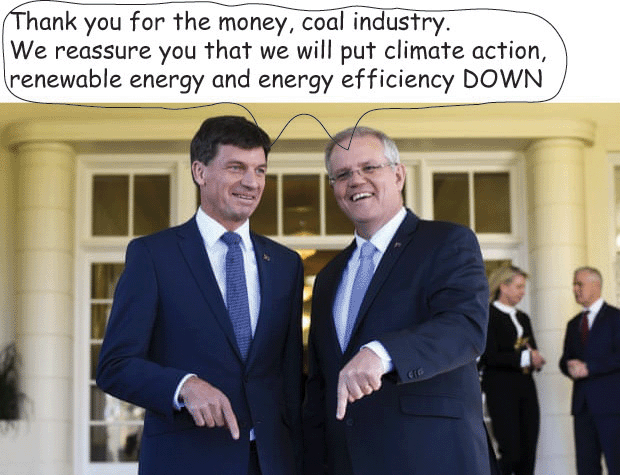 Scott Morrison says drought the Coalition’s ‘first call’ – but makes no mention of climate
Prime minister suggests Coalition may commit to extra funding relief in Liberal party federal council speech, Ben Doherty, @bendohertycorro, Sat 19 Oct 2019 The Guardian
Scott Morrison has indicated the federal government might be prepared to commit extra relief funding to drought-stricken communities, reaffirming the drought is the government’s top priority.
In a triumphal speech to the Liberal party’s federal council in Canberra on Saturday, Morrison again said the drought was “the most pressing and biggest call on our budget”.
“It is the first cab off the rank, the first thing we sit together and say, ‘Once we have done everything we can in this area, then we can consider other priorities’…….
The prime minister did not mention the climate crisis while detailing the government’s three-phase drought response package thus far: the farm household allowance for eligible farming families; the drought communities program dedicating $100m to councils affected by the drought; and long-term drought resilience plans, including money for new dams and the drought future fund. ………
The government has been criticised by Labor for moving too slowly on the drought. Accusing the government of “six years of inaction”, Labor’s Joel Fitzgibbon has called for a bipartisan drought war cabinet to be established.
“What began as crisis for our farmers fast moved to a crisis for our rural townships, which are literally running out of water,” he said. “And I fear that we now are fast approaching a threat to our food security … We need to sit the major parties down together and to start making some pretty significant decisions.”
The drought response has also been questioned by some councils, including Moyne shire in south-west Victoria, which was given $1m despite not being in drought and whose mayor said he wanted to refuse it……. https://www.theguardian.com/australia-news/2019/oct/19/scott-morrison-says-drought-the-coalitions-first-call-but-makes-no-mention-of-climate
Australian government’s “entrenched” anti-climate attitude – John Hewson
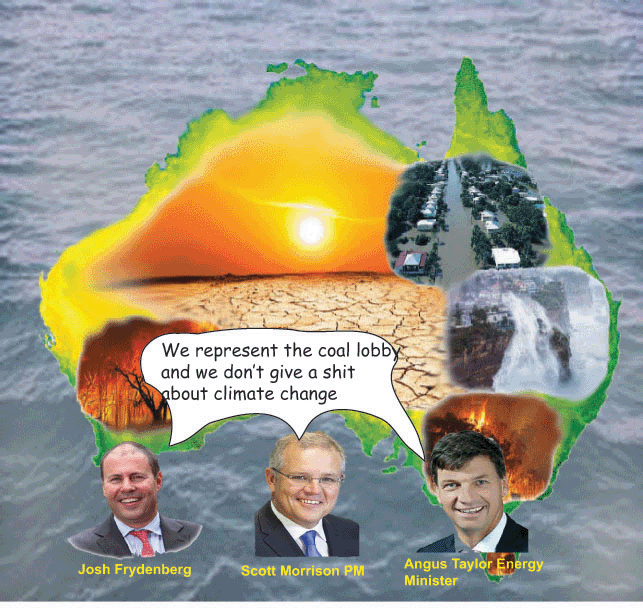 John Hewson slams Coalition on climate change while business takes lead reducing emissions, ABC, NSW Country Hour, 20 Oct By Joshua Becker
Key points:
- John Hewson takes aim at the Government’s policies and its “entrenched anti-climate sentiment’
- The former Liberal leaders argues that regenerative agriculture can offset a large amount of future emissions
- Academics say government policy might be less influential than market forces as companies move faster to reduce emissions
“We don’t have a sense of urgency to achieve these emission [reduction] targets,” he told the Australian Farm Institute Roundtable in Canberra.
“There’s an entrenched anti-climate sentiment in the Government at the moment, and indeed government ministers are not turning up at events if they have the word ‘climate’ in the title.
“The comments made by the Prime Minister at the UN, that we are going to meet our emissions targets, was a gross misrepresentation and was staggering for someone in his position.”
Dr Hewson, who is now the chair of the Business Council for Sustainable Development, said he would like to see regenerative agriculture form part of the solution.
“Regenerative agriculture can offset a very significant portion of our future emissions, and I’m staggered that is not being recognised by the National Party,” he said.
“It would have a lot of benefits for regional Australia; a farmer could earn carbon credits or a stream of income for sequestering carbon on their farm.”
Is agriculture prepared to be part of the solution?
Large multinational food companies are moving to adopt new targets to reduce emissions in line with the Paris Agreement on climate change.
The Sustainable Food Policy Alliance, which represents companies like Nestle, Unilever, Mars and Danone, has backed calls for companies to use their political influence to push governments to implement a science-based policy agenda.
Some academics believe this marks a shift in the global effort to combat climate change, when companies are moving faster than governments to reduce emissions.
Richard Eckard, a professor of agricultural sciences at the University of Melbourne, said government policy might be less influential than market forces.
“In the past six months, I’ve been back and relooked at all these companies’ sustainability statements and noticed that they’ve all switched to absolute emission reduction targets in line with the Paris Agreement,” he said.
“Some of them have interim steps to get there, but all of them are aiming for carbon-neutral food production by 2050.”…… https://www.abc.net.au/news/rural/2019-10-19/hewson-slams-coalition-on-climate-change-as-business-takes-lead/11617292
Federal govt trying to con Australians that a national nuclear waste dump is a “local” not a NATIONAL ISSUE

|
Blank Cheque For A Bad Plan: Canberra’s Nuclear Waste Problem Council Is South Australia’s Nightmare, https://newmatilda.com/2019/10/18/blank-cheque-for-a-bad-plan-canberras-nuclear-waste-problem-council-is-south-australias-nightmare/
By Dave Sweeney on October 18, 2019 The process for establishing a national nuclear waste repository in remote South Australia is deeply flawed on numerous fronts, writes Dave Sweeney.
At the request of federal Resources Minister Matt Canavan, the Kimba District Council in regional South Australia recently posted letters to registered Council voters asking if they supported the area becoming home to Australia’s radioactive waste. In November the Flinders Ranges Council is set to do the same. Local communities should certainly have a say in decisions with direct impacts for them – and hosting radioactive waste that lasts 10,000 years is certainly a direct impact. But to make an informed decision a community needs access to detailed and accurate information and, unacceptably, this is missing. Estimates of the facility size, design, economics and employment have shifted and remain uncertain. There is little or no detail about waste acceptance criteria, transport and handling procedures or future plans for the management of the most contaminating waste. Minister Canavan refuses to define what level of community response would constitute “broad community support”.The community is effectively being asked to give a blanket approval to a concept, not measured consideration of a specific proposal. And not all the local community is invited or involved. Barngarla people have been excluded from the ballot even though they are Native Title holders who neighbour the proposed Kimba site. In the Flinders many in the Adnyamathanha community are set to miss having a say, while others with long standing interests don’t meet the arbitrary ballot boundary and will not have a vote. Successive governments’ approach to radioactive waste management over many years has been divisive and lacked the evidence base required to achieve community consensus and a lasting solution. The current plan would see low-level waste interred at the site while the more problematic intermediate level wastes would be stored above ground pending future underground disposal at a separate site.There is no clear proposal, process, funding or timeline for this pivotal next stage. This unnecessary double handling of waste that needs to be isolated for up to 10,000 years is not consistent with international best practice. There is a real risk this waste will become stranded in a place with far fewer institutional assets to manage it than those sites where it is housed now. At present most of Australia’s radioactive waste is stored at two secured Commonwealth facilities – Lucas Heights in NSW and Woomera in SA. There is no compelling radiological or public health rationale for prematurely advancing the selection of a new site, especially one based on the current sub-optimal process. The Lucas Heights facility has the capacity to continue to store the most problematic intermediate level waste for many years. ARPANSA, the federal nuclear regulator, has clearly stated there is no urgent need to re-locate this material.Radioactive waste management is a complex issue, but it need not be an intractable one. And regardless of the complexity, politics should not be given priority over sound process. Trust, transparency and evidence are essential preconditions to achieving a credible and lasting radioactive waste management solution. All are sadly lacking in the federal government’s approach. Many civil society stakeholders, including national environment, public health, trade union and Aboriginal groups, support a public and independent assessment of the full range of radioactive waste management options in Australia. This would include, but not be solely restricted to, the government’s preferred remote or regional central facility model. This waste problem was not created by the people of Kimba or Hawker, nor is it their sole responsibility to solve. The federal approach has been to shrink the space for a discussion about this waste and to seek to turn a needed national debate into a local infrastructure opportunity and bidding war. This approach has been deeply divisive. It has failed to consider other options or address existing deficiencies. It has not given a voice to people in the wider communities of the Eyre Peninsula, the Flinders Ranges or South Australia. The current plan also neglects the interests of the tens of thousands of Australians who live along potential transport corridors. This exclusion is even more galling considering that what Canberra is proposing is in direct conflict with existing South Australian law. The waste plan is unpopular, unnecessary and unlawful. Securely managing radioactive waste is a complex and costly challenge. Giving Canberra a blank cheque for a bad plan is simply not a good idea for any of us – now or for the future. |
|
South Australia: ballot on nuclear waste dump: Labor reaffirms anti-nuclear policy

 Dave Sweeney, 19 Oct 19, Things are getting pointy around the federal radioactive waste plan in SA.
A community ballot (which does not include Native Title holders) is currently underway in the Kimba region with a comparable initiative due to start next month in the Flinders Ranges.
There are high levels of community concern and contest and continuing legal and procedural challenges in both the Federal Court and the Australian Human Rights Commission.
 Also below is the common sense position adopted by SA Labor at its recent state convention in Adelaide on October 12.
No Nuclear Waste Dump in South Australia
State Convention acknowledges that radioactive waste management continues to be a complex policy challenge that requires the highest level of transparency and evidence and that the current federal approach to site a national waste facility in regional South Australia is strongly contested.
- Supports Traditional Owners and community members in the Flinders Ranges and Kimba regions of South Australia in their current struggle to prevent a nuclear waste facility being constructed in their region.
- Acknowledge that Native Title holders in both affected regions in SA have taken legal and procedural action against their non-inclusion in the federal governments’ community ballot
- Calls for full transparency, broad public input and best practice technical and consultative standards during the current site nomination and selection process.
- Expresses concern at the federal government’s continuing focus on finding a single remote site for radioactive waste to be disposed (low level) and stored (intermediate level) to the exclusion of all other waste management options.
- Reaffirms its support for the civil society call for the extended interim storage of federal wastes at federal sites pending a broad independent inquiry that examines all options for future responsible radioactive waste, transport and storage and management
- Commits to support communities opposing the nomination of their lands or region for a dump site, and any workers who refuse to facilitate the construction and operation or transport and handling of radioactive waste material destined for any contested facility or sites including South Australian Port communities.
- Commits to defend the SA Nuclear Waste Facility (Prohibition) Act 2000
- Oppose the double handling of the intermediate level waste, currently produced and stored at Lucas Heights
- Note federal Labor’s national conference commitment to ‘responsible radioactive waste management’
Environment groups are working to support the affected communities and advance the circuit breaker of extended interim storage at existing federal sites and a management options review.
Nuclear Power Uninsurable and Uneconomic in Australia
 australia
New research has revealed that financial services in Australia will not insure against nuclear accidents, and if developers of nuclear power stations were forced to insure against nuclear accidents, nuclear power would be completely uneconomic.
 The Australia Institute’s submission to the Inquiry into the prerequisites for nuclear energy in Australia, shows that establishing a nuclear power industry in Australia is economically unfeasible, particularly given the uninsurable nature of the technology means the risks of a nuclear incident are borne substantially by Australian taxpayers.
Submission key findings include:
- Nuclear power is far more expensive than other forms of power and has a long history of getting more expensive over time, not less.
- Nuclear power is slow to build, with the average build time taking a decade, face numerous delays and nearly all facing significant cost blow outs.
- While renewable energy is booming globally, nuclear power generation is going backwards, nuclear companies are facing distress or bankruptcy, and governments are giving bailouts using taxpayer money. While China is the largest recent source of new reactors, it has not begun building any new nuclear power plants since 2016, and currently generates twice as much power from renewable energy as nuclear power.
- New nuclear power technologies remain economically speculative; so-called ‘Small Modular Reactors’ face numerous diseconomies of scale and many analysts doubt their viability.
- Nuclear power is subject to substantial outages, both planned and unplanned, and does not have the flexibility required for a modern energy grid.
- In a country prone to extreme heat and prolonged droughts, nuclear power is extremely water intensive and vulnerable to extreme heat.
“The biggest barrier to nuclear power in Australia is that it is uneconomic, the costs of establishing a nuclear industry simply don’t stack up,” says Richie Merzian, Climate & Energy Program Director at The Australia Institute.
“Insurance policies by Australia’s major insurers contain specific language excluding coverage of nuclear disasters; none will insure against nuclear incidents.
“If nuclear power operators were made to adequately insure against the risk of nuclear accidents, the insurance premiums would make nuclear power completely uneconomic.
“Renewables, demand management and storage can meet Australian energy needs safely and at best-cost. In a country with no existing nuclear industry and vast renewable energy resources, it makes no economic sense to establish nuclear generation.”
“A sensible, fact based conversation about nuclear power in Australia must start in economics, and given the industry’s dismal economic outlook, really that is where the conversation should end.”
The Australia Institute report which expands on its inquiry submission, Over Reactor: The economic problems with nuclear power, by Tom Swann and Audrey Quicke can be downloaded here.
Liberal Democrat MP David Limbrick pushes for nuclear power to be approved as “renewable”
Tomorrow I will be putting forward an amendment to add nuclear to the list of approved energy sources for the Renewable Energy Target Bill. If the purpose of the bill is to encourage low carbon electricity production, it doesn’t make sense to exclude it.

Keep Australia’s ban on nuclear power – Noel Wauchope at Federal Inquiry Hearing
 I’m here today to state that I totally oppose changing Australia’s present laws banning nuclear activities. At the present time, Australia’s in a bit of a mess energy-wise. There’s a big transition happening with energy, and—not much helped or understood by government, it seems—renewable energy is taking off pretty fast in Australia. But Australia is a kind of test canary for climate change. I think you all would know of the extremes of climate which we’re getting more of now, already, and which will come on in the future with climate change. It’s very important for Australia to decide what to do about it, and at present we have no energy policy for going forward, and the world is watching us—watching our energy policy and watching our Prime Minister cuddling a lump of coal, which doesn’t go down very well with the world. We are not showing ourselves to be a good global citizen. Worse, we’re not helping our own selves.
So what we need is a way forward. We need to head towards a zero-carbon economy. We have all the ability to go in that direction. We’ve got an intelligent, educated population. We can largely work very hard on energy efficiency. That is something which is kind of the forgotten, the ugly stepsister of energy, but the biggest thing we could do is plan and organise energy efficiency in our buildings, in our transport and in many other ways. As well as that, we need to pursue renewable energy and properly phase out coal.
When it comes to nuclear power, a debate on nuclear power for Australia is simply a waste of energy, time and money. We all know that it’ll take many decades to have nuclear power established in this country. The idea of small modular reactors, which has been put forward at times, is absolutely ridiculous. It would not happen for at least two decades. Imagine little reactors dotted about the country. It’s absurd. I believe that, while that discussion is on, we’re not heading in the direction that is practical and could be done. If we change the policy and cease to ban nuclear activities, that opens the door for the big nuclear companies, and the little ones—I suppose you could call NuScale little, although it’s probably very well funded for its propaganda if not for its actual setting up. With that distraction of removing the ban, we open the door for propaganda to be spread by these companies and their friends in Australia. Of course, some people in the defence industry are very interested because they’d be looking to small modular reactors for nuclear submarines. So I see this as a great distraction from what we should be talking about and what we should be doing.
Our laws were not just set up as a random whim; they were set up because of a realisation, well before the Fukushima thing happened, of the environmental and health hazards of nuclear power and of the issue of nuclear waste. Nobody has solved the problem, as Rosamund has said, of where to finally dispose of it. That hasn’t been worked out, and it seems quite ridiculous to keep on producing something for which we have no proper garbage can.
As well as that, there’s the question of weapons proliferation. Continue reading
Dick Smith, Julian Assange, and USA’s “outrageous” claim to “universal jurisdiction over every person on earth”.
|
Dick Smith lobbied US to drop Julian Assange extradition The campaign for the Morrison government to intervene gathered momentum on Monday after former deputy prime minister Barnaby Joyce lent his support to the WikiLeaks founder’s cause. Independent MP Andrew Wilkie also revealed that a multi-party parliamentary group to “agitate” for Mr Assange to be brought home to Australia would be launched in the coming weeks and would include some members of the Coalition government. In April, Mr Smith voiced concerns to Washington’s man in Canberra that Mr Assange could be charged under an “outrageous” US claim to “universal jurisdiction over every person on earth”. “Australians, like Americans, may have mixed opinions on Julian Assange, however, I believe the tide will turn if it appears an Aussie is being made a scapegoat for a security failure of the US intelligence services,” Mr Smith wrote in the letter seen by The Age and The Sydney Morning Herald. “I can assure you that many Australians will not readily accept that Mr Assange is being held responsible for such a serious security failure, as embarrassing as it may be.” He said it was “imperative to maintain the good relations” between Australia and the US, but Washington would “jeopardise” the relationship by asking its courts to “criminalise journalistic endeavours”. “I believe this will damage the reputation of the United States as an upholder of freedom of speech and a defender of human rights, and result in untold damage to the good relations between Australia and the American people.” Treasurer Josh Frydenberg said the government would not intervene in attempts by the US to have the 48-year-old Australian stand trial, where he faces a sentence of 175 years if found guilty of computer fraud and obtaining and disclosing national defence information……. Confidential government briefing notes, inadvertently released on email by the Prime Minister’s Office on Monday, gave “talking points” to MPs if they were asked about Mr Assange and his fight against extradition from Britain to the US. …. https://www.theage.com.au/politics/federal/dick-smith-lobbied-us-to-drop-julian-assange-extradition-request-20191014-p530lf.html |
|
Clean Energy Council slams Federal Nuclear Inquiry as “distraction” from real energy challenges
CEC slams nuclear inquiry as “distraction” from real energy challenges, https://reneweconomy.com.au/cec-slams-nuclear-inquiry-as-distraction-from-real-energy-challenges-40379/
Sophie Vorrath. 14 October 2019 The Clean Energy Council has delivered a scathing submission to the federal government’s nuclear power inquiry, describing the review itself as a waste of time, and the consideration of nuclear energy as a viable generation source in Australia as “beyond comprehension.”The CEC’s belated submission on the prerequisites for nuclear energy in Australia said the clean energy industry was disappointed the federal parliament had prioritised the inquiry over “much more pressing and worthwhile topics” such as the need for integrated energy and climate policy.
The Clean Energy Council has delivered a scathing submission to the federal government’s nuclear power inquiry, describing the review itself as a waste of time, and the consideration of nuclear energy as a viable generation source in Australia as “beyond comprehension.”
The CEC’s belated submission on the prerequisites for nuclear energy in Australia said the clean energy industry was disappointed the federal parliament had prioritised the inquiry over “much more pressing and worthwhile topics” such as the need for integrated energy and climate policy.
“Inquiries such as this are not only misdirected, but also act as a distraction to addressing the real challenges confronting investors, customers and institutions attempting to facilitate and respond to this transition,” CEC chief Kane Thornton said.
And it said little had changed since past analysis of the topic had concluded that nuclear power was too costly, took too long to develop, and would require “a minor miracle” to win community support.
These factors, considered in the light of the “extraordinary progress” of renewable energy and energy storage, and its potential to deliver reliable, affordable and clean power for Australia, just made the inquiry seem even more ridiculous.
“It is beyond our comprehension as to why Australia would contemplate replacing one dirty energy energy production technology with another that produces large amounts of highly hazardous waste, when it could fulfil its objectives of zero emissions with technologies that are lower-cost, faster to develop and readily available now,” the CEC said.
The submission points to the findings of the CSIRO’s GenCost study of 2018, which puts the cost of small modular reactors in excess of $250/MW/hr, compared to the prices of wind and solar energy at $50/MWh. Firmed wind and solar costs, meanwhile, are now below $70/MWh.
And it points out that the only remaining roadblock to the wholesale shift to renewables in Australia is a political one.
“A lack of federal energy policy and combination of a range of regulatory challenges mean that investment confidence in large-scale renewable energy and the accompanying energy storage is fragile,” the submission says.
“As Australia’s coal fired generation continues to close, there is a clear need for policy and regulatory reform to support the continued deployment of renewable energy and energy storage that will secure system reliability and lower energy prices.”
Barnaby Joyce and former foreign minister Bob Carr urge stopping extradition of Julian Assange to USA
Barnaby Joyce joins calls to stop extradition of Assange to US, The Age, By Rob Harris, October 13, 2019 Former deputy prime minister Barnaby Joyce has joined calls for the Morrison government to try to halt Julian Assange’s potential extradition from Britain to the United States on espionage charges, as the WikiLeaks founder’s supporters intensify their campaign to bring him to Australia.
Mr Joyce joined former foreign minister Bob Carr in voicing concerns over US attempts to have the 48-year-old Australian stand trial in America, where he faces a sentence of 175 years if found guilty of computer fraud and obtaining and disclosing national defence information.
Also seeking to increase pressure on the federal government is actress Pamela Anderson, who is demanding to meet Prime Minister Scott Morrison to request he intervene in the case. She plans to visit Australia next month.
Assange’s supporters say they are increasingly concerned about his health and his ability to receive a fair trial in the US………
Mr Carr has challenged Foreign Minister Marise Payne to make “firm and friendly” representation to US Secretary of State Mike Pompeo, believing Australians would be “deeply uneasy” at a fellow citizen being handed over to the “living hell of a lifetime sentence in an American penitentiary”.
Mr Joyce, who in 2007 was the first Coalition MP to call for the then Howard government to act over the detention of Australian David Hicks in Guantanamo Bay, said his position was principled and he gave “no opinion of Mr Assange whatsoever”.
“If someone was in another country at a time an alleged event occurred then the sovereignty of the land they were in has primacy over the accusation of another nation,” Mr Joyce said.
“It would be totally unreasonable, for instance, if China was to say the actions of an Australian citizen whilst in Australia made them liable to extradition to China to answer their charges of their laws in China. Many in Hong Kong have the same view.”
Assange is serving a 50-week sentence in Belmarsh Prison in south-east London for bail violations after spending seven years inside the Ecuadorian embassy in London in a bid to avoid extradition to Sweden to answer allegations of rape and molestation in 2012.
In June, the then British home secretary, Sajid Javid, signed an extradition request after the US Justice Department filed an additional 18 Espionage Act charges over Assange’s role in obtaining and publishing 400,000 classified US military documents on the war in Iraq in 2010.
Mr Carr, the former NSW premier who served as foreign minister in the Gillard government, said he understood many people would have reservations about the “modus operandi” of Assange and his alleged contact with Russia.
Mr Carr said the Morrison government should make strong representations to the US on behalf of an Australian citizen who “is in trouble because he delivered on our right to know”.
“I think the issue will gather pace and in the ultimate trial there’ll be a high level of Australian public concern, among conservative voters as much as any others.”……..
Mr Carr said the Morrison government should make strong representations to the US on behalf of an Australian citizen who “is in trouble because he delivered on our right to know”.
“I think the issue will gather pace and in the ultimate trial there’ll be a high level of Australian public concern, among conservative voters as much as any others.”…….https://www.theage.com.au/politics/federal/barnaby-joyce-joins-calls-to-stop-extradition-of-assange-to-us-20191013-p53080.html
Dr Jim Green addresses Australia’s Federal Nuclear Inquiry
Dr Green: Thanks for the invitation to speak. Mr O’Brien, I would respectfully ask you to revisit and reconsider your express view that small modular reactors and other new technologies are leading to ‘cleaner, safer and more efficient energy production’. That argument would be compelling if there were fleets or networks of these SMRs operating anywhere in the world and operating successfully, but as you know, and as Dr Switkowski mentioned in his testimony, there are no such networks anywhere in the world, so we have no idea if or how a network of SMRs might operate in Australia. Further, there isn’t even one single SMR operating anywhere in the world. There isn’t even one prototype SMR operating anywhere in the world. So operating SMRs, of which there are precisely none, clearly provide no basis for arguing that new technologies are leading to cleaner, safer and more efficient energy production.
The next level of evidence that we would logically turn to would be SMRs under construction. And if we ignore the icebreakers, and the floating nuclear power plant under construction by the Chinese and Russian governments, then we’re left with just two SMRs under construction. One is the disaster in Argentina, which has been several decades in gestation. The latest cost estimate for that is $32.4 billion per gigawatt, so wildly uncompetitive. The second one is China’s high-temperature SMR. There’s not a great deal that we know about that reactor, but we do know that plans for 18 further high-temperature SMRs at the same site have been dropped—to use the language from the World Nuclear Association. There have clearly been cost overruns. There have clearly been delays. It’s not terribly promising.
Given the absence of any operating SMRs and the unpromising nature of the two under construction, or the two relevant ones under construction, the argument that SMRs are leading to cleaner, safer and more efficient energy production could only possibly be justified with reference to paper designs until the unproven claim is promoted by the nuclear industry. It ought to be obvious, and I’m sure it is obvious, to everyone here that paper designs and corporate claims are no basis for public policy, especially given the history of the past decade.
The current cost estimates for EPR reactors in the UK are seven times greater than the estimates going back to the mid 2000s—not seven per cent greater or even 70 per cent greater but 700 per cent greater. It’s even worse in the United States where the current cost estimates for AP1000 reactors are 10 times greater than the numbers being floated by Westinghouse in 2006, a 1,000 per cent increase. So we need to be incredibly sceptical with corporate cost claims. I think a good starting point for those claims is to add a zero onto the end and it’s a good chance that your estimate would be better than the company estimates.
NuScale is said to be the next big thing in the SMR world, if only because most of its competitors have collapsed. It’s notable that the South Australian royal commission’s estimate of NuScale costs is 2.4 times higher than NuScale’s own estimate. That’s highly significant because if NuScale can deliver power at its projected costs it will certainly be competitive. But if the royal commission’s figures are correct, as I believe they will be and quite possibly understanding the real costs, then it’s not going to be competitive. The royal commission’s figure was $225 per megawatt hour……….
The private sector is not prepared to bet billions of dollars on SMRs, not even to get a prototype up and running. This is what we see in the US, the UK, Canada and elsewhere. It will not build a single prototype in the absence of very large amounts of taxpayer subsidies, amounting at a bare minimum to hundreds of millions of dollars and almost certainly into the billions of dollars. To date governments are resisting. The British government has invested tens of millions of pounds in grants, but that would need to be increased by one to two orders of magnitude if a single prototype is to be built, let alone a fleet of SMRs. In the US, government largesse has amounted to roughly half a billion dollars. Once again, it’s not even close to getting a single prototype off the ground. The debate in Canada is at an earlier stage, and they haven’t come up with any serious ideas about how they’re going to get a single prototype SMR funded, let alone a fleet of SMRs.
The only thing that would actually change in Australia if the ban against nuclear power were repealed is that nuclear companies would descend on Canberra to try to gouge as much taxpayer money as they could possibly get from the federal government. That would be the one practical change. Dr Switkowski told the committee that, because of Australia’s prohibition against nuclear power, the US company TerraPower can’t collaborate with an Australian company. But if an Australian company were rich or brave or crazy enough to invest in TerraPower, they’d be most welcome. TerraPower, like all of these other companies, has no intention of building even a single prototype in the absence of huge taxpayer subsidies. So, once again, if Australia’s legal prohibition against nuclear power were repealed, the only change would be that TerraPower company representatives would be lined up outside ministerial offices trying to stitch together a package of direct and indirect taxpayer subsidies.
There are dozens of start-ups involved in the SMR sector and the advanced reactor sector. There are said to be well over 50 in the United States alone. But if all of those companies pooled all of their money into one single pot it’s highly doubtful they would have enough money to build one single prototype—hence the attempts to get billions of dollars of taxpayer money. The executive summary from our joint NGO submission includes a very long and growing list of failed SMR and advanced reactor projects, and there have been further failures in the short time since this committee was initiated.
Finally, Mr O’Brien, in light of the findings of the South Australian royal commission, I would ask you to reconsider your expressed view that SMRs are leading to cleaner, safer and more efficient energy production. The royal commission investigated these issues in detail. It commissioned expert research, and the royal commission concluded:
… fast reactors or reactors with other innovative designs are unlikely to be feasible or viable in South Australia in the foreseeable future. No licensed and commercially proven design is currently operating. Development to that point would require substantial capital investment. Moreover, the electricity generated has not been demonstrated to be cost-competitive with current light water reactor designs……
1 This month
17 October, Free Public Talk on Nuclear Issues in South Australia
David Noonan will speak on public interest concerns over the new Roxby Downs Indenture Act 2026 on BHP copper-uranium mining and ore processing in SA, and on how AUKUS may face SA with a High-Level nuclear waste agenda.
Dr Jim Green will discuss international developments in the field of nuclear power including ‘small modular reactors’ and Generation 4 ‘advanced’ nuclear reactor concepts.


Help Aunty Sue Protect Her Land and Sacred Sites From Destructive Rocket Testing.
.

Australians deserve the truth
about
AUKUS – https://aukuspublicinquiry.com/

PETITION – To: Prime Minister Anthony Albanese and the Australian Labor Government

of the week – Australians for War Powers Reform (AWPR)
To see nuclear-related stories in greater depth and intensity

