A NATIONAL APPROACH TO A NATIONAL RIVER SYSTEM
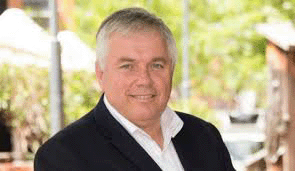 Senator Rex Patrick 3 Nov 19, I’m sick and tired of the NSW Government threatening to pull out of the Murray-Darling Basin Plan every time they get upset about something happening on the river.
It’s been threatened at least 4 times since February 2018, when the Senate was debating whether or not to allow an extra 70GL of extraction from the Norther Basin (Centre Alliance voted against extra extraction).
NSW pulling out of the Basin Plan would not be in its own interests. There are a number of significant NSW river projects that are or will be funded by the Basin Plan, but won’t be if NSW were to pull out.
The Murray-Darling is a national river that needs to be managed accordingly. If NSW took its bat and ball home, there would be little choice but for the Federal Government to take control, either using existing Commonwealth powers or by supporting a constitutional amendment handing powers to the Federal Parliament. Centre Alliance already has a Constitutional Alteration Bill before the Parliament that seeks to do this.
NSW Nationals MPs have cried wolf on pulling out of the plan so often now that it’s becoming meaningless. They would be better off focussing their efforts on reigning in over-extraction, but that would involve acting in the national interest, not in the Nationals’ interests.
Gross injustice: the relentless destruction of Julian Assange
The charge against Julian is very specific; conspiring with Chelsea Manning to publish the Iraq War logs, the Afghanistan war logs and the State Department cables. The charges are nothing to do with Sweden, nothing to do with sex, and nothing to do with the 2016 US election; a simple clarification the mainstream media appears incapable of understanding.
The campaign of demonization and dehumanization against Julian, based on government and media lie after government and media lie, has led to a situation where he can be slowly killed in public sight, and arraigned on a charge of publishing the truth about government wrongdoing, while receiving no assistance from “liberal” society.
Unless Julian is released shortly he will be destroyed. If the state can do this, then who is next?
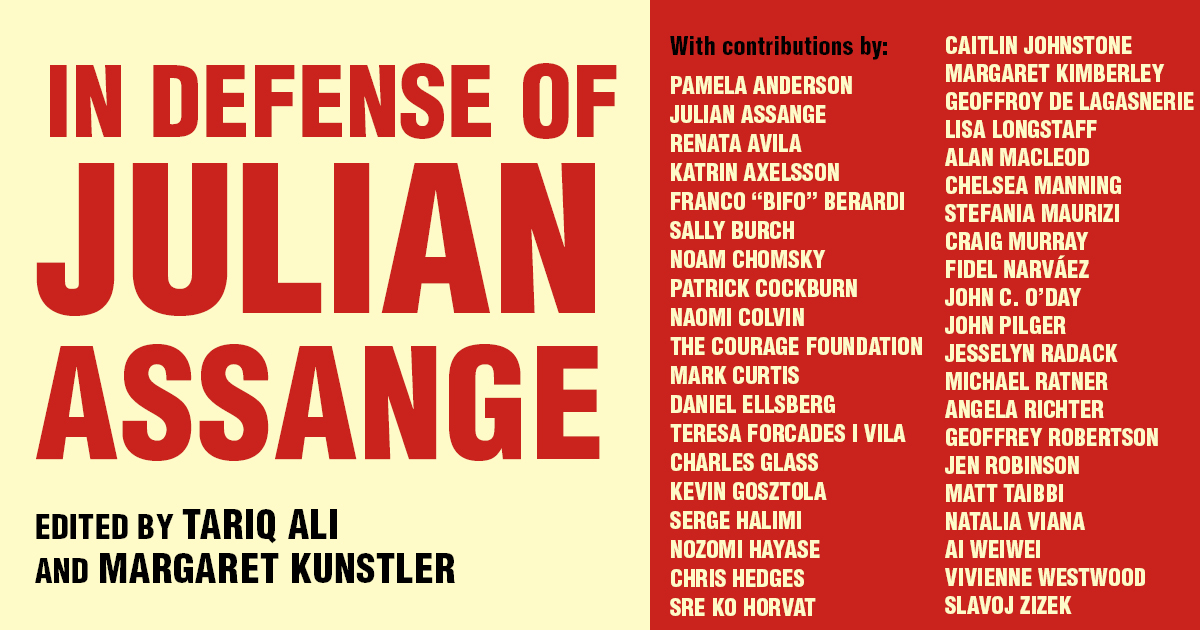
 The Annihilation of Julian Assange, https://www.truthdig.com/articles/the-annihilation-of-julian-assange/, Craig Murray “In Defense of Julian Assange,” edited by Tariq Ali and Margaret Kunstler, is now available for OR Books.
I was deeply shaken while witnessing yesterday’s events in Westminster Magistrates Court. Every decision was railroaded through over the scarcely heard arguments and objections of Assange’s legal team, by a magistrate who barely pretended to be listening.
Before I get on to the blatant lack of fair process, the first thing I must note was Julian’s condition. I was badly shocked by just how much weight my friend has lost, by the speed his hair has receded and by the appearance of premature and vastly accelerated aging. He has a pronounced limp I have never seen before. Since his arrest he has lost over 15 kg in weight.
But his physical appearance was not as shocking as his mental deterioration. When asked to give his name and date of birth, he struggled visibly over several seconds to recall both. I will come to the important content of his statement at the end of proceedings in due course, but his difficulty in making it was very evident; it was a real struggle for him to articulate the words and focus his train of thought.
Until yesterday I had always been quietly skeptical of those who claimed that Julian’s treatment amounted to torture – even of Nils Melzer, the UN Special Rapporteur on Torture – and skeptical of those who suggested he may be subject to debilitating drug treatments. But having attended the trials in Uzbekistan of several victims of extreme torture, and having worked with survivors from Sierra Leone and elsewhere, I can tell you that yesterday changed my mind entirely and Julian exhibited exactly the symptoms of a torture victim brought blinking into the light, particularly in terms of disorientation, confusion, and the real struggle to assert free will through the fog of learned helplessness. Continue reading
Scott Morrison doesn’t like even the “quiet people” speaking up
 Morrison doesn’t like it when the quiet Australians start to speak up, Canberra Times, Ebony Bennett , 2 Nov 19,
In his government’s latest free-speech crackdown, Prime Minister Scott Morrison has vowed to outlaw civil society groups campaigning against Australian businesses that work with companies with dubious environmental, human rights or ethical records.
The bank ruled out lending to Adani, as did other banks – in part because AYCC’s Dollarmite protests were a real risk to their brand (this was before the banking royal commission tanked it) but also because Adani’s coal mine is a dud project that has failed to secure finance from virtually any bank or investor, except for billionaire Gautam Adani himself.
Scott Morrison says this style of campaigning “is a potentially more insidious threat to the Queensland economy and jobs and living standards than a street protest”.
That was in 2014, when former prime minister Tony Abbott proposed a ban on secondary boycotts. Australia’s competition laws already restrict secondary boycotts – but that is mostly targeted at unions, with exemptions for campaigns run by environmental and consumer groups……
Scott Morrison doesn’t like it when quiet Australians break their silence and take aim at dodgy companies or those who choose to provide services to them – especially when they’re in his favoured industries, like the coal industry. While the Coalition government rolls out the red carpet for the coal industry, it can’t pull up the drawbridge fast enough when it comes to renewables.
If the Minerals Council says jump, the federal government (and NSW and Queensland governments) say “how high?” Whereas the Coalition government has done its level best to kill off the renewables industry. Thankfully, in the long term they have been about as effective at killing off renewables as they have been at cutting emissions: hopeless.
The Morrison government regularly boasts about Australia’s record on renewables, but the fact is it is single-handedly destroying the holy trinity of renewable energy policy: the Renewable Energy Target (RET), the Australian Renewable Agency (ARENA) and the Clean Energy Finance Corporation (CEFC).
Collectively, the RET, ARENA and the CEFC are responsible for unleashing $23.4 billion worth of investment in renewable energy over a five-year period (2013-18). But there’s nothing the Coalition loves more than throwing sand in the gears of the success of the renewables industry.
Looking ahead, the RET has been exhausted, ARENA is running out of money and the last bastion of renewable energy investment, the CEFC, is now being bastardised to fund fossil-fuel projects……..
Prime Minister Scott Morrison has gone to great pains to talk up renewables, but the truth is that the PM is quite happy to wreck the renewables revolution. He labels those who protest companies wrecking our environment as “selfish and indulgent”, but the truth is that under Scott Morrison, free speech is reserved only for people with paid jobs, and protests are only to be tolerated at convenient times, in convenient places.
If you don’t like it, shut up – or Scott Morrison will make you shut up.
How good is Australia?
- Ebony Bennett is deputy director at independent think tank the Australia Institute. Twitter: @ebony_bennett. https://www.canberratimes.com.au/story/6470618/morrison-doesnt-like-it-when-the-quiet-australians-start-to-speak-up/?cs=14246
Scott Morrison delivers a speech that sounds very like an attack on democracy

|
Scott Morrison threatens crackdown on protesters who would ‘deny liberty’ https://www.theguardian.com/australia-news/2019/nov/01/scott-morrison-threatens-crackdown-on-secondary-boycotts-of-mining-companies?CMP=share_btn_tw
PM signals action on secondary boycotts of resources companies and says progressives want to tell Australians ‘what you can say, what you can think’ Paul Karp @Paul_Karp Fri 1 Nov 2019 Scott Morrison has branded environmental protesters “anarchists” and threatened a radical crackdown on the right to protest in a speech claiming progressives are seeking to “deny the liberties of Australians”.In a speech to the Queensland Resources Council on Friday, the prime minister said a threat to the future of mining was coming from a “new breed of radical activism” and signalled the government would seek to apply penalties to those targeting businesses who provide services to the resources industry. Civil society groups, including the Human Rights Law Centre and Australian Conservation Foundation, and the Greens immediately attacked the proposal as undemocratic and a bid to stifle a social movement fighting for Australia to take action on climate change. Morrison told Australian corporations to listen to the “quiet shareholders” and not environmental protesters, who he suggested could shift targets from coal companies to all carbon-intensive industries including power generation, gas projects, abattoirs and airlines. In a speech proposing limits on free speech advocating boycotts against polluting companies, Morrison said progressives wanted to tell Australians “what you can say, what you can think and tax you more for the privilege of all of those instructions”. He claimed that “progressivism” – which he labelled a “new-speak type term”, invoking George Orwell – intends “to get in under the radar, but at its heart would deny the liberties of Australians”. “Apocalyptic in tone, it brooks no compromise,” Morrison said. “It’s all or nothing. Alternative views are not permitted.” He pointed to the “worrying development” of environmental groups targeting businesses or firms involved in the mining sector with “secondary boycotts”, such as businesses refusing to provide banking, insurance or consultancy services. “They are targeting businesses of all sizes, including small businesses, like contracting businesses in regional Queensland.” “Let me assure you this is not something my government intends to allow to go unchecked. “Together with the attorney general, we are working to identify mechanisms that can successfully outlaw these indulgent and selfish practices that threaten the livelihoods of fellow Australians.” But Morrison admitted the government “can’t force one Australian company to provide a service to another”. The Greens were quick to reverse the charge of intolerance and level it at Morrison, with acting leader Adam Bandt labelling him “a direct threat to Australian democracy and freedom of speech”. “The prime minister’s commitment to outlaw the peaceful, legal protest of Australian individuals and community groups reads like a move straight from the totalitarian’s playbook,” he said. |
It’s time that the Australian government declared a water emergency
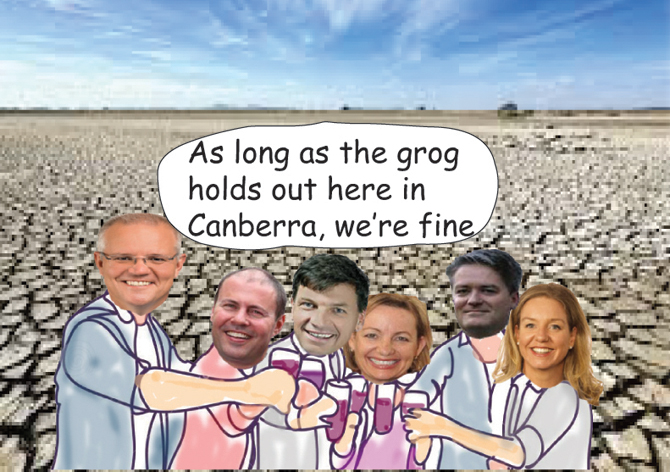
Declaring a water emergency means putting people before profit, mo https://www.michaelwest.com.au/declaring-a-water-emergency-means-putting-people-before-profit/by Quentin Grafton and John Williams — 1 Nov 19, The current drought in Eastern Australia has focused the attention of all Australians on water but effective policy responses are missing in action. Isn’t it time to call it a water emergency? Quentin Grafton and John Williams report.
The dictionary defines an emergency as “a serious, unexpected, and often dangerous situation requiring immediate action”. If there is a climate emergency – and 330,000 Australians have already signed a petition to the Australian Government to declare a climate emergency – then surely there must also be a water emergency here, right now, in Australia. As in any emergency, it requires that we be told the truth and, importantly, act on the truth.
Political leaders, however, prefer the word ‘drought’ because Australia has experienced it in the past and it is ‘solved’ when the rains come. Politicians cannot be blamed for acts of nature. ‘Drought relief’ also gives politicians the opportunity to pretend to fix the problem while showing compassion for those doing it tough.
Income support in the form of a farm household allowance for eligible households with less than $5 million in assets, and that pays more than $30,000 per farming couple per year for up to four years, is, no doubt, very welcome to those who qualify. Unfortunately, it does not solve our water emergency. In this make-believe narrative, all blame accrues to the heavens.
The current drought began in 2017, and came less than 10 years after the Millennium Drought ended. Yet the nation’s elected leaders are surprised by another major drought. Like rabbits on the road facing the full beam of an approaching vehicle, they seem unable to move beyond last century solutions to respond to this water emergency.
Instead, they announce multi-billion dollar commitments of taxpayer money for dams, many of which won’t be completed for years and would never fill until the drought ends. Water extracted from the dams would also be subject to water extraction limits under the Basin Plan.
So why do Australian political leaders support dam building as a solution knowing that dams don’t make it rain or snow? Is it because they are stuck in the past, trapped in myths or delusions, or asleep at the wheel?
If only this were true. Australia could then solve the water emergency by simply ‘briefing’ the Prime Minister, Premiers, and Water Ministers about the 21st Century solutions to the water emergency.
They could be informed of solutions like comprehensive water accounting so that everyone knows who has the water and what it is being used for. Other solutions include water planning that leaves sufficient water in the dams for people to drink by setting enough water aside for the worst droughts, and water recycling and reuse by communities to reduce extraction. Or even managed aquifer recharge to reduce surface water evaporation, and dynamic water pricing that increases the volumetric price paid when dams have less water — the list goes on.
So what is getting in the way of implementing these solutions? Money, power, and influence. Both rent-seeking and regulatory capture, represent the demand for and the supply of water respectively, and are affecting decision-making that benefits particular interests, rather than the broader public interest.
Rent-seeking is when actions are undertaken by people and organisations outside of government to influence decision-making for self-interest, rather than for the sake of improving the decision. Many forms of rent-seeking are legal in Australia, including lobbying — a multi-billion-dollar business.
Rent-seeking allows privileged access to our elected leaders and advisors to those with the means to get it. For example, between 2014 and 2018 the NSW Irrigation Council had more than 25 water-related meetings with New South Wales Ministers, yet many non-industry and non-irrigation entities had only one meeting. All combined, Indigenous, catchment, and environment entities had just 20 per cent of the total number of ministerial meetings given to irrigation and industry entities in the period.
So what does privileged access mean? Decision-making that the NSW Natural Resources Commission has described, in relation the Barwon-Darling River Water Sharing Plan, that has
“…increased allowance for extractive use at lower flow classes that are critical to the environment. These provisions benefit the economic interest of a few upstream users over the ecological and social needs of the many”.
This decision-making contributed to the dire situation in the Murray-Darling Basin and the massive fish kills along the Darling River in January 2019. Sadly, it is just one of many examples of water decision-making not made in the public interest, and described by the South Australian Murray-Darling Basin Royal Commission in January this year as “gross maladministration”.
Billions of dollars in expenditure on irrigation infrastructure, including the construction of private dams, highlighted in the ABC’s Four Corners program in July 2019 Cash Splash, and supported by evidence in peer-reviewed academic research, shows that such subsidies are likely to reduce return flows from irrigators’ fields to groundwater, streams, and rivers.
Yet, the Australian Government has spent some $4 billion on subsidising irrigation infrastructure in the Murray-Darling Basin without any cost-benefit analysis or even comprehensive measures of the impacts on stream flows.
To add to our water woes, more billions of dollars have been allocated to further subsidise water infrastructure, including dams, and announced as a ‘solution’ to the water emergency. Such spending is highly unlikely to generate a net public benefit.
As Rome burns, people in towns like Wilcannia on the lower Darling get their drinking water from 10 litre cartons delivered from the back of trucks. In a desperate cry of help, and defiance, one Barkandji Elder from Wilcannia, Kerry ‘Sissy’ King, has a message for politicians to
“Come out here and see how you feel about living [with no water]. They’ve taken it from the nation that lives off the river system. Come and sit in the gutter with us.”
Australia must stop blaming the river and recognise that capture by special interests has led to this water emergency. It is not simply an act of God; it has arisen from a lack of planning and decision-making that benefit the few at the expense of the many. Neither drought relief nor dams are solutions. Instead, Australia needs its political leaders to lead, to put the national interest first, and to make decisions that place people before profit.
Scott Morrison’s threats against climate activists – getting a bit sinister
As he rails against activism, Scott Morrison is turning a bit sinister, a bit threatening, The government the PM leads finds activism inconvenient, but it is the same government that has sparked the activism. Guardian, Katharine Murphy Political editor, @murpharoo, Fri 1 Nov 2019 It takes some chutzpah to stand up with a straight face and deliver a speech foreshadowing a government crackdown on protest activity while in the same breath declaring that a new insidious form of progressivism is intent on denying the liberties of Australians.
But Scott Morrison has never lacked confidence.
In the florid prime ministerial tale unfurled on Friday at the Queensland Resources Council (and boy folks, it was a doozy), progressivism wanted to tell you what job you can have, what you can say, what you can think “and tax you more for the privilege of all of those instructions that are directed to you” – which made progressivism kind of busy, and a whole lot more organised and efficient than progressivism generally is.
We could, on Friday, have been treated to a measured prime ministerial reflection on the problems associated with cancellation culture. The Labor frontbencher Clare O’Neil showed this week that conversation can be attempted without everyone losing their minds. We could have had some words to bring the country together.
But after a brief touchdown in the goat’s cheese circle, which was somehow intrinsically hostile to mining in ways that weren’t really unpacked (and perhaps that might have been risky, given Morrison was addressing a business lunch where goat’s cheese might, accidentally, have featured) – we arrived, unexpectedly it must be said, at the sneering apocalypse.
Morrison warned that a new breed of #RadicalActivism™ was the on the march, “apocalyptic in tone, brooks no compromise, all or nothing, alternative views not permitted – a dogma that pits cities against regional Australia, one that cannot resist sneering at wealth creating and job creating industries, and the livelihoods particularly of regional Australians including here in Queensland”.
Apart from this being overhyped, high-velocity bollocks, it pays to remember right at this juncture that the actual purpose of Morrison’s address on Friday was to foreshadow a government crackdown against forms of activism and protests that the Coalition and the mining industry finds inconvenient.
So, just in case this unclear, let me spell it out: we were being treated to the spectacle of a prime minister teeing off against intolerance while in the same breath foreshadowing his own bout of government sanctioned intolerance – the type where police might be involved, and people might be bundled away in vans.
Yes, that happened. I saw it, because the prime minister’s speech was broadcast outside Queensland. It wasn’t always clear that Morrison knew the audience looking on at lunchtime on Friday might be broader than the residents of central Queensland, but it was broadcast nationally. To the south-east corner of the sunshine state, and Sydney, and Melbourne.
Unremarked in this stirring presentation was the fact that climate-related activism is building right at the moment, both at the community level, from the schoolkids to the grandmas, and also at the shareholder level, in large part because the Coalition has invited it.
The government who finds this activism inconvenient is the same government who has sparked the activism, given its purpose and salience and traction, because of its own woeful record on climate change……..
Apart from the perversity of a government railing against a set of conditions it has, itself, created, there was also the curiosity about carbon risk, which was presented implicitly by Morrison as a fiction of progressivism, #RadicalActivism™ and the sneering apocalypse. ………
This strange diktat will be news to the regulators – the Reserve Bank of Australia, the Australian Prudential Regulation Authority, the Australian Securities and Investments Commission – who are calmly out in the marketplace warning stakeholders on a regular basis to get their houses in order or risk being stranded in the inevitable transition, who present carbon risk as what it is: a threat to financial stability in Australia.
They’ll be astonished to learn they are the unwitting tools of the deep progressive state, co-opted by the noisy Australians. Shh, no one tell them.
This strange diktat will be news to the regulators – the Reserve Bank of Australia, the Australian Prudential Regulation Authority, the Australian Securities and Investments Commission – who are calmly out in the marketplace warning stakeholders on a regular basis to get their houses in order or risk being stranded in the inevitable transition, who present carbon risk as what it is: a threat to financial stability in Australia.
They’ll be astonished to learn they are the unwitting tools of the deep progressive state, co-opted by the noisy Australians. Shh, no one tell them. https://www.theguardian.com/australia-news/2019/nov/01/as-he-rails-against-activism-morrison-turns-a-bit-sinister-a-little-bit-threatening
Australia’s media under threat

“Media outlets have faced attacks in the form of centralisation of private ownership, funding cuts to public broadcasters, and potential prosecution of journalists, including News Corp journalist Annika Smethurst.”
One of the report’s authors, Geoffrey Watson, SC, former counsel assisting the Independent Commission Against Corruption, said he had been shocked by how quickly the brutal type of politics that evolved in the United States and the United Kingdom, and partly led to the ascendancy of Donald Trump and Boris Johnson, had taken root in Australia.
“One day you see the judiciary attacked and the next someone in the media,” said Mr Watson, who is a director of the Centre for Public Integrity. “On the third day it might be the CSIRO, they even attack our scientists. Some people don’t recognise it as the same problem, but it is all part of the same disease.”
He said the effectiveness of the media in Australia as a watchdog was not only threatened by personal and legal attacks by the government, but by regulations that had allowed ownership of newspapers to be reduced to an effective duopoly.
The report, entitled “Protecting the Integrity of Accountability Institutions”, said that a range of institutions – including the judiciary and the Administrative Appeals Tribunal, the public service, integrity commissions such as the ICAC, statutory authorities such as the Human Rights Commission and the Fair Work Commission, and the CSIRO – had all been targeted in recent years by interested parties seeking to undermine their independence and public trust.
“These institutions are important not only because they ensure actual accountability, transparency and good governance but because they build confidence and trust within the Australian community,” it said. “When this confidence and trust is diminished, divisiveness and conflict increase. This impacts social cohesiveness and the economy, and the welfare of all Australians suffers. Ultimately, as international experience has shown, it is a threat to democracy itself.”
It cited as examples of interference attempts by federal ministers to influence the Victorian Court of Appeal in 2017 terrorism cases, sustained funding cuts and personal attacks on the ABC, and the de-skilling of the public service through the outsourcing of up to 50 per cent of government departments to contractors.
The report listed a series of principles that needed to be respected in order to protect the independence of the threatened institutions. They include protection from political retribution, secure and sufficient funding, secure tenure of senior officials and public access to advice to the government from accountability institutions, as well as the creation of an effective federal integrity watchdog.
The Centre for Public Integrity, a independently funded think tank, was formed earlier this year in part to champion the case for a such a body. The report comes in the midst of a campaign by Australian media, including the Herald and The Age, to defend the public right to information in the face of increasing attempts by government and government agencies to suppress information, prosecute whistleblowers and criminalise legitimate public interest journalism.
MP Sonja Terpstra and Victoria’s Labor government stand by existing bans on nuclear activities
 Sonja Terpstra, State Labor Member for Eastern Metropolitan Region “….The Victorian Government and I do not support the state parliamentary inquiry into the use of nuclear energy. We stand by our existing ban on nuclear power and are committed to retaining the Victorian Nuclear Activities (Prohibitions) Act 1963.
It makes no sense to construct nuclear power stations in Australia. They present significant community, environmental and health risks, not to mention the ongoing and yet unsolved problem of the disposal of nuclear waste. Instead through the Victorian Labor Government’s ambitious Victorian Renewable Energy Target, we are giving the renewable energy sector the confidence needed to invest in the clean energy projects and jobs that are crucial to our future….”
New political party Reform WA wants nuclear power as an option for Western Australia
New political party Reform WA wants nuclear power as an option for Western Australia
240 conservation scientists call on Australian government to strengthen environmental protection laws
Letter by 240 leading scientists calls on Scott Morrison to stem extinction crisis, More than 240 conservation scientists sign open letter warning PM that 17 Australian native species face extinction in next 20 years. Guardian, Adam Morton Environment editor @adamlmorton, Mon 28 Oct 2019 More than 240 conservation scientists have called on Scott Morrison to drop his opposition to stronger environment laws and seize a “once-in-a-decade opportunity” to fix a system that is failing to stem a worsening extinction crisis.
With the federal government due to this week announce a 10-yearly legislated review of the Environmental Protection and Biodiversity Conservation (EPBC) Act, the scientists have signed an open letter to the prime minister urging him to increase spending and back laws to help protect the natural world from further destruction.
The letter says three native species have become extinct in the past decade and another 17 could follow in the next 20 years. More than 1,800 Australian plants and animals are formally listed as threatened with extinction, but the scientists say this is an underestimate.
“Our current laws are failing because they are too weak, have inadequate review and approval processes, and are not overseen by an effective compliance regime,” the scientists say.
“Since they were established (in 1999), 7.7m hectares of threatened species habitat has been destroyed. That’s an area larger than Tasmania. Meanwhile, the number of extinctions continue to climb, while new threats emerge and spread unchecked.”
Environmental law was a point of difference at this year’s election, with Morrison pledging to limit “green tape” that he said cost jobs while Labor promised a new environment act and a federal environment protection authority.
Lesley Hughes, a distinguished professor of biology at Macquarie University, member of the Wentworth Group of Concerned Scientists and a signatory to the letter, said environmental protections had been consistently wound back over the past decade, most often by conservative governments.
She said it was having a significant impact, pointing to the 2016 state-of-the-environment report that found Australia was facing multiple environment changes and lacked a national policy that established a clear vision for the protection and sustainable management of the country’s natural heritage.
She also cited a WWF assessment that ranked eastern Australia as one of the world’s top 11 deforestation hotspots. Australia was the only developed country on the list.
“It’s a very grim picture,” Hughes said. “This letter is a pre-emptive strike to say this is an opportunity to do it better, this is not an opportunity to weaken and dilute the existing weak laws.”
Morrison’s pledge not to increase environmental laws came as a United Nations global assessment found biodiversity was declining at an unprecedented rate, with one million species across the globe at risk of extinction and human populations in jeopardy if the trajectory was not reversed.
The environment minister, Sussan Ley, said the review of the EPBC Act was an independent process that would encourage submissions from a wide variety of perspectives……. https://www.theguardian.com/environment/2019/oct/28/toughen-environmental-laws-to-stem-extinction-crisis-scientists-tell-morrison
Attorney General Christian Porter backs laws that restrict journalists’ reporting
 Material from raid on journalist’s home ‘may be used to prosecute’, The Age, By Dana McCauley October 25, 2019 — Attorney-General Christian Porter has launched an extraordinary intervention in a High Court case over raids by Australian Federal Police (AFP) on News Corp journalist Annika Smethurst’s home, asking the court to block a move to destroy material that may be used for future prosecution. Material from raid on journalist’s home ‘may be used to prosecute’, The Age, By Dana McCauley October 25, 2019 — Attorney-General Christian Porter has launched an extraordinary intervention in a High Court case over raids by Australian Federal Police (AFP) on News Corp journalist Annika Smethurst’s home, asking the court to block a move to destroy material that may be used for future prosecution.
Mr Porter, who has sought to reassure media companies fighting for press freedom that he is “seriously disinclined” to approve prosecutions over public interest journalism, said in a joint submission to the court that the AFP was still weighing up whether to refer the matter to prosecutors. “If charges are laid, the data seized from Ms Smethurst’s phone may well be important. In those circumstances, the court should not order that the data be destroyed,” Mr Porter’s joint submission with the Australian Federal Police said. “It should leave it to the trial judge in any future criminal prosecution to determine whether that material will be admitted.” Australian media outlets – including Nine, publisher of The Sydney Morning Herald and The Age – have united with a ‘Right to Know’ campaign to warn against growing censorship, calling for reforms to shield whistleblowers and journalists from prosecution. Mr Porter has asked the court to uphold the validity of the AFP raid warrant and secrecy laws that restrict journalists’ reporting, which News Corp and Ms Smethurst are challenging. AFP officers raided Ms Smethurst’s home in June over a story published in the Sunday Telegraph a year earlier, in which she reported on a government plan to allow the Australian Signals Directorate to spy on Australian citizens for the first time. News Corp and Ms Smethurst argue the raid breached the implied freedom of political communication in Australia’s Constitution because the prohibition on publishing classified information was not limited to “inherently harmful” disclosures and gave the government “unconstrained discretion” to protect information, even if it was “merely embarrassing”…….. The Parliamentary Joint Committee on Intelligence and Security inquiry into press freedom will report at the end of November……… On Friday, the information watchdog launched an investigation into the Home Affairs department’s compliance with freedom of information laws after it emerged the department was failing to release documents within the legal deadline in one out of four cases. https://www.theage.com.au/politics/federal/material-from-raid-on-journalist-s-home-may-be-used-to-prosecute-20191025-p534cr.html |
|
South Australian Labor comes out swinging against nuclear waste dump selection process
|
Deputy Opposition leader slams federal government’s nuclear waste site selection process, Transcontinental, Amy Green 25 Oct 19,
“We are utterly opposed to the process,” says Deputy Leader of the Opposition Susan Close regarding the current federal approach to a national radioactive waste facility in regional South Australia. “We understand there is a need to do something with Australia’s domestic waste but they have gone about it so badly that they have put the community off. “They haven’t done the due consideration that they ought to be doing of what the possibilities physically are.” At a recent state conference, the South Australian Labor Party adopted a policy contesting the federal government’s site nomination and selection process. They have called for full transparency, broad public input and best practice technical and consultative standards.
Ms Close condemned the federal government’s current approach to building a potential facility at sites in Kimba and Hawker. “It is a federal issue but we just have a view about it that they have gone about it in an appalling way,” Ms Close said. “They get to make the decision, we don’t have have any capacity even if we were in government to do anything, but what they have done is asked landholder if anyone wants to have this and left the Aboriginal community out. “For some reason, the only three sites they are looking at are in South Australia which is very strange.” Federal Minister for Resources Matt Canavan said thethree potential sites in South Australia were all voluntarily nominated and the facility will only be built where a community broadly supports it…….. Premier Steven Marshall has maintained a stance that radioactive waste management is a federal issue and the state government has remained quiet during the drawn out process. With community ballots now underway in the District Council of Kimba, and one scheduled later this year for the Flinders Ranges Council, Ms Close has accused the Marshall government of being “asleep at the wheel”……. “This is just part of a pattern that the Marshall Liberal government doesn’t seem prepared to have any kind of argument with the commonwealth govt and that is to the detriment of South Australia’s interest.” The Transcontinental reached out to the state government for comment, but did not receive a reply. https://www.transcontinental.com.au/story/6454080/state-labor-party-weighs-in-on-nuclear-debate/ |
|
Angus Taylor repeats misleading claim on carbon emissions yet again
|
Angus Taylor repeats misleading claim on carbon emissions yet again https://www.abc.net.au/news/2019-10-24/zombie—angus-taylor-emissions-abatement-kyoto-protocol/11630780
RMIT ABC Fact Check
Posted Thu at 9:21am As the nation continues to grapple with drought and unseasonably early bushfires, climate change remains a point of political focus. The Morrison Government has repeatedly claimed the Coalition — through its own hard work — turned around Australia’s poor record on greenhouse gas emissions that it says was inherited from the former Labor government. The latest Coalition MP to make such a claim is Energy Minister Angus Taylor.
Senior Coalition figures, including Prime Minister Scott Morrison, have made similar claims on numerous occasions. Why this claim is misleadingFact Check previously examined this claim and found it to be misleading. Among other things, the so-called emissions “deficit” referred to by Mr Morrison was taken from an October 2012 report, and merely represented a forecast of the greenhouse gas reductions needed to hit Australia’s 2020 target at that time. Soon after the Coalition came to office, it became apparent that emissions under Labor’s carbon tax had been lower than expected in a report released in September 2013, which superseded the 2012 report. Government officials also for the first time factored in a significant “carryover” from the overachievement of Australia’s 2012 target. Since then, emissions have been lower than anticipated as a result of soaring power prices, the states’ adoption of renewable energy and the closure of coal-fired power stations, including Victoria’s Hazelwood plant. The bottom line is, when it comes to achieving Australia’s 2020 Kyoto target, the Coalition actually “inherited” a relatively strong position from Labor. In 2013 and 2014, when Labor’s carbon tax was still in force, Australia was significantly ahead of the target for those years. Over time, as emissions under the Coalition have steadily risen, the gap between actual emissions and the target has gradually narrowed. As experts noted in our previous fact check, the Coalition’s “direct action” fund did achieve some abatement at a reasonable price, but a comparatively modest amount. For these reasons, Fact Check judges the claim repeated by Mr Taylor this week once again to be misleading. |
|
Australia’s environment department is unlawfully withholding documents from the public
The Transparency Project Freedom of information Environment department illegally withholds thousands of FOI pages
More than 10,000 pages of documents have not been made public, including records on Adani and the Angus Taylor grasslands saga , Guardian, Christopher Knaus @knausc Wed 16 Oct 2019
Australia’s environment department is unlawfully withholding more than 10,000 pages of freedom of information documents from the public, including internal records on Adani and the Angus Taylor grasslands affair.
The department has failed to place documents on its FOI disclosure log for the past 10 months, meaning material it has released to individual applicants is not visible to the wider public.
The failings, first reported by the Mandarin, are a breach of FOI law, which compels government agencies to publish documents online within 10 working days of giving them to the initial applicant.
It means more than 10,000 pages have not been published on the log, including internal records on its decision to approve the controversial groundwater plan for the Adani coalmine and on Taylor’s interactions with an investigation into land-clearing by a company he and his family part-owned.
Guardian Australia understands the department’s conduct has been the subject of an official complaint to the information watchdog, the office of the Australian information commissioner (OAIC). The OAIC typically does not comment on ongoing investigations………
Peter Timmins, a lawyer and highly-regarded FOI expert, said it showed a broader problem with the federal government’s attitude toward FOI.
“It shows a broader problem really about the state of FOI if we have agencies that can disregard quite clear obligations to make documents released publicly available on their disclosure log,” Timmins said. “The broader problem is that I think without appropriate leadership – and that really is at the highest level of government – about the importance of transparency and integrity, we see these breaches occur.”…….. https://www.theguardian.com/australia-news/2019/oct/16/environment-department-illegally-withholding-thousands-of-foi-pages
Once again, Aaron Patrick subtly slants this story in the pro nuclear direction.
Mr Forshaw, who chaired an inquiry into the replacement of the Lucas Heights reactor, on Monday said that he didn’t regret Parliament’s decision, and isn’t convinced that nuclear can compete with other energy sources on cost.
|
Read down to the article’s later paragraphs (in red) to get a better picture
 of what is really going on. AND – of what is really going on. AND –
The man who helped ban nuclear has second thoughts, https://www.afr.com/companies/energy/the-man-who-helped-ban-nuclear-has-second-thoughts-20191021-p532n4 Australian Financial Review Aaron Patrick, Senior Correspondent, Oct 21, 2019 Twenty-one years after the Federal Parliament banned nuclear power, one of the senators responsible would like Australia to have another look at the energy source.
In 1998, Michael Forshaw, a Labor senator, agreed to a Greens proposal to insert a clause into a proposed law on nuclear safety that prohibited using nuclear power to generate electricity. Now, as parliamentary inquiries at the federal level and in NSW and Victoria investigate nuclear power, Mr Forshaw is one of a number of Labor figures open to reconsidering whether nuclear can play a role in combating climate change. “I think the debate is good because there have been people who have been the strongest environmentalists for many years who now say nuclear is a clean source of energy,” he said in an interview from the Sutherland Shire, where he is a councillor. “Nuclear energy is certainly on one case cleaner that some of the more traditional forms of energy, such as coal-fired power stations. But the problem is of course what do you do with the nuclear waste. We still haven’t got to Australia settling on a site for the waste we currently produce.” Pro-nuclear advocates regard the events of late 1998 as one of the great, unheralded missteps in the history of energy policy. The medical industry was desperate for the Lucas Heights nuclear reactor – then located in bushland west of Sydney – to continue because it produced radioisotopes vital for the treatment of cancer and other diseases. The 40-year-old reactor needed to be replaced, and the government wanted to merge the Australian Radiation Laboratory and the Nuclear Safety Bureau into a single independent regulator, the Australian Radiation Protection and Nuclear Safety Agency, according to a brief history by Bright New World, a pro-nuclear lobby group. The Greens and Australian Democrats decided to tap into anti-nuclear sentiment coursing through society by raising concerns about where the nuclear waste would be stored. The Greens, which wanted to attract votes from the bigger Democrats party, saw a political opportunity to demand that the new law would state that it did not “authorise the construction or operation” of a nuclear power plant or uranium enrichment facility. As a junior Labor spokesman for health, Forshaw had responsibility for the legislation in the upper house. On December 10, not long before the Senate broke for lunch, he announced that the Labor Party had agreed to the proposal, ensuring it would pass. “We understand that there is no either medium-term or long-term intention on the part of the government to proceed to construct such facilities,” then senator Forshaw said. “On that basis alone, one would think that the government should be prepared to support this amendment.” Needing the Senate’s support to replace the ageing Lucas Heights plant with a new Argentinian reactor, prime minister John Howard’s government didn’t bother opposing the clause. Only 10 of the 76 senators were present for the vote, including three from the Greens and Australian Democrats. “The rest just accepted it without any opposition,” the Bright New World history says. The process took six minutes. Eleven hours later the law was approved by the House of Representatives, without a vote, at the direction of health minister Michael Wooldridge. “I believe the amendments agreed to by the Senate will strengthen this legislation,” Dr Wooldridge told the lower house. Waste concerns lingerMr Forshaw, who chaired an inquiry into the replacement of the Lucas Heights reactor, on Monday said that he didn’t regret Parliament’s decision, and isn’t convinced that nuclear can compete with other energy sources on cost. The Greens senator who proposed the ban, Dee Margetts, wasn’t well enough to answer questions, a party spokeswoman said. “I am sure she would believe it is still the right decision though,” she said. “Dee never wavered in her stance on issues.” Mr Forshaw said political agreement was needed on a central location to store nuclear waste for hundreds of years. Once that was settled, a rational debate about the cost and benefits of nuclear power would be appropriate, he said. We should store our own. That’s the requirement under international agreement. It’s a real travesty we haven’t been able to sort that out. “If we can’t get governments to make a decision about where to make a long-term nuclear storage facility – if we can’t get that right I think we are a long way from making a reasoned decision on something like a nuclear power station.” Other figures from the left who have expressed conditional support for nuclear energy include University of Queensland economist John Quiggin, Industry Super Funds chief economist Stephen Anthony, green-energy advocate Simon Holmes a Court and Australian Workers Union national secretary Daniel Walton. The Labor Party remains adamantly opposed, and environment spokesman Mark Butler has already begun to stoke fear among voters about the risk of nuclear reactors. Former NSW premier Bob Carr, who was an early Labor Party supporter of nuclear power, said he had become pessimistic about overcoming public opposition. “If a continent can’t settle on a location for a toxic waste incinerator despite 30 years of discussion, can you really tell me which locality is going to put its hand up to host the country’s first nuclear power reactor?” he said on Monday. The US National Aeronautics and Space Administration estimated in 2013 that nuclear power prevented 1.8 million deaths between 1971 and 2009 by displacing coal and other polluting sources of energy. |
|
1 This month
17 October, Free Public Talk on Nuclear Issues in South Australia
David Noonan will speak on public interest concerns over the new Roxby Downs Indenture Act 2026 on BHP copper-uranium mining and ore processing in SA, and on how AUKUS may face SA with a High-Level nuclear waste agenda.
Dr Jim Green will discuss international developments in the field of nuclear power including ‘small modular reactors’ and Generation 4 ‘advanced’ nuclear reactor concepts.


Help Aunty Sue Protect Her Land and Sacred Sites From Destructive Rocket Testing.
.

Australians deserve the truth
about
AUKUS – https://aukuspublicinquiry.com/

PETITION – To: Prime Minister Anthony Albanese and the Australian Labor Government

of the week – Australians for War Powers Reform (AWPR)
To see nuclear-related stories in greater depth and intensity

