Poor safety record of Australian Nuclear Science and Technology Organisation (ANSTO) and Australian Radiation Protection and Nuclear Safety Agency (ARPANSA)
 Inadequate Safety Practices at Lucas Heights and Inadequate Regulation by ARPANSA, Friends of the Earth 10 Aug 12 Since 2007, a saga has been unfolding regarding contamination accidents at the Australian Nuclear Science and Technology Organisation (ANSTO), ANSTO’s handling of those incidents, ANSTO’s treatment of whistleblowers, the handling of the matter by the Australian Radiation Protection and Nuclear Safety Agency (ARPANSA), and the
 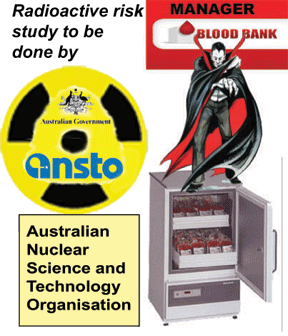 independence or otherwise of ARPANSA.
The saga has exposed inadequate safety practices at ANSTO and an inadequate performance by the regulator ARPANSA. The problems would not have been exposed and partially rectified if not for a number of ANSTO whistleblowers.
A few snapshots of this saga are noted below and more details can be found on the Friends of the Earth website:
28 August 2008 − Incident at ANSTO involving a vial of molybdenum-99. An audit found that proper processes were not followed: evacuation of the area did not occur, timely communication and event reporting, thorough investigation and follow-up did not occur. The staff member in question had not completed occupational health and safety induction training or a radiation safety course.
June 2009 − David Reid, an ANSTO employee and staff-elected health and safety officer, was suspended in June 2009 and sacked in June 2011. He repeatedly raised concerns about contamination incidents and some of his concerns were later vindicated. ANSTO states that his suspension and dismissal were unrelated to his statements regarding safety problems at ANSTO.
5 May 2010 − The ABC report states: “ARPANSA is Australia’s nuclear industry watchdog and Lateline has obtained a copy of its report into the accident. It largely supports David Reid’s concerns and raises further questions about safety at Lucas Heights. Continue reading
USA nuclear-related bases in Australia still targets for attack
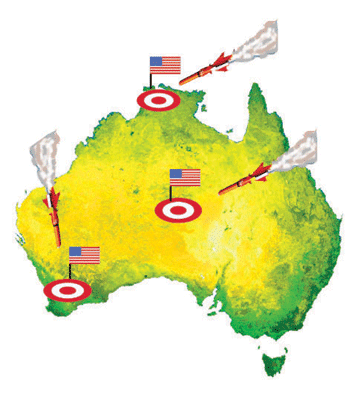
”I am sure that all important targets are included in Russian combat plans,” Colonel Valery Yarynich, a visitor to Australia, said at a rally in Hyde Park on the eve of today’s anniversary of the Hiroshima atom-bombing.
Questioned about the top-secret facilities at Pine Gap near Alice Springs, and WA’s North West Cape communications station, he said: ”Nobody knows, only the high command. It’s secret. Like American plans, too. And targeting can be changed in a matter of minutes.”…….
”I think the world was saved largely due to the fact that missiles of those days were imperfect. They required many hours to prepare to launch. This circumstance helped Kennedy and Krushchev to reach agreement. Today the Russian rocket and the American minuteman demand only a couple of minutes.”
In the 1980s, Soviet strategists became worried the high accuracy of new US missiles might allow a disabling first strike. Colonel Yarynich was involved in setting up the terrifying ”Perimitr” (perimeter) dead-hand system which set off a retaliatory strike automatically from sensor data. It is now disabled. Like many Cold War warriors, the colonel is now involved in efforts to reduce the risk of nuclear war.
He hopes negotiations on nuclear force reductions and de-alerting of remaining forces will pick up between Washington and Moscow after the US election in November and set an example for other nuclear powers. ”We must act,” he said. ”It is necessary and it is possible to remove the finger from the trigger.” http://www.smh.com.au/opinion/political-news/australian-bases-still-in-russian-sights–soldier-20120805-23nxr.html#ixzz22nWt1Gdc
Sydney hospitals’ dangerous dumping of radioactive materials
Toxic health dumping scandal, SMH, July 8, 2012 Natalie O’Brien The dangerous disposal of hazardous substances including liquid uranium and contaminated objects, the dumping of the confidential records of patients and the mishandling of asbestos have exposed a culture of mismanagement in Sydney hospitals. : http://www.smh.com.au/national/health/toxic-health-dumping-scandal-20120707-21nqp.html#ixzz204LVGURR
Lynas’s rare earths stockpile near Fremantle – call for transparency in its radiation monitoring
 Rare earth stockpile radiation levels questioned ABC News, June 20, 2012 An MP is calling on the State Government to make radiation monitoring results public after revelations the Lynas Corporation has been stockpiling rare earth concentrate in Bibra Lake. The Member for Fremantle, Adele Carles, says the Government is yet to confirm whether
monitoring is being conducted.
The Environment Minister Bill Marmion has confirmed the containers have been held at Lynas’ holding yard since March…… Ms Carles says the Government is basically saying the material is perfectly safe. “I say to them, well, if it’s so safe, then release to us the radiation monitoring so that we can see that for ourselves,” she said.
Ms Carles says monitoring is required under a Radiation Management Plan. “That requires that if this material is stored anywhere for more than 24 hours, there must be radiation monitoring,” she said. “I’ve asked to get copies of this monitoring and the Minister has basically denied that information.” http://www.abc.net.au/news/2012-06-20/questions-over-rare-earth-stockpile/4081280?section=wa
Another Northern Territory train derailment highlights danger of radioactive materials transport
Of greater concern was the transport of nuclear waste from Lucas Heights in NSW to the proposed nuclear dump at
Muckaty Station…. “we have extreme weather conditions,”
Crash sparks calls for Adelaide to Darwin rail line probe, BY:REBECCA PUDDY AND DAN BOX The Australian June 11, 2012 THE third derailment on the Adelaide to Darwin railway in just 19 months has reignited demands for an inquiry into the integrity of the track amid plans to increase the amount of uranium the line carries through central Australia. Continue reading
Toro Energy’s plan to track radioactive material through Western Australia and Northern Territory

The Australian, 23 May 12 WEST Australian yellowcake will be carted thousands of kilometres across state borders and shipped out of Adelaide or Darwin in a bold plan that limits political fallout in the west and puts the blowtorch on federal Labor to increase uranium exports.
South Australian company Toro Energy yesterday received approval from the WA Environmental Protection Authority to mine 1200 tonnes of uranium ore from its Wiluna operations, 520km north of Kalgoorlie, and to truck it in 200-litre drums across the Nullarbor. Once it crosses state lines, it will go direct to Adelaide and be shipped out or put on rail to Darwin.
The plan means the yellowcake will not have to be shipped through the port at Fremantle, near Perth, where the local council’s policy declares that “no uranium, nuclear waste nor other material connected with the nuclear power industry may be stored or transported in or through the municipality”.
ANSTO says not involved in 1981 truck’s toxic spill. Inquiry to be held
Nuclear agency distances itself from toxic scare ABC News, April 18, 2012 Australia’s peak nuclear agency says toxic material that has halted upgrade work of the Pacific Highway in New South Wales did not originate at its Lucas Heights facility…… a statement from the Australian Nuclear Science and Technology Organisation (ANSTO), says a review of records shows its predecessor, the Australian Atomic Energy Commission (AAEC), was not concerned with any aspect of the truck accident….
It went on to say that a report from April 1981 stated that “the sources were not the property of the AAEC nor were they being consigned to or from the AAEC”. “They were the property of a geophysical company and do not appear to have suffered any harm.” ANSTO says it has received advice from the Environmental Protection Agency that there is no indication of radioactive drums or canisters being located at the site……A federal parliamentary report into
hazardous materials in 1982 included details of the crash which Mr Higgins says is being checked in light of the sick workers….. http://www.abc.net.au/news/2012-04-18/ansto-distances-itself-from-radiation-scare/3958572
Minister calls for highway inquiry http://news.smh.com.au/breaking-news-national/minister-calls-for-highway-inquiry-20120419-1x83j.html April 19, 2012 NSW Roads Minister Duncan Gay says an independent inquiry will investigate how five road workers came to be exposed to potentially toxic material buried on the state’s mid-north coast. Continue reading
New South Wales: road workers made sick by ionising radiation?
 Workers sick amid highway radiation scare http://www.abc.net.au/news/2012-04-18/radioactive-discovery-halts-pacific-hwy-upgrade/3957168 April 18, 2012 Road workers were sent for medical treatment after vomiting when suspected nuclear material was unearthed during work on an upgrade to the Pacific Highway on the mid-north coast of New South Wales The materials, which include caesium, were buried north of Port Macquarie after a truck carrying radioactive isotopes from Sydney’s Lucas Heights nuclear reactor crashed in the area in 1980.
The isotopes were being taken to Brisbane, before being shipped to the United States. The upgrade’s project manager, Bob Higgins, says road workers fell ill after unearthing a strange clay-like material.
“As we’ve taken down the cutting there we exposed the face of the existing material (and) came across a clay material that when it’s exposed to air it gets an orange streak through it,” he said. “There were a number of workers that felt a little bit of nausea and there was a bit of vomiting when they were in close proximity. “[They went] off to the doctor, but obviously we need to be extremely careful here.”
The Environmental Impact Statement for the highway upgrade had noted some uncertainty about where exactly the containers were buried. Specialists are in the area assessing what to do with the radioactive materials, and if they pose any risk.
Lucas Heights nuclear reactor’s slips and leaks
Radiation leak fear at Sydney’s Lucas Heights as four workmen contaminated, Linda Silmalis The Sunday Telegraph April 15, 2012 FOUR workmen at the Lucas Heights nuclear reactor suffered low-level radiation contamination late last year.
An investigation by the nuclear safety watchdog of the reactor log books to ensure it was meeting its licence conditions has found a rise in the number of contamination events recorded in November and December..
…Two reactor trips were also recorded, while “unusual” water leakage was identified coming from one of the control rods, the Australian Radiation Protection and Nuclear Safety Agency report said…. While the watchdog ticked off the 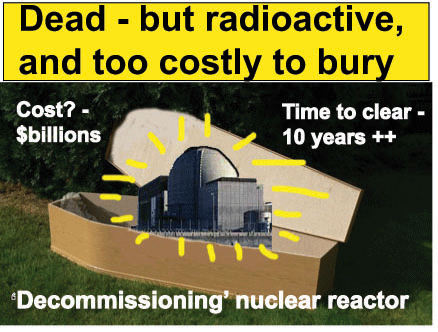 operations at the reactor as complying with safety regulations, it recommended the Australian Nuclear Science and Technology Organisation (ANSTO) consider increasing the level of detail it recorded for events.
It noted a number of events and items of interest that had been recorded in the Reactor Operation Event Management System and log book. “The number of minor contamination events at OPAL has increased recently,” it said..
… OPAL replaces the high flux reactor, which began a $50 million decommissioning phase in 2007. The process is expected to take 10 years, with dismantling of the structure only to begin in 2016 after short-lived radioactive materials in the reactor have decayed. http://www.dailytelegraph.com.au/news/sydney-nsw/radiation-leak-fear-in-sydney/story-e6freuzi-1226326493993
Willy Brigitte, who planned attack on Lucas Heights Nuclear Reactor, arrested in France
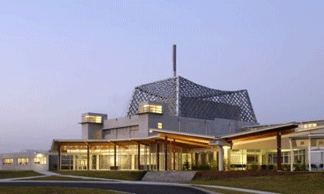 Militant who targeted Australian nuclear plant held in France http://articles.timesofindia.indiatimes.com/2012-03-31/europe/31266028_1_islamist-militants-nicolas-sarkozy-french-muslim Reuters Mar 31, 2012, PARIS: A French Muslim convert convicted in 2007 for planning an attack on an Australian nuclear plant is one of the suspected militants being held for questioning after a series of raids throughout France, a police source said on Saturday.
Willy Brigitte was arrested on Friday at his home in Asnieres, a northwestern suburb of Paris. Authorities found no weapons but seized his computer and a mobile phone, the source told Reuters.
South Australian will have no say about radioactive waste transport through their State
 South Australians will be given no say on the transportation of radioactive waste through the state as the National Radioactive Waste Management Act overrides all state laws. SA laws regulating the transport of hazardous materials will have no effect. South Australians will have no say over the mode of transport or the route taken or the timing of waste transportation through the state.
SA must win nuclear battle with feds, Independent Weekly (SA) Jim Green , 27 March 2012
www.indaily.com.au/#folio=10 EIGHT years ago South Australians won a famous victory, forcing the Howard government to abandon its plan to establish a national radioactive waste dump in SA. The victory was all the sweeter because of the schoolyard-bully tactics of the Howard government including its use of compulsory land acquisition powers and its indifference to public opinion and to South Australian legislation banning the imposition of a nuclear dump…..
The current [nuclear waste] debate has important implications for SA. A federal government-commissioned report outlines four possible transport routes between the Lucas Heights nuclear site in NSW and the proposed NT dump site. Two involve trucking waste long distances through SA (one through Adelaide) and a third involves train transport through SA including Adelaide. The report also flags the option of spent nuclear fuel reprocessing waste being shipped from France and the UK to Port Adelaide then being trucked north. Continue reading
Earthquakes in South Australia, latest is near Olympic Dam uranium mine
SEISMIC SURGE IN FAR NORTH: 3.9 EARTHQUAKE NEAR ROXBY DOWNS, Coober Pedy Regional Times, 26 March 12, A 3.9 magnitude earthquake has struck near Olympic Dam in South Australia’s Mid – Far North overnight, in addition to a spate of 4 separate earthquakes in the Far North of the state in the past week.

The succession of medium to significant earthquakes has promted Geoscience Australia to begin setting up seismic monitoring equipment in the Far North where three of the earthquakes occured last week including a 6.1 magnitude quake….. The most recent earthquake which occured overnight is not far from the townships of Roxby Downs and Andamooka near the Stuart Highway, and situated within relatively close proximity to a number of the state’s mining and prospecting operations including the Olympic Dam uranium mine, whose massive orebody engulfs the 35km Masher’s Fault. …… http://cooberpedyregionaltimes.wordpress.com/2012/03/26/seismic-surge-in-far-north-3-9-earthquake-near-roxby-downs/
4 earthquakes in South Australia’s far North within the past week
 SPATE OF EARTHQUAKES HIT SOUTH AUSTRALIA’S FAR NORTH, Coober Pedy Regional Times, 24 March 12, A spate of earthquakes all within a week of each other have occurred in South Australia’s Far North with three strikes on the APY Lands. A significant 6.1 earthquake struck near Ernabella (Pukatja), Fregon and Indulkana on the APY Lands at 8.25pm South Australian Daylight Savings Time CDT Friday night 23 March 2012. ..
… Three further earthquakes have struck South Australia’s Far North in the past week.
16 March a 4.3 earthquake struck in the Musgrave Ranges near Ernabella at a depth of 15 km.
20 March a 3.8 earthquake struck in the Musgrave Ranges near Ernabella at a depth of 10 km.
21 March a 3.9 earthquake struck between Oodnadatta and William Creek in the Arckaringa Basin at a depth of 0.007km. http://cooberpedyregionaltimes.wordpress.com/2012/03/24/spate-of-earthquakes-hit-south-australias-far-north/
Lynas’ Mt Weld rare earths mines found to have out-dated safety permits
Lynas’ Mt Weld Rare Earths Mines Safety Permits Outdated : http://community.nasdaq.com/News/2012-03/lynas-mt-weld-rare-earths-mines-safety-permits-outdated.aspx?storyid=125132#ixzz1oO63K2tj NASDAQ 3/5/2012 by Esther Tanquintic-Mis The controversy now has hit home. With Lynas Corp. still to fully arrest and win over the controversy surrounding its Lynas Advanced Materials Plant (LAMP) in Malaysia, here comes yet another information that could possibly whip up a storm right where its home base is.
In a statement released to media news agencies worldwide, the Anti-Nuclear Alliance of Western Australia (ANAWA) is set to file a motion today, Mar. 6, at the Environmental Protection Authority (EPA) to question the authenticity and effectiveness of the health and safety approvals issued to Lynas Corp. in reference to its Mt Weld rare earths mines in Western Australia.
According to the Free Malaysia Today, it was the Environmental Defenders Office of Australia that issued the media statement.
Marcus Atkinson, ANAWA spokesperson, alleged Lynas Corp. had made a number of alterations on the original health and safety approvals issued more than a decade ago for the operations of Mt Weld that did not undergo through the appropriate standard operating procedures relative to updating or modifying obsolete approvals.
“Lynas are currently operating under approvals issued to them 14 years ago,” Atkinson said, noting the terms and conditions contained in the original approvals could possibly no longer hold true to this day, specially “the amounts of radioactive materials being transported from Mt Weld through Fremantle Port.”
The Australian non-governmental organization urged the EPA to scrutinize the present operations at Mt Weld versus was what contained in the original health and safety approvals. “Health and safety issues need to be thoroughly examined to ensure the best protection of those involved in the handling of this material,” he said.
“The approvals given 14 years ago need to be re-examined by the EPA and stronger regulations need to be put in place to ease the fears of the community.” ANAWA also called for “extremely stringent” safeguards to protect Fremantle residents and other communities along the transport routes.
“We have made many mistakes in the past with the transport of lead and other materials, and we need to ensure that the same mistakes are not made with rare earth products,” Atkinson said.
Lynas Corp. is currently embroiled in a bitter battle against residents and political wannabes in Malaysia over its $200-million rare earths processing plant project in Gebeng, Kuantan.
Olympic Dam uranium mine at risk from earthquakes
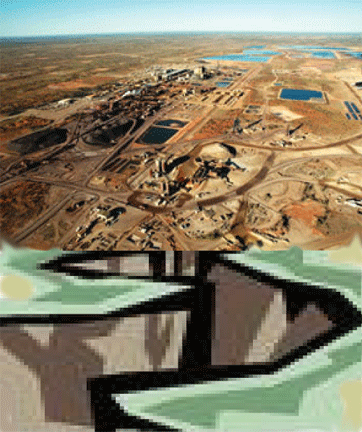 from our Seismology Watcher, 28 feb 12, Australian Yet another timely warning for Quarry Australia following seismologist, Edward Cranswick’s peer-reviewed paper on the 35-km-long, steeply dipping Mashers Fault which passes through the middle of the Olympic Dam ore body. The fault length implies an earthquake of maximum about 7.
An observation by Cranswick is that censoring of Australian lists of earthquakes and their corresponding source parameters, (i.e., time, location, depth, magnitude) has taken place.
Cranswick, who investigated earthquakes for the US Geological Survey for 22 years, suggests that the connection between mining and sesmicity (earthquakes) is obscured in Australia particularly the seismic hazard of the OD project in SA. Seemingly, BHP’s proposed expansion and potential radioactive fall-out at the Olympic Dam project in the event of a “natural” catastrophe reveals scant regard for public health and safety. However, there is nothing like an outraged Momma Nature (whose **se is being chewed by the mining industry) to make an ecocidal event, a grim reality.
Cranswick also makes reference to the Barrick/Newmont super pit and its connection to the unprecedented 5.2 magnitude earthquake that occurred in the stable continental region of Kalgoorlie/Boulder in April 2010. And what a pitiful mess that made of the historic buildings in the main street of Boulder which is about a kilometre from the super pit.
En garde my fellow Australians, asleep at the wheel.
1 This month

of the week – Australians for War Powers Reform (AWPR)
To see nuclear-related stories in greater depth and intensity
 Antinuclear