Production at Australia’s only nuclear medicine facility halted after ‘safety incident’
Production at Australia’s only nuclear medicine facility halted after ‘safety incident’ Production has ceased and an urgent investigation has been launched after two employees at a newly opened Australian nuclear medicine facility at Lucas Heights were exposed to an unsafe dose of radiation late last week.Just two weeks after it was granted a licence to enter into full domestic production, the Australian Nuclear Science and Technology Organisation (Ansto) has confirmed production at its new $168m nuclear medicine facility has been halted after “a safety incident” on Friday morning.
Ansto said three of its workers were “attended to by radiation protection personnel” after the incident, in which contamination was detected on the outside of a container holding 42 millilitres of the radioisotope molybdenum-99 (Mo-99).
Two of those workers received a radiation dose above the legal limit roughly equivalent to a conventional cancer radiation therapy treatment, an Ansto spokesman said……
Located at the Lucas Heights nuclear facility in Sydney’s south, the $168m nuclear medicine facility was announced by the federal government in 2012 with the goal of tripling Australian production of Mo-99, the parent isotope of Technetium-99m. …..
It is the second contamination scare at the Lucas Heights facility in only a few months.
In March three staff at the Lucas Heights nuclear facility were taken to hospital after they were exposed to sodium hydroxide when a cap came off a pipe in the nuclear medicine manufacturing building. https://www.theguardian.com/australia-news/2019/jun/24/two-workers-exposed-to-unsafe-radiation-dose-at-lucas-heights-nuclear-facility
Veteran of Chernobyl nuclear clean-up: HBO TV episode was very accurate
Chernobyl Episode 4 Scene | HBO | Graphite Clearing
This man knows what it’s really like shovelling radioactive debris on top of Chernobyl’s reactor ABC News , 21 June 19
Key points:
- At age 32, Jaan Krinal was forced to go to Chernobyl and clean the roof of the reactor
- He says men were initially enthusiastic to help eliminate the radiation
- One-third of the men of his town he served with in Chernobyl have died
When he left his wife and two children on May 7, 1986 and went to work, Jaan Krinal didn’t know he would be one of those people.
The 32-year-old was working on a state-owned farm in Soviet-occupied Estonia.
Because he’d been forced to complete the Soviet military’s retraining a year before, he was confused when officers surprised him at work and said he’d been called up again — immediately.
Jaan and 200 other men were taken to a nearby school. Once they’d walked through the door, no-one was allowed to leave.
The men’s passports were seized before they were loaded onto buses and taken to a forest, where they were told to slip into brand new army uniforms.
“That’s when I first questioned what’s really going on here,” Jaan recalls………
Workers told radiation could have health benefits
It all happened fast.
Hundreds of men boarded a Ukraine-bound train on May 8. By the next evening, they were setting up camp on the edge of Chernobyl’s exclusion zone.
They were just 30 kilometres away from the site of the world’s worst nuclear disaster — the still-smouldering wreckage of a reactor torn apart by a series of explosions and spewing radiation in a plume across Europe.
Jaan was among the first group sent to clean up in the aftermath of the catastrophe.
Tasked with hosing down radiation on the houses in nearby villages, he was thrown into the thick of it……
Despite the apparent uselessness of the job, they continued to work 11-hour days without a day off until the end of June. After that, they had two days of downtime a month.
As the weeks rolled on, suspicions grew.
“We started to have doubts. But all the officers said, ‘Why are you fretting, the radiation levels aren’t that high.”
In a cruel irony, the commanders told the men that being exposed to radiation would actually have health benefits.
“They joked that whoever has cancer can now get rid of it — because the radiation helps,” Jaan says.
Men unaware of deadly reason behind roof time limit
By the end of September, whatever enthusiasm the men initially felt had faded.
As many developed a cough, concerns grew about whether they were being lied to about the radiation being harmless. The respirators the men were given wouldn’t stay on because of the heat and were used until they got holes in them.
Later they found they should have been replaced every day…….
A rumour had it that the very last leg of the assignment was going on the roof of the reactor to clean up as much debris as possible.
Humans were going to be given a task that remote-control robots had previously attempted, but failed. The machines simply stopped working due to the unprecedented levels of radiation.
“When they told us, ‘You have to go to the roof’, we thought, ‘Oh, this means we can go home soon’,” he says.
On the day, he changed his army uniform for a protective suit, glasses and a gas mask, and a metal groin guard.
“We were all lined up and told, ‘who doesn’t want to go on the roof, step forward’. But only a couple of us did,” he says.
“There was no mass rejection. Most people went up there.
“It had to be done. We couldn’t just leave it. I think everyone realised the longer the reactor would have stayed open, the more dangerous it would have become.”
Jaan was shown on a small screen exactly which piece of debris he had to pick up with a shovel and throw off the roof of the reactor, but strictly warned against going too close to the edge.
He had two minutes to complete the assignment — a bell would ring to tell him when to run back.
The two-minute timeframe was to limit exposure to radiation, which could kill a man.
But this wasn’t communicated to the men at the time.
Jaan says the roof-cleaning scene depicted in HBO’s mini-series Chernobyl mirrored real life events…….
A staggering one-third of the men of his town who went to Chernobyl have died.
The average age of death has been 52.
“Over the past couple of years, just a couple of us have died. But not too long ago it was around 10 men a year,” he says.
“There have been cancers. There have been suicides too, but thankfully not too many.”……
he hopes tourists won’t start flocking to the ghost city.
“I hope they’ll never start sending large groups of tourists there. It’s still a dangerous zone,” he says.
He hasn’t seen the mini-series, but welcomes the attention Chernobyl disaster is getting — he thinks it acts as a warning to the human kind. https://www.abc.net.au/news/2019-06-22/chernobyl-what-it-was-really-like-on-top-of-reactor/11223876
Corruption in the Australian uranium industry
Radioactive Corruption Video 1
Gal Vanise, · PREPARE TO BE ABSOLUTELY SHOCKED ………………….Pilot Plant near Roxby 1996 . This was an elaborate Government and corporate cover up under the Lib Government of the day. If you think the mining companies are doing ALL THE RIGHT THINGS…They are not. You only need to ask anyone who works in a mine how things don’t get reported..Out of sight out of mind.
This site was later ‘repatriated’ but no one can say where the contaminated waste was taken to other than ALLEGEDLY by the truckloads carried on trucks from Roxby Downs to Port Adelaide ….through townships and urban residential areas.. I fully expect I will get in trouble for this even though I haven’t committed any free speech crimes. SHARE TO AS MANY PEOPLE AS POSSIBLE.. NOW I ASK YOU THIS!.. WILL THIS NEW LIB GOV DO THE RIGHT THING IN REGARD TO THE PROPOSED RADIOACTIVE WASTE DUMP IRREGARDLESS OF WHERE IN SA THEY PLACE IT?.. NOT IF THESE VIDEOS ARE ANY INDICATION. THIS IS DYNAMITE… AND I WILL NEED A BLOODY GOOD LAWYER ONCE ITS OUT.
Radioactive Corruption Vid 2
-
Peter Jack I worked at Roxby Downs in 1986. I got to go underground. Back then there was about 60 kilometres of roads down there. As we drove around we were shown these massive caverns some were filled with water possibly direct access to the great artesian basin and others with floor to ceiling blue plastic barrels full of yellow cake.
I assume they were all transported through residential areas.
-
Brett Burnard Stokes These unsealed radioactive sources are highly dangerous and illegal. The dust is the big issue, along with radon gas which is heavy and collects in cellars etc, What are the longer term health impacts, you might ask. Radon and uranium dust can cause lung cancer and other issues.
These and other radioactive poisons cause genetic damage and more. -
Trevor Vivian Outta sight, outta mind is the MO of all mining the world over and in Australia the state & Federal govt’s refuse to support whistleblowers. At Mt Todd (NT) photo evidence of unbunded drill pads with waste polluting local creeks caused A Senate review(early 90’s) which shut down this disasterous destruction of Jaywon Sacred sites. The hostility from Mine managers toward bird survey whistleblowers meant never working in Australian mining ever. To me it is a badge of honour to reveal these lying thieving Global Corporate miners outta sight, outta mind operations.
- Gal Vanise HERE IS A QUOTE FOR THE DISBELIEVERS.. I WONT REVEAL THE WHO’s OR IDENTIFY THE PARKERS IN THE SIN BIN. I GAVE MY WORD…………………………”I was XXXXXXXXXXXX I know where it is. 198X. I was told to never tell anyone. It’s worried me ever since We dumped the unprocessed concentrate into the main tailings dam. It’s was blowing all over the place as the nylon bags had broken. Took two nights. Myself xxxxxxxxxxxxxxxboss who oversaw the job.
A couple of days later one of those 7:30 type shows questioned the ……….. mining on tv. He denied any waste dumped.
xxxxxxxxxx only had about xxxxxxx working for xxxxxxxxx. But after we did that job he got all the contracts.
Really shonky. Ive never heard what happened toxxxxxxxxxxxxx but one of the older xxxxxxxxx mining blokes had to take samples from the bags.
Mr.xxxxxxxx went off at him because his radiation tag came back high.
He accused him of putting it in the concentrate. I never wore mine. xxxx was also a lazy buggar.
At the same time they had a ball mill break down.
It was going to take forever to screen the steel balls from the mill. xxxxxxxx got us to dump this as well.
We pushed the whole lot into the water and by day light it was covered.
We then went back and covered the pilot plant with fresh crusher dust.
and finished just before the inspector arrived.” MY ONLY HINT TO THIS IS… WHO WAS A PROMINENT COMPANY THEN AND ISNT ANYMORE? THANK YOU ELEMENTARY FOR YOUR STORY… I HOPE YOU CAN BREATHE NOW YOU GOT IT https://www.facebook.com/danlee67/posts/587530574936680
ANSTO can afford to help China build new reactors, but apparently not to maintain its own building safely
 How come, if ANSTO is so cash-strapped, that its CEO Dr Adi Paterson, can find the money to join with China’s SINAP in developing Thorium Molten Salt Reactors? https://independentaustralia.net/environment/environment-display/australia-is-back-in-the-nuclear-game,12488#.XJWdhxDqitc.twitter
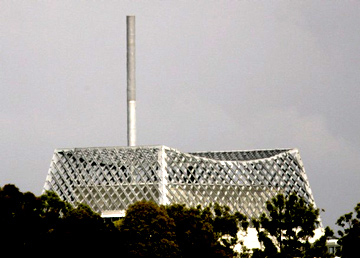
 Federal budget leaves ‘urgent’ rebuild of Sydney nuclear facility up in air https://www.smh.com.au/national/federal-budget-leaves-urgent-rebuild-of-sydney-nuclear-facility-up-in-air-20190403-p51ags.html#comments, By Carrie Fellner, April 4, 2019 The Morrison government has failed to provide the $210 million needed to decommission an “unsafe” nuclear medicine facility at Lucas Heights, with money only provided towards a business case in this week’s federal budget.
The decision has sparked concern for public safety, after an independent panel of experts found the building did not meet modern nuclear safety standards and called for its urgent replacement last October.
“The lack of a permanent replacement solution … is undermining the possibility of truly effective risk control,” the reviewers found.
Known as “Building 23”, the facility – built in the 1950s – has been dogged by accidents and near-misses in recent years, including a radioactive spill in 2017 that was then classified as the most serious incident in the world.
The Australian Nuclear Science and Technology Organisation (ANSTO) is responsible for maintaining Building 23.
Tuesday’s federal budget sets ANSTO’s 2019-20 funding at $354.9 million, which includes more than $56.4 million for the support of nuclear medicine production.
Money to plan for the replacement of the building must be drawn from a bucket of $26 million given to ANSTO for the “maintenance of ageing infrastructure”, according to an ANSTO statement.
The same money must also cover the management of spent nuclear fuel and waste and planning for the production of nuclear medicine in the future.
Minister for Science and Technology Karen Andrews said the funding given would allow “the development of a business case to consider options to secure the long-term and sustainable future of Australia’s nuclear medicine supply”.
“The funding will enable proactive maintenance work and equipment upgrades to support the ongoing operations of the nuclear medicine production facility,” she said.
But Labor slammed the government’s decision not to provide the full amount to replace the building, arguing it was “clear it is no longer fit for purpose”.
“Despite warnings from ANSTO, and the recent independent report, the government has not made public any plans to replace or upgrade Building 23,” opposition spokesman for science and research Kim Carr said.
“As a matter of public safety, we expect that the government should act on this matter.
A spokesman for ANSTO welcomed the overall funding increase of $112.4 million since the previous financial year, and said the budget had made provision “to start the necessary planning work” for the replacement of Building 23, to occur “over a five- to 10-year horizon”.
“Regarding Building 23, it is typical practice around the world, including Australia, that nuclear facilities are both planned for, then operated, over horizons of many decades,” the spokesman said.
The most serious of the accidents at the building occurred in August 2017, when a worker suffered blisters after a vial of radioactive material spilled onto his hands. The employee received a “significant radiation dose”, elevating his risk of cancer.
There were a further three incidents within the following 12 months.
A replacement facility had been in the pipeline for several years but plans had been hindered because of federal government budget restrictions, the review found.
“Heightened expectations and then subsequent failure to secure backing for replacing this
ageing facility has led to frustration, disappointment and cynicism amongst the staff,” it said.
The review made 85 recommendations, including that the Australian government commit to a replacement facility as soon as practicable.
According to the regulator – the Australian Radiation Protection and Nuclear Safety Agency [ARPANSA] – an implementation plan to address the rest of the recommendations is still under development.
ANSTO submitted a draft of the plan to the regulator last December, but is yet to receive approval.
An ARPANSA spokeswoman said the organisation had “demonstrated progress” towards addressing the recommendations.
“However [it was] felt that ANSTO did not provide sufficient detail around the objectives and strategies that would achieve the desired improvements and safety outcomes,” she said.
The organisations were in “frequent communication” and it was anticipated the plan would be approved in coming months.
“Twenty actions responding to the recommendations in the report have already been completed,” the ANSTO spokesman added.
Three people treated at Sydney’s Lucas Heights nuclear facility after chemical spill
Three staff at the Lucas Heights nuclear facility have been decontaminated after being exposed to a chemical spill.
Key points:
- Australia’s only nuclear reactor is located at Lucas Heights, about 40km south of Sydney’s CBD
- Two men and a women were decontaminated and taken to Sutherland Hospital
- The facility has had several contamination scares in recent years
A spokesman for Australia’s Nuclear Science and Technology Organisation (ANSTO) said the workers were exposed to sodium hydroxide when a cap came off a pipe in the nuclear medicine manufacturing building…………
Contamination scares
The Lucas Heights facility, about 40 kilometres south of the Sydney CBD, has had several contamination scares in recent years.
In August 2017 a worker suffered blisters on his hands after he dropped a vial of radioactive material and was contaminated through two pairs of gloves.
The event was deemed the most serious in the world in 2017, according to the International Nuclear Event Scale — the global grading system for nuclear incidents.
ANSTO apologised to the worker who was exposed to the radioactive material and produced an “action plan”, in response.
An independent review of the facility was conducted in October 2018 and found that it failed modern nuclear safety standards and should be replaced.
In the same week ANSTO confirmed five workers had received a dose of radiation at the facility, but that the amount of radiation was “less than a chest X-ray”.https://www.abc.net.au/news/2019-03-01/three-treated-after-safety-breach-at-sydney-nuclear-facility/10860708
Earthquake close to Federal govt’s planned nuclear waste dump site – Kimba South Australia
Earthquake Felt In Cleve Kimba Area Last Night. 3.7 On The Scale.
Geoscience Australia said 13 reports of the tremor had been received from Whyalla. The tremor was magnitude 3.7 on the Richter scale at a depth of 10 kilometres.
It was felt as far away as Kadina on Yorke Peninsula.
A Geoscience spokesman at the National Earthquake Alerts Centre in Canberra said that In the past 100 years there had been more than 300 earthquakes in the region. …https://www.whyallanewsonline.com.au/story/5772041/tremor-hits-whyalla/
Spikes in radiation monitored during bushfires near Lucas Heights nuclear site
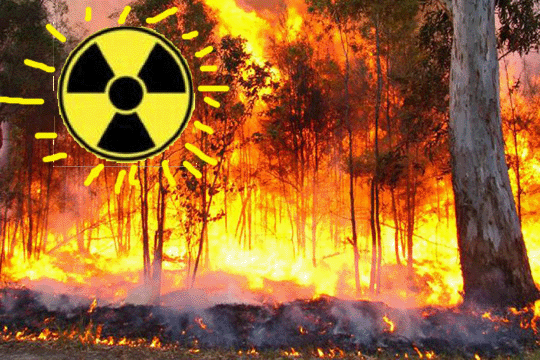 15th April 2018 – Residents told to “Shelter in place”, Peter Daley
technologypals.com.au, 20 Nov 18
The Australian Nuclear Science and Technology Organisation (ANSTO) local radiation monitor station shows significant spikes in radiation during the fire event.
Below are screen shots from the ANSTO radiation monitoring station at Endagine. Endagine is located East of the Lucas Heights reactor.
What caused this spike in local radiation?
Did the fire release local radioactive contamination?
Reactor venting?
Fault in equipment?
Their rainfall monitor shows it definitely was not raining at the time of these detections, so these detections can’t be explained away as Radon wash out events.
Radiation Spike plus rainfall chart 15th to 16th April
More Radiation detection spikes showing on the live Engadine ANSTO monitor station chart, 19th April.
ANSTO live monitoring site,
IAEA sees ‘Areas for Enhancement’ in Australia’s Nuclear and Radiation Safety
IAEA Mission Says Australia Committed to Strengthening Nuclear and Radiation Safety, Sees Areas for Enhancement, IAEA, 52/2018, Melbourne, Australia An International Atomic Energy Agency (IAEA) team of experts said Australia is committed to strengthening its regulatory framework for nuclear and radiation safety. The team also noted areas for further enhancements, including implementation of the framework in a more consistent manner across the country.
The Integrated Regulatory Review Service (IRRS) team on 16 November concluded a 12-day mission to Australia. The mission was conducted at the request of the Government of Australia and hosted by the Australian Radiation Protection and Nuclear Safety Agency (ARPANSA), the Commonwealth Government regulator. Under Australia’s federal system of government, ARPANSA regulates Commonwealth entities and other entities are regulated within the six states and two territories. The majority of licenced activities in Australia are carried out within states and territories. This was the third IRRS mission to Australia since 2007 and the first to include all nine jurisdictions.
……..The IRRS team commended the hosts for inviting a comprehensive review involving all jurisdictions in Australia, adding that it was the first such IRRS mission. The team identified this as a good practice and a model that other federal countries may want to consider when planning for future IRRS missions. Regarding the national framework, the team noted ongoing activities to address consistency in the country’s radiation safety programmes, but said further efforts were warranted in several areas……
The team provided recommendations and suggestions for further enhancements, including:
- All relevant authorities should consider formalizing the existing elements of the framework for safety into a comprehensive national policy and strategy for safety.
- The Commonwealth Government should make a firm commitment and take actions with specific milestones to address decommissioning of facilities and radioactive waste management.
- The Governments of all jurisdictions should ensure that all parties responsible for the safety of facilities and regulatory activities have the necessary capabilities and human resources to carry out their responsibilities.
- ARPANSA should establish criteria to evaluate the effectiveness of licensees’ emergency exercises and assign roles and responsibilities for its staff during emergency situations.
Lucas Heights nuclear reactor in disarray – costs and safety problems
Delays hold back nuclear medicine – SEAN PARNELL, OCTOBER 26, 2018 https://www.theaustralian.com.au/national-affairs/health/delays-hold-back-nuclear-medicine/news-story/16d8606ac2f0e5c1d8e9010ea316aa74
Australia’s production of nuclear medicine is in disarray, with a promised world-class manufacturing plant running two years behind schedule, unresolved questions over waste management, and broader concerns over ageing facilities and safety issues at Lucas Heights.
A conveyor breakdown in June at building 23 — where a series of safety incidents prompted a damning independent review — has caused ongoing supply issues throughout Australia and overseas.
The Weekend Australian has learned the existing plant will not be able to resume full domestic production of generators until next year. Amid the disruptions, the Australian Nuclear Science and Technology Organisation has been forced to import generators and trade local ingredients with an American producer. It is refusing to detail how much the inefficient workaround is costing.
One of the safety incidents that prompted a rare intervention by the regulator was caused by a wheel falling off a trolley. It has now emerged the conveyor breakdown was caused by damage to the guide rails that other trolleys use and the conveyor chain guides themselves.
With nuclear medicine stakeholders expressing frustration at the ongoing delays, and a perceived lack of transparency by ANSTO, Industry, Science and Technology Minister Karen Andrews has asked the agency to respond to the internal review as a priority.
“I’ve also sought assurance from ANSTO that they are supplying the market at normal levels,” Ms Andrews said.
Stakeholders had raised concerns with the minister’s predecessor without response and point to continuing practice restrictions.
A new $168.8 million plant, to be known as ANSTO Nuclear Medicine, was meant to be operational in 2016 and as much as triple the production of generators, making Australia a major global player. However, it will not be operational before early next year — ANSTO will not say if the budget has blown out — and license conditions set by the Australian Radiation Protection and Nuclear Safety Agency add to the challenges.
ARPANSA will not allow any overall increase in production until the existing plant is decommissioned, adding to delays, and is demanding more information on plans for a new waste-management facility — including contingency plans should it, too, be delayed.
The ANM would also rely on building 23 which, like the existing plant, was built in the 1950s and is past its use-by date. The independent review revealed ANSTO wanted to replace the building “but federal government budget restrictions have meant that this has not been progressed”.
“A number of additions and modifications have been made to the facility, but these cannot possibly resolve all of the issues associated with a facility not designed for its current use,” the review concluded.
Ms Andrews would not be drawn on the issue, saying it was a matter for ANSTO to respond to the independent review, which also raised concerns over culture.
ARPANSA is overseeing the independent review and has given ANSTO more time to respond to the recommendations.
Another radiation contamination incident at Australia’s Lucas Heights nuclear reactor

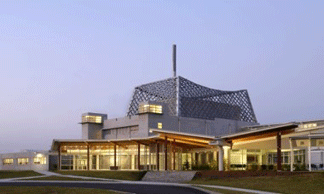 Lucas Heights nuclear reactor in another contamination scare amid calls for safety review, By John Stewart and Rebecca Trigger, ABC Investigations 24 Oct 18 There has been another contamination scare at Australia’s only nuclear reactor in southern Sydney, in the same week a report was released recommending immediate action to review safety procedures at the site.
The Australian Nuclear Science and Technology Organisation (ANSTO) confirmed five workers reported receiving a dose of radiation, but it was not above allowable limits.
………The Australian Manufacturers and Workers Union (AMWU) told the ABC at 11:30am on Tuesday, five employees working in the industrial handling bay inside building 23 were contaminated by an airborne iodine isotope.
The AMWU said one employee had been sent for thyroid scans, and another had to shave part of his beard off as it was carrying contaminates.
The scare came in the same week as a report into the ageing facility found it failed modern nuclear safety standards, and needed to be replaced, after another worker was exposed to radioactive material last year.
The union said Tuesday’s contamination was a result of comprehensive and repeated failures to protect the safety of workers at the site.
……….‘Legacy’ buildings at nuclear site need action, report finds
A worker was exposed to hazardous material after dropping a vial in an area of the facility known as building 23 in August last year.
The event was deemed the most serious in the world in 2017, according to the International Nuclear Event Scale.
A review conducted by the Australian Radiation Protection and Nuclear Safety Agency (ARPNSA) following this incident, found two buildings at the site — 23 and 54 — were relatively old “legacy” facilities designed to meet 1950s-era standards, “and therefore may not fully meet modern standards of nuclear design, safety and operational workflows”.
“However, it should be noted that both facilities have met the safety requirements of the applicable regulators,” the report said.
The report also noted concerns around “unacceptable” behaviours including allegations of bullying and harassment of ANSTO staff.
ARPNSA made 85 recommendations, and directed ANSTO to “take immediate steps to initiate an independent review of the approach to occupational radiation safety of processes and operational procedures in B23″……..https://www.abc.net.au/news/2018-10-24/contamination-scare-at-australias-lucas-heights-nuclear-reactor/10422476
Safety concerns about Lucas Heights nuclear reactor: needs $210m tax-payer funded upgrade
Steve Dale According to the article below, this is referring to “Building 23” – which “operates a nuclear medicine production facility and is responsible for distributing “finished” products”. So it sounds like ANSTO have got their hands out again for more taxpayer money for their messy, high-volume waste producing nuclear medicine factory. ANSTO should be putting all their efforts into finding methods that minimise the waste eg. cyclotrons.
Unsurprisingly the article also mentions –
“A perception of widespread bullying also emerged, with about one in five ANSTO staff interviewed saying they had “experienced bullying” over a six-month period.” Seems like ANSTO is toxic in multiple ways https://www.abc.net.au/…/lucas-heights-nuclear…/10403532
Sydney nuclear facility needs $210m revamp: report, SMH, 22 October 2018 The federal government’s ageing nuclear medical facility in southern Sydney should be replaced or rebuilt due to safety concerns, an independent report says.
The expert report published on Monday found there was a “make do and mend” culture at the Australian Nuclear Science and Technology Organisation site in Lucas Heights.
The report found the 1950s-era nuclear medical facility failed to meet modern nuclear safety standards.
A replacement facility has been in the pipeline for several years but plans have been hindered because of federal government budget restrictions, the report says.
The organisation’s boss on Monday argued if work started “today” on a new $210 million building, it could be up and running in five years.
While several modifications have been made to the facility, the report found upgrades cannot resolve all of its problems.
In August 2017, a technician at the facility was exposed to radioactive material that contaminated his hands through two pairs of gloves after he dropped a vial, exposing him to an elevated risk of cancer.
The incident was the most serious in the world last year – the only safety failure that was rated a “Level 3” event or above. It was followed by three other less-serious incidents – “near misses” – within the next 10 months.
“It should be noted that Level 3 events are regarded as serious events in the nuclear industry and any additional events at this level may result in loss of confidence in the organisation,” the report says.
……. The report made 85 recommendations, including that the Australian government commit to a replacement facility as soon as practicable and provide additional funding or find alternative funding for the new site. https://www.smh.com.au/national/nsw/sydney-nuclear-facility-needs-210m-revamp-report-20181022-p50b9z.html
Defence Department breached radiation regulations
Defence breached radiation regulations, THE AUSTRALIAN, By RORY CALLINAN, OCTOBER 22, 2018
The Defence Department has blamed poor record keeping for its failure to properly transport and dispose of small amounts of radioactive material contained in lighting systems accompanying old artillery pieces.
The Australian Radiation Protection and Nuclear Safety Agency found Defence had breached licence conditions in relation to the material in lighting systems associated with the Hamel 105mm towed light howitzers that were phased out of operation in 2018
Defence failed to comply with regulations in regard to disposing of controlled material without prior approval and not following the transport code for radioactive sources, said ARPANSA’s recently released annual report.
……. The spokesman said after investigating the matter, Defence had acted to ensure that similar incidents would not occur.
He said ARPANSA had been satisfied with the action taken and it accepted no radiation safety impacts as a result of the incident. No fines or enforcement action was warranted, he said.https://www.theaustralian.com.au/national-affairs/defence/defence-breached-radiation-regulations/news-story/543e133be974ee5cd69e0343f54a2201
Australia’s Opal nuclear reactor at Lucas Heights – safety problems, needs lotsa money, (or better, shut it down)
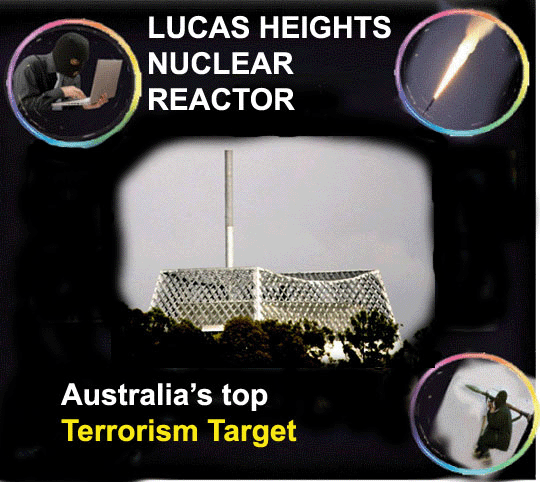 Nuclear facility needs overhaul: report https://www.sbs.com.au/news/nuclear-facility-needs-overhaul-report–21 Oct 18
An independent report has recommended that the federal government’s nuclear medical facility at southern Sydney be replaced or rebuilt due to safety concerns. The federal government’s nuclear medical facility at Lucas Heights in Sydney should be replaced or rebuilt with contributions from the private sector, an independent report says.
The report, to be published on Monday, found there is a “make do and mend” culture at the facility and that it fails nuclear safety standards, The Australian reports.
In August 2017 a technician’s hands were contaminated through two pairs of gloves after he dropped a vial at the Lucas Heights medical facility, putting him at a higher risk of cancer.
The incident was the only safety failure in the world in 2017 that was rated by the International Atomic Energy Agency at a Level 3 or above. It was followed by three more incidents within the next 10 months.
“It should be noted that Level 3 events are regarded as serious events in the nuclear industry and any additional events at this level may result in loss of confidence in the organisation,” the report says.
Climate change is the big security issue for Pacific Island nations, – and for Australia?
 For Pacific Island nations, rising sea levels are a bigger security concern than rising Chinese influence, The Conversation, Head of Department, Politics and Philosophy, La Trobe University, August 31, 2018 When the Pacific Islands Forum is held in Nauru from September 1, one of the main objectives will be signing a wide-ranging security agreementthat covers everything from defence and law and order concerns to humanitarian assistance and disaster relief.
The key question heading into the forum is: can the agreement find a balance between the security priorities of Australia and New Zealand and the needs of the Pacific Island nations?
Even though new Prime Minister Scott Morrison is not attending the forum, sending Foreign Minister Marise Payne instead, the Biketawa Plus security agreement remains a key aim for Canberra……….
A focus on climate change as a security issue
One key reason for updating Biketawa is to realign Australia’s security interests with those of Pacific Island countries that have grown more aware of their shared interests and confident in expressing them in international relations. This growing confidence is clear in the lobbying of Pacific nations for climate change action at the United Nations and in Fiji’s role as president of the UN’s COP23 climate talks.
In the absence of direct military threats, the Pacific Island nations are most concerned about security of a different kind. Key issues for the region are sustainable growth along a “blue-green” model, climate change (especially the increasing frequency and intensity of natural disasters and rising sea levels), illegal fishing and over-fishing, non-communicable diseases (NCDs), transnational crime, money laundering and human trafficking. ……..
Climate change adaptation and mitigation must also be elevated to the top of the agenda in Australia’s relations with the region. It is the most pressing problem in the Pacific, but for political and economic reasons, it hasn’t resonated to the same extent with Canberra.
In fact, Australia has recently been identified as the worst-performing country in the world on climate action. This has not gone unnoticed in the Pacific. Fiji’s prime minister, in particular, has been clear in highlighting that Australia’s “selfish” stance on climate change undermines its credibility in the region.
These shifting priorities in the Pacific present a greater challenge for Australia, especially now that there are more players in the region, such as China, Russia and Indonesia. Australia may see these “outsiders” as potential threats, but Pacific nations are just as likely to view them as alternative development partners able to provide opportunities………
there can be no authentic engagement with the region without addressing climate insecurity as well. https://theconversation.com/for-pacific-island-nations-rising-sea-levels-are-a-bigger-security-concern-than-rising-chinese-influence-102403
Nuclear waste being shipped to Australia by company with a terrible safety record
Responsibility overboard: the shocking record of the company shipping nuclear waste to Australia http://www.onlineopinion.com.au/view.asp?article=19892&page=0
| By Natalie Wasley -, 14 August 2018In the very early hours of Sunday July 29, the federal government carried out a highly secretive transport of spent nuclear fuel. Helicopters and hundreds of police accompanied trucks from the Australian Nuclear Science and Technology’s reactor at Lucas Heights to Port Kembla in Wollongong.
Any transportation of nuclear materials carries risks, but Briese has a particularly terrible safety record, including leaking oilfrom vessels, losing cargo overboard and failing to follow basic navigation rules. In 2015, French nuclear giant Areva (now Orano) chartered the controversial Briese ship the BBC Shanghai to bring reprocessed spent fuel waste back to Australia. This was despite the ship being recently detained in Australia and Spain, and banned from carrying government cargo in the United States, for failing safety inspections The transport occurred during a federal Parliamentary Inquiry into Flag of Convenience ships, where it was revealed that the BBC Shanghai was “owned and operated by a web of German companies, registered in the tiny Caribbean islands of Antigua and Barbuda and crewed by a mix of Russian and Ukrainian seafarers.” At the time, independent Senator John Madigan accused the government of “tendering out its national security to the lowest common denominator.” A complex web of ownership and vessel registration allows Briese to circumvent systematic regulation and accountability. Along with safety breaches, vessels have been caught carrying weapons, allegedly intended for war-ravaged nations. Briese is known to have transported Russian and Ukrainian weapons and has an “important functional role” of “heavy weapons shipments to countries with poor infrastructure” as part of the Odessa Network that has allegedly supplied weapons used in Syria. Briese ships have been stopped and crew detained with weapons cargo and tanks “presumably intended” for Sudan and Singapore. Amnesty International identified a Briese vessel moving cluster bombs between South Korea and Pakistan in 2010, contravening the 2008 Convention on Cluster Munitions. The vessel was not sailing under a German flag, and therefore did not need the permit that would usually be required under German law. Workers’ rights Briese has a terrible track record on workers’ rights. In 2015, the Maritime Union of Australia (MUA) argued that the crew of the BBC Shanghai only signed a binding wage agreement en route to Australia after the radioactive waste shipment attracted public scrutiny. International Transport Federation National Coordinator Dean Summers inspected a sister ship at Port Kembla and found the crew was underpaid and working under a “sham” collective agreement. The MUA has a long held policy of opposition to all aspects of the nuclear industry. The position recognises that handling and transport of radioactive materials is a risk to stevedores, seafarers and other transport and emergency workers. It also expresses support for Traditional Owners and community members resisting imposition of nuclear projects. When the BBC Shanghai docked in 2015, MUA Southern NSW Branch Secretary Garry Keane reiterated: “Our members do not support the nuclear industry. There is no totally safe way to transport or store waste which remains a danger and threatens communities for thousands of years.” Community opposition The reprocessing waste that returned to Australia was categorised as long-lived intermediate level waste (ILW). The intention was for it to be stored at a purpose built national radioactive waste facility, along with other low and intermediate level waste that would be transported from around the country. However, the attempts of successive federal government to construct such a facility have been thwarted by persistent community campaigns and legal actions. Nominated sites in South Australia (1998-2004) and the Northern Territory (2005-2014) were dropped by the federal government after years of hard fought campaigning. Significant government resources are currently being thrown at advancing the assessment of three shortlisted sites in South Australia- one on Adnyamathanha country in the Flinders Ranges and two in the Kimba region of the Eyre Peninsula. The SA waste dump plan has caused great anxiety and stress for Traditional Owners and local community members near the sites. Adnyamathanha Traditional Owner Regina McKenzie describes the Flinders Ranges as “arngurla yarta” (spiritual land). Upon receiving the 2016 Peter Rawlinson environment award, Regina said: “The proposed dumpsite contains thousands of Aboriginal artefacts. Our ancestors are buried there. We don’t want a nuclear waste dump here on our country and worry that if the waste comes here it will harm our environment and muda (our lore, creation).” Communities – including many of Regina’s extended family – have campaigned for decades to stop uranium mining and nuclear waste dumps and to fight for compensation for people affected by nuclear bomb tests conducted in the 1950s and 1960s. The nuclear chain is toxic from start to finish. As we move, albeit slowly, towards creation of long-term, sustainable and safer jobs in renewable industries there will be ongoing need ‒for many generations ‒to manage the radioactive materials already stockpiled around the world. Instead of continuing with plans to greatly expand the production and export of radioactive medical isotopes from Lucas Heights, the federal government should start planning to replace the reactor with more benign technologies for scientific and medical applications. A recent conveyor beltbreakdown and two spills of radioactive material that affected workers in the past year highlight the risks and vulnerabilities inherent in this industry. Environment groups, trade union and health organisations have long called for an independent inquiry into the production, transport and management of radioactive waste in Australia that includes all key stakeholders. This is essential to take the discussion around intergenerational management out of the trenches and to the table. Arthur Rorris from the South Coast Labour Council summarised it well in the lead up to the 2015 transport: “When a shipment of solarpanels comes through the port you don’t see hundreds of cops blocking highways and a national security operation. Communities the world over want to see the back of the nuclear industry so we don’t have to endure these unnecessary risks to public health, the environment and our national security.” |
1 This month
17 October, Free Public Talk on Nuclear Issues in South Australia
David Noonan will speak on public interest concerns over the new Roxby Downs Indenture Act 2026 on BHP copper-uranium mining and ore processing in SA, and on how AUKUS may face SA with a High-Level nuclear waste agenda.
Dr Jim Green will discuss international developments in the field of nuclear power including ‘small modular reactors’ and Generation 4 ‘advanced’ nuclear reactor concepts.


Help Aunty Sue Protect Her Land and Sacred Sites From Destructive Rocket Testing.
.

Australians deserve the truth
about
AUKUS – https://aukuspublicinquiry.com/

PETITION – To: Prime Minister Anthony Albanese and the Australian Labor Government

of the week – Australians for War Powers Reform (AWPR)
To see nuclear-related stories in greater depth and intensity


