Government cover-up of Australia’s involvement in nuclear bomb testing
The following summarizes some of the key conclusions of the Royal Commission:
- The Australian government controlled media reporting such that news items provided what the UK government deemed suitable only;
- Prior to the first tests on the Australian mainland, the Government Cabinet, Parliament and news media were not informed of what was happening;
- It is likely that the major tests resulted in a general increase in cancer within the Australian population;
- Exposure to radiation increased the risk of cancer in nuclear veterans;
- There was a failure to adequately take into account the distinctive lifestyle of Aboriginal people living in the region;
- The authorities were negligent in their management, equipping and briefing of the crews of the Lincoln aircraft who were directed to fly through the nuclear cloud in the Totem 1 test;
- In the Buffalo tests, “. . . the attempts to ensure Aboriginal safety during the Buffalo series demonstrate ignorance, incompetence and cynicism on the part of those responsible for that safety.” (12)
This summary is a very small and selective account of the content of the Royal Commission’s Report.
Since Hiroshima: Australia’s Active Involvement in the Use and Abuse of Nuclear Energy Sunday, 05 October 2014 09:59By Lindsay Fitzclarence, Truthout “………..By 1952, the government had signed a contract with the CDA (Combined Development Agency) representing the UK and United States to supply uranium (5).

At the same time, in a remarkable expression of executive power, the pro-royalist prime minister of Australia, Robert Menzies, agreed to a British request to begin testing of atomic weapons in its former colony (6). At the dawn of the Cold War nuclear arms race, Australia was an active participant at both ends of the weapons cycle: the source of primary nuclear fuel and as a nuclear testing ground. Continue reading
1984 Royal Commission concluded that Australian servicemen were nuclear guinea pigs
 TODAY IN HISTORY – Bendigo Advertiser 12 Sept 14
1984 – Australian Royal Commission starts an investigation into whether servicemen were deliberately exposed to radiation in British nuclear tests at Maralinga in 1956-57. It will conclude that they were. http://www.bendigoadvertiser.com.au/story/1880269/good-morning-bendigo-12092014/?cs=80
Australia was deliberately used as Britain’s radiation test experiment, at Maralinga!

As The Advertiser has previously reported, hundreds of bones were subsequently collected from the bodies of 21,830 dead babies, infants, children, teenagers and young adults across Australia without the knowledge of their parents.
The Strontium-90 testing program in Australia was the longest of its kind in the world, finally ending in 1978.
In September, 2001, following an extensive investigation by The Advertiser, the Australian Radiation Protection and Nuclear Safety Agency revealed it had kept ash samples from bones collected from hospitals in Adelaide, Sydney, Perth, Brisbane and Melbourne.
In a report to the then federal health minister, Michael Wooldridge, the agency said it had detected varying levels of Strontium-90 in all Australian capital cities.
British scientists secretly used Australian population to test for radiation contamination after nuclear tests at Maralinga (includes copies of documents from British National Archives) http://www.news.com.au/national/south-australia/british-scientists-secretly-used-australian-population-to-test-for-radiation-contamination-after-nuclear-tests-at-maralinga/story-fnii5yv4-1227041781005 news.com,.au 29 Aug 14 scientists secretly used the Australian population to test for radiation contamination after the nuclear tests at Maralinga in the 1950s, a new book confirms.
Its author, Frank Walker, has obtained the minutes of a top secret meeting in England where the UK Atomic Energy Research Establishment approved a program to determine the long-term effects of the tests on Australia and its citizens. Continue reading
Rio Tinto’s deceptive reporting about its “sustainability”
Unsustainable: the ugly truth about Rio Tinto‘, also reveals that Rio Tinto’s sustainability reporting contrasts sharply with the company’s actual performance in all four categories. It shows how Rio Tinto’s reckless pursuit of profit at any cost has caused disputes with numerous unions as well as environmental, indigenous and community groups. Most of the disputes covered in the report are ongoing. Rio Tinto has continued to provoke disputes in the three months since the report was released:
- with South African regulators by illegally operating a coal mine for a decade;
- with injured Australian workers by systematically targeting them in a layoff;
- with leaders in Zimbabwe by reportedly reneging on a pledge to support community development programs;
- and with the people of Papua New Guinea by rejecting calls for an investigation into the company’s role in a bloody civil war.
Rio Tinto will go on provoking disputes and operating in an unsustainable manner unless it believes that doing so could threaten its license to operate. To reform Rio Tinto, first we must threaten its ‘license to operate’
 Rio Tinto’s ‘Sustainable Mining’ Claims Exposed By Kemal Özkan http://www.globalresearch.ca/rio-tintos-sustainable-mining-claims-exposed/5394301 July 31, 2014 Global mining giant Rio Tinto markets itself as a ‘sustainable company’. But serious failures in its reporting, and its attempt to hold an Australian indigenous group to ransom, reveal a very different truth: the company is driven by a reckless pursuit of profit at any cost. Rio Tinto uses its sustainability reporting to bolster the argument that it is a responsible company and therefore entitled to a license to operate. Now, a global campaign is demanding that Rio Tinto live up to its sustainability claims.
Rio Tinto subsidiary, Energy Resources of Australia (ERA), has threatened the Mirarr people that if it is not allowed to expand its Ranger uranium mining operations underground, it may be unable to fully fund rehabilitation of the open pit mine. The Ranger mine is located in the traditional lands of the Mirarr, the world heritage-listed Kakadu national park in Australia’s Northern Territory. If ERA does not complete rehabilitation of the site, which suffered a radioactive spill last year, the water, air quality and soil in the area could be scarred with toxic radiation for generations.
‘It’s not our problem’ When a shareholder confronted Rio Tinto CEO Sam Walsh about this at the company’s April annual meeting, Walsh flatly refused to commit to full rehabilitation or take responsibility for the mess. Continue reading
Murky dealings in Australian government’s “clean coal” fantasy
 The search for the clean coal holy grail http://www.abc.net.au/radionational/programs/backgroundbriefing/ The Abbott government and a group of investors are pinning
  their environmental hopes on a clean coal technology that is still in the very early stages of development. Paddy Manning tracks the quest for the clean coal holy grail and investigates the men getting unspeakably rich from the search.
The federal government is pinning its hopes of cleaning up Australia’s electricity  sector on a new clean coal technology that is still at the laboratory stage.
Environment Minister Greg Hunt has made clear that a key plank of the government’s plan to tackle climate change is reducing emissions from existing black and brown coal-fired power stations……
Ignite Energy Resources, a member of the DICE network, recently recieved a $20 million grant to produce liquid fuel for DICE engines from brown coal, among other things………
photo – Dr John White Executive Director, Ignite Energy Resources
Conflict of interest: Abbott’s Aboriginal man Warren Mundine and the Martu people’s missing $millions

For Mundine, today’s revelations raise questions about his business judgment – and specifically about his company’s role in the Reward Minerals deal. How could anyone believe that the Martu people were being properly represented by the Western Desert corporation during negotiations when one of its top executives had an undisclosed interest in a predetermined outcome?
The sorry tale of Lake Disappointment, the missing mining millions and Warren Mundine, SMH. July 10, 2014 Richard Baker and Nick McKenzie “……once again, he [Darren Farmer] was doing what he had been told not to do. This time he was asking questions. He strode towards Biljabu, who was deputy chairman of the [Western Desert] Corporation. Where, he demanded to know, was the paperwork? And why couldn’t he or the others see it?
The paperwork in question outlined details of the deals Western Desert had struck with mining companies to allow them to dig on the 136,000 square kilometres of resource-rich Pilbara that are the Martu’s traditional lands.
These deals had brought about $50million into the corporation, a non-profit prescribed body corporate that is meant to use the money to benefit all Martu. But little of the money had gone into improving Martu townships.
Farmer kept on with his questions. Why had the Western Desert corporation spent $7million in four years on its handful of employees and paid directors more than $1million? How had well-connected corporate advisers pocketed millions, while much of the Martu mob lived in poverty? Why had the views of senior elders on mining proposals been ignored? Everyone at the meeting that day could tell it was not going to end well.
There are conflicting accounts of what happened next……….
Heated debate – and sometimes violence – is nothing new at indigenous land-council meetings across Australia. These are the forums where the future clashes with the past; where members of some of Australia’s most impoverished communities weigh up the riches that mining can deliver against the cultural cost of digging up their sacred sites.
But what was different about that meeting last July was that the deals at the centre of all the trouble had been brokered by companies owned by the biggest names in Australia’s indigenous community, including the nation’s most influential Aboriginal, Warren Mundine.
The accountant Dalgleish, true to stereotype, was a stickler for detail and decided to dig further into Wolf and Wright’s activities. He found that in mid 2008 they had separately bought more than $1million worth of Perth property. This was close to the time Wright joined WDLAC and the Rio Tinto $21million deal was done.
Although he had no proof that the property purchases involved money from Rio Tinto, Dalgleish was intrigued by the confluence of events and brought them to the attention of WDLAC’s board. On May 7, 2009, Dalgleish wrote a confidential memo to WDLAC’s chairman in which he wondered how Wolf could have approved such an “outrageously excessive fee” as the $2.35million paid to Procter.
A day later, Wright paid out Dalgleish’s contract and asked him to leave. He was able to do this because he had become the corporation’s acting chief executive following Wolf’s departure, a promotion that had bumped his salary to $250,000.
Three days after his departure, Dalgleish reported his concerns to the WA police fraud squad, which in turn contacted Western Desert corporation. According to the police file, detectives were assured by Western Desert in September 2009 that Procter no longer acted for the corporation, and that an “independent third party” would examine the issues and provide recommendations.
A WA police spokeswoman says police never received a copy of any third-party review.
‘‘The matter is currently filed pending further contact from WDLAC as the complainant,’’ she says.
Procter is bewildered as to why anyone would seek police attention over the Rio deal. His company, he says, acted with integrity and its role was supported by the Martu people, who were $20million richer because of IndiEnergy’s involvement.
Dalgleish also contacted the federal regulator, the Office of the Registrar of Indigenous Corporations, which is meant to ensure good governance and financial probity at the more than 2500 indigenous bodies across Australia. ORIC also decided not to investigate.
Meanwhile, in early 2009, the Australian Uranium Association – the peak body for uranium miners – announced the members of its indigenous dialogue group. Wolf and Mundine were among those named to promote the potential for uranium mining to enrich indigenous communities.
At the same time, Procter was busy expanding the reach of his company, IndiEnergy. He began appointing ‘‘special advisers’’ from the mining, legal and financial worlds. By far his most important appointment was that of Mundine as a special adviser and advisory board member.
The two had known each other since 2004 when the Howard government appointed them as members of the body that replaced ATSIC.
By the time Abbott announced Mundine as head of his Indigenous Advisory Council in September 2013, he was a close business associate of both Wolf and Procter.
Australia may be a big country, but the indigenous business and politics scene is small and replete with overlapping interests. It was only a matter of time before one of Mundine’s business relationships would clash with his quasi-ministerial role.
Mundine’s potential for a conflict of interest became a reality in February when Procter announced IndiEnergy had taken a stake in an indigenous company whose co-owner, Larrakia Development Corporation, is actively seeking Commonwealth support.
Procter highlighted Mundine in the February announcement of his new venture, praising him and Abbott for promoting indigenous business opportunities. ‘‘Skin in the game is the only way indigenous organisations can attract the right people to assist them in reaching their commercial dreams,’’ Procter said.
But having skin in the game means you risk losing some. And this is the risk that emerged for Mundine when a company he part-owned became involved in the Western Desert corporation’s most contentious mining deal…………
For Mundine, today’s revelations raise questions about his business judgment – and specifically about his company’s role in the Reward Minerals deal. How could anyone believe that the Martu people were being properly represented by the Western Desert corporation during negotiations when one of its top executives had an undisclosed interest in a predetermined outcome?……………
In December 2011, Reward announced it would pay the Western Desert corporation $500,000 upon the signing of an agreement. Another $500,000 would come when mining began and there would also be royalties of 1.25per cent on potash sales. This money was meant to be held in trust for all Martu.
But the biggest prize was Reward’s issuing of 9.5million share options to the Western Desert corporation and Poynton’s Azure Capital, which was in effect the parent company of Indigenous Investment Management. The value of the options at the time was almost $10 million. The Martu will get millions more options as the project progresses.
With money now in the bank, the Western Desert corporation went on a spending spree. Despite its own rules banning the handing out of funds without the approval of all members, the board decided on February 16, 2012, to use the first $500,000 from Reward and $100,000 from the corporation’s operating budget to pay 30 select elders $20,000 each.
Five board members, including Biljabu’s brother, received $20,000 each. Another recipient had just finished his term as a director, and the parents of three board members were also paid. Wolf says ensuring money is properly handled is easier said than done. ‘‘Some Martu live on $9000 a year and so when money hits the account you say ‘that should go to education or something’ but it’s hard when you live in poverty.’’
Still, Farmer says many Martu people are bewildered by their board’s capitulation over Lake Disappointment. ‘‘Why did we fight so hard, only to let it go?’’
So where has the federal regulator been in all this? ORIC has long been aware of governance issues at Western Desert corporation. In 2010, it found the Western Desert corporation had failed to keep proper records, paid money to the board’s chair and deputy in breach of its rules and provided cars to directors – including Biljabu – without member approval. But no disciplinary action was taken against individuals responsible.
Farmer’s fight for answers has taken a toll. ‘‘I’ve been isolated, lost sleep, become ill and [been] made out to be the troublemaker who is stopping people getting their money,’’ he says.
Meanwhile, he says, the Martu communities have not benefited as much as they should have from the mining deals. ‘‘Go out into the communities and there is f— all to show for all the millions.’’………: http://www.smh.com.au/national/the-sorry-tale-of-lake-disappointment-the-missing-mining-millions-and-warren-mundine-20140711-zt2b8.html#ixzz37Iu9KYXJ
Tony Abbott’s Aboriginal Adviser Warren Mundine, involved in murky mining deal
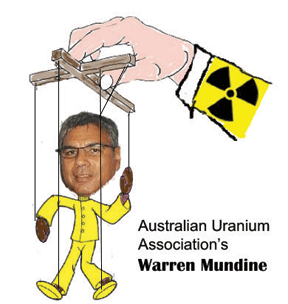
 Questions over Warren Mundine’s involvement in mining deal http://www.afr.com/p/national/questions_over_warren_mundine_involvement_DJUrsCD9hl6GHsajefKFoI RICHARD BAKER AND NICK MCKENZIE 12 July 14 A company part owned by Warren Mundine, the federal government’s chief indigenous adviser, helped broker a contentious deal that gave a mining company access to an Aboriginal sacred site in outback Western Australia.
The revelation raises questions about Mr Mundine’s past business relationships and comes as he seeks to drive reforms to ensure good governance in Aboriginal corporations through his role as head of Prime Minister Tony Abbott’s Indigenous Advisory Council.
Documents show Indigenous Investment Management, which was part owned by Mr Mundine at the time, was hired in 2010-11 by Reward Minerals. Continue reading
Australia’s fossil fuel front groups “tax deductible gift recipients” !
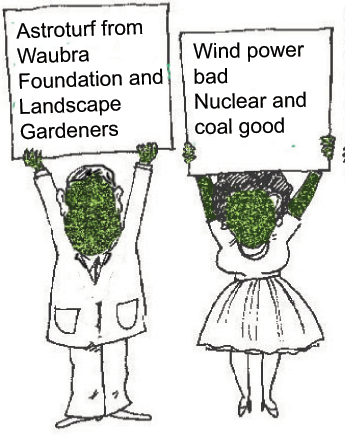 The IPA and Waubra Foundation’s charitable tax status rorts Independent Australia Sandi Keane 8 July 2014 Why do corporate lobby groups like the IPA and fossil fuel front organisations like the Waubra Foundation retain ‘deductible gift recipient’ status, while genuine environmental charities like the Australian Conservation Foundation face having theirs stripped away by the Abbott Government.Sandi Keane investigates.
FOR AN ORGANISATION that has been touting ‘low taxes‘ for sixty years, the Institute of Public Affairs (IPA) sure delivers big on tax benefits to its major donors, especially Big Mining — which is already heavily subsidised by Australia’s taxpayers (note graphic below right).
Some, like Glencore, not only enjoy such subsidies but have no qualms about paying zero tax. These are the true “leaners” we tax-payers have to “lift”, as this article will show……….
Fortunately, Sourcewatch has done significant work into the IPA’s funding and relates the following:
The IPA has heavily relied on funding from a small number of conservative corporations. Those funders disclosed by the IPA to journalists and media organisations include:
- Major mining companies – BHP-Billiton and Western Mining Corporation;
- Pesticides/Genetically modified organisms: Monsanto;
- A range of other companies including communications company Telstra, Clough Engineering, Visy, and News Limited;
- Tobacco companies – Philip Morris (Nahan) and British American Tobacco
- Oil and gas companies: Caltex, Esso Australia (a subsidiary of Exxon) and Shell and Woodside Petroleum; and fifteen major companies in the electricity industry;
- Forestry: Gunns, the largest logging company in Tasmania;
- Murray Irrigation Ltd …
In 2003, the Australian [Howard] Government paid $50,000 to the Institute of Public Affairs to review the accountability of NGOs.

The latest truly breathtaking rort is tax deductibility for donations to fund the new IPA-promoted misinformation manual, Climate Change: The Facts 2014. Like previous books, it attacks climate science, carbon pricing and renewable energy targets……….http://www.independentaustralia.net/environment/environment-display/the-ipa-and-waubra-foundations-charitable-tax-status-rorts,6649
Ranger uranium mine safety records documents conveniently disappear
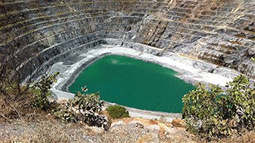 Documents showing inspections at Ranger uranium mine go missing, 1057 ABC Darwin, By Xavier La Canna 5 June 14, Despite a big diesel spill at the Northern Territory’s Ranger uranium mine in 1995, an investigation into the operation has found paperwork to show diesel tanks are being routinely inspected has gone missing. On Thursday giving Energy Resources of Australia (ERA) was given the green light to recommence processing operations at Ranger after a one-million litre radio-active spill last year sparked a shut-down.
ERA claimed there had been no environmental damage was caused by the spill, but processing was suspended in the wake of the incident.
It is understood processing operations will recommence immediately following the decision by the federal and NT governments.
But 19 years after a 12,000 litre diesel spill at the site caused bird deaths, the review found problems with the documentation of diesel tank inspections.
“Diesel Tanks A and B are missing documentation relating to their one-monthly routine inspections and five-yearly external inspections,” the review found……..
Dave Sweeney from the Australian Conservation Foundation said he was disappointed Ranger was allowed to recommence processing even though a report into the cause of the failure had not been publicly tabled.
Mr Sweeney said the government had a well-worn path of refusing to comment when incidents happened at Ranger because it could jeopardize the independence of inquiries, then refusing to release the full findings of reports because it was “commercial in confidence”.
Ranger, which began production in 1981, is one of the world’s largest uranium mines and is located within the World Heritage listed Kakadu National Park. http://www.abc.net.au/local/stories/2014/06/05/4019591.htm
Spying by people employed by coal companies to infiltrate activist groups
 Australian Coal Companies Used Spies To Infiltrate Group Of Activists Climate Progress, BY WILL FREEMAN ON JUNE 3, 2014 Two Australian coal companies have been exposed for hiring former soldiers and intelligence officers to spy on anti-coal protests in New South Wales, according to revelations published by the Sydney Morning Herald on Monday.
In interviews with Fairfax Media, the undercover agents revealed they were employed by the Centre for Intelligence and Risk Management (CIRM), a private intelligence firm run by Tony Groves, a former Australian military intelligence officer. The Idemitsu mining company openly admits it contracted CIRM in order to gather information about protesters. For five months, the firm’s undercover operatives pretended they were anti-coal activists and used fake names, secretly sending detailed field reports back to CIRM relaying sensitive information about protest leaders and plans of action.
The spying “could fall foul of provisions in the corporations, consumer and privacy laws,” Barbara MacDonald, a law professor at Sydney University, told the Sydney Morning Herald, particularly if “someone had acted on the deception to the material detriment” of those being spied on. Given the information that has recently come to light, Idemitsu and Whitehaven Coal could be charged with seriously violating Australian law.
Both the Boggabri and Maules Creek mines have stirred up considerable controversy among locals and international environmental groups alike, who claim the large scale mining projects will exacerbate already intense effects of climate change in Australia. The past few years have seen record high temperatures and several extreme weather events in the nation, such as droughts and increasingly severe wildfires in the Australian bush.
Despite these warning signs, the government of Prime Minister Tony Abbott has dismantled much of the country’s progressive environmental legislation and, as leader of the G20 summit, argued that climate change should be excluded from the meeting’s agenda. Greg Hunt, Abbott’s Minister of the Environment since 2013, gave the green light to Whitehaven Coal to proceed with construction of the Maules Creek mine despite mounting evidence that the coal industry is endangering public health.
If the Maules Creek mine is finished, it will release nearly 20 thousand tons of dust into the surrounding area, causing severe health problems and destroying fields of crops.
A coalition of local farmers and aboriginal groups, concerned that the Maules Creek mine will bring a similarly devastating tide of environmental degradation to their communities, have actively resisted the construction project for over six months. Farmers fear the impact of drought on their livelihood, as the mine threatens to drain up to seven meters from the water table in the area. The Gomeroi people, an aboriginal group and the traditional owners of the land, will see destruction of sacred sites and historical artifacts if the mine is completed.
Over the months, a group of doctors and medical students, dubbed Medics Against Coal, and religious leaders from several faiths joined in the protests as well. Since December, police have made over 120 arrests, even detaining a 92-year-old World War Two veteran for his participation in the protests. http://thinkprogress.org/climate/2014/06/03/3443822/australia-coal-spies/
Secret agents hired to spy on anti-coal activists in New South Wales
Undercover: Spies hired to infiltrate anti-coal campaign The Age, June 1, 2014 Tom Allard National Affairs Editor Former soldiers and intelligence operatives have been sent to infiltrate a network of anti-coal protesters aiming to thwart a multibillion dollar expansion of coal production in northern NSW. Using false identities, the spies-for-hire have attempted to penetrate the inner sanctum of a group of environmentalists and local landowners who have vigorously attempted to stop the coalmines at Maules Creek and Boggabri.
In what represents a significant escalation of a heated battle between Whitehaven Coal and Idemitsu Australia Resources and anti-coal activists, a Fairfax Media investigation has uncovered a clandestine campaign of significant scale but ham-fisted execution.
Several undercover agents were discovered by the activists, including one alleged spy Marnie Tisot, who was confronted on camera. The operation raises questions of its legality given the outright deception to disrupt protest movements.
Fairfax has interviewed individuals directly involved in the espionage and multiple sources with detailed inside knowledge of the surveillance have independently alleged it was orchestrated by a company run by a former Australian military intelligence officer, Tony Groves, and his partner, Maria Topia. While their firm, the Centre for Intelligence and Risk Management, had direct operational responsibility for the espionage, it is only one link in a chain of companies believed to be involved.
Who the ultimate client was remains a mystery. Spies in the field were not told, although it was clear the Centre for Intelligence and Risk Management was acting for another party or parties.
Several leading corporations and prominent Australians are also involved in the coal expansion in northern NSW and the security operations that protect them……. http://www.theage.com.au/national/undercover-spies-hired-to-infiltrate-anticoal-campaign-20140601-39ci6.html
Austtralia’s hypocrisy. Government knows full well that Israel has nuclear weapons
 Australia still denies Israel’s open secret of a nuclear arsenal, SMH, April 15, 2014 Phillip Dorling
Secret government files reveal that Australian governments, diplomats and spies have known for more than 30 years that Israel has an arsenal of nuclear weapons, while continuing to deny any knowledge of its existence to the point of misleading Parliament.
Previously secret diplomatic files declassified by the National Archives reveal a longstanding policy to turn a blind eye to Israel’s nuclear arsenal. Last week the Department of Foreign Affairs and Trade again declined to comment on whether the Australian government thinks Israel is an undeclared nuclear weapons state.
Foreign Affairs Department briefing papers prepared for former Labor foreign minister Bill Hayden in 1987 state that ”intelligence assessments are that Israel has a small arsenal of nuclear weapons (possibly about 20). Israel’s technological capabilities would enable it confidently to deploy such weapons without recourse to a nuclear test.”
Mr Hayden and Dr Blix were talking against the backdrop of the treason trial of Mordechai Vanunu, the Israeli nuclear technician who in 1986 disclosed detailed evidence of Israel’s nuclear weapons production. The Foreign Affairs Department advised Mr Hayden to publicly deny knowledge of Israel’s nuclear weapons capabilities. Mr Hayden told Parliament on September 17, 1987: ”We have no information to corroborate these allegations.”
However, Foreign Affairs’ files, declassified in response to applications by Fairfax Media, reveal that Australia had been monitoring Israel’s nuclear program from its beginnings in the 1950s………
Australian policy remains unchanged, with the Abbott government deciding last October not to support a UN General Assembly resolution on nuclear proliferation in the Middle East – 169 countries voted for the resolution. Only five – the US, Israel, Canada, Palau and the Federated States of Micronesia – voted against. Australia abstained……..http://www.smh.com.au/federal-politics/political-news/australia-still-denies-israels-open-secret-of-a-nuclear-arsenal-20140414-36nr4.html
Legal bullying made a scientific journal remove its article about climate change
 The journal that gave in to climate deniers’ intimidation The Conversation, Elaine McKewon, Research Associate, Australian Centre for Independent Journalism at University of Technology, Sydney 1 April 14,
In February 2013, the journal Frontiers in Psychology published a peer-reviewed paper which found that people who reject climate science are more likely to believe in conspiracy theories. Predictably enough, those people didn’t like it.The paper, which I helped to peer-review, is called “Recursive fury: Conspiracist ideation in the blogosphere in response to research on conspiracist ideation”. In it, cognitive scientist Stephan Lewandowsky and his colleagues survey and analyse the outcry generated on climate skeptic blogs to their earlier work on climate denial.
The earlier study had also linked climate denial with conspiracist thinking. And so by reacting with yet more conspiracy theorising, the bloggers rather proved the researchers’ point.
Yet soon after Recursive Fury was published, threats of litigation started to roll in, and the journal took the paper down (it survives on the website of the University of Western Australia, where Lewandowsky carried out the study).
A lengthy investigation ensued, which eventually found the paper to be scientifically and ethically sound. Yet on March 21 this year, Frontiers retracted the paper because of the legal threats.
The episode offers some of the clearest evidence yet that threats of libel lawsuits have a chilling effect on scientific research………
the journal’s management and editors were clearly intimidated by climate deniers who threatened to sue. So Frontiers bowed to their demands, retracted the paper, damaged its own reputation, and ultimately gave a free kick to aggressive climate deniers.
I would have expected a scientific journal to have more backbone, certainly when it comes to the crucially important issue of academic freedom. http://theconversation.com/the-journal-that-gave-in-to-climate-deniers-intimidation-25085
Thorium mining illegal in Victoria – but watch this space, and watch Dr John White
The Liberal Party’s nuclear dreams: The strange case of Dr John White and Ignite, Independent Australia Sandi Keane 12 March 2014,
Why were Ignite Energy so desparate to dissociate their director Dr John White from both the nuclear industry and the Liberal Party? Deputy editor Sandi Keaneinvestigates.
IS THE nuclear fantasy that has taken hold in South Australia poised to slip under Victoria’s ‘no nukes‘ radar?
More to the point, is the iconic Ninety Mile Beach region of Gippsland being eyed off as a future source of thorium – uranium’s young sister – the substance hailed by nuclear proponents as the green energy source of the future?………
Enquiries to both the Sydney and Melbourne offices of Ignite confirmed that, yes, Dr White was still one of its key people — manager, government and community liaison. Less than five months ago, he was introduced as Ignite’s “executive director” in an interview with the ABC’s The World Today on 17 October 2013. Indeed, the receptionist at Ignite thought that the ‘executive director’ title was still listed on Dr White’s CV.
So, why delete it from the website and have conniptions over us publishing his connections to the Uranium Industry Framework? Also, what did Megan Davison mean by ‘casting aspersions’? Was it the reference to his being ‘a key Liberal Party adviser in the Howard-era’?
As chair of Howard’s Uranium Industry Framework and mastermind of the business plan for the Global Nuclear Energy Partnership (now renamed the International Framework for Nuclear Energy Co-operation), ‘key adviser’ hardly seems to do him justice.
Is this a reaction to the claims by members of the Gippsland community that Ignite is getting favourable treatment because of John White’s special relationship with the Liberal Party?
ELA4968’s thorium prospects Continue reading
Dual function drones – climate study and spying – for Australia
 Ex-military spy drone to conduct NASA climate tests in Australian skies
US space agency NASA is preparing to launch drone missions high in Australian skies during the next six weeks…..,the Northrop-Grumman Global Hawk, costing a hefty $US200 million each when fitted out with sophisticated eavesdropping equipment, is designed to circle the globe on secret military Intelligence, Surveillance and Reconnaissance (ISR) missions…..
While Global Hawk is now proving useful in the civil world, the UAV’s primary function is as a highly effective global electronic intelligence gathering platform……Australia is a member of the so-called Five Eyes intelligence club that also includes the US, the United Kingdom, Canada and New Zealand
http://www.abc.net.au/news/2014-01-23/us-drone-over-australia/5215598
1 This month
17 October, Free Public Talk on Nuclear Issues in South Australia
David Noonan will speak on public interest concerns over the new Roxby Downs Indenture Act 2026 on BHP copper-uranium mining and ore processing in SA, and on how AUKUS may face SA with a High-Level nuclear waste agenda.
Dr Jim Green will discuss international developments in the field of nuclear power including ‘small modular reactors’ and Generation 4 ‘advanced’ nuclear reactor concepts.


Help Aunty Sue Protect Her Land and Sacred Sites From Destructive Rocket Testing.
.

Australians deserve the truth
about
AUKUS – https://aukuspublicinquiry.com/

PETITION – To: Prime Minister Anthony Albanese and the Australian Labor Government

of the week – Australians for War Powers Reform (AWPR)
To see nuclear-related stories in greater depth and intensity

