Australia’s Liberal government suppresses information and discussion of ideas
 despite the song and their promise to be a more accountable government, with more honesty and common sense than their Labor predecessors, the Liberals are doing everything they can to suppress discussion of ideas.
Abbott promised a more accountable government for Australians yet his has also become the most inaccessible  and shadowed from scrutiny. Cabinet ministers have to get approval from the Prime Minister’s office before they can speak publicly on ideas and issues. And why is it that Tony Abbott has been one of the most reluctant to publicly debate his ideas in either interviews or formal press conferences?.
Libs stifle debate while touting ‘battle of ideas’, The Age, January 12, 2014 –Amy Gray “…..It is tempting to sideline Bernardi as a “freelancing” backbencher whose “views do not represent the position of the government”, as described in a statement issued by Prime Minister Tony Abbott’s office last week.
But for all his flamboyant vilification of the millions of Australians who apparently bear the scarlet letters of ethnicity, sexual preference, medical autonomy and marital/family status, Bernardi is hardly freelancing when it comes to this strategy.
Seen from such an angle, it would appear Bernardi does represent the position of the government, not only due to his status as an elected senator who received top billing, but also because of the similar views and strategies used by his party teammates. Any disavowal from Abbott’s office appears disingenuous to say the least. The calls for “common sense” and “battle of ideas” and the cries against “the tyranny of political correctness” appear straight out of the Liberal Party hymn book and right now Bernardi is singing up a vulgar storm. Continue reading
Adelaide’s University College London (UCL) -pro nuclear research funded by nuclear interests
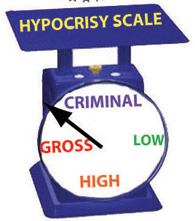 Professors slam UCL Australia’s nuclear and shale gas research http://london-student.net/news/11/18/professors-slam-ucl-australias-nuclear-shale-gas-research/ by James Burley on November 18, 2013
- Two biggest donors are uranium and shale gas producers
• Academics say this makes idea research was independent “laughable”
Senior professors have spoken out against University College London (UCL) Australia’s pro-nuclear, pro-shale gas research, claiming that strong industry ties make the idea it is independent “laughable”.
UCL’s Adelaide-based campus released one green paper calling for Australia to acquire nuclear submarines and another advocating the use of shale gas in the country. Of its two biggest sponsors, one mines uranium – needed to fuel nuclear submarines – and the other produces shale gas.
Speaking on the condition of anonymity, UCL professors told London Student: “The idea that research favouring nuclear submarines and shale gas extraction could possibly be independent (taking into account relevant alternatives) is laughable – UCL Australia has not produced a single piece of research on sustainable, greener, or alternative energies.”
“A university should not only be academically independent and impartial but also be seen to be so. In these matters UCL’s academic integrity is in jeopardy.” Continue reading
Toro Energy bribing Aborigines into agreements on uranium mining?

“These people that Toro are talking to are driving around Toyotas that they did not have before. About 11 Toyotas just appeared”
Allegation of Toyotas for uranium mining http://thestringer.com.au/allegation-of-toyotas-for-uranium-mining/#.Uriap9JDt9X by The Stringer December 17th, 2013 A Toro Energy meeting took place today in Perth with the Wiluna Native Title signatories in light of Toro’s focus to culminate plans to proceed with Western Australia’s first uranium mine. Concerned Wiluna Elder Glen Cooke has long opposed the project and said he was excluded from discussions with Toro. Mr Cooke said he is concerned of potential risk exposures to his people and to his people’s Country.
“Our Country, our rivers, our creeks will be poisoned. It is guaranteed there will be incidents, accidents, leaks, spills. Look at what has occurred at Ranger (uranium mine in the Northern Territory), with more than 200 incidents, and at Olympic Dam (in South Australia) drying up Country (with its demand on water). When we hurt nature, we are actually hurting ourselves, if we fight with nature we are fighting with ourselves,” said Mr Cooke.
Mr Cooke previously entered the Toro AGM shareholders meeting by proxy on the 28th of November to express his concerns that the company had failed to communicate a number of vital issues with Wiluna residents.
“They make it sound good, they don’t say the dangers and say uranium is good stuff and will cause no harm to anything”, said Mr Cooke Continue reading
US corporations can see Trans-Pacific Partnership text, but Australian Senate can’t!
 Secrecy surrounds Trans-Pacific Partnership talks : http://www.smh.com.au/national/secrecy-surrounds-transpacific-partnership-talks-20131208-2yzea.html#ixzz2n02wqzej December 9, 2013 Peter Martin Economics correspondent The government has refused the Senate access to the secret text of the trade deal it is negotiating in Singapore, saying it will only be made public after it has been signed.
As the final round of ministerial talks on the Trans-Pacific Partnership resumed on Sunday, Nobel prize-winning economist Joseph Stiglitz wrote to each of the 12 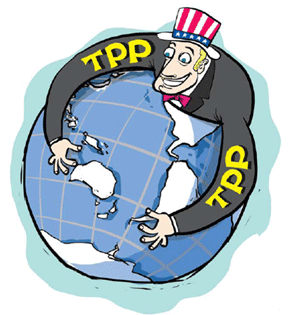 participating nations warning that the deal and the secrecy surrounding it presented ”grave risks”.
Australia’s delegate, Trade Minister Andrew Robb, has told Fairfax Media he is prepared to agree to so-called ”investor-state dispute settlement provisions” in return for access to markets including those of the US, Japan and Canada.
The provisions, rejected by the previous Labor government, allow foreign corporations to sue sovereign governments. Continue reading
BHP used Australian spy agencies targeting Japan and China
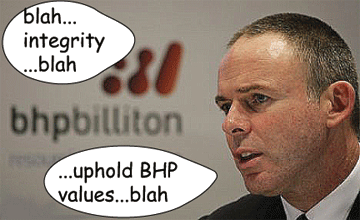 Australian spy agency helped BHP negotiate trade deals The Age, November 7, 2013 Philip Dorling BHP was among the companies helped by Australian spy agencies as they negotiated trade deals with Japan, a former Australian Secret Intelligence Service officer says.
A former diplomat has also confirmed Australian intelligence agencies have long targeted Japanese companies. Writing in The Japan Times, Professor Gregory Clark said Australian companies were beneficiaries of intelligence operations.
“In Australia, favoured firms getting spy material on Japanese contract policies and other business negotiations used to joke how [it had] ‘fallen off the back of a truck’,” Professor Clark wrote.
Business information is a main target for [intelligence] agencies, he said. “The targeting is also highly corrupting since the information can be passed on selectively to co-operative firms – often firms that provide employment and cover for spy operatives.”…….The former spy says informal exchanges with business executives were continuing when he retired in the 1990s. More recently, US diplomatic cables obtained by WikiLeaks and published by Fairfax Media in 2011 revealed former BHP Billiton chief executive Marius Kloppers privately offered “to trade confidences” with US officials about China.
”Kloppers has a keen interest in learning everything he can about the Chinese and is not shy about asking us for our impressions,” US Consul-General Michael Thurston reported to Washington in 2009. BHP declined to comment at the time. : http://www.smh.com.au/national/australian-spy-agency-helped-bhp-negotiate-trade-deals-20131106-2x1sw.html#ixzz2jzqhzexO
Peter Reith’s conflict of interest on “expert” task force about coal seam gas.

Advice is compromised, The Age, Russell Edwards, 5 Nov 13 Lobbyist Peter Reith, who chaired the state government’s ”expert” taskforce regarding the expansion of coal seam gas, is employed by First State Advisors and Consultants Pty Ltd. Among its clients are Thiess Pty Ltd and the NSW Aboriginal Land Council, both major players in the CSG industry. That the government would take advice from such a compromised party is disturbing. …… http://www.theage.com.au/comment/the-age-letters/actions-underpinned-by-greed-not-compassion-20131104-2wxj1.html#ixzz2jnlts1AD
VIDEO: Discussion on the implications of the Trans Pacific Partnership
The first language in both these deals goes something along the lines with, “All signatories are required to make their laws and regulations conform to the standards of this agreement.” They are literally required to make their nation-based laws subordinate to the terms of these agreements.
Quebec has an anti-fracking prohibition to protect the Saint Lawrence River Valley. There’s a US company that’s suing $250 million. And if they win that case before the special panel, the Quebec government will have to pay that amount. Under the TPP, you’ll see an enormous expansion of that kind of power.
One of the aspects of the Trans-Pacific Partnership is it’s an everyone-but-China deal. One of the intentions of the deal is to isolate China. So if you think isolating China is a good thing, then that would be a reason to support the deal.
 VIDEO: Yves Smith and Dean Baker on Secrets in Trade http://billmoyers.com/segment/yves-smith-and-dean-baker-on-secrets-in-trade/ TRANSCRIPT of VIDEO November 1, 2013 Let’s turn now to another big story most of us know even less about than drones. TPP — the Trans-Pacific Partnership. It’s a trade agreement the United States is negotiating with Australia, Canada, Japan and
  eight other countries in the Pacific region. If you don’t know about the TPP, and few do, it’s because the powerful people behind it — including President Obama — don’t want you to know.
The negotiations are shrouded in secrecy, and once they are completed, Obama wants to rush the agreement through Congress — fast-tracking, they call it — with our elected representatives given the choice only of voting it up or down. Last year, over 130 members of Congress asked the White House for more transparency about what’s being negotiated, and were essentially told to go fly a kite. You can be sure of this, however: a select group of corporate partners — companies like General Electric, Goldman Sachs, and Pfizer, the pharmaceutical giant — are not likely to be in the dark. Players like these stand to be the real beneficiaries of the agreement, because like other so-called “free trade” agreements, TPP actually will reward those at the top, even as it creates rules to override domestic laws on the environment, workplace safety, and investment. Corporate lobbyists already are lining up in Washington to ram the agreement through once the White House hurries it out of the delivery room. How do we know this? Because some vigilant independent watchdogs are tracking the negotiations, with sources they trust, and two are with me now. Continue reading
USA corporations, but not Australians, can know what is in the Trans Pacific Partnership agreement
Right now we don’t know exactly what will be in the TPP, because it’s kept completely secret, unless you’re fortunate enough to be a wealthy lobbying organisation in the United States, who are provided access to the text through the US Trade Representative (USTR), and have direct input into it.
We urge the Abbott Government to release the TPP text before it’s too late to fix. Let’s not cripple Australian innovation in the interests of American profits.
Why can’t Australian citizens read the Trans-Pacific Partnership Agreement? http://www.theguardian.com/commentisfree/2013/oct/30/trans-pacific-partnership-tpp-dfat?CMP=twt_guAs Journalists have been banned from a briefing about the TPP. Why the secrecy – and why can only wealthy lobbyists access the text? Only in Australia could the phrase “public briefing” mean that the meeting will be held behind closed doors, where journalists are not welcome.
Yesterday, the Department of Foreign Affairs and Trade (DFAT) rescinded the invitations of several journalists to attend a public briefing regarding a multilateral trade agreement under negotiation called theTrans-Pacific Partnership Agreement (TPP).
The TPP is an extensive agreement that covers typical topics such as goods and services, but also contains chapters on labour laws, intellectual property, the environment and investor-state dispute settlement provisions. This agreement is currently being negotiated completely opaquely between the US, Japan, Australia, Peru, Malaysia, Vietnam, New Zealand, Chile, Singapore, Canada, Mexico, and Brunei Darussalam. DFAT claims that it will be finished negotiating by the end of the year.
If you’ve never heard of the TPP, here’s a summary of the major issues: Continue reading
Secrecy is the style of Australia’s new Abbott government
PM’s department keeps first briefings secret October 31, 2013 SMH Dan Harrison Health and Indigenous Affairs Correspondent Tony Abbott’s department has decided to keep secret its first briefing for the Prime Minister, arguing disclosure of its advice would be contrary to the public interest.
The decision to block access to the briefing, which was handed to Mr Abbott the day after the election, marks a shift from 2010, when the Department of Prime Minister and Cabinet published a redacted version of the briefing it prepared for Julia Gillard.
It follows decisions by Treasury and the Attorney-General’s department – both of which published elements of their 2010 briefs – to refuse Freedom of Information requests for the briefs they prepared for their new political masters.
Fairfax Media, along with other media organisations, applied to the Department of Prime Minister and Cabinet under Freedom of Information for access to the so-called “blue book” prepared in advance for an incoming Coalition government as well as the “red book” for a re-elected Labor government.
The documents typically provide a frank assessment of the party’s election policies as well as the public service’s view of the economy and other information designed to allow a smooth transition between governments.
The department’s acting first assistant secretary, Myra Croke, declined both requests on the grounds that the release of the briefs would “have a substantial adverse effect on the proper and efficient conduct of the operations” of the department. “I consider that release of any part of these documents would be contrary to the public interest,” Ms Croke wrote…….
Treasury and the Attorney-General’s department cited similar grounds in refusing requests for their briefs, with the Attorney-General’s department also noting the view expressed publicly by Mr Abbott in opposition that release of the briefs would contravene the Westminster conventions. The Industry and Employment departments have rejected requests from Labor Senator Joe Ludwig for the briefs prepared for their new ministers, arguing the requests are an unreasonable diversion of their resources……..
…..Senator Ludwig said while departments would always take a conservative approach to such requests, Ministers could encourage their departments to release their briefs.
“It is by and large information by individual taxpayers, why shouldn’t they be able to access that information? I think this is a government that is wedded to secrecy,” he said…….. http://www.smh.com.au/federal-politics/political-news/pms-department-keeps-first-briefings-secret-20131031-2wllw.html#ixzz2jQmSYq8j
A warning about the Trans Pacific Partnership
 Most stunningly, these new rights in a public treaty could be privately enforceable. The U.S. is pushing for inclusion of “investor-state” enforcement. This little-known mechanism allows foreign firms to bypass domestic court systems and directly sue governments for cash damages
The U.S. proposal could also undermine the drug formularies of Australia, New Zealand and other countries that have successfully controlled drug costs.
The Trans-Pacific Partnership Agreement (TPPA) is a mega-treaty across nine or more countries. If the negotiations succeed they will put a straightjacket on the policies and laws our government can adopt for the next century. Corporations will gain massive new powers in Australia. Help us stop the TPPA! OCCUPY T.P.P.A PPA – A Stealth Attempt to Undermine Democracy March 7, 2012
Lori was recently in Melbourne for the TPPA talks and spoke at Occupy Friday on 2 March 2012.
It takes quite a “trade” agreement to undermine financial regulation, increase drug prices, flood us with unsafe imported food and products, ban Buy America policies aimed at recovery and redevelopment, and empower corporations to attack our environmental and health safeguards before tribunals of corporate lawyers. Trade, in fact, is the least of the TPP.
Backdoor deregulation and imposition of new corporate investor and patent rights via “trade” negotiation began in the 1990s, with the “mission creep” of the World Trade Organization and North American Free Trade Agreement. But the TPP now threatens a slow motion stealth attack against a century of progressive domestic policy, of an unprecedented scope. At stake is nothing less than a democratic society’s ability to regulate a market economy in the broad public interest…….. Continue reading
Some important details on the Trans Pacific Partnership
Article 12.8 gives rights holders the right to demand personal information about customers of Internet Service Providers – or other service providers – on a mere accusation. . This is a fundamental attack on the privacy of the citizens of all signatory countries. There is nothing to stop rights holders going on extensive fishing expeditions, searching through millions of users, looking for people to sue. This power is not granted to law enforcement without due process. Handing such powers to corporations without any requirement to show a breach has occurred is an attack upon the process of law. We have a right to not be placed under surveillance by companies based upon their word that illegal activity has occurred
 Pirate Party Australia’s Presentation to Trans-Pacific Partnership Stakeholders Meeting in Melbourne March 4, 2012 Here is the speech that was presented by Pirate Party Australia President David Campbell at 11.45am at the TPPA stakeholders meeting in Melbourne. Thanks to Simon Frew (Deputy President) for authoring the speech and Mozart Palmer (Media Relations) for his contributions.
Pirate Party Australia, like many other attendees at the intellectual property section of this Agreement negotiation, first became aware of the proposed intellectual property provisions of the Trans-Pacific Partnership Agreement when the United States negotiating position was leaked last year.[1]
Much of the content of the leak is a wish-list for old media corporations who refuse to adapt to the Internet and instead pay massive “donations” to their government in order to push their legislative agenda against the interests of modern society. This wish-list echoes that of the intellectual property segments of the Stop Online Piracy Act – known as SOPA – and the Anti-Counterfeiting Trade Agreement – known as ACTA. The US TPPA provisions have been nicknamed “the son of ACTA”. The proposed solutions to online file-sharing will fundamentally change the operation of the Internet, to its detriment.
The extreme position of the leaked United States’ Intellectual Property chapter is highlighted by the unprecedented request for the negotiating texts to remain secret for four years after the agreement is signed. This secrecy is a perversion of democracy. The public would not be given a chance to oppose such a draconian attack on both the Internet and the civil liberties of citizens in all of the signatory countries. All of this to protect the corporate interests of a small sector of one industry? What about the cost to our democratic rights?……..
In Australia, we have seen the harm that tighter intellectual property restrictions can cause through the Australia–US Free Trade Agreement. The Productivity Commission, a body that investigates the economic benefit or hindrance of various Australian economic policies, warned that agreeing to intellectual property provisions in free trade agreements needs to be subjected to a rigorous cost/benefit analysis.
The Australia–US Free Trade Agreement is believed to cost the Australian economy between 88 million and 763 million dollars a year in copyright enforcement alone. This is wealth being directly transferred from Australia to the United States – there is no net benefit to Australia derived from the tighter restrictions.[2]
If the US delegation gets its way, that and more will be forced upon your people and local economy, to what benefit? We urge delegates to reject the inclusion of any intellectual property provisions in your own national interests as they WILL harm your economies. Continue reading
ASX investigation casts shadow over Toro uranium company’sAGM
 18 Oct 13 At today’s AGM Toro Energy is expected to face strong criticism from shareholders over an investigation by the ASX into claims that the company has released misleading information.
The investigation follows complaints to the ASX and ASIC by the Conservation Council and a shareholder, claiming that Toro has misled shareholders and investors by inferring that a newly discovered uranium deposit is included in their existing uranium mine proposal at Wiluna.
Toro Energy has an existing application to mine uranium at Wiluna which is limited to its Lake Way and Centipede deposits. This mining proposal has received a conditional environmental approval but requires a number of other approvals from both State and Federal regulators.
Nuclear Free Campaigner, Mia Pepper explained “The new deposit mentioned in Toro’s latest release to the ASX is not part of the current Wiluna mining proposal as suggested, and will require new and separate environmental and mining approvals which will add further delays and costs to Toro’s mining plans at Wiluna.
“This is not only misleading for shareholders, but we are concerned Toro Energy is attempting to avoid proper environmental assessment for their long-term plans for a uranium precinct at Wiluna.
“Toro want the ‘best of both worlds’ by promoting an expanded project to their shareholders and investors, while withholding the details of this expansion from the community and government regulators.
“We have also written to State and Commonwealth regulators calling on them to halt further approvals for Toro’s Wiluna proposal until they are able to undertake a full cumulative impact assessment of the company’s long-term plans.”
In addition to the lack of approvals, there are a range of serious environmental and other constraints to the expansion of the already problematic Wiluna proposal.
Ms Pepper continued “The Wiluna uranium proposal as it is, is an environmental catastrophe waiting to happen with plans to dump 9.1 million tonnes of radioactive mine waste in a Lake bed, and with only enough water for a third of the life of the mine.
“If Toro were to incorporate additional deposits, the proposal would be drastically different. A 100km network of small shallow uranium mines and waste dumps across two Lake Systems is very different to a single mine. The cumulative impact of these operations must be fully assessed.
People will be handing out economic reports to shareholders entering the AGM from 8.30am – 9am at the Celtic Club – 48 Ord St West Perth.
Media Comment – before and after the shareholders meeting:
Greens urge Abbott govt to come clean on Trans Pacific Partnership
Greens will move to review flawed and dangerous Trans Pacific Partnership (TPP) 08 Oct 2013 | Scott Ludlam Prime Minister Abbott should immediately stop the clock on negotiations over the secret text of the Trans Pacific Partnership (TPP), which threatens to further extend the power of foreign multinational companies.
In the event that Parliament ever resumes, the Australian Greens will move for the Joint Standing Treaties Committee to urgently review what the Abbott Government is proposing to sign us up to.
“Most Australians would be horrified if they knew what Tony Abbott might be about to sign away: Australia’s health, environmental and consumer protection laws are on the chopping block,” said Senator Scott Ludlam.
“The transnational tobacco, pharmaceutical and media corporations want to grant themselves the power to sue governments for passing laws they don’t like. Draft copies of the secret trade agreement have been provided to corporate lobbyists but not ordinary citizens. The TPP is an example of massive corporate overreach, and Australians would do well to join with people in other countries objecting to this agreement.
“We understand there are still significant areas of disagreement between governments on the TPP, but that it could be signed as early as the first week of December.
“Last year the Australian Greens secured a recommendation in a Treaties Report that: “prior to commencing negotiations for a new agreement, the Government table in Parliament a document setting out its priorities and objectives including independent analysis of the anticipated costs and benefits of the agreement”.
“Making a statement setting out the costs and benefits of such a dangerous treaty instrument is the very least the Government should do. In the meantime the Greens will work to force disclosure of what this secretive Government is actually up to,” said Senator Ludlam.
The JSCOT Report http://www.aph.gov.au/Parliamentary_Business/Committees/House_of_Represe…
Joint statement from Australian, New Zealand and Canadian Greens on TPPA issued August 2012 http://scott-ludlam.greensmps.org.au/content/news-stories/joint-statemen…
Tony Abbott ready to sign up to secretive Trans Pacific Partnership
The TPP seeks, among other things, to rewrite the global rules on intellectual property enforcement that would give Big Media new powers to lock users out of our own content and services, provide new liabilities that might force ISPs to police our online activity, and give giant media companies even greater powers to shut down websites and remove content at will. It also encourages ISPs to block accused infringers’ Internet access, and could force ISPs to hand over our private information to big media conglomerates without appropriate privacy safeguards. You can see a more complete list of new restrictions below, but it appears that the TPP would turn all Internet users into suspected copyright criminals. In fact it appears to criminalize content sharing in general.
Abbott set to sign highly secretive TPP agreement this month http://www.independentaustralia.net/2013/business/abbott-set-to-sign-secretive-tpp-agreement-this-month/ WHAT SORT of “Trade Agreement” manages to both criminalise internet use and force coal seam fracking onto communities?
The answer to this is the Trans-Pacific Partnership (TPP), a pact that has the ominous potential to achieve both these corporate objectives — and many more.
Of course, we cannot know the exact effects of the TPP, as the negotiations over the past few years have been held in secret. However, two leaked chapters – out of the 26 or more under negotiation – have caused more than their fair share of concern.
TPP: The Biggest Threat to the Internet You’ve Probably Never Heard Of
One of these chapters threatens to undermine both our existing domestic and international legal systems, throwing away the protections and rights achieved over hundreds of years.
How? Through tribunals linked to a system of International Investor-State Dispute Settlements (ISDS). The one in the TPP led to an open letter signed by prominent Australian judges, lawyers, politicians and academics insisting that the government should not sign an agreement that includes ISDS. The letter states:
‘…the increasing use of this mechanism to skirt domestic court systems and the structural problems inherent in the arbitral regime are corrosive of the rule of law and fairness.’
But ISDS is most definitely included in the proposed TPP put forward by United States negotiators. The Gillard government made it clear that Australia would not sign another trade agreement that included international dispute settlement by tribunals. This followed Australians being burnt by an agreement that has allowed Phillip-Morris to take Australia to an international tribunal over its plain packaging laws, even though our own High Court already decided against Phillip-Morris.
Other countries are experiencing equally serious consequences. Continue reading
Radio: Adelaide the hub of military industrial intelligence nuclear complex
The issue isn’t nuclear power. The issue is processing uranium for nuclear power that then can be used for defence
You have to understand this in terms of in terms of Adelaide, -it’s a military industrial intelligence complex
Simons is connected to the University College of London but basically he’s a front man for business interests, We can clearly question what he is doing given the fact that he’s getting funding from indirect corporate sources.

 AUDIO: https://radio.adelaide.edu.au/nuclear-power-in-south-australia-a-golden-age/ Nuclear Power in South Australia – a golden age? Radio Adelaide 23 Aug 13 Chris Komorek spoke with Dr David Palmer from Flinders University to explore the changing landscape. Produced by Ian Newton. TRANSCRIPT by Christina Macpherson
Chris Komorek As the uranium debate heats up, so does the destroyed reactor in Fukushima, Japan.The International Energy Policy Institute at the University College London’s Adelaide campus is advocating a ramped up nuclear industry here in South Australia. We’re joined by Dr David Palmer from Flinders University.
1 This month
17 October, Free Public Talk on Nuclear Issues in South Australia
David Noonan will speak on public interest concerns over the new Roxby Downs Indenture Act 2026 on BHP copper-uranium mining and ore processing in SA, and on how AUKUS may face SA with a High-Level nuclear waste agenda.
Dr Jim Green will discuss international developments in the field of nuclear power including ‘small modular reactors’ and Generation 4 ‘advanced’ nuclear reactor concepts.


Help Aunty Sue Protect Her Land and Sacred Sites From Destructive Rocket Testing.
.

Australians deserve the truth
about
AUKUS – https://aukuspublicinquiry.com/

PETITION – To: Prime Minister Anthony Albanese and the Australian Labor Government

of the week – Australians for War Powers Reform (AWPR)
To see nuclear-related stories in greater depth and intensity

