Scandalous conflicts of interest in Australia’s advice from USA on nuclear submarines.


To an extraordinary degree in recent years, Australia has relied on high-priced American consultants to decide which ships and submarines to buy and how to manage strategic acquisition projects. In addition to the six retired U.S. admirals, the government of Australia has hired three former civilian U.S. Navy leaders and three U.S. shipbuilding executives.
RETIRED U.S. ADMIRALS ADVISE AUSTRALIA ON DEAL FOR NUCLEAR SUBMARINES,
Washington Post, By Craig Whitlock and Nate Jones 19 Oct 22, Since 2015, Australia has hired the admirals and other former Navy officials as high-dollar consultants on shipbuilding,
Two retired U.S. admirals and three former U.S. Navy civilian leaders are playing critical but secretive roles as paid advisers to the government of Australia during its negotiations to acquire top-secret nuclear submarine technology from the United States and Britain.
The Americans are among a group of former U.S. Navy officials whom the Australian government has hired as high-dollar consultants to help transform its fleet of ships and submarines, receiving contracts worth as much as $800,000 a person, documents show.
All told, six retired U.S. admirals have worked for the Australian government since 2015, including one who served for two years as Australia’s deputy secretary of defense. In addition, a former U.S. secretary of the Navy has been a paid adviser to three successive Australian prime ministers.
A Washington Post investigation found that the former U.S. Navy officials have benefited financially from a tangle of overlapping interests in their work for a longtime ally of the United States. Some of the retired admirals have worked for the Australian government while simultaneously consulting for U.S. shipbuilders and the U.S. Navy, including on classified programs.
One of the six retired U.S. admirals had to resign this year as a part-time submarine consultant to the Australian government because of a potential conflict of interest over his full-time job as board chairman of a U.S. company that builds nuclear-powered subs.
Australia has leaned heavily on former U.S. Navy leaders for advice during its years-long push to upgrade its submarine fleet, a seesaw effort that has rattled long-standing alliances and remains beset by uncertainty. After abruptly canceling a pact with France last year, Australia is now trying to finalize a deal with the United States and Britain to build a fleet of nuclear-powered submarines that could cost an estimated $72 billion to $106 billion, when adjusted for inflation over the length of the program.1
The outcome will have global ramifications and could alter the military balance of power among the United States, its allies and China. Helping the Australians build nuclear-powered submarines would enhance U.S. national security in Asia overall but could strain U.S. shipyards and delay the Pentagon’s own plans to add more subs to its fleet, according to U.S. military officials and defense analysts.
The Australian government has kept details of the Americans’ advice confidential. The Post was forced to sue the U.S. Navy and State Department under the Freedom of Information Act (FOIA) to obtain documents that shed light on the admirals’ involvement.
Under federal law, retired U.S. military personnel as well as reservists must obtain approval from the Pentagon and the State Department before they can accept money or jobs from foreign powers. The law applies to retirees — generally those who served at least 20 years in uniform — because they can be recalled to active duty. Records show that each of the six retired admirals followed the rules and received U.S. authorization to work for the government of Australia.
Between 2015 and 2021, the Navy received 95 applications from retirees to work for foreign governments — and approved every one, according to the documents that The Post obtained under FOIA. Government lawyers fought the release of the records, arguing that they were of little public interest and that disclosing basic details would violate the retirees’ privacy
For three of the retired admirals on Australia’s payroll, the U.S. Navy spent less than a week reviewing their paperwork before granting permission, the documents show. Two of the admirals applied to work for the Australians within one month of their retirement from the military.
Officials at the White House and the U.S. Navy declined to comment for this article.
Compared with the U.S. Navy, which has about 290 deployable ships and submarines, Australia’s fleet is small, with only 43 vessels. But Australia’s strategic importance looms large because of its proximity to the Indian and Pacific oceans, as well as the world’s busiest shipping lanes, near the contested waters of the South China Sea.
If Australia acquires nuclear subs, it will become the seventh country to do so. With only 26 million people, Australia would be by far the least populous member of the club.
To an extraordinary degree in recent years, Australia has relied on high-priced American consultants to decide which ships and submarines to buy and how to manage strategic acquisition projects. In addition to the six retired U.S. admirals, the government of Australia has hired three former civilian U.S. Navy leaders and three U.S. shipbuilding executives.
Since 2015, those Americans have received consulting deals worth about $10 million combined, according to Australian contracting records posted online.
The six retired U.S. admirals who have worked for the Australian government declined to be interviewed or did not respond to requests for comment.
Some Australian lawmakers and defense analysts have expressed doubts about whether the U.S. consultants have been worth the expense. The Americans’ recommendations have influenced a series of ill-fated decisions by Australian officials that could delay the arrival of any new submarines until 2040, almost a decade later than planned.
“We were paying a lot of money [for advice] and it wasn’t obvious to me that we were getting value for money,” said Rex Patrick, a former member of the Australian Senate who has criticized the government’s submarine acquisition plans.
$6.8 million for advice on an aging fleet
In September 2021, after years of futile attempts to replace its aging fleet of six submarines, the government of Australia announced two decisions that surprised the world.
First, it abruptly canceled a long-standing $66 billion agreement to buy a dozen French diesel-powered subs. Then it revealed it had reached a historic accord instead to acquire nuclear propulsion technology for submarines from the United States and Britain……………………………………………….
As Australia negotiates with the United States, it is paying for expert advice from two people who once served in American uniforms: retired U.S. admirals William Hilarides and Thomas Eccles……………………………………….
The influx of American shipbuilding consultants in Australia began eight years ago…………………………………………………………………………………..
The Australian government created additional naval advisory committees — and stocked them with Americans.
In October 2016, Australian officials announced a new Naval Shipbuilding Advisory Board with Winter, the former Navy secretary, serving as the chairman. He was joined by three retired admirals: Eccles, Hilarides and Sullivan.13………………………………………
Marcus Hellyer, a senior defense analyst with the Australian Strategic Policy Institute, a nonpartisan think tank based in Canberra, said the advisory panels could have used more European perspectives to balance out those of the Americans. Unlike the U.S. Navy, he noted, the Australian navy does not design its own ships from scratch and is accustomed to relying on foreign models.
“It’s a very different kettle of fish to the U.S. system,” he said.
A carousel of consultants
By 2019, Australia’s landmark submarine deal with France appeared to be in jeopardy. Delays plagued the design phase. Projected costs rose. Doubts spread about whether the Shortfin Barracudas, which the Australians dubbed their Attack class of subs, would be capable of deterring China’s more imposing undersea fleet.
The American carousel of hired help continued to spin. Sullivan, the retired vice admiral, left the shipbuilding advisory board in 2019. That same year, Johnson resigned as Australia’s deputy defense secretary. But the Australian government added three more U.S. civilian consultants to its advisory panels.
Australian lawmakers grew impatient with the submarine program’s delays and irritated by the Australian government’s unwillingness to let its highly paid U.S. advisers answer questions.
The American carousel of hired help continued to spin. Sullivan, the retired vice admiral, left the shipbuilding advisory board in 2019. That same year, Johnson resigned as Australia’s deputy defense secretary. But the Australian government added three more U.S. civilian consultants to its advisory panels.
Australian lawmakers grew impatient with the submarine program’s delays and irritated by the Australian government’s unwillingness to let its highly paid U.S. advisers answer questions.
‘It’s confidential’
In June 2021, worried about the fate of the submarine agreement with France, the Australian Senate insisted on hearing directly from Hilarides and senior Australian defense officials.
Lawmakers wanted answers: Had the American consultants urged the Australian government to consider modifying, or even killing, the Attack-class submarine deal?
Testifying remotely from the United States, Hilarides was as tight-lipped as Winter had been.
“Because that advice is used to support government decision-making, it’s confidential,” Hilarides said.
Three months later, the Australian government canceled the submarine contract with the French. It also announced a new three-way defense alliance with the United States and Britain, including an agreement to admit Australia to the exclusive club of nations with nuclear-powered submarines.
Only four other countries — China, Russia, France and India — operate nuclear subs. Brazil is trying to develop nuclear reactors for submarines, but its progress has been slow.
Left undecided was whether Australia would buy U.S. or British nuclear subs, and where they would be built. But defense analysts predicted the United States would probably win out.
Australian lawmakers soon began to raise questions about the American consultants and their connections to the U.S. submarine industry.
Donald, the retired four-star admiral on Australia’s Submarine Advisory Committee, has also served as chairman of the board of Huntington Ingalls Industries since 2020. The defense contractor, based in Newport News, Va., is the maker of Virginia-class submarines, the same model that the government of Australia was now thinking about buying.
At a parliamentary hearing in October 2021, a senior Australian defense official acknowledged that Donald’s role with Huntington presented a potential conflict of interest. But the official said the Australian government and Donald hadn’t yet decided if it was necessary for him to resign as a consultant.
Donald remained on the committee for six more months. In his written response to questions, Donald said he resigned in April to avoid any conflicts after “it became evident” his committee “would need to become involved in providing independent critical assessment” on acquiring nuclear-powered subs.
But Australia is still paying other Americans for advice on how to negotiate with the U.S. government.
Winter, the former U.S. Navy secretary, registered with the U.S. Justice Department in September 2021 as a foreign lobbyist working for the Australian prime minister’s office. In his disclosure form, Winter said he would be paid $6,000 a day, plus expenses, to support Australia during its nuclear submarine talks with Washington.15………………………………………………………
Australia will almost certainly have to buy its first nuclear subs off American or British production lines.
U.S. Navy and British Royal Navy officials, however, say their shipyards are booked solid making their own submarines. The only way to squeeze in orders from Australia would be to spend billions expanding U.S. or British shipyards.
Hellyer, the Australian defense analyst, said it is hard to envision a scenario under which Australia would receive its first nuclear submarine before 2040. With the Collins-class vessels scheduled for retirement a decade from now, that could leave Australia without submarines for eight years.
“I can’t really see what the way forward is at the moment,” he said. “The whole thing has been completely disastrous.”
About this story
Photos used in the card illustrations from Department of Defense.
Editing by David Fallis and Sarah Childress. Research by Alice Crites. Copy editing by Martha Murdock and Christopher Rickett. Photo editing by Robert Miller and Wendy Galietta. Video editing by Jason Aldag. Design and development by Frank Hulley-Jones, Stephanie Hays and Talia Trackim. Design editing by Christian Font and Matt Callahan. Project management by Wendy Galietta. https://www.washingtonpost.com/investigations/interactive/2022/australia-nuclear-submarines-us-admirals/?itid=ap_craigwhitlock
AI Group Unveiled: a propaganda service for Defence, big business and the Coalition
Michael West Media, by Michael West | Jul 22, 2020 ,
Is AI Group just a front for big business and foreign weapons manufacturers? Michael West reports on the rise of government and business propaganda outfits who are suddenly mute when the subject turns to the delicate matter of who funds them.
“Given the tone of the questions and misspelling of Willox you can list it as “no response”,” sniffed Tony the PR man for AI Group.
“Dang!” we muttered … “Willox, Willox, Willox. No “c”!”
And two “ns” in Innes too! This was indeed a grave error, a double-banger, getting the name of a PR guy wrong in an email to a PR guy. Unforgivable!
Albeit unsurprising. Lobbyists are famously taciturn when it comes to the subject of their own affairs, even as their views are plastered weekly across national media.
Our questions were about who funded them and how much of their hefty $72 million in annual revenue comes from big business, multinational weapons makers and the Government itself.
These questions are important because AI Group and other lobbyists such as the Australia Strategic Policy Institute (ASPI) are sermonising constantly about the way governments and everybody else should be conducting their affairs.
ASPI too is largely funded by foreign defence contractors and the Federal Government. It was little surprise therefore that, hard of the heels of Prime Minister Scott Morrison’s urgent yet vague warning earlier this month that Australia was the victim of menacing cyber attacks, it was ASPI which promptly named China as the culprit and affirmed the urgent nature of the unnamed threats.
Looking at the 2019 financial statements for AI Group, which you will not find on its website, the “peak employer organisation” made $14.3 million from Federal Government contracts last year, which rather helps explain why it is rare to see any criticism of government policy, other than a spot of whining at decisions which do not favour big business enough.
It is by no means alone in this. The Big Four consulting firms Deloitte, EY, PwC and KPMG are in the same boat, reeling in some $700 million in fees annually by consulting to the Government.
On top of its taxpayer take, AI made $38 million from “consulting, management services and training businesses”. So, not only is AI a lobby group but it is also is running businesses for profit, even a law firm while it pays no income tax.
This self-appointed not-for-profit (NFP) is sitting on cash and liquid assets of $76 million and it notched up income of $72 million last year. What did it spend it all this money on?
Some $55 million went on employees. The next biggest item was “Communications” at $5.6 million. They do do a lot of communicating and when it comes to having their voice heard in mainstream media, AI – and particularly its chief executive – Willox are slick operators, perhaps the best in the business lobby.
But unlike the Business Council of Australia, the Minerals Council, and think tanks such as the Sydney Institute and the Institute for Public Affairs (IPA), they actually get large government consulting deals as well as running profitable businesses.
In this, they are similar to the NSW Business Chamber, which boasts revenues of $237 million a year, also runs a law firm and vocation businesses and is even a registered charity…………………………………………..
 |
CIA spying on Assange “illegally” swept up US lawyers, journalists: Lawsuit
Newsweek SHAUN WATERMAN ON 8/15/22 CIA surveillance of Wikileaks founder Julian Assange while he was sheltering in the Ecuadorian Embassy in London included recording his conversations with American lawyers, journalists and doctors, and copying private data from visitors’ phones and other devices, violating constitutional protections, according to a lawsuit filed Monday.
The suit – filed on behalf of four Americans who visited Assange – seeks damages personally from then-CIA Director Mike Pompeo for violating the plaintiffs’ Fourth Amendment rights against unreasonable search and seizure. The suit also seeks damages against a Spanish security firm contracted to protect the embassy, and its CEO, alleging that they abused their position to illegally spy on visitors and passed on the surveillance data they collected to the CIA, which is also named a defendant in the suit.
Legal experts, including a former senior intelligence official, told Newsweek that the allegations in the lawsuit, if proven, show the CIA crossed lines drawn to protect American citizens from surveillance by overzealous intelligence agencies………………………………………………..
The suit cites evidence gathered in a preliminary criminal inquiry by the Spanish High Court, launched after whistleblowers came forward from the Spanish firm hired to provide physical security for the embassy. The firm and its CEO are under investigation for alleged violations of Assange’s privacy and the confidentiality of communications with his lawyers – both of which are guaranteed by EU law.
The plaintiffs in the U.S. suit – filed in federal District Court in New York – are two New York attorneys on the Assange international legal team and two American journalists who interviewed him. A U.S. doctor who conducted medical interviews with Assange about his mental state chose not to join the lawsuit but told Newsweek he was subjected to the same surveillance. The surveillance also swept up visits from a U.S congressman and celebrities such as model and activist Pamela Anderson.
“As a criminal attorney, I don’t think that there’s anything worse than your opposition listening in on what your plans are, what you intend to do, on your conversations. It’s a terrible thing,” said the lead plaintiff, attorney Margaret Kunstler, a member of Assange’s U.S. legal team. “It’s gross misconduct,” she added, “I don’t understand how the CIA … could think that they could do this. It’s so outrageous that it’s beyond my comprehension.”
New York-based attorney Richard Roth, who filed the suit, said, “This was outrageous and inappropriate conduct by the government. It violated the most profound privacy rights” of the plaintiffs and others who visited Assange in the embassy.
And the violation is worse, Roth added, because it included “conversations of an absolutely privileged and confidential nature,” such as those with his lawyers, and the “theft of data” from devices owned by people such as journalists and doctors who rely on confidential relationships with their sources and patients.
“All my conversations with Julian Assange were covered by doctor-patient confidentiality,” said Sean Love, a physician and faculty member at Johns Hopkins, who visited Assange twice in 2017 to conduct a study of the effects of his confinement on his physical and mental health………………………………
The privacy of other American visitors not party to the lawsuit was also violated, according to copies of surveillance material turned over to the Spanish court and reviewed by Newsweek. Every visitor had their passport photocopied and most seem to have their phones photographed. Among the visitors subject to surveillance was then-California GOP Rep. Dana Rohrabacher, who was trying to negotiate a deal for a presidential pardon for Assange. .Washington Post reporter Ellen Nakashima’s phone was photographed and a detailed written account of her visit (revealing that she removed the battery from her phone before handing it over) was prepared by embassy security guards. Anderson’s passwords for her email and other accounts were included in surveillance photographs allegedly sent to the CIA, according to disclosures by Spanish whistleblowers.
Email messages sent to Anderson’s foundation requesting comment were not returned.
Apart from the constitutional violations against Americans swept up in the surveillance, the sheer magnitude and sensitivity of the material obtained by U.S. authorities may make it impossible for Assange to get a fair trial, Roth said. In addition to the surveillance, after the Ecuadorian government allowed British police to enter the embassy and arrest Assange, it publicly turned over all his legal papers and computer equipment to the U.S. Department of Justice.
“When a federal prosecutor comes after a lawyer with a search warrant and seizes their devices, there are multiple layers of review and protection for privileged lawyer-client communications,” Roth said. The court might appoint a special master – typically a retired judge or a senior attorney independent of the government – to oversee the process and ensure that privileged communications were segregated from those collected for the prosecution.
“None of that happened here. They just grabbed everything.”
…………………………………………………………………………………. Anyone who visited was required to leave their phones and other electronic devices with security guards at the embassy, according to the lawsuit.
“Julian’s visitors weren’t allowed to bring their devices into the embassy, nothing that could photograph or record or connect to the Internet,” WikiLeaks media attorney Deborah Hrbek, the other attorney suing, told Newsweek. “We turned them over to the security guards. We thought they were embassy personnel. We believed it was a measure to protect Julian.”
In fact, the guards were contractors, working for the Spanish private security firm UnderCover Global. Engaged by the Ecuadorian government to provide security for the embassy and its long term houseguest, UC Global in 2017 began secretly also working for U.S. intelligence, according to the lawsuit, citing evidence compiled by the Audiencia National, the Spanish High Court.
UC Global CEO David Morales returned from a Las Vegas security convention in early 2017, telling colleagues they were now working “in the big leagues,” “for the dark side,” and with “our American friends,” according to whistleblower testimony from former UC Global employees. The testimony says it became clear over the subsequent weeks and months that he was being paid substantial sums of money to share surveillance data with the CIA…………………………………………………………………………………….
The suit is directed against Pompeo personally because U.S. law and the Constitution make it difficult to sue executive branch agencies for damages, said Robert Boyle, a constitutional law attorney who consulted with Roth on the suit.
A 1971 Supreme Court judgment “made it possible to personally sue government officials for violations of certain constitutional rights,” he said……………………………………………
The surveillance revealed by the Spanish courts was likely “the tip of the iceberg,” said lead plaintiff Kunstler. “We happen to have discovered that. Who knows what else they were up to?”
https://www.newsweek.com/cia-spying-assange-illegally-swept-us-lawyers-journalists-lawsuit-1731570—
Nuclear bomb tests at Maralinga triggered Hedley Marston to study fallout over Australia
ABC Radio Adelaide / By Daniel Keane 10 Aug 22,
Hedley Marston could be charming, genial and witty but he was not above fulmination, especially where fulminations of a different kind were concerned.
In the mid-1950s, the CSIRO biochemist emerged as arguably the most significant contemporary critic of Britain’s nuclear weapons testing program, which was launched on Australia’s Montebello Islands almost 70 years ago in October 1952.
Despite the imminent anniversary Marston remains an obscure figure, but his biographer Roger Cross believes that should change.
“He appears to be totally unknown to the Australian public and, of course, to South Australians — he was a South Australian after all,” Dr Cross said.
Marston’s reservations about the nuclear program were far from spontaneous; indeed, his strongest concerns weren’t voiced until several years after the first test, when he recorded a radioactive plume passing over Adelaide.
The source of that plume was Operation Buffalo, a series of four nuclear blasts in 1956, and Marston was especially outraged by the fact that the general population was not warned.
“Sooner or later the public will demand a commission of enquiry on the ‘fall out’ in Australia,” he wrote to nuclear physicist and weapons advocate Sir Mark Oliphant.
“When this happens some of the boys will qualify for the hangman’s noose.”
What made Marston’s fury difficult to dismiss, especially for those inclined to deride opposition to nuclear testing as the exclusive preserve of ‘commies’ and ‘conchies’, was the fact that he was no peacenik.
Detractors might have damned him as an arriviste, but never as an activist: his cordial relations with Oliphant and other scientific grandees demonstrate that Marston was, in many respects, an establishment man.
Dr Cross has described Marston’s elegant prose as “Churchillian”, and the adjective is apposite in other ways.
While the roguish Marston might not have gone as far as the British wartime leader’s assertion that, during conflict, truth is so precious “that she should always be attended by a bodyguard of lies”, he had, in a 1947 letter to the editor, publicly defended scientific secrecy:
Under present conditions of fear and mistrust among nations it is obvious that military technology must be kept secret; and to achieve this end it should be conducted in special military laboratories where strictest security measures may be observed.”
But by late 1956, Marston’s alarm at radioactive fallout across parts of Australia was such that he was privately demanding greater disclosures to the general public.
Much of his ire was aimed at the Atomic Weapons Tests Safety Committee — a body established before the Maralinga tests, but after blasts had already occurred at Emu Fields* and the Montebello Islands.
“He was the only senior Australian scientist to express concerns and, because of his character, the concerns that he expressed were very forthright,” said Dr Cross, whose biography of Marston, aptly entitled Fallout, inspired the documentary Silent Storm.
“When the safety committee after each explosion said there was absolutely no effect on Australians, he believed that they were lying.”
‘If the wind changes, we need to go’
The experiments that led Marston, whose reputation largely rested on his expertise in sheep nutrition, to reach this conclusion were two-fold.
In the more protracted one, he analysed the presence of radioactive iodine-131 — a common component of nuclear fallout — in the thyroids of sheep.
“One group he kept penned up under cover eating dried hay, which had been cut some time before. The other group, he put outside eating the grass,” Dr Cross said.
“He tested the thyroids in each group – the ones on the hay only had background amounts of iodine-131.
“But the ones in the fields had a tremendously high concentration of this radioactive isotope, both north and south of the city.”
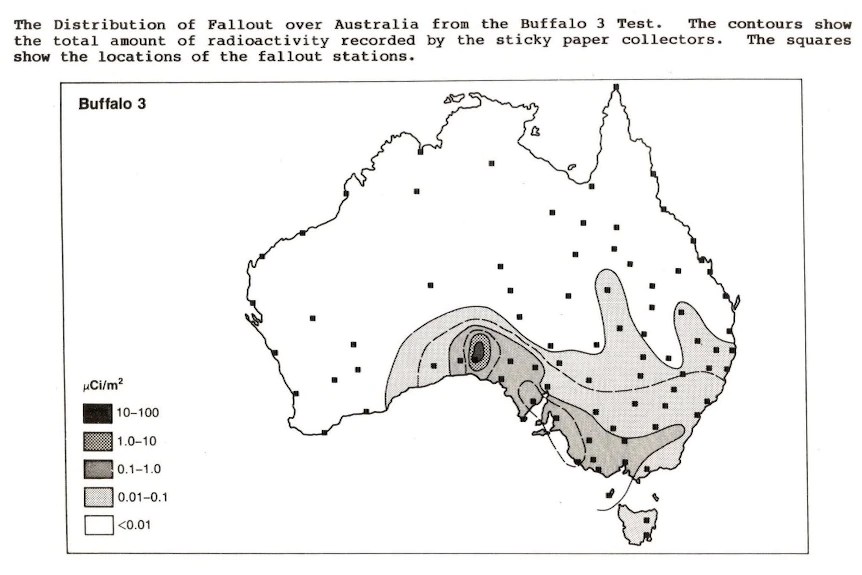
A fallout map from the 1985 royal commission, which stated that while fallout at Maralinga Village from the October 11, 1956, test was “considered to be ‘negligible from a biological point of view’ it does suggest difficulties with the forecast prior to the test”.(Royal Commission into British Nuclear Tests in Australia)
For the other experiment, Marston conducted air monitoring in Adelaide.
He was especially alarmed by what he found for the period following the Maralinga test of October 11, 1956.
“There was a wind shear and at least part, maybe the major part, of that cloud, blew in a south-easterly direction and that took it towards Adelaide and the country towns in between,” Dr Cross said.
“The safety committee — who must have known of the wind shear — had done nothing about warning Adelaide people perhaps to stay indoors.”……………………………………………………
Despite Marston’s reservations, the nuclear program carried on regardless.
Less than a year after the Operation Buffalo tests, Maralinga was hosting Operation Antler.
In September 1957, newspapers around Australia reported on an upcoming “second test” that would, weather permitting, proceed as part of a “spring series”.
If it hadn’t been for the presence of the words “atomic” and “radioactive”, a reader might easily have inferred that what was being described was as commonplace as a game of cricket.
|
Australian Prime Minister Albanese refuses to meet with Assange’s family
The claim that Australia cannot intervene in the legal case is being advanced by Labor MPs across the board, including those who previously postured as defenders of the WikiLeaks founder.
https://www.wsws.org/en/articles/2022/08/06/rbnb-a06.html Oscar Grenfell@Oscar_Grenfell5 6August 2022 In a revealing development last Wednesday, Prime Minister Anthony Albanese refused to meet with the family of incarcerated WikiLeaks publisher Julian Assange when they visited the Australian federal parliament in Canberra.
Assange’s father John Shipton and his brother Gabriel Shipton met with Independent and Greens MPs, but were reportedly unable to secure meetings with Albanese, Foreign Minister Penny Wong or Attorney-General Mark Dreyfus.
The snub expresses, again, the real attitude of the Labor government to Assange, Australia’s most famous political prisoner. In line with its commitment to US-led militarism, including the confrontations with Russia and China, Labor is intensely hostile to Assange because of his exposure of US-led war crimes in Iraq and Afghanistan.
While making highly ambiguous statements about the Assange case having “dragged on too long,” the Labor administration has refused to use its diplomatic and legal powers to secure his freedom since it was installed after the May 21 election.
This amounts to a green light for Assange’s extradition from Britain to the US, where he faces Espionage Act charges and 175 years in prison for publishing true information about the illegal wars and global diplomatic conspiracies of American imperialism.
In comments to the Guardian after their visit, both Shiptons condemned the Labor government’s failure to defend Assange and demanded that it immediately intervene.
Gabriel Shipton recalled one of the few occasions on which Albanese explicitly referenced the WikiLeaks founder. Asked about the Assange case last December, Albanese purportedly told a shadow cabinet meeting, “enough is enough”—a refrain cited publicly by several Labor MPs.
But Shipton noted: “It is months ago now that he said this stuff and made the statement that enough is enough, but when is enough, enough? Julian’s still in prison. He’s been there for three years and he is not a convicted criminal.”
Shipton added: “They could pick up the phone and call Joe Biden and make it a non-negotiable. We are strategically vital to the US at the moment, they need our resources, if it was made a non-negotiable, Julian would be here tomorrow.”
The Labor government, however, is serving as the closest of partners with the Biden administration. Albanese and Wong have met repeatedly with the US president. The primary focus of their first months in office has been on foreign policy.
Labor has functioned as an attack dog for the Biden administration throughout the Asia-Pacific, with Wong continuously traveling the region to demand that its leaders sign up unequivocally to the US-led aggression against China.
Shipton pointed to the obvious hypocrisy at the heart of Labor’s refusal to defend a persecuted citizen and journalist. “We’re dealing with this prosecution or persecution that in any normal circumstance would be seen as totally illegal, and if it was Iran doing it to somebody, or China, or Vietnam, the government would be calling them out,” he said.
Shipton continued: “It is not just about Julian’s life and his wellbeing, it is a matter of principle, and if Australia wants to be the sort of country that calls out nations on their press freedom record, they could definitely be more vocal.”
John Shipton commented on a recent Declassified Australia article. It cited internal briefings to the Labor government, indicating that the sole focus of Labor’s “diplomacy” in the Assange case, was to consider a possible prison transfer from the US to Australia.
This would only be an option after Assange had been extradited and convicted on frame-up charges in a US court, a process that could take years or decades. It would, moreover, be entirely conditional on the agreement of the US government.
John Shipton said this scenario was “grotesque.” He pointed to the spate of extraordinary abuses carried out as part of the US pursuit of Assange. They have included the theft of Assange’s legal documents, unlawful spying on him and discussions within the Trump administration and the American Central Intelligence Agency in 2017 on kidnapping or assassinating him in London.
For Labor to refuse to intervene until after Assange’s extradition was “the most feasible way for them to continue to sit on their hands and do nothing.”
Such a course of action would also amount to a death sentence. Assange’s psychologists and doctors have testified, under oath, that he would take his life were he to face imminent dispatch to his US persecutors. In addition, the WikiLeaks publisher’s physical health is failing, expressed most sharply in a minor stroke last October.
On the same day the Shiptons visited parliament, Greens Senator David Shoebridge noted in question time that Labor MPs had claimed the government was engaged in “quiet diplomacy” on Assange’s behalf. “Quiet diplomacy can’t be no diplomacy,” Shoebridge stated, before asking: “What exactly is the government doing to secure the release of this Australian citizen, journalist and whistleblower?”
In reply, Trade Minister Don Farrell stated again that the case had “gone on for too long” and should be “brought to a close,” without giving any indication of how this would take place.
Farrell said Australia was not a party to the extradition case, which was between Britain and the US, and “respected” the legal processes of both parties. This line replicates that of the previous Liberal-National Coalition government. It amounts to a green light for the extradition and a declaration that Labor will do nothing.
Assange’s extradition hearings are not a routine “legal matter” but a monstrous frame-up. They involve the persecution of an Australian journalist for his publishing activities. This is a frontal assault on the most fundamental democratic norms, including press freedom.
In numbers of cases, Australian governments have actively used their diplomatic and legal powers to secure the freedom of citizens persecuted abroad, even when such attacks have taken a pseudo-legal form.
This was the case with Peter Greste, a journalist freed from an Egyptian prison in 2015, after being framed-up on “national security” charges. The same occurred with James Ricketson, a documentary filmmaker who had phony “espionage” charges leveled against him in Cambodia, and Kylie Moore-Gilbert, an academic who was accused by Iran of being a spy.
The claim that Australia cannot intervene in the legal case is being advanced by Labor MPs across the board, including those who previously postured as defenders of the WikiLeaks founder.
It was repeated in a recent Consortium News interview by Labor backbencher Julian Hill. He insisted there were “limits to what we can do because Australia and the Australian government are not parties to the case, that’s just a fact.” Hill also defended Albanese’s supposed “quiet diplomacy.”
Hill has changed his tune since Labor took office. In August 2020, for instance, he stated: “The UK claims to be a rule of law country guaranteeing a fair trial, open justice and due process. What a joke!… The persecution and treatment of Julian Assange are unconscionable. This is inherently political and our government is too cowardly to defend him, to even demand that he gets a fair trial.”
Hill could now say the same about Albanese, the Labor government and himself.
For their part, the Greens posture as defenders of Assange. But they have rejected calls for a party campaign fighting for his freedom and buried the WikiLeaks publisher’s plight during the election.
The Greens’ entire orientation is to deepen their collaboration with the Labor government, expressed last week in their backing for Albanese’s climate bill, which will do nothing to address global warming and is premised on defending the interests of the coal and gas barons.
As the Socialist Equality Party has insisted, the fight for Assange’s freedom requires a struggle against the entire political establishment, and its program of war and authoritarianism. This must be based on mobilising the Australian and international working class, the constituency for a genuine fight against capitalist reaction and in defence of democratic rights.
US and Australia to launch second joint spy satellite from site in New Zealand
Some in space industry bewildered by Australia’s lack of fanfare about the launch of the satellites, which will be used to collect intelligence for allied nations
Guardian, Tory Shepherd, Tue 2 Aug 2022
A second spy satellite built by Australia and the United States is scheduled for liftoff on Tuesday from a launch site in New Zealand.
The first of the two satellites, which will be used to collect intelligence for the allied nations, launched two weeks ago.
The Australian Department of Defence did not announce the successful launch of the first satellite or the launch date of the second.
US spy agency, the National Reconnaissance Office, has been celebrating the “Antipodean Adventure”, which features a crocodile, a rocket and an eagle on its logo.
Some in the space industry are bewildered by the lack of information and fanfare on the Australian side.
Malcolm Davis, the Australian Strategic Policy Institute’s senior analyst and resident space expert, said there is a “very different culture” in the US military, which actively promotes its work, and the Australian military, which is “closed off”.
“It’s not just these particular satellites, it’s an attitude within Defence that they’re very closed off,” he said.
“The Americans are very forward. You only need to look at how they support movies like Top Gun: Maverick. It’s a very different culture, and it’s a frustrating one down here.”
…………………New Zealand’s Rocket Lab is providing the rockets to deliver the classified payloads into orbit from the launch site on the Māhia Peninsula.https://interactive.guim.co.uk/maps/embed/aug/2022-08-01T01:42:57.html
A Defence spokesperson said the department partnered with the NRO for “two space missions as part of a broad range of cooperative satellite activities”.
As defence minister, Peter Dutton announced Australia’s intention to work with the NRO to build a “more capable, integrated, and resilient space architecture designed to provide global coverage in support of a wide range of intelligence mission requirements”.
Earlier this year he announced a separate plan to develop a surveillance satellite with Queensland company Gilmour Space Technologies, due to launch next year.
The NRO projects are in the lead-up to Defence Project 799. The federal government has pledged $500m to DEF-799, to “improve Australia’s space-based intelligence, surveillance and reconnaissance capabilities to support Australian Defence Force operations around the world and at home”.
“The next goal is to build our own satellites,” Davis said. “So these are important steps … these are like interim tests that we’ve codeveloped with the Americans.”
The Defence spokesperson said details about the satellite payloads and missions were “protected”.
“Defence will continue to enhance Australia’s ability to generate military effects utilising the space domain,” they said.
“This will be achieved through efforts that include developing capabilities resilient in denied environments and assuring access to space.”
The NROL-199 launch was initially scheduled for 22 July but was delayed due to software issues. https://www.theguardian.com/science/2022/aug/02/us-hails-antipodean-adventure-and-australia-silent-as-second-spy-satellite-set-to-launch-from-new-zealand?CMP=share_btn_tw
The National Party’s false claim about nuclear power

Barnaby Joyce’s meltdown over nuclear energy claim , ABC, Jacob Shteyman August 5, 2022,
With Australia’s future energy needs dominating parliament, Nationals MP Barnaby Joyce has claimed we are the only OECD country that does not produce nuclear power.
The claim is false. Eighteen of the 38 OECD countries do not produce nuclear power.
Mr Joyce made the claim during a debate on Labor’s Climate Change Bill 2022 on August 3. In outlining his support for nuclear power, the shadow minister for veterans’ affairs asked: “Why is it that every OECD country produces nuclear power except us? Are we the wise ones and they’re all stupid?” (video mark 19:25).
Mr Joyce has been a supporter of nuclear power for a number of years while the coalition has looked into its implementation at several points in recent decades.
Opposition Leader Peter Dutton announced on August 2 that the coalition would begin an internal process to examine the potential for nuclear power in Australia.
AAP FactCheck contacted Mr Joyce on the source of his claim but received no reply at the time of publication.
The OECD, which is made up of 38 countries, was established in 1961 as a forum for governments to “seek solutions to common economic and social problems”.
The OECD Nuclear Energy Agency publishes an annual report showing nuclear energy generation by each member nation. The 2021 report (table 1.1, page 14) shows 18 of the 38 do not produce nuclear power.
They are Italy, Turkey, Poland, Ireland, Norway, Israel, Austria, Chile, Colombia, Denmark, Estonia, Greece, Iceland, Latvia, Luxembourg, Portugal, New Zealand and Australia.
ANU nuclear expert Tony Irwin confirmed to AAP FactCheck in an email that Australia is not the only OECD nation to generate nuclear power.
A similar claim was made by Liberal MP Stuart Robert in an interview on ABC’s Afternoon Briefing on August 2. While responding to a question about the affordability of nuclear energy, he said: “I think we’re one of only, in fact we’re the only non-top 20 OECD country that doesn’t use nuclear power as part of its power mix” (video mark 9min).
A spokesman for Mr Robert clarified to AAP FactCheck that he meant to say Australia is the only top 20 OECD country without nuclear power.
Either way his claim is false……………………………..
The most recent World Nuclear Industry Status Report, published last year, found global nuclear energy production is on the decline, despite a significant increase in China.
In 2019 AAP FactCheck debunked a similar claim by coalition MP Keith Pitt that Australia is the only OECD country not utilising nuclear energy.
Hard-Wired for Corruption -The arms trade and Australia’s lax monitoring regimes
Chris Douglas concludes that from an anti-bribery/corruption risk perspective, Naval Group should not have been put on the shortlist for the Future Submarines program, let alone selected to partner with Australia to build the submarines. The ‘contract of the century’ was mired in unacceptable risk from the outset due to Defence’s poor risk-management processes and non-existent specific anti-bribery/corruption measures. A formal inquiry is needed both to examine how this deeply flawed decision was reached and to help prevent the situation recurring in future major defence procurement projects.
‘In the arms business, it’s always a time of war’, wrote Roeber. Without war, there is no revenue, no profit, no growth. Countries with established arms manufacturing industries therefore have a perpetual economic driver towards conflict and warfare.
To give just one example, there is no visibility around what or how much weaponry Australia has exported to Saudi Arabia or the United Arab Emirates during the years of the Yemen war.
https://undueinfluence.substack.com/p/hard-wired-for-corruption?utm_source=substack&utm_medium=email Michelle Fahy 1 Aug 22, The international arms trade, worth around US$200 billion a year, represents less than 1 per cent of world trade yet is said to account for about 40 per cent of its corruption. While estimates vary, there is little dispute amongst long-term arms industry researchers that it is the most corrupt industry on the planet. Indeed, it is said to be hard-wired for corruption.
The World Peace Foundation (WPF), housed at Tufts University in America, produces extensive research on the global arms trade, including a compendium of corrupt arms deals. It says that ‘Corruption within the industry is often treated in terms of isolated incidents, when it is, in fact, representative of the business model for the industry’.
This finding is supported by research for Transparency International’s (TI) Government Defence Integrity (GDI) index, which assesses the quality of controls for managing corruption risk in defence and security institutions. The GDI shows that 86 per cent of global arms exports between 2016 and 2020 originated from countries at moderate to very high risk of corruption in their defence sectors, while 49 per cent of global arms imports went to countries at high to critical risk of defence corruption. Australia is rated as a moderate corruption risk in the GDI, with two key areas of concern being the lack of transparency in defence procurement and weak anti-corruption safeguards on military operations.
The legal trade in arms has long been known for its susceptibility to corruption. This is due to the high value and complexity of arms deals, the close association between the arms industry and political power, and the secrecy claimed necessary for national security, all of which shield arms-related activities from scrutiny. As arms industry expert Joe Roeber pointed out, ‘Defence goods are complex and each contract contains a mix of special requirements. Comparison is remarkably difficult and effective monitoring by public watchdogs is all but impossible. An unknowable price can be manipulated to accommodate any amount of covert payments’. Further, there are very few major arms deals on offer globally each year—usually less than 10 in the range of tens of billions each meaning competition is intense—while only a small number of people make the decision on what to buy…
‘In the arms business, it’s always a time of war’, wrote Roeber. Without war, there is no revenue, no profit, no growth. Countries with established arms manufacturing industries therefore have a perpetual economic driver towards conflict and warfare.
For example, in the month leading up to Russia’s invasion of Ukraine, and just days after a horrific attack in Yemen by the Saudi-led coalition using a Raytheon missile that killed 90 people and injured 200, Raytheon’s CEO told investors that global tensions represented ‘opportunities for international sales’, and that he expected to ‘see some benefit’ from ‘the tensions in Eastern Europe [and] in the South China Sea’. Meanwhile, Just Security has noted that the ‘well-documented risks of corruption in the arms industry and the potential for profiteering from an arms race in the Ukraine war’ are risk factors embedded in the massive flow of lethal weaponry from the West into Ukraine…
Blanket secrecy
All countries justify secrecy around arms-related activity with claims of protecting ‘national security’. The Australian government, for example, imposes a high level of secrecy over its arms procurement, sustainment and export deals, with politicians and the Department of Defence resisting demands for greater transparency…
Australia also relies on ‘commercial-in-confidence’ justifications to protect arms industry interests. This, in combination with national security claims, has led to almost blanket secrecy around Australia’s arms exports. To give just one example, there is no visibility around what or how much weaponry Australia has exported to Saudi Arabia or the United Arab Emirates during the years of the Yemen war. The government has only released information about the number of export permits it has approved or declined (by March 2021 Australian approvals to these two nations topped 100). However, permit numbers are not useful, as not all permit approvals translate into actual exports, and permits can cover numerous types of equipment, small or large quantities, extend for varying time periods, and even cover multiple destinations.
This is significant because the decades-long UK Campaign Against the Arms Trade has amassed a ‘mountain of evidence of corruption in arms sales to Saudi’ showing that bribery is central to the Saudi government’s approach to arms deals. Andrew Feinstein, author of the exhaustively researched 600-page book The Shadow World: Inside the Global Arms Trade, told ABC radio in 2018 that he had never seen a Saudi arms deal that didn’t involve ‘massive amounts’ of corruption, and that the percentage of a Saudi contract paid in bribes could be up to ‘about 35 per cent of the contract price’. The United Arab Emirates is also known for its secrecy, corruption, and money laundering links.
Australia’s decreasing commitment to anti-corruption measures
Australia’s extraordinary current spending on military capability—$270 billion in a decade, on top of the usual defence budget—means the domestic arms industry is awash with cash. At the same time, the public’s limited ability to scrutinise this spending has been eroded further by a defence minister, Peter Dutton, who has restricted Defence’s engagement with the media. The combination of record sums of money and little scrutiny provides fertile ground for corruption.
Australia’s performance on anti-corruption measures has nose-dived in recent years:
- It recorded its worst ever score on a global anti-corruption index in 2022, dropping four points (from 77 to 73) and falling to 18th place. Australia has now dropped 12 points in a decade, from a high of 7th (85 points) in 2012.
- Its membership status at the Open Government Partnership risks being put under review because it has ‘acted contrary to the OGP process’ and failed to submit its latest national action plan.
- Its negligible attempts to investigate and prosecute cases of foreign bribery have been criticised by the Working Group for the OECD’s Anti-Bribery Convention (it expressed concern over ‘the continued low level of foreign bribery enforcement… given the size of Australia’s economy and the high-risk regions and sectors in which its companies operate’ and ‘its long-standing challenges in attributing wrongdoing to corporate entities’).
- It has been named an ‘international laggard’ in expanding anti-money-laundering laws in line with recommendations by the G7’s Financial Action Task Force, one of only three countries, alongside Haiti and Madagascar, to have failed to do so. Australia now risks being put on a grey list of countries that don’t meet international money-laundering standards. (Australia has been resisting anti-money-laundering regulation for fifteen years.)
- A dedicated federal anti-corruption body still has not been established…
Red flags
‘The biggest corruption risk in an arms deal is a company’s decision to pay bribes to secure the deal’, says Sam Perlo-Freeman, former Program Manager for Global Arms and Corruption, World Peace Foundation, Tufts University. Decisions to pay significant bribes are made at a company’s highest levels, and while no amount of technical anti-corruption measures will eliminate high-level corrupt behaviour, strong whistleblower protection mechanisms can increase the probability of exposure. Other anti-corruption measures are also important, particularly at lower levels where zealous company employees might be tempted to cut corners to advance their careers. However, such technical measures do not tackle the underlying political and economic drivers of high-level corruption in the arms industry, where winning large deals is necessary for corporate survival and price is not the primary concern. As Joe Roeber noted incisively, bribery in this context ‘is not just a simple add-on to the procurement process, but distorts the decisions. What would the equilibrium level of trade be without the stimulus of corruption?’ …
No evidence has emerged of…extensive corrupt practices in Australia, but there are regular red flags of possible arms industry corruption. Chris Douglas, a 31-year veteran of financial crime investigation for the Australian Federal Police, who now runs his own consultancy, is an Australian expert in anti-bribery and corruption measures. He says that such compliance programs are a necessary component of good corporate and public governance—essential for preventing corruption in the defence industry. Although he has lodged numerous Freedom of Information requests (FOIs) with the Defence Department about anti-bribery/corruption measures on major procurements, he says, ‘I have not detected an ABC [anti-bribery/corruption] program being used in any of the major defence projects I have examined’.
Douglas says that the Department of Defence ‘has not caught up with modern corporate management practices’ and has no understanding of how to use anti-bribery/corruption risk-based assessments to manage the significant risks posed by bribery and corruption in its projects, particularly major ones. As he puts it: ‘That any department would not undertake an ABC risk assessment when such large sums of money are involved, in an industry that is rated high for corrupt behaviour, speaks volumes about a poor culture within that department’.
Repeated cost blowouts and delays are just two of the red flags for corruption that are regularly found in Australian defence procurement and sustainment projects. The cost of these to the public is substantial.
While there are numerous examples of red flag projects, here are just three.
Naval Group—submarine contract
This contract was abandoned with the arrival of AUKUS, but the original deal with Naval Group requires a public inquiry to examine the full extent of the process by which the internationally lucrative ‘contract of the century’ was awarded. The need for an inquiry has been amplified given the shock shredding of Defence’s largest ever contract, a decision which made international news and may yet cost Australia billions.
Continue readingHow social media is censored by algorithms to effectively throttle dissent.

ED note: This article is very personal for me. I’ve had the experience in the last few days of Facebook suppressing my post (posted as Noel Wauchope). The post was a transcript of a Youtube item by prestigious Australian journalist Michael West
It was an important article, showing up the hypocrisy of Rupert Murdoch’s News Corporation, in this case , shamefully and inaccurately promoting nuclear power as ”cheap”
I can dispute this censorship – but that could take months – even if I succeed, it would be too late to matter.
Censorship By Algorithm Does Far More Damage Than Conventional Censorship, Caitlin’s Newsletter, Caitlin Johnstone Jan 25 2022
”…………………………………………………….’And Silicon Valley did eventually admit that it was in fact actively censoring voices who fall outside the mainstream consensus. In order to disprove the false right-wing narrative that Google only censors rightist voices, the CEO of Google’s parent company Alphabet admitted in 2020 to algorithmically throttling World Socialist Website. Last year the CEO of Google-owned YouTube acknowledged that the platform uses algorithms to elevate “authoritative sources” while suppressing “borderline content” not considered authoritative, which apparently even includes just marginally establishment-critical left-of-center voices like Kyle Kulinski. Facebook spokeswoman Lauren Svensson said in 2018 that if the platform’s fact-checkers (including the state-funded establishment narrative management firm Atlantic Council) rule that a Facebook user has been posting false news, moderators will “dramatically reduce the distribution of all of their Page-level or domain-level content on Facebook.”…………………….
That’s the biggest loophole the so-called free democracies of the western world have found in their quest to regulate online speech. By allowing these monopolistic megacorporations to become the sources everyone goes to for information (and even actively helping them along that path as in for example Google’s research grants from the CIA and NSA), it’s possible to tweak algorithms in such a way that dissident information exists online, but nobody ever sees it.
You’ve probably noticed this if you’ve tried to search YouTube for videos which don’t align with the official narratives of western governments and media lately. That search function used to work like magic; like it was reading your mind. Now it’s almost impossible to find the information you’re looking for unless you’re trying to find out what the US State Department wants you to think. It’s the same with Google searches and Facebook, and because those giant platforms dictate what information gets seen by the general public, that wild information bias toward establishment narratives bleeds into other common areas of interaction like Twitter as well.
The idea is to let most people freely share dissident ideas and information about empire, war, capitalism, authoritarianism and propaganda, but to make it increasingly difficult for them to get their content seen and heard by people, and to make their going viral altogether impossible. To avoid the loud controversies and uncomfortable public scrutiny brought on by acts of overt censorship as much as possible while silently sweeping unauthorized speech behind the curtain. To make noncompliant voices “disappear from view so slowly you won’t even notice,” as Cook put it
The status quo is not working. Our ecosystem is dying, we appear to be rapidly approaching a high risk of direct military confrontation between nuclear-armed nations, and our world is rife with injustice, inequality, oppression and exploitation. None of this is going to change until the public begins awakening to the problems with the current status quo so we can begin organizing a mass-scale push toward healthier systems. And that’s never going to happen as long as information is locked down in the way that it is.
Whoever controls the narrative controls the world. And as more and more people get their information about what’s happening in the world from online sources, Silicon Valley algorithm manipulation has already become one of the most consequential forms of narrative control.
Julian Assange and family suffer as unjust detention continues.
Independent Australia By Binoy Kampmark | 16 June 2022,
The documentary Ithaka powerfully depicts the fight Julian Assange’s family is putting up for him, writes Dr Binoy Kampmark.
JOHN Shipton, despite his size, glides with insect-like grace across surfaces. He moves with a hovering sense, a holy man with message and meaning. As Julian Assange’s father, he has found himself a bearer of messages and meaning, attempting to convince those in power that good sense and justice should prevail over brute stupidity and callousness.
His one object: release Julian………………………..
The documentary Ithaka powerfully depicts the fight Julian Assange’s family is putting up for him, writes Dr Binoy Kampmark.
JOHN Shipton, despite his size, glides with insect-like grace across surfaces. He moves with a hovering sense, a holy man with message and meaning. As Julian Assange’s father, he has found himself a bearer of messages and meaning, attempting to convince those in power that good sense and justice should prevail over brute stupidity and callousness.
His one object: release Julian…………………..
The documentary Ithaka powerfully depicts the fight Julian Assange’s family is putting up for him, writes Dr Binoy Kampmark.
JOHN Shipton, despite his size, glides with insect-like grace across surfaces. He moves with a hovering sense, a holy man with message and meaning. As Julian Assange’s father, he has found himself a bearer of messages and meaning, attempting to convince those in power that good sense and justice should prevail over brute stupidity and callousness.
His one object: release Julian……………………………….
Soft, a voice of reed and bird song, Shipton urged activists and citizens to join the fray, to save his son, to battle for a cause imperishably golden and pure. From this summit, power would be held accountable, institutions would function with sublime transparency, and citizens could be assured that their privacy would be protected.
In the documentary Ithaka, directed by Ben Lawrence, we see Shipton, Assange’s partner, Stella Moris, the two children, the cat and glimpses of brother Gabriel, all pointing to the common cause that rises to the summit of purpose. The central figure, who only ever manifests in spectral form – on-screen via phone or fleeting footage – is one of moral reminder, the purpose that supplies blood for all these figures.
Assange is being held at Belmarsh, Britain’s most secure and infamous of prisons, denied bail and being crushed by judicial procedure. But in these supporters, he has some vestigial reminders of a life outside.
The film’s promotion site describes the subject as ‘the world’s most famous political prisoner, WikiLeaks founder Julian Assange’ a figure who has ‘become an emblem of an international arm wrestle over freedom of journalism, government corruption and unpunished war crimes’. ………..
suffer he shall, if the UK Home Secretary Priti Patel decides to agree to the wishes of the U.S. Department of Justice (DOJ).
The DOJ insists that their man face 17 charges framed, disgracefully and archaically, from a U.S. law passed during World War I and inimical to free press protections. The Espionage Act of 1917 has become the crutch and support for prosecutors who see, in Assange, less a journalist than an opportunistic hacker who outed informants and betrayed confidences. ……………………..
Through the film, the exhausting sense of media, that estate ever-present but not always listening, comes through. This point is significant enough; the media – at least in terms of the traditional fourth estate – put huge stock in the release of material from WikiLeaks in 2010, hailing the effort and praising the man behind it.
But relations soured, and tabloid nastiness set in. The Left found tell-all information and tales of Hillary Clinton too much to handle while the Right, having initially revelled in the revelations of WikiLeaks in 2016, took to demonising the herald. Perversely, in the United States, accord was reached across a good number of political denizens: Assange had to go, and to go, he had to be prosecuted in the United Kingdom and extradited to the United States.
The documentary covers the usual highlights without overly pressing the viewer. A decent run-up is given to the Ecuadorian stint lasting seven years, with Assange’s bundling out, and the Old Bailey proceedings covering extradition. But Shipton and Moris are the ones who provide the balancing acts in this mission to aid the man they both love……….
The film has faced, as with its subject, the usual problems of distribution and discussion. When Assange is mentioned, the dull-minded exit for fear of reputation, and the hysterical pronounce and pounce.
In Gabriel Shipton’s words:
“All of the negative propaganda and character assassination is so pervasive that many people in the sector and the traditional distribution outlets don’t want to be seen as engaging in advocacy for Julian.”
Where Assange goes, the power monopolies recoil. Distribution and the review of a documentary such as Ithaka is bound to face problems in the face of such a compromised, potted media terrain. Assange is a reminder of the plague in the patient of democracy, a pox on the body politic. ……….. https://independentaustralia.net/life/life-display/julian-assange-and-family-suffer-as-unjust-detention-continues,16470#.YqqqxM6TP0M.twitter
Another episode in the unlawful spying and harassment of Julian Assange and his legal team, by the UK and USA governments
Julian Assange’s Australian lawyer who counts Amal Clooney and Amber Heard as friends says she has reached settlement with government ‘over breach of her human rights after it admitted she was likely put under covert surveillance’
- Jennifer Robinson has reached settlement with Government over surveillance
- She said it accepted covert surveillance of her ‘likely breached her human rights’
- She was one of the three lead claimants in a complaint against the Government
- She said it raises ‘grave concerns’ over interference with ‘journalistic material
By JESSICA WARREN FOR MAILONLINE, DAILY MAIL, 10 June 2022
One of WikiLeaks founder Julian Assange‘s lawyers has reached a settlement with the Government after it accepted it was likely she was the subject of ‘covert surveillance which breached her human rights’, she said.
Jennifer Robinson welcomed a statement by the European Court of Human Rights which she said meant the UK Government has ‘accepted her rights were breached by surveillance’.
She was one of the three lead claimants in a complaint against the UK Government which went to the court.
Ms Robinson said the UK Government has reached a ‘friendly settlement’, admitting there was reasonable cause to believe she was the subject of surveillance.
She said: ‘The UK Government has now admitted that its surveillance and information-sharing arrangements with the US violated my rights. That includes in relation to the protection of confidential journalistic material.
‘This follows a pattern of unlawful spying on Julian Assange and his legal team, and it raises grave concerns about government interference with journalistic material and privilege.
‘It also raises serious questions about what information the UK and US governments have been sharing about Mr Assange’s case against extradition to the US.’
The development came as Mr Assange awaits a decision by Home Secretary Priti Patel on whether he should be extradited to the United States.
Ms Robinson, who works from the respected Doughty Chambers in London, has represented Assange for some 12 years.
She is the go-to barrister for the rich and famous, and counts the Hollywood elite among her inner circle, travelling to George and Amal Clooney’s wedding on a speedboat with actor Bill Murray.
In 2019, she was named international pro bono barrister of the year and prior to lockdown, was pictured at events with Prince Charles and Cherie Blair.
She has also appeared on BBC Question Time and supported Amber Heard during the Johnny Depp’s libel case against The Sun newspaper in 2020…………………. https://www.dailymail.co.uk/news/article-10901023/Julian-Assanges-lawyer-reached-settlement-government-breach-human-rights.html
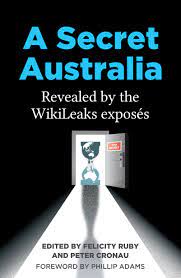
A Secret Australia Revealed by the WikiLeaks Exposés
https://publishing.monash.edu/product/a-secret-australia/?fbclid=IwAR3n6_ljrq7LHcdyeKwyeex78AJrDfKE0llSnjEvPEt0HfZFa_rnXdAK-TI Edited by Felicity Ruby and Peter Cronau Also available as an ebook from your favourite retailer.
In A Secret Australia, eighteen prominent Australians discuss what Australia has learnt about itself from the WikiLeaks revelations – revelations about a secret Australia of hidden rules and loyalty to hidden agendas. However Australians may perceive their nation’s place in the world – as battling sports stars, dependable ally or good international citizen – WikiLeaks has shown us a startlingly different story.
This is an Australia that officials do not want us to see, where the Australian Defence Force’s ‘information operations’ are deployed to maintain public support for our foreign war contributions, where media-wide super injunctions are issued by the government to keep politicians’ and major corporations’ corruption scandals secret, where the US Embassy prepares profiles of Australian politicians to fine-tune its lobbying and ensure support for the ‘right’ policies.
The revelations flowing from the releases of millions of secret and confidential official documents by WikiLeaks have helped Australians to better understand why the world is not at peace, why corruption continues to flourish, and why democracy is faltering. This greatest ever leaking of hidden government documents in world history yields knowledge that is essential if Australia, and the rest of the world, is to grapple with the consequences of covert, unaccountable and unfettered power.
The contributors include author Scott Ludlam, former defence secretary Paul Barratt, lawyers Julian Burnside and Jennifer Robinson, academics Richard Tanter, Benedetta Brevini, John Keane, Suelette Dreyfus, Gerard Goggin and Clinton Fernandes, as well as writers and journalists Andrew Fowler, Quentin Dempster, Antony Loewenstein, Guy Rundle, George Gittoes, and Helen Razer, and psychologist Lissa Johnsson.
Australia is No1 on Transparency’s list of countries with developing public sector corruption
9 COUNTRIES TO WATCH ON THE 2021 CORRUPTION PERCEPTIONS INDEX , Transparency International 1 May 22
Troubling signs and key opportunities that can make – or break – the fight against corruption
What is a ‘country to watch’ on the CPI?
In this annual watch-list published alongside the CPI, Transparency International flags countries that need closer monitoring and attention in the coming year………
1 AUSTRALIA
Australia (CPI score: 73) is one of the world’s most significant decliners, having dropped 12 points since 2012 to hit a record low this year. Its deteriorating score indicates systemic failings in tackling public sector corruption. Despite public calls and previous promises, last year Australia missed a landmark opportunity to establish a national anti-corruption agency with broad powers to investigate corruption………………………………… https://www.transparency.org/en/blog/cpi-2021-corruption-watch-list-australia-austria-el-salvador-kazakhstan
Australian government will not intervene as Australian citizen Julian Assange is extradited from UK to USA
Australia won’t interfere in Assange case https://www.aapnews.com.au/news/australia-won-t-interfere-in-assange-case?share=PPzPIGP&fbclid=IwAR2z0saMHCLbT3dc-VMgelywE7ND1eEa4TahOq9wCQ2Ai7IG2CKRyzKmWVE, By Dominic Giannini, April 21, 2022 The Australian government will not make any representations to the British home secretary after a UK court approved the extradition of whistleblower Julian Assange to the US.
A British court has sent Mr Assange’s extradition order to Home Secretary Priti Patel, but the whistleblower can try to challenge the decision by judicial review if signed.
Finance Minister Simon Birmingham said the government maintained confidence in the UK’s justice system.
“We trust the independence and integrity of the UK justice system. Our expectation is that, as always, it operates in the proper and transparent and independent way,” he told the ABC.
“It, of course, has appeal processes built into it as well. This is the legal system upon which our own has been built on and established and we have confidence in the process.”
Labor foreign affairs spokeswoman Penny Wong said it was ultimately a decision for the UK home secretary.
“I do understand why not only Mr Assange’s personal supporters but many Australians more generally are worried about this. It has dragged on a long time,” she told the ABC.
“As an Australian citizen, he is entitled to consular assistance. We also expect the government to keep seeking assurances from both the UK and US that he’s treated fairly and humanely.”
But Senator Wong stopped short of saying a Labor government would make specific representations about the case.
“Consular matters are regularly raised with counterparts, they are regularly raised and this one would be no different,” she said.
The development comes 10 days after Mr Assange surpassed the three-year anniversary of his arrest.
The 50-year-old Australian was dragged from London’s Ecuador embassy on April 11 in 2019 to face extradition to the United States on espionage charges over WikiLeaks’ release of confidential US military records and diplomatic cables.
Deputy Prime Minister Barnaby Joyce has previously called for an end to Mr Assange’s extradition.
Mr Joyce said Mr Assange didn’t steal secret US files but only published them, which did not breach any Australian laws at the time, and he was not in the US when leaks were put online.
The Greens have criticised the extradition of Mr Assange, with senator Peter Whish-Wilson saying the US Espionage Act wasn’t intended to be used against publishers.
“We must support press freedoms and those who hold the powerful to account,” he said.
“Julian Assange’s prosecution has always been political. It needs political intervention of the highest order from our government to get justice for him.”
Assange Australia campaign adviser Greg Barnes says it’s important the matter has moved back into the political realm.
“Previously the Australian government has said we can’t even intervene because the matter is before the courts. It is no longer before the courts in that sense,” he told Sky News.
This is a political decision that will be made by Priti Patel and it’s a decision which the Australian government, and of course in this context the opposition, could influence.”
The Greens, crossbenchers such as Andrew Wilkie, and Liberal and Labor backbenchers had expressed support for Mr Assange, which could potentially influence a hung parliament in May, Mr Barnes said.
“That’s also an interesting factor as to what pressure is going to come on whoever gets elected in May to bring this Australian home.”
with Reuters
The Australian media colludes with USA, UK and Australian governments’ persecution ofJulian Assange -”Crikey journal” typifies this
Australian media must stand up for Assange’s freedom, https://independentaustralia.net/life/life-display/australian-media-must-stand-up-for-assanges-freedom,15918 By Matilda Duncan | 10 January 2022, For far too long the Australian media has remained silent in the face of Julian Assange’s persecution and that must change, writes Matilda Duncan.
LAST MONTH, Crikey’s legal correspondent Michael Bradley wrote a bizarre analysis of Julian Assange’s impending extradition to the U.S. without any regard for basic facts.
It’s worth examining, as it typifies the failures and absurdities of Australian press responses to Assange going back a decade — filled with lies, smears and false narratives that prevent the public from understanding the significance and substance of his case.
In writing about one of the gravest threats to press freedom in years, Bradley went as far as to include a cringeworthy – if not downright pernicious, given Assange recently suffered a stroke and is in precarious health – reference to a Monty Python quote being inscribed on Assange’s tombstone that ‘he’s not the Messiah, he’s a very naughty boy’.
You couldn’t make this stuff up.
In allowing his thoughts to remain mired in diversionary debates and myths about WikiLeaks and Assange, Bradley completely misses the point of the U.S. extradition case and fails to mention the dire threat to investigative journalism around the world it presents.
He does not confront or condemn the alarming legal precedent of the United States charging a foreign national, one of our citizens, with espionage under U.S domestic law — despite Assange not being a U.S. citizen and WikiLeaks not being a U.S.-based publication.
Bradley writes:
‘WikiLeaks broke new ground but mainly in volume and approach, not content.’
In 2010, Assange and WikiLeaks – in partnership with numerous mainstream media outlets, including The New York Times, The Guardian and Der Spiegel – published a curated cache of 250,000 diplomatic cables revealing the corruption and destruction of the Bush-era and early Obama-era wars, into which Australia so subserviently followed.
Without Assange’s work, numerous war crimes, mass surveillance schemes and unreported civilian casualties would have gone uncovered. In one year, he generated more consequential journalistic scoops confronting Western centres of power than the rest of the world’s news organisations combined.
Some of the information published by Assange has since become the subject of criminal investigations into the CIA and U.S. authorities before the International Criminal Court, which, as lawyers for Assange testified during his extradition hearing, is further evidence that the U.S. case against him is politically motivated.
Further, irrefutable illustrations of the significance of the “content” of Assange’s work can be found in comparisons between it and the lies and deceptions fed to the Australian population by this country’s press in the Iraq War years. Consider, as just one example of many, WikiLeaks’ publishing of the detainee assessment briefs and manual for Guantanamo Bay, where children as young as 15 were held, in contrast with the vapid first-hand account of the illegal prison presented by one of the Australian Broadcasting Corporation’s top foreign correspondents, Leigh Sales.
In 2007, Sales wrote of her second visit to Gitmo:
‘At the same time, my own eyes and ears led me to believe that Guantanamo wasn’t as barbaric as it was made out to be either. None of the detainees came running to the wire, begging for help to get out.’
One Guantanamo Bay prisoner has recently waived his right to appear in court on numerous occasions because he suffered “rectal damage” while in custody of the CIA that makes it too painful for him to sit.
According to Bradley, it’s Assange that’s the “problem”, not the CIA spying on Assange and planning to kidnap or assassinate him with the help of UC Global as he held political asylum inside the Ecuadorian Embassy. After UC Global installed microphones in 2017, all of Assange’s conversations were recorded, including those he had with his lawyers outlining his defence strategy for the current case against him.
This is likely a violation of attorney-client privilege in itself and might be reason enough to throw out the U.S. case against him.
Bradley wasted his words on puerile arguments about Assange being a “tarnished hero” instead of communicating the most pressing things to know about Assange: six of the 18 counts against him are Espionage Act charges that criminalise the obtaining of ‘national defense information’, something journalists that report on their governments do every day.
Ten other counts relate to the disclosure of national defense information. Again, a regular task for many journalists. One further ‘conspiracy to commit computer intrusion’ count relates to Assange allegedly offering to help Chelsea Manning crack a security code to help her avoid detection while she was obtaining U.S. Government documents.
This is a charge that amounts to an attempt to criminalise a journalist assisting a source to protect themselves, yet another activity that responsible journalists regularly engage in.
Even more terrifyingly, the case against Assange centres around “national defence information”, a nebulous term that might be applied to whatever information the U.S. Government so chooses. It doesn’t even have to be classified or top-secret information — much of the information leaked by Manning was unclassified and widely accessible to others in government.
It has been recognised with press awards around the world for over a decade now, including a Walkley, and exposed human rights abuses globally. It is plain wrong to say that Assange did not redact the information he released — the compelling eyewitness testimony from Mark Davis can directly attest to that.
Further, there is no evidence of anyone becoming endangered by his reporting. In fact a 2013 investigation by McClatchy found officials couldn’t point to any examples of lives being endangered by WikiLeaks and in 2010, Obama officials privately admitted that any damage from the leaks was “limited” and that their public comments about the leaks having “seriously damaged American interests” were intended “to bolster legal efforts to shut down the WikiLeaks website and bring charges against the leakers”.
‘Like anyone who attains the status of iconic mystery, Assange – not actually seen freely moving in public in a decade – has become less person and more mirror reflecting the meanings we choose to attach to him and his experiences. What he actually thinks is known only to him, and his lawyers presumably.’
Bradley was correct on one thing: using the word “mirror” in connection with Assange. This citizen of ours bravely risked his life and liberty to tell us ugly truths about U.S. imperial power and military machinery, which this country so strongly enables and supports.
He reflected right back at this country snippets of the destruction and mass civilian deaths we willingly participated in. His brave journalism exposed the bulk of our country’s media as the petty, unserious talking heads they are: journalists that don’t actually serve the public, but parrot the lies they are told by governments.
Contrary to what Bradley says, what Assange “actually thinks” has been well-documented for years now.
After seven years of arbitrary detention followed by three years of solitary confinement and other tortures in London’s Belmarsh Prison, Assange thinks of suicide constantly. That the U.S. is slowly killing this Australian journalist, partner and father before our eyes for exposing war crimes while the Australian Government does nothing and the majority of our press either remains silent or – when they say anything at all – write flippant and inaccurate stories about him demonstrates just how broken this country’s media is.
It shows how unaware we are of the press freedom we are about to lose and how deeply needed the work of Julian Assange and others of his ilk is.
1 This month
Chernobyl: The Lost Tapes – A good documentary on Chernobyl on SBS available On Demand for the next 3 weeks– https://www.sbs.com.au/ondemand/tv-program/chernobyl-the-lost-tapes/2352741955560
15 April – Zoom –Nuclear Power is Not the Solution
Apr 15, 2026 01:00 AM in Canberra, Melbourne, Sydney

Join the International Physicians for the Prevention of Nuclear War (IPPNW) on Tuesday, April 14th for a timely webinar exploring the risks associated with nuclear power and challenging the myth that it offers a simple, safe, carbon-free solution to the climate crisis

21 April Webinar: No Nuclear Weapons in Australia
Start: 2026-04-21 18:00:00 UTC Canberra, Melbourne, Sydney (GMT+10:00)
End: 2026-04-21 19:30:00 UTC Canberra, Melbourne, Sydney (GMT+10:00)
Event Type: Virtual
A virtual link will be communicated before the event.
Host Contact Info: australia@icanw.org

of the week – Australians for War Powers Reform (AWPR)
To see nuclear-related stories in greater depth and intensity
 Antinuclear