Prof Peta Ashworth, stooge of the nuclear lobby, is again propagandisingfor them
Supposedly independent (LOL), Ms Ashworth was contracted by DIIS to massage the NRWMF community consultation process ~ & recommended a 2 site competition strategy to “…. ‘motivate competing communities to become invested in winning …”
Yet here she now be, boldly spruiking nuclear power in the company of other tricky nuke cyclists……
PS…. JACOBS would be one of the front runners in the chase to get the Govt contract for construction &/or to operate any national radioactive suppository. https://www.facebook.com/groups/1314655315214929/
No advantage in ‘new’ back-to-the-future nuclear reactors for Australia. Is the real motive military?
Part 2 of A Study of the “Report of the inquiry into the prerequisites for nuclear energy in Australia” Australian Parliamentary Committee 2020. The Industry Push to Force Nuclear Power in Australia
The Parliamentary Committee recommends, in part, the following: Recommendation 2
The Committee recommends that the Australian Government undertake a body of work to progress the understanding of nuclear energy technology by:
- Commissioning the Australian Nuclear Science and Technology Organisation (ANSTO), or other equivalent expert reviewer, to undertake a technological assessment on nuclear energy reactors to:
- produce a list of reactors that are defined under the categories of Generation I, II, III, III+ and IV;
- advise on the technological status of Generation III+ and Generation IV reactors including small modular reactors;
- advise on the feasibility and suitability of Generation III+ and Generation IV reactors including small modular reactors in the Australian context; and
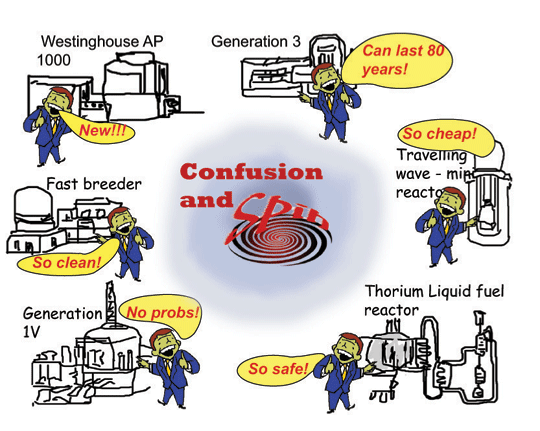
- formulate a framework to be used by Government to monitor the status of new and emerging nuclear technologies.The first item of the recommendation – for ANTSO to compile of reactors according to each one’s status within the table of Generation – 1 to 4 might be a good idea, for many of the Generation IV reactor designs were first envisaged and trialled in the 1950s and 1960s before being discarded. Whereas, at the present time, and since the time the US Department of Energy sought ways of halting the decline of nuclear power’s percentage contribution to global energy supply in the 1990s. For that is the time that the idea of resurrecting old designs and calling them new and “Generation IV” and re marketing them first arose
The waste from the very first molten salt fuelled and cooled reactor, as we saw in the previous post, continues to cost US taxpayers money 60 years later.
In 2014 the Brookings Institute published an essay by Josh Freed entitled “Back to the Future, Advanced Nuclear Energy and the Battle Against Climate Change”. This essay is available to read at http://csweb.brookings.edu/content/research/essays/2014/backtothefuture.html The cover illustration is very interesting.
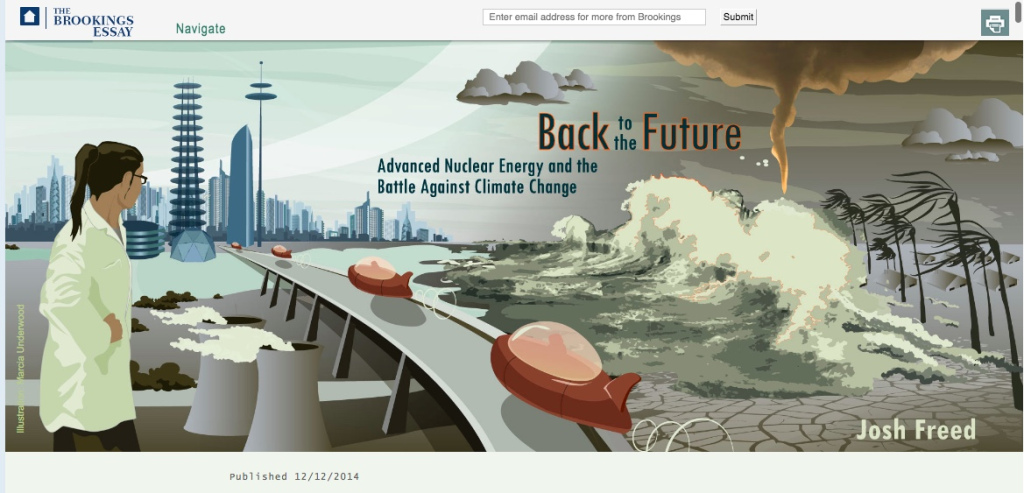
The titled cover includes the disclosure that the nuclear industry sees a future for previously discarded, old reactor designs. It shows a nuclear reactor sitting below sea level, protected by a combined Dyke / Causeway for levitating vehicles. Huge waves threaten the Dyke, vehicles, reactor and giant Science Woman, who is watching on with skilled impartiality. In the distance, buildings taken straight from the cartoon “The Jetsons” appear. The illustration is also, actually, a reinterpretation of the events which occurred in March 2011 at Fukushima. The sub text of the picture admits that nuclear industry cannot keep going in the way that it has done since the days between 1945 and now. The industry would disappear if it did not “modernise”.
The fission industry is dying as more and more competition arises in the form of alternative technologies in the energy generation technology market. Even Fusion research continues to make inroads toward the goal of successful and economic power generation, but it still a few years off. The 1930s fission patents of Szilard are long in the tooth and actually, in terms of economic energy production has always been a failure. Kick started by governments, the standard designs are trusted by fewer and fewer people, especially throughout Asia. Westinghouse Nuclear, GE Nuclear, Toshiba Nuclear are all bankrupt. British Nuclear Fuels Ltd is broke, Sellafield is broke and a growing cleanup cost liability.
So increasingly, the industry needs a unique selling point, something new and radical, something that solves the old nuclear problems. It needs a product which never fails or spills radioactive materials into the biosphere, it needs a product that will not fail because the grid goes down for a few days, it cannot melt down, catch fire like Windscale, Monju and Fermi 1 did.
Seeing as there actually no new concepts, why not look again, in desperation, at the rejected designs of the past? The essay by Josh Freed (his real name) mentions a company called Transatomic. In contrast to the contents of the Freed article, which claims the old new reactor envisioned by Transatomic run on nuclear waste, Transatomic make no such claim. They state that their proposed reactor would run on liquid uranium fuel. As per the original 50s/60s design. They claim that the Molten salt reactor would create less weight of high level waste.
Because the waste would be continuously removed from the reactor. he corporate website for Transatomic is here: http://www.transatomicpower.com/the-science/ And this, from their web site, is precisely what they promise: Molten salt reactors like Transatomic Power’s are fueled by uranium dissolved in a liquid salt. The fuel is not surrounded by cladding, making it possible to continuously remove the fission products that would otherwise stop the nuclear reaction. The liquid fuel is also much more resistant to structural damage from radiation than solid materials – simply, liquids have very little structure to be damaged. With proper filtration, liquid fuel can remain in a molten salt reactor for decades, allowing us to extract much more of its energy.” end quote. They claim their reactor design produces half the nuclear waste of a comparable conventional light water reactor.
This still does not solve the high level nuclear waste stockpile. It adds to it. Given the competition nuclear power has in the modern world, given that the need for ‘baseload’ energy is now shown to be nonsense, what would 1 or 2 small modular molten salt reactors add to Australia? Would they merely replace coal fire powered generation? SA has not had coal fired electricity for some years now. A combination of solar, wind and storage in SA means SA is a net electricity exporter to the Eastern States. We have back up of gas fired generation which very rarely needed.
Sadly for Transatomic, Green Tech Media state the following at https://www.greentechmedia.com/articles/read/transatomic-to-shutter-its-nuclear-reactor-plans-make-its-technology-public announced the following in 2018:
“Transatomic to Shutter It’s Nuclear Reactor Plans, Open-Source It’s Tecnology.
The startup backed by Peter Thiel won’t be able to build its advanced reactor designs—but it’s making its IP available for others to carry on the work.” Source: Jeff St. John, 25 Sept 2018.as given above.
This gift to the world by Transatomic occurred at the time in Australia when various people began a bombastic and highly enthused campaign to convince Australians that Molten Salt Reactors, fuelled with either Uranium or Lithium or nuclear waste, were Jesus Mark 2. “We’ll Save Yer, just like we did in the Cold War. Solar and batteries are for whimps. We Can’t have solar and wind power in Australia, its a threat to Queensland Coal. Let’s nuclear instead and all make a quick a buck with IP”.
Funny that. Talk about drumming up business prospects and investment funds, and in 2020, floating a float on the back of sympathetic and one eyed Parliamentary Inquiry!
Double or Nothing?
The promise made by Transatomics is that molten fuel/molten salt reactors made with modern techniques will reduce by roughly half the amount of high level nuclear waste generated per unit of power generated. However, at the current time the amount of high level nuclear waste (ie, fission products -the transmutation products described in Szilard’s 1930s patents) and the release of the gaseous forms of these substances into the atmosphere, generated by Australian electricity generation is ZERO.
So the introduction of Molten Salt Reactor into Australia for electricity production will RAISE the production of high level nuclear waste from this activity by 100%. It won’t half, it won’t double, it will increase by x grams per watt. It is a spurious argument to say any reactor type will reduce Australia’s power industry high level nuclear waste when we produce zero at the moment. And if Australia continues on its non nuclear path, that zero rate of power related high level waste will remain zero forever. So where is the advantage for Australia in introducing power reactors in the civilian sphere?
I am led to believe that it will take between 10 – 20 years for any Australian nuclear power reactor to come on line from the time it is approved. By that stage the competition from other forms of low carbon power production will be much, much more severe than it is now. And today, in my opinion, only a devotee of nuclear power would see any advantage in introducing any type of nuclear reactor to Australia. Unless the real motive for such a reactor is a military motive. If so, the O’Brien Committee and the government needs to come clean on that. Not that they will. Such an admission is likely to be impossible for several reasons. Besides, no nuclear industry is free to fully disclose the corporate production and disposition of “special nuclear materials”.
So, I suppose in the end the Committee recommend ANTSO compile a list of reactor types and nominate the current industry PR terms for each type. For the Generational types (1 through IV) have actually very little to do with the chronological order and date range over which each type first manifest as a prototype. The small World War 2 German reactors, of which there were many, are little known, and the US ALSOS project has not disclosed that much about them. Germany had at least 4 reactor programs, 7 ways of enriching uranium. Japan had an Army fission project, a Navy fission project, an Air Force Fission project. All were formally abandoned, ironically , in July 1945. Germany was able to enrich uranium.
This is ancient history, but the world remains fairly ignorant I think, as to which reactor type is the safest, most economic, most reliable and so on. So far, all I have heard from the nuclear industry is PR manufactured originally by the US Department of Energy which relabelled the various reactor designs originated in the US according to a “Generation Number” which is completely detached from the chronological sequence in which they occurred.
In World War 2 Germany was working on heavy water reactors. Does that mean Hitler’s heavy water reactors were Generation III+ ? Of course not. They were Gen 1. As was the Canadian heavy water reactor of World War 2 which supplemented the US plutonium production at Hansford. If the Candu reactor is Gen III+ I’m Father Christmas. What the US DOE is doing with its naming is using marketing techniques to sell old concepts as new ideas.
Car companies do the same when naming cars. Makers of garbage trucks send salesmen around to Council depots extolling the virtues of the Gen IV 2 ton rubbish truck, complete with compactor, a tilt tray and 8 track stereo sound. And Depot managers get given toy model rubbish trucks they sit on their book cases to show how technically astute they are in the field of garbage.
Same deal here. It’s a no brainer. Yet, start collecting lists from ANSTO Mr. O’Brien. Great idea sir. It’ll keep you off the streets for awhile.
Busting the lies of the Australian Government about “new” nuclear reactors
The core propositions of non-traditional reactor proponents – improved economics, proliferation resistance, safety margins, and waste management – should be reevaluated.
Before construction of non-traditional reactors begins, the economic implications of the back end of these nontraditional fuel cycles must be analyzed in detail; disposal costs may be unpalatable………. reprocessing remains a security liability of dubious economic benefit
Non-traditional” is used to encompass both small modular light water reactors (Generation III+) and Generation IV reactors (including fast reactors, thermal-spectrum molten salt reactors, and high temperature gas reactors)
|
Burning waste or playing with fire? Waste management considerations for non-traditional reactors Full Text
The Industry Push to Force Nuclear Power in Australia https://nonuclearpowerinaustralia.wordpress.com/2020/03/02/burning-waste-or-playing-with-fire-waste-management-considerations-for-non-traditional-reactors-full-text/ by nuclearhistory March 2, 2020 The following paper is copied here in order to counter the false, incorrect and erroneous propaganda published by the Australian Government and its Parliamentary Committee for lying to the Australian people about so-called new nuclear reactor designs, all of which were rejected by competent authorities in the 1950s, 1960s, and 1970s. The residues produced by these test reactors continue to cost the American taxpayer money and continue to present the American people with stored, hazardous radioactive waste which is also high chemically reactive. |
No, Mr Baldock, our children do not deserve this dirty, long-lasting, nuclear trash dump
 Paul Waldon Fight To Stop A Nuclear Waste Dump In South Australia, 21 Feb 20, People leaving, property values dropping, large tracts of land hitting the market, children’s heritage being sold and/or eroded, a once strong community now divided, people happier to shop outside their community, these are the trademarks of a dying town with poor opportunities.
An aggressive social cancer fueled by a desperate and ignorant nuclear embracing dichotomy trying to grasp the doctrines of the indentured servitude bound nuclear coterie with a vested interest spouting factoids will surely fail to attract new business and people to the region.
Meanwhile Andrew Baldock, nuclear profiteer, social axe man has continued to state “We are doing this for the children!”
Well Baldock my children, my children’s children’s children don’t deserve this. https://www.facebook.com/groups/941313402573199/
Correcting the propaganda: Australia’s nuclear medicine DOES NOT NEED a national radioactive waste dump
|
Commenting on the opinion piece: Kimba nuke decision dumps on Indigenous rights In Daily 21 Feb 20, Once again, Sam Chard (Your views, February 19) glosses over some of the less flattering details of the proposed National Radioactive Waste Management Facility.
A lot of focus is given to the permanent disposal of the so-called ‘gloves and gown’ low-level waste. However, the proposal also includes the temporary above-ground storage of long-lived intermediate level waste. This waste will not be be safe after a half-life of 30 years (as with the low level waste). In fact, it will not be safe after 100 years when the facility is projected to close. This long-lived intermediate level waste is not currently ‘spread across 100 sites’. It is housed in one location in a purpose-built facility at Lucas Heights. This long-lived intermediate level waste is not currently ‘spread across 100 sites’. It is housed in one location in a purpose-built facility at Lucas Heights. There is no future plan, nor funding, to manage this waste in 100 years when the facility closes. The question that South Australians have to ask is; how our grandchildren are going to manage this waste long after the ‘community development’ fund is gone? – Megan Johnson The head of the federal government’s radioactive waste task force stated (Your views, February 19) that the planned national waste facility at Kimba is ‘critical to Australian nuclear medicine’, and went on to assert that ‘radioactive waste from nuclear medicine is currently spread over more than 100 locations across the country, at science facilities, universities and hospitals. It needs to be consolidated into a purpose-built facility, where it can be safely managed’. Sounds reasonable, but is it accurate? With minor exceptions, Australia’s waste from nuclear medicine is managed on a ‘store and decay’ basis. This means it is secured and stored at the site of use until it has decayed to a point where it can be disposed to local landfill. This material does not need any federal facility, and continuing access to nuclear medicine is not dependant on the planned national facility. The facility is related to nuclear medicine in as much as it is planned to house spent nuclear fuel from the Lucas Heights reactor, but not in relation to any need from clinics, Uni’s, hospitals or medical centres that use nuclear medicine. Perhaps the federal department could step up and list the one hundred sites that currently store radioactive material that will no longer need to do so should a national facility ever be built. No doubt they will claim they can’t do so because of security considerations, an explanation that sounds better than because there are few or no sites that need this. Radioactive waste lasts longer than any politician’s promise. Matt Canavan, who signed off on the contested Kimba plan at the start of this month, is now no longer a Minister – but the waste has up to another 10,000 years to go. We need to do better than to try and manage half-lives with half-truths. – Dave Sweeney, Australian Conservation Foundation https://indaily.com.au/opinion/reader-contributions/2020/02/21/your-views-on-nuclear-waste-le-cornu-site-and-holden-demise/ |
|
#ScottyFromMarketing ‘s hypocritical ploy to do nothing effective against climate change
 The government’s sudden passion for climate technology is newfound and insincere, The call for technology before action is a specious distraction designed to paper over the plan to take no action Guardian, Simon Holmes à Court– @simonahac 21 Feb 2020 The government’s sudden passion for climate technology is newfound and insincere, The call for technology before action is a specious distraction designed to paper over the plan to take no action Guardian, Simon Holmes à Court– @simonahac 21 Feb 2020
If you’re committed to the Paris agreement – to keep the increase in global average temperature to well below two degrees above pre-industrial levels, and pursue efforts to limit the increase to 1.5 degrees – then at a minimum, logically, scientifically, you’re committed to net-zero carbon emissions by 2050. So far, at least 77 countries have committed to the target, as has every state and territory in Australia. The fact that prime minister Scott Morrison is pushing back hard against the calls for such a target sends yet another strong signal that his government still denies the need to tackle climate change. Sensing it must be seen to do something, but committed to doing nothing substantive, the government is arguing that investing in technology is the superior pathway to… to… to what? Are billions of dollars of public funds about to be allocated to a strategy that delivers on an unspoken goal? This passion for technology is newfound and insincere. In truth, our government has a long history of undermining climate technologies. In the three years to 2016, the government ripped just shy of $1bn from the Australian Renewable Energy Agency (Arena), the body charged with helping early stage technologies through to commercial launch. The funding of a feasibility study for a coal power station in Collinsville and the foreshadowed gift of $11m to extend the life of the 42 years old Vales Point coal power station in the Hunter, demonstrate just how reluctant the Coalition is to let go of last century’s energy technologies. One of the most promising and critical new technologies is the rapid maturation of the electric vehicle, but who can forget the government’s pushback against EVs during last year’s election?…… Mike and Annie Cannon-Brooke’s Resilient Energy Collective is a case study for how far we’ve come. In just a handful of weeks the group has put together an emergency power product for restoring power to bushfire affected communities. The solar-powered, battery-backed system can be installed in a single day, and will be rolled out to 100 communities in as many days. The energy supply companies partnering in the project are stunned that the infrastructure is being rolled out in hours not months. Community members are amazed that they’re using solar power at night. ….. In reality, the call for technology before action is a specious distraction designed to paper over the plan to take no action. The greatest proponent of the frame is Danish political scientist Bjorn Lomborg, one of a small cadre of almost respectable climate obfuscationists. …… The first three years of the Coalition government focussed on tearing down climate policy. The next three used endless reviews that came to nothing – as intended. In July 2014, Tony Abbott finally made good on his promise to dismantle Australia’s carbon price mechanism, our most effective and efficient climate policy. In doing so, not only did he throw away the best tool we had, he cheated Australian farmers out of earning billions from exporting carbon credits to Europe. In 2015, Abbott managed to slash the renewable energy target – assisted in the background by Angus Taylor, the man now charged with reducing emissions – cutting future activity under the target by 40%…… In July 2014, Tony Abbott finally made good on his promise to dismantle Australia’s carbon price mechanism, our most effective and efficient climate policy. In doing so, not only did he throw away the best tool we had, he cheated Australian farmers out of earning billions from exporting carbon credits to Europe. In 2015, Abbott managed to slash the renewable energy target – assisted in the background by Angus Taylor, the man now charged with reducing emissions – cutting future activity under the target by 40%….. So here we are again. Another strategy to kick the can down the road……https://www.theguardian.com/commentisfree/2020/feb/21/the-governments-sudden-passion-for-climate-technology-is-newfound-and-insincere |
|
Australian Parliamentary Committee Want Money Wasted On More Nuclear Reports
Parliamentary Committee Supports Nuclear – But Only If Everyone Is Into It , Solar Quotes, December 19, 2019 by Ronald Brakels “….They Want Money Wasted On More Reports
The report suggests we get people to write another report on how much nuclear power will cost here:
But I have a different suggestion. A much cheaper one. We just wait for another country to build and operate a nuclear power plant at a low enough cost that would be competitive in Australia. Then we can look into it.
Better yet, to make sure they aren’t exaggerating how cheap their nuclear power is, we say:
“Hey, budget nuclear energy guys, how would you like to build a nuclear power station in Australia? We give you nothing, but you get the market price for whatever electricity you sell.”
If they say, “nyet” or “bu shi” or “piss off” then we can suspect it’s not as cheap as they’re making it out to be.
If they say, “yes” then we can talk about how they’ll be required to insure it for a reasonable amount based on the costs of nuclear accidents that have occurred in the past. While nuclear power is very safe, there must have been at least one or two minor little upsets.
Everyone Has To Love Nuclear Energy
The report says that social acceptance of nuclear power is necessary for it to go ahead. So it’s not going to go ahead because that’s not going to happen. Nuclear energy has turned out to be an economic disaster overseas, we have much cheaper alternatives, and now that I think about it there have been one or two major nuclear accidents overseas that have left a bad impression.
There was a problem with a nuclear power station in Fukushima, Japan. The Japanese Government estimated the cost at around $270 billion dollars. As our government is currently willing to spend around $4.5 million to save an Australian life through public health and safety measures, if we lost that amount of money it would represent around 60,000 Australian lives that potentially could have been saved with it.
Since nuclear power — at the costs we see overseas — is only going to increase electricity bills, and we have far cheaper ways to reduce emissions that are quicker to deploy, and because Australians aren’t in love with a very very small chance of a nuclear accident that has a very high cost, there will never be acceptance for nuclear power in this country. Not in its current form. But be sure to let me know when a DeLorean compatible Mr Fusion becomes available.
I’m guessing the entire section on social acceptance is only in the report so when nuclear power doesn’t get built, its supporters can say, “It’s the fault of normal Australians for not believing in the nuclear economic viability fairy hard enough”, rather than admit they themselves were wrong.
The Moratorium Means Nothing
Currently there is a moratorium on nuclear power in Australia. This means you’re not allowed to build it without special permission from the government. Well, guess what? In this country you are never going to be allowed to build a nuclear reactor without permission from the government. That’s just the way it is. I know it’s a terrible infringement of our right to build nuclear reactors in our backyards and squash courts. But on the other hand, it does support our right not to live next door to someone who’s building a nuclear reactor in their backyard, so I could go either way on this one.
The report suggests scrapping the moratorium or partially lifting it. I’m not sure what partially lifting it means. Maybe you have to ask for permission but you don’t have to say pretty please or maybe it just means they won’t be too worried if you have an eye patch, a cool scar, and introduce yourself as “The Jackal”.
Because the moratorium doesn’t really mean anything, there may not be any harm in lifting it and shutting up a few idiots who think the only reason nuclear power isn’t currently under construction in this country is because the government hasn’t muttered the magic words, “The moratorium is lifted!” So they may as well say moratorium leviosa and be done with it.
It’s not as if nuclear power is going to be built in this country one way or the other. Supporters will soon discover no one’s lining up to build reactors even with our current high wholesale electricity prices. The only way they will get built is with very substantial subsidies and the government is too busy trying to keep coal power afloat while Australia burns to waste its energy subsidising nuclear. https://www.solarquotes.com.au/blog/nuclear-energy-australia/


Pro nuclear nonsense from Geoff Russell – “we’re all toast without nuclear power”
Once again, New Matilda gave nuclear lobbyist Geoff Russell a forum for an attack on a critic of the nuclear industry. (Steggall’s Chicken On Nuclear Family, While Party Politics Buggers Inquiry, 16 Dec 19.) On this occasion, New Matilda was trashing a very mild nuclear critic, Zali Steggall.
So we’re “all toast” without nuclear power? This is nonsense. Even Geoff Russell knows that to get up and running the thousands of nuclear power plants that would be needed to stall global heating – would take decades. That means that, with the speed of global heating, nuclear power would be too late to make any difference. (And that’s if nuclear power really were effective against climate change – which it isn’t, when you consider the whole carbon emitting nuclear fuel cycle from uranium mining to deep disposal of wastes) Meanwhile, energy efficiency, wind and solar power, are quickly set up, quickly effective, and provide energy fuel that is genuinely zero carbon.
Dr Jim Green busts ANSTO’s spin about nuclear wastes
Dr Jim Green at Senate Nuclear Inquiry , 11 Nov 19
WES FANG: I am unaware if you heard the evidence earlier today, but we heard from Australian Nuclear Science and Technology Organisation about the advances that have developed not only in the development of power but also in the way that waste is handled. ANSTO is not a lobbyist; it is a scientific organisation.
Dr GREEN: ANSTO is a lobbyist and its claims about nuclear waste are demonstrably false. I mean that quite literally. If you take the example of the integral fast reactor, the idea is that you can use high-level nuclear waste, consume it in a reactor and then turn it into low-carbon power. That is an incredibly enticing proposition but the reality in Idaho—where they operated one of those demonstration reactors and are now trying to deal with the waste—is that they have turned one difficult, challenging form of nuclear waste, namely spent fuel, into multiple forms of challenging, difficult nuclear waste. They have not improved the situation; they have made a bad situation worse.
That is the reality of the theoretical arguments that you have heard from ANSTO this morning. I would also strong recommend that you read the articles that we have pointed to in our submission from Dr Allison Macfarlane, who is a former chair of the US Nuclear Regulatory Committee. Once again, she has looked at demonstration advanced reactor projects. They are not improving waste management issues; they are making those issues more difficult to deal with—demonstrably in the real world, as opposed to the theoretical nonsense you have heard from ANSTO.
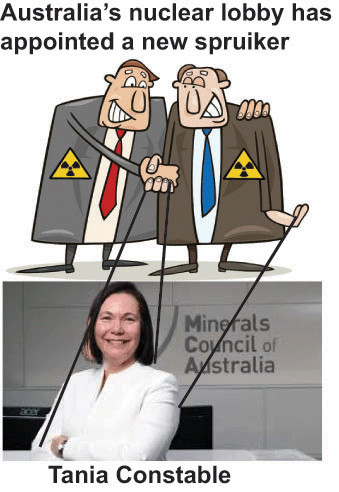
Minerals Council renews push for nuclear energy, but rather coy about its costs
“The construction of nuclear power plants has proven to be an economic disaster for the corporations involved and a massive waste of public monies, given the plants are all entirely reliant on government financial subsidies,” IEEFA said.
Nuclear inquiry sparks industry campaign to lift moratorium, https://www.theage.com.au/politics/federal/nuclear-inquiry-sparks-industry-campaign-to-lift-moratorium-20191201-p53fsz.htl By Mike Foley, December 1, 2019 — The Minerals Council is ramping up its long-run campaign to remove Australia’s ban on nuclear power, claiming new market research shows majority community support for the technology.
Federal Parliament banned nuclear power in 1998, and the moratorium has remained in place with bipartisan support ever since.
The Morrison government has asked the House of Representatives Standing Committee on Environment and Energy to investigate the prerequisites for nuclear energy in Australia.
According to the Minerals Council of Australia, one prerequisite for nuclear power, community support, could be achieved if the public are properly informed about the technology.
The Minerals Council commissioned JWS Research to sample Australians’ support for nuclear power. The survey of 1500 people found 40 per cent support nuclear power and 33 per cent oppose it.
The support for nuclear energy rose to 47 per cent when respondents were presented a range of positive and negative facts about the technology.
“The more people learn about it, the greater the support for nuclear energy,” said Minerals Council chief executive Tania Constable.
She said the survey showed politicians that Australians wanted nuclear to be considered in their future energy mix.
“This should give them the courage to act. Any government serious about addressing climate change must be looking at nuclear, the zero-emissions foundation of electricity systems across the globe.”
The factors for nuclear energy were delivery of emissions-free power around the clock, Australia’s vast landmass could safely house reactors in remote locations, increased uranium mining, and nuclear power plants could bring jobs growth, and Australia already permits uranium exports – which could be utilised at home.
The factors against nuclear energy were the potential for human error to cause accidents at a reactor or waste facility, previous catastrophic failures such as Three Mile Island and Fukushima, concerns of health impacts for people living near reactors or waste facilities, and the risk that uranium exports could be used for weapons.
Energy analyst Lazard’s estimates the current cost of energy production for nuclear is more expensive than renewables.
The levelised cost of solar power around the world for solar power is about $60 per megawatt hour, $42/Mwh for wind, $145/Mwh for coal, and $220/Mwh for nuclear.
Nuclear power production costs could come with new technology. Small to medium sized reactors are proposed as potential cost savers, but there are no commercial examples in operation.
Government contributions would likely be required to underwrite private investment in a nuclear power plant in Australia. The cost of building Britain’s first nuclear plant in a generation, Hinkley Point, has blown out to more than $42 billion. It is contracted to supply the government with power at $176/Mwh.
The Institute for Energy Economics and Financial Analysis submission to the inquiry believes nuclear is one of the most expensive power sources.
“The construction of nuclear power plants has proven to be an economic disaster for the corporations involved and a massive waste of public monies, given the plants are all entirely reliant on government financial subsidies,” IEEFA said.
The Minerals Council submission said nuclear’s zero emissions power generation had to be incorporated into Australia’s future energy mix.
“Have Your Say” on nuclear waste dump – just a window-dressing exercise by the Australian govt
Kazzi Jai No Nuclear Waste Dump Anywhere in South Australia, 30 Oct 19, In today’s Transcontinental paper on page 4 there is a half page ad for “Have your Say on the National Radioactive Waste Management Facility”. It says…
In November and December 2019, the Australian Government will survey businesses and neighbours of the proposed sites to determine if they support hosting the National Radioactive Waste Management Facility in their community. These surveys are in addition to the Flinders Ranges Council Community Ballot (Mon 11 November to Thurs 12 December 2019).
Also, anyone can make a submission by 12 December 2019 to radioactivewaste@industry.gov.au
It then says in bold letters at the bottom “Further information, including an ‘opt-in’ process for surveys, is available at www.radioactivewaste.gov.au/have-your-say”
But alas – it only goes to https://www.industry.gov.au/strategies-for-the-future/managing-radioactive-waste page……..
So….is there something sneaky going on here??
The presumptive flip side to that is therefore The Minister has already determined everyone else will NOT be detrimentally affected & so not worth greater effort. LMFAO https://www.facebook.com/groups/1314655315214929/
Once again, Aaron Patrick subtly slants this story in the pro nuclear direction.
Mr Forshaw, who chaired an inquiry into the replacement of the Lucas Heights reactor, on Monday said that he didn’t regret Parliament’s decision, and isn’t convinced that nuclear can compete with other energy sources on cost.
|
Read down to the article’s later paragraphs (in red) to get a better picture
 of what is really going on. AND – of what is really going on. AND –
The man who helped ban nuclear has second thoughts, https://www.afr.com/companies/energy/the-man-who-helped-ban-nuclear-has-second-thoughts-20191021-p532n4 Australian Financial Review Aaron Patrick, Senior Correspondent, Oct 21, 2019 Twenty-one years after the Federal Parliament banned nuclear power, one of the senators responsible would like Australia to have another look at the energy source.
In 1998, Michael Forshaw, a Labor senator, agreed to a Greens proposal to insert a clause into a proposed law on nuclear safety that prohibited using nuclear power to generate electricity. Now, as parliamentary inquiries at the federal level and in NSW and Victoria investigate nuclear power, Mr Forshaw is one of a number of Labor figures open to reconsidering whether nuclear can play a role in combating climate change. “I think the debate is good because there have been people who have been the strongest environmentalists for many years who now say nuclear is a clean source of energy,” he said in an interview from the Sutherland Shire, where he is a councillor. “Nuclear energy is certainly on one case cleaner that some of the more traditional forms of energy, such as coal-fired power stations. But the problem is of course what do you do with the nuclear waste. We still haven’t got to Australia settling on a site for the waste we currently produce.” Pro-nuclear advocates regard the events of late 1998 as one of the great, unheralded missteps in the history of energy policy. The medical industry was desperate for the Lucas Heights nuclear reactor – then located in bushland west of Sydney – to continue because it produced radioisotopes vital for the treatment of cancer and other diseases. The 40-year-old reactor needed to be replaced, and the government wanted to merge the Australian Radiation Laboratory and the Nuclear Safety Bureau into a single independent regulator, the Australian Radiation Protection and Nuclear Safety Agency, according to a brief history by Bright New World, a pro-nuclear lobby group. The Greens and Australian Democrats decided to tap into anti-nuclear sentiment coursing through society by raising concerns about where the nuclear waste would be stored. The Greens, which wanted to attract votes from the bigger Democrats party, saw a political opportunity to demand that the new law would state that it did not “authorise the construction or operation” of a nuclear power plant or uranium enrichment facility. As a junior Labor spokesman for health, Forshaw had responsibility for the legislation in the upper house. On December 10, not long before the Senate broke for lunch, he announced that the Labor Party had agreed to the proposal, ensuring it would pass. “We understand that there is no either medium-term or long-term intention on the part of the government to proceed to construct such facilities,” then senator Forshaw said. “On that basis alone, one would think that the government should be prepared to support this amendment.” Needing the Senate’s support to replace the ageing Lucas Heights plant with a new Argentinian reactor, prime minister John Howard’s government didn’t bother opposing the clause. Only 10 of the 76 senators were present for the vote, including three from the Greens and Australian Democrats. “The rest just accepted it without any opposition,” the Bright New World history says. The process took six minutes. Eleven hours later the law was approved by the House of Representatives, without a vote, at the direction of health minister Michael Wooldridge. “I believe the amendments agreed to by the Senate will strengthen this legislation,” Dr Wooldridge told the lower house. Waste concerns lingerMr Forshaw, who chaired an inquiry into the replacement of the Lucas Heights reactor, on Monday said that he didn’t regret Parliament’s decision, and isn’t convinced that nuclear can compete with other energy sources on cost. The Greens senator who proposed the ban, Dee Margetts, wasn’t well enough to answer questions, a party spokeswoman said. “I am sure she would believe it is still the right decision though,” she said. “Dee never wavered in her stance on issues.” Mr Forshaw said political agreement was needed on a central location to store nuclear waste for hundreds of years. Once that was settled, a rational debate about the cost and benefits of nuclear power would be appropriate, he said. We should store our own. That’s the requirement under international agreement. It’s a real travesty we haven’t been able to sort that out. “If we can’t get governments to make a decision about where to make a long-term nuclear storage facility – if we can’t get that right I think we are a long way from making a reasoned decision on something like a nuclear power station.” Other figures from the left who have expressed conditional support for nuclear energy include University of Queensland economist John Quiggin, Industry Super Funds chief economist Stephen Anthony, green-energy advocate Simon Holmes a Court and Australian Workers Union national secretary Daniel Walton. The Labor Party remains adamantly opposed, and environment spokesman Mark Butler has already begun to stoke fear among voters about the risk of nuclear reactors. Former NSW premier Bob Carr, who was an early Labor Party supporter of nuclear power, said he had become pessimistic about overcoming public opposition. “If a continent can’t settle on a location for a toxic waste incinerator despite 30 years of discussion, can you really tell me which locality is going to put its hand up to host the country’s first nuclear power reactor?” he said on Monday. The US National Aeronautics and Space Administration estimated in 2013 that nuclear power prevented 1.8 million deaths between 1971 and 2009 by displacing coal and other polluting sources of energy. |
|
Exposing misleading evidence to the federal nuclear inquiry
Big claims and corporate spin about small nuclear reactor costs, Jim Green, 19 September 2019, RenewEconomy https://reneweconomy.com.au/big-claims-and-corporate-spin-about-small-nuclear-reactor-costs-65726/
The ‘inquiry into the prerequisites for nuclear energy in Australia’ being run by Federal Parliament’s Environment and Energy Committee has finished receiving submissions and is gradually making them publicly available.
 The inquiry is particularly interested in ‘small modular reactors’ (SMRs) and thus one point of interest is how enthusiasts spin the economic debate given that previous history with small reactors has shown them to be expensive; the cost of the handful of SMRs under construction is exorbitant; and both the private sector and governments around the world have been unwilling to invest the billions of dollars required to get high-risk SMR demonstration reactors built.
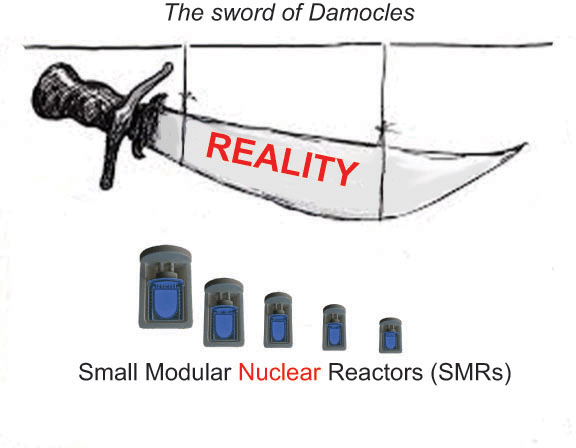 To provide a reality-check before we get to the corporate spin, a submission to the inquiry by the Institute for Energy Economics and Financial Analysis notes that SMRs have been as successful as cold fusion – i.e., not at all. The submission states:
“The construction of nuclear power plants globally has proven to be an ongoing financial disaster for private industry and governments alike, with extraordinary cost and construction time blow-outs, while being a massive waste of public monies due to the ongoing reliance on government financial subsidies. … Governments have repeatedly failed to comprehend that nuclear construction timelines and cost estimates put forward by many corporates (with vested interests) have proven disastrously flawed and wrong.”
The Institute is equally scathing about SMRs:
“For all the hype in certain quarters, commercial deployment of small modular reactors (SMRs) have to-date been as successful as hypothesized cold fusion – that is, not at all. Even assuming massive ongoing taxpayer subsidies, SMR proponents do not expect to make a commercial deployment at scale any time soon, if at all, and more likely in a decade from now if historic delays to proposed timetables are acknowledged.”
Thus the Institute adds its voice to the chorus of informed scepticism about SMRs, such as the 2017 Lloyd’s Register survey of 600 industry professionals and experts who predicted that SMRs have a “low likelihood of eventual take-up, and will have a minimal impact when they do arrive“.
 Corporate spin #1: Minerals Council of Australia
The Minerals Council of Australia claims in its submission to the federal inquiry that SMRs could generate electricity for as little as $60 per megawatt-hour (MWh). That claim is based on a report by the Economic and Finance Working Group (EFWG) of the Canadian government-industry ‘SMR Roadmap’ initiative.
The Canadian EFWG gives lots of possible SMR costs and the Minerals Council’s use of its lowest figure is nothing if not selective. The figure cited by the Minerals Council assumes near-term deployment from a standing start (with no-one offering to risk billions of dollars to build demonstration reactors), plus extraordinary learning rates in an industry notorious for its negative learning rates.
Dr. Ziggy Switkowski noted in his evidence to the federal inquiry that “nuclear power has got more expensive, rather than less expensive”. Yet the EFWG  paper takes a made-up, ridiculously-high learning rate and subjects SMR cost estimates to eight ‘cumulative doublings’ based on the learning rate. That’s creative accounting and one can only wonder why the Minerals Council would present it as a credible estimate.
Here are the first-of-a-kind SMR cost estimates from the EFWG paper, all of them far higher than the figure cited by the Minerals Council:
- 300-megawatt (MW) on-grid SMR: C$162.67 (A$179) / MWh
- 125-MW off-grid heavy industry: C$178.01 (A$196) / MWh
- 20-MW off-grid remote mining: C$344.62 (A$380) / MWh
- 3-MW off-grid remote community: C$894.05 (A$986) / MWh
The government and industry members on the Canadian EFWG are in no doubt that SMRs won’t be built without public subsidies:
 “The federal and provincial governments should, in partnership with industry, investigate ways to best risk-share through policy mechanisms to reduce the cost of capital. This is especially true for the first units deployed, which would likely have a substantially higher cost of capital than a commercially mature SMR.”
The EFWG paper used a range of estimates from the literature and vendors. It notes problems with its inputs, such as the fact that many of the vendor estimates have not been independently vetted, and “the wide variation in costs provided by expert analysts”. Thus, the EFWG qualifies its findings by noting that “actual costs could be higher or lower depending on a number of eventualities”.
Corporate spin #2: NuScale Power
US company NuScale Power has put in a submission to the federal nuclear inquiry, estimating a first-of-a-kind cost for its SMR design of US$4.35 billion / gigawatt (GW) and an nth-of-a-kind cost of US$3.6 billion / GW.
NuScale doesn’t provide a $/MWh estimate in its submission, but the company has previously said it is targeting a cost of US$65/MWh for its first SMR plant. That is 2.4 lower than the US$155/MWh (A$225/MWh) estimate based on the NuScale design in a report by WSP / Parsons Brinckerhoff prepared for the SA Nuclear Fuel Cycle Royal Commission.
 NuScale’s cost estimates should be regarded as promotional and will continue to drop – unless and until the company actually builds an SMR. The estimated cost of power from NuScale’s non-existent SMRs fell from US$98-$108/MWh in 2015 to US$65/MWh by mid-2018. The company announced with some fanfare in 2018 that it had worked out how to make its SMRs almost 20% cheaper – by making them almost 20% bigger!
Lazard estimates costs of US$112-189/MWh for electricity from large nuclear plants. NuScale’s claim that its electricity will be 2-3 times cheaper than that from large nuclear plants is implausible. And even if NuScale achieved costs of US$65/MWh, that would still be higher than Lazard’s figures for wind power (US$29-56) and utility-scale solar (US$36-46).
Likewise, NuScale’s construction construction cost estimate of US$4.35 billion / GW is implausible. The latest cost estimate for the two AP1000 reactors under construction in the US state of Georgia (the only reactors under construction in the US) is US$12.3-13.6 billion / GW. NuScale’s target is just one-third of that cost – despite the unavoidable diseconomies of scale and despite the fact that every independent assessment concludes that SMRs will be more expensive to build (per GW) than large reactors.
Further, the modular factory-line production techniques now being championed by NuScale were trialled with the AP1000 reactor project in South Carolina – a project that was abandoned in 2017 after the expenditure of at least US$9 billion.
Corporate spin #3: Australian company SMR Nuclear Technology
In support of its claim that “it is likely that SMRs will be Australia’s lowest-cost generation source”, Australian company SMR Nuclear Technology Pty Ltd cites in its submission to the federal nuclear inquiry a 2017 report by the US Energy Innovation Reform Project (EIRP).
According to SMR Nuclear Technology, the EIRP study “found that the average levelised cost of electricity (LCOE) from advanced reactors was US$60/MWh.”
However the cost figures used in the EIRP report are nothing more than the optimistic estimates of companies hoping to get ‘advanced’ reactor designs off the ground. Therefore the EIRP authors heavily qualified the report’s findings:
“There is inherent and significant uncertainty in projecting NOAK [nth-of-a-kind] costs from a group of companies that have not yet built a single commercial-scale demonstration reactor, let alone a first commercial plant. Without a commercial-scale plant as a reference, it is difficult to reliably estimate the costs of building out the manufacturing capacity needed to achieve the NOAK costs being reported; many questions still remain unanswered – what scale of investments will be needed to launch the supply chain; what type of capacity building will be needed for the supply chain, and so forth.”
SMR Nuclear Technology’s conclusions – that “it is likely that SMRs will be Australia’s lowest-cost generation source” and that low costs are “likely to make them a game-changer in Australia” – have no more credibility than the company estimates used in the EIRP paper.
SMR Nuclear Technology’s submission does not note that the EIRP inputs were merely company estimates and that the EIRP authors heavily qualified the report’s findings.
The US$60/MWh figure cited by SMR Nuclear Technology is far lower than all independent estimates for SMRs:
- The 2015/16 South Australian Nuclear Fuel Cycle Royal Commission estimated costs of A$180-184/MWh for large light-water reactors, compared to A$225 for an SMR based on the NuScale design (and a slightly lower figure for the ‘mPower’ SMR design that was abandoned in 2017 by Bechtel and Babcock & Wilcox).
- A December 2018 report by CSIRO and the Australian Energy Market Operator found that electricity from SMRs would be more than twice as expensive as that from wind or solar power with storage costs included (two hours of battery storage or six hours of pumped hydro storage).
- A report by the consultancy firm Atkins for the UK Department for Business, Energy and Industrial Strategy found that electricity from the first SMR in the UK would be 30% more expensive than that from large reactors, because of diseconomies of scale and the costs of deploying first-of-a-kind technology. Its optimistic SMR cost estimate is US$107-155 (A$157-226) / MWh.
- A 2015 report by the International Energy Agency and the OECD Nuclear Energy Agency predicted that electricity from SMRs will be 50−100% more expensive than that from large reactors, although it holds out some hope that large-volume factory production could reduce costs.
- An article by four pro-nuclear researchers from Carnegie Mellon University’s Department of Engineering and Public Policy, published in 2018 in the Proceedings of the National Academy of Science, concluded than an SMR industry would only be viable in the US if it received “several hundred billion dollars of direct and indirect subsidies” over the next several decades.
SMR Nuclear Technology’s assertion that “nuclear costs are coming down due to simpler and standardised design; factory-based manufacturing; modularisation; shorter construction time and enhanced financing techniques” is at odds with all available evidence and it is at odds with Dr. Ziggy Switkowski’s observation in a public hearing of the federal inquiry that nuclear “costs per kilowatt hour appear to grow with each new generation of technology”.
SMR Nuclear Technology claims that failing to repeal federal legislative bans against nuclear power would come at “great cost to the economy”. However the introduction of nuclear power to Australia would most likely have resulted in the extraordinary cost overruns and delays that have crippled every reactor construction project in the US and western Europe over the past decade – blowouts amounting to A$10 billion or more per reactor.
Nor would the outcome have been positive if Australia had instead pursued non-existent SMR ‘vaporware‘.
Dr Jim Green is lead author of a Nuclear Monitor report on SMRs and national nuclear campaigner with Friends of the Earth Australia.
(Reposting this important one) Nuclear lobby launches its “grassroots” push for nuclear power in Australia
Before the nuclear lobby has even got the Australian Parliament to overturn Australia’s legislation prohibiting nuclear power, they are launching their “win hearts and minds”action.
With this catchy title “Stand Up For Nuclear”- they are holding a rally on Sunday October 20, 2019 at 3 PM – 6 PM at an undisclosed location in Collins St Melbourne.
Their lying propaganda claims that:
“”Only nuclear can lift all humans out of poverty while protecting the natural environment.
anti-nuclear activists are funded by natural gas and renewable energy interests.” – (that’s news to me – 12 years of running this site I have received zero funding)

Dr Jim Green explodes the Australian Financial Review ‘s propaganda promoting Small Modular Nuclear Reactorsll
|
|
|
1 This month

of the week – Australians for War Powers Reform (AWPR)
To see nuclear-related stories in greater depth and intensity
 Antinuclear