On the contrary, Mr Dutton, nuclear generated electricity is not “emissions free”.

Helen Caldicott, 7 Oct 24
On the contrary, Mr Dutton, nuclear generated electricity is not “emissions free”.
Large quantities of CO2 are emitted during the mining, milling and enrichment of the uranium ore, and during the construction of the concrete reactor, nuclear fuel rods, and the transport and storage of radioactive waste for 240,000 years
Mutagenic radioactive gases are also routinely released during reactor operations including tritium – radioactive hydrogen which enters the body through the skin and lung, carbon 14 and noble gases – xenon, krypton and argon. These carcinogenic elements are inhaled and also bioconcentrate in the food chain near the reactors thereby exposing the surrounding population to the development of cancer and leukemia.
It is important to note that children are 10 to 20 times more susceptible to radiation induced cancer than adults.
Reference – Nuclear Power is Not the – Helen Caldicott – The New Press – 2011.
Stuck on repeat: why Peter Dutton’s ‘greatest hits’ on nuclear power are worse than a broken record.
Guardian, Graham Readfearn, 26 Sept 24
So far there are no costings and no details on what type of reactors there would be, their size or who would build them.
Usually you need a few genuine releases under your belt before you start putting out “greatest hits” albums, but when it comes to spruiking nuclear this hasn’t stopped Peter Dutton.
This week, the opposition leader gave a speech that some hoped – perhaps naively – would add some more detail to the Coalition’s scant policy proposal to build nuclear reactors at seven sites around Australia.
But instead, Dutton delivered a familiar run-down of “greatest hits”; nuclear will mean cheap power, everyone else is going nuclear (so why shouldn’t we?), and renewables are unreliable (did you know, for example, and I bet you didn’t, that “solar panels don’t work at night” or that “turbines don’t turn on their own”?).
Perhaps Dutton is banking on the illusory truth effect where, regardless of the truthfulness of a statement, the more people hear it the more they’re inclined to accept it.
So far there are no costings, no details on what type of reactors or how large they will be, or who will build them. We do know Dutton wants to fund them through the taxpayer.
But let’s run through the track listing.
Renewables-only redux
Take, for example, Dutton’s claim in his speech, at the Centre for Economic Development Australia in Sydney, that Labor is pursuing a “renewables-only” policy for the electricity grid – a phrase he repeated seven times.
Just as it has been for many months, the “renewables-only” claim is false.
While it’s true Labor does want the electricity grid dominated by solar and wind, backed up by storage such as batteries and pumped hydro, the current plan also includes gas-fired power that would act as back-up if solar or wind levels dropped too low…………………………………………………………………………………………………………………………….
28,000km – again
Also getting another go on the turntable was Dutton’s claim the government’s plan would require “28,000km of new transmission lines”.
The actual figure, according to AEMO, is 10,000km – or about a third of Dutton’s claim.
Only under a scenario where Australia gets very aggressive on green energy exports, such as hydrogen, does AEMO think you might need another 10,000km or more of transmission lines.
This has been pointed out before, but, like a broken record, Dutton continues to repeat it.
The nuclear train?
In a statement that will surprise nobody, Dutton said even if the various state and federal bans on nuclear power generation were lifted “we can’t switch nuclear power on tomorrow”.
“But what we can do is ensure that Australia doesn’t miss the nuclear train,” he said.
An independent report on the status of that global “nuclear train” was published last week.
The 500-page World Nuclear Industry Status report said in 2023 a record US$623bn was invested into non-hydro renewable energy, which was “27 times the reported global investment decisions for the construction of nuclear power plants”.
As of July, the report said there were 59 reactors under construction, 10 fewer than a decade ago, with almost half being built in China. Some 23 of those reactors were behind schedule………………………… more https://www.theguardian.com/environment/commentisfree/2024/sep/26/stuck-on-repeat-why-peter-dutton-greatest-hits-on-nuclear-power-are-worse-than-a-broken-record
Hidden costs? Cheaper energy? ‘Farcical’ locations? Debunking the hype around nuclear
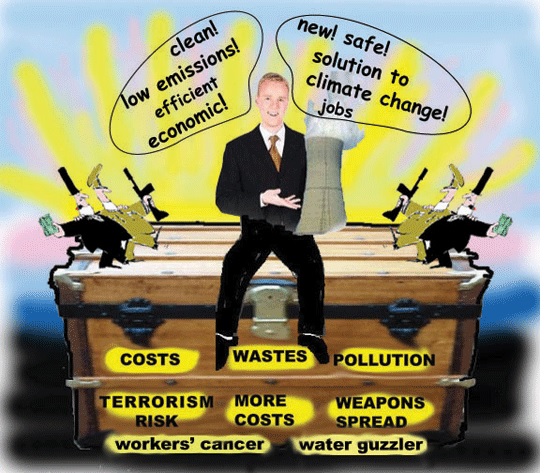
29 June 2024 , By Charis Chang, SBS News

Seven nuclear power plants could be built in Australia if the Coalition wins the next election, but will they live up to the hype?
Australians are being promised a brighter future with nuclear as the answer to rising energy costs.
As concerns grow over the cost of living and rollout of renewables, the Coalition has announced an alternative vision, promising to build seven nuclear power plants across the country if elected.
Last week, it confirmed it would push for nuclear power plants to be built at Tarong and Callide in Queensland, Liddell and Mount Piper in NSW, Port Augusta in South Australia, Loy Yang in Victoria and Muja in Western Australia.
“We have a vision for our country: to deliver cleaner electricity, cheaper electricity and consistent electricity,” Opposition leader Peter Dutton said on 19 June.
But can nuclear in Australia live up to the hype?
Can nuclear bring down electricity prices?
One of the biggest claims the Coalition makes is that
nuclear energy could bring down the price of electricity
in Australia.
Dutton told the Today show on 21 June: “In Ontario, for example — they have 60 per cent nuclear in the mix there, their electricity prices are a quarter of what it is here in Australia”.
But Tim Buckley, director of think tank Climate Energy Finance, questioned how a form of energy that would produce “zero” electricity for the next 15 to 20 years, could bring down power prices.
In the meantime, the Coalition’s plan would undermine investor confidence so Australia didn’t get as much electricity supply from other sources, Buckley said.
“Less supply means higher prices — that’s economics 101.”
He believes the Coalition’s nuclear strategy could increase electricity prices by 20-50 per cent over the next decade because of the need for more government intervention and funding to extend the life of coal plants.
Buckley said the GenCost report — produced by Australia’s national science agency, the CSIRO — found power from nuclear could also be double the price of firmed renewables.
“Therefore power prices go up, not down,” he said.
GenCost looked at the levelised cost of electricity, which is the estimated price that would need to be charged so the generator could cover its costs including a return on investment.
It found electricity generated by large-scale nuclear would be $155/MWh (per megawatt hour) to $252/MWh.
Integrating renewables such as solar photovoltaic (PV) and wind into the grid, including the cost of storage and transmission lines, was estimated to be much cheaper, costing between $90/MWh and $100/MWh.
The GenCost report noted overseas electricity costs may not reflect the prices that could be charged in Australia because of differences in installation, maintenance and fuel costs.
Other countries may also be benefiting from older projects where the costs to build the power plant had already been recovered by investors or governments.
“Such prices are not available to countries that do not have existing nuclear generation such as Australia,” the report said.
Batteries will need to be ‘ripped down’ for nuclear
The Coalition plans to locate its nuclear power plants in the locations of old and retiring coal-fired power plants to “avoid much of the new spending needed for Labor’s ‘renewables-only’ system”.
An electricity grid with a large proportion of intermittent renewables requires many new transmission poles and wires, “all of which will be passed on in the form of higher bills”, Opposition energy spokesperson Ted O’Brien has said.
But Buckley points out that most retired coal-fired power sites are already being used for new battery plants. This includes a 500-megawatt battery plant announced last year on the site of the old Liddell plant in NSW’s Hunter Valley.
Ted O’Brien and Peter Dutton are proposing nationalisation of private assets, and then they’re going to have to rip down the batteries that have just been built at billions of dollars in cost … in order to then wait for 20 years while they build their nuclear power plants,” he said.
“It’s a little bit farcical to me.”
An ambitious 13-year timeline
In a press release announcing its policy, O’Brien said large-scale nuclear would be built by 2037, in 13 years.
But the CSIRO has estimated a nuclear power plant in Australia would take at least 15 years to build.
Australia’s federal nuclear ban would have to be overturned and the government may also have to override several state-level bans
Site selection and acquisition, design, impact studies and environmental permits would then need to be completed before construction could even begin.
Buckley said getting the relevant planning approvals was a time-consuming hurdle for any energy project, let alone one that had never been done in Australia before.
Nuclear ‘will need to be refurbished after 30 years’
Dutton has said nuclear is “an investment for 80 years” and this longevity makes the technology superior to renewable sources of power such as wind energy.
“These nuclear plants can produce and provide 24/7 power for 80 to 100 years … wind turbines last 19 years, so you’ve got to cycle them in and out three or four times,” he told the Today show on 21 June.
Buckley said Coalition statements underestimated the life of renewable projects, noting that nuclear power plants needed to be refurbished after around 30 years.
Warranties on new solar modules now covered them for more than 20 years, he said. And those on batteries had doubled from 10 to 20 years.
“Most solar projects have a design life of 25 years, wind projects have a design life of 30,” he said.
Buckley said the price of refurbishment should also be included in the capital costs for nuclear, and so should decommissioning expenses, which can cost about $10 billion once the plant reaches the end of its life.
‘Who’s going to pay for other costs?’
Eventually, funding will also have to be found to store the nuclear waste generated, which has to be securely stored for tens of thousands of years.
“Who’s going to pay for 10,000 years of nuclear waste disposal?” Buckley said.
Even based purely on the initial construction cost, nuclear does not come out ahead.
Who’s going to pay for 10,000 years of nuclear waste disposal? Tim Buckley, Climate Energy Finance director
The GenCost report estimated the cost of a large-scale nuclear plant in Australia would be $8.6 billion for a 1,000kW plant built in 2023, although the first one would likely be much more expensive.
A small modular reactor (SMR) was estimated to be even more expensive, at $28.6 billion.
In comparison, onshore wind is estimated to cost $3 billion for 1000kW of generation, while large-scale solar PV is even cheaper, at $1.5 billion.
Costs for offshore wind rise to between $5.5 billion and $7.7 billion.
The capital cost for firming technologies such as batteries is separate, but — as mentioned above — the levelised cost of renewables is estimated to be $90-$100/MWh, even including the cost of storage and transmission lines.
Meanwhile, the levelised cost of nuclear is between $155-$252/MWh.
The Coalition hasn’t yet released costings for its nuclear plan, only saying they would come “very soon”.
Analysis from the Smart Energy Council suggests it could cost between $116-$600 billion to build seven nuclear reactors, and they would only supply 3.7 per cent of Australia’s energy mix in 2050.
Michael Preuss, director of research infrastructure at Monash University’s faculty of engineering, has previously told SBS News that while the initial investment in nuclear is expensive, those upfront costs could be recovered.
“There’s a huge upfront investment and once they’re built and they start operating, they’re relatively inexpensive to operate and then you recoup the investment. But it takes a long time,” he said.
There will also be ongoing costs to buy the fuel required to run the nuclear power plant, something renewables can source for free.
Australian communities facing an un-insurable risk?
The Coalition has dismissed concerns about government funding of the plants, saying local communities would welcome the investment.
“You can imagine what this means to local communities, to mums and dads and their kids as they look to the future,” O’Brien told reporters on 19 June.
But Buckley said government funding was required because nuclear power plants were not commercially viable without taxpayer subsidies. He said no private company could afford the insurance risk of a nuclear catastrophe………………………..
Is the world embracing nuclear?
Dutton told Today on 21 June: “I think if you look at the top 20 economies of the world, Australia is the only one that hasn’t embraced or hasn’t signed up to nuclear.”
But Buckley believes this statement is misleading.
“America has closed more nuclear units in the last two decades than they’ve opened so how is that embracing nuclear?”……………………………………………………….
He said other countries that had embraced nuclear did not have the wind and solar resources that Australia did.
“Why would Australia go and choose the most expensive source of electricity with massive water consumption issues, with massive site rehabilitation and massive waste disposal risks, when we don’t need to?
“When there’s a lower cost, commercially proven technology today?” https://www.sbs.com.au/news/article/hidden-costs-cheaper-energy-farcical-locations-debunking-the-hype-around-nuclear/7rd5ewmbr
The fake charity AMDA Foundation is exposed by Michael West Media’s Michelle Fahy.

Landforces’ brothers in arms: how a weapons peddler qualified for charitable status . https://www.michaelwest.com.au/landforces-brothers-in-arms-how-a-weapons-peddler-qualified-for-charitable-status/
by Michelle Fahy | Jun 4, 2021 The Coalition is cracking down on charitable organisations. However, the Australian charity promoting arms deals on behalf of weapons makers that profit from humanitarian catastrophes is unlikely to be in the government’s sights. With the weapons expo LandForces wrapping up in Brisbane this week, Michelle Fahy delves into the charity behind LandForces.
The Morrison government has charitable organisations in its sights. It proposes to amend the legislation covering charities so that minor legal misdemeanours by staff or supporters of a charity could be used as a prompt by the regulator for a review of a charity’s privileged status.
St Vincent de Paul told The Saturday Paper that if an activist wearing a Vinnies T-shirt refused to move along when asked by police, Vinnies could risk having its charitable status removed.
Hands Off Our Charities, an alliance of Australian charities, said in a submission to government: “The proposal is a major overreach and the need for further regulation has not been (and in our view cannot be) properly explained.”
Yet consider the activities of a not-for-profit organisation that many Australians will be astounded to discover has gained privileged charitable status – AMDA Foundation Limited (AMDA).
AMDA is the organiser of Land Forces, a biennial military and weapons exhibition running in Brisbane this week showcasing organisations “operating across the full spectrum of land warfare”.
The 600 exhibitors at Land Forces include local and multinational weapons manufacturers and other suppliers to military forces. Event sponsors include global arms corporations such as Boeing, BAE Systems, Lockheed Martin, Rheinmetall, General Dynamics, Saab and Hanwha, along with local companies Electro Optic Systems (EOS), CEA, and NIOA. Representatives from foreign governments and militaries are among the attendees.
Several of AMDA’s arms-maker sponsors have supplied their weaponry to the two countries leading the coalition fighting the war in Yemen – Saudi Arabia and the United Arab Emirates. The UN has been pleading for years for countries to cease supplying weaponry to these countries.
In late 2018, the New York Times published distressing photographs of emaciated children in Yemen dying as a result of aid blockades during the war. The mass starvation continues. UNICEF has said more than 400,000 Yemeni children under five could die preventable deaths this year.
Promoting arms deals on behalf of corporations that have profited from this unspeakable humanitarian catastrophe is the antithesis of what an Australian registered charity should be doing.
But the political posturing evident in the government’s proposed changes is unlikely to result in any repercussions for the AMDA Foundation. Instead, it is ‘activist’ environmental charities that are being targeted by the changes. Which is precisely the problem with such sweeping broad powers. They can be implemented selectively to silence voices the government does not want heard.
“It is the principle that underpins the change that is wrong, regardless of who it is used to target,” said Matt Rose, Economy & Democracy Program Manager at the Australian Conservation Foundation.
Arms trade promotion a “charitable activity”?
AMDA runs numerous major military and weapons-related trade exhibitions around Australia. Its roster of events includes Avalon, a biennial aerospace military and weapons expo in Victoria, next slated for early December 2021. The Indo Pacific Expo, a maritime warfare exhibition, is scheduled for May 2022 in Sydney.
These and other industry trade shows bring together sellers and buyers of weaponry and other military and security-related equipment. “Doing business is easy at Land Forces,” says its website, noting that Land Forces serves as a “powerful promotional and industry engagement forum”.
AMDA says it exists to help the “general community in Australia”. But the general community is not permitted to attend Land Forces nor AMDA’s other arms exhibitions. (The public can attend the Avalon Air Show, a separate public event run at the same time as the Avalon arms expo.)
AMDA is part of a group of companies registered with ACNC which operates around the country. It had 24 full-time-equivalent employees and a gross income in 2020 of $11.7 million – 32% of which came from government grants and 61% from operating revenue. Its income in 2019 was $26.2 million, mostly from operating revenue.
Revolving doors and conflicted interests
The AMDA board is an all-male affair. Its chair is former chief of the Royal Australian Navy, Christopher Ritchie, who joined the board in May 2017 while concurrently sitting on the boards of Lockheed Martin Australia (until 2020) and German naval shipbuilder Luerssen Australia, both multibillion dollar contractors to the Defence Department.
Former chief of army Kenneth Gillespie sits on the AMDA board while also sitting on the board of Naval Group, the French multinational building Australia’s controversial new submarines. Gillespie is also chair of the Australian Strategic Policy Institute (ASPI) Council, the highly influential and supposedly “independent” think tank tasked with providing strategic advice to the government.
ASPI is sponsored by Naval Group as well as other global arms manufacturers including Lockheed Martin, Thales, Saab and Northrop Grumman. ASPI has been vocal in its anti-China ‘war drums’ rhetoric, stoking regional tensions, along with the Asia Pacific arms race.
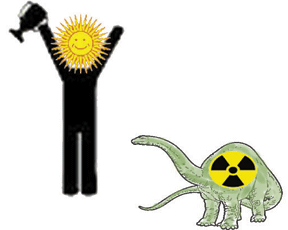
Nuclear energy as dead as dinosaurs
Dave Horsfall, North Gosford, August 6, 2024, https://coastcommunitynews.com.au/central-coast/news/2024/08/nuclear-energy-as-dead-as-dinosaurs/
Those in the anti-renewables lobby don’t give up, do they?
One could be excused for thinking that they have shares in the fossil-energy industry (and for the record, I do not have shares in the renewables industry, nor indeed any shares at all, as I do not believe in gambling upon the fortunes of a nation).
The latest offering is presented in CCN 449 (Time to rethink nuclear power), where not only is the since-discredited myth that wind turbines affect whales promulgated – which they do not, but I guess that alleged dangers to whales always make for a good story.
Apparently we are expected to believe that said turbines can suddenly uproot themselves and go cruising around of their own accord; either that, or ships’ captains are stupid or something.
Of course, no mention is made of how to safely dispose of the highly dangerous waste, nor indeed the reactor vessel itself once it’s reached its commercial end of life; then again, I guess these are just inconvenient truths.
Do these individuals really believe that they are more qualified than Australia’s peak scientific body – viz the CSIRO – which found that nuclear energy is the most expensive of all sources, and renewables the cheapest?
Nuclear energy is as dead as the dinosaurs; get used to it.
About Peter Dutton’s claim that nuclear is cheaper than renewables.

Philip White – (letter to The Advertiser) 5 Aug 24
Nuclear proponents go to great lengths in an attempt to show that nuclear energy is cheaper than renewables. For example, in Monday’s Advertiser former Australian Nuclear Science and Technology Organisation boss Ali Paterson is quoted comparing France’s electricity rates with Australia’s.
That is like comparing apples with pears. There is a huge difference in the impact on electricity prices of existing reactors that have already been paid for, and new reactors that won’t generate electricity for another 15 plus years.
I would put much greater faith in an estimate by Monash University’s Roger Dargaville that power bills could rise by $1,000 a year under the Coalition’s nuclear plan.
And by the way, the only French nuclear reactor to be built this century is 12 years behind scheduled and more than 4 times over budget and it still hasn’t started operating.
Renewables caught in misinformation crossfire from Australia’s nuclear cheerleaders

Graham Readfearn, 18 July 24, https://www.theguardian.com/environment/article/2024/jul/18/renewables-caught-in-misinformation-crossfire-from-australias-nuclear-cheerleaders
Those pushing the nuclear option are making some questionable claims about the capacity of renewable energy.
Advocacy for the Coalition’s hopes to build nuclear power plants is increasingly coming with large side-orders of misinformation, not just on the speed or costs of nuclear but on renewables.
Dr Adi Paterson, the chair of the Nuclear for Australia advocacy group, has taken to attacking the credentials of CSIRO experts while going hyperbolic with his rhetoric.
When Paterson told Sky News he thought the agency’s report on the costs of different electricity generation technologies was “a form of fascism” there was not a whisper of disapproval from the surrounding studio panel. Mussolini would be turning in his grave.
The definitely-not-fascist GenCost report has found electricity from nuclear would be far more expensive than solar and wind, taking into account the cost of extra transmission lines and technologies to connect, store and rerelease renewable power.
Paterson claimed on the Sky news show Outsiders that the GenCost report “looks at one reactor in Finland”. In fact, the report had based the cost of large-scale reactors in Australia on South Korea’s long-running nuclear program – one of the most successful in the world.
Entrepreneur Dick Smith, a patron of Nuclear for Australia, has also tried to claim CSIRO used a “worst-case scenario” for nuclear costs. One leading energy analyst has previously told Temperature Check the opposite was more likely the case.
Paterson, a former boss of the Australian Nuclear Science and Technology Organisation, said in any case, he wanted to see Australia consider 5MW micro-reactors (less than the size of a large wind turbine, suggesting Paterson would like to see Australia scattered with tiny nuclear reactors).
He then pointed to Bill Gates’ Terrapower company and its project in Wyoming (which has a much higher proposed generation capacity of 345 MW), saying it was currently licensed and “being built now”.
In fact, as Terrapower’s chief executive told CNBC a couple of months ago, the company has only just submitted its construction permit application to the US Nuclear Regulatory Commission and hopes to get approval in 2026. They are doing some construction at the site, but none of it relates to the nuclear aspects of the plant.
Two days out of five?
Paterson has claimed wind turbines only generate electricity “two days out of five” or “37% of the time”.
Dr Dylan McConnell, an energy systems analyst at UNSW, said this was a “misleading” characterisation of windfarm performance.
McConnell said the 37% figure referred to something called the capacity factor – that is, how much electricity is generated over a given period relative to a windfarm’s maximum capacity.
“It is equivalent to implying that windfarms run at 100% of capacity two days out of five, and zero capacity three days out of five. This is of course not at all how windfarms or renewable energy generation works,” he said.
“They infrequently run at 100% of capacity. The converse of this is that they are often running just at levels below their full rated output – which is even more true across the whole fleet.”
McConnell points to data showing over the past year windfarms contributed about 12% of the total generation across the national electricity market (everywhere except WA and the NT) and while he said there was “a lot of variability”, there were no days when windfarms failed to generate.
He said: “Saying they work ‘two days out of every five’ is misunderstanding or a misrepresentation of the contribution of wind to the power system.”
Free pass for renewables?
Conservative economist and contributor to the Australian and the Spectator, Judith Sloan, has penned several pieces in recent weeks favouring nuclear power while making questionable claims about renewables.
In the Spectator, Sloan wrote that state governments “have allowed renewable energy companies to avoid the normal approval processes, including environmental assessments”.
Firstly, renewables projects are subject to both state and federal environmental assessments.
The federal environment minister, Tanya Plibersek, has assessed and approved more than 50 renewables projects – often with conditions attached – under current environmental laws, and rejected one windfarm in north Queensland in May because of potential impacts on nature. (The previous environment minister, Sussan Ley, also rejected a windfarm in 2020.)
Marilyne Crestias, interim chief executive at the Clean Energy Investor Group, said it was “inaccurate” to say that projects avoided environmental assessments at state level.
“Each state and territory has its own set of laws governing environmental assessments for renewable energy projects.
For example, in New South Wales, large-scale renewable energy projects must undergo an environmental impact assessment (EIA) under the Environmental Planning and Assessment Act 1979. Similarly in Victoria, projects are assessed under the Planning and Environment Act 1987 for their environmental, social and economic impacts. And in Queensland, the Environmental Protection Act 1994 requires environmental impact statements (EIS) for significant projects, including renewable energy developments. These assessments ensure that renewable energy projects are developed responsibly and sustainably.”
Talking to Sky, Sloan has said: “One of the worst aspects of [the renewables rollout] is that these renewable investors have never entered into an undertaking that they will remediate the land.”
Crestias said this was a “misconception”, saying developers typically did have agreements that included remediating the land.
“These agreements often cover the entire lifecycle of the project, from development through decommissioning,” she said.
“For instance, planning permits for windfarms in Victoria require developers to submit a decommissioning and rehabilitation plan before construction begins.”
“Battering ram of bad faith actors:” Clean Energy Council says nuclear push causing confusion, delays and higher costs
Giles Parkinson, Jul 16, 2024, https://reneweconomy.com.au/battering-ram-of-bad-faith-actors-cec-says-nuclear-push-causing-confusion-delays-and-higher-costs/
The head of the Clean Energy Council, Kane Thornton, has launched a forceful attack on the pro-nuclear lobby, describing it as littered with bad faith actors, disinformation, and praying on a weakened mainstream media.
Thornton said Australia is poised to finally take advantage of its unique competitive advantage to produce low-cost, zero-emissions power that will transform the Australian economy, but the country’s ability to deliver reform and generational change is fragile and being undermined by vested interests.
“Bad faith actors are using a weakened media, praying on communities increasingly anxious about the uncertainty and tensions in the world around us to tear things down,” Thorntold said in an opening address to the Clean Energy Summit in Sydney on Tuesday.
“Vested interests are stepping up to tell their story and peppering it with mistruths and outright disinformation. They are undermining the very things that would build our nation’s future and resilience in an unstable world, to further their own short term political agenda.”
”The battering ram of bad faith actors today is nuclear power. We all know it’s several times more expensive than renewables and storage and is two decades away at best.”
Thornton noted that heavily promoted nuclear technologies such as small nuclear reactors still do not exist in commercial form, and coal power in Australia would be long gone before they could be delivered, if ever they could.”
Despite this reality, we are having a national debate about nuclear power. The Australian public are being confused and misled,” Thornton said.
”Investors know nuclear is not a commercially viable option for Australia and will never be realised here. But this debate is nevertheless deeply unhelpful for Australia’s international reputation as a safe place to invest, giving a perception that Australia’s energy policy remains deeply fractious and at risk of radical U-turns from one election to another.
”If we can’t have a sensible discussion about energy policy, then our problems as a nation go far beyond balancing our energy mix. We have suffered for over 15 years through the climate wars.
”These distractions and the inaction are why power prices are higher today and the energy transition is all the harder. It’s why we are playing catchup to reform our energy markets, fix and build out the grid, train the workforce, developing the standards and practices we should expect.”
Thornton said the rooftop solar market remained strong, and the battery storage market was also robust. “It’s the energy we need to charge these batteries that needs to happen much quicker,” he said.
Thornton said he hoped that the federal government’s Capacity Investment Scheme, which seeks 32 GW of new wind, solar and storage, will be one of the last “missing pieces” of the energy transition puzzle and help accelerate the rollout.
‘It needs to move quickly and deliver the investment confidence the market is seeking. If it works, we can expect a wave of large-scale renewable energy projects come forward,” he said.
But Thornton said that, given the disinformation around nuclear, the industry needed to work together to give confidence in the future of renewables.
“We need to recognise that change doesn’t always come easy. For some people it can create anxiety and uncertainty,” he said.
”They look for clarity, to people they trust. They want to understand lived experience and how new technology or projects in their community will impact their lives.”
Federal Coalition urged to retract claims linking medical technologies to nuclear power plans.
Margaret Beavis, Thursday, July 4, 2024,
Introduction by Croakey: Traditional owners of the Jabiluka uranium site in the Northern Territory are concerned the Federal Opposition’s plans for nuclear energy will increase demand for mining on their land, according to an ABC report.
As Croakey has previously reported, the Coalition’s nuclear plans have also been slammed by health, medical and scientific experts, with particular concerns for impacts upon First Nations peoples’ health and wellbeing.
In the article below, Dr Margaret Beavis OAM, Vice President of the Medical Association for Prevention of War (MAPW), calls on the Opposition to retract “patently false” claims made about a link between nuclear power and radiology, radiotherapy and nuclear medicine, which seek to “misrepresent nuclear medicine for political gain”. She also notes the likely derailing of climate action, and the problems of toxic waste and the potential for accidents and nuclear proliferation.
Meanwhile, Independent MP Dr Monique Ryan has urged Prime Minister Anthony Albanese to call an early election, warning that the Coalition has “recklessly jammed a stick into the spokes of the Australian economy by refusing to reveal a 2030 emissions reduction target and confusing the country with a threadbare nuclear energy announcement”.
Margaret Beavis writes:
The proposal for nuclear power in Australia needs more scrutiny from the public health perspective.
There are three aspects that are particularly problematic.
Firstly, investment in renewables will be damaged, making urgently needed decarbonisation much harder, worsening the very well documented health impacts of climate change.
No-one is pretending nuclear power can be implemented quickly. But for those who feel optimistic, looking at democracies similar to ours demonstrates the reality. The Hinkley Point plan in the United Kingdom, Flamanville in France, and Vogtle and VC Summer (abandoned after spending USD 9 billion) in the United States all have had both massive delays and major cost blowouts.
Slower roll out means even more coal and gas, and all the climate and health impacts that go with that. Compounding these delays will be the need in Australia for legislation at both state and federal level, and our lack of expertise and established workforce.
Secondly, the Coalition claims made about radiology, radiotherapy and nuclear medicine are patently false and deliberately misleading.
A letter sent by Coalition MPs to their constituents last month claimed that: “Nuclear energy already plays a major role in medicine and healthcare, diagnosing and treating thousands of Australians every day.”
We do not have, and have never had, nuclear power in Australia, and nuclear power has no connection to our world class nuclear medicine sector.
Australians will continue to benefit from diagnostic and therapeutic nuclear medicine irrespective of whether Australia’s future is powered by reactors or renewables. Nuclear power is not nuclear medicine, it is not X-Rays, and it is not radiotherapy.
X-Rays and radiotherapy do not use a nuclear reactor at all. Nuclear medicine in Australia – used to diagnose and treat some types of heart disease, thyroid conditions, infections, injuries, and cancers – involves radioactive elements (isotopes) that are made using a small research nuclear reactor at Lucas Heights in NSW.
Lucas Heights cannot and has not produced commercial power. But, like all nuclear reactors, it does produce radioactive waste that remains highly toxic for 10,000 years.
The Coalition also claims, on a website promoting the “need” for nuclear energy in Australia, that: “Research and advancements in radiation technology continue to evolve, providing new and improved methods for both diagnosing and treating diseases…”
False connections
Advancements to improve health outcomes and to reduce the size and risks of radiation exposures will occur whether or not Australia has nuclear power. With renewable energy, nuclear medicine will still exist and advance – our loved ones will still be treated and be cared for.
It’s disappointing that the Coalition has chosen to misrepresent nuclear medicine for political gain, and to make false connections between nuclear power and health.
Finally, it is important to consider the problems of waste and the risk of accidents, attacks and weapons proliferation.
Nuclear power poses significant risks to the health of people and the planet.
It is far from the zero emissions technology its acolytes claim it to be.
As noted, reactor waste is highly toxic for over 10,000 years. It remains globally an unsolved problem. The failure over decades to find a site for Australia’s existing limited amount of intermediate waste illustrates communities’ concerns.
First Nations communities have been repeatedly targeted. They have suffered enough from the impacts of British nuclear testing in the fifties and sixties.
Accidents can and do occur. There have been many near misses and at least 15 accidents risking uncontrolled radioactive release, involving fuel or core damage in Canada, Germany, Japan, Slovakia, the UK, Ukraine and the US.
Attacks on facilities could also cause extensive releases of radiation. A significant radiation release would require major long-term evacuation.
In addition, nuclear power is clearly linked with nuclear proliferation. Tilman Ruff, formerly at the Nossal Institute for Global Health in the School of Population and Global Health at University of Melbourne and co-founder of the International Campaign to Abolish Nuclear Weapons (ICAN), wrote in 2019:
South Africa, Pakistan and North Korea have primarily used the HEU (highly enriched uranium) route to build nuclear weapons, India and Israel primarily a plutonium route. All have used facilities and fuel that were ostensibly for peaceful purposes.”
Indeed, the possibility of acquiring nuclear weapons was part of former Australian Prime Minister John Gorton’s reasoning when considering a nuclear power plant at Jervis Bay.
In summary, building nuclear power in Australia will have significant long term adverse public health impacts. Extravagant claims that existing medical technologies and medical advances are somehow linked to plans for nuclear power are plainly wrong.
We urge the Coalition to retract these statements and remove inaccurate information from its marketing materials. We also urge they reconsider this policy, given its major health impacts both locally and globally.
Dr Margaret Beavis OAM is Vice President of the Medical Association for Prevention of War (MAPW) and a former GP who teaches medicine at Melbourne University. She has lectured on nuclear medicine and nuclear waste in Melbourne University’s MPH program.
Coalition parties asked to respond
Croakey has asked Federal Opposition Leader Peter Dutton and Leader of the Nationals Party David Littleproud for responses to the below questions raised in three articles Croakey has published on the Coalition’s nuclear energy plan.
- Health, medical and scientific experts have rejected your nuclear energy plans as dangerous and a way to delay climate action. What is your response?
- Aboriginal and Torres Strait Islander organisations and communities have raised concerns that nuclear energy would harm their health, wellbeing and connection to Country. What is your response?
- Additionally, health professionals have called for the Coalition to retract claims that medical technologies are linked to nuclear power plans. What is your response?
- Will you continue with your nuclear energy plan if local communities oppose reactors?
- How will you manage harms to health by delaying action on climate change and decarbonisation?
- Who will provide disaster insurance (Fukushima clean up estimated at $470-$660 billion)?
The nuclear and renewable myths that mainstream media can’t be bothered challenging
Mark Diesendorf, Jul 4, 2024, https://reneweconomy.com.au/the-nuclear-and-renewable-myths-that-mainstream-media-cant-be-bothered-challenging/
Nuclear energy proponents are attempting to discredit renewable energy and promote nuclear energy and fossil gas in its place. This article refutes several myths they are disseminating that are receiving little or no challenge in the mainstream media.
Myth: Renewables cannot supply 100% electricity
Denmark, South Australia and Scotland already obtain 88, 74 and 62 per cent of their respective annual electricity generations from renewables, mostly wind. Scotland actually supplies 113 per cent of its electricity consumption from renewables; the difference between its generation and consumption is exported by transmission line.
All three jurisdictions have achieved this with relatively small amounts of hydroelectricity, zero in South Australia. Given the political will, all three could reach 100% net renewables generation by 2030, as indeed two northern states of Germany have already done. The ‘net’ means that they trade some electricity with neighbours but on average will be at 100% renewables.
Computer simulations by several research groups – using real hourly wind, solar and demand data spanning several years – show that the Australian electricity system could be run entirely on renewable energy, with the main contributions coming from solar and wind. System reliability for 100% renewables will be maintained by a combination of storage, building excess generating capacity for wind and solar (which is cheap), key transmission links, and demand management encouraged by transparent pricing.
Storage to fill infrequent troughs in generation from the variable renewable sources will comprise existing hydro, pumped hydro (mostly small-scale and off-river), and batteries. Geographic dispersion of renewables will also assist managing the variability of wind and solar. For the possibility of rare, extended periods of Dunkelflaute (literally ‘dark doldrums’), gas turbines with stores of biofuels or green hydrogen could be kept in reserve as insurance.
Myth: Gas can fill the gap until nuclear is constructed
As a fuel for electricity generation, fossil gas in eastern Australia is many times more expensive per kilowatt-hour than coal. It is only used for fuelling gas turbines for meeting the peaks in demand and helping to fill troughs. For this purpose, it contributes about 5% of Australia’s annual electricity generation. But, as storage expands, fossil gas will become redundant in the electricity system.
The fact that baseload gas-fired electricity continues temporarily in Western Australia and South Australia is the result of peculiar histories that will not be repeated. Unlike the eastern states, WA has a Domestic Gas Reservation Policy that insulates customers from the high export prices of gas.
However, most new gas supplies would have to come from high-cost unconventional sources. South Australia’s ancient, struggling, baseload, gas-fired power station, Torrens Island, produces expensive electricity. It will be closed in 2026 and replaced with renewables and batteries.
Myth: Nuclear energy can co-exist with large contributions from renewables
This myth has two refutations:
- Nuclear is too inflexible in operation to be a good partner for variable wind and solar. Its very high capital cost necessitates running it constantly, not just during periods of low sun or wind. Its output can only be ramped up and down slowly, and it’s expensive to do that.
- On current growth trends of renewables, there will be no room for nuclear energy in South Australia, Victoria or NSW. The 2022 shares of renewables in total electricity generation in each of these states were 74%, 37% and 33% respectively.
Rapid growth from these levels is likely. It’s already too late for nuclear in SA. Provided the growth of renewables is not deliberately suppressed in NSW and Victoria, these states too could reach 100% renewables before the first nuclear power station comes online.
As transportation and combustion heating will be electrified, demand for electricity could double by 2050. This might offer generating space for nuclear in the 2040s in Queensland (23% renewables in 2022) and Western Australia (20% renewables in 2022). However, the cost barrier would remain.
Myth: There is insufficient land for wind and solar
The claim by nuclear proponents that wind and solar have “vast land footprints” is misleading. Although a wind farm can span a large area, its turbines, access road and substation occupy a tiny fraction of that area, typically about 2%.
Most wind farms are built on land that was previously cleared for agriculture and are compatible with all forms of agriculture. Off-shore wind occupies no land.
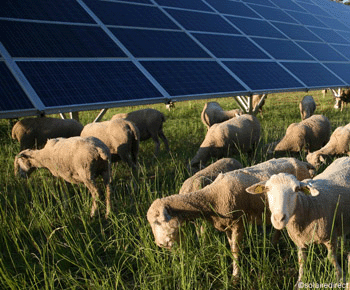
Solar farms are increasingly being built sufficiently high off the ground to allow sheep to graze beneath them, providing welcome shade. This practice, known as agrivoltaics, provides additional farm revenue, which is especially valuable during droughts. Rooftop solar occupies no land.
Myth: The longer lifetime of nuclear reactors hasn’t been taken into account
The levelised cost of energy method – used by CSIRO, AEMO, Lazard and others – is the standard way of comparing electricity generation technologies that perform similar functions.
It permits the comparison of coal, nuclear and firmed renewables. It takes account automatically of the different lifetimes of different technologies.
Myth: We need baseload power stations
The recent claim that nuclear energy is not very expensive “when we consider value” is just a variant of the old, discredited claim that we need baseload power stations, i.e. those that operate 24/7 at maximum power output for most of the time.
The renewable system, including storage, delivers the same reliability, and hence the same value, as the traditional system based on a mix of baseload and peak-load power stations.
When a nuclear power reactor breaks down, it can be useless for weeks or months. For a conventional large reactor rated at 1000 to 1600 megawatts, the impact of breakdown on electricity supply can be disastrous.
Big nuclear needs big back-up, which is expensive. Small modular reactors do not exist––not one is commercially available or likely to be in the foreseeable future.
Concluding remarks
We do not need expensive, dangerous nuclear power, or expensive, polluting fossil gas. A nuclear scenario would inevitably involve the irrational suppression of renewables.
The ban on nuclear power should be maintained because nuclear never competes in a so-called ‘free market’. Renewables – solar, wind and existing hydro – together with energy efficiency, can supply all Australia’s electricity.
Mark Diesendorf is Honorary Associate Professor at the Environment & Society Group in the School of Humanities & Languages and Faculty of Arts, Design & Architecture at UNSW. First published in Pearls and Irritations. Republished with permission of the author.
The Coalition’s nuclear fantasy serves short-term political objectives – and its fossil fuel backers
This is the truth at the heart of the Coalition’s latest climate fantasy: it gives people concerned about the speed and impact of the energy transition an alternative reality where this change doesn’t have to happen.
This is the truth at the heart of the Coalition’s latest climate fantasy: it gives people concerned about the speed and impact of the energy transition an alternative reality where this change doesn’t have to happen.
Dutton’s policy latches on to genuine concerns about power prices and disruption evident in the latest Guardian Essential report, but what are its real motivations?
Peter Lewis, 2 July 24 https://www.theguardian.com/australia-news/commentisfree/article/2024/jul/02/coalition-nuclear-policy-peter-dutton-power-plants
In 1959 the US government hatched a covert scheme to replace every single bird with a replicant surveillance drone to spy on its own citizens. This is only the second silliest theory flying around the internet right now.
Peter Dutton’s make-believe nuclear plan bears some of the hallmarks of Peter McIndoe’s actual piss-take, “Birds Aren’t Real”, which became so real he wound up doing interviews with Fox News and running large-scale community rallies where only some of the participants were chanting his nonsense slogan ironically.
There’s not too great a distance from ‘bird truthers’ to the Coalition’s latest permutation of fossil-fuelled climate skepticism.
In a world where information is driven by platform algorithms designed to maximise attention and reinforce existing prejudices, any theory can find a home; the crazier and louder the claims, the more likely they are to take off.
This is the truth at the heart of the Coalition’s latest climate fantasy: it gives people concerned about the speed and impact of the energy transition an alternative reality where this change doesn’t have to happen.
As this week’s Guardian Essential Report shows, support for renewable energy is contested. Lining up renewables, nuclear and fossil fuels, we found a lack of consensus on price, environmental impact and economic consequence.
While renewables are seen as the best energy source for the environment and most desirable overall, fossil fuels are seen as cheaper and better for jobs. It is here that the Coalition’s nuclear fantasy plays a critical bridging role.
The rollout of the renewable energy grid is a genuinely disruptive development; coal communities genuinely fear for their long-term economic future; consumers genuinely feel power prices rising as the rollout of renewables gathers momentum.
Coalition energy spokesperson Ted O’Brien is tasked with convincing those who have genuine concerns that if they just embrace nuclear, they can stop all these things they don’t like and still hit net zero by 2050.
Just like the bird conspiracy, this nuclear policy isn’t real: it has no scope, no production estimate, no costings, no timeline. But it’s a device that serves a flock of short-term political objectives.
It creates a reason to delay decommissioning coal and gas because, like magic, nuclear will provide a short cut. That’s good for the LNP’s fossil fuel backers and communities that rely on the production of these energy sources.
It offers hope to coal communities that they can become home to a new heavy industry. While critics of nuclear can make fun of the three-headed fish near the Springfield, the truth is Homer Simpson enjoyed the sort of secure job these communities fear will soon disappear.
And it sends a message to every regional community that they might not need to host the new renewable energy grid that is being rolled out. Because if you have a choice between looking out across a valley or looking out across power lines, who wouldn’t take the valley?
The problem for the Albanese government is that while each of these justifications is patently false, attacking them head-on risks a rerun of the voice referendum dynamic where “two sides” reporting creates a false equivalence that ends up defining the contest as a coin toss.
Exacerbating this challenge is the fact that fewer people trust the main proponents of the energy transition – the government and energy companies. Instead, trust is anchored at the level of the local.
The only people we really trust are those who we know personally – our friends and family and members of our community. Which raises the question, who do the people we trust get their information from? Perversely, the answer can only be “us”.
As McIndoe riffs in a hilarious piece of performance media: “Just because it’s a theory doesn’t mean its fake. It’s on the media, you can find it … Truth is subjective … There’s different proof out there for different things and if you do your research, you just might find it.”
Given this environment, the choice for Labor is whether to get dragged into a nuclear showdown where alternate facts will be wished into existence or simply dismiss the whole charade as the piece of political theatre it is.
A final question in this week’s report suggests the more effective way of confronting the nuclear “debate” is what disinformation experts call “pre-bunking” by calling out the opposition’s real motivations.
These findings show that half the electorate – and nearly two-thirds of young people – will reject the idea that this is a legitimate debate at all. Taking these people out of the equation before embarking on any merit analysis drastically reduces the number of votes in play.
Rather than trading economic models or platforming nuclear safety fears, the best approach might actually be the most honest one: to drag nuclear back into the political swamp from which it has risen.
First, expose the interests that will benefit from Dutton’s nuclear fantasy. Put the spotlight on the fossil fuel and nuclear players, who runs them, where they converge, who they pay to keep their dream alive and how much they stand to make by delaying the energy transition for a couple more decades.
Second, take away the oxygen for nuclear by doing the hard work required to build social licence for renewables, responding to legitimate concerns by giving communities a greater say in the way development occurs and how both costs and benefits are distributed.
Finally, turn the opposition to renewables back on to the LNP. While the political opportunism of the Dutton nuclear play is obvious, there are also risks that this decision comes to define not just him as a leader, but his entire political apparatus.
In a world where younger generations just want to get on with the job of addressing climate change, a major political party is walking away from this challenge in the interests of its corporate masters.
That’s the real conspiracy. And it’s not just a theory.
- Peter Lewis is the executive director of Essential and host of Per Capita’s Burning Platforms podcast
Peter Dutton says nuclear power plants “burn energy.” No they don’t

Giles Parkinson, Jun 25, 2024 https://reneweconomy.com.au/peter-dutton-says-nuclear-power-plants-burn-fuel-no-they-dont/
Opposition leader Peter Dutton has betrayed his complete ignorance about the nuclear technology he threatens to impose on the Australian population by a making a fundamental error: He thinks they burn fuel, or energy.
The comments were made in a heated Question Time in parliament house on the first day of the winter session which promises to be focused on energy and climate.
Opposition energy spokesman Ted O’Brien was ejected from the house by speaker Milton Dick, and Dutton ran close, earning the ire of the speaker on several occasions when he interjected as Labor ministers spoke.
At one point Dutton – trying to tie Labor up in knots over waste from a nuclear submarine, said this, according to Hansard:
Mr Dutton: It’s on relevance. And, perhaps, to be of assistance to the minister, the propulsion system burns energy—that’s how the system is working—and it’s stored in the—
The SPEAKER: Resume your seat.
Actually, they don’t burn fuel. That’s the point of them. If they did, they would likely create emissions, as defence minister Richard Marles explained.
Mr MARLES: Actually, it doesn’t burn any fuel, because burning is oxidisation, which is what happens in an internal combustion engine, which is exactly what happens when you use hydrocarbons. What this is is a nuclear reaction which gives rise to power. That is what happens inside the sealed nuclear reactor. The point is that the waste that will need to be disposed of …
And if he doesn’t accept Labor’s word on it, the Opposition leader could also read up on the website of the Nuclear Energy Institute:
“Nuclear plants are different because they do not burn anything to create steam. Instead, they split uranium atoms in a process called fission. As a result, unlike other energy sources, nuclear power plants do not release carbon or pollutants like nitrogen and sulfur oxides into the air.”
It reminds me of an encounter I had when I first started driving an EV. It was rubbished by a passer-by who suggested the car would be better off powered by nuclear. He seemed to think you could just shovel uranium into a boiler and off you go. Just top it up at the local refuelling station.
It could be that the aspiring prime minister thinks along the same lines. After all, we are constantly told we should mine Australia’s vast uranium reserves – heck, why not burn them like we do with coal.
It’s not the only major misunderstanding of nuclear by Dutton. He has suggested that what he defines as a small nuclear reactor, around 400 MW, would produce just a single can of coke as waste. It will need to be a very big can.
Emeritus Professor Ian Lowe, of Griffith University’s school of environment and science, told the SMH it was safe to say an SMR would generate many tonnes of waste per year, and it was likely that waste would be more radioactive than the waste from a large-scale reactor.
“For a 400-megawatt SMR, you’d expect that to produce about six tonnes of waste a year. It could be more or less, depending on the actual technology but certainly multiple tonnes a year,” he said. “They run on highly enriched uranium and produce a much nastier and a much more intractable set of radioactive waste elements that have to be treated.”
The Coalition’s entire nuclear push is based on lies and misconceptions, from their claim that wind, solar and storage can’t power a modern economy, that their plan needs no additional transmission, that its cheaper than renewables, and that it’s consistent with climate targets.
As virtually all experts have pointed out, with the exception of an heroic rear guard action on Sky News, the policy makes no sense economically, environmentally, or from an engineering point of view.
Perhaps Dutton needs to watch a few more episodes of The Simpsons. Or perhaps not.
Does the Coalition’s case for nuclear power stack up? We factcheck seven key claims

Will the Coalition’s plan be ‘cleaner’, as it claims?
No. Using more gas, less renewable energy and extending the life of coal-fired power plants will increase Australia’s greenhouse gas emissions.
The Coalition admits this. It wants to abandon the country’s 2030 emissions target and allow significantly more heat-trapping pollution while arguing it is still committed to net zero by 2050.
Will the Coalition’s plan be ‘cleaner’, as it claims?
Cheaper electricity, less emissions and ready by 2035 are some of the Coalition’s core promises on nuclear energy, but are they backed by evidence?
Adam Morton Climate and environment editorThu 20 Jun 2024, https://www.theguardian.com/australia-news/article/2024/jun/20/does-the-coalitions-case-for-nuclear-power-stack-up-we-factcheck-seven-key-claims
The Coalition has made a range of claims about what nuclear energy could do for Australia, and why it is better than building solar and wind.
What is the reality? We factcheck the key claims.
Would nuclear power provide cheaper electricity?
No evidence – such as economic modelling – has been produced to back up opposition leader Peter Dutton’s main argument about nuclear energy: that it would make Australians’ electricity bills cheaper than under a renewable energy-run grid and bring down other costs. As things stand, it is a baseless claim.
The CSIRO and the Australian Energy Market Operator (Aemo) have assessed the cost of different electricity sources and found that solar and wind backed by storage energy, new transmission lines and other “firming” – what the country is building now, in other words – were the cheapest option.
They found nuclear generation would be significantly more expensive – the most expensive technology available – for consumers. They suggested Australia’s first large-scale nuclear power plant (1GW capacity) could cost about $17bn, not counting finance costs. If a nuclear industry was established, that might eventually drop to $8.6bn.
Small modular nuclear reactors (SMRs), a developing technology that the Coalition has suggested could be used in South Australia and Western Australia, are likely to be far more expensive again. They do not exist anywhere on a commercial basis. The leading proposal for an SMR in the US was last year cancelled due to rising cost.
Confronted with this, the Coalition argues the nuclear experience in Ontario, Canada, demonstrates that nuclear energy is cheaper than Australian renewable energy.
This is not a relevant comparison. Like France, Ontario runs on nuclear plants built decades ago. Construction costs in the 1980s tell us nothing about the costs in the 2030s and 2040s.
Even then, the claim electricity is cheaper in Ontario is misleading. Wholesale electricity prices – the only part of the bill that is affected by the cost of generation – in Ontario are actually higher than the cost of new firmed renewable energy in Victoria and Queensland.
A more relevant comparison may be the ongoing construction of the large Hinkley C generator in the UK. It was initially expected to open in 2017 and cost about A$34bn. That has now been pushed out to 2031, and up to A$89bn.
Will using more gas until nuclear comes online cut costs?
There is no evidence it will.
Gas is the most expensive form of electricity generation currently used in the National Electricity Market, connecting the five eastern states and the ACT.
The price of gas is set on the international market – what fossil fuel companies can get by selling the gas in Asia. Nearly all Australian gas is exported. Opening a couple of new gas fields is not likely to materially change this.
Currently, gas is used in “peaking” plants that are turned on only when needed, at times of high demand. This is expected to continue for at least the next couple of decades. Gas-fired power provided less than 5% of total generation last year.
The Coalition has not explained how it would get more gas into the electricity grid. Would taxpayers pay to build several new gas power plants? It has also not explained how the resulting power could be as cheap as renewable energy.
Will the Coalition’s plan be ‘cleaner’, as it claims?
No. Using more gas, less renewable energy and extending the life of coal-fired power plants will increase Australia’s greenhouse gas emissions.
The Coalition admits this. It wants to abandon the country’s 2030 emissions target and allow significantly more heat-trapping pollution while arguing it is still committed to net zero by 2050.
Could Australia have nuclear energy by 2035?
Again, no evidence has been released to explain how this would be possible. The experience in developed democracies internationally is that it would take much longer.
The Coalition says if it decided to build SMRs there could be “two establishment projects” in place by 2035. If it opts for large-scale plants it says first power would be in 2037.
CSIRO found an initial nuclear power plant of any size would not be possible until after 2040. Other analysts, including the pro-nuclear Blueprint Institute, agree.
That’s just the technology challenge. The Coalition would also have to get legislation through both houses of federal parliament to overturn a nuclear energy ban. Labor and most of the crossbench oppose lifting the ban, and the Coalition is 20 seats short of a majority in the lower house and hasn’t had a majority in the Senate since 2007.
It would also need to persuade three states that ban nuclear energy – and remain strongly committed to their current position – to change their laws.
Have renewables caused a big increase in power bills?
No. It has a much smaller effect than factors related to fossil fuels.
Tony Wood, the energy and climate change program director for the Grattan Institute, says there was a 20% jump in wholesale electricity costs last year for four reasons: the war in Ukraine pushing up the price of gas; gas shortages; outages at ageing coal power plants reducing competition; and extreme weather causing flooding at coalmines. Prices have since started to come back down.
The renewable energy in the system has a smaller effect on price as the cost of incentive schemes is passed on, but it also helps reduce costs by increasing capacity and competition in the power grid
The coal-fired power plants in the grid are ageing, increasingly have units offline and need to be replaced. Evidence from government agencies and most independent experts is that renewable energy plus firming is the best path to an affordable, reliable, clean grid.
Is it true that “Labor can’t keep the lights on today”?
No. The lights are still on.
Coalition MPs making this claim were referring to the findings of Aemo’s “electricity statement of opportunities” report, which was portrayed as warning blackouts were imminent.
This misrepresents what the statement does. It is a message to the industry about how much more generation will be needed over time. This year’s statement found there could be reliability gaps in New South Wales, Queensland, South Australia and Victoria unless there was faster deployment of renewable energy and batteries.
This is consistent with other warnings that investment has slowed and needs to accelerate. But Aemo did not say blackouts were inevitable, or that renewable energy would cause them.
Is it true that you can’t run an industrial economy on renewables?
No – again, based on evidence from experts and industry.
The energy and economic transformation is challenging whatever technology is used. But the electrons are the same, regardless of the source.
Industry leaders have repeatedly welcomed renewable energy investment. Rio Tinto this year signed what it called Australia’s largest renewable energy power purchase agreement to run its operations in Gladstone.
BlueScope Steel applauded the creation of an offshore windfarm zone in the Illawarra, saying it had the “potential to supply significant quantities of renewable energy to help underpin BlueScope’s decarbonisation of iron and steelmaking in Australia”.
Aemo has repeatedly found an optimal future power grid, including one that would power new green industries, would run on more than 90% renewable energy.
Other countries, including those with some nuclear power, have similar goals. Both the US and Germany are targeting 80% renewable energy by 2030.
A Coalition pie-in-the-sky nuclear nightmare

(Cartoon by Mark David / @MDavidCartoons)
By Belinda Jones | 22 June 2024, Independent Australia
Having reignited the “climate wars” with pie-in-the-sky nuclear energy plans, if the plans fail, Dutton and Littleproud will face the wrath of a climate-war-weary Australian people at the ballot box, writes Belinda Jones.
AUSTRALIANS finally caught a glimpse of the Coalition’s nuclear energy plan this week. And, we mean “glimpse” — a one-page media release identifying seven proposed locations for nuclear power plants and not much more detail than that.
Nationals’ Leader David Littleproud called for Australia to have “a conversation about nuclear”, which culminated in this week’s long-awaited announcement from Littleproud and Opposition Leader Peter Dutton.
It has taken two years to create a one-page media release. By any standard, that is poor form.
As Betoota Advocate editor Clancy Overell so eloquently summed it up this week,
“Man who was paralysed with fear over lack of details about Indigenous Voice provides a one-page media release for his half a trillion dollar nuclear plan.”
In fact, the Coalition press conference on nuclear energy inspired far more questions than answers, despite Dutton claiming the Coalition has done “an enormous amount of work”.
Obviously, for Australians, the most pressing concerns for nuclear energy are cost and the time it’ll take to build seven nuclear reactors, as well as safety concerns.
As a policy, it’s not off to a good start. State premiers have rejected the idea and their support is crucial to the success of nuclear energy, due to the fact state legislation would have to be amended to allow any nuclear energy plan even to exist…………………………………………………………………..
However, the states’ consensus on nuclear energy may not be a major hurdle for the Coalition’s nuclear plans. Constitutional law expert, Professor Emerita Anne Twomey, suggested “state bans on nuclear could be overridden by a federal law, as outlined in section 109 of the Constitution”.
Section 109 of the Australian Constitution states:
‘When a law of a State is inconsistent with a law of the Commonwealth, the latter shall prevail, and the former shall, to the extent of the inconsistency, be invalid.’
Perhaps, similar to the Coalition’s plan to announce first where they plan to build nuclear reactors, then consult with the local communities affected after the fact, their plan is to bulldoze their way past state laws irrespective of the wishes of constituents, state governments or any other objectors to their nuclear plans — which is hardly a democratic process.
One supporter of the current Coalition’s nuclear energy policy is nuclear physicist Dr Ziggy Switkowski, the former Howard Government advisor on nuclear. This is despite Switkowski telling a Federal Parliamentary Inquiry in 2019 of the risk of “catastrophic failure” and that the “window for ‘large nuclear generation’ had closed for Australia”. At the time, Switkowski cited the “emerging technology of small nuclear reactors [as] the viable option on the table”.
That prediction has been proven to be premature with no small nuclear reactors at a viable or commercial stage in 2024. The USA’s first small modular reactor was cancelled by developer NuScale last year due to cost blowouts.
Switkowski also told the 2019 Inquiry:
“It was unlikely the industry could establish enough support to gain a social licence to operate.”
This week, Switkowski weighed in on the scepticism his work in previous years had helped to foment within Australia saying, “The strong positions some critics have taken in the last 24 hours are ridiculous”.
Australia’s wealthiest woman and enthusiastic Coalition supporter Gina Rinehart has long been demanding nuclear energy be part of Australia’s energy mix — a view that may emanate from her business interests around uranium exploration and mining.
Rinehart is no fan of renewables, claiming they’ll force food prices up and send farmers broke. This is despite the fact that they produce alternative sources of income for farmers and provide reliable energy solutions where “there’s no mains just to switch on” in isolated, rural communities.
The Coalition’s proposed seven nuclear reactors would not provide any benefit to those rural communities to which Rinehart refers that are not connected to mains power, whereas a combination of solar or wind and battery power would.
So, the electorally embattled Dutton and Littleproud face an uphill battle to get their nuclear policy off the ground in the face of overwhelming opposition to their plans. And though their scant plans offer nothing substantial on the issue of Coalition nuclear policy, they have managed to “reignite the climate wars”, which may in fact be the method in their madness.
Rather than bring the nation together, divide and conquer on any issue seems to be their modus operandi.
For a nation exhausted by over a decade of “climate wars” that it hoped were well and truly over, the Coalition has taken a huge risk to bring expensive, pie-in-the-sky nuclear to the table and reignite those wars. If it fails and it likely will, based purely on economics, then both Dutton and Littleproud will face the wrath of a climate-war-weary Australian people at the ballot box and, ultimately, their own political parties.
Dutton and Littleproud have both nailed their colours to the mast, demanding a conversation on nuclear energy with no intention of taking no for an answer. Like their failure to consult with communities before announcing their plans, they may have put the cart before the horse. Time will tell. https://independentaustralia.net/politics/politics-display/a-coalition-pie-in-the-sky-nuclearnightmare,18704
Ziggy Switkowski and another big nuclear back-flip
Ziggy 1.0 said in 2009 that the construction cost of a one gigawatt (GW) power reactor in Australia would be A$4-6 billion.
Ziggy 1.0 wasn’t wrong by 4-5 percent, or 40-50 percent. He was out by 400-500 percent. And yet he still gets trotted out in the mainstream media as a credible commentator on nuclear issues. Go figure.
Jim Green, Jun 21, 2024, https://reneweconomy.com.au/ziggy-switkowski-and-another-big-nuclear-back-flip/
Dr Ziggy Switkowski, best known as a former Telstra CEO, less well known as a former oil and gas company director, is a nuclear physicist by training. Wearing his nuclear hat, he was appointed by then prime minister John Howard to lead the 2006 Uranium Mining, Processing and Nuclear Power Review (UMPNER) inquiry.
The UMPNER inquiry didn’t inquire. The panel was comprised entirely of “people who want nuclear power by Tuesday” according to the late comedian John Clarke. Its report was predictably biased and misleading.
Howard evidently decided that he was pushing too hard and too fast. The UMPNER panel was required to finish its report in great haste in late 2006 and the Coalition tried to run dead on the nuclear issue in the lead up to the November 2007 federal election.
However, the Coalition’s political opponents – including Anthony Albanese – were more than happy to draw voters’ attention to the Coalition’s unpopular nuclear power plans. During the election campaign at least 22 Coalition candidates publicly distanced themselves from the government’s policy. Howard lost his seat and the Coalition was defeated. The nuclear power policy was ditched immediately after the election. Past as prologue, perhaps.
Ziggy 2.0
In recent years we’ve had Ziggy 2.0. To his credit, he reassessed his views in light of the cost blowouts with reactor projects and the large reductions in the cost of renewable energy sources.
He said in 2018 that “the window for gigawatt-scale nuclear has closed” and he noted that nuclear power is no longer cheaper than renewables, with costs rapidly shifting in favour of renewables.
Ziggy 2.0 noted in his evidence to the 2019 federal nuclear inquiry that “nuclear power has got more expensive, rather than less expensive,” and that there is “no coherent business case to finance an Australian nuclear industry.”
He added that no-one knows how a network of small modular reactors (SMRs) might work in Australia because no such network exists “anywhere in the world at the moment.”
Ziggy 2.0 noted the “non-negligible” risk of a “catastrophic failing within a nuclear system”. He acknowledged the difficulty of managing high-level nuclear waste from nuclear power plants, particularly in light of the failure of successive Australian governments to resolve the long-term management of low- and intermediate-level waste.
Ziggy 3.0
Now we have Ziggy 3.0, who sounds a lot like Ziggy 1.0. Peter Dutton and shadow energy minister Ted O’Brien “are as well informed on things nuclear as any group I’ve talked to in the last 20 years in Australia,” Ziggy 3.0 says.
Just about everything Dutton and O’Brien say about nuclear power is demonstrably false. Only the ill-informed could possibly claim they are well informed.
Ziggy 3.0 is spruiking the next generation of nuclear plants. Perhaps he’s talking about non-existent SMRs, or failed fast breeder technology, or a variety of other failed technologies now being dressed up as ‘advanced’ or ‘Generation IV’ concepts.
Who knows what he has in mind, and there’s no reason anyone should care expect that he has, once again, assumed the role of a prominent nuclear cheerleader.
“I think it’s unreasonable for anybody to expect the opposition leader to come out with a fully documented and costed plan at this stage,” Switkowski says.
But why is that so hard? O’Brien chaired a 2019 parliamentary inquiry into nuclear power. Coalition MPs initiated and participated in a 2022/23 parliamentary inquiry. And they have a mountain of other research to draw from.
Baseload
According to the Sydney Morning Herald, Switkowski now says “the cost curve for solar and wind has moved aggressively down” and he praises CSIRO for its work on the higher relative cost of nuclear power compared to renewables.
But Ziggy 3.0 goes on to say that “you need to have nuclear as well for baseload power”. Seriously? Nuclear power as a complement to renewables as we head to, or towards, 82 per cent renewable supply to the National Electricity Market by 2030? That’s nuts.
Perhaps he thinks non-existent SMRs can integrate well with renewables? Does he support the Coalition’s plan to expand and prolong reliance on fossil fuels until such time as SMRs i) exist anywhere in the world and ii) are operating in Australia?
Apart from the practical constraints (not least the fact that they don’t exist), the economics of SMRs would go from bad to worse if using them to complement renewables. According to the Institute for Energy Economics and Financial Analysis, power from an SMR with a utilisation factor of 25% would cost around A$600 per megawatt-hour (MWh).
Likewise, a recent article co-authored by Steven Hamilton – assistant professor of economics at George Washington University and visiting fellow at the Tax and Transfer Policy Institute at the ANU – states:
“Opposition Leader Peter Dutton said: “Labor sees nuclear power as a competitor to renewables. The Coalition sees nuclear power as a companion to renewables”.
“The trouble is that nuclear is a terrible companion to renewables. The defining characteristic of being “compatible” with renewables is the ability to scale up and down as needed to “firm” renewables.
“Even if we don’t build a single new wind farm, in order to replace coal in firming renewables, nuclear would need to operate at around 60 per cent average utilisation (like coal today) to keep capacity in reserve for peak demand. This alone would push the cost of nuclear beyond $225/MWh. To replace gas as well, the cost skyrockets beyond $340/MWh.”
Making sense of Ziggy 3.0
Ziggy 1.0 said in 2009 that the construction cost of a one gigawatt (GW) power reactor in Australia would be A$4-6 billion. Compare that to the real-world experience in the US (A$23.4 billion / GW), the UK (A$27.2 billion / GW) or France (A$19.4 billion / GW).
Ziggy 1.0 wasn’t wrong by 4-5 percent, or 40-50 percent. He was out by 400-500 percent. And yet he still gets trotted out in the mainstream media as a credible commentator on nuclear issues. Go figure.
Dr. Jim Green is the national nuclear campaigner with Friends of the Earth Australia and co-author of the ACF’s new report, ‘Power Games: Assessing coal to nuclear proposals in Australia’.
1 This month

of the week – Australians for War Powers Reform (AWPR)
To see nuclear-related stories in greater depth and intensity
 Antinuclear
