Chairman of Mutawintji land council opposes uranium mining in Western New South Wales
 NSW prospectors await uranium riches, 21 JAN 2013,
BILL CODE, SBS“…….There’s no doubt that talk on uranium
mining in western NSW is still in its very early stages.
But in the area, there are some traditional owners of the land who are
far from convinced of its benefits.
Wilcannia lies on the banks of the Darling River east of Broken Hill.
These days, many traditional owners from Western NSW live here.
One of them is William Bates, a man who fought against uranium mining
in South Australia in the early 1980s.
He’s the chair of Broken Hill’s neighbouring Mutawintji land council.
Because of the nascent stage of development, whether there’s uranium
under that arid piece of NSW taken up by the indigenous-run national
park is not certain, but he is sure the prospectors will come knocking
sooner or later.
‘I’m against it because it’s not safe, mining companies are always
stuffing up’ he says when I pull up in Wilcannia on a scorching
afternoon. ‘They might have an accident.’…
15% fall in uranium price in 2013 – a problem for Rio Tinto
 While Rio thought it was buying the asset at the bottom of the uranium
market – which had been badly depressed after the Fukushima nuclear
disaster in March 2011 – it was soon proved wrong when prices for
sales of uranium fell by close to 15 per cent in 2013.
Rio’s uranium foray faces write-down, The Age January 21, 2013 PeterKer RIO Tinto’s most recent acquisition could be among those written
down next month when the miner reveals full details of the $US14
billion in impairments that cost chief executive Tom Albanese his job.
Australian analysts believe one of those smaller write-downs could be
against the Canadian uranium deposits acquired by Rio just over one
year ago in its $638 million acquisition of Canadian junior Hathor
Exploration.
That deal gave Rio a prospective uranium deposit called Roughrider,
but only after a bidding war with uranium major Cameco that saw the
two rivals swap improved bids several times. Continue reading
ERA still planning an underground uranium mine for Northern Territory Ranger site
ERA beings approvals process for Ranger 3 Deeps uranium mine http://www. miningaustralia.com.au/news/era-beings-approvals-process-for-ranger-3-deeps-ur 16 January, 2013 Cole Latimer
Energy Resources of Australia has formally begun its statutory approvals process for the proposed Ranger 3 Deeps underground uranium mine.
It today lodged a referral with the Commonwealth Department of Sustainability, Environment, Water, Population and Communities (SEWPaC) as well as with the Northern Territory government.
It comes after the miner was accused of expanding said operations without environmental assessments.
ERA is investing around $120 million to construct an exploration decline to define its existing resource.
Construction of the decline began in May last year, with closed space drilling scheduled to commence in quarter three of this year.
The miner has also allocated an additional $57 million for a prefeasibility study into the development of an underground mine.
1982 – Northern Territory government’s secret plans for uranium enrichment plant
 Plan for nuke plant NT News, NIGEL ADLAM | January 1st, 2013 THE
Territory Government was keen to set up a uranium enrichment plant in
the NT, according to Cabinet documents from 1982 made public today
under the 30-year rule. Paul Everingham’s administration wanted to
process yellowcake from the Ranger mine, which had opened a year
earlier. ..The project was stillborn because it failed to win Federal
Government approval.. Yellowcake is trucked 220km from Ranger, near
 Jabiru, to Darwin for export.
The trade used to attract fierce opposition. Protesters often tried to
halt the shipments, which left from Fort Hill wharf until the East Arm
port was built, by climbing cranes. It would usually take several
hours for police to get them down….
Joh Bjelke Petersen’s secret plans for uranium enrichment at Ipswich
The revelation came as a shock to Cr Tully, elected to the Ipswich
City Council in 1979.
Cr Tully had no inkling the Bjelke-Petersen government had Ipswich in
its sights.
“That’s news to me. It’s outrageous that any government would consider
Ipswich or any other city as a potential site and keep it secret from
the city,” he said.
Cr Tully said government documents should be released after 10 years
“What are governments thinking about now? They are talking about
uranium mining in Queensland now; will we have to wait 30 years to
hear about it?”
Papers reveal Bjelke-Petersen uranium plant plan for Ipswich
http://www.qt.com.au/news/papers-reveal-uranium-plant-plan-for-ipswich/1702063/
Kieran Banks 1st Jan 2013
Sunshine Coast Daily Archives – 21 June 1976
IPSWICH was identified as a possible site for a uranium enrichment
plant following a secretive government investigation in the 1980s,
confidential cabinet documents reveal today. Continue reading
Jim Green exposes the pro nuclear bias of Australia’s “independent think tank” Lowy Insitute
Despite its claim to champion “open debate” and to “encourage the widest range of opinions”, the Lowy Institute refused to publish a critique of Medcalf’s propaganda. Friends of the Earth will soon be writing to the Institute’s sponsors suggesting they redirect funding to organisations upholding reasonable intellectual standards and promoting peace instead of militarism and WMD proliferation. We don’t expect a positive response from at least two of those sponsors − uranium miners BHP Billiton and Rio Tinto.
 The Lowy Institute’s dangerous nuclear propaganda, Online Opinion, Jim Green, 28 December 12m “….. The Lowy Institute, a well-resourced think-tank with considerable foreign policy experience, ought to have played a constructive, educational role. Executive Director Michael Fullilove claims the Institute is “independent, non-partisan and evidence-driven; that we encourage the widest range of opinions but are the advocate of none.” Bollocks. The Institute − led by staff member Rory Medcalf − has run a disgraceful propaganda campaign in support of uranium sales to India. Continue reading
Background to Australia’s story of uranium sales to India
 The Lowy Institute’s dangerous nuclear propaganda, Online Opinion, Jim Green, 28 December 12 The Lowy Institute portrays itself as an independent think-tank. But a close looks at the Institute’s work in relation to uranium sales to India suggests it is a dangerous, reactionary propaganda outfit.
First to briefly recap the debate over uranium sales to India (as discussed in Online Opinion earlier this year). India, Pakistan, Israel and North Korea are the four nuclear weapons states outside the Nuclear Non-Proliferation Treaty (NPT). Five countries are ‘declared’ nuclear weapons states within the NPT − the USA, Russia, UK, France and China. The declared weapons states are obliged under the NPT to seriously pursue nuclear disarmament, though none of them do so and nothing is done to hold them to account.
For many years it was bipartisan policy in Australia to permit uranium sales to NPT states (including declared weapons states) but not to countries outside the NPT. The Howard government reversed that policy in 2007, the Rudd Labor government held firm on the principle of refusing uranium sales to non-NPT states, but Julia Gillard orchestrated a policy reversal at the 2011 ALP National Conference. Bilateral uranium export negotiations are slowly progressing between Australia and India. Continue reading
Radioactive waste in Arkaroola Wilderness now tax-payers’ problem, not Marathon’s
 In February of this year, Marathon was paid $5 million in compensation by the State Government over the decision to stop it exploring in the Flinders Ranges.
it is ironic the Arkaroola Wilderness Sanctuary is home to a radioactive waste facility.
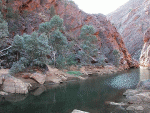 Radioactive waste being stored in shed in Arkaroola, THE AUSTRALIAN BRYAN LITTLELY with Giuseppe Tauriello From: adelaidenow December 25, 2012 IT’S the nuclear-waste facility that few people know about – 21 barrels of medium- to high-level radioactive material stored in a tin shed in South Australia’s Outback paradise.
The waste is in the heart of Arkaroola, the Outback wilderness sanctuary the State Government hopes will one day be included on the World Heritage list.
The facility, known as Painter Camp, is not registered under the Radiation Protection Act and a management plan for its safe and secure operation is still being developed.
In a revelation likely to outrage environmental groups and anti-nuclear campaigners, responsibility for Painter Camp now lies with the State Government, Continue reading
Marathon’s Arkaroola uranium project: summary of events
Radioactive waste being stored in shed in Arkaroola, THE AUSTRALIAN BRYAN LITTLELY with Giuseppe Tauriello From: adelaidenow December 25, 2012 @,,,,,,,A MARATHON PROJECT
February 2005: Adelaide-based Marathon Resources commences exploration at the site around Mt Painter and Mt Gee in the Arkaroola Wilderness Sanctuary.
September 25, 2007: The sanctuary’s leaseholders raise concerns that wildlife and flora will be destroyed by a uranium mine proposed on the property. Marathon wants to mine almost 45 million tonnes of ore to produce 900 tonnes of uranium a year.
February 12, 2008: The State Government suspends exploration in Arkaroola indefinitely for what it describes as a significant breach of the exploration licence.
July 31, 2010: Marathon resumes its controversial exploration of the Mt Gee area after a major clean-up.
February 22, 2011: Then-Premier Mike Rann claims he is “unashamedly pro-mining” but is considering options to safeguard Arkaroola. He tells Parliament all options are on the table.
June 9, 2011: A Greens motion to protect the Arkaroola mountains from mining is passed in the Upper House.
July 22, 2011: Premier Rann announces the Arkaroola Wilderness Sanctuary will never be mined, labelling it unique.
February 2012: The State Government pays Marathon $5 million in compensation for the exploration ban. http://www.theaustralian.com.au/news/radioactive-waste-being-stored-in-shed-in-arkaroola/story-e6frg6n6-1226543320645
Resources scientist questions management of tailings and water for Wiluna uranium project
 Dr Mudd also highlighted the use and contamination of ground water
sources in the area as a key issue, saying there have been issues at
other uranium mines across Australia and it remains unclear where
water for this site will come from or what techniques will be used to
source it
Monash mining expert examines Wiluna uranium proposal
Science Network, 23 December 2012 AN AUSTRALIAN expert on mining
sustainability has highlighted some of the key environmental aspects
for West Australia, as the state moves closer to its first uranium
mine.
Resources company Toro Energy recently received state government
environmental approval to develop WA’s first uranium mine near Wiluna,
with the company now seeking federal environmental approval.
Monash University mining expert Gavin Mudd says the primary issues
concern the management of tailings and waste rock, as well as water
use, contamination and other aspects local to the mine site. Continue reading
Lynas rare earths company DOES have a radioactive waste problem
 Lynas was attracted to Malaysia because it was offered tax free status for 10 years.
there was little mention of the waste — or “residue”, as Lynas prefers to call it.
Lynas and its supporters assert its operations are completely safe, but as NM reported on Monday, others — including scientists — are less confident.
The IAEA also recommended that Lynas proceed no further until it had filed comprehensive plans for the permanent disposal of waste, decommissioning of the plant and remediation of the site at the end of its life.
 Lynas’ waste plans a toxic pipe dream Aliran, 19 December 2012 Scientists and community leaders are concerned about radioactive waste from Lynas’ Malaysian plant but the company representative who took Wendy Bacon’s questions brushed off the criticism. This is the second of two articles about Lynas by Wendy Bacon. Read the first here.http://aliran.com/11005.html Australian rare earth company Lynas has always known it had a waste problem.
It plans to process rare earth concentrate, imported from its mine at Mount Weld in Western Australia, at its Lynas Advanced Materials Plant (Lamp) in Malaysia. It will not only produce rare earths for export but also a huge amount of waste, including more than a million cubic metres of low level radioactive material.
Lynas was originally going to build its Lamp plant in China, which produces more than 90 per cent of global rare earths. But according to its 2007 annual report, it decided to move to Malaysia, because the Chinese government was increasing its control over production, including applying environmental standards more strictly. Continue reading
Uranium lobbyist Michael Angwin attacks Australia’s Environment Protection and Biodiversity Conservation (EPBC) Act
 Uranium industry calls for reform, Mining Weekly, By: Esmarie Swanepoel 19th December 2012JOHANNESBURG – The Australian Uranium Association (AUA) has called for a reform of the environmental assessment and approvals process in Australia, after federal Environment Minister Tony Burke delayed a decision on a new uranium mine in Western Australia.
Burke on Tuesday extended his decision deadline until March 31 next year, and requested more information on the project from projectdeveloper Toro Energy.
The AUA’s CEO Michael Angwin said on Wednesday that the best way to reform the environmental assessment and approvals process was to cease the “discriminatory treatment” that the industry received under the Environment Protection and Biodiversity Conservation (EPBC) Act….
Toro Energy’s new female leadership now landed with government rebuff for uranium project
 No green light for Toro uranium mine, The Age, December 18, 2012 – Peter Ker Resources reporter Uranium aspirant Toro Energy has been dealt a blow on the eve of the Christmas break, with Environment Minister Tony Burke refusing toapprove the company’s plans for Australia’s next uranium mine at Wiluna.
While Mr Burke has not rejected the proposal, he has not approved it today as many in the market had expected.
Instead he has told Toro that more information on certain matters is required before the mine – located in Western Australia’s harsh interior – can proceed. Mr Burke has extended the deadline for a decision to be made to March 31, 2013, but has also indicated he may give his ruling earlier than that…..
While the market may not have expected a delay to approvals for the Wiluna mine, environment groups had been confidently predicting for some time that Toro had not done enough to satisfy the approval conditions.
A recent consultant’s report commissioned by the Conservation Council of Western Australia predicted that certain measures around storage of tailings were not adequate to meet federal approval. Council spokeswoman Mia Pepper said Mr Burke’s decision was prudent and responsible.
”The Toro project is ill-conceived,” she said. Australian Conservation Foundation spokesman Dave Sweeney said Toro
was a small company that would struggle to raise the funds needed to get the Wiluna project off the ground.
Toro will have a change of leadership in February when Mr Hall steps down and is replaced by Dr Vanessa Guthrie.
That transition has already made headlines for making Toro what is believed to be the only ASX company with an-all female leadership,given that its chairman is Erica Smyth.
http://www.theage.com.au/business/mining-and-resources/no-green-light-for-toro-uranium-mine-20121218-2bku9.html#ixzz2FWbwfzw7
Australian government refuses Toro ‘s Wiluna uranium project, requires further scrutiny
Peak state and national environment groups today welcomed the Federal Environment Minister’s increased scrutiny of WA’s first planned uranium mine – Toro Energy’s Wiluna project.
The Australian Conservation Foundation and the Conservation Council of Western Australia described Tony Burke’s refusal to approve the Toro Wiluna uranium project and to require further project detail as prudent and responsible.
“The Toro project is ill-conceived and the WA assessment has been dangerously deficient,” said CCWA campaigner Mia Pepper.
“The WA Government has broken its promise of a world’s best practice uranium industry and has failed to meet national standards. “Premier Barnett and the WA Government now urgently need to re-examine the environmental assessment process in WA and hold a comprehensive public inquiry into uranium mining.” Continue reading
Lynas in Malaysian court tomorrow over its confused and contradictory radioactive wastes plans
 Lynas will be in court in Malaysia on 19 December. The Save Malaysia Stop Lynas (SMSL) campaigners will be appealing against the Kuantan High Court decision to lift its stay on the company being able to exercise its rights to proceed under the temporary licence.
The toxic waste that’s not in Australia’s backyard http://aliran.com/11005.html 18 Dec 12, Australian-owned company Lynas is quietly shipping rare earth to a processing plant in Malaysia – without a firm plan in place to dispose of dangerous radioactive waste. Wendy Bacon reports.
If a manufacturing plant involving radioactive materials moved into your community, one of the first things you would ask is, “what’s going to happen to the waste?”
This is exactly how residents of Kuantan on Malaysia’s east coast reacted when the Australian company Lynas announced plans to build Lamp, the world’s biggest rare earth processing plant in their area.
Several years later, they have no clear answer. Indeed last week, while the plant that will use concentrate imported from Lynas’s rare earth mine at Mount Weld in Western Australia was finally ramping up for production, the Malaysian government and the company were in direct conflict about what would happen to the waste. Continue reading
1 This month

of the week – Australians for War Powers Reform (AWPR)
To see nuclear-related stories in greater depth and intensity
 Antinuclear