Australian uranium to India, a mirage more than a reality
 the glacial pace of nuclear power plant construction and activation in India in the face of anti-nuclear campaigns;
Indian uranium deals a long way off GEOFF HISCOCK The Australian October 29, 2012 AUSTRALIA’S new willingness to sell uranium to India is more about snuggling up to Asia’s third largest economy than any actual nuclear
commerce. It is highly unlikely that Australian uranium will be powering Indian nuclear reactors in this decade. Continue reading
Abbot Point recommended for World Heritage, not for uranium exports
Uranium export claims rejected by environmentalist Daily Mercury Dominic Geiger 29th Oct 2012 A BOWEN-BASED environmentalist has hit back at Federal Member for Dawson George Christensen’s claims the town would support uranium being exported from Abbot Point.
Mr Christensen made the claims following State Premier Campbell Newman’s recent decision to lift the ban on uranium mining in Queensland. “Abbot Point (is) an established resource port that (is) far removed from an urban area and the Bowen locals would love the potential work and opportunity,” he said.
But Bowen resident Ian Lee said the town had a history of opposing uranium mining and nuclear power. “Before the amalgamations, Bowen Shire Council voted to become a uranium-free and a nuclear-free shire,” Mr Lee said. “They’re all now jumping on the bandwagon and wanting to make Abbot Point a massive port.
“The World Heritage Committee has recommended there be no major developments outside the long established major ports. Abbot Point is classified as a minor port.”
Mr Christensen isn’t the first Federal Member for Dawson to come under criticism for a pro-nuclear stance. Former member De-Anne Kelly was deposed in 2007 after supporting a short-lived push to have a nuclear
power plant established in the Mackay region…..
http://www.dailymercury.com.au/news/uranium-export-claims-rejected/1599798/
Senator Larissa Waters debunks Queensland’s uninformed fervour for uranium minng
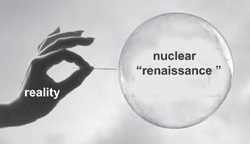 Senator Barnaby Joyce says nuclear power in Australia is next step after Queensland decision to resume uranium mining Robyn Ironside, John McCarthy The Courier-Mail October 24, 2012 “….Queensland Greens Senator Larissa Waters said those supporting uranium mining in Queensland had not worked out safe means of
transporting and exporting uranium.
Guidelines have only recently been adopted in WA and that state will not allow uranium oxide to be transported to, or shipped from, its ports until 2014.
“It is too dangerous, it is too risky, it is dirty and we have clean safe renewable alternatives that won’t end up making the world’s conflicts even worse,” Senator Waters said.
She said she doubted uranium would be an “economic saviour” for Queensland because the price of uranium was very low, now about $43 per pound.
The Queensland government is expecting total royalties of around $900 million if the total resource ($18 billion on current prices) was mined.
“The price for uranium has tanked in the last few years – all the more because of the Fukushima disaster – and we have just seen Olympic Dam in South Australia, the biggest uranium mine in Australia – well we’ve just seen plans for that to expand,  shelved,” Senator Waters said.
Senator Waters said transportation of uranium remained a major problem. “There is no safe way to dig up uranium, or transport it to port, or export it, and have it used safely,” she said. “We simply don’t have the guarantees that we need that this stuff can be managed.” “It is radioactive, it is toxic.”….. : http://www.brisbanetimes.com.au/queensland/uranium-cheapest-alternative-fuel-20121023-2838o.html#ixzz2AWgmmDmv
Pakistan says of Australian uranium – “Me Too!”
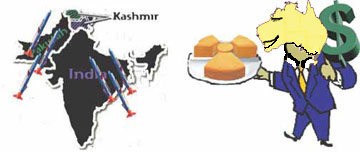 Pakistan says it should be allowed to buy Australian uranium November 17, 2011 BUSINESS RECORDER Pakistan says if Australia sells uranium to India, it too should be eligible for exports of the product. India’s arch rival is also a nuclear power and, like India, a non-signatory of Nuclear Non-Proliferation Treaty. Pakistan says it could use Australian
uranium to boost its civilian nuclear power programme.
And its High Commissioner to Australia Abdul Malik Abdullah told ABC Radio correspondent Michael Edwards in an interview that it would be discrimination to sell to India and not to Pakistan.
“We are not against uranium sales to India but that if they do go ahead they should also be available to Pakistan,” Abdullah was quoted as saying by ABC Radio on Tuesday. “In the past when United States, India nuclear deal had taken place, we feel that Pakistan was discriminated against. And we hope that this time, given our very strong and cordial relationship with Australia, Pakistan would not be discriminated against.”
Pakistan’s atomic programme began in earnest after India conducted its first nuclear test in 1974. It tested its first bomb in 1998. It’s also expanding its civilian nuclear power programme. ….. http://www.brecorder.com/business-a-economy/189/1251905/
Queensland Premier Newman admits uranium not necessarily a job provider
 No evidence jobs flow from uranium mining ABC News By Eric Tlozek, 26 Oct 12, Queensland Premier Campbell Newman admits the State Government has no economic modelling or studies to show lifting a ban on uranium mining will create jobs or investment in the state.
In announcing the lifting of the ban this week, Mr Newman said the decision was partially prompted by Prime Minister Julia Gillard’s recent support for uranium sales to India…
.. Mr Newman says the State Government has no modelling to show the industry will create jobs or increase investment in regional areas. He says the proposal was put to Cabinet after just one meeting with the Mines Minister.
Uranium has not been mined in Queensland since the closure of the Mary Kathleen mine in the state’s north-west in 1982.
http://www.abc.net.au/news/2012-10-25/no-evidence-jobs-flow-from-uranium-mining/4333390?section=qld
Queensland Premier’s risky choice to go for uranium, not for sunshine
 The Premier should remember that community trust is a finite resource.
The risks of uranium last far longer than a politician’s promise. Attempts to introduce uranium mining in Queensland will be actively contested.
Queensland, especially regional Queensland, is perfectly positioned to become a world leader in the globe’s fastest growing energy sector – renewable energy. Queensland has some of the world’s best solar and wind resources. There is no need to open the door to an industry like uranium which is unsafe, unwelcome and under-performing.
Uranium decision takes the cake http://www.theaustralian.com.au/news/uranium-decision-takes-the-cake/story-e6frg6n6-1226502563991 BY: DON HENRY From: The Courier-Mail October 25, 2012 WHEN Premier Campbell Newman wrote to me two weeks ago saying his Government had no plans to approve the development of uranium mining, I took the letter at face value.
So I was as surprised as other Queenslanders when Newman announced on Monday at noon that he would overturn the popular and long-standing state ban on mining the nuclear fuel
.
I realise the Premier has been under a lot of pressure to reverse the state’s prudent position on uranium. The Australian Uranium Association, the Queensland Resources Council and some of the multinational mining companies that hope to make big profits from digging up uranium and shipping it overseas have lobbied hard.
But there are some very strong reasons Queenslanders should keep our uranium in the ground. Uranium is not like other minerals. Continue reading
Queensland’s scandalous uranium history: a bad idea to start it again
 Queensland Forgets Its Uranium History http://newmatilda.com/2012/10/24/queensland-forgets-its-uranium-history Jim Green, New Matilda, 24 Oct 2012 The Queensland Government is unwise to reverse the ban against uranium mining and there is no stronger reason than the industry’s sordid track record in the state.
French company Minatome undertook trial mining at Ben Lomond, near Townsville, in the early 1980s. Federal MP Bob Katter spoke at length about Ben Lomond in Parliament on 1 November 2005. He noted that Minatome initially denied reports of a radioactive spill, but then changed its story and claimed that the spill posed no risk and did not reach the water system from which 210,000 people drank.
 Bob Katter’s version of the story is on Hansard: “For the next two or three weeks they held out with that story. Further evidence was produced in which they admitted that it had been a dangerous level. Yes, it was about 10,000 times higher than what the health agencies in Australia regarded as an acceptable level. After six weeks, we got rid of lie number two. I think it was at about week 8 or week 12 when, as a state member of parliament, I insisted upon going up to the site. Just before I went up to the site, the company admitted — remember, it was not just the company but also the agency set up by the government to protect us who were telling lies — that the spill had reached the creek which ran into the Burdekin River, which provided the drinking water for 210,000 people. We had been told three sets of lies over a period of three months.”
 Queensland’s other misadventure with uranium was the Mary Kathleen mine in western Queensland. In the mid-1970s, a whistleblower from Mary Kathleen Uranium Mining leaked documents which revealed the existence of a global uranium cartel leading to protracted international scandals and fines totalling hundreds of millions of dollars.
The leaked documents also revealed evidence of shoddy environmental practices at Mary Kathleen; close surveillance of environmental organisations; the close relationship between then-ACTU President Bob Hawke and the chairman of uranium miner Conzinc Riotinto Australia; and advice from government officials about how companies could circumvent non-proliferation treaties in order to sell uranium to countries that had not signed the Nuclear Non-Proliferation Treaty.
One million litres of radioactive liquid were released in February 1984 from Mary Kathleen’s evaporation ponds during a wet spell. Even now, 30 years after the mine’s closure, there is ongoing seepage of saline, metal and radionuclide-rich waters from tailings, as well as low-level uptake of heavy metals and radionuclides into vegetation.
Bob Katter’s son, state MP Rob Katter, claims that uranium mining represents a potential $20 billion export industry for Queensland which could generate 2600 jobs. The simple facts are that uranium accounts for just 0.2 per cent of Australia’s export revenue ($610 million in 2010-11) and less than 0.02 per cent of Australian jobs (1760 jobs including mining, exploration and regulation). Queensland is home to just 3 per cent of Australia’s uranium resources.
Rob Katter claims that Queenslanders support uranium mining but he provides no evidence. The latest poll reported in the Courier Mail in November 2008, found that 47 per cent of Queenslanders oppose uranium mining compared to 45 per cent in support. Two-thirds of Queenslanders oppose uranium sales to nuclear weapons states. A majority of Australians believe that the “safeguards” system, which aims to prevent nuclear weapons proliferation, is ineffective.
Before the last state election, the Queensland Liberal National Party said it had no intention of reversing the ban against uranium mining. Campbell Newman’s LNP Government ought to take its new position to the next state election. Better still, a referendum could be held on the question of uranium mining when Queenslanders next go to the polls.
The uranium industry has no capacity to deliver serious economic benefits to Queensland but, if given the chance, it will create more long-term environmental and public health hazards such as Ben Lomond and Mary Kathleen.
Queensland farmers not keen on uranium mines in their back yard
Uranium mining rethink sparks Qld farmland fears, ABC News, By Chrissy Arthur 24 Oct 12 Rural lobby group AgForce says it has concerns about the impact of uranium mining on Queensland farms. The State Government will lift a long-standing ban on uranium mining, saying it will generate investment and jobs.
However, some landholders and conservationists have expressed concern about the environmental impact and the possibility of toxic mine spills. AgForce president Brent Finlay says landholder concerns will need to be considered.
“All of those issues concern us and that is why it has to be done properly if it is done,” he said.
“We have to work with landholders, we understand that no landholder wants any mine in their backyard – it puts pressure on agriculture. “If these developments do go ahead, the impacts on the environment and the community are very important and they have to be managed and if there are spills, they need to be cleaned up.”
A Gulf of Carpentaria mayor says local government leaders will also pressure the Queensland Government to ensure environmental safeguards are in place for any uranium developments…
Call to Aboriginal land councils to avoid uranium
 Aboriginal land councils urged to avoid uranium http://www.abc.net.au/news/2012-10-23/aboriginal-land-councils-urged-to-avoid-uranium/4328580/?site=indigenous&topic=latest Eugene Boisvert 23, 2012 An environmental activist says Aboriginal land councils may apply for permits to explore for uranium because they now don’t have to give permission for exploration on their land.
Natalie Wasley from the Beyond Nuclear Initiative is organising a protest next month, when expressions of interest for the permits close.
The far west is believed to be rich in uranium. Ms Wasley says exploration will inevitably lead to mining, and that the Broken Hill Aboriginal Land Council should have to give permission for mining activity to happen on their land.
“Unfortunately when the exploration laws changed they actually altered the Aboriginal Land Rights Act to say that local councils don’t have to give consent for exploration to go ahead,” she said. “This is a very retrograde move and something that should be very strongly opposed.” Natalie Wasley from the Beyond Nuclear Initiative says it is unclear
who has applied for the licences, but she believes Aboriginal Land Councils will apply.
“I believe there’s been an expression of interest put in but we’re not sure who’s actually made applications until the application period closes on the 13th of November,” she said.
“There’ll be a rally outside Parliament House on that day where lots of different organisations are sending representatives to say that we don’t want any exploration licences to be granted. The ABC has attempted to contact the Broken Hill Aboriginal Land Council for comment.
Gillard government takes its orders from USA – uranium to India
Gillard is helping to destabilise the sub-continent by fuelling a dangerous arms race involving India’s rivals, China and Pakistan.
The Labor government’s about face on uranium sales to India under Gillard was carried out on Washington’s orders. In November 2011, the US ambassador to Australia, Jeffrey Bleich, publicly called on Canberra to “sort out” its issues with India, as the US had done when it resolved the “thorny point” of uranium sales through the 2008 nuclear deal that exempted India from the Nuclear Non-Proliferation Treaty (NPT)

Australian PM visit to India bolsters new “strategic partnership” WSWS, By Patrick O’Connor 20 October 2012 Australian Prime Minister Julia Gillard’s three-day trip to India this week was aimed at deepening military, diplomatic, and economic ties between the two countries.
Washington has encouraged the closer relations as part of its aggressive drive to undermine the influence of China in the Indo-Pacific region. Gillard met with Prime Minister Manmohan Singh on Wednesday. High on the agenda was progress towards Australian uranium sales to India, Continue reading
Grim future for Australia’s uranium industry, falling demand, falling prices
 Adding to the miners’ woes, uranium prices continue to fall, from US$73 a pound in March 2011, to around US$43 currently. That’s lower than the cash cost of production at Paladin’s Kayelekera mine in Malawi, giving the miner a decent sized headache.
Nuclear Fallout Hurts Uranium Miners , 9 News, by Mike King, The Motley Fool, October 19, 2012 The world continues to feel the impact of the Fukushima nuclear disaster. The disaster in Japan in 2011 has left 48 of Japan’s nuclear reactors sitting idle, awaiting government approval to resume operations, with just 2 restarted. In mid-September, the Japanese government approved a new energy plan which included reducing the nation’s reliance on nuclear energy substantially.
Following the Fukushima accident, Germany immediately shut 8 of its reactors, and plans to close its remaining 9 reactors by 2022.
The impact is being felt by uranium miners globally.
Paladin Energy Ltd (ASX: PDN) recently stated that annual demand for uranium has fallen, as the future of nuclear energy was cast into doubt. The world’s largest uranium producer, Canada’s Cameco, has also forecast lower sales and highlighted doubts about the take-up of nuclear power in future. Continue reading
Australian media more interested in Julia Gillard’s shoes, than in the dangerous uranium deal with India
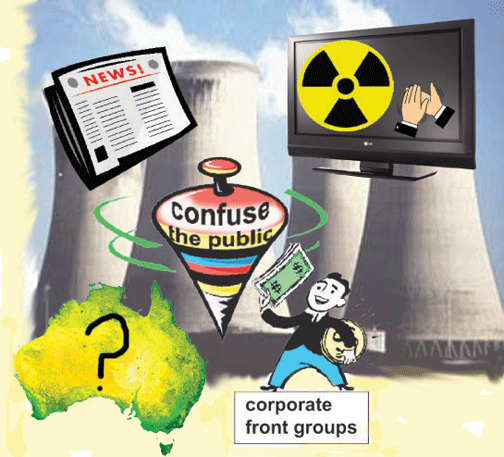 The opening up of nuclear trade with India — first by the US in 2008 and most recently by Australia — has broader implications. It fundamentally changes the proliferation equation for other countries.
The most dangerous lie peddled by industry and by the Australian and Indian governments is that India has a strong track record of nuclear non-proliferation.
The Gillard government has no intention of seriously addressing any of the proliferation, safety, security and regulatory problems, nor does it care about the repression and murder of peaceful citizen protesters in India.
India’s Abysmal Nuclear Record, By Jim Green, New Matilda, 18/10/12 http://newmatilda.com/2012/10/18/indias-abysmal-nuclear-track-record
While the media focuses on Julia Gillard’s stumbles, India’s clunker of a nuclear industry stays unexamined. But hey, what’s a bit of nuclear proliferation between friends? Jim Green from Friends of the Earth on the South Asian nuclear arms race
According to Gemma Bailey, writing in the Australian Financial Review, Prime Minister Gillard has a cunning plan. She will ensure that Australia’s uranium supply treaty with India contains strict conditions on the safe use of the nuclear fuel. The plan, we’re told, “is intended to neutralise opponents who highlight that India has not signed the Nuclear Non-Proliferation Treaty.”
If only that were true. Here’s Gillard’s real plan: trot out tired old lines about strict conditions and hope that journalists will regurgitate them without question. For the most part, it works. A number of media organisations have run an Associated Press piece which asserts as fact that Australia “sells uranium only … under strict conditions”. Michelle Grattan has twice used her Fairfax column to remind us about John Howard’s cricketing abilities, but she remains silent about the weapons proliferation issues at stake with the uranium deal.
Fairfax’s National Times ran what was essentially a propaganda piece by Professor Amitabh Mattoo from the Canberra-funded Australia India Institute. And the day before Labor’s National Conference debated uranium sales to India last year, the Sydney Morning Herald published a column by the Lowy Institute’s Rory Medcalf downplaying the risk of proliferation. The Lowy Institute — which prominently lists uranium miner BHP Billiton as a funding partner — refused to run a critique of Medcalf’s column on its blog.
At stake is the nuclear arms race in South Asia and broader, global nuclear proliferation concerns. As Ron Walker, a retired Australian diplomat and former Chair of the Board of the International Atomic Energy Agency (IAEA), said last year: “I am horrified that the media have not explained the enormity of this proposal.”
India is at least as culpable as its neighbours in fanning the nuclear arms race in South Asia.
Australian uranium sales to India, fraught with hypocrisy and danger
If we really want to assist Indian communities who currently lack access to electricity – and we should – it would be far more effective to prioritise exporting Australian expertise in regional renewable energy systems.
the admission this week from India’s own auditor that the country’s nuclear industry is “dangerously unsafe, disorganised and, in many cases, completely unregulated” – only compounds concerns.
When Australian uranium leaves our waters it effectively disappears from the radar. This is a profound concern for a fuel that can power either nuclear reactors or nuclear weapons. High-level Indian officials have stated that they need to source uranium from overseas in order to free up their own uranium for military purposes
No smooth passage to India for Australian uranium http://www.abc.net.au/environment/articles/2012/10/18/3612800.htm DAVE SWEENEY, ABC 18 OCT 2012 PRIME MINISTER JULIA GILLARD is in India this week and amid the staged handshakes and solemn exchanges of signed papers. The uranium sales plan is being heavily promoted. But there is growing concern both here and in India about the implications of the move and the fast-tracking of nuclear-armed India into the global atomic club.
No doubt Julia Gillard will be employing the age-old tactic of highlighting a problem that no reasonable person could ignore and then seeking to ‘own’ the solution. Proponents of the sales deal point to the estimated 200 million Indians who do not have reliable access to electricity as a rationale for the sales deal. But to link Australian yellowcake with lights and cookers in remote Indian villages is to draw a very long bow. Continue reading
Many a slip twixt Toro’s plan and uranium mining at Wiluna in Western Australia
The Anti Nuclear Alliance of WA said it would fight in court the approval granted by WA Environment Minister Bill Marmion yesterday.
the mine cannot make money at current low uranium prices and the company, valued at only $86.5 million, did not have the financial capacity to clean up the mine if it was unprofitable
“If Toro falls over at Wiluna, who cleans it up? It either doesn’t get cleaned up, which is unacceptable, or it gets cleaned up at public expense,” Mr Sweeney said
Green protests at Toro HQ over mine approval Rhianna King, Nick Evans and AAP, The West Australian
October 11, 2012, A group of about 25 protesters marched outside the West Perth offices of Toro Energy this morning to express their anger over the approval of WA’s first uranium mine.
Environmentalists and trade unionists walked from Toro’s headquarters to Parliament House, chanting ‘Toxic Toro, you’ve got to go.’ Conservation Council of WA Nuclear Free campaigner Mia Pepper said green groups would not give up until the State Government’s decision was overturned.
“This proposal has no complete mine closure plan or costings, it will run out of water in seven years and no alternatives have been evaluated, scientists are still naming a new plant species found near the mine site, and Toro are yet to finalise their transport management plan,” she said.
“This is not a credible plan. It is a half-baked, half-assessed shambles driven by a political agenda and is not based on good science or evidence. Continue reading
Uranium mining for Queensland – NOT a job provider, and NOT needed
As for respecting the wishes of Aboriginal Queenslanders, neither our State nor Federal legal frameworks give traditional owners the right to refuse mining on their lands, so it is difficult to see how their wishes will be respected should they not wish to host a uranium mine. And given the findings of a 2006 study that found a 90% higher incidence of cancer amongst indigenous peoples living in close proximity to uranium mines in Kakadu, one can well understand how that might be their preference.
Queenslanders have thus far decided we don’t want to be part of an industry that generates toxic waste with no functioning long-term storage solution, fuels weapons of mass destruction, and has no future in electricity generation because it grows ever more expensive while clean energy alternatives grow ever cheaper.
The jobs aren’t in uranium: Stone Opinion: Adam Stone | 6th October 2012 “……..The LNP obviously decided to insulate their campaign from public concern about uranium mining by committing that they would not change Queensland’s anti uranium mining policy, but their underlying conviction on the subject is completely at odds with this position. After all, they openly campaigned in favour of repealing the policy in the 2009 State election …..
The Queensland Resources Council (QRC) and Australian Uranium Association (AUA) have opened by arguing that uranium mining in Queensland will: provide jobs, respect the wishes of indigenous Queenslanders, cut greenhouse gas emissions, only supply uranium for peaceful purposes, and is necessary for baseload power generation as only nuclear, hydro and fossil fuels can meet this need. Continue reading
1 This month

of the week – Australians for War Powers Reform (AWPR)
To see nuclear-related stories in greater depth and intensity
 Antinuclear