Annie McGovern: stop pretending that the Kimba nuclear waste dump is a”medical necessity”
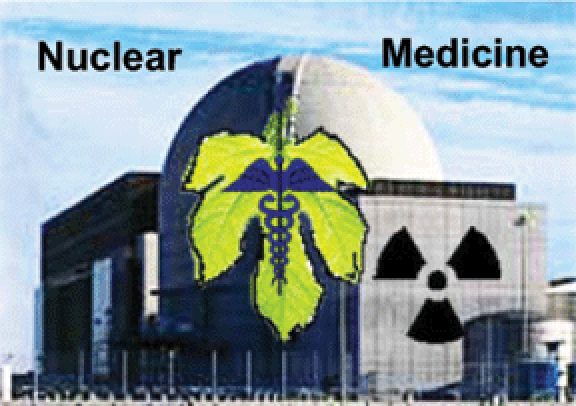
Much of what you and the Public are told is that this is mostly about providing good medicine and
saving lives. According to the Medical Association for Prevention of War ‘Factsheet’:- “Less than 1%
is medical waste (radium and some disused sources). Most states and territories each only have a
few cubic metres of low level medical waste.”
The current ploy of localising all the decision-making regarding this “National Waste Dump”, through
enticements of land procurement and localised funding, has placed this critically important process
at the level of a ‘sausage-sizzle deal’, highly inadequate for the responsibilities involved.
National Radioactive Waste Management Amendment (Site Specification, Community Fund and Other Measures) Bill 2020
[Provisions]
Annie McGovern, Submission 83 To: Senate Standing Committees on Economics.
National Radioactive Waste Management Amendment (Site Specification, Community Fund and
Other Measures) Bill 2020 (Provisions).
As stated in the support document accompanying this Bill, the Federal Government has been in the
process for the past 40 yearsof finding a site in Australia for the Dumping of Nuclear Waste. This Project has been presented bothas an independent National necessity and also as an associated proposal for an International
Industry for disposing of the world’s Nuclear Waste.
For those same 40 years the Australian people have continued to take the position that a Nuclear
Industry is a hazardous, uneconomical and unsustainable incursion into the stability of both National
and International interests, and that Australia should remain Nuclear Free.
Over time we have seen the steady erosion of the rights of the Public to express common will in
relation to industrial development in this country, and usurpation of decision-making of whether an
industry is desirable for the common good or is perceived as destructive and not in the best interests
of the Community or Environment. Clearly the Nuclear Industry falls into the latter category where
the balance of all the detrimental factors far outweigh the positive contributing factors.
The challenge of finding a disposal site is directly correlated to the resistance of allowing an easy
road for the Nuclear Industry to flourish, when it is seen to be both economically and
environmentally unsustainable. Agreement for conditions of disposal should occur when there is an
end in sight. When the Industry is shut down:- weapons, uranium and radioactive sand mining,
reactors and associated arms of the industry, then we are able to consider final disposal. With the
guarantee of no further production of this toxic and dangerous legacy there will be a genuine reason
to consider the disposal of what we have created. Until then, the current proposal is yet another
attempt to justify and legitimize a manipulative and dangerous industry, and to perpetuate its
attempts to grow in power.
The current ploy of localising all the decision-making regarding this “National Waste Dump”, through
enticements of land procurement and localised funding, has placed this critically important process
at the level of a ‘sausage-sizzle deal’, highly inadequate for the responsibilities involved.
A ‘cart-before-the –horse’ scenario occurs when acceptance of the site and facility is put before you
when there have been no Public Environmental Studies performed nor any detailed scrutiny of the
planned infrastructure. Community ratification has been achieved (minus the Indigenous Voice)
without a thorough investigation of the Impacts or ramifications of this site selection, with only an
assurance of what initial Economic gain the Community might make on this deal.
This over-simplification and commercialisation of such an important Project is reflected in the
inclusion of an extensive “Visitor’s Centre” at the site, as though it were a Tourist Attraction. This
attitude indicates a serious lack of awareness of how toxic and hazardous radioactive materials are
and a down-playing of the necessity for safe-guards that have also been eroded over the years.
Why South Australia? It is a well-known fact that the Nuclear Industry has its sites set on an
expansion of all levels of its activities, particularly in S.A. It is also a well-known fact that the people
of S.A. voted against the recent Royal Commission’s facilitation of a proposal to install an
International Radioactive Waste Dump in S.A. Its’ own State Legislation prohibits the development
of Nuclear Facilities so you as the National Senate Committee deliberating on this matter will override
the will of the people of S.A., unless you look below the surface of what you have been
proffered as justifications for this proposal.
Much of what you and the Public are told is that this is mostly about providing good medicine and
saving lives. According to the Medical Association for Prevention of War ‘Factsheet’:- “Less than 1%
is medical waste (radium and some disused sources). Most states and territories each only have a
few cubic metres of low level medical waste.”
Nuclear scans for investigating disease. These produce the vast bulk of medical nuclear waste. This is
short-lived and decays on the medical facilities’ premises until its activity is negligible. It is then
disposed of safely and appropriately in the usual manner of most waste (sewers, incinerators,,
landfill tips etc.) according to set standards.
Cancer treatment radiotherapy. Most radiotherapy uses x-rays or electromagnetic radiation which
do not produce any waste at all. A very small proportion of cancer treatment actually relies on
radioactive materials, which almost all decay rapidly. Longer lived sources must be returned to their
(overseas) sources when used up and so do not need local disposal.”
The Medical Associations for Prevention of War also supports a re-think on the production of
medical isotopes to manufacture the same product without generating radioactive waste.
“…Canada…is switching to non-reactor isotope production, which does not create radioactive wastes.
It goes on to explain: “There are broadly two areas in which radioactive material is used for medical
purposes:
Nuclear scans for investigating disease. These produce the vast bulk of medical nuclear waste. This is
short-lived and decays on the medical facilities’ premises until its activity is negligible. It is then
disposed of safely and appropriately in the usual manner of most waste (sewers, incinerators,,
landfill tips etc.) according to set standards.
Cancer treatment radiotherapy. Most radiotherapy uses x-rays or electromagnetic radiation which
do not produce any waste at all. A very small proportion of cancer treatment actually relies on
radioactive materials, which almost all decay rapidly. Longer lived sources must be returned to their
(overseas) sources when used up and so do not need local disposal.”
The Medical Associations for Prevention of War also supports a re-think on the production of
medical isotopes to manufacture the same product without generating radioactive waste.
“…Canada…is switching to non-reactor isotope production, which does not create radioactive waste.
In contrast, ANSTO is proposing to dramatically increase reactor isotope production to sell 30% of
the world market. As a result Australia will accumulate much more waste from international isotope
sales. Developing cyclotrons instead (like Canada) would eliminate waste from isotope production.”
To ply the Public with guilt-laden decision-making tools which are questionable and possibly wrong is
an underhanded way of bending peoples’ resolve. Clearly, Australia has choices of the way we
proceed into the future. It is not the right of a small group of often underinformed politicians or
vested financiers to force us into untenable industries. We, as a Nation already have enough
Radioactivity to deal with. The legacy of past mistakes and ones that today continue to add to the
problem, unseen, unchecked ‘til some day those hazards will also have to be dealt with. Roxby
Downs, Beverley, Ranger, Yeelirrie, Radium Hill, Honeymoon, Wiluna, Lucas Heights, Woomera and
Marlinga.
The Intermediate Level Waste is promoted as a temporary visitor to this site. Where is its’ long-term
repository? Is this yet another plan that has not yet been divulged? Where is the constraint, the
hazard reduction? The respect for the earth and its people that would cause decision-makers to
recognize that we gone too far?
It is a nightmare of what we already have to deal with, of decaying drums, of shipping highly toxic
huge stockpiles and dangerous goods across the country, of supervising this disposal for hundreds of
years into the future with only 100 years guaranteed by this plan.
Please see the deep and murky waters here and the lack of knowledge that lies at the bottom of
what you are being asked to authorize. There are no easy solutions or truly economically viable ones,
it will all be a cost.
Stop the Nuclear Industry now and then we will discuss what to do with the mess we have made.
Thank you for the opportunity to address this very important issue.
Annie McGovern.
Kim Mavromatis on Radioactive Waste Bill: community consent? transport dangers, on agricultural land. poor process.
Dear Committee Chairperson
I live in Port Pirie, within the Upper Spencer Gulf and Southern Flinders region of South Australia. I’m a filmmaker and have been following and documenting the Nuclear Waste dumps facility process for 5 years. My hometown of Port Pirie,
along with Whyalla and Port Lincoln, have been named potential Nuclear Waste ports by the NRWMF, so I live potentially along the transport route?
Nuclear Ports NRWMF Reference : Site Characterization Tech Report, Wallerberdina Pg 177 Proximity to Ports 4.1.2.1.6.
61.5% of residents supported a facility located in their community”.
In Senator Canavan’s media release 1st Feb 2020, announcing Napandee near Kimba as the site for Australia’s National Nuclear Waste Dumps facility, he replaced the word “residents” with “voters” :Senator Canavan : “…61.6 per cent of voters in Kimba support the proposal”.
facility – all the eligible voters need to be included in the percentages, whether they voted Yes, No or Abstained, to get a true percentage of the Community Support. All the figures need independent scrutiny.
Kimba Council and Barngarla Independent vote gives a very different outcome : 43.75% Support the waste dumps facility (452 Yes from 1,033 eligible voters), which Does Not constitute Broad Community Support.
title rights and this Fed Govt National Nuclear Waste Dumps facility process has
denied them from having a voice and ignored their independent vote. This
process not only has ramifications for the Barngarla people, but for all of
Australia’s Aboriginal people – it will inform future govts of ways to ignore and
exclude Native Title Holders, without proper consultation, and get away with it.
Spent Nuclear Fuel (10,000 x more radioactive than uranium ore) and waste
from reprocessed SNF (still contains 95% of the radioactivity of SNF), which
most of the world classify as High Level Radioactive Waste (Aust classify as
Intermediate), will be transported 1,700km halfway across Aust from Lucas
Heights, via road, rail or ship, and dumped temporarily above ground for up to
100 years on Eyre Peninsula farmland, near Kimba in SA.
South Australia’s Greens fight to stop nuclear waste dumping on Kimba
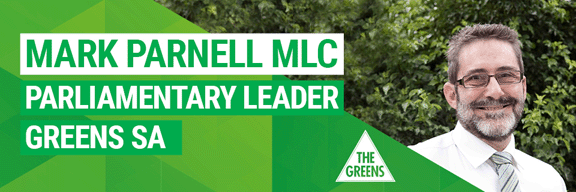
Mark Parnell, 21 Apr 20 The people of the Flinders Ranges voted to reject the proposal to site the nuclear waste dump in their local area, so the Federal Morrison Government has decided that Kimba, at the top of Eyre Peninsula, will host the dump.
Legislation has been introduced into Federal Parliament and a Senate inquiry is now underway. It is due to report back to Parliament by the end of July. You can find out more and read the submissions here.
the Barngarla people challenged the flawed community ballot and their claim of racial discrimination was dismissed by the Federal Court. But all is not lost. Earlier this month, the Parliamentary Joint Committee on Human Rights found that the Government’s new dump laws posed “a significant risk” that the rights of Traditional Owners under international human rights laws would NOT be protected. This means that it’s more important than ever to show our support to the Traditional Owners to have their voices heard.
In my last update, I flagged the likelihood of an imminent new South Australian Parliamentary Inquiry into the proposed Kimba nuclear waste dump. I now don’t expect that inquiry to commence until much later in the year. Of course, if the Federal Bill is defeated in the Senate, then there may be no need for an inquiry at all! That is our hope.
Finally, I recently tabled a new petition against the nuclear waste dump in State Parliament, which I know some of you have signed. You can read my speech here, or watch it here.
Australian Radiation Protection and Nuclear Safety Agency (ARPANSA) is critical of Government propaganda on Kimba nuclear waste dump plan
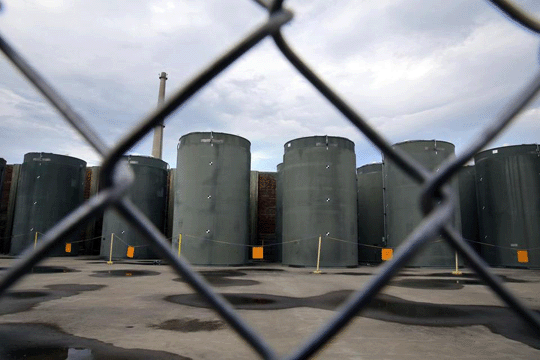
David Noonan, 20 Apr 2020, Australian Radiation Protection and Nuclear Safety Agency (ARPANSA) is  challenging govt propaganda more directly than we would usually expect:
“ARPANSA is aware that some stakeholders have interpreted ARPANSA’s decisions regarding the IWS as a requirement for relocation of the waste stored in the IWS, even suggesting that there is an urgent need for relocation. This is not correct. “
A Note so you may be aware of interesting matters raised in the ARPANSA submission to the Senate Inquiry:
Submission No.86 (7 pages) by the regulator Australian Radiation Protection and Nuclear Safety Agency (PDF 833 KB) has been posted on Senate Inquiry website: https://www.aph.gov.au/DocumentStore.ashx?id=41390f03-33ed-46be-bcb4-2913c6263b99&subId=680048
The UK reprocessed nuclear waste shipment is planned in 2022 – with ANSTO Lucas Heights the “only feasible destination”:
See p.3-4 under Headings:
Commonwealth waste holdings – role of the NRWMF
ANSTO
ANSTO
The Interim Waste Store (IWS) Facility
Additional ILW remains in the UK from reprocessing of HIFAR spent fuel, and is planned to be returned to Australia in 2022. Should the shipment take place at that time, the NRWMF will (again) not be available, which in all likelihood leaves Lucas Heights as the preferred (by ANSTO) option, and possibly the only feasible destination. ARPANSA is aware that the waste in this second shipment is likely to be immobilised and contained in a TN-81 cask with considerably less activity content than the first cask.
ARPANSA expects an application from ANSTO for approval to make a change with significant implications for safety under section 63 of the Regulations10, supported by a revised safety analysis report and an updated safety case, well in advance of the time the second shipment is intended to be loaded on a vessel for shipment to Australia.
So at this stage the UK reprocessed nuclear waste shipment is planned to go into Sydney (presumably to go over Port Kembla).
Unless the UK gov agree to a delay & that’s assuming the NRWMF is progressing to receive shipments of nuclear waste at a port in SA.
Noting the French gov did not agree to a delay back in 2015.
Also, ARPANSA making clear they intend an Application from ANSTO “well in advance of the time the second shipment is intended to be loaded on a vessel for shipment to Australia” – ANSTO didn’t do so in 2015.
So opponents of the nuclear waste plan and MUA may get some useful notice and can engage on that shipment publicly and formally.
If this UK shipment does go into Sydney (like the French reprocessed nuclear waste did in 2015), presumably they and MUA can raise a strong case that it shouldn’t later be moved a second time to ‘temporary’ (indefinite) above ground storage in SA, with a third move then required to a future disposal site…
And the federal gov case for an above ground interim (read indefinite) nuclear fuel waste store in SA is further significantly weakened.
Note – ARPANSA saying (p.4):
“ARPANSA has not raised safety concerns regarding storage of waste at the Interim Waste Store.”
(Regarding the IWS at Lucas Heights which holds the French reprocessed waste and was designed to also take the UK waste and operate for 40+ years)
And acknowledging ANSTO has identified two “contingency measures in short to medium term” – including what we are asking for:
- “Retention of the returned residues at ANSTO until the availability of a final disposal option”
( The other contingency measure is the ANSTO / Department / Minister’s plan for:
- Retention of the returned residues at ANSTO until the availability of the NRWMF for storage )
ARPANSA usefully counter some of the propaganda going around pro-dump circles on claimed ‘need’ to move key nuclear wastes:
“ARPANSA is aware that some stakeholders have interpreted ARPANSA’s decisions regarding the IWS as a requirement for relocation of the waste stored in the IWS, even suggesting that there is an urgent need for relocation. This is not correct. ARPANSA has not raised safety concerns regarding storage of waste at the IWS.”
On Transport:
ARPANSA flag a potential requirement (p.7) for “prior approval of a transport safety and/or security plan by ARPANSA” in a Safety Case before Site Licensing,
So we’d get an opportunity to publicly and formally contest these issues in consultation with the regulator, to show they are not ‘resolved’, before any licensing could happen.
Requiring community engagement / consultation on a ‘transport safety and/or security plan’ prior to Site licensing should become a specific ask of opponents of the plan.
“The safety case should acknowledge the existence of any unresolved issues and should provide information on work proposed to resolve these issues in future stages of the licensing process. Issues that have been resolved with ARPANSA and other stakeholders should be documented and form part of the safety case.
The safety of transport to, from and between radioactive waste management facilities should also be considered noting that the responsibility for transport of waste to a storage or disposal facility lies with the waste owner. This may require prior approval of a transport safety and/or security plan by ARPANSA.”
Note – To add to the call for the Senate Inquiry to be held over until Public Hearings can be held in Adelaide, Whyalla and Kimba:
For the Inquiry timeline to be extended to receive evidence of two ANSTO nuclear waste management reports that are due to ARPANSA by 30th June.
And for the Inquiry and community to be able to hear and consider the ARPANSA response and evaluation of ANSTO’s proposed Intermediate Level Waste plans.
- see p.4 on these two reports in the first two para’s at header: Implications of ILW generation and storage at Lucas Heights for the NRWMF
Also Note the fundamental point made well in the two-page ACF Briefing Note April 2010 to the Senate Inquiry
(attached to ACF submission No.97):
“Advancing responsible radioactive waste management in Australia”
https://www.aph.gov.au/DocumentStore.ashx?id=efb5c09a-d4eb-45cf-82e3-683fa4ef5b12&subId=680115
“There is no regulatory or radiological impediment to extended interim storage at Lucas Heights. ANSTO’s facility is prohibited from becoming a permanent disposal site, however there are no comparable constraints on it as a site for extended storage. Importantly, this approach also provides the ability to have an evidence based and open review of the best long-term management options.”
ANSTO’s own submission is seriously misleading in reading as though Lucas Heights can’t continue to store for decades the nuclear fuel wastes / Intermediate Level Wastes – just because it can’t be a permanent disposal site.
We have called for Extended Storage at Lucas Heights at least until scientifically defensible and publicly acceptable nuclear waste disposal plans may arise – which is one of the two accepted contingencies by the regulator ARPANSA & put forward by ANSTO.
The Committee are still posting submissions received, the Secretary summarises them for Members of Inquiry, and Members usually then decide on whom to call as Witnesses. The Inquiry may shortly hold a ‘tele-conference’ hearing in Canberra with Agencies (ANSTO, Department and ARPANSA) as way of getting started…
Parliamentary committee finds that Kimba nuclear waste dump law may breach Indigenous human rights

|
Kimba nuclear waste dump law risks breaching Indigenous human rights, committee finds https://www.abc.net.au/news/2020-04-16/risk-kimba-nuclear-dump-may-breach-human-rights-committee-says/12154474 ABC North and West SA By Gabriella Marchant 17 Apr 20, A cross-party parliamentary committee has found “significant risk” that local Indigenous groups were not consulted about a proposed nuclear waste facility to a standard required under international law.
Key points:
A report by the Joint Committee on Human Rights found that given Barngarla traditional owners unanimously vetoed the proposed facility, the Federal Government’s decision to press ahead with a bill to build it risked breaching Barngarla rights to culture and self-determination. The proposed site outside Kimba on South Australia’s Eyre Peninsula is on land traditionally associated with the Barngarla people and would store Australia’s low to medium-level radioactive waste, most of which is created by nuclear medicine. Two non-binding independent ballots were conducted to gauge community support for the proposal; one for residents in the local government area surrounding the site, the other among Barngarla Determination Aboriginal Corporation members, who largely did not qualify for the first ballot. While more than 60 per cent of voters in the Kimba local government ballot supported the facility, 100 per cent of Barngarla voters rejected the proposal. Rights ‘may not be sufficiently protected’The committee found the site’s nomination seemed to “rest heavily on the local council ballot from which native title holders were excluded, which the Minister uses as evidence of local community support”.
|
|
National Radioactive Waste Facility has strong community opposition – says Public Health Association of Australia
Uniting Church, South Australia, rejects National Radioactive Waste Bill as discriminatory against Aboriginal people
|
Uniting Church of Australia
Synod of South Australia Submission No.11
Submission to the Senate Economics Legislation Committee – RE: Inquiry into National Radioactive
Waste Management Amendment (Site Specification, Community Fund and Other Measures) Bill On behalf of the Uniting Church in South Australia, we make this submission to express our views
regarding the National Radioactive Waste Management Amendment Bill. The Uniting Church in South Australia stands proudly in covenantal relationship with the Uniting Aboriginal Islander Christian Congress (UAICC). The UAICC have expressed distress for the National Radioactive Waste Management Act to specify a site near Kimba for a nuclear waste facility. Our paramount concern is the lack of consultation by the federal government with the Barngarla people, the Traditional Owners of the site. ***
The explanatory memorandum of the Bill states, “The Commonwealth engaged extensively with
communities and undertook an evidence-based approach to gathering and analysing the available information about each of the shortlisted sites to consider various aspects of site suitability and identify key risks.” The notion that the Commonwealth engaged extensively with the community regarding the facility in Kimba is not adequate truth telling. The federal government excluded Barngarla Traditional Owners from a ‘community ballot’ in 2019. The Barngarla Determination Aboriginal Corporation initiated a separate, confidential postal survey of Traditional Owners, conducted by Australian Election Company. This resulted in 100% of respondents voting ‘no’ to the proposed nuclear facility. The Uniting Church in South Australia stands against the oppression of First People. We urge the Commonwealth to truly engage with the Barngarla people and hear their voices. ***
The longstanding relationship between the Uniting Church in South Australia and the UAICC has been
life giving. Uniting Church personnel have learnt to see beyond earthly possessions. Likewise, to truly respect the relationship between First People and their Country. We lament the historical wrongs done to First People such as the dispossession of land. We stand in solidarity with First People against stopping such inequalities. We urge the Commonwealth to empower First People by listening to their voices. ***
We recommend that:
1. The Senate Economics Legislation Committee should recommend the withdrawal or rejection of the
National Radioactive Waste Management Amendment Bill 2020 (in which case a number of following recommendations are redundant) and repeal of the National Radioactive Waste Management Amendment Act. ***
2. The Committee should recommend repeal of the NRWM Act 2012 Section 12(1)(c) & 13(1), and of the Bill’s sections 34GA(1)(c) and 34GB(1), as unacceptable draconian overrides of existing State and Commonwealth legal protections for Indigenous people’s heritage and traditions. ***
3. The Committee should undertake a review of the potential impact of the existing Act, the proposed
amendments and the proposed nuclear waste facility on Aboriginal rights, interests and traditions …..
***
4. The Committee should assess the compatibility of the Act, the Bill with the UN Declaration on the Rights
of Indigenous People, in particular the right of free, prior and informed consent..
***
5 The Committee should recommend that the federal government adopt the proposal from the then
South Australian Premier Jay Weatherell, in 2017, that traditional owners should have a right of veto
over any proposed nuclear waste facility on their lands…….
***
6. The Committee should recommend withdrawal or rejection of the Bill on the grounds that the
government’s own benchmark for broad community support has not been met (43.8% support
among eligible voters in the combined ballots)
***
7. The Committee should recommend that the Bill is withdrawn, and the federal government’s nuclear
waste agenda put on hold, until such time as public opinion among other relevant stakeholders is
determined (including state-wide opinion in South Australia, and opinion along potential transport corridors
|
|
A flawed process- National Radioactive Waste Management- Submission from David Noonan
 The Bill entrenches proposed untenable indefinite above ground storage and unnecessary double /
dual handling of ANSTO nuclear fuel wastes and Intermediate Level Wastes (ILW).
against the express will of the Barngarla People, compromising their Indigenous rights and interests
nuclear waste storage compromises Safety & Security and Rights & Interests in SA.
Dear Committee Chairperson
failures of best practice and shortcomings of the Federal gov. process on these issues to date.
nuclear waste state and Napandee near Kimba as an above-ground interim Nuclear Waste Store.
dual handling of ANSTO nuclear fuel wastes and Intermediate Level Wastes (ILW). The nuclear
regulator ARPANSA states these wastes require radiation shielding, safe handling and security, and
require isolation from people and from the environment for over 10,000 years.
(NSC) to the regulator ARPANSA and arguably compromises safety and security in South Australia.
granted to the proposed Nuclear Store, leaving an amended Act stranded with a specified failed site.
thereby intended to be imposed onto the community of SA contrary to our Parliament’s express will.
community on core plans to ship nuclear fuel waste to a Port in SA and to transport ILW across SA.
The Bill’s proposed specification of Napandee as a Nuclear Store effectively targets the Whyalla Port.
***
named Whyalla Port to take shipments of nuclear fuel wastes, in the event Napandee is specified.
thereby intended to be imposed onto the community of SA contrary to our Parliament’s express will.
casks, within the first two years of operations of a Nuclear Waste Store at Napandee (p.152).
Some 100 x B-double 50 tonne loads of Intermediate Level Wastes (ILW) are also intended in the
first four years of Nuclear Store operations at Napandee (p.152). The Report (p.157-158) states:
“It may be possible to have these containers shipped from Port Kembla to ports such as Whyalla”
these Federal plans and now face potential serious reputational risks and material impacts.
Whyalla is targeted for nuclear waste shipments and should have a right to refuse untenable plans.
letter to APRANSA CEO Dr Carl-Magnus Larsson (Nov 2016), NSC Chair Dr Tamie Weaver stressed the
“ongoing requirement to clearly and effectively engage all stakeholders, including those along
transport routes”, with the NSC stating such engagement “is essential”.
International Best Practice” and “also has implications for security” and for safety.
against the express will of the Barngarla People, compromising their Indigenous rights and interests.
in Bill. Then Premier of SA Jay Weatherill (Oct 2017) argued for recognition of an Aboriginal People’s
‘right of veto’ over proposed nuclear waste storage and disposal on their traditional lands.
and presents a reputational and material impact risk to their livelihood and community cohesion
Co-location of an above ground Nuclear Store alongside a Low-Level Waste Disposal Facility may fail.
***
Nuclear Store and for the Low-Level Waste Disposal Facility. The Federal gov. must not pre-empt nor
take for granted the outcome of this separate ARPANSA Licensing process for a Nuclear Store in SA.
The Nuclear Store in SA is unnecessary given ANSTO capacity for Extended Storage at Lucas Heights.
based in Adelaide over 1996 to 2011, including 5 years on the prior Federal attempt to impose a nuclear waste facility in SA (over 1998 to 2004) – another flawed process that had to be abandoned.
Committee Inquiry on the Findings of the Nuclear Royal Commission, held in 2016.
Nov 2018), provided a range of Briefing materials (see Attach’s 1 & 2), and given media comments.
Please feel free to contact regarding any aspect of this public submission, by Mobile, Text or E-Mail.
Yours sincerely
Mr David J Noonan B.Sc., M.Env.St.
Independent Environment Campaigner
Bob Phelps’ submission: There is no valid case for the planned national nuclear waste facility at Kimba
Bob Phelps, 9 Apr, 20 The federal government’s proposed changes to the National Radioactive Waste Management Act are unfair, undemocratic and dangerous.
There is no valid case on safety or security grounds for the planned national nuclear waste facility at Kimba. The necessary infrastructure, resources and expertise for nuclear operations and waste management are all located at Lucas Heights and transferring the waste component of the system to a remote location at Kimba is a recipe for disaster in the medium and long term – up to 10,000 years from now, in the case of intermediate waste. Synroc failed and there is no credible alternative disposal proposal.
The traditional owners of the land were also disrespected and excluded from the purportedly public and democratic approval process. All citizens of Australia have a stake in the successful resolution of our national nuclear waste problems yet we were not consulted either.
My objections to the proposed Bill and its proposed changes to the Act specifically include that it would:
o compromise judicial review of the government’s site selection plans currently available
o enable unfair and undemocratic ‘consultations’ that reduce the rights and options of Barngarla Traditional Owners’ and other directly impacted parties
o render key environmental, cultural and heritage protection laws irrelevant to the decisions
o make no clear or compelling case for transferring long-lived intermediate level waste (ILW) from secure to insecure storage, at substantial additional public expense
o provide far less certainty about the final fate and long-term management of Australia’s radioactive waste
o be inconsistent with international best practice for containment, siting, transport, and temporary storage of radioactive wastes
o ignores long-standing South Australian laws that prohibit a federal radioactive waste facility
Nuclear waste containment continues to fail globally and there are no safe, secure or permanent repositories for nuclear waste anywhere. There is no justification at all for taking such wastes out of Lucas Heights, where they continue to be produced. It is also the best repository for lower level created in hospitals and other facilities nationally.
The Kimba nuclear waste dump and temporary storage, with no future plan, is a short term and fatally flawed proposal that does not serve the public interest.
I ask the Committee to reject the proposed changes to the current Act and to recommend a complete review of all nuclear waste and related operations, to best achieve robust and sustainable radioactive waste management for Australia, for the long-term future.
Josephite South Australia Reconciliation Circle’s advice to the Senate Inquiry on Radioactive Waste Bill
It’s not too late to send in your submission, closing date is 9 April. Submissions can be sent by following simple steps on the link below. Also on this link are published some of the submissions received.
THIS EXCELLENT SUBMISSION COVERS ALL IMPORTANT ASPECTS.  I publish it in full, and urge you to read it all
on Kaurna Land Submission No. 7
Solidarity, Justice, Advocacy, Reconciliation
The Secretary
Senate Standing Economics Legislation Committee of Inquiry
National Radioactive Waste Management Amendment Bill 2020
c/o economics.sen@aph.gov.au
1. Introduction and Summary The Josephite SA Reconciliation Circle is an advocacy group based in
Australia and elsewhere and a long time involvement and concern for environmental matters. Under the
leadership of our mentor and Chairperson, the late Kaurna/Narrunga Elder Dr Alitya Wallara Rigney, and
together with other Aboriginal South Australians, as a group of Josephite, Carmelite Sisters and Associates
we have worked together as a social justice group for 16 years regarding political structures,
environmental concerns and cross-cultural awareness.
significance of the words and phrases – controlled; and safely and securely managed:
(1) The object of this Act is to ensure that controlled material is safely and securely managed by
providing for:
(a) the specification of a site for a radioactive waste management facility; and
(b) the establishment and operation of such a facility on the site specified.
(2) By ensuring that controlled material is safely and securely managed, this Act, among other
things, gives effect to certain obligations that Australia has as a party to the Joint Convention,
in particular, Australia’s obligations under Chapters 3 and 4 of the Joint Convention.
waste can be ‘controlled’ and ‘safely and securely managed’ in Australia is for it to presently remain in
the federal facility at Lucas Heights where the nuclear experts are and where the necessary safety
measures and skilled personnel are at optimum levels. We question the sense, the expense and the risks
of transporting long lived intermediate nuclear waste (LLILW) from where it is temporarily housed at
Lucas Heights with the nuclear experts, 1700 kilometres across the country to be temporarily stored in a
regional, yet to be built, facility. We submit that this proposal is the antithesis of safe and secure
management. Given that most of Australia’s intermediate level nuclear waste comes from Lucas Heights
we believe that it should be kept there, at least until a final disposal solution is established. Short term
proposals for the storage of Australia’s nuclear waste will leave insoluble problems for present and future
generations. There are no present plans for its permanent disposal.
contain the LLILW nuclear waste component of this proposed project.
fails to represent International Best Practice, 4. The Nuclear Medicine debate wrongly used to justify the
need for a NRWM Facility, 5 Kimba as an international grain farming area, 6.The Restrictive Voting Area, 7.
The Flawed Consultation processes, 8.The Need for Consultation in the chosen Port and along Transport
routes, 9 State legislation to be overriden. 10. Conclusion. 11. Recommendations.
impose nuclear waste against the express will of the Barngarla People, compromising their Indigenous
rights and interests. The broad Australian community has an obligation to respect and to protect
Aboriginal rights and interests. This must be reflected in the Senate Inquiry’s considerations, Report and
Findings. In addition to their express opposition, the Barngarla People’s heritage, Song Lines & Story Lines,
are protected by the SA Aboriginal Heritage Act 1988 as Indigenous cultural values.
Barngarla Traditional Owners, native titleholders over the area. Excluded from the Kimba ballot last year,
Barngarla people engaged the Australian Election Company to conduct a confidential postal ballot. Not a
single Barngarla Traditional Owner voted in favour of the dump.The Barngarla initiated a legal action
ignored on our traditional lands and unheard and unrecognised by the Kimba Council,’ said Mr Jason
Bilney, chairperson of the Barngarlaarla Determination Aboriginal Corporation. Mr Bilney said the land
and waterways held storylines with significant connections to Barngarla people.1
to wonder at the standing human rights legislation has in our nation when such rights can be so easily be
legislated away without redress. As Barngarla Traditional Owner Jeanne Miller laments, Aboriginal people
with no voting power are put back 50 years, ‘again classed as flora and fauna.’2 If the results of the two
ballots are combined, the overall level of support falls to just 43.8% of eligible voters (452/824 for the
government-initiated ballot, and 0/209 for the Barngarla ballot) ‒ well short of the government’s
benchmark of 65% for ‘broad community support’.3
Management Act 2012 (NRWM Act) to over-ride both Federal and State Aboriginal Heritage Acts. Sections
12 & 13 of the NRWM Act state that: “the significance of land in the traditions of Indigenous people … has
no effect to the extent that it would regulate, hinder or prevent” actions that are authorised by Section 11
Selecting the site for a facility.4
Indigenous people’s traditions, rights and interests, as set out in and protected by any State law: On the
contrary Federal claims to “not impose a facility on an unwilling community” 5,should exclude sites where
the Native Title representative body opposes siting of nuclear waste facilities on their traditional lands.
We call on Inquiry members and after that our Australian Senators to refuse to take such action
‘authorised ‘ by overriding human rights. We agree that such is unacceptable in a modern era.
show special care for Indigenous communities and their cultural traditions. They are not merely one
minority among others but should be the principal dialogue partners…When they remain on their land,
they themselves care for it best. Nevertheless in various parts of the world, pressure is being put on them
to abandon their homelands to make room for agricultural or mining projects which are undertaken
without regard for the degradation of nature and culture.’ Pope Francis Laudato Si 6
The NRWM Facility plan for “indefinite storage” of ANSTO nuclear fuel wastes and Intermediate Level
Wastes is not consistent with longstanding advice of the regulator ARPANSA, Radiation Health & Safety
Advisory Council and of the Nuclear Safety Committee (NSC) on International Best Practice (p.16).
We note also that the Nuclear Safety Committee (NSC) has advised (2013) that dual handling transport
for interim storage as named in our Introduction above “does not represent International Best Practice”
and “also has implications for security” and for safety. 7
The nuclear regulator ARPANSA states these wastes require radiation shielding, safe handling and
security, and isolation from people and from the environment for over 10,000 years.
an above-ground interim Nuclear Waste Store. However for the past four years no other states have been
under consideration for the deposition of Australia’s most toxic material. From the original 26 nominated
sites, the final three selected were all from South Australia. Surely a political rather than a scientific
decision.
(IWS) at Lucas Heights with a conservative design operating life of 40 years to take reprocessed nuclear
fuel waste shipments from both France and the UK. The IWS received the French waste in Dec 2015 and
can take the UK waste due in 2020’s. The regulator ARPANSA has said it expects separate Licence
Applications for the above ground Nuclear Store and for the Low-Level Waste Disposal Facility.8
Applications for the above ground Nuclear Store and for the Low-Level Waste Disposal Facility.8
The “National Radioactive Waste Management Facility” (NRWMF) is really two dumps in one with a Low-
Level radioactive waste disposal site (including wastes that require isolation for up to 300 years) which is
also primarily over 95% for Federal gov. wastes.
for the less toxic low level waste has been submitted, it is astonishing to our members that the federal
government and its department officials have shown and continue to show scant regard for these safety
and security values in practice by the startling failure to provide any planned facility design for the
deposit of the far more dangerous LLILW. We wonder if all Members and Senators voting on the Bill
realise that this is the case.
imposed on to SA. It is a main thrust of our submission – to regularly transport 1700 kms and then simply
store the nuclear waste, toxic for 10,000 years, above ground in a yet to be designed facility in regional SA
– that this ‘plan’ is unconscionable and must change. Waniwa Lucy Lester Yankunyjatjara Elder brings
attention to Intergenerational justice: Do we have the right to condemn future generations to poisoning
the land?9
on in this process, federal government officials and representatives have increasingly ramped up the
government’s nuclear medicine defence for the NRWM Facility.
1)Dr Bill Williams, Medical Association for the Prevention of War “As health organisations, we are appalled
that access to nuclear medical procedures is being used to justify the proposed nuclear waste dump. Most
waste from these procedures break down quickly and can be safely disposed of either on site or locally.10
2)Nuclear Radiologist Dr Peter Karamoskos. “Linking the need for a centralized radioactive waste storage
facility with the production of isotopes for nuclear medicine is misleading. The production of radioactive
isotopes for nuclear medicine comprises a small percentage of the output of research reactors. The
majority of the waste that is produced in these facilities occurs regardless of the nuclear medicine isotope
production.” 10
misunderstanding about the most dangerous intermediate level nuclear waste (LLILW) destined for the
proposed NRWMF (National Radioactive Waste Management Facility) continues. The use of nuclear
medicine in hospitals does not produce any nuclear waste that will go to a NRWMF.The ‘Australian
Radioactive Waste Management Framework’ shows that at January 2018 the volumes of ILW to be stored
at a NRWMF to be1771 m3. Of this just 13m3 (less than 1%) comes from ‘Industry, hospitals, universities’,
in all states and territories. Little if any LLILW is stored in hospitals…The use of nuclear medicine produces
only low level waste which sits a while then goes to the usual (non radioactive) waste streams. The
manufacture of nuclear medicine produces LLILW and LLW (Low level waste ) but that happens and stays
at Lucas Heights. X-rays and CTs produce no radioactive waste. The ‘heads’ of radiotherapy devices will
National Radioactive Waste Management Amendment (Site Specification, Community Fund and Other Measures) Bill 2020
[Provisions] be radioactive waste but the modern ones need to be returned to the manufacturer when obsolete and
all manufacturers are overseas.’11
Australia’s just 4.5 per cent agricultural cropping land. This flawed Federal government process has
seriously divided and damaged the Kimba agricultural and town community and presents a reputational
and material impact risk to their livelihood and community cohesion.
*Kimba farmer James Shepherdson names the long term implications of the one off federal government
promise of payment: ‘Farmers are under scrutiny and at the beck and call of buyers and brokers, and to
risk what is an $80m income for this district every 12 months, for a one-off $20m payment, that’s
absurd.The people in favour (of the facility being built), I can see it from their point of view, they want
financial prosperity for the town and area, but to risk it all just for a bit of prosperity is madness.
“Seeing as this is the entire nation’s waste, and we all share the responsibility of nuclear medicine, why
shouldn’t it be a national decision? 12
*Farmer Peter Woolford, President of No Radioactive Waste Dump on Agricultural Land in Kimba or SA
summarises the seriousness of the local divisive campaign: ‘if you want to know what intimidation is, you
stand between people and money.’13
*Tom Harris who has been farming in Kimba for over 50 years has named with some distress the current
doubt by insurance agents regarding his insurance viability because of its proximity of his farm to the
nuclear storage site; this may jeopardise his sons’ succession.13
*Barry Wakelin, the retired Coalition federal member, is another of the farmers fiercely opposing the plan
and the danger to the Kimba international grain markets. In the face of groundwater, transport and
serious, hugely long-term safety risks, Wakelin insists, ‘This is a national issue, not something that a
regional community should be left to deal with.’14
central Kimba Council. As well as the Barngala people being excluded many farmers were also.James
Shepherdson notes, ’We’ve got people who are closer to the site than the township of Kimba is, but aren’t
in the council boundary, who did not get a vote.’16 One farming couple opposed to the facility were denied
a vote even though just a road separates their farm from the proposed site
restricted vote: ‘Both nominated sites near Kimba are closer to the council boundary than the Kimba
township or the centre of the district. I live at Cootra which shares councils. Our farm is 8 km from the
waste site and I did get a vote but my immediate neighbors don’t. If the 50 km radius was applied at
Kimba like it is at Hawker the vote would fail at these waste sites. Our neighborhood is split in half by the
vote here. Volunteers from our neighbourhood that are members of the local fire service attend incidents
around the waste dump site area and yet most didn’t get a vote. We have already been through this once
already where everyone was on equal terms. The minister at the time has already ruled there was not
broad community support. However the landholder that nominated his land the first time then
renominated a different part of his farm and his friends and family within the Kimba council moved for a
vote of only the council area. The community funding has now been restricted to the Kimba council area
only. Because of this people are looking at the large inducement not the radioactive waste issues.’ 17
declares ‘At the least, the entire Eyre Peninsula should have been consulted. It’s not only the grain
exports, you’ve got to realise there’s the fishing industry at Port Lincoln, there’s oysters out of Cowell. The
Eyre Peninsula is isolated, but it’s a very healthy, productive area for South Australia and creates a lot of
wealth. A lot more wealth than any waste dump could ever provide for SA. ‘!
there were ‘years of consultations’ with the stakeholders in the Kimba locality. Unfortunately as our members
proposed SA regions opposed to the project, the consultations were, in fact, only in the form of
information about already decided government plans with a determined resistance to hear considered
and factual genuine objections from those opposed.
Our Josephite SA Reconciliation Circle in fact had personal experience of this approach.Following our
letters of concern about the whole issue to the then Minister, a meeting was convened by Minister
Canavan with our own members and two members of the relevant government department. A
consistent line of dismissal of our informed comments and objections by members was the pattern of the
meeting. As one member recalled, ‘ I remembered the emphasis seemed to be on avoiding or stalling
replies to our comments and questions. I also remember one man actually speaking over us when we
made comments. I thought then it was a “political” meeting to find out more about us and with attempts
to influence us to withdraw our objections.‘19
government within their departmental documentation named Whyalla or Port Pirie as required nuclear
waste ports facing decades of shipments of ANSTO reprocessed nuclear fuel waste imports to SA: Two
shipments of nuclear fuel waste in 130 tonne TN-18 casks are intended in the first 2 years of operations
including a shipment of reprocessed nuclear fuel wastes from UK in the early 2020’s and a shipment from
Lucas Heights, then multiple future shipments direct from France. 20
The affected Eyre Peninsula, Whyalla and transport route communities have been denied a say on these
Federal plans and now face potential serious reputational risks and material impacts. The Whyalla City
Council states there has had no advice from Federal or SA governments on use of the Port. Whyalla is
targeted for nuclear waste shipments and should have a right to refuse untenable plans.
(LLILW) are also to be trucked into SA, primarily from Lucas Heights, in the first four years of Nuclear
Store operations in SA. 21 That there has been no consultation at all to those communtities along the
transport routes mean that Federal government processes are a direct breach of advice from the Nuclear
Safety Committee. In a letter to ARPANSA CEO Dr Carl-Magnus Larsson (Nov 2016), Nuclear Safety
Committee Chair Dr Tamie Weaver stressed the “ongoing requirement to clearly and effectively engage all
stakeholders, including those along transport routes…such engagement “is essential”. 22
Waste Facility (Prohibition) Act, introduced by the SA Liberal Government in the year 2000 and
strengthened by the SA Labor Government in 2002. The federal government is expected to take the
draconian and unacceptable step of using regulations to specifically override the SA Nuclear Waste Facility
(Prohibition) Act. South Australians are opposed to the proposed nuclear waste facility: a 2015 survey
found just 15.7% support for a nuclear waste dump, and a 2018 survey found that those who strongly
agreed with stopping the dump outnumbered those who strongly disagreed by a factor of three (41:14).
Submission 7
of the planet and its peoples is in unprecendented crises. In this scenario our members, many of whom
have spent a lifetime in the education of young people declare It is unconscionable that the present
federal government by proposing an interim storage above ground facility in country South Australia
should be passing the responsibility and bestowing high risk down the road for next generations to deal
with. Now is the time for a genuinely safe plan for Australia’s long term intermediate nuclear waste. The
time for cavalier action in the face of real evidence and human and environmentally linked risk is over.
This is a project full of huge risks in an unprecendented time of enormous risks. It must not go ahead.
Recommendation
National Radioactive Waste Management Amendment Bill 2020 and repeal of the National
Radioactive Waste Management Amendment Act.
1 The Committee should assess the compatibility of the Act, the Bill and the proposed nuclear waste
facility with the UN Declaration on the Rights of Indigenous Peoples, in particular the principle of free,
prior and informed consent.
2. Given that the government has consistently failed to provide any logical justification for doublehandling
of intermediate-level waste, the Committee should recommend that intermediate-level waste
stored at ANSTO’s Lucas Heights site should remain there until a long-term solution is realised.
3.The Committee should recommend that the Bill is withdrawn, and the federal government’s nuclear
waste agenda put on hold, until such time as public opinion among other relevant stakeholders is
determined (including state-wide opinion in SA; and opinion along potential transport corridors).
Michele Madigan for the Josephite SA Reconciliation Circle
25th March 2020
Footnotes as requested
1. Jason Bilney Chair BDAC Sarah Martin The Guardian 26th February 2020
2. Jeanne Miller video link : https://vimeo.com/382855709
3. Kim Mavromatis general email 6/2/20
4. NRWM Act Section 12 and 13 and Section 11
5. Frequent saying of former Minister Canavan quoted in notes and audios of various consultations
eg Hawker SA, Kimba SA Quoted in M Madigan Eureka Street Marchers Unite against federal
nuclear dump 27/8/2018
6. Pope Francis Laudato Si An Encyclical Letter on Ecology and Climate 2015
7. Nuclear Safety Committee International Best Practice p 16 2013
8. David Noonan Briefinf document email 27/2/20
9. Waniwa Lucy Lester, Josephite SA Reconciliation Circle meeting convened with Department
representatives. Bethany, St Joseph’s Convent Kensington SA 2018
10. Bill Williams and Dr Peter K Friends of the Earth Friends of the Earth Nuclear medicine and the
proposed national radioactive waste dump
11. Dr Susi Andersson email to Michele Madigan Quoted in 23rd November 2019 Responses to
Farmers and Traditional Owners decry SA nuclear vote 20th November Eureka Street
12. James Shepherdson Stock Journal February 6, 2020
13. Peter Woolford Speech at Kimba SA Rally Feb 2nd 2020 M Madigan notes
14. Tom Harris Speech at Kimba SA Rally Feb 2nd 2020 M Madigan notes
15. Barry Wakelin Speech at Kimba SA Rally Feb 2nd 2020 M Madigan notes
16. James Shepherdson Stock Journal February 6, 2020
17. Terry Schmucker, December 5, 2019 Written Response to M Madigan Eureka Street article
Farmers and Traditional Owners decry SA nuclear vote November 20th 2019
18. Tom Harris as above
19. Josephite SA Reconciliation Circle member email 20/2/20 in preparation for Circle submission
20. Department of Industry, Innovation and Science Government 18 page Information document
researched by David Noonan
21. David Noonan Briefing document https://nuclear.foe.org.au/wpcontent/
uploads/Transport-Napandee-Nuclear-Store-targets-Whyalla-Port-Feb2020.pdf
22. NSC Chairperson Dr Tamie Weaver Letter to Dr Carl- Magnus Larsson CEO ARPANSA November
Submission re National Waste Dump Bill: Flawed process: the pretense that this National issue is just a Local issue
|
Noel Wauchope, 26 Mar 20, Flawed process: the pretense that this National issue is just a Local issue The whole process of selection for a nuclear waste site prior to, and including this Bill is flawed. This obviously National project has been treated as not even a State project, but just as one of concern only to a small local community. As if no-one else in the State, nor in the whole country were concerned, this amendment doesn’t just specify only South Australia – it specifies just one site, Napandee, near Kimba, as an above ground nuclear waste store.
The planned waste facility is illegal under South Australian law.
In confining discussion to the local community, the federal government not only plans to impose the waste dump on South Australia, but fails to consult the South Australian community, and indeed the Australian community, on the long transport of radioactive wastes, and the ports involved in this transport., – probably Whyalla in South Australia, and probably Port Kembla in New South Wales. And even in consulting the local community, the government made sure to exclude the Bangarla Aboriginal people, who oppose the waste dump, that threatens their traditional rights in the area.
Unnecessary imposition of stranded wastes The Bill establishes indefinite “temporary” storage of ANSTO nuclear fuel wastes, and Intermediate Level Wastes – i.e Stranded Wastes. It means unnecessary double handling of these wastes. It could mean a security and safety risk for the area for at least 10,000 years, and certainly does mean this for at least 100 years.
ANSTO has the space, the capacity, and the experienced staff for Extended Storage at Lucas Heights.
Damage to the local society and to the Eyre Peninsula’s agricultural reputation. It is already apparent that this issue has divided and damaged the Kimba community. ARPANSA guidelines regarding agricultural land are completely ignored. Here I can best illustrate this by quoting a comment on Your Say. It’s in relation to the 2016 S.A. Nuclear Royal Commission, but it’s applicable here, too :
Kristen Jelk, Your Say Last month I was in China promoting an Australian product that comes from SA which is pitched as a clean, green, environment. The full potential of the market in China for South Australian produce is immeasurable. From a Chinese consumers point of view, the environmental conditions where the product is sourced or grown, is pivotal to the choices made when purchasing. Chinese consumers will pay top prices for products that are considered SAFE – produced where the source is known to be an unpolluted clean environment. Perception is everything, and if a consumer becomes aware that SA had developed a nuclear waste dump, then that perception of a safe environment will be shattered. It will not matter that the dump is in a desert, nor will it matter if the dump is considerable distance from prime agricultural land, nor will it matter if experts assure of safety standards.The perception that would prevail is that SA will be a dumping ground for nuclear waste. If this is a discussion over commercial viability verses environmental risks long term, then I would argue that the real cost of the dump being located in SA is the loss in the perception that SA is a “clean, green” state. Questions would be raised over validity of the safety of the states produce. Science does not dispel the pervading distrust of nuclear waste storage. Impassioned long standing anti-nuclear supporters cannot be placated and therefore ongoing discourse over the proposed dump will just shine a brighter light on the discussion world wide. The long term impact on the revenue of export sales will, without doubt be affected. To risk the potential of long term growth in export sales due to a short term vision on job creation,( which is questionable ) is not good economics. SA has the potential to be a renewable energy ambassador with exciting projects already in development. We have to think globally, not locally if we are to sustain economic growth based on the real tangible asset that we have, which is our environment. http://yoursay.sa.gov.au/discussions/nuclear-community-conversation-comment-on-the-specific-recommendations-in-the-final-report So many things wrong with the National Radioactive Waste Management’s process: Pretense that it’s essential for nuclear medicine. The so-called Intermediate Level Wastes, i.e. spent fuel rod wastes from Lucas Heights emanate from the nuclear reactor’s operation, and not from the (mostly short-lived radioisotopes from nuclear medicine). The Kimba communityn was conned into the belief that they are somehow responsible for the ongoing production of nuclear medicine. Wobbly language – Definition of ” immediate neighbours” changed from one phase to the next. The term “broad community” support being determined by one minister’s definition. Landowner able to nominate without first consulting with community. Community supporting members closer to the site than the township of Kimba not given a vote . I write as an Australian, who lives in another state, not South Australia. I think that it is unnecessary to transport dangerous radioactive trash for very long distances across and around our continent, – and the whole thing based on one farmer volunteering his land (for a substantial payment), – this national decision to be made really by one government Minister, with no consultation with the national public. The “dual facility” – above ground higher level stranded waste storage, combined with the low-level waste permanent dump, is a bad idea, fraught with problems. The problems are not just for the local community, but for their descendants for generations, and also for all the communities along the transport route, including n other States. |
|
|
National Radioactive Waste Management must come clean. Kimba is the start of continued high level nuclear waste dumping
 Eyre Peninsula Tribune, March 4th 2020 , GARY CRUSHWAY
I write in response to a recent letter (Happy to answer questions raised, Letters to the Editor, February 20) from Sam Chard of the National Radioactive Waste Management Facility.
A radioactive waste dump will NOT unite the Kimba community
Paul Waldon This Is Not Progress!
The socially, economically and environmentally blind radioactive waste embracing Mayor of Kimba is now calling for unification in a community that he helped divide, while proclaiming extra services for the dying towns hospital that may prove to be unattainable. He ignorantly goes on to imply that only a radioactive dump will give birth to upgraded communication network for the town.
Meanwhile the ignorant farmer come nuclear profiteer has falsely touted opportunities for the town of Kimba, a town now in decline, where property values are falling, people are vacating and its own people are driving outside the region to shop.
We have heard a speaker for the Department of Industry, Innovation and Science continually claim a “strong level of information,” if so why haven’t they answered questions pertaining to the lack of consultation regarding the determination of transport routes, availability of resources, training, infrastructure emergency preparedness, response and risk management for potential incidents during any shipment, this is but a few issues the DIIS have failed to address.
And let us not forget that Kimba’s unemployment @ 2%, minus those too old, too young, unable to work due to restraints and those opposed to the dump, makeup a number that could be a quarter of that 2%, which is likely to be insufficient to manage a radioactive dump.
The half full ANSTO facility at Lucas Heights which has seen recent upgrades costing the taxpayer millions of dollars is the most logistical centralized site for a radioactive dump when based on volume of waste per kilometer.
Court dismisses Aboriginal group’s appeal to stop the Kimba nuclear waste dump
Court rules against bid to stop nuke dump,https://www.transcontinental.com.au/story/6677900/court-rules-against-bid-to-stop-nuke-dump/?cs=9397&fbclid=IwAR25qIOzDiqg20vLhGNb5YS9iUwZJX39yQ3yV5iM_5U86kKJaMUTasN3Slc, Tim Dornin , MARCH 13 2020 -Native title holders on South Australia’s Eyre Peninsula have lost a court bid in their continuing fight to stop the federal government establishing a nuclear waste dump near Kimba.
The government recently named a site on a farming property as the location for the dump which will take Australia’s low to medium-level nuclear waste material.
But the Barngarla Determination Aboriginal Corporation, the native title holders of the region, argued that their 200-strong community had been unfairly excluded from the ballot on their basis of the Aborginality.
They appealed to the Full Court of the Federal Court against a single judge’s decision to uphold the District Council of Kimba’s earlier move.
But the full court dismissed their appeal on Friday.
“It is not correct to say that BDAC’s members were excluded from the ballot,” the court ruled.
“Membership of BDAC was not a characteristic that disqualified any person from the franchise. Rather, the effect of the resolutions was that possession of native title rights and interests was not included among the various qualifying criteria.”
The court found the original decision by a single judge was correct in that it concluded that anyone who fulfilled one of 14 criteria could take part in the vote, irrespective of a person’s race.
“Similarly, the classes of persons who were excluded from the franchise included persons who were Aboriginal and persons who were not,” the appeal judges said.
In his argument, counsel for the Barngarla, Daniel O’Gorman SC, had told the court that their request to take part in the ballot should have been granted.
“This was a ballot of the community, the Kimba community. They are the native title holders of the land surrounding the sites in question,” he said.
“Therefore, we submit, they clearly had an interest in the ballot, they clearly had an interest in the dump and whether it goes ahead or not.
“Their mere standing as native title holders, warranted them being included as part of the community.”
The ballot ultimately returned about 62 per cent support for the dump, which then Resources Minister Matt Canavan accepted as broad community backing.
Those still opposed to the dump going ahead include some locals, environmental groups as well as indigenous communities.
Legislation to allow construction of the waste facility is before the federal parliament.
The underpinning laws allow for acquisition of land for the facility as well as a $20 million payment for the community to help establish and maintain the site, which is expected to operate for at least 100 years. AT TOP https://www.transcontinental.com.au/story/6677900/court-rules-against-bid-to-stop-nuke-dump/?cs=9397&fbclid=IwAR25qIOzDiqg20vLhGNb5YS9iUwZJX39yQ3yV5iM_5U86kKJaMUTasN3Slc
A nuclear waste dump for Eyre Peninsula conflicts with the Strategic Plan for the Eyre Peninsula Natural Resources Management Region – 2017-2027
Susan Craig shared a No Nuclear Waste Dump Anywhere in South Australia
1 This month
7 April – WEBINAR – Australia and the Doomsday Clock – Preventing nuclear war through NoFirstUse and other policies
Online | Tuesday April 7, 4:00-5:30pm, Australian Eastern Time / 8:00-9:30am Central Europe Time
– Access the registration link
15 April – Zoom –Nuclear Power is Not the Solution
Apr 15, 2026 01:00 AM in Canberra, Melbourne, Sydney

Join the International Physicians for the Prevention of Nuclear War (IPPNW) on Tuesday, April 14th for a timely webinar exploring the risks associated with nuclear power and challenging the myth that it offers a simple, safe, carbon-free solution to the climate crisis

21 April Webinar: No Nuclear Weapons in Australia
Start: 2026-04-21 18:00:00 UTC Canberra, Melbourne, Sydney (GMT+10:00)
End: 2026-04-21 19:30:00 UTC Canberra, Melbourne, Sydney (GMT+10:00)
Event Type: Virtual
A virtual link will be communicated before the event.
Host Contact Info: australia@icanw.org

of the week – Australians for War Powers Reform (AWPR)
To see nuclear-related stories in greater depth and intensity
 Antinuclear