Minister Canavan incorrect in saying that terrorism risks had not been raised.
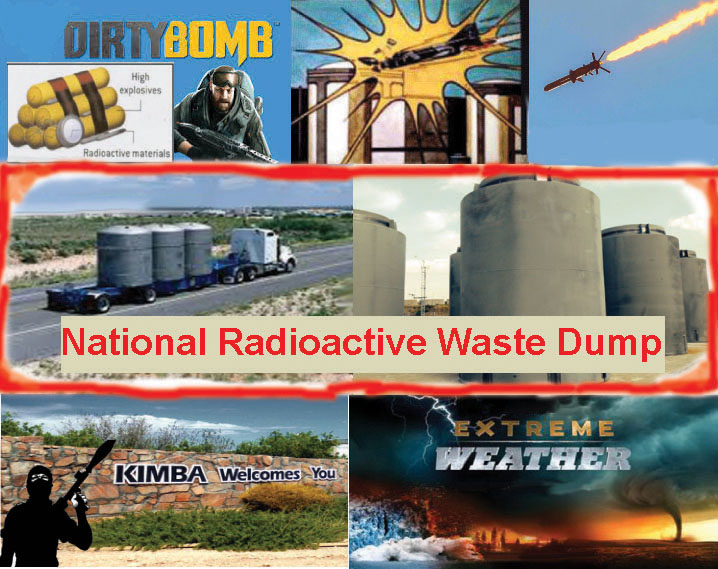
Scrap the plan for a national nuclear waste dump at Kimba, South Australia
 Facility should be scrapped, Eyre Tribune, AUSTEN EATTS, Kimba, 20 Feb 19,
My concerns are not with ANSTO, I appreciate and am aware of the work that is done there and its value.
I realise the need for the waste facility for Australia’s waste only.
If it is as safe as claimed why transport the waste half way across Australia to 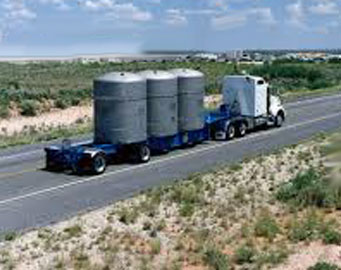 become the responsibility of the rural community also when we have so much arid and semi-arid land in Australia.
The site will be here for hundreds if not thousands of years the responsibility of future generations.
I went to the first meeting organised by Rowan Ramsey our federal member, he said it would be low level waste that would be deposited in the proposed site.
The next meeting there would also be stored on a temporary basis intermediate level waste for a time of approximately three or four decades and an offer of ten million dollars and 15 jobs.
Now it is $31 million plus two million dollars every year for at least two years, a total of $35 million, plus 45 jobs.
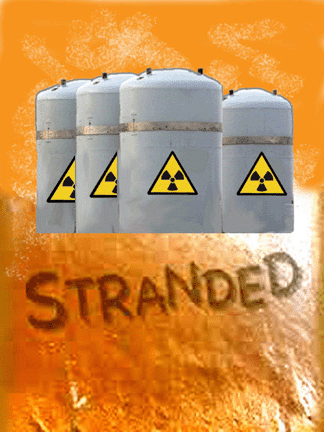 The storage time for the intermediate waste could be 100 years.
The cost to build the waste facility is estimated to be approximately $200 million.
The 100 hectares of land will become federal government property, our local government, state government and present federal government will have no control over its future use.
The money offered is a bribe to call it anything else is just playing with words.
Regarding the proposed voting, at present between 700 and 800 people in the Kimba district have the right to vote.
The population of South Australia is approximately 1.5 million people.
The voters in the Kimba district will make the decision as to whether not only Kimba or Eyre Peninsula but the whole of South Australia will have a radioactive waste facility whether they want it or not.
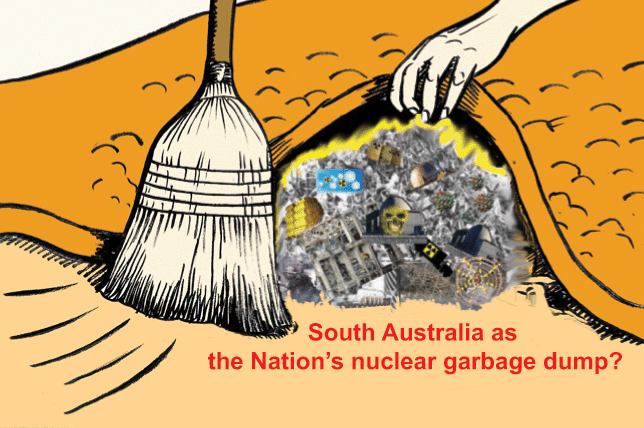
It is undemocratic, unfair, the whole proposition should be scrapped.
Eyre Peninsula is a unique part of South Australia, don’t spoil it with a radioactive waste facility.https://www.eyretribune.com.au/story/5914045/letters-to-the-editor/?fbclid=IwAR03Y5IJmNdL0bkVW3-l89eRaixcbcpRvJgXhE75rWcR0JVaP0f3uqfe8vs
Kimba and Hawker communities kept in the dark about the dangers of hosting nuclear wastes
Risk of terrorism at radioactive waste site kept secret from residents near earmarked sites, Jade Gailberger, Federal Political Reporter, The Advertiser February 24, 2019
https://www.adelaidenow.com.au/news/south-australia/risk-of-terrorism-at-radioactive-waste-site-kept-secret-from-residents-near-earmarked-sites/news-story/2d275aa3353d665011b9b4792b5dea17
The risk of terrorist activity at a radioactive waste site, including the removal of drums for use in a “dirty bomb”, has been kept secret from residents near two sites earmarked for a new national dump.
As the communities of Hawker and Kimba remain divided on the site selection for a new waste site, documents obtained under Freedom of Information laws reveal the Defence Department identified a potential risk of terrorist activity at a dump at Woomera.
The revelation has cemented the security concerns of residents, who say they have been ignored by Government officials.
The now closed Koolymilka dump, situated on Defence land at Woomera, was licensed for temporary radioactive waste storage but has not taken new material since 2010.
An emergency response plan for the site, which still houses waste that is anticipated to be transferred to a national facility, details scenarios that may affect it including:
-
- TERRORISTS removing drums to make a “dirty bomb”.
- MISSILE and aircraft strikes, fire, flood or a storm in Woomera that could damage the building and cause contamination if drums ruptured.
- CIVILIAN protest activity.
Defence has said it has no responsibility to inform the public of the risks because the new waste dump is an Industry Department project.
Kimba farmer Peter Woolford, who is opposed to radioactive waste storage on agricultural land, said security, terrorism and fire concerns at a national site had been raised but “fobbed off” by officials who claimed it “would be safe”.
“The (Industry) Department continually says it is going to be open and transparent but you have to obtain FOI documents to get the full story,” he said. “It’s an issue that the department should be … explaining.”
 Centre Alliance Senator Rex Patrick said communities had been denied information needed to make an informed decision about a dump in their region.
At a Senate estimates hearing last week, Mr Patrick asked if the Industry Department had briefed the communities about potential terrorism. Industry Minister Matt Canavan said: “I have never 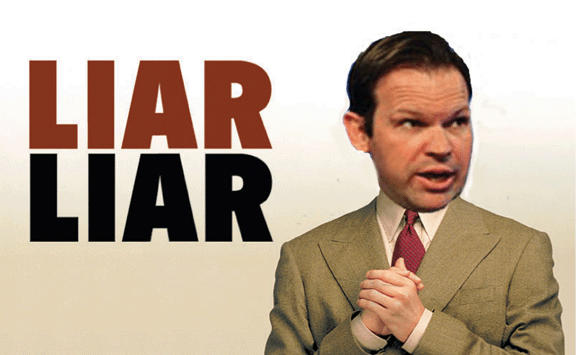 been provided with any advice that this is at all a risk … this has never been raised as an issue”.
The Industry Department said the new dump would pose “no security or safety risk to the community” and “significant detail” on safety and security had been made public.
The Australian Nuclear Science and Technology Organisation said 14 of 45 jobs at the new dump would be security.
Nuclear Shipment Truth Exposed
David Noonan 24 Feb 19, This shipment came in from France through Port Kembla to Lucas Heights. This was the first shipment ‘returned’ to Australia from previous ANSTO irradiated nuclear fuel waste shipments sent overseas for ‘reprocessing’ – to get it out of the country – while ANSTO continues to produce more… ANSTO have produced nuclear fuel waste for 60 years without a disposal capaciity, and intend to continue to do so for multiple decades to come, while targeting ‘indefinate’ above ground storage (said to be for up to 100 years) on communities in SA…
Scotland’s Ministers have the power to stop export of nuclear wastes to planned dump in South Australia
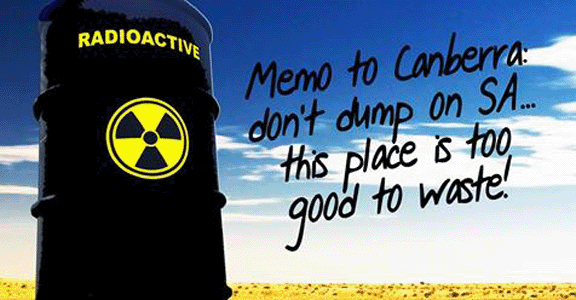 Scottish ministers can stop nuclear waste dump, say advisers, The Ferret, 19 Feb 19, Scottish ministers have the power to halt plans to dump nuclear waste on Aboriginal land in Australia which could breach human rights, according to government advisors.
Documents obtained by The Ferret reveal that expert advice sought by ministers stated that the Scottish Government could prevent the export of radioactive waste from the UK under a swap arrangement involving the Dounreay nuclear complex in Caithness.
The revelations have prompted campaigners to call for the Scottish Government to step in and stop the waste dumping, which they see as a potential desecration of sacred Aboriginal lands in south Australia.
The Scottish Government and its regulator, the Scottish Environment Protection Agency (Sepa), have insisted that regulating the waste shipment is not their responsibility – but Sepa’s former chief executive says this is wrong.
Nuclear fuel was sent from an Australian research reactor to Dounreay for reprocessing in the 1990s. The resulting radioactive waste, amounting to 51 cemented drums, was originally due to be returned to Australia for disposal.
But under the terms of a waste substitution deal in 2014, Scottish and UK governments agreed that the drums should stay at Dounreay because of the difficulties of transporting them around the globe……
Peter Roche, an anti-nuclear campaigner and member of Nuclear Waste Advisory Associates, pointed out that environmentalists were opposed to nuclear waste being transported around the world. “It should be stored in above
ground stores on the site where it is produced,” he said. “And should certainly not be sent back to Australia if it is likely to pose a potential risk to the rights of Aboriginal communities near the two proposed storage sites in Australia.” He added: “The Scottish Government should accept that it bears some responsibility for this waste and tell the UK government
to halt the proposed shipment.” https://theferret.scot/scottish-government-australian-nuclear-waste/
Earthquake sends tremor through Kimba’s proposed Nuclear Waste Dump Site
Today’s Cleve 3.1M Earthquake sends tremor through Kimba’s proposed Nuclear Waste Dump Site

Are there ANY members now on the Kimba radioactive dump community consultative committee?
 At 7th February 2019, all positions on the Kimba radioactive dump community consultative committee are vacant.
- Allan Suter (Convener)
- Dean Johnson (Deputy Convener)
- Symon Allen.
- Heather Baldock.
- Jeffrey Frank Baldock.
- Pat Beinke.
- Randall Cliff.
- Kellie Hunt.
Mental health issues in Kimba community divided by nuclear waste dump proposal
Nuclear waste site selection process triggers mental health concerns, business boycotts and division, FOI documents reveal https://www.abc.net.au/news/2019-02-13/foi-documents-show-kimba-divided-over-nuclear-waste-site/10807462 ABC North and West By Gary-Jon Lysaght (FOI documents are attached on the original) Freedom of Information (FOI) documents reveal the Federal Government has been aware of potential mental health issues, from as early as 2017, caused by the search for a site to store the nation’s nuclear waste.The Federal Government is currently considering two sites at Kimba and one near Hawker for a facility that would permanently store low-level waste and temporarily store medium-level waste.
Kimba, a small town on South Australia’s Eyre Peninsula, has been divided on whether to support or oppose the facility. Some residents believe the facility could help bring much-needed business to the rural town, while others suggest it could damage the region’s agricultural reputation.
“Many of the opposed group have raised the issue of mental health in submissions and direct discussions,” the FOI documents, written in 2017, said.
They believe mental health issues are arising in Kimba due to the stress of being in this process.
“These issues have been raised with the Kimba doctor and counsellor.”
Centre Alliance Senator Rex Patrick obtained the Freedom of Information documents and hoped the concerns were a catalyst for change.
“In my view, that creates a very strong obligation for the Government to act,” he said.
“They’ve clearly known about this issue since 2017 and it is now time to ask the minister exactly what he is doing in relation to that.”
Industry, Innovation and Science Minister, Matt Canavan, is responsible for determining which site should be chosen for the facility.
“If anyone in Kimba advises they have concerns about their health, they can be referred to the Kimba Mental Health and Wellbeing Group,” a department spokesman said. “Following a Community Benefit Program application, that group received funding of $30,000 for Healthy Mind Healthy Community workshops to improve resilience, mental health and wellbeing.”
Site selection process ongoing
The site selection process has been put on hold since traditional owners took the District Council of Kimba to court over a proposed community ballot on support for the facility.
The Barngarla Native Title Determination Aboriginal Corporation took the matter to the Federal Court because not all native title holders were included in the ballot.
A decision will be made on the court action this year, with Native Title holders claiming the ballot would breach the Racial Discrimination Act.
owever, an early technical assessment gave the Napandee property a score of 90, while Lyndhurst received 82.
“Both sites were ranked as ‘highly suitable’ by the initial desktop assessment,” the FOI documents said.
“This assessment involved a multi-criteria site assessment where the sites were evaluated against criteria of health, safety, security, environment protection, equity, economic viability, and stable environment.
“On balance, it is recommended that if there is a decision to proceed, both sites should be taken forward.
“If only one site is taken forward, it is recommended to be Napandee.”
This is despite a consultation in 2016, mentioned in the documents, found “that the Lyndhurst site was preferred by the community”.
“Given the perception it is ‘further out of town’ and on less productive land, but there is no strong basis for this assessment.”
Community divided
The documents also revealed that the Federal Government was aware of the “strong division” within Kimba that the site selection process was causing.
“It is unlikely community views will change significantly in the short to medium term, with a block of around 40 per cent persistently strongly opposed,” the documents said. “There is strong division in the town and this is expected to continue and may become more vocal in the short term.”
Jeff Baldock owns Napandee, the site indicated to be preferred by the Federal Government in the FOI documents.
“It’s been a very long process,” he said.
“When it first started out, there was probably a few things that could have been done better.
“But as it’s gone along, everyone’s had plenty of opportunity to find out what they want to know.”
Mr Baldock said there had been “vague references” to mental health concerns. (Below: Jeff Baldock and family)
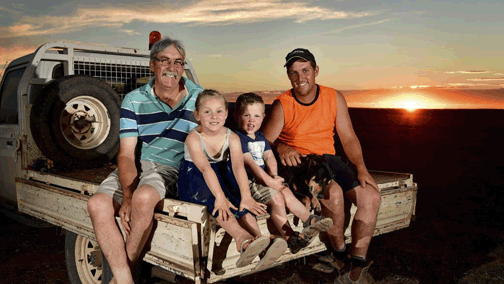
“But I’ve never actually spoken to anyone who feels particularly that way and I know that the department did have an open offer that they could contact them.”
Peter Woolford is Chair of No Radioactive Waste on Agricultural Land in Kimba or South Australia, an organisation against the facility.
He said there was no doubt that the site selection process had caused mental health concerns within the community.
“We’ve lost people from our community because of it,” he said.
“People I speak to are reluctant to go into Kimba much these days.
“It’s disappointing to say the least that if you went up the street and tried to have a conversation about the nuclear waste facility from people from opposite sides, you wouldn’t get much of a conversation.”
Boycotting businesses
Another section of the documents found there had been some cases of businesses being boycotted by locals if the owner either supported or opposed the facility.
“Business owners have noted that boycotting of businesses by the opposed group is occurring,” the documents said.
“While these claims may be exaggerated, this would appear valid and detrimental to the town.”
The ABC has also been told that those opposed to the facility were boycotting businesses that supported it.
It has also been told that up to 90 per cent of businesses at Kimba supported the facility.
Senator Patrick was concerned about the impact boycotting businesses could have on a town like Kimba.
“Kimba is a very small township and the last thing you want to have is animosity developing across members of the community,” he said.
“To the point where they simply won’t go and shop in a particular shop because of someone’s view on this issue.”
Contrary to what ANSTO says, nuclear waste returning to Australia IS High Level Waste (HLW)
Gary See Fight To Stop Nuclear Waste Dump In Flinders Ranges SA https://www.facebook.com/groups/344452605899556/,
Scotland’s Environment Protection Agency (SEPA) clearly state that it considers radioactive waste generated at Sellafield in England, and heading to Australia, to be vitrified High Level waste, despite what ANSTO call it. https://www.gov.scot/…/0038…/00389151-pdf/govscot%3Adocument
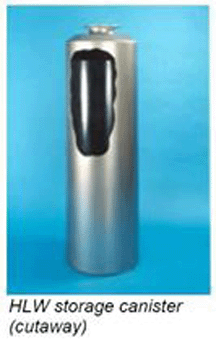 Steve Dale To think politicians and the nuclear people here got together to deliberately deceive the Australian public – to call what other countries calls “High Level Waste” something else. It’s the same toxic, corrupt thinking that brought us Maralinga. At left is a picture of High Level Waste from a UK document – looks (and is) the same as the stuff they have at Lucas Heights (same link)
from here:
https://webarchive.nationalarchives.gov.uk/…/radwaste.pdf
Kimba District Council excluded Bangarla Aboriginal people from vote on nuclear waste dump site proposal
 Traditional owners left out of dump vote https://www.eyretribune.com.au/story/5878759/traditional-owners-left-out-of-dump-vote/?cs=9397, Kathryn Bermingham , 30 Jan 19, A South Australian council did not consider native title holders when deciding who should vote on a proposed nuclear waste dump, a court has heard.
Kimba District Council chief executive officer Deborah Larwood gave evidence at a Federal Court hearing between the council and the Barngarla Determination Aboriginal Corporation on Wednesday.
She said there was never any discussion about including traditional owners in the poll until after that decision was made, when the council received a letter from the Barngarla people.
“There was a lot of issues that would arise if the Barngarla Determination Aboriginal Corporation went outside of the guidelines to be allowed to vote,” she said. “It (would have) then opened up: should we be letting all other owners who are non-ratepayers have a vote?”
Two sites near Kimba, on the Eyre Peninsula, have been short-listed as potential locations for a low-level radioactive waste storage facility, while a third is near the Flinders Ranges town of Hawker.
The Kimba vote was stalled last year after the Barngarla people won an injunction in the South Australian Supreme Court, where the case was then referred to the Australian Human Rights Commission.
Lawyer Dan O’Gorman, for the Barngarla people, again argued on Wednesday the ballot was in contravention of the Racial Discrimination Act.
He said the breach occurred because the council chose to use the eligibility guidelines established under the Act – it was not compelled to do so.
Also called to give evidence on Wednesday was Bruce Wilson, principal advisor to the National Radioactive Waste Management Taskforce.
Mr Wilson said the ballot was a “tried method that had community understanding and integrity” after a similar vote was conducted by the Australian Electoral Commission on behalf of the council in 2017.
“That process was run, that worked well… it was agreed by ourselves and the council that they would use that method in the second ballot for that reason,” he said.
Courageous indigenous appeal to Scotland to stop sending nuclear waste – stop indigenous cultural genocide
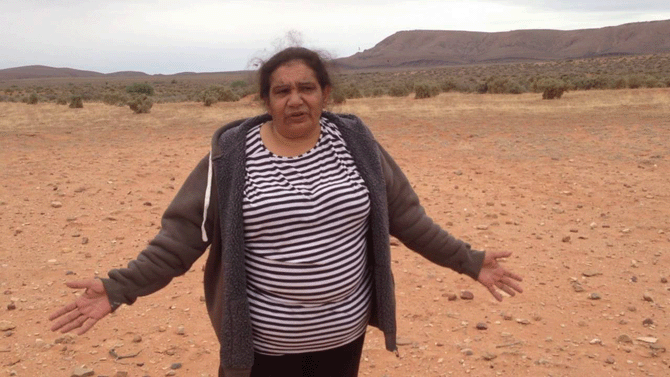 Last ditch aborigine appeal to Scotland to stop nuclear waste transfers to Australia, https://www.heraldscotland.com/news/17391290.last-ditch-aborigine-appeal-to-scotland-to-stop-nuclear-waste-transfers-to-australia/?ref=fbshr&fbclid=IwAR3r2Lqdv0V66rc7I8PrKJme4mkAsIx2Wtd5bv-Vy_XeT1i3GOgi_Mr By Martin Williams @MWilliamsHT 29 Jan 19, SOME of the Aborigines who live in and around a sacred burial place in South Australia can still remember the clouds of poison that were the result of Britain’s nuclear bomb tests in the 1950s.
About nuclear wastes: Ignorance, incompetence and hypocrisy of Dan van Holst Pellekaan, South Australian Minister for Energy and Resources

Meetings with Minister Pellekaan and the DIIS, Anti-Nuclear Coalition of South Australia,  January 2019
Report back from ANC members’ meetings with SA Minister for Energy and Resources, Dan van Holst Pellekaan, on Nov. 14, and with two bureaucrats from the DIIS (Department of Industry, Innovation & Science).
This second meeting was held in Adelaide at the Department of Industry, Innovation & Science (DIIS) offices on November 28. Ms Sam Shard the GM for the NRWMFT (National Radioactive Waste Management Taskforce) fielded all questions, and Wendy (no one heard her surname), Head of Policy, who only spoke once throughout the hour-long meeting. Requests for meetings with federal Minister Canavan (delegated to his department’s officials) and his SA counterpart, Minister Pellekaan, were made several months ago, and both only came about as a result of persistent efforts.
In this summary, the NRWMF (National Radioactive Waste Management Facility)=the dump.
Pellekaan Meeting: In his initial response to the ANC’s request to meet – first declined – Pellekaan outlined his government’s support for a national dump, “in one central, secure location” for LLW (low level waste) the justification being that such waste resulted from “life-saving medical procedures and research”. Notably, he omitted any reference to the planned ‘temporary’ storage of ILW (intermediate level waste).
(Last year on talkback radio, then, Premier Weatherill, similarly, omitted any mention of co-location of the very long-lived ILW at a national dump.)
Pellekaan and his leader’s support for a national dump (“one dump is better than many”) are predicated entirely on there being a willing host community. He wouldn’t, “refuse a dump to a community that gave its broad support”.
During the half-hour (only) meeting the emphasis from five ANC participants was on his omission to mention the co-location of the ILW (he did say that he had talked about it on radio). Also, on the significance of a radioactive dump for all South Australians, not only the two small communities targeted for a dump. On the latter point, Pellekaan argued that, if the wider community were to prevent a willing local community from hosting a dump it would disenfranchise local people(!) It was pointed out to him that it is South Australians, in general, who are being disenfranchised by the federal government’s strategy.
Regarding the ILW, Pellekaan was not overly concerned about the temporary storage, considering it would be just as safe at a rural SA location as at Lucas Heights, saying, “It has to be stored somewhere”.
Other questions and comments were about the classification of radioactive waste; the regulator’s (ARPANSA) licensing arrangements, about which he said that he was, “not across the detail”; the longevity of the ILW and the implications of the SA Nuclear Waste (Prohibition) Act.
He downplayed any special role he might have as either the responsible SA Minister or as the Member for Sturt, the electorate in which a national dump could well be located, emphasising that it would not be his decision, but a cabinet decision.
Regarding the South Australian legislation, he considers that at least, in part, it would have to be altered to allow the dump. This was not seen in any way as a hindrance because legislation can be enacted and repealed, if the parliament wishes.
In summary, Pellekaan follows faithfully the federal government’s arguments for the dump. His apparent lack of knowledge about High Level Waste (HLW) and Intermediate Level Waste (ILW); the length of time the ILW could remain stored above ground at the ‘interim’ site; the lack of any permanent plans for its disposal, or facilities and technical expertise for dealing with radioactive hazards at an interim dump is deeply troubling and unacceptable.
Note: Ally apologises for inaccurately stating in the prepared questions to put to Pellekaan that the ARPANSA licencing arrangement for the temporary storage of ILW at Lucas Heights is conditional on it being transferred to a permanent site. This is not the case. However, what it does say is, “The NRWMF will cater for the long-term above ground storage (approximately 100 years) of Intermediate Level Waste including the waste processed in France and the United Kingdom.”https://www.arpansa.gov.au/sites/g/files/net3086/f/legacy/pubs/comment/iws/IWSO-LA-WCP-WasteContingencyPlan_ Final_ARPANSA.pdf
Department of Industry Innovation and Science (DIIS) Meeting: Four people from ANC met with two departmental bureaucrats (see above) for an hour – not a minute more. Unfortunately, no full set of notes was taken. This report is based on notes taken by Mnem Giles, Colin Mitchell and Ally Fricker. Getting into the commonwealth offices in Franklin St was farcical with security having difficulty establishing who qualified as bone fide visitors, and negotiating with a boss up on the thirteenth floor to allow a fourth person to attend. Another five people remained on the street with placards and leaflets. A press release was sent out. The main entrance door was locked and only unlocked after we departed the building.
Mnem presented Sam Chard with a submission to the Senate Standing Committee from WILPF as requested by Ruth Russell. It was explained who WILPF is.
NOTE: Sam Chard’s comments are not always direct quotes. They are highlighted in red to make it clearer when it is her comments.
Sam Chard was the only person who responded to our questions. We established very quickly that we had not come to hear the government’s PR; that we were quite familiar with it. Head of Policy Wendy … commented only once saying that a permanent national dump for the intermediate waste would require two decades to plan.
The questions and comments attached were largely followed. We emphasised our request for the DIIS to hold a public meeting in Adelaide to inform politicians, media and public (who remain very confused) about the full plans for the national dump.
Response: The state is aware of the details and all the information is on-line.
It was also stressed that a national radioactive waste dump is an issue of national significance, not only an issue for locally targeted communities. (There is little likelihood that an Adelaide meeting would occur without follow up with a formal letter from the ANC and persistent demands to DIIS, the Minister and other relevant agencies.)
Chard agreed that a national dump was an issue of national significance because 1 in 2 people in Australia need nuclear medicine.
Other Issues Raised: 1. The lack of transparency at the Barndioota Consultative Committee meeting held at Quorn on the previous day (Nov 27) NO observers were allowed to attend, even after several had signed the usual request to sign confidentiality statements!
Response: This is entirely at the Chairman’s discretion and to allow free and frank discussion. The reason for the cancellation of the Kimba meeting (due on Nov 28) was because of it being “harvest time”, not because of the Barngarla legal challenge, as people inside the committee meeting at Quorn were told.
- Disposal of DoD (Department of Defence) waste.
Response: it is not wanted at Woomera for “operational reasons”, which would be classified. Re the quantity and location of DoD waste, the document, Australian Radioactive Waste Framework April 2018, was distributed to everyone, and referred to throughout the meeting, but this document fails to give any detail about what activities created the waste in the first place. Chard took on notice further questions relating to DOD waste stored at Woomera.
- Illegality of a national dump in SA: Response – Once land is acquired by the commonwealth, the federal Act (2012) would override the SA Act prohibiting a nuclear dump. Note this differs from Pellekaan’s response.
- Still after decades of planning, there remains no full inventory of waste intended for a national dump.
Response: A new ARPANSA document is now available which discusses the possible acceptance criteria for a national dump, but no further information, apart from the Framework document available (at the meeting). The first phase of acceptance criteria is available on the web.
- DIIS document titled,National Radioactive Waste Management Facility. Lucas Heights Sydney 2017 says, about long-term disposal of waste at Lucas Heights, “ . . .it’s not allowed. ANSTO’s Lucas Heights campus is only licenced . . . to store waste on a temporary basis, and on the condition that a plan is developed by the end of the decade for final disposal pathway for its waste.” (Our emphasis) It was pointed out that this was unambiguous. Response: There was no elaboration. ARPANSA document,Information to Stakeholders (May 2017) notes that temporary storage of ILW at a national dump ‘could be in excess of 100 years.’
Response: this is not correct. We responded in which case, ARPANSA should be corrected. Response: 100 years refers to the LLW only. ILW would only remain at an interim location for a couple of decades, or up to 30 years, or up to 40 years – 40 years is, conveniently, the approximate lifetime of the TN81 steel containers in which the reprocessed spent fuel is packaged.
- What facilities would be available at a temporary dump for re-packaging the TN81 containers?
Response: Waste entering the dump would be checked, but there are no plans for re-packaging facilities. The waste would not be there for long enough to require them. There are also, as yet, no facilities at Woomera for re-packaging any of the CSIRO waste currently stored there that might require
- These would need to be established.
- Co-location of LLW and ILW in other countries:
Response – There are models overseas for this. Where is it occurring? Response – Would take on notice. It was pointed out that the LLW and ILW stored permanently at Aube, France was not the equivalent of the co-location planned in SA because French classification of ILW is not the same as Australia’s, and definitely does not include reprocessed spent fuel. Response – Don’t know the specifics of Frances’ arrangements.
- Storage of ILW at Lucas Heights: Response -It’s in a dedicated facility. It is only there on a temporary basis; it’s quite safe there. Storage at a national dump would be the same as at Lucas Heights.
- Difference between French and Australian classification of the returned reprocessed spent fuel:
Response – The French have now changed their reference to HLW and brought the classification into line with Australia’s requirements. France now agrees with Australian authorities.
- Future availability of reprocessing facilities in France and any alternative arrangements: Response – Would take on notice.
- Commercial in confidence re the business case for the expansion of medical radioisotope production at Lucas Heights: Response – the expansion is for the export business (therefore commercial?)
- Classification of spent fuel: Response –Spent fuel from a nuclear power reactor is HLW, but from a research reactor it is ILW – there is a significant difference between ILW and HLW. A request to explain the difference was taken on notice.
- Permanent disposal of ILW, no site, no plans and no technology on the horizon: Response: That entity not yet defined.
- Permanent disposal of waste, ‘too dangerous’ to leave at Lucas Heights: ALP Shadow Minister for Energy and Resources, Kim Carr, spoke to Susan Craig and said that this was the reason why waste had to be removed to another interim site. Response: DIIS could not comment on this.
Formal minutes taken by DIIS staff were requested and an undertaking to forward them to ANC was made. Mnem followed this up and was told the minutes were being ‘cleaned up’. Mnem said we would prefer them as they were recorded. As with minutes from the Minister Pellekaan meeting, we are still waiting . . .
Thanks to Mnem for persisting with the arrangements for this meeting with DIIS, and the people who waited outside, and to Kate who distributed many leaflets.
Both Liberal and Labor keep mum about South Australia nuclear waste issue
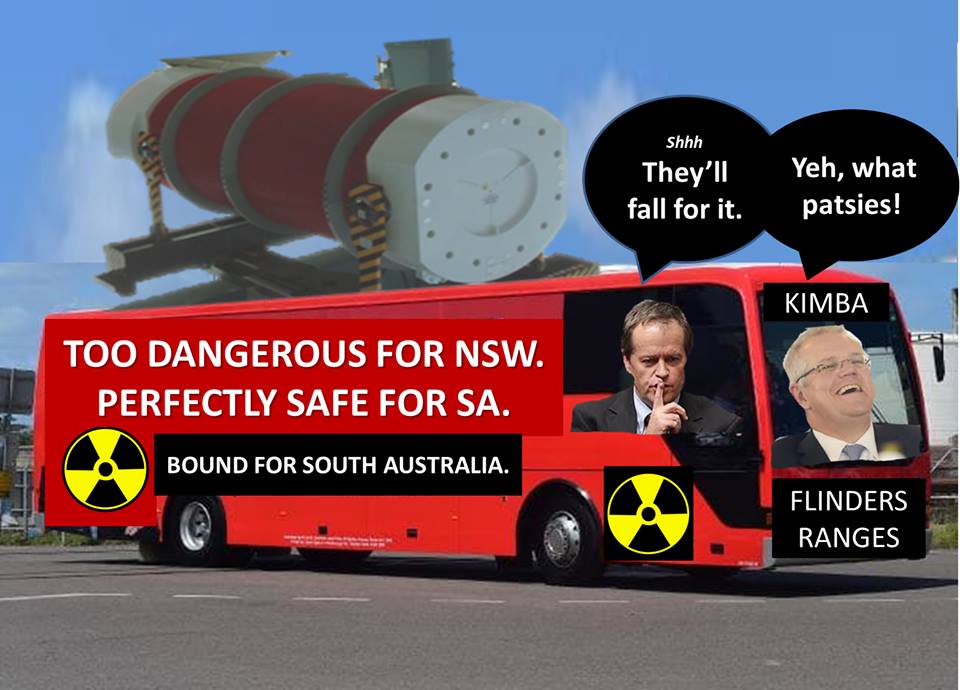
Susan Craig Fight To Stop Nuclear Waste Dump In Flinders Ranges SA, 18 Jan 19,
Federal Labor tell us the nuclear waste is TOO DANGEROUS for Lucas Heights, NSW, “we’ve got to get it out of there because it’s too dangerous to have it in densely populated metropolitan Sydney.
Federal Liberal tell us it’s PERFECTLY SAFE. It’s confounding that a post code can change the risk level of nuclear waste!
Both Scott and Bill are on the same bus. They refuse to make this an election issue. South Australians need to get on our own bus and demand that this issue be brought out into the open.
The current plan for a nuclear waste dump for South Australia is dangerous. Intermediate level nuclear waste is 100% fatal, after exposure life expectancy is around 4 – 6 weeks, it’s radioactive for 10,000 years and it will be stored above ground in a tin shed. It’s time for a cohesive, intelligent worlds best practice plan be developed to keep all Australian’s and our environment safe, now and into the future.
ANSTO nuclear waste will compromise safety and security in South Australia
ANSTO nuclear waste to compromise safety and security in SA, https://www.foe.org.au/ansto_nuclear_waste_to_compromise_safety_and_security_in_s a David Noonan, 17 Jan 19 The federal government intends shipments of irradiated nuclear fuel waste to be imposed through Whyalla or Port Pirie to go onto indefinite above-ground storage at a nuclear dump site at either Kimba or Hawker ‒ all of which is illegal under state law in South Australia.
Two shipments of reprocessed nuclear waste ‒ arising from the  reprocessing of fuel irradiated in research reactors operated by the Australian Nuclear Science and Technology Organisation (ANSTO) ‒ are intended in the first two years of nuclear store operations in SA. A shipment is due from Sellafield in UK in the early 2020s, and ANSTO plans a shipment of nuclear waste that was reprocessed in France then shipped to ANSTO’s Lucas Heights site (south of Sydney) in 2015.
 Some 100 B-Double truckloads of federal government Intermediate Level Wastes (ILW) ‒ predominantly ANSTO waste from Lucas Heights ‒ are also to be trucked into SA in the first four years of nuclear store operations in SA.
SA communities face decades of potential accident and terrorist risks and impacts from ongoing ANSTO nuclear waste transports, with all of the next 40 years of ANSTO reactor waste also to be shipped and trucked to SA for indefinite above-ground storage.
The federal nuclear regulator, the Australian Radiation Protection and Nuclear Safety Agency (ARPANSA), states that nuclear fuel wastes and other ILW require radiation shielding and require isolation from the environment for over 10,000 years. Yet the current plan is to store this waste in SA in a fancy shed for indefinite storage described as “interim” and as “long term above-ground storage (approximately 100 years)”.
After 60 years, ANSTO still has no nuclear waste disposal capacity, while ANSTO’s nuclear waste production is set to increase to more than double waste stockpiles over the next 40 years.

The government’s April 2018 ‘Australian Radioactive Waste Management Framework’1 reports total ILW at 1,770 cubic metres (m3), with 95% by volume arising as federal government wastes.
 The federal government plans to produce a further 1,960 m3 of ILW over next 40 years, with 95% (1,850 m3) arising from ANSTO’s reactor operations – all to be trucked into SA for indefinite above-ground storage at either Kimba or Hawker.
All of these federal government nuclear waste plans face serious obstacles and community opposition. They are illegal under state law in SA; are in breach of formal advice of the Nuclear Safety Committee to the federal regulator ARPANSA2; and do not represent International Best Practice.
The import, transport, storage and disposal of ANSTO nuclear fuel wastes were prohibited by the SA Liberal government in 2000; then in 2002‒03 the incoming SA Labor government extended the legislation to cover other radioactive wastes. Yet the federal Coalition government intends to override state law to impose nuclear wastes onto SA.
Advice provided to the CEO of ARPANSA by ARPANSA’s ‘Nuclear Safety Committee’ in Nov. 2013 states that:
“International best practice points to the need to have in place a policy and infrastructure for final management and ultimate disposal of waste before activities generating waste commence.”
“[T]he dual handling and transport process associated with interim storage does not represent international best practice”
“Dual handling also has implications for security.”
More recently, in Nov. 2016, the Nuclear Safety Committee advised the CEO of ARPANSA on the “ongoing requirement to clearly and effectively engage all stakeholders, including those along transport routes” and the Committee said that such engagement is “essential”.3
However, in an arrogant, flawed process, the federal government named port cities in SA as required ports to take shipments of nuclear waste in a report4 posted on the internet but failed to even inform the targeted communities and their local councils.
The story broke on Southern Cross TV on Aug. 6. The next day the ABC quoted Port Pirie’s Mayor saying Council was “blind-sided” by the federal government position to potentially require Port Pirie as a nuclear waste port. On Aug. 9 the story ran on p.1 of the Whyalla News, with the Whyalla Mayor saying Council won’t accept this.
Communities in Whyalla or Port Pirie ‒ and in Port Augusta which was named on a number of potential required nuclear waste transport routes ‒ face “complete shutdown” in transport of nuclear wastes through their cities but have been excluded from having a say by this federal government.
The federal Coalition government must stop this untenable nuclear waste threat to compromise safety and security in SA and accept extended storage of ANSTO nuclear fuel waste and ILW at Lucas Heights.
As the alternate federal government, the ALP is yet to say what they may do if elected in 2019.
More information: www.nuclear.foe.org.au/noonan
References:….
- www.radioactivewaste.gov.au/sites/prod.radioactivewaste/files/files/Australian%20Radioactive%20Waste%20Management%20Framework.pdf
- www.arpansa.gov.au/sites/default/files/legacy/pubs/nsc/nsc_iwsadvice.pdf
- www.arpansa.gov.au/sites/default/files/legacy/pubs/nsc/nrwmf-stakeholder-engagement.rtf
- https://prod-radioactivewaste.industry.slicedtech.com.au/sites/prod.radioactivewaste/files/60565376_NRWMF%20Site%20Characterisation%20Technical%20Report_Wallerberdina_20.07.2018_FINAL_Optimized.pdf
Published in Chain Reaction #134, December 2018. National magazine of Friends of the Earth Australia. www.foe.org.au/chain_reaction
Matt Canavan’s ‘urgent’ new nuclear waste dump: The devil is in the detail
|
Matt Canavan’s ‘urgent’ new nuclear waste dump: The devil is in the detail https://www.foe.org.au/canavans_nuclear_waste_dump – Dave Sweeney, December 18 It is a national problem that has taken 60 years to make and will last 10,000 years, but according to Canberra, it will be soon be sorted. Radioactive waste management has been a challenge for successive federal governments, with communities across South Australia and the Northern Territory consistently rejecting plans for the dumping and storage of wastes in their region. Now the pressure is right back on regional South Australia, with a concerted federal push to locate a site either near Kimba on the Eyre Peninsula, or Hawker in the iconic Flinders Ranges. The plan sounds straightforward: take radioactive waste from around Australia to a central site, where low-level material would be disposed of and higher-level wastes stored, pending a final management decision. But, as ever, the devil is in the detail. Or in this case, in the profound lack of detail. Despite two years of promotional newsletters, shopfronts and drop-in centres, and publicly funded visits from pro-nuclear advocates, there remains a disturbing lack of clarity and deep concerns over the federal government’s plan and process. Radioactive waste is a complex policy area. The stuff lasts a long time, poses a real management challenge and, understandably, raises community concerns. Responsible decisions are best based on the “T” factor: talk, time, testing and trust. Sadly, the current federal push has failed to learn from this history and is replicating a failed formula. Despite plenty of talk about the benefits of the plan, the federal Government has actively refused to debate critics in open forums, key project assumptions have never been independently verified or tested, and many community members, Aboriginal landowners and wider stakeholders do not trust the process. Time is now running out on Minister for Resources and Northern Australia Matt Canavan’s long stated plan to make a siting decision this year. This timeline won’t be met ‒ largely due to legal action initiated by the Barngarla Determination Aboriginal Corporation. The Barngarla Traditional Owners have sought legal redress over their exclusion from the community ballot planned to assess public opinion in the Kimba region, arguing that this breaches the Racial Discrimination Act. Despite this delay the Minister still hopes to push ahead with the plan before the 2019 federal election, expected in May. The federal Government has been spending big and promising large, with job and community benefit estimates and assurances soaring since the ballot was announced. The Government is working to localise this issue and present it as an economic opportunity for a small region, but this plan is a national issue with profound and lasting implications. Around 95 per cent of the material planned to be moved to any new facility is currently managed at two secured federal sites. Low-level waste that needs to be isolated for 300 years is currently at the Woomera defence lands in South Australia’s north. The more problematic intermediate level waste, that needs isolation for 10,000 years, is stored where it was made at the Australian Nuclear Science and Technology Organisation’s (ANSTO) Lucas Heights facility in southern Sydney. Both sites have the physical, technical and regulatory capacity to continue to store these wastes for many years, and the current sense of federal urgency and pressure is being driven by politics and ANSTO’s corporate preferences, rather than by evidence or need. The federal nuclear regulator the Australian Radiation and Nuclear Safety Agency has repeatedly confirmed that there is no urgency to move the waste from ANSTO. In any discussion around radioactive waste management, a lot of airspace is devoted to the question of nuclear medicine. No one disputes either the importance or the need for secure access to nuclear medicine. The planned national radioactive waste facility is not expected to receive nuclear medicine waste from any hospital or medical clinic in Australia. These wastes would continue to be managed at these multiple sites on the current “store and decay” basis. A national radioactive waste facility would take nuclear reactor waste from the process that generated the nuclear medicine, but not nuclear medical waste. Importantly, this means that a national waste facility is not required to ensure access to nuclear medicine. Currently, Australia’s most serious radioactive waste is stored above ground at ANSTO. This makes sense, as the waste is already on site and Lucas Heights also has clear tenure, high levels of security and policing, the most advanced radioactive monitoring and emergency response capacity in the country, and it is the workplace of around 1,200 people. The federal Government’s plan is to move this material from this facility to one in regional South Australia with far less capacity and institutional assets. There is no radiological protection rationale to move this material from extended above ground storage in Sydney to extended above ground storage with far fewer checks and balances in regional South Australia. The current federal approach to the intermediate level waste is not consistent with international best practice and is merely kicking the can further down a less travelled road. The current federal plan is a retreat from responsibility, which is playing short-term politics with a long-term hazard. It is extraordinary that, after over six decades of making waste and two decades of sustained and successful community resistance to federal siting plans, Australia has never had an objective review of management practises and options. We need this now. Dave Sweeney works on nuclear issues with the Australian Conservation Foundation and was a member of the Federal advisory panel on radioactive waste. You can follow him on Twitter @nukedavesweeney Published in Chain Reaction #134, December 2018. National magazine of Friends of the Earth Australia. www.foe.org.au/chain_reaction |
|
1 This month
To see nuclear-related stories in greater depth and intensity
– go to https://nuclearinformation.wordpress.com/


 Antinuclear