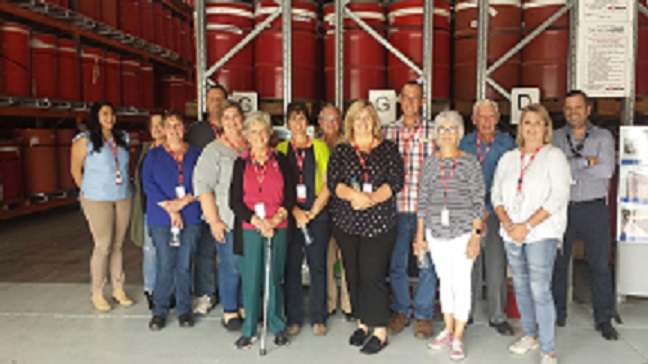
“Australia does not produce any high level waste.” [???] said Bruce McCleary, the General Manager of the National Radioactive Waste  Management Taskforce
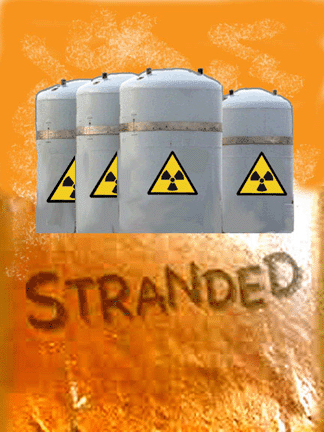
[He also did not mention that these wastes for Kimba will be temporary, i.e. STRANDED WASTES]
ANational Radioactive Waste Management Facility:
Kimba locals welcomed to Australia’s nuclear facility Eleven members of the Kimba community were on site at Lucas Heights yesterday, to see first-hand Australia’s nuclear technology and radioactive waste management expertise.
The delegation to the Australian Nuclear Science and Technology Organisation (ANSTO) included people with a variety of views on Kimba hosting the National Radioactive Waste Management Facility.
It included four neighbours of the two volunteered sites in Kimba, and three members of the Kimba Consultative Committee (KCC), as well as other interested community members.
Patricia Beinke saw the OPAL multi-purpose reactor, where ANSTO stores low and intermediate level radioactive waste, and how waste is prepared for transportation.
“It was a much bigger campus and complex than I had ever envisaged. I read all the information that comes my way, but wasn’t expecting this scale,” Mrs Beinke, who is a member of the KCC, said.
“I just found the trip so good. The scientists and engineers spoke on a level that everyone could understand.
“I saw the reactor, and we had a great discussion about how the waste is prepared for transportation, including the processes it would go through before being sent to a national facility.”
Austen Eatts has property that neighbours one of the volunteered sites, and is opposed to the facility, but was pleased to have seen ANSTO’s campus.
“I have always had a reasonable idea of what happens at ANSTO regarding medicine and industry, and what they are doing there is very good actually,” Mr Eatts said.
“The waste has to be put somewhere. I am still of two minds about whether it should be located in Kimba, but I found the trip very informative.”
Mr Eatts stressed that he is against the idea of a facility anywhere in Australia that could store high level, imported waste from overseas – a proposition not being put forward by the Federal Government.
Bruce McCleary is the General Manager of the National Radioactive Waste Management Taskforce, and said it was great to host people with a variety of views on trips such as this.
“Tours of ANSTO’s medicine manufacturing and radioactive waste facilities are a great information tool for communities considering if they want to host a radioactive waste industry,” Mr McCleary said.
“They are also a way of us establishing what questions the community still has, and for them to see and hear from experts who work with this material every day, first-hand.
“I can confirm for Mr Eatts – and anyone else who shares his concern – that the national facility will not hold international or high level waste, because it is for Australian waste only, and Australia does not produce any high level waste. [????]
“Our national facility needs 100-hectares for an above ground low-level waste disposal and temporary storage of intermediate-level waste, whereas an international high-level facility would need to be far larger and would require a deep underground facility in order to be safe and economically viable.”
For more project information: www.radioactivewaste.gov.au
March 7, 2018
Posted by Christina Macpherson |
Federal nuclear waste dump, South Australia |
Leave a comment
SOUTH AUSTRALIA: OUR FUTURE: SCORECARD , 5 March 2018
All of the four party responses are signed by the leader and are dated 28 Feb 2018.
Cory Bernardi’s Australian Conservatives
Note: The “Australian Conservatives” were invited to respond and did not provide any response.
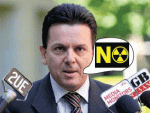 “SA Best is pleased to provide the following response to … :
11a Categorically rule out the creation of an international high and/or intermediate
level radioactive waste storage and disposal facility
Yes
11b Actively oppose the federal government plan for a radioactive waste facility in SA.
Refer to SA-BEST environment policy.
We do not oppose a low-level waste facility in principle, recognising the benefits of nuclear medicine and research and the need to dispose of this waste.
However, until such time as the federal government demonstrates full transparency around the consultation and selection process, SA-BEST would not be supportive.
We would use legislation in SA to block it if the process is not acceptable.
11c. Actively support the state Nuclear Waste Storage Facility (Prohibition) Act 2000.
Commit to further strengthen this legislation by removing the modified section
Question 11c on the High level nuclear waste..
We support and commit the current legislation as it now stands.
My understanding is the modifications have already been put in place.
Yours sincerely
Nick Xenophon
“The Liberal Party of SA makes the following commitments in response to…
11a Categorically rule out the creation of an international high and/or intermediate
level radioactive waste storage and disposal facility
Yes
11c. Actively support the state Nuclear Waste Storage Facility (Prohibition) Act 2000.
Commit to further strengthen this legislation by removing the modified section
Other: The Liuberal Party supports the current Nuclear Waste Storage Facility (Prohibition) Act 2000.
Yours Sincerely
Steven Marshall MP
State liberal Leader
 Note: The Liberal response (as published) does not provide an answer to Q 11b:
Actively oppose the federal government plan for a radioactive waste facility in SA.
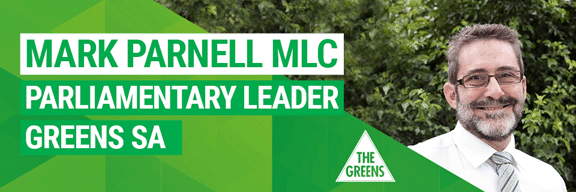
“The Greens have made the following commitments in response to … :
 11a Categorically rule out the creation of an international high and/or intermediate
level radioactive waste storage and disposal facility
Yes
11b Actively oppose the federal government plan for a radioactive waste facility in SA.
Yes
11c. Actively support the state Nuclear Waste Storage Facility (Prohibition) Act 2000.
Commit to further strengthen this legislation by removing the modified section
Yes. Done, Thanks to a Greens bill.
Yours sincerely
Mark Parnell MLC
Parliamentary Leader Greens SA
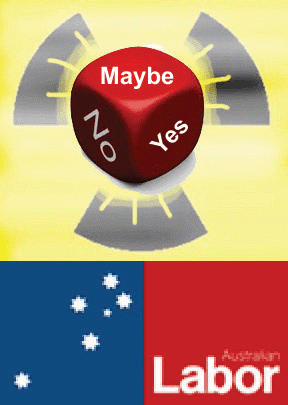
 Labor: “Thanks for opportunity to outline our position. A detailed response to your questions is attached:
see p.36 of doc, extract:
“We have written to Turnbull government outlining our strong expectation around community support for any proposed facility, including a veto for the local Aboriginal community. …”
Hon. Jay Weatherill MP
Premier of SA
Note: The Labor response (as published) does not provide an answer to Q 11a:
March 5, 2018
Posted by Christina Macpherson |
Federal nuclear waste dump, politics, South Australia |
Leave a comment
 Cameron Scott, Submission to ARPANSA on draft Code for Radioactive Waste, 4 Mar 18 It needs to be stated in the Code for Disposal of radioactive Waste that the Federal Government can not override state legislation for building a national facility. The code needs to include a clause protecting farming land from becoming home to hazardous waste. Licensing should require communities to nominate land not individuals.
March 5, 2018
Posted by Christina Macpherson |
Federal nuclear waste dump, South Australia |
Leave a comment
 Conservation Council SA Mara Bonacci, Nuclear Waste Campaigner, 1 Mar 18,
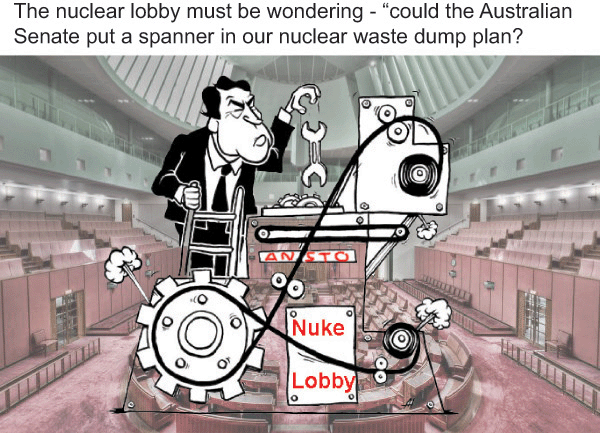
On 6 February 2018, the federal Senate referred an inquiry into the selection process for a national radioactive waste management facility in South Australia to the Senate Economics References Committee for inquiry and report by 14 August 2018.

This is welcome.
It is an important opportunity for you to have your say in Australia’s approach to radioactive waste management. The terms of reference can be found
here and information about writing a submission is
here. Submissions are due by 3rd April 2018. Please consider writing your own submission or alternatively, submit an online submission
here.
Some points to consider including are:
- A single individual or property owner should not be allowed to nominate a site for a nuclear waste dump.
- The federal government have not made a clear or compelling case that we need a national nuclear waste dump in SA.
- The consultation process has been deficient and has caused division in our communities.
- The federal government plan lacks social licence or community consent. Traditional Owners have flagged concerns over cultural heritage issues.
- The project has not considered the full range of options to best advance responsible radioactive waste management in Australia. Australia’s worst waste should be dealt with better.
It would be great to get as many submissions to the Senate Standing Committees on Economics as possible so collectively we can end this terrible process and get the federal government to finally take a responsible approach to radioactive waste management.
March 3, 2018
Posted by Christina Macpherson |
AUSTRALIA - NATIONAL, Federal nuclear waste dump |
Leave a comment
 https://www.greenpeace.org.au/news/Greenpeace-finds-nuclear-waste-headed-to-Australia-classified-as-high-level-waste-by-France/ 1 December,2015,
Nuclear waste returning to Australia this weekend by ship from France has been classified as high-level waste by French authorities, contradicting Australia’s claims over its radioactivity, a Greenpeace report has found.
Greenpeace’s investigation also found the waste still contains quantities of plutonium – highly toxic even in small quantities – despite reprocessing by French state-owned nuclear company, Areva.
“The Australian government is downplaying the danger of this shipment, saying it is intermediate-level waste that isn’t harmful unless mismanaged. But we know it contains plutonium and is classified as high-level waste by the French authorities,” said Emma Gibson, Greenpeace Australia Pacific’s Head of Programs.
“It’s clear on evidence the government is not being as straight as it can be about the nature of this shipment by insisting Australia only has intermediate-level waste. Australians have a right to know what is being stored in their backyard. The lack of transparency over this waste is highly problematic,” she said.
The nuclear waste was generated by the Australian Nuclear Science and Technology Organisation (ANSTO) and sent to France in 2001 to be reprocessed.
The French Nuclear Safety Authority (ASN) has revealed to Greenpeace that the waste has been classified as high-level (long-life) waste according to standards set by ANDRA, the French national radioactive waste management agency. High-level waste is ANDRA’s most severe nuclear waste classification.
Areva documents have also confirmed that the waste still contains low quantities of plutonium.
However ANSTO has classified the shipment as intermediate-level waste using an alternate classification system.
“The discrepancy is a significant concern as the French have much more experience of nuclear waste management than the Australians. We have written to Christopher Pyne, the Minister for Industry, Innovation and Science, asking him to clarify the exact nature of the waste,” said Ms Gibson.
She said the vessel carrying the waste – the BBC Shanghai – also has a worrying safety record and has been banned by a number of nations.
Official documents seen by Greenpeace show the BBC Shanghai has been detained by Australia, the United States and Spain in the past five years after failing safety inspections. The US has banned the ship from carrying government cargo, while 14 other nations have found deficiencies in the ship since 2002.
“The government is spending about $30 million to bring its nuclear waste back to Australia, but the management of this shipment has been a catalogue of mistakes and misinformation.
“American and Australian authorities have both detained this junkyard ship in the past two years after it failed inspections. While the US has banned it from carrying government cargo, the Australian government loaded it with tonnes of dangerous nuclear waste to transport around the world.
“The more you move radioactive waste around, the more you increase the likelihood of an accident which could spread radioactive contamination into the environment.
“The government is now saying Australia could be a nuclear waste dump for the rest of the world. Imagine the corners that could be cut when these dangerous shipments arrive regularly,” said Ms Gibson.
Endorsing Greenpeace’s report, Dr Helen Caldicott, veteran anti-nuclear advocate said:
“The fact France has classified this as high-level waste should send alarm bells ringing about what is actually coming back to Australia. The French have significantly more experience in handling nuclear waste than Australia does. That the two countries could have such different views on how dangerous this nuclear waste is should be a huge concern.
“There are enormously different safety regulations required for high-level nuclear waste compared with intermediate-level waste.
“Australia is conducting a dangerous radioactive exercise by transporting 10 tonnes of this high-level radioactive waste in a notoriously dangerous ship.”
The nuclear waste is due to be unloaded off the BBC Shanghai at Port Kembla in southern Sydney in the early hours of Sunday, 6 December. It will then be transported to Lucas Heights by road for interim storage.
March 2, 2018
Posted by Christina Macpherson |
AUSTRALIA - NATIONAL, Federal nuclear waste dump |
Leave a comment
 This submission was sent today – not yet published on ARPANSA’s site . To read all 24 submissions already published, go to the site https://www.arpansa.gov.au/code-disposal-solid-radioactive-waste-rps-c-3
OR to our new page Submissions on Radioactive Waste Code 2018
David J Noonan B.Sc., M.Env.St. Independent Environment Campaigner, 2 March 2018
Summary for ARPANSA Website:
David Noonan: To be credible, a finalised ARPANSA Code must mandate the best practice Principal of Non-Imposition of nuclear waste disposal facilities on community.
It is untenable for this Code to countenance Disposal Facility Siting in an area of special cultural heritage significance to Aboriginal people. Proposed NRWMF siting in the iconic Flinders Ranges must stop. A finalised ARPANSA Code must respect Aboriginal people’s rights and interests.
ARPANSA needs to recognise the Storage and Disposal of nuclear wastes affects the rights, interests and safety of all South Australians and is prohibited in our State under the Nuclear Waste Storage (Prohibition) Act 2000.
Any imposition of Disposal Facility Siting in SA will be strongly resisted by community across SA.
Please feel free to contact regarding this submission (contacts provided in e-mail cover note).
To: ARPANSA Public Consultation on the Code for Disposal of Solid Radioactive WasteRadiation Protection Series C-3, RHC Draft – December 2017 StakeholderComment@arpansa.gov.au
Re: D.Noonan public submission on Required Protection of Cultural Heritage from impact by Disposal Facility Site selection AND on the Principal of Non-Imposition of Disposal Facilities 2nd March 2018 Continue reading →
March 2, 2018
Posted by Christina Macpherson |
AUSTRALIA - NATIONAL, Federal nuclear waste dump |
Leave a comment
 The Brewarrina community is stepping up the campaign against a proposed national nuclear waste dump, with two successful events held over the weekend.
A silent protest was held at the local Council meeting on Friday the 23rd February, with over 20 local protestors attending. Ngemba man Jason Ford presented the No Nuclear Bundabunda on Ngemba Land – Bad Poison petition to the councillors. The petition had 563 clear ‘no’ votes compared to 84 residents who voted in a Council survey that Council should ‘continue with the project.’
Ngemba woman and campaign coordinator Trish Frail said, “We did not win gold, but we won silver and we are happy with that at this stage of the campaign. No further action can be taken by Council until a Working Group is established and the many questions we put to them are answered.”
“We want to know the motivation and funding behind the delegation to Lucas Heights last November and details of the consultation arrangement for nuclear advocate Robert Parker. There is clearly no mandate for the Council to just push ahead and keep promoting the nuclear waste dump,” Ms Frail stated.
The ‘Keep Bre Nuclear Free’ rally the following day mobilised over 100 people, with young people proudly leading the march and chanting ‘No Bundabunda on Ngemba Land’ and ‘Keep Bre Nuclear Free’.
Many Elders also came out to support the campaign.
Aunty Doreen said, “As a Ngemba Elder and a custodian of the land it is important that I support the younger generation in preventing this atrocity from happening on our land, which came from the Dreaming. We struggle with the atrocities that have happened in the past; our future generations should not have to struggle with this danger.”
“It is nuclear genocide. The cotton industry has wrecked our water ways, we can’t let the nuclear industry wreck our land, water and environment,” Aunty Doreen concluded.
Supporters from Melbourne and Canberra travelled to participate in the rally, with messages of support sent from other areas currently under assessment to host the national nuclear dump.

February 28, 2018
Posted by Christina Macpherson |
Federal nuclear waste dump, New South Wales, Opposition to nuclear |
Leave a comment
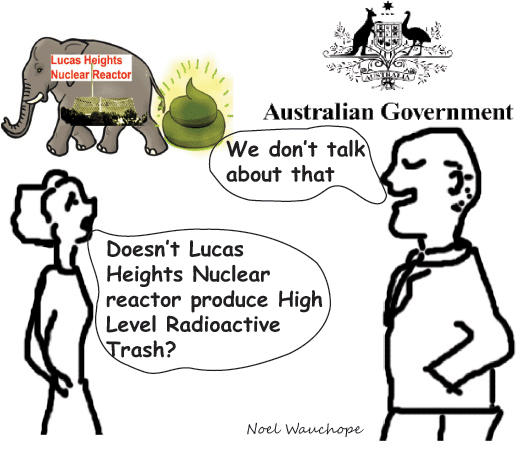
Paul Waldon Fight To Stop Nuclear Waste Dump In Flinders Ranges 26 Feb 18, SA We the people of South Australia, and the people of ANSTO, ARPANSA, and the DIIS, all have one common denominator, and that is “We don’t want nuclear waste in our backyards.”
Australia agreed to keep the waste as close as possible to the point of production, the day the Basel Convention was signed. However the DIIS are trying to sell this waste to all South Australians using our tax money, but can the SA taxpayer entice the residents of Barden Ridge to keep the waste by offering a few extra dollars. Yes, this is the deadly radioactive waste that they declared they were more than happy to reside alongside of when they purchased, built, moved into, or worked near Lucas heights. more https://www.facebook.com/groups/344452605899556/
February 26, 2018
Posted by Christina Macpherson |
AUSTRALIA - NATIONAL, Federal nuclear waste dump |
Leave a comment
 Submission 1 to Code for Disposal of Solid Radioactive Waste (RPS C-3) By Noel Wauchope, 24 Feb 18
Regarding the type of radioactive wastes discussed
The big change in this Code is that it now applies to all types of disposal facility – meaning that higher level nuclear wastes are planned for. The draft Code states on page 9:
– “Australia has no high level waste (HLW) and is unlikely to possess any in the foreseeable 108 future”
But the plan is obviously to include reprocessed nuclear wastes returned to Lucas Heights, from France, where they are classified as High Level Wastes, not Intermediate Level Wastes (ILW) The vitrified waste we received back from France has a radioactivity over one Billion Becquerels per gram (one GigaBq/gr). France considers this High Level Waste http://inventaire.andra.fr/…/2006_summar…/files/docs/all.pdf
Many people are aware of the approx 10 cubic metres reprocessed spent fuel classed as ILW & returned from France in 2015. Not more generally known is the fact that there is much much more ILW destined for ‘temporary storage’ above ground (contrary to IAEA best practice) in the proposed repository
Currently there is no official determination about what is actually to be accumulated there – hence the delay in remediating the leaking drums at Woomera and failure to properly inform the local communities, also thereby wrongfully expecting them to sign off on an unknown quality/quantity.
Regarding the containers for transport and interim storage of radioactove wastes
CASKS. No detail is given in the draft Code, which calls for
“appropriate selection of waste forms and packaging”.
There are problems both in transport and in storage above ground for hundreds of years
For example – accidents, includng fires. The Mont Blac Tunnel was one fire in 1999 that had temperatures of 1000 degrees celsius, while dry cask tests only reach 760 degrees for no more than 20 minutes http://www.mace.manchester.ac.uk/…/Infrastructural…/mont.htm
There is no detail on the containers for radioactive waste. This is becoming an issue overseas. The Swedish Environmental Court has ruled against their planned radioactive waste repository because of concerns about the copper canisters planned. http://www.dianuke.org/landmark-swedish-court-judgment-nuc…/
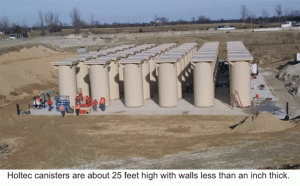
USA’s The Nuclear Regulatory Commission (NRC) allows U.S. nuclear plants to store or transport spent fuel waste in thin walled welded stainless steel canisters designed to withstand a crash at 30 miles per hour https://www.newtimesslo.com/…/a-pact-with-the-devil/Content…
Britain has similar concerns. https://cumbriatrust.wordpress.com/…/swedens-problem-is-al…/ February 21, 2018by cumbriatrust
Regarding the transport and interim storage of radioactive wastes
TRANSPORT. In all its 65 pages has just the bare 2 lines, which refer the reader to another document. The dangers in transporting nuclearwastes for over 2000 km across the continent are glossed over. But it is well known that such transport over very long distances is risky. Washington, D.C. Mayor Carolyn Goodman – “Anywhere it’s transported is at risk because of the tunnels, the bridges, the railroads, the roads,” she said. “An accident … puts millions and millions of people around the country at risk for loss of life, cancer and everything else.” , https://lasvegassun.com/…/in-dc-goodman-highlights-dangers…/
INTERIM STORAGE. This is a nice phrase for what is likely to turn out to be STRANDED WASTES. Page 43 of the draft Code – “Near surface disposal facilities are generally designed on the assumption that 1295 institutional control has to remain in force for a period of time. For short lived waste, 1296 the period will have to be several tens to hundreds of years following closure.”
This Code will approve and give the go-ahead for the plan to have this temporary above-ground storage set up BEFORE there is any building of a permanent deep disposal repository.
Regarding the discussion of COMMUNITY
COMMUNITY . Page 17 of the draft Code defines “Community” In this Code the term ‘community’ is used to define the level of spatial and social organisation at which the issue of demographics must be addressed by the license applicant in terms of ‘the impact of the facility on the community in which the facility is, or is to be situated’. In general usage ‘community’ refers to a geographical area defined for the purpose of consultation.”
The Code thus eliminates the interest of the broader community – in rural South Australia, in the State of Sout hAustralia, and in the whole country.
Even while considering just the immediate local community, the Code states, on page 23, that one criterion for the location is that it must be a site “which has little or no potential for agriculture or outdoor recreational use”. I wonder what the farming community in the Kimba area think of this?
February 24, 2018
Posted by Christina Macpherson |
AUSTRALIA - NATIONAL, Federal nuclear waste dump |
Leave a comment
AECOM (formerly known as AECOM Technology Corporation) is an American multinational engineering firm…AECOM traces its origins to Kentucky-based Ashland Oil & Refining Company,
 Successful Tenderer To Conduct Site Characterisation 2 February 2018
Successful tenderer to conduct site studies.
THE Department of Industry, Innovation and Science today announced AECOM is the successful tenderer to assess technical suitability of sites being considered for a National Radioactive Waste Management Facility.
The “site characterisation” works that they undertake under the contract will be conducted on all three of the nominated sites, currently being considered: two in Kimba and one at Wallerberdina Station……..
AECOM was the successful tenderer of five applicants, based on factors including its engineering and radioactive waste management experience, combined with specific experience operating in South Australia.
Radioactive waste is currently stored in more than 100 locations around Australia, and the Site Characterisation is part of Phase 2 of a process to establish a single, safe facility to consolidate the waste.
The facility will be the permanent repository for Australia’s low level radioactive waste, and it will also temporarily store our intermediate level radioactive waste………
“While these assessments are underway, our extensive community consultation will continue.
“Additionally, within the next week we will see the closing of applications for the Community Benefit Program for both communities, on Monday 5th February 2018.
“We have the right experts and the right staff in place to advance this project through various decision points this year,” McCleary said.
February 24, 2018
Posted by Christina Macpherson |
AUSTRALIA - NATIONAL, Federal nuclear waste dump |
Leave a comment
Kimba residents to be involved with nuclear economic investigation https://www.eyretribune.com.au/story/5241635/kimba-residents-to-be-involved-with-nuclear-economic-investigation/
Kimba residents have the chance to be directly involved in investigating economic opportunities and issues relating to the proposed National Radioactive Waste Management Facility.
As part of the Department of Industry, Innovation and Science’s ongoing consultation, an Economic Working Group (EWG) consisting of local community members will be established to consider the proposal.
The department is asking community members who want to get involved to submit an expression of interest.
Working group members will consider how economic benefits could be realised, or issues addressed, if Kimba is selected as the location for the national facility.
Opportunities that could come from the facility may include contracting works in construction, ongoing work during operation, and flow on roles in everything from the service industry to tourism.
Head of the National Radioactive Waste Management Facility Taskforce Bruce McCleary said the project had economic potential.
“This project has potential to generate significant local economic opportunities and this committee will give locals the chance to directly explore that,” he said.
“We know that local community members are best placed to highlight where there are local opportunities, and where more opportunities need to be created.
“Members of the Economic Working Group will work with the Kimba Consultative Committee and the department’s project team to discuss the ways the proposed facility could enhance the local community.
“The committee members will also be tasked with identifying any economic activities that could be impacted by the facility.”
The group will be based on the model already implemented in Barnidoota.
“I encourage all interested local community members – those for, against or undecided on the proposal, to put in an Expression of Interest in joining the Kimba Economic Working Group,” Mr McCleary said.
The Kimba Economic Working Group will consist of a maximum of 10 members, including a Chairperson.
Expressions of interest are now open and close at 5pm EDT on March 13 2018.
For more information on the selection criteria and how to apply to be a member of the Economic Working Group, go to www.radioactivewaste.gov.au.
February 24, 2018
Posted by Christina Macpherson |
AUSTRALIA - NATIONAL, Federal nuclear waste dump, South Australia |
Leave a comment
 Medical Association for the Prevention of War (MAPW), 23 Feb 18 REGARDING THE NATIONAL RADIOACTIVE WASTE MANAGEMENT FACILITY (NRWMF )
1) The process is very divisive. Repeated, highly damaging processes imposed on previously cohesive communities are causing significant harms.
2) Considerable amounts of persistently misleading information have been and continue to be presented to communities. Incorrect and incomplete information does not result in genuine consent.
3) There is a failure to observe international best practice standards for the highly radioactive long lived intermediate level waste (ILW) management. There is no disposal plan whatsoever for ILW, leaving the problem for many future generations.
REGARDING THE EXPANSION OF NUCLEAR MEDICINE PRODUCTION FOR EXPORT
1) There is a lack of demonstrable “Net benefit”. The proposed 40 year-long expansion of medical isotope production needs genuine cost/benefit analysis to make sure this is not a heavily subsidised product being sold into the global market at the expense of the Australian community both now and in the future. Independent NEA/OECD economic modelling finds only 10-15% cost recovery of isotope manufacture when there is genuine inclusion of all costs.
2) The expansion will create 40 years of significantly increased production of ILW.
3) ANSTO has a narrative of global shortages, yet given falling demand and increasing global supply there is no shortage of Mo99. The NEA/OECD predict a significant oversupply.
4) Again, there is no plan whatsoever for disposal of the additional ILW generated.
Both processes are unacceptably flawed.
Medical Association for the Prevention of War (MAPW) urges
* A halt to the current NRWMF process until such time as world’s best practice is followed. There is sufficient capacity at the Lucas Heights facility, once regulatory approvals are met, to store Low Level Waste (LLW) and Intermediate Level Waste (ILW) well into the next decade.
* Cessation of expansion of nuclear medicine for export, and a phase out of exports, until there is demonstrated, publicly available, clear analysis of cost/benefit and plans for appropriate disposal of the substantial amount of ILW this process will generate.
* Transparent evaluation of “net benefit” to the Australian community. This as a whole must underpin the process, and be based on cradle to grave impacts of production.
* Recognition that currently the information provided to communities is riddled with so much misinformation it calls into question the underlying validity of any community consent process.
In closing, it is clear there is an urgent need for an independent inquiry into the production and management of Australia’s nuclear waste.
February 23, 2018
Posted by Christina Macpherson |
AUSTRALIA - NATIONAL, Federal nuclear waste dump |
Leave a comment
 James & Cindy Shepherdson We feel very strongly that there should be no consideration at all of having any type of radioactive waste stored on agricultural land. ARPANSA also needs to take into consideration the social ramifications of any proposed site on any populated, productive land.
Janet Tiller Nuclear waste and food producing districts do not mix. I say no.
The whole process is flawed and one sided. The guidelines keep changing when the outcomes don’t suit what the government are seeking.
Tiffany Congdon I am 100% against this proposal and my mind will never change. This whole process has turned a once thriving, peaceful and friendly town into a town of fighting, taking sides and the friendliness has definitely gone. I was born and bred in Kimba and I loved the community but this whole dump idea and how the town has divided was not something I wanted for my family so a few months ago we moved and we are the happiest we have been in a long time. This has made such a damaging impact!!!
Colleen Guidera I am very much opposed to a Nuclear Waste Facility being built in the Kimba District or anywhere else in South Australia. Low level waste is hazardous for up to 300 years and Intermediate level waste is estimated to take tens of thousands years to decay. How can the Government guarantee it will be monitored? No amount of money or jobs is worth the stress and division in our community that the process so far has caused.
Graham Tiller BROAD community support. Set figure 70% and dont change it.
Completely transparent and fair process a must.Not the present pathetic process. Not to be on any agriculture aquaculture and horticulture areas of food producing land. Food and nuclear waste do not mix . Clean and Green
The yes / no vote should be the whole state not just one town.
Local vote to be 100km radius of nominated sites. Neighboring councils should be notified and have input .
Graham Tiller In the event of a nuclear waste dump incedent eg. fire flood earthquake leakage accident, all persons within a 500km radius of the dump must be fully compensated by the gov. for there loses until such time that contamination, health and livelihoods are restored.
GrahamTiller Continuous lies, change of guide lines, half truths proper gander misleading information have been a issue through the whole process period in kimba. And of course the 2 mill. bribe and the 10mill. bigger bribe . Not much for the destruction of a ounce perfect safe and prosperous community . Greed sums it up, it’s all about the money. https://www.arpansa.gov.au/code-disposal-solid-radioactive-waste-rps-c-3
February 21, 2018
Posted by Christina Macpherson |
AUSTRALIA - NATIONAL, Federal nuclear waste dump |
Leave a comment
No Nuclear Waste Dump Anywhere in South Australia, 20 Feb 18, Even if they were the to last not 4, 40, or world’s best practice type with the limited liability guarantee of a 100 years;
The canisters after any time period, create yet more nuclear waste, along with their toxic radioactive contents, that all have to be repackaged creating more nuclear material to be stored.
This process, of repackaging, whether it’s 4, 40, or a 100 years, goes on indefinitely.
To add another layer of complexity to this utterly illogical process, this waste grows exponentially over this indefinite timeline of essential care.
As nothing but steady decay into volatile, life-damaging radionuclides occurs, phasing from one type to the next. A process that literally is indefinite, unimaginable in human governance terms. Even ‘if’ no nuclear waste and unspent fuel are created by the nuclear cycle, of mining, milling, rod construction and the reactor outcomes, including decommissioning reactors.
February 21, 2018
Posted by Christina Macpherson |
AUSTRALIA - NATIONAL, Federal nuclear waste dump |
Leave a comment











 Antinuclear