The pretense that Lucas Heights nuclear spent fuel rods are an “asset”. No, they are wastes
Steve Dale Nuclear Fuel Cycle Watch South Australia If France and others stop reprocessing our spent nuclear reactor fuel, some organisations will no longer be able to call it “an asset”.
“‘The spent fuel rods at Lucas Heights can only sensibly be treated as high level waste. The pretence that spent fuel rods constitute an asset must stop” from the Research Reactor Review, Future Reactions: Report of the Research Reactor Review, 1993
To Feb 19 these are all the published comments on ARPANSA’s site about Code for Radioactive Wastes
Amy Koch I am from Kimba and I say NO!!
If there is no issue with this effecting our business then there is no reason that we can’t get a guaranteed from our industry representatives that our profitable farming business will not be effected by the proposed sight?
A clear indication of “Broad community support” is a must. Minister Canavan stated support of 65% was needed to go forward into phase two and yet he put kimba through with Only 57% there is a huge difference there. Clear guidelines needed!
Brett Burnard Stokes I denounce the covert administration of radioactive poisons to pregnant Australian women and their children.
I demand that production of radioactive poisons cease and that the perpetrators of these poisonings be brought to justice.
I challenge the perpetrators to actually measure the effects of their covert administration of radioactive poisons to pregnant Australian women and their children.
I denounce the current use of junk science to justify these covert poisonings.
Anonymous I am strongly against this and this whole process. It has made my Community divided, my family stressed and finally my decision to leave this town.
Anonymous ATLA Adnymathana Traditional Lands Association voted unamiously against the Radioactive Waste Dump proposal at Wallerbedina in the Flinders Ranges.ANSTO ignored the Media release by ATLA in 2016
Anonymous Particle accelerators are providing a cleaner (no highly radioactive, long lived waste) alternative to nuclear reactors for producing medical isotopes.Download PDF
Justine Major There is no mention of the impact of this facility upon existing industries when undertaking site selection. I feel there needs to be an inclusion of a clause (perhaps at 3.1.29 of the Code) along the lines of “sufficient evidence is provided that the cohabitation of this facility with existing industries will have minimal negative impact on existing industries”. This evidence needs to be relevant to Australia, not international equivalents.
Denise Carpenter ( member of the Barndioota Consultative Committee. This Committee’s role is to help determine which is the best site for a National Radioactive Waste Dump.) I am confident, after a lot or research on the subject, that ARPANSA is a regulatory body that will ensure that world best practice procedures will be stringently followed and adhered to and I am happy for a repository to go ahead in our area.
ARPANSA’s stringent regulations will ensure safety is paramount both for nuclear storage and the wellbeing of everyone working or living in the vicinity.
ARPANSA draft Code for Disposal of Solid Radioactive Waste – Comments deadline postponed to 2nd March
 This process is about determining the nature of the material to be dumped in the proposed x3 SAust radioactive suppositories.
Currently there is no official determination about what is actually to be accumulated there – hence the delay in remediating the leaking drums @ Woomera & failure to properly inform the local communities.
Also thereby wrongfully expecting them to sign off on an unknown quality/quantity.
ARPANSA is engaging in public consultation on the draft Code for Disposal of Solid Radioactive Waste (Radioactive Waste Disposal Code).
to – Senate Standing Committee -Stop nuclear waste threats in South Australia
 Stop nuclear waste threats in South Australia https://www.facebook.com/StopNuclearWasteThreatsInSouthAustralia/posts/398850867208130to – Senate Standing Committees on Economics
via email economics.sen@aph.gov.au
Subject – Selection process for a national radioactive waste management facility in South Australia
Terms of Reference addressed:
e) whether wider (Eyre Peninsular or state-wide) community views should be taken into consideration and, if so, how this is occurring or should be occurring;
======================================
Dear Committee Members
I am one of hundreds of South Australians who have signed the following Online Open Letter calling for police action against illegal threats to import nuclear waste and to establish nuclear waste dump(s).
Please take note of this community rejection of nuclear waste importation into South Australia.
Please take note of this community support for the laws which prohibit nuclear waste importation into South Australia.
Please cease this process which threatens present and future South Australians and shows contempt towards South Australian law.
Best wishes
from Brett Stokes
Dear Commissioner of Police,
We are citizens of Australia who want action taken to enforce the law, including the South Australian Nuclear Waste Storage Facility (Prohibition) Act 2000 (abbreviated herein as the NWSF(P) Act 2000).
We are sick and tired of being threatened with illegal importation of nuclear waste.
We are sick and tired of public money being spent illegally to plan and promote illegal importation of nuclear waste.
We want action now to stop current threats of illegal importation of nuclear waste. We want action now to deter future threats of illegal importation of nuclear waste.
It is clear that the NWSF(P) Act 2000 has been breached.
During 2015 and 2016, s13 has been breached by spending of public money on many promotional and planning aspects of illegal nuclear waste importation, as briefly described in Appendix A.
Since early 2016, there has been an open conspiracy to breach s8 and s9, with planning and promotion of importation and storage of nuclear waste into South Australia, as briefly described in Appendix B.
There are ten year imprisonment penalties and multi million dollar fines for offences – these are very serious penalties, in accord with the gravity of the threat.
As well as these offences against the NWSF(P) Act 2000, there are also other offences, including fraud, which may become more apparent as your investigation proceeds.
Please act now to enforce the law.
Please act now to end this illegal threat.
Please act now to “protect the health, safety and welfare of the people of South Australia and to protect the environment in which they live”. (Quote from s3 Objects of Act of the NWSF(P) Act 2000)
Thank you for your attention to this important matter.
Signed (Name and Postcode)
1 Tim Baker 5081 signed on 2016-11-24 at 20:30 (ACDT)
2 Brett Stokes 5118 signed on 2016-11-24 at 21:15 (ACDT)
3 John Mcgovern 5472 signed on 2016-11-24 at 22:35 (ACDT)
4 Zac Eagle 5159 signed on 2016-11-24 at 23:29 (ACDT)
5 James DeAth 5155 signed on 2016-11-25 at 00:13 (ACDT)
6 Paigen Hunter 5433 signed on 2016-11-25 at 01:04 (ACDT)
7 Daryl Gibson 2430 signed on 2016-11-25 at 06:19 (ACDT)
8 Greg Waldon 5481
signed on 2016-11-25 at 06:27 (ACDT)
9 Tanya Hunter 5000 signed on 2016-11-25 at 06:38 (ACDT)
10 Paul Levai 5433 signed on 2016-11-25 at 07:31 (ACDT)
11 Fernando M. Gonçalves 5022 signed on 2016-11-25 at 07:54 (ACDT)
12 Edi Carlos de Oliveira 5085 signed on 2016-11-25 at 08:06 (ACDT)
13 Patsy Laver 2573 signed on 2016-11-25 at 09:30 (ACDT)
14 Ty Haddrick 5230 signed on 2016-11-25 at 09:37 (ACDT)
15 Mark Wallman 5013 signed on 2016-11-25 at 10:38 (ACDT)
16 Louise McCauley 5166 signed on 2016-11-25 at 10:42 (ACDT)
17 Brett Derschow 6722 signed on 2016-11-25 at 11:08 (ACDT)
18 Paddy Tobin 2663 signed on 2016-11-25 at 11:11 (ACDT)
19 Susan Thiselton 5690 signed on 2016-11-25 at 11:20 (ACDT)
20 Letitia Kemister 2777 signed on 2016-11-25 at 11:21 (ACDT)
,,, continued ,,, >https://www.aph.gov.au/Parliamentary_Business/Committees/Senate/Economics/Wastemanagementfacility
Confusion about what types of nuclear waste are at Woomera, and planned for Kimba area
Steve Dale “The mixture of water and concentrated radioactive material inside some of the drums also had the potential to produce explosive hydrogen gas, inspectors found.” There is now great risk to workers having to deal with this stuff. The nuclear lobbyists and pronuclear politicians won’t be the ones putting their life span at risk cleaning this radioactive mess up.
Paul Waldon Fight To Stop Nuclear Waste Dump In Flinders Ranges SA It would be a grave risk to endure a banquet blindfolded, with a food allergy. Yet the promotion of a deadly radioactive waste dump which the DIIS has “failed” to defined the different qualities, grade, and product sources of radiation would be a fatuous advance. Thus, the risk is “Paramount.” https://www.facebook.com/groups/344452605899556/
Despite local opposition, Australian government still planning for nuclear waste dump in rural South Australia
 Planning is continuing for a nuclear waste disposal site in the South Australian outback, despite opposition from local residents. http://www.abc.net.au/news/2018-02-17/barndioota-nuclear-waste-site-planning-outrages-locals/9456052
 ABC North and West By Gary-Jon Lysaght 17 Feb 18 The Federal Government has shortlisted two sitesat Kimba on the Eyre Peninsula and one at Barndioota, south of Lake Torrens, near Hawker. The site that is chosen will become a permanent facility for low-level nuclear waste, and will temporarily hold intermediate-level waste.
The intermediate-level waste is currently being held at Lucas Heights, in Sydney’s south.
Barndioota is a gazetted area, and was a town between 1883 and 1929. Locals from Quorn and Hawker, the two communities closest to the Barndioota site, have been vocally opposing the site since planning began in 2015.
“We can see no reason why you’d bring stuff that’s temporarily stored somewhere else … to a completely new site that hasn’t even been built,” resident Greg Bannon said.
Mr Bannon is chairman of the Flinders Local Action Group, a community based organisation aimed at highlighting the problems with a nuclear waste storage facility in the Flinders Ranges.
He said the facility would have a significant impact on tourism, which was a chief economic driver for the Flinders Ranges.
“It’ll create a perception from tourists that they don’t want to go there,” Mr Bannon said.
“We think this facility is totally at odds with anything that’s promoted for the Flinders Ranges.”
Sacred women’s site in area The Adnyamathanha are the traditional owners of Barndioota, and have a sacred Aboriginal women’s site in the region. Enise March is the site’s custodian and said she had been astonished to hear the region was being considered for a nuclear waste disposal facility. “I received that message at 2 o’clock in the morning and I was shocked, extremely shocked,” she said.
“I felt as though I’d been hit in the back of the head with an axe.”
Region seismically active, ‘worst place’ for facility
The Barndioota site, and the entire Flinders Ranges, is considered seismically active.
Flinders University emeritus professor in geology Chris Vonderborch said because of this, it was the worst place to put a nuclear waste facility. “It seems to tick all the wrong boxes for a safe disposal site,” he said. “If you look at past earthquakes around Australia, they’ll line up and down the front of the Flinders Ranges. “It’s an area that can have earthquakes.”
Professor Vonderborch said if the facility was built, the nuclides from it could form a surface sediment on Lake Torrens. “Anything that goes in there comes to the surface, or gets washed in to the surface, and then it’s got a very good chance of blowing who knows where, towards Port Augusta or whatever,” he said.
What nuclear waste will be stored?
Low-level waste Emits radiation at levels that generally require minimal shielding during handling, transport and storage
Examples include paper, plastic, gloves, cloths and filters which contain small amounts of radioactivity
Could include items, such as test tubes, that have come into contact with nuclear medicine
Intermediate Waste Emits a higher level of radiation and requires additional shielding
Generated from radiopharmaceutical production and reactor operations
For example, steel rods that come from the reactors Source: ANSTO
So far, 4 pro nuclear Submissions to Senate Committee on nuclear waste dump selection.
M y advice to those writing submissions is to take your time, and do it properly.
I have skimmed through the 4 submissions already published, and they are pretty crummy, repetitive pro nuclear stuff – all emphasising that the writer thinks that the Federal Nuclear Waste Dump is really a matter for the local, not the wider, community
The writers are: Denise Carpenter, Ian Carpenter, Chelsea Haywood and Janice Alex McInnis
Nuclear waste dump? A new abuse for Brewarrina’s Aboriginal people?

Brewarrina, or “Bre” as it is known, is an historic and fascinating town on the Barwon-Darling River. New South Wales.With 68% of the local population identifying as indigenous it is essentially an Aboriginal town. ….
It is hard to underestimate the importance of the Aboriginal stone fish traps which, at 40,000 years old, may be the oldest man-made structures on the planet.
Brewarrina was the scene of a huge massacre of Aboriginals. “They rounded them up like cattle, old and young, on the Quantambone plain, and shot them. It is said that there were about 400 and that was how Hospital Creek got its name”
 No Nuclear Bundabunda at Brewarrina – bad poison [SIGN THE PETITION] https://www.thepetitionsite.com/513/682/502/no-nuclear-bundabunda-at-brewarrina-bad-poison/?taf_id=51207201&cid=fb_na#bbfb=750086702
If Nuclear waste was so safe why is it taken over 35years to find a site, why are they seeking to build in isolated communities with the majority off the population being Aboriginal?
Brewarrina is known worldwide for the oldest man-made structure in the world with Baiame’s Ngunnhu Fish Traps and we want to keep it that way, not to be known as a nuclear waste facility.
The local Council approached the Federal Government for this proposal without consultation with the community and without negotiation with the Local Land Council or the Ngemba Community Working Party or other local councils.
We believe the health of the community will be at risk. We are being promised 15 jobs, what is 15 jobs compared to the health of the community and the land and water.
There are other options available to boost the economy of the town such as solar power, tourism and the abattoirs.
No Nuclear Bundabunda at Brewarrina – bad poison
(please note; 7 out of 9 Councillors have supported this proposal)
The Greens will table our petition in Federal Parliament.
National Radioactive Waste Management Project is deceiving local communities
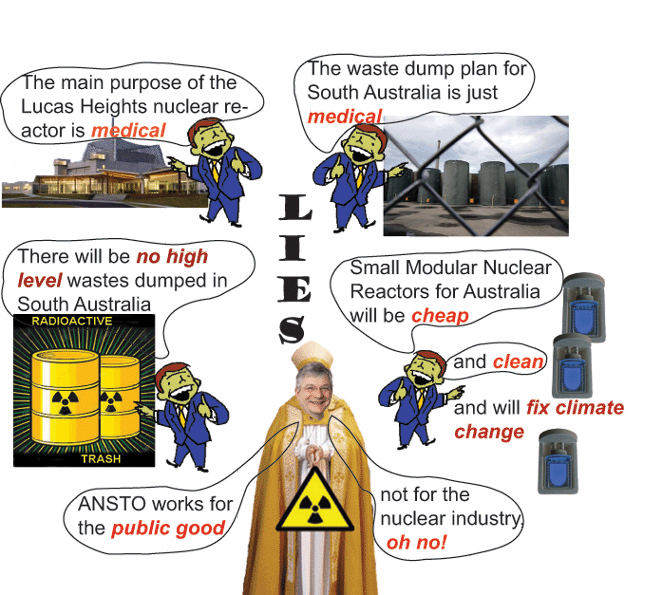
EnuFF[SA https://www.facebook.com/sanuclearfree/, 14 Feb 18, Many people are aware of the approx 10 cubic metres reprocessed spent fuel classed as ILW & returned from France in 2015. Not more generally known is the fact that there is much much more ILW destined for ‘temporary storage’ above ground (contrary to IAEA best practice) in the proposed suppository.
Trying to get current figures is nigh on impossible. If anyone has access to such then please share that knowledge with us….
One abject failure of the National Radioactive Waste Management Project to fully inform local communities, the State Parliament, or even their own Federal Minister, are facts about the so-called Intermediate Level Waste (ILW). Even those who are following the issue may only be aware of the approx 10 cubic metres of reprocessed fuel returned from France in 2015. However, there is much much more ILW. Below is an extract table of Australia’s ILW inventory from 1999 (now 2018 & there could be more):
Waste forms to be accepted at a long-lived intermediate level waste store
ANSTO Radioisotope Production solid waste
ANSTO-HIFAR spent fuel reprocessing waste COGEMA glass matrix DOUNREY cemented Yet to be returned
ANSTO-HIFAR decommissioning waste Care & maintenance
ANSTO-OPAL Operational waste Prior to OPAL start Spent fuel reprocessing Yet to eventuate Eventual decommissioning Yet to eventuate
Over 600 cubic metres of ILW initially placed in a ‘temporary’ above ground store & each year another 7 added with an open-ended time frame – could be for decades to come. 1 Primary source: “National Radioactive Waste Repository Site Selection Study – A Report on Public Comment”, Department of Industry, Science and Resources, June 1999, page 48 https://industry.gov.au/resource/Documents/radioactive_waste/report_on_public_comment_phase_3.pdf viewed 13/02/18
UK’s Cumbria Trust point to serious concerns about nuclear dump plans and “Working with communities”
 “Working with communities” – we have serious concerns https://cumbriatrust.wordpress.com/2018/02/14/working-with-communities-we-have-serious-concerns/ February 14, 2018
Kimba or Wallerberdina Station could be stuck with Stranded Radioactive Trash
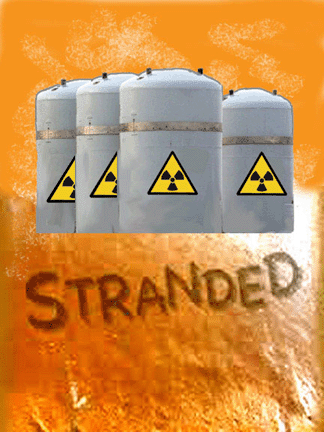 Noel Wauchope, https://cooberpedytimes.com/news-paper/ , 8 Feb 18 I am feeling quite uneasy about the over-confident tone of the latest statement about the National Radioactive Waste Management Facility.The General Manager of the National Radioactive Waste Management Taskforce Bruce McCleary says:
“We have the right experts and the right staff in place to advance this project through various decision points this year.”
Just who are these “right experts”, and what is their agenda?
We, the public, have been given to understand that this radioactive waste facility is all about promoting medicine, by storing “medical” wastes. Medical radioactive wastes are almost entirely are classified as “low level” – especially as, for the vast majority, their radioactive half-lives are so short – a matter of hours or a few days. It stands to reason that these wastes don’t need to be transported about 3200 Km across the continent.
Now we learn that the South Australian dump site will “temporarily store our intermediate level radioactive waste”. This sounds awfully like the reprocessed nuclear wastes that are returning to the Lucas Heights nuclear reactor site from France, and England. The vitrified waste we received back from France has a radioactivity over one Billion Becquerels per gram (one GigaBq/gr). France considers this High Level Waste http://inventaire.andra.fr/…/2006_summar…/files/docs/all.pdf
The fact that this facility, planned for Kimba or other sites in the region is to be stored “temporarily”, means that the plan is to send it to Kimba or Wallaerberdina Station BEFORE there is any plan for its permanent disposal.
Kimba or Wallerberdin a Station, or whoever is the “successful” applicant is likely to be stuck with that problem already hitting American communities – having “stranded n clear wastes”. This would be a very bad outcome for an area that has previously been known as agricultural, clean and green
April 3rd submissions close for Senate Inquiry into Selection for Nuclear Waste Dump Site
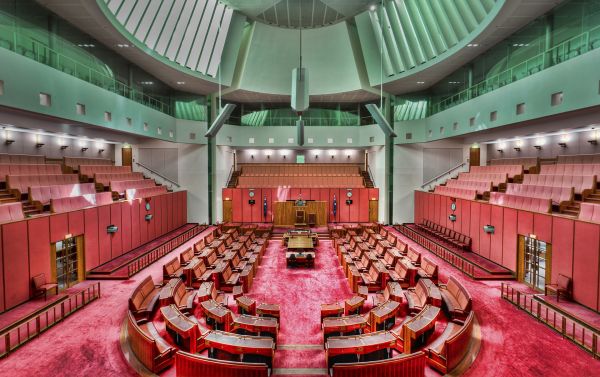

 Selection process for a national radioactive waste management facility in South Australia
https://www.aph.gov.au/Parliamentary_Business/Committees/Senate/Economics/Wastemanagementfacility
On 6 February 2018, the Senate referred an inquiry into the selection process for a national radioactive waste management facility in South Australia to the Senate Economics References Committee for inquiry and report by 14 August 2018.
Closing date for submissions is 3rd April 2018
Committee Secretariat contact:
Senate Standing Committees on Economics
PO Box 6100
Parliament House
Canberra ACT 2600
Phone: +61 2 6277 3540
Fax: +61 2 6277 5719
economics.sen@aph.gov.au
Terms of Reference
On 6 February 2018 the following matter was referred to the Economics References Committee for inquiry and report by 14 August 2018:
The appropriateness and thoroughness of the site selection process for a national radioactive waste management facility at Kimba and Hawker in South Australia, noting the Government has stated that it will not impose such a facility on an unwilling community, with particular reference to:
- the financial compensation offered to applicants for the acquisition of land under the Nominations of Land Guidelines;
- how the need for ‘broad community support’ has played and will continue to play a part in the process, including:
- the definition of ‘broad community support’, and
- how ‘broad community support’ has been or will be determined for each process advancement stage;
- how any need for Indigenous support has played and will continue to play a part in the process, including how Indigenous support has been or will be determined for each process advancement stage;
- whether and/or how the Government’s ‘community benefit program’ payments affect broad community and Indigenous community sentiment;
- whether wider (Eyre Peninsular or state-wide) community views should be taken into consideration and, if so, how this is occurring or should be occurring; and
- any other related matters.
Senate Committee investigating nuclear waste project may already be compromised

 Paul Waldon, Fight To Stop Nuclear Waste Dump In Flinders Ranges SA, 8 Feb 18,
We have ANSTO, ARPANSA, and DIIS which have failed to display there impartiality, they are incapable of listening, they are environmentally blind, impotent of nuclear safeguards, responsibly inadequate, and obstinate, so what makes people think we will be better off saying yes to a investigation when we have already delivered a resolute “NO.”
Submissions by 3 April: Senate Committee of Inquiry into Selection Process for a National radioactive waste dump site in South Australia
Senate in push for state nuke dump vote, The Advertiser, Peter Jean , Political Reporter 7 Feb 18 All South Australians would vote on whether a radioactive waste dump should be built in the state, under options to be considered by a federal parliamentary committee.
South Australia’s peak environment body welcomes Senate nuclear waste dump inquiry
 South Australia’s peak environment body has strongly welcomed the establishment of a Senate Inquiry, proposed by NXT Senator Rex Patrick, into the controversial site selection process for the national nuclear waste dump.
The Federal Government’s plan to establish a Radioactive Waste Management Facility has deeply divided and caused undue stress to the affected communities of Kimba in the Eyre Peninsula and Hawker in the Flinders Ranges.
“The Turnbull Government’s flawed process to impose a nuclear waste dump on South Australia has been deeply distressing to the communities of Kimba and Hawker,” said Conservation SA Chief Executive Craig Wilkins.
“Of course we need an appropriate long term solution to the nuclear waste created at the Lucas Heights reactor in Sydney, but the process currently underway is clearly not the right one.
“We are very pleased that Senator Rex Patrick from the Nick Xenophon Team is standing up for South Australia and the affected communities, and this inquiry has received support from the federal senate” he continued.
The Full TOR for the Inquiry can be found here:
https://www.aph.gov.au/Parliamentary_Business/Committees/Senate/Economics/Wastemanagementfacility
South Australia has repeatedly said no to nuclear waste – from legislation banning dumps introduced by the state Liberal Government in 2000 to the recent defeat of plans to establish an international nuclear waste dump in SA to now, where communities are voicing loud and clear opposition to the Federal site selection process.
Mr Wilkins said “It’s clear that political and community opposition to the current federal nuclear waste dump process is valid and growing.
“We welcome the recent announcement by Premier Weatherill that his government would consider legal action to stop any attempt to impose a national nuclear waste dump on our state.
“South Australians have a right to know where all parties stand on the national nuclear waste dump issue ahead of the state election on March 17,” he concluded..
1 This month
7 April – WEBINAR – Australia and the Doomsday Clock – Preventing nuclear war through NoFirstUse and other policies
Online | Tuesday April 7, 4:00-5:30pm, Australian Eastern Time / 8:00-9:30am Central Europe Time
– Access the registration link
15 April – Zoom –Nuclear Power is Not the Solution
Apr 15, 2026 01:00 AM in Canberra, Melbourne, Sydney

Join the International Physicians for the Prevention of Nuclear War (IPPNW) on Tuesday, April 14th for a timely webinar exploring the risks associated with nuclear power and challenging the myth that it offers a simple, safe, carbon-free solution to the climate crisis

21 April Webinar: No Nuclear Weapons in Australia
Start: 2026-04-21 18:00:00 UTC Canberra, Melbourne, Sydney (GMT+10:00)
End: 2026-04-21 19:30:00 UTC Canberra, Melbourne, Sydney (GMT+10:00)
Event Type: Virtual
A virtual link will be communicated before the event.
Host Contact Info: australia@icanw.org

of the week – Australians for War Powers Reform (AWPR)
To see nuclear-related stories in greater depth and intensity
 Antinuclear