What next as the Senate rejects the mandatory selection of Napandee as nuclear waste dump?
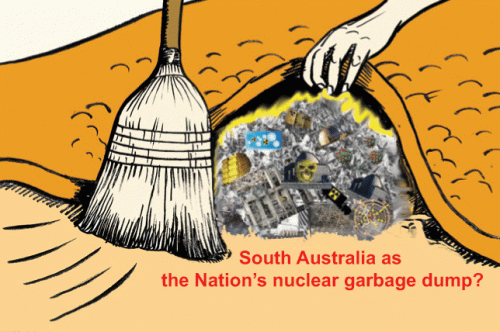
Minister Pitt insists he is not giving up on the legislation. Expert in radiation impacts Dr Tilman Ruff has recently called out Pitt’s recent declaration of ‘the urgent need of this facility’ in ‘saving lives’ as ‘reckless claims.’
A new stage in fight against radioactive waste bill, https://www.eurekastreet.com.au/article/a-new-stage-in-fight-against-radioactive-waste-bill?utm_medium=email&utm_campaign=Eureka%20Street%20Daily%20-%20Tuesday%2017%20November%202020&utm_content=Eureka%20Street%20Daily%20-%20Tuesday%2017%20Nove– Michele Madigan -17 November 2020
-
- ‘We have spent two very productive days at Parliament House speaking about our concerns regarding the proposed Kimba dump site and the Government’s attempts to pass legislation that intentionally takes away our rights to judicial review. Thank you to all of our supporters who helped get us there, this has been a long and expensive fight, but our voices are being heard.’
- This message from the No Radioactive Waste on Agricultural Land in Kimba or SA group (No Rad Waste) Radioactive Waste Management Amendment Bill 2020 was a good intimation that day to anxious followers that the hoped for blocking in the Senate of the Coalition’s Radioactive Waste Management Amendment Bill 2020 was indeed going to happen. ACF’s progressive checking of the Senate Agenda had already revealed that the Bill, listed as number 8 on Monday 9/11, had by Tuesday 10/11 slipped to number 23. On Wednesday 11/11 it had disappeared off the list.Did this mean the government, knowing it didn’t have the numbers, had given up on the legislation — at least for the present?Hope was confirmed for sure the next day. An Adelaide Advertiser’s 12th November article heading read: ‘Pauline Hanson’s One Nation torpedoes Kimba nuclear waste dump in SA.’
The article confirmed ‘The One Nation leader… has confirmed she will not back legislation to build the nuclear waste storage site at Napandee farm, near Kimba.’ The article then went on to explain that ‘Without One Nation’s two crucial votes — and Labor, the Greens, and independent senator Rex Patrick not backing the Bill — the government does not have enough votes for it to pass parliament without changes.’
- As Senator Hanson had told The Advertiser reporter, she ‘had serious concerns about the process to select Napandee, the level of community support, the waste site being built on farming land, and the facility storing intermediate radioactive waste above ground.’
-
So in the long journey of nearly five years since the Australianfederal government’s renewed search for a national radioactive waste facility, it seems a new stage has been reached.Here’s a question: did the federal Minister for Resources overreach himself? With the power to simply name the government’s preferred site, Minister Keith Pitt went a step further by presenting to Parliament the naming of the site.This meant that a passing of the government’s Amendment Bill would block off the chances for any opponent group ton take the processes leading to that decision to the courts — no judicial review.
I wrote of the progress of the bill in the House and later of the Senate Inquiry hearings.In a style reminiscent of recently ex-Minister, Joel Fitzgibbon, in the inquiry Labor Senators Carr and Gallacher chose to side with government in their questioning, comments and final vote.
However Labor, with their knowledge of community concerns, decided to follow Senator Jenny McAllister’s dissenting report and its unease regarding judicial review. Their resolution was ‘to ask for the amendment of removing the name of the Napandee site with the proviso, “Should our amendment be unsuccessful, we willoppose the Bill in the Senate.”’
The reasons? ‘This is a contentious issue and should have the highest levels of scrutiny to ensure that the principles of procedural fairness and natural justice have been applied given the national significance of this matter.’ This from the leader of the Opposition in the Senate, SA Senator Penny Wong’s Office to the Josephite SA Reconciliation Circle on 26th October.
In the meantime, president of No Radioactive Waste on Agricultural Land in Kimba or SA Peter Woolford had first heard of the Minister’s Pitt’s long awaited visit to Kimba and the Napandee site via an ABC’s North and West reporter on Tuesday October 27th. The Minister eventually confirmed that four of their group were permitted to meet with him. As well, of course, were meetings with the executive of the pro-dump District Council of Kimba and theWorking for Future pro-dump group.
‘A PR box ticking exercise’ was how Woolford named the Minister’s visit with their group. After the event it was harder to be dispassionate: ‘Pitt and Ramsey (the federal Member) certainly know what we think and the impact it’s had… it certainly got a little heated at times… We had 45 minutes and we raised many issues relating to the doubling handlingof ILW (intermediate-level waste), the vote unfairness, jobs, judicial review etc.’
With three crossbench votes needed in addition to the Greens and Labor to defeat the Bill, the Barngarla Determination Aboriginal Corporation (BDAC), headed by Chair Jason Bilney had long planned to travel to Canberra to meet with legislators.
COVID restrictions meant that the vital trip was delayed but perhaps providence meant that it took place at just the right time for the November Senate session. Both key opposition groups have long supported each others’ concerns.
So with the government unable to get the Senate numbers, what will happen next?
Minister Pitt insists he is not giving up on the legislation. Expert in radiation impacts Dr Tilman Ruff has recently called out Pitt’s recent declaration of ‘the urgent need of this facility’ in ‘saving lives’ as ‘reckless claims.’
Independent SA Senator Rex Patrick has long been involved with both BDAC and No Rad Waste groups. The Advertiser November 12th report above continued with the voice representing the other two of the vital No votes: ‘I want to make the right decision, not for the interim, I want to make the right decision for future generations,’ Senator Hanson said. ‘I’m not going to be badgered or pushed into this… It’s about looking after thepeople of SA, but also the whole of Australia.’
The SA Stock Journal’s September survey recorded 70 per cent of respondents were against the federal nuclear dump plan. In Aboriginal Way Spring 2020, Karina Lester, Chair of YNTAC, reported that four Aboriginal groups ‘right across the state’ including the Yankunyjatjara Native Title
Aboriginal Corporation have ‘submitted their concern.’
In November, it’s good to hear that South Australians aren’t alone in actively recognising that simply storing above ground, for at least ‘decades,’ nuclear waste that will be radioactive for 10,000 years is a pertinent national issue.
Doctors call for an open independent review of nuclear waste production and disposal

One of the first principles of toxic waste management is to reduce production.
Non-reactor production of nuclear medicine is increasing, and produces very little radioactive waste. Australia should be partnering with countries like Canada, to research non-reactor production of the commonest nuclear medicine isotope Technetium.
16 Nov 20, The Medical Association for Prevention of War is calling for an open independent review of nuclear waste production and disposal in Australia, to create a careful evidence based long term best practice plan.
The recent deeply flawed proposal for a federal nuclear dump and store at Kimba now looks unlikely to get support in the Senate.
It was a cheap storage plan for highly radioactive waste that stays radioactive for more than 10,000 years- an interim facility with no longer term plan. It effectively dumps the problem on future generations of South Australians.
The Australian Radiation Protection and Nuclear Safety Agency chief executive Dr Carl-Magnus Larsson, at a Senate inquiry in June 2020, said: “Waste can be safely stored at Lucas Heights for decades to come.”
MAPW Vice-President Dr Margaret Beavis said, “We have plenty of time to properly review and plan a disposal facility that meets international best practice standards. The recent proposal did not meet those standards.
Contrary to disgraceful and dishonest government scaremongering, there is no threat to nuclear medicine in Australia. I and other MAPW members regularly rely on nuclear medicine in our clinical practice.”
We call on the government to commit to an open independent review of both production and disposal of nuclear waste.
One of the first principles of toxic waste management is to reduce production.
Non-reactor production of nuclear medicine is increasing, and produces very little radioactive waste. Australia should be partnering with countries like Canada, to research non-reactor production of the commonest nuclear medicine isotope Technetium.
Planned nuclear waste dump at Kimba has absolutely nothing to do with the production of nuclear medicine

Peter Remta, 16 Nov 20, Referring to Minister Keith Pitt’s media release of 9 November 2020 regarding the round table conference on nuclear medicine – it still fails to answer and explain how precisely will nuclear medicine be affected by not having a national waste management facility at Kimba.
It is well known that nuclear waste is currently stored in over 100 different locations throughout Australia most of which has been generated through nuclear medical treatment and is classified as low level waste. However as Minister Pitt has himself acknowledged it would be very doubtful if the national facility managed to get 30% of that waste for storage and
disposal.
How will the production of nuclear medical material by ANSTO at Lucas Heights be affected by the failure to have the waste facility at Kimba?
The proposed facility at Kimba has nothing to do with and will not affect the production of nuclear medicine by ANSTO and to suggest otherwise is totally false and deliberately misleading.
It is no more than clutching at straws in order to convince senators who are opposed to the Bill for the waste facility presently before the Senate to change their minds. It is an insult to their intelligence.
The only thing that will affect the production of nuclear medicine by ANSTO is its own inherent problems with the nuclear medicine facility plant at Lucas Heights which keeps breaking down and having trouble despite the
huge cost of planning and building it.
Again that has nothing to do whatever with the proposed waste facility at Kimba other than perhaps to demonstrate the inefficiency of ANSTO and confirm the dangerous nature of the reactor waste which is completely unsuitable for storage at Kimba before ultimate disposal.
Despite many repeated requests, Senator Pitt has not explained how nuclear medicine will be affected should the waste facility not to be built at Kimba,
I
Minister Pitt on Kimba nuclear waste dump plan – inept, badly briefed, or just plain lying?
Peter Remta, 14 Nov 20, THE HON KEITH PITT MP Minister for Resources, Water and Northern Australia Member for Hinkler MEDIA RELEASE 12 November 2020
NATIONAL RADIOACTIVE WASTE MANAGEMENT FACILITY
‘‘The National Radioactive Waste Management Facility is a vital piece of national infrastructure, which will support the ongoing development of our nuclear medicine and research industries.”
He still fails to explain how and why
All of this waste is classified as intermediate level waste although when France returned the reprocessed spent fuel to Australia it classified it as high level waste
There has not been any suggestion by either ANSTO or ARPANSA that this waste is causing any lack of storage space or other problems at Lucas Heights.
What difference does that make?
Australian government completely inept in selecting Kimba nuclear waste dump

Relief in Kimba, that Labor and crossbench Senators want a fair process on nuclear wastes
 No Radioactive Waste Facility for Kimba District– 14 Nov 20 · We are reassured by this week’s events that there are still many in Australian politics who believe in a fair process. The lack of support from Labor and crossbench Senators for the Government’s proposed Bill to legislate Kimba as the chosen site for the national radioactive waste dump is certainly a relief to us.
The Australian government can still bully its way to imposing a Kimba nuclear waste dump
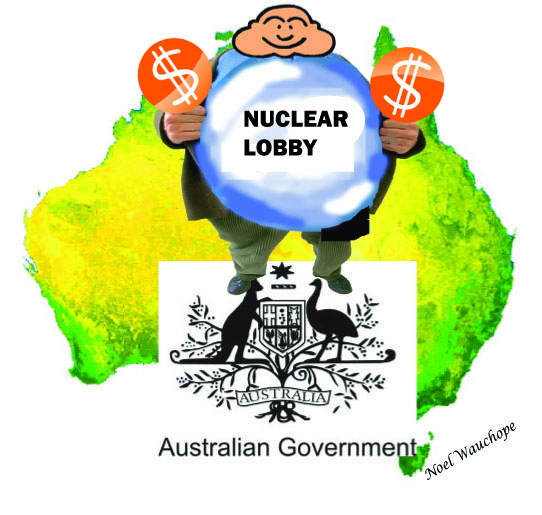 Today the Advertiser reports that the federal government does not have the numbers to get the draconian, racist National Radioactive Waste Management Bill passed in the Senate. Labor and most or all of the crossbench Senators oppose the Bill.
Karina Lester speaks out: ”Traditional owners’ voices not heard and rights stripped over nuclear waste dump”
”Traditional owners voices not heard and rights stripped over nuclear waste dump”
 Extract:
Chairperson of Yankunytjatjara Native Title Aboriginal Corporation (YNTAC) Karina Lester says, “The two key issues that I’m quite concerned about are the lack of consent from the traditional owners; and that they want to take away judicial review. No Barngarla person or anyone in that Kimba region can take it to the courts for it to be properly heard. That’s a given right for any Australian; to take an issue through a judicial process and they’re now trying to shift the goalposts away from Aboriginal people and people from the Kimba region so it can’t be challenged.”
Four Aboriginal groups submitted their concern about the lack of Indigenous community engagement in the consultation and selection process, as well as potential violation of those communities’ rights, these were the Yankunytjatjara Native Title Aboriginal Corporation (YNTAC), Tjayuwara Unmuru Aboriginal Corporation (TUAC), De Rose Hill-Ilpalka Aboriginal Corporation (DRHIAC) and the First Nations of South Australia Aboriginal Corporation (FNSAAC).
They acknowledged that the specified site has significance for a wider group of Aboriginal People than just the Barngarla, and that the proposed use is a matter of significance for Aboriginal People right across the state.
“They’ve been saying that this is just a Barngarla issue, just a Kimba issue – but it’s not. No, this is an issue for First Nations people everywhere. We need to stand in solidarity and send a strong message as the First Nations people of South Australia to say that no dump is wanted in our state,” said Ms Lester, who is the daughter of anti-nuclear and Indigenous rights advocate, Yami Lester.
“We have been pressured to be the ‘solution’ to waste management; it’s not been clear why the Federal Government keeps coming back to our state. I think that’s part of the problem.
“The process has been flawed from the very beginning. The risk is that if we open the door to this, we could well be opening the door to a permanent solution here in SA. Why put a temporary solution here when the facility says they can keep storing it at Lucas Heights in Sydney?
“There’s so much history of Aboriginal people’s activism against this in South Australia. For it to come back to our state, after leaving our state so many years ago, it feels like an ongoing generational battle for us to put an end to this issue in South Australia.”
Uncertainty over Kimba nuclear waste dump as farmers go to Canberra to oppose it
|
Kimba nuclear debate set to continue, Eyre Peninsula Tribune, Alisha Fogden, 9 Nov 20,
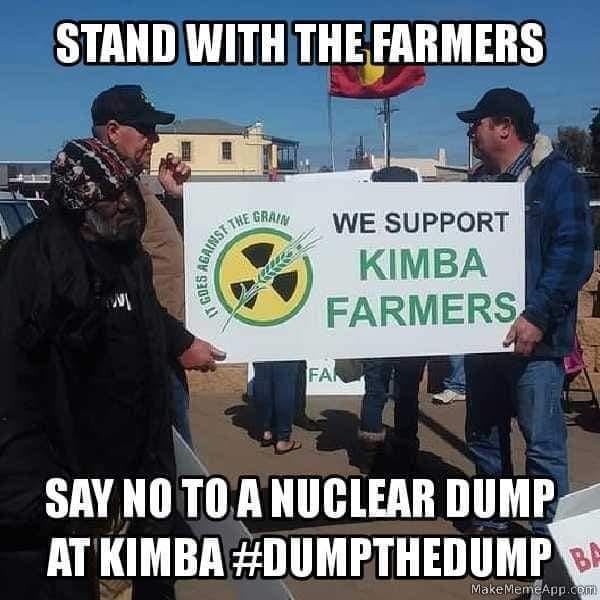
A group of Kimba farmers and community members travelled to Canberra this week to meet with the Labor Party, The Greens and cross-bench Senators “to put a face to those directly impacted by the proposed legislation to name Kimba as the site for Australia’s radioactive waste dump”.
No Radioactive Waste on Agricultural Land in Kimba or SA Committee secretary Toni Scott said the government process to site the facility in Kimba over the past five years had been “unfair, manipulative and completely lacking in transparency”. “We are extremely concerned that the government’s proposed legislation, currently awaiting Senate consideration, intentionally removes our right to contest the decision and denies basic protections,” she said.
“Productive farming land in Kimba is not the best, or even the right, place for our nation’s radioactive waste. We urge the federal government to review their selection process, rather than trying to force this decision through parliament.” The trip follows a visit by Federal Resources Minister Keith Pitt to the Kimba region last week, where he said he remained confident the federal government would get their legislation for the facility through the upper house when the Senate resumed this week. This is despite Labor withdrawing its support for the bill at the ‘eleventh hour’ and further dissenting reports from The Greens and Independent Senator Rex Patrick………https://www.eyretribune.com.au/story/7005850/group-push-nuclear-rethink/ |
|
|
Farmers to Canberra, to protest the law that forces a nuclear dump on Kimba’s agriculutral land
We are members of the Kimba community and proud and productive grain farmers who have travelled to Canberra to meet with Labor, Green and cross-bench Senators to put a face to those directly impacted by the proposed legislation to name Kimba as the site for Australia’s radioactive waste dump.
In our view the process the Government has employed to site this facility in Kimba over the last five years has been unfair, manipulative and completely lacking in transparency.
We are extremely concerned that the Governments proposed legislation currently awaiting Senate consideration intentionally removes our right to contest the decision and denies basic protections .
It is clear that productive farming land in Kimba is not the best, or even the right place for our nations radioactive waste. We urge the federal government to step back and review their selection process rather than continue trying to force this decision through via Parliament.
Quotes can be attributed to Toni Scott – Secretary, No Radioactive Waste on Agricultural Land in Kimba or SA Committee Media Contact – Kellie Hunt – 0428 572 411
Out of site out of mind – Australian govt has NO PLAN for nuclear waste disposal.
Divisive campaign on South Australian facility highlights urgent need for long term nuclear waste management plan, Croakey, 6 Nov 20, Tillman Ruff
“……..No long term management plan for nuclear waste
Australia needs to develop a plan for long-term management and disposal of long-lived intermediate level nuclear waste, which must be kept strictly isolated from people and the environment for 10,000 years.
More than 90 percent of Australia’s radioactive waste comes from nuclear reactors managed by the Australian Nuclear Science and Technology Organisation (ANSTO) at Lucas Heights in southern Sydney. This waste is stored there in a dedicated Interim Waste Store facility at Australia’s principal nuclear facility, with the best expertise and capacity in the country to manage this safely, monitored 24/7 by the Australia Federal Police.
A serious, open, transparent, evidence-based process is required to carefully consider the options, and develop the most responsible plan for ongoing long-term management and disposal of this waste.
nstead, successive governments — both Coalition and Labor — have sought to impose a succession of ill-considered waste dump plans on SA and NT remote communities. All have previously failed because of deeply flawed processes and strong community opposition.
Transport, taxpayer burdens absent health need
The risks of accident or theft are greatest during transport of nuclear materials. Kimba is 1,700 km from Lucas Heights. Road or sea transport of radioactive waste would involve lengthy routes potentially traversing many communities in multiple states.
The nuclear regulator, the Australian Radiation Protection and Nuclear Safety Agency (ARPANSA) has recently confirmed to a Senate inquiry that Lucas Heights has the capacity to safely store Australia’s radioactive waste for several decades, and that there is no urgent need to relocate it.
The Senate Inquiry last month recommended the South Australian plan go ahead, but there was a split among the committee membership, with Senators Jenny McAllister (Labor), Sarah Hanson-Young (Greens) and Rex Patrick (Independent) dissenting.
The government’s repeated claim that an immediate interim radioactive waste dump is needed to ensure the continuation of nuclear medicine in Australia is false.
Every sizeable hospital currently manages their radioactive waste on a ‘delay and decay’ basis on site; the residual waste rapidly loses its radioactivity and is stored on-site until it has decayed and can be discarded with normal waste. This doesn’t need to and won’t change.
The emotive but fallacious claim that provision of nuclear medicine services needed for diagnosis and treatment of cancer will be jeopardised if a new nuclear waste dump is not urgently progressed is being dishonestly but persistently promoted.
To support passage of the government’s amendments, Federal Resources, Water and Northern Australia Minister Keith Pitt is believed to be planning a “nuclear medicine roundtable” at Parliament House on Monday 9 November.
The true driver of increasing need for waste management is ANSTO’s institutional nuclear ambitions, reflected in its current massive ramp-up of production of medical isotopes for export — from around one percent to a target of 25-30 percent of global supply over the next several years.
Not only are we left with the waste legacy of this expanding isotope export business, Australian taxpayers also pick up the bill, paying $400 million for the Lucas Heights OPAL reactor, and subsidising ANSTO on an annual basis for its nuclear operations.
ANSTO received $313.8 million in 2019-20, and was given an additional $238.1 million over 4 years in last month’s Budget.
Cost analyses in several other countries have found that medical isotope sales usually only recover 10-15 percent of the true cost of production once waste, decommissioning, insurance and other costs are factored in.
ANSTO’s export expansion push is increasing domestic nuclear waste pressures, and this is happening without proper public and parliamentary accountability and scrutiny………..
Out of sight, out of mind
The government’s approach, codified in the proposed amendments, would see long-lived radioactive intermediate level nuclear waste transported long distances from the best and most secure site to manage radioactive waste in Australia, to a distant site in South Australian farming country with no current expertise, facilities or experience in securely managing long-lived hazardous radioactive waste.
Effectively, this “temporary” storage facility for waste that must be kept safe from the environment for over 10,000 years will be a large shed.
There is currently no plan and no process to develop a plan for the long-term management and eventual disposal of this waste. Therefore the intermediate level waste will likely languish indefinitely above ground in a facility inadequate for safe long-term storage or disposal, but out of sight and out of mind from Canberra or Sydney.
Australia needs an open, transparent, evidence-based and independent review of Australia’s current and projected radioactive waste production. This review should examine and make recommendations on the best practice long-term management of Australia’s radioactive waste production and disposal.
It should be conducted independently of ANSTO, given their role as proponent of the current proposal and plans to significantly increase nuclear waste production over the next decade for reasons which are not based on the health or other needs of Australians.
It should be open to input from Indigenous organisations, civil society organisations, experts and the public, and be undertaken before any soil is turned for a dump in Kimba and before any waste is moved from Lucas Heights. We have ample time to do this properly.
Tilman Ruff AO is Associate Professor at the Nossal Institute for Global Health, University of Melbourne. He is Co-President of International Physicians for the Prevention of Nuclear War, and co-founder and founding chair of the International Campaign to Abolish Nuclear Weapons, both Nobel Peace Prize laureate organisations. https://www.croakey.org/divisive-campaign-on-sa-facility-highlights-urgent-need-for-long-term-nuclear-waste-management-plan/
Australian government’s Nuclear Waste Bill – divisive, undemocratic and racist processes
Divisive campaign on South Australian facility highlights urgent need for long term nuclear waste management plan, Croakey, 6 Nov 20,
Tilman Ruff writes: Radioactive waste production and management need a sound evidence-based plan, not shoddy and racist imposition based on misguided nuclear ambition.
On Tuesday 6 October, under the cover of the Federal Budget, the Government planned to introduce controversial amendments to laws on radioactive waste management in the Senate.
The amendments were dropped from the Senate list the following day, only to reappear the following day, the last sitting day for this parliamentary session. They were ultimately not tabled, for reasons unstated, but most likely because the government was concerned it did not have the numbers to pass them.
The National Radioactive Waste Management Amendment (Site Specification, Community Fund and Other Measures) Bill 2020 seeks to confirm the siting of a national radioactive waste facility near Kimba in regional South Australia. It would also remove any legal right to review this decision.
These laws were opposed by Labor, minor party and independent members when they passed in the lower house in June, and remain actively contested in Parliament and more so in the community.
Nonetheless $103.6 million was allocated in the budget over the next four years for the planned radioactive waste dump at Kimba, a clear sign the government remains committed to this flawed legislation, which is again scheduled to be debated in the Senate next week.
The radioactive waste management plans it would lock in deserve greater public scrutiny than they have received to date…………
Divisive, undemocratic and racist processes
The government campaign to persuade the residents of Kimba to accept a radioactive waste dump has been misleading and divisive, with much inaccurate information about risks and benefits, inflated employment promises, and very poor process to assess genuine community views.
The people selected to vote on this proposal (with shifting and nebulous goalposts) were town-based, excluding many farmers who actually live closer to the site than those in Kimba township. The local community has become divided.
Crucially, despite multiple requests, Barngarla Native Title holders were explicitly excluded from the government’s community ballot, and remain actively opposed to the planned waste facility. The Barngarla people unsuccessfully attempted to have their exclusion from the consultation process struck down in the Federal Court in March on the grounds that it contravened the Racial Discrimination Act.
When the Barngarla people commissioned a survey themselves, 100 percent of those surveyed were opposed. Nonetheless the process has proceeded, despite government promises that Aboriginal views would be taken into account.
Minister Pitt visited Kimba for the first time in months on 3 November. His media release thanking the Kimba community and chronicling his meetings with the mayor, proposed waste site landowner and various local organisations mentions Barngarla people not once.
Removing the right to legal review
The clear and unacceptable rationale of the proposed amendments are to remove the right of legal challenge to the choice of a national radioactive waste facility near Kimba.
Minister Pitt already has the power under the existing National Radioactive Waste Management Act (2012) to advance the planned Kimba facility, however this would be subject to legal review.
The right to independent legal recourse is a fundamental principle of our democracy and should not be jettisoned without compelling reasons – especially on an issue with such significant long-term implications and impacts as radioactive waste.
To remove the right to judicial review for affected people is unfair, unnecessary and unjustified. It violates the rights of Aboriginal people. ……….. https://www.croakey.org/divisive-campaign-on-sa-facility-highlights-urgent-need-for-long-term-nuclear-waste-management-plan/
Australian Nuclear Science and Technology Organisation (ANSTO) – disingenuous and inept promotion of Kimba nuclear waste dump
If anyone has viewed the Senate estimates hearing on Thursday 29 October 2020 with regard to ANSTO then I am sure they will be concerned at the ill-prepared and unconvincing explanations by its management which at times verged on being completely disingenuous. If this is the major federal government entity on which there is so much reliance for the establishment of the planned nuclear waste facility at Kimba in South Australia then the whole nation and not just the local community should be seriously worried about the capability of ANSTO which contrary to its self serving promotion and publicity is not held in high regard internationally
This extends to the Department of Industry Science Energy and Resources and the other agencies involved with the proposed nuclear waste facility at Kimba and demonstrates the ineptness and lack of competence on the part of the government in its various capacities in trying to establish the facility
Because of this it is very likely that the facility will not obtain the necessary licence for its establishment and operations and in any case the enabling legislation will be rejected by the Senate
It therefore defies logic for the government’s continued persistence with the Kimba proposal including the ministerial visit to Napandee farm yesterday which apparently failed to achieve anything as to a resolution of the inherent communityproblems – perhaps a political photo opportunity or confirmation at last that Napandee is a farm and not a community?
http://www.aph.gov.au Watch parliament Senate, Economics Legislation Committee
(Senate Estimates) Thu, 29 Oct 2020 Part 1 at 9.00 am EST
315 nuclear bombs and ongoing suffering: the shameful history of nuclear testing in Australia and the Pacific
|
315 nuclear bombs and ongoing suffering: the shameful history of nuclear testing in Australia and the Pacific, https://theconversation.com/315-nuclear-bombs-and-ongoing-suffering-the-shameful-history-of-nuclear-testing-in-australia-and-the-pacific-148909, Tilman Ruff, Associate Professor, Education and Learning Unit, Nossal Institute for Global Health, School of Population and Global Health, University of Melbourne, Dimity Hawkins, PhD Candidate, Swinburne University of Technology
November 3, 2020 The Treaty on the Prohibition of Nuclear Weapons received its 50th ratification on October 24, and will therefore come into force in January 2021. A historic development, this new international law will ban the possession, development, testing, use and threat of use of nuclear weapons.Unfortunately the nuclear powers — the United Kingdom, France, the United States, Russia, China, Israel, India, Pakistan and North Korea — haven’t signed on to the treaty. As such, they are not immediately obliged to help victims and remediate contaminated environments, but others party to the treaty do have these obligations. The shifting norms around this will hopefully put ongoing pressure on nuclear testing countries to open records and to cooperate with accountability measures. For the people of the Pacific region, particularly those who bore the brunt of nuclear weapons testing during the 20th century, it will bring a new opportunity for their voices to be heard on the long-term costs of nuclear violence. The treaty is the first to enshrine enduring commitments to addressing their needs. From 1946, around 315 nuclear tests were carried out in the Pacific by the US, Britain and France. These nations’ largest ever nuclear tests took place on colonised lands and oceans, from Australia to the Marshall Islands, Kiribati to French Polynesia.
The impacts of these tests are still being felt today. All nuclear tests cause harm Studies of nuclear test workers and exposed nearby communities around the world consistently show adverse health effects, especially increased risks of cancer. The total number of global cancer deaths as a result of atmospheric nuclear test explosions has been estimated at between 2 million and 2.4 million, even though these studies used radiation risk estimates that are now dated and likely underestimated the risk. The number of additional non-fatal cancer cases caused by test explosions is similar. As confirmed in a large recent study of nuclear industry workers in France, the UK and US, the numbers of radiation-related deaths due to other diseases, such as heart attacks and strokes, is also likely to be similar. Britain conducted 12 nuclear test explosions in Australia between 1952 and 1957, and hundreds of minor trials of radioactive and toxic materials for bomb development up to 1963. These caused untold health problems for local Aboriginal people who were at the highest risk of radiation. Many of them were not properly evacuated, and some were not informed at all. We may never know the full impact of these explosions because in many cases, as the Royal Commission report on British Nuclear Tests in Australia found in 1985: “the resources allocated for Aboriginal welfare and safety were ludicrous, amounting to nothing more than a token gesture”. But we can listen to the survivors.
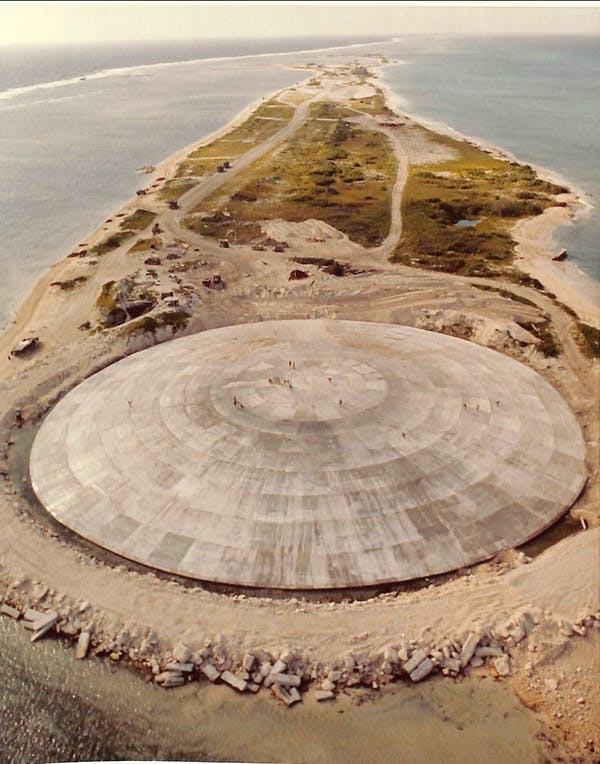
His daughter, Karina Lester, is an ambassador for the International Campaign to Abolish Nuclear Weapons in Australia, and continues to be driven by her family’s experience. She writes: For decades now my family have campaigned and spoken up against the harms of nuclear weapons because of their firsthand experience of the British nuclear tests […] Many Aboriginal people suffered from the British nuclear tests that took place in the 1950s and 1960s and many are still suffering from the impacts today. More than 16,000 Australian workers were also exposed. A key government-funded study belatedly followed these veterans over an 18-year period from 1982. Despite the difficulties of conducting a study decades later with incomplete data, it found they had 23% higher rates of cancer and 18% more deaths from cancers than the general population. An additional health impact in Pacific island countries is the toxic disease “ciguatera”, caused by certain microscopic plankton at the base of the marine food chain, which thrive on damaged coral. Their toxins concentrate up the food chain, especially in fish, and cause illness and occasional deaths in people who eat them. In the Marshall Islands, Kiritimati and French Polynesia, outbreaks of the disease among locals have been associated with coral damage caused by nuclear test explosions and the extensive military and shipping infrastructure supporting them. Pacific survivors of nuclear testing haven’t been focused solely on addressing their own considerable needs for justice and care; they’ve been powerful advocates that no one should suffer as they have ever again, and have worked tirelessly for the eradication of nuclear weapons. It’s no surprise independent Pacific island nations are strong supporters of the new treaty, accounting for ten of the first 50 ratifications. Negligence and little accountabilitySome nations that have undertaken nuclear tests have provided some care and compensation for their nuclear test workers; only the US has made some provisions for people exposed, though only for mainland US residents downwind of the Nevada Test Site. No testing nation has extended any such arrangement beyond its own shores to the colonised and minority peoples it put in harm’s way. Nor has any testing nation made fully publicly available its records of the history, conduct and effects of its nuclear tests on exposed populations and the environment. These nations have also been negligent by quickly abandoning former test sites. There has been inadequate clean-up and little or none of the long-term environmental monitoring needed to detect radioactive leakage from underground test sites into groundwater, soil and air. One example among many is the Runit concrete dome in the Marshall Islands, which holds nuclear waste from US testing in the 1940s and 50s. It’s increasingly inundated by rising sea levels, and is leaking radioactive material. The treaty provides a light in a dark time. It contains the only internationally agreed framework for all nations to verifiably eliminate nuclear weapons. It’s our fervent hope the treaty will mark the increasingly urgent beginning of the end of nuclear weapons. It is our determined expectation that our country will step up. Australia has not yet ratified the treaty, but the bitter legacy of nuclear testing across our country and region should spur us to join this new global effort. |
|
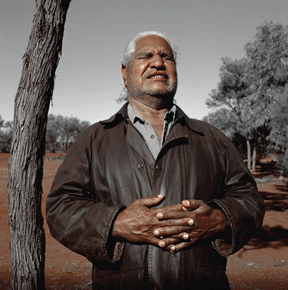
Problems re the planned nuclear waste dump: Some tough questions for the Kimba Council
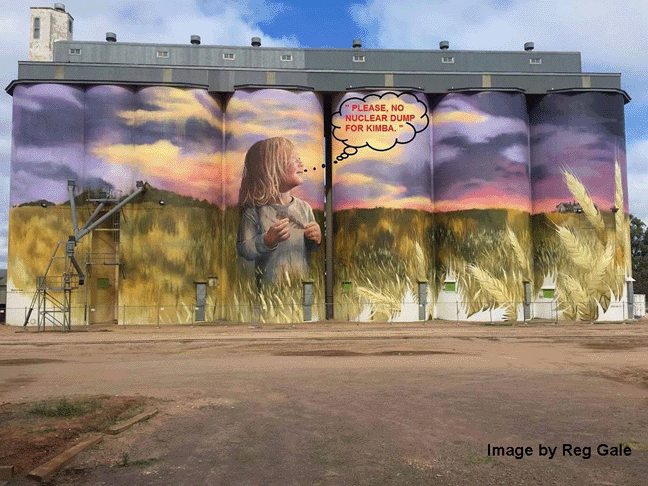
1. Based on overseas experience every place where some nuclear facility for waste storage and disposal has been established has seen a dramatic reduction in property values
2. Has the Kimba District Council considered this probable and economically debilitating situation
3. Is so how and what precautions have been taken by the Council to prevent it and what notification has it given to the community in that regard
4. If it has not been considered by the Council please explain why having regard to the duty of care that the Council owes to its community to ensure that they do not incur any financial loss
5. Has it ever been raised by the Council with the government and the responsible ministers and if so what responses has it received
6. Having now been given notice of this probable economic reversal what does the Council propose to do to prevent or at ameliorate the potential losses in property values for the Kimba community
7. Has or will the Council seek any financial assistance from the government towards the losses incurred by the community on their properties?
8. Has the Council sought any financial and legal advice with regard to this impending and major financial problem particularly as any economic advantages promoted by the government wold be only a pittance of the losses?
1 This month

of the week – Australians for War Powers Reform (AWPR)
To see nuclear-related stories in greater depth and intensity
 Antinuclear