Submission on Required Protection of Cultural Heritage from impact by Disposal Facility Site selection AND on the Principle of Non-Imposition of Disposal Facilities
 This submission was sent today – not yet published on ARPANSA’s site . To read all 24 submissions already published, go to the site https://www.arpansa.gov.au/code-disposal-solid-radioactive-waste-rps-c-3
OR to our new page Submissions on Radioactive Waste Code 2018
David J Noonan B.Sc., M.Env.St. Independent Environment Campaigner, 2 March 2018
Summary for ARPANSA Website:
David Noonan: To be credible, a finalised ARPANSA Code must mandate the best practice Principal of Non-Imposition of nuclear waste disposal facilities on community.
It is untenable for this Code to countenance Disposal Facility Siting in an area of special cultural heritage significance to Aboriginal people. Proposed NRWMF siting in the iconic Flinders Ranges must stop. A finalised ARPANSA Code must respect Aboriginal people’s rights and interests.
ARPANSA needs to recognise the Storage and Disposal of nuclear wastes affects the rights, interests and safety of all South Australians and is prohibited in our State under the Nuclear Waste Storage (Prohibition) Act 2000.
Any imposition of Disposal Facility Siting in SA will be strongly resisted by community across SA.
Please feel free to contact regarding this submission (contacts provided in e-mail cover note).
To: ARPANSA Public Consultation on the Code for Disposal of Solid Radioactive WasteRadiation Protection Series C-3, RHC Draft – December 2017 StakeholderComment@arpansa.gov.au
Re: D.Noonan public submission on Required Protection of Cultural Heritage from impact by Disposal Facility Site selection AND on the Principal of Non-Imposition of Disposal Facilities 2nd March 2018 Continue reading
Brewarrina nuclear dump protests send clear message to Council: “Keep Bre Nuclear Free”.
 The Brewarrina community is stepping up the campaign against a proposed national nuclear waste dump, with two successful events held over the weekend.
A silent protest was held at the local Council meeting on Friday the 23rd February, with over 20 local protestors attending. Ngemba man Jason Ford presented the No Nuclear Bundabunda on Ngemba Land – Bad Poison petition to the councillors. The petition had 563 clear ‘no’ votes compared to 84 residents who voted in a Council survey that Council should ‘continue with the project.’
Ngemba woman and campaign coordinator Trish Frail said, “We did not win gold, but we won silver and we are happy with that at this stage of the campaign. No further action can be taken by Council until a Working Group is established and the many questions we put to them are answered.”
“We want to know the motivation and funding behind the delegation to Lucas Heights last November and details of the consultation arrangement for nuclear advocate Robert Parker. There is clearly no mandate for the Council to just push ahead and keep promoting the nuclear waste dump,” Ms Frail stated.
The ‘Keep Bre Nuclear Free’ rally the following day mobilised over 100 people, with young people proudly leading the march and chanting ‘No Bundabunda on Ngemba Land’ and ‘Keep Bre Nuclear Free’.
Many Elders also came out to support the campaign.
Aunty Doreen said, “As a Ngemba Elder and a custodian of the land it is important that I support the younger generation in preventing this atrocity from happening on our land, which came from the Dreaming. We struggle with the atrocities that have happened in the past; our future generations should not have to struggle with this danger.”
“It is nuclear genocide. The cotton industry has wrecked our water ways, we can’t let the nuclear industry wreck our land, water and environment,” Aunty Doreen concluded.
Supporters from Melbourne and Canberra travelled to participate in the rally, with messages of support sent from other areas currently under assessment to host the national nuclear dump.

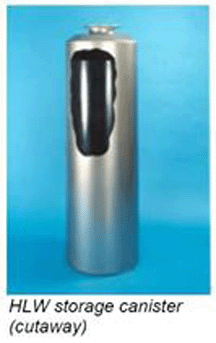
Vitrified nuclear waste due to be sent from UK to Lucas Heights, Australia by 2022
 Radioactive Waste: Australia:Written question – 10476 http://www.parliament.uk/business/publications/written-questions-answers-statements/written-question/Commons/2017-09-13/10476/
In 1996 the Australia Nuclear Science and Technology Organisation (ANSTO) signed a contract with the United Kingdom Atomic Energy Authority (UKAEA) for the processing of spent nuclear fuel from the Australian research reactor at the Dounreay reprocessing facility. The contract contained an obligation to return uranium and an option to return waste which is supported by a MoU between the UK and Australian Governments in the form of an intergovernmental letter. The radioactive waste, which arose from the processing, comprises several tens of drums of cemented waste. The Nuclear Decommissioning Authority (NDA) assumed responsibility for the material when it became owners of Dounreay in 2005.
Cemented waste is challenging in terms of transport and volume, and for the ANSTO waste the return would require multiple moves or the provision of new flasks to ensure transport can be secured. The Scottish and UK Governments consulted on a proposed policy of radioactive waste substitution for the radioactive waste arising from historic fuel reprocessing contracts with overseas customers at Dounreay in 2010. Agreement was reached between the Scottish and UK Governments on 16 March 2012. Waste substitution is an internationally accepted practice where a radiological equivalent amount of waste is returned to the customer in a form that is acceptable. A contract was signed in 2014 with the NDA to enable waste substitution.
The substituted radioactive waste will be in the form of four vitrified residue containers holding waste which falls within the activity levels of Intermediate Level Waste. The vitrified residue (sealing of radioactive waste in molten glass poured into engineered stainless steel containers) comes from Sellafield. Waste in this form is immobilised. The cemented drums containing the Australian-origin radioactive waste from the processing of the spent nuclear fuel will be retained and managed at Dounreay pending final disposal, as the Dounreay Intermediate Level Waste stores are designed to accept it.
The vitrified residues are forecast to be returned to Australia by 2022 and are expected to be stored in an authorised storage facility located at Lucas Heights near Sydney, where the Australian research reactor is located. Following storage at Lucas Heights the vitrified residues will be co-located with a new disposal facility for Low Level Waste and will be temporary stored at that facility.
The Australian Government accepts that it has an international obligation to receive the vitrified residues. The Department of Industry, Innovation and Science (DIIS) is charged with identifying a site – National Radioactive Waste Management Facility – for its Low Level Waste currently stored in 100 different places around Australia. The NDA has been informed that following a public consultation process across Australia, DIIS is now actively engaged in dialogue with two communities in South Australia – Wallerberdina Station, near Hawker, and at Kimba. A decision on where the facility will be located has not yet been made.
Australia signed up to keep nuclear waste as close as possible to the point of production
Paul Waldon Fight To Stop Nuclear Waste Dump In Flinders Ranges 26 Feb 18, SA We the people of South Australia, and the people of ANSTO, ARPANSA, and the DIIS, all have one common denominator, and that is “We don’t want nuclear waste in our backyards.”
Australia agreed to keep the waste as close as possible to the point of production, the day the Basel Convention was signed. However the DIIS are trying to sell this waste to all South Australians using our tax money, but can the SA taxpayer entice the residents of Barden Ridge to keep the waste by offering a few extra dollars. Yes, this is the deadly radioactive waste that they declared they were more than happy to reside alongside of when they purchased, built, moved into, or worked near Lucas heights. more https://www.facebook.com/groups/344452605899556/
Senator Cory Bernardi promises $445 billion for South Australia, if it hosts international nuclear waste dump
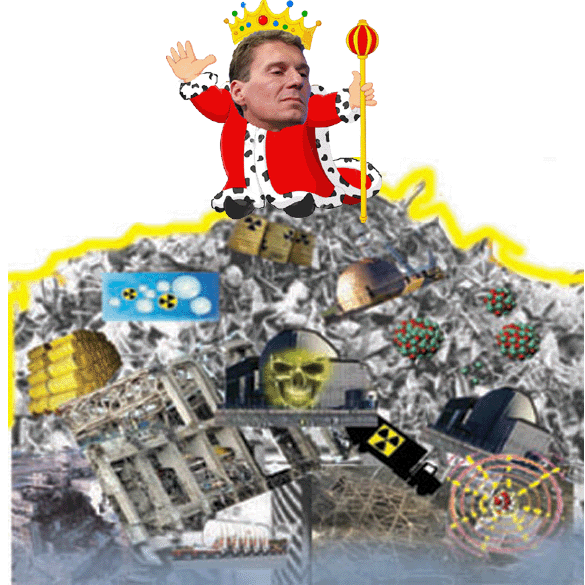
Cory Bernardi says a nuclear power dump could make us the ‘Saudi Arabia of the  south’, news.com.au 26 Feb 18 CORY Bernardi is pushing to reignite a controversial development in South Australia, saying it could make the state the “Saudi Arabia of the south”.
LEADER of the Australian Conservatives party Cori Bernardi is pushing for a nuclear waste dump in South Australia, which he says will transform the state into the economic “Saudi Arabia of the south”.
Speaking at the party’s election launch in South Australia on Sunday, founder and federal Senator Cory Bernardi said he wanted to reopen the debate on an outback nuclear dump.
He called for changes to the law to allow for “all forms of energy production”, including nuclear power, urging authorities to “complete a full rigorous analysis” of the idea.
According to The Advertiser, he claimed the dump would generate up to $6.7 billion in gross state product, allow for $3 billion in annual taxes to be scrapped, and see the state reaping in $445 billion over the next century.
“Imagine that legacy for our children … to draw on in developing this state,” he said. “We would be an economic powerhouse. We would be the strongest state in the Commonwealth.”
Upper House candidate Robert Brokenshire said the party is “committed to looking at all types of energy production including nuclear energy to find the cheapest and most reliable form of energy”.
Labor Premier Jay Weatherill was quick to rule out the suggestion.
“That’s dead,” he said on Sunday. “Labor Party policy has been opposed to a nuclear waste facility in the past and there’s no prospect of changing that in the future.”
Mr Weatherill did not rule out pursuing a High Court case against the Turnbull government if a national nuclear waste dump was to be approved in South Australia, The Australian reported last month.
……..Earlier this month, the Australian Conservatives announced it will field 33 Lower House and two Upper House candidates at the state election on March 17. http://www.news.com.au/technology/environment/cory-bernardi-says-a-nuclear-power-dump-could-make-us-the-saudi-arabia-of-the-south/news-story/eb3f1ada5ed978646f53a2911f0e1c3d
Submission to ARPANSA on the draft Code for Disposal of Solid Radioactive Waste
 Submission 1 to Code for Disposal of Solid Radioactive Waste (RPS C-3) By Noel Wauchope, 24 Feb 18
Regarding the type of radioactive wastes discussed
The big change in this Code is that it now applies to all types of disposal facility – meaning that higher level nuclear wastes are planned for. The draft Code states on page 9:
– “Australia has no high level waste (HLW) and is unlikely to possess any in the foreseeable 108 future”
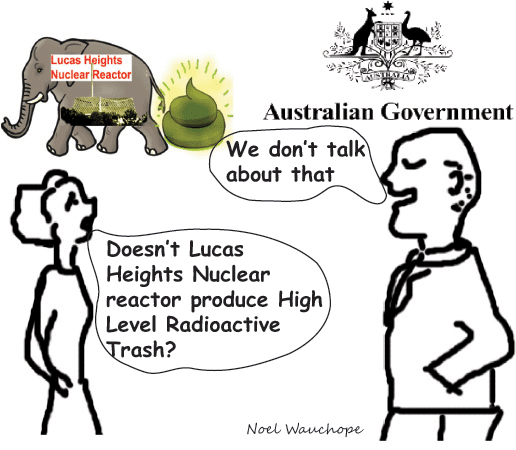
But the plan is obviously to include reprocessed nuclear wastes returned to Lucas Heights, from France, where they are classified as High Level Wastes, not Intermediate Level Wastes (ILW) The vitrified waste we received back from France has a radioactivity over one Billion Becquerels per gram (one GigaBq/gr). France considers this High Level Waste http://inventaire.andra.fr/…/2006_summar…/files/docs/all.pdf
Many people are aware of the approx 10 cubic metres reprocessed spent fuel classed as ILW & returned from France in 2015. Not more generally known is the fact that there is much much more ILW destined for ‘temporary storage’ above ground (contrary to IAEA best practice) in the proposed repository
Currently there is no official determination about what is actually to be accumulated there – hence the delay in remediating the leaking drums at Woomera and failure to properly inform the local communities, also thereby wrongfully expecting them to sign off on an unknown quality/quantity.
Regarding the containers for transport and interim storage of radioactove wastes
CASKS. No detail is given in the draft Code, which calls for
“appropriate selection of waste forms and packaging”.
There are problems both in transport and in storage above ground for hundreds of years
For example – accidents, includng fires. The Mont Blac Tunnel was one fire in 1999 that had temperatures of 1000 degrees celsius, while dry cask tests only reach 760 degrees for no more than 20 minutes http://www.mace.manchester.ac.uk/…/Infrastructural…/mont.htm
There is no detail on the containers for radioactive waste. This is becoming an issue overseas. The Swedish Environmental Court has ruled against their planned radioactive waste repository because of concerns about the copper canisters planned. http://www.dianuke.org/landmark-swedish-court-judgment-nuc…/
USA’s The Nuclear Regulatory Commission (NRC) allows U.S. nuclear plants to store or transport spent fuel waste in thin walled welded stainless steel canisters designed to withstand a crash at 30 miles per hour https://www.newtimesslo.com/…/a-pact-with-the-devil/Content…
Britain has similar concerns. https://cumbriatrust.wordpress.com/…/swedens-problem-is-al…/ February 21, 2018by cumbriatrust
Regarding the transport and interim storage of radioactive wastes
TRANSPORT. In all its 65 pages has just the bare 2 lines, which refer the reader to another document. The dangers in transporting nuclearwastes for over 2000 km across the continent are glossed over. But it is well known that such transport over very long distances is risky. Washington, D.C. Mayor Carolyn Goodman – “Anywhere it’s transported is at risk because of the tunnels, the bridges, the railroads, the roads,” she said. “An accident … puts millions and millions of people around the country at risk for loss of life, cancer and everything else.” , https://lasvegassun.com/…/in-dc-goodman-highlights-dangers…/
INTERIM STORAGE. This is a nice phrase for what is likely to turn out to be STRANDED WASTES. Page 43 of the draft Code – “Near surface disposal facilities are generally designed on the assumption that 1295 institutional control has to remain in force for a period of time. For short lived waste, 1296 the period will have to be several tens to hundreds of years following closure.”
This Code will approve and give the go-ahead for the plan to have this temporary above-ground storage set up BEFORE there is any building of a permanent deep disposal repository.
Regarding the discussion of COMMUNITY
COMMUNITY . Page 17 of the draft Code defines “Community” In this Code the term ‘community’ is used to define the level of spatial and social organisation at which the issue of demographics must be addressed by the license applicant in terms of ‘the impact of the facility on the community in which the facility is, or is to be situated’. In general usage ‘community’ refers to a geographical area defined for the purpose of consultation.”
The Code thus eliminates the interest of the broader community – in rural South Australia, in the State of Sout hAustralia, and in the whole country.
Even while considering just the immediate local community, the Code states, on page 23, that one criterion for the location is that it must be a site “which has little or no potential for agriculture or outdoor recreational use”. I wonder what the farming community in the Kimba area think of this?
Department of Industry, Innovation and Science appoints giant American corporation AECOM to assess nuclear waste dump sites
AECOM (formerly known as AECOM Technology Corporation) is an American multinational engineering firm…AECOM traces its origins to Kentucky-based Ashland Oil & Refining Company,
 Successful Tenderer To Conduct Site Characterisation 2 February 2018
Successful tenderer to conduct site studies.
THE Department of Industry, Innovation and Science today announced AECOM is the successful tenderer to assess technical suitability of sites being considered for a National Radioactive Waste Management Facility.
The “site characterisation” works that they undertake under the contract will be conducted on all three of the nominated sites, currently being considered: two in Kimba and one at Wallerberdina Station……..
AECOM was the successful tenderer of five applicants, based on factors including its engineering and radioactive waste management experience, combined with specific experience operating in South Australia.
Radioactive waste is currently stored in more than 100 locations around Australia, and the Site Characterisation is part of Phase 2 of a process to establish a single, safe facility to consolidate the waste.
The facility will be the permanent repository for Australia’s low level radioactive waste, and it will also temporarily store our intermediate level radioactive waste………
“While these assessments are underway, our extensive community consultation will continue.
“Additionally, within the next week we will see the closing of applications for the Community Benefit Program for both communities, on Monday 5th February 2018.
“We have the right experts and the right staff in place to advance this project through various decision points this year,” McCleary said.
Department of Industry, Innovation and Science to set up another pro nuclear ‘Economic Working Group’ (EWG)
Kimba residents to be involved with nuclear economic investigation https://www.eyretribune.com.au/story/5241635/kimba-residents-to-be-involved-with-nuclear-economic-investigation/
Kimba residents have the chance to be directly involved in investigating economic opportunities and issues relating to the proposed National Radioactive Waste Management Facility.
As part of the Department of Industry, Innovation and Science’s ongoing consultation, an Economic Working Group (EWG) consisting of local community members will be established to consider the proposal.
Working group members will consider how economic benefits could be realised, or issues addressed, if Kimba is selected as the location for the national facility.
Opportunities that could come from the facility may include contracting works in construction, ongoing work during operation, and flow on roles in everything from the service industry to tourism.
Head of the National Radioactive Waste Management Facility Taskforce Bruce McCleary said the project had economic potential.
“This project has potential to generate significant local economic opportunities and this committee will give locals the chance to directly explore that,” he said.
“We know that local community members are best placed to highlight where there are local opportunities, and where more opportunities need to be created.
“Members of the Economic Working Group will work with the Kimba Consultative Committee and the department’s project team to discuss the ways the proposed facility could enhance the local community.
“The committee members will also be tasked with identifying any economic activities that could be impacted by the facility.”
The group will be based on the model already implemented in Barnidoota.
“I encourage all interested local community members – those for, against or undecided on the proposal, to put in an Expression of Interest in joining the Kimba Economic Working Group,” Mr McCleary said.
The Kimba Economic Working Group will consist of a maximum of 10 members, including a Chairperson.
Expressions of interest are now open and close at 5pm EDT on March 13 2018.
For more information on the selection criteria and how to apply to be a member of the Economic Working Group, go to www.radioactivewaste.gov.au.
REGARDING THE NATIONAL RADIOACTIVE WASTE MANAGEMENT FACILITY – summary of letter to Industry Minister Matt Canavan
 Medical Association for the Prevention of War (MAPW), 23 Feb 18 REGARDING THE NATIONAL RADIOACTIVE WASTE MANAGEMENT FACILITY (NRWMF )
1) The process is very divisive. Repeated, highly damaging processes imposed on previously cohesive communities are causing significant harms.
2) Considerable amounts of persistently misleading information have been and continue to be presented to communities. Incorrect and incomplete information does not result in genuine consent.
3) There is a failure to observe international best practice standards for the highly radioactive long lived intermediate level waste (ILW) management. There is no disposal plan whatsoever for ILW, leaving the problem for many future generations.
REGARDING THE EXPANSION OF NUCLEAR MEDICINE PRODUCTION FOR EXPORT
1) There is a lack of demonstrable “Net benefit”. The proposed 40 year-long expansion of medical isotope production needs genuine cost/benefit analysis to make sure this is not a heavily subsidised product being sold into the global market at the expense of the Australian community both now and in the future. Independent NEA/OECD economic modelling finds only 10-15% cost recovery of isotope manufacture when there is genuine inclusion of all costs.
2) The expansion will create 40 years of significantly increased production of ILW.
3) ANSTO has a narrative of global shortages, yet given falling demand and increasing global supply there is no shortage of Mo99. The NEA/OECD predict a significant oversupply.
4) Again, there is no plan whatsoever for disposal of the additional ILW generated.
Both processes are unacceptably flawed.
Medical Association for the Prevention of War (MAPW) urges
* A halt to the current NRWMF process until such time as world’s best practice is followed. There is sufficient capacity at the Lucas Heights facility, once regulatory approvals are met, to store Low Level Waste (LLW) and Intermediate Level Waste (ILW) well into the next decade.
* Cessation of expansion of nuclear medicine for export, and a phase out of exports, until there is demonstrated, publicly available, clear analysis of cost/benefit and plans for appropriate disposal of the substantial amount of ILW this process will generate.
* Transparent evaluation of “net benefit” to the Australian community. This as a whole must underpin the process, and be based on cradle to grave impacts of production.
* Recognition that currently the information provided to communities is riddled with so much misinformation it calls into question the underlying validity of any community consent process.
In closing, it is clear there is an urgent need for an independent inquiry into the production and management of Australia’s nuclear waste.
The latest comments on ARPANSA’s site about Code for Radioactive Wastes
 James & Cindy Shepherdson We feel very strongly that there should be no consideration at all of having any type of radioactive waste stored on agricultural land. ARPANSA also needs to take into consideration the social ramifications of any proposed site on any populated, productive land.
Janet Tiller Nuclear waste and food producing districts do not mix. I say no.
The whole process is flawed and one sided. The guidelines keep changing when the outcomes don’t suit what the government are seeking.
Graham Tiller BROAD community support. Set figure 70% and dont change it.
Completely transparent and fair process a must.Not the present pathetic process. Not to be on any agriculture aquaculture and horticulture areas of food producing land. Food and nuclear waste do not mix . Clean and Green
The yes / no vote should be the whole state not just one town.
Local vote to be 100km radius of nominated sites. Neighboring councils should be notified and have input .
GrahamTiller Continuous lies, change of guide lines, half truths proper gander misleading information have been a issue through the whole process period in kimba. And of course the 2 mill. bribe and the 10mill. bigger bribe . Not much for the destruction of a ounce perfect safe and prosperous community . Greed sums it up, it’s all about the money. https://www.arpansa.gov.au/code-disposal-solid-radioactive-waste-rps-c-3
Nuclear waste canisters will themselves eventually become toxic radioactive trash
Paul Richards No Nuclear Waste Dump Anywhere in South Australia, 20 Feb 18, Even if they were the to last not 4, 40, or world’s best practice type with the limited liability guarantee of a 100 years;
The canisters after any time period, create yet more nuclear waste, along with their toxic radioactive contents, that all have to be repackaged creating more nuclear material to be stored.
This process, of repackaging, whether it’s 4, 40, or a 100 years, goes on indefinitely.
To add another layer of complexity to this utterly illogical process, this waste grows exponentially over this indefinite timeline of essential care.
As nothing but steady decay into volatile, life-damaging radionuclides occurs, phasing from one type to the next. A process that literally is indefinite, unimaginable in human governance terms. Even ‘if’ no nuclear waste and unspent fuel are created by the nuclear cycle, of mining, milling, rod construction and the reactor outcomes, including decommissioning reactors.
The pretense that Lucas Heights nuclear spent fuel rods are an “asset”. No, they are wastes
Steve Dale Nuclear Fuel Cycle Watch South Australia If France and others stop reprocessing our spent nuclear reactor fuel, some organisations will no longer be able to call it “an asset”.
“‘The spent fuel rods at Lucas Heights can only sensibly be treated as high level waste. The pretence that spent fuel rods constitute an asset must stop” from the Research Reactor Review, Future Reactions: Report of the Research Reactor Review, 1993
To Feb 19 these are all the published comments on ARPANSA’s site about Code for Radioactive Wastes
Amy Koch I am from Kimba and I say NO!!
If there is no issue with this effecting our business then there is no reason that we can’t get a guaranteed from our industry representatives that our profitable farming business will not be effected by the proposed sight?
A clear indication of “Broad community support” is a must. Minister Canavan stated support of 65% was needed to go forward into phase two and yet he put kimba through with Only 57% there is a huge difference there. Clear guidelines needed!
Brett Burnard Stokes I denounce the covert administration of radioactive poisons to pregnant Australian women and their children.
I demand that production of radioactive poisons cease and that the perpetrators of these poisonings be brought to justice.
I challenge the perpetrators to actually measure the effects of their covert administration of radioactive poisons to pregnant Australian women and their children.
I denounce the current use of junk science to justify these covert poisonings.
Anonymous I am strongly against this and this whole process. It has made my Community divided, my family stressed and finally my decision to leave this town.
Anonymous ATLA Adnymathana Traditional Lands Association voted unamiously against the Radioactive Waste Dump proposal at Wallerbedina in the Flinders Ranges.ANSTO ignored the Media release by ATLA in 2016
Anonymous Particle accelerators are providing a cleaner (no highly radioactive, long lived waste) alternative to nuclear reactors for producing medical isotopes.Download PDF
Justine Major There is no mention of the impact of this facility upon existing industries when undertaking site selection. I feel there needs to be an inclusion of a clause (perhaps at 3.1.29 of the Code) along the lines of “sufficient evidence is provided that the cohabitation of this facility with existing industries will have minimal negative impact on existing industries”. This evidence needs to be relevant to Australia, not international equivalents.
Denise Carpenter ( member of the Barndioota Consultative Committee. This Committee’s role is to help determine which is the best site for a National Radioactive Waste Dump.) I am confident, after a lot or research on the subject, that ARPANSA is a regulatory body that will ensure that world best practice procedures will be stringently followed and adhered to and I am happy for a repository to go ahead in our area.
ARPANSA’s stringent regulations will ensure safety is paramount both for nuclear storage and the wellbeing of everyone working or living in the vicinity.
ARPANSA draft Code for Disposal of Solid Radioactive Waste – Comments deadline postponed to 2nd March
 This process is about determining the nature of the material to be dumped in the proposed x3 SAust radioactive suppositories.
Currently there is no official determination about what is actually to be accumulated there – hence the delay in remediating the leaking drums @ Woomera & failure to properly inform the local communities.
Also thereby wrongfully expecting them to sign off on an unknown quality/quantity.
ARPANSA is engaging in public consultation on the draft Code for Disposal of Solid Radioactive Waste (Radioactive Waste Disposal Code).
to – Senate Standing Committee -Stop nuclear waste threats in South Australia
Stop nuclear waste threats in South Australia https://www.facebook.com/StopNuclearWasteThreatsInSouthAustralia/posts/398850867208130to – Senate Standing Committees on Economics
via email economics.sen@aph.gov.au
Subject – Selection process for a national radioactive waste management facility in South Australia
Terms of Reference addressed:
e) whether wider (Eyre Peninsular or state-wide) community views should be taken into consideration and, if so, how this is occurring or should be occurring;
======================================
Dear Committee Members
I am one of hundreds of South Australians who have signed the following Online Open Letter calling for police action against illegal threats to import nuclear waste and to establish nuclear waste dump(s).
Please take note of this community rejection of nuclear waste importation into South Australia.
Please take note of this community support for the laws which prohibit nuclear waste importation into South Australia.
Please cease this process which threatens present and future South Australians and shows contempt towards South Australian law.
Best wishes
from Brett Stokes
Dear Commissioner of Police,
We are citizens of Australia who want action taken to enforce the law, including the South Australian Nuclear Waste Storage Facility (Prohibition) Act 2000 (abbreviated herein as the NWSF(P) Act 2000).
We are sick and tired of being threatened with illegal importation of nuclear waste.
We are sick and tired of public money being spent illegally to plan and promote illegal importation of nuclear waste.
We want action now to stop current threats of illegal importation of nuclear waste. We want action now to deter future threats of illegal importation of nuclear waste.
It is clear that the NWSF(P) Act 2000 has been breached.
During 2015 and 2016, s13 has been breached by spending of public money on many promotional and planning aspects of illegal nuclear waste importation, as briefly described in Appendix A.
Since early 2016, there has been an open conspiracy to breach s8 and s9, with planning and promotion of importation and storage of nuclear waste into South Australia, as briefly described in Appendix B.
There are ten year imprisonment penalties and multi million dollar fines for offences – these are very serious penalties, in accord with the gravity of the threat.
As well as these offences against the NWSF(P) Act 2000, there are also other offences, including fraud, which may become more apparent as your investigation proceeds.
Please act now to enforce the law.
Please act now to end this illegal threat.
Please act now to “protect the health, safety and welfare of the people of South Australia and to protect the environment in which they live”. (Quote from s3 Objects of Act of the NWSF(P) Act 2000)
Thank you for your attention to this important matter.
Signed (Name and Postcode)
1 Tim Baker 5081 signed on 2016-11-24 at 20:30 (ACDT)
2 Brett Stokes 5118 signed on 2016-11-24 at 21:15 (ACDT)
3 John Mcgovern 5472 signed on 2016-11-24 at 22:35 (ACDT)
4 Zac Eagle 5159 signed on 2016-11-24 at 23:29 (ACDT)
5 James DeAth 5155 signed on 2016-11-25 at 00:13 (ACDT)
6 Paigen Hunter 5433 signed on 2016-11-25 at 01:04 (ACDT)
7 Daryl Gibson 2430 signed on 2016-11-25 at 06:19 (ACDT)
8 Greg Waldon 5481
signed on 2016-11-25 at 06:27 (ACDT)
9 Tanya Hunter 5000 signed on 2016-11-25 at 06:38 (ACDT)
10 Paul Levai 5433 signed on 2016-11-25 at 07:31 (ACDT)
11 Fernando M. Gonçalves 5022 signed on 2016-11-25 at 07:54 (ACDT)
12 Edi Carlos de Oliveira 5085 signed on 2016-11-25 at 08:06 (ACDT)
13 Patsy Laver 2573 signed on 2016-11-25 at 09:30 (ACDT)
14 Ty Haddrick 5230 signed on 2016-11-25 at 09:37 (ACDT)
15 Mark Wallman 5013 signed on 2016-11-25 at 10:38 (ACDT)
16 Louise McCauley 5166 signed on 2016-11-25 at 10:42 (ACDT)
17 Brett Derschow 6722 signed on 2016-11-25 at 11:08 (ACDT)
18 Paddy Tobin 2663 signed on 2016-11-25 at 11:11 (ACDT)
19 Susan Thiselton 5690 signed on 2016-11-25 at 11:20 (ACDT)
20 Letitia Kemister 2777 signed on 2016-11-25 at 11:21 (ACDT)
,,, continued ,,, >https://www.aph.gov.au/Parliamentary_Business/Committees/Senate/Economics/Wastemanagementfacility
1 This month

of the week – Australians for War Powers Reform (AWPR)
To see nuclear-related stories in greater depth and intensity
 Antinuclear